


Abstract
Level design requires designers to articulate intended challenge and pacing before implementation, yet small and educational teams often lack accessible tools for representing these intentions explicitly. This article presents the Level Design Mapping Tool (LDMT), a spreadsheet-based, planning-oriented framework that organizes level segments, mechanics, hazards, support elements, and designer-assigned weights into a visual progression curve. The framework was developed from a targeted literature review and an interpretive comparison of selected platform games and is illustrated through a worked application to one level of Black Evasion. The application demonstrates the structure and internal operation of the framework; it does not constitute an empirical evaluation of player experience, usability, or predictive accuracy. LDMT scores are relative, designer-authored planning indices rather than measurements of perceived difficulty. The framework’s principal contribution is methodological and pedagogical: it offers a transparent, editable, and low-barrier way to document and compare intended challenge and pacing during early-stage level planning. Future work will evaluate inter-designer reliability, usability, and the correspondence between planned challenge profiles and player telemetry.
1. Introduction
Level design structures the player’s spatial and temporal progression through a game. Designers coordinate mechanics, obstacles, enemies, rewards, and recovery opportunities so that challenges can be introduced, reinforced, and recombined over time [1,2]. The Mechanics–Dynamics–Aesthetics framework explains how authored mechanics can produce emergent dynamics and aesthetic responses [3], while flow- and learning-oriented accounts emphasize the relationship between challenge, skill development, feedback, and mastery [4,5]. These perspectives provide important design principles, but they do not by themselves offer a concrete, low-barrier representation of intended challenge progression before a level is implemented.
During production, small adjustments to enemy placement, jump distance, timing windows, or checkpoint locations can alter the intended rhythm of a level. The practical problem is not only deciding what to change, but also retaining an explicit overview of why each segment is expected to be more or less demanding than adjacent segments. Procedural content generation (PCG), dynamic difficulty adjustment (DDA), and AI-assisted systems can generate or adapt content, but they generally address stages later than initial human-readable planning and may require technical infrastructure or player data. This leaves a gap for students, independent developers, and small teams that need to externalize design intent before implementation.
This study addresses that gap by presenting the Level Design Mapping Tool (LDMT), a spreadsheet-based framework for recording level segments, mechanics, hazards, support elements, and designer-assigned weights. The LDMT produces a planned challenge-intensity profile: a visual representation of the designer’s assumptions about relative peaks, transitions, and recovery points. It is not intended to measure perceived difficulty or predict player experience.
Accordingly, the study addresses the following research questions:
- RQ1: How can designer-defined challenge factors be represented in a transparent and editable format during early-stage level planning?
- RQ2: How can these factors be organized into a visual progression curve that supports inspection of intended pacing?
- RQ3: How can the LDMT workflow be illustrated through a worked single-level application?
The contribution is threefold: (1) a planning-oriented framework for representing level segments and relative challenge factors; (2) an explicit workflow for translating design assumptions into a visual progression curve; and (3) a worked application to one level of Black Evasion. The contribution is methodological, conceptual, and pedagogical rather than empirical. The remainder of the article reviews related work, explains the framework-development process and its scope, describes the LDMT and the illustrative application, and discusses limitations and priorities for validation.
2. Background and Related Work
2.1. Literature Review
The targeted review focused on concepts that could be translated into explicit planning variables. Flow theory describes engagement as a changing relationship between challenge and skill rather than as a fixed difficulty value [4]. Design-oriented accounts similarly emphasize progression, feedback, repetition, and variation as conditions for learning and mastery [1,2,5]. Swink [6] and Sylvester [7] add that moment-to-moment responsiveness and emotional framing influence how challenges are experienced, which cautions against treating a spreadsheet score as a complete description of play.
At the level of spatial composition, terrain, gaps, moving platforms, enemies, and combined hazards shape the demands placed on the player. Introducing an element in isolation can support learning, while later recombination can increase complexity. Checkpoints, restart distance, rewards, and lower-intensity spaces influence the cost of failure and the rhythm between tension and recovery [1,8]. These elements are relevant to the LDMT not because they objectively determine difficulty, but because they provide observable units that designers can record and discuss.
Work on implicit tutorials shows that layout, enemy placement, and feedback can communicate rules without interrupting play [9,10], while procedural tutorial generation extends this principle to automated instruction [11]. Across these perspectives, three planning principles recur: introduce mechanics progressively, reinforce them through repetition and variation, and recombine them while preserving opportunities for feedback and recovery.
These principles informed the categories used in the LDMT. The framework does not operationalize flow or fun as directly measurable quantities; instead, it uses designer-authored indices to make assumptions about planned challenge and pacing visible.
2.2. AI-Driven Level Design and Mixed-Initiative PCG
Contemporary PCG and mixed-initiative approaches can generate layouts, allocate content, or coordinate structural and audiovisual elements. Evolutionary systems, for example, explore candidate dungeons or challenge configurations [12,13,14], while automated level-design work in other genres demonstrates how generators can support variation and reduce repetitive authoring [15]. Generative AI and large language model (LLM)-based co-creative systems can also propose mechanics or content alternatives during ideation [16,17].
These approaches emphasize generation, exploration, or co-creation. Their outputs still require criteria that express what kind of progression a designer intends. The LDMT is positioned as a lightweight constraint-authoring and documentation layer: it does not generate content, but it can make intended sequencing and relative challenge explicit before or alongside automated tools.
2.3. Dynamic Difficulty Adjustment (DDA) and Flow-Aligned Adaptation
Dynamic difficulty adjustment modifies game parameters in response to performance, behavior, or affective signals. Studies compare performance-based, emotion-based, and hybrid strategies, while reviews document a wide range of methods and outcomes rather than a single approach suitable for every player or genre [18,19]. DDA therefore operates on observed play or runtime state, whereas the LDMT represents pre-implementation design intent.
Across PCG, DDA, and co-creative AI, the gap addressed by the LDMT is not computational capability but representational accessibility: a human-readable way to document intended challenge progression before those systems generate, evaluate, or adapt content. Table 1 summarizes the primary development stages, typical outputs, and complementary roles of these approaches, positioning the LDMT as a pre-implementation planning framework rather than a competing generative or adaptive system.
Table 1.
Positioning of the LDMT relative to adjacent level-design approaches.
3. Methodological Approach
This is a framework-development study with an illustrative application. It combines a targeted literature review, an interpretive comparison of three platform games, translation of recurring design patterns into spreadsheet variables, and a worked application to one level of Black Evasion. The study does not include players, telemetry, A/B testing, an expert panel, or an independent usability evaluation. Consequently, it demonstrates and internally verifies the framework’s workflow but does not validate predictive accuracy or effects on player experience.
3.1. Reference-Case Selection
Hollow Knight [20], Celeste [21], and Super Meat Boy [22] were selected purposively as contrasting action-platform references. They share a reliance on movement, hazards, and repeated skill application, allowing comparable observations, while differing in macrostructure, checkpoint and restart patterns, and the way challenge is sequenced. The selection was intended to provide design examples rather than a representative sample or a basis for statistical generalization.
In Hollow Knight, ability acquisition is embedded in exploration, and demanding encounters are separated by broader traversal and recovery spaces. This provides an example of mechanic introduction within a non-linear world and of contrast between high-intensity encounters and lower-intensity exploration.
In Celeste, compact screens isolate challenge concepts, then vary and recombine them across a chapter. Frequent checkpoints and rapid restarts reduce the cost of failure and support repeated attempts, making the relationship between challenge structure and recovery especially visible.
In Super Meat Boy, difficulty is structured through precision demands, rapid repetition, and increasingly unforgiving combinations of familiar hazards. The title provides a contrasting example in which the restart loop is short but the density and timing of hazards intensify.
3.2. Comparative Analysis Procedure
The comparison used five descriptive lenses derived from Section 2: (1) introduction of mechanics; (2) repetition and recombination; (3) interaction between spatial hazards and enemies; (4) cost of failure and availability of recovery; and (5) alternation between higher- and lower-intensity sequences. For each title, the authors organized qualitative observations under these lenses and identified recurring patterns that could be represented in a spreadsheet. The procedure was interpretive rather than a formal coded content analysis; no independent coders or inter-rater agreement measures were used.
Across the three cases, the recurring strategies were progressive mechanic introduction, challenge escalation through recombination, and reinforcement through feedback, repetition, or recovery. These strategies guided the transition from qualitative design observations to the variables used in the LDMT.
3.3. Translation into LDMT Variables
The recurring patterns were translated into fields that a designer can populate and inspect. Table 2 makes this translation explicit by linking each planning principle to a corresponding LDMT representation and function.
Table 2.
Traceability from design principles to LDMT fields.
The resulting categories are planning constructs. They organize the authors’ interpretation of design patterns but do not establish causal relationships between a listed element and a player’s experienced difficulty.
3.4. Illustrative Application to Black Evasion
Black Evasion was used as a worked example because it was the project in which the LDMT was originally developed. The level was divided into ten segments. For each segment, the authors recorded the present elements, applied project-specific weights, summed the contributions, and plotted the resulting sequence as a planned challenge-intensity curve.
The framework was used during planning, whereas a playable build of Black Evasion now exists. The existence of that build does not constitute evaluation: no player behavior, telemetry, questionnaire responses, or expert judgments were collected or analyzed for this study. The example is therefore used only to show data entry, calculation, and visualization.
3.5. Methodological Scope and Limitations
Internal verification consisted of recalculating the segment totals from the listed positive, negative, and neutral inputs and confirming that the plotted curve uses the same sequence of values. External validation was not performed. The interpretation, variable selection, and scoring were produced by the authors, so the study cannot establish inter-designer reliability, usability, transferability across genres or production cultures, or correspondence between LDMT scores and perceived difficulty.
4. Proposed Framework and Illustrative Application
The Level Design Mapping Tool is a spreadsheet-based planning framework for organizing and visualizing intended challenge progression. It combines a spatial mapping layer with an analytical layer called the Difficulty Progression Model (DPM). Although the historical DPM name is retained, its output is a planned challenge-intensity index, not a measurement of player difficulty. The framework was originally developed during the planning of Black Evasion and is presented here as a transparent workflow rather than as a validated prediction model.
The primary intended users are students, educators, independent developers, and small teams that benefit from a low-barrier and editable representation of design intent. Professional teams may also adapt the framework, but this study does not compare user profiles, production scales, or organizational practices.
4.1. Framework Overview and Terminology
In this article, a level is the complete playable unit, a zone is an optional grouping of related segments, and a segment is the basic unit of analysis and calculation. Each segment may be associated with an introduction, reinforcement, or challenge phase, reflecting how a mechanic is first presented, revisited, and later combined with other demands.
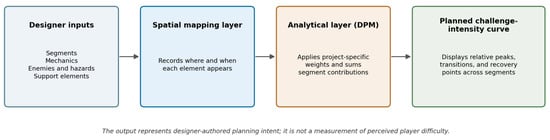
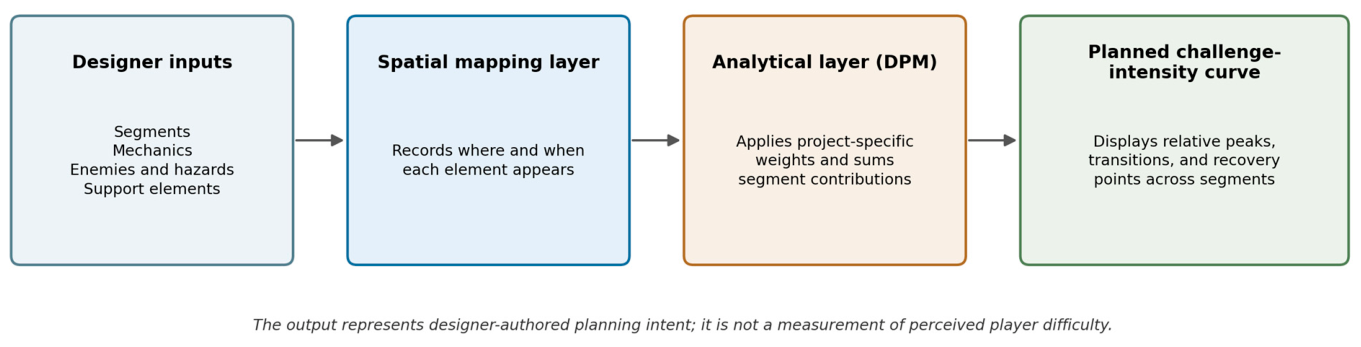
For each segment, the designer records mechanics, enemies, environmental hazards, timing demands, and support or recovery elements. The analytical layer combines the associated project-specific weights and displays the results as a progression curve. As illustrated in Figure 1, this workflow connects spatial mapping, weighted challenge estimation, and visual representation of the intended difficulty progression. Scores are interpreted comparatively within one project and should not be compared across projects without a shared calibration procedure.
Figure 1.
LDMT workflow. Designer-authored elements are organized by segment in the spatial mapping layer, combined with relative weights in the analytical layer, and plotted as a planned challenge-intensity curve. The curve represents design intent rather than observed player difficulty.
4.2. Core Components
The spreadsheet contains two connected layers:
Spatial mapping layer. This sheet records where mechanics, enemies, hazards, collectibles, checkpoints, and other elements occur. Columns or groups of columns can represent spatial units, while rows identify the element types used in the project.
Analytical layer. This sheet associates elements with designer-authored weights, aggregates the values assigned to each segment, and plots the resulting sequence. It provides a compact representation of assumptions that would otherwise remain distributed across sketches, notes, or engine scenes.
Each segment records the following core components:
- Segment identifier: the unique number or name of the analytical unit.
- Mechanics introduced or reinforced: abilities, systems, or interaction patterns addressed in the segment.
- Challenge factors: enemies, obstacles, spatial constraints, timing requirements, or combinations of these elements.
- Support and recovery elements: checkpoints, resources, cues, or lower-intensity spaces intended to reduce the planned demand.
- Contextual notes: terrain, narrative beats, visual landmarks, assumptions, and design rationale.
Conditional formatting and color labels can be used as optional visual conventions. Their usability or accessibility was not evaluated in this study, so they should be treated as configurable aids rather than validated interface features.
4.3. Planned Challenge-Intensity Scoring
The core output of the DPM is a relative, designer-authored planned challenge-intensity score. Positive weights indicate elements intended to increase the segment’s challenge, negative weights indicate support or recovery, and zero-valued elements are treated as neutral in the current configuration. Segment totals are additive and are not restricted to a 0–10 or 1–10 scale. The values used in Black Evasion are project-specific examples rather than validated defaults.
For a given segment, the score is calculated as C(j) = Σw(i)x(i,j), where w(i) is the designer-assigned weight for an element and x(i,j) is its presence, count, or configured contribution in that segment. The spreadsheet can therefore be recalibrated by changing the element library, the weights, or the way occurrences are counted.
Weight assignment may consider mechanical demand, timing precision, interaction with other elements, and the consequence of failure. These considerations provide a documented rationale for a value; they do not make the value objective or psychometric. Table 3 presents the designer-authored weights assigned to the gameplay elements in Black Evasion, illustrating how different challenges and support elements are represented within the LDMT.
Table 3.
Example designer-authored weights used in the Black Evasion illustration.
A designer may assign a smaller positive value to a short, low-consequence obstacle and a larger value to an element associated with stricter timing or a more costly failure. The Black Evasion values document the authors’ planning assumptions and can be changed by another designer or project.
The values in Table 4 explain why the graph is not bounded by 10 and why negative inputs can occur. For example, Segment 9 reaches 13 because the index is an additive project-relative total rather than a normalized rating scale.
Table 4.
Additive segment calculations for the Black Evasion worked example.
4.4. Planned Challenge Curve and Internal Responsiveness
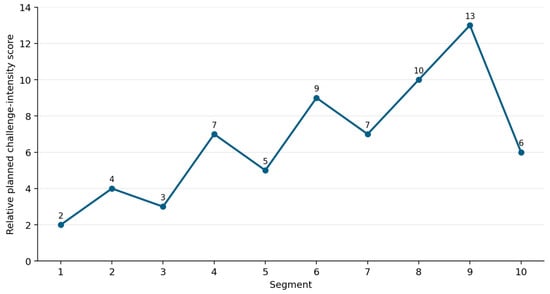
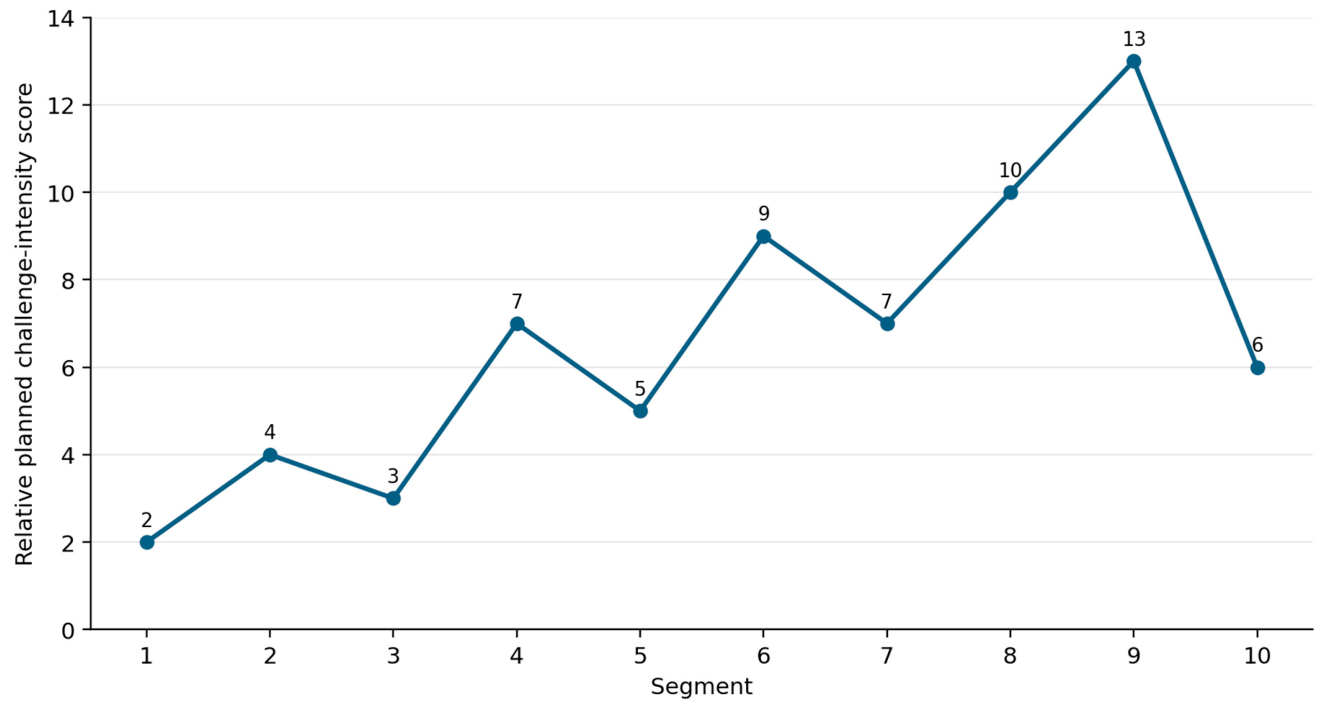
The LDMT does not prescribe a continuously increasing curve. Designers may instead represent intended alternation between higher-intensity segments and lower-intensity recovery points. In the Black Evasion illustration, the assigned values produce the sequence 2, 4, 3, 7, 5, 9, 7, 10, 13, and 6. This sequence is a direct visualization of the inputs in Table 4; it does not confirm flow, engagement, or perceived difficulty.
Lower-scored segments can be placed after planned peaks to represent recovery, exploration, or mechanic consolidation. As illustrated in Figure 2, the planned challenge-intensity curve for Black Evasion visualizes these variations across ten segments, allowing the designer to inspect whether the numerical representation matches the intended pacing rationale. However, only interactive evaluation can determine whether players experience the level in the intended way.
Figure 2.
Planned challenge-intensity curve for the ten Black Evasion segments. Values are derived from designer-assigned inputs and are not player observations or predictions of perceived difficulty.
To demonstrate internal responsiveness, Table 5 applies three transparent counterfactual changes to the same additive model. These calculations show how the output changes when an input changes; they do not evaluate whether the revised level would be better or more difficult for players.
Table 5.
Illustrative sensitivity checks using the Black Evasion weights.
Because the current model is additive, these changes are linear by construction. Interaction effects must be represented through additional variables, adjusted weights, or a future non-additive formulation.
4.5. Implementation and Integration
The current LDMT implementation is a modular spreadsheet template. Its implemented functions are:
- Segment-based spatial and analytical mapping;
- Editable element libraries and project-specific weights;
- Automatic aggregation of segment scores and curve plotting;
- Optional conditional formatting, color labels, and design notes.
Export to Unity or Godot, CSV/JSON pipelines, telemetry ingestion, automated balancing, and adaptive weighting are not part of the current implementation. They are proposed extensions. Although Black Evasion has a playable build, the build was not used to collect evidence for the present article.
4.6. Positioning and Transferability
The LDMT complements PCG, DDA, and AI co-creation by representing design-time intent in a human-readable form. It could potentially provide constraints for generators, a reference profile for adaptive systems, or structured requirements for an AI collaborator. These integrations were not implemented or tested and should therefore be read as conceptual future directions.
The segment abstraction may be adapted beyond platform games. Depending on the genre, a segment could represent a room, encounter, wave, puzzle, mission step, or narrative beat. However, each genre would require its own variables, weighting rationale, and validation procedure; transferability cannot be inferred from the single Black Evasion example.
At larger production scales, the spreadsheet could serve as documentation or a communication layer, but version control, multi-user workflows, and integration with existing pipelines would require additional development. The current contribution is therefore best understood as a transparent planning framework and research prototype.
5. Discussion
The worked application demonstrates that the LDMT can externalize authorial assumptions, aggregate project-specific weights, and produce a consistent visualization from the entered values. This is an internal demonstration of the artifact’s operation, not evidence that the tool improves pacing, usability, learning, collaboration, or design quality.
5.1. Methodological and Pedagogical Contribution
The principal methodological contribution is a low-barrier procedure for moving from qualitative design reasoning to an explicit segment-by-segment representation. The spreadsheet format makes the assumptions inspectable and editable: another designer can see which factors were included, how they were weighted, and how each segment total was produced.
This transparency may be useful in educational and small-team contexts because it provides a concrete object for discussing sequencing, escalation, and recovery before engine implementation. That pedagogical value remains a proposition rather than a finding, because students, instructors, and professional designers were not studied.
5.2. Limitations and External Validity
The evidence is limited to one game, one level, and the authors’ own use of the framework. There was no player study, telemetry, A/B comparison, expert review, independent designer assessment, or usability test. Inter-designer consistency is unknown, and the weights may reflect local design conventions rather than shared judgments.
A spreadsheet also cannot fully represent timing feel, camera behavior, animation feedback, control responsiveness, player strategy, accessibility needs, or emotional interpretation. Color coding and visual layout were not evaluated. Cross-genre and cross-cultural transfer therefore require separate investigation rather than extrapolation from this example.
5.3. Validation Priorities
The first priority is inter-designer reliability. Multiple designers should independently segment and score the same level material, after which agreement, disagreement, and the reasoning behind weight choices can be analyzed. This would clarify whether the framework supports shared communication or mainly records individual judgment.
The second priority is correspondence with observed play. Once a level is implemented, telemetry such as completion time, deaths, retries, and checkpoint use can be compared with player-reported challenge and the planned curve. Such a study should distinguish prediction, explanation, and post-hoc calibration rather than treating correlation as proof of causation.
A complementary educational study could compare design work completed with and without the LDMT, using predefined criteria and independent assessment. Engine integration and AI-assisted extensions are secondary priorities until the basic usability, reliability, and player correspondence of the planning framework are established.
6. Conclusions and Future Work
This article presented the Level Design Mapping Tool, a spreadsheet-based framework for representing intended challenge and pacing during early-stage level planning. Its methodological contribution is a transparent workflow that decomposes a level into segments, records challenge and support factors, applies designer-authored weights, and visualizes the resulting planned challenge-intensity profile.
The Black Evasion worked example demonstrates how the spreadsheet stores inputs, calculates additive segment totals, responds to input changes, and produces a curve. It does not validate player experience, usability, predictive accuracy, or the quality of the resulting level. LDMT scores should therefore be interpreted as project-relative design indices rather than objective measurements of difficulty.
Future work should prioritize two questions: whether different designers can use the framework consistently and whether planned profiles correspond meaningfully with telemetry and player-reported challenge. Until those questions are evaluated, the LDMT is best understood as a methodological and pedagogical planning aid that makes design intent explicit, revisable, and open to later empirical testing.
Author Contributions
Conceptualization, E.R. and G.C.; methodology, G.C.; software, E.R.; formal analysis, E.R. and G.C.; investigation, E.R. and G.C.; resources, E.R. and G.C.; writing—original draft preparation, E.R.; writing—review and editing, G.C.; visualization, E.R.; supervision, G.C.; project administration, G.C. All authors have read and agreed to the published version of the manuscript.
Funding
This research received no external funding.
Institutional Review Board Statement
Not applicable.
Informed Consent Statement
Not applicable.
Data Availability Statement
The materials supporting this framework-development study, including the spreadsheet prototype of the Level Design Mapping Tool (LDMT) and the Black Evasion level-design file, are available from the corresponding author upon reasonable request. A playable build of Black Evasion is publicly accessible at https://eulersonrodrigues.itch.io/black-evasion (accessed on 7 October 2026). The build is provided as implementation context; no player, telemetry, questionnaire, or expert-evaluation data were collected or analyzed in this study.
Acknowledgments
During the preparation and revision of this manuscript, the authors used OpenAI ChatGPT to assist with language refinement, text organization, and formatting. The authors reviewed and verified the AI-assisted content and take full responsibility for the final manuscript.
Conflicts of Interest
The authors declare no conflicts of interest.
Abbreviations
The following abbreviations are used in this manuscript:
| Abbreviation | Definition |
| LDMT | Level Design Mapping Tool |
| DPM | Difficulty Progression Model |
| MDA | Mechanics–Dynamics–Aesthetics |
| PCG | Procedural Content Generation |
| DDA | Dynamic Difficulty Adjustment |
| AI | Artificial Intelligence |
| LLM | Large Language Model |
| CSV | Comma-Separated Values |
| JSON | JavaScript Object Notation |
References
- Adams, E. Fundamentals of Game Design; Pearson Education: London, UK, 2014. [Google Scholar]
- Schell, J. The Art of Game Design: A Book of Lenses; CRC Press: Boca Raton, FL, USA, 2008. [Google Scholar]
- Hunicke, R.; LeBlanc, M.; Zubek, R. MDA: A formal approach to game design and game research. In Proceedings of the AAAI Workshop on Challenges in Game AI, San Jose, CA, USA, 25–26 July 2004; Volume 4, p. 1722. [Google Scholar]
- Csikszentmihalyi, M. Flow: The Psychology of Optimal Experience; Harper & Row: New York, NY, USA, 1990. [Google Scholar]
- Koster, R. A Theory of Fun for Game Design; O’Reilly Media: Sebastopol, CA, USA, 2013. [Google Scholar]
- Swink, S. Game Feel: A Game Designer’s Guide to Virtual Sensation; CRC Press: Boca Raton, FL, USA, 2008. [Google Scholar]
- Sylvester, T. Designing Games: A Guide to Engineering Experiences; O’Reilly Media: Sebastopol, CA, USA, 2013. [Google Scholar]
- Howard, J. Quests: Design, Theory, and History in Games and Narratives; AK Peters/CRC Press: Natick, MA, USA, 2022. [Google Scholar]
- Andersen, E.; O’rourke, E.; Liu, Y.E.; Snider, R.; Lowdermilk, J.; Truong, D.; Cooper, S.; Popovic, Z. The impact of tutorials on games of varying complexity. In Proceedings of the SIGCHI Conference on Human Factors in Computing Systems, Austin, TX, USA, 5–10 May 2012; pp. 59–68. [Google Scholar] [CrossRef] [Scilit]
- Cao, S.; Liu, F. Learning to play: Understanding in-game tutorials with a pilot study on implicit tutorials. Heliyon 2022, 8, e11482. [Google Scholar] [CrossRef] [Scilit]
- Green, M.; Khalifa, A.; Barros, G.; Togelius, J. “Press Space to Fire”: Automatic Video Game Tutorial Generation. Proc. AAAI Conf. Artif. Intell. Interact. Digit. Entertain. 2021, 13, 75–80. [Google Scholar] [CrossRef] [Scilit]
- So, A.R.P.; Souza, A.C.C.; Costa, L.M.; Mantovani, R.G.; Souza, F.C.M. Design and Evaluation of a Procedurally Generated Dungeon Game. In Simpósio Brasileiro de Jogos e Entretenimento Digital (SBGames); Sociedade Brasileira de Computação (SBC): Porto Alegre, RS, Brazil, 2024; pp. 329–339. [Google Scholar] [CrossRef] [Scilit]
- Hojatoleslami, M.R.; Zamanifar, K.; Zojaji, Z. GFGDA: General Framework for Generating Dungeons with Atmosphere. Multimed. Tools Appl. 2024, 83, 83275–83309. [Google Scholar] [CrossRef] [Scilit]
- Setiawan, A.; Andoko, W.; Abidin, Z. Dynamic 2D Dungeon Game Level: A Synergistic Approach with Binary Space Partitioning and Genetic Algorithm. In 2025 International Conference on Smart Computing, IoT and Machine Learning (SIML); IEEE: Piscataway, NJ, USA, 2025; pp. 1–6. [Google Scholar] [CrossRef] [Scilit]
- Wattanapornprom, W.; Santichavalit, J.; Pakdee, A.; Ruamngoen, W.; Rodkaew, Y.; Susutti, W. Revolutionizing Tower Defense: Automating Game Level Design with Rogue-lite Integration. In 2024 28th International Computer Science and Engineering Conference (ICSEC); IEEE: Piscataway, NJ, USA, 2024; pp. 1–6. [Google Scholar] [CrossRef] [Scilit]
- Anjum, A.; Li, Y.; Law, N.; Charity, M.; Togelius, J. The Ink Splotch Effect: A Case Study on ChatGPT as a Co-Creative Game Designer. In Proceedings of the 19th International Conference on the Foundations of Digital Games, Worcester, MA, USA, 21–24 May 2024; pp. 1–15. [Google Scholar] [CrossRef] [Scilit]
- Ratican, J.; Hutson, J. Adaptive worlds: Generative AI in game design and future of gaming, and interactive media. ISRG J. Arts Humanit. Soc. Sci. 2024, 2, 284–290. [Google Scholar] [CrossRef]
- Fisher, N.; Kulshreshth, A.K. Exploring Dynamic Difficulty Adjustment Methods for Video Games. Virtual Worlds 2024, 3, 230–255. [Google Scholar] [CrossRef] [Scilit]
- Mortazavi, F.; Moradi, H.; Vahabie, A.H. Dynamic Difficulty Adjustment Approaches in Video Games: A Systematic Literature Review. Multimed. Tools Appl. 2024, 83, 83227–83274. [Google Scholar] [CrossRef] [Scilit]
- Team Cherry. Hollow Knight [Video Game]; Team Cherry: Adelaide, SA, Australia, 2017. [Google Scholar]
- Matt Makes Games. Celeste [Video Game]; Matt Makes Games: Vancouver, BC, Canada, 2018. [Google Scholar]
- Team Meat. Super Meat Boy [Video Game]; Team Meat: Toronto, ON, Canada, 2010. [Google Scholar]

Disclaimer/Publisher’s Note: The statements, opinions and data contained in all publications are solely those of the individual author(s) and contributor(s) and not of MDPI and/or the editor(s). MDPI and/or the editor(s) disclaim responsibility for any injury to people or property resulting from any ideas, methods, instructions or products referred to in the content. |
© 2026 by the authors. Licensee MDPI, Basel, Switzerland. This article is an open access article distributed under the terms and conditions of the Creative Commons Attribution (CC BY) license.