


Abstract
Phenol–resorcinol–formaldehyde (PRF) is a cold-setting wood adhesive whose cured form is intrinsically brittle and whose bonding effectiveness deteriorates with storage age due to the loss of reactive methylol groups. This study investigated the potential of nanocellulose (NC) reinforcement to enhance toughness and offset aging-related losses. Before the hardener was added, three NC types—cellulose nanocrystals (CNC) and bleached and unbleached cellulose nanofibers (BNF, UBNF)—were homogenized into fresh (NP) and 4-year-aged (OP) PRF resin at one and three weight percent. The resin was then cast and gradually post-cured. Differential scanning calorimetry and rheometry were used to track curing activity, and flexural characteristics were assessed on cured specimens. The inclusion of NC increased the temperature at which gelation began, prolonging the working time of the resin. In comparison to neat PRF, CNF (BNF/UBNF) integration enhanced flexural strength by up to 39%, while CNC addition increased flexural modulus by up to 57%. Fibril aggregation was responsible for the 12–20% decrease in BNF/UBNF strength at three weight percent loading. Aged PRF was regularly outperformed by fresh PRF composites. These findings support the use of NC reinforcement in wood–PRF composites for extrusion-based additive manufacturing by demonstrating that it can toughen PRF and restore characteristics lost due to resin aging.
1. Introduction
The increasing concern about the environmental impact of fossil-based, non-renewable materials has sparked interest in sustainable, bio-based alternatives. As the most prevalent natural polymer on Earth, cellulose stands out among the numerous bio-based polymers being investigated to replace products derived from petroleum.
Cellulose is an alluring choice because of its attributes (abundance, renewable, biodegradable, low toxicity, and high strength) and modifiable surface chemistry. It is biosynthesized from plants, algae, tunicates, and bacteria [1,2,3,4,5]. Cellulose fibers in composites impart low density and good mechanical properties; however, they have poor interfacial adhesion with non-polar matrices and, due to moisture uptake, can compromise dimensional stability and durability [6,7]. To address these shortcomings, surface modification and compatibilizers have been studied to enhance fiber–matrix compatibility and reduce hydrophilicity [8]. Recently, the isolation of nanocellulose (NC)—including cellulose nanofibrils (CNF) and cellulose nanocrystals (CNC)—has created new opportunities for the expansion of green composites.
NC is a cellulose-derived nanoscale fiber with one dimension < 100 nm, which is valued for its high strength [9]. It is commonly categorized into CNC, CNF, and bacterial nanocellulose (BNC), which is microbially biosynthesized and very pure [10]. CNCs are generally a few nanometers in width and 10–500 nm in length, whereas CNFs are 3–50 nm in width and micrometers in length [11,12]. NC has a high Young’s modulus (110–220 GPa), tensile strength (7.5–7.7 GPa), large surface area, and easy surface modification, making it a suitable reinforcement for composites in various applications [13,14,15,16].
CNFs are produced through fibrillation using wood pulps. Bleaching of the pulp increases purity and brightness, resulting in fibers with minimal chromophoric content, which is desirable for applications needing optical clarity [17]. Unbleached pulp contains residual lignin and is brown in color [18]. Solala et al. [19] has shown that residual lignin can affect fibrillation, surface hydrophobicity, colloidal stability, and compatibility with non-polar matrices, offering avenues to tune interfacial properties in composite systems.
Cold-curing thermoset adhesives in composite products offer reduced energy requirements, ease of application, and lower operational costs than hot-setting systems [20]. Resorcinol–formaldehyde (RF) resin is a durable, structural, water-resistant, and cold-setting resin [21,22]. However, the cost of resorcinol has steered the use of phenol–resorcinol–formaldehyde (PRF) resins, in which low-cost phenol partially replaces resorcinol to compensate for performance and economic viability. PRF resins are used in laminated lumber products, including glulam beams, due to their high bond strength, resistance to weather, and long-term structural dependability [23,24].
Incorporation of NC in thermosetting resins (e.g., epoxy) has resulted in improved material performance [25]. Refs. [26,27] showed that CNC addition to urea-formaldehyde resin improved apparent crosslinking density and enhanced attributes of plywood. The reinforcement effect of NC has been credited to improved stress transfer, confined polymer chain agility, and hydrogen bonding with the resin network. Ref. [28] reported that furfural-based resin containing CNC enhanced both the tensile and flexural strength, showing the ability of NC to act as a nano-reinforcement. Moreover, epoxy-based composites reinforced with 2% hemp NC were shown to significantly improve tensile, flexural, and impact strengths and hardness [29]. Low levels of CNF (0.5–1.5%) in epoxy composites doubled the impact strength and enhanced the critical stress intensity factor [30]. Another investigation examines the influence of using CNFs from bleached and unbleached pulps in an epoxy resin [25]. Therefore, NC will likely serve as an effective reinforcing agent in PRF resins. The high aspect ratio and surface functionality of NC can also improve 3-dimensional (3D) printed structures by controlling resin viscosity, shape retention, and print quality [31]. The use of NC-reinforced thermoset systems has advanced; however, crucial gaps in implementation need to be filled. No study has examined different types of NC (CNC, BNF, and UBNF) within the cold-setting PRF. Some studies have evaluated CNC or CNF in isolation using UF or PF resins [26,27,32]. Neither the relationship between resin age and NC reinforcement efficacy within a PRF network, rather than a filler, has been investigated [33,34]. Also, lignin’s function in PF and UF curing is well known during hot pressing [22,33]; this study fills a gap by examining whether residual lignin on UBNF influences PRF reactivity. Finally, fresh (NP) and aged (OP) PRF resins were included to mimic industrial settings where resins are often kept beyond their allowable expiration.
In order to ascertain whether NC reinforcement could counteract the reactivity and performance losses linked to resin aging, the purpose of this study was to examine the effects of nanocellulose type (CNC, BNF, and UBNF) and content (1 and 3%) on the curing behavior, rheology, and mechanical properties of phenol–resorcinol–formaldehyde resin.
2. Materials and Methods
2.1. Materials
CNCs were sourced from Dr. Nicole Stark (Forest Products Laboratory, Madison, WI, USA). Fresh PRF resin (NP) and aged (4 years) PRF (OP) were Cascophen 4001-8 and hardener/catalyst (Cascoset 5830 E), supplied by Hexion (Columbus, OH, USA), and utilized at a resin-to-hardener weight ratio of 2.5:1. Deionized water was used in all experiments. CNF was prepared according to [35]. Briefly, bleached and unbleached softwood kraft pulps were sourced from a kraft pulp mill in Alabama, USA. The pulps were washed with (i) 0.1 M HCl until pH 3, (ii) water until pH 5, (iii) 0.1 M NaOH until pH 9, and (iv) washed thoroughly with water until <5 µS/cm conductivity was obtained [36]. Pulp suspensions of 2 wt.% consistency were prepared and fibrillated using a Masuko Supermasscolloider (MKZA-10-15 J) refiner (Kawaguchi, Japan). The fibrillated NC suspensions had a gel-like consistency and were stored at 5 °C. The BCNF and UBCNF suspensions were freeze-dried (Labconco Freezone 4.5, Kansas City, MO, USA) and (i) Wiley-milled (<2 mm) and (ii) disentangled in a Vivitek planetary ball mill (Fremont, CA, USA) for 6 h at 1000 rpm, using 50 mL zirconia jars and 5 mm Ø zirconia beads to obtain BNF and UBNF, respectively.
2.2. Characterization of Nanocellulose
The density of the NCs was determined on a Quantachrome Ultra Pycnometer 1000 (Boynton Beach, FL, USA).
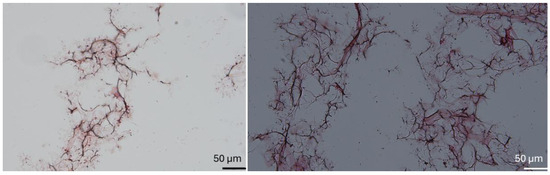
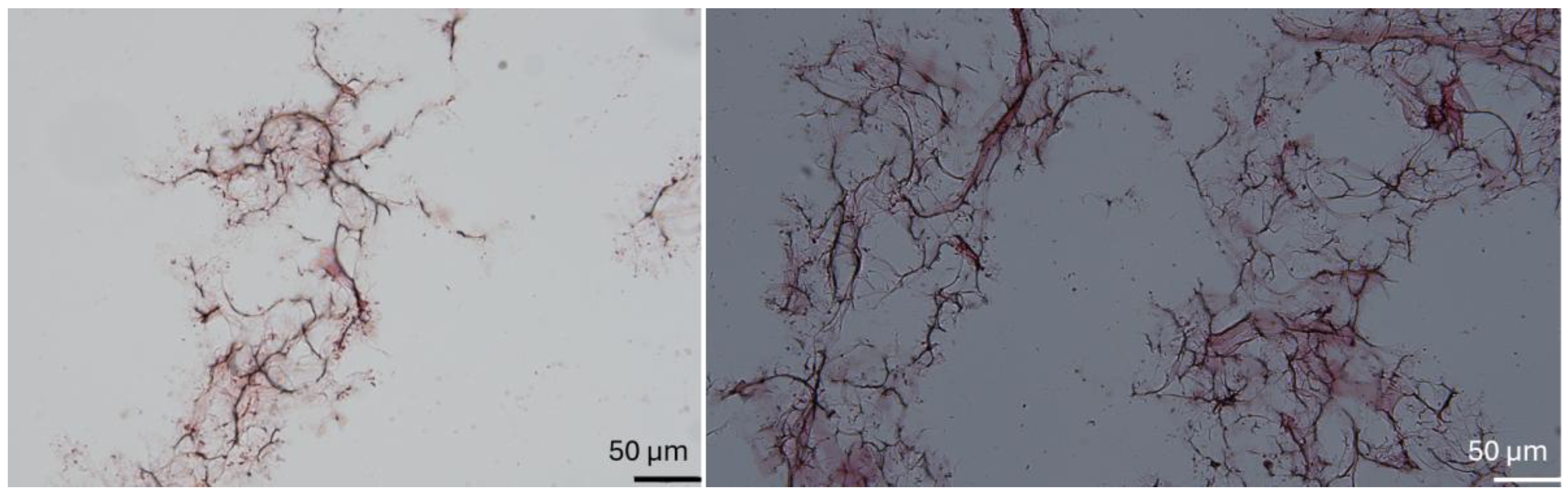
The morphology of the CNF was determined by optical microscopy (Olympus BX53, Center Valley, PA, USA) at 20× magnification. A drop of 1% CNF suspension was placed on a slide and stained with safranin. The optical micrographs were analyzed for width with the Olympus Cell Standard V4.1.1 software (Center Valley, PA, USA).
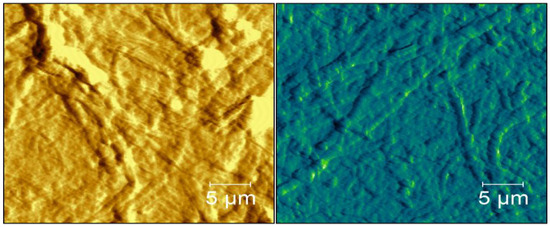
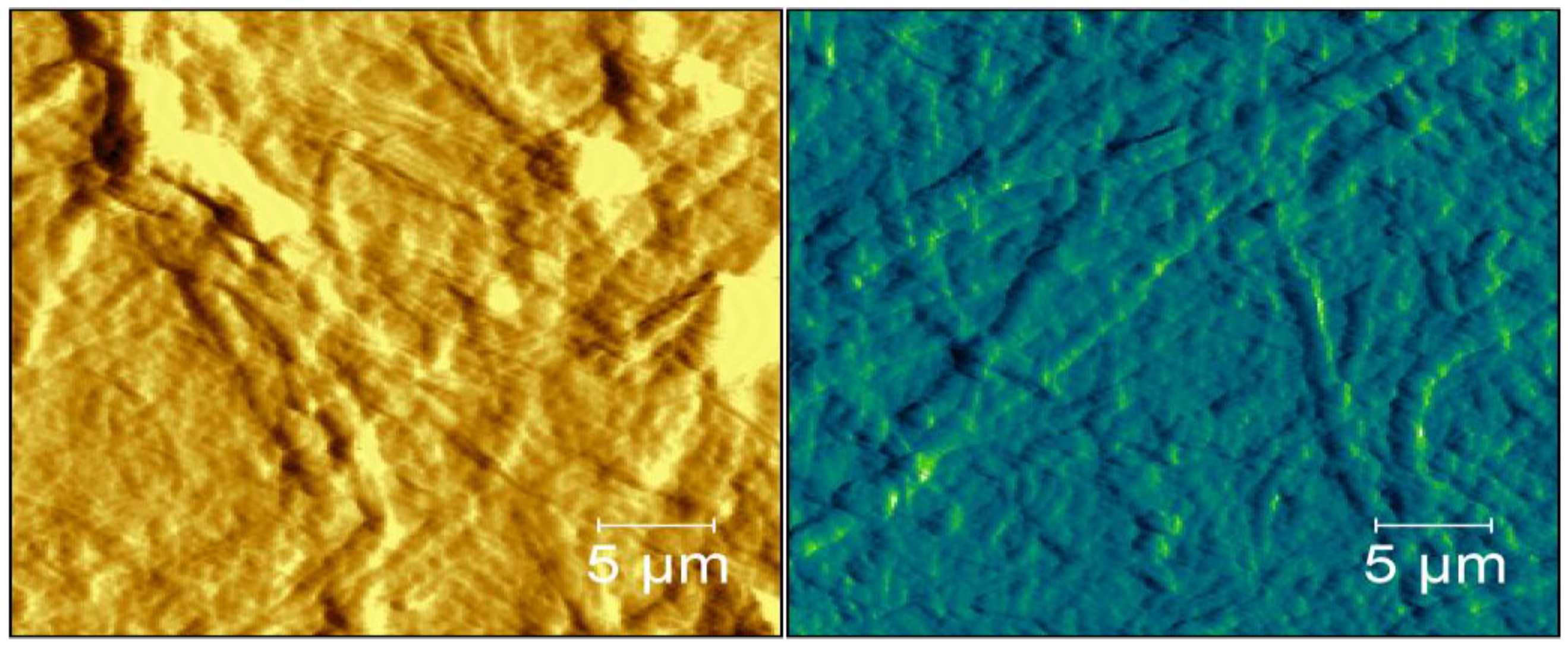
Atomic force microscopy (AFM) in contact mode was performed on a B2 AFM Workshop unit (Hilton Head Island, SC, USA) to examine the NC samples. Scans were 30 µm × 30 µm using an AFM Workshop probe model ACLA-10. A drop of 1% NC suspension was placed on a mica disk (15 mm Ø) and air-dried prior to AFM imaging. Fiber diameters were determined using Gwyddion v2.58 software on 10 fibers in three different images per sample.
Scanning electron microscopy (SEM) was employed using a Zeiss Leo Gemini (Dublin, CA, USA) field emission SEM operating at 5–10 kV on gold-coated CNF samples.
X-Ray diffraction (XRD) analysis (Siemens D5000 diffractometer, Billerica, MA, USA) for cellulose crystallinity index (CI) on NC samples using Cu Kα radiation (λ = 0.154 nm) from 2θ = 5° to 40° at 0.05° increments was performed. The diffractograms were fitted with Gaussian peaks (deconvolution) to the amorphous and crystalline regions using IgorPro V8.04 software (WaveMetrics Inc., Portland, OR, USA). The CI based on the area of the amorphous and crystalline [(101), (002), and (040)] regions was determined according to [37]. The crystallite grain size (L) was determined using the Scherrer Equation (1) of the cellulose (002) peak.
where k is the crystal shape factor (0.91), λ is 0.154 nm, β is the full width at half maximum (FWHM), θ is 0.5 of the Bragg angle corresponding to the (200) plane, and a conversion factor of 57.3 for θ to radians is applied [37].
Fourier transform infrared (FTIR) spectra were acquired on an iS5 FTIR spectrometer (ThermoNicolet, Madison, WI, USA) using an iD5 ZnSe attenuated total reflection unit in triplicate. Spectra were processed using the OMNIC v9.8 software.
2.3. PRF-Nanocellulose Composites
Dry BNF, UBNF, and CNC (0.15 g or 0.45 g) were each homogenized with PRF resin (15 g) in alumina jars (100 mL) containing 5 mm Ø beads to obtain concentrations of 1% and 3% on a weight basis. Homogenization was performed at 1200 rpm for 3 h, and then the hardener was added and manually stirred. The mixture was poured into silicone molds (80 × 55 × 23 mm3), and triplicate samples were made. A control PRF plus hardener sample was also prepared in triplicate. A polytetrafluoroethylene (PTFE) sheet was placed on top of the sample mixture together with a 500 g weight, and the sample was left to gel at 21 °C for 2–4 d. The gelled sample was removed from the mold, then sandwiched between wire mesh (40 #) with a 500 g weight placed on top to allow moisture discharge, and incrementally heated to 40 °C for 24 h, 60 °C for 24 h, 80 °C for 24 h, and 105 °C until constant weight. The slow curing regime was successful in preventing sample cracking. The formulations used and their code names are given in Table 1.
Table 1.
A list of PRF-NC formulations and code names.
2.4. Resin and Composite Characterization
Negative ion electrospray ionization-mass spectrometry (ESI-MS) was performed on a LCQdeca (ThermoQuest, San Jose, CA, USA) instrument according to [38] to determine the average molar mass distribution of the two PRF resins. PRF resin (1 mg/mL) was dissolved in a methanol-water (67:33) mixture and introduced (10 µL/min) into the ESI-MS. Rheometry was performed on a Discovery Hybrid Rheometer (DHR2, TA Instruments, New Castle, DE, USA) resin samples containing hardener (see 2.4) to determine their curing behavior and rheological properties (complex viscosity (η*) and Tan δ) between 25 mm Ø plates and a 1 mm gap. Curing behavior was assessed using a temperature ramp (30 °C to 200 °C at 2 °C/min) with 0.05% strain at 1 Hz. The resin flow behavior was assessed using a frequency sweep (0.01 to 100 Hz) at 30 °C and 0.05% strain. The curing behavior of the resin-containing samples plus hardener (5–6 mg) was assessed by differential scanning calorimetry (DSC) on a Q200 DSC (TA Instruments, New Castle, DE, USA) unit.
The PRF-NC and hardener blends were freeze-dried prior to modulated DSC analysis. The samples (5 mg), in duplicate, were weighed into Tzero hermetically sealed pan/lids and ramped from 40 °C to 250 °C at 5, 10, or 15 °C/min. TA Universal Analysis V 4.5.5 software was used for data analysis. Kinetic parameters were determined using the Kissinger–Akahira–Sunose (KAS) (isoconversional) and Crane methods [39,40]. The enthalpy (ΔH) of curing was calculated from the area under the exotherm curve using the Kissinger Equation (2). The reaction order (n) was calculated using the Crane Equation (3):
where Tp is the peak temperature, R is the gas constant (8.314 J/mol/K), A is the pre-exponential factor (1/s), β is the heating rate (K/min), and Ea is the activation energy (J/mol). Plotting −ln(β/T) vs. 1/Tp2 was used to calculate Ea. The plot’s intercept was used to determine A. The Crane equation was used to obtain the reaction order (n). The Ea at each conversion degree (α) was determined using the KAS Equation (4), where T is the temperature in K at a specific α.
Three-point bending tests were performed on the cured composite samples (3 samples per formulation and five specimens (55 mm length × 12 mm width × 2.8 mm thickness) per sample). Tests were done on a Mecmesin MultiTest-dV 2.5 testing machine with a 45 mm span, 2.5 kN load cell, and 1.1 mm/min crosshead speed, following ASTM D790 [41]. Vector Pro v6.11 software was used to acquire and analyze data.
Dynamic mechanical analysis (DMA) was used to determine the viscoelastic properties of the cured samples (3.0 × 3.5 × 17 mm3), in triplicate, using a Perkin Elmer DMA-7 (Shelton, CT, USA) instrument in 3-point bending mode from 0 °C to 270 °C at 3 °C/min with a 15 mm span, 0.1% strain, and a frequency of 1 Hz. Pyris v13.3.1 software was used to analyze the data.
2.5. Statistical Analysis
A one-way ANOVA test (Microsoft 365 Excel) for individual flexural test results was evaluated with a significance level of α = 0.05. For pairwise mean comparison, Tukey’s HSD post hoc test was used.
3. Results and Discussion
3.1. Characterization of Nanocellulose
The NC samples were characterized by their physicochemical properties. Densities of 1.65 g/cm3, 1.37 g/cm3, and 1.58 g/cm3 were obtained for CNC, UBNF, and BNF, respectively. These densities are comparable with the literature for crystalline cellulose, between 1.60 and 1.63 g/cm3 [42]. The low density observed for UBNF can be associated with the presence of amorphous residual lignin and hemicelluloses. The residual lignin may contribute to a reduction in density in lignin-containing NC [43].
Optical micrographs of UBNF and BNF (Figure 1) show a highly fibrillated structure common to mechanically refined NF. The NF morphology was similar to a previous report [44]. The average fibril diameters were estimated at 0.81 µm for UBNF and 0.78 µm for BCNF. These values were significantly larger than nanoscale dimensions commonly reported for mechanically treated bleached CNF, suggesting partial defibrillation of the cellulose fibers during generation. Ref. [45] reported diameters of 43 ± 17 nm for bleached ball-milled fibers and 80 ± 16 nm for bleached shredded fibers. The discrepancy is likely due to different fibrillation processes, extent of refinement, and optical microscopy limitations. The CNCs were not visible by optical microscopy, as their size is below the diffraction limit of ~200 nm. Transmission electron microscopy (TEM) or atomic force microscopy (AFM) are generally used for characterization of CNCs.
Figure 1.
Optical micrographs of safranin-stained UBNF (left) and BNF (right) at 20× magnification. Scale bar = 50 µm.
The structure of the CNF and CNC were examined by AFM [46]. AFM clearly shows nanofiber structures for BNF and UBNF (Figure 2). UBNF and BNF were shown to have average fibril widths of 609 ± 364 nm and 556 ± 200 nm, respectively. Individual CNCs were not successfully observed by AFM.
Figure 2.
AFM micrographs of UBNF (left) and BNF (right).
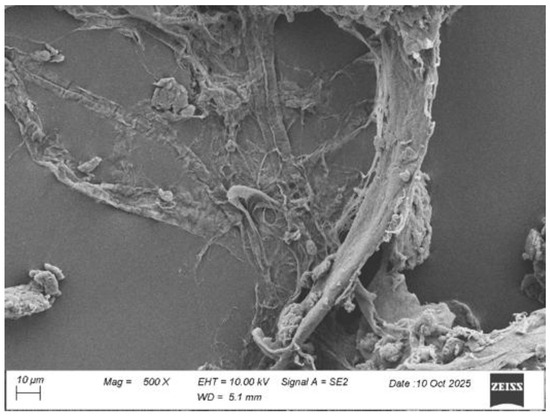
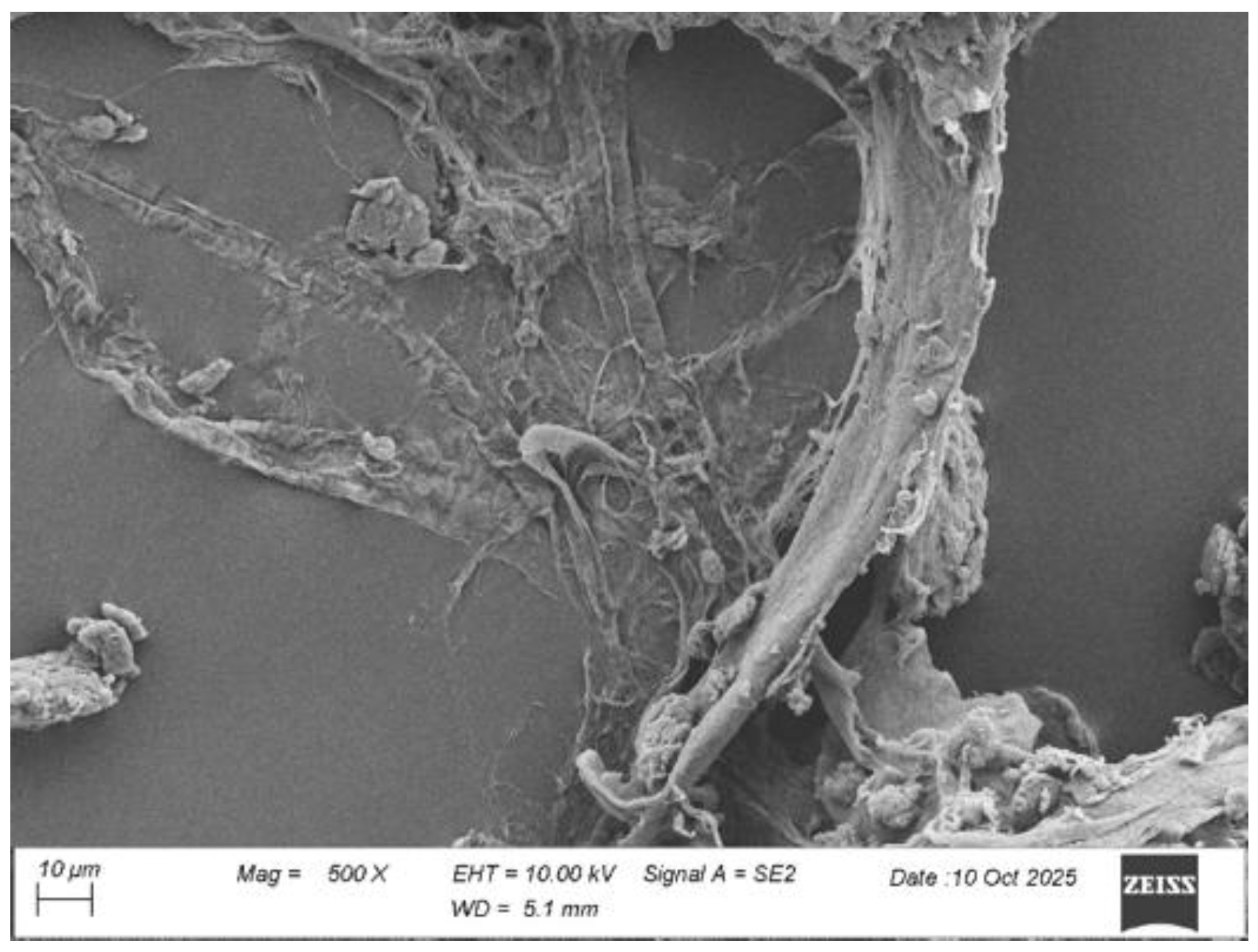
SEM showed a highly fibrillated, web-like network with tiny fibrils intermeshed with larger fiber fragments for BNF (Figure 3). The appearance of BNF and UBNF was alike. SEM of CNC showed clusters of particles, and no individual CNC whiskers were visible at high magnification.
Figure 3.
SEM micrograph of BNF.
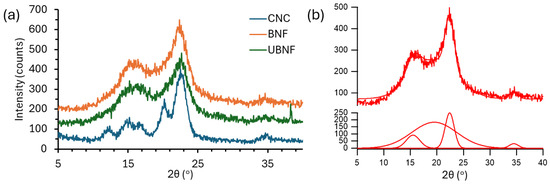
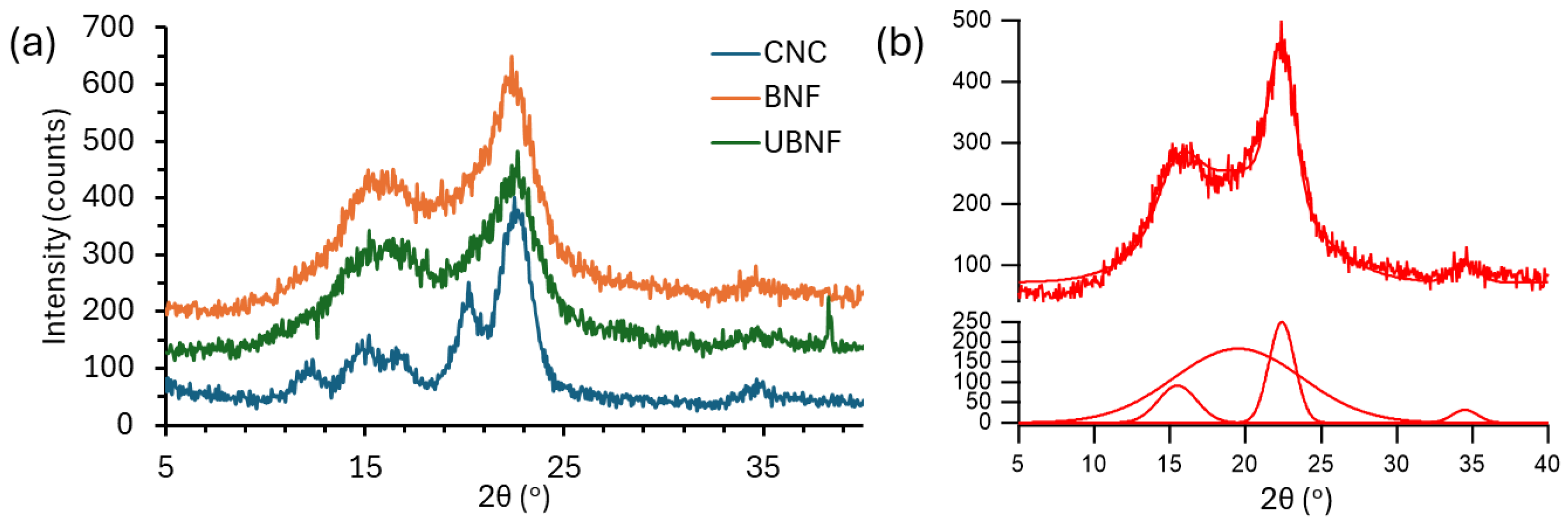
The CI and crystallite size on the NC samples were determined by XRD (Figure 4a). Three peaks at 15.6°, 22.5°, and 34.2° were assigned to (101 and 10Ȋ), (002), and (040) cellulose I crystal planes, respectively, for BNF and UBNF. CNC showed four peaks (14.8°, 16.6°, 22.6°, and 34.5°) assigned to cellulose I and two peaks (12.2° and 20.2°) assigned to cellulose II. This mix of cellulose I and II crystal structures has also been observed in CNC [47]. The production of CNC uses alkali and acid treatments which are likely to form some cellulose II. The CI was determined after Gaussian peak fitting of the amorphous background and crystalline peaks (Figure 4b). A CI of 32% was found for UBNF, while BNF was higher at 38%, which is due to the removal of residual lignin and hemicellulose during bleaching. Ref. [47] reported a CI of 39%, while ref. [35] reported a CI of 40% for bleached kraft CNF. CNC had the highest CI at 70%, while ref. [47] reported a higher CI of 95%. The crystal size (L) of cellulose was 4.9 nm, 4.1 nm, and 3.5 nm for CNC, BNF, and UBNF, respectively. The crystallite size was slightly larger (3.8 nm for CNC and 2.9 nm for bleached CNF) than that reported by [47].
Figure 4.
(a) X-ray diffractograms of CNC, BNF and UBNF and (b) X-ray diffractogram showing peak fitting of BNF.
3.2. Resin Characterization
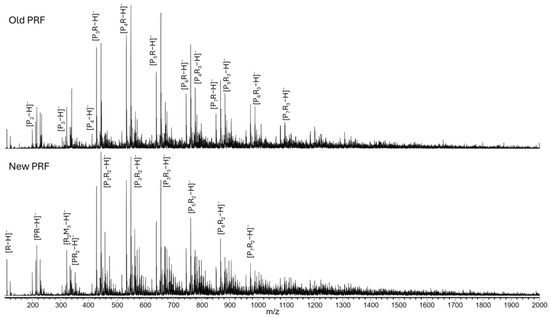
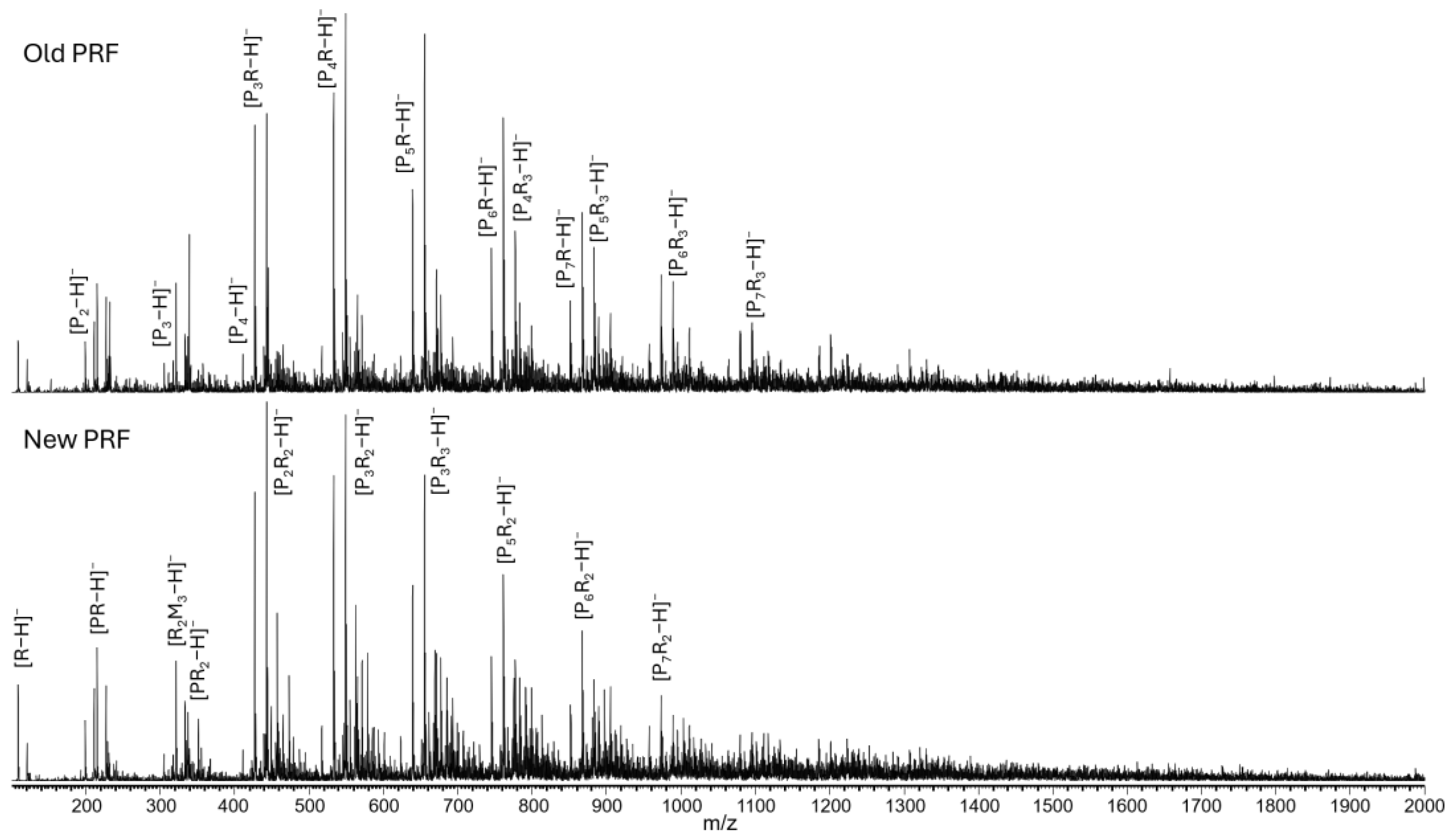
The oligomeric profiles between the OP and NP resins (with no hardener) were analyzed by negative ion ESI-MS (Figure 5). The number-average molar mass (Mn) for OP and NP resins was similar at 915 and 932 g/mol, respectively. The weight-average molar mass (Mw) for OP and NP was, respectively, 1095 and 1109 g/mol. The ESI-MS of the resins was similar and showed major [M-H]− peaks, and tentative assignments based on m/z are given in Table 2. OP and NP had oligomers up to a degree of polymerization of 10. The oligomers had methylene (–CH2–) bridges between the aromatic units [38,48].
Figure 5.
Negative ion ESI-MS of NP (bottom) and OP (top) PRF resins.
Table 2.
A list of major deprotonated molecular ions ([M-H]−) determined by ESI-MS and their tentative structural assignments based on phenolic (P) and resorcinolic (R) oligomer composition, including methylol (M) substituents as shown.
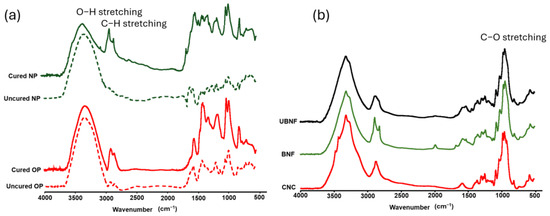
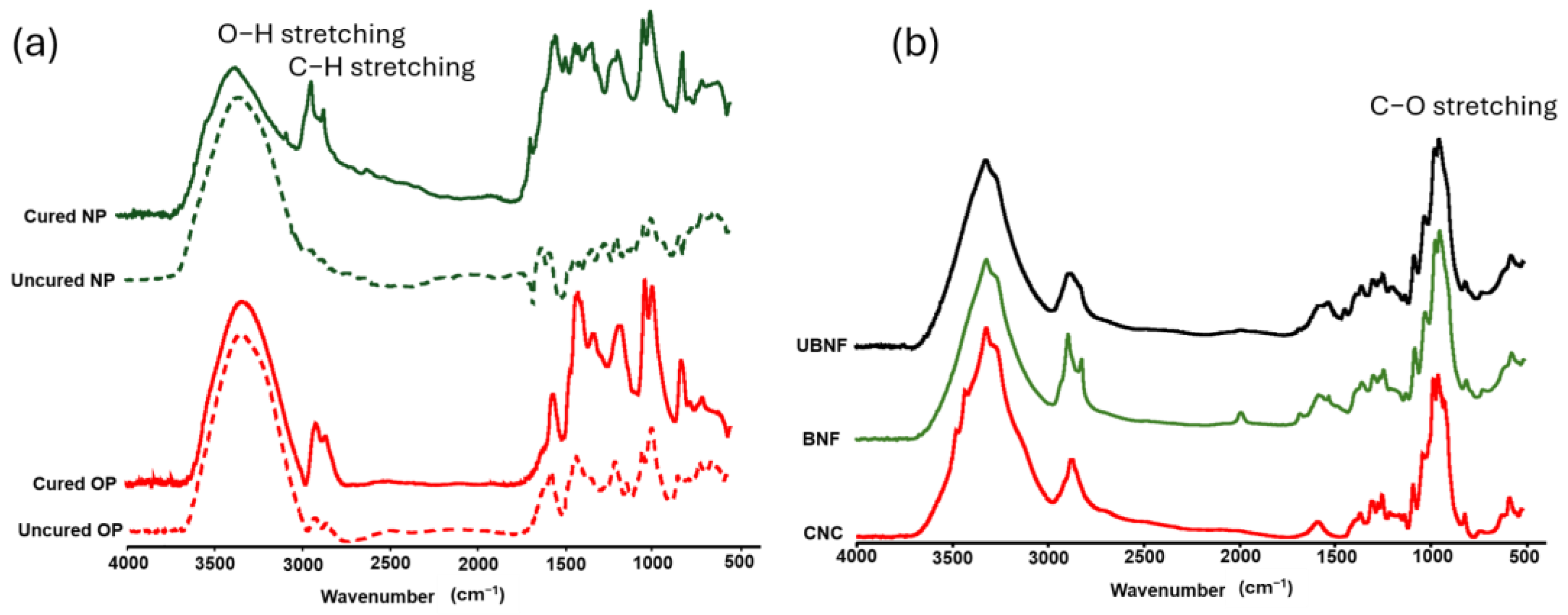
PRF resins during curing undergo a condensation reaction, and this can be monitored by FTIR spectroscopy. Functional groups involved in the condensation reaction were identified in the spectra of the uncured liquid and cured solid (Figure 6a). A decrease in band intensity indicates consumption of reactive species, while an increase in band intensity corresponds to methylene (–CH2–) and methylene ether (–CH2–O–CH2–) linkage formation of cured PRF resins [49]. The major spectral bands and chemical bonds observed were (i) a wide band about 3400 cm−1 (O–H stretching of aliphatic and phenolic hydroxyl groups [50]; (ii) The 2920–2850 cm−1 band (C–H stretching of –CH2– and methyl (–CH3–) units); (iii) 1600 and 1500 cm−1 bands (aromatic C=C ring skeletal vibrations); (iv) 1040–1020 cm−1 band (C–O–C stretching of ether bridges); and (iv) 870–750 cm−1 bands (out-of-plane C–H bending and substituted benzene). During PRF curing, the OH band (~3400 cm−1) intensity decreased in both resins, indicating that phenolic and methylol groups were being consumed during the condensation reaction. The cured PRF samples showed an increase in the –CH2– band (~2920 cm−1) intensity, supporting the formation of methylene bridges. A reduction in the C–O–C ether band (~1040 cm−1) was observed, supporting that the methylol groups were converted to methylene bridges. As curing progresses, the aromatic region (1600–1500 cm−1) becomes sharper, which supports polymerization occurring.
Figure 6.
FTIR spectra of (a) neat and cured NP and OP PRF and (b) CNC, BNF and UBNF.
The spectra of CNC, BNF, and UBNF (Figure 6b) show variations due to preparation differences. All NCs exhibit a broad O-H stretching band (3300–3400 cm−1) assigned to hydroxyl groups. The C–H stretching band (2900 cm−1) was assigned to cellulose alkyl units and was similar between the three NCs. The IR fingerprint region (1200–900 cm−1) showed characteristic cellulose bands: (i) 1030 cm−1 (C–O–C stretching) was strongest in CNC (associated with crystallinity), fairly resolved in BNF, and widened in UBNF; (ii) 1160 cm−1 (C–O–C asymmetric bridging) prominent in the three NCs; and (iii) UBNF only showed lignin associated bands at 1605 and 1505 cm−1 (C=C aromatic skeletal vibrations) and 1265 cm−1 (C–O stretching of guaiacyl unit). These results were consistent with findings from [51].
3.2.1. Flow Behavior of PRF Resin and PRF-NC Blends
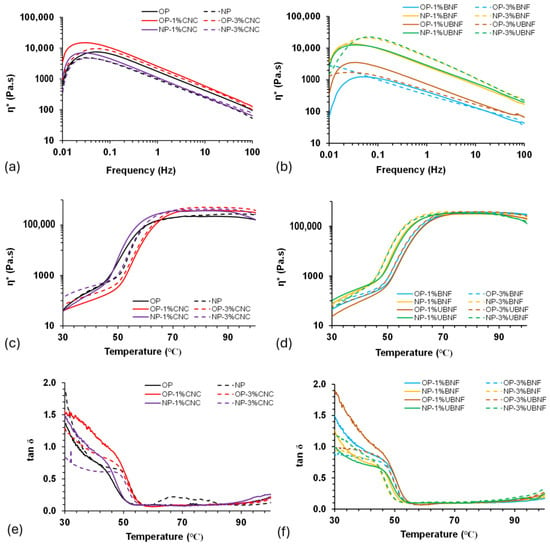
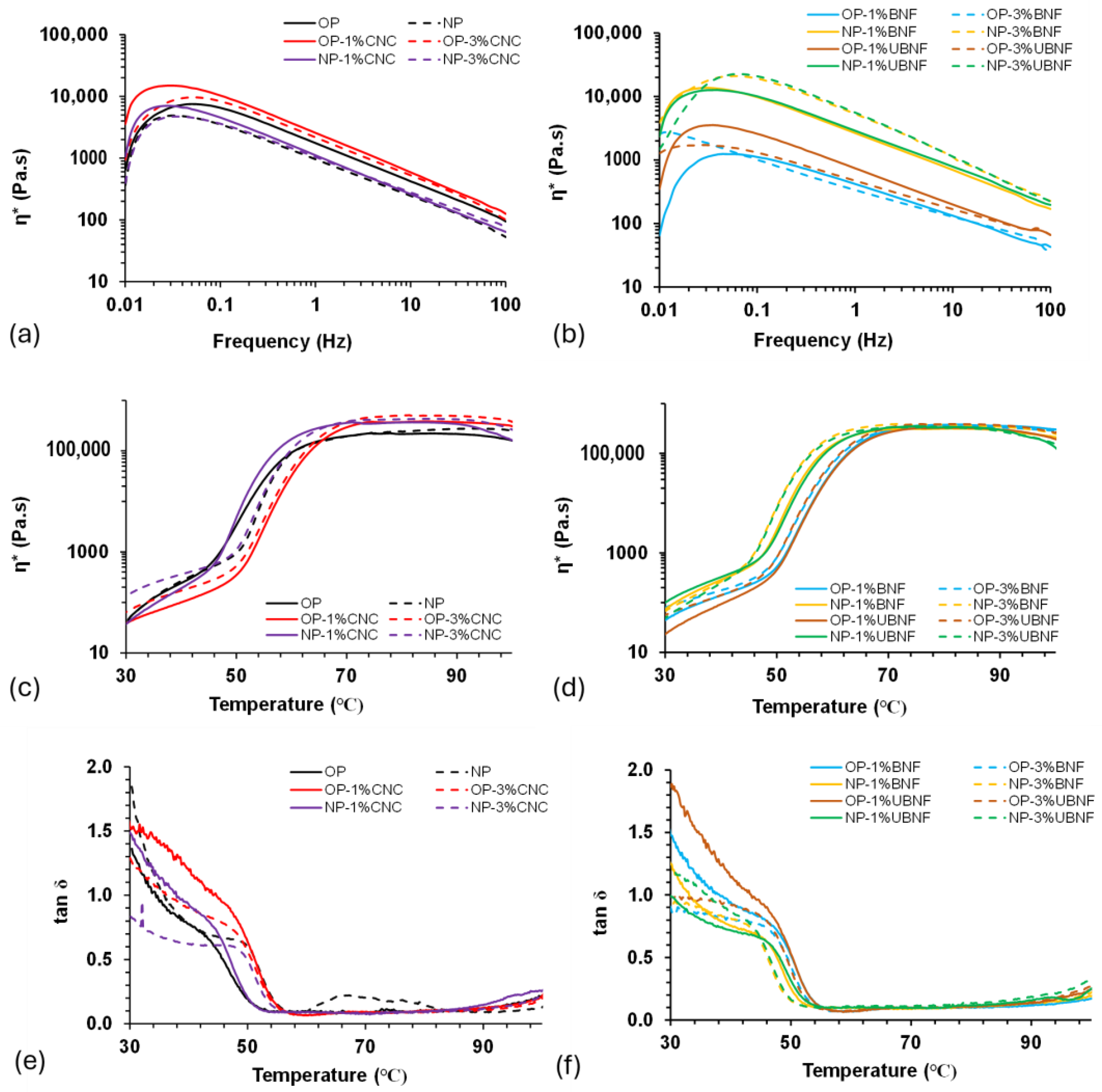
Rheology was used to determine the flow curves (complex viscosity (η*) vs. frequency) of PRF and PRF-NC blends (Figure 7a,b). Linear non-Newtonian behavior was observed >0.1 Hz but deviated at the lower frequencies (<0.1 Hz) for all formulations. The η* at 1 Hz was used to compare formulations (Table 3). Low η* values at 1.7 and 0.9 kPa·s, were respectively observed for OP and NP resins. The rod-shaped CNC crystals have a large surface area, a tendency to hydrogen bond, and can increase solution viscosity even at low concentrations. 1% CNC addition to PRF increased the η* to 2.5 kPa·s. While at 3% CNC, the η* was 2.1 kPa·s, which implies the possibility of CNC aggregation [52]. At comparable contents, UBNF provides higher η* than BNF for both OP and NP resins. For example, 3%UBNF in NP had a η* of 5.6 kPa·s, which was slightly higher than 3% BNF in NP (5.3 kPa·s). UBNF was more resistant to deformation, possibly because it contained residual lignin [53]. The results, comparing NP and OP, show that η* was also affected by resin aging. At the same NC concentration, OP formulations typically exhibit a lower η* than the NP formulations, suggesting that resin aging may change the network structure [34]. For example, the η* of OP-3%BNF was only 0.3 kPa·s, while that of NP-3%BNF was about 18-fold higher. Generally, the η* trends show that the rheological behavior of PRF and NC blends was influenced by resin age, NC type, and NC content; all of these are necessary for tuning material performance for specific applications.
Figure 7.
Rheological plots of (a) η* vs. frequency for PRF resin and PRF-CNC blends at 30 °C, (b) η* vs. frequency for PRF-BNF/UBNF blends at 30 °C, (c) η* vs. temperature for PRF resin and PRF-CNC blends, (d) η* vs. temperature for PRF-BNF/UBNF blends, (e) tan δ vs. temperature for PRF-CNC blends, and (f) tan δ vs. temperature for PRF-BNF/UBNF blends.
Table 3.
Rheological data, complex viscosity (η*) of the PRF and NC blends at 1 Hz and 30 °C, and Carreau–Yasuda fitted model parameters η∞, η0, λ, m, goodness of fit (R2), and τcs.
The flow curves (η* vs. frequency plots) were analyzed using the Carreau–Yasuda model [54], since all blends showed zero shear viscosity at low frequencies, and the model takes into account relaxation and transition times from Newtonian to non-Newtonian behavior as given in Equation (5):
where η* is the complex viscosity, η∞ is the viscosity at infinite shear rate, η0 is the zero-shear viscosity, λ is the time constant, m is the power-law index, and γ is the shear rate. The rheological flow model parameters (η0, η∞, λ, m, and R2) for the formulations are given in Table 3. The model flow curves for all formulations had goodness of fit (R2) > 0.91. The m index for all formulations was <0.5, which is indicative of a progressive transition from Newtonian to the shear-thinning region [55]. Higher m ≥ 1 indicates a rapid and sharp change in viscosity. The critical shear stress (τcs) was determined using Equation (6) from Carreau–Yasuda model data (Table 3) [56].
τcs reflects the way each resin and blend formulation behaves between processability and structural robustness. A lower τcs indicates an easier flow but quicker viscosity decrease during extrusion. While higher τcs indicates improved shape retention, a more problematic flow [57]. Addition of BNF and UBNF to PRF significantly alters τcs through fibril entanglement and resin interactions, while CNC generally modifies viscosity without altering τcs in NP [42,58]. The drop in τcs was observed in OP formulations, indicating a more brittle, somewhat pre-aged resin network whose structure disintegrates more easily under stress. In contrast, an increase in τcs at 3% BNF and UBNF contents in NP reveals percolated CNF networks that can withstand shear [59].
τcs = η0/λ
3.2.2. Curing Behavior of PRF Resin as a Function of NC Addition
Temperature ramps were performed to understand the curing behavior of PRF-NC blends by monitoring η* (Figure 7c,d) and tan δ (Figure 7e,f). The η* for OP started to increase around 45 °C, while for NP this was around 50 °C, and this is due to gelation of the resin (Figure 7c) [60]. As the temperature further increased, the η* started to level off around 70 °C, and this is attributed to vitrification. CNC, BNF, and UBNF-reinforced PRF showed similar transitions (gelation and vitrification) to PRF (Figure 7c,d). Furthermore, a higher η* was observed for the NC-PRF blends as compared to PRF. Study [32] found that NC incorporation into PF resin also increased resin viscosity. In the tan 𝛿 curves of PRF resins, an inflection was observed (Figure 7e) around 45 °C for OP and 50 °C for NP, and this transition was comparable to that obtained from η* curves. As temperature increased, tan δ decreased and started to level out around 55 °C, which is evidence of vitrification. For the NC-PRF blends, tan δ showed gelation around 45–50 °C and vitrification onset at 55 °C.
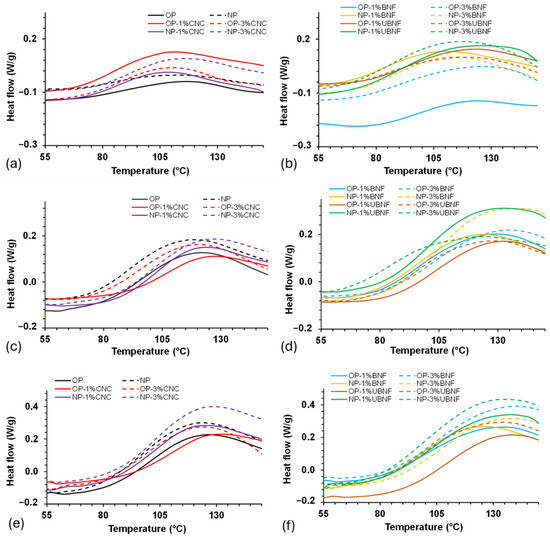
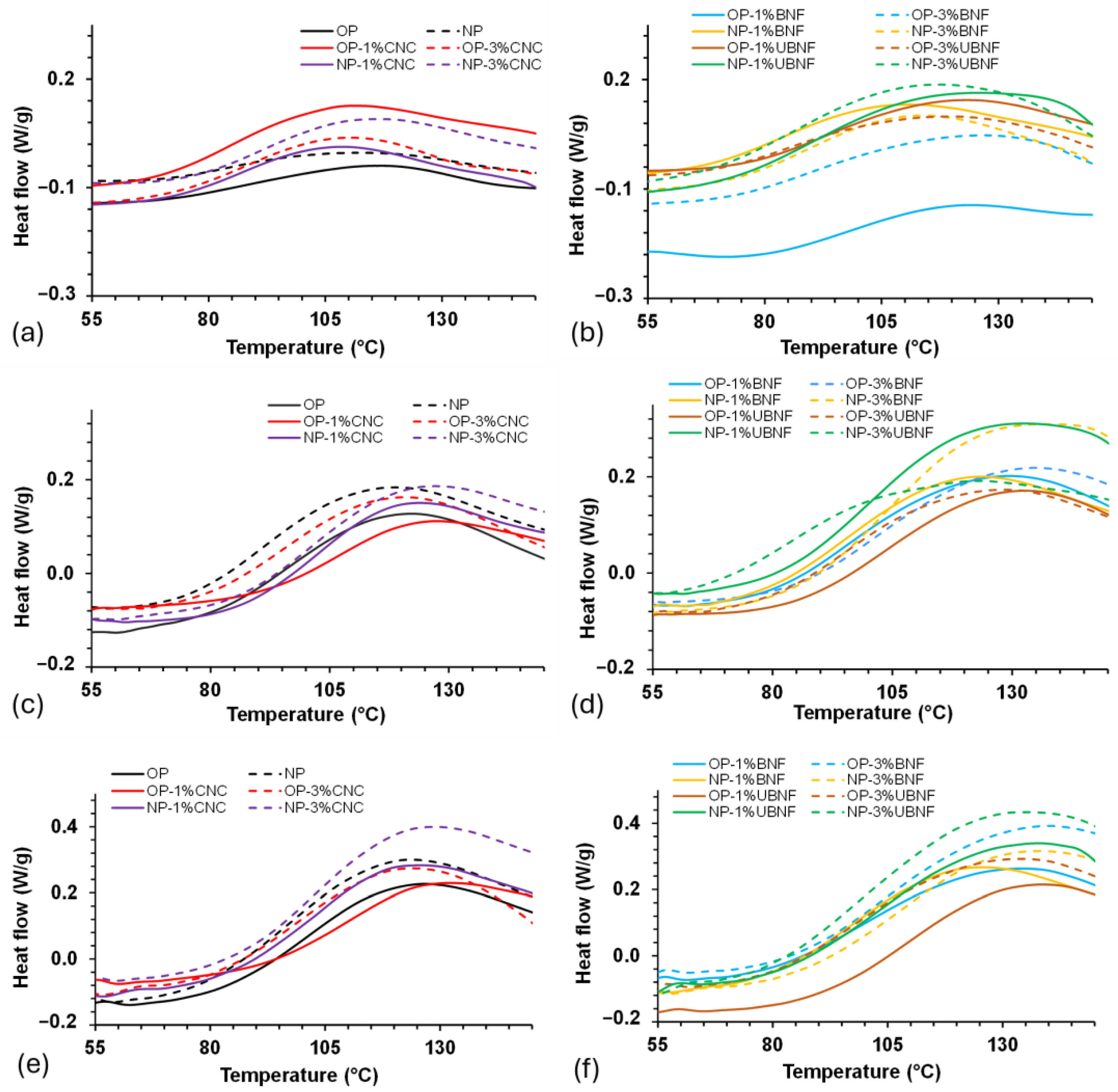
The curing behavior of PRF with NC was also monitored by DSC (Figure 8). Tp and ΔH obtained at different βs are given in Table 4. Kissinger plots were generated (Supplementary Material Figure S1), and kinetic parameters were obtained by calculating Ea and ΔH from Equations (2) and (3) and the data given in Table 4. The DSC thermograms for the PRF-NC blends gave a single exothermic peak, and both Tp and ΔH increased with β. The Tp of OP resin and NC blends increased from 113 °C to 127 °C with β (5 to 15 °C/min), whereas NP resin and NC blends had marginally lower Tp (111 to 124 °C), indicating quicker curing kinetics. The NP resin and NC blends have higher ΔH values (57.7 J/g) at 5 °C/min than OP blends (38.7 J/g). This phenomenon indicates a more thorough curing exotherm in NP due to less resin degradation [61].
Figure 8.
Non-reversible heat flow DSC thermograms of (a) PRF-CNC (b) PRF-BNF/UBNF at 5 °C/min, (c) PRF-CNC (d) PRF-BNF/UBNF at 10°C/min, (e) PRF-CNC (f) PRF-BNF/UBNF at 15 °C/min.
Table 4.
Kinetic parameters for PRF and PRF-NC blends calculated using Kissinger’s and Crane’s models from DSC data. Note: Standard Deviation is given in parentheses.
Incorporation of CNC raised the Tp, particularly at higher contents (NP-3%C), indicating a kinetic impedance to curing. This could be attributable to particle-matrix network effects and is consistent with previous research, which has shown that NC content and resin age significantly impact curing characteristics [32,62]. BNF addition increased Tp compared to neat PRF or CNC-PRF samples. NP-3%BNF showed an increase in Tp values from 126°C to 140°C, with β increasing from 5 to 15°C/min (Table 4). This right-shift suggests that the CNF network inhibits the mobility of PRF chains, retarding the reaction rate and raising Tp at all heating rates [33,63]. PRF-UBNF samples show slightly lower Tp than BNF at similar NC contents. This decrease may be related to the presence of residual lignin and hemicellulose in UBNF, and the exact mechanism is unknown. PRF-UBNF blends produce higher ΔH values than PRF-BNF blends, indicating a higher degree of cure and crosslinking. This finding is consistent with research indicating that unbleached pulp fibers are more active and facilitate resin-fiber interactions [64]. The Ea of the PRF-NC blends was calculated from the plot of −ln(β/Tp2) versus 1/Tp2 (Supplementary Material Figure S1) and can be used to monitor their curing behavior. Ea. For all PRF and PRF-NC blends, the R2 values were 0.89–0.99.
A high Ea (106 kJ/mol) was obtained for NP as compared to OP. This suggests that the OP contains reactive groups and pre-cured chains. Similar results on resin age were shown by [61]. Addition of NC to PRF lowers Ea in all formulations, particularly at 1% NC for NP (54 kJ/mol), suggesting that nanoparticles help reaction initiation, possibly as nucleation or catalytic sites. Higher NC content caused a modest increase in Ea, speculatively due to particle agglomeration or network hindrance. PRF-BNFs blends (OP-1%BNF and OP-3%BNF) have Ea (103 and 96 kJ/mol) similar to or slightly lower than OP. This indicates that the bleached cellulosic surface does not facilitate PRF cure. However, at 1% UBNF (NP-1%UBNF: 63 kJ/mol), a lower Ea is observed, speculating that residual lignin and hemicellulose residues improve reactivity, and the exact mechanism is not known. At 3% UBNF, Ea increases (NP-3%UBNF: 98 kJ/mol), indicating a shift in network crowding or agglomeration, which counteracts their beneficial effects and reduces overall kinetics. Therefore, UBNF at low concentrations (1%) is advantageous for resin cure; however, BNFs provide no catalytic benefit [33,64].
3.3. Composite Characterization
The flexural properties (strength, modulus, and % strain at break) of cured PRF-NC composites were determined (Table 5). Compared to neat resins (OP and NP), the addition of BNF and UBNF greatly increases flexural strength, particularly in the NP system, which exhibits the maximum strength (up to 62.9 MPa).
Table 5.
Flexural strength, modulus, and % strain at break values for PRF and PRF-NC composites.
A point to note is that elevating the CNF content to 3% can occasionally result in a reduction in flexural strength (e.g., OP-3%BNF and OP-3%UBNF). This can be interpreted as fiber aggregation, poor dispersion, or increased resin viscosity, which all can generate flaws and stress concentration sites [53]. CNCs have smaller aspect ratios than CNFs and therefore are less efficient at stress transfer between CNC and resin and thus generally have a lower flexural strength than CNF composites [65]. It is worth noting that NP formulations mostly show higher flexural strength as compared to the OP formulations. UBNFs frequently offer marginally improved reinforcement than BNFs when it comes to CNF. This may be attributable to the presence of residual lignin improving UBNFs’ interfacial adhesion with the resin.
The flexural modulus of PRF was greatly enhanced by the incorporation of NC, according to NC type, content, and resin age (Table 4). PRF formulations with CNC had higher modulus (2.1–2.7 GPa) values than BNF/UBNFs (1.5–2.0 GPa). The rigidity and highly packed crystalline structure of CNC result in composites with higher modulus. In contrast, CNFs are flexible, string-like, and have an entangled network structure with both crystalline and amorphous regions, resulting in a reduced stiffness compared to CNCs [47]. Furthermore, CNCs’ small, uniform size can improve dispersion in polymer matrices at low loadings, thus obtaining improved mechanical reinforcement. Generally, the NP-NC formulations had a higher flexural modulus than the OP formulations. In addition, the UBNF composites generally had a higher flexural modulus value than the BNF composites. It is speculated that the presence of residual lignin and/or hemicellulose in UBNF may contribute to the marginal difference. Increasing the CNF loading to 3% resulted in a general decrease in flexural modulus, and this is likely associated with CNF agglomeration (tangling) and poor dispersion [66].
With the incorporation of NC into PRF, strain at break slightly increased, suggesting that the brittle cured PRF resin was toughened. The CNC- and BNF-PRF formulations achieved strain at break of 3.6–4.5% as compared to neat cured PRF (OP: 2.92%, NP: 3.15%). This finding is consistent with NC networks improving fracture deflection, fiber pull-out, and matrix shear yielding [67,68,69]. The NP-1%UBNF composites achieved a strain at break of 5% and decreased to 4.4% at NP-3%UBNF, and this reduction is possibly due to nanofiber aggregation [67,68,69].
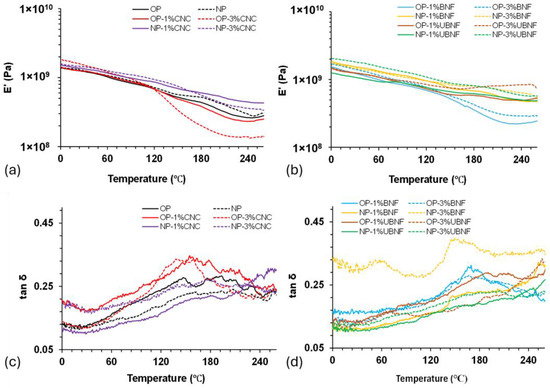
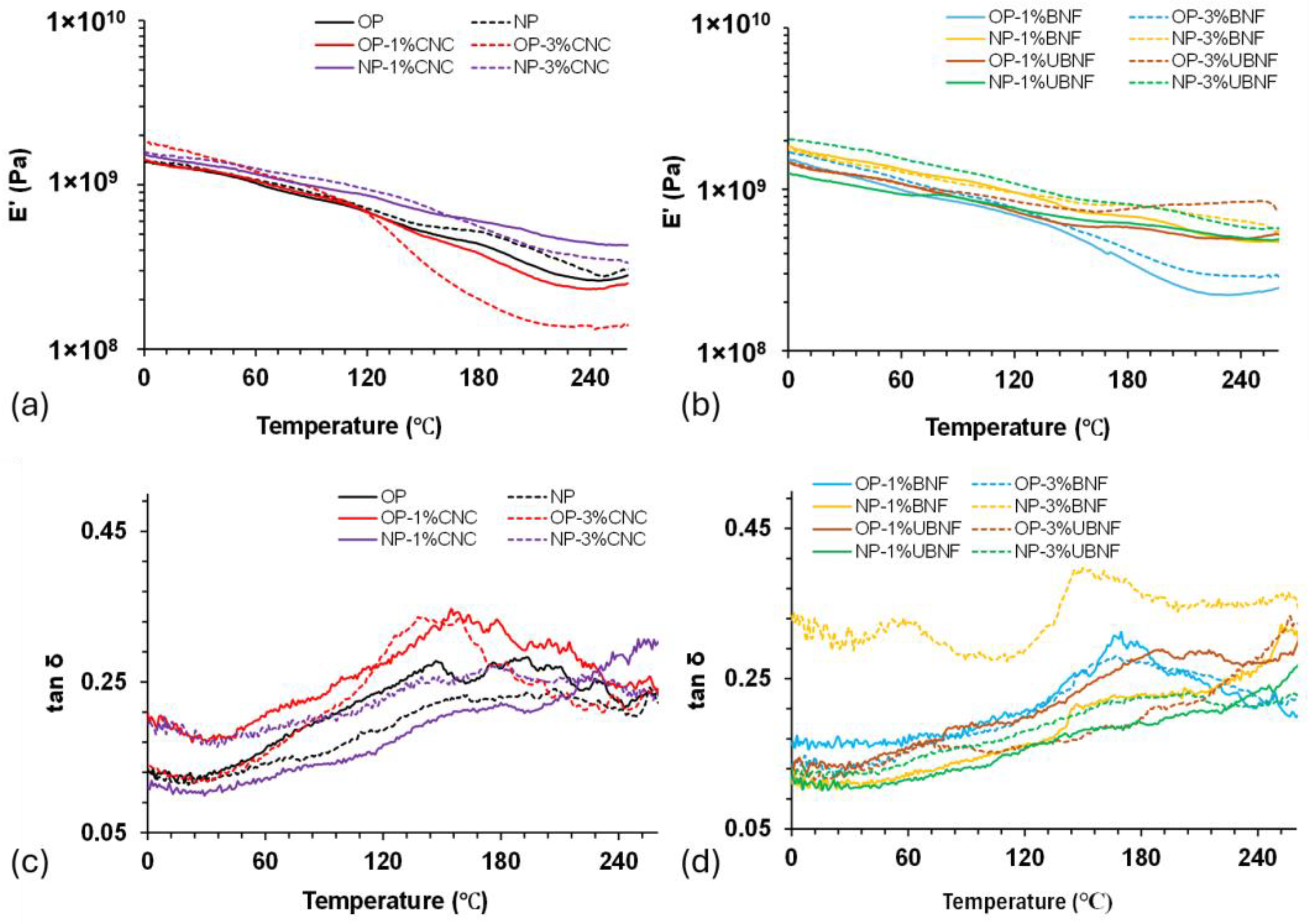
The viscoelastic characteristics of cured PRF and PRF-NC (storage modulus (E′) and tan δ) were determined by DMA (Figure 9). E′ thermograms (Figure 9a,b) represent the material’s elastic response with temperature and are proportional to its modulus. DMA data reveal that the E′ of PRF-NC composites was highly impacted by NC type and content, as well as resin age. E′ was shown to reduce with temperature due to thermal softening and chain weakening in resin structures [70]. The E′ for cured NP generally was higher than for OP, indicating improved PRF network integrity for NP. Composite NP-3%UBNF had the highest thermal stability and E′, most likely because of the synergistic stiffening effects of residual lignin and fibril networking. CNCs and BNFs incorporation into PRF both increased E′, although to a lesser extent. CNC provided stronger reinforcement than BNF, particularly at 3% loading [71,72,73].
Figure 9.
DMA thermograms of E′ for (a) PRF-CNC and (b) PRF-BNF/UBNF and DMA thermograms of tan δ for (c) PRF-CNC and (d) PRF-BNF/UBNF.
The dampening effect (a material’s ability to dissipate energy during deformation) of viscoelastic materials is determined by tan δ [74]. High tan δ values indicate higher energy dissipation, restricted material flow, and reduced storage modulus (E″) [75]. The primary tan δ peak for each cured material was from 150 °C to 190 °C (Figure 9c,d). This tan δ peak corresponds to the cured PRF glass transition temperature (Tg). The addition of CNCs to PRF significantly alters viscoelastic behavior, as seen by an increase in tan δ (e.g., OP-3%CNC), indicating interfacial interactions within the material [72]. Tan δ values for BNF and UBNF PRF composites were lower than for CNC-PRF. UBNF composites had the lowest tan δ and were speculatively attributed to residual lignin influencing polymer-fiber interactions and structural stability [76]. High tan δ materials can be beneficial for applications requiring toughness and impact strength, such as vibration-damping materials. In addition, high tan δ materials also have reduced stiffness, making them less suitable for load-bearing uses where limited energy loss is desired [77].
4. Conclusions
This study shows the successful reinforcement of PRF resin with NC. The addition of NC sequentially increased resin gelation temperature and modified the cure kinetics and network development of the composite. To note, UBNF incorporation into PRF exhibited a lower Ea, implying that residual lignin in the fiber may enhance compatibility with the PRF matrix and encourage cure reactions.
Flexural performance was affected by NC content and type. CNC addition to PRF improved the flexural modulus of the composites, while BNF and UBNF incorporation improved flexural strength. Furthermore, incorporation of NC into PRF increased the flexural strain at break of the composite, clearly showing that NC improved composite toughness. Low levels of NC (1%) improved reinforcement efficiency; however, higher loadings (3%) often resulted in lower flexural properties in the BNF and UBNF composites. This is most likely due to fibril aggregation, clumping, and poor dispersion within the resin. Resin age was also shown to play a role in lowering performance during storage.
The major outcome is that NC can readily reinforce and toughen PRF resin to improve its processing (rheological) and in-use (mechanical) performance, which can be applied to extrusion-based composite applications, such as additive manufacturing (3D printing) of engineered wood composites. Ongoing work will focus on using NC-reinforced PRF and other cold-setting thermoset resins for use in wood composites for producing structures by additive manufacturing.
Supplementary Materials
The following supporting information can be downloaded at https://www.mdpi.com/article/10.3390/adhesives2040020/s1: Figure S1. Plot of −ln(β/Tp2) versus 1/Tp2 for (a) PRF-CNC and (b) PRF-BNF/UBNF blends.
Author Contributions
Conceptualization: J.K.K. and A.G.M.; methodology: J.K.K.; formal analysis: J.K.K.; investigation: J.K.K.; resources: A.G.M. and M.S.P.; data curation: J.K.K.; writing—original draft preparation: J.K.K.; writing—review and editing: J.K.K., A.G.M. and M.S.P.; visualization: J.K.K.; supervision: A.G.M.; project administration: A.G.M. and M.S.P.; funding acquisition: A.G.M. and M.S.P. All authors have read and agreed to the published version of the manuscript.
Funding
The authors are grateful for financial support from (i) the National Science Foundation, award #2119809, and for support in the purchase of the rheometer from (ii) the Idaho State Board of Education, Higher Education Research Council, IGEM, award # IGEM 20-002.
Data Availability Statement
All data are provided in the manuscript.
Acknowledgments
The authors would like to acknowledge (i) Thomas Williams for running the SEM, (ii) Hexion (Columbus, OH, USA) for providing resins and hardener, and (iii) Nicole Stark for providing the CNC.
Conflicts of Interest
The authors declare no conflicts of interest.
References
- Chen, X.; Wang, K.; Wang, Z.; Zeng, H.; Yang, T.; Zhang, X. Highly Stretchable Composites Based on Cellulose. Int. J. Biol. Macromol. 2021, 170, 71–87. [Google Scholar] [CrossRef] [Scilit]
- Lu, Z.; Huang, J.; E, S.; Li, J.; Si, L.; Yao, C.; Jia, F.; Zhang, M. All Cellulose Composites Prepared by Hydroxyethyl Cellulose and Cellulose Nanocrystals through the Crosslink of Polyisocyanate. Carbohydr. Polym. 2020, 250, 116919. [Google Scholar] [CrossRef] [Scilit]
- Rohadi, T.N.T.; Ridzuan, M.J.M.; Majid, M.S.A.; Khasri, A.; Sulaiman, M.H. Isolation and Characterisation of Cellulose from Cortex, Pith and Whole of the Pennisetum Purpureum: Effect of Sodium Hydroxide Concentration. J. Mater. Res. Technol. 2020, 9, 15057–15071. [Google Scholar] [CrossRef] [Scilit]
- Thinkohkaew, K.; Rodthongkum, N.; Ummartyotin, S. Coconut Husk (Cocos nucifera) Cellulose Reinforced Poly Vinyl Alcohol-Based Hydrogel Composite with Control-Release Behavior of Methylene Blue. J. Mater. Res. Technol. 2020, 9, 6602–6611. [Google Scholar] [CrossRef] [Scilit]
- Zainal, S.H.; Mohd, N.H.; Suhaili, N.; Anuar, F.H.; Lazim, A.M.; Othaman, R. Preparation of Cellulose-Based Hydrogel: A Review. J. Mater. Res. Technol. 2021, 10, 935–952. [Google Scholar] [CrossRef] [Scilit]
- Jawaid, M.; Kian, L.K.; Fouad, H.; Saba, N.; Alothman, O.Y.; Hashem, M. Morphological, Structural, and Thermal Analysis of Three Part of Conocarpus Cellulosic Fibres. J. Mater. Res. Technol. 2021, 10, 24–33. [Google Scholar] [CrossRef] [Scilit]
- Manimaran, P.; Saravanan, S.P.; Sanjay, M.R.; Siengchin, S.; Jawaid, M.; Khan, A. Characterization of New Cellulosic Fiber: Dracaena Reflexa as a Reinforcement for Polymer Composite Structures. J. Mater. Res. Technol. 2019, 8, 1952–1963. [Google Scholar] [CrossRef] [Scilit]
- Mylsamy, B.; Chinnasamy, V.; Palaniappan, S.K.; Subramani, S.P.; Gopalsamy, C. Effect of Surface Treatment on the Tribological Properties of Coccinia Indica Cellulosic Fiber Reinforced Polymer Composites. J. Mater. Res. Technol. 2020, 9, 16423–16434. [Google Scholar] [CrossRef] [Scilit]
- Kargarzadeh, H.; Huang, J.; Lin, N.; Ahmad, I.; Mariano, M.; Dufresne, A.; Thomas, S.; Gałęski, A. Recent Developments in Nanocellulose-Based Biodegradable Polymers, Thermoplastic Polymers, and Porous Nanocomposites. Prog. Polym. Sci. 2018, 87, 197–227. [Google Scholar] [CrossRef] [Scilit]
- Abeer, M.M.; Mohd Amin, M.C.I.; Martin, C. A Review of Bacterial Cellulose-Based Drug Delivery Systems: Their Biochemistry, Current Approaches and Future Prospects. J. Pharm. Pharmacol. 2014, 66, 1047–1061. [Google Scholar] [CrossRef] [Scilit]
- Kargarzadeh, H.; Ioelovich, M.; Ahmad, I.; Thomas, S.; Dufresne, A. Methods for Extraction of Nanocellulose from Various Sources. In Handbook of Nanocellulose and Cellulose Nanocomposites; Kargarzadeh, H., Ahmad, I., Thomas, S., Dufresne, A., Eds.; Wiley: New York, NY, USA, 2017; pp. 1–49. [Google Scholar]
- Moon, R.J.; Schueneman, G.T.; Simonsen, J. Overview of Cellulose Nanomaterials, Their Capabilities and Applications. JOM 2016, 68, 2383–2394. [Google Scholar] [CrossRef] [Scilit]
- Fagone, M.; Loccarini, F.; Ranocchiai, G. Strength Evaluation of Jute Fabric for the Reinforcement of Rammed Earth Structures. Compos. Part B Eng. 2017, 113, 1–13. [Google Scholar] [CrossRef] [Scilit]
- Mohammed, L.; Ansari, M.N.M.; Pua, G.; Jawaid, M.; Islam, M.S. A Review on Natural Fiber Reinforced Polymer Composite and Its Applications. Int. J. Polym. Sci. 2015, 2015, 243947. [Google Scholar] [CrossRef] [Scilit]
- Onuaguluchi, O.; Banthia, N. Plant-Based Natural Fibre Reinforced Cement Composites: A Review. Cem. Concr. Compos. 2016, 68, 96–108. [Google Scholar] [CrossRef] [Scilit]
- Trache, D.; Tarchoun, A.F.; Derradji, M.; Hamidon, T.S.; Masruchin, N.; Brosse, N.; Hussin, M.H. Nanocellulose: From Fundamentals to Advanced Applications. Front. Chem. 2020, 8, 392. [Google Scholar] [CrossRef] [Scilit]
- Sabaruddin, F.A.; Paridah, M.T.; Sapuan, S.M.; Ilyas, R.A.; Lee, S.H.; Abdan, K.; Mazlan, N.; Roseley, A.S.M.; Abdul Khalil, H.P.S. The Effects of Unbleached and Bleached Nanocellulose on the Thermal and Flammability of Polypropylene-Reinforced Kenaf Core Hybrid Polymer Bionanocomposites. Polymers 2020, 13, 116. [Google Scholar] [CrossRef] [Scilit]
- Asad, F.; Immonen, K.; Kiiskinen, T.; Sarlin, E. Effect of Unbleached and Bleached Softwood Cellulose Pulp Fibers on Poly(Lactic Acid) Properties. BioResources 2024, 19, 5338–5351. [Google Scholar] [CrossRef] [Scilit]
- Solala, I.; Iglesias, M.C.; Peresin, M.S. On the Potential of Lignin-Containing Cellulose Nanofibrils (LCNFs): A Review on Properties and Applications. Cellulose 2020, 27, 1853–1877. [Google Scholar] [CrossRef] [Scilit]
- Wibowo, E.S.; Park, B.-D.; Lubis, M.A.R.; Kusumah, S.S.; Santoso, A.; Sari, A.A.; Iswanto, A.H. Enhancing the Performance of Cold-Setting Phenol–Resorcinol–Formaldehyde Resin Adhesives through Condensation Extension. Int. J. Adhes. Adhes. 2025, 138, 103958. [Google Scholar] [CrossRef] [Scilit]
- Kim, M.G. Adhesives and Finishes for Wood: For Practitioners and Students; John Wiley & Sons: Hoboken, NJ, USA, 2023. [Google Scholar]
- Pizzi, A.; Ibeh, C.C. 2—Phenol–Formaldehydes. In Handbook of Thermoset Plastics, 3rd ed.; Dodiuk, H., Goodman, S.H., Eds.; William Andrew Publishing: Boston, MA, USA, 2014; pp. 13–44. [Google Scholar]
- Kläusler, O.; Clauß, S.; Lübke, L.; Trachsel, J.; Niemz, P. Influence of Moisture on Stress–Strain Behaviour of Adhesives Used for Structural Bonding of Wood. Int. J. Adhes. Adhes. 2013, 44, 57–65. [Google Scholar] [CrossRef] [Scilit]
- Vaněrek, J.; Bálková, R.; Šmak, M.; Běťák, A.; Vejpustek, Z. The Effect of Long and Short Term Elevated Temperatures on the Behaviour of Lap Glued Joints of Load-Bearing Spruce Elements. Int. J. Adhes. Adhes. 2024, 129, 103575. [Google Scholar] [CrossRef] [Scilit]
- Alvarez Marin, L.; Naghizadeh Mahani, Z.; Peresin, M.S. Comparative Study of Bleached and Lignin-Containing Cellulose Nanofibrils as Reinforcements in Epoxy Composites. Wood Sci. Technol. 2025, 59, 98. [Google Scholar] [CrossRef] [Scilit]
- Artner, M.A.; de Cademartori, P.H.G.; Avelino, F.; Lomonaco, D.; Magalhães, W.L.E. A Novel Design for Nanocellulose Reinforced Urea–Formaldehyde Resin: A Breakthrough in Amino Resin Synthesis and Biocomposite Manufacturing. Cellulose 2021, 28, 3435–3450. [Google Scholar] [CrossRef] [Scilit]
- Kawalerczyk, J.; Dziurka, D.; Mirski, R.; Siuda, J. The Reduction of Adhesive Application in Plywood Manufacturing by Using Nanocellulose-Reinforced Urea-Formaldehyde Resin. J. Appl. Polym. Sci. 2021, 138, 49834. [Google Scholar] [CrossRef] [Scilit]
- Wang, C.; Sun, S.; Zhao, G.; He, B.; Xiao, H. Furfural Resin-Based Bio-Nanocomposites Reinforced by Reactive Nanocrystalline Cellulose. In Proceedings of the SPIE 7493, Second International Conference on Smart Materials and Nanotechnology in Engineering, Weihai, China, 8–11 July 2009; Leng, J., Asundi, A.K., Ecke, W., Eds.; SPIE: Cergy, France, 2009; p. 74932Z. [Google Scholar] [CrossRef] [Scilit]
- Rana, S.; Gupta, M. Fabrication of Bionanocomposites Reinforced with Hemp Nanocellulose and Evaluation of Their Mechanical, Thermal and Dynamic Mechanical Properties. Proc. Inst. Mech. Eng. Part L J. Mater. Des. Appl. 2021, 235, 2470–2481. [Google Scholar] [CrossRef] [Scilit]
- Roszowska-Jarosz, M.; Masiewicz, J.; Kostrzewa, M.; Kucharczyk, W.; Żurowski, W.; Kucińska-Lipka, J.; Przybyłek, P. Mechanical Properties of Bio-Composites Based on Epoxy Resin and Nanocellulose Fibres. Materials 2021, 14, 3576. [Google Scholar] [CrossRef] [Scilit]
- Ying Ee, L.; Li, S.F.Y. Recent Advances in 3D Printing of Nanocellulose: Structure, Preparation, and Application Prospects. Nanoscale Adv. 2021, 3, 1167–1208. [Google Scholar] [CrossRef] [Scilit]
- Kawalerczyk, J.; Dziurka, D.; Mirski, R.; Siuda, J.; Szentner, K. The Effect of Nanocellulose Addition to Phenol-Formaldehyde Adhesive in Water-Resistant Plywood Manufacturing. BioResources 2020, 15, 5388–5401. [Google Scholar] [CrossRef] [Scilit]
- Dorieh, A.; Ayrilmis, N.; Farajollah Pour, M.; Ghafari Movahed, S.; Valizadeh Kiamahalleh, M.; Shahavi, M.H.; Hatefnia, H.; Mehdinia, M. Phenol Formaldehyde Resin Modified by Cellulose and Lignin Nanomaterials: Review and Recent Progress. Int. J. Biol. Macromol. 2022, 222, 1888–1907. [Google Scholar] [CrossRef] [Scilit]
- Yu, Y.; Xu, P.; Chang, M.; Chang, J. Aging Properties of Phenol-Formaldehyde Resin Modified by Bio-Oil Using UV Weathering. Polymers 2018, 10, 1183. [Google Scholar] [CrossRef] [Scilit]
- Iglesias, M.C.; McMichael, P.S.; Asafu-Adjaye, O.; Via, B.K.; Peresin, M.S. Interfacial Interactions between Urea Formaldehyde and Cellulose Nanofibrils (CNFs) of Varying Chemical Composition and Their Impact on Particle Board (PB) Manufacture. Cellulose 2021, 28, 7969–7979. [Google Scholar] [CrossRef] [Scilit]
- Horvath, A.E.; Lindström, T.; Laine, J. On the Indirect Polyelectrolyte Titration of Cellulosic Fibers. Conditions for Charge Stoichiometry and Comparison with ESCA. Langmuir 2006, 22, 824–830. [Google Scholar] [CrossRef] [Scilit]
- Mengistie, E.; Bokros, N.; DeBolt, S.; McDonald, A.G. Lodging Variability in Sorghum Stalks Is Dependent on the Biomechanical and Chemical Composition of the Stalk Rinds. Crops 2024, 4, 3–26. [Google Scholar] [CrossRef] [Scilit]
- Orji, B.O.; McDonald, A.G. Flow, Curing and Mechanical Properties of Thermoset Resins–Wood-Fiber Blends for Potential Additive-Manufacturing Applications. Wood Mater. Sci. Eng. 2023, 18, 1487–1504. [Google Scholar] [CrossRef] [Scilit]
- Crane, L.W.; Dynes, P.J.; Kaelble, D.H. Analysis of Curing Kinetics in Polymer Composites. J. Polym. Sci. Polym. Lett. Ed. 1973, 11, 533–540. [Google Scholar] [CrossRef] [Scilit]
- Kissinger, H.E. Reaction Kinetics in Differential Thermal Analysis. Anal. Chem. 1957, 29, 1702–1706. [Google Scholar] [CrossRef] [Scilit]
- ASTM D790-17; Standard Test Methods for Flexural Properties of Unreinforced and Reinforced Plastics and Electrical Insulating Materials. ASTM International: West Conshohocken, PA, USA, 2017. [Google Scholar] [CrossRef] [Scilit]
- Sun, C. (Calvin) True Density of Microcrystalline Cellulose. J. Pharm. Sci. 2005, 94, 2132–2134. [Google Scholar] [CrossRef] [Scilit]
- Baraka, F.; Ganesan, K.; Milow, B.; Labidi, J. Cellulose Nanofiber Aerogels: Effect of the Composition and the Drying Method. Cellulose 2024, 31, 9699–9713. [Google Scholar] [CrossRef] [Scilit]
- Kukal, J.; Peresin, M.S.; McDonald, A.G. Enhancing Wood–PRF Extrudable Composites with Nanocellulose Reinforcement. Solids 2026, 7, 35. [Google Scholar] [CrossRef] [Scilit]
- Dali, M.-H.A.; Salim, M.H.; AbuZaid, M.; Qassem, M.O.S.; Marzooqi, F.A.; Ceriani, A.; Decarlis, A.; Dumée, L.F.; Tardy, B.L. Evaluating Nanocellulose from Food Waste as a Functional Amendment for Sandy Soils: Linking Fiber Structure to Water Dynamics, Soil Mechanics, and Plant-Microbes Interactions. J. Bioresour. Bioprod. 2025, 10, 513–529. [Google Scholar] [CrossRef] [Scilit]
- Nečas, D.; Klapetek, P. Gwyddion: An Open-Source Software for SPM Data Analysis. Open Phys. 2012, 10, 181–188. [Google Scholar] [CrossRef] [Scilit]
- Xu, X.; Liu, F.; Jiang, L.; Zhu, J.Y.; Haagenson, D.; Wiesenborn, D.P. Cellulose Nanocrystals vs. Cellulose Nanofibrils: A Comparative Study on Their Microstructures and Effects as Polymer Reinforcing Agents. ACS Appl. Mater. Interfaces 2013, 5, 2999–3009. [Google Scholar] [CrossRef] [Scilit]
- Pizzi, A.; Pasch, H.; Simon, C.; Rode, K. Structure of Resorcinol, Phenol, and Furan Resins by MALDI-TOF Mass Spectrometry and 13C NMR. J. Appl. Polym. Sci. 2004, 92, 2665–2674. [Google Scholar] [CrossRef] [Scilit]
- Teixeira, L.A.; Junior, V.D.L. The Influence of Curing Agent Ratio on Epoxy Resin by Using FTIR Spectroscopy. In Proceedings of the 16th Brazilian Polymer Conference (16° CBPOL), Ouro Preto, Brazil, 24–28 October 2021. [Google Scholar]
- Bobrowski, A.; Grabowska, B. FTIR method in studies of the resol type phenol resin structure in the air atmosphere in some time intervals. Metall. Foundry Eng. 2015, 41, 107. [Google Scholar] [CrossRef] [Scilit][Green Version]
- Alemdar, A.; Sain, M. Isolation and Characterization of Nanofibers from Agricultural Residues–Wheat Straw and Soy Hulls. Bioresour. Technol. 2008, 99, 1664–1671. [Google Scholar] [CrossRef] [Scilit]
- Beuguel, Q.; Tavares, J.R.; Carreau, P.J.; Heuzey, M.-C. Rheological Behavior of Cellulose Nanocrystal Suspensions in Polyethylene Glycol. J. Rheol. 2018, 62, 607–618. [Google Scholar] [CrossRef] [Scilit]
- Klemm, D.; Kramer, F.; Moritz, S.; Lindström, T.; Ankerfors, M.; Gray, D.; Dorris, A. Nanocelluloses: A New Family of Nature-Based Materials. Angew. Chem. Int. Ed. 2011, 50, 5438–5466. [Google Scholar] [CrossRef] [Scilit]
- Carreau, P.J. Rheological Equations from Molecular Network Theories. Trans. Soc. Rheol. 1972, 16, 99–127. [Google Scholar] [CrossRef] [Scilit]
- Santesarti, G.; Marino, M.; Viola, F.; Verzicco, R.; Vairo, G. An Insight into Parameter Identifiability Issues in the Carreau-Yasuda Model: A More Consistent Rheological Formulation for Shear-Thinning Non-Newtonian Inelastic Fluids. J. Non-Newton. Fluid Mech. 2025, 342, 105438. [Google Scholar] [CrossRef] [Scilit]
- Macosko, C.W. Rheology: Principles, Measurements, and Applications-Alfred University. Available online: https://primo.alfred.edu/discovery/fulldisplay/alma99534990104810/01SUNY_AUA:01SUNY_AUA (accessed on 25 February 2026).
- Bercea, M. Rheology as a Tool for Fine-Tuning the Properties of Printable Bioinspired Gels. Molecules 2023, 28, 2766. [Google Scholar] [CrossRef] [Scilit]
- Samyn, P.; Cosemans, P. Nanocellulose Grades with Different Morphologies and Surface Modification as Additives for Waterborne Epoxy Coatings. Polymers 2024, 16, 1095. [Google Scholar] [CrossRef] [Scilit]
- Sun, X.; Wu, Q.; Lee, S.; Qing, Y.; Wu, Y. Cellulose Nanofibers as a Modifier for Rheology, Curing and Mechanical Performance of Oil Well Cement. Sci. Rep. 2016, 6, 31654. [Google Scholar] [CrossRef] [Scilit]
- Gotro, J. Thermoset Characterization Part 7: Introduction to Vitrification. Polymer Innovation Blog, 27 May 2014. Available online: https://polymerinnovationblog.com/thermoset-characterization-part-7-introduction-vitrification/ (accessed on 28 September 2026).
- Rabby, M.M.; Das, P.P.; Rahman, M.; Vadlamudi, V.; Raihan, R. Prepreg Age Monitoring and Qualitative Prediction of Mechanical Performance of Composite Using Dielectric State Variables. Polym. Polym. Compos. 2022, 30, 09673911221145053. [Google Scholar] [CrossRef] [Scilit]
- Atta-Obeng, E.; Via, B.K.; Fasina, O.; Auad, M.L.; Jiang, W. Cellulose Reinforcement of Phenol Formaldehyde: Characterization and Chemometric Elucidation. Int. J. Compos. Mater. 2013, 3, 61–68. [Google Scholar]
- Kamboj, G.; Gaff, M.; Smardzewski, J.; Haviarová, E.; Hui, D.; Rousek, R.; Das, S.; Rezaei, F.; Sethy, A.K. Comparative Study on the Properties of Cellulose Nanofiber (CNF) and Cellulose Nanocrystals (CNC) Reinforced 1C-PUR Adhesive Bonded Wooden Joints. Constr. Build. Mater. 2022, 344, 128262. [Google Scholar] [CrossRef] [Scilit]
- Ao, T.-J.; Wu, J.; Chandra, R.; Zhang, H.-Y.; Yuan, Y.-F.; Luo, Y.-P.; Li, D.; Liu, C.-G.; Renneckar, S.; Saddler, J. Influence of Hemicellulose and Lignin on the Effect of Drying of Cellulose and the Subsequent Enzymatic Hydrolysis. Green Chem. 2025, 27, 8901–8913. [Google Scholar] [CrossRef] [Scilit]
- Habibi, Y.; Lucia, L.A.; Rojas, O.J. Cellulose Nanocrystals: Chemistry, Self-Assembly, and Applications. Chem. Rev. 2010, 110, 3479–3500. [Google Scholar] [CrossRef] [Scilit]
- Wang, Y.; Yu, Z.; Dufresne, A.; Ye, Z.; Lin, N.; Zhou, J. Quantitative Analysis of Compatibility and Dispersibility in Nanocellulose-Reinforced Composites: Hansen Solubility and Raman Mapping. ACS Nano 2021, 15, 20148–20163. [Google Scholar] [CrossRef] [Scilit]
- Kaur, P.; Sharma, N.; Munagala, M.; Rajkhowa, R.; Aallardyce, B.; Shastri, Y.; Agrawal, R. Nanocellulose: Resources, Physio-Chemical Properties, Current Uses and Future Applications. Front. Nanotechnol. 2021, 3, 1–17. [Google Scholar] [CrossRef] [Scilit]
- Khalid, M.Y.; Al Rashid, A.; Arif, Z.U.; Ahmed, W.; Arshad, H. Recent Advances in Nanocellulose-Based Different Biomaterials: Types, Properties, and Emerging Applications. J. Mater. Res. Technol. 2021, 14, 2601–2623. [Google Scholar] [CrossRef] [Scilit]
- Omran, A.A.B.; Mohammed, A.A.B.A.; Sapuan, S.M.; Ilyas, R.A.; Asyraf, M.R.M.; Rahimian Koloor, S.S.; Petrů, M. Micro- and Nanocellulose in Polymer Composite Materials: A Review. Polymers 2021, 13, 231. [Google Scholar] [CrossRef] [Scilit]
- Zhang, Y.; Park, M.; Park, S.-J. Implication of Thermally Conductive Nanodiamond-Interspersed Graphite Nanoplatelet Hybrids in Thermoset Composites with Superior Thermal Management Capability. Sci. Rep. 2019, 9, 2893. [Google Scholar] [CrossRef] [Scilit]
- Rostamabadi, H.; Bist, Y.; Kumar, Y.; Yildirim-Yalcin, M.; Ceyhan, T.; Falsafi, S.R. Cellulose Nanofibers, Nanocrystals, and Bacterial Nanocellulose: Fabrication, Characterization, and Their Most Recent Applications. Future Postharvest Food 2024, 1, 5–33. [Google Scholar] [CrossRef] [Scilit]
- Talebi, H.; Ghasemi, F.A.; Ashori, A. The Effect of Nanocellulose on Mechanical and Physical Properties of Chitosan-Based Biocomposites. J. Elastomers Plast. 2022, 54, 22–41. [Google Scholar] [CrossRef] [Scilit]
- Wongvasana, B.; Thongnuanchan, B.; Masa, A.; Saito, H.; Sakai, T.; Lopattananon, N. Comparative Structure–Property Relationship between Nanoclay and Cellulose Nanofiber Reinforced Natural Rubber Nanocomposites. Polymers 2022, 14, 3747. [Google Scholar] [CrossRef] [Scilit]
- Islam, M.S.; Hamdan, S.; Talib, Z.A.; Ahmed, A.S.; Rahman, M.R. Tropical Wood Polymer Nanocomposite (WPNC): The Impact of Nanoclay on Dynamic Mechanical Thermal Properties. Compos. Sci. Technol. 2012, 72, 1995–2001. [Google Scholar] [CrossRef] [Scilit]
- Yan, Y.; Dong, Y.; Li, J.; Zhang, S.; Xia, C.; Shi, S.Q.; Cai, L. Enhancement of Mechanical and Thermal Properties of Poplar through the Treatment of Glyoxal-Urea/Nano-SiO2. RSC Adv. 2015, 5, 54148–54155. [Google Scholar] [CrossRef] [Scilit]
- Saba, N.; Safwan, A.; Sanyang, M.L.; Mohammad, F.; Pervaiz, M.; Jawaid, M.; Alothman, O.Y.; Sain, M. Thermal and Dynamic Mechanical Properties of Cellulose Nanofibers Reinforced Epoxy Composites. Int. J. Biol. Macromol. 2017, 102, 822–828. [Google Scholar] [CrossRef] [Scilit]
- Tang, X.; Yan, X. A Review on the Damping Properties of Fiber Reinforced Polymer Composites. J. Ind. Text. 2020, 49, 693–721. [Google Scholar] [CrossRef] [Scilit]

Disclaimer/Publisher’s Note: The statements, opinions and data contained in all publications are solely those of the individual author(s) and contributor(s) and not of MDPI and/or the editor(s). MDPI and/or the editor(s) disclaim responsibility for any injury to people or property resulting from any ideas, methods, instructions or products referred to in the content. |
© 2026 by the authors. Licensee MDPI, Basel, Switzerland. This article is an open access article distributed under the terms and conditions of the Creative Commons Attribution (CC BY) license.