


Abstract
This study examined associations between key socioeconomic factors and fire occurrence across Greece’s thirteen administrative Regions over the period 2000–2021. Correlation analysis and Loess nonparametric regression were applied to identify the underlying trends between socioeconomic factors and fire occurrence at the regional level. Findings across the thirteen Regions indicate that selected socioeconomic factors show varying degrees of bivariate association with fire occurrence; however, given the use of unadjusted bivariate correlations across multiple regions, these results should be interpreted as exploratory and hypothesis-generating. The results highlight the relevance of socioeconomic context in interpreting spatial heterogeneity of fire occurrence across Greek regions, providing preliminary evidence to guide the development of region-specific fire prevention strategies.
1. Introduction
Fires are among the most destructive natural hazards affecting Mediterranean Europe, with Greece consistently ranking among the most fire-prone countries on the continent [1,2], since the frequency and scale of fire activity have been increased in recent decades by a combination of meteorological extremes and ongoing transformations in human–landscape interactions [3,4].
Most fires in Mediterranean countries are caused, either directly or indirectly, by human activity, making the socioeconomic context a critical dimension for understanding fire regimes [5]. Human-related drivers such as population dynamics, land-use change, land abandonment, accessibility, and proximity to the wildland–urban interface are consistently identified as significant predictors of fire occurrence patterns across European and Mediterranean landscapes [6]. Large-scale statistical and machine-learning analyses confirm that while drought and fuel dryness govern the potential for fire spread, human factors predominantly determine where and when ignitions occur [7].
Socioeconomic indicators such as Gross Domestic Product (GDP), sectoral employment, particularly in agriculture and forestry and measures of land abandonment have emerged as key predictors of fire activity in the Mediterranean [8]. Land abandonment, driven by rural depopulation and declining agricultural and pastoral activities, increases fuel continuity and burn probability in agro-pastoral landscapes [9,10,11]. Therefore, macro-economic indicators such as income levels and GDP dynamics may modulate fire risk through mechanisms involving investment in fire suppression, land management capacity and broader demographic processes [12]. Evidence from case studies in other Mediterranean countries highlights that the direction and strength of these socioeconomic factors vary by spatial context underscoring the importance of region-specific analyses [13].
In Greece, previous research has employed remote sensing, vulnerability mapping, and local case studies to assess fire risk [14]. However, a comprehensive, multi-regional analysis that explicitly examines the temporal dynamics of socioeconomic factors and their association with fire occurrence at the regional level over a long time period remains limited in scope. Addressing this gap is crucial for enabling fire and forest management authorities to develop appropriately differentiated prevention strategies tailored to the distinct socioeconomic, cultural, and ecological characteristics of each Region.
The present study investigates the extent to which a range of socioeconomic factors including GDP, GDP per capita, employment levels in the agriculture and forestry sectors, and Gross Value Added (GVA) are associated with fire occurrence across Greece’s thirteen administrative Regions during the period 2000–2021.
2. Methods
2.1. Study Area
Greece’s administrative territory is organized into thirteen Regions at the NUTS 2 level: Attica, Central Greece, Central Macedonia, Crete, Eastern Macedonia and Thrace, Epirus, Ionian Islands, North Aegean, Peloponnese, South Aegean, Thessaly, Western Greece, and Western Macedonia. These Regions span diverse bioclimatic conditions, ranging from Mediterranean-type climates with hot, dry summers and mild, wet winters in coastal and southern areas, to continental and alpine climates in the mountainous interior.
2.2. Fire Data and Socioeconomic Variables
Annual fire data were obtained from the Greek Fire Service database for the period 2000–2021. The dataset includes records of fire ignition events—comprising all types of fires (vegetation, forest, agricultural, and wildland) reported for each of the thirteen administrative Regions. Each recorded event represents a single reported fire ignition event in the database, without filtering by fire cause, size, or land-cover type; this pooling of ignitions from diverse origins is acknowledged as a limitation, as different ignition types may respond differently to socioeconomic conditions. Socioeconomic data were sourced from the Hellenic Statistical Authority (ELSTAT). Four socioeconomic variables were compiled at the regional (NUTS 2) level on an annual basis for the period 2000–2021: (i) GDP, representing total regional economic output expressed in constant prices (Eurostat, base year 2015, in millions of euros); (ii) GDP per capita, normalizing GDP by regional population to allow comparison across Regions of different sizes; (iii) GVA, capturing the contribution of each Region to total national economic output; and (iv) employment in the agriculture and forestry sectors (expressed as a count of employed persons), used here as a descriptive indicator of primary-sector activity [1,4,11].
2.3. Statistical Analysis
To examine bivariate associations between each socioeconomic factor and fire occurrence, Spearman rank correlation coefficients were computed for each of the thirteen Regions across the 2000–2021 period. Because the data did not follow a normal distribution, Spearman’s rank correlation was employed as a non-parametric method to assess monotonic relationships and provide robustness to the non-normal distributions typically observed in both fire occurrence and socioeconomic variables. Pairwise correlation matrices were inspected for the magnitude and direction of association and for statistical significance, reported at the α = 0.05 threshold. Correlation analyses were performed independently for each Region to capture the spatial heterogeneity of associations between socioeconomic factors and fire occurrence, providing a measure of bivariate rank association rather than causal inference.
Loess nonparametric regression was also applied to model the underlying temporal relationships between each socioeconomic factor and fire occurrence within each Region. Unlike parametric models, Loess does not impose a global functional form, making it particularly suited to detecting non-linear and evolving trends in the socioeconomic–fire relationship over multi-decadal time series [15]. The fitted Loess curves and the resulting scatter plots were used to describe the temporal dynamics of the relationship between each socioeconomic factor and fire activity at the regional level. All statistical analyses were performed in the R statistical computing environment version R 4.6.2.
3. Results and Discussion
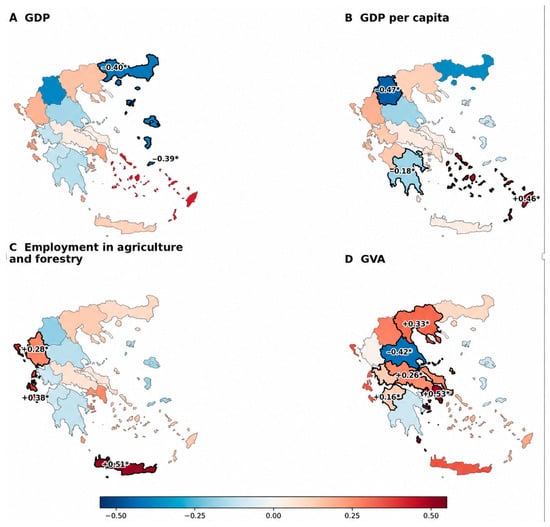
Figure 1 shows the spatial patterns of Spearman’s rank correlation coefficients between fire occurrence and the four examined socioeconomic indicators across the 13 administrative Regions of Greece.
Figure 1.
Spatial patterns of Spearman’s rank correlation coefficients (ρ) between fire occurrence and the four socioeconomic factors across the 13 administrative Regions of Greece. An asterisk (*) indicates statistical significance at p < 0.05; Blue tones indicate negative associations; red tones indicate positive associations.
The analysis revealed regional variation in the relationships between fire occurrence and socioeconomic factors across the 13 administrative Regions of Greece. GDP showed significant negative correlations with wildfire occurrence in Eastern Macedonia and Thrace (ρ = −0.40) and the North Aegean (ρ = −0.39), indicating that higher GDP values were associated with lower wildfire occurrence in these regions. GDP per capita exhibited a more heterogeneous spatial pattern, with a significant negative correlation in Western Macedonia (ρ = −0.47) and a significant positive correlation in the South Aegean (ρ = 0.46). Employment in agriculture and forestry was positively associated with fire occurrence, with significant correlations observed in Crete (ρ = 0.51), the Ionian Islands (ρ = 0.38), and Epirus (ρ = 0.28), suggesting that regions with greater employment in primary land-based activities may experience higher fire occurrence. GVA displayed pronounced regional differences: significant positive correlations were identified in Attica (ρ = 0.53), Central Macedonia (ρ = 0.33), Central Greece (ρ = 0.26), and Western Greece (ρ = 0.16), whereas Thessaly showed a significant negative correlation (ρ = −0.42). Across all regions, no single socioeconomic factor exhibited a consistent directional relationship with fire occurrence, underscoring the spatial heterogeneity of socioeconomic–fire associations at the regional level. Conducting 52 independent significance tests (13 regions × 4 variables) without adjusting the α = 0.05 threshold admittedly increases the probability of false positives; therefore, the reported associations should be treated as preliminary and hypothesis-generating instead of confirmatory. Additionally, no stationarity or autocorrelation diagnostics were applied prior to correlation analysis; the potential for confounded associations arising from shared temporal trends cannot be excluded and should be addressed in future work. The associations reported in the current study were assessed without multiple-testing correction; therefore, the reported significant coefficients should be regarded as preliminary findings requiring further validation.
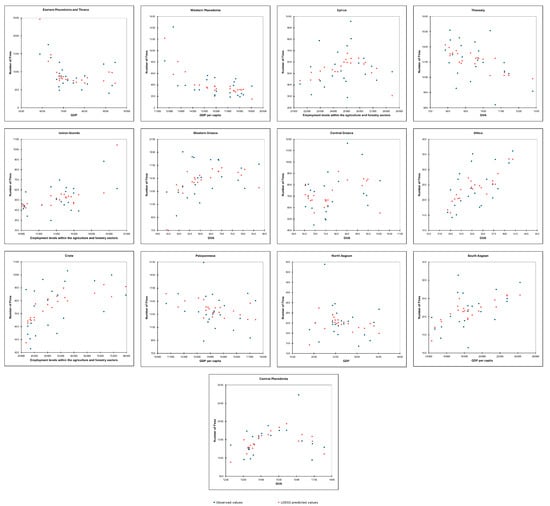
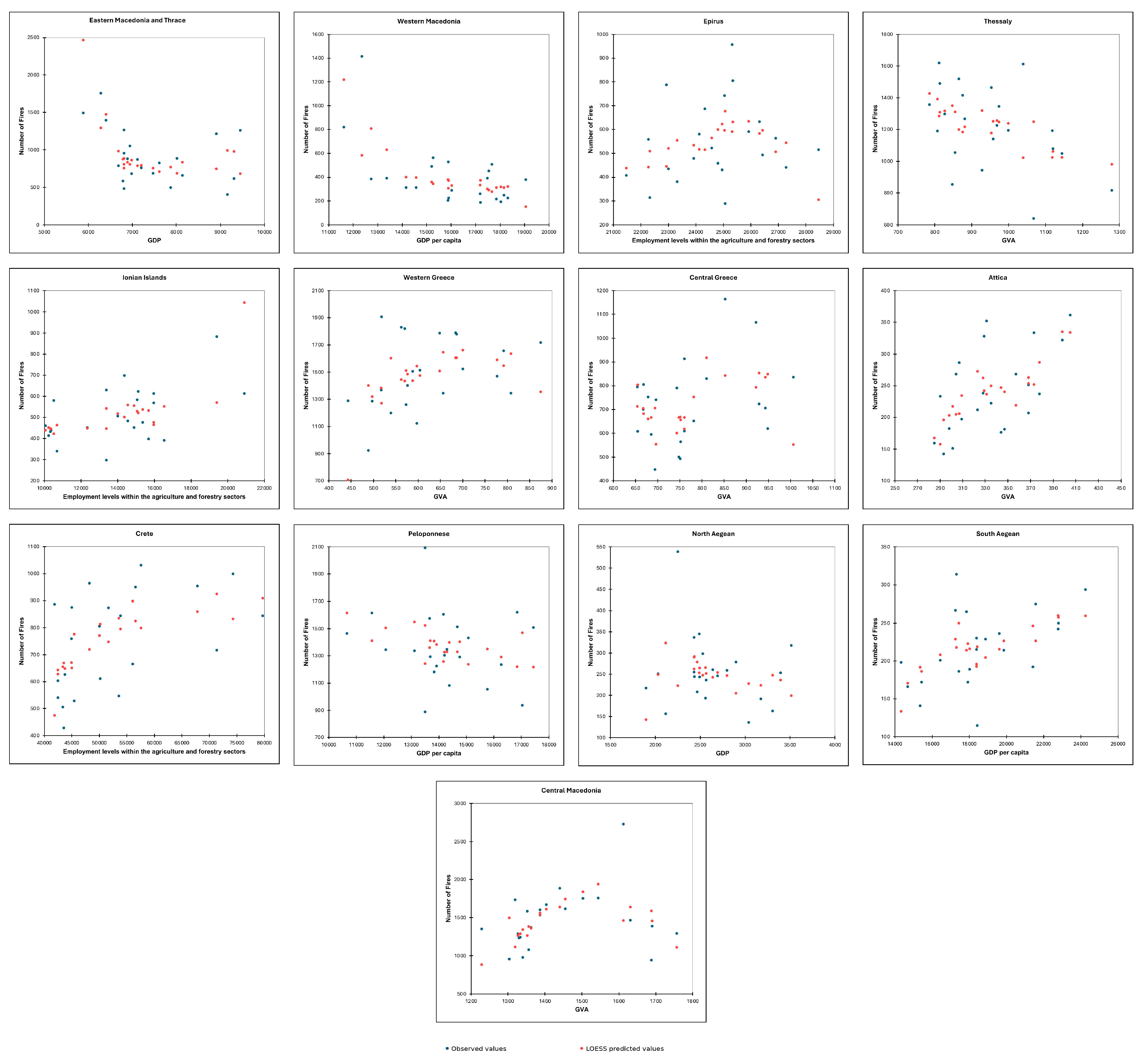
Figure 2 shows the scatter plots of the Loess nonparametric regression relationships between fire occurrence and statistically significant socioeconomic factors across Greece.
Figure 2.
Loess nonparametric regression relationships between fire occurrence and statistically significant socioeconomic factors across Greece. Blue dots represent observed annual fire occurrence values; red dots show Loess-predicted values. Only region–factor pairs with statistically significant Spearman correlations (α = 0.05) are shown.
Loess nonparametric regression revealed substantial regional heterogeneity in the relationships between fire occurrence and socioeconomic factors across Greece. The fitted Loess curves generally reproduced the direction of the significant Spearman associations, while also revealing nonlinear patterns that linear correlation coefficients alone cannot capture. Negative relationships between fire occurrence and GDP or GDP per capita were evident in several regions, including Eastern Macedonia and Thrace, Western Macedonia, the North Aegean, and the Peloponnese, although the form and strength of these relationships varied considerably across regions. Positive relationships were particularly apparent for employment in agriculture and forestry in Crete and the Ionian Islands, and for GVA in Attica. The South Aegean exhibited a positive nonlinear relationship between fire occurrence and GDP per capita. Overall, the Loess regression results suggest that socioeconomic–fire relationships are spatially heterogeneous and frequently nonlinear, reinforcing the need for region-specific rather than nationally uniform interpretations of socioeconomic associations with fire occurrence in Greece.
The findings of this study revealed that no single socioeconomic factor exhibits a consistent directional relationship with fire occurrence across all thirteen administrative Regions of Greece, which is in line with a growing body of Mediterranean literature demonstrating that socioeconomic drivers of fire are spatially heterogeneous and context-dependent [5,8,12,13]. Analogous regional diversity has been documented in Italy [8,12], Spain [13,16], and Croatia [9], where the explanatory power and direction of socioeconomic variables vary substantially by territorial cluster, regional development stage, and the urban–rural gradient. The absence of a nationally uniform driver confirms that aggregate country-level analyses risk masking opposing regional signals and that spatially explicit, region-specific analytical frameworks are indispensable for interpreting fire regimes in heterogeneous Mediterranean countries [5,13].
4. Conclusions
This study provided a systematic, multi-regional assessment of the temporal associations between socioeconomic factors and fire occurrence across all thirteen administrative Regions of Greece over the period 2000–2021. The combined application of Spearman rank correlation analysis and Loess nonparametric regression reveals that GDP, GDP per capita, agricultural and forestry employment, and GVA are each significantly associated with fire ignition frequency in at least one Region, yet the direction, strength, and temporal form of these associations vary across the country. No single socioeconomic indicator shows a consistent, nationally uniform association with fire occurrence, confirming that spatially heterogeneous, region-specific interpretations are essential for understanding Mediterranean fire regimes and for developing effective fire management plans.
Overall, the findings of this study suggest that socioeconomic dynamics constitute a potentially meaningful and spatially differentiated component of fire risk in Greece, complementary to climatic and vegetation drivers. Fire prevention strategies adapted to the distinct socioeconomic, demographic and land-use characteristics of each administrative Region are likely to be more effective than nationally uniform approaches, and the socioeconomic factors examined here may serve as preliminary, routinely updated indicators to be considered alongside climatic and land-cover variables in regional fire risk assessments. Future work integrating climatic covariates, land-cover change, and higher-resolution socioeconomic data will further advance the evidence base needed to develop adaptive, region-tailored fire management plans across Greece.
Author Contributions
Conceptualization, I.M.; methodology, I.M.; validation, I.M.; formal analysis, T.V.; data curation, T.V.; writing—original draft preparation, T.V.; writing—review and editing, I.M. All authors have read and agreed to the published version of the manuscript.
Funding
This research received no external funding.
Institutional Review Board Statement
Not applicable.
Informed Consent Statement
Not applicable.
Data Availability Statement
The data used in this study are openly available from public repositories. Data are available on request by the corresponding author.
Acknowledgments
We thank the reviewers for their valuable comments, which helped us substantially improve the manuscript.
Conflicts of Interest
The authors declare no conflicts of interest.
References
- Ganteaume, A.; Camia, A.; Jappiot, M.; San-Miguel-Ayanz, J.; Long-Fournel, M.; Lampin, C. A review of the main driving factors of forest fire ignition over Europe. Environ. Manag. 2013, 51, 651–662. [Google Scholar] [CrossRef] [Scilit] [PubMed]
- Meier, S.; Strobl, E.; Elliott, R.J.; Kettridge, N. Cross-country risk quantification of extreme wildfires in Mediterranean Europe. Risk Anal. 2023, 43, 1745–1762. [Google Scholar] [CrossRef] [Scilit] [PubMed]
- Kontoes, C.; Keramitsoglou, I.; Papoutsis, I.; Sifakis, N.I.; Xofis, P. National Scale Operational Mapping of Burnt Areas as a Tool for the Better Understanding of Contemporary Wildfire Patterns and Regimes. Sensors 2013, 13, 11146–11166. [Google Scholar] [CrossRef] [Scilit] [PubMed]
- Marchi, M.; Chianucci, F.; Ferrara, C.; Pontuale, G.; Pontuale, E.; Mavrakis, A.; Morrow, N.; Rossi, F.; Salvati, L. Sustainable Land-Use, Wildfires, and Evolving Local Contexts in a Mediterranean Country, 2000–2015. Sustainability 2018, 10, 3911. [Google Scholar] [CrossRef] [Scilit]
- Chergui, B.; Fahd, S.; Santos, X.; Pausas, J.G. Socioeconomic Factors Drive Fire-Regime Variability in the Mediterranean Basin. Ecosystems 2018, 21, 619–628. [Google Scholar] [CrossRef] [Scilit]
- Vilar, L.; Camia, A.; San-Miguel-Ayanz, J. Modelling socio-economic drivers of forest fires in the Mediterranean Europe. In Proceedings of the VII International Conference on Forest Fire Research, Coimbra, Portugal, 17–20 November 2014; ISBN 978-989-26-0884-6. [Google Scholar]
- Ochoa, C.; Bar-Massada, A.; Chuvieco, E. A European-scale analysis reveals the complex roles of anthropogenic and climatic factors in driving the initiation of large wildfires. Sci. Total Environ. 2024, 917, 170443. [Google Scholar] [CrossRef] [Scilit] [PubMed]
- Ferrara, C.; Salvati, L.; Corona, P.; Romano, R.; Marchi, M. The background context matters: Local-scale socioeconomic conditions and the spatial distribution of wildfires in Italy. Sci. Total Environ. 2019, 654, 289–298. [Google Scholar] [CrossRef] [Scilit] [PubMed]
- Jajtić, K.; Galijan, V.; Žafran, I.; Cvitanović, M. Analysing wildfire occurrence through a mixed-method approach: A case study from the Croatian Mediterranean. Erdkunde 2019, 73, 323–341. [Google Scholar] [CrossRef] [Scilit]
- Colantoni, A.; Egidi, G.; Quaranta, G.; D’Alessandro, R.; Vinci, S.; Turco, R.; Salvati, L. Sustainable Land Management, Wildfire Risk and the Role of Grazing in Mediterranean Urban-Rural Interfaces: A Regional Approach from Greece. Land 2020, 9, 21. [Google Scholar] [CrossRef] [Scilit]
- Salis, M.; Del Giudice, L.; Jahdi, R.; Alcasena-Urdiroz, F.; Scarpa, C.; Pellizzaro, G.; Bacciu, V.; Schirru, M.; Ventura, A.; Casula, M.; et al. Spatial Patterns and Intensity of Land Abandonment Drive Wildfire Hazard and Likelihood in Mediterranean Agropastoral Areas. Land 2022, 11, 1942. [Google Scholar] [CrossRef] [Scilit]
- Michetti, M.; Pinar, M. Forest Fires Across Italian Regions and Implications for Climate Change: A Panel Data Analysis. Environ. Resour. Econ. 2019, 72, 207–246. [Google Scholar] [CrossRef] [Scilit]
- de e Diego, J.; Fernández, M.; Rúa, A.; Kline, J.D. Examining socioeconomic factors associated with wildfire occurrence and burned area in Galicia (Spain) using spatial and temporal data. Fire Ecol. 2023, 19, 18. [Google Scholar] [CrossRef] [Scilit]
- Xepapadeas, P.; Douvis, K.; Kapsomenakis, I.; Xepapadeas, A.; Zerefos, C. Assessing the Link between Wildfires, Vulnerability, and Climate Change: Insights from the Regions of Greece. Sustainability 2024, 16, 4822. [Google Scholar] [CrossRef] [Scilit]
- Cleveland, W.S.; Devlin, S.J. Locally weighted regression: An approach to regression analysis by local fitting. J. Am. Stat. Assoc. 1988, 83, 596–610. [Google Scholar] [CrossRef]
- Vilar, L.; Gómez, I.; Martínez-Vega, J.; Echavarría, P.; Riaño, D.; Martín, M.P. Multitemporal Modelling of Socio-Economic Wildfire Drivers in Central Spain between the 1980s and the 2000s: Comparing Generalized Linear Models to Machine Learning Algorithms. PLoS ONE 2016, 11, e0161344. [Google Scholar] [CrossRef] [Scilit] [PubMed]
Disclaimer/Publisher’s Note: The statements, opinions and data contained in all publications are solely those of the individual author(s) and contributor(s) and not of MDPI and/or the editor(s). MDPI and/or the editor(s) disclaim responsibility for any injury to people or property resulting from any ideas, methods, instructions or products referred to in the content. |
© 2026 by the authors. Licensee MDPI, Basel, Switzerland. This article is an open access article distributed under the terms and conditions of the Creative Commons Attribution (CC BY) license.