


Abstract
This study aims to assess the impact of the October 2023 Gaza War on water and sanitation systems and propose actionable solutions for effective management. The study adopted a mixed-methods approach (quantitative and qualitative). Primary data were collected through semi-structured interviews, targeted questionnaires, and direct field observations. Secondary data were gathered from reports by international organizations (UNRWA, OCHA, WHO), Palestinian authorities, academic research, in addition to satellite imagery and Geographic Information System (GIS) data for damage assessment. The results showed that the institutional level of emergency preparedness before the war varied significantly. Despite the existence of pre-developed emergency plans (mean score 3.26, relative weight 65.28%, p = 0.0355), there were significant shortcomings in practical staff training (mean score 2.64, relative weight 52.83%, p = 0.006), logistical readiness, and the activation of international partnerships. The study also revealed major challenges faced in providing water and sanitation services during the war, including fuel and resource shortages, safety risks for field teams, weak coordination with security agencies, lack of materials and equipment, insufficient emergency funding, coordination gaps, staff displacement, communication breakdowns, difficulty accessing water sources, area division and blockade, and loss of personnel. Specifically, the inability to access water sources was a critical challenge (mean score 4.30, relative weight 86.04%, p < 0.0001), as was indiscriminate shelling impacting field team safety (mean score 4.19, relative weight 83.77%, p < 0.0001) and lack of materials and equipment (mean score 4.15, relative weight 83.02%, p < 0.0001). Residents reported water availability only every 10–15 days, and over 70% of water and sanitation systems were damaged. While funding proposals were being prepared (mean score 3.26, relative weight 65.28%, p = 0.02), weaknesses in reporting systems and coordination of roles were observed (mean score 2.55, relative weight 50.94%, p < 0.0001). The research contributes to guiding local and international efforts towards reconstruction, enhancing resilience, and ensuring the provision of safe drinking water and adequate sanitation for the affected population, thereby reducing the risks of waterborne diseases and improving public health.
1. Introduction
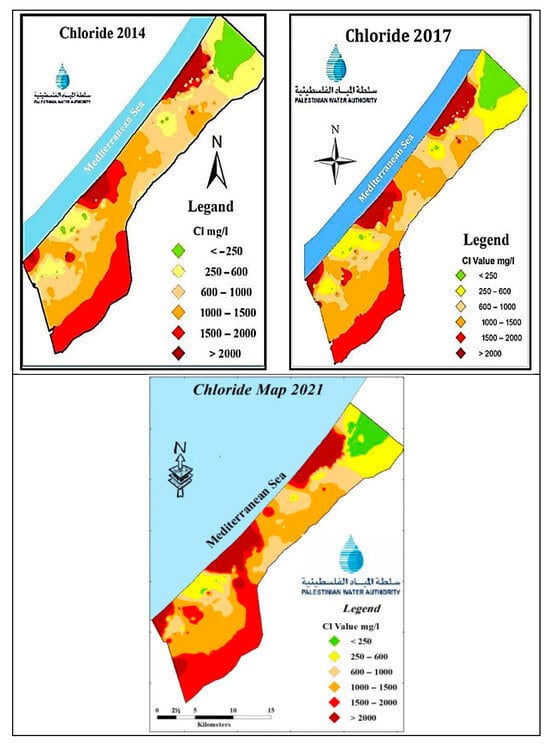
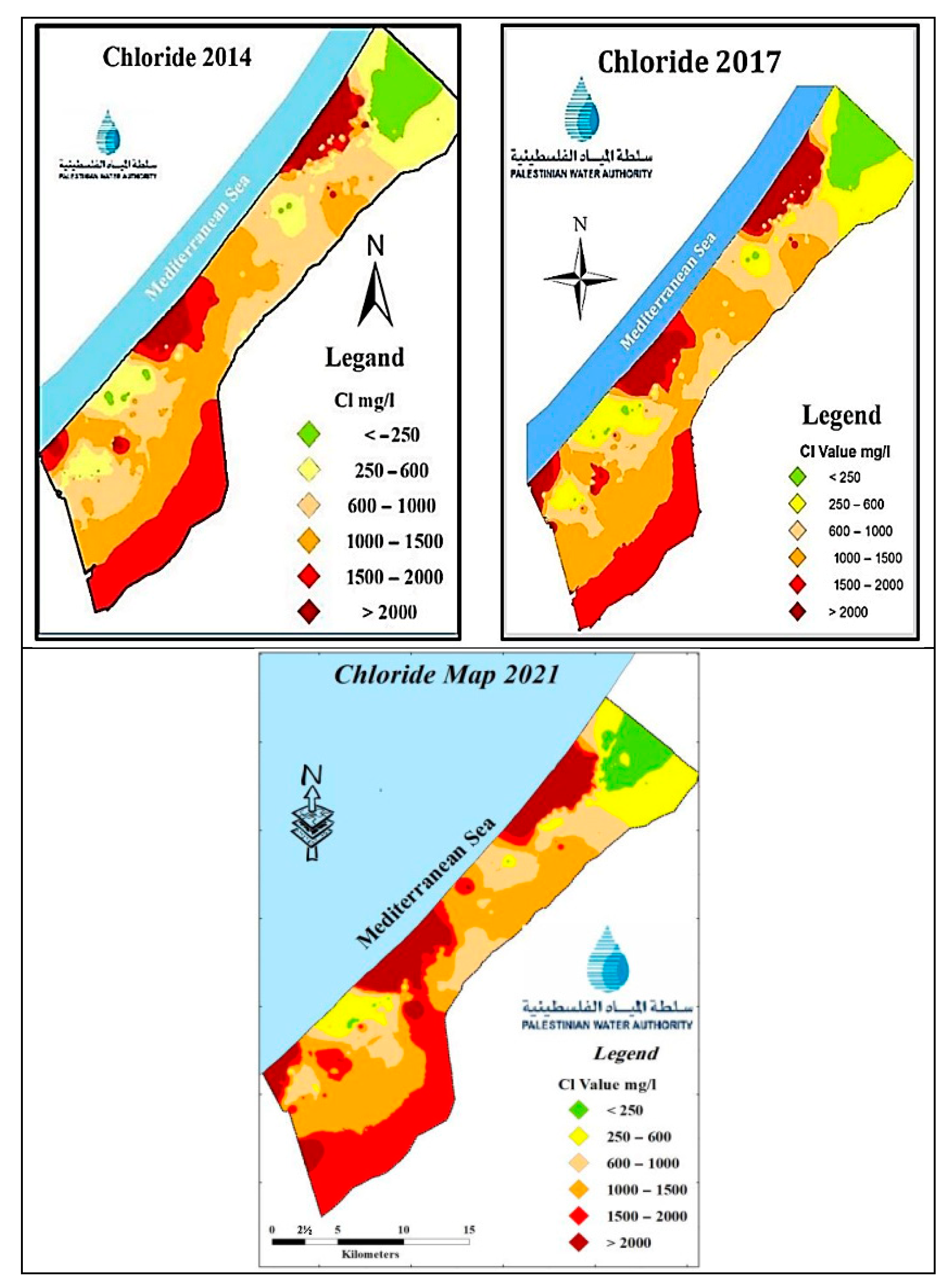
The water and sanitation system in the Gaza Strip has many problems that keep happening. These problems get worse because there are too many people, damage to the environment, and political problems. Before the war, Gaza usually got its water from a natural underground source called the Coastal Aquifer, found along the eastern coast of the Mediterranean Sea. For many years, overwhelming the groundwater led to sea intrusion and increases chloride (Figure 1). Reports from relevant Palestinian institutions indicated that 97% of its water was not safe for drinking [1]. Because of this, the area depended a lot on desalination plants.
Figure 1.
Interpolated map of chloride concentration (The map scale is marked at 0, 2.5, 10, and 15 km). Source: Palestinian water Authority [2].
Gaza used desalination plants to obtain safe drinking water. These plants are small- to medium-sized and were funded by donors from other countries. These plants were meant to provide people with clean drinking water, but they had a lot of problems that made it hard to work well. They often lost power, did get enough repairs and spare parts, which made it difficult to operate regularly. The largest desalination plant is located in Deir al-Balah, but it does run at full capacity because it does have enough power and fuel during the war [3].
Gaza’s water and sanitation sector was already affected by longstanding, multiple issues that severely degraded the quantity and quality of resources even before the war. The Coastal Aquifer became highly contaminated as a consequence of the substantial untreated sewage discharge, seawater intrusion, and agricultural runoff. What little remained of the aquifer’s water showed dangerously high levels of salinity and nitrates, creating serious health risks to those who drank this water. Some areas reported nitrate levels several times higher than the World Health Organization guidelines, contributing to a rise in the incidence of waterborne diseases, especially in children [4].
Israeli invasions have severely damaged vital infrastructure, especially water and sewage systems. Many of Gaza’s water facilities, like wells, pumping stations, sewage plants, and desalination plants, were destroyed or stopped working due to bombings, shelling, and ground war. Reports say that more than 70% of the water and sanitation systems in Gaza have been damaged since the recent war began [5]. This includes the damage of central wastewater treatment plants that were already running on limited resources because they did not have enough funding even before the war [2]. Because there are not enough treatment plants and the infrastructure is not suitable, untreated or partly treated sewage is dumped straight into the Mediterranean Sea. This pollutes the coast and makes the available water quality worse.
Also, the damage to water and sanitation systems has stopped basic services from being provided to many communities. Such problems with getting clean drinking water and proper bathrooms increase the chance of getting ill and make the public health situation even worse. International organizations such as UNICEF have reported that there are increasing health problems because many people do not have clean water and proper sanitation, especially in camps and crowded places where many displaced residents of Gaza are living [6].
Over 90% of the people in Gaza have been forced to leave their homes and are now living in small spaces or temporary shelters [7]. Basic water and sanitation facilities are often missing in these shelters, putting extra stress on systems that are already struggling. A big problem has occurred because many people are forced to seek refuge in temporary shelters. There is not enough clean water, bathrooms, or waste disposal systems, and this has caused a huge increase in the need for these services.
2. Methodology
The study used a mixed-methods approach [7] because it is hard to assess water and sanitation systems in places affected by war. The quantitative part looks at numbers related to how dirty the water is, how often people get sick from water, and how frequently there are problems with water services. This is done by using information from collected data, surveys, and reports from humanitarian organizations. The qualitative part involves in-depth interviews with key people, such as officials from the Palestinian Water Authority, members of the Gaza Municipality, workers from humanitarian organizations like UNICEF, UNRWA, ICRC, and OCHA, as well as local residents who are impacted.
Quantitative Data: A structured questionnaire (IBM SPSS Statistics version 29, 2023 analysis) was administered to 53 key stakeholders from the Palestinian Water Authority, Gaza Municipality, and humanitarian organizations.
Qualitative Data: In-depth, semi-structured interviews were conducted with officials and community leaders to capture nuanced operational challenges.
Comparative Analysis: Lessons were drawn from water, sanitation, and hygiene cluster (Water, Sanitation, and Hygiene-WASH) management in other war zones, such as Syria and Yemen, to contextualize the Gazan experience.
3. Results and Discussion
3.1. Pre-War Prepardness
The findings indicated a moderate level of institutional emergency preparedness prior to the war. While “Emergency plans were pre-developed in the institution before the war” showed the highest mean score (3.26) and relative weight (65.28%, p = 0.0355), suggesting adequate pre-planning, other critical aspects were found to be deficient. “Established partnerships with international organizations for rapid response” (mean = 2.98, 59.62%) lacked statistical significance (p = 0.8867), implying limited practical effectiveness. Furthermore, crucial areas such as “Staff were trained on emergency plans in advance” (mean = 2.64, 52.83%, p = 0.006), “Availability of reserve materials (spare parts, tools, backup fuel)” (mean = 2.36, 47.17%, p = 0.0002), and “Simulation drills were conducted to prepare for crises” (mean = 2.21, 44.15%, p = 0.0001) scored below average. This suggests that while a theoretical framework for emergency planning existed, there were substantial shortcomings in practical implementation, particularly concerning human resource development, logistical stockpiling, and operational readiness exercises. The data clearly indicates a critical gap between theoretical emergency planning and practical readiness. The questionnaire highlighted a lack of staff training, insufficient reserve materials, and ineffective international partnerships. Interviews corroborated these deficiencies by demonstrating the immediate and severe consequences, such as the inability to maintain services due to fuel and spare parts shortages. This suggests that preparedness efforts were either superficial or lacked the necessary resources and operationalization to withstand the shocks of war. A key takeaway is that preparedness must extend beyond mere documentation to include tangible investments in human capacity, logistical stockpiles, and robust, actionable partnerships.
3.2. Operational Challenges During the War
During the war, the emergency plans for the water and sanitation sector exhibited a mixed level of comprehensiveness and effectiveness. The development of plans with the “participation of multiple sectors concerned with water and sanitation” was highly rated (mean = 3.30, 66.04%, p = 0.02), indicating strong multi-sectoral engagement at the design stage. However, key elements for robust implementation were weak. Items such as “The plan allowed for the continuation of minimum water and sanitation services” (mean = 2.74, 54.72%, p = 0.04) and “The plan included a risk assessment and identified worst-case scenarios” (mean = 2.72, 54.34%, p = 0.04) revealed deficiencies in ensuring operational continuity and proactive risk management. Similarly, “The plan included the existence of spare parts warehouses” (mean = 2.57, 51.32%, p = 0.02) and “Previous wars were utilized as lessons in preparing the emergency plan” (mean = 2.64, 52.83%, p = 0.01) scored low, highlighting inadequate logistical preparedness and insufficient integration of past experiences. This indicates a gap between planning and effective execution during crises, particularly in maintaining essential services and learning from historical events. While multi-sectoral engagement in plan development was positive, the plans themselves proved inadequate in ensuring operational continuity and integrating risk assessment. The statistical findings on the lack of minimum service continuation and risk assessment were vividly illustrated by interviewees describing widespread water shortages and infrastructure damage. This points to a fundamental flaw in emergency planning: a failure to translate strategic intent into resilient operational frameworks capable of functioning under extreme duress. The emphasis on coordination in interviews, despite the questionnaire showing its weakness, suggests a recognized need that was not effectively met in practice.
The questionnaire unequivocally demonstrated that operational challenges during the war were severe and multifaceted, significantly impeding the delivery of WASH services. The most critical constraints identified were “Inability to access water sources such as wells and main pipelines in occupied and dangerous areas” (mean = 4.30, 86.04%, p < 0.0001), “Indiscriminate shelling impacted the safety of field teams” (mean = 4.19, 83.77%, p < 0.0001), and “Lack of materials and equipment delayed water network repairs” (mean = 4.15, 83.02%, p < 0.0001). These findings underscore the extreme physical and security-related obstacles. Other highly impactful factors included “Division and siege of areas hindered field teams’ access” (mean = 4.13, 82.64%, p < 0.0001), “Poor communication between staff due to frequent communication outages” (mean = 4.09, 81.89%, p < 0.0001), and “Fuel and resource shortages affected operational capacity” (mean = 4.06, 81.13%, p < 0.0001). These results collectively highlight a compounded effect of logistical breakdowns, insecurity, and human resource disruptions, further exacerbated by critical institutional and systemic weaknesses such as “Absence of emergency funding” (mean = 3.89, 77.74%, p < 0.0001) and “Weak coordination with relevant authorities” (mean = 3.87, 77.36%, p < 0.0001).
3.3. Evaluation of the Effectiveness of the Current Response and Post-War Recovery
The assessment of post-crisis response and recovery mechanisms revealed general weaknesses within the water and sanitation sector during the war. While “Funding proposals are being prepared” (mean = 3.26, 65.28%, p = 0.02) showed some proactive efforts towards securing future resources, most other aspects of effective response scored below average. Significant deficiencies were noted in “Emergency incidents are responded to effectively” (mean = 2.66, 53.21%, p = 0.01), “The plan included a clear component for recovery and reactivation” (mean = 2.66, 53.21%, p = 0.00), and “Damages are assessed regularly and urgently” (mean = 2.74, 54.72%, p = 0.01). The weakest dimensions were related to institutional coordination and operational follow-up, specifically “There is a reporting system and coordination of roles among the involved parties” (mean = 2.55, 50.94%, p < 0.0001) and “Regular follow-up is conducted on the status of pumping and treatment stations” (mean = 2.62, 52.45%, p = 0.00). These findings suggest that the sector’s emergency response was largely reactive and fragmented, with substantial shortcomings in inter-agency collaboration, monitoring, and comprehensive recovery planning, despite some efforts towards future funding and partial crisis management. Both the questionnaire and interviews painted a picture of a largely reactive and fragmented response, with significant shortcomings in coordination, monitoring, and comprehensive recovery planning. While efforts to secure funding were noted, the practical impact on the ground, as described by residents, was minimal. This suggests a disconnect between resource mobilization and effective service delivery. The emphasis by humanitarian organizations on the need for better coordination and flexible funding underscores the systemic nature of these weaknesses. Recovery efforts appear to be ad hoc rather than part of a cohesive, long-term strategy.
4. Conclusions
The findings unequivocally demonstrate that while foundational elements of preparedness and planning were nominally present, their practical implementation and inherent resilience were severely undermined by the harsh realities of war. Key deficiencies consistently identified across both data modalities include critical shortcomings in staff training, logistical readiness, operational continuity, and effective coordination. These internal vulnerabilities were profoundly exacerbated by overwhelming external barriers, such as severe access restrictions, pervasive insecurity, and acute resource shortages.
The strong convergence between the statistical evidence derived from the questionnaire and the lived experiences articulated by diverse stakeholders, including the Coastal Municipal Water Utility (CMWU), Gaza Municipality representatives, humanitarian organizations (UNICEF), and local residents/community leaders, underscores the critical urgency of addressing these systemic weaknesses. The analysis reveals that the prevailing response mechanisms within the WASH sector have been largely reactive and fragmented, consistently failing to provide consistent and adequate services to the affected population. This reactive posture has led to a perpetual state of crisis management rather than proactive resilience building.
Specifically, the study highlights that pre-war preparedness efforts, though documented, lacked tangible investment in human capacity, logistical stockpiles, and actionable partnerships. Emergency plans, while developed with multi-sectoral engagement, proved inadequate in ensuring operational continuity and integrating robust risk assessment, leading to widespread service disruptions. The overwhelming operational barriers, primarily driven by war dynamics, consistently impeded the delivery of essential WASH services, demonstrating that internal improvements alone are insufficient without addressing the external environment. Furthermore, the assessment of response and recovery mechanisms revealed significant shortcomings in coordination, monitoring, and comprehensive long-term planning, with a notable disconnect between resource mobilization and effective service delivery on the ground.
In essence, the research confirms that the WASH sector in Gaza operates within a highly vulnerable and constrained environment, where pre-existing fragilities are amplified by war. The current state necessitates a fundamental paradigm shift from theoretical planning to tangible, actionable preparedness, coupled with the development of resilient emergency plans that prioritize operational continuity and integrated risk management.
5. Recommendations
Based on the integrated analysis and the critical findings, the following scientifically sound and actionable recommendations are put forth to enhance the resilience, effectiveness, and sustainability of WASH services in war-affected areas like the Gaza Strip. These recommendations are structured to address the immediate humanitarian needs:
- Strengthening Practical Preparedness and Operational Readiness
Strategic Stockpiling and Decentralized Warehousing: Establish and maintain secure, strategically located, and decentralized warehouses for essential spare parts, critical equipment, water treatment chemicals, and emergency fuel. This pre-positioning of resources is crucial to mitigate supply chain disruptions during wars and blockades, ensuring rapid access to necessary materials for repairs and operations. Inventory management systems should be robust to track and replenish these stocks efficiently.
Development of Actionable and Adaptive Partnerships: Foster and regularly test partnerships with a diverse range of stakeholders, including international humanitarian organizations, local NGOs, governmental bodies, and private sector entities. These partnerships must be formalized with clear roles, responsibilities, and pre-agreed protocols for rapid response, resource sharing, and joint needs assessments. The focus should be on building trust and interoperability to enhance practical effectiveness during crises.
- Addressing Overarching Operational Barriers and External Impediments
Sustained Advocacy for Unimpeded Access and Protection: International and local actors must engage in continuous and robust advocacy efforts to ensure unimpeded access for WASH personnel, supplies, and equipment into and within war zones. Furthermore, strong advocacy is needed for the protection of critical WASH infrastructure and field teams under international humanitarian law, preventing their targeting or destruction during hostilities.
Author Contributions
Conceptualization, S.Y.I. and H.A.-N.; methodology, S.Y.I.; software, S.Y.I.; validation, S.Y.I. and H.A.-N.; formal analysis, S.Y.I.; investigation, S.Y.I.; resources, S.Y.I.; data curation, S.Y.I.; writing—original draft preparation, S.Y.I.; writing—review and editing, H.A.-N.; visualization, S.Y.I.; supervision, H.A.-N.; project administration, S.Y.I. All authors have read and agreed to the published version of the manuscript.
Funding
This research received no external funding.
Institutional Review Board Statement
The study was conducted in accordance with the Declaration of Helsinki, and approved by the Institutional Review Board of the Islamic University of Gaza (IUG-ENG-2026-WASH01, 15 January 2026).
Informed Consent Statement
Informed consent was obtained from all subjects involved in the study.
Data Availability Statement
The data presented in this study are available on request from the corresponding author. The data are not publicly available due to privacy and ethical restrictions related to the interviewed participants.
Conflicts of Interest
The authors declare no conflicts of interest.
References
- Middle East Institute. The Devastating Impact of Gaza’s Acute and Prolonged Water Crisis. 2023. Available online: https://www.mei.edu/publications/devastating-impact-gazas-acute-and-prolonged-water-crisis (accessed on 1 October 2025).
- Available online: https://reliefweb.int/sites/reliefweb.int/files/resources/gaza_water_resources_status_report_2017.pdf (accessed on 1 October 2025).
- UNICEF. Water, Sanitation, and Hygiene in Emergencies: A Global Perspective. 2022. Available online: https://www.unicef.org/media/120446/file/UNICEF%20WASH%20HAC%202022.pdf (accessed on 1 October 2025).
- United Nations Environment Program (UNEP). What Is Integrated Water Resources Management? 2024. Available online: https://www.unep.org/explore-topics/disasters-conflicts/where-we-work/sudan/what-integrated-water-resources-management (accessed on 1 October 2025).
- UNICEF. WASH and Peacebuilding Guidance. 2022. Available online: https://knowledge.unicef.org/wash/wash-peace-guidance-and-tools (accessed on 1 October 2025).
- Associated Press. Israel-Hamas War: Gaza Destruction Captured in Satellite Photos. AP News. 31 March 2025. Available online: https://apnews.com/article/israel-hamas-war-gaza-destruction-satellite-photos-90093bca75d28af6193c21b9d1b5eaed (accessed on 1 October 2025).
- Caruth, G.D. Demystifying Mixed Methods Research Design: A Review of the Literature. Mevlana Int. J. Educ. (MIJE) 2013, 3, 112–122. Available online: https://files.eric.ed.gov/fulltext/ED544121.pdf (accessed on 1 October 2025). [CrossRef] [Scilit]
Disclaimer/Publisher’s Note: The statements, opinions and data contained in all publications are solely those of the individual author(s) and contributor(s) and not of MDPI and/or the editor(s). MDPI and/or the editor(s) disclaim responsibility for any injury to people or property resulting from any ideas, methods, instructions or products referred to in the content. |
© 2026 by the authors. Licensee MDPI, Basel, Switzerland. This article is an open access article distributed under the terms and conditions of the Creative Commons Attribution (CC BY) license.