


Abstract
In the Czech Republic, water balance assessments still rely on an outdated method for estimating evaporation losses from open water surfaces. To address this limitation, we developed floating evaporimeters that directly measure evaporation from the water surface of specific water bodies under real conditions. This paper introduces the design and operating principles of the floating evaporimeters and highlights their main advantages, including higher accuracy, site-specific applicability, and improved representation of actual evaporation processes relevant for contemporary water management practice.
1. Introduction
The Czech Republic has experienced measurable climate change in recent decades, with mean air temperatures increasing by more than 2 °C over the past 60 years, contributing to enhanced evaporative water losses across landscapes and water surfaces alike [1]. These trends are important because water balance in temperate regions is governed by the interplay of precipitation and evaporation, and an increase in evaporative demand—particularly at open water surfaces—can substantially affect hydrological budgets, reservoir storage, and water availability for societal and ecological needs [2,3].
Evaporation from open water surfaces (free water level evaporation) is a key component of landscape water balance and has been shown to increase under current climatic conditions in the Czech Republic [4,5]. Traditional hydrological assessments often rely on empirical models or simplified calculations to estimate evaporation from water bodies, typically tied to long-term climatic averages rather than direct, site-specific observation [2,6]. These approaches are often embedded in technical standards but are based on outdated empirical relationships that do not fully capture recent climate trends.
National technical standards provide general guidance for water management, but contemporary methods for calculating open water evaporation that account for climate change and site-specific conditions are lacking [5]. Calculation procedures often rely on legacy techniques and simplified temperature-based relationships, which may systematically underestimate real water losses from reservoirs and ponds, especially under warming conditions.
Direct field measurements of actual evaporation remain uncommon in routine practice, partly due to technical and resource limitations associated with conventional instruments such as Class-A pans or energy-budget systems [3,7]. However, the need for accurate, real-time measurements has grown as model estimates increasingly diverge from observed hydrological behavior [8].
To address this gap, floating evaporimeters were developed and deployed to monitor evaporative fluxes at the water–air interface directly. These instruments combine continuous measurement of water surface evaporation with meteorological parameters, enabling characterization of site-specific evaporation processes under contemporary climatic dynamics [3]. Preliminary deployments at Vavřinecký Pond in Central Bohemia show that direct evaporation measurements often exceed traditional estimates, particularly during periods of high evaporative demand [3].
This paper introduces the design, implementation, and calibration of floating evaporimeters and evaluates their advantages for improving water balance practices in the Czech Republic under changing climate conditions.
2. Background and Existing Approaches
Accurate quantification of evaporation from open water surfaces is essential for hydrological modeling and water balance assessments, particularly under changing climatic conditions. Direct measurement is technically challenging, so indirect methods have historically been used.
Pan evaporation measurements are common, where standard pans infer open water losses through empirical coefficients calibrated for local conditions. This method is simple and cost-effective but can be inaccurate due to differences in heat storage, wind exposure, and humidity dynamics between pans and actual water bodies [9].
Energy balance and combination methods, such as the Penman and Penman–Monteith equations, estimate potential evaporation using meteorological observations (temperature, radiation, humidity, wind speed) [9,10]. These methods are more accurate but rely on precise input data and assumptions, which can introduce errors when applied to specific reservoirs.
Other methods include mass balance, bulk transfer, energy-budget, and equilibrium temperature approaches, each with different data requirements and complexity [10]. Mass balance methods require detailed inflow, outflow, and storage data; bulk transfer methods depend on accurate meteorological measurements; energy balance methods require comprehensive instrumentation.
Empirical approaches embedded in national technical norms often lag behind current understanding of evaporation processes. In the Czech Republic, ČSN 75 2405 provides general design guidance but does not incorporate climate-responsive evaporation methods [4,5]. Observed evaporation frequently exceeds standard estimates, highlighting the need for site-specific measurement.
These limitations motivate the use of direct measurement systems, such as floating evaporimeters, which provide accurate, high-resolution data and capture actual water losses from open water surfaces under a warming climate.
3. Methodology
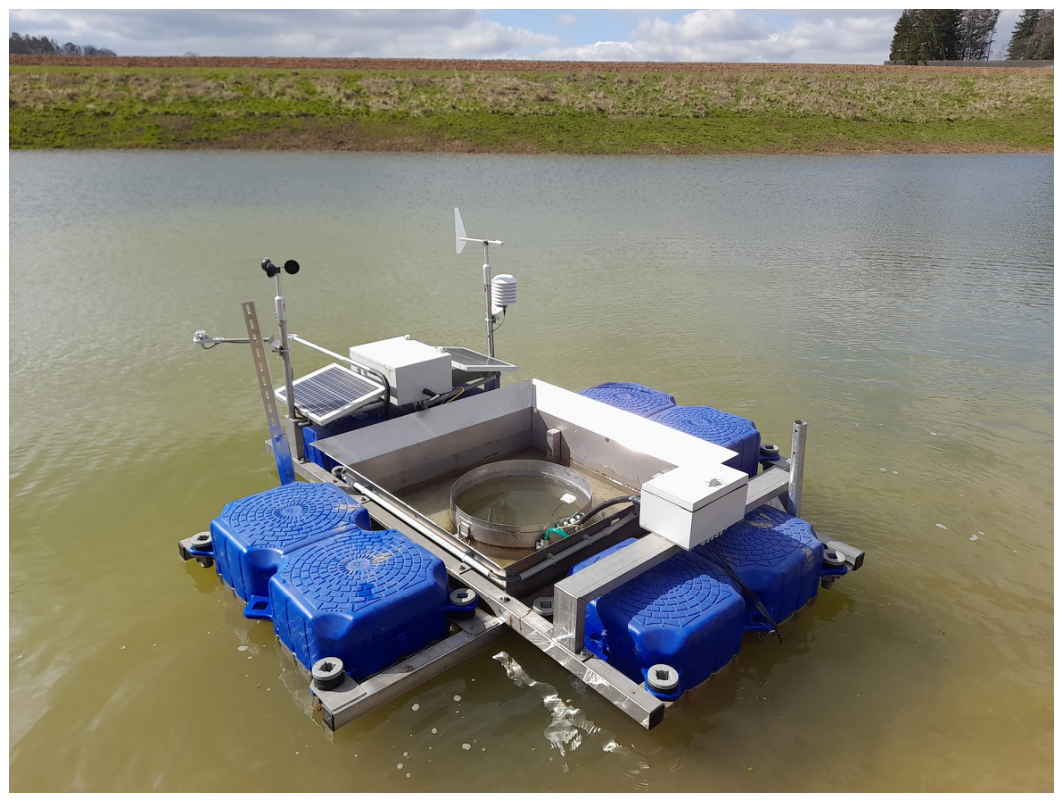
A floating evaporimeter was deployed to measure evaporation directly from open water surfaces. The instrument floats freely while being anchored to prevent drifting, and its structure allows for rotation and tilt in response to wind and waves (Figure 1).
Figure 1.
Floating evaporimeter on a water body.
The device integrates sensors for water level, water temperature, air temperature, relative humidity, wind speed and direction, solar radiation, and rainfall. A water surface sensor measures vapor flux directly, while energy balance is continuously monitored to derive evaporation rates. The system is powered by solar panels and records data automatically at predefined intervals, enabling long-term deployment without frequent maintenance.
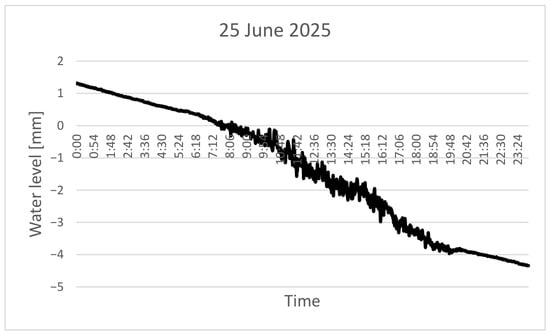
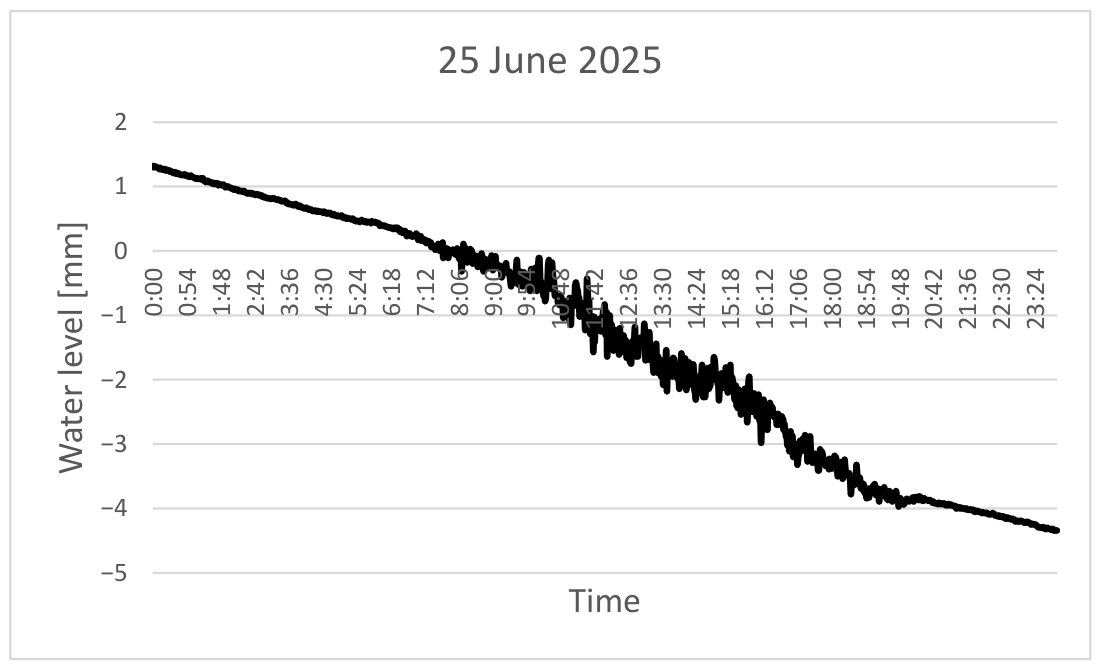
Deployments over the past seven years in the Czech Republic have captured seasonal and diurnal variability in evaporation, with measurements typically recorded every 10–30 min. Figure 2 illustrates a one-day record of evaporation at 1 min intervals, demonstrating high temporal resolution and direct observation of site-specific water losses.
Figure 2.
Example of one-day (25 June 2025) evaporation on a 1 min step. Slight oscillations of the water surface are observed during daytime, caused by light wind.
The floating evaporimeter is robust and adaptable, functioning under varying water levels and climatic conditions. Its compact design minimizes interference with the water body, and the anchoring system ensures stability while maintaining sensitivity to natural surface movements.
4. Validation and Results
Validation was performed using data from a floating evaporimeter deployed on a reservoir in the Lužnice River basin in 2024 [11]. The instrument recorded water level changes, water temperature, air temperature, relative humidity, wind speed, wind direction, solar radiation, and rainfall.
During April–November 2024, observed monthly evaporation exceeded long-term normative estimates by nearly 100 mm. The average evaporation from the 23 ha reservoir was 6.4 L/s, peaking at approximately 10 L/s in June and July, resulting in a total water loss of 136,000 m3 over the monitoring period.
Comparison with four empirical equations derived from the Hlasivo monitoring station showed that formulas based on water temperature and air temperature provided the most accurate estimates, while those incorporating wind speed or solar radiation had higher discrepancies due to local measurement differences.
Applying the air temperature-based equation to 29 reservoirs in the Lužnice basin yielded an estimated annual evaporation of 27.8 million m3, compared to 23.4 million m3 calculated from long-term norms. Peak deviations occurred in August (0.63 m3/s), September (0.43 m3/s), and October (0.44 m3/s), representing a significant adjustment to water balance calculations, particularly in basins with a high proportion of surface water.
These results demonstrate that floating evaporimeters provide reliable, high-resolution data, enhancing the accuracy of water balance estimates and highlighting the need to revise traditional normative approaches [11].
5. Discussion and Conclusions
This study provides clear evidence that direct, high-resolution measurements of evaporation can significantly improve the accuracy of water balance assessments compared to traditional normative approaches. At the same time, it demonstrates that incorporating floating evaporimeters into routine monitoring can lead to more reliable water management decisions under conditions of ongoing climate change.
In a changing climate, traditional methods based on long-term averages are insufficient to capture actual water losses from open water surfaces. Floating evaporimeters provide direct, high-resolution measurements of evaporation at the water–air interface, yielding accurate, site-specific assessments that reflect real water loss dynamics.
This methodology improves hydrological and water balance calculations, offering a clearer understanding of evaporation volumes and their effects on reservoirs and rivers. The floating evaporimeter is adaptable to different water bodies, operates autonomously via solar power, and minimally interferes with natural conditions, making it suitable for application globally.
In areas with high proportions of surface water, where evaporation can represent a significant fraction of total water volume, floating evaporimeters are particularly valuable for water management, drought planning, and ecological flow assessment. Overall, these devices offer a practical, robust, and universally applicable tool for modern water management, enhancing decision-making under increasing climatic variability.
Author Contributions
Conceptualization, A.B., A.V., R.K. and P.P.; methodology, A.B., A.V., R.K. and P.P.; validation, A.B., A.V., R.K. and P.P.; formal analysis, A.B., A.V., R.K. and P.P.; investigation, A.B., A.V., R.K. and P.P.; resources, A.B., A.V., R.K. and P.P.; data curation, A.B., A.V., R.K. and P.P.; writing—original draft preparation, A.B.; writing—review and editing, A.B., A.V., R.K. and P.P.; visualization, A.B.; supervision, A.B.; project administration, A.B. and A.V. All authors have read and agreed to the published version of the manuscript.
Funding
This research was funded by the Technology Agency of the Czech Republic within the grants “Water Systems and Water Management in the Czech Republic in Conditions of Climate Change” (SS02030027) and “Prediction, Evaluation and Research for Understanding National sensitivity and impacts of drought and climate change for Czechia” (SS02030040).
Institutional Review Board Statement
Not applicable.
Informed Consent Statement
Informed consent was obtained from all subjects involved in the study.
Data Availability Statement
The data presented in this study are available upon request from the corresponding author.
Conflicts of Interest
The authors declare no conflict of interest.
References
- Ball, R. Regulation of atmospheric carbon dioxide by vegetation fires. Clim. Res. 2014, 59, 125–133. [Google Scholar] [CrossRef] [Scilit]
- Žalud, Z.; Trnka, M.; Hlavinka, P.; Dubrovský, M.; Svobodová, E.; Semerádová, D.; Bartošová, L.; Balek, J.; Eitzinger, J.; Možný, M. Climate Change Impacts on Czech Agriculture. In Climate Change—Socioeconomic Effects, 1st ed.; Kheradmand, H., Blanco, J.A., Eds.; Intech Open: Rijeka, Croatia, 2011; pp. 251–278. [Google Scholar]
- Beran, A.; David, V.; Tyl, R. Direct monitoring of water vapor from the free water level of the Vavřinecký pond and its influence on the hydrological balance. Vodohospod. Tech.-Ekon. Inf. 2023, 65, 4–8. [Google Scholar]
- Melišová, E.; Vizina, A.; Hanel, M.; Pavlík, P.; Šuhájková, P. Evaluation of Evaporation from Water Reservoirs in Local Conditions at Czech Republic. Hydrology 2021, 8, 153. [Google Scholar] [CrossRef] [Scilit]
- ČSN 75 2405; Water Reservoirs—Basic Design Parameters. Czech Office for Standards, Metrology and Testing: Prague, Czech Republic, 2011.
- Šuhájková, P. Výpar z výparoměrných stanic VÚV TGM. Vodohospod. Tech.-Ekon. Inf. 2020, 62, 16–27. [Google Scholar] [CrossRef] [Scilit]
- Penman, H.L. Natural evaporation from open water, bare soil and grass. Proc. R. Soc. Lond. A 1948, 193, 120–145. [Google Scholar] [CrossRef] [Scilit]
- Akhter, M.; Ahanger, M.A. Uncertainty in Evapotranspiration Inputs Impacts Hydrological Modeling. Water Sci. Technol. 2025, 91, 235–251. [Google Scholar] [CrossRef] [Scilit] [PubMed]
- Jensen, M.E.; Wright, J.L. Estimating evaporation from water surfaces. In Proceedings of the CSU/ARS Evapotranspiration Workshop, Fort Collins, CO, USA, 15 March 2010. [Google Scholar]
- McJannet, D.L.; Cook, F.J.; Burn, S. Comparison of techniques for estimating evaporation from open water. Water Resour. Res. 2013, 49, 1–15. [Google Scholar]
- Nesládková, M.; Ledvinka, V. Water management balance assessment in watersheds with higher proportion of water bodies under conditions of climate change. In Proceedings of the Magdeburg Water Protection Seminar 2025, Magdeburg, Germany, 8–9 October 2025; pp. 85–88. [Google Scholar]
Disclaimer/Publisher’s Note: The statements, opinions and data contained in all publications are solely those of the individual author(s) and contributor(s) and not of MDPI and/or the editor(s). MDPI and/or the editor(s) disclaim responsibility for any injury to people or property resulting from any ideas, methods, instructions or products referred to in the content. |
© 2026 by the authors. Licensee MDPI, Basel, Switzerland. This article is an open access article distributed under the terms and conditions of the Creative Commons Attribution (CC BY) license.