


Abstract
Ports are cyber-physical systems, and compromising them has physical consequences: paralysed cranes, blocked gates and cargo that does not move. Research on protecting them remains divided between cybersecurity engineering, port management and supply chain studies, with no shared unit of analysis. This review adopts the maritime port supply chain as that unit and asks which vulnerabilities and threat vectors are specific to its IT and operational technology (OT) environments, which regulatory instruments apply and how they interrelate, and which resilience strategies the literature supports, and on what kind of evidence. A combined bibliometric and qualitative review design was adopted to provide both a macro-level overview of the field and an in-depth examination of the technical and regulatory evidence. In total, 21,268 records were retrieved from Scopus and the Web of Science, of which 14,659 remained after deduplication and the application of a 2010 lower bound. The corpus was mapped with bibliometrix and VOSviewer and examined qualitatively alongside relevant regulatory instruments. Five thematic clusters emerge, showing a temporal shift from SCADA and infrastructure protection towards intrusion detection, IoT and machine learning. Exposure is cumulative: IT enables access, OT determines consequence, and software supply chains propagate both. The regulatory regime remains ship-biassed, with the main gap lying in implementation rather than in the absence of instruments. The controls most consistently recommended are architectural and organisational rather than novel, but only one of the thirteen appraised is supported by three or more independent sources generated in port or maritime settings. A framework for proactive port cyber resilience is proposed.
1. Introduction
1.1. Background
Maritime transport remains the backbone of the global economy: more than 80% of world merchandise trade by volume is carried by sea, and virtually all of it passes through ports at least twice on its journey from producer to consumer [1]. Maritime logistics is, in this sense, a dyadic system in which the ship and the port terminal jointly give operational meaning and material support to the movement of goods, and the criticality of ports for international trade and global supply chains has been quantified at the network level [2]. Within this system, seaports operate simultaneously as modal nodes of international trade and as dense agglomerations of industrial, logistical and informational activity. Over the past two decades, the sector has undergone an accelerated process of digitalisation, automation and hyperconnection associated with the fourth industrial revolution, encompassing Port Community Systems (PCS), Terminal Operating Systems (TOS), automated cranes and gates, and increasingly pervasive industrial Internet of Things (IIoT) deployments [3,4]. The resulting ‘smart port’ paradigm pursues measurable gains in throughput, energy efficiency and berth productivity [5,6].
This transformation, however, has a structural counterpart: every newly connected system enlarges the sector’s attack surface. The empirical record leaves little room for doubt. The 2017 NotPetya incident propagated through a compromised software update and paralysed the terminal operations of A.P. Møller-Maersk across four countries, with direct losses estimated at USD 250–300 million for a single firm [7]. Globally, the average cost of a data breach reached USD 4.88 million in 2024, the highest figure on record [8], while network-based modelling shows that the failure of a handful of systemically important ports would propagate measurable losses through international supply chains [2]. Hence the central paradox of port digitalisation: the same connectivity that generates efficiency simultaneously generates exposure, and the gap between the speed of technology adoption and the maturity of its protection continues to widen [9,10].
1.2. Problem Statement
The core of the problem resides in the convergence of information technology (IT) and operational technology (OT). Port operations increasingly couple enterprise systems, booking platforms, customs interfaces, and community systems with the industrial control systems that move cranes, gates, conveyors and energy infrastructure [11,12]. This convergence dissolves the historical separation between the informational and the physical: a phishing email or a poisoned software dependency can now culminate in immobilising physical cargo-handling assets. Because ports are deeply interdependent nodes, local compromise propagates systemically; pandemic-era disruptions demonstrated how quickly port-level shocks cascade into global supply chain instability [13]. The risk consequently exceeds the economic sphere. States have progressively designated ports as critical infrastructure whose degradation bears on national security, public safety and strategic autonomy, a recognition codified in instruments such as the second Network and Information Security Directive (NIS 2) in the European Union (EU) [14,15,16]. Protecting port supply chains is therefore no longer a private operational concern but a matter of public policy.
1.3. Research Gap
Scholarly attention to maritime cybersecurity has grown markedly, and several reviews have begun to organise the literature. Bolbot et al. [17] combined a systematic review with bibliometric analysis to map research directions across the maritime domain; Larsen and Lund [18] synthesised the literature on cyber risk perception; Ben Farah et al. [19] surveyed attack typologies and defensive technologies; and Vaarandi et al. [20] reviewed security monitoring architectures. In parallel, the supply chain management literature has consolidated its own stream on cyber risk [21,22,23,24,25,26,27,28,29,30,31,32]. Yet, as Table 1 summarises, these contributions remain fragmented across three weakly connected domains: cybersecurity engineering, port management and logistics research. None takes the maritime port supply chain as its analytical unit, and none integrates the three questions that practitioners and regulators must answer jointly: which vulnerabilities and threat vectors are specific to port IT/OT environments; which regulatory frameworks and standards apply to them; and which risk management and resilience strategies enjoy empirical support. The absence of an integrated, methodologically transparent systematisation of this triad constitutes the research gap that the present review addresses.
Table 1.
Prior reviews related to the field and their scope, compared with the present review.
1.4. Research Aim, Objectives and Research Questions
The aim of this study is to characterise and systematise the field of cybersecurity and resilience in maritime port supply chains, integrating evidence dispersed across the cybersecurity, port management and logistics studies. The review pursues three specific objectives, formalised as research questions (RQs) that structure the analysis throughout the paper:
- RQ1. Which vulnerabilities and threat vectors are specific to the IT and OT environments of maritime port supply chains?
- RQ2. Which regulatory frameworks and standards are applicable to the cybersecurity of ports and their supply chains, and how do they interrelate?
- RQ3. Which risk management and cyber resilience strategies does the literature support, and at what level of evidence?
To answer these questions, a mixed-methods design was adopted, structured in three phases: a systematic search of the Scopus and Web of Science databases; a bibliometric co-occurrence analysis of author keywords using VOSviewer version 1.6.21 [33] and the bibliometrix package [34]; and a narrative thematic synthesis of the principal research fronts, with the selection process documented in accordance with standard systematic review guidelines [35]. These research questions reappear verbatim in the results sections, where each is answered in turn.
1.5. Contributions
The study makes four contributions to the literature:
- It provides the first bibliometric map that takes the maritime port supply chain, rather than the smart port or the vessel, as its unit of analysis;
- It develops a taxonomy of attacks organised by target asset and by the confidentiality, integrity or availability pillar affected, distinguishing IT from OT environments;
- It offers a comparative analysis of the applicable regulatory frameworks and standards (IMO instruments, NIS 2, ISO/IEC 27001, IEC 62443, NIST frameworks), exposing overlaps and gaps in their coverage of port supply chains; and
- It proposes a framework for proactive port cyber resilience that integrates organisational, technical and governance dimensions, together with a research agenda for the field.
1.6. Structure of the Paper
The remainder of the paper is organised as follows. Section 2 establishes the conceptual background, defining the constructs that underpin the review and articulating them into a guiding framework. Section 3 details the methodology. Section 4 reports the bibliometric results. Section 5 presents the thematic synthesis addressing RQ1, RQ2 and RQ3, covering threat vectors, regulatory frameworks and resilience strategies. Section 6 discusses the findings, Section 7 outlines the research agenda and presents the proposed framework, and Section 8 concludes.
2. Conceptual Background
2.1. Cybersecurity in Logistics and Supply Chains: Foundational Concepts
Cybersecurity is conventionally defined as the protection of information and of the systems that process it against compromise of confidentiality, integrity and availability (the CIA triad), although the concept extends beyond information security to encompass the protection of cyber-enabled physical assets and of the humans who operate them [36]. Cyber risk, in turn, is understood as the expected consequence of a threat exploiting a vulnerability in an asset, combining likelihood and impact; in supply chain settings this risk is distinctive because exposure is shared across organisational boundaries, so that the security posture of any firm is bounded by that of its weakest partner [21,37]. The attack surface denotes the totality of points through which an adversary can attempt entry (interfaces, devices, protocols, credentials and third-party connections) and grows monotonically with digitalisation and interconnection [22].
A construct of particular salience for this review is the software supply chain: the chain of dependencies, build systems and update channels through which modern software is assembled and distributed. Attacks that inject malicious code upstream, in open-source dependencies, vendor updates or build pipelines, inherit the trust placed in legitimate software and propagate downstream to every consumer [38,39]. Such attacks are amongst the most consequential contemporary vectors precisely because they bypass perimeter defences [40], and their governance has prompted dedicated guidance such as NIST SP 800-161 on cybersecurity supply chain risk management [41]. Throughout the review, these concepts are used operationally: they define the unit of exposure (the port supply chain), the mechanism of compromise (vulnerability exploitation across IT, OT and software layers) and the object of protection (continuity of critical port functions).
2.2. Maritime Ports as Critical Infrastructure and Cyber-Physical Systems
A contemporary port is best conceptualised as a system of systems in which informational and physical processes are inseparable. Table 2 summarises its core digital systems. PCS provide the single-window layer through which carriers, terminals, customs and freight forwarders exchange commercial and regulatory data; TOS plan and control berth, yard and gate operations in real time; Supervisory Control and Data Acquisition (SCADA) systems and programmable logic controllers (PLC) supervise cranes, conveyors, refrigerated containers and energy systems; and the navigational layer, comprising the Automatic Identification System (AIS), the Electronic Chart Display and Information System (ECDIS) and Global Navigation Satellite Systems (GNSS), connects the port to the ships it serves [3,42]. Each of these systems has documented weaknesses: AIS lacks message authentication and is trivially spoofable [43,44]; ECDIS installations frequently run obsolete operating systems exposed through chart-update channels [45]; and GNSS positioning and timing signals can be jammed or counterfeited [46].
Two properties follow. First, the port is a cyber-physical system: computation, networking and physical processes are coupled, so that digital compromise manifests as physical consequence (paralysed cranes, blocked gates, misrouted cargo) [47,48]. Within this coupling, the vessel deserves a distinct reading. When a ship berths, it docks digitally as well as physically, exchanging manifests, stowage plans and navigational data with the terminal that receives it; the ship can therefore be understood as a berthing vector into port infrastructure, a mobile carrier of compromise that reaches shore-side systems through the legitimate interfaces on which cargo operations depend [45,49]. Second, the port is critical infrastructure: its sustained disruption degrades functions essential to society and the economy, which is why ports fall squarely within contemporary critical infrastructure protection regimes and their escalating regulatory obligations [14,49]. The combination of the two properties, physical consequence and societal criticality, is what distinguishes port cybersecurity from generic enterprise security and motivates the dedicated analysis undertaken in this review. Port criticality is not solely operational. Ports are embedded in urban and institutional settings in which the continuity of port functions is negotiated among operators, authorities, residents and other stakeholder groups, and in which sustainability and legitimacy objectives condition what port governance is able to implement. Recent evidence from Piraeus shows that stakeholder assessments of port-related impacts diverge systematically between those groups, and that governance arrangements which do not incorporate them generate friction in planning and implementation [50]. A disruption of port functions is therefore simultaneously an operational, an economic and a port-city event, and the coordination capacity that governs the latter is the same capacity on which collective cyber preparedness depends.
Table 2.
Core digital systems of the maritime port and illustrative threat vectors.
2.3. IT/OT Convergence and OT/ICS Security
IT security practice does not transfer directly to operational technology and its industrial control systems (ICS), and the reasons are structural rather than incidental (Table 3). Where IT prioritises confidentiality, OT prioritises availability and safety: a control loop that halts is itself the harm, independently of any data loss [12]. OT assets live for decades, embed legacy components and run industrial protocols (Modbus, DNP3 and their relatives) that were designed for closed, trusted networks and therefore lack authentication and encryption [52,54]. Patching is constrained by downtime costs, vendor certification and safety revalidation, so known vulnerabilities persist far longer than in IT estates [11,55].
Table 3.
Contrasting security paradigms of IT and OT/ICS environments.
Historically, these weaknesses were tolerated because OT networks were physically isolated. That assumption has eroded: business demand for operational data, remote maintenance access and IIoT instrumentation has multiplied the connections between enterprise and control networks, while flat internal architectures permit lateral movement once a perimeter is breached [13,56]. The threat vectors characteristic of OT environments follow from this configuration: ingress from compromised IT segments, abuse of remote access channels, exploitation of unauthenticated industrial protocols, malicious or accidental insider action, and supply chain compromise of devices and software embedded in long-lived assets. In ports, where terminal automation has advanced rapidly atop legacy control layers, this IT/OT seam constitutes the principal axis of exposure examined under RQ1.
2.4. Cyber Resilience: Definitions and Dimensions
Cyber resilience is the capacity of a system to anticipate adverse cyber events, to withstand them while sustaining essential functions, to recover those functions rapidly, and to adapt its structure and behaviour in the light of what occurred [57,58]. The construct is explicitly distinct from cybersecurity. Security is preventive in orientation: it seeks to reduce the probability of compromise. Resilience, by contrast, assumes that compromise will eventually occur, an assumption amply justified by the incident record, and shifts the analytical focus from the perimeter to the continuity of critical functions under degraded conditions [59,60]. The four canonical dimensions (anticipate, withstand, recover, adapt) span the temporal arc of an incident and map onto distinct capabilities: threat intelligence and preparedness; redundancy, segmentation and graceful degradation; incident response and restoration; and organisational learning.
Two features of the resilience literature matter for this review. First, resilience is a socio-technical property: empirical studies consistently find that organisational dimensions (governance, training, supplier management, incident exercises) explain resilience outcomes at least as strongly as technical controls [61,62]. Second, measurement remains immature: systematic assessments find a proliferation of frameworks with limited validation, which complicates the comparison of strategies across studies and motivates the four-level evidence-appraisal scheme defined in Appraisal of the Strength of Evidence Section and applied under RQ3.
2.5. Conceptual Framework of the Review
Figure 1 articulates the four constructs above into the framework that guides the review. The digitalised port supply chain (Section 2.2) constitutes the object of protection; IT/OT convergence (Section 2.3) is modelled as the principal amplifier of its attack surface, through which the dominant threat vectors operate: ransomware, software supply chain compromise, navigation spoofing and the exploitation of legacy OT (RQ1). The regulatory and governance layer (International Maritime Organization (IMO) instruments, the NIS 2 Directive, ISO/IEC 27001, IEC 62443 and the National Institute of Standards and Technology (NIST) frameworks) conditions both the obligations and the capabilities of port actors (RQ2). Cyber resilience (Section 2.4) is positioned as the desired emergent property of the whole socio-technical system, realised through strategies whose empirical support the review evaluates (RQ3), and feeding back, through adaptation, into the configuration of the port system itself. The framework thus expresses the central claim developed throughout the paper: protection of port supply chains is shifting from an infrastructure-centred to a holistic conception in which organisational, technical and governance dimensions are jointly necessary.
Figure 1.
Conceptual framework of the review. Source: compiled by the authors.
3. Methodology
3.1. Research Design
This study adopts a mixed-methods review design articulated in three sequential and mutually reinforcing phases: (i) a systematic and fully documented search of the literature; (ii) a quantitative bibliometric analysis of the resulting corpus; and (iii) a narrative thematic synthesis that contextualises the principal research fronts identified in the bibliometric analysis. The rationale for combining methods is the complementarity of analytical levels. Bibliometric techniques provide a macroscopic, reproducible description of the intellectual and thematic structure of a field (production, sources, influential actors and keyword co-occurrence), but say little about the substantive content of individual studies [63,64]. Systematic review protocols, conversely, maximise transparency and minimise selection bias at the level of individual documents [65,66,67], while narrative thematic synthesis permits the structured extraction and interpretation of meaning within them [68,69]. The sequence is deliberately funnel-shaped: the bibliometric phase characterises the whole field and informs the coding scheme, and the content analysis phase answers the three research questions on a purposive selection of port-specific and regulatory sources. The study is therefore a bibliometric review with a structured narrative synthesis, and not a systematic review in the sense of PRISMA 2020. The bibliometric phase is a census of the retrieved corpus, in which every eligible record is analysed and no sampling takes place, so that no screening stage applies to it; the narrative phase draws on a purposive selection of sources whose procedure is reported in Section 3.7. Reporting of the search follows the PRISMA-S extension [70], and the flow of records is reported in Figure 2 in a diagram adapted from PRISMA 2020 [35].
Figure 2.
Record-flow and source-selection diagram, adapted from the PRISMA 2020 flow diagram [35]. Blue-outlined boxes show record identification and screening; green boxes indicate the bibliometric corpus and retained research sources; the yellow box identifies regulatory and institutional instruments retrieved by hand-search; and the orange box shows the final set of sources retained for the narrative synthesis. Arrows indicate the flow of records and sources through the selection process. Source: compiled by the authors.
3.2. Protocol and Registration
The review protocol (research questions, search strings, eligibility criteria, screening procedure, coding scheme and analysis plan) was specified a priori and registered in the Open Science Framework (OSF) before screening commenced (https://doi.org/10.17605/OSF.IO/R8EDQ [71,72]). Although registration is not yet mandatory for reviews outside the health sciences, pre-specification constrains retrospective flexibility in inclusion decisions and coding, thereby reducing the risk of hindsight bias; any deviation from the protocol that proved necessary during execution is documented and justified in Section 3.8.
3.3. Data Sources and Search Strategy
Two bibliographic databases were searched: Scopus and the Web of Science Core Collection. The choice is conventional in bibliometric research because both provide curated metadata, including author keywords and cited references, of sufficient quality for science mapping, while their journal coverage is complementary rather than redundant, particularly in engineering and the social sciences [73]. The search was executed on 6 June 2026 with no restriction other than the 2010 criterion described below, and was restricted to title, abstract and keywords.
The search string combines three concept blocks with the Boolean operator AND, each block grouping its synonyms with OR (Table 4): Block A captures the domain (port, maritime, supply chain, logistics, critical infrastructure); Block B the security phenomenon (cybersecurity, cyber attack, cyber risk, SCADA, OT security and cognates); and Block C, applied in a second, narrower query, the response dimension (resilience, risk management, standards, governance). Truncation and phrase operators were adapted to the syntax of each database; the complete, database-specific strings are reproduced verbatim in Appendix A, in line with PRISMA-S [70]. The database search was complemented by backward and forward snowballing on the included studies [74] and by a targeted hand-search of the regulatory and institutional corpus relevant to RQ2 (IMO, ENISA, NIST, ISO/IEC, IACS, BIMCO), which is treated as contextual regulatory material rather than as primary evidence.
Table 4.
Structure of the search string: concept blocks and operators (full strings in Appendix A).
The breadth of the domain block is deliberate and follows from the research gap stated in Section 1.3. Because the knowledge relevant to port cybersecurity is distributed across three weakly connected studies, cybersecurity engineering, port management and logistics research, a query restricted to port terms would retrieve only the smallest of them and would reproduce the very fragmentation that this review sets out to characterise. The bibliometric phase is therefore a census of the field within which port research is embedded, and its findings are descriptive of that field: where its intellectual centre of gravity lies, how it has grown, and how far it sits from the port as an object. Of the 14,659 records analysed, 4661 (31.8%) carry an explicit maritime or port term in title, abstract or keywords, which calibrates the interpretation of every corpus-level indicator reported in Section 4. The answers to the three research questions do not rest on those indicators: they rest on the port-specific literature and on the regulatory instruments examined in Section 5, whose selection is described in Section 3.7.
3.4. Eligibility Criteria
Table 5 presents the inclusion and exclusion criteria with their justification. Four decisions warrant comment. First, the time window opens in 2010, the year of Stuxnet, which is conventionally taken as the inflexion point of the modern OT-security literature; earlier work addresses a threat landscape that no longer applies. Second, peer review is required for the analytical corpus to guarantee a minimum and homogeneous quality floor, but standards and institutional reports are deliberately retained as a separate regulatory corpus, since RQ2 cannot be answered from the academic literature alone. Third, the thematic criterion preserves the interface between port and supply chain as the unit of analysis: generic IT-security studies enter only when their object is directly transferable to port or supply chain environments. Fourth, conference papers are admitted because a substantial share of the OT/ICS security literature is published in engineering conferences; admitting them mitigates, rather than amplifies, coverage bias.
Table 5.
Inclusion and exclusion criteria applied in this review, and the stage at which each was applied.
3.5. Bibliometric Corpus Construction and Record Flow
Records retrieved from Scopus and Web of Science were exported with full bibliographic metadata, merged and deduplicated using DOI information and normalised bibliographic fields. The temporal eligibility criterion was then applied programmatically, excluding records published before 2010. The resulting dataset constituted the corpus used for the bibliometric analysis.
The record-processing procedure was represented through an adapted PRISMA-style flow diagram to provide a transparent account of database identification, duplicate removal and temporal filtering. A total of 21,268 records were identified across the two databases. After the removal of 6314 duplicate records, 14,954 unique records remained. A further 295 records fell outside the predefined temporal window, yielding a final bibliometric corpus of 14,659 records. Figure 2 summarises the flow of records. It has two branches. The first reports the construction of the analytical corpus on which the bibliometric phase operates as a census, from identification through deduplication and temporal exclusion to the 14,659 records analysed. The selection of sources for the narrative synthesis is reported separately in Figure 3, in Section 3.7.
Figure 3.
Annual scientific production of the corpus, including a linear year-end estimate for 2026. Turquoise bars represent observed annual document counts, and the coral bar represents the estimated year-end total for 2026. Black dots connected by a solid line indicate observed annual counts. Vertical dashed lines mark the annotated cybersecurity events and regulatory milestones. Source: compiled by the authors.
3.6. Bibliometric Analysis
The bibliometric phase was applied to the full corpus of 14,659 records retained after deduplication and basic eligibility filtering. Two families of techniques were used. Descriptive performance analysis (annual scientific production, most productive sources, countries and institutions, citation distributions and the corpus’ compound annual growth rate) was computed with the bibliometrix package for R [34]. Science mapping was then performed through co-occurrence analysis of author keywords in VOSviewer [33]. Author keywords were preferred over indexed keywords because they reflect the authors’ own framing of their contribution; a thesaurus file was applied to consolidate synonyms, plurals, acronyms and spelling variants (e.g., ‘cyber-security’ and ‘cybersecurity’; ‘IoT’ and ‘Internet of Things’; ‘ICS’ and ‘industrial control systems’; ‘IDS’ and ‘intrusion detection systems’; ‘supply chains’ and ‘supply chain’; ‘cyberattack’ and ‘cyber attacks’) prior to mapping.
Following standard practice, a minimum occurrence threshold of 30 was imposed, yielding 215 keywords in the map; the association strength measure was used for normalisation of the co-occurrence matrix, as recommended by van Eck and Waltman [33], and clustering resolution was set at 1.0 with a minimum cluster size of 5. The robustness of the cluster solution was checked by varying the threshold and resolution parameters and verifying the stability of the principal clusters. The resulting thematic clusters and their temporal overlay are reported in Section 4 and provide the structural basis for the subsequent interpretation of the major research fronts.
3.7. Narrative Thematic Synthesis
To complement the bibliometric mapping, a narrative thematic synthesis was conducted around the principal research fronts identified in the network analysis. This stage followed a structured narrative thematic approach aimed at contextualising and interpreting the substantive issues represented by the main bibliometric clusters.
The synthesis was conducted on a purposive selection of sources rather than on the full corpus, and the procedure was as follows. Starting from the thematic clusters of the keyword map, the authors identified, for each cluster and each research question, the sources addressing the corresponding technical, organisational or regulatory issue with an explicit port, maritime or ship-port interface object. Priority was given to empirical contributions over conceptual ones, to recent contributions where the object is technological, and to highly cited contributions where the object is conceptual. Sources concerning generic information technology, generic supply chains or other critical infrastructure sectors were admitted only where they supply a mechanism transferable to the port environment, and that transfer is stated in the text wherever it occurs. Regulatory instruments were identified by hand-search of the issuing bodies, as Section 3.3 describes, and are treated as a separate corpus.
The synthesis draws on 94 peer-reviewed sources and 19 regulatory instruments, sixteen of which are analysed under RQ2, listed in Supplementary Table S1 with the cluster, the research question and the type of evidence each contributes. Attention was given to vulnerabilities and threat vectors, IT/OT convergence, cyber-physical systems, software supply chain risk, maritime and port cyber incidents, regulatory frameworks and standards, and risk management and resilience strategies. The selection is purposive and interpretive, and Section 8.2 states the consequences of that choice. Table 6 summarises the analytical dimensions of the combined design.
Table 6.
Bibliometric and narrative analytical dimensions.
The resulting synthesis is presented in Section 5, where the major vulnerability strata, attack categories, software supply chain risks and regulatory developments are discussed with reference to the relevant literature.
Appraisal of the Strength of Evidence
Because the review makes comparative claims about how well individual controls are supported, the evidence underpinning each claim was appraised on a four-level scale, announced in Section 2.4 and applied in Section 5.5. Level A, port field evidence, comprises evidence generated in operating ports: documented incidents with technical analysis, security assessments or audits of real facilities, and operational data. Level B, maritime experimental evidence, comprises evidence generated experimentally on port or maritime systems, including testbeds, digital twins and penetration assessments of shipboard or terminal systems. Level C, analogous-sector evidence, comprises empirical results obtained in other critical infrastructure or industrial control sectors, admitted only where an argument for transferability to the port environment is stated. Level D, normative or conceptual prescription, comprises recommendations derived from standards, institutional guidance or conceptual argument without empirical validation. Each control is characterised by two attributes: the highest level of evidence found for it, and the number of independent sources supplying evidence at that level. A control is described as port-validated where at least one source provides Level A or B evidence, and as robustly port-validated where three or more independent sources do so with no contradicting evidence in the corpus. Both attributes were assessed for every control, and the resulting distribution is itself a finding: applying the rule to the thirteen controls recommended in the literature shows that only one is robustly port-validated, which is reported and discussed in Section 5.5.
3.8. Robustness, Validity and Reliability
Several procedures were used to strengthen the robustness and reproducibility of the analysis. Database records were imported and processed through a scripted workflow, de-duplicated before analysis and filtered using an explicit temporal criterion. Keyword preprocessing was conducted through a reproducible normalisation procedure and a thesaurus file to reduce fragmentation caused by spelling variants, acronyms and closely equivalent terms.
The robustness of the thematic structure was examined by comparing alternative keyword-occurrence thresholds and clustering settings and assessing whether the principal research fronts remained conceptually stable. Interpretation therefore relied on recurring groups of strongly connected terms rather than on isolated keywords or individual publications.
The narrative synthesis was used to contextualise, rather than statistically validate, the bibliometric clusters. Claims concerning specific vulnerabilities, incidents, regulatory instruments or mitigation strategies were supported by representative peer-reviewed studies and authoritative institutional sources.
Four limitations should nevertheless be acknowledged. First, database coverage bias remains possible because Scopus and Web of Science do not index all regional journals, conference proceedings or practitioner-oriented outlets, which may favour highly visible English-language academic literature [73]. Second, bibliometric results depend on the quality and consistency of the underlying metadata, particularly author keywords, affiliations and citation records. Third, the corpus contains a substantial volume of research on logistics, supply chains and critical infrastructure with no connection to ports, a consequence of the deliberately broad query explained in Section 3.3, which is why the bibliometric results are used for field-level description only. Fourth, the selection of sources for the narrative synthesis was purposive and interpretive rather than systematic, was carried out by the authors and was not performed in duplicate with a formal agreement statistic, so a different team might have weighted the literature differently. The findings should therefore be interpreted as a structured representation of the field’s dominant research fronts and associated substantive themes, rather than as a complete census of every empirical claim in the literature.
4. Bibliometric Results
This section answers the descriptive question of how the field has developed. All figures derive from the bibliometric corpus described in Section 3.6; the interpretive synthesis of content is deferred to Section 5.
4.1. Publication Trends and Growth of the Field
Figure 3 displays the annual scientific production of the corpus (14,659 records, 2010–2026). Output remains marginal until the mid-2010s, after which the field exhibits sustained exponential growth, with a compound annual growth rate of 21.3%. The growth is not uniform, and two inflexions coincide with events in the sector, although the design of this review does not permit causal attribution. The first follows 2017, the year in which NotPetya paralysed the terminal operations of Maersk and demonstrated that a port supply chain could be halted by malware not even aimed at it [75]. The second falls in the period 2021 to 2023. It coincides with the first verifications of documents of compliance requiring cyber risk management within safety management systems under IMO Resolution MSC.428(98), adopted in 2017 and applicable from 1 January 2021 [76] and with the European legislative cycle of the NIS 2 Directive, proposed by the Commission on 16 December 2020, adopted on 14 December 2022, in force since 16 January 2023 and transposed by Member States from 17 October 2024 [14], The temporal coincidence is reported as an association and not as a causal effect. The pattern corroborates, on a corpus specific to the interface between port and supply chain, the growth trajectory reported for maritime cybersecurity at large [17,20]: the literature is young, reactive to major incidents and regulation, and still far from maturity, with most knowledge accumulated in the last five years.
4.2. Leading Sources, Countries and Institutions
Table 7 reports the most productive sources and countries in the corpus. Two structural features stand out. First, publication venues are dispersed across broad computer science and engineering outlets, conference proceedings, and specialised cybersecurity or critical-infrastructure journals. IEEE Access leads the ranking with 303 documents and 7371 total citations, followed by Lecture Notes in Networks and Systems, CEUR Workshop Proceedings, Communications in Computer and Information Science, and Lecture Notes in Computer Science. Specialised outlets such as the International Journal of Critical Infrastructure Protection and Computers & Security publish fewer documents but accumulate comparatively high citation totals, confirming the coexistence of broad publication channels and more focused cybersecurity venues. Second, production is geographically concentrated but internationally distributed: the USA, India and China jointly account for 4622 documents, 31.5% of the corpus, followed by the United Kingdom, Italy and Germany. This pattern suggests that indexed research output is led by a small group of highly productive countries, while European contributions are distributed across several national research systems rather than concentrated in a single dominant country. At the same time, the country ranking should not be interpreted as a direct proxy for port throughput or defensive capacity. Several major transshipment economies do not appear among the leading contributors, indicating a possible asymmetry between maritime traffic centrality and visible indexed scientific output. This may reflect differences in publication language, database coverage, institutional disclosure practices, and the sensitivity of cybersecurity information in port and logistics infrastructures.
Table 7.
Most productive sources and countries of the corpus.
4.3. Most Influential Documents and Authors
Citation analysis identifies the main intellectual reference points captured by the corpus, while also showing that raw citation counts require thematic interpretation. As shown in Table 8, the most cited records are Kshetri [77] and Ding et al. [78], with 817 and 748 total citations and 81.7 and 83.11 citations per year, respectively. Neither study addresses ports. Both entered the corpus through the supply chain and critical infrastructure terms of Block A, and they are reported here for what they show, namely that the intellectual centre of gravity of the surrounding field lies in the Internet of Things and in industrial cyber-physical systems rather than in the port, which is consistent with the research gap stated in Section 1.3. The citation ranking of this section should therefore be read as a property of the field and not as a ranking of port cybersecurity research.
Table 8.
Most cited documents of the corpus.
The other highly cited records likewise belong to the wider field rather than to the port literature, addressing IoT device classification and network traffic analysis, process-control system attacks, crisis management, smart-building IoT architectures, port energy-management systems, IoT/IIoT security, supply chain resilience, and SCADA attack taxonomies [79,80,81,82,83,84,85,86]. In thematic terms, the influential set maps onto the clusters discussed in Section 4.4: ICS/SCADA and cyber-physical systems anchor the OT domain; risk, resilience and port-related studies contribute to the maritime and infrastructure domain; and IoT, IIoT, blockchain and supply chain resilience connect the logistics and cyber supply chain stream.
Author-level indicators suggest a limited number of recurrent contributors with comparatively high productivity, but they are reported in Supplementary Table S2 rather than here, because author names are abbreviated in the source metadata and do not disambiguate individual researchers, which makes the ranking unreliable at the level of the person. Institutional-affiliation indicators, if reported separately, show concentration around large research systems, government-related organisations and universities, rather than author nationality.
4.4. Keyword Co-Occurrence and Thematic Clusters
Figure 4 presents the co-occurrence map of author keywords (215 keywords, association-strength normalisation) and reveals five partially overlapping thematic clusters. Overall, the structure reflects a progressive convergence between information technology (IT) and operational technology (OT) security.
Figure 4.
Keyword co-occurrence map. Colors indicate thematic clusters: red, machine-learning-based cyber threat detection; green, cybersecurity, risk and resilience in critical infrastructure; blue, digital transformation, IT security and supply chain technologies; yellow, industrial control and cyber-physical infrastructure security; purple, cross-cutting methods for monitoring, optimisation and adaptive security. Source: compiled by the authors.
Cluster 1 (red) groups machine-learning-based cyber threat detection. It includes machine learning, deep learning, intrusion detection systems, anomaly detection, random forest, malware detection, feature selection and support vector machines. Although these techniques are strongly associated with IT security, their increasing application to industrial and cyber-physical environments also makes this cluster a methodological bridge towards OT security [87,88,89,90,91,92,93,94,95,96,97,98,99,100].
Cluster 2 (green) forms the conceptual core of the network. It is centred on cybersecurity, critical infrastructure, cyber attacks, resilience, cyber threats, risk management, risk assessment, cyber risk, operational technology and maritime cybersecurity. Its central position suggests that risk, resilience and critical-infrastructure protection provide the main conceptual backbone of the field [101,102,103,104,105,106,107,108,109,110,111].
Cluster 3 (blue) brings together digital transformation, IT security and digitally enabled supply chain technologies. Prominent terms include Internet of Things, artificial intelligence, information security, blockchain, supply chain, privacy, digital twin, cloud computing and supply chain management. This cluster represents the most clearly IT-oriented part of the network, focused on information assets, connected technologies, data flows and digital platforms [21,22,23,24,25,26,27,28,29,30,31,32].
Cluster 4 (yellow) concentrates on industrial control, SCADA and cyber-physical infrastructure security. Key terms include industrial control systems, SCADA, cyber-physical systems, critical infrastructure protection, PLC, Modbus and SCADA security. This is the most clearly OT-oriented cluster, centred on the protection of physical processes and industrial control environments [12,56,112,113,114].
Cluster 5 (purple) is smaller and more cross-cutting. It combines federated learning, training, optimisation, monitoring, real-time systems, protocols, data models, sensors, robustness and simulation. Rather than forming a spatially compact thematic domain, it appears to capture a set of cross-cutting methods and capabilities supporting monitoring, optimisation and adaptive security across both IT and OT environments [115,116].
The network therefore highlights several bridges across the IT/OT boundary. Cyber-physical systems and operational technology connect the critical-infrastructure core with the industrial-control cluster, while Internet of Things, edge computing and several cross-cutting monitoring and learning methods occupy intermediate positions between digital transformation, machine-learning-based detection and operational environments.
The composition of the map requires an explicit reading. Clusters 1, 3 and 5 are dominated by research that is not port-specific and are reported here as field context: they describe the methods and technologies of the wider cybersecurity literature, within which port research is a minority. Cluster 4 is port-relevant by transfer rather than by object, since terminal automation is an industrial control environment of the kind it describes. The port-anchored content of the map is concentrated in Cluster 2 and in a small set of identifiable terms, namely maritime cybersecurity, port, shipping, vessel, maritime transport and navigational systems, which is consistent with the share of port-related records reported in Section 4.1.
4.5. Thematic Evolution over Time
The temporal overlay of selected author keywords shows a clear thematic displacement over time (see Figure 5). The earliest terms, located on the left-hand side of the figure, are SCADA, critical infrastructure protection, information security, critical infrastructures, and smart grid, which reflect an infrastructure-protection and asset-centred paradigm. A middle layer is formed by security, risk assessment, industrial control systems, risk management, cyber attacks, resilience, cyber-physical systems, malware, and supply chain, pointing to a transition towards risk-based and system-oriented perspectives. The most recent terms, concentrated on the right-hand side, include cybersecurity, network security, cyber threats, intrusion detection, Internet of Things, Industry 4.0, blockchain, anomaly detection, intrusion detection systems, machine learning, deep learning, artificial intelligence, and random forest. Taken together, Figure 5 suggests a shift from protecting infrastructure to sustaining functions across increasingly interconnected cyber-physical and supply chain systems.
Figure 5.
Thematic evolution of keywords by average publication year. Source: compiled by the authors.
5. Thematic Synthesis
This section reports the narrative thematic synthesis. It draws on the port-specific literature and on the regulatory corpus selected as described in Section 3.7, and not on the corpus-level indicators of Section 4, which describe the wider field. It is organised by research question: vulnerabilities and threat vectors (RQ1, Section 5.1, Section 5.2 and Section 5.3), regulatory frameworks (RQ2, Section 5.4) and risk management and resilience strategies (RQ3, Section 5.5).
5.1. Vulnerabilities and Threat Vectors Across IT and OT Environments [RQ1]
The literature reveals three highly consistent vulnerability strata:
- IT stratum: dominant vectors include phishing, social engineering, credential theft, business email compromise and ransomware [7,10,51]. Single-window architectures in port communities aggravate these risks by multiplying interconnected organisations (carriers, forwarders, customs, hauliers), making the weakest endpoint a collective exposure [22,117]. Consequently, studies converge on the human and organisational layer, rather than technology, as the most exploited surface [18,118].
- OT stratum: the literature documents structural weaknesses: legacy assets running unauthenticated protocols, flat networks lacking segmentation, patching constrained by operational uptime, and scarce OT-specific monitoring [11,12,52,55]. Port assessments confirm that terminal automation has outpaced its security, leaving crane control, gate automation and reefer monitoring reachable from compromised IT segments [42,48,119,120].
- Cyber-physical stratum: this layer involves navigational and positioning systems: AIS accepts unauthenticated messages by design [43,121], ECDIS installations run obsolete operating systems [45] and GNSS remains vulnerable to low-cost jamming and spoofing [46,122,123,124].
Rather than discrete bugs, the literature synthesises a compounding architecture of exposure: IT vectors provide access, OT weaknesses deliver consequence, and supply chain interdependence drives propagation [125,126,127,128,129,130].
5.2. Cyberattack Taxonomy and Notable Maritime/Port Incidents
Table 9 organises the documented attack space by target asset and by the CIA pillar affected. Read vertically, the taxonomy shows that availability is the pillar most frequently and most expensively compromised in ports: ransomware and wipers against TOS and corporate IT halt physical operations directly, whereas integrity attacks (AIS spoofing, cargo data manipulation) are subtler, longer-lived and historically associated with organised crime rather than extortion, as in the Antwerp case [7,51]. The incident record also exhibits a clear escalation sequence: opportunistic and criminal intrusions (2011–2016), collateral systemic damage from state-grade tooling the NotPetya incident in 2017, deliberate targeting of port operators (2018–2020, including COSCO, Barcelona, San Diego and Shahid Rajaee) and, in the most recent period, ransomware campaigns explicitly aimed at logistics chokepoints [75,131,132]. The synthesis cautions, however, that the public record under-represents the true incidence: under-reporting is endemic where disclosure obligations are recent or absent [7], a bias the NIS 2 reporting regime is expected to partially correct [133].
Table 9.
Taxonomy of cyberattacks in the port ecosystem by target asset and CIA pillar.
5.3. Software Supply Chain and Third-Party Risk
A distinct and rapidly growing body of work addresses compromise that arrives not through the port’s own perimeter but through the software and services it consumes. The mechanics are well characterised: poisoning of open-source dependencies, typosquatting, compromise of build systems and distribution of malicious updates under legitimate signatures [38,39,135,136,137]. The SolarWinds campaign demonstrated the strategic reach of the vector across sectors [134], and NotPetya, delivered through the update channel of a widely deployed accounting package, demonstrated its specific capacity to devastate logistics operators [75]. The port ecosystem is structurally susceptible: TOS, PCS and automation stacks are supplied by a small oligopoly of vendors, so a single compromised update propagates to many terminals simultaneously; and operators typically lack visibility into the composition of the software embedded in long-lived OT assets [138].
The literature converges on three mitigations whose support, in port settings, is prescriptive rather than empirical: Software Bills Of Materials (SBOM) to restore visibility into composition; vendor assurance and contractual security requirements integrated into procurement, as operationalised by NIST SP 800-161r1 [41]; and the extension of supply chain risk management from physical flows to digital and software flows [37,139,140,141,142,143,144,145,146,147,148,149,150]. The synthesis nonetheless finds the empirical port-specific evidence thin: most prescriptions are transferred from generic software engineering contexts, and validation in port OT environments remains an open task (Section 7.1).
5.4. Regulatory Frameworks and Standards [RQ2]
Table 10 compares the principal instruments governing port cybersecurity. The synthesis yields four findings. First, the regime is layered but ship-biassed: the IMO instruments (Resolution MSC.428(98); MSC-FAL.1/Circ.3) and the unified requirements of the International Association of Classification Societies (IACS) harden the vessel side of the interface, while the port side has long depended on voluntary guidance [16,76,151,152,153,154]. Second, the NIS 2 Directive marks a qualitative break in the European Union: port authorities and operators become essential entities subject to mandatory risk management, governance accountability and 24 h and 72 h incident reporting, with administrative fines of up to a maximum of at least 10 million euro or 2% of total worldwide annual turnover, whichever is higher [14,133,155]. Third, coverage of IT and OT remains asymmetric across the standards stack: ISO/IEC 27001 supplies the certifiable management-system backbone but is IT-centred, whereas IEC 62443 and NIST SP 800-82 supply OT depth without the port-specific operational context, which only the guidance of the European Union Agency for Cybersecurity (ENISA) addresses directly [12,51,156,157,158,159]. Fourth, scholars consistently diagnose an implementation rather than an instrument gap: the normative architecture is increasingly complete, but auditing capacity, OT competence and harmonised enforcement lag behind [151,160,161,162,163,164,165,166,167,168,169,170], a diagnosis developed further in Section 6.4.
Table 10.
Comparison of regulatory frameworks and standards applicable to port supply chain cybersecurity.
5.5. Risk Management and Resilience Strategies, and Emerging Technologies [RQ3]
Across the sources examined, the strategies most consistently recommended are architectural and organisational rather than exotic. Network segmentation between IT and OT zones, operationalised through the zones-and-conduits model of IEC 62443, is the single most recommended technical control, and the one whose absence most incident analyses identify as the decisive amplifier [7,12,56]; its support comes from documented port incidents and from industrial control system research in other critical infrastructure sectors, rather than from controlled evaluation in ports. Zero-trust principles extend this logic from the perimeter to every access request and are increasingly prescribed for the heterogeneous, multi-organisation port environment [171], although that prescription is transferred from general cybersecurity practice and has not, to our knowledge, been evaluated in an operating port. OT-aware monitoring and intrusion detection systems (IDS) constitute the second pillar: the maritime monitoring literature is growing rapidly, although validated port deployments remain scarce [20,172]. On the organisational side, structured risk assessment adapted to maritime supply chains [42,125,126,173], incident response planning that spans IT and OT, training and awareness programmes, and inter-organisational information sharing exhibit consistent positive associations with security performance [174,175,176]. The resilience literature adds the function-continuity perspective: redundancy, graceful degradation, tested manual fallback and post-incident learning, framed by the cycle of anticipating, withstanding, recovering and adapting [57,59,60,62,177].
Appraised against the scheme of Appraisal of the Strength of Evidence Section and reported in Table 11, the distribution of evidence is markedly uneven. Of the thirteen controls the literature recommends, only structured maritime cyber-risk assessment is supported by three or more independent sources generated in or on port and maritime systems. Segmentation, the most frequently recommended control of all, rests on a single retrospective analysis of maritime incidents together with industrial control system research transferred from other sectors; and the organisational measures, machine-learning detection and software bills of materials reach only Levels C and D. The scarcity of port-validated evidence is therefore not a gap in this review but a property of the field, and it is the principal finding under RQ3.
Table 11.
Appraisal of the evidence supporting each recommended control, following the scheme of Appraisal of the Strength of Evidence Section Levels: A, port field evidence; B, maritime experimental evidence; C, analogous-sector evidence with a stated transfer argument; D, normative or conceptual prescription. Status: robustly port-validated (three or more independent sources at Level A or B), port-validated (at least one), transferred (highest level C), prescribed (highest level D).
Emerging technologies display a consistently dual character. AI and machine learning (ML) improve detection over IT and IIoT telemetry [178,179,180,181] yet simultaneously equip attackers with automated phishing, adaptive malware, and adversarial evasion of the very detectors deployed [88,136,182]. The IIoT extends sensing and automation while mass-deploying weakly secured devices into OT networks [53,84,183,184]. Blockchain offers integrity and traceability for documentary flows [185,186,187,188,189,190,191,192,193,194,195,196,197,198], but adds its own attack surface and governance burden. Digital twins and testbeds, finally, enable security experimentation impossible on live port systems, and the synthesis identifies them as the most promising vehicle for generating the port-specific empirical evidence the field lacks [123,172]. Across all four technologies, the corpus supports a sober conclusion: none substitutes for segmentation, governance and preparedness; each raises the ceiling of both defence and offence.
6. Discussion
6.1. From Infrastructure Protection to Holistic Resilience: A Paradigm Shift
Read jointly, the bibliometric trajectory (Section 4.5) and the qualitative synthesis (Section 5) document a paradigm displacement rather than a mere thematic drift. The field’s founding question, how to protect critical assets behind a perimeter [49], has been progressively replaced by a different one: how to sustain critical functions across an interdependent socio-technical system in which compromise is assumed. The displacement operates simultaneously on the unit of analysis, which widens from the facility to the supply chain, on the objective, which shifts from prevention to continuity [57,60] and on the locus of agency, which expands from the IT department to governance [14]; Section 4.5 and Section 5 document each of the three. This is precisely the configuration anticipated by the conceptual framework of Section 2.5, which the evidence now allows us to state as a finding rather than a premise: organisational, technical and governance dimensions are jointly necessary, and the literature that treats them in isolation systematically under-predicts observed outcomes [36,61].
6.2. IT/OT Convergence and Software Supply Chain Attacks as the Most Critical Vectors
Among the vectors catalogued under RQ1, two concentrate disproportionate criticality, and for the same structural reason: both monetise trust rather than exploit code. IT/OT convergence is critical because it couples the high-frequency, high-exposure world of enterprise IT to the high-consequence, low-patchability world of physical operations; the seam between them converts cheap access into expensive disruption [12,42,52]. Software supply chain attacks are critical because they invert the defence model: the attack arrives pre-authenticated, inside signed updates or trusted dependencies, bypassing precisely the controls in which ports have invested [38,39,40]. NotPetya sits at the intersection of both, a poisoned update that crossed the IT/OT seam, which explains its status as the field’s paradigmatic case [75]. The design implication is architectural: defences must be organised around the assumption of compromised trust, segmentation that contains, zero trust that re-verifies, SBOM and vendor assurance that restore visibility [41,171], rather than around the fiction of a defendable perimeter. Seen from the terminal, the berthed vessel itself operates as a berthing vector: every port call connects an external, unaudited OT estate to shore-side networks through the same interfaces that make cargo handling possible, so the classification requirements that harden the ship side [152,153] function simultaneously as port defences. For port managers, this reorders investment priorities; for researchers, it identifies the ship, port and shipment interface, not the individual asset, as the natural unit of future threat modelling.
6.3. The Dual Character of AI and the Industrial IIoT
The synthesis under RQ3 resists both the optimistic and the alarmist readings of emerging technology. The dual character documented in Section 5.5, in which AI equips defenders and attackers alike and each IIoT sensor is also an unmanaged endpoint, admits a theoretical reading [84,88,179,181,182]. That point is that ‘enabler versus threat’ is a property of the socio-technical deployment, not of the technology: governance of the deployment, device lifecycle management, model monitoring, and data provenance determine on which side of the ledger the technology lands [183,184]. For the port sector, which is adopting both technologies under competitive pressure [4], the practical consequence is that AI/IIoT adoption decisions are cybersecurity decisions and should pass through the same risk governance as any other change to critical infrastructure.
6.4. Security Maturity Deficits and the Gap Between Strategy and Implementation
A persistent pattern across the corpus is the distance between formulation and execution. At the normative level, the instruments reviewed in Section 5.4 now constitute a reasonably complete architecture; at the operational level, assessments of ports repeatedly find unsegmented networks, unmonitored OT, untested response plans and security functions without OT competence [51,131,160,163]. The synthesis suggests three mechanisms behind the gap. First, asymmetric capability: large hub ports professionalise rapidly, while small and medium ports, the majority, lack the scale to internalise OT security expertise [160]. Second, split incentives within the port community: the entity bearing the investment (terminal operator, authority, vendor) is often not the entity bearing the loss, a classic externality that voluntary standards do not resolve [10,117]. Third, compliance theatre: management-system certification can satisfy auditors while leaving the operational network untouched, because the certifiable scope is IT-centred (Section 5.4). The implication is that regulation which mandates outcomes and reporting (NIS 2) rather than artefacts, combined with maturity measurement [59,199,200], is better aligned with closing the gap than further proliferation of guidance, a hypothesis the post-transposition period will test empirically.
6.5. Implications: Theoretical, Managerial and Policy
Theoretically, the review consolidates the port as a distinct object for cybersecurity research: a multi-organisation cyber-physical system whose risk is relational. It also supplies an integrated framework (Section 2.5 and Section 7.2) that connects constructs the literature has treated separately. It additionally identifies resilience, rather than security, as the construct with greater explanatory and prescriptive traction for systems whose compromise is a matter of when, not whether [57,60].
Managerially, the evidence prioritises a small set of high-yield actions for port authorities and terminal operators: segment IT from OT and verify the segmentation; extend zero-trust verification to remote and vendor access [171]; demand software bills of materials and security clauses in procurement [41]; instrument OT networks for detection; exercise incident response across the port community, not within single firms; and measure maturity on a recognised framework to direct investment [159]. None of these requires frontier technology; all require governance.
For policy, three implications follow. Reporting regimes should be harmonised across IMO and EU instruments to reduce duplicative burden and improve the incident evidence base [16,133]. Capability support, shared security operations centres (SOCs), sectoral computer emergency response teams (CERTs), and model procurement clauses should target small and medium ports where the maturity deficit concentrates [158,160,201]. And regulators should treat the port community, including its software vendors, as the regulated perimeter, since the binding constraint on any port’s security is now external to the port itself [14,155].
7. Research Agenda and Future Directions
7.1. Open Research Gaps
The synthesis and the bibliometric mapping jointly identify the following gaps, organised by research question.
Linked to RQ1 (threat landscape). The empirical base remains incident-poor and disclosure-biassed: the field needs systematic, longitudinal incident datasets for ports, exploiting the reporting flows that NIS 2 will generate [7,133]. Threat modelling at the ship, port and vendor interface (rather than for single assets) is largely undeveloped [48]. Quantification of cascading impact from port compromise into supply chains has begun at the network level [2] but lacks cyber-specific propagation models.
Linked to RQ2 (governance). The post-2024 implementation of NIS 2 in the port sector is an open natural experiment: comparative studies of transposition, enforcement and compliance costs across member states are needed [155,160]. The interaction, complementarity or friction between IMO instruments, classification requirements [152] and territorial regulation remains under-theorised [16,154]. Evidence on what certification actually changes in operational OT security is almost absent.
Linked to RQ3 (strategies). Validated effectiveness studies are the field’s scarcest commodity: most recommended controls rest on engineering rationale rather than measured outcomes [177]. Port-scale digital twins and testbeds offer a tractable path to controlled evaluation [172]. Resilience metrics adapted to port operations, capable of expressing continuity of cargo flow under degraded conditions, remain to be developed and validated [57,59,202,203]. Finally, the economics of port cyber resilience (investment allocation, insurance, shared-defence arrangements within port communities) is virtually unexplored [176].
A further line concerns the articulation between cyber resilience, port-city continuity and sustainability objectives. Port continuity planning is currently modelled on cargo flow, whereas the disruption of port functions also affects urban services, passenger operations and the environmental and social commitments through which ports sustain their social licence to operate [50]. Research connecting cyber resilience metrics to those broader continuity objectives is, to our knowledge, absent.
7.2. A Proposed Framework for Proactive Port Cyber Resilience
The framework was constructed in two movements. The four-function backbone, anticipation, withstanding, recovery and adaptation, is taken from the cyber-resilience literature and from NIST SP 800-160 Volume 2 [57,60], and is not a finding of this review. The content of each function is drawn from the controls discussed in Section 5.5, and every cell of the figure corresponds to a control identified there, so that the reader can trace each element back to the evidence and to the provenance of its support. The two cross-cutting layers follow from two results of the synthesis: the governance layer from the diagnosis of an implementation rather than an instrument gap (Section 6.4), and the collaboration layer from the relational constitution of port risk (Section 5.3 and Section 6.1). The Piraeus case further illustrates why coordination across port and city stakeholders matters when defining that layer [50].
Figure 6 condenses the findings into a proposed framework for proactive port cyber resilience. Its architecture follows directly from the evidence. At its centre stand the critical functions of the port supply chain, the object whose continuity defines success. Around them, the four resilience functions operate as a continuous cycle, each populated with the controls identified in Section 5.5: anticipation (threat intelligence and sharing, IT/OT-specific risk assessment, supply chain mapping with SBOM, exercises); withstanding (IT/OT segmentation, zero trust, redundancy and graceful degradation, OT-aware monitoring); recovery (joint IT/OT incident response, tested backups and manual fallback, business continuity, crisis communication); and adaptation (post-incident learning codified into architecture, standards and training). Two cross-cutting layers close the system: a governance layer that anchors accountability and standards alignment (IMO, NIS 2, ISO/IEC 27001, IEC 62443, NIST CSF) and drives maturity measurement; and a collaboration layer that operationalises the relational nature of port risk through port community information sharing, public–private partnerships, supplier assurance and sectoral CERTs, and information sharing and analysis centres (ISACs). The framework is proactive in a precise sense: every cycle of the four functions, fed by governance and collaboration, raises the maturity baseline before the next incident, rather than after it. As a contribution, it converts the review’s diagnosis, fragmented knowledge, and holistic problem into an actionable architecture, and each of its cells constitutes a testable hypothesis for the agenda of Section 7.1.
Figure 6.
Proposed framework for proactive port cyber resilience, derived as described at the head of this section and proposed for validation rather than reported as a validated model. Arrows indicate the continuous resilience cycle linking anticipation, withstanding, recovery and adaptation, with adaptation feeding back into anticipation. Source: compiled by the authors.
8. Conclusions
8.1. Summary of Key Findings
This review set out to characterise and systematise the field of cybersecurity and resilience in maritime port supply chains through a mixed bibliometric and qualitative design, combining database-based corpus construction, bibliometric mapping, and a narrative thematic synthesis of selected literature and relevant regulatory sources. In answer to RQ1, the vulnerabilities specific to port environments form a compounding architecture rather than a list: IT vectors such as phishing, ransomware and credential theft provide access; structural OT weaknesses, including unauthenticated protocols, flat networks and constrained patching, provide physical consequences; and supply chain interdependence, including the software supply chain, provides propagation, with IT/OT convergence and software supply chain attacks emerging as the most critical vectors. In answer to RQ2, the applicable regulatory architecture is layered and increasingly complete: IMO instruments and IACS requirements on the ship side, NIS 2 as the mandatory turning point for ports in the EU, and ISO/IEC 27001, IEC 62443 and NIST frameworks as the standards stack. However, this architecture remains asymmetric in IT/OT coverage and is constrained by an implementation gap rather than by the absence of instruments. In answer to RQ3, the strategies most consistently recommended are architectural and organisational: segmentation, zero trust, OT-aware monitoring, exercised response, supplier assurance and information sharing, framed by the anticipate, withstand, recover and adapt resilience cycle. Their support is uneven, and the appraisal in Table 11 quantifies how uneven: of thirteen recommended controls, one is supported by three or more independent sources at Levels A or B, three rest on a single such source, and the remaining nine are transferred from adjacent sectors or prescribed without empirical validation in ports. That distribution, rather than any individual control, is the review’s principal contribution under RQ3, and it defines the empirical agenda set out in Section 7.1. AI, IIoT and blockchain display a dual character as simultaneous enablers of defence and sources of new exposure.
8.2. Limitations
The findings must be read against five limitations. First, the corpus contains a substantial volume of research on logistics, supply chains and critical infrastructure with no connection to ports, a consequence of the deliberately broad query explained in Section 3.3, which is why the bibliometric results support field-level description only and why no claim about ports is derived from them. Second, the selection of sources for the narrative synthesis was purposive and interpretive rather than systematic, was carried out by the authors and was not performed in duplicate with a formal agreement statistic. Third, database coverage under-represents regional and practitioner literature, and the language criterion introduces a further bias. Fourth, the 2010 lower bound excludes earlier antecedents. Fifth, the bibliometric indicators depend on the quality of the underlying metadata, particularly author keywords and affiliations. The incident record, moreover, is structurally affected by under-reporting, which no review design can fully correct.
8.3. Concluding Remarks
Ports concentrate, in a single object, the defining security problem of digitalised economies: cyber-physical criticality embedded in radical interdependence. The evidence assembled here indicates that neither technology procurement nor regulatory accumulation will, by itself, secure that object. What the field’s own trajectory points towards, and what the proposed framework operationalises, is a holistic, collaborative practice of proactive resilience, in which organisational capability, technical architecture and governance mature together, across the port community rather than within its individual members.
Supplementary Materials
The supporting materials are available from the OSF repository at https://doi.org/10.17605/OSF.IO/R8EDQ (accessed on 4 October 2026) and include the database-specific search strategies, analysis scripts, search and deduplication records, and the resulting bibliometric tables, figures, and reproducibility files. The original Scopus and Web of Science exports are retained under restricted access because of database licencing and redistribution conditions.
Author Contributions
A.I.V.M.: Methodology, software, validation, formal analysis, investigation, data curation, writing—review and editing, and visualisation. R.E.R.C.: Writing—review and editing. J.I.A.J.: Conceptualisation, methodology, resources, investigation, writing—original draft preparation and editing, supervision, and project administration. All authors have read and agreed to the published version of the manuscript.
Funding
This research received no external funding.
Data Availability Statement
No new primary data were created. The study is based on bibliographic records retrieved from Scopus and the Web of Science Core Collection. The search strategies, analysis scripts and derived results are available in the associated OSF repository. Original database exports are not publicly redistributed because of licencing restrictions.
Conflicts of Interest
The authors declare no conflicts of interest.
Abbreviations
The following abbreviations are used in this manuscript:
| AI | Artificial intelligence |
| AIS | Automatic Identification System |
| CERT | Computer emergency response team |
| CIA | Confidentiality, integrity and availability |
| C-SCRM | Cyber supply chain risk management |
| CSF | Cybersecurity Framework |
| DNP3 | Distributed Network Protocol 3 |
| ECDIS | Electronic Chart Display and Information System |
| ENISA | European Union Agency for Cybersecurity |
| GNSS | Global Navigation Satellite System |
| IACS | International Association of Classification Societies |
| ICS | Industrial control system |
| IDS | Intrusion detection system |
| IEC | International Electrotechnical Commission |
| IIoT | Industrial Internet of Things |
| IMO | International Maritime Organization |
| IoT | Internet of Things |
| ISAC | Information sharing and analysis centre |
| ISO | International Organization for Standardization |
| IT | Information technology |
| ML | Machine learning |
| NIS 2 | Directive (EU) 2022/2555 on measures for a high common level of cybersecurity |
| NIST | National Institute of Standards and Technology |
| OSF | Open Science Framework |
| OT | Operational technology |
| PCS | Port Community System |
| PLC | Programmable logic controller |
| PRISMA | Preferred Reporting Items for Systematic Reviews and Meta-Analyses |
| RQ | Research question |
| SBOM | Software bill of materials |
| SCADA | Supervisory Control and Data Acquisition |
| SLR | Systematic literature review |
| SOC | Security operations centre |
| TC | Total citations |
| TOS | Terminal Operating System |
Appendix A. Full Search Strings
In accordance with PRISMA-S [70], the complete, database-specific search strings are reproduced below exactly as executed on 6 June 2026. Two queries were run per database, implementing the concept blocks of Table 4 (Section 3.3): Q1 combines the domain block (A) with the security block (B); Q2 narrows Q1 with the response block (C). The union of Q1 and Q2 result sets, after de-duplication, constitutes the identification corpus of Figure 2.
Appendix A.1. Scopus
Query Q1 (domain AND security):
TITLE-ABS-KEY ((port* OR seaport* OR harbour* OR harbor* OR maritime OR shipping OR “supply chain*” OR logistic* OR “critical infrastructure*”) AND (cybersecurity OR “cyber security” OR “cyber-security” OR cyberattack* OR “cyber attack*” OR “cyber risk*” OR “cyber threat*” OR “cyber resilience” OR ransomware OR “information security” OR “OT security” OR “operational technology” OR scada OR “industrial control system*”)) AND PUBYEAR > 2009 AND PUBYEAR < 2027 AND (LIMIT-TO (LANGUAGE, “English”) OR LIMIT-TO (LANGUAGE, “Spanish”)) AND (LIMIT-TO (DOCTYPE, “ar”) OR LIMIT-TO (DOCTYPE, “re”) OR LIMIT-TO (DOCTYPE, “cp”)).
Query Q2 (Q1 AND response):
(<Q1 string>) AND TITLE-ABS-KEY (resilien* OR “risk management” OR “risk assessment” OR standard* OR regulat* OR governance OR mitigat* OR countermeasure*).
Appendix A.2. Web of Science Core Collection
Query Q1 (domain AND security):
TS = ((port* OR seaport* OR harbour* OR harbor* OR maritime OR shipping OR “supply chain*” OR logistic* OR “critical infrastructure*”) AND (cybersecurity OR “cyber security” OR “cyber-security” OR cyberattack* OR “cyber attack*” OR “cyber risk*” OR “cyber threat*” OR “cyber resilience” OR ransomware OR “information security” OR “OT security” OR “operational technology” OR SCADA OR “industrial control system*”)).
Refined by: Document Types: Article OR Review Article OR Proceedings Paper; Languages: English OR Spanish; Timespan: 1 January 2010 to 6 June 2026; Indexes: SCI-EXPANDED, SSCI, ESCI, CPCI-S, CPCI-SSH.
Query Q2 (Q1 AND response):
(<Q1 string>) AND TS = (resilien* OR “risk management” OR “risk assessment” OR standard* OR regulat* OR governance OR mitigat* OR countermeasure*).
Notes on reproducibility. (i) Field tags: TITLE-ABS-KEY in Scopus and TS (Topic) in Web of Science search title, abstract and keywords; results therefore differ marginally from full-text engines. (ii) Truncation (*) and phrase quoting follow each database’s syntax; hyphenated variants (“cyber-security”) are searched explicitly in Scopus because hyphen handling differs across platforms. (iii) Document-type limits implement the eligibility criteria of Table 5. (iv) The exact export files (RIS/CSV), including the deduplication log, are deposited in the OSF repository [71].
* Although the Scopus query included the condition PUBYEAR > 2009, a small number of records published before 2010 were retained in the exported results. The predefined temporal criterion was therefore reapplied programmatically after deduplication, and these records were excluded before constructing the final bibliometric corpus.
References
- United Nations Conference on Trade and Development (UNCTAD). Review of Maritime Transport 2024: Navigating Maritime Chokepoints; United Nations: Geneva, Switzerland, 2024. [Google Scholar]
- Verschuur, J.; Koks, E.E.; Hall, J.W. Ports’ Criticality in International Trade and Global Supply-Chains. Nat. Commun. 2022, 13, 4351. [Google Scholar] [CrossRef] [Scilit]
- Heilig, L.; Lalla-Ruiz, E.; Voß, S. Digital Transformation in Maritime Ports: Analysis and a Game Theoretic Framework. NETNOMICS Econ. Res. Electron. Netw. 2017, 18, 227–254. [Google Scholar] [CrossRef] [Scilit]
- de la Peña Zarzuelo, I.; Freire Soeane, M.J.; López Bermúdez, B. Industry 4.0 in the Port and Maritime Industry: A Literature Review. J. Ind. Inf. Integr. 2020, 20, 100173. [Google Scholar] [CrossRef] [Scilit]
- Molavi, A.; Lim, G.J.; Race, B. A Framework for Building a Smart Port and Smart Port Index. Int. J. Sustain. Transp. 2020, 14, 686–700. [Google Scholar] [CrossRef] [Scilit]
- Yau, K.L.A.; Peng, S.; Qadir, J.; Low, Y.C.; Ling, M.H. Towards Smart Port Infrastructures: Enhancing Port Activities Using Information and Communications Technology. IEEE Access 2020, 8, 83387–83404. [Google Scholar] [CrossRef] [Scilit]
- Meland, P.H.; Bernsmed, K.; Wille, E.; Rødseth, J.; Nesheim, D.A. A Retrospective Analysis of Maritime Cyber Security Incidents. TransNav 2021, 15, 519–530. [Google Scholar] [CrossRef] [Scilit]
- IBM. Cost of a Data Breach Report 2024; IBM: Armonk, NY, USA, 2024. [Google Scholar]
- de la Peña Zarzuelo, I. Cybersecurity in Ports and Maritime Industry: Reasons for Raising Awareness on This Issue. Transp. Policy 2021, 100, 1–4. [Google Scholar] [CrossRef] [Scilit]
- Senarak, C. Port Cybersecurity and Threat: A Structural Model for Prevention and Policy Development. Asian J. Shipp. Logist. 2021, 37, 20–36. [Google Scholar] [CrossRef] [Scilit]
- Knowles, W.; Prince, D.; Hutchison, D.; Disso, J.F.P.; Jones, K. A Survey of Cyber Security Management in Industrial Control Systems. Int. J. Crit. Infrastruct. Prot. 2015, 9, 52–80. [Google Scholar] [CrossRef] [Scilit]
- Stouffer, K.; Pease, M.; Tang, C.; Zimmerman, T.; Pillitteri, V.; Lightman, S.; Hahn, A.; Saravia, S.; Sherule, A.; Thompson, M. Guide to Operational Technology (OT) Security; NIST: Gaithersburg, MD, USA, 2023.
- Notteboom, T.; Pallis, T.; Rodrigue, J.P. Disruptions and Resilience in Global Container Shipping and Ports: The COVID-19 Pandemic versus the 2008–2009 Financial Crisis. Marit. Econ. Logist. 2021, 23, 179–210. [Google Scholar] [CrossRef] [Scilit]
- European Parliament and Council of the European Union. Directive (EU) 2022/2555 of the European Parliament and of the Council of 14 December 2022 on Measures for a High Common Level of Cybersecurity Across the Union, Amending Regulation (EU) No 910/2014 and Directive (EU) 2018/1972, and Repealing Directive (E; L); European Parliament and Council of the European Union: Brussels, Belgium, 2022; pp. 80–152. [Google Scholar]
- Alcaide, J.I.; Llave, R.G. Critical Infrastructures Cybersecurity and the Maritime Sector. Transp. Res. Procedia 2020, 45, 547–554. [Google Scholar] [CrossRef] [Scilit]
- Karim, M.S. Maritime Cybersecurity and the IMO Legal Instruments: Sluggish Response to an Escalating Threat? Mar. Policy 2022, 143, 105138. [Google Scholar] [CrossRef] [Scilit]
- Bolbot, V.; Kulkarni, K.; Brunou, P.; Banda, O.V.; Musharraf, M. Developments and Research Directions in Maritime Cybersecurity: A Systematic Literature Review and Bibliometric Analysis. Int. J. Crit. Infrastruct. Prot. 2022, 39, 100571. [Google Scholar] [CrossRef] [Scilit]
- Larsen, M.H.; Lund, M.S. Cyber Risk Perception in the Maritime Domain: A Systematic Literature Review. IEEE Access 2021, 9, 144895–144905. [Google Scholar] [CrossRef] [Scilit]
- Ben Farah, M.A.; Ukwandu, E.; Hindy, H.; Brosset, D.; Bures, M.; Andonovic, I.; Bellekens, X. Cyber Security in the Maritime Industry: A Systematic Survey of Recent Advances and Future Trends. Inforamation 2022, 13, 22. [Google Scholar] [CrossRef] [Scilit]
- Vaarandi, R.; Tsiopoulos, L.; Visky, G.; Ur Rehman, M.; Bahşi, H. A Systematic Literature Review of Cyber Security Monitoring in Maritime. IEEE Access 2025, 13, 85307–85329. [Google Scholar] [CrossRef] [Scilit]
- Ghadge, A.; Weiß, M.; Caldwell, N.D.; Wilding, R. Managing Cyber Risk in Supply Chains: A Review and Research Agenda. Supply Chain Manag. 2020, 25, 223–240. [Google Scholar] [CrossRef] [Scilit]
- Cheung, K.F.; Bell, M.G.H.; Bhattacharjya, J. Cybersecurity in Logistics and Supply Chain Management: An Overview and Future Research Directions. Transp. Res. Part E Logist. Transp. Rev. 2021, 146, 102217. [Google Scholar] [CrossRef] [Scilit]
- Syed, N.F.; Shah, S.W.; Trujillo-Rasua, R.; Doss, R. Traceability in Supply Chains: A Cyber Security Analysis. Comput. Secur. 2022, 112, 102536. [Google Scholar] [CrossRef] [Scilit]
- Curado Silveirinha, J.; Bhandari, M.; Ferreira, J.C.; Martins, A.L. Enhancing Maritime Supply Chain Security and Efficiency: A Review of Zero-Knowledge Proofs in Blockchain Applications. Marit. Policy Manag. 2025, 1–23. [Google Scholar] [CrossRef] [Scilit]
- Inkinen, T.; Helminen, R.; Saarikoski, J. Port Digitalization with Open Data: Challenges, Opportunities, and Integrations. J. Open Innov. Technol. Mark. Complex. 2019, 5, 30. [Google Scholar] [CrossRef] [Scilit]
- Li, K.X.; Li, M.; Zhu, Y.; Yuen, K.F.; Tong, H.; Zhou, H. Smart Port: A Bibliometric Review and Future Research Directions. Transp. Res. Part E Logist. Transp. Rev. 2023, 174, 103098. [Google Scholar] [CrossRef] [Scilit]
- Tijan, E.; Jović, M.; Aksentijević, S.; Pucihar, A. Digital Transformation in the Maritime Transport Sector. Technol. Forecast. Soc. Change 2021, 170, 120879. [Google Scholar] [CrossRef] [Scilit]
- Triska, Y.; Frazzon, E.M.; Silva, V.M.D.; Heilig, L. Smart Port Terminals: Conceptual Framework, Maturity Modeling and Research Agenda. Marit. Policy Manag. 2024, 51, 259–282. [Google Scholar] [CrossRef] [Scilit]
- Sanchez-Gonzalez, P.-L.; Díaz-Gutiérrez, D.; Leo, T.J.; Núñez-Rivas, L.R. Toward Digitalization of Maritime Transport? Sensors 2019, 19, 926. [Google Scholar] [CrossRef] [Scilit]
- Munim, Z.H.; Dushenko, M.; Jimenez, V.J.; Shakil, M.H.; Imset, M. Big Data and Artificial Intelligence in the Maritime Industry: A Bibliometric Review and Future Research Directions. Marit. Policy Manag. 2020, 47, 577–597. [Google Scholar] [CrossRef] [Scilit]
- Fahim, P.B.M.; An, R.; Rezaei, J.; Pang, Y.; Montreuil, B.; Tavasszy, L. An Information Architecture to Enable Track-and-Trace Capability in Physical Internet Ports. Comput. Ind. 2021, 129, 103443. [Google Scholar] [CrossRef] [Scilit]
- Özyılmaz, Z.; Kayisoglu, G. Bibliometric Analysis of Smart Port Cybersecurity Research. J. Navig. 2026, 78, 474–492. [Google Scholar] [CrossRef] [Scilit]
- van Eck, N.J.; Waltman, L. Software Survey: VOSviewer, a Computer Program for Bibliometric Mapping. Scientometrics 2010, 84, 523–538. [Google Scholar] [CrossRef] [Scilit]
- Aria, M.; Cuccurullo, C. Bibliometrix: An R-Tool for Comprehensive Science Mapping Analysis. J. Informetr. 2017, 11, 959–975. [Google Scholar] [CrossRef] [Scilit]
- Page, M.J.; McKenzie, J.E.; Bossuyt, P.M.; Boutron, I.; Hoffmann, T.C.; Mulrow, C.D.; Shamseer, L.; Tetzlaff, J.M.; Akl, E.A.; Brennan, S.E.; et al. The PRISMA 2020 Statement: An Updated Guideline for Reporting Systematic Reviews. BMJ 2021, 372, n71. [Google Scholar] [CrossRef] [Scilit]
- Von Solms, R.; Van Niekerk, J. From Information Security to Cyber Security. Comput. Secur. 2013, 38, 97–102. [Google Scholar] [CrossRef] [Scilit]
- Boyson, S. Cyber Supply Chain Risk Management: Revolutionizing the Strategic Control of Critical IT Systems. Technovation 2014, 34, 342–353. [Google Scholar] [CrossRef] [Scilit]
- Ohm, M.; Plate, H.; Sykosch, A.; Meier, M. Backstabber’s Knife Collection: A Review of Open Source Software Supply Chain Attacks. Lect. Notes Comput. Sci. 2020, 12223, 23–43. [Google Scholar] [CrossRef] [Scilit]
- Ladisa, P.; Plate, H.; Martinez, M.; Barais, O. SoK: Taxonomy of Attacks on Open-Source Software Supply Chains. In Proceedings of the 2023 IEEE Symposium on Security and Privacy (SP), San Francisco, CA, USA, 21–25 May 2023; pp. 1509–1526. [Google Scholar] [CrossRef] [Scilit]
- Enck, W.; Williams, L. Top Five Challenges in Software Supply Chain Security: Observations from 30 Industry and Government Organizations. IEEE Secur. Priv. 2022, 20, 96–100. [Google Scholar] [CrossRef] [Scilit]
- Boyens, J.; Paulsen, C.; Moorthy, R.; Bartol, N.; Shankles, S.A. Cybersecurity Supply Chain Risk Management Practices for Systems and Organizations; NIST Special Publication 800-161 Revision 1; National Institute of Standards and Technology: Gaithersburg, MD, USA, 2022.
- Gunes, B.; Kayisoglu, G.; Bolat, P. Cyber Security Risk Assessment for Seaports: A Case Study of a Container Port. Comput. Secur. 2021, 103, 102196. [Google Scholar] [CrossRef] [Scilit]
- Balduzzi, M.; Pasta, A.; Wilhoit, K. A Security Evaluation of AIS Automated Identification System. In Proceedings of the 30th Annual Computer Security Applications Conference; ACM: New York, NY, USA, 2014; Volume 2014-Decem, pp. 436–445. [Google Scholar]
- Kessler, G.C.; Craiger, P.; Haass, J.C. A Taxonomy Framework for Maritime Cybersecurity: A Demonstration Using the Automatic Identification System. TransNav Int. J. Mar. Navig. Saf. Od. Sea Transp. 2018, 12, 429–437. [Google Scholar] [CrossRef] [Scilit]
- Svilicic, B.; Kamahara, J.; Rooks, M.; Yano, Y. Maritime Cyber Risk Management: An Experimental Ship Assessment. J. Navig. 2019, 72, 1108–1120. [Google Scholar] [CrossRef] [Scilit]
- Bhatti, J.; Humphreys, T.E. Hostile Control of Ships via False GPS Signals: Demonstration and Detection. Navigation 2017, 64, 51–66. [Google Scholar] [CrossRef] [Scilit]
- Humayed, A.; Lin, J.; Li, F.; Luo, B. Cyber-Physical Systems Security—A Survey. IEEE Internet Things J. 2017, 4, 1802–1831. [Google Scholar] [CrossRef] [Scilit]
- Kavallieratos, G.; Katsikas, S. Managing Cyber Security Risks of the Cyber-Enabled Ship. J. Mar. Sci. Eng. 2020, 8, 768. [Google Scholar] [CrossRef] [Scilit]
- Alcaraz, C.; Zeadally, S. Critical Infrastructure Protection: Requirements and Challenges for the 21st Century. Int. J. Crit. Infrastruct. Prot. 2015, 8, 53–66. [Google Scholar] [CrossRef] [Scilit]
- Georgopoulos, N.; Katsanakis, I.; Kopanaki, E.; Varelas, S.; Stroumpoulis, A.; Anastasopoulos, I.; Konstantopoulou, C.; Klada, N.; Tsoupros, G. Bridging Visitors’ and Residents’ Perspectives in Destination Planning: A Sustainability and Governance Case Study of Piraeus Port. Tour. Hosp. 2025, 6, 196. [Google Scholar] [CrossRef] [Scilit]
- Drougkas, A.; Sarri, A.; Kyranoudi, P.; Zisi, A.; European Union Agency for Cybersecurity (ENISA). Port Cybersecurity: Good Practices for Cybersecurity in the Maritime Sector; ENISA: Athens, Greece, 2019. [Google Scholar]
- McLaughlin, S.; Konstantinou, C.; Wang, X.; Davi, L.; Sadeghi, A.R.; Maniatakos, M.; Karri, R. The Cybersecurity Landscape in Industrial Control Systems. Proc. IEEE 2016, 104, 1039–1057. [Google Scholar] [CrossRef] [Scilit]
- Aslam, S.; Michaelides, M.P.; Herodotou, H. Internet of Ships: A Survey on Architectures, Emerging Applications, and Challenges. IEEE Internet Things J. 2020, 7, 9714–9727. [Google Scholar] [CrossRef] [Scilit]
- Galloway, B.; Hancke, G.P. Introduction to Industrial Control Networks. IEEE Commun. Surv. Tutor. 2013, 15, 860–880. [Google Scholar] [CrossRef] [Scilit]
- Cherdantseva, Y.; Burnap, P.; Blyth, A.; Eden, P.; Jones, K.; Soulsby, H.; Stoddart, K. A Review of Cyber Security Risk Assessment Methods for SCADA Systems. Comput. Secur. 2016, 56, 1–27. [Google Scholar] [CrossRef] [Scilit]
- Kayan, H.; Nunes, M.; Rana, O.; Burnap, P.; Perera, C. Cybersecurity of Industrial Cyber-Physical Systems: A Review. ACM Comput. Surv. 2022, 54, 1–35. [Google Scholar] [CrossRef] [Scilit]
- Linkov, I.; Eisenberg, D.A.; Plourde, K.; Seager, T.P.; Allen, J.; Kott, A. Resilience Metrics for Cyber Systems. Environ. Syst. Decis. 2013, 33, 471–476. [Google Scholar] [CrossRef] [Scilit]
- Björck, F.; Henkel, M.; Stirna, J.; Zdravkovic, J. Cyber Resilience–Fundamentals for a Definition. Adv. Intell. Syst. Comput. 2015, 353, 311–316. [Google Scholar] [CrossRef] [Scilit]
- Kott, A.; Linkov, I. To Improve Cyber Resilience, Measure It. Computer 2021, 54, 80–85. [Google Scholar] [CrossRef] [Scilit]
- Ross, R.; Pillitteri, V.; Graubart, R.; Bodeau, D.; McQuaid, R. Developing Cyber-Resilient Systems: A Systems Security Engineering Approach; National Institute of Standards and Technology: Gaithersburg, MD, USA, 2021.
- Dupont, B. The Cyber-Resilience of Financial Institutions: Significance and Applicability. J. Cybersecur. 2019, 5, tyz013. [Google Scholar] [CrossRef] [Scilit]
- Annarelli, A.; Nonino, F.; Palombi, G. Understanding the Management of Cyber Resilient Systems. Comput. Ind. Eng. 2020, 149, 106829. [Google Scholar] [CrossRef] [Scilit]
- Zupic, I.; Čater, T. Bibliometric Methods in Management and Organization. Organ. Res. Methods 2015, 18, 429–472. [Google Scholar] [CrossRef] [Scilit]
- Donthu, N.; Kumar, S.; Mukherjee, D.; Pandey, N.; Lim, W.M. How to Conduct a Bibliometric Analysis: An Overview and Guidelines. J. Bus. Res. 2021, 133, 285–296. [Google Scholar] [CrossRef] [Scilit]
- Tranfield, D.; Denyer, D.; Smart, P. Towards a Methodology for Developing Evidence-Informed Management Knowledge by Means of Systematic Review. Br. J. Manag. 2003, 14, 207–222. [Google Scholar] [CrossRef] [Scilit]
- Kitchenham, B.; Charters, S. Guidelines for Performing Systematic Literature Reviews in Software Engineering; Keele University: Keele, UK; Durham University: Durham, UK, 2007. [Google Scholar]
- Booth, A.; Sutton, A.; Papaioannou, D. Systematic Approaches to a Successful Literature Review, 2nd ed.; SAGE Publications: London, UK, 2016. [Google Scholar]
- Hsieh, H.-F.; Shannon, S.E. Three Approaches to Qualitative Content Analysis. Qual. Health Res. 2005, 15, 1277–1288. [Google Scholar] [CrossRef] [Scilit]
- Krippendorff, K. Content Analysis: An Introduction to Its Methodology, 4th ed.; SAGE Publications: Thousand Oaks, CA, USA, 2019. [Google Scholar]
- Rethlefsen, M.L.; Kirtley, S.; Waffenschmidt, S.; Ayala, A.P.; Moher, D.; Page, M.J.; Koffel, J.B.; Blunt, H.; Brigham, T.; Chang, S.; et al. PRISMA-S: An Extension to the PRISMA Statement for Reporting Literature Searches in Systematic Reviews. Syst. Rev. 2021, 10, 39. [Google Scholar] [CrossRef] [Scilit]
- Vazquez Mejias, A.I.; Jiménez, J.I.A. Cybersecurity in Critical Logistics and Port Infrastructure: Bibliometric Analysis and Reusable Review Workflow. Available online: https://osf.io/r8edq/overview (accessed on 4 October 2026).
- Foster, E.D.; Deardorff, A. Open Science Framework (OSF). J. Med. Libr. Assoc. 2017, 105, 203–206. [Google Scholar] [CrossRef] [Scilit]
- Mongeon, P.; Paul-Hus, A. The Journal Coverage of Web of Science and Scopus: A Comparative Analysis. Scientometrics 2016, 106, 213–228. [Google Scholar] [CrossRef] [Scilit]
- Wohlin, C. Guidelines for Snowballing in Systematic Literature Studies and a Replication in Software Engineering. In Proceedings of the 18th International Conference on Evaluation and Assessment in Software Engineering, London, UK, 13–14 May 2014. [Google Scholar] [CrossRef] [Scilit]
- Greenberg, A. The Untold Story of NotPetya, the Most Devastating Cyberattack in History. Available online: https://www.wired.com/story/notpetya-cyberattack-ukraine-russia-code-crashed-the-world/ (accessed on 29 July 2026).
- International Maritime Organization (IMO). Resolution MSC 428(98): Maritime Cyber Risk Management in Safety Management Systems; International Maritime Organization: London, UK, 2017. [Google Scholar]
- Kshetri, N. Can Blockchain Strengthen the Internet of Things? IT Prof. 2017, 19, 68–72. [Google Scholar] [CrossRef] [Scilit]
- Ding, D.; Han, Q.L.; Xiang, Y.; Ge, X.; Zhang, X.M. A Survey on Security Control and Attack Detection for Industrial Cyber-Physical Systems. Neurocomputing 2018, 275, 1674–1683. [Google Scholar] [CrossRef] [Scilit]
- Sivanathan, A.; Gharakheili, H.H.; Loi, F.; Radford, A.; Wijenayake, C.; Vishwanath, A.; Sivaraman, V. Classifying IoT Devices in Smart Environments Using Network Traffic Characteristics. IEEE Trans. Mob. Comput. 2019, 18, 1745–1759. [Google Scholar] [CrossRef] [Scilit]
- Cárdenas, A.A.; Amin, S.; Lin, Z.S.; Huang, Y.L.; Huang, C.Y.; Sastry, S. Attacks against Process Control Systems: Risk Assessment, Detection, and Response. In Proceedings of the 6th ACM Symposium on Information, Computer and Communications Security, Hong Kong, China, 22–24 March 2011; pp. 355–366. [Google Scholar] [CrossRef] [Scilit]
- Ansell, C.; Boin, A.; Keller, A. Managing Transboundary Crises: Identifying the Building Blocks of an Effective Response System. J. Conting. Cris. Manag. 2010, 18, 195–207. [Google Scholar] [CrossRef] [Scilit]
- Minoli, D.; Sohraby, K.; Occhiogrosso, B. IoT Considerations, Requirements, and Architectures for Smart Buildings-Energy Optimization and Next-Generation Building Management Systems. IEEE Internet Things J. 2017, 4, 269–283. [Google Scholar] [CrossRef] [Scilit]
- Iris, Ç.; Lam, J.S.L. A Review of Energy Efficiency in Ports: Operational Strategies, Technologies and Energy Management Systems. Renew. Sustain. Energy Rev. 2019, 112, 170–182. [Google Scholar] [CrossRef] [Scilit]
- Sengupta, J.; Ruj, S.; Das Bit, S. A Comprehensive Survey on Attacks, Security Issues and Blockchain Solutions for IoT and IIoT. J. Netw. Comput. Appl. 2020, 149, 102481. [Google Scholar] [CrossRef] [Scilit]
- Sadeghi, A.R.; Wachsmann, C.; Waidner, M. Security and Privacy Challenges in Industrial Internet of Things. In Proceedings of the Design Automation Conference; Institute of Electrical and Electronics Engineers Inc.: New York, NY, USA, 2015; Volume 2015. [Google Scholar]
- Ali, A.; Mahfouz, A.; Arisha, A. Analysing Supply Chain Resilience: Integrating the Constructs in a Concept Mapping Framework via a Systematic Literature Review. Supply Chain Manag. An. Int. J. 2017, 22, 16–39. [Google Scholar] [CrossRef] [Scilit]
- Sarker, I.H.; Furhad, M.H.; Nowrozy, R. AI-Driven Cybersecurity: An Overview, Security Intelligence Modeling and Research Directions. SN Comput. Sci. 2021, 2, 173. [Google Scholar] [CrossRef] [Scilit]
- Kaur, R.; Gabrijelčič, D.; Klobučar, T. Artificial Intelligence for Cybersecurity: Literature Review and Future Research Directions. Inf. Fusion 2023, 97, 101804. [Google Scholar] [CrossRef] [Scilit]
- Yu, K.; Tan, L.; Mumtaz, S.; Al-Rubaye, S.; Al-Dulaimi, A.; Bashir, A.K.; Khan, F.A. Securing Critical Infrastructures: Deep-Learning-Based Threat Detection in IIoT. IEEE Commun. Mag. 2021, 59, 76–82. [Google Scholar] [CrossRef] [Scilit]
- Wang, G.; Cui, Y.; Wang, J.; Wu, L.; Hu, G. A Novel Method for Detecting Advanced Persistent Threat Attack Based on Belief Rule Base. Appl. Sci. 2021, 11, 9899. [Google Scholar] [CrossRef] [Scilit]
- Lu, P.; Hu, T.; Wang, H.; Zhang, R.; Wu, G. G-CAS: Greedy Algorithm-Based Security Event Correlation System for Critical Infrastructure Network. Secur. Commun. Netw. 2021, 2021, 13. [Google Scholar] [CrossRef] [Scilit]
- Meydani, A.; Shahinzadeh, H.; Ramezani, A.; Nafisi, H.; Gharehpetian, G.B. A Review and Analysis of Attack and Countermeasure Approaches for Enhancing Smart Grid Cybersecurity. In Proceedings of the 2024 28th International Electrical Power Distribution Conference, EPDC 2024; Institute of Electrical and Electronics Engineers Inc.: New York, NY, USA, 2024; p. 19. [Google Scholar]
- Ba, A.; Add, M. Machine Learning for Intrusion Detection in IIoT: A Comprehensive Review. In Proceedings of the Procedia Computer Science; Elsevier B.V.: Amsterdam, The Netherlands, 2025; Volume 272, pp. 100–107. [Google Scholar]
- Awotunde, J.B.; Chakraborty, C.; Adeniyi, A.E. Intrusion Detection in Industrial Internet of Things Network-Based on Deep Learning Model with Rule-Based Feature Selection. Wirel. Commun. Mob. Comput. 2021, 2021, 17. [Google Scholar] [CrossRef] [Scilit]
- Almotairi, A.; Atawneh, S.; Khashan, O.A.; Khafajah, N.M. Enhancing Intrusion Detection in IoT Networks Using Machine Learning-Based Feature Selection and Ensemble Models. Syst. Sci. Control Eng. 2024, 12, 65–85. [Google Scholar] [CrossRef] [Scilit]
- Ferrag, M.A.; Shu, L.; Djallel, H.; Choo, K.K.R. Deep Learning-Based Intrusion Detection for Distributed Denial of Service Attack in Agriculture 4.0. Electronics 2021, 10, 1257. [Google Scholar] [CrossRef] [Scilit]
- Huma, Z.E.; Latif, S.; Ahmad, J.; Idrees, Z.; Ibrar, A.; Zou, Z.; Alqahtani, F.; Baothman, F. A Hybrid Deep Random Neural Network for Cyberattack Detection in the Industrial Internet of Things. IEEE Access 2021, 9, 55595–55605. [Google Scholar] [CrossRef] [Scilit]
- Kantharaju, V.; Suresh, H.; Niranjanamurthy, M.; Ansarullah, S.I.; Amin, F.; Alabrah, A. Machine Learning Based Intrusion Detection Framework for Detecting Security Attacks in Internet of Things. Sci. Rep. 2024, 14, 30275. [Google Scholar] [CrossRef] [Scilit]
- Salem, A.H.; Azzam, S.M.; Emam, O.E.; Abohany, A.A. Advancing Cybersecurity: A Comprehensive Review of AI-Driven Detection Techniques. J. Big Data 2024, 11, 105. [Google Scholar] [CrossRef] [Scilit]
- Alfahaid, A.; Alalwany, E.; Almars, A.M.; Alharbi, F.; Atlam, E.; Mahgoub, I. Machine Learning-Based Security Solutions for IoT Networks: A Comprehensive Survey. Sensors 2025, 25, 3341. [Google Scholar] [CrossRef] [Scilit]
- Linkov, I.; Kott, A. Fundamental Concepts of Cyber Resilience: Introduction and Overview. In Cyber Resilience of Systems and Networks; Kott, A., Linkov, I., Eds.; Springer International Publishing: Cham, Switzerland, 2019; pp. 1–25. [Google Scholar]
- Hausken, K. Cyber Resilience in Firms, Organizations and Societies. Internet Things 2020, 11, 100204. [Google Scholar] [CrossRef] [Scilit]
- Järveläinen, J.; Dang, D.; Mekkanen, M.; Vartiainen, T. Towards a Framework for Improving Cyber Security Resilience of Critical Infrastructure against Cyber Threats: A Dynamic Capabilities Approach. J. Decis. Syst. 2025, 34, 2479546. [Google Scholar] [CrossRef] [Scilit]
- de Araujo, M.S.; Machado, B.A.S.; Passos, F.U. Resilience in the Context of Cyber Security: A Review of the Fundamental Concepts and Relevance. Appl. Sci. 2024, 14, 2116. [Google Scholar] [CrossRef] [Scilit]
- Mentges, A.; Halekotte, L.; Schneider, M.; Demmer, T.; Lichte, D. A Resilience Glossary Shaped by Context: Reviewing Resilience-Related Terms for Critical Infrastructures. Int. J. Disaster Risk Reduct. 2023, 96, 103893. [Google Scholar] [CrossRef] [Scilit]
- Hossain, N.U.I.; Nur, F.; Hosseini, S.; Jaradat, R.; Marufuzzaman, M.; Puryear, S.M. A Bayesian Network Based Approach for Modeling and Assessing Resilience: A Case Study of a Full Service Deep Water Port. Reliab. Eng. Syst. Saf. 2019, 189, 378–396. [Google Scholar] [CrossRef] [Scilit]
- Wan, C.; Yang, Z.; Zhang, D.; Yan, X.; Fan, S. Resilience in Transportation Systems: A Systematic Review and Future Directions. Transp. Rev. 2018, 38, 479–498. [Google Scholar] [CrossRef] [Scilit]
- Maglaras, L.; Janicke, H.; Ferrag, M.A. Cybersecurity of Critical Infrastructures: Challenges and Solutions. Sensors 2022, 22, 5105. [Google Scholar] [CrossRef] [Scilit]
- Daniel, S.A.; Victor, S.S. Emerging Trends in Cybersecurity for Critical Infrastructure Protection: A Comprehensive Review. Comput. Sci. IT Res. J. 2024, 5, 576–593. [Google Scholar] [CrossRef] [Scilit]
- Venkatachary, S.K.; Prasad, J.; Alagappan, A.; Andrews, L.J.B.; Raj, R.A.; Duraisamy, S. Cybersecurity and Cyber-Terrorism Challenges to Energy-Related Infrastructures–Cybersecurity Frameworks and Economics–Comprehensive Review. Int. J. Crit. Infrastruct. Prot. 2024, 45, 100677. [Google Scholar] [CrossRef] [Scilit]
- Fenz, S.; Heurix, J.; Neubauer, T.; Pechstein, F. Current Challenges in Information Security Risk Management. Inf. Manag. Comput. Secur. 2014, 22, 410–430. [Google Scholar] [CrossRef] [Scilit]
- Smurthwaite, M.; Bhattacharya, M. Convergence of IT and SCADA: Associated Security Threats and Vulnerabilities. In Proceedings of the IOP Conference Series: Materials Science and Engineering; Institute of Physics Publishing: Bristol, UK, 2020; Volume 790. [Google Scholar]
- Zahran, B.; Hussaini, A.; Ali-Gombe, A. Security of IT/OT Convergence: Design and Implementation Challenges. In 2026 IEEE/ACIS 24th International Conference on Software Engineering Research, Management and Applications (SERA); IEEE: New York, NY, USA, 2023. [Google Scholar] [CrossRef] [Scilit]
- Kim, D.; Jeon, S.; Kim, K.; Kang, J.; Lee, S.; Seo, J.T. Guide to Developing Case-Based Attack Scenarios and Establishing Defense Strategies for Cybersecurity Exercise in ICS Environment. J. Supercomput. 2024, 80, 21642–21675. [Google Scholar] [CrossRef] [Scilit]
- Pospisil, O.; Blazek, P.; Kuchar, K.; Fujdiak, R.; Misurec, J. Application Perspective on Cybersecurity Testbed for Industrial Control Systems. Sensors 2021, 21, 8119. [Google Scholar] [CrossRef] [Scilit]
- Lee, D.C.; Seo, K.M.; Park, H.M.; Kim, B.S. Simulation Testing of Maritime Cyber-Physical Systems: Application of Model-View-ViewModel. Complexity 2022, 2022, 1742772. [Google Scholar] [CrossRef] [Scilit]
- Creazza, A.; Colicchia, C.; Spiezia, S.; Dallari, F. Who Cares? Supply Chain Managers’ Perceptions Regarding Cyber Supply Chain Risk Management in the Digital Transformation Era. Supply Chain Manag. 2022, 27, 30–53. [Google Scholar] [CrossRef] [Scilit]
- Mraković, I.; Vojinović, R. Maritime Cyber Security Analysis–How to Reduce Threats? Trans. Marit. Sci. 2019, 8, 132–139. [Google Scholar] [CrossRef] [Scilit]
- Progoulakis, I.; Rohmeyer, P.; Nikitakos, N. Cyber Physical Systems Security for Maritime Assets. J. Mar. Sci. Eng. 2021, 9, 1384. [Google Scholar] [CrossRef] [Scilit]
- Bolbot, V.; Theotokatos, G.; Boulougouris, E.; Vassalos, D. A Novel Cyber-Risk Assessment Method for Ship Systems. Saf. Sci. 2020, 131, 104908. [Google Scholar] [CrossRef] [Scilit]
- Goudossis, A.; Katsikas, S.K. Towards a Secure Automatic Identification System (AIS). J. Mar. Sci. Technol. 2019, 24, 410–423. [Google Scholar] [CrossRef] [Scilit]
- Androjna, A.; Brcko, T.; Pavic, I.; Greidanus, H. Assessing Cyber Challenges of Maritime Navigation. J. Mar. Sci. Eng. 2020, 8, 776. [Google Scholar] [CrossRef] [Scilit]
- Khandker, S.; Turtiainen, H.; Costin, A.; Hamalainen, T. Cybersecurity Attacks on Software Logic and Error Handling Within AIS Implementations: A Systematic Testing of Resilience. IEEE Access 2022, 10, 29493–29505. [Google Scholar] [CrossRef] [Scilit]
- Kayişoğlu, G.; Güneş, B.; Bolat, P. ECDIS Cyber Security Dynamics Analysis Based on the Fuzzy FUCOM Method. Trans. Marit. Sci. 2024, 13, 1–25. [Google Scholar] [CrossRef] [Scilit]
- Kalogeraki, E.M.; Papastergiou, S.; Mouratidis, H.; Polemi, N. A Novel Risk Assessment Methodology for SCADA Maritime Logistics Environments. Appl. Sci. 2018, 8, 1477. [Google Scholar] [CrossRef] [Scilit]
- Polatidis, N.; Pavlidis, M.; Mouratidis, H. Cyber-Attack Path Discovery in a Dynamic Supply Chain Maritime Risk Management System. Comput. Stand. Interfaces 2018, 56, 74–82. [Google Scholar] [CrossRef] [Scilit]
- Kapalidis, C.; Karamperidis, S.; Watson, T.; Koligiannis, G. A Vulnerability Centric System of Systems Analysis on the Maritime Transportation Sector Most Valuable Assets: Recommendations for Port Facilities and Ships. J. Mar. Sci. Eng. 2022, 10, 1486. [Google Scholar] [CrossRef] [Scilit]
- Clavijo Mesa, M.V.; Patino-Rodriguez, C.E.; Guevara Carazas, F.J. Cybersecurity at Sea: A Literature Review of Cyber-Attack Impacts and Defenses in Maritime Supply Chains. Information 2024, 15, 710. [Google Scholar] [CrossRef] [Scilit]
- Tombak, M.L.; Zetterman, B.E.; Tapaninen, U.P. Cybersecurity Risks at Port. Transp. Telecommun. 2025, 26, 276–291. [Google Scholar] [CrossRef] [Scilit]
- Badea, M.; Bucovețchi, O.; Gheorghe, A.V.; Hnatiuc, M.; Raicu, G. Maritime Industry Cybersecurity Threats in 2025: Advanced Persistent Threats (APTs), Hacktivism and Vulnerabilities. Logistics 2025, 9, 178. [Google Scholar] [CrossRef] [Scilit]
- Akpan, F.; Bendiab, G.; Shiaeles, S.; Karamperidis, S.; Michaloliakos, M. Cybersecurity Challenges in the Maritime Sector. Network 2022, 2, 123–138. [Google Scholar] [CrossRef] [Scilit]
- Afenyo, M.; Caesar, L.D. Maritime Cybersecurity Threats: Gaps and Directions for Future Research. Ocean Coast. Manag. 2023, 236, 106493. [Google Scholar] [CrossRef] [Scilit]
- Schmitz-Berndt, S. Defining the Reporting Threshold for a Cybersecurity Incident under the NIS Directive and the NIS 2 Directive. J. Cybersecur. 2023, 9, tyad009. [Google Scholar] [CrossRef] [Scilit]
- Massacci, F.; Jaeger, T. SolarWinds and the Challenges of Patching: Can We Ever Stop Dancing with the Devil? IEEE Secur. Priv. 2021, 19, 14–19. [Google Scholar] [CrossRef] [Scilit]
- Okafor, C.; Schorlemmer, T.R.; Torres-Arias, S.; Davis, J.C. SoK: Analysis of Software Supply Chain Security by Establishing Secure Design Properties. In Proceedings of the SCORED 2022–Proceedings of the 2022 ACM Workshop on Software Supply Chain Offensive Research and Ecosystem Defenses, Co-Located with CCS 2022, Los Angeles, CA, USA, 11 November 2022; Volume 1, pp. 15–24. [Google Scholar] [CrossRef] [Scilit]
- Zhang, L.; Gao, X.; Zhao, B.; Guan, Z.; Bian, S. GRAMSSAT: An Efficient Label Inference Attack against Two-Party Split Learning Based on Gradient Matching and Semi-Supervised Learning. J. Inf. Secur. Appl. 2025, 93, 104159. [Google Scholar] [CrossRef] [Scilit]
- Reichert, B.M.; Obelheiro, R.R. Software Supply Chain Security: A Systematic Literature Review. Int. J. Comput. Appl. 2024, 46, 853–867. [Google Scholar] [CrossRef] [Scilit]
- Hammi, B.; Zeadally, S. Software Supply-Chain Security: Issues and Countermeasures. Computer 2023, 56, 54–66. [Google Scholar] [CrossRef] [Scilit]
- Pandey, S.; Singh, R.K.; Gunasekaran, A.; Kaushik, A. Cyber Security Risks in Globalized Supply Chains: Conceptual Framework. J. Glob. Oper. Strateg. Sourc. 2020, 13, 103–128. [Google Scholar] [CrossRef] [Scilit]
- Suryawanshi, P.; Dutta, P. Optimization Models for Supply Chains under Risk, Uncertainty, and Resilience: A State-of-the-Art Review and Future Research Directions. Transp. Res. Part E Logist. Transp. Rev. 2022, 157, 102553. [Google Scholar] [CrossRef] [Scilit]
- Liu, S.; Han, W.; Zhang, Z.; Chan, F.T.S. An Analysis of Performance, Pricing, and Coordination in a Supply Chain with Cloud Services: The Impact of Data Security. Comput. Ind. Eng. 2024, 192, 110237. [Google Scholar] [CrossRef] [Scilit]
- Gaudenzi, B.; Baldi, B. Cyber Resilience in Organisations and Supply Chains: From Perceptions to Actions. Int. J. Logist. Manag. 2024, 35, 99–122. [Google Scholar] [CrossRef] [Scilit]
- Melnyk, S.A.; Schoenherr, T.; Speier-Pero, C.; Peters, C.; Chang, J.F.; Friday, D. New Challenges in Supply Chain Management: Cybersecurity across the Supply Chain. Int. J. Prod. Res. 2022, 60, 162–183. [Google Scholar] [CrossRef] [Scilit]
- Sobb, T.; Turnbull, B.; Moustafa, N. Supply Chain 4.0: A Survey of Cyber Security Challenges, Solutions and Future Directions. Electronics 2020, 9, 1864. [Google Scholar] [CrossRef] [Scilit]
- Afifi, Y.A.M.; Hashem, A.E.A.E.; Ahmed Younis, R.A. The Anatomy of a Good Concept: A Systematic Review on Cyber Supply Chain Risk Management. Sustainability 2026, 18, 1151. [Google Scholar] [CrossRef] [Scilit]
- Latsiou, A.; Lambrinoudakis, C. Cyber Supply Chain Risk Management: From Threats to Treatment. Int. J. Inf. Secur. 2026, 25, 40. [Google Scholar] [CrossRef] [Scilit]
- Jazairy, A.; Brho, M.; Manuj, I.; Goldsby, T.J. Cyber Risk Management Strategies and Integration: Toward Supply Chain Cyber Resilience and Robustness. Int. J. Phys. Distrib. Logist. Manag. 2024, 54, 1–29. [Google Scholar] [CrossRef] [Scilit]
- Solfa, F.D.G. Impacts of Cyber Security and Supply Chain Risk on Digital Operations: Evidence from the Pharmaceutical Industry. Int. J. Technol. Innov. Manag. 2022, 2, 18–32. [Google Scholar] [CrossRef] [Scilit]
- Boiko, A.; Shendryk, V.; Boiko, O. Information Systems for Supply Chain Management: Uncertainties, Risks and Cyber Security. In Proceedings of the Procedia Computer Science; Elsevier B.V.: Amsterdam, The Netherlands, 2019; Volume 149, pp. 65–70. [Google Scholar]
- Kolluru, R.; Meredith, P.H. Security and Trust Management in Supply Chains. Inf. Manag. Comput. Secur. 2001, 9, 233–236. [Google Scholar] [CrossRef] [Scilit]
- International Maritime Organization (IMO). Guidelines on Maritime Cyber Risk Management; IMO: London, UK, 2025. [Google Scholar]
- International Association of Classification Societies (IACS). UR E26: Cyber Resilience of Ships; IACS: London, UK, 2022. [Google Scholar]
- International Association of Classification Societies (IACS). UR E27: Cyber Resilience of On-Board Systems and Equipment; IACS: London, UK, 2022. [Google Scholar]
- Hopcraft, R.; Martin, K.M. Effective Maritime Cybersecurity Regulation–the Case for a Cyber Code. J. Indian Ocean Reg. 2018, 14, 354–366. [Google Scholar] [CrossRef] [Scilit]
- Vandezande, N. Cybersecurity in the EU: How the NIS2-Directive Stacks up against Its Predecessor. Comput. Law Secur. Rev. 2024, 52, 105890. [Google Scholar] [CrossRef] [Scilit]
- ISO/IEC 27001:2022; Information Security, Cybersecurity and Privacy Protection—Information Security Management Systems—Requirements. ISO: Geneva, Switzerland, 2022.
- International Electrotechnical Commission (IEC). Security for Industrial Automation and Control Systems—Part 3-2: Security Risk Assessment for System Design; International Electrotechnical Commission: Geneva, Switzerland, 2020. [Google Scholar]
- ENISA. Cyber Risk Management for Ports; ENISA: Athens, Greece, 2020. [Google Scholar]
- NIST. The NIST Cybersecurity Framework (CSF) 2.0; NIST: Gaithersburg, MD, USA, 2024; Volume NIST CSWP. [Google Scholar]
- Bocayuva, M. Cybersecurity in the European Union Port Sector in Light of the Digital Transformation and the COVID-19 Pandemic. WMU J. Marit. Aff. 2021, 20, 173–192. [Google Scholar] [CrossRef] [Scilit]
- Kyranoud, P.; Kalogeraki, E.M.; Michota, A.; Polemi, N. Cybersecurity Certification Requirements for Supply Chain Services. In Proceedings of the Proceedings-IEEE Symposium on Computers and Communications; Institute of Electrical and Electronics Engineers Inc.: New York, NY, USA, 2021; Volume 2021–Septe. [Google Scholar]
- Papaphilippou, M.; Moulinos, K.; Theocharidou, M. Good Practices for Supply Chain Cybersecurity; ENISA_2: Athens, Greece, 2023. [Google Scholar]
- Drazovich, L.; Brew, L.; Wetzel, S. Advancing the State of Maritime Cybersecurity Guidelines to Improve the Resilience of the Maritime Transportation System. In Proceedings of the 2021 IEEE International Conference on Cyber Security and Resilience, CSR 2021; Institute of Electrical and Electronics Engineers Inc.: New York, NY, USA, 2021; pp. 503–509. [Google Scholar]
- Chiara, P.G. The IoT and the New EU Cybersecurity Regulatory Landscape. Int. Rev. Law Comput. Technol. 2022, 36, 118–137. [Google Scholar] [CrossRef] [Scilit]
- BIMCO; International Chamber of Shipping (ICS). The Guidelines on Cyber Security Onboard Ships; ICS: Copenhagen, Denmark, 2024. [Google Scholar]
- NIST. Framework for Improving Critical Infrastructure Cybersecurity, Version 1.1; NIST: Gaithersburg, MD, USA, 2018; Volume NIST CSWP.
- Barker, W.C.; Fisher, W.; Scarfone, K.; Souppaya, M. Ransomware Risk Management: A Cybersecurity Framework Profile; National Institute of Standards and Technology, NIST: Gaithersburg, MD, USA, 2022.
- NIST. Security and Privacy Controls for Information Systems and Organizations; NIST: Gaithersburg, MD, USA, 2020.
- Adams, N.; Chisnall, R.; Pickering, C.; Schauer, S.; Peris, R.C.; Papagiannopoulos, I. Guidance for Ports: Security and Safety against Physical, Cyber and Hybrid Threats. J. Transp. Secur. 2021, 14, 197–225. [Google Scholar] [CrossRef] [Scilit]
- Kechagias, E.P.; Chatzistelios, G.; Papadopoulos, G.A.; Apostolou, P. Digital Transformation of the Maritime Industry: A Cybersecurity Systemic Approach. Int. J. Crit. Infrastruct. Prot. 2022, 37, 100526. [Google Scholar] [CrossRef] [Scilit]
- NIST; Rose, S.; Borchert, O.; Mitchell, S.; Connelly, S. Zero Trust Architecture; NIST: Gaithersburg, MD, USA, 2020.
- Conti, M.; Donadel, D.; Turrin, F. A Survey on Industrial Control System Testbeds and Datasets for Security Research. IEEE Commun. Surv. Tutor. 2021, 23, 2248–2294. [Google Scholar] [CrossRef] [Scilit]
- Tam, K.; Jones, K. MaCRA: A Model-Based Framework for Maritime Cyber-Risk Assessment. WMU J. Marit. Aff. 2019, 18, 129–163. [Google Scholar] [CrossRef] [Scilit]
- Gani, A.B.D.; Fernando, Y.; Lan, S.; Lim, M.K.; Tseng, M.L. Interplay between Cyber Supply Chain Risk Management Practices and Cyber Security Performance. Ind. Manag. Data Syst. 2023, 123, 843–861. [Google Scholar] [CrossRef] [Scilit]
- Colicchia, C.; Creazza, A.; Menachof, D.A. Managing Cyber and Information Risks in Supply Chains: Insights from an Exploratory Analysis. Supply Chain Manag. An. Int. J. 2019, 24, 215–240. [Google Scholar] [CrossRef] [Scilit]
- Sawik, T. Balancing Cybersecurity in a Supply Chain under Direct and Indirect Cyber Risks. Int. J. Prod. Res. 2022, 60, 766–782. [Google Scholar] [CrossRef] [Scilit]
- Sepúlveda Estay, D.A.; Sahay, R.; Barfod, M.B.; Jensen, C.D. A Systematic Review of Cyber-Resilience Assessment Frameworks. Comput. Secur. 2020, 97, 101996. [Google Scholar] [CrossRef] [Scilit]
- Buczak, A.L.; Guven, E. A Survey of Data Mining and Machine Learning Methods for Cyber Security Intrusion Detection. IEEE Commun. Surv. Tutor. 2016, 18, 1153–1176. [Google Scholar] [CrossRef] [Scilit]
- Ferrag, M.A.; Maglaras, L.; Moschoyiannis, S.; Janicke, H. Deep Learning for Cyber Security Intrusion Detection: Approaches, Datasets, and Comparative Study. J. Inf. Secur. Appl. 2020, 50, 102419. [Google Scholar] [CrossRef] [Scilit]
- Al-Garadi, M.A.; Mohamed, A.; Al-Ali, A.K.; Du, X.; Ali, I.; Guizani, M. A Survey of Machine and Deep Learning Methods for Internet of Things (IoT) Security. IEEE Commun. Surv. Tutor. 2020, 22, 1646–1685. [Google Scholar] [CrossRef] [Scilit]
- Apruzzese, G.; Laskov, P.; Montes De Oca, E.; Mallouli, W.; Brdalo Rapa, L.; Grammatopoulos, A.V.; Di Franco, F. The Role of Machine Learning in Cybersecurity. Digit. Threat. Res. Pract. 2023, 4, 1–38. [Google Scholar] [CrossRef] [Scilit]
- Radanliev, P.; De Roure, D.; Page, K.; Nurse, J.R.C.; Mantilla Montalvo, R.; Santos, O.; Maddox, L.T.; Burnap, P. Cyber Risk at the Edge: Current and Future Trends on Cyber Risk Analytics and Artificial Intelligence in the Industrial Internet of Things and Industry 4.0 Supply Chains. Cybersecurity 2020, 3, 13. [Google Scholar] [CrossRef] [Scilit]
- Sicari, S.; Rizzardi, A.; Grieco, L.A.; Coen-Porisini, A. Security, Privacy and Trust in Internet of Things: The Road Ahead. Comput. Netw. 2015, 76, 146–164. [Google Scholar] [CrossRef] [Scilit]
- Khan, M.A.; Salah, K. IoT Security: Review, Blockchain Solutions, and Open Challenges. Futur. Gener. Comput. Syst. 2018, 82, 395–411. [Google Scholar] [CrossRef] [Scilit]
- Kshetri, N. Blockchain’s Roles in Meeting Key Supply Chain Management Objectives. In Proceedings of the International Journal of Information Management; Elsevier Ltd.: Amsterdam, The Netherlands, 2018; Volume 39, pp. 80–89. [Google Scholar]
- Saberi, S.; Kouhizadeh, M.; Sarkis, J.; Shen, L. Blockchain Technology and Its Relationships to Sustainable Supply Chain Management. Int. J. Prod. Res. 2019, 57, 2117–2135. [Google Scholar] [CrossRef] [Scilit]
- Balci, G.; Surucu-Balci, E. Blockchain Adoption in the Maritime Supply Chain: Examining Barriers and Salient Stakeholders in Containerized International Trade. Transp. Res. Part E Logist. Transp. Rev. 2021, 156, 102539. [Google Scholar] [CrossRef] [Scilit]
- Surucu-Balci, E.; Iris, Ç.; Balci, G. Digital Information in Maritime Supply Chains with Blockchain and Cloud Platforms: Supply Chain Capabilities, Barriers, and Research Opportunities. Technol. Forecast. Soc. Change 2024, 198, 122978. [Google Scholar] [CrossRef] [Scilit]
- Yang, C.S. Maritime Shipping Digitalization: Blockchain-Based Technology Applications, Future Improvements, and Intention to Use. Transp. Res. Part E Logist. Transp. Rev. 2019, 131, 108–117. [Google Scholar] [CrossRef] [Scilit]
- Li, Z.; Sun, Y. Blockchain in Maritime: Applications, Effects and Challenges. Front. Mar. Sci. 2025, 12, 1627544. [Google Scholar] [CrossRef] [Scilit]
- Min, H. Blockchain Technology for Enhancing Supply Chain Resilience. Bus. Horiz. 2019, 62, 35–45. [Google Scholar] [CrossRef] [Scilit]
- Tsiulin, S.; Reinau, K.H.; Hilmola, O.P.; Goryaev, N.; Karam, A. Blockchain-Based Applications in Shipping and Port Management: A Literature Review towards Defining Key Conceptual Frameworks. Rev. Int. Bus. Strateg. 2020, 30, 201–224. [Google Scholar] [CrossRef] [Scilit]
- Pu, S.; Lam, J.S.L. Blockchain Adoptions in the Maritime Industry: A Conceptual Framework. Marit. Policy Manag. 2021, 48, 777–794. [Google Scholar] [CrossRef] [Scilit]
- Muñoz-Sánchez, C.; Menéndez-García, J.; Silva, J.A.; Garza-Reyes, J.A.; Monroy-Becerril, D.M.; Hakizimana, E. Blockchain Technology and Maritime Logistics: A Systematic Literature Review. Logistics 2025, 10, 12. [Google Scholar] [CrossRef] [Scilit]
- Durán, C.; Yazdi, A.K.; Derpich, I.; Tan, Y. Leveraging Blockchain for Maritime Port Supply Chain Management through Multicriteria Decision Making. Mathematics 2024, 12, 1511. [Google Scholar] [CrossRef] [Scilit]
- Kim, H.; Xiao, Z.; Zhang, X.; Fu, X.; Qin, Z. Rethinking Blockchain Technologies for the Maritime Industry: An Overview of the Current Landscape. Futur. Internet 2024, 16, 454. [Google Scholar] [CrossRef] [Scilit]
- Fosso Wamba, S.; Kala Kamdjoug, J.R.; Epie Bawack, R.; Keogh, J.G. Bitcoin, Blockchain and Fintech: A Systematic Review and Case Studies in the Supply Chain. Prod. Plan. Control 2020, 31, 115–142. [Google Scholar] [CrossRef] [Scilit]
- Paul, S.; Adhikari, A.; Bose, I. White Knight in Dark Days? Supply Chain Finance Firms, Blockchain, and the COVID-19 Pandemic. Inf. Manag. 2022, 59, 103661. [Google Scholar] [CrossRef] [Scilit]
- Carias, J.F.; Arrizabalaga, S.; Labaka, L.; Hernantes, J. Cyber Resilience Self-Assessment Tool (CR-SAT) for SMEs. IEEE Access 2021, 9, 80741–80762. [Google Scholar] [CrossRef] [Scilit]
- Karamperidis, S.; Kapalidis, C.; Watson, T. Maritime Cyber Security: A Global Challenge Tackled through Distinct Regional Approaches. J. Mar. Sci. Eng. 2021, 9, 1323. [Google Scholar] [CrossRef] [Scilit]
- Nganga, A.; Nganya, G.; Lützhöft, M.; Mallam, S.; Scanlan, J. Bridging the Gap: Enhancing Maritime Vessel Cyber Resilience through Security Operation Centers. Sensors 2024, 24, 146. [Google Scholar] [CrossRef] [Scilit]
- Cho, H.; Sung, J.H.; Kang, H.J.; Jang, J.; Shin, D. Quantifying Cyber Resilience: A Framework Based on Availability Metrics and AUC-Based Normalization. Electronics 2025, 14, 2465. [Google Scholar] [CrossRef] [Scilit]
- Tsoulfas, G.T. Port Resilience: A Systematic Literature Review. Marit. Econ. Logist. 2025, 28, 388–408. [Google Scholar] [CrossRef] [Scilit]
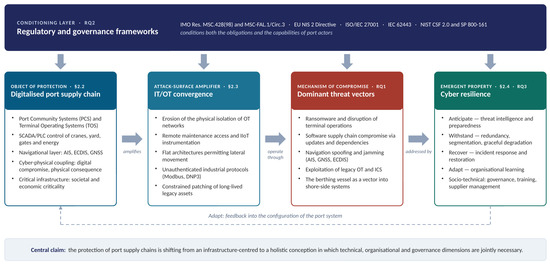
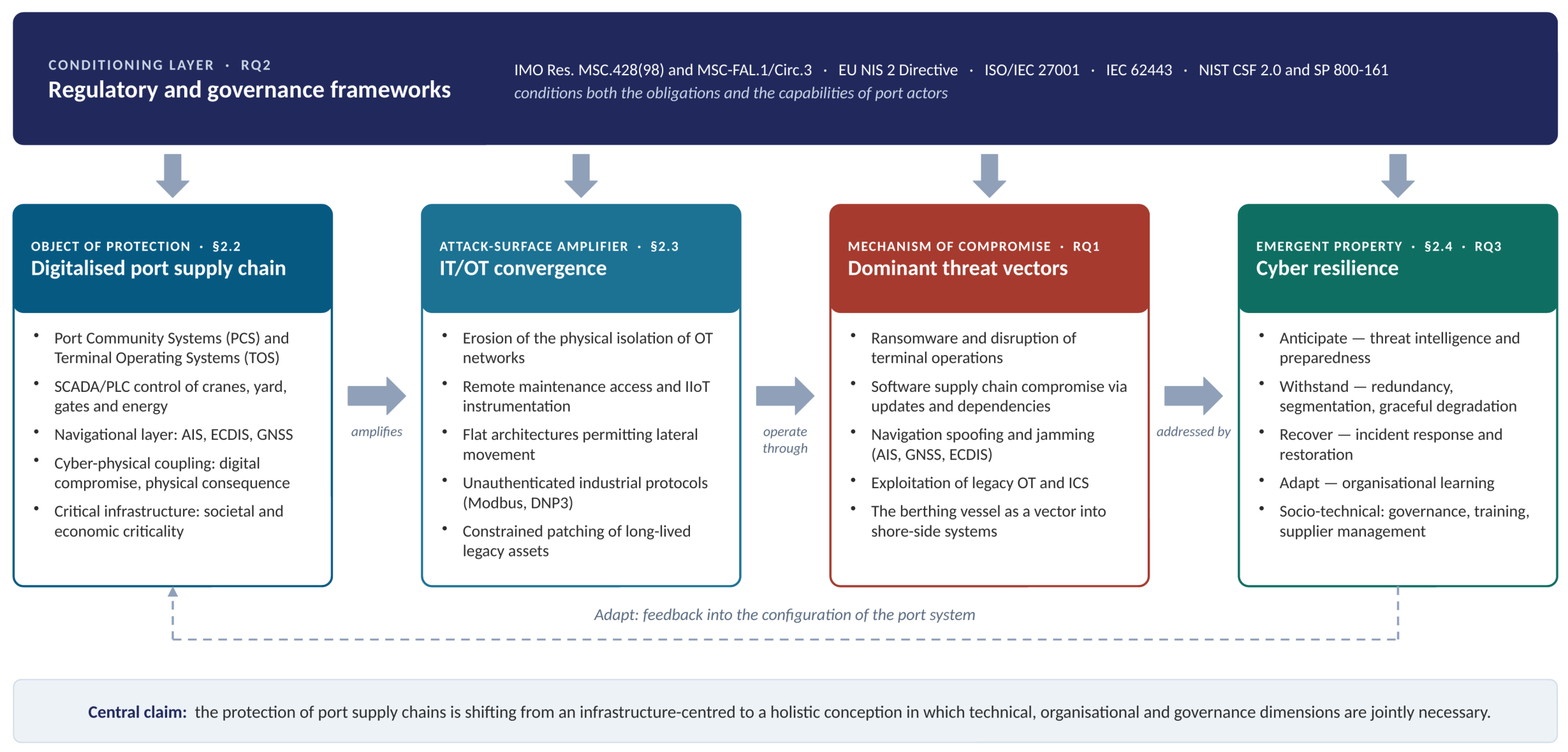
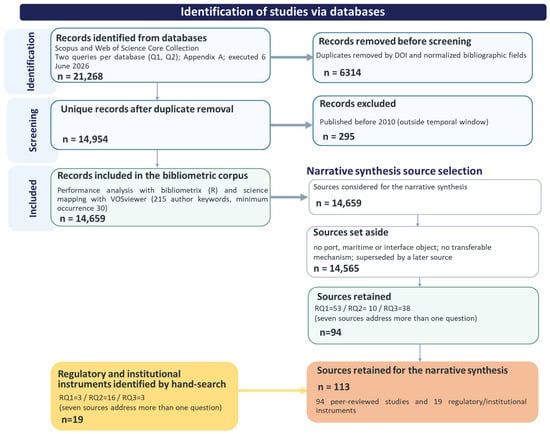
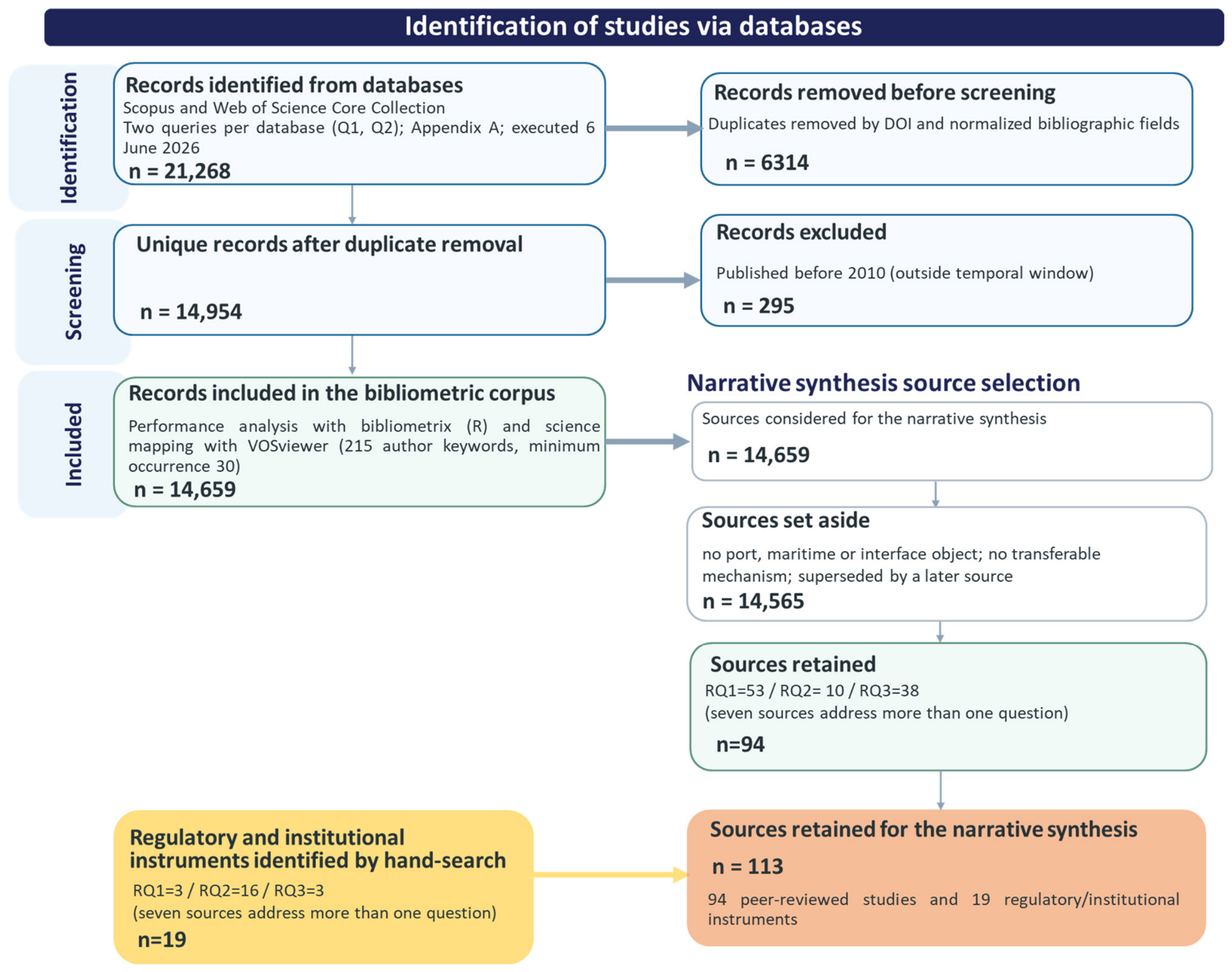
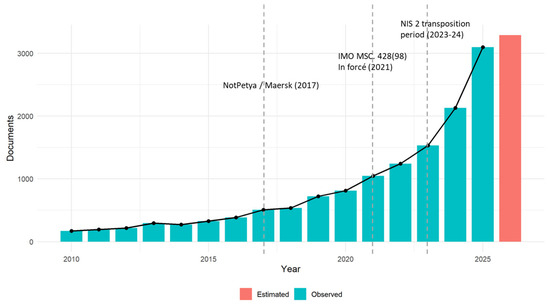
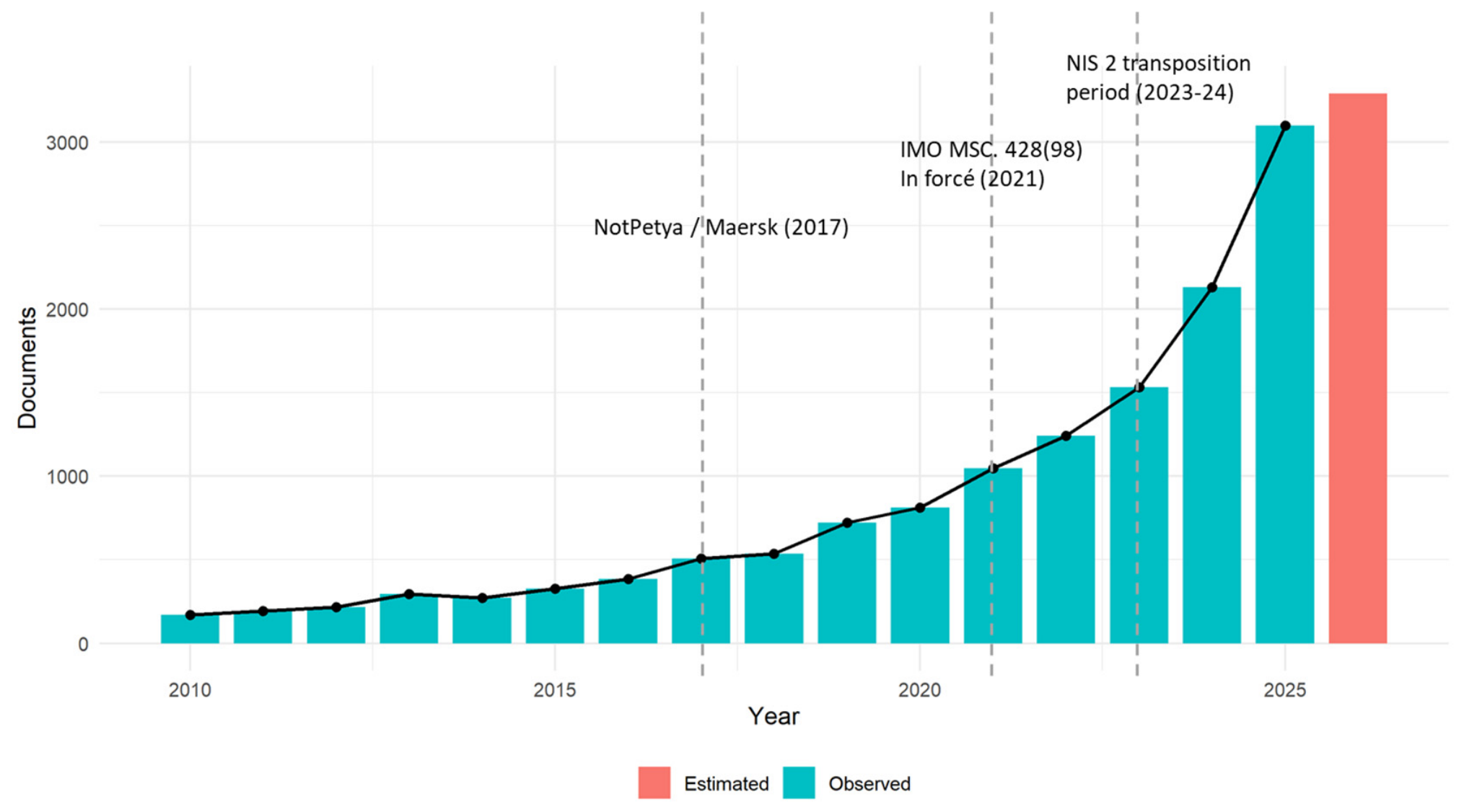
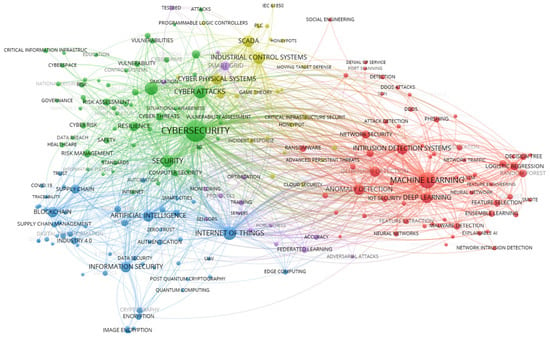
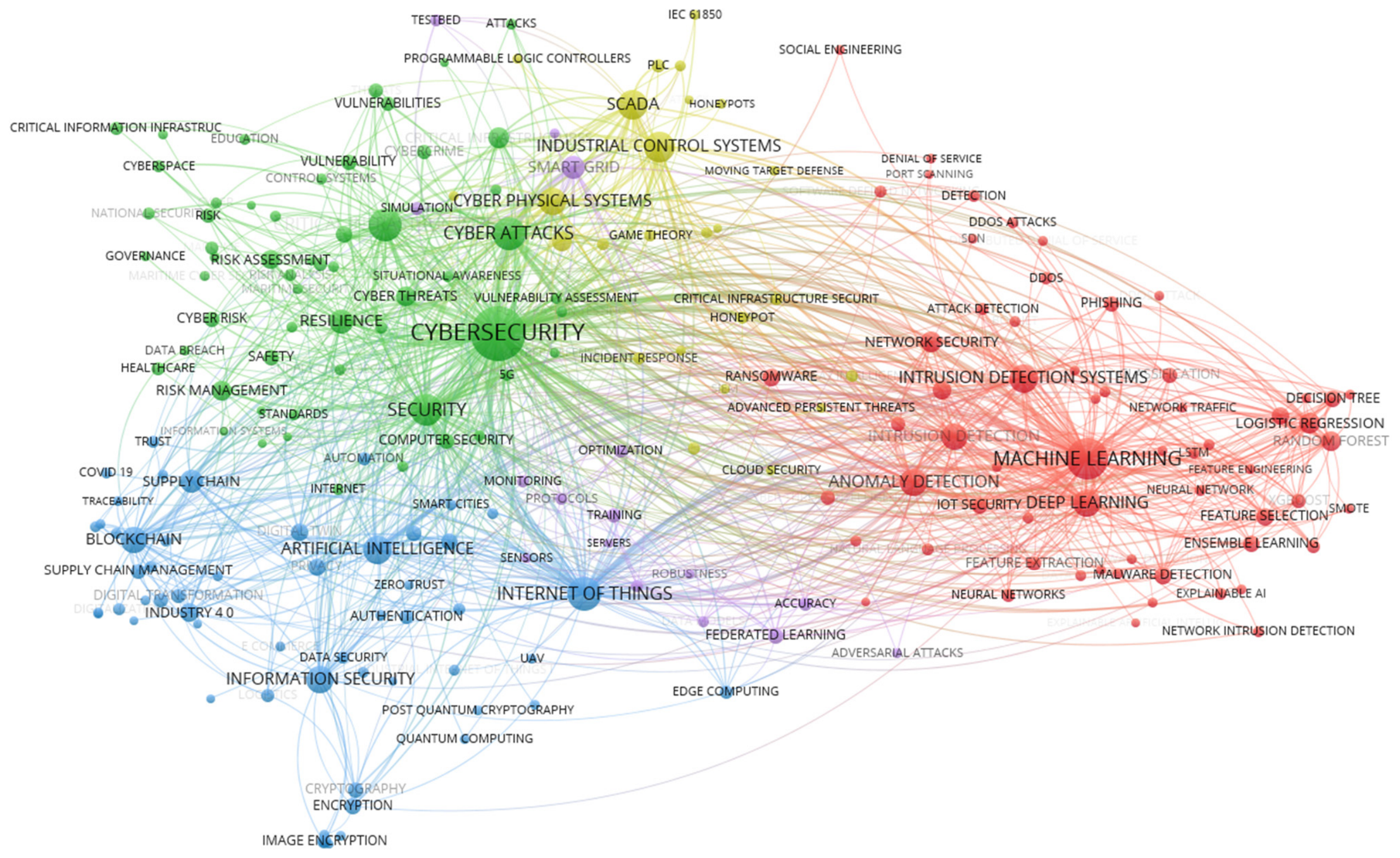
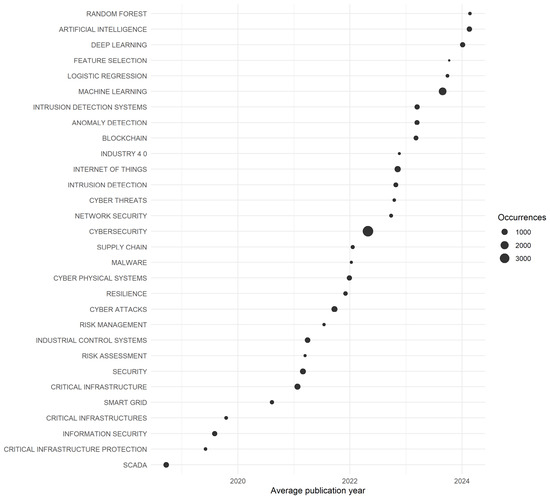
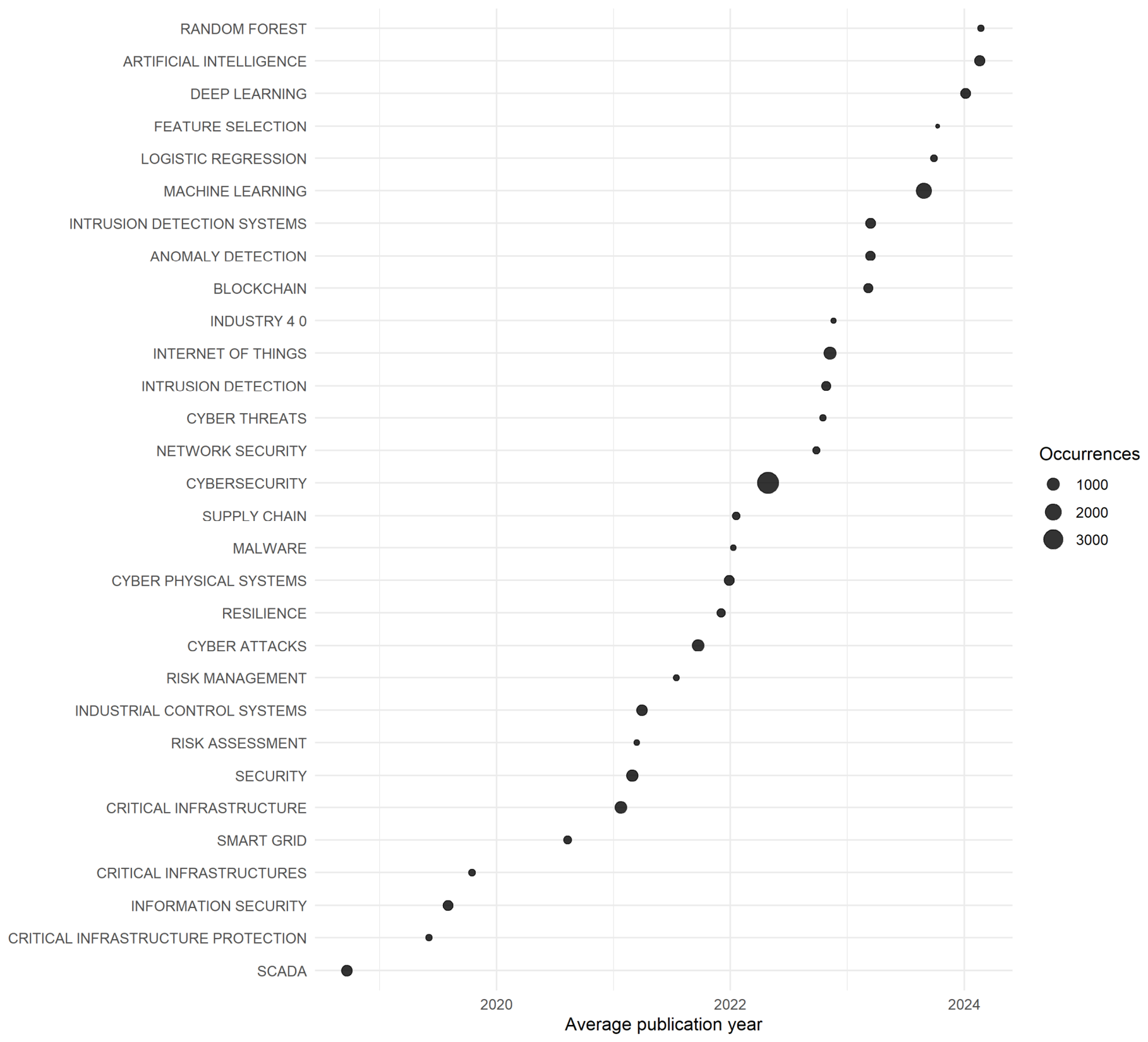
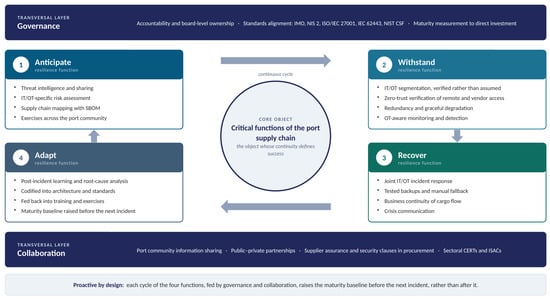
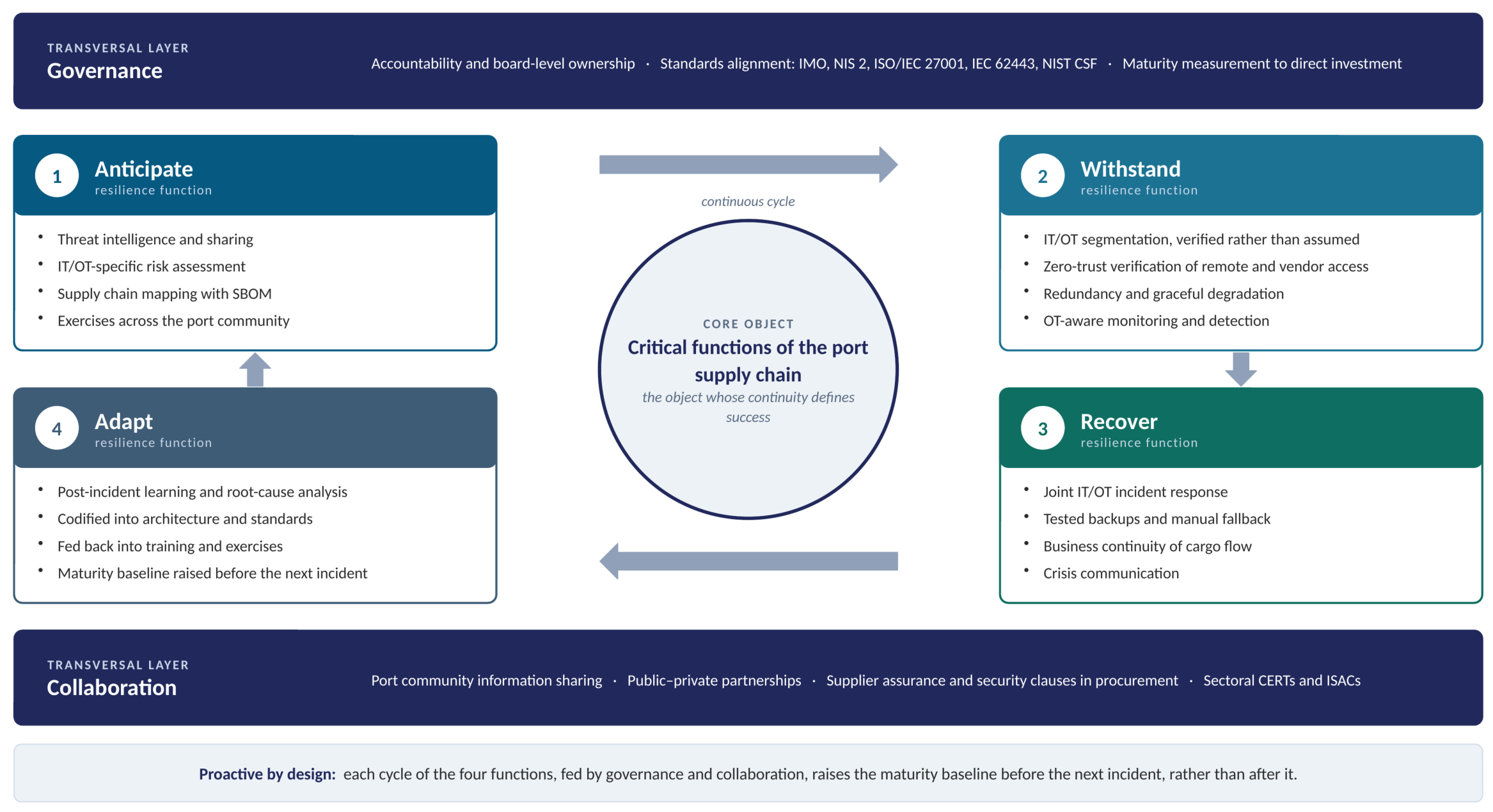

Disclaimer/Publisher’s Note: The statements, opinions and data contained in all publications are solely those of the individual author(s) and contributor(s) and not of MDPI and/or the editor(s). MDPI and/or the editor(s) disclaim responsibility for any injury to people or property resulting from any ideas, methods, instructions or products referred to in the content. |
© 2026 by the authors. Licensee MDPI, Basel, Switzerland. This article is an open access article distributed under the terms and conditions of the Creative Commons Attribution (CC BY) license.