


Abstract
The educational-Pink Innovation Grade Index (e-PIGI) is a novel metric designed to assess and quantify the level of innovation within educational practices and pedagogical projects. This work introduces the e-PIGI tool, an interactive and survey-based software that enables educators, institutions, and project designers to identify both strengths and limitations in their initiatives across ten key dimensions. These include different categories such as: (i) emerging technologies, (ii) adaptability to diversity, (iii) promotion of 21st-century skills, (iv) collaboration, (v) alignment with regulatory frameworks, (vi) active methodologies, (vii) impact, (viii) sustainability, (ix) evaluation and (x) multidisciplinarity. Each dimension is scored using a pink color-based scale ranging from 0 to 10, with darker tones indicating a higher degree of innovation. The resulting output includes a color-coded innovation score and a circular-shaped pictogram that offers a visual representation of the project’s innovative profile. A threshold value of 50 points is proposed as an operational criterion for identifying projects considered innovative. The tool was validated through expert judgment for content validity and through empirical reliability analysis (Cronbach’s coefficient α = 0.833, n = 126), confirming good internal consistency. To demonstrate its utility, the new tool was applied to a set of educational initiatives, helping to highlight their pedagogical strengths and areas for improvement. As an accessible and scalable instrument, e-PIGI aims to support reflective teaching practices, promote ongoing developments, and facilitate the comparison of innovation across diverse educational contexts. This software highlights the potential of e-PIGI to contribute to a more evidence-based and strategically guided culture of innovation in education.
1. Introduction
In recent years, educational systems around the world have faced an urgent call to innovate. Digital transformation, global crises, and changing societal needs have highlighted the limitations of traditional pedagogical models and accelerated the demand for more flexible and effective approaches to teaching and learning [1]. As a result, educational institutions are increasingly encouraged to rethink how knowledge is delivered [2], what skills are prioritized [3], and how learning is assessed and supported [4]. Educational innovation can be defined as any adaptation (organizational, administrative, pedagogical, or formative) that enhances or improves student’s learning [5]. Innovation in education goes beyond the adoption of technology; it involves reimagining pedagogical frameworks to respond to the challenges of contemporary society. This includes promoting active methodologies [6], integrating emerging technologies [7], fostering interdisciplinary collaboration [8], and ensuring inclusivity and sustainability [9]. For example, the European Schoolnet (www.eun.org) (accessed on 13 February 2026) and Scientix® (www.scientix.eu) (accessed on 13 February 2026) are initiatives that support education by offering a wide range of teaching and innovative learning resources. Both play a key role in transforming education systems through the promotion of the use of digital technologies and forward-thinking pedagogical approaches.
Although institutional policies promote innovation in higher education, particularly in alignment with the objectives of the European Higher Education Area, this top-down encouragement alone is often not enough to ensure meaningful implementation [10]. In this context, previous studies have shown that innovative aspects are not yet part of actual teaching [11] or assessment [12]. In practice, the success of educational innovation depends on contextual factors, with the motivation and training of academic staff playing a pivotal role in translating institutional goals into real classroom impact. However, despite the widespread emphasis on educational innovation, there is currently a lack of structured and standardized tools that can assess the level of innovation in educational projects and practices. Thus, new assessment tools to measure innovative performance are needed [13]. Most evaluations rely on qualitative reflections [14], which makes it difficult to compare initiatives or identify areas for improvement in a systematic way. In other cases, authors have implemented questionnaire-based tools to assess educational innovation. For example, Keinänen et al. [13] developed an instrument to measure students’ innovation competences. Their assessment tool includes five dimensions: (1) creative problem-solving, (2) systems thinking, (3) goal orientation, (4) teamwork, and (5) networking. However, this electronic self-assessment questionnaire is specifically focused on measuring individual students’ innovation competences within Finnish higher education institutions. Similarly, Halász et al. [15] conducted a national education sector innovation survey in Hungary, using the educational unit (e.g., schools or university departments) as the main unit of analysis. More broadly, existing instruments reported in the literature are predominantly based on questionnaires oriented either towards individual actors (e.g., competences and perceptions) [16] or towards institutions and organizational structures [17,18]. Recently, a metric has been proposed in the educational field within the context of green and sustainable chemistry education, in which the authors introduce eight principles, a set of evaluation criteria, a scoring system, and an editable Excel-based sheet [19]. To date, however, no tools have been explicitly designed to assess innovation at the level of educational projects or teaching initiatives.
Based on the developments in other scientific areas, particularly the creation of visual-based metrics in analytical chemistry, this work proposes a novel assessment tool and software specifically adapted to the educational context: the educational-Pink Innovation Grade Index (e-PIGI). The e-PIGI tool is designed to quantify and visualize the degree of innovation in pedagogical projects, teaching strategies, or institutional practices and is based on ten core dimensions that reflect key components of educational innovation. Each dimension is scored through a structured survey, producing a color-coded visual output that allows users to instantly interpret the strengths and limitations of their educational initiative. The software aims to support educators, project managers, and institutional leaders in making informed decisions, fostering continuous improvement, and encouraging reflective teaching practices.
2. Description of the e-PIGI Tool
The e-PIGI is a structured, survey-based metric designed to evaluate the degree of innovation in educational practices and pedagogical projects. It was conceptually inspired by existing visual evaluation tools such as the violet innovation grade index (VIGI) [20], the blue applicability grade index (BAGI) [21], and the red analytical performance index (RAPI) [22]. These tools proved the usefulness of standardized, color-coded systems for assessing complex constructs, and e-PIGI builds upon this model to create a version tailored specifically to the educational context. The e-PIGI tool is based on ten essential attributes that reflect current priorities and trends in educational innovation. These attributes were defined following a review of international frameworks in educational policy, curriculum innovation, digital transformation, and interdisciplinary teaching. Each attribute is addressed through a statement phrased as a reflective question (Does the educational project…?), and users respond according to their level of agreement following a similar points scale reported in previous educational tools [13]. A four-point scoring system is used: 10 points for “strongly agree”, 6 points for “moderately agree”, 3 points for “disagree”, and 0 points when the item is not applicable or the attribute is not addressed. The four options were chosen to keep the tool usable and fast while still allowing meaningful differentiation. Too many response levels (e.g., 7–10) increase ambiguity and reduce inter-rater consistency, especially for non-experts. Moreover, each score corresponds to a specific hue to allow for visual interpretation. The following hexadecimal color codes are used: dark pink (#C71585) for 10 points, pink (#FF85C1) for 6 points, light pink (#FFD1DC) for 3 points, and white (#FFFFFF) for 0 points.
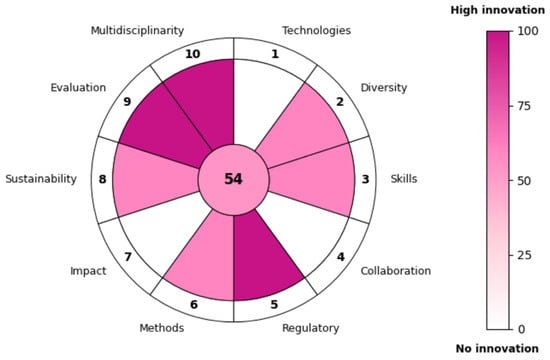
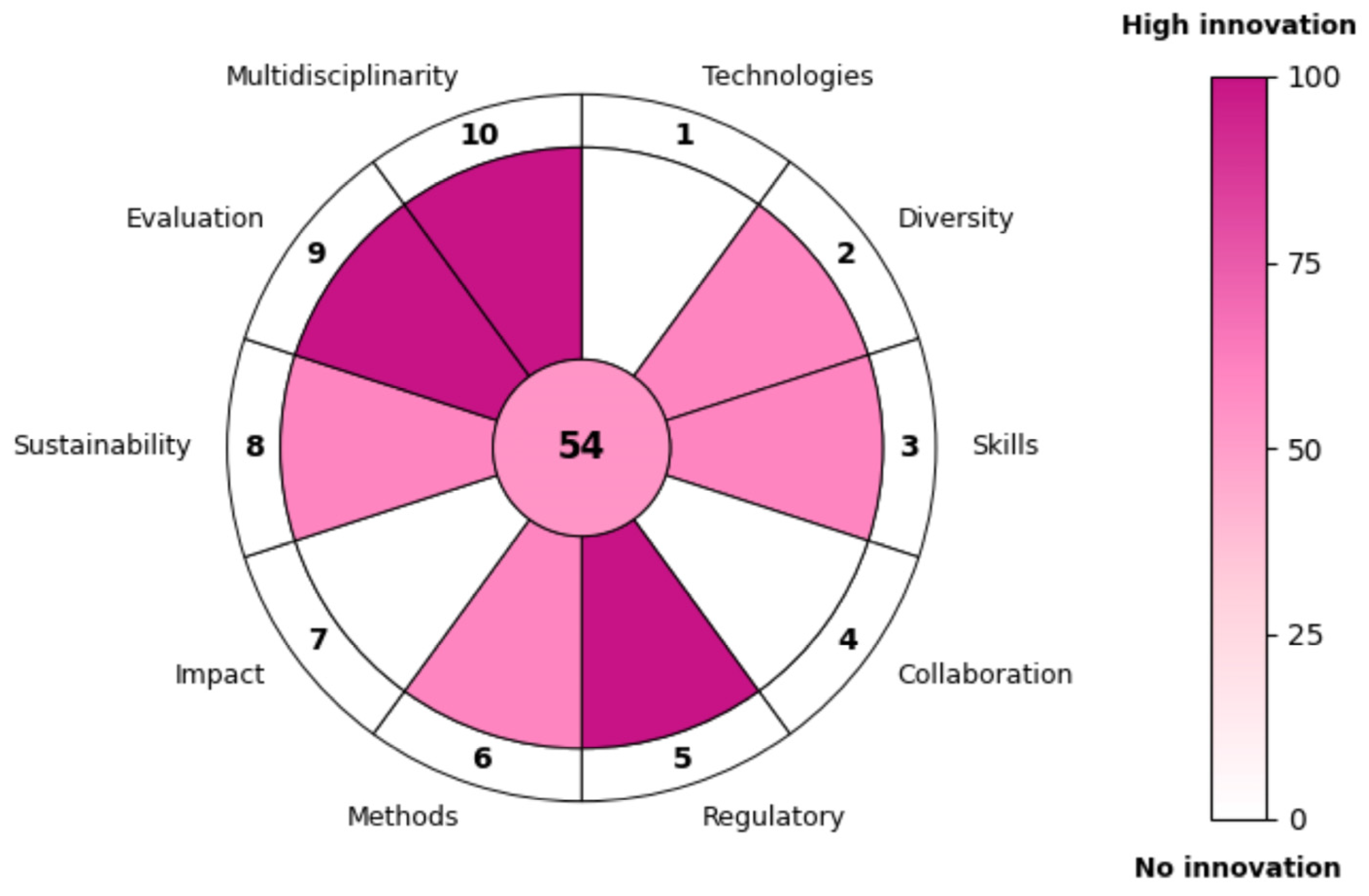
Once all ten attributes have been assessed, the tool generates a pie chart composed of ten segments. Each segment corresponds to one of the innovation attributes and is colored according to the score received. In the center of the figure, the overall innovation score, ranging from 0 to 100, is displayed (see Figure 1). The 0–100 scale was selected because it is intuitive and widely understood. It resembles a percentage-like score, which makes results easy to communicate. In addition, using 10 parameters with a maximum of 10 points each provides a direct mapping (10 parameters × 10 points = 100 points) that avoids extra normalization steps and reduces calculation errors.
Figure 1.
Visualization of the e-PIGI pie chart. The pink color intensity in each segment reflects the level of innovation achieved in the attribute, while the number in the center represents the overall innovation score on a 0–100 scale, with 50 points defined as the threshold. The following hexadecimal color codes are used: dark pink (#C71585) for 10 points (high innovation; strongly agree), pink (#FF85C1) for 6 points (regular innovation; moderately agree), light pink (#FFD1DC) for 3 points (low innovation; disagree), and white (#FFFFFF) for 0 points (not applicable, N/A). Displaying criteria annotation and legend is optional and depends on the user preference.
This total score is calculated by summing the ten individual values, each equally weighted. This ensures a balanced view of innovation. At this stage, there is no clear evidence that one dimension should be more important than the others in all educational contexts. Using equal weights reduces subjectivity, makes the metric easy to understand, and allows clear comparison between projects and evaluators.
A minimum score of 50 is proposed as the threshold for identifying projects considered innovative, although this benchmark is not absolute and should be interpreted within the specific goals and scope of each project. The 50-point threshold is a midpoint-based operational rule that supports a simple decision: “innovative vs. not yet innovative”. With ten equally weighted parameters, 50 corresponds to an average of 5/10 per parameter, meaning the project shows at least a moderate level of innovation across the set of dimensions rather than excelling in only one area. In practice, this threshold helps prevent a project from being labeled “innovative” when it only scores very high in a small number of parameters but performs poorly in most others. Therefore, 50 points works as a conservative minimum, indicating that innovation is reasonably distributed. It is important to mention that the threshold is, to some extent, a design choice. For this reason, e-PIGI is intended as a decision-support tool; the total score can be complemented by reporting the profile of scores per parameter (i.e., strengths and weaknesses).
To enhance accessibility, e-PIGI has been developed as a free, user-friendly online application (https://bit.ly/e-PIGI (accessed on 13 February 2026)). The first version of the tool was implemented using an open-source Python-based framework (Python 3.14.3), released under the MIT license, to define the scoring logic and the conceptual graphical representation of the metric. The visual design of the pictograms was initially developed using Canva and Microsoft PowerPoint 2024, which were employed to prototype and refine the layout, color scale, and overall visual structure of the output. These graphical elements were translated and implemented within the Anvil web development platform, enabling consistent rendering in the browser-based application. This migration facilitated deployment as an online tool and improved usability without technical backgrounds. The platform enables users to complete the assessment through a structured drop-down interface, visualize results, and download the corresponding pictogram. The tool is flexible and adaptable for a wide range of educational settings, including teachers, schools, universities, training programs, and institutional innovation initiatives. Its primary objective is not only to provide a numerical score but also to serve as a catalyst for dialog and continuous pedagogical improvement.
The e-PIGI metric tool evaluates the innovation grade of an educational project by considering the ten primary attributes (see Table 1) outlined in the subsequent sections. The selection of them and the metric design was based on four pillars: (i) our experience in developing similar assessment tools [20]; (ii) our extensive involvement in the coordination of educational innovation projects; (iii) a set of guiding principles for the creation of metrics [23]; and (iv) the priorities defined by the European Union.
Table 1.
Description of the main attributes of e-PIGI.
To further support users in the interpretation and application of the e-PIGI tool, Table 2 presents a selection of example practices associated with each of the ten innovative attributes. These examples, drawn from diverse educational contexts, are intended to guide users in understanding how diverse types of projects, strategies, or activities may align with each category. This reference table is not prescriptive but intended as a source of inspiration and practical guidance for those applying for the e-PIGI assessment.
Table 2.
Representative examples associated with each e-PIGI attribute.
2.1. Technology
The first attribute evaluates the extent to which an educational project integrates emerging technological tools and approaches to enhance the learning experience. Innovation in this area is not solely about incorporating digital resources but about using them thoughtfully and ethically to support pedagogical goals [24]. The use of innovative technologies contributes to the design and implementation of educational scenarios where the student takes an active role in the framework of the teaching act [25]. This includes, but is not limited to, the application of artificial intelligence, simulations, augmented and virtual reality, virtual labs, educational 3D games, open educational resources, digital platforms, and robotics [26,27,28]. The focus is placed on whether these tools are used in a responsible manner that promotes engagement and meaningful learning outcomes. Projects that score highly in this dimension typically go beyond basic technological adoption and demonstrate a strategic alignment between the chosen tools and the educational objectives. For instance, the use of artificial intelligence to personalize feedback, virtual reality to simulate scientific environments, or collaborative online platforms to connect students across contexts are all examples of pedagogically driven technological innovation [29]. The real value of truly innovative practices does not come from using the newest tools but from how those tools improve learning, support students in meaningful ways, and reflect strong ethical and educational principles. Moreover, the attribute considers whether educators and learners are supported in developing digital competence and in using technology critically [30]. Innovation is not only technical but also pedagogical, social, and reflective. Projects that provide training for teachers, promote digital citizenship, or evaluate the impact of technology on inclusion and equity are particularly valued within this category.
2.2. Diversity
The diversity attribute assesses how well an educational project considers and responds to the wide range of profiles, contexts, and needs present in today’s learning environments. A truly innovative practice recognizes that students are not a homogeneous group, and it actively seeks to accommodate differences related to learning styles, cultural backgrounds, abilities, gender, socioeconomic status, and more. This dimension highlights the project’s ability to adopt an inclusive and personalized perspective that ensures every learner has equitable access to meaningful learning opportunities [31]. High-scoring projects in this category demonstrate a clear commitment to accessibility and adaptation. This might include the use of universal design for learning principles [32]. The innovation lies in how these strategies are not treated as isolated actions but rather integrated naturally into the project’s teaching approach and overall design. Diversity also involves recognizing and valuing the personal contributions of each learner. Projects that empower students to bring their identities and experiences into the learning process, that create culturally responsive environments, or that foster a sense of belonging and participation for all members of the learning community exemplify the spirit of this attribute [33].
2.3. Skills
The skills attribute focuses on the extent to which an educational project promotes the development of competencies that are essential for learners to thrive in a rapidly changing world. In an innovation-oriented framework like e-PIGI, this means prioritizing not only subject-specific knowledge but also educational projects that promote transversal abilities such as critical thinking, creativity, communication, collaboration, and problem-solving [34]. It also includes digital literacy, media literacy, computational thinking, and entrepreneurial mindset, skills that are increasingly recognized as vital across educational levels and disciplines [35]. Innovative projects in this dimension are characterized by their intentional design of learning activities and environments that engage students in meaningful challenges, encourage independent and reflective thinking, and offer opportunities for applied learning. Rather than simply delivering content, these projects aim to equip learners with tools to understand complex situations, make informed decisions, and actively contribute to their communities and professional futures. Furthermore, skill development in innovative education is often integrated across the curriculum and supported through formative assessment and feedback. Projects that integrate skill-building within real-world contexts demonstrate a more advanced and transformative understanding of this attribute [36].
2.4. Collaboration
Collaboration is critical for the transformation of educational practices [37]. In the context of innovation, it is not limited to students working in groups but extends to dynamic relationships among teachers, learners, families, institutions, and external stakeholders [38,39,40]. This attribute in e-PIGI captures the degree to which a project builds bridges between people, disciplines, and organizations to enrich the learning process. Rather than functioning in isolation, high-scoring projects in this dimension actively engage with others to co-create learning experiences [34]. This may involve interdisciplinary teaching teams, partnerships with local or international institutions, or the integration of community voices into curriculum design.
2.5. Regulatory
What does it mean for an educational project to be aligned with current regulations and strategic frameworks? The fifth attribute invites educators to reflect on how their initiatives interact with existing policies, educational strategies, institutional priorities, and even broader societal goals. Projects often operate within constraints: curricular standards, legal requirements, accreditation criteria or national reforms. Innovation, in this context, is not necessarily about rejecting these structures but about using them as a starting point for relevance and transformation. A project that actively addresses a curricular gap, responds to an institutional digital strategy, or aligns with the United Nations Sustainable Development Goals demonstrates that it is not isolated but rather integrated into a meaningful educational ecosystem [41]. What sets a high-scoring initiative in this category is its capacity to go beyond compliance. It interprets regulatory frameworks not as limitations but as opportunities to connect learning with real-world issues. It may even propose new ways of implementing policies more effectively or more equitably.
2.6. Methods
Educational methods are at the heart of teaching practice. Yet not all methods carry the same potential for innovation. Traditional approaches, often based on passive knowledge transmission, rigid content delivery, and limited student agency, still dominate many learning environments. The sixth attribute seeks to evaluate how far a project departs from these conventions and look for active, student-centered methodologies [42]. Innovative educational projects tend to adopt methods that prioritize participation, critical thinking, and the construction of knowledge through experience. These include, among others, inquiry-based learning, cooperative work, gamification, project-based learning, flipped classrooms, and problem-solving approaches [6]. What unites these diverse methods is a shift in perspective: from teaching as instruction to learning as a process of exploration and engagement. This attribute rewards practices that position learners as protagonists of their own educational journey.
2.7. Impact
Educational innovation is often discussed in terms of ideas, methods, or tools, but its true value lies in the change it produces. The impact attribute assesses whether a project leads to measurable or observable improvements that go beyond the initial learning context. Innovation, in this sense, is not just about being different; it is about making a meaningful difference. This impact can take many forms: increased student motivation, improved academic outcomes, greater inclusion, strengthened community ties, or influence on institutional practices [43]. Projects with a strong score in this dimension are those that demonstrate a clear link between what they propose and the results they achieve. They are able to show, through evidence or structured observation, that their work contributes to personal, social, or educational transformation. The e-PIGI also values projects with potential for long-term influence or broader dissemination. Whether through scalability, replicability, or policy relevance, initiatives that inspire change in other contexts are welcome to contribute to this attribute.
2.8. Sustainability
Sustainability in education is often associated with environmental awareness, but in the context of e-PIGI, it refers to the long-term viability and responsible management of innovative practices [44]. This attribute evaluates whether a project has been designed with continuity in mind and whether it can be supported, adapted, and improved over time without excessive dependence on external resources or temporary enthusiasm. An educational initiative might be innovative at first glance, but if it collapses once funding ends, if it requires unsustainable workloads, or if it depends entirely on a single person’s leadership, its impact will likely be short-lived. Sustainable projects, by contrast, integrate mechanisms for feedback, iteration, and growth. They are built on realistic planning, shared responsibilities, and a clear understanding of the context in which they operate. This dimension also values resource consciousness, not just in financial or material terms, but also in terms of time and effort.
2.9. Evaluation
The ninth attribute looks at how assessment is approached, designed, and put into practice in educational projects. This dimension values a rich and flexible evaluation strategy, one that goes beyond a single test or final grade and reflects a comprehensive view of the learning process. Projects that score highly in this area typically incorporate a variety of assessment tools adapted to the characteristics of their learners. A strong evaluation framework includes multiple instruments, such as analytical rubrics, portfolios, performance tasks, peer and self-assessment, and oral or visual presentations [45]. This diversity ensures that students with different strengths and communication styles have equitable opportunities to demonstrate their learning. Moreover, ongoing feedback is a key feature of meaningful and impactful educational innovation [46]. Another important element of this attribute is planning. Innovative projects integrate evaluation as part of the overall design from the beginning, rather than treating it as a final or isolated task. They establish clear criteria for success, align assessment with expected outcomes, and ensure that the process supports student growth.
2.10. Multidisciplinarity
The last attribute recognizes educational projects that break down traditional subject boundaries and invite students to connect ideas, tools, and perspectives from different fields. In this dimension, innovation is demonstrated by the ability to design learning experiences that transcend isolated content areas [47]. Projects that combine science and art, technology and ethics, or mathematics and environmental studies illustrate how knowledge becomes more powerful and more relevant when it is integrated [48]. In this context, science, technology, engineering, arts and math (STEAM) projects have proliferated due to the huge interest that international education policies have in preparing students for an advanced society [34]. Multidisciplinary approaches not only help students see the bigger picture but also mirror how problems are approached in real-world contexts. When a project involves multiple areas of expertise, fosters cross-departmental collaboration, or encourages learners to transfer skills and concepts across contexts, it reflects a deeper level of pedagogical ambition. Multidisciplinarity, in this sense, is not about adding more content but about opening more paths to understanding and building bridges between different disciplines.
3. Validation of the Tool
Validation was based on a previous study [18] and conducted through a two-step process combining expert judgment for content validity and empirical reliability analysis using Cronbach’s alpha. First, content validity was assessed through a panel of experts (n = 9), following commonly accepted procedures for the validation of educational assessment instruments. The expert panel was intentionally composed to ensure a diversity of perspectives across educational levels and professional contexts. It included three university professors with more than ten years of experience in higher education teaching and the coordination of teaching innovation projects; three secondary education teachers with involvement in curriculum development and active methodologies; and three professionals working in educational innovation as independent consultants specialized in digital learning. Experts were selected based on predefined criteria, including demonstrated experience in educational innovation, involvement in the design or evaluation of educational projects, and familiarity with assessment instruments or quality frameworks in education. All experts were contacted individually and received detailed information about the objectives of the e-PIGI tool and its intended use. The validation procedure consisted of a single structured review round, during which experts were asked to evaluate each of the ten e-PIGI attributes according to three criteria: relevance (importance of the attribute for assessing educational innovation), pertinence (adequacy of the attribute to the scope of the tool), and clarity/univocity (absence of ambiguity in the formulation of the attribute). Based on their feedback, minor wording refinements were introduced to ensure a shared interpretation of all attributes, while the overall structure of the metric was preserved.
Second, the reliability and internal consistency of the e-PIGI questionnaire were evaluated using Cronbach’s alpha coefficient, one of the most widely used indicators of scale reliability in educational research [49]. The analysis was performed using data obtained from the application of the e-PIGI tool to a set of teaching innovation projects developed at Spanish universities between 2015 and 2024 (n = 126). The projects were selected from institutional teaching innovation calls, funded educational programs, and peer-reviewed publications, provided that sufficient available information was available to assess the ten attributes. All projects were evaluated by the authors based on project reports and published materials, rather than through self-assessment by the project coordinators, in order to reduce potential self-reporting bias. The ten attributes were treated as components of a single scale aimed at capturing the global construct of educational innovation. The resulting Cronbach’s alpha value (α = 0.833) indicates good internal consistency, according to commonly accepted interpretation criteria, and confirms that the attributes function as a unified measurement instrument. Statistical analyses were conducted using IBM SPSS Statistics 26.0 (SPSS Inc., Chicago, IL, USA).
4. Application of e-PIGI to Selected Case Studies
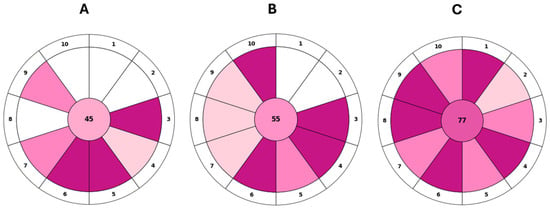
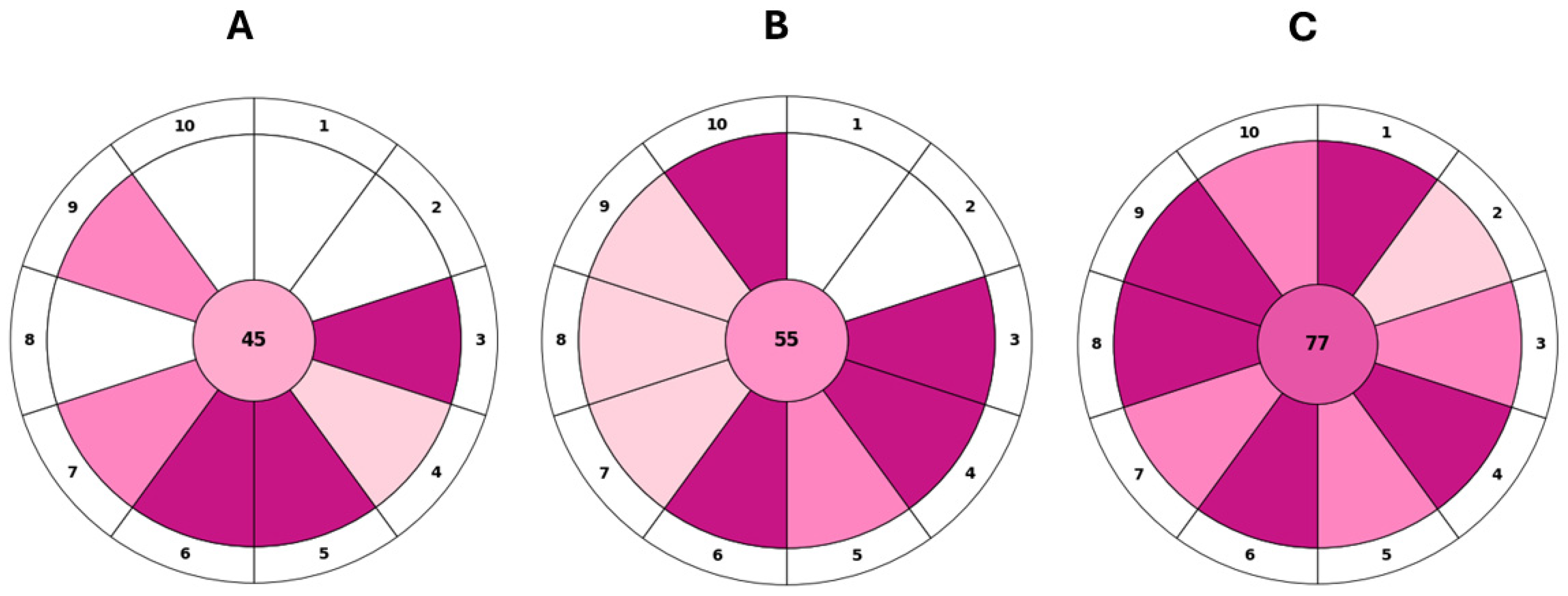
To illustrate the practical usefulness of the e-PIGI tool, three educational projects have been selected and analyzed using the proposed framework. These case studies represent a range of educational levels, formats, and thematic areas, providing a broad perspective on how e-PIGI can be applied in diverse contexts. The purpose of this comparative analysis is to assess each project’s level of innovation based on the ten dimensions defined in the metric. If the tool is applied, it becomes possible to identify not only the overall innovation score but also the specific strengths and limitations of each initiative. The results, as well as the pictograms, are presented in Table 3 and Figure 2.
Table 3.
Scoring and justification of e-PIGI assessment for different educational projects.
Figure 2.
The e-PIGI pie charts for different educational projects ((A) corresponds to [50]; (B) to [34]; (C) to [28]). The pink color intensity in each segment reflects the level of innovation achieved in the attribute, while the number in the center represents the overall innovation score on a 0–100 scale, with 50 points defined as the threshold. The following hexadecimal color codes are used: dark pink (#C71585) for 10 points (high innovation; strongly agree), pink (#FF85C1) for 6 points (regular innovation; moderately agree), light pink (#FFD1DC) for 3 points (low innovation; disagree), and white (#FFFFFF) for 0 points (not applicable, N/A). Displaying criteria annotation and legend is optional and depends on the user preference.
The first case study is diabescape, an educational project designed to evaluate the effectiveness of a gamification-based intervention aimed at improving knowledge about diabetes among vocational training students pursuing careers in social and healthcare fields [50]. Using the e-PIGI assessment tool, the initiative achieved a total score of 45 out of 100, categorizing it as scarcely innovative. The highest-scoring attributes were skills, methods, and regulatory, each receiving 10 points. These scores reflect the project’s strong focus on fostering student competencies (e.g., teamwork, perseverance), its gamified learning format, and its alignment with both national and international public health frameworks. Moderate innovation (6 points) was observed in the dimensions of impact and evaluation, showing the presence of measurable learning outcomes and the use of assessment tools such as questionnaires and knowledge tests. Despite involving more than 300 students, the project did not incorporate elements related to technology, diversity, sustainability, or multidisciplinarity, which resulted in low scores in those areas. The e-PIGI pictogram clearly illustrates this disparity, highlighting an uneven innovation profile and suggesting potential directions for improvement in future implementations. Although the authors emphasize that gamified approaches enhance both knowledge acquisition and student satisfaction compared to traditional methodologies, they also note that further research is needed to assess the long-term effectiveness of such innovative strategies.
The second case study is an interdisciplinary project implemented in teacher education programs, aiming to improve preservice teachers’ skills through problem-based learning in collaboration with cultural institutions [34]. The e-PIGI gave this initiative a total score of 55 out of 100, categorizing it as innovative. The project demonstrated strong performance in areas such as skills, collaboration, methods, and multidisciplinarity, each scoring 10 points. These reflect its emphasis on fostering critical thinking, communication, and creativity among students; promoting partnerships between universities, schools, and museums; integrating active methodologies; and encouraging connections across disciplines using the archeological museum as a learning context. Moderate innovation (6 points) was noted in regulatory, aligned with curricular goals and teacher education competencies. Other dimensions such as impact, sustainability, and evaluation scored lower (3 points), suggesting that while the project offered a sound educational framework, its broader societal or longitudinal outcomes were less defined. Notably, the absence of specific elements related to technology and diversity contributed to low scores in these categories.
The third case study analyzed is Final Frontier [28], an educational intervention within the NEWTON Project aimed at improving learning experiences in primary education. The project leverages a 3D educational video game designed to simulate space exploration, which justifies the highest score in technology (10 points). It promotes personalization of content and includes adaptive features, supporting learner engagement, which contributed to moderate scores in diversity (6 points) and skills (6 points) as it encourages the development of STEAM-related abilities. Collaboration was notably high (10 points) given the involvement of 14 partners from academia and industry as well as engagement with school teachers. In terms of regulatory alignment, the project addressed European Union priorities in education, meriting 6 points. Methods received the maximum score (10 points) due to the use of game-based learning as an active methodology. Impact was also moderately strong (6 points) given its implementation across multiple European schools, demonstrating scalability. The evaluation strategy, involving surveys, consent forms, and teacher validation of pedagogical quality, earned 10 points. Although the project was not explicitly designed as a sustainable or multidisciplinary initiative, partial scores were awarded in sustainability (3 points) due to its long-term applicability and in multidisciplinarity (6 points) based on its integration of STEM fields. The total score was 77 out of 100, classifying it as highly innovative.
5. Conclusions
This new tool offers a holistic framework for assessing the innovative potential of educational projects in a visually intuitive manner by incorporating ten dimensions. Its structure draws on other established color-coded evaluation models used in the analytical chemistry field, but e-PIGI has been carefully tailored to meet the specific needs of educators, institutions, and policymakers who are working to bring meaningful improvements to education. The application of e-PIGI to selected case studies has demonstrated its capacity to differentiate between various levels of innovation across diverse educational initiatives. The use of a color-coded pictogram, supported by a numerical score, enables a quick and significant interpretation of results, supporting both qualitative reflection and comparative analysis. Furthermore, the online version of the tool—developed using open-source software—enhances its accessibility and encourages broader adoption. While e-PIGI is not intended to replace qualitative judgment, it serves as a valuable complementary tool that encourages self-assessment, promotes accountability, and supports evidence-based decision-making. Its key strength lies in its simplicity and adaptability, allowing users to identify both strengths and areas for improvement in their educational initiatives. We believe that e-PIGI can become a useful and trusted tool for educators and institutions seeking to promote more innovative teaching practices.
Author Contributions
Conceptualization, A.F.-B. and S.G.-B.; methodology, A.F.-B. and S.G.-B.; software, A.F.-B. and S.G.-B.; formal analysis, A.F.-B.; investigation, A.F.-B.; resources, A.F.-B.; data curation, A.F.-B.; writing—original draft preparation, A.F.-B.; writing—review and editing, A.F.-B., S.G.-B., A.M.A., V.S. and J.B.; visualization, A.F.-B., S.G.-B., V.S. and J.B.; supervision, A.F.-B.; project administration, A.F.-B. All authors have read and agreed to the published version of the manuscript.
Funding
This research received no external funding.
Institutional Review Board Statement
Not applicable.
Informed Consent Statement
Not applicable.
Data Availability Statement
The original contributions presented in this study are included in the article. Further inquiries can be directed to the corresponding authors.
Acknowledgments
Adrián Fuente-Ballesteros thanks the University of Valladolid for his PhD contract. After completing the article, the authors used ChatGPT (5.2) by OpenAI to assist with language refinement. The authors reviewed and edited the content as necessary and take full responsibility for the content of the publication.
Conflicts of Interest
The authors declare no conflicts of interest.
Abbreviations
The following abbreviations are used in this manuscript:
| BAGI | blue applicability grade index |
| e-PIGI | educational-pink innovation grade index |
| RAPI | red analytical performance index |
| STEAM | science, technology, engineering, arts and math |
| VIGI | violet innovation grade index |
References
- Rajaram, K. Future of Learning: Teaching and Learning Strategies. In Learning Intelligence: Innovative and Digital Transformative Learning Strategies; Springer: Singapore, 2023; pp. 3–53. [Google Scholar]
- Tan, S.C.; Chan, C.; Bielaczyc, K.; Ma, L.; Scardamalia, M.; Bereiter, C. Knowledge Building: Aligning Education with Needs for Knowledge Creation in the Digital Age. Educ. Technol. Res. Dev. 2021, 69, 2243–2266. [Google Scholar] [CrossRef] [Scilit]
- Rodrigues, A.L.; Cerdeira, L.; Machado-Taylor, M.d.L.; Alves, H. Technological Skills in Higher Education—Different Needs and Different Uses. Educ. Sci. 2021, 11, 326. [Google Scholar] [CrossRef] [Scilit]
- Schellekens, L.H.; Bok, H.G.J.; de Jong, L.H.; van der Schaaf, M.F.; Kremer, W.D.J.; van der Vleuten, C.P.M. A Scoping Review on the Notions of Assessment as Learning (AaL), Assessment for Learning (AfL), and Assessment of Learning (AoL). Stud. Educ. Eval. 2021, 71, 101094. [Google Scholar] [CrossRef] [Scilit]
- Ramirez-Montoya, M.S. Challenges for Open Education with Educational Innovation: A Systematic Literature Review. Sustainability 2020, 12, 7053. [Google Scholar] [CrossRef] [Scilit]
- Córdova-Esparza, D.M.; Romero-González, J.A.; Córdova-Esparza, K.E.; Terven, J.; López-Martínez, R.E. Active Learning Strategies in Computer Science Education: A Systematic Review. Multimodal Technol. Interact. 2024, 8, 50. [Google Scholar] [CrossRef] [Scilit]
- Almufarreh, A.; Arshad, M. Promising Emerging Technologies for Teaching and Learning: Recent Developments and Future Challenges. Sustainability 2023, 15, 6917. [Google Scholar] [CrossRef] [Scilit]
- Khan, M.S.; Wells, M.A. Integrating Interdisciplinary Education in Materials Science and Engineering. Nat. Rev. Mater. 2023, 8, 491–493. [Google Scholar] [CrossRef] [Scilit]
- Yang, C.; Wang, T.; Xiu, Q. Towards a Sustainable Future in Education: A Systematic Review and Framework for Inclusive Education. Sustainability 2025, 17, 3837. [Google Scholar] [CrossRef] [Scilit]
- Fernández-Cruz, F.J.; Rodríguez-Legendre, F. The Innovation Competence Profile of Teachers in Higher Education Institutions. Innov. Educ. Teach. Int. 2022, 59, 634–645. [Google Scholar] [CrossRef] [Scilit]
- Edwards-Schachter, M.; García-Granero, A.; Sánchez-Barrioluengo, M.; Quesada-Pineda, H.; Amara, N. Disentangling Competences: Interrelationships on Creativity, Innovation and Entrepreneurship. Think. Ski. Creat. 2015, 16, 27–39. [Google Scholar] [CrossRef] [Scilit]
- Kivunja, C. Innovative Pedagogies in Higher Education to Become Effective Teachers of 21st Century Skills: Unpacking the Learning and Innovations Skills Domain of the New Learning Paradigm. Int. J. High. Educ. 2014, 3, 37. [Google Scholar] [CrossRef] [Scilit]
- Keinänen, M.; Ursin, J.; Nissinen, K. How to Measure Students’ Innovation Competences in Higher Education: Evaluation of an Assessment Tool in Authentic Learning Environments. Stud. Educ. Eval. 2018, 58, 30–36. [Google Scholar] [CrossRef] [Scilit]
- Maldonado-Mariscal, K.; Alijew, I. Social Innovation and Educational Innovation: A Qualitative Review of Innovation’s Evolution. Innov. Eur. J. Soc. Sci. Res. 2023, 36, 381–406. [Google Scholar] [CrossRef] [Scilit]
- Halász, G. Measuring Innovation in Education: The Outcomes of a National Education Sector Innovation Survey. Eur. J. Educ. 2018, 53, 557–573. [Google Scholar] [CrossRef] [Scilit]
- Morad, S.; Ragonis, N.; Barak, M. The Validity and Reliability of a Tool for Measuring Educational Innovative Thinking Competencies. Teach. Teach. Educ. 2021, 97, 103193. [Google Scholar] [CrossRef] [Scilit]
- Vidicki, P.; Vrgović, P.; Stevanov, B.; Medić, N. Framework for Measuring Innovation Performance in Higher Education Institutions. Teh. Vjesn.—Tech. Gaz. 2023, 30, 68–79. [Google Scholar] [CrossRef] [Scilit]
- Turrado-Sevilla, M.Á.; Cantón-Mayo, I. Design and Validation of an Instrument to Measure Educational Innovations in Primary and Pre-Primary Schools. J. New Approaches Educ. Res. 2022, 11, 79–96. [Google Scholar] [CrossRef] [Scilit]
- Zuin, V.G.; Segatto, M.L.; Zandonai, D.P.; Grosseli, G.M.; Stahl, A.; Zanotti, K.; Andrade, R.S. Integrating Green and Sustainable Chemistry into Undergraduate Teaching Laboratories: Closing and Assessing the Loop on the Basis of a Citrus Biorefinery Approach for the Biocircular Economy in Brazil. J. Chem. Educ. 2019, 96, 2975–2983. [Google Scholar] [CrossRef] [Scilit]
- Fuente-Ballesteros, A.; Martínez-Martínez, V.; Ares, A.M.; Valverde, S.; Samanidou, V.; Bernal, J. Violet Innovation Grade Index (VIGI): A New Survey-Based Metric for Evaluating Innovation in Analytical Methods. Anal. Chem. 2025, 97, 6945–6955. [Google Scholar] [CrossRef] [Scilit] [PubMed]
- Manousi, N.; Wojnowski, W.; Płotka-Wasylka, J.; Samanidou, V. Blue Applicability Grade Index (BAGI) and Software: A New Tool for the Evaluation of Method Practicality. Green Chem. 2023, 25, 7598–7604. [Google Scholar] [CrossRef] [Scilit]
- Nowak, P.M.; Wojnowski, W.; Manousi, N.; Samanidou, V.; Płotka-Wasylka, J. Red Analytical Performance Index (RAPI) and Software: The Missing Tool for Assessing Methods in Terms of Analytical Performance. Green Chem. 2025, 27, 5546. [Google Scholar] [CrossRef] [Scilit]
- Fuente-Ballesteros, A.; Samanidou, V.; Ares, A.M.; Bernal, J. Ten Principles for Developing and Implementing Tools in the Context of White Analytical Chemistry. Sustain. Chem. Pharm. 2025, 45, 102031. [Google Scholar] [CrossRef] [Scilit]
- Hampson, M.; Goldsmith, C.; Lefevre, M. Towards a Framework for Ethical Innovation in Children’s Social Care. J. Child. Serv. 2021, 16, 198–213. [Google Scholar] [CrossRef] [Scilit]
- Kolyvas, S. Innovative and Collaborative Learning in Visual Arts with the Use of Modern Educational Software. Educ. Q. Rev. 2020, 3, 194–200. [Google Scholar] [CrossRef] [Scilit]
- Gandedkar, N.H.; Wong, M.T.; Darendeliler, M.A. Role of Virtual Reality (VR), Augmented Reality (AR) and Artificial Intelligence (AI) in Tertiary Education and Research of Orthodontics: An Insight. Semin. Orthod. 2021, 27, 69–77. [Google Scholar] [CrossRef] [Scilit]
- Chiu, W.K. Pedagogy of Emerging Technologies in Chemical Education during the Era of Digitalization and Artificial Intelligence: A Systematic Review. Educ. Sci. 2021, 11, 709. [Google Scholar] [CrossRef] [Scilit]
- El Mawas, N.; Tal, I.; Moldovan, A.N.; Bogusevschi, D.; Andrews, J.; Muntean, G.-M.; Muntean, C.H. Improving STEM Learning Experience in Primary School by Using NEWTON Project Innovative Technologies. In Communications in Computer and Information Science; McLaren, B., Reilly, R., Zvacek, S., Uhomoibhi, J., Eds.; Springer: Cham, Switzerland, 2019; Volume 1022, pp. 214–230. [Google Scholar]
- Tan, S.C.; Lee, A.V.Y.; Lee, M. A Systematic Review of Artificial Intelligence Techniques for Collaborative Learning over the Past Two Decades. Comput. Educ. Artif. Intell. 2022, 3, 100097. [Google Scholar] [CrossRef] [Scilit]
- Zhao, Y.; Pinto Llorente, A.M.; Sánchez Gómez, M.C. Digital Competence in Higher Education Research: A Systematic Literature Review. Comput. Educ. 2021, 168, 104212. [Google Scholar] [CrossRef] [Scilit]
- Danau, D. Example of Best Practice: ETUCE Study on Embracing Diversity in Education: Key Elements of Inclusive Education and Training Needs of Education Personnel. Intercult. Educ. 2023, 34, 95. [Google Scholar] [CrossRef] [Scilit]
- Sasson, I.; Yehuda, I.; Miedijensky, S. Innovative Learning Spaces: Class Management and Universal Design for Learning. Learn. Environ. Res. 2022, 25, 725–739. [Google Scholar] [CrossRef] [Scilit]
- Tsai, Y.C. Empowering Students through Active Learning in Educational Big Data Analytics. Smart Learn. Environ. 2024, 11, 14. [Google Scholar] [CrossRef] [Scilit]
- Santaolalla, E.; Urosa, B.; Martín, O.; Verde, A.; Díaz, T. Interdisciplinarity in Teacher Education: Evaluation of the Effectiveness of an Educational Innovation Project. Sustainability 2020, 12, 6748. [Google Scholar] [CrossRef] [Scilit]
- DeCoito, I.; Briona, L.K. Fostering an Entrepreneurial Mindset Through Project-Based Learning and Digital Technologies in STEM Teacher Education. In Enhancing Entrepreneurial Mindsets Through STEM Education; Kaya-Capocci, S., Peters-Burton, E., Eds.; Springer: Berlin/Heidelberg, Germany, 2023; pp. 195–222. [Google Scholar]
- Kwangmuang, P.; Jarutkamolpong, S.; Sangboonraung, W.; Daungtod, S. The Development of Learning Innovation to Enhance Higher Order Thinking Skills for Students in Thailand Junior High Schools. Heliyon 2021, 7, e07309. [Google Scholar] [CrossRef] [Scilit]
- Hussein, B. Addressing Collaboration Challenges in Project-Based Learning: The Student’s Perspective. Educ. Sci. 2021, 11, 434. [Google Scholar] [CrossRef] [Scilit]
- Spaulding, E.M.; Marvel, F.A.; Jacob, E.; Rahman, A.; Hansen, B.R.; Hanyok, L.A.; Martin, S.S.; Han, H.R. Interprofessional Education and Collaboration among Healthcare Students and Professionals: A Systematic Review and Call for Action. J. Interprof. Care 2021, 35, 612–621. [Google Scholar] [CrossRef] [Scilit] [PubMed]
- Paccaud, A.; Keller, R.; Luder, R.; Pastore, G.; Kunz, A. Satisfaction with the Collaboration Between Families and Schools—The Parent’s View. Front. Educ. 2021, 6, 646878. [Google Scholar] [CrossRef] [Scilit]
- Rasmitadila, R.; Humaira, M.A.; Rachmadtullah, R. Student Teachers’ Perceptions of the Collaborative Relationships Form between Universities and Inclusive Elementary Schools in Indonesia. F1000Research 2021, 10, 1289. [Google Scholar] [CrossRef] [Scilit]
- Amorós Molina, Á.; Helldén, D.; Alfvén, T.; Niemi, M.; Leander, K.; Nordenstedt, H.; Rehn, C.; Ndejjo, R.; Wanyenze, R.; Biermann, O. Integrating the United Nations Sustainable Development Goals into Higher Education Globally: A Scoping Review. Glob. Health Action 2023, 16, 2190649. [Google Scholar] [CrossRef] [Scilit]
- Howell, R.A. Engaging Students in Education for Sustainable Development: The Benefits of Active Learning, Reflective Practices and Flipped Classroom Pedagogies. J. Clean. Prod. 2021, 325, 129318. [Google Scholar] [CrossRef] [Scilit]
- Ingason, H.T.; Eskerod, P. Using Simulations in Project Management Education—Impact on Awareness and Ability to Navigate Projects in a Sustainable Way. Int. J. Manag. Proj. Bus. 2024, 17, 278–301. [Google Scholar] [CrossRef] [Scilit]
- Deák, C.; Kumar, B. A Systematic Review of STEAM Education’s Role in Nurturing Digital Competencies for Sustainable Innovations. Educ. Sci. 2024, 14, 226. [Google Scholar] [CrossRef] [Scilit]
- Devaki, V. Exploring the Impact of Innovative Assessment Methods on Learning Outcomes: A Review of Project-Based Assessments, Portfolios, Peer Assessment, and Self-Assessment. In Policy Development, Curriculum Design, and Administration of Language Education; IGI Global Scientific Publishing: Palmdale, PA, USA, 2024; pp. 343–374. [Google Scholar]
- Loureiro, M.; Nakamura, F.Y.; Ramos, A.; Coutinho, P.; Ribeiro, J.; Clemente, F.M.; Mesquita, I.; Afonso, J. Ongoing Bidirectional Feedback between Planning and Assessment in Educational Contexts: A Narrative Review. Int. J. Environ. Res. Public Health 2022, 19, 12068. [Google Scholar] [CrossRef] [Scilit]
- Hardy, J.G.; Sdepanian, S.; Stowell, A.F.; Aljohani, A.D.; Allen, M.J.; Anwar, A.; Barton, D.; Baum, J.V.; Bird, D.; Blaney, A.; et al. Potential for Chemistry in Multidisciplinary, Interdisciplinary, and Transdisciplinary Teaching Activities in Higher Education. J. Chem. Educ. 2021, 98, 1124–1145. [Google Scholar] [CrossRef] [Scilit]
- Bonilla-Jurado, D.; Zumba, E.; Lucio-Quintana, A.; Yerbabuena-Torres, C.; Ramírez-Casco, A.; Guevara, C. Advancing University Education: Exploring the Benefits of Education for Sustainable Development. Sustainability 2024, 16, 7847. [Google Scholar] [CrossRef] [Scilit]
- Taber, K.S. The Use of Cronbach’s Alpha When Developing and Reporting Research Instruments in Science Education. Res. Sci. Educ. 2018, 48, 1273–1296. [Google Scholar] [CrossRef] [Scilit]
- Bujanda, A.; Bujanda, E. DIABESCAPE: An Innovative Educational Project on Diabetes. Endocrinol. Diabetes Nutr. 2022, 69, 392–400. [Google Scholar] [CrossRef] [Scilit]

Disclaimer/Publisher’s Note: The statements, opinions and data contained in all publications are solely those of the individual author(s) and contributor(s) and not of MDPI and/or the editor(s). MDPI and/or the editor(s) disclaim responsibility for any injury to people or property resulting from any ideas, methods, instructions or products referred to in the content. |
© 2026 by the authors. Licensee MDPI, Basel, Switzerland. This article is an open access article distributed under the terms and conditions of the Creative Commons Attribution (CC BY) license.