


Abstract
Background: Endoscopic myotomy has become a well-established treatment for foregut motility disorders. Despite its high technical and clinical success rates, post-procedure management varies across institutions, with many centers routinely admitting patients overnight (OA). Increasingly, there is interest in same-day discharge (SDD) as a resource-saving alternative that could reduce healthcare costs without compromising patient safety. However, there is limited high-quality evidence directly comparing the safety and effectiveness of SDD versus OA after peroral endoscopic myotomy (POEM), including esophageal POEM (E-POEM), gastric POEM (G-POEM), and Zenker’s POEM (Z-POEM). Methods: We performed a systematic review and meta-analysis of comparative studies (PROSPERO CRD420251243902). PubMed, Scopus, Web of Science, and the Cochrane Library were searched from inception through 12 November 2025, for studies comparing SDD with OA after E-POEM, G-POEM, or Z-POEM. The primary outcomes were 30-day emergency department (ED) visits and hospital readmissions, which occur after the discharge decision. Adverse events, procedure duration, and post-procedural imaging were analyzed as descriptive associations because they occur before, or determine, the discharge decision. Risk ratios (RRs) and mean differences (MDs) with 95% confidence intervals (CIs) were pooled using random-effects models. Sensitivity analyses addressed sparse events, conference abstracts, and the single Z-POEM study. Certainty of evidence was assessed using GRADE. Results: Nine comparative studies (six G-POEM, two E-POEM, one Z-POEM) including 1106 patients (366 SDD, 740 OA) were included. No statistically significant difference was detected in 30-day ED visits (5 studies, 237 patients; RR 0.97, 95% CI 0.46 to 2.06) or readmissions (6 studies, 802 patients; RR 0.79, 95% CI 0.34 to 1.85). Both CIs were wide and compatible with clinically important benefit or harm, so equivalence could not be established. Results were consistent across sparse-data methods and after excluding conference abstracts or the Z-POEM study. Adverse events were recorded in 1.1% of SDD and 5.8% of OA patients. Most occurred during or shortly after the procedure and determined discharge status, so this difference reflects selection rather than a protective effect of SDD. Doi plot asymmetry suggested possible small-study effects for ED visits (LFK index 2.67). The certainty of evidence was very low for ED visits, readmissions, and adverse events, owing to risk of bias, imprecision, and suspected publication bias. Conclusions: Very low-certainty evidence, derived mainly from G-POEM studies, did not show a statistically significant increase in 30-day ED visits or readmissions with SDD after uncomplicated POEM in selected patients at experienced centers. Equivalence with OA cannot be concluded. Evidence for E-POEM is limited, and Z-POEM could not be assessed. Procedure-specific prospective studies with prespecified discharge criteria are needed.
1. Introduction
Endoscopic myotomy has become a cornerstone in the management of esophageal and gastric motility disorders [1]. Esophageal peroral endoscopic myotomy (E-POEM) is now widely established as an effective therapy for achalasia, with high technical and clinical success in randomized trials and large observational studies [1,2,3]. As experience with E-POEM has expanded, endoscopic myotomy has been adapted for other foregut disorders. These include gastric peroral endoscopic myotomy (G-POEM) for refractory gastroparesis and Zenker’s peroral endoscopic myotomy (Z-POEM) for Zenker’s diverticulum, both supported by prospective clinical data and contemporary expert guidance [1,4,5,6,7,8,9,10].
Although the procedural efficacy of endoscopic myotomy is well established, post-procedural management remains variable across centers. Many institutions still admit patients for overnight observation after endoscopic myotomy, frequently with post-procedural imaging before discharge. This practice derives largely from surgical pathways rather than endoscopy-specific evidence [1,5,6,11]. Recent safety data indicate that major adverse events after endoscopic myotomy are rare and are usually detected during the procedure or become clinically evident shortly afterward [12,13]. Experts have also questioned routine post-procedural imaging, because imaging findings correlate poorly with clinically important outcomes [14,15].
With increasing procedural volumes and growing confidence in peri-procedural care, same-day discharge (SDD) has emerged as a potential alternative to routine overnight admission (OA) after endoscopic myotomy [1,5]. From a health-system perspective, early discharge may reduce healthcare utilization and improve patient convenience. However, concerns persist about delayed adverse events, unplanned emergency department (ED) visits, and readmissions in the absence of standardized discharge pathways [5]. The evidence informing SDD comes largely from small, single-center observational studies with heterogeneous selection criteria and discharge protocols [11,14].
The comparative safety and effectiveness of SDD and OA therefore remain incompletely defined. We conducted a systematic review and meta-analysis comparing SDD with OA after E-POEM, G-POEM, and Z-POEM. Our objective was to evaluate short-term healthcare utilization, safety, and clinical effectiveness, with procedure-specific results reported throughout. Because discharge status is determined after the procedure, we distinguished outcomes that occur after discharge from outcomes that occur before, or influence, the discharge decision.
2. Methods
2.1. Protocol Registration
This systematic review was conducted in line with the Cochrane Handbook for Systematic Reviews of Interventions and reported in accordance with the Preferred Reporting Items for Systematic Reviews and Meta-Analyses (PRISMA) 2020 statement [16,17]. The protocol was registered in the International Prospective Register of Systematic Reviews (PROSPERO; CRD420251243902) before data extraction began. Deviations from the registered protocol are reported in Section 2.9. The completed PRISMA 2020 checklist is provided in Supplementary Table S5.
2.2. Eligibility Criteria
We included studies that met the following criteria: (1) Population: adult patients (≥18 years) undergoing a POEM procedure, including gastric (G-POEM), esophageal (E-POEM), or Zenker’s (Z-POEM) variants; (2) Intervention: SDD, defined as discharge on the same calendar day as the procedure without an overnight hospital stay; (3) Comparator: OA, defined as a post-procedural hospital stay of at least one night; (4) Study design: randomized controlled trials, prospective or retrospective comparative cohort studies, and case-control studies directly comparing SDD with OA. Conference abstracts were eligible if they reported extractable outcome data for both groups. We excluded case reports, small case series, single-arm studies, review articles, editorials, animal studies, studies of procedures that were not POEM variants, and studies published in languages other than English.
2.3. Search Strategy
We searched PubMed, Scopus, Web of Science, and the Cochrane Library from inception to 12 November 2025. We also screened the reference lists of included articles and previous systematic reviews, and conference proceedings. The search combined keywords and indexed subject terms for endoscopic myotomy, same-day discharge, and overnight stay. The complete strategy for each database is provided in Supplementary Table S1. All included reports were available before the final search date.
2.4. Screening and Selection Process
After removing duplicate records, two reviewers independently screened all titles and abstracts using Covidence systematic review software (Veritas Health Innovation, Melbourne, Australia; web-based platform available at https://www.covidence.org). The same reviewers then assessed the full texts of potentially eligible studies against the predefined eligibility criteria. A third reviewer resolved any disagreements.
2.5. Data Extraction
Two reviewers independently extracted data using a standardized, piloted form. For each study, we collected the following information: (1) study characteristics (author, year, country, study design, study period, and total sample size); (2) patient demographics and procedural details (age, body mass index, sex distribution, frequency of diabetes mellitus, type of POEM, and American Society of Anesthesiologists classification class).
The primary outcomes were 30-day emergency department visits and 30-day hospital readmissions. One study reported readmissions within 15 days [18]; these data were included, and their influence was examined in a sensitivity analysis. Secondary outcomes were adverse events, technical success, clinical success, post-procedural imaging, double myotomy, total procedure time, and change in symptom scores (Gastroparesis Cardinal Symptom Index [GCSI] or Eckardt score). Adverse events were extracted as defined by each study, together with their definitions and ascertainment windows.
Clinical success was defined procedure-specifically. For G-POEM, it was defined as a ≥1-point improvement in GCSI, as prespecified in the protocol. For E-POEM and Z-POEM, the protocol accepted study-specific definitions (for example, a post-procedural Eckardt score ≤3 after E-POEM). No E-POEM or Z-POEM study reported clinical success separately by discharge group. The pooled clinical success analysis therefore included only the two G-POEM studies that reported it by group [18,19]. When several time points were reported, the longest follow-up was used, as registered; the earliest time point was used in a sensitivity analysis. Symptom response after E-POEM was assessed as change in Eckardt score.
For interpretation, outcomes were grouped according to their timing relative to the discharge decision. Post-discharge outcomes (30-day ED visits and readmissions) occur after the decision and therefore address whether SDD is safe. Adverse events, procedure time, post-procedural imaging, and double myotomy occur before, or influence, the discharge decision. These were analyzed as descriptive associations and not as effects of discharge strategy. Technical success, clinical success, and symptom-score change were analyzed as efficacy outcomes.
2.6. Risk of Bias and Certainty of Evidence Assessment
The methodological rigor of the included studies was assessed by two independent reviewers using the Risk of Bias in Non-randomized Studies of Interventions (ROBINS-I) tool, which evaluates bias across seven domains. We resolved disagreements through discussion [20].
To assess the certainty of the evidence for all outcomes, we applied the Grading of Recommendations, Assessment, Development, and Evaluations (GRADE) framework using the GRADEpro Guideline Development Tool (GRADEpro GDT; McMaster University and Evidence Prime, Hamilton, ON, Canada; web-based platform available at https://www.gradepro.org). The evidence was judged across five domains for potential downgrading: risk of bias, inconsistency, indirectness, imprecision, and publication bias. Because the included studies were observational, we also examined three domains for potential upgrading: a large magnitude of effect, a dose-response gradient, and the effect of plausible residual confounding. The overall certainty of evidence for each outcome was classified as high, moderate, low, or very low [21]. Absolute effects were calculated by applying the pooled RR to the crude risk in the OA groups of the contributing studies. A summary of findings table was prepared for the primary outcomes and adverse events.
2.7. Data Synthesis
All analyses were conducted in R (version 4.3.3; R Foundation for Statistical Computing, Vienna, Austria) using the meta (version 8.5-0) and metasens (version 1.5-3) packages [22,23]. Dichotomous outcomes were pooled as risk ratios (RRs) and continuous outcomes as mean differences (MDs), each with 95% confidence intervals (CIs). When necessary, reported medians and interquartile ranges were converted to means and standard deviations using the method of Wan et al. [24]. When the mean change from baseline was not reported, it was derived from baseline and follow-up values, and the standard deviation of the change was imputed using a correlation coefficient of 0.5.
Clinical and methodological heterogeneity was expected across procedure types, indications, patient selection, discharge protocols, study designs, and follow-up. A random-effects model was therefore used as the primary analysis for all outcomes. Between-study variance (τ2) was estimated with restricted maximum likelihood (REML), and studies were weighted by inverse variance [25]. Heterogeneity was quantified with I2 and τ2 and tested with Cochran’s Q (p < 0.10). Common-effect models (Mantel-Haenszel for dichotomous outcomes; inverse variance for continuous outcomes) and random-effects models with Hartung-Knapp adjustment [26] were fitted as sensitivity analyses. Subgroup analysis by procedure type (G-POEM, E-POEM, Z-POEM) was prespecified in the registered protocol. Leave-one-out analyses were performed for outcomes with at least three studies. Statistical significance was set at a two-sided p < 0.05.
In the primary analysis, 0.5 was added to all cells of studies with zero events in one arm. Studies with zero events in both arms were excluded from RR estimation because they carry no information on the relative effect; they are displayed in the forest plots. Because events were sparse and group sizes were unequal, four additional sensitivity analyses were performed for 30-day ED visits, readmissions, and adverse events: (1) inclusion of double-zero studies with a 0.5 continuity correction; (2) the treatment-arm continuity correction, which scales the correction to the size of each arm [27]; (3) the Mantel-Haenszel common-effect RR without continuity correction; and (4) a random-effects binomial-normal generalized linear mixed model (GLMM), which uses the exact binomial likelihood and requires no continuity correction (odds ratio scale) [28]. Further sensitivity analyses excluded the three conference abstracts and the single Z-POEM study.
2.8. Publication Bias
Funnel plots and Egger’s test have limited power with fewer than 10 studies [29]. We therefore used Doi plots and the Luis Furuya-Kanamori (LFK) index for outcomes informed by at least five studies [30]. An LFK index within ±1 indicated no asymmetry, between ±1 and ±2 minor asymmetry, and beyond ±2 major asymmetry. With few studies, asymmetry can arise from clinical heterogeneity, methodological differences, selection mechanisms, or chance. We therefore interpreted asymmetry as a possible small-study effect rather than as direct evidence of publication bias.
2.9. Deviations from the Registered Protocol
The registered protocol specified a fixed-effect model, with a switch to a random-effects model if substantial heterogeneity was present. During peer review, we adopted a random-effects model as the primary analysis for all outcomes and retained common-effect models as sensitivity analyses. The sparse-data sensitivity analyses, the sensitivity analyses excluding conference abstracts and the Z-POEM study, and the grouping of outcomes by timing relative to the discharge decision were added after peer review. Doi plots were restricted to outcomes with at least five studies.
3. Results
3.1. Study Selection
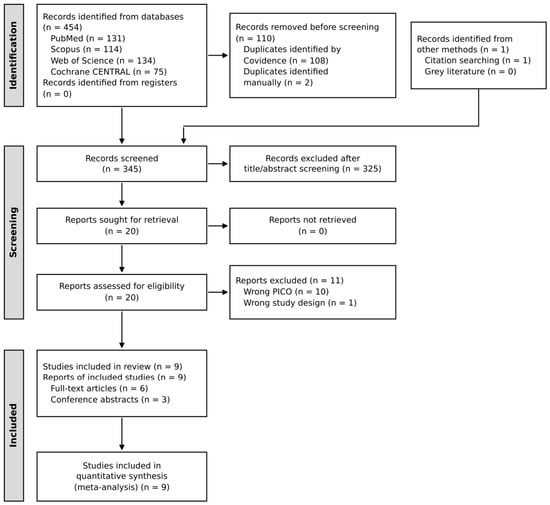
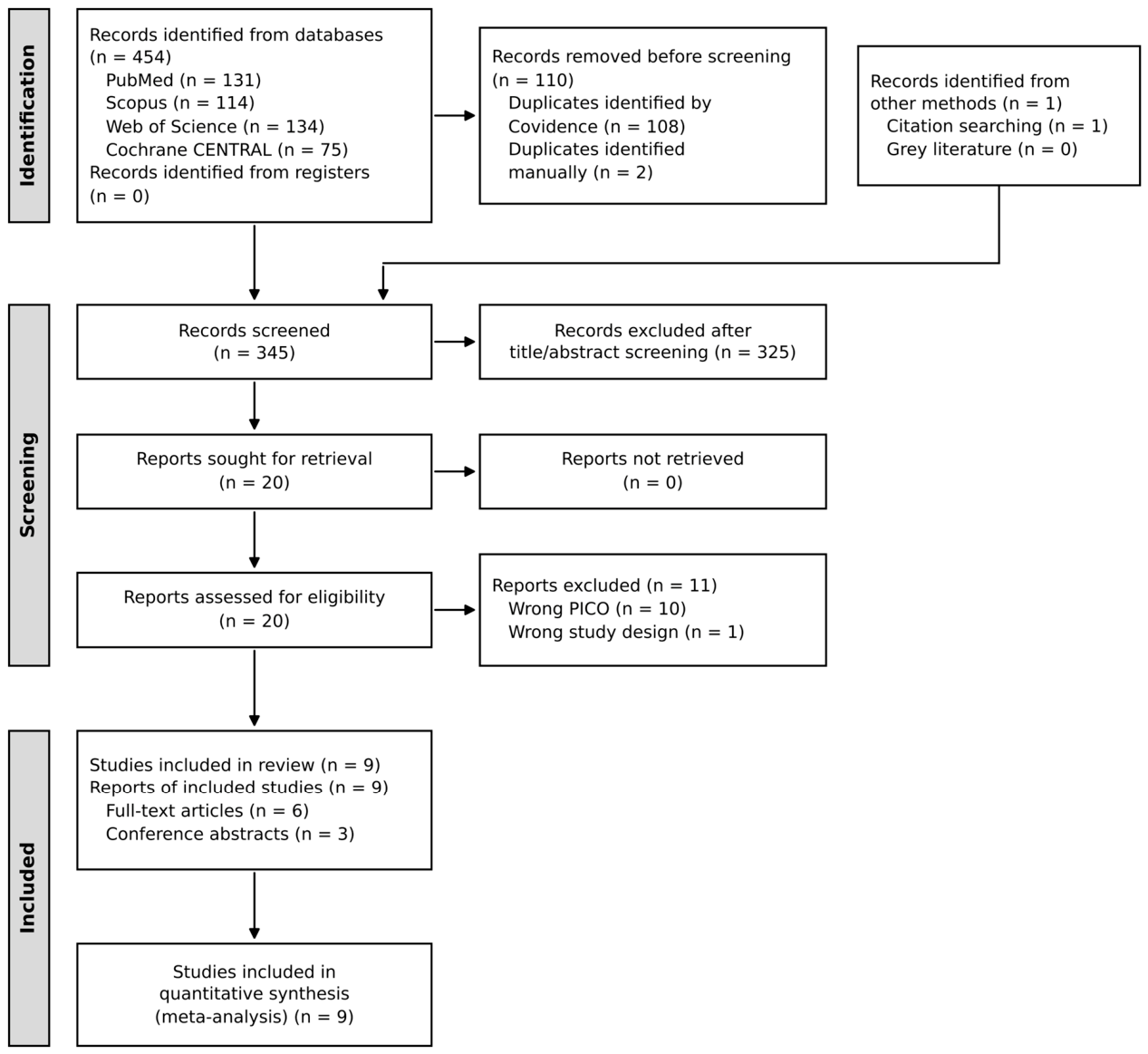
The database search identified 454 records, and one additional record was identified through citation searching. After removal of 110 duplicates, 345 records were screened, and 20 full-text reports were assessed for eligibility. Nine studies were included (Figure 1). Eight were retrospective cohort studies [18,19,31,32,33,34,35,36], and one was a prospective single-center pilot cohort [37]. Six were published as full-text articles [18,31,32,35,36,37], and three were available only as conference abstracts [19,33,34].
Figure 1.
PRISMA 2020 flow diagram of study selection.
3.2. Study Characteristics
Table 1 summarizes the characteristics of the included studies. Seven studies were conducted in the United States, one was an international multicenter study involving 11 centers [18], and one did not report the country [19]. The studies were published between 2020 and 2025, and patients were enrolled between 2014 and 2024. Six studies evaluated G-POEM [18,19,34,35,36,37], two evaluated E-POEM [32,33], and one evaluated Z-POEM [31]. G-POEM accounted for 734 of the 1106 patients (66.4%), E-POEM for 333 (30.1%), and Z-POEM for 39 (3.5%). Overall, 366 patients (33.1%) underwent SDD and 740 (66.9%) underwent OA. Reported follow-up ranged from one to 24 months.
Table 1.
Characteristics of the included studies.
Table 2 summarizes baseline characteristics. Mean age ranged from the mid-40s to the early 70s. Baseline differences between groups were inconsistent across studies. SDD patients were older in four studies [32,34,36,37] and younger in three [19,31,33]. Diabetes mellitus was more frequent in the SDD group in one study [37] and similar between groups in five [18,19,32,35,36]. ASA class III–IV was more frequent in the SDD group in two studies [18,34], less frequent in one [32], and identical in the propensity-matched study [35]. Body mass index (BMI) was reported as a mean in five studies [18,19,32,33,34], with values in the overweight range (26.4 to 30.4 kg/m2) and no consistent difference between groups; one further study reported only the proportion of patients with overweight or obesity [36]. Males accounted for 31.1% of SDD and 30.9% of OA patients.
Table 2.
Baseline characteristics of patients in the included studies.
3.3. Quality Assessment
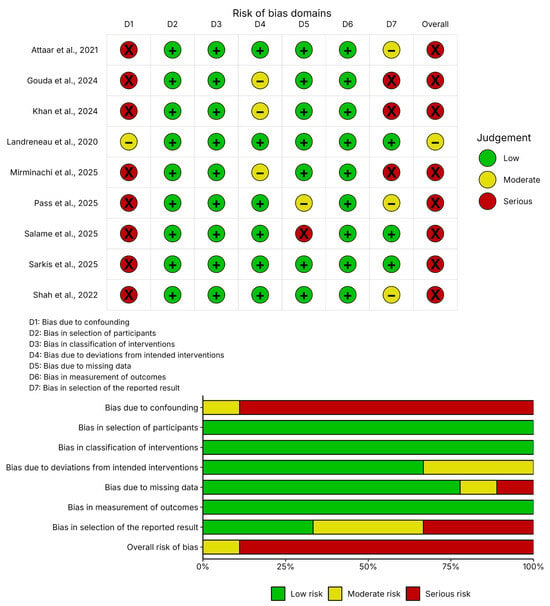
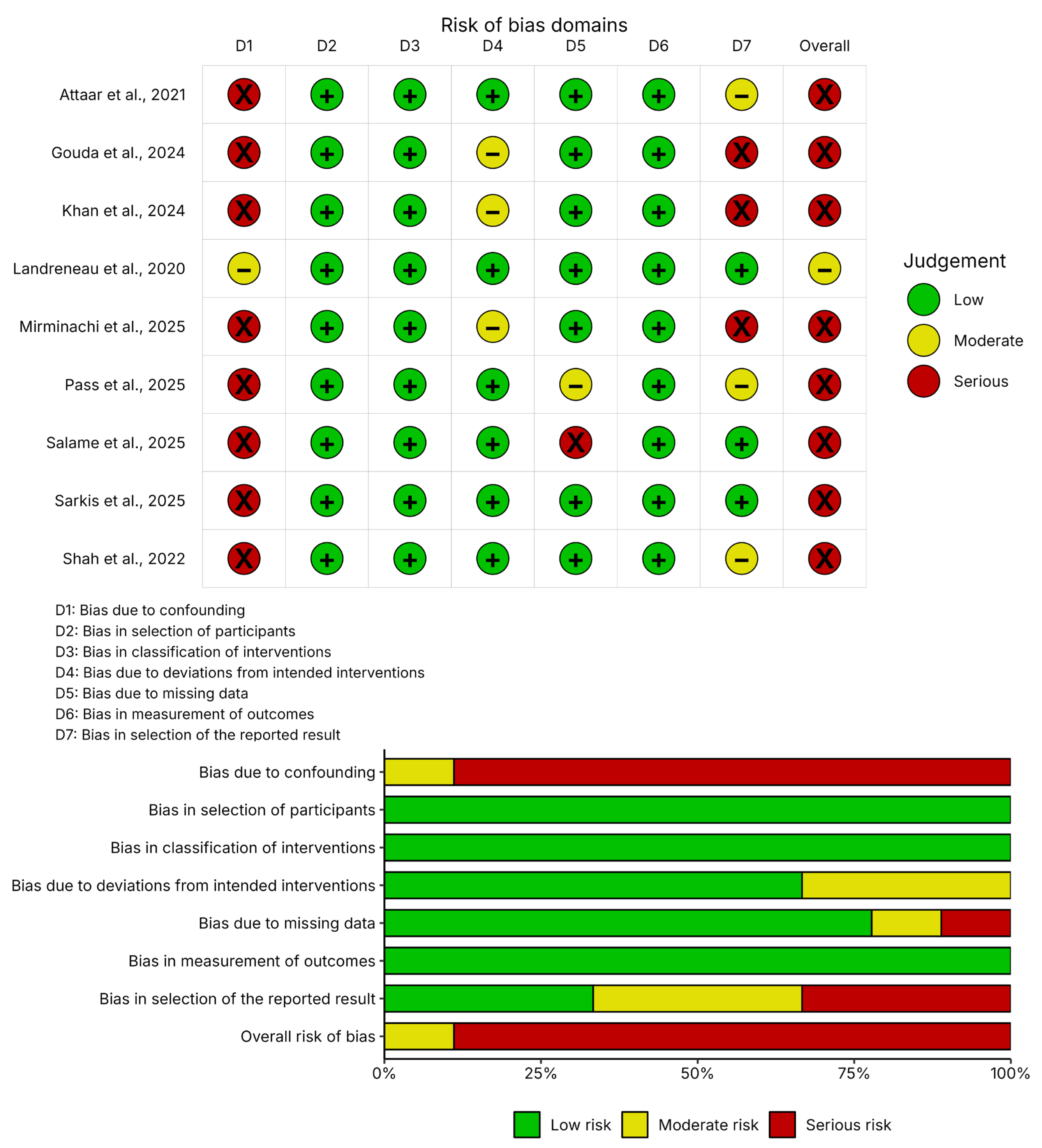
Figure 2 shows the risk of bias of the included studies. One study was judged at moderate overall risk of bias [35], and the remaining eight were judged at serious risk [18,19,31,32,33,34,36,37]. Bias due to confounding was rated serious in all studies except Landreneau et al., which was rated moderate because propensity score matching addressed confounding more effectively, although not completely [35]. Additional concerns were noted for deviations from intended interventions, missing data, and selection of the reported result.
Figure 2.
Risk of bias of the included studies assessed with the ROBINS-I tool. The included studies are Attaar et al., 2021 [32]; Gouda et al., 2024 [33]; Khan et al., 2024 [34]; Landreneau et al., 2020 [35]; Mirminachi et al., 2025 [19]; Pass et al., 2025 [36]; Salame et al., 2025 [18]; Sarkis et al., 2025 [31]; and Shah et al., 2022 [37].
3.4. Post-Discharge Outcomes (Primary Outcomes)
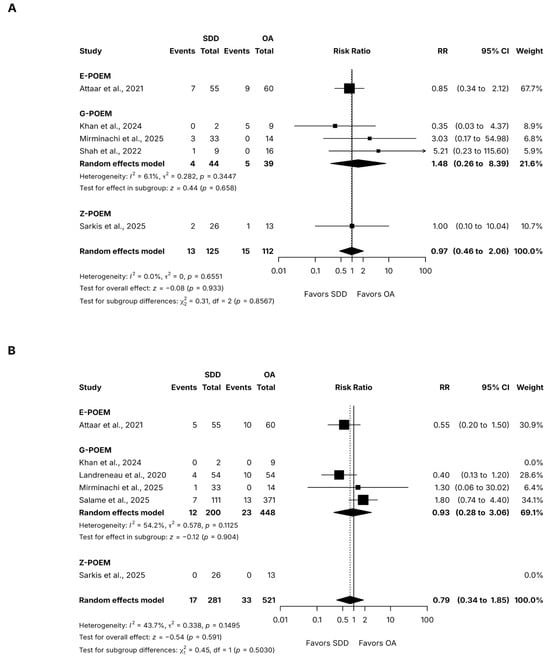
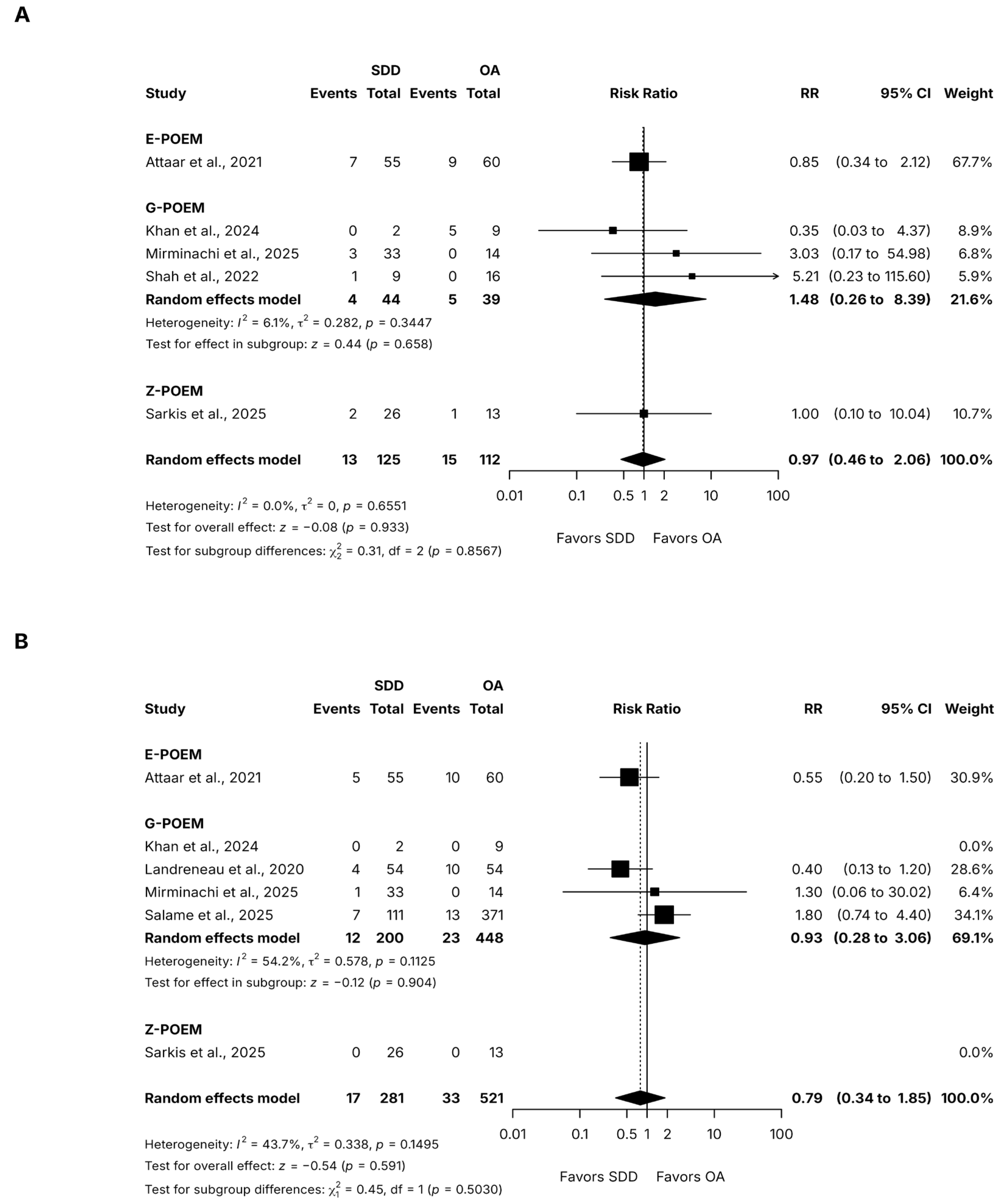
Five studies (237 patients; 125 SDD, 112 OA) reported 30-day ED visits. No statistically significant difference was detected (RR 0.97, 95% CI 0.46 to 2.06; p = 0.93; I2 = 0%) (Figure 3A). The CI was compatible with both a 54% relative reduction and a twofold increase in ED visits. Applied to the OA risk of 13.4%, this corresponds to 4 fewer ED visits per 1000 patients (73 fewer to 142 more). Six studies (802 patients; 281 SDD, 521 OA) reported readmissions; two had no events in either arm, so four contributed to the pooled estimate. No statistically significant difference was detected (RR 0.79, 95% CI 0.34 to 1.85; p = 0.59; I2 = 43.7%) (Figure 3B), corresponding to 13 fewer readmissions per 1000 patients (42 fewer to 54 more) at an OA risk of 6.3%. These results do not establish equivalence or non-inferiority.
Figure 3.
Random-effects meta-analysis of post-discharge outcomes comparing SDD with OA, by procedure type: (A) 30-day emergency department visits; (B) hospital readmissions. Black squares represent the risk ratio of each study, with size proportional to study weight, and horizontal lines represent 95% confidence intervals. Diamonds represent pooled random-effects estimates. The solid vertical line marks no difference (risk ratio = 1), and the dotted vertical line marks the overall pooled estimate. The arrow indicates a confidence interval extending beyond the plotted range. Studies with zero events in both groups carry no weight. Studies in panel (A): Attaar et al., 2021 [32]; Khan et al., 2024 [34]; Mirminachi et al., 2025 [19]; Shah et al., 2022 [37]; Sarkis et al., 2025 [31]. Studies in panel (B): Attaar et al., 2021 [32]; Khan et al., 2024 [34]; Landreneau et al., 2020 [35]; Mirminachi et al., 2025 [19]; Salame et al., 2025 [18]; Sarkis et al., 2025 [31].
Neither outcome differed by procedure type (ED visits, p for subgroup difference = 0.86; readmissions, p = 0.50). Procedure-specific estimates were imprecise (Supplementary Table S4). For G-POEM, the RR was 1.48 (95% CI 0.26 to 8.39; 3 studies) for ED visits and 0.93 (95% CI 0.28 to 3.06; 3 studies with events) for readmissions. E-POEM was represented by one study for each outcome (ED visits RR 0.85, 95% CI 0.34 to 2.12; readmissions RR 0.55, 95% CI 0.20 to 1.50) [32]. Z-POEM was represented by one study with three ED visits in total (RR 1.00, 95% CI 0.10 to 10.04) and no readmissions in either group [31].
Results were consistent across all sparse-data methods (Supplementary Table S3). Point estimates ranged from 0.97 to 1.00 for ED visits and from 0.78 to 0.83 for readmissions, and all CIs included 1. Results were similar after excluding the three conference abstracts (ED visits RR 0.98, 95% CI 0.43 to 2.24; readmissions RR 0.76, 95% CI 0.30 to 1.92), after excluding the Z-POEM study (ED visits RR 0.96, 95% CI 0.43 to 2.14; readmissions unchanged), and with Hartung-Knapp adjustment. Restricting readmissions to studies with a 30-day window, by excluding the 15-day data of Salame et al., gave an RR of 0.50 (95% CI 0.24 to 1.03). Leave-one-out analyses did not change the statistical significance of either outcome (Supplementary Figure S3A,B).
Doi plots showed major asymmetry for ED visits (LFK index 2.67) and minor asymmetry for readmissions (LFK index 1.27 among the four studies with events; 2.84 when the two double-zero studies were included with a continuity correction) (Supplementary Figure S1A,B). Given the small number of studies, this asymmetry indicates possible small-study effects and was incorporated into the GRADE assessment.
3.5. Outcomes Occurring Before or at the Discharge Decision
Adverse events were reported in all nine studies, but definitions, ascertainment windows, and level of detail varied (Table 3). Most events occurred during the procedure or in the immediate recovery period and were themselves reasons for admission. Adverse events were recorded in 4 of 366 SDD patients (1.1%) and 43 of 740 OA patients (5.8%); six studies reported no events in the SDD group. The pooled RR was 0.28 (95% CI 0.12 to 0.64), and the sparse-data sensitivity analyses gave estimates between 0.09 and 0.29 (Supplementary Figure S2A; Supplementary Table S3). Because patients with intraprocedural or early events were systematically kept overnight, this difference reflects how the discharge groups were formed and is not a comparative effect of SDD. Delayed procedure-related events after discharge occurred in SDD patients, including delayed bleeding requiring exploratory laparotomy after G-POEM [18] and, after E-POEM, a submucosal tunnel leak on day 5 and bleeding from an open mucosotomy requiring endoscopic suturing on day 22 [32].
Table 3.
Definitions, timing, and description of adverse events in the included studies.
Procedure time was shorter in SDD groups (9 studies, 1106 patients; MD −8.61 min, 95% CI −14.38 to −2.83; I2 = 82.1%) (Supplementary Figure S2B). This is expected, because longer or technically difficult procedures more often led to admission [18,32]. The direction of the association was unchanged in leave-one-out analysis, and heterogeneity decreased most after omission of Pass et al. (I2 = 73.0%) (Supplementary Figure S3D).
Post-procedural upper gastrointestinal imaging was performed less often in SDD groups (6 studies, 973 patients; RR 0.50, 95% CI 0.27 to 0.93; I2 = 94.7%), with a significant difference by procedure type (p = 0.004) (Supplementary Figure S2C). This association was not robust. It lost statistical significance with Hartung-Knapp adjustment (95% CI 0.23 to 1.08) and after omission of Attaar et al., Landreneau et al., or Salame et al. (Supplementary Figure S3E). The Doi plot showed major asymmetry (LFK index −6.77) (Supplementary Figure S1E). Imaging use was largely protocol-driven: all Z-POEM patients underwent esophagram before discharge [31], nearly all patients in one E-POEM cohort underwent esophagram [33], and awaiting next-day esophagram was the most common reason for admission in another [32].
Double myotomy was reported in three G-POEM studies (526 patients) and did not differ significantly between groups (RR 1.77, 95% CI 0.82 to 3.83; I2 = 93.1%). After omission of Pass et al., heterogeneity resolved and double myotomy was more frequent in SDD patients (RR 2.70, 95% CI 1.96 to 3.71) (Supplementary Figure S3F).
3.6. Efficacy Outcomes
Technical success was 100% in both groups in all six reporting studies (RR 1.00, 95% CI 0.98 to 1.02). Clinical success was reported by discharge group only in two G-POEM studies (147 patients), both defining it as a ≥1-point improvement in GCSI [18,19]. No significant difference was detected (RR 0.83, 95% CI 0.61 to 1.13; I2 = 0%), and results were similar when the 1–3-month time point of Salame et al. was used (RR 0.85, 95% CI 0.70 to 1.02). Change in GCSI score (3 G-POEM studies; MD −0.08, 95% CI −0.44 to 0.28; I2 = 21.7%) and change in Eckardt score (2 E-POEM studies; MD 0.01, 95% CI −0.83 to 0.86; I2 = 0%) did not differ between groups (Supplementary Figure S4). Doi plots were not constructed for these outcomes because fewer than five studies contributed.
3.7. GRADE Assessment
Table 4 presents the summary of findings for the primary outcomes and adverse events, and the full evidence profile is provided in Supplementary Table S2. The certainty of evidence was very low for 30-day ED visits, readmissions, and adverse events, and for all other outcomes except technical success and procedure time, which were rated low. ED visits and readmissions were downgraded for serious risk of bias, very serious imprecision, and suspected publication bias. Adverse events were downgraded by two levels for risk of bias because discharge status was assigned after early events had occurred.
Table 4.
Summary of findings for post-discharge outcomes and adverse events (GRADE).
4. Discussion
Post-procedural care after POEM was initially modeled on surgical myotomy, including overnight nil per os (NPO) status and routine postoperative esophagram [32]. Realizing the benefits of a minimally invasive procedure requires evaluation of recovery pathways and length of stay, and practice has gradually moved toward SDD [7,32,38,39]. In this systematic review and meta-analysis, we compared SDD with OA after E-POEM, G-POEM, and Z-POEM.
Across nine comparative studies, we did not detect a statistically significant difference in 30-day ED visits or readmissions between SDD and OA. These outcomes occur after the discharge decision and are the most informative for the safety question. However, the CIs were wide and compatible with clinically important benefit or harm. The findings therefore do not establish that the two strategies are equivalent. They show only that the available data do not demonstrate an increase in post-discharge healthcare use among patients selected for SDD. The timing of delayed events supports this interpretation. In the study by Attaar et al., patients readmitted after E-POEM who required intervention presented between 4 and 29 days after discharge, a window that a single additional night of observation would not have covered [32]. After G-POEM, Landreneau et al. reported four readmissions after SDD: nausea and vomiting (n = 2), abdominal pain with capnoperitoneum (n = 1; discharged the following day), and bleeding from ulceration at the tunnel site in a patient who did not adhere to the prescribed proton-pump inhibitor and sucralfate regimen (n = 1). The authors concluded that inpatient recovery would not have prevented these events [35]. Clinically significant delayed events can still occur after SDD. Salame et al. described delayed bleeding after SDD that required surgical management [18]. Most procedure-related complications are recognized during the procedure or soon after recovery, and an overnight stay is unlikely to prevent events that present days later.
Pooling E-POEM, G-POEM, and Z-POEM was prespecified because the three procedures share submucosal tunneling, myotomy, and mucosal closure, and because their post-procedural pathways were derived from the same surgical model. However, they treat different diseases at different anatomical sites and carry different risks and monitoring needs. G-POEM contributed six of nine studies and two-thirds of patients, so the pooled estimates mainly reflect G-POEM. Evidence for E-POEM came from two studies, only one of which reported ED visits and readmissions [32,33]. A recent meta-analysis restricted to E-POEM, which included seven retrospective studies, also found no significant difference in readmissions or ED visits between SDD and admitted patients [40]. Z-POEM was represented by a single study of 39 patients [31]. No conclusion about SDD after Z-POEM can be drawn from our data, and excluding this study did not change any primary result. The overall estimates should therefore not be generalized to all POEM procedures.
The lower adverse-event rate and the shorter procedure time in SDD groups should not be interpreted as effects of discharge strategy. In every included study, discharge status was determined after the procedure. Patients with intraprocedural complications, significant pain, nausea, or prolonged procedures were kept overnight by protocol or clinical judgment [18,31,32,36,37]. Many recorded adverse events were themselves the reason for admission, such as gastric perforations and submucosal tunnel leaks identified on the day of G-POEM [18] and intraoperative complications during E-POEM [32]. These outcomes are therefore partly a consequence of how patients were allocated to the discharge groups (reverse causation), and no statistical adjustment can remove this bias. For this reason, we present them as descriptive associations only. Baseline characteristics did not consistently favor SDD. SDD patients were older in four studies and younger in three, diabetes was more frequent among SDD patients in one study, and ASA class III-IV was more frequent among SDD patients in two studies (Table 2). The dominant selection mechanism therefore appears to be the intraprocedural and early post-procedural course rather than baseline risk.
The reasons for overnight stay in the included studies are also informative. Many admissions were driven by non-medical factors rather than procedural complications. Pass et al. distinguished medical from non-medical admissions after G-POEM and found that more than half were due to logistical or social barriers, such as lack of home support or travel distance. Excluding non-medical admissions would have increased the SDD rate from 65% to 85% [36]. After E-POEM, Attaar et al. found that delay in obtaining a post-procedure esophagram was the most common reason for admission (25% of admitted patients). After routine esophagram was discontinued, 45 of 64 patients (70%) were discharged on the same day, compared with 10 of 51 (20%) before [32]. Routine esophagrams have been used inconsistently in POEM studies, and several series reported no improvement in clinical outcomes or readmission rates with their routine use [14,18,32,35,41]. Routine imaging after G-POEM detected minor submucosal tunnel leaks that were managed conservatively [18]. Large series also show that esophagram frequently detects transient pneumomediastinum or pneumoperitoneum that resolves without clinical consequence [14,15].
Imaging practices differed by procedure. Landreneau et al. found no leak in any of 52 post-procedure upper gastrointestinal series after G-POEM and concluded that routine imaging is not necessary [35], and Salame et al. concluded that admission solely for next-day imaging did not appear justified after uncomplicated G-POEM [18]. In contrast, Sarkis et al. required a post-procedure esophagram before SDD after Z-POEM to confirm mucosal integrity, because mucosal closure is more difficult [31]. Some Z-POEM patients required OA only because same-day imaging was unavailable, and earlier procedure scheduling was suggested to facilitate SDD; a minimum 2-h observation period was also recommended [31]. Our imaging analysis was highly heterogeneous, was not robust in sensitivity analyses, and showed major Doi plot asymmetry. It therefore cannot support a recommendation for or against routine imaging. The available evidence does not demonstrate a clear benefit of routine imaging in clinically stable patients, and procedure-specific prospective studies are needed.
Patient factors also influence discharge decisions. Older patients with cardiopulmonary comorbidity may warrant overnight observation, and in some centers this is recommended by the anesthesia team. Medical complications, mainly arrhythmias, were a reason for admission after E-POEM [32], and a higher comorbidity index was associated with admission after G-POEM [37]. Landreneau et al. also advised inpatient admission for patients with substantial comorbidity and for centers early in their experience [35]. Capnoperitoneum and pneumomediastinum are common after POEM and are usually of no clinical significance [13,15]; asymptomatic free air alone should not delay discharge in a clinically stable patient. Several included studies used peri-procedural antibiotic prophylaxis that was continued after discharge [31,36,37], consistent with evidence supporting antimicrobial prophylaxis in upper gastrointestinal surgery [42], whereas Landreneau et al. suggested that routine antibiotic prophylaxis may not be necessary after G-POEM [35]. BMI was reported in only five studies and did not differ consistently between groups, and no study evaluated BMI as a determinant of discharge or outcomes. A structured pre-procedural assessment, for example through a pre-admission clinic, may help identify suitable candidates for SDD before the procedure.
Clinical and technical success and symptom-score changes did not differ between SDD and OA. Clinical success data came from only two G-POEM studies, and the double-myotomy result depended on a single study. These findings most likely reflect practice variation between centers rather than an effect of discharge strategy.
This study has strengths. We included only comparative studies, assessed risk of bias with ROBINS-I and certainty with GRADE, and performed prespecified subgroup analyses by procedure type. We also distinguished post-discharge outcomes from outcomes that determine discharge status, and we tested the robustness of the primary results with several sparse-data methods and sensitivity analyses.
This study has several limitations. All included studies were observational, and the certainty of evidence was low to very low. Allocation to SDD was based on the procedural course and on local criteria that differed between centers, so selection bias and reverse causation are unavoidable. The number of studies per procedure was small, and Z-POEM was represented by one study. Three studies were available only as conference abstracts with limited detail. In one abstract, adverse events and OA ED visits were not explicitly reported and were assumed to be zero [19]. Adverse-event definitions and ascertainment windows varied, and one study reported readmissions at 15 rather than 30 days [18]. Doi plots and LFK indices are unreliable with few studies. Finally, the random-effects primary analysis and the additional sensitivity analyses were added after peer review, as described in Section 2.9.
Taken together, discharge timing itself is unlikely to be the main determinant of outcomes after POEM. Outcomes appear to depend largely on patient selection, procedural complexity, and institutional practice. SDD should therefore be viewed as a care-pathway option for selected patients rather than as a therapeutic intervention.
Considerations for Same-Day Discharge After POEM
Table 5 lists considerations for SDD after POEM. They were not derived statistically. They were compiled by the authors from the discharge protocols and reported admission factors of the included studies and of prior single-arm series [14,18,31,32,36,37]. They represent expert opinion and are proposed for prospective validation rather than as evidence-based discharge criteria.
Table 5.
Considerations for same-day discharge after POEM proposed for prospective validation, with their sources.
5. Conclusions
In this systematic review and meta-analysis of very low-certainty evidence, SDD after POEM in selected patients at experienced centers was not associated with a statistically significant increase in 30-day ED visits or readmissions. The CIs were wide, so equivalence with OA cannot be concluded. The evidence mainly reflects G-POEM; data for E-POEM are limited, and Z-POEM could not be assessed. The lower adverse-event rate and shorter procedure time in SDD groups reflect patient and procedure selection rather than a benefit of early discharge. The available evidence does not demonstrate a clear benefit of routine post-procedural imaging in clinically stable patients, but imaging practices varied by procedure and this analysis was not robust. Procedure-specific prospective studies with prespecified discharge criteria, standardized adverse-event reporting, and separate reporting of medical and non-medical admissions are needed before standardized recommendations can be made.
Supplementary Materials
The following supporting information can be downloaded at: https://www.mdpi.com/article/10.3390/therapeutics3040023/s1, Table S1: Literature search strategy for each database; Table S2: GRADE evidence profile for all outcomes; Table S3: Sensitivity analyses for sparse data, model choice, and study selection; Table S4: Procedure-specific (subgroup) estimates from random-effects models; Table S5: PRISMA 2020 checklist; Figure S1: Doi plots and LFK indices for outcomes with at least five studies; Figure S2: Random-effects forest plots for outcomes occurring before or at the discharge decision; Figure S3: Leave-one-out sensitivity analyses; Figure S4: Random-effects forest plots for efficacy outcomes.
Author Contributions
Conceptualization, E.A.I. and I.M.; methodology, E.A.I. and M.A.T.M.; formal analysis, M.A.T.M. and Y.B.H.; writing—original draft preparation, E.A.I., M.A.T.M. and A.A.; writing—review and editing, E.A.I., I.M., H.A. and H.G.; supervision, G.M.H.; project administration, H.A. All authors have read and agreed to the published version of the manuscript.
Funding
This research received no external funding.
Institutional Review Board Statement
This research did not involve human participants; therefore, ethics approval was not applicable.
Informed Consent Statement
This manuscript does not contain data from human participants; consent to publish is therefore not applicable.
Data Availability Statement
The original contributions presented in this study are included in the article and its Supplementary Material. Further inquiries can be directed to the corresponding author.
Acknowledgments
This article is a revised and expanded version of a paper entitled “Same-Day Discharge Versus Overnight Admission After Endoscopic Myotomy: A Systematic Review and Meta-Analysis with GRADE Assessment” (abstract Sa2155), which was presented at Digestive Disease Week® 2026, Chicago, IL, USA, 2–5 May 2026 [43].
Conflicts of Interest
The authors declare no conflict of interest.
Abbreviations
| AGREE | Adverse Events for Gastrointestinal Endoscopy classification |
| ASA | American Society of Anesthesiologists |
| BMI | Body Mass Index |
| CI | Confidence Interval |
| E-POEM | Esophageal Peroral Endoscopic Myotomy |
| ED | Emergency Department |
| GCSI | Gastroparesis Cardinal Symptom Index |
| GRADE | Grading of Recommendations, Assessment, Development, and Evaluations |
| G-POEM | Gastric Peroral Endoscopic Myotomy |
| GLMM | Generalized Linear Mixed Model |
| I2 | I-squared (Measure of Heterogeneity) |
| LFK Index | Luis Furuya-Kanamori Index |
| MD | Mean Difference |
| NPO | Nil Per Os (Nothing by Mouth) |
| OA | Overnight Admission |
| POEM | Peroral Endoscopic Myotomy |
| PRISMA | Preferred Reporting Items for Systematic Reviews and Meta-Analyses |
| PROSPERO | International Prospective Register of Systematic Reviews |
| REML | Restricted Maximum Likelihood |
| ROBINS-I | Risk Of Bias In Non-randomized Studies—of Interventions |
| RR | Risk Ratio |
| SDD | Same-Day Discharge |
| vs. | Versus |
| Z-POEM | Zenker’s Peroral Endoscopic Myotomy |
References
- Khashab, M.A.; Benias, P.C.; Swanstrom, L.L. Endoscopic Myotomy for Foregut Motility Disorders. Gastroenterology 2018, 154, 1901–1910. [Google Scholar] [CrossRef] [Scilit]
- Ponds, F.A.; Fockens, P.; Lei, A.; Neuhaus, H.; Beyna, T.; Kandler, J.; Frieling, T.; Chiu, P.W.Y.; Wu, J.C.Y.; Wong, V.W.Y.; et al. Effect of Peroral Endoscopic Myotomy vs Pneumatic Dilation on Symptom Severity and Treatment Outcomes Among Treatment-Naive Patients With Achalasia: A Randomized Clinical Trial. JAMA 2019, 322, 134–144. [Google Scholar] [CrossRef] [Scilit]
- Kahrilas, P.J.; Katzka, D.; Richter, J.E. Clinical Practice Update: The Use of Per-Oral Endoscopic Myotomy in Achalasia: Expert Review and Best Practice Advice From the AGA Institute. Gastroenterology 2017, 153, 1205–1211. [Google Scholar] [CrossRef] [Scilit]
- Norton, B.; Siggens, K.; Papaefthymiou, A.; Telese, A.; Duku, M.; Murino, A.; Johnson, G.; Murray, C.; Mohammadi, B.; Mughal, M.; et al. Zenker Peroral Endoscopic Myotomy Is Safe and Effective for the Management of Pharyngeal Pouch: A Multicentre Retrospective Cohort Study. Dig. Dis. 2025, 43, 477–487. [Google Scholar] [CrossRef] [Scilit]
- Yang, D.; Bechara, R.; Dunst, C.M.; Konda, V.J.A. AGA Clinical Practice Update on Advances in Per-Oral Endoscopic Myotomy (POEM) and Remaining Questions-What We Have Learned in the Past Decade: Expert Review. Gastroenterology 2024, 167, 1483–1490. [Google Scholar] [CrossRef] [Scilit]
- Khashab, M.A.; Vela, M.F.; Thosani, N.; Agrawal, D.; Buxbaum, J.L.; Fehmi, S.M.A.; Fishman, D.S.; Gurudu, S.R.; Jamil, L.H.; Jue, T.L.; et al. ASGE guideline on the management of achalasia. Gastrointest. Endosc. 2020, 91, 213–227.e6. [Google Scholar] [CrossRef] [Scilit]
- Khashab, M.A.; Wang, A.Y.; Cai, Q. AGA Clinical Practice Update on Gastric Peroral Endoscopic Myotomy for Gastroparesis: Commentary. Gastroenterology 2023, 164, 1329–1335.e1. [Google Scholar] [CrossRef] [Scilit]
- Vosoughi, K.; Ichkhanian, Y.; Benias, P.; Miller, L.; Aadam, A.A.; Triggs, J.R.; Law, R.; Hasler, W.; Bowers, N.; Chaves, D.; et al. Gastric per-oral endoscopic myotomy (G-POEM) for refractory gastroparesis: Results from an international prospective trial. Gut 2022, 71, 25–33. [Google Scholar] [CrossRef] [Scilit]
- Gregor, L.; Wo, J.; DeWitt, J.; Yim, B.; Siwiec, R.; Nowak, T.; Mendez, M.; Gupta, A.; Dickason, D.; Stainko, S.; et al. Gastric peroral endoscopic myotomy for the treatment of refractory gastroparesis: A prospective single-center experience with mid-term follow-up (with video). Gastrointest. Endosc. 2021, 94, 35–44. [Google Scholar] [CrossRef] [Scilit]
- Eckhardt, D.; Elshafei, M.; Fechner, K.; Diener, M.K.; Hüttner, F.J. Endoscopic and surgical treatment options for gastroparesis: Systematic review and network meta-analysis. Br. J. Surg. 2025, 112, znaf183. [Google Scholar] [CrossRef] [Scilit]
- Cloutier, Z.; Mann, A.; Doumouras, A.G.; Hong, D. Same-day discharge is safe and feasible following POEM surgery for esophageal motility disorders. Surg. Endosc. 2021, 35, 3398–3404. [Google Scholar] [CrossRef] [Scilit]
- Liu, X.; Yao, L.; Cheng, J.; Xu, M.; Chen, S.; Zhong, Y.; He, M.; Chen, W.; Zhang, Y.; Qin, W.; et al. Landscape of Adverse Events Related to Peroral Endoscopic Myotomy in 3135 Patients and a Risk-Scoring System to Predict Major Adverse Events. Clin. Gastroenterol. Hepatol. 2021, 19, 1959–1966.e3. [Google Scholar] [CrossRef] [Scilit]
- Nabi, Z.; Reddy, D.N.; Ramchandani, M. Adverse events during and after per-oral endoscopic myotomy: Prevention, diagnosis, and management. Gastrointest. Endosc. 2018, 87, 4–17. [Google Scholar] [CrossRef] [Scilit]
- Benias, P.C.; Korrapati, P.; Raphael, K.L.; D’sOuza, L.S.; Inamdar, S.; Trindade, A.J.; Lee, C.; Kumbhari, V.; Sejpal, D.V.; Okolo, P.; et al. Safety and feasibility of performing peroral endoscopic myotomy as an outpatient procedure with same-day discharge. Gastrointest. Endosc. 2019, 90, 570–578. [Google Scholar] [CrossRef] [Scilit]
- Levy, J.L.; Levine, M.S.; Rubesin, S.E.; Falk, G.W.; Metz, D.C.; Dempsey, D.T.; Ginsberg, G.G. Findings of Esophagography for 25 Patients After Peroral Endoscopic Myotomy for Achalasia. AJR Am. J. Roentgenol. 2016, 207, 1185–1193. [Google Scholar] [CrossRef] [Scilit]
- Page, M.J.; McKenzie, J.E.; Bossuyt, P.M.; Boutron, I.; Hoffmann, T.C.; Mulrow, C.D.; Shamseer, L.; Tetzlaff, J.M.; Akl, E.A.; Brennan, S.E.; et al. The PRISMA 2020 statement: An updated guideline for reporting systematic reviews. BMJ 2021, 372, n71. [Google Scholar] [CrossRef] [Scilit]
- Cumpston, M.; Li, T.; Page, M.; Chandler, J.; Welch, V.; Higgins, J.P.; Thomas, J. Updated guidance for trusted systematic reviews: A new edition of the Cochrane Handbook for Systematic Reviews of Interventions. Cochrane Database Syst. Rev. 2019, 10, ED000142. [Google Scholar] [CrossRef] [Scilit]
- Salame, M.; Ichkhanian, Y.; Hadaki, N.; Wo, J.M.; Stainko, S.A.; Saito, A.; Siwiec, R.M.; Nowak, T.V.; Li, A.; Hwang, J.H.; et al. Safety of same-day discharge after gastric peroral endoscopic myotomy in patients with refractory gastroparesis: An international multicenter study. Gastrointest. Endosc. 2025, 102, 595–599.e1. [Google Scholar] [CrossRef] [Scilit]
- Mirminachi, S.; Cifuentes, L.; Gonzales, T.; Tansel, A.; Levinthal, D.J.; Kingsley, M.J.; Oh, S.J.; Wang, T.; Mahmood, S. Comparing the efficacy and safety of same day discharge versus inpatient stay following gastric peroral endoscopic myotomy (G-POEM). Gastrointest. Endosc. 2025, 101, S253–S254. [Google Scholar] [CrossRef] [Scilit]
- Sterne, J.A.C.; Hernán, M.A.; Reeves, B.C.; Savović, J.; Berkman, N.D.; Viswanathan, M.; Henry, D.; Altman, D.G.; Ansari, M.T.; Boutron, I.; et al. ROBINS-I: A tool for assessing risk of bias in non-randomised studies of interventions. BMJ 2016, 355, i4919. [Google Scholar] [CrossRef] [Scilit]
- Guyatt, G.H.; Oxman, A.D.; Vist, G.E.; Kunz, R.; Falck-Ytter, Y.; Alonso-Coello, P.; Schünemann, H.J. GRADE: An emerging consensus on rating quality of evidence and strength of recommendations. BMJ 2008, 336, 924–926. [Google Scholar] [CrossRef] [Scilit]
- Balduzzi, S.; Rücker, G.; Schwarzer, G. How to perform a meta-analysis with R: A practical tutorial. Evid. Based Ment. Health 2019, 22, 153–160. [Google Scholar] [CrossRef] [Scilit]
- Schwarzer, G.; Carpenter, J.R.; Rücker, G. Metasens: Statistical Methods for Sensitivity Analysis in Meta-Analysis. 28 January 2022. Available online: https://datacompass.lshtm.ac.uk/id/eprint/2964/ (accessed on 11 January 2026).
- Wan, X.; Wang, W.; Liu, J.; Tong, T. Estimating the sample mean and standard deviation from the sample size, median, range and/or interquartile range. BMC Med. Res. Methodol. 2014, 14, 135. [Google Scholar] [CrossRef] [Scilit]
- Langan, D.; Higgins, J.P.T.; Jackson, D.; Bowden, J.; Veroniki, A.A.; Kontopantelis, E.; Viechtbauer, W.; Simmonds, M. A comparison of heterogeneity variance estimators in simulated random-effects meta-analyses. Res. Synth. Methods 2019, 10, 83–98. [Google Scholar] [CrossRef] [Scilit]
- IntHout, J.; Ioannidis, J.P.A.; Borm, G.F. The Hartung-Knapp-Sidik-Jonkman method for random effects meta-analysis is straightforward and considerably outperforms the standard DerSimonian-Laird method. BMC Med. Res. Methodol. 2014, 14, 25. [Google Scholar] [CrossRef] [Scilit]
- Sweeting, M.J.; Sutton, A.J.; Lambert, P.C. What to add to nothing? Use and avoidance of continuity corrections in meta-analysis of sparse data. Stat. Med. 2004, 23, 1351–1375. [Google Scholar] [CrossRef] [Scilit]
- Stijnen, T.; Hamza, T.H.; Ozdemir, P. Random effects meta-analysis of event outcome in the framework of the generalized linear mixed model with applications in sparse data. Stat. Med. 2010, 29, 3046–3067. [Google Scholar] [CrossRef] [Scilit]
- Sterne, J.A.C.; Sutton, A.J.; Ioannidis, J.P.A.; Terrin, N.; Jones, D.R.; Lau, J.; Carpenter, J.; Rücker, G.; Harbord, R.M.; Schmid, C.H.; et al. Recommendations for examining and interpreting funnel plot asymmetry in meta-analyses of randomised controlled trials. BMJ 2011, 343, d4002. [Google Scholar] [CrossRef] [Scilit]
- Furuya-Kanamori, L.; Barendregt, J.J.; Doi, S.A.R. A new improved graphical and quantitative method for detecting bias in meta-analysis. Int. J. Evid. Based Healthc. 2018, 16, 195–203. [Google Scholar] [CrossRef] [Scilit]
- Sarkis, Y.; Al-Haddad, M.; Stainko, S.; Wreglesworth, L.; Ashcraft, K.; DeWitt, J. Safety of same day discharge after Zenker’s diverticulum peroral endoscopic myotomy. Dig. Liver Dis. 2025, 57, 902–905. [Google Scholar] [CrossRef] [Scilit]
- Attaar, M.; Su, B.; Wong, H.J.; Kuchta, K.; Denham, W.; Haggerty, S.P.; Linn, J.; Ujiki, M.B. Factors associated with admission after implementation of a same-day discharge pathway in patients undergoing peroral endoscopic myotomy (POEM). Surg. Endosc. 2021, 35, 3971–3980. [Google Scholar] [CrossRef] [Scilit]
- Gouda, Z.; Schiavone, G.; Zhao, J.; Gervase, J.; Le, J.; Robles, M.; Kumar, A.; Schlachterman, A. S1505 Same Day Discharge vs Overnight Admission for Outpatient Esophageal Per-Oral Endoscopic Myotomy. Am. J. Gastroenterol. 2024, 119, S1089–S1090. [Google Scholar] [CrossRef] [Scilit]
- Khan, M.T.; Sorensen, L.; Bouvette, C.; Qamar, U.; Grossen, A.; Clifton, S.; Ali, I.A.; Rumman, A. Optimizing G-POEM recovery: Same-day discharge vs overnight admission insights from a retrospective study and meta-analysis. Gastrointest. Endosc. 2024, 99, AB1149. [Google Scholar] [CrossRef] [Scilit]
- Landreneau, J.P.; Strong, A.T.; Ponsky, J.L.; Tu, C.; Kroh, M.D.; Rodriguez, J.H.; El-Hayek, K. Enhanced recovery outcomes following per-oral pyloromyotomy (POP): A comparison of safety and cost with same-day discharge versus inpatient recovery. Surg. Endosc. 2020, 34, 3153–3162. [Google Scholar] [CrossRef] [Scilit]
- Pass, B.; Neice, M.; Sachdeva, K.; Roppolo, N.; Alkurd, A.; Mohuiddin, F.; Armstrong, E.; Dies, R.; Andrus, V.; Deville, A.; et al. Same-Day Discharge, Medical and Non-Medical Admission After Per-Oral Endoscopic Pyloromyotomy. J. Dig. Dis. 2025, 26, 135–142. [Google Scholar] [CrossRef] [Scilit]
- Shah, R.; Chen, H.; Calderon, L.F.; Gooden, T.; Mubashir, M.; Rashid, S.; Raza, S.M.; Derise, A.; Mccurdy, G.; Sanders, B.; et al. Safety and feasibility of same day discharge after per oral endoscopic pyloromyotomy in refractory gastroparesis: A pilot study. Chin. Med. J. 2022, 135, 1432–1437. [Google Scholar] [CrossRef] [Scilit]
- Khashab, M.A.; Ngamruengphong, S.; Carr-Locke, D.; Bapaye, A.; Benias, P.C.; Serouya, S.; Dorwat, S.; Chaves, D.M.; Artifon, E.; de Moura, E.G.; et al. Gastric per-oral endoscopic myotomy for refractory gastroparesis: Results from the first multicenter study on endoscopic pyloromyotomy (with video). Gastrointest. Endosc. 2017, 85, 123–128. [Google Scholar] [CrossRef] [Scilit]
- Kamal, F.; Khan, M.A.; Lee-Smith, W.; Sharma, S.; Acharya, A.; Jowhar, D.; Farooq, U.; Aziz, M.; Kouanda, A.; Dai, S.; et al. Systematic review with meta-analysis: One-year outcomes of gastric peroral endoscopic myotomy for refractory gastroparesis. Aliment. Pharmacol. Ther. 2022, 55, 168–177. [Google Scholar] [CrossRef] [Scilit]
- Saeed, A.; Hayat, U.; Herman, T.; Igbinedion, S.; Baidoo, L.; Hayat, M.; Kamal, F.; Mahmood, S.; Parsi, M.A.; Bilal, M.; et al. Safety and feasibility of same-day discharge after peroral endoscopic myotomy in esophageal motility disorders: A systematic review and meta-analysis. Surg. Endosc. 2026, 40, 3698–3708. [Google Scholar] [CrossRef] [Scilit]
- Campagna, R.A.J.; Hungness, E.S. Treatment of Idiopathic Achalasia with Per-Oral Esophageal Myotomy. Tech. Gastrointest. Endosc. 2018, 20, 114–119. [Google Scholar] [CrossRef] [Scilit]
- Marano, L.; Carbone, L.; Poto, G.E.; Calomino, N.; Neri, A.; Piagnerelli, R.; Fontani, A.; Verre, L.; Savelli, V.; Roviello, F.; et al. Antimicrobial Prophylaxis Reduces the Rate of Surgical Site Infection in Upper Gastrointestinal Surgery: A Systematic Review. Antibiotics 2022, 11, 230. [Google Scholar] [CrossRef] [Scilit]
- Ibrahim, E.A.; Mohamad, I.; Mahmoud, M.A.; Hafez, Y.B.; Aref, A.; Abosheaishaa, H.; Ghoz, H.; Hammoud, G.M. Sa2155 Same-Day Discharge Versus Overnight Admission after Endoscopic Myotomy: A Systematic Review and Meta-Analysis with GRADE Assessment. Gastrointest. Endosc. 2026, 103, S481. [Google Scholar] [CrossRef] [Scilit]

Disclaimer/Publisher’s Note: The statements, opinions and data contained in all publications are solely those of the individual author(s) and contributor(s) and not of MDPI and/or the editor(s). MDPI and/or the editor(s) disclaim responsibility for any injury to people or property resulting from any ideas, methods, instructions or products referred to in the content. |
© 2026 by the authors. Licensee MDPI, Basel, Switzerland. This article is an open access article distributed under the terms and conditions of the Creative Commons Attribution (CC BY) license.