


Abstract
Problematic internet use (PIU) is an important concern among adolescents. This exploratory longitudinal secondary analysis examined patterns in adolescents’ descriptions of PIU following a 6-night, 7-day residential treatment camp combining cognitive behavioral therapy and experiential activities. Twenty-two adolescents answered an open-ended question at baseline, immediately after the intervention, and at 3-month follow-up. Internet addiction severity was assessed using a diagnostic questionnaire (DQ). Baseline DQ data from 106 adolescents in the same region served as cross-sectional reference data, not longitudinal controls. Mean DQ scores decreased from 4.3 ± 1.6 to 3.2 ± 1.5 (p = 0.013; rank-biserial correlation = 0.673). Text mining showed that total extracted-word counts increased from 284 to 373 and 854 across the three assessments, while participant-level median counts increased from 8 to 12 and 30.5 (Friedman test, p < 0.001). Frequencies of words including “illness,” “daily life,” “school,” and “surroundings” varied over time, alongside differences in co-occurrence network structures. However, these lexical patterns may partly reflect unequal response lengths and do not establish improved psychological awareness. The findings support the feasibility of longitudinal free-text analysis, but intervention causality cannot be inferred.
1. Introduction
Problematic internet use (PIU) is a serious problem in Japan as well as worldwide (Kawabe et al., 2020; Kuss & Lopez-Fernandez, 2016). Some studies have reported the effectiveness of interventions for improving PIU (Zajac et al., 2017). In Kagawa Prefecture, Japan, the Internet and Game Addiction Countermeasure Ordinance was established in April 2020 (Imataka et al., 2022). As one of its initiatives, a residential treatment camp has been implemented since 2021.
Residential treatment camps have been developed as intensive interventions for problematic internet and gaming use. Therapeutic Residential Camp (TRC), developed in South Korea, combines cognitive behavioral therapy (CBT), psychotherapy, and psychoeducation (Koo et al., 2011). In Japan, Self-Discovery Camp (SDiC) has been associated with reductions in gaming time and improvements in problem recognition and self-efficacy (Sakuma et al., 2017). Pornnoppadol et al. (2020) reported reductions in internet gaming disorder (IGD) severity following a therapeutic residential camp for adolescents, with improvements observed up to six months after the intervention. However, these studies have primarily evaluated outcomes using quantitative measures, leaving adolescents’ own descriptions of problematic internet and gaming use less well characterized.
The terms PIU, internet addiction (IA), and IGD are related but not interchangeable. PIU broadly refers to problematic patterns of internet use, whereas IA refers to excessive or compulsive internet use characterized by impaired control and negative consequences in daily life. In contrast, IGD specifically concerns problematic gaming behavior (Kuss & Lopez-Fernandez, 2016). In the present study, PIU is used as the overarching term because the Diagnostic Questionnaire (DQ) is a screening questionnaire for problems related to general internet use rather than gaming specifically.
The way individuals perceive and understand health-related problems may influence how they respond to and cope with these problems. The Common-Sense Model of Self-Regulation proposes that individuals develop perceptions of health threats, including beliefs about their identity, causes, consequences, and controllability, which influence their coping behaviors and may change over time through experience and feedback (Leventhal et al., 2016). Understanding how individuals conceptualize a health-related problem is therefore important for examining their recognition of the problem and potential responses to it. One approach to exploring such perceptions is to examine the language individuals use to describe their experiences. Pennebaker et al. (2003) reviewed evidence suggesting that natural language use can reflect aspects of individuals’ psychological and social experiences, highlighting the potential value of language analysis for understanding psychological processes. Although standardized questionnaires are useful for quantifying symptom severity, open-ended responses allow individuals to express their perceptions in their own words. Text mining can complement questionnaire-based assessments by systematically identifying word frequencies and co-occurrence patterns in these responses. Previous methodological research has illustrated how systematic text analysis, including word-frequency analysis, can be applied to open-ended responses collected in longitudinal program evaluations (Feng & Behar-Horenstein, 2019). Examining such linguistic patterns over time may provide exploratory insights into how adolescents describe and conceptualize problematic internet use. However, changes in language alone cannot establish corresponding changes in psychological awareness or insight.
Previous qualitative research has shown that adolescents who completed treatment for problematic gaming reported gaining insight into how their gaming behavior affects other aspects of their lives and their relationships with parents (Gurdal et al., 2023). However, longitudinal changes in adolescents’ own descriptions of problematic internet use remain insufficiently explored, particularly through systematic text-mining analyses. In the context of residential treatment camps for PIU, a previous quantitative study reported changes in internet addiction severity and depressive symptoms (Suzuki et al., 2026). Nevertheless, the adolescents’ own free-text descriptions collected repeatedly during and after such camps remain less well characterized. The contribution of the present study lies in combining three assessment points, quantitative text mining of adolescents’ own descriptions, and symptom severity assessment within a residential treatment camp setting. This exploratory approach aims to characterize longitudinal lexical patterns rather than establish changes in psychological awareness or causal intervention effects.
Therefore, in this secondary analysis, the primary objective was to describe longitudinal changes in word frequencies and co-occurrence patterns in adolescents’ free-text descriptions of PIU at baseline, immediately after a residential treatment camp, and at the 3-month follow-up. The secondary objective was to examine changes in DQ scores from baseline to the 3-month follow-up. These analyses were conducted to characterize linguistic patterns and symptom severity changes separately, without assuming a direct relationship between them.
2. Materials and Methods
2.1. Subjects
The present study was designed as an exploratory, single-group longitudinal secondary analysis of data collected from adolescents who participated in a residential treatment camp for PIU. The analysis focused on changes in participants’ free-text descriptions across three assessment points: baseline, immediately after the intervention, and at the 3-month follow-up. Changes in DQ scores from baseline to follow-up were also examined as a secondary outcome. Although the previously published study by Suzuki et al. (2026) included a non-intervention comparison group, the present longitudinal analysis was restricted to the camp participants. The baseline data from 106 adolescents in the comparison group were used only as a cross-sectional descriptive reference to provide context for interpreting the lexical content of the intervention group’s baseline responses, and not for direct statistical comparisons of word frequencies or longitudinal analyses. Accordingly, the present study aimed to characterize longitudinal patterns within the intervention group rather than establish causal effects of the residential treatment camp.
At the residential treatment camp, university student mentors engaged participants in outdoor activities, such as campfires and stargazing, as well as cooking activities, including making curry and barbecuing. In addition, participants received psychological interventions using i Swing for OFFLINE CAMP, a structured program based on cognitive behavioral therapy (CBT), as previously described (Umino, 2026). Each day, for 1 h over five sessions, group work was conducted on the following themes: “What is internet/game addiction?”, “Why do we use too much?”, “What happens when we use internet/games excessively?”, “How to manage internet/game use effectively”, and “Let’s prepare for the presentation!”. On the final day, participants presented their goals for future living in front of all attendees, including their parents. Additionally, at the end of each day’s activities, participants recorded a daily reflection based on three categories—“things done for me,” “things I did in return,” and “things I caused trouble with”—based on the three-question framework of Naikan therapy, a Japanese structured self-reflection method (Maeshiro, 2009). Participants met with their university mentors to discuss these Naikan-based reflections. All 22 participants included in the present analysis completed the six-night, seven-day residential camp and participated in the CBT-based sessions and Naikan-based reflection activities. However, some participants rested instead of participating in certain outdoor activities because of fatigue. Detailed attendance records for individual outdoor activities were not maintained, and the number of participants who missed these activities could not be determined. Formal assessments of intervention fidelity were not conducted.
Of the 24 adolescents who participated in the residential treatment camp, 22 (14 males and 8 females) were included in this secondary analysis. The remaining two participants completed the baseline and post-intervention assessments but did not attend the 3-month follow-up assessment and were therefore excluded from the longitudinal analysis. The two excluded participants were a 12-year-old male in Grade 6 and a 10-year-old female in Grade 5. Both had baseline DQ scores of 6, which were higher than the mean baseline DQ score of the 22 included participants (4.3 ± 1.6). The eligibility criteria were as follows: (1) living in Kagawa Prefecture and participation in the “Effective Program for Recovery from Internet and Gaming Addiction (residential treatment camp, 6 nights and 7 days)” conducted by Sanko Hospital in 2024 as a commissioned project of Kagawa Prefecture; and (2) provision of written informed consent by parents and assent by the adolescent participants. Unlike the previous study (Suzuki et al., 2026), which was restricted to students in Grades 5–9, the present secondary analysis also included two high school students who participated in the same residential treatment camp. Neither the DQ results nor the free-text responses analyzed in the present study were reported in Suzuki et al. (2026). Additionally, baseline data from 106 students in the same region who did not participate in the residential treatment camp were included as a baseline reference sample. These students were recruited through their schools and completed the baseline questionnaire at school using Google Forms on tablet devices. The sample comprised 66 students in Grades 5–6 and 40 students in Grades 7–9, with no high school students. These data were used solely as a cross-sectional descriptive reference for contextualizing the intervention group’s baseline responses and were not used as a longitudinal control group or for direct statistical comparisons of word frequencies. Further details were described in the previous report (Suzuki et al., 2026). The present study included 22 adolescents who provided free-text responses at all three assessment points, yielding 66 responses for longitudinal text-mining analysis. Given the exploratory and descriptive nature of the study, this sample was considered appropriate for identifying preliminary lexical patterns and generating hypotheses for future research, although it was not intended to provide definitive or generalizable conclusions.
2.2. Survey
Baseline measurements were conducted during the orientation on 15 July 2024. The residential treatment camp (intervention), lasting 6 nights and 7 days, was conducted from 18 August to 24 August 2024. Post-intervention measurements were obtained on the final day, and follow-up measurements were conducted on 24 November 2024.
A self-administered questionnaire asked participants to provide open-ended responses to the question, “What are your thoughts on internet/game addiction?” Free-text responses were obtained from all 22 participants at all three assessment points: baseline, post-intervention, and 3-month follow-up. The open-ended question was developed by the researchers to elicit participants’ own views and perceptions of internet/game addiction without restricting their responses to predetermined categories. The participants had been recruited to a residential treatment program specifically designed to address internet and gaming addiction, and the concept of addiction was therefore part of the program context. The same question wording and self-administered response format were used at all three assessment points. Free-text responses were collected on a single A4-sized sheet, with the question printed at the top and most of the remaining space available for writing. The response space was identical across all three assessment points. All questionnaires were completed in the same room at the same facility. Participants were given 30 min to complete the questionnaire and were allowed to leave once they had finished. Parents were not present during questionnaire administration, while staff members and university student mentors supervised the sessions. The question was not formally pilot-tested.
The DQ (Young, 1998), previously used in other studies (Bakken et al., 2009; Durkee et al., 2012; Mihara et al., 2016), was also administered. The DQ consists of eight yes/no items, with total scores ranging from 0 to 8. A score of ≥5 was used to indicate suspected internet addiction based on the original cutoff proposed by Young (1998), while a score of ≥3 was used to identify problematic internet use, encompassing both at-risk internet use (scores of 3–4) and suspected internet addiction (scores of ≥5), consistent with the classification reported by Bakken et al. (2009). However, because the DQ measures control difficulties related to daily internet use, scores were expected to decrease regardless of the effectiveness of the residential treatment camp when measured after the intervention. Therefore, it was not administered immediately after the residential treatment camp.
2.3. Statistical Analysis
Continuous variables were summarized as mean ± standard deviation (SD) or median and interquartile range (IQR), as appropriate. Changes in DQ scores between baseline and the 3-month follow-up were assessed using a two-sided Wilcoxon signed-rank test, with zero differences excluded and average ranks assigned to tied absolute differences. The p-value was calculated using the asymptotic normal approximation without adjustment for multiple comparisons. The rank-biserial correlation coefficient was calculated as a measure of effect size. Positive values indicated a decrease in DQ scores at follow-up relative to baseline.
The number of extracted words was calculated for each participant at each assessment point using KH Coder. Individual word counts were summarized as medians and IQRs. Differences in individual word counts across the three time points were assessed using the Friedman test, followed by pairwise Wilcoxon signed-rank tests with Holm adjustment for multiple comparisons. Kendall’s W was calculated as a measure of effect size for the Friedman test. As an exploratory analysis, Spearman’s rank correlation coefficient was used to examine the association between changes in DQ scores and changes in individual extracted-word counts from baseline to the 3-month follow-up.
Additional exploratory analyses were conducted to examine associations between participant characteristics and extracted-word counts. Spearman’s rank correlation coefficients were calculated to assess associations of age and baseline DQ scores with extracted-word counts at baseline and follow-up, as well as changes in word counts from baseline to follow-up. Differences by sex were examined using two-sided Mann–Whitney U tests. Given the exploratory nature of these analyses, p-values were not adjusted for multiple comparisons.
Statistical analyses were performed using IBM SPSS Statistics version 29.0.2.0 (IBM Corp., Armonk, NY, USA).
Text mining was performed using KH Coder version 3.Beta.08c (Higuchi, 2016, 2017a). The original Japanese free-text responses were analyzed without prior translation. Morphological analysis was performed using ChaSen (version 2.03b9) to segment the responses into words. A frequency list of extracted words was generated to identify high-frequency terms.
The following parts of speech were included in the analysis: nouns, verbal nouns, adjectival nouns, proper nouns, organization names, personal names, place names, nai-adjectives, adverbial nouns, unknown words, tags, interjections, verbs, adjectives, adverbs, and noun C.
The default preprocessing settings of KH Coder were used, and no additional user-defined stop-word list was applied. No synonym merging was performed; extracted Japanese terms were retained as identified by the morphological analysis. Interjections were intentionally included because the participants included elementary school students, and colloquial expressions were considered potentially relevant to their descriptions of problematic internet use. Therefore, interjections were not excluded solely on the basis of their part of speech.
Co-occurrence networks were constructed separately for baseline, post-intervention, and 3-month follow-up using KH Coder, as previously described (Higuchi, 2017b), following the general approach of co-word analysis (Callon et al., 1983). The unit of co-occurrence was set to H5, corresponding to an individual participant’s free-text response stored in a single Excel cell. Two words were considered to co-occur when both appeared within the same response, even if they occurred in different sentences. Words occurring at least twice within each assessment corpus were eligible for inclusion, with a minimum document frequency of one. This low frequency threshold was selected to retain relatively infrequent terms in the small exploratory corpus, although it could increase the sensitivity of the network structure to individual responses. Co-occurrence strength was calculated using the Jaccard coefficient, and up to 60 word pairs with the highest coefficients were selected for visualization. The limit of 60 edges represented a maximum rather than a fixed number; therefore, fewer edges were displayed when fewer than 60 eligible co-occurrence relationships were identified. Node size represented word frequency, and edge thickness represented co-occurrence strength. Subgraphs were identified using the modularity-based community detection function implemented in KH Coder. The Jaccard coefficient was calculated as the number of responses containing both words divided by the number of responses containing either or both words. As a sensitivity analysis, the word-frequency threshold was increased from two to three occurrences, while all other network analysis settings remained unchanged.
The extracted Japanese terms were translated into English using the web-based DeepL Translator (https://www.deepl.com/translator accessed on 25 September 2026) after completion of the text-mining analysis. Machine translation was used to minimize subjective choices in the English rendering of individual terms. No synonym merging or manual harmonization of English translations was performed. All text-mining analyses were conducted using the original Japanese terms before translation. The English translations were checked against the original Japanese terms to identify obvious mistranslations.
2.4. Ethics
Ethical approval was obtained from the Ethics Committee of Sanko Hospital (approval number: R2024-8; approval date: 5 July 2024). Written informed consent was obtained from the parents of all participating adolescents. In addition, assent was obtained from all adolescent participants before their participation in the study. All procedures performed in this study involving human participants were conducted in accordance with the ethical standards of the institutional research committee and with the Declaration of Helsinki and its later amendments.
3. Results
The characteristics of the study participants are summarized in Table 1. The DQ scores were 4.3 ± 1.6 in the intervention group and 2.2 ± 1.6 in the baseline reference sample. Subjects classified as “problematic internet use” (DQ ≥ 3) accounted for 81.8% in the intervention group and 39.6% in the baseline reference sample. Subjects classified as “suspected addiction” (DQ ≥ 5) accounted for 45.5% in the intervention group and 6.6% in the baseline reference sample. These findings suggest that participants in the residential treatment camp had higher tendencies toward PIU (Table 1).
Table 1.
Characteristics of enrolled participants.
DQ scores significantly decreased from 4.3 ± 1.6 at baseline to 3.2 ± 1.5 at the 3-month follow-up. The median DQ score decreased from 4.0 (IQR: 3.0–5.75; range: 2–8) at baseline to 3.5 (IQR: 2.0–4.0; range: 0–6) at follow-up (Wilcoxon signed-rank test, Z = −2.480, p = 0.013; rank-biserial correlation = 0.673). The median within-participant change (follow-up minus baseline) was −1 (IQR: −2 to 0). DQ scores decreased in 13 participants, increased in four participants, and remained unchanged in five participants. The proportion of participants scoring ≥3 on the DQ decreased from 81.8% (18/22) at baseline to 59.1% (13/22) at the 3-month follow-up. Similarly, the proportion scoring ≥5 decreased from 45.5% (10/22) to 18.2% (4/22). Six participants moved from scores ≥3 to scores below 3, whereas one participant moved in the opposite direction. For the cutoff of ≥5, six participants moved below the cutoff, and no participants moved from below the cutoff to scores ≥5.
To explore changes in adolescents’ descriptions following the residential treatment camp, text-mining analysis was conducted. The results at baseline for both the intervention group and baseline reference sample are shown in Table 2 and Table 3. The total number of words obtained was 284 and 813 for the intervention and baseline reference sample, respectively. The most frequent words in the intervention group were “think” (12 occurrences), followed by “game” and “net” (Table 2). In the baseline reference sample, the most frequent word was “think” (54 occurrences), followed by “scary,” “game,” and “bad” (Table 3). These terms were identified descriptively based on their observed frequencies rather than through a formal characteristic-word extraction method. Accordingly, they should not be interpreted as statistically distinctive terms of either sample.
Table 2.
Frequency of words used in the intervention group.
Table 3.
Frequency of words used in the baseline reference sample.
Table 2 presents the frequencies of words extracted at each assessment point. The total number of extracted words increased from 284 at baseline to 373 post-intervention and 854 at follow-up. At the participant level, the median number of extracted words was 8 (IQR: 3–13.25) at baseline, 12 (IQR: 6.25–22) post-intervention, and 30.5 (IQR: 21–49.25) at the 3-month follow-up. The Friedman test revealed a significant difference across the three time points (χ2(2) = 24.60, p < 0.001; Kendall’s W = 0.559). Post hoc comparisons using Wilcoxon signed-rank tests with Holm adjustment showed significantly higher word counts at follow-up than at baseline (adjusted p < 0.001) and post-intervention (adjusted p < 0.001), whereas the difference between baseline and post-intervention was not significant (adjusted p = 0.093). Word counts increased from baseline to follow-up in 20 of the 22 participants (Table 4). Exploratory Spearman correlation analysis showed no significant association between changes in DQ scores and changes in individual extracted-word counts from baseline to the 3-month follow-up (ρ = −0.116, p = 0.606; n = 22).
Table 4.
Summary of extracted-word counts and co-occurrence network characteristics across the three assessment points.
Additional exploratory analyses showed that extracted-word counts were positively correlated with age at baseline (Spearman’s ρ = 0.439, p = 0.041) and at the 3-month follow-up (ρ = 0.658, p < 0.001). However, age was not significantly associated with changes in extracted-word counts from baseline to follow-up (ρ = 0.333, p = 0.129). Baseline DQ scores were not significantly associated with extracted-word counts at baseline (ρ = 0.306, p = 0.166), at follow-up (ρ = 0.112, p = 0.620), or with changes in word counts (ρ = 0.047, p = 0.835). Differences by sex were not statistically significant at baseline (p = 0.973), at follow-up (p = 0.060), or for changes in word counts (p = 0.101).
At post-intervention, “illness” occurred six times in the extracted-word frequency analysis (Table 2). The term “illness” was not used at baseline but was used by 6 participants post-intervention and 1 participant at follow-up. The term “school” was used by 2 participants at follow-up. The term “surroundings” was used by 2 participants immediately after the intervention and by 2 participants at follow-up. The term “daily life” was used by 4 participants at follow-up but was not used at baseline or immediately after the intervention. Each participant used each respective term only once per assessment point.
Representative translated excerpts provide context for these findings. Immediately after the intervention, one participant described internet/game addiction as “an illness that anyone can develop and that is difficult to recognize,” adding that recovery requires help from “family, friends, and people in your surroundings” (Participant A).
At baseline, another participant stated, “I think it is a little concerning because I use my smartphone as soon as I get home and have not been helping with household chores.” Immediately after the intervention, the same participant wrote, “I thought it was a very scary illness. I thought I should be careful because excessive dependence can make me lose awareness of my surroundings.” At follow-up, this participant stated, “At first, I had difficulty stopping and did not prioritize things properly, but now I have gradually reduced the time I spend on the internet and games and have become more careful about my priorities. I also think it is scary because being unable to stop can make me irritable and lose awareness of my surroundings” (Participant B).
At follow-up, another participant wrote, “Cutting back on school time leads to truancy and isolation” (Participant C). Another participant stated, “I think they become so absorbed in the internet and games that they lose awareness of their surroundings and cause trouble for others. It reduces their sleep time and disrupts the balance of daily life” (Participant D).
These excerpts illustrate the different contexts in which the key terms were used, including illness recognition, social support, awareness of surroundings, school attendance, and daily life. The longitudinal example also illustrates how an individual participant’s description became more detailed across the three assessment points.
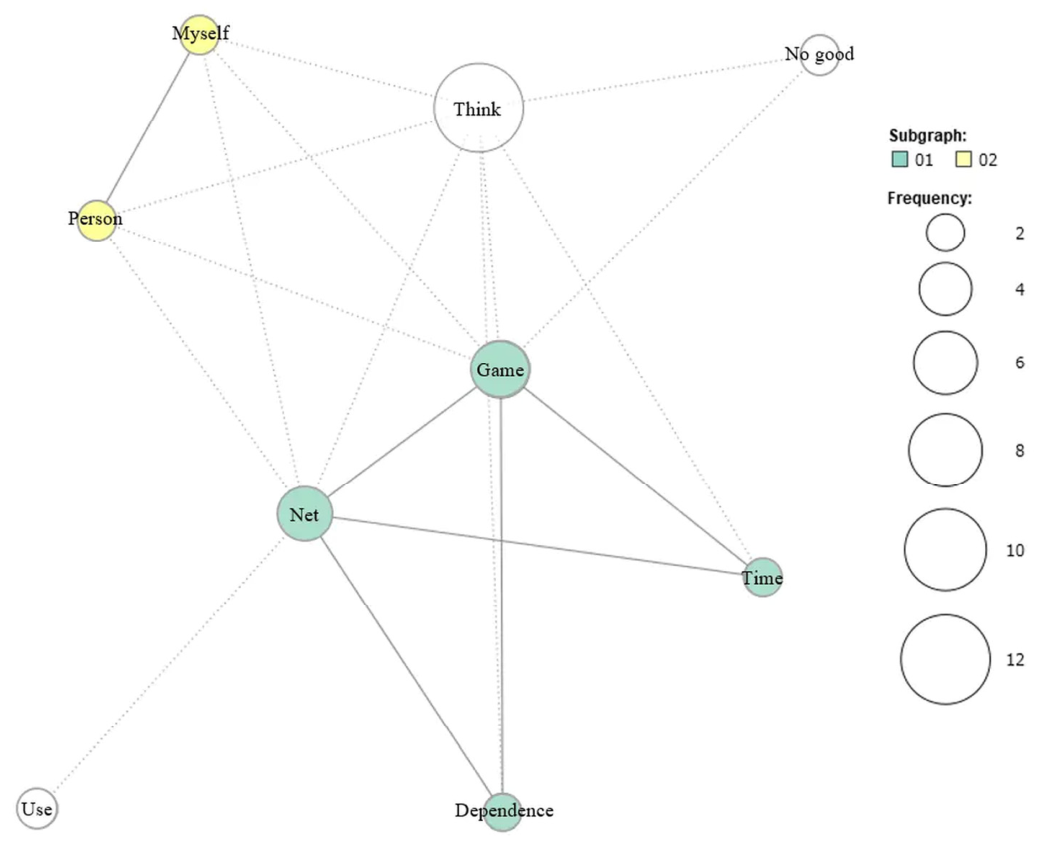
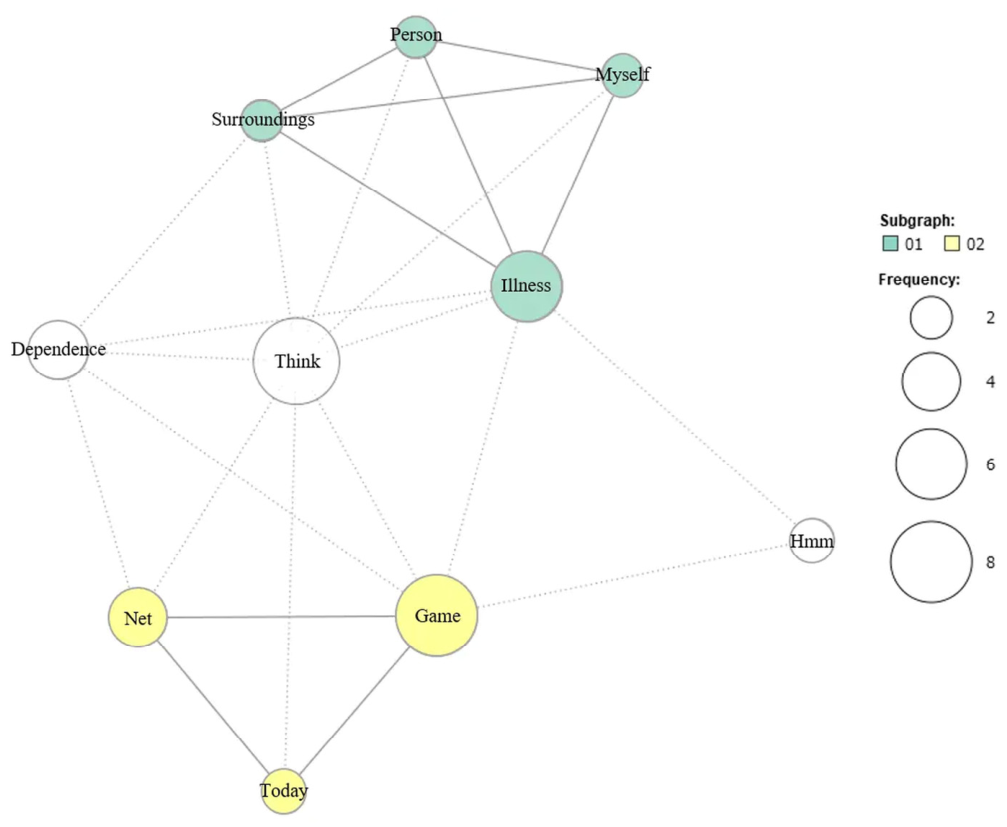
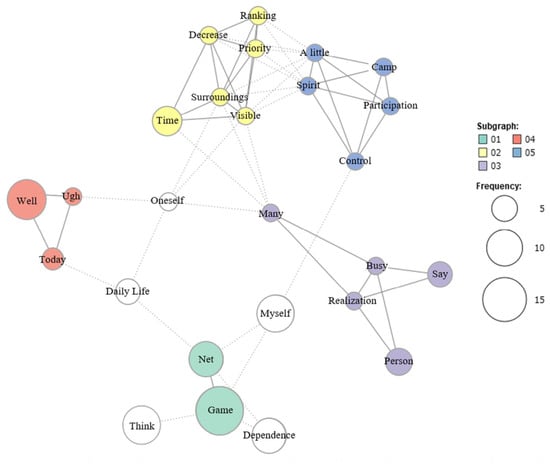
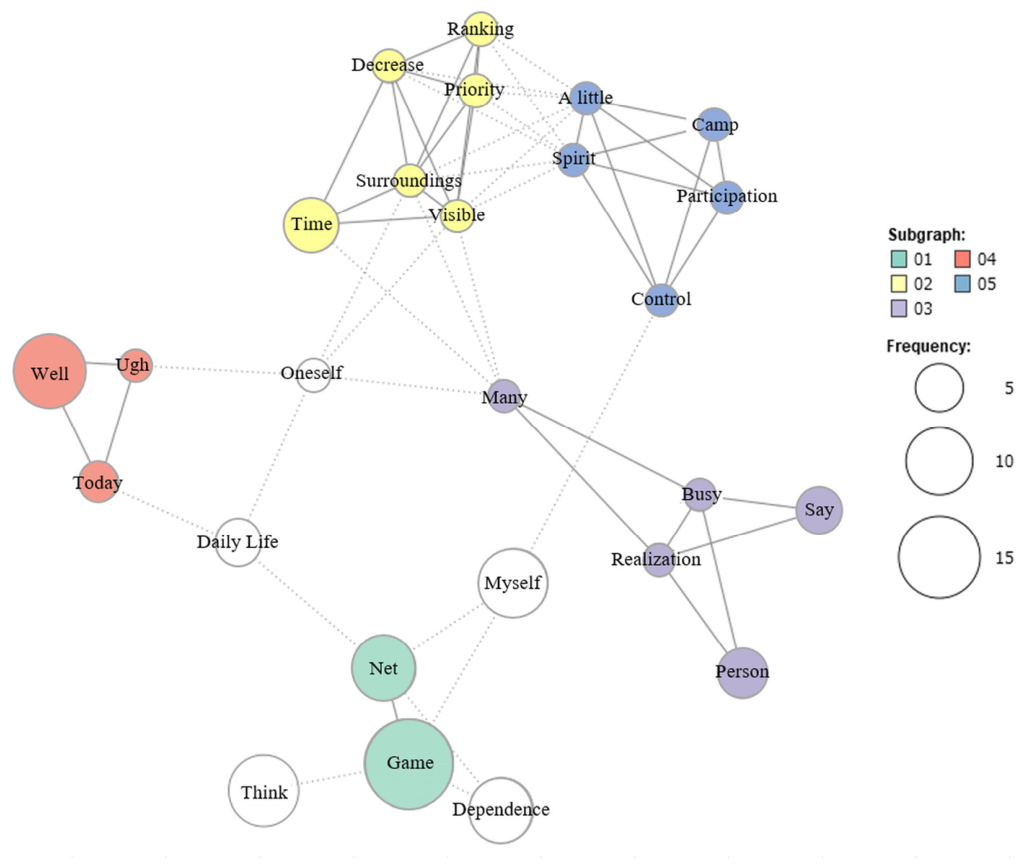
The co-occurrence networks also differed across the assessment points, with more nodes and connections at follow-up than at baseline (Figure 1, Figure 2 and Figure 3). At baseline, the co-occurrence network consisted of 9 nodes and 19 edges, with a network density of 0.528. At post-intervention, the network contained 10 nodes and 24 edges, with a density of 0.533. At the 3-month follow-up, the network contained 26 nodes and 60 edges, with a density of 0.185. Modularity-based community detection identified two subgraphs at baseline, two at post-intervention, and five at follow-up. At baseline, one subgraph primarily included terms related to internet and gaming use, such as “game,” “net,” “dependence,” and “time,” while the other included terms such as “myself” and “person” (Figure 1). Immediately after the intervention, one subgraph included “illness,” “surroundings,” “person,” and “myself,” whereas the other included “game,” “net,” and “today” (Figure 2). At the 3-month follow-up, five subgraphs were identified, including groups of terms related to internet and gaming use (“game” and “net”), time and daily activities (“time,” “surroundings,” and “priority”), camp experiences (“camp” and “participation”), and interpersonal or reflective expressions (“person,” “realization,” and “say”) (Figure 3). These descriptions summarize the lexical composition of the detected subgraphs and do not imply that the subgraphs represent distinct psychological constructs. Although the numbers of nodes and displayed edges increased at follow-up, network density decreased. These descriptive differences should be interpreted with caution because corpus size differed substantially across the assessment points and the maximum number of displayed edges was set to 60 (Table 4).
Figure 1.
Co-occurrence network at baseline. Nodes represent words occurring at least twice in the baseline corpus. Node size represents word frequency, and edge thickness represents co-occurrence strength measured using the Jaccard coefficient. Solid lines connect words within the same subgraph, whereas dashed lines connect words belonging to different subgraphs. Node colors distinguish automatically detected subgraphs. Up to 60 edges with the highest Jaccard coefficients were selected for visualization. The baseline network contained 9 nodes, 19 edges, and 2 subgraphs. The frequency scales differ across Figure 1, Figure 2 and Figure 3 because node sizes were scaled separately within each network. Therefore, node sizes should not be compared directly across the three figures.
Figure 2.
Co-occurrence network at post-intervention. The network consisted of 10 nodes, 24 edges, and 2 subgraphs. Words occurring at least twice were included, and up to 60 edges with the highest Jaccard coefficients were selected for visualization. Node size, edge thickness, line styles, and subgraph colors are defined in the legend of Figure 1.
Figure 3.
Co-occurrence network at follow-up. The network consisted of 26 nodes, 60 edges, and 5 subgraphs. Words occurring at least twice were included, and up to 60 edges with the highest Jaccard coefficients were selected for visualization. Node size, edge thickness, line styles, and subgraph colors are defined in the legend of Figure 1.
In the sensitivity analysis using a higher word-frequency threshold of three occurrences, the networks consisted of 3 nodes and 3 edges at baseline, 5 nodes and 9 edges post-intervention, and 11 nodes and 44 edges at the 3-month follow-up.
4. Discussion
In this secondary analysis, we used text mining to explore changes in adolescents’ descriptions of PIU following participation in a residential treatment camp in Kagawa Prefecture, Japan. The results showed that DQ scores significantly decreased from baseline to follow-up. Furthermore, participant-level analyses demonstrated a significant increase in the number of extracted words at the 3-month follow-up compared with both baseline and post-intervention. This increase was observed in 20 of the 22 participants when compared with baseline, suggesting that the increase in the overall corpus size was not driven solely by a small number of participants with lengthy responses.
Previous studies of residential treatment camps have reported improvements in gaming-related outcomes, problem recognition, self-efficacy, and quality of life (Koo et al., 2011; Sakuma et al., 2017; Pornnoppadol et al., 2020). Improvements in internet dependency levels and mental health have also been reported in residential treatment camps conducted in 2022 and 2023 (Sanko Hospital, 2023, 2024). In contrast, the present study focused on longitudinal changes in adolescents’ own descriptions of problematic internet use rather than directly evaluating the effectiveness of the residential treatment camp.
Although the increase in extracted-word counts was observed in most participants, greater textual output does not necessarily indicate improvements in psychological awareness, insight, or motivation for behavioral change. Furthermore, these participant-level changes in word counts do not establish individual longitudinal changes in the content or meaning of participants’ descriptions. The substantial increase in response length may have contributed to the greater number and variety of words observed at follow-up, as well as the more extensive co-occurrence network. Therefore, the observed changes in word frequencies and co-occurrence patterns should be interpreted with caution, as they may partly reflect differences in response length rather than changes in lexical diversity or psychological awareness. Previous methodological research has demonstrated that measures of lexical diversity can be influenced by text length (McCarthy & Jarvis, 2010). Further studies using approaches that account for differences in text length are needed to clarify these findings.
Several components of the residential treatment program may provide context for interpreting the observed changes in adolescents’ descriptions. Temporary separation from the online environment provided participants with experiences outside their habitual internet use, while psychoeducational sessions provided information about PIU and its consequences. Group sessions also encouraged participants to explore the perceived benefits and disadvantages of internet and gaming use, including their ambivalence toward these behaviors. These activities are conceptually consistent with the Stages of Change Model (Prochaska & DiClemente, 1983), which emphasizes readiness to change, and motivational interviewing, which focuses on exploring ambivalence and eliciting change talk (Miller & Rollnick, 2013; Miller & Rose, 2009). Daily Naikan-based reflections also provided opportunities to consider participants’ behavior and interpersonal experiences. However, readiness to change, ambivalence, and motivation were not directly measured, and the observed linguistic changes cannot be interpreted as evidence of changes in these psychological processes.
Furthermore, the camp provided opportunities for adolescents to engage in offline recreational and social activities away from the internet and gaming. These activities, together with peer interactions and shared experiences within the camp setting, may provide additional context for interpreting the observed changes in participants’ descriptions. However, the present study was not designed to determine the contribution of individual program components to these changes.
The appearance of the term “illness” immediately after the intervention should also be interpreted cautiously. Although six participants used this term at post-intervention, it was not used by any participant at baseline and was used by only one participant at follow-up. Its emergence immediately after the camp may reflect exposure to psychoeducational content, particularly the session on “What is internet/game addiction?”, rather than a sustained change in illness awareness. Alternatively, its use may simply reflect differences in word choice rather than changes in participants’ underlying perceptions. Therefore, the appearance of this term alone cannot establish changes in participants’ psychological understanding or recognition of addiction.
Other factors may also have contributed to the observed changes in free-text responses. Repeated administration of the same question may have increased participants’ familiarity with the assessment and influenced the length or content of their responses. Although the questionnaires were administered under consistent conditions at the same facility, differences in participants’ experiences and circumstances across assessment points cannot be excluded. In particular, the post-intervention assessment was conducted during the summer vacation period, whereas the 3-month follow-up was conducted in November, during the school term. This seasonal difference may have influenced participants’ descriptions, particularly their references to school, daily life, and social relationships. Therefore, the observed lexical changes cannot be attributed solely to the residential treatment camp.
From a clinical perspective, the period following a residential treatment camp may provide an opportunity for continued outpatient support, including CBT or motivational interviewing. The changes observed in adolescents’ descriptions may help clinicians explore how participants describe and understand their internet-related experiences after the camp. However, the present findings are exploratory and do not establish whether the residential treatment camp caused psychological or behavioral changes. Further studies are needed to clarify the clinical significance of these descriptive changes.
This study has several limitations. First, it was a secondary analysis of data from a previously reported intervention study (Suzuki et al., 2026). Although the free-text responses were collected prospectively, the original study was not specifically designed for detailed longitudinal text analysis, which may have limited the scope of the present findings.
Second, although the sample of 22 adolescents was considered appropriate for the exploratory and descriptive objectives of this study, the small sample size and recruitment from a single intervention at one facility limit the generalizability of the findings and the ability to detect subtle individual differences. Therefore, further studies with larger and more diverse samples are warranted. Exploratory analyses suggested that response length may be influenced by age, as extracted-word counts were positively associated with age at baseline and follow-up. However, age was not significantly associated with the increase in word counts over time. These findings suggest that developmental differences in verbal expression may have influenced the observed lexical patterns. Given the small sample size and multiple exploratory comparisons, these findings should be interpreted cautiously. The two participants excluded because of missing follow-up data had higher baseline DQ scores than the mean score of the included participants. Although the longitudinal analyses were based on paired data from the same 22 participants, the follow-up outcomes of the two excluded participants remain unknown. Therefore, the findings may not fully represent the outcomes of all 24 camp participants.
Third, adolescents and their parents who enrolled in the program may have been more health-conscious or motivated to seek help than the general population of adolescents with PIU, potentially introducing selection bias.
Fourth, the baseline reference sample of 106 adolescents was not included in the longitudinal text-mining analysis. Therefore, the present study could not determine whether the observed changes in word frequencies and co-occurrence patterns were specific to the intervention group. Furthermore, because the intervention group and the baseline reference sample differed substantially in sample size and baseline DQ scores, direct comparisons of raw word frequencies between the two groups are not appropriate. Further studies with larger samples and appropriate comparison groups are needed to determine whether the observed changes are attributable to the residential treatment camp. In addition, the questionnaire administration procedures differed between the intervention group and the baseline reference sample. Whereas the intervention group completed paper-based questionnaires at the study facility, the reference sample completed the baseline survey electronically at school. These differences in administration settings and response formats may have influenced response length and content, further limiting the comparability of the two samples.
Fifth, although all participants completed the residential camp and attended the CBT-based sessions and Naikan-based reflection activities, detailed attendance records for individual outdoor activities were not maintained. Therefore, participants’ exposure to these activities could not be fully assessed. In addition, formal assessments of intervention fidelity were not conducted.
Sixth, the wording of the open-ended question may have influenced participants’ responses. Although the question was intended to elicit participants’ own views without restricting their answers to predetermined categories, the explicit use of the term “addiction” may have encouraged illness-related or pathology-oriented descriptions. Furthermore, because the concept of addiction was already part of the camp context, the influence of the question wording cannot be separated from the influence of the program context. In addition, participants’ perceptions were assessed using a single open-ended question, which may not have captured the full range of their experiences and understanding of PIU. Repeated exposure to the same question across the three assessment points may also have influenced their responses through familiarity with the question or the assessment procedure. Future studies should consider using more neutral questions to explore adolescents’ spontaneous perceptions of problematic internet and gaming behaviors.
Seventh, the substantial differences in response length across the three assessment points may have affected the comparability of word frequencies and co-occurrence patterns. Although individual response lengths were examined, we did not conduct length-adjusted analyses of word frequencies or include longitudinal comparisons of lexical diversity in the main analysis. Many individual responses were extremely short, particularly at baseline (median: 8 extracted words). An exploratory assessment of MTLD using ChaSen-segmented Japanese text showed that many individual responses, particularly at baseline, did not yield complete MTLD factors, raising concerns about the stability of the estimates. Consequently, longitudinal comparisons of lexical diversity using MTLD were not considered sufficiently reliable for inclusion in the present analysis. Therefore, the observed lexical patterns may partly reflect differences in the amount of text produced rather than changes in the diversity of vocabulary used by participants. Future studies should collect sufficiently long free-text responses and employ normalized frequency measures and appropriate length-adjusted lexical diversity indices to better account for differences in response length (McCarthy & Jarvis, 2010). The low minimum word-frequency threshold of two occurrences may have made the co-occurrence networks sensitive to infrequent terms and individual responses. Although a sensitivity analysis using a higher threshold of three occurrences showed that the follow-up network remained larger than the networks at earlier assessment points, the numbers of nodes and edges changed substantially. This indicates that the network structures were sensitive to the selected frequency threshold and may be unstable. Furthermore, the effects of differences in corpus size and response length could not be fully separated from changes in participants’ descriptions. Therefore, individual co-occurrence relationships and subgraph structures should be interpreted cautiously. Importantly, changes in word frequencies and co-occurrence patterns represent lexical changes and cannot, by themselves, establish corresponding changes in psychological awareness, illness recognition, or motivation.
Finally, although the extracted Japanese terms were translated into English using DeepL and checked against the original Japanese terms for obvious mistranslations, machine translation may not have fully preserved the contextual nuances of individual expressions. Because all word-frequency and co-occurrence analyses were performed on the original Japanese text, translation did not affect the quantitative results, but it may have influenced how the extracted terms are understood by readers of the English manuscript.
5. Conclusions
This study used text-mining analysis to descriptively examine longitudinal patterns in adolescents’ free-text descriptions of PIU across three assessment points: before the residential treatment camp, immediately after the camp, and at the 3-month follow-up. The findings support the feasibility of collecting and analyzing longitudinal free-text responses across three assessment points. Descriptive differences were observed in both the content and length of participants’ responses over time. However, these linguistic differences do not establish improvements in psychological awareness, insight, or recovery, and causal effects of the intervention cannot be inferred.
Author Contributions
Conceptualization, S.U.; methodology, S.U.; formal analysis, S.U. and H.O.; investigation, S.U. and H.S.; writing—original draft preparation, S.U.; writing—review and editing, H.S., H.O. and N.M.; supervision, N.M.; project administration, S.U.; funding acquisition, H.S. All authors have read and agreed to the published version of the manuscript.
Funding
This research was funded in part by a commissioned project from Kagawa Prefecture, Japan, and by JSPS KAKENHI (Grant Number 23K16358).
Institutional Review Board Statement
The study was conducted in accordance with the Declaration of Helsinki and was approved by the Ethics Committee of Sanko Hospital (approval number: R2024-8; approval date: 5 July 2024).
Informed Consent Statement
Informed consent was obtained from all subjects involved in the study.
Data Availability Statement
The data presented in this study are available on request from the corresponding author due to privacy, confidentiality, and ethical restrictions.
Acknowledgments
We thank the participants who enrolled in the study.
Conflicts of Interest
The authors declare no conflicts of interest.
Abbreviations
The following abbreviations are used in this manuscript:
| CBT | Cognitive Behavioral Therapy |
| DQ | Diagnostic Questionnaire |
| IA | Internet Addiction |
| IGD | Internet Gaming Disorder |
| IQR | Interquartile Range |
| PIU | Problematic Internet Use |
| SD | Standard Deviation |
| SDiC | Self-Discovery Camp |
| S-TRC | Siriraj Therapeutic Residential Camp |
| TRC | Therapeutic Residential Camp |
References
- Bakken, I. J., Wenzel, H. G., Götestam, K. G., Johansson, A., & Øren, A. (2009). Internet addiction among Norwegian adults: A stratified probability sample study. Scandinavian Journal of Psychology, 50(2), 121–127. [Google Scholar] [CrossRef] [Scilit]
- Callon, M., Courtial, J.-P., Turner, W. A., & Bauin, S. (1983). From translations to problematic networks: An introduction to co-word analysis. Social Science Information, 22(2), 191–235. [Google Scholar] [CrossRef] [Scilit]
- Durkee, T., Kaess, M., Carli, V., Parzer, P., Wasserman, C., Floderus, B., Apter, A., Balazs, J., Barzilay, S., Bobes, J., Brunner, R., Corcoran, P., Cosman, D., Cotter, P., Despalins, R., Graber, N., Guillemin, F., Haring, C., Kahn, J.-P., … Wasserman, D. (2012). Prevalence of pathological internet use among adolescents in Europe: Demographic and social factors. Addiction, 107(12), 2210–2222. [Google Scholar] [CrossRef] [Scilit]
- Feng, X., & Behar-Horenstein, L. (2019). Maximizing NVivo utilities to analyze open-ended responses. The Qualitative Report, 24(3), 563–571. [Google Scholar] [CrossRef] [Scilit]
- Gurdal, S., Kapetanovic, S., Einarsson, I., Boson, K., & Claesdotter-Knutsson, E. (2023). Adolescents’ perceptions of a relapse prevention treatment for problematic gaming—A qualitative study. Healthcare, 11(17), 2366. [Google Scholar] [CrossRef] [Scilit]
- Higuchi, K. (2016). A two-step approach to quantitative content analysis: KH Coder tutorial using Anne of Green Gables (Part I). Ritsumeikan Social Sciences Review, 52(3), 77–91. [Google Scholar] [CrossRef]
- Higuchi, K. (2017a). A two-step approach to quantitative content analysis: KH Coder tutorial using Anne of Green Gables (Part II). Ritsumeikan Social Sciences Review, 53(1), 137–147. [Google Scholar] [CrossRef]
- Higuchi, K. (2017b). Using KH Coder in the field of linguistics. Mathematical Linguistics, 31(1), 36–45. [Google Scholar] [CrossRef]
- Imataka, G., Sakuta, R., Maehashi, A., & Yoshihara, S. (2022). Current status of Internet gaming disorder (IGD) in Japan: New lifestyle-related disease in children and adolescents. Journal of Clinical Medicine, 11(15), 4566. [Google Scholar] [CrossRef] [Scilit]
- Kawabe, K., Horiuchi, F., Nakachi, K., Hosokawa, R., & Ueno, S. (2020). Prevalence of Internet addiction in Japan: Comparison of two cross-sectional surveys. Pediatrics International, 62(8), 970–975. [Google Scholar] [CrossRef] [Scilit]
- Koo, C., Wati, Y., Lee, C. C., & Oh, H. Y. (2011). Internet-addicted kids and South Korean government efforts: Boot-camp case. Cyberpsychology, Behavior, and Social Networking, 14(6), 391–394. [Google Scholar] [CrossRef] [Scilit]
- Kuss, D. J., & Lopez-Fernandez, O. (2016). Internet addiction and problematic Internet use: A systematic review of clinical research. World Journal of Psychiatry, 6(1), 143–176. [Google Scholar] [CrossRef] [Scilit]
- Leventhal, H., Phillips, L. A., & Burns, E. (2016). The Common-Sense Model of Self-Regulation (CSM): A dynamic framework for understanding illness self-management. Journal of Behavioral Medicine, 39(6), 935–946. [Google Scholar] [CrossRef] [Scilit]
- Maeshiro, T. (2009). Naikan therapy in Japan: Introspection as a way of healing. World Cultural Psychiatry Research Review, 4, 33–38. [Google Scholar]
- McCarthy, P. M., & Jarvis, S. (2010). MTLD, vocd-D, and HD-D: A validation study of sophisticated approaches to lexical diversity assessment. Behavior Research Methods, 42(2), 381–392. [Google Scholar] [CrossRef] [Scilit]
- Mihara, S., Osaki, Y., Nakayama, H., Sakuma, H., Ikeda, M., Itani, O., Kaneita, Y., Kanda, H., Ohida, T., & Higuchi, S. (2016). Internet use and problematic Internet use among adolescents in Japan: A nationwide representative survey. Addictive Behaviors Reports, 4, 58–64. [Google Scholar] [CrossRef] [Scilit]
- Miller, W. R., & Rollnick, S. (2013). Motivational interviewing: Helping people change (3rd ed.). Guilford Press. [Google Scholar]
- Miller, W. R., & Rose, G. S. (2009). Toward a theory of motivational interviewing. American Psychologist, 64(6), 527–537. [Google Scholar] [CrossRef] [Scilit]
- Pennebaker, J. W., Mehl, M. R., & Niederhoffer, K. G. (2003). Psychological aspects of natural language use: Our words, our selves. Annual Review of Psychology, 54, 547–577. [Google Scholar] [CrossRef] [Scilit]
- Pornnoppadol, C., Ratta-apha, W., Chanpen, S., Wattananond, S., Dumrongrungruang, N., Thongchoi, K., Panchasilawut, S., Wongyuen, B., Chotivichit, A., Laothavorn, J., & Vasupanrajit, A. (2020). A comparative study of psychosocial interventions for Internet gaming disorder among adolescents aged 13–17 years. International Journal of Mental Health and Addiction, 18(4), 932–948. [Google Scholar] [CrossRef] [Scilit]
- Prochaska, J. O., & DiClemente, C. C. (1983). Stages and processes of self-change of smoking: Toward an integrative model of change. Journal of Consulting and Clinical Psychology, 51(3), 390–395. [Google Scholar] [CrossRef]
- Sakuma, H., Mihara, S., Nakayama, H., Miura, K., Kitayuguchi, T., Maezono, M., Hashimoto, T., & Higuchi, S. (2017). Treatment with the Self-Discovery Camp (SDiC) improves Internet gaming disorder. Addictive Behaviors, 64, 357–362. [Google Scholar] [CrossRef] [Scilit]
- Sanko Hospital. (2023). Report on the evaluation of the effectiveness of offline camp programs for recovery from internet and gaming addiction: Fiscal year 2022. Available online: https://www.pref.kagawa.lg.jp/documents/54361/r4report.pdf (accessed on 25 September 2026). (In Japanese)
- Sanko Hospital. (2024). Report on the implementation of effective programs for internet and gaming addiction: Fiscal year 2023. Available online: https://www.pref.kagawa.lg.jp/documents/54361/r5report.pdf (accessed on 25 September 2026). (In Japanese)
- Suzuki, H., Umino, S., Ohnishi, H., & Miyatake, N. (2026). Effectiveness of a residential treatment camp for adolescents with problematic Internet use in Japan: A 3-month follow-up pilot controlled study. Addictive Behaviors Reports, 23, 100692. [Google Scholar] [CrossRef] [Scilit]
- Umino, S. (2026). Treatment of internet/gaming addiction in Kagawa prefecture: A regional model using the “i Swing”. Psychiatria et Neurologia Japonica, 128(6), 438–445. (In Japanese) [Google Scholar] [CrossRef]
- Young, K. S. (1998). Internet addiction: The emergence of a new clinical disorder. CyberPsychology & Behavior, 1(3), 237–244. [Google Scholar] [CrossRef] [Scilit]
- Zajac, K., Ginley, M. K., Chang, R., & Petry, N. M. (2017). Treatments for Internet gaming disorder and Internet addiction: A systematic review. Psychology of Addictive Behaviors, 31(8), 979–994. [Google Scholar] [CrossRef] [Scilit]

Disclaimer/Publisher’s Note: The statements, opinions and data contained in all publications are solely those of the individual author(s) and contributor(s) and not of MDPI and/or the editor(s). MDPI and/or the editor(s) disclaim responsibility for any injury to people or property resulting from any ideas, methods, instructions or products referred to in the content. |
© 2026 by the authors. Licensee MDPI, Basel, Switzerland. This article is an open access article distributed under the terms and conditions of the Creative Commons Attribution (CC BY) license.