


Abstract
Parenting in contemporary societies is increasingly organized through tensions between individualized responsibility and socially embedded care. While psychological accounts have traditionally emphasized parental competencies, attachment, and individual functioning, they have devoted less attention to the social conditions through which parental efficacy becomes possible. This paper develops a theoretical psycho-social account of parenting that reconceptualizes parental efficacy as a relational accomplishment constituted through relations of belonging and social alienation rather than an individual attribute or possession. Through an integrative dialogue among psychology, sociology, childhood studies, alienation theory, and phenomenology, it argues that belonging is sustained through social recognition, collective support, and institutional embeddedness, whereas alienation emerges when these conditions become fragile and the burdens of care are individualized. Parenting is therefore understood not merely as a private psychological practice but as a lived psycho-social process through which broader social transformations are experienced and negotiated. The framework reconnects psychological understandings of parenting with the relational, institutional, and phenomenological conditions through which parental efficacy is constituted.
1. Introduction
Parenting in contemporary societies has become one of the most intensively scrutinized domains of social life. Across sociology, psychology, and childhood studies, scholars have documented how parenting is simultaneously framed as a deeply private responsibility and as a public site of evaluation and accountability (Burman, 2016; Hays, 1996; Lee et al., 2014). Parents are expected to secure their children’s emotional, social, and economic futures under conditions of uncertainty, inequality, and precarity through individualized expectations of competence, self-regulation, and emotional management (Gillies, 2008; Rose, 1999). As a result, parenting is organized through psychological vocabularies of self-efficacy, resilience, attachment, and emotional attunement, which serve as normative benchmarks for evaluating parental adequacy and interpreting children’s educational, behavioral, and emotional outcomes through parental capacities or failures (Bandura, 1997; Burman, 2016; Edwards et al., 2015; Gillies, 2008; Hays, 1996; Jones & Prinz, 2005; Lee et al., 2014).
Yet parenting unfolds within social worlds that shape what care can become. Childhood itself is not a natural or fixed category but a historically and culturally constituted condition shaped by social imaginaries, institutional arrangements, and generational relations (Alanen, 2009; Jenks, 2020; Prout & James, 2015). Parents’ practices are mediated by cultural constructions of the “priceless child” (Zelizer, 1985), by classed and moralized repertoires of care such as “concerted cultivation” and “natural growth” (Lareau, 2011), and by the presence or absence of solidarities embedded in neighborhoods, kinship networks, and everyday social relations (Putnam, 2016), alongside differential access to institutional settings through which social ties are formed and sustained (Small, 2009). Research across these traditions indicates that parental confidence and well-being are shaped by social support and institutional context. In one study of first-time mothers, social support was associated with maternal parental self-efficacy and postnatal depression (Leahy-Warren et al., 2012), while sociological and childhood-studies research shows how recognition, institutional positioning, and social networks shape parental experience (Mayall, 2002; Small, 2009). These findings motivate attention to belonging and alienation alongside individual competence.
This tension between individualized psychological responsibility and socially embedded conditions of care raises a central question: how do experiences of belonging or estrangement shape parents’ sense of efficacy and the lived meaning of raising children? Much of the existing literature has approached parental efficacy as a cognitive orientation located within the individual, measurable through standardized scales and correlated with developmental or behavioral outcomes (Bandura, 1997; Jones & Prinz, 2005). Yet parental confidence is also socially mediated: parents’ sense of competence is shaped by whether they encounter support or scrutiny, recognition or dismissal, connection or isolation (Fang et al., 2021; Leahy-Warren & McCarthy, 2011; Small, 2009). The question, then, is not whether efficacy is purely individual or purely social, but how individual beliefs are formed and sustained within relational and institutional worlds.
This paper addresses this gap by developing a psycho-social account of parenting that conceptualizes belonging and alienation as constitutive dimensions of parental efficacy and the lived experience of care. Its central argument is that parental efficacy emerges as a psycho-social accomplishment sustained by social recognition, collective support, and institutional belonging, while alienation develops as these relational conditions become fragile or unavailable. Throughout the paper, alienation is used in the social and phenomenological sense of estrangement from relationships, practices, and forms of recognition; it does not refer to the distinct family-law usage of the term “parental alienation.” Drawing on sociology, psychology, childhood studies, alienation theory, and phenomenology, the paper situates parenting within the relational, institutional, and cultural contexts that shape how care is enacted and experienced.
This article is a theoretical integration rather than a systematic or scoping review. The literature is selected purposively to bring into dialogue bodies of scholarship that address complementary dimensions of the argument: psychological research on parental self-efficacy; sociological and childhood-studies accounts of parenting, social capital, and cultural construction; Marxian and contemporary analyses of alienation and responsibilization; and phenomenological accounts of embodiment, temporality, and the lifeworld. Empirical studies are used to anchor specific propositions and illustrate mechanisms rather than to estimate effects or support exhaustive claims about the literature. The aim is conceptual: to develop a psycho-social framework for understanding how conditions of belonging and alienation enter into parents’ lived sense of efficacy.
To develop this framework, alienation theory and phenomenology are brought into dialogue. Alienation theory highlights how responsibilization, monitoring, and commodification can estrange parents from practices of care (Gillies, 2008; Marx, 2016), while phenomenology examines how these arrangements are lived in embodied, relational, and temporal experience (Husserl, 2019; Merleau-Ponty, 1962; Schutz, 1967). The synthesis links structural conditions to everyday experience.
The paper proceeds in five substantive sections. Section 2 examines how contemporary parenting is simultaneously individualized and socially constituted. Section 3 reconsiders parental efficacy through belonging and recognition. Section 4 examines alienation in contemporary parenting, including surveillance, commodification, responsibilization, and economic insecurity. Section 5 turns to phenomenology, temporality, and parental guilt, and Section 6 develops the account of belonging as lived experience. Together, these sections connect psychological beliefs with the social and institutional conditions in which parenting is lived.
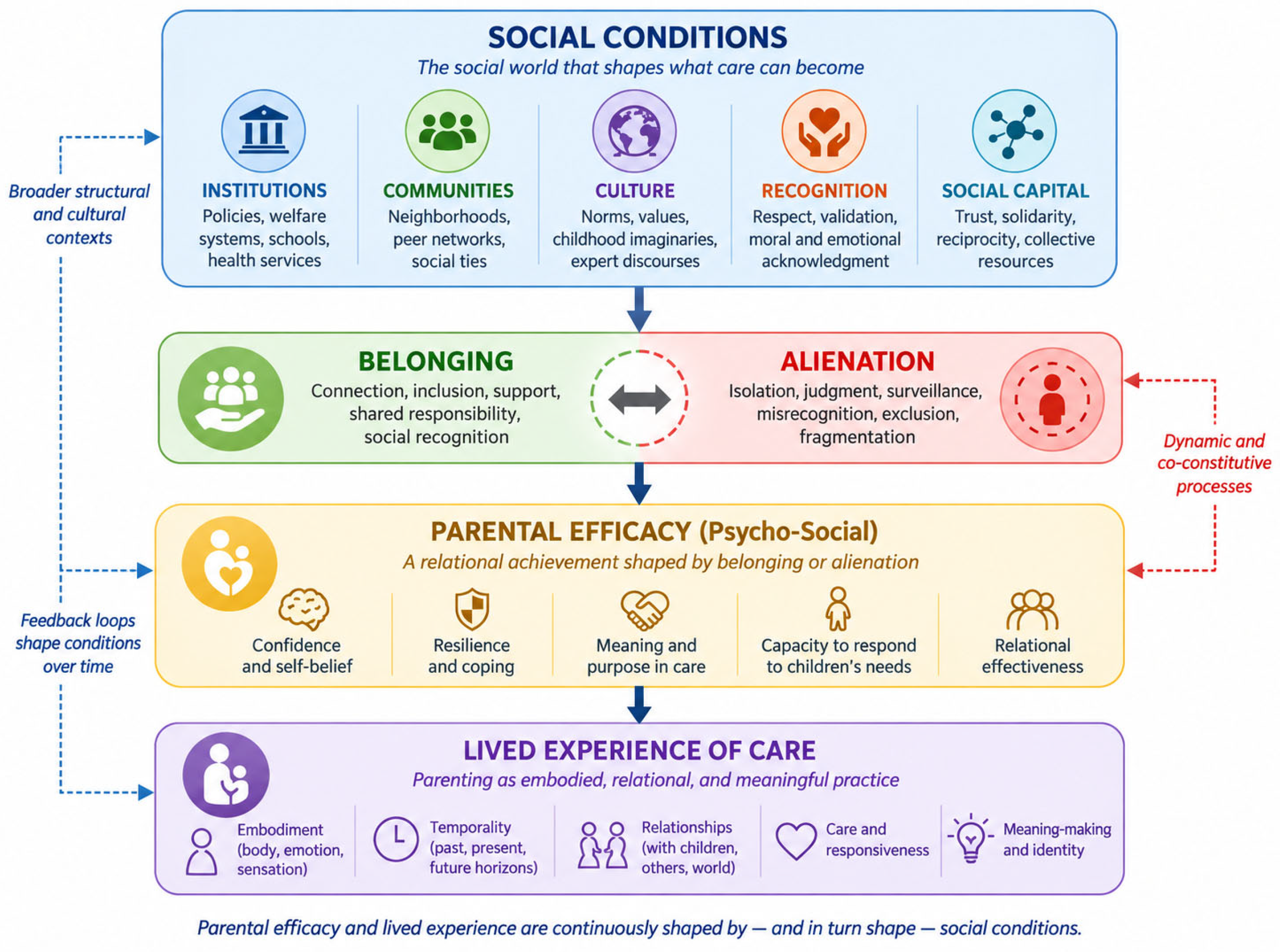
Figure 1 summarizes the paper’s overall psycho-social framework: social and institutional conditions shape experiences of belonging and alienation, which in turn influence parental efficacy and the lived experience of care. The remainder of the paper develops these relationships in greater theoretical detail.
Figure 1.
A Psycho-Social Model of Parenting.
2. Parenting as Individualized and Socially Constituted
Contemporary parenting cultures frame caregiving as an intensive and individualized responsibility. Hays’s (1996) influential account of “intensive mothering” captures this development, showing how parenting, and mothering in particular, has been culturally redefined as an all-encompassing form of labor demanding sustained emotional presence, time, effort, financial resources, and moral accountability. Subsequent work in parenting culture studies has elaborated this logic. Lee et al. (2014) describe how parents are positioned as responsibilized managers of risk, compelled to legitimate everyday decisions by reference to expert knowledge, evidence-based advice, and normative standards of best practice. Parenting becomes a privatized performance of psychological competence, measured through adherence to prescriptive norms that often obscure the relational and social conditions in which care unfolds.
This psychologization is reinforced by the growing authority of developmental psychology and mental health expertise in defining what parenting ought to be. Burman’s (2016) critique of developmental psychology demonstrates how dominant frameworks of attachment, resilience, and milestone attainment transform parenting into a technical enterprise, encouraging parents to align everyday care with expert prescriptions and standardized developmental expectations. Within this regime, parenting is reconfigured as a sequence of assessable performances, and parental efficacy becomes a quality to be measured, monitored, and corrected. When children experience behavioral, emotional, or educational difficulties, these experiences are frequently interpreted as signs of parental inadequacy or insufficient self-regulation, diverting attention from the wider social, institutional, and economic conditions that shape family life. In this sense, the psychologization of parenting operates as a mechanism of displacement, relocating responsibility from social structures to individual parents and exemplifying what Rose (1999) describes as the responsibilization of subjects under neoliberal governance.
Viewing parenting through this lens, however, captures only part of the picture. Parenting is also embedded within social relationships that shape what care means, how it is practiced, and how it is recognized. Childhood studies has been particularly influential in challenging the assumption that parenting can be understood primarily through individual parental capacities. Across this body of work, childhood is conceptualized as a historically and culturally produced condition, organized through institutional arrangements, moral expectations, and generational relations rather than biological dependency alone (Alanen, 2009; Jenks, 2020; Prout & James, 2015). Parents therefore encounter children through socially produced understandings of who children are, what they need, and what adults are expected to provide. Alanen’s (2009) concept of the generational order further situates parenting within enduring social relations that organize authority, dependency, rights, and obligations between adults and children. Parenting emerges as a relational practice shaped by structures that precede and extend beyond the experiences of individual parents.
The social organization of parenting is equally visible in the cultural meanings attached to childhood itself. Zelizer’s (1985) analysis of the “priceless child” demonstrates how children came to be valued primarily through their emotional significance, intensifying expectations that parents continually protect, invest in, and optimize children’s futures. Jenks (2020) extends this analysis by showing how contemporary childhood is simultaneously imagined as innocent, vulnerable, and potentially at risk, creating expectations that parents remain constantly attentive to both protection and regulation. These cultural constructions do more than shape public understandings of childhood. They organize how parents experience responsibility, transforming ordinary care into an ongoing practice of vigilance, anticipation, and moral accountability.
Becoming a parent also confers a distinctive form of social belonging. To become a parent is to occupy a socially meaningful position embedded within shared expectations, moral commitments, and everyday practices of care. Anderson’s (2006) notion of imagined communities is instructive here. Although parents may never meet most other parents, many nevertheless understand themselves as participating in a wider community organized around common concerns, aspirations, and responsibilities. This imagined community takes concrete form through parenting groups, schools, neighborhood networks, digital forums, and other organizational settings that facilitate the formation of social ties, alongside broader cultural narratives that present parenting as a shared social endeavor, even though access to these communities and the recognition they confer remains unevenly distributed (Faircloth, 2014; Lee et al., 2014; Putnam, 2016; Small, 2009).
Belonging within these communities can shape how parents come to understand themselves as capable caregivers. Across diverse social settings, sociological research illustrates how recognition, practical support, and shared interpretive frameworks structure parents’ experiences of legitimacy and competence (Calarco, 2014; Lareau, 2011; Small, 2009). Lareau’s (2011) analysis of classed parenting demonstrates that middle-class parents engaged in concerted cultivation often experience their practices as legitimate because they align with institutional expectations, while working-class parents frequently encounter misrecognition despite equally committed caregiving. Small’s (2009) ethnographic work similarly illustrates how organizational settings such as childcare centers generate social networks that sustain parents through emotional and material support, particularly under conditions of economic hardship. Calarco (2014) further shows that parents develop confidence through culturally shared understandings of what counts as competent parenting. Taken together, these studies illuminate social conditions through which parents’ sense of competence and belonging may be supported.
Childhood studies add an important dimension to this account by showing that parents’ experiences are also mediated through children’s own social worlds. Children actively participate in peer cultures, institutional settings, and generational relationships that extend beyond parental control (Corsaro & Everitt, 2023; Mayall, 2002). Their experiences of inclusion, exclusion, recognition, and marginalization frequently shape how parents understand their own effectiveness, creating forms of affirmation or uncertainty that arise indirectly through children’s encounters with schools, peers, and other institutions. Parenting therefore unfolds within relational worlds that parents influence but never fully control.
Ethnographic studies of school and neighborhood life further illuminate these processes. Research demonstrates how children’s peer interactions, teacher classifications, and institutional routines structure opportunities for inclusion and exclusion, effects that frequently reverberate back into family life as implicit or explicit evaluations of parental competence (Calarco, 2014; Reay, 2005; Thorne, 2024). More recent institutional ethnographies, such as Gilliam and Gulløv’s (2016) work on schooling and welfare contexts, show how children’s peer dynamics and institutional positioning can amplify or undermine parental efforts independently of parental intention or capacity. Parents often experience these institutional encounters as reflections of their own competence, even when the forces shaping children’s experiences extend well beyond family life.
These dynamics are particularly pronounced for families navigating migration, poverty, or racialized marginalization. In these contexts, the presence or absence of supportive networks and institutional recognition often determines whether parenting is experienced as manageable or overwhelming, revealing that efficacy is shaped as much by social positioning as by parental effort (Gillies, 2008; Mayall, 2002; Roberts, 2002). Experiences of belonging become unevenly distributed, leaving some parents supported and recognized while others confront isolation, misrecognition, and alienation despite deep commitment to their children. Parental efficacy, viewed through this lens, reflects parents’ location within social and institutional landscapes that shape both children’s opportunities and parents’ own experiences of recognition.
The paradox is thus evident. Parenting is publicly framed as a privatized psychological performance, while everyday caregiving unfolds within dense networks of social relationships, cultural meanings, and institutional arrangements. Parents are held individually accountable for raising resilient and well-adjusted children, even though the conditions that sustain parenting are profoundly collective. Communities, schools, families, neighborhoods, and welfare institutions all contribute to the possibilities and limits of care, yet responsibility continues to be concentrated on individual parents. This contradiction has profound consequences for how parents experience themselves. Those who feel socially supported often translate belonging into confidence and resilience, even under difficult circumstances. Parents who encounter persistent isolation or institutional misrecognition, by contrast, may experience growing uncertainty about their own competence despite considerable care, effort, and commitment.
Seen in this way, parental efficacy cannot be treated solely as a psychological capacity that parents possess or lack. It is also a psycho-social accomplishment shaped by recognition, shared responsibility, and collective support. Belonging is therefore one of the social conditions through which efficacy is sustained.
3. Belonging and Parental Efficacy
Parental self-efficacy occupies a central place in psychological research on parenting. Drawing on Bandura’s (1997) theory of self-efficacy, the concept is commonly understood as parents’ beliefs in their capacity to influence their children’s development and well-being. A substantial body of research has linked higher parental efficacy to adaptive parenting practices, reduced stress, and more favorable developmental outcomes (Jones & Prinz, 2005; Shumow & Lomax, 2002). Within this tradition, efficacy is generally treated as a psychological resource that enables effective parental action.
The argument developed here asks how parental efficacy itself becomes possible. Evidence that efficacy is socially conditioned extends beyond individual studies. A systematic review of research on parenting self-efficacy identified perceived social support among the socio-contextual factors associated with general parenting self-efficacy, while also noting that much of the available evidence is cross-sectional and disproportionately focused on mothers (Fang et al., 2021). In early parenthood specifically, Leahy-Warren et al. (2012) found associations among informal social support, maternal parental self-efficacy, and postnatal depression in first-time mothers. An earlier integrative review similarly identified social support as one of the factors relevant to maternal parental self-efficacy during the postpartum period (Leahy-Warren & McCarthy, 2011). These findings do not establish belonging as a causal determinant of efficacy, but they support the narrower proposition that efficacy is socially mediated. The broader claim developed here is theoretical: recognition, practical support, and shared interpretive frameworks can help parents experience their caregiving as intelligible and legitimate (Calarco, 2014; Lareau, 2011; Small, 2009).
This interpretation is also consistent with Bandura’s own account of efficacy. Although often applied as an individual psychological construct, Bandura (1997) emphasized that efficacy develops through social experiences, including observation, encouragement, and feedback from others. Parenting unfolds within environments saturated with such interactions. Parent groups, schools, digital communities, healthcare providers, and everyday conversations all communicate expectations about what competent parenting looks like. These relationships do more than evaluate parents. They shape how parents come to experience themselves as capable or inadequate. Belonging thus functions as an ongoing source of efficacy, while isolation gradually erodes it.
These processes extend beyond interpersonal support. Childhood studies and sociological scholarship locate parental efficacy within broader structures of recognition, institutional authority, and generational relations (Corsaro & Everitt, 2023; Mayall, 2002). Parents’ sense of competence develops through encounters with schools, healthcare systems, welfare agencies, and children’s own social worlds, where recognition may be strengthened or undermined independently of parental intentions. Experiences of efficacy are therefore shaped through relationships that parents participate in but never fully control. Children’s inclusion, exclusion, successes, and struggles frequently become mirrors through which parents interpret their own caregiving.
Putnam’s (2016) analysis of social capital further illustrates how belonging becomes a condition for parental efficacy. Communities characterized by trust, reciprocity, and mutual support distribute the demands of caregiving across wider social networks, allowing parents to draw on shared knowledge and collective responsibility. Where these forms of social cohesion weaken, parents shoulder responsibility alone, making ordinary challenges feel like personal inadequacies. Belonging, in this sense, does not simply strengthen parental efficacy. It helps constitute the social conditions through which efficacy becomes possible.
This understanding also resonates with Marx’s account of alienation. Marx (2016) argued that human capacities develop through social relations and become diminished when those relationships are fragmented or deprived of mutual recognition. Parenting under neoliberal conditions encourages parents to interpret structural difficulties as personal shortcomings. Alienation emerges as belonging recedes. Parents remain responsible for children’s outcomes while losing many of the collective relationships that historically sustained caregiving. Those embedded within supportive communities are therefore less likely to internalize struggle as personal failure, while parents facing isolation often experience persistent uncertainty despite considerable care and commitment.
These dynamics become particularly visible in contexts of migration, racialization, and social marginalization. Disrupted kinship networks, unfamiliar institutions, and experiences of mistrust can undermine parents’ sense of efficacy even when they remain deeply engaged in their children’s lives (De Haan, 2012). Conversely, community organizations, extended families, religious communities, and ethnic networks often provide forms of recognition and solidarity that sustain parents through periods of uncertainty. Children’s own experiences of belonging or exclusion also reverberate through family life, shaping how parents interpret their effectiveness and their place within the wider community (Suárez-Orozco & Suárez-Orozco, 2001).
The COVID-19 pandemic brought these dynamics into particularly sharp focus. Parents who maintained supportive relationships through extended families, neighborhoods, or digital communities reported greater confidence and lower distress despite intensified caregiving demands (Brown et al., 2020). Those who became socially isolated described heightened anxiety, exhaustion, and feelings of failure. These experiences illustrate that parental efficacy is responsive to changing social conditions. It expands and contracts alongside opportunities for belonging, recognition, and shared responsibility.
Taken together, this literature supports a broader reconceptualization of parental efficacy. Psychological beliefs remain important, yet they develop within relationships, institutions, and communities that shape how parents experience themselves as capable caregivers. Parental efficacy therefore emerges through relationships of belonging, recognition, and collective support rather than residing solely within the individual. When belonging becomes fragile, efficacy often becomes fragile as well.
4. Alienation and Contemporary Parenting
Under contemporary capitalist conditions, parents are routinely positioned as responsible for producing emotionally regulated, educationally successful, and future-ready children through continuous practices of management, monitoring, and self-optimization (Faircloth, 2014; Gillies, 2008; Hays, 1996; Lareau, 2011; Lee et al., 2014). As the preceding sections have argued, parenting is evaluated through expert standards and future-oriented expectations. Marx’s concept of alienation helps explain what these conditions feel like from the parent’s perspective. Parenting becomes organized around outcomes that can be measured, optimized, and compared, drawing parents into evaluative regimes that extend far beyond everyday relationships with their children. Estrangement develops when care is experienced through continual assessment rather than through shared belonging and mutual recognition.
This perspective also clarifies how contemporary parenting becomes tied to neoliberal governance. The discussion above has already shown how intensive parenting and developmental expertise relocate responsibility from collective institutions to individual parents (Burman, 2016; Gillies, 2008; Hays, 1996). Alienation captures the experiential consequences of this shift. Parents absorb responsibilities once distributed across schools, communities, welfare systems, and extended families, while remaining accountable for outcomes they cannot fully control. The burden is not simply greater responsibility; it is responsibility experienced in the absence of the social conditions that sustain caregiving. Developmental expertise further intensifies these dynamics by positioning parenting as a technical practice governed through standardized expectations (Burman, 2016; Faircloth, 2014). Parents are encouraged to align everyday care with developmental benchmarks that often displace relational knowledge, cultural variation, and practical judgment. As care becomes something to be demonstrated, justified, and evaluated, parents may become estranged from their own embodied experience of parenting.
Alienation is also experienced unevenly across social locations. The class differences discussed earlier become especially visible when viewed through Marx’s framework. Middle-class parents frequently encounter alienation through continual monitoring, overextension, and pressure to optimize children’s futures (Lareau, 2011). Working-class parents often experience alienation through institutional misrecognition, where caring practices are judged against middle-class norms that remain unequally accessible. Although these experiences differ, both reveal how parenting becomes separated from relationships of belonging and reorganized through external standards of legitimacy.
Childhood studies deepens this analysis by demonstrating that alienation is also shaped through culturally constructed understandings of childhood. Earlier sections showed how contemporary childhood is imagined through vulnerability, preciousness, and future potential (Jenks, 2020; Zelizer, 1985). Within this cultural landscape, ordinary caregiving becomes future-oriented risk management. Parents find themselves navigating contradictory expectations to protect children, cultivate independence, anticipate future success, and prevent possible failure. Alienation deepens as these expectations become difficult to reconcile.
Children’s own social worlds further complicate these experiences. As discussed previously, children actively participate in peer cultures and institutional settings that extend beyond parental authority (Corsaro & Everitt, 2023; Mayall, 2002). Parents nevertheless remain responsible for outcomes emerging from these relationships. This separation between responsibility and control becomes another source of alienation, particularly when institutions interpret children’s difficulties as evidence of parental inadequacy rather than expressions of wider social conditions.
Alienation, however, is never uniformly experienced. Migration, racialization, and institutional marginalization frequently intensify experiences of estrangement through disrupted kinship networks, bureaucratic uncertainty, and unequal recognition (Suárez-Orozco & Suárez-Orozco, 2001). Yet these same contexts often generate alternative forms of belonging. Extended families, religious communities, neighborhood networks, and cultural traditions frequently sustain caregiving through relationships of reciprocity and mutual recognition (Small, 2009; Stack, 1974). Belonging therefore emerges alongside alienation, continually interrupting and reshaping its effects.
This coexistence reflects Marx’s own understanding of alienation as a contradictory social condition. Alienation constrains human relationships without eliminating the possibility of connection. Parenting therefore remains a domain where intimacy, recognition, and shared meaning continue to emerge despite expanding pressures of commodification and surveillance. Dermott and Pomati (2016) show that many parents continue to experience everyday moments with children as deeply meaningful, even amid intensifying demands. Shared play, ordinary routines, and moments of mutual recognition remind parents that care cannot be fully reduced to performance, productivity, or measurable outcomes.
Alienation therefore names socially produced forms of estrangement that coexist with, and are sometimes interrupted by, practices of belonging and recognition. Parenting remains organized through surveillance, responsibilization, and commodification, yet intimacy, solidarity, and shared meaning continue to exceed these governing logics.
Contemporary technological, cultural, and economic transformations extend these dynamics into new domains of family life. Digital monitoring, commodified expertise, and persistent economic insecurity do not replace earlier forms of alienation; they intensify evaluative pressures and create additional tensions between belonging, care, and surveillance.
One of the most visible developments is the growing integration of digital technologies into everyday parenting. Parents increasingly rely on devices and platforms to manage uncertainty and risk. Baby monitors that track sleep cycles, applications that record feeding patterns, location-tracking software, and platforms that quantify school performance all promise greater reassurance and control. Yet these technologies also reshape parents’ relationships with their own caregiving. Research suggests that digital monitoring frequently amplifies anxiety, drawing parents into cycles of continual observation and adjustment (Nelson, 2010). Parents’ attention shifts toward metrics, alerts, and predictions, leaving less space for embodied judgment and relational presence. As Lupton (2016) argues, these technologies reinforce cultural images of children as permanently vulnerable and requiring continuous surveillance. Alienation emerges as parents become dependent on technological forms of knowing while growing less certain of their own experiential knowledge.
A similar process unfolds through the expanding commercialization of parenting. As discussed earlier, contemporary parenting culture encourages parents to seek expert validation for ordinary caregiving decisions (Burman, 2016; Lee et al., 2014). Sleep consultants, feeding specialists, behavioral coaches, and enrichment programs become part of an expanding parenting marketplace. Professional expertise undoubtedly provides valuable support for many families. At the same time, it can subtly reposition parents from knowledgeable caregivers to consumers seeking external validation. Faircloth (2014) shows that many parents gradually come to question their own judgment in the absence of professional endorsement. Alienation therefore appears as growing distance from one’s own practical knowledge of one’s child. This development also extends the cultural logic of the “priceless child” (Zelizer, 1985), where love becomes intertwined with consumption, investment, and optimization.
Economic precarity further intensifies these pressures. The previous discussion demonstrated how neoliberal governance organizes parenting around future responsibility. Contemporary conditions extend this orientation by requiring parents to prepare children for uncertain educational, economic, and social futures while navigating shrinking collective supports. Parents frequently experience everyday family life as a continuous project of optimization, where ordinary decisions appear to carry disproportionate consequences for children’s future opportunities (Gillies, 2008; Lareau, 2011). The contradiction becomes particularly acute because parents are simultaneously expected to protect children from risk, cultivate independence, and maximize future success. These competing expectations rarely allow parenting to remain fully present-oriented, contributing to ongoing experiences of pressure, guilt, and estrangement.
Periods of social crisis make these dynamics especially visible. During the COVID-19 pandemic, responsibilities once distributed across schools, workplaces, and community institutions shifted abruptly onto families. Parents described heightened isolation, self-blame, and exhaustion as they attempted to manage education, health, and emotional well-being with limited institutional support (Brown et al., 2020). The pandemic revealed how dependent parenting remains on collective infrastructures that often become most visible only when they disappear. As Putnam (2016) argues, declining social cohesion leaves families carrying burdens that were previously shared across communities.
These transformations also reshape parents’ relationships with themselves. Parents may come to experience themselves less as caregivers than as managers, coordinators, or auditors of family life, continually anticipating evaluation by professionals, schools, digital communities, and institutional authorities. In a qualitative study of five mothers experiencing parental burnout, Hubert and Aujoulat (2018) documented exhaustion alongside guilt, shame, loneliness, and self-reproach. Their accounts illustrate how intensive parental ideals and anticipated judgment can become entwined with painful self-evaluation.
Yet these developments never fully extinguish belonging. Parents selectively resist surveillance technologies, reinterpret expert advice, and create informal networks that redistribute care through relationships of trust and reciprocity. Children likewise remain active participants who continually reshape the social worlds adults seek to organize (Corsaro & Everitt, 2023). These everyday practices remind us that alienation is always accompanied by efforts to rebuild recognition, intimacy, and shared meaning.
These developments show how neoliberal and technocratic logics enter intimate domains without fully determining them. Surveillance, commodification, and individualized responsibility can deepen alienation, while relationships of trust and reciprocity continue to sustain belonging.
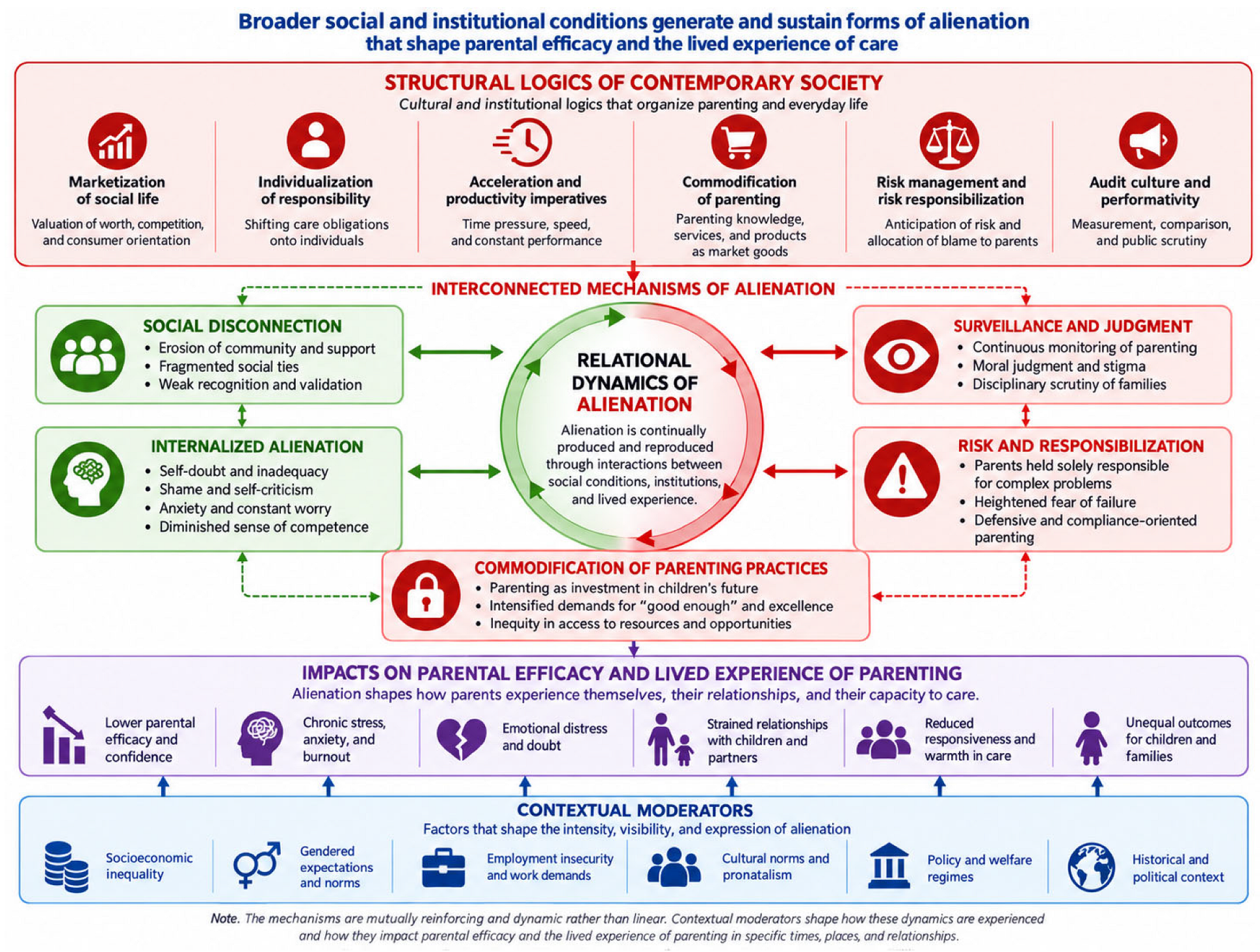
Alienation in contemporary parenting emerges through interconnected social, institutional, and cultural processes rather than through a single source. Figure 2 summarizes these mechanisms and shows how broader social conditions can generate and sustain experiences of alienation in parenting, with consequences for parental efficacy and lived experience.
Figure 2.
Relational Dynamics of Alienation in Contemporary Parenting.
5. Phenomenology, Time, and Parental Guilt
Husserl’s invitation to return “to the things themselves” can be read, in this context, as a call to approach parenting as a transformed lifeworld. Parenting reorganizes attention, perception, and everyday intentionality. Ordinary perception becomes attuned to the child, attention is repeatedly interrupted and redirected, and everyday spaces are reorganized around the child’s needs and vulnerabilities. The child’s presence reshapes fields of significance, altering what matters, what demands immediate response, and what feels possible or necessary. This reorientation is cognitive, affective, and practical, sedimented through repetition and sustained within the moral atmosphere of everyday decisions, from feeding and sleep to safety and schooling (Husserl, 2019).
Merleau-Ponty deepens this analysis by insisting that experience is embodied. Parenting is lived through bodies that carry, hold, soothe, feed, and move in response to another body. Much of what matters in parenting unfolds below the threshold of explicit reflection, in posture, touch, rhythm, and proximity. Caregiving therefore emerges as an embodied intersubjective practice in which reassurance and recognition are conveyed through presence as much as through language (Merleau-Ponty, 1962). This is also where the broader pressures discussed throughout this paper become most tangible. When expert advice, institutional scrutiny, or digital monitoring displace embodied confidence, parents can begin to doubt their own sensory and relational attunement. Estrangement appears as a subtle dislocation from one’s own touch, timing, and intuitive responsiveness. Phenomenology helps illuminate this shift, showing how alienation becomes woven into the texture of lived relationships rather than appearing solely as a psychological concern.
Schutz’s account of the lifeworld adds a further dimension by showing that experience is intersubjective and socially organized. Parents inhabit a world structured by shared typifications and a “stock of knowledge at hand,” including culturally available images of what a good parent is, what risks demand vigilance, and what development should look like (Schutz, 1967). Parenting decisions are rarely experienced as private acts. They unfold under an implied gaze—sometimes literal, sometimes anticipated—of professionals, peers, institutions, and online publics. Here phenomenology enters into dialogue with childhood studies. If childhood is historically and culturally constructed, and parenting is situated within generational orders, these constructions appear not simply as social structures but as lived orientations through which parents perceive children and themselves. The child becomes imagined as innocent, vulnerable, threatened, or “priceless,” while the parent comes to inhabit expectations of responsibility, vigilance, and accountability (Alanen, 2009; Prout & James, 2015; Zelizer, 1985). Phenomenology makes visible how these cultural imaginaries become habits of perception, shaping what parents notice, fear, anticipate, and feel responsible for in everyday life.
The discussion of belonging can now be approached phenomenologically. Belonging is experienced not only as an external social resource but as a change in the texture of everyday life. Organizationally mediated networks can make parenting feel accompanied, recognized, and shared even under material strain (Small, 2009). Isolation, by contrast, can intensify uncertainty and self-doubt. Belonging and alienation therefore function as lived orientations that shape how parents interpret themselves, their children, and everyday care.
Phenomenology also brings the temporal structure of parenting into focus. Husserl’s account of time-consciousness suggests that experience unfolds through retention, the just-past that lingers; impression, the lived present; and protention, the horizon of anticipation (Husserl, 2019). Parenting is deeply structured by this tri-temporality. Parents encounter children simultaneously as they are, as they have been, and as they may become, while everyday acts of care are continually threaded through memory and anticipation.
Contemporary parenting, however, privileges anticipation over the lived present. Daily interactions become evaluated through imagined futures: school readiness, emotional regulation, resilience, educational achievement, and later employability. Earlier sections have shown how parenting cultures encourage parents to organize everyday decisions around optimizing future trajectories (Faircloth, 2014; Hays, 1996; Lareau, 2011; Lee et al., 2014). Phenomenology helps explain what this future orientation feels like. The present becomes difficult to inhabit on its own terms because it is continually measured against what it may eventually produce.
Within this temporal economy, parents frequently report guilt when they perceive themselves as failing to inhabit the present as they believe they should. Qualitative research documents self-reproach around frustration, exhaustion, distraction, and emotional distance, alongside wider concerns about caregiving (De Haan, 2012; Faircloth, 2014; Lee et al., 2014). Time-use research also documents the intensive temporal demands placed on mothers and fathers (Craig et al., 2014). These patterns help contextualize guilt as part of the temporal organization of contemporary parenting.
Viewed phenomenologically, parental guilt signals a disruption in the experience of time. Parents are encouraged to inhabit the present while simultaneously evaluating it through anticipated futures. Alienation therefore becomes temporal as well as social. Anticipation gradually colonizes immediacy, making the present appear valuable primarily because of what it may accomplish later. Parenting becomes an activity that is never fully inhabited, even during moments of intimacy, presence, and care.
Embodiment, intersubjectivity, and temporality therefore disclose parenting as a lived paradox rather than a coherent role or stable identity. Parents frequently describe profound intimacy and meaning in everyday acts of care while simultaneously experiencing anxiety, guilt, and exposure when their practices diverge from expert expectations or dominant cultural norms. These experiences are less usefully understood as inconsistencies than as tensions built into contemporary parenting itself. They are lived through the ongoing negotiation between spontaneity and evaluation, presence and anticipation, intimacy and performance.
Merleau-Ponty’s later account of the intertwining of self and world further illuminates this paradox because parenting is experienced as personally inhabited while simultaneously socially organized (Merleau-Ponty, 1962). Parents do not encounter expectations as external rules imposed after the fact. They gradually become woven into perception, movement, attention, and feeling. The contradictions explored throughout this paper therefore appear not simply as ideological or institutional pressures but as embodied ways of inhabiting relationships, responsibility, and time.
6. Belonging and the Lived Experience of Parenting
The discussion developed throughout this paper also invites a different understanding of parental efficacy. Earlier sections argued that efficacy develops through relationships of belonging, recognition, and collective support. Phenomenology extends this argument by asking how these conditions are experienced from within. To feel efficacious is more than believing one can act effectively; it is experiencing one’s caregiving as intelligible, recognized, and meaningful within a shared social world. Conversely, alienation is experienced as the gradual loss of these relationships of recognition, leaving parents feeling exposed, unsupported, or persistently inadequate. Phenomenology therefore does not replace psychological accounts of efficacy but situates them within the lived social conditions through which efficacy is sustained, challenged, and sometimes undone (Putnam, 2016; Small, 2009).
This perspective also enriches childhood studies by showing how cultural understandings of childhood become woven into lived experience. Earlier sections demonstrated how contemporary childhood is organized through cultural imaginaries of vulnerability, innocence, and future promise (Alanen, 2009; Prout & James, 2015; Zelizer, 1985). Phenomenology asks how these imaginaries become part of perception itself. Zelizer’s (1985) “priceless child,” for example, can be understood as a moral-perceptual orientation through which everyday decisions acquire extraordinary ethical significance. Ordinary moments of caregiving become charged with responsibility because parents experience even minor choices as potentially shaping their children’s futures.
Similarly, cultural imaginaries of risk do not operate only through public discourse or institutional policy. As Jenks (2020) suggests, they gradually become perceptual dispositions that organize attention and affect, shaping what parents notice, anticipate, and interpret as dangerous, responsible, or negligent. Risk is therefore experienced less as abstract knowledge than as an embodied orientation toward the world. It influences movement, proximity, vigilance, and everyday interaction with children, becoming part of how parenting is experienced rather than simply how it is regulated. From this perspective, parenting unfolds through culturally patterned ways of seeing, sensing, and anticipating. Social norms are experienced less as external rules than as orientations that shape perception itself, influencing how parents inhabit responsibility, time, and relationships with their children.
Phenomenology also clarifies how belonging continues to emerge within conditions of alienation. Qualitative studies consistently show that, despite surveillance, commodification, and responsibilization, parents describe moments in which meaning returns through ordinary experiences of intimacy: reading together, sharing humour, engaging in unstructured play, or simply being present with a child (Faircloth, 2014; Gabb, 2010; Nelson, 2010). These moments interrupt the continual demand to evaluate, optimize, and account for parenting, allowing relationships themselves to become the focus of experience.
Such moments should not be understood as escapes from contemporary parenting culture. They remain embedded within wider social conditions while simultaneously revealing that caregiving cannot be fully organized through managerial or evaluative logics. Husserl’s notion of the lifeworld is especially helpful here. The lifeworld always exceeds institutional categories and expert scripts, preserving possibilities for intimacy, recognition, and shared meaning even within highly regulated environments (Husserl, 2019). Parents may therefore move continually between experiencing themselves as accountable managers and as intimate companions without fully resolving this tension. Phenomenology provides a language for understanding this coexistence, allowing belonging and alienation to remain intertwined rather than reducing one to the other.
Bringing phenomenology into dialogue with psychology, sociology, childhood studies, and alienation theory completes the psycho-social framework. Parenting emerges as an embodied, relational, and temporal way of inhabiting a shared world with children, shaped by structures of recognition and responsibility. Phenomenology makes visible how these arrangements enter perception, emotion, bodily confidence, and everyday care, while also showing how intimacy and meaning can persist within conditions of surveillance and responsibilization.
7. Conclusions
Parenting in contemporary societies renders the contradictions of late capitalism with particular intensity. It is an intimate relationship that is also increasingly surveilled, responsibilized, and commodified. This paper argues that parental efficacy, belonging, and alienation are mutually constituted through the interplay of cultural meanings, institutional arrangements, and lived experience.
This framework makes three related contributions. First, it reconceptualizes parental efficacy as a psycho-social accomplishment sustained through relationships of recognition, collective support, and institutional belonging. Parental efficacy emerges through the social conditions that enable parents to experience themselves as capable caregivers. Second, it extends alienation theory into the domain of parenting, demonstrating how contemporary regimes of surveillance, responsibilization, and commodification reshape everyday care while simultaneously generating new forms of belonging, resistance, and solidarity. Alienation appears less as the opposite of care than as a condition through which contemporary care is lived and negotiated. Third, it demonstrates how phenomenology enriches psychological, sociological, and childhood studies perspectives by showing how broader structural arrangements become woven into perception, embodiment, temporality, and everyday relationships with children.
Viewed through this integrated lens, parental responsibility is experienced as private even though caregiving depends on social recognition, institutional support, and collective forms of belonging. Belonging is therefore not merely an external resource but one condition through which efficacy is sustained, while alienation emerges when relationships of recognition become fragile or unavailable. This interaction shows how political, economic, and cultural processes become lived within ordinary practices of care.
Several limitations delimit this conceptual account. Much of the empirical literature mobilized here concerns mothers, especially in Western welfare, educational, and healthcare settings, so the framework should not be assumed to describe fathers or other caregivers in equivalent ways. Although migration, racialization, and cultural variation are discussed, the analysis remains weighted toward scholarship produced in Western societies; comparative work may reveal different relations among kinship, authority, belonging, and parental efficacy. As a theoretical integration, the framework is interpretive rather than exhaustive or causal and requires empirical refinement across family forms and social locations. The paper also does not examine legal and judicial constructions of parental authority, discipline, liability, or neglect, although these are important sites where social expectations of parenthood are formalized.
Future research should test and refine the framework across fathers and other caregivers, diverse family forms, non-Western settings, and differing welfare and legal regimes. Qualitative and phenomenological research would be especially useful for examining how recognition, responsibility, and alienation are lived, while comparative work could clarify how technologies, community infrastructures, and institutional arrangements alter these dynamics.
Ultimately, parenting remains a profoundly relational practice. Contemporary conditions organize caregiving through surveillance, optimization, and individualized responsibility, yet relationships of intimacy, solidarity, and mutual recognition continue to emerge within and sometimes despite these pressures. Understanding parenting through the intertwined dynamics of belonging and alienation offers a way of recognizing both the vulnerabilities and the possibilities of contemporary family life, showing how meaning, care, and human connection continue to be created within conditions that often threaten to fragment them.
Funding
This research received no external funding.
Institutional Review Board Statement
Not applicable.
Informed Consent Statement
Not applicable.
Data Availability Statement
No new data were created or analyzed in this study. Data sharing is not applicable to this article.
Conflicts of Interest
The author declares no conflict of interest.
References
- Alanen, L. (2009). Generational order. In The Palgrave handbook of childhood studies (pp. 159–174). Palgrave Macmillan. [Google Scholar]
- Anderson, B. (2006). Imagined communities: Reflections on the origin and spread of nationalism (Rev. ed.). Verso. [Google Scholar]
- Bandura, A. (1997). Self-efficacy: The exercise of control. Macmillan. [Google Scholar]
- Brown, S. M., Doom, J. R., Lechuga-Peña, S., Watamura, S. E., & Koppels, T. (2020). Stress and parenting during the global COVID-19 pandemic. Child Abuse & Neglect, 110, 104699. [Google Scholar] [CrossRef] [Scilit]
- Burman, E. (2016). Deconstructing developmental psychology. Routledge. [Google Scholar]
- Calarco, J. M. (2014). Coached for the classroom: Parents’ cultural knowledge and children’s social skills in working-class and middle-class families. American Sociological Review, 79(5), 1015–1037. [Google Scholar] [CrossRef] [Scilit]
- Corsaro, W. A., & Everitt, J. G. (2023). The sociology of childhood. Sage Publications. [Google Scholar]
- Craig, L., Powell, A., & Smyth, C. (2014). Towards intensive parenting? Changes in the composition and determinants of mothers’ and fathers’ time with children 1992–2006. British Journal of Sociology, 65(3), 555–579. [Google Scholar] [CrossRef] [Scilit]
- De Haan, M. (2012). The reconstruction of parenting after migration: A perspective from cultural translation. Human Development, 54(6), 376–399. [Google Scholar] [CrossRef] [Scilit]
- Dermott, E., & Pomati, M. (2016). ‘Good’ parenting practices: How important are poverty, education and time pressure? Sociology, 50(1), 125–142. [Google Scholar] [CrossRef] [Scilit]
- Edwards, R., Gillies, V., & Horsley, N. (2015). Brain science and early years policy: Hopeful ethos or ‘cruel optimism’? Critical Social Policy, 35(2), 167–187. [Google Scholar] [CrossRef] [Scilit]
- Faircloth, C. (2014). Intensive parenting and the expansion of parenting culture. In E. Lee, J. Bristow, C. Faircloth, & J. Macvarish (Eds.), Parenting culture studies (pp. 25–50). Palgrave Macmillan. [Google Scholar]
- Fang, Y., Boelens, M., Windhorst, D. A., Raat, H., & van Grieken, A. (2021). Factors associated with parenting self-efficacy: A systematic review. Journal of Advanced Nursing, 77(6), 2641–2661. [Google Scholar] [CrossRef] [Scilit]
- Gabb, J. (2010). Home truths: Ethical issues in family research. Qualitative Research, 10(4), 461–478. [Google Scholar] [CrossRef] [Scilit]
- Gilliam, L., & Gulløv, E. (2016). Children of the welfare state: Civilising practices in schools, childcare and families. Pluto Books. [Google Scholar]
- Gillies, V. (2008). Childrearing, class and the new politics of parenting. Sociology Compass, 2(3), 1079–1095. [Google Scholar] [CrossRef] [Scilit]
- Hays, S. (1996). The cultural contradictions of motherhood. Yale University Press. [Google Scholar]
- Hubert, S., & Aujoulat, I. (2018). Parental burnout: When exhausted mothers open up. Frontiers in Psychology, 9, 1021. [Google Scholar] [CrossRef] [Scilit]
- Husserl, E. (2019). The phenomenology of internal time-consciousness. Indiana University Press. [Google Scholar]
- Jenks, C. (2020). Childhood. Routledge. [Google Scholar]
- Jones, T. L., & Prinz, R. J. (2005). Potential roles of parental self-efficacy in parent and child adjustment: A review. Clinical Psychology Review, 25(3), 341–363. [Google Scholar] [CrossRef] [Scilit]
- Lareau, A. (2011). Unequal childhoods: Class, race, and family life (2nd ed.). University of California Press. [Google Scholar]
- Leahy-Warren, P., & McCarthy, G. (2011). Maternal parental self-efficacy in the postpartum period. Midwifery, 27(6), 802–810. [Google Scholar] [CrossRef] [Scilit]
- Leahy-Warren, P., McCarthy, G., & Corcoran, P. (2012). First-time mothers: Social support, maternal parental self-efficacy and postnatal depression. Journal of Clinical Nursing, 21(3–4), 388–397. [Google Scholar] [CrossRef] [Scilit]
- Lee, E., Bristow, J., Faircloth, C., & Macvarish, J. (Eds.). (2014). Parenting culture studies. Palgrave Macmillan. [Google Scholar]
- Lupton, D. (2016). The diverse domains of quantified selves: Self-tracking modes and dataveillance. Economy and Society, 45(1), 101–122. [Google Scholar] [CrossRef] [Scilit]
- Marx, K. (2016). Economic and philosophic manuscripts of 1844. In Social theory re-wired (pp. 152–158). Routledge. [Google Scholar]
- Mayall, B. (2002). Towards a sociology of childhood. Open University Press. [Google Scholar]
- Merleau-Ponty, M. (1962). Phenomenology of perception. Routledge. [Google Scholar]
- Nelson, M. K. (2010). Parenting out of control: Anxious parents in uncertain times. New York University Press. [Google Scholar]
- Prout, A., & James, A. (2015). A new paradigm for the sociology of childhood?: Provenance, promise and problems. In Constructing and reconstructing childhood (pp. 6–28). Routledge. [Google Scholar]
- Putnam, R. D. (2016). Our kids: The American dream in crisis. Simon and Schuster. [Google Scholar]
- Reay, D. (2005). Doing the dirty work of social class? Mothers’ work in support of their children’s schooling. The Sociological Review, 53(2), 104–115. [Google Scholar] [CrossRef] [Scilit]
- Roberts, D. (2002). Shattered bonds: The color of child welfare. Basic Books. [Google Scholar]
- Rose, N. (1999). Powers of freedom: Reframing political thought. Cambridge University Press. [Google Scholar]
- Schutz, A. (1967). The phenomenology of the social world. Northwestern University Press. [Google Scholar]
- Shumow, L., & Lomax, R. (2002). Parental efficacy: Predictor of parenting behavior and adolescent outcomes. Parenting: Science and Practice, 2(2), 127–150. [Google Scholar] [CrossRef] [Scilit]
- Small, M. L. (2009). Unanticipated gains: Origins of network inequality in everyday life. Oxford University Press. [Google Scholar]
- Stack, C. B. (1974). All our kin: Strategies for survival in a black community. Harper & Row. [Google Scholar]
- Suárez-Orozco, C., & Suárez-Orozco, M. M. (2001). Children of immigration. Harvard University Press. [Google Scholar]
- Thorne, B. (2024). Gender play: Girls and boys in school. Rutgers University Press. [Google Scholar]
- Zelizer, V. A. R. (1985). Pricing the priceless child: The changing social value of children (Vol. 24). Basic Books. [Google Scholar]
Disclaimer/Publisher’s Note: The statements, opinions and data contained in all publications are solely those of the individual author(s) and contributor(s) and not of MDPI and/or the editor(s). MDPI and/or the editor(s) disclaim responsibility for any injury to people or property resulting from any ideas, methods, instructions or products referred to in the content. |
© 2026 by the author. Licensee MDPI, Basel, Switzerland. This article is an open access article distributed under the terms and conditions of the Creative Commons Attribution (CC BY) license.