


Abstract
Drawing on attachment theory, this study examines the relationship between Secure Base Leadership (SBL) and key organizational outcomes through the mediating role of employee well-being. Data were collected using a multi-source correlational design within a single multinational organization through two independent surveys administered at different points in time. SBL was assessed via follower ratings of 115 leaders in the early stages of their managerial roles, while employee well-being, work engagement, learning and development, and diversity and inclusion were measured using an internal organizational climate survey. Structural Equation Modeling using Partial Least Squares (PLS-SEM) revealed that SBL was positively associated with employee well-being. In turn, employee well-being showed strong and positive relationships with engagement, learning and development, and perceptions of diversity and inclusion. Indirect effects analyses supported employee well-being as a theoretically grounded indirect pathway linking SBL to these organizational outcomes, highlighting its central role as a psychological mechanism linking attachment-based leadership behaviors to broader employee experiences. From a practical perspective, the results suggest that developing SBL behaviors may represent a coherent lever associated with employee well-being and may improve key organizational climate indicators in complex and uncertain work environments.
1. Introduction
Contemporary organizations operate in increasingly complex, uncertain, and demanding environments, characterized by rapid change, elevated performance expectations, and continuous transformation. In this context, organizational success is no longer assessed solely through traditional performance indicators, but also through employees’ psychological experiences at work, including well-being, engagement, learning capacity, and perceptions of inclusion. A growing body of organizational research highlights employee well-being as a critical resource for sustainable performance, mental health at work, and organizational adaptation (Liu et al., 2025; McConnell et al., 2025). In particular, recent work has emphasized that supportive leadership relationships may contribute to employee well-being by reducing work-related strain and fostering more adaptive psychological functioning (McConnell et al., 2025; Navas-Jiménez et al., 2025). Leadership has consistently emerged as one of the most influential contextual factors shaping these employee experiences (Edú-Valsania et al., 2025), as leaders play a central role in structuring work, regulating demands, and influencing how individuals interpret and respond to challenges at work.
Among contemporary leadership approaches, Secure Base Leadership (SBL) offers a relational perspective rooted in attachment theory (Molero et al., 2019; Uglanova et al., 2026). Attachment theory (Bowlby, 1969/1982, 1988) posits that individuals are biologically predisposed to seek proximity to significant figures in times of stress and to explore their environment when they perceive sufficient security. Translated to organizational settings, leaders may function as salient attachment figures who provide both a safe haven—offering support, protection, and emotional availability under conditions of strain—and a secure base that encourages exploration, autonomy, learning, and growth when circumstances allow. Leaders who enact these functions are theorized to foster psychological safety, trust, and emotional regulation among employees, thereby enabling more adaptive and engaged forms of functioning at work. Although the conceptual relevance of SBL has increased in recent years, empirical research examining its organizational consequences remains relatively limited, particularly with respect to the mechanisms through which SBL relates to multiple employee outcomes. Recent empirical studies have begun to show that SBL is associated with relevant employee outcomes, including greater work engagement and resilience, lower exhaustion and burnout, and stronger job performance (Laguía et al., 2024; Moriano et al., 2026; Navas-Jiménez et al., 2024, 2025; Uglanova et al., 2026; Santos et al., 2026). However, less is known about whether employee well-being acts as a common psychological pathway linking SBL to broader organizational climate outcomes, such as learning and development or diversity and inclusion.
Employee well-being is increasingly understood not only as a desirable outcome in itself, but also as a foundational condition that shapes how employees engage with their work, perceive developmental opportunities, and experience fairness and inclusion. Drawing on perspectives from positive organizational psychology, self-determination theory, and research on work engagement, well-being can be conceptualized as a proximal psychological state that enables motivation, learning behaviors, and constructive social functioning. Leadership behaviors that enhance employees’ sense of security, autonomy, and emotional support are therefore likely to generate downstream effects on engagement, learning and development, and diversity and inclusion perceptions. From this perspective, well-being represents a potential explanatory pathway through which attachment-based leadership behaviors may exert broader organizational effects, rather than acting solely as a parallel outcome.
The present study aims to examine the relationship between SBL and employee well-being, and to test whether well-being mediates the relationship between leadership perceptions and key organizational outcomes, namely work engagement, learning and development, and diversity and inclusion. The study is conducted within a single organization and focuses on leaders in the early stages of their managerial roles, a critical period often characterized by heightened uncertainty, learning demands, and reliance on relational leadership behaviors. By integrating attachment theory with contemporary models of well-being and employee outcomes, this research seeks to contribute to the growing literature on SBL and to provide evidence-based insights for leadership development initiatives aimed at fostering sustainable employee well-being and positive organizational climates.
Despite the growing interest in attachment-based leadership, three important gaps remain in the literature. First, most empirical studies on SBL have focused on direct relationships with employee outcomes such as engagement, resilience, and exhaustion, while the psychological mechanisms explaining these effects remain underexplored. Second, little is known about whether employee well-being serves as a common pathway linking SBL to multiple organizational outcomes simultaneously. Third, research examining attachment-based leadership in relation to diversity and inclusion perceptions remains particularly scarce. Addressing these gaps, the present study proposes and tests a theoretically grounded indirect-effects model in which employee well-being represents the central psychological pathway linking SBL to work engagement, learning and development, and diversity and inclusion. Given that the organizational climate survey was administered before the SBL survey, the model should be interpreted as a theory-driven statistical test of indirect associations rather than as evidence of temporal or causal mediation.
Attachment theory serves as the overarching theoretical framework for the proposed model. Its central premise is that the availability of a responsive attachment figure regulates the balance between security seeking and exploration. Applied to organizational settings, leaders may function as attachment figures whose safe-haven behaviors help employees regulate strain and whose secure-base behaviors support autonomy, exploration, and investment in work-related goals. In the present model, employee well-being represents the proximal psychological state associated with this sense of security, whereas learning and development, diversity and inclusion, and work engagement represent more distal employee experiences associated with the availability of psychological, social, and motivational resources. Attachment theory therefore provides the integrative rationale for the proposed indirect relationships rather than serving only as a general background to SBL.
1.1. Secure Base Leadership, Employee Well-Being, and Organizational Outcomes
Building on attachment theory as the overarching framework of the study, SBL conceptualizes leadership as a fundamentally relational process through which leaders function as salient attachment figures in the workplace (Molero et al., 2019). Attachment theory posits that individuals are biologically predisposed to seek proximity and support from trusted figures under conditions of threat or uncertainty, and to engage in exploration and growth when a sense of security is available (Ainsworth et al., 1978; Bowlby, 1969/1982, 1988). In organizational contexts, leaders are particularly likely to activate the attachment system of employees, as they control access to resources, define expectations, and play a central role in shaping the emotional and social climate at work (Kahn, 1990; Mikulincer & Shaver, 2007, 2019; Molero et al., 2019).
Recent empirical and review evidence indicates that attachment-related processes at work play a protective role in employee well-being, stress regulation, and exhaustion (McConnell et al., 2025; Navas-Jiménez et al., 2025; Uglanova et al., 2026; Warnock et al., 2024). In particular, Navas-Jiménez et al. (2025) showed that SBL can buffer the negative impact of emotional demands on exhaustion, supporting the idea that secure base leaders may function as protective relational resources in demanding work environments. Secure base leaders are characterized by their ability to provide both a safe haven—offering emotional support, availability, and protection in times of stress—and a secure base that encourages autonomy, learning, and development when circumstances allow. Through these functions, SBL is theorized to foster psychological safety (Edmondson, 1999), trust, and emotional regulation, and a sense of relational security among employees. Rather than directly producing performance-related outcomes, attachment-based leadership is expected to operate primarily by shaping employees’ internal psychological states.
Within this framework, employee well-being represents a pivotal mechanism. Well-being reflects a state of psychological balance, emotional stability, and perceived support that allows employees to cope effectively with demands while remaining open to growth and social interaction. When leaders enact secure base behaviors, employees are less preoccupied with threat management and emotional self-protection, which frees cognitive and emotional resources for more adaptive forms of functioning at work. Consequently, well-being can be understood not merely as an outcome of leadership, but as a foundational condition that enables other positive organizational experiences.
Drawing directly on attachment theory, the first hypothesis concerns the proximal effect of SBL on employee well-being. When leaders reliably act as a safe haven and a secure base, employees experience the leader as an available and responsive attachment figure, which strengthens felt security and supports emotion regulation (Bowlby, 1988; Mikulincer & Shaver, 2007, 2019). Felt security reduces chronic threat appraisal and the need for self-protective strategies, thereby preserving the psychological and emotional resources that constitute well-being at work. Consistent with this reasoning, recent evidence indicates that secure attachment dynamics with leaders are associated with better mental health and may buffer strain-related processes, including emotional demands, exhaustion, and burnout (McConnell et al., 2025; Moriano et al., 2026; Navas-Jiménez et al., 2025; Santos et al., 2026; Uglanova et al., 2026; Warnock et al., 2024). We therefore expect SBL to be positively related to employee well-being.
H1.
SBL is positively related to employee well-being.
1.1.1. Well-Being as a Mediator Between SBL and Learning and Development
Attachment theory distinguishes two complementary leader functions: providing a safe haven under threat and serving as a secure base that supports exploration and growth (Bowlby, 1988; Molero et al., 2019). The secure base function is directly relevant to learning and development, because exploration in Bowlby’s framework becomes possible only once the attachment system is deactivated and the individual no longer allocates resources to threat management. When SBL fosters well-being, employees operate from a state of felt security in which cognitive and emotional resources are freed for curiosity, experimentation, and skill acquisition rather than defensive vigilance (Mikulincer & Shaver, 2007). Under these conditions, developmental opportunities are more likely to be perceived as accessible, and setbacks are more likely to be framed as learning rather than as risk. This mechanism is consistent with evidence that psychological safety enables learning behavior in work teams (Edmondson, 1999). Accordingly, we expect the association between SBL and learning and development to be explained indirectly through employee well-being.
H2.
Employee well-being mediates the positive relationship between SBL and employees’ perceptions of learning and development.
1.1.2. Well-Being as a Mediator Between SBL and Diversity and Inclusion
Beyond enabling exploration, felt security shapes how employees appraise their social environment. Research on attachment security in adulthood indicates that securely attached individuals display more open, tolerant, and prosocial orientations toward others and are less prone to defensive or threat-driven social appraisals (Mikulincer & Shaver, 2007, 2019). Translated to the workplace, when SBL enhances well-being, employees are less preoccupied with self-protection and more able to interpret interpersonal dynamics and organizational practices as fair, respectful, and inclusive. Conversely, when well-being is compromised, sensitivity to exclusion and threat cues increases, which can undermine inclusion perceptions. This reasoning aligns with recent findings linking inclusive and relational leadership to employee well-being and, through it, to more favorable workplace experiences (Liu et al., 2024, 2025). We therefore expect well-being to represent an indirect pathway linking SBL to perceptions of diversity and inclusion.
H3.
Employee well-being mediates the positive relationship between SBL and employees’ perceptions of diversity and inclusion.
1.1.3. Well-Being as a Mediator Between SBL and Work Engagement
Work engagement is a sustained motivational state characterized by energy, dedication, and absorption (Schaufeli et al., 2002). From an attachment perspective, such sustained investment presupposes a baseline of felt security: employees can devote energy to their work only when they are not depleting resources on emotional self-protection (Kahn, 1990; Mikulincer & Shaver, 2007). By providing a safe haven and a secure base, SBL fosters the well-being that makes these resources available, thereby creating the psychological conditions for engagement. This indirect pathway is consistent with prior work showing that attachment-based and related relational leadership styles are associated with engagement through employees’ psychological and motivational states (Abolnasser et al., 2023; Baquero, 2023; Kark & Shamir, 2013; Moriano et al., 2026; Navas-Jiménez et al., 2024; Santos et al., 2026). Recent studies conducted in demanding police and military contexts have similarly found positive relationships between SBL and work engagement, alongside negative relationships with burnout, supporting the dual safe-haven and secure-base functions proposed by attachment theory (Moriano et al., 2026; Santos et al., 2026). We therefore expect employee well-being to mediate the association between SBL and work engagement.
H4.
Employee well-being mediates the positive relationship between SBL and work engagement.
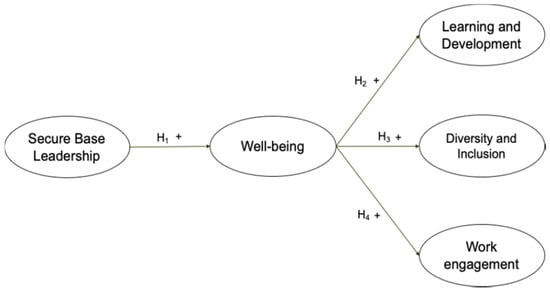
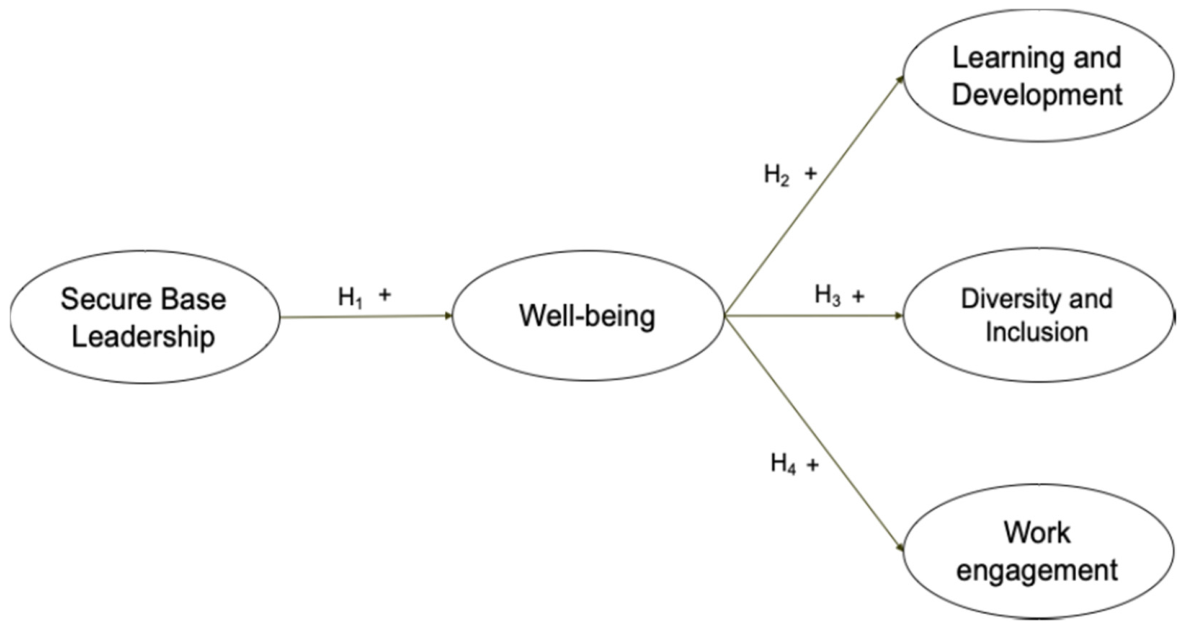
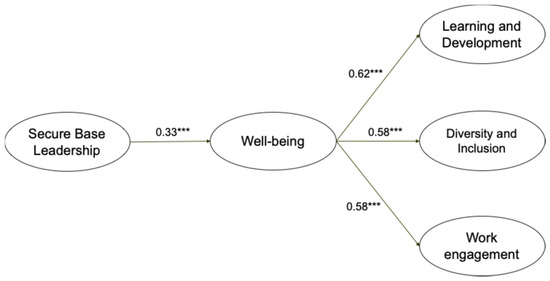
The conceptual framework and hypotheses of the present study are illustrated in Figure 1.
Figure 1.
Theoretical model and hypotheses.
2. Materials and Methods
2.1. Sample and Procedure
Data for this study were collected within a large multinational organization using two independent online surveys administered at different points in time. The use of a single organizational context was considered appropriate for the aims of the study because it ensured consistency in organizational practices, climate survey procedures, leadership development processes, and measurement conditions across participants. At the same time, the organization operates internationally and includes employees and leaders from multiple national and cultural backgrounds, which provided a heterogeneous applied setting for examining SBL and employee outcomes. Nevertheless, the single-organization design is acknowledged as a factor that may limit the generalizability of the findings to other organizational or sectoral contexts.
The first data collection corresponded to the company-wide employee climate survey, which was administered via Qualtrics during March 2024. The survey was distributed electronically to employees across international teams through the organization’s standard internal communication channels. Participation was voluntary and anonymous, and participants received information about the purpose of the survey, confidentiality, and data protection procedures before completing the questionnaire. The climate survey yielded a total of 2421 employee responses. Participants represented a broad range of age groups, with ages measured in ten-year intervals. Approximately one third of respondents were between 30 and 39 years old, followed by a substantial proportion between 40 and 49, and smaller proportions in the 20–29 and 50–59 age ranges. Tenure was also diverse, with employees ranging from less than one year in the organization to more than 20 years, although most respondents fell within the 1–10 year range. The sample reflected the international nature of the organization, with employees representing multiple nationalities, predominantly from Europe and Latin America.
The second data collection focused on SBL and was conducted in December 2024, approximately nine months after the climate survey. This survey was administered using Microsoft Forms and targeted employees reporting to leaders who were about to begin an SBL development program. Employees were invited to evaluate the leadership behaviors of their immediate manager. Participation was again voluntary and anonymous, and individual responses were not disclosed to leaders or managers. The SBL survey initially yielded 403 employee responses, corresponding to 129 leaders and representing a 61% response rate among eligible employees invited to complete the survey.
The two datasets were matched at the leader level using internal leader identification codes available within the organization’s survey system. Individual employee identities were not accessible to the research team. The matching procedure was conducted exclusively at the leader level, allowing the integration of follower-rated SBL data with aggregated climate survey indicators while preserving participant confidentiality and anonymity. After matching the SBL survey with the climate survey, the final analytical sample included 115 leaders with data available from both sources. Within this final matched sample, SBL ratings were based on 372 employee responses nested within these 115 leaders. The organizational climate variables (employee well-being, work engagement, learning and development, and diversity and inclusion) were based on 504 employee responses, corresponding to an 83% response rate among eligible employees in the matched climate survey sample. In both data sources, responses were aggregated at the leader level and linked to the same final sample of 115 leaders.
The reduction from 129 to 115 leaders after matching was primarily due to organizational changes, internal mobility, and the nomination of new leaders in the period between the two surveys. Although this attrition may introduce some risk of selection bias, the reduction was mainly driven by organizational restructuring rather than by participant self-selection or study-related exclusion criteria. This potential limitation is further acknowledged in Section 4.
For the final matched sample, the unit of analysis was the leader (N = 115). SBL ratings were based on 372 follower ratings aggregated at the leader level, whereas the organizational climate variables were based on 504 employee responses provided by the organization as anonymized leader-level aggregated scores.
Leader age was reported in ten-year groups, with the majority falling between 30 and 39 years (42%), followed by 40–49 (29%) and 20–29 (19%). Leader tenure ranged from under one year to over 20 years, with most leaders having between 5 and 15 years of organizational tenure. Both genders were represented, although the sample was predominantly male (70%). Leaders represented a wide range of nationalities, reflecting the organization’s international footprint.
The final analytical sample therefore consisted of 115 leaders. The SBL construct was based on 372 follower ratings (66% response rate), while the climate survey constructs were based on 504 employee responses (83% response rate), all aggregated at the leader level.
The use of two independent surveys, follower-rated leadership data, and leader-level aggregation helped reduce some concerns related to common method bias. However, the temporal order of the measures should be noted: the organizational climate survey was administered before the SBL survey. Therefore, although the proposed model is theoretically grounded, the temporal ordering of the data does not correspond to the causal sequence implied by the mediation model. The results should consequently be interpreted as theory-driven indirect associations rather than as evidence of temporal or causal mediation. In addition, as all constructs were measured using survey-based indicators, potential shared perception effects cannot be fully ruled out.
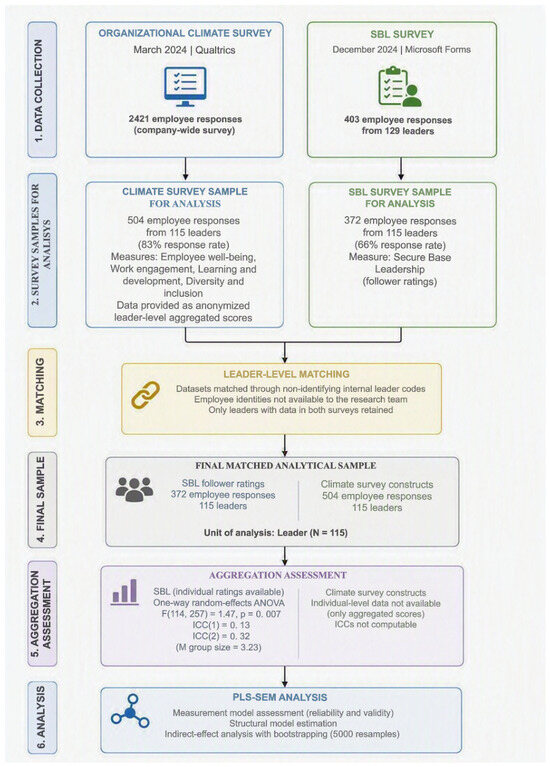
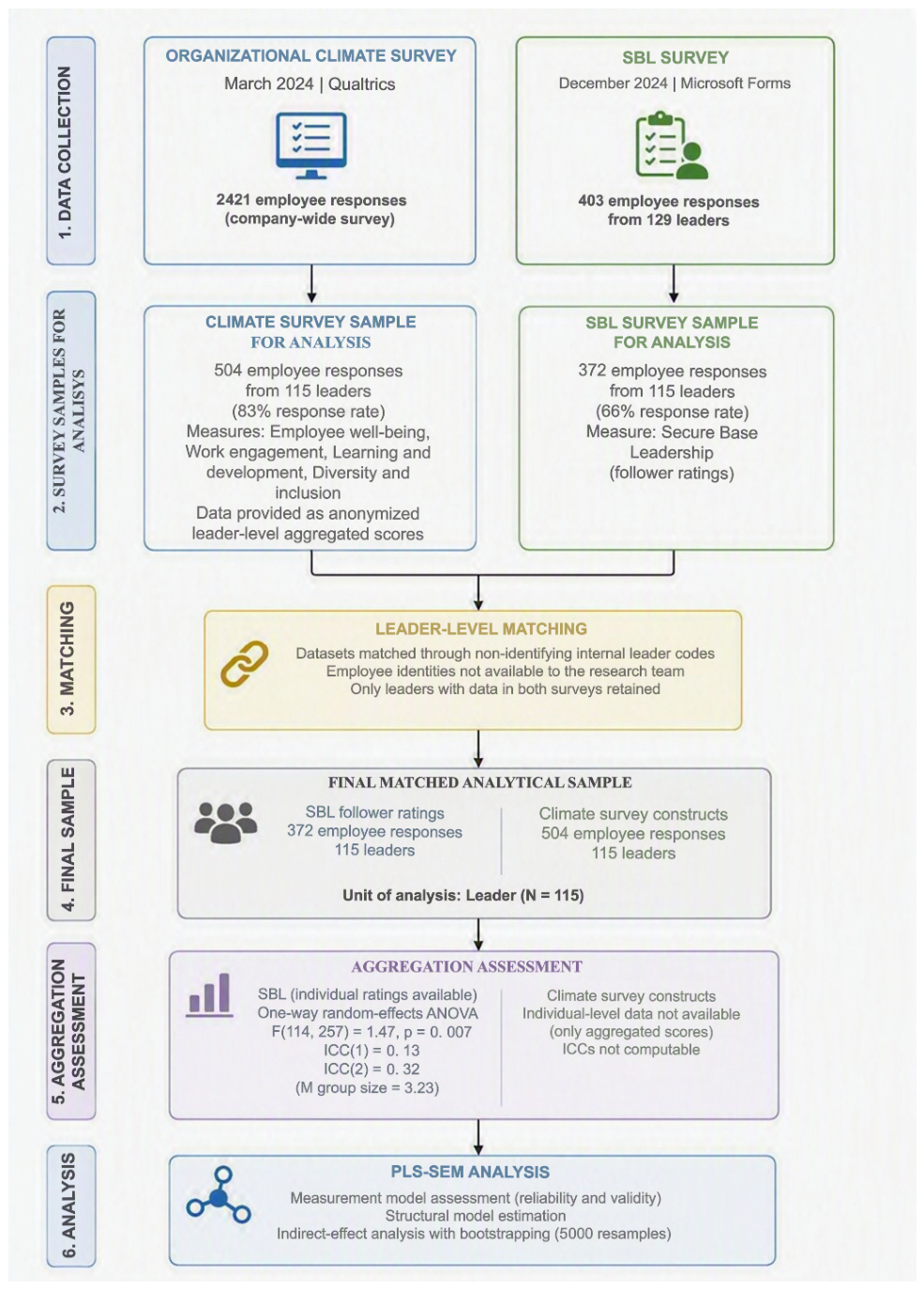
Figure 2 summarizes the data-collection, matching, aggregation, and analytical procedures followed in the study.
Figure 2.
Flowchart of data collection, matching, aggregation, and analysis procedures. Note. The organizational climate survey preceded the SBL survey. Accordingly, the indirect effects are interpreted as theory-driven statistical associations rather than evidence of temporal or causal mediation.
2.2. Measures
All study variables were measured using standardized online questionnaires and five-point Likert-type response scales ranging from 1 (strongly disagree) to 5 (strongly agree). The measures related to employee well-being, work engagement, diversity and inclusion, and learning and development were collected as part of the organizational climate survey, which was administered using the Qualtrics platform.
Employee well-being was measured using three items (e.g., “I am able to balance my work and personal life”), capturing employees’ overall psychological and emotional experience at work. Work engagement was assessed with seven items reflecting energy, dedication, and involvement in work activities (e.g., “In my role, I am empowered to make decisions and take actions”). Perceptions of diversity and inclusion were measured using three items capturing concrete aspects of employees’ workplace experience: whether diversity is valued and promoted, whether employees experience inclusion and are able to participate authentically, and whether they perceive equal access to organizational opportunities (e.g., “My organization values and promotes employee diversity”). Thus, diversity and inclusion in this study refers to employees’ perceptions of recognition, belonging, authentic participation, and equitable opportunity rather than to workforce-composition indicators or the formal existence of diversity policies. Learning and development was measured with two items assessing employees’ perceived access to learning opportunities and career growth within the organization (e.g., “I have good opportunities to learn and develop at my company”). Accordingly, this construct reflects perceived conditions for competency development rather than objectively assessed skill acquisition or proficiency in a specific professional domain.
SBL was measured in a separate survey administered to employees in a later data collection wave. This survey included a 17-item scale assessing leader behaviors associated with attachment-based leadership (e.g., “When something bad happens or I feel upset at work, I turn to my leader for support”; Molero et al., 2019). All SBL items were rated using the same five-point Likert-type response scale. The scale assesses the extent to which leaders display behaviors that foster psychological safety, emotional support, and autonomy in the workplace.
In line with the study design, employee responses were aggregated at the leader level by computing the mean score across all employee responses associated with each leader. This aggregation approach is consistent with the conceptualization of leadership as a shared employee experience and with the analytical focus of the study, which examines leader-level relationships between follower-rated leadership behaviors and aggregated employee outcomes.
For the SBL survey, individual follower ratings were available for the final matched analytical sample, allowing us to statistically assess the appropriateness of aggregating SBL ratings at the leader level. Based on 372 employee ratings nested within 115 leaders, a one-way random-effects ANOVA showed significant between-leader variability in SBL perceptions, F(114, 257) = 1.47, p = 0.007. The ICC(1) was 0.13, indicating that approximately 12.6% of the variance in SBL ratings was attributable to leader membership and providing evidence of meaningful between-leader variability. The ICC(2) was 0.32, indicating modest reliability of the aggregated leader means, likely due to the relatively small average number of respondents per leader (M = 3.23). Accordingly, aggregation of SBL ratings to the leader level was retained on theoretical and analytical grounds, given the leader-level focus of the study and the significant between-leader variability; however, the modest ICC(2) suggests that leader-level SBL effects should be interpreted with caution.
For the organizational climate survey variables (employee well-being, work engagement, learning and development, and diversity and inclusion), individual-level responses linked to each leader were not available to the research team. To preserve employee confidentiality and comply with internal data protection procedures, the organization provided only anonymized leader-level aggregated scores based on 504 employee responses. Therefore, ICC(1) and ICC(2) could not be computed retrospectively for these climate survey constructs.
2.3. Data Analysis
The adequacy of the sample size was assessed following current PLS-SEM recommendations. Because the maximum number of structural paths directed at any single construct in the model is small, the minimum sample size required under the 10-times rule (Hair et al., 2017) was modest. The final sample of 115 leaders clearly exceeded this threshold and was therefore considered sufficient to estimate the proposed mediation model.
Prior to estimating the PLS-SEM model, leader-level aggregation was examined for the SBL ratings, for which individual employee responses were available. ICC(1) and ICC(2) were calculated to assess between-leader variability and the reliability of aggregated leader-level means, respectively. For the organizational climate survey constructs, aggregation indices could not be computed because the research team only had access to anonymized leader-level aggregated scores provided by the organization.
Data were analyzed using Partial Least Squares Structural Equation Modeling (PLS-SEM) with SmartPLS 4 software (Ringle et al., 2025). PLS-SEM was selected because the primary objective of the study was to explain and predict the mechanisms linking SBL to employee well-being and organizational outcomes through multiple mediating relationships, rather than to test the overall fit of a well-established covariance structure. Accordingly, variance-based SEM was considered more appropriate than covariance-based SEM (CB-SEM), which is primarily intended for theory confirmation and global model fit assessment. In addition, the proposed model is relatively complex, comprising multiple latent constructs and indirect effects, for which PLS-SEM has been shown to provide robust parameter estimates and strong predictive capabilities (Hair et al., 2017, 2019). Furthermore, PLS-SEM does not require multivariate normality and is therefore well suited to organizational survey data, where this assumption is often difficult to satisfy. Finally, PLS-SEM is particularly recommended for research focusing on theory development and the examination of key mechanisms linking leadership behaviors to employee outcomes (Edú-Valsania et al., 2025).
The analysis followed the recommended two-step approach, involving the evaluation of the measurement models prior to the assessment of the structural model. This procedure ensures that the latent constructs demonstrate adequate reliability and validity before testing the hypothesized relationships among them (Hair et al., 2017).
In the first step, the measurement models were assessed by examining indicator reliability, internal consistency reliability, convergent validity, and discriminant validity. Indicator reliability was evaluated through standardized factor loadings, with values close to or exceeding 0.70 considered acceptable. Internal consistency reliability was assessed using Cronbach’s alpha and composite reliability, with values above 0.70 indicating satisfactory reliability. Convergent validity was examined using the average variance extracted (AVE), with values above 0.50 indicating that the construct explains more than half of the variance of its indicators.
Discriminant validity was evaluated using the heterotrait–monotrait (HTMT) ratio of correlations, following the guidelines proposed by Henseler et al. (2015). HTMT values below 0.85 were taken as evidence of adequate discriminant validity between constructs. This approach is considered more sensitive and reliable than traditional criteria for assessing discriminant validity in variance-based structural equation modeling.
In the second step, the structural model was assessed by examining path coefficients, coefficients of determination (R2), effect sizes, and the significance of direct and indirect effects. The statistical significance of the hypothesized relationships and mediation effects was tested using a bootstrapping procedure with 5000 resamples, as recommended for PLS-SEM analyses (Hair et al., 2017, 2019). One-tailed tests were applied given that all hypotheses specified a positive direction.
Mediation was evaluated by assessing the significance of the indirect effects of SBL on learning and development, diversity and inclusion, and work engagement through employee well-being. Confidence intervals derived from bootstrapping were inspected to determine whether indirect effects differed significantly from zero. In line with current recommendations, conclusions regarding mediation were based on the presence and significance of indirect effects rather than on changes in direct effects alone (Hair et al., 2019).
3. Results
3.1. Measurement Models Assessment
Prior to testing the structural model, the measurement models were evaluated to assess the reliability and validity of the latent constructs. Indicator reliability was examined using standardized outer loadings. Most indicators exhibited loadings at or above the recommended threshold of 0.70, indicating adequate indicator reliability (Table 1). However, eight indicators showed loadings below this threshold: seven belonged to SBL and one to employee well-being. In contrast, all indicators measuring learning and development and diversity and inclusion exhibited loadings of 0.84 or higher. Following established PLS-SEM recommendations, indicators with loadings between 0.40 and 0.70 may be retained when the corresponding constructs demonstrate acceptable composite reliability and average variance extracted and when retention preserves theoretically relevant content (Hair et al., 2017, 2019).
Table 1.
Measurement Model Assessment: Outer Loadings, Reliability, and Average Variance Extracted.
Internal consistency reliability was assessed using composite reliability, the preferred index in PLS-SEM, together with Cronbach’s alpha. Composite reliability exceeded the recommended threshold of 0.70 for all constructs, ranging from 0.80 to 0.94, indicating satisfactory internal consistency. Cronbach’s alpha was likewise above 0.70 for all constructs except employee well-being (α = 0.57). This lower value is attributable to the small number of items in the well-being scale (three items) and to the well-documented tendency of Cronbach’s alpha to underestimate reliability under these conditions. For this construct, the composite reliability (0.80), which is less sensitive to the number of items, together with an average variance extracted of 0.56, supports its internal consistency. Consistent with expectations for PLS-SEM, composite reliability values equaled or exceeded the corresponding Cronbach’s alpha estimates, further supporting the reliability of the measurement model.
Convergent validity was examined using the average variance extracted (AVE). AVE values were above the recommended threshold of 0.50 for all constructs, indicating that each latent variable explained more than half of the variance of its indicators. This result provides support for the convergent validity of the measurement model.
Discriminant validity was assessed using the heterotrait–monotrait (HTMT) ratio of correlations. HTMT values ranged from 0.186 to 0.891. Most values were below the conservative threshold of 0.85 (Henseler et al., 2015), although the association between well-being and learning and development slightly exceeded this threshold (HTMT = 0.891), approaching but remaining below the more liberal cutoff of 0.90. This indicates acceptable, albeit not fully distinct, discriminant validity between these conceptually related constructs. Taken together, these results suggest that the measurement model demonstrates satisfactory psychometric properties and is suitable for subsequent structural model analysis.
3.2. Structural Model Assessment
3.2.1. Descriptive Statistics and Correlations
As a preliminary step, means, standard deviations, and bivariate correlations among the study variables were examined. Table 2 presents the descriptive statistics and zero-order correlations for SBL, employee well-being, learning and development, diversity and inclusion, and work engagement.
Table 2.
Means, Standard Deviations, and Correlations among Study Variables.
Overall, the descriptive statistics indicate relatively high mean values across all constructs, with limited dispersion, which is consistent with organizational climate data collected in real work settings. The correlation pattern is in line with expectations, showing moderate to strong positive associations between well-being and the three outcome variables, supporting its central role in the proposed mediation model.
3.2.2. Structural Model Results
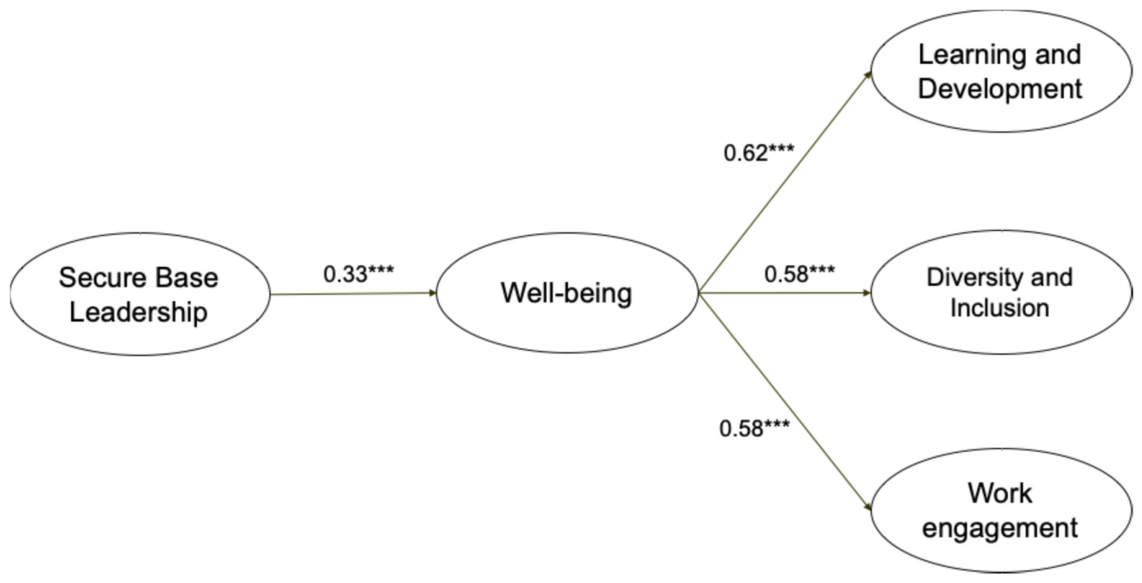
Following the assessment of the measurement model, the structural model was evaluated to test the hypothesized relationships among SBL, employee well-being, learning and development, diversity and inclusion, and work engagement (Figure 3). Path coefficients, coefficients of determination (R2), and indirect effects were examined using PLS-SEM with bootstrapping procedures.
Figure 3.
Estimated structural model. *** p < 0.001.
Consistent with Hypothesis 1, SBL showed a positive and statistically significant relationship with employee well-being (β = 0.33, p < 0.001), indicating that leaders who display secure base behaviors are associated with higher levels of employee psychological well-being. The explained variance in employee well-being was modest but meaningful (R2 = 0.112), suggesting that SBL constitutes a relevant relational resource in shaping employees’ experience at work.
In line with the proposed model, employee well-being showed strong positive relationships with learning and development (β = 0.62, p < 0.001), diversity and inclusion (β = 0.58, p < 0.001), and work engagement (β = 0.58, p < 0.001), respectively. These findings indicate that employees who experience higher levels of well-being are more likely to perceive greater access to learning opportunities, stronger inclusion and fairness in the workplace, and higher levels of motivational engagement.
Indirect-effect analyses were conducted to examine whether employee well-being represented a theory-driven indirect pathway linking SBL to the three outcome variables. As shown in Table 3, the indirect effects of SBL on learning and development, diversity and inclusion, and work engagement through employee well-being were all positive and statistically significant. In all cases, the bias-corrected bootstrapped confidence intervals did not include zero, providing support for the proposed indirect associations.
Table 3.
Indirect Effects of Secure Base Leadership via Employee Well-being.
Taken together, these results indicate that employee well-being represents a significant theory-driven indirect pathway linking SBL and the examined organizational outcomes.
Regarding explained variance, the model accounted for meaningful proportions of variance in employee well-being (11%), learning and development (38%), diversity and inclusion (33%), and work engagement (34%), indicating moderate explanatory power for an applied leadership model.
3.3. Summary of Hypotheses Testing
Finally, as summarized in Table 4, the empirical findings provide support for all four hypothesized relationships. The statistical evidence validates the proposed theoretical framework, confirming that each hypothesis (H1 through H4) met the criteria for empirical acceptance.
Table 4.
Summary of hypotheses testing.
4. Discussion
The present study examined the relationships between SBL, employee well-being, and three key organizational outcomes—learning and development, diversity and inclusion, and work engagement—using a multi-source correlational design. Overall, the findings are consistent with the proposed attachment-based model in which SBL is positively associated with employee well-being, and well-being represents a central indirect pathway linking leadership to broader employee experiences at work. However, because the organizational climate survey was administered before the SBL survey, these findings should be interpreted as theory-driven indirect associations rather than as evidence of temporal or causal mediation.
Although all indirect effects were statistically significant, their magnitude was not identical. The indirect effect was slightly stronger for learning and development, followed by work engagement and diversity and inclusion. This pattern suggests that the secure base function of leadership may be particularly relevant for outcomes that require exploration, growth, and motivational investment. At the same time, the diversity and inclusion pathway, although slightly smaller in magnitude, represents one of the most conceptually novel findings of the study because it extends attachment-based leadership research into the domain of social fairness, respect, and inclusion perceptions.
Consistent with Hypothesis 1, SBL showed a positive and statistically significant relationship with employee well-being. This finding aligns with attachment theory, which posits that the availability and responsiveness of salient figures under conditions of stress foster emotional regulation and psychological security. Leaders who act as a safe haven and a secure base appear to create relational environments in which employees feel supported, emotionally resourced, and better able to cope with work-related demands. This result is consistent with recent attachment-at-work research showing that secure relational experiences can protect employee well-being and help regulate stress-related demands. However, the explained variance in well-being was modest, suggesting that SBL should be understood as one relevant relational resource among other possible individual, team, and organizational determinants of employee well-being.
Employee well-being emerged as the key explanatory pathway through which SBL was related to learning and development. In line with Hypothesis 2, the indirect effect through well-being was statistically significant and was the strongest of the three mediation paths. This finding is highly consistent with the secure base function proposed by attachment theory. When employees perceive their leader as available, supportive, and encouraging of autonomy, they may feel less preoccupied with threat management and more capable of engaging in exploration, learning, and growth. In this sense, SBL does not only provide emotional comfort; it also creates the psychological conditions that enable employees to perceive development opportunities as accessible and meaningful. This finding extends previous SBL research by showing that attachment-based leadership may be relevant not only for affective or motivational outcomes, but also for employees’ perceptions of learning and career development. However, the construct assessed perceived opportunities for learning and career growth rather than objective competency gains. Future studies should therefore examine whether SBL and employee well-being are associated with measurable, domain-specific outcomes, such as certification completion, technical-skill progression, demonstrated leadership competencies, training transfer, or performance-based learning indicators.
The mediation involving diversity and inclusion also provides an important contribution. In line with Hypothesis 3, employee well-being mediated the relationship between SBL and employees’ perceptions of diversity and inclusion. Although this indirect effect was slightly smaller than the effects observed for learning and development and work engagement, it is theoretically meaningful because it suggests that attachment-based leadership may influence how employees interpret the social and relational climate of the organization. Secure-base relationships are characterized by acceptance, respect, non-defensive communication, and trust. When leaders provide this relational security, employees may experience greater psychological balance and may be more likely to perceive workplace interactions and organizational practices as fair, respectful, and inclusive. In the present research context, these inclusion perceptions refer more specifically to employees’ sense that diversity is valued, that they can participate authentically in the workplace, and that organizational opportunities are available on an equitable basis. The findings concern these perceived everyday manifestations of inclusion rather than demographic representation or the formal implementation of diversity policies. Conversely, when well-being is compromised, employees may be more sensitive to interpersonal threat, exclusion cues, or perceived unfairness. Therefore, this finding extends attachment theory beyond individual well-being and motivation, suggesting its relevance for understanding inclusion-related perceptions in organizations.
In line with Hypothesis 4, employee well-being also mediated the relationship between SBL and work engagement. Work engagement requires sustained energy, dedication, and involvement in work activities. From an attachment theory perspective, employees who feel secure and supported can allocate more cognitive and emotional resources to work goals rather than to coping with stress, uncertainty, or relational insecurity. The present findings are consistent with prior research linking relational leadership styles to engagement and psychological well-being. They are also consistent with recent evidence from police and military settings showing that SBL is positively associated with work engagement and negatively associated with burnout, and that these motivational and strain-related processes may help explain the association between SBL and performance (Moriano et al., 2026; Santos et al., 2026). However, the results also suggest that engagement may be better understood as a downstream consequence of employee well-being rather than as an isolated outcome of leadership. This interpretation reinforces the idea that motivational investment at work is more likely to be sustained when employees experience emotional security and psychological resources.
Taken together, these findings extend previous research on SBL and attachment-based leadership in several ways. Prior studies have linked secure leadership relationships to outcomes such as engagement, resilience, and lower exhaustion. The present study converges with this literature while adding a more integrative explanation: SBL appears to relate to multiple organizational outcomes through employee well-being as a common psychological pathway. Moreover, by including learning and development and diversity and inclusion as outcomes, the study broadens the scope of SBL research beyond traditional motivational or stress-related variables. The results suggest that SBL may support not only how employees feel, but also how they learn, engage, and interpret the inclusiveness of their work environment.
From a theoretical standpoint, these results highlight the value of positioning well-being at the core of leadership models grounded in attachment theory. Rather than conceptualizing leadership effects as a series of independent direct relationships, the present findings support a more parsimonious and process-oriented explanation: SBL fosters well-being, which in turn enables engagement, learning, and inclusion. This perspective contributes to the literature by clarifying how relational leadership behaviors are translated into organizationally relevant outcomes and by emphasizing the foundational role of employee well-being in this process.
4.1. Practical Implications
Building on these theoretical findings, the study also offers several practical implications for organizations seeking to improve employee engagement, learning and development, and perceptions of diversity and inclusion through leadership development. Rather than addressing these outcomes as independent priorities, the results suggest that SBL represents an integrative leverage point by fostering employee well-being as a foundational psychological resource. In many organizations, engagement initiatives, learning strategies, and diversity and inclusion programs are frequently designed and managed as separate interventions, often led by different functions and supported by distinct frameworks and measurement systems. While such initiatives may be well intentioned, this fragmentation may limit their overall impact if the underlying psychological conditions required for their effectiveness are not sufficiently addressed.
The present findings indicate that employee well-being constitutes a critical enabling condition that allows these organizational priorities to materialize. Leaders who consistently provide emotional support, availability, and autonomy support help create environments in which employees feel psychologically secure and emotionally resourced. In turn, this state of well-being appears to enable higher motivational investment in work, greater openness to learning and development opportunities, and more positive interpretations of inclusion and fairness in daily interactions. From a practical standpoint, this suggests that leadership development efforts focused on secure base behaviors may generate spillover benefits across multiple organizational domains, rather than producing isolated improvements in a single outcome.
These results also have important implications for the design and evaluation of leadership development programs. The implementation of SBL should nevertheless be considered in light of real-world organizational constraints. Leaders often operate under high workloads, broad spans of control, time pressure, competing performance priorities, and limited opportunities for individualized interaction. Under these conditions, the theoretical ideal of continuous availability and personalized support may be difficult to sustain. Moreover, secure-base behaviors require balance: emotional support without appropriate challenge may foster dependency or reduce accountability, whereas autonomy and challenge without sufficient relational support may be experienced as withdrawal or pressure. Organizations should therefore translate SBL into feasible and repeatable practices, such as predictable check-ins, clear escalation channels, psychologically safe feedback, calibrated delegation, and structured developmental conversations, rather than expecting leaders to provide unlimited availability or intensive individualized support.
The practical application of SBL may also differ in small and medium-sized enterprises (SMEs), which may lack formal leadership academies, dedicated well-being resources, sophisticated employee-survey systems, or specialized diversity and inclusion functions. However, the relational foundations of SBL do not necessarily require resource-intensive programs. SMEs may embed secure-base behaviors in existing management routines through regular one-to-one conversations, clear communication during uncertainty, peer mentoring, fair and transparent decision-making, autonomy-supportive delegation, and constructive responses to mistakes. In these settings, implementation may depend less on formal infrastructure and more on owner-managers’ and supervisors’ consistency, accessibility, and interpersonal capability. Future research should examine whether the relationships identified in this study generalize to smaller organizations and resource-constrained contexts.
Overall, the study underscores the practical value of shifting from a strategy that manages engagement, learning, and inclusion as separate agendas to a more coherent approach that prioritizes relational leadership and employee well-being as common foundations. By investing in SBL capabilities, organizations may enhance multiple aspects of the employee experience in a more integrated and sustainable manner, particularly in relation to inclusion and fairness perceptions, which recent studies have shown to be closely tied to leadership-supported well-being (Liu et al., 2024, 2025).
4.2. Limitations and Future Research
Several limitations of this study should be acknowledged. First, although the study relied on two independent surveys administered at different points in time, the temporal ordering of the measures does not align with the causal sequence proposed in the theoretical model: the organizational climate survey was administered before the SBL survey. Therefore, the results do not support temporal or causal conclusions about mediation. Rather, the indirect effects should be interpreted as theory-driven statistical associations. Although the proposed model is theoretically grounded, alternative explanations, including reciprocal relationships or the influence of unmeasured third variables, cannot be ruled out. Future studies should employ longitudinal or intervention-based designs, particularly pre–post evaluations of SBL development programs, in which changes in employee-rated leadership behaviors are assessed before changes in employee well-being and subsequent organizational outcomes. Second, although SBL was assessed using employee ratings of their leaders rather than leader self-reports, which helps reduce single-source bias, all variables were measured using perceptual survey instruments. As a result, some relationships may still be influenced by shared perception processes. The use of two temporally separated surveys—a leadership survey focusing on SBL and a company climate survey capturing well-being and outcome variables—partially mitigates concerns related to common method variance but does not eliminate them entirely. A further limitation concerns the statistical justification of aggregation. ICC(1) and ICC(2) values could be computed for SBL because individual follower ratings were available. The ICC(1) value indicated significant between-leader variability in SBL perceptions, providing some empirical justification for examining SBL at the leader level. However, ICC(2) indicated modest reliability of the aggregated leader means, likely due to the relatively small average number of respondents per leader. For the organizational climate survey variables, the research team only had access to anonymized leader-level aggregated scores due to confidentiality and data protection restrictions. Therefore, ICC values could not be calculated retrospectively for employee well-being, work engagement, learning and development, or diversity and inclusion. Future research should seek access to individual-level nested data in order to report aggregation indices for all constructs aggregated at the leader level. Third, the study was conducted within a single multinational organization. While this context provided the opportunity to collect data from culturally diverse employees and leaders, the findings may not generalize equally across industries, organizational sizes, or institutional contexts. Replication across multiple organizations and sectors would strengthen confidence in the robustness and generalizability of the results.
Future research could also extend the present model by examining potential boundary conditions. For example, the effectiveness of SBL may vary depending on levels of environmental uncertainty, organizational change, remote or hybrid work arrangements, or workload intensity. In addition, incorporating objective indicators, such as turnover, absenteeism, or performance metrics, would further enhance the practical and theoretical contribution of future studies by linking attachment-based leadership not only to perceptual outcomes but also to observable organizational results.
5. Conclusions
In conclusion, the present study provides empirical evidence that SBL, as perceived by employees, is positively associated with employee well-being, and that well-being plays a central role in explaining employees’ engagement, perceptions of diversity and inclusion, and perceived learning and development opportunities. By positioning well-being as the key psychological mechanism linking leadership to multiple organizational outcomes, this study advances existing research on attachment-based leadership and offers a more integrative and process-oriented understanding of how leadership behaviors translate into employee experiences. From an organizational perspective, the findings suggest that investing in the development of SBL capabilities may represent a coherent and efficient pathway for improving multiple aspects of the organizational climate through an uplift in employee well-being.
Author Contributions
Conceptualization, F.J.F.M., J.A.M. and A.L.; methodology, F.J.F.M.; formal analysis, F.J.F.M.; writing—original draft preparation, F.J.F.M.; writing—review and editing, F.J.F.M., J.A.M. and A.L.; supervision, J.A.M. and A.L. All authors have read and agreed to the published version of the manuscript.
Funding
This research received no external funding.
Institutional Review Board Statement
The study was conducted in accordance with the Declaration of Helsinki, and ethical approval was waived for this study. According to the guidance of the Research Ethics Committee of the Universidad Nacional de Educación a Distancia (UNED), research does not require an ethics committee report when it does not affect participants’ fundamental rights and uses only non-identifying personal data (https://www.uned.es/universidad/inicio/unidad/comite-de-etica-de-la-investigacion.html; https://www.uned.es/universidad/facultades/en/psicologia/bienvenida/comite-etica.html, accessed on 3 September 2026). The present study involved the secondary, non-interventional analysis of organizational survey data provided to the research team in de-identified and aggregated form.
Informed Consent Statement
Informed consent was obtained from all subjects involved in the study. Electronic informed consent was obtained from all participants before they completed the online questionnaires. Only participants who provided consent were able to proceed. No handwritten signature was collected because the questionnaires were administered online.
Data Availability Statement
The data are not publicly available due to confidentiality and data protection restrictions. Any potential access would require prior authorization from the participating organization.
Acknowledgments
The authors thank the participating organization and employees for their contribution to this research.
Conflicts of Interest
The authors declare no conflicts of interest.
Abbreviations
The following abbreviations are used in this manuscript:
| SBL | Secure Base Leadership |
References
- Abolnasser, M. S. A., Abdou, A. H., Hassan, T. H., & Salem, A. E. (2023). Transformational leadership, employee engagement, job satisfaction, and psychological well-being among hotel employees after the height of the COVID-19 pandemic: A serial mediation model. International Journal of Environmental Research and Public Health, 20(4), 3609. [Google Scholar] [CrossRef] [Scilit] [PubMed]
- Ainsworth, M. D. S., Blehar, M. C., Waters, E., & Wall, S. (1978). Patterns of attachment: A psychological study of the strange situation. Psychology Press. [Google Scholar]
- Baquero, A. (2023). Authentic leadership, employee work engagement, trust in the leader, and workplace well-being: A moderated mediation model. Psychology Research and Behavior Management, 16, 1403–1424. [Google Scholar] [CrossRef] [Scilit] [PubMed]
- Bowlby, J. (1982). Attachment and loss: Vol. 1. Attachment (2nd ed.). Basic Books. (Original work published 1969). [Google Scholar]
- Bowlby, J. (1988). A secure base: Parent–child attachment and healthy human development. Basic Books. [Google Scholar]
- Edmondson, A. (1999). Psychological safety and learning behavior in work teams. Administrative Science Quarterly, 44(2), 350–383. [Google Scholar] [CrossRef] [Scilit]
- Edú-Valsania, S., Laguía, A., & Moriano, J. A. (2025). Interpersonal dynamics of authentic leadership: Effects on support perception and workplace procrastination. Psychology International, 7(1), 21. [Google Scholar] [CrossRef] [Scilit]
- Hair, J. F., Hult, G. T. M., Ringle, C. M., & Sarstedt, M. (2017). A primer on partial least squares structural equation modeling (PLS-SEM) (2nd ed.). Sage. [Google Scholar]
- Hair, J. F., Risher, J. J., Sarstedt, M., & Ringle, C. M. (2019). When to use and how to report the results of PLS-SEM. European Business Review, 31(1), 2–24. [Google Scholar] [CrossRef] [Scilit]
- Henseler, J., Ringle, C. M., & Sarstedt, M. (2015). A new criterion for assessing discriminant validity in variance-based structural equation modeling. Journal of the Academy of Marketing Science, 43(1), 115–135. [Google Scholar] [CrossRef] [Scilit]
- Kahn, W. A. (1990). Psychological conditions of personal engagement and disengagement at work. Academy of Management Journal, 33(4), 692–724. [Google Scholar] [CrossRef] [Scilit] [PubMed]
- Kark, R., & Shamir, B. (2013). The dual effect of transformational leadership: Priming relational and collective selves and further effects on followers. In B. J. Avolio, & F. J. Yammarino (Eds.), Transformational and charismatic leadership: The road ahead (2nd ed., pp. 103–109). Emerald. [Google Scholar] [CrossRef] [Scilit]
- Laguía, A., Navas-Jiménez, M. C., Schettini, R., Rodríguez-Batalla, F., Guillén, D., & Moriano, J. A. (2024). Effects of secure base leadership vs. avoidant leadership on job performance. Businesses, 4(3), 438–452. [Google Scholar] [CrossRef] [Scilit]
- Liu, Y., Fang, Y., & He, G. (2025). The effect of inclusive leadership on employee well-being. Scientific Reports, 15, 39991. [Google Scholar] [CrossRef] [Scilit] [PubMed]
- Liu, Y., Fang, Y., Hu, L., Chen, N., Li, X., & Cai, Y. (2024). Inclusive leadership and employee workplace well-being: The role of vigor and supervisor developmental feedback. BMC Psychology, 12, 540. [Google Scholar] [CrossRef] [Scilit] [PubMed]
- McConnell, D., Wong, G., & Ferrey, A. (2025). The relationship between attachment and mental health at work: A narrative review. Work, 81(3), 2833–2843. [Google Scholar] [CrossRef] [Scilit] [PubMed]
- Mikulincer, M., & Shaver, P. R. (2007). Attachment in adulthood: Structure, dynamics, and change. Guilford Press. [Google Scholar]
- Mikulincer, M., & Shaver, P. R. (2019). Attachment orientations and emotion regulation. Current Opinion in Psychology, 25, 6–10. [Google Scholar] [CrossRef] [Scilit] [PubMed]
- Molero, F., Mikulincer, M., Shaver, P. R., Laguía, A., & Moriano, J. A. (2019). The development and validation of the leader as security provider scale. Journal of Work and Organizational Psychology, 35, 183–193. [Google Scholar] [CrossRef] [Scilit]
- Moriano, J. A., Navas-Jiménez, M. C., Laguía, A., & Pérez-Garín, D. (2026). Secure base leadership as an organizational resource in the police training of the Carabineros de Chile. Policing: An International Journal. Advance online publication. [CrossRef] [Scilit]
- Navas-Jiménez, M. C., Laguía, A., Recio, P., García-Guiu, C., Pastor, A., Edú-Valsania, S., Molero, F., Mikulincer, M., & Moriano, J. A. (2024). Secure base leadership in military training: Enhancing organizational identification and resilience through work engagement. Frontiers in Psychology, 15, 1401574. [Google Scholar] [CrossRef] [Scilit] [PubMed]
- Navas-Jiménez, M. C., Laguía, A., Schettini, R., Rodríguez-Batalla, F., Guillén-Corchado, D., & Moriano, J. A. (2025). When leaders are safe havens: How secure base leadership buffers the impact of emotional demands on exhaustion. Merits, 5(1), 3. [Google Scholar] [CrossRef] [Scilit]
- Ringle, C. M., Wende, S., & Becker, J.-M. (2025). SmartPLS 4. SmartPLS GmbH. Available online: https://www.smartpls.com (accessed on 20 January 2026).
- Santos, D., de la Cruz, G., Guillén, D., González, J. L., Laguía, A., & Moriano, J. A. (2026). Liderazgo de base segura en la Guardia Civil: Estudio piloto en unidades territoriales [Secure-base leadership in the Guardia Civil: A pilot study in territorial units]. Revista Logos Guardia Civil, 4(2), 13–36. [Google Scholar]
- Schaufeli, W. B., Salanova, M., González-Romá, V., & Bakker, A. B. (2002). The measurement of engagement and burnout: A two-sample confirmatory factor analytic approach. Journal of Happiness Studies, 3(1), 71–92. [Google Scholar] [CrossRef] [Scilit]
- Uglanova, E., Laguía, A., Stempel, C. R., & Moriano, J. A. (2026). Assessing the validity and reliability of the German version of the leader as a security provider scale (LSPS). Current Psychology, 45(15), 1340. [Google Scholar] [CrossRef] [Scilit]
- Warnock, K. N., Ju, C. S., & Katz, I. M. (2024). A meta-analysis of attachment at work. Journal of Business and Psychology, 39, 1239–1257. [Google Scholar] [CrossRef] [Scilit]

Disclaimer/Publisher’s Note: The statements, opinions and data contained in all publications are solely those of the individual author(s) and contributor(s) and not of MDPI and/or the editor(s). MDPI and/or the editor(s) disclaim responsibility for any injury to people or property resulting from any ideas, methods, instructions or products referred to in the content. |
© 2026 by the authors. Licensee MDPI, Basel, Switzerland. This article is an open access article distributed under the terms and conditions of the Creative Commons Attribution (CC BY) license.