


Abstract
This study aimed to investigate whether a multimodal cognitive behavioural intervention could enhance academy athletes’ stress mindset, self-compassion, and performance, as well as reduce irrational beliefs and symptoms of anxiety and depression. We delivered 6 × 1 h group workshops at five different football (n = 4) and rugby (n = 1) academies in the United Kingdom. We hypothesised that there would be increases in stress mindset, self-compassion, and perceived performance coupled with decreases in irrational beliefs, anxiety, and depressive symptoms as a result of the intervention, and that such changes would remain evident one month later. Sixty-seven participants (n = 59 males, n = 8 females, Mage = 17.03 years, SD = 2.55) completed assessment at baseline, post-intervention, and at a follow-up. Through paired-sample t-tests, our results demonstrated support for the hypotheses with principally small effect sizes. Findings offer support for the use of a multimodal cognitive behavioural programme in academy athletes.
1. Introduction
1.1. Mental Health and Academy Football
Sport is often perceived as a vehicle through which individuals can develop physically, socially, and emotionally. However, athletes are still prone to symptoms of mental ill health and mental illness (Rice et al., 2016), with an estimate of 34% of athletes experiencing anxiety or depression (Gouttebarge et al., 2019), while some studies report that these figures can be even higher (e.g., 46.4% in Gulliver et al., 2015). Therefore, it is vital that athletes take care of their wellbeing alongside their performance, and accordingly, reducing symptoms of anxiety and depression to contribute towards improved wellbeing is vital for athletes to succeed both in their sport and their daily lives.
Young athletes, identified as those between the ages of 14 and 25 (according to the United Nations), are particularly susceptible to mental ill health given that 50% of mental disorders develop by the age of 14 (Purcell et al., 2023). Such maladaptive psychological outcomes may be exacerbated by the demands associated with high-level competitive youth sport (Sothern & O’Gorman, 2021). In the UK, sports academies were formed to allow the best youth athletes the opportunity to develop and practice at top facilities at an early age, thus providing a pathway to the elite level. Consequently, young athletes in academy systems face several challenges such as injury, performance, transitions, and education (Reeves et al., 2009). They also face the prospect of judgement and release from an academy (Wilkinson, 2021) and as they may have been part of the club for large parts of their childhood, the spectre of being told they are no longer needed can weigh heavy on the mind of the young athlete. Therefore, it is no surprise that 55% of academy players experienced clinical levels of psychological distress within three weeks after being released (Blakelock et al., 2016). The issue is exacerbated by the fact that young athletes are unlikely to seek psychological support for themselves (Sothern & O’Gorman, 2021). This provides all the more reason to ensure that academy athletes should be equipped to deal with stress and the demands that come with playing in an academy.
The psychological support provided to young players varies depending on several factors such as the sport, funding, and location. In football, of the four categories graded by the Elite Player Performance Plan (EPPP) introduced by England’s Premier League in 2012, only Category One academies are required to have a full-time psychologist deliver sport psychology provision (Premier League, 2011). In England, 43% of the 60 academies currently are considered to be Category One. Therefore, of the estimated 12,500 youth academy footballers that are attached to professional clubs in the UK, it can be argued that for many, their mental health may be overlooked (Sothern & O’Gorman, 2021). This notion also exists in other sports such as rugby as low mental health literacy and a perceived lack of provision has been cited as potential barriers to mental health help-seeking (Kola-Palmer et al., 2020), while financial barriers may also be evident (Pain & Harwood, 2004). Although psychological support may be provided by coaches and parents, the challenges that academy athletes face coupled with the prevalence of poor mental health means that exploring ways in which players can receive psychological support through evidence-based psychoeducation strategies is warranted. Not every athlete suffers from psychological distress during adolescence, but providing strategies to navigate inevitable stressful situations with the future in mind could mean that all academy athletes stand to benefit from psychoeducation interventions.
1.2. Stress Mindset
Stress has been defined as “the relationship between the person and the environment that is appraised by the person as taxing or exceeding his or her resources and endangering his or her well-being” (Lazarus & Folkman, 1984, p. 21) and is therefore a fundamental component that affects an individual’s wellbeing. Although this definition is widely adopted in academia, not all stress should be considered detrimental, and experiencing stress is an individual process that can lead to adaptive performance and wellbeing outcomes (Jenkins et al., 2021). Research has continued to build upon the notion that stress can be interpreted differently by individuals, and although stress mindset is a trait-level belief, it is malleable (Crum et al., 2013). Stress mindset is the extent to which individuals believe that stress influences an individual’s performance and productivity, health and wellbeing, as well as learning and growth (Crum et al., 2013). An individual’s stress mindset may be represented on a continuum with those that consider stress to be adaptive possessing a ‘stress-is-enhancing’ mindset, while those that consider stress to have maladaptive consequences are said to possess a ‘stress-is-debilitating’ mindset (Crum et al., 2013). Researchers have demonstrated that a ‘stress-is-enhancing’ mindset is associated with vitality (Mansell, 2021), proactive coping (Mansell & Turner, 2023), and performance (Keech et al., 2018). Conversely, possessing a ‘stress-is-debilitating’ mindset is a risk factor for mental and physical ill health (Mansell, 2021).
Beyond cross-sectional studies, using a multimodal cognitive behavioural intervention, da Silva et al. (2025) demonstrated that it is possible to enhance the stress mindset of young athletes, and Mansell et al. (2023) reported that reductions in negative affect were also evident as a result of viewing stress in a more balanced way. Other studies support the benefits of enhancing stress mindset. Keech et al. (2021a) found that altering stress mindset was accompanied by greater positive affect and performance, while Sparks et al. (2025) found that enhancing stress mindset was accompanied by reductions in depressive symptoms. Thus, it is important within an environment such as sporting academies, where stressors and demands are continually present, to work with athletes to cultivate more adaptive beliefs about stress.
1.3. Irrational Beliefs
The relationship between stress mindset and adaptive stress-related outcomes can be explained using the ABC thinking framework posited by Rational Emotive Behaviour Therapy (REBT; Ellis & Dryden, 2007). Within REBT, the ABC thinking framework outlines that it is not the adverse situation (A) alone that causes behavioural and emotional consequences (C), but instead the beliefs (B) regarding the situation. In particular, the framework enables individuals to enhance self-awareness of how their beliefs contribute towards maladaptive consequences, therefore highlighting to individuals that they are in control of their response to adversity (Turner, 2022). A ‘stress-is-debilitating’ mindset may be considered akin to irrational beliefs due to being rigid, illogical, and unhelpful towards wellbeing and performance (Mansell, 2021). Irrational beliefs have been associated with a variety of unhealthy factors including depression, anxiety, and burnout (Turner et al., 2022). However, interventions using REBT have evidenced that a reduction in irrational beliefs correlates with the reduction in psychological distress (Turner & Barker, 2013), heightened self-efficacy (Chrysidis et al., 2020), increased resilience (Deen et al., 2017), and enhanced performance (Wood et al., 2017).
In sports, the pressure to perform and an obsession with success can cause an irrational shift from “want to” to “have to” (Turner, 2022). In an academy football context, where irrational beliefs are prevalent (Jordana et al., 2023), Turner et al. (2014) found significant reductions in irrational beliefs through single-session REBT. In this study, statements used by the athletes to express their psychological approach to performance included “I have to score in the next game” and “I must not concede any goals this week”, which may lead athletes to feel anxious and adopt maladaptive behaviours (Turner & Barker, 2013). As a result of the REBT session, athletes felt they could perform better through greater self-confidence and feeling more relaxed (Turner et al., 2014). However, it is worth noting that effects of single-session REBT were temporary as follow-up irrational beliefs scores indicated a return to baseline levels. Irrational beliefs are seen to be deep-rooted cognitions that are stubborn to change (Turner, 2022), and in single-session REBT, the lack of depth in exploring the athletes’ beliefs may have resulted in temporary effects. However, using REBT over a longer period of five sessions was found to be effective by Wood et al. (2018). Using a sample of five Paralympic athletes, they reported that the intervention was responsible for better emotional control and performance, thus offering support for the inclusion of a series of sessions.
1.4. Self-Compassion
Considered compatible with an effective personal philosophy towards adversity that is shared within REBT (Stephenson et al., 2018), self-compassion is a personal philosophy that can be applied to promote adaptive stress-related outcomes. A common issue for young athletes is self-criticism and repeated concern about making mistakes (Donachie et al., 2025), and despite some athletes suggesting that it can serve a motivational purpose, self-criticism can undermine performance and wellbeing (James et al., 2022). One method used to reduce self-criticism is through self-compassion (Cormier et al., 2023). Self-compassion involves providing care and kindness to yourself during difficult situations, and one of three pillars of self-compassion that is diametrically opposite of self-criticism is self-kindness (Neff, 2003). A second component of self-compassion is mindfulness, which encourages individuals to find a balance between their thoughts and feelings instead of overidentifying with them during stressful experiences (Neff, 2003). Third, common humanity is a fundamental pillar of self-compassion that recognises that we are all works in progress and that others may have the same concerns as us (Neff, 2003). All three pillars align with flexible and helpful thinking encouraged within REBT, and therefore, the inclusion of self-compassion within a multimodal cognitive behavioural intervention may compliment other related strategies.
Due to the adaptive effects that self-compassion can have on an individual, interventions grounded in self-compassion have become more popular with sport psychology practitioners (Cormier et al., 2023), with demonstrable benefits for youth athletes (Mosewich et al., 2011). Appropriately, James et al. (2022) presented a review of self-compassion approaches in football, revealing self-compassion techniques were efficacious to support footballers with both their wellbeing and performance. However, further research is required to demonstrate the different ways in which self-compassion can be cultivated in young athletes, and whether increases in self-compassion can be maintained. Indeed, although there is evidence to support the use of self-compassion with young people, providing them with a range of strategies may be more effective than relying only on one, as not every young person will embrace the use of self-compassion (Kuchar et al., 2023).
1.5. Education and Reappraisal
In addition to self-compassion, other techniques such as education and reappraisal can be effective in supporting young athletes to deal with challenging situations. Accordingly, it is possible to enhance individuals’ management of stressful situations using a multimodal approach (Burton, 1990) and employing such an approach has been found to be effective in sport (Maynard et al., 1998; Watson et al., 2022). REBT-informed interventions are flexible and may be delivered via a range of approaches (Munnik et al., 2023), and such variety may appeal to young athletes (Mansell et al., 2023). A core tenet of REBT is education about the ABC thinking framework, specifically the pivotal role in the formation of an individual’s beliefs which in turn, affect an individual’s thoughts, emotions, and behaviours (Turner, 2022). This can encourage greater perceptions of control individuals hold over their thinking, such as their stress mindset, which can result in reduced negative affect (Mansell et al., 2023). Indeed, the ABC thinking framework can be applied to help individuals understand how irrational beliefs (B) about adverse events (A) can lead to maladaptive consequences (C), or to help individuals use self-compassion to promote adaptive new beliefs (Stephenson et al., 2018).
Along with education, reappraisal has demonstrated efficacy in changing the emotional impact of a perceived stressful situation (Lazarus, 2000). Reappraisal can encompass the core principles of REBT in that it does not promote the avoidance of stressful situations but acknowledges that they may still occur and assists individuals in applying more adaptive ways of thinking about stress. To illustrate, young athletes were found to express higher pleasant emotions, enjoyment, confidence, social connection, and lower unpleasant emotions when using reappraisal opposed to suppressing their emotions (Kim & Tamminen, 2023).
One form of reappraisal is imagery. Through using all available senses to prepare the brain by experiencing events before they happen (White & Hardy, 1998), imagery has been shown to be effective in enhancing stress mindset in tandem with educating individuals on the nature of stress (Keech et al., 2021a). This is supported by the Bioinformational Theory of Imagery (Lang, 1979) which seeks to alter the meaning of stress responses to stimuli, such as recognising that an increase in heart rate is the body’s way of preparing itself for an important game. Imagery is also considered to be an effective psychological skills technique in academy football (Thrower et al., 2024), and is associated with increased confidence, which can help to facilitate performance, although there may be variability in imagery ability (Mansell et al., 2023). Therefore, combining education with imagery to reappraise stress and unhelpful beliefs may be an effective approach to enhance athletes’ performance and wellbeing.
1.6. Aims and Hypothesis
The purpose of this study’s programme was to enhance stress mindset and reduce irrational beliefs in academy athletes. Subsequently, this study aimed to also enhance self-compassion and perceived performance and reduce anxiety and depressive symptoms. Targeting such constructs in elite academy athletes is important given the continual challenges that young athletes must navigate and the potentially maladaptive influence on wellbeing and performance that may be experienced (Wilkinson, 2021). It is hypothesised that academy athletes will experience increases in stress mindset, self-compassion, and perceived performance, as well as reductions in irrational beliefs and in anxiety and depressive symptoms from baseline to post-intervention. Furthermore, it is proposed that such changes will remain evident at a follow-up one month later.
2. Method
2.1. Participants and Design
A repeated-measures design was adopted involving measures at baseline, post-intervention, and at a follow-up one month later. A power calculation was run via G*Power (version 3.1), and to detect a medium effect of 0.42 (based on the mean effect size—Cohen’s d—of the targeted dependent variables in Mansell et al., 2023), the study required a sample of 37 based on an alpha of p = 0.05 and power of 0.80. Sixty-seven participants (n = 59 males, n = 8 females, Mage = 17.03 years, SD = 2.55) completed the baseline questionnaire pack. All participants were required to be proficient at reading English and be currently representing a sports club at the academy level. We provided no exclusion criteria. A convenience sampling approach was utilised through the researchers’ existing contacts in academy sports, and once permission had been granted by senior staff within the academies, players (and parents where necessary) were provided with an opportunity to provide informed consent to participate. A control condition was sought, and despite this being implemented effectively in two of the centres, a decision was made to proceed without a control condition for the data analysis due to logistical difficulties in establishing a control condition with equal numbers in the other academies. However, given the staggered start dates of the intervention and with measures taken at three time-points, participants were able to act as their own control. Overall, four football academy teams that participated including a Category One academy (n = 12), a Category Two academy (n = 12), a Category Three academy (n = 13), and an Under 16 girl’s academy (n = 8). Additionally, an academy team from a second-tier professional rugby union club took part in the study (n = 22). There was attrition of 20 participants (approximately 33%) from all centres at post-intervention and follow-up as a result of logistical issues in administering the follow-up questionnaire (see Table 1). This included 100% attrition in the girls’ academy cohort. For example, issues with scheduling due to the busy period of the season and athlete retention contributed to this attrition, which is typical in studies using repeated measures (Barry, 2005). To understand whether this attrition would influence the findings at follow-up, we conducted independent-samples t-tests to compare participants who completed follow-up measures with those who had not for all variables at baseline. The results indicated that there were no significant differences between the groups in the variables (p > 0.05). Despite this attrition, our remaining sample size was sufficient to detect statistical changes according to the power calculations.
Table 1.
Structure of the Multimodal Cognitive Behavioural Intervention (M:PUP).
2.2. Measures
2.2.1. Stress Mindset
Stress mindset was assessed using the 15-item Stress Control Mindset Measure (SCMM; Keech et al., 2021b). Participants were asked to rate the extent to which they agreed with statements about stress based upon the four domains associated with stress beliefs, namely general beliefs about stress (e.g., “The effect of stress on you is negative”), performance and productivity (e.g., “Stress can be used to enhance your performance and productivity”), health and wellbeing (e.g., “You can use stress to stimulate your health and vitality”), and learning and growth (e.g., “Stress can be used to enhance your learning and growth”). Responses were gathered on a 6-point Likert scale ranging from 1 (strongly disagree) to 6 (strongly agree), with negatively worded items reverse-scored. A mean score was calculated, with higher scores indicating a greater ‘stress-is-enhancing’ mindset. The Cronbach alpha coefficient for the SCMM in the present study was 0.85, indicating high levels of internal reliability.
2.2.2. Irrational Beliefs
The 28-item Irrational Performance Beliefs Inventory (iPBI; Turner et al., 2018) was employed to assess irrational beliefs across the four subscales including Demandingness (DEM; e.g., “I have to be viewed favourably by people that matter to me”), Frustration Intolerance (LFT; e.g., “I couldn’t stand it if my competencies did not continually develop and improve”), Awfulizing (AWF; e.g., “It is awful to be treated unfairly by my teammates”), and Depreciation (DEP; e.g., “I am a loser if I do not succeed in things that matter to me”). Responses were made on a 5-point Likert scale ranging from 1 (strongly disagree) to 5 (strongly agree), before a main score was calculated to capture a composite score of irrational beliefs. The scale has previously demonstrated excellent validity and reliability in adolescent athlete samples (Mansell et al., 2023), and the Cronbach alpha coefficient for the iPBI in the present study offers support for this (α = 0.90).
2.2.3. Anxiety and Depression
Anxiety and depression were assessed using the 14-item Hospital Anxiety and Depression Scale (HADS; Zigmond & Snaith, 1983), with half the items assessing anxiety (e.g., “Worrying thoughts go through my mind”) and half assessing depression (e.g., “I look forward with enjoyment to things”). Participants rated the extent to which they agree with the statements on a 4-point Likert scale ranging from 0 to 3. A mean score was calculated, and higher scores indicate greater anxiety and/or depression. In the present study, the Cronbach alpha coefficients were 0.78 (anxiety) and 0.71 (depression), indicating acceptable levels of internal reliability.
2.2.4. Self-Compassion
Self-compassion was assessed via the Self-Compassion Scale—Short Form (SCS—SF; Neff, 2003). The SCS is a 12-item questionnaire that assesses how individuals typically respond towards themselves during adverse situations. Responses were recorded on a 5-point Likert scale ranging from 1 (almost never) to 5 (almost always). A mean score is calculated, with higher scores indicating greater self-compassion. The SCS—SF has been reported to demonstrate external and internal validity and reliability (Raes et al., 2011), and results from the present study indicate an acceptable level of internal validity (α = 0.78).
2.2.5. Perceived Performance
The Perceived Performance Questionnaire (PPQ; Gomes et al., 2020) was deployed to assess athletes’ perceptions of their current performance. Specifically, the 5-item subscale that assesses perceived individual performance was utilised, where participants record their responses on a 5-point Likert scale ranging from 1 (strongly disagree) to 5 (strongly agree). For instance, after the prefix of “Until now, in games/competitions I…”, items included asking participants the extent to which they agreed with statements such as “…performed as I expected” and “…achieved my goals”. Similarly to the study by Nogueira et al. (2022) that employed only the individual performance subscale, the Cronbach alpha for the present study was 0.80, indicating good levels of internal reliability.
2.2.6. Engagement Checks
Participants were asked to reflect on their engagement with the content across the intervention as well as the imagery tasks specifically. Responses to both questions were on a 7-point Likert scale (1 = none of the time, 7 = all the time).
2.2.7. Social Validation
To understand the participants’ thoughts about the usability and acceptability of the intervention, they were asked to respond to five questions on a 7-point Likert scale immediately after the intervention. First, they were asked to reflect on the extent to which they believed the programme had enhanced their wellbeing and performance (1 = not at all, 7 = very much so). They were also asked to what extent would they recommend the programme to a friend (1 = not at all, 7 = very likely). Finally, they were asked to consider the number of sessions in the intervention, as well as the duration of the 60 min sessions (1 = not enough, 7 = too many; and 1 = too short, 7 = too long, respectively). Participants were also given the opportunity to provide their thoughts qualitatively on the intervention by responding to questions about what they enjoyed about the intervention, what they would change about it, and what they were already utilising from the intervention. At the follow-up stage, participants were asked to describe what they were still using from the intervention.
2.3. Procedures
Ethical approval was obtained from the lead author’s University’s ethics committee. Utilising the existing connections of the research team, permission was obtained from each academy (e.g., through the individual responsible for player welfare), and the logistics regarding the intervention were then discussed with an individual in charge of each team. Upon gathering informed consent to participate from parents (of players aged below 18) and players, the baseline questionnaire pack was administered, and the intervention immediately began. The intervention was delivered between October 2023 and March 2024, usually in a classroom at each academy centre, and participants completed the same questionnaire pack immediately after the final session and at a follow-up approximately one month later. The follow-up period is consistent with other similar studies (Bailey & Turner, 2023) and was practically feasible for this period of the season.
2.4. Intervention
Each club experienced the same intervention content. The 6 × 1 h intervention was delivered face-to-face by a researcher that had received training by the lead author (Mertens et al., 2021). To ensure standardisation of the delivery, the researchers were provided with a PowerPoint to guide them through the sessions as well as a session protocol and supporting documents, such as a player workbook. This was used to help document the players’ learning, offering opportunities for reflection between the sessions, also helping to standardise the intervention across different cohorts. The intervention had previously been delivered to young athletes and the feedback from the participants had been used to build on the acceptability and efficacy for the present study (Mansell et al., 2023). An overview of the intervention is provided in Table 1. All sessions were designed to be interactive to keep the players engaged such as discussions of topics within the sessions (e.g., their views about the nature of stress).
2.5. Data Analyses
Data were screened and cleaned in SPSS (IBM, Armonk, NY, USA, version 29). Standardised z-scores (>+3 or <−3) were used to detect outliers, and accordingly, from the entire dataset including all three stages, 15 scores were Winsorised (e.g., Turner et al., 2021). The main analyses were split into two tests due to a drop in participants who completed the follow-up questionnaire from the baseline and post-intervention. First, paired-sample t-tests (one-tailed) were used to assess any differences in the variables from baseline to post-intervention (n = 59). Next, separate paired-sample t-tests were conducted to explore any differences in the same variables between post-intervention and a one-month follow-up (n = 39). Using t-tests in this fashion was chosen to maximise the participant numbers rather than using a repeated-measures ANOVA, which would result in a 33% reduction in participants who had not completed measures at all three stages. Indeed, with the main aim of the study being to understand whether significant changes would be evident from pre- to post-intervention, it was deemed important to ensure that as many participants as possible remained in these analyses. Although this may increase the likelihood of a type-I error, a t-test is an appropriate means to determine whether changes are evident in any paired samples (Mishra et al., 2019). We aimed to mitigate the type-I error risk by applying a Bonferroni adjustment. For the analysis of the qualitative social validation questions, the principles of content analysis were used (Berelson, 1952).
3. Results
3.1. Manipulation Checks
At the end of the final session, participants were asked for their thoughts on how easy they felt it was to image scenarios during the task and to consider how engaged they were in the tasks more broadly. Mean scores for ease of imagery (4.61, SD = 1.32) and task engagement (5.52, SD = 1.17) suggest that individuals could generate the images fairly well during session 5, whilst the task engagement reflects a positive level of engagement in the tasks across the intervention.
3.2. Stress Mindset
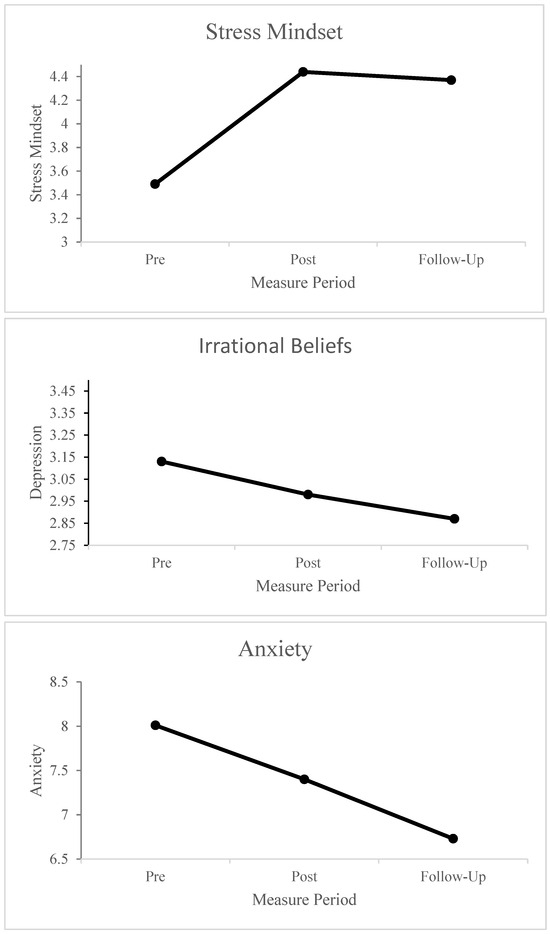
Descriptive statistics for each variable can be found in Table 2 and are depicted in graphical form in Figure 1. Results of the paired-sample t-test indicated there was a significant increase in stress mindset at post-intervention compared to baseline, t(58) = 8.19, p < 0.001 (CI = −1.18 to −0.72). The effect size was large, with a Cohen’s d of 1.19. Next, a paired-samples t-test indicated that there were no significant differences in stress mindset between post-intervention and follow-up, t(36) = 0.817, p = 0.210 (CI = −0.15 to 0.36).
Table 2.
Participant results in Stress Mindset, Irrational Beliefs, Anxiety, Depression, Self-Compassion, and Perceived Performance.
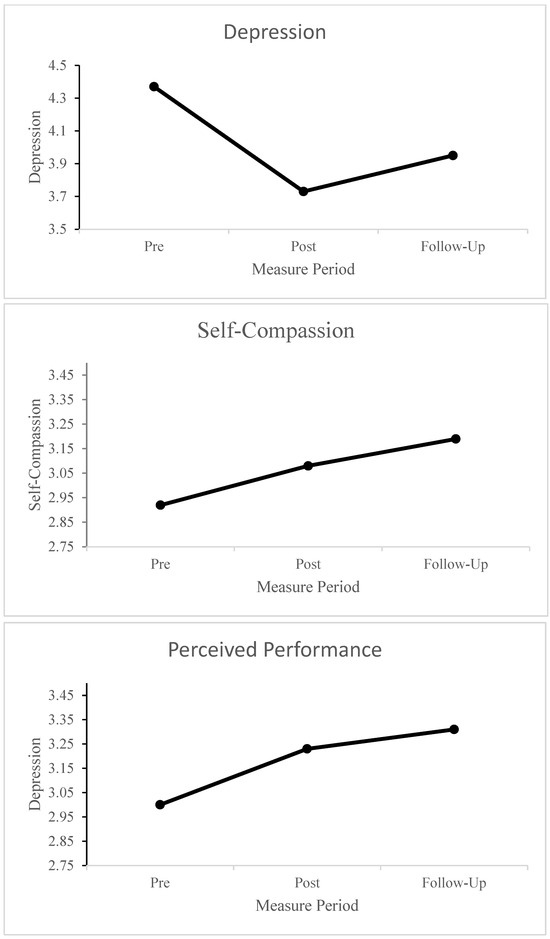
Figure 1.
Graphs to demonstrate results in Stress Mindset, Irrational Beliefs, Anxiety, Depression, Self-Compassion, and Perceived Performance.
3.3. Irrational Beliefs
Results of the paired-sample t-test indicated there was a significant decrease in irrational beliefs at post-intervention compared to baseline, t(59) = 1.99, p = 0.026 (CI = 0.00 to 0.30). The Cohen’s d of 0.28 indicated a small effect size. Next, a paired-samples t-test indicated a non-significant difference in irrational beliefs between post-intervention and follow-up, t(38) = 0.371, p = 0.356 (CI = −0.13 to 0.97).
3.4. Anxiety
Results of the paired-sample t-test indicated there was a significant decrease in anxiety at post-intervention compared to baseline, t(58) = 1.82, p = 0.037 (CI = −0.06 to 1.28). The Cohen’s d of 0.17 indicated a small effect size. Next, the results of the paired-samples t-test indicated a non-significant difference in anxiety between post-intervention and follow-up, t(36) = 0.050, p = 0.480 (CI = −1.06 to 1.12).
3.5. Depression
Results of the paired-sample t-test indicated there was a significant decrease in depression at post-intervention compared to baseline, t(58) = 1.87, p = 0.033 (CI = −1.05 to 1.33), with a Cohen’s d of 0.20 indicated a small effect size. Results of the paired-samples t-test indicated a non-significant difference in depression between post-intervention and follow-up, t(36) = 1.004, p = 0.161 (CI = −1.88 to 0.63).
3.6. Self-Compassion
Results of the paired-sample t-test indicated there was a significant increase in self-compassion at post-intervention compared to baseline, t(57) = 2.53, p = 0.007 (CI = −0.28 to −0.03). The Cohen’s d of 0.28 indicated a small effect size. Next, results of the paired-samples t-test indicated a non-significant difference in self-compassion between post-intervention and follow-up, t(36) = 0.758, p = 0.227 (CI = −0.26 to 0.12).
3.7. Perceived Performance
Results of the paired-sample t-test indicated there was a significant increase in perceived performance at post-intervention compared to baseline, t(55) = 2.50, p = 0.015 (CI = −0.43 to −0.02), with the Cohen’s d of 0.32 indicating a small effect size. Next, results of the paired-samples t-test indicated a non-significant difference in perceived performance between post-intervention and follow-up, t(37) = 1.273, p = 0.106 (CI = −0.42 to 0.97).
3.8. Social Validation
Participants completed five single-item measures at the end of the intervention to further understand their perceptions about the intervention in addition having the opportunity to respond qualitatively to three questions about their experiences of the intervention. Mean scores for wellbeing (4.90, SD = 1.04) and performance (4.70, SD = 1.13) suggest that the project was somewhat beneficial towards both areas. Participants were also asked to reflect on the duration of each session (M = 4.60, SD = 1.20) and the length of the intervention overall (M = 4.59, SD = 0.99), and results suggest that both were slightly too long. Overall, the consensus is that they would recommend the intervention to a friend (M = 5.12, SD = 1.50), and these findings support those of the manipulation checks in that participants were engaged in the intervention material.
Qualitative feedback from the participants at all four centres was mainly of a positive nature. For example, a rugby player offered the following response to what he enjoyed about the intervention: “It reframes stress and allows me to come across setbacks in a positive manner”. This was supported by a footballer who reported what he enjoyed: “Learning that stress isn’t bad, and the intervention is a break from football to think about how I feel and to learn new things about myself”. Demonstrating a willingness to participate in psychological skills training, another footballer stated that they enjoyed “Learning new things, talking, sharing ideas, seeing things in different ways, and not stressing so much”. One athlete commented that the intervention “can be long because we’re listening a lot”, and some of the athletes felt that taking part in the sessions was demanding on top of their physical training commitments. Conversely, another academy rugby player commented that “I really recommend the intervention, and I feel like I will be able to handle stress a lot more methodically after these six weeks”. Finally, multiple athletes said they were using imagery to as part of their pre-match preparation, with responses about what they are using from the intervention including “The use of imagery to see threats as challenges and the use of positive self-talk to assist mental rehearsal”.
Athletes were also questioned about which strategies they were using one month after the intervention, and the follow-up data suggested that imagery, control mapping, and the ABC thinking framework were helping to regulate their emotions and to see stress as facilitative. Overall, these qualitative remarks suggest that content about stress mindset was most impactful, and that imagery is a psychological skill that has the most applied use.
4. Discussion
The aims of the present study were to investigate whether a multimodal cognitive behavioural intervention could enhance stress mindset, self-compassion, and perceived performance, as well as reduce irrational beliefs, anxiety, and depression in academy athletes. A further aim of this study was to understand whether any changes at the end of the intervention would be remain at a one-month follow-up period. Although the majority of the effects were small, the hypotheses were supported in that the intervention would be effective in facilitating stress-related outcomes and that such changes would still be evident one month later. On a practical level, even changes of this nature on a modest level may be important in facilitating adaptive stress-related thoughts, feelings, and behaviours in athletes (Moore et al., 2018).
In support of the findings of Mansell et al. (2023), da Silva et al. (2025), and Sparks et al. (2025), results demonstrated that there was a significant increase in stress mindset at post-intervention compared to the baseline. These results add to the literature by suggesting that significant increases in stress mindset remain in athletes at a one-month follow-up period. Given the known associations between stress mindset and health-related outcomes, the maintenance of increases in stress mindset is an important finding, especially given the stressful environment of an elite academy (Sothern & O’Gorman, 2021). In support of our findings, Crum et al. (2023) reported that enhancements in stress mindset were still evident at an eight-month follow-up period in a sample of occupational workers. The authors suggested that changes were evident through a metacognitive approach, and in this intervention, coupling education about stress with the ABC thinking framework posited with REBT (Ellis & Dryden, 2007) may have encouraged athletes to introspectively examine their beliefs about stress beyond just receiving education about it. Perhaps such changes in stress mindset were also evident due to the way that the intervention positioned stress in terms of growth. Utilising a ‘stress piggy bank’ analogy, the researchers asked the athletes to reflect on stressful scenarios they had faced and what they had learned from them. During the discussions, it became clear that even when the athletes had not enjoyed the stressful situations, they still felt they had typically gained something from them. As such, the researchers encouraged athletes to view the learnings from stressful episodes as deposits in their ‘stress piggy bank’ to draw upon in future scenarios. Beliefs about stress in relation to learning and growth are an important domain-specific contributor to an individual’s stress mindset, and positioning stress in this way may have encouraged enhancements in athletes’ stress mindset.
Results supported the hypothesis that irrational beliefs would decrease as a result of the intervention, albeit with a small effect size, and such changes remained consistent at follow-up. These reductions in irrational beliefs support the work delivered at group level by Wood et al. (2018), and in the present study, education about the ABC thinking framework in session three may have chiefly been responsible for this. This is supported by the social validation data, and although we do not have the depth of insight as to why athletes found this to be useful, we posit that the ABC thinking framework simplifies the relationship between activating events, beliefs, and consequences. In addition, athletes were also shown examples of rational alternatives to irrational beliefs (i.e., regarding not being selected for an important game), and proposing that they had a choice in which statement they deemed more helpful could have also reduced irrational beliefs. These findings add to the literature by demonstrating that irrational beliefs may be reduced through the deployment of a combination of REBT-related strategies rather than focusing solely on irrational beliefs. Mean baseline scores suggested a moderate presence of irrational beliefs, and targeting individuals with high irrational beliefs may yield to greater reductions. Indeed, as with most of the other variables, adopting a 1-to-1 approach may yield greater effect sizes due a more personal and tailored approach rather than the group approach in this study. We also note that from the social validation results, findings suggest that some participants found the sessions to be demanding on top of their existing sports-related commitments. This may partially explain the small effect sizes. The sessions were often conducted in the evening or after training when athletes are somewhat fatigued, and where possible, delivering content in the mornings may provide an opportunity for this additional content to have a greater impact.
Significant increases in stress mindset and reductions in irrational beliefs may be associated with psychological wellbeing (Mansell, 2021), and through education about stress and the ABC thinking framework, we hypothesised that this would be accompanied by significant reductions in symptoms of anxiety and depression. Baseline mean scores indicated a mild presence of anxiety symptoms, and the results demonstrated that there were significant reductions of a small effect size in anxiety and depression at post-intervention, with the changes maintained one month later. These findings highlight the efficacy of REBT-informed interventions in reducing symptoms of anxiety and depression (e.g., Turner & Barker, 2013). Interestingly, anxiety scores continued to decrease (non-significantly) one month later, and perhaps the athletes benefitted from self-reflecting on their cognitions and the strategies that were included in the intervention. For example, reflecting on their more adaptive stress mindset or feeling more in control of their thoughts through utilising the ABC thinking framework may have alleviated anxiety symptoms such as fear and worry. However, it is difficult to say which part of the intervention may have been responsible for reductions in anxiety and depressive symptoms, and perhaps the combination of a variety of strategies within the multimodal approach was effective rather than a specific strategy (Watson et al., 2022). It should also be noted that depression began to increase at follow-up compared to post-intervention, although these changes were non-significant. Taken together, these findings suggest that Mindset: Performing Under Pressure (M:PUP) is a useful strategy for reducing symptoms of anxiety and depression in academy athletes, and such an evidence-based approach is important given the prevalence of poor mental health in this population (Purcell et al., 2023). Although the magnitude of change in anxiety and depression symptoms was small (0.17 and 0.20, respectively), such changes in mental health symptoms should be considered as noteworthy (Nixdorf et al., 2016).
Addressing limitations of previous research and in support of the hypothesis, results of the present study indicated significant increases in self-compassion from baseline to post-intervention of a small effect size, which were maintained one month later. This adds to the literature in demonstrating that self-compassion can be enhanced and sustained as part of a multimodal intervention underpinned by REBT (Mansell et al., 2023; da Silva et al., 2025). Perhaps the combination of education about the ABC thinking framework in session three followed by a focus on self-compassion in session four reinforced the principles of flexible thinking and self-kindness, and in turn, this may have also contributed to significant reductions in anxiety and depression symptoms. This would support the findings of Stephenson et al. (2018), who noted the mediational influence of self-compassion on the relationship between frustration intolerance and anxiety. The authors also suggest the relevance of self-compassion for inclusion in REBT-informed work in that it is an effective personal philosophy. In other words, it is a style of thinking that facilities the formation of effective new beliefs that offer an alternative to irrational beliefs. Developing self-compassion is important given the unavoidable instances of failure that athletes will experience during their careers. Indeed, in the present study, some athletes were awaiting decisions on whether their services would be retained for the next season, and enhancing skills posited within self-compassion such as self-kindness may be useful proactive strategies to navigate such circumstances.
In support of the hypothesis, perceived performance was significantly greater at post-intervention compared to baseline, with changes of a small effect size, and these changes remained at follow-up. These results offer support for the findings of Watson et al. (2022) who reported that satisfaction with performance improved and remained evident at a three-month follow-up period using a multimodal intervention with five national-level basketball players. Additionally, other previous interventions involving REBT have demonstrated increases in self-efficacy (Chrysidis et al., 2020) and performance (Wood et al., 2017, 2018). It may be that athletes experienced increases in self-efficacy through the challenge and threat content (Turner et al., 2013), and resultingly, this enhanced their perceptions of their current performance. This may have been further enhanced by the use of imagery, which has been known to enhance self-efficacy through targeting challenge appraisals (e.g., Hanton & Jones, 1999) and is a skill that was highlighted in the social validation responses as useful despite not all participants reporting being able to image well. Participants also rated their ease of imagery as relatively easy, and although this adds to the social validation data, it should be noted that this data was collected using a subjective single-item measure as a manipulation check. However, given the subjective nature of self-rated performance, future research may wish to triangulate these responses by collecting objective performance data and asking the coach to reflect on their players’ performance.
4.1. Strengths and Limitations
A strength of the study is the collection of data at three time-points, which allowed us to capture any immediate changes resulting from the intervention and also assess any maintenance in such changes one month after, thus addressing a gap in the athletic literature noted by Mansell et al. (2023). A limitation of the present study is the absence of a control group. Obtaining a control group can often be challenging in academy sports, but perhaps using a waitlist control group may be a more appealing option so that all athletes are able to benefit from the intervention eventually. In academy settings, circumstances can change quickly. A coach or member of staff can suddenly leave, or players may become inaccessible to researchers for several reasons including being released from the academy. Although longitudinal study designs are valuable in elite youth sports, the logistical challenges posed by the nature of such settings mean that this is not always possible. Accordingly, it may be possible that some of the changes in the constructs could be as a result of external factors or maturation. To understand more about the long-term effects of such an intervention, a semi-structured interview with athletes several months after the intervention could provide depth and apply insight into which strategies they are continuing to use and how.
From a contextual perspective, a consideration is the varied start date of the intervention between the cohorts. The intensity of stress may fluctuate during the season, and there is often more at stake for academy athletes towards the end of the season as, for example, decisions are made on contracts. Hence, those participants that began the intervention in February may have been experiencing greater stress than those who began in October, and therefore, the intervention may have been useful for the former. A standardised start date of the intervention across all centres could be adopted in future research to reduce the influence of external factors. Although all measures have been deployed in studies with older adolescents before, future research may wish to validate measures such as the SCMM (Keech et al., 2021b) for use with younger adolescents too. A further limitation is the gender imbalance, which includes no follow-up data from the girls’ academy cohort, and future research should aim to conduct similar research with girls within academy setups. Indeed, the attrition between the post-intervention and follow-up stages of approximately 33% of participants is also a limitation. Although there were no statistical differences in the mean scores, this means that due to a reduced sample size at the follow-up stage, caution is urged regarding the weight of these findings. In particular, losing the girls’ cohort from the follow-up stage means that our findings with respect to this stage lack generalisability to girls’ academy teams.
Future research should assess whether the adaptive stress-related outcomes in the present study remain after a longer period than one month. In academy sports where athletes may be deselected at short notice, researchers may wish to capture if such an intervention could be employed reactively to buffer the negative outcomes associated with challenges of this nature. Future research may also investigate conducting a similar intervention more holistically in academy sports by involving coaches, staff, and parents as a way of reinforcing the messages purported within the intervention (Maurice et al., 2021). Indeed, as many of the significant changes in the present study were of a small effect size, it may be possible that efforts on an environmental level within each club to imbed rational language and promote self-compassion may lead to greater adaptive outcomes for the athletes. As academy contexts may vary depending on the sport, future research could also examine whether such an intervention has a different impact in different sports. Finally, future research may also wish to compare differences between the age groups within an academy to understand whether an intervention like this is effective with particular stages of development in adolescence.
4.2. Applied Recommendations
Results demonstrate support for the use of M: PUP as a viable option for the delivery of psychoeducation in academy sports. Delivery at group-level can be an efficient and low-cost option for academies, and the intervention content may be adapted to suit examples from different sports. The data reveals that academy athletes enjoyed learning to reconsider stress, viewing setbacks as opportunities for growth, and appreciated the variety within the intervention as a refreshing break. To address the concern of players’ completing the sessions after training when they are physically tired, practitioners may wish to explore whether delivering the session before training or on a 1-to-1 level may be more enjoyable. Furthermore, practitioners may wish to vary the location of the sessions, such as conducting the session not only in classrooms at the club’s training ground but seeking permission to deliver the sessions at the club’s stadium or another off-site location, such as a university that a practitioner may be associated with. Adding variety through “walk and talk” tasks may also alleviate perceptions of the sessions being lengthy. Coaches could ensure they are using language that supports a ‘stress-is-enhancing’ mindset, such as positioning setbacks as an opportunity for learning and growth. To enhance self-compassion, academy staff could prompt athletes to treat themselves with the same kindness and understanding they would offer a friend. With reference to football, clubs could consider integrating specific elements of the intervention as part of the player’s Individual Development Plan (IDP), such as self-compassion. Within the performance setup in academies, football clubs provide players with an individual programme tailored to their age and current stage of development, highlighting their strengths and areas of improvement (Premier League, 2022). Through a clear framework, IDPs define career goals, self-evaluate skills, define objectives, and create personal action plans that set up a structured framework to reach targets. For example, an objective could be to practice imagery for one hour per week. By integrating psychological elements into a player’s IDP, athletes could maintain continuous learning and be exposed to psychological skills training with a holistic approach that allows progress to be tracked and monitored.
5. Conclusions
In summary, results from the present study suggest that, from baseline to post-intervention, a multimodal cognitive behavioural programme is effective in enhancing stress mindset, self-compassion, and perceived performance in academy athletes, whilst simultaneously reducing irrational beliefs, anxiety, and depression. Results add to the literature by suggesting that such changes are maintained at a one-month follow-up period, though future research should aim to reduce any attrition between post-intervention to follow-up so that conclusions may be drawn from a robust and consistent sample size. The magnitude of change was large in stress mindset and small in the other variables. Although practically meaningful and therefore important in the context of sport where even small changes in variables associated with wellbeing and performance can influence success and failure (Moore et al., 2018), such changes should not be overstated. This is the first known study that demonstrates the ability of an intervention to enhance and maintain stress mindset in athletes. The study offers support for the implementation of a multimodal approach to psychological skills training with young athletes, and that targeting trait beliefs (i.e., stress mindset and irrational beliefs) may be effective in altering stress-related outcomes such as performance and wellbeing.
Author Contributions
Conceptualization, P.M., K.S. and M.S.; methodology, P.M., K.S. and M.S.; formal analysis, P.M. and M.S.; investigation, P.M., K.C., J.B., J.W. and S.W.; writing, P.M., K.C., J.B., J.W., S.W., K.S. and M.S.; supervision, M.S.; project administration, P.M. All authors have read and agreed to the published version of the manuscript.
Funding
This research did not receive any specific grant from funding agencies in the public, commercial, or not-for-profit sectors.
Institutional Review Board Statement
The study was conducted in accordance with the Declaration of Helsinki, and approved by the Institutional Review Board (or Ethics Committee) of University of Staffordshire’s ethics board (SU-22-099 and date of approval is 1 March 2023).
Informed Consent Statement
Informed consent was obtained from all subjects involved in the study.
Data Availability Statement
Data is available upon request from the lead author.
Conflicts of Interest
No potential conflict of interest was reported by the author.
References
- Bailey, R. G., & Turner, M. J. (2023). The effects of a brief online rational-emotive-behavioral-therapy program on coach irrational beliefs and well-being. The Sport Psychologist, 1, 266–273. [Google Scholar] [CrossRef] [Scilit]
- Barry, A. E. (2005). How attrition impacts the internal and external validity of longitudinal research. Journal of School Health, 75, 267. [Google Scholar] [CrossRef]
- Berelson, B. (1952). Content analysis in communication research. Free Press. [Google Scholar]
- Blakelock, D., Chen, M., & Prescott, T. (2016). Psychological distress in elite adolescent soccer players following deselection. Journal of Clinical Sport Psychology, 10, 59–77. [Google Scholar] [CrossRef] [Scilit]
- Burton, D. (1990). Multimodal stress management in sport: Current status and future directions. In J. G. Jones, & L. Hardy (Eds.), Stress and performance in sport (pp. 171–201). John Wiley & Sons. [Google Scholar]
- Chrysidis, S., Turner, M. J., & Wood, A. G. (2020). The effects of REBT on irrational beliefs, self-determined motivation, and self-efficacy in American football. Journal of Sports Sciences, 38, 2215–2224. [Google Scholar] [CrossRef] [Scilit] [PubMed]
- Cormier, D. L., Kowalski, K. C., Ferguson, L. J., Mosewich, A. D., McHugh, T. L. F., & Röthlin, P. (2023). Self-compassion in sport: A scoping review. International Review of Sport and Exercise Psychology, 18, 154–193. [Google Scholar] [CrossRef] [Scilit]
- Crum, A. J., Salovey, P., & Achor, S. (2013). Rethinking stress: The role of mindsets in determining the stress response. Journal of Personality and Social Psychology, 104, 716–733. [Google Scholar] [CrossRef] [Scilit]
- Crum, A. J., Santoro, E., Handley-Miner, I., Smith, E. N., Evans, K., Moraveji, N., Achor, S., & Salovey, P. (2023). Evaluation of the “rethink stress” mindset intervention: A metacognitive approach to changing mindsets. Journal of Experimental Psychology: General, 152, 2603. [Google Scholar] [CrossRef] [Scilit]
- da Silva, S. M., Mansell, P., Fonseca, A., & Barker, J. (2025). Using a multimodal cognitive behavioral 1-2-1 intervention to target irrational beliefs, perceived performance, and stress mindset with elite youth football Players. The Sport Psychologist, 39, 280–288. [Google Scholar] [CrossRef] [Scilit]
- Deen, S., Turner, M. J., & Wong, R. S. (2017). The effects of REBT, and the use of credos, on irrational beliefs and resilience qualities in athletes. The Sport Psychologist, 31, 249–263. [Google Scholar] [CrossRef] [Scilit]
- Donachie, T. C., Mallinson-Howard, S. H., Hill, A. P., & Tamminen, K. A. (2025). Exploring how soccer players with perfectionism navigate challenges in talent pathways. Journal of Sport and Exercise Psychology, 47, 90–101. [Google Scholar] [CrossRef] [Scilit]
- Ellis, A., & Dryden, W. (2007). The practice of rational emotive behavior therapy. Springer Publishing Company. [Google Scholar]
- Gomes, A. R., Almeida, A., & Resende, R. (2020). Athletes’ perception of leadership according to their perceptions of goal achievement and sport results. Perceptual and Motor Skills, 127, 415–431. [Google Scholar] [CrossRef] [Scilit]
- Gouttebarge, V., Castaldelli-Maia, J. M., Gorczynski, P., Hainline, B., Hitchcock, M. E., Kerkhoffs, G. M., Rice, S. M., & Reardon, C. L. (2019). Occurrence of mental health symptoms and disorders in current and former elite athletes: A systematic review and meta-analysis. British Journal of Sports Medicine, 53, 700–706. [Google Scholar] [CrossRef] [Scilit]
- Gulliver, A., Griffiths, K. M., Mackinnon, A., Batterham, P. J., & Stanimirovic, R. (2015). The mental health of Australian elite athletes. Journal of Science and Medicine in Sport, 18, 255–261. [Google Scholar] [CrossRef] [Scilit]
- Hanton, S., & Jones, G. (1999). The effects of a multimodal intervention program on performers: II. Training the butterflies to fly in formation. The Sport Psychologist, 13, 22–41. [Google Scholar] [CrossRef] [Scilit]
- James, I. A., Medea, B., Harding, M., Glover, D., & Carraça, B. (2022). The use of self-compassion techniques in elite footballers: Mistakes as opportunities to learn. The Cognitive Behaviour Therapist, 15, 43. [Google Scholar] [CrossRef] [Scilit]
- Jenkins, A., Weeks, M. S., & Hard, B. M. (2021). General and specific stress mindsets: Links with college student health and academic performance. PLoS ONE, 16, e0256351. [Google Scholar] [CrossRef] [Scilit] [PubMed]
- Jordana, A., Ramis, Y., Chamorro, J. L., Pons, J., Borrueco, M., De Brandt, K., & Torregrossa, M. (2023). Ready for failure? Irrational beliefs, perfectionism and mental health in male soccer academy players. Journal of Rational-Emotive and Cognitive-Behavior Therapy, 41, 454–477. [Google Scholar] [CrossRef] [Scilit]
- Keech, J. J., Hagger, M. S., & Hamilton, K. (2021a). Changing stress mindsets with a novel imagery intervention: A randomized controlled trial. Emotion, 21, 123. [Google Scholar] [CrossRef] [Scilit]
- Keech, J. J., Hagger, M. S., O’Callaghan, F. V., & Hamilton, K. (2018). The influence of university students’ stress mindsets on health and performance outcomes. Annals of Behavioral Medicine, 52, 1046–1059. [Google Scholar] [CrossRef] [Scilit]
- Keech, J. J., Orbell, S., Hagger, M. S., O’Callaghan, F. V., & Hamilton, K. (2021b). Psychometric properties of the stress control mindset measure in university students from Australia and the UK. Brain and Behavior, 11, e01963. [Google Scholar] [CrossRef] [Scilit]
- Kim, J., & Tamminen, K. A. (2023). Emotion regulation among competitive youth athletes: Exploring the independent and interactive effects of cognitive reappraisal and expressive suppression. International Journal of Sport and Exercise Psychology, 21, 534–556. [Google Scholar] [CrossRef] [Scilit]
- Kola-Palmer, S., Lewis, K., Rodriguez, A., & Kola-Palmer, D. (2020). Help-seeking for mental health issues in professional rugby league players. Frontiers in Psychology, 11, 570690. [Google Scholar] [CrossRef] [Scilit] [PubMed]
- Kuchar, A. L., Neff, K. D., & Mosewich, A. D. (2023). Resilience and Enhancement in Sport, Exercise, & Training (RESET): A brief self-compassion intervention with NCAA student-athletes. Psychology of Sport and Exercise, 67, 102426. [Google Scholar] [CrossRef] [Scilit]
- Lang, P. J. (1979). A bio-informational theory of emotional imagery. Psychophysiology, 16, 495–512. [Google Scholar] [CrossRef] [Scilit]
- Lazarus, R. S. (2000). How emotions influence performance in competitive sports. The Sport Psychologist, 14, 229–252. [Google Scholar] [CrossRef] [Scilit]
- Lazarus, R. S., & Folkman, S. (1984). Transactional theory and research on emotions and coping. European Journal of Personality, 1, 141–169. [Google Scholar] [CrossRef] [Scilit]
- Mansell, P. C. (2021). Stress mindset in athletes: Investigating the relationships between beliefs, challenge and threat with psychological wellbeing. Psychology of Sport and Exercise, 57, 102020. [Google Scholar] [CrossRef] [Scilit]
- Mansell, P. C., Sparks, K., Wright, J., Roe, L., Carrington, S., Lock, J., & Slater, M. (2023). “Mindset: Performing under pressure”—A multimodal cognitive-behavioural intervention to enhance the well-being and performance of young athletes. Journal of Applied Sport Psychology, 36, 623–642. [Google Scholar] [CrossRef] [Scilit]
- Mansell, P. C., & Turner, M. J. (2023). The mediating role of proactive coping in the relationships between stress mindset, challenge appraisal tendencies, and psychological wellbeing. Frontiers in Psychology, 14, 1140790. [Google Scholar] [CrossRef] [Scilit]
- Maurice, J., Devonport, T. J., & Knight, C. J. (2021). Toward improved triadic functioning: Exploring the interactions and adaptations of coaches, parents and athletes in professional academy soccer through the adversity of COVID-19. Frontiers in Psychology, 12, 609631. [Google Scholar] [CrossRef] [Scilit] [PubMed]
- Maynard, I. W., Hemmings, B., Greenlees, I. A., Warwick-Evans, L., & Stanton, N. (1998). Stress management in sport: A comparison of unimodal and multimodal interventions. Anxiety, Stress, & Coping, 11, 225–246. [Google Scholar] [CrossRef] [Scilit]
- Meijen, C., Turner, M., Jones, M. V., Sheffield, D., & McCarthy, P. (2020). A theory of challenge and threat states in athletes: A revised conceptualization. Frontiers in Psychology, 11, 126. [Google Scholar] [CrossRef] [Scilit] [PubMed]
- Mertens, N., Boen, F., Steffens, N. K., Haslam, S. A., Bruner, M., Barker, J. B., Slater, M. J., & Fransen, K. (2021). Harnessing the power of ‘us’: A randomized wait-list controlled trial of the 5R shared leadership development program (5RS) in basketball teams. Psychology of Sport and Exercise, 54, 101936. [Google Scholar] [CrossRef] [Scilit]
- Mishra, P., Singh, U., Pandey, C. M., Mishra, P., & Pandey, G. (2019). Application of student’s t-test, analysis of variance, and covariance. Annals of Cardiac Anaesthesia, 22, 407–411. [Google Scholar] [CrossRef] [Scilit]
- Moore, L. J., Young, T., Freeman, P., & Sarkar, M. (2018). Adverse life events, cardiovascular responses, and sports performance under pressure. Scandinavian Journal of Medicine & Science in Sports, 28, 340–347. [Google Scholar] [CrossRef] [Scilit]
- Mosewich, A. D., Kowalski, K. C., Sabiston, C. M., Sedgwick, W. A., & Tracy, J. L. (2011). Self-compassion: A potential resource for young women athletes. Journal of Sport and Exercise Psychology, 33, 103–123. [Google Scholar] [CrossRef] [Scilit]
- Munnik, J. B., Turner, M. J., & van Niekerk, R. L. (2023). Recommendations for integrating Psychological Skills Training (PST) into Rational Emotive Behavioral Therapy (REBT). Journal of Sport Psychology in Action, 15, 235–246. [Google Scholar] [CrossRef] [Scilit]
- Neff, K. (2003). Self-compassion: An alternative conceptualization of a healthy attitude toward oneself. Self and Identity, 2, 85–101. [Google Scholar] [CrossRef] [Scilit]
- Nixdorf, I., Frank, R., & Beckmann, J. (2016). Comparison of athletes’ proneness to depressive symptoms in individual and team sports: Research on psychological mediators in junior elite athletes. Frontiers in Psychology, 7, 893. [Google Scholar] [CrossRef] [Scilit]
- Nogueira, D., Fontes, L., Gomes, A. R., & Resende, R. (2022). Referees’ emotions and performance perception: The importance of stress and cognitive appraisal. Cuadernos de Psicología del Deporte, 22, 156–170. [Google Scholar] [CrossRef] [Scilit]
- Pain, M. A., & Harwood, C. G. (2004). Knowledge and perceptions of sport psychology within English soccer. Journal of Sports Sciences, 22, 813–826. [Google Scholar] [CrossRef] [Scilit]
- Premier League. (2011). Elite player performance plan-goal reports. Available online: https://www.goalreports.com/EPLPlan.pdf (accessed on 24 July 2025).
- Premier League. (2022). The elite player performance plan. Available online: https://resources.premierleague.com/premierleague/document/2022/11/17/5c3d5e72-567e-4886-80ab-9a2e68857b8b/Premier-League-Elite-Player-Performance-Plan-Report-2022.pdf (accessed on 1 July 2024).
- Purcell, R., Walton, C. C., Currie, A., & Rice, S. (2023). Young athletes’ mental health and well-being. In I. Nixdorf, R. Nixdorf, J. Beckmann, S. Martin, & T. Macintyre (Eds.), Routledge handbook of mental health in elite sport (pp. 389–405). Routledge. [Google Scholar]
- Raes, F., Pommier, E., Neff, K. D., & Van Gucht, D. (2011). Construction and factorial validation of a short form of the self-compassion scale. Clinical Psychology & Psychotherapy, 18, 250–255. [Google Scholar] [CrossRef] [Scilit]
- Reeves, C. W., Nicholls, A. R., & McKenna, J. (2009). Stressors and coping strategies among early and middle adolescent premier league academy soccer players: Differences according to age. Journal of Applied Sport Psychology, 21, 31–48. [Google Scholar] [CrossRef] [Scilit]
- Rice, S. M., Purcell, R., De Silva, S., Mawren, D., McGorry, P. D., & Parker, A. G. (2016). The mental health of elite athletes: A narrative systematic review. Sports Medicine, 46, 1333–1353. [Google Scholar] [CrossRef] [Scilit]
- Sothern, N. A., & O’Gorman, J. (2021). Exploring the mental health and wellbeing of professional academy footballers in England. Soccer and Society, 22, 641–654. [Google Scholar] [CrossRef] [Scilit]
- Sparks, K. V., Mansell, P., Wright, J., & Slater, M. (2025). The influence of a multimodal cognitive behavioural intervention on the stress mindset, psychological wellbeing, and performance of students aged 16–18 facing exams. Stress and Health, 41, e70075. [Google Scholar] [CrossRef] [Scilit]
- Stephenson, E., Watson, P. J., Chen, Z. J., & Morris, R. J. (2018). Self-compassion, self-esteem, and irrational beliefs. Current Psychology, 37, 809–815. [Google Scholar] [CrossRef] [Scilit]
- Thrower, S. N., Barker, J. B., Bruton, A. M., Coffee, P., Cumming, J., Harwood, C. G., Howells, K., Knight, C. J., McCarthy, P. J., & Mellalieu, S. D. (2024). Enhancing wellbeing, long-term development, and performance in youth sport: Insights from experienced applied sport psychologists working with young athletes in the United Kingdom. Journal of Applied Sport Psychology, 36, 519–541. [Google Scholar] [CrossRef]
- Turner, M. J. (2022). The rational practitioner: The sport and performance psychologist’s guide to practicing rational emotive behaviour therapy. Taylor & Francis. [Google Scholar]
- Turner, M. J., Allen, M. S., Slater, M. J., Barker, J. B., Woodcock, C., Harwood, C. G., & McFayden, K. (2018). The development and initial validation of the Irrational Performance Beliefs Inventory (iPBI). European Journal of Psychological Assessment, 34, 3. [Google Scholar] [CrossRef] [Scilit]
- Turner, M. J., & Barker, J. B. (2013). Examining the efficacy of Rational Emotive Behavior Therapy (REBT) on irrational beliefs and anxiety in elite youth cricketers. Journal of Applied Sport Psychology, 25, 131–147. [Google Scholar] [CrossRef] [Scilit]
- Turner, M. J., Jones, M. V., Sheffield, D., Slater, M. J., Barker, J. B., & Bell, J. J. (2013). Who thrives under pressure? Predict-ing the performance of elite academy cricketers using the cardiovascular indicators of challenge and threat states. Journal of Sport and Exercise Psychology, 35(4), 387–397. [Google Scholar] [CrossRef] [Scilit] [PubMed]
- Turner, M. J., Miller, A., Youngs, H., Barber, N., Brick, N. E., Chadha, N. J., Chandler, C., Coyle, M., Didymus, F. F., Evans, A. L., & Jones, K. (2022). “I must do this!”: A latent profile analysis approach to understanding the role of irrational beliefs and motivation regulation in mental and physical health. Journal of Sports Sciences, 40, 934–949. [Google Scholar] [CrossRef] [Scilit] [PubMed]
- Turner, M. J., Slater, M. J., & Barker, J. B. (2014). Not the end of the world: The effects of rational-emotive behavior therapy (REBT) on irrational beliefs in elite soccer academy athletes. Journal of Applied Sport Psychology, 26, 144–156. [Google Scholar] [CrossRef] [Scilit]
- Turner, M. J., Wood, A. G., Boatwright, D., Chadha, N., Jones, J. K., & Bennett, R. (2021). Assessing beliefs about emotion generation and change: The conceptualisation, development, and validation of the Cognitive Mediation Beliefs Questionnaire (CMBQ). Psychotherapy Research: Journal of the Society for Psychotherapy Research, 31, 932–949. [Google Scholar] [CrossRef] [Scilit]
- Watson, D. R., Hill, A. P., & Madigan, D. J. (2022). Psychological skills training and perfectionism: A single-subject multiple baseline study. Journal of Applied Sport Psychology, 35, 854–873. [Google Scholar] [CrossRef] [Scilit]
- White, A., & Hardy, L. (1998). An in-depth analysis of the uses of imagery by high-level slalom canoeists and artistic gymnasts. The Sport Psychologist, 12, 387–403. [Google Scholar] [CrossRef] [Scilit]
- Wilkinson, R. J. (2021). A literature review exploring the mental health issues in academy football players following career termination due to deselection or injury and how counselling could support future players. Counselling and Psychotherapy Research, 21(4), 859–868. [Google Scholar] [CrossRef] [Scilit]
- Wood, A. G., Barker, J. B., & Turner, M. J. (2017). Developing performance using Rational Emotive Behavior Therapy (REBT): A case study with an elite archer. The Sport Psychologist, 31, 78–87. [Google Scholar] [CrossRef] [Scilit]
- Wood, A. G., Barker, J. B., Turner, M. J., & Sheffield, D. (2018). Examining the effects of rational emotive behavior therapy on performance outcomes in elite paralympic athletes. Scandinavian Journal of Medicine & Science in Sports, 28, 329–339. [Google Scholar] [CrossRef] [Scilit]
- Zigmond, A. S., & Snaith, R. P. (1983). The hospital anxiety and depression scale. Acta Psychiatrica Scandinavica, 67, 361–370. [Google Scholar] [CrossRef] [Scilit] [PubMed]

Disclaimer/Publisher’s Note: The statements, opinions and data contained in all publications are solely those of the individual author(s) and contributor(s) and not of MDPI and/or the editor(s). MDPI and/or the editor(s) disclaim responsibility for any injury to people or property resulting from any ideas, methods, instructions or products referred to in the content. |
© 2026 by the authors. Licensee MDPI, Basel, Switzerland. This article is an open access article distributed under the terms and conditions of the Creative Commons Attribution (CC BY) license.