


Abstract
Emotion regulation refers to the processes through which people modulate their emotional experiences and expressions, and difficulties in these processes underpin many forms of psychopathology. According to the process model, emotion regulation encompasses five classes of strategies, commonly grouped into antecedent-focused strategies (e.g., cognitive reappraisal) and response-focused strategies (e.g., expressive suppression). These strategies involve both explicit and implicit processes, which can be objectively assessed using physiological indices. The present study examined the effects of startle habituation and vagally mediated heart rate variability (vmHRV) on the use of cognitive appraisal and suppression. Forty-nine college-aged participants were recruited, and their resting heart rate variability (HRV) and response habituation to an auditory startle-eliciting stimulus were measured. Emotion regulation strategies were assessed by a self-report questionnaire. Multiple regressions were used to analyze the effects of startle habituation, vmHRV, and their interaction on emotion regulation strategies. Results indicated that, although suppression was not associated with any physiological indices in the regression models, cognitive reappraisal was predicted by both vmHRV and startle habituation. Notably, vmHRV and startle habituation interacted such that the positive association between vmHRV and cognitive reappraisal emerged only among individuals who exhibited slow startle habituation. These findings have practical implications for the prevention and treatment of psychopathology, as well as for promoting more adaptive emotion regulation in daily life.
1. Introduction
Emotion regulation refers to the ability and process that people use to recognize, understand, and modulate their emotions (Gross, 2015; Koole, 2009). Emotion dysregulation is implicated in various forms of psychopathology. For example, deficient self-regulatory processes and emotion dysregulation were heightened among children at familiar risk for depression (Daches et al., 2025; Kovacs et al., 2008). Individuals with generalized anxiety disorder experience more difficulties in downregulating their negative emotional reactions (Mennin et al., 2009). Emotion dysregulation also increases risk for posttraumatic stress disorder (PTSD; Pencea et al., 2020). Therefore, behavioral, physiological, and clinical facets of emotion regulation have received extensive research attention (for reviews, see Beauchaine, 2015; Beauchaine & Cicchetti, 2019; Sheppes et al., 2015). Moreover, the study of emotion regulation has wide applications in many other areas. Effective emotion regulation can enhance educational outcomes by using real-time facial expression recognition to tailor instruction and support learners’ engagement and self-regulation during collaborative tasks (De Neve et al., 2023; H. Wang et al., 2023). Particularly, artificial intelligence tools that detect students’ facial expressions can help educators adjust teaching methods and promote effective socially shared regulation of learning in online and face-to-face settings, linking moment-to-moment emotion cues with regulation strategies and group dynamics (Shi, 2025; Veltmeijer et al., 2021). In addition, research on emotion regulation also informs workplace and human–computer interaction research, where understanding emotional cues supports adaptive technologies and teamwork, and can be integrated with emotion regulation models to optimize communication and performance in diverse real-world contexts (Hajric et al., 2024; Henkel et al., 2020).
The ability to regulate emotions relies on a range of cognitive functions, encompassing both explicit and implicit processes (Braunstein et al., 2017). Several theoretical frameworks have been proposed to explain how cognitive and affective processes interact in emotion regulation. R. A. Thompson (1994) emphasized that emotion regulation skills are learned and refined throughout development. The component process model (Scherer, 2009) proposes that emotions consist of coordinated cognitive, physiological, and motivational components, and that regulation emerges from their dynamic interplay. In addition, models such as the emotion regulation flexibility framework (Bonanno & Burton, 2013) and the emotion regulation choice model (Sheppes et al., 2015) highlight how individuals select and deploy specific regulation strategies.
Among the theoretical frameworks of emotion regulation, the process model of emotion regulation (Gross, 1998) is particularly influential and proposes a set of emotion regulation strategies that can be used in different contexts. Specifically, emotion regulation involves five types of processes, including situation selection, situation modification, attentional deployment, cognitive change, and response modulation (Gross, 1998; Gross & Thompson, 2007). Those processes can be categorized into antecedent-focused (e.g., cognitive reappraisal) and response-focused strategies (e.g., expressive suppression; Gross, 1998; Gross & John, 2003). The physiological and behavioral outcomes of the habitual use of two types of emotion regulation strategies are different. In general, cognitive reappraisal requires higher levels of top-down cognitive resources but is linked to great well-being and considered as the more adaptive strategy, while suppression reduces memory load and does not alter subjective feelings and is often associated with poorer outcomes in various populations (Cai et al., 2024; Gross & John, 2003; Ochsner & Gross, 2005).
While Gross’s (1998) process model is supported by empirical evidence and has informed interventions for psychological disorders, a critical research gap in research on emotion regulation strategies is the lack of objective measures of emotion regulation, especially implicit regulation. To address this issue, physiological measures may reveal important aspects of emotion regulation that are important to maintain mental health (Patrick & Hajcak, 2016). Habituation of physiological responses provides a window of implicit cognitive underpinnings of emotion regulation. Habituation is gradual response reduction to a repeated stimulus over time (Gandhi et al., 2021; Groves & Thompson, 1970; Rankin et al., 2009; Rho et al., 2024). Of note, the startle response disengages an organism from ongoing activities and facilitates the fight-or-flight response to a sudden, intense stimulus (Graham, 1992), and startle habituation is an adaptive response pattern to unthreatening stimuli (Gorka et al., 2013). In human research, startle magnitude is usually quantified by the strength of the eyeblink reflex by measuring electromyographic activity of the orbicularis oculi muscle (Filion et al., 1998). Compared to healthy individuals, those with panic disorder and PTSD exhibited less habituation of the startle response (Ludewig et al., 2002; Rothbaum et al., 2001). These psychological disorders are also associated with maladaptive emotion regulation (Oussi & Bouvet, 2023; Shepherd & Wild, 2014; Yang et al., 2021).
Like startle habituation, heart rate variability (HRV), especially vagally mediated HRV (vmHRV), is also associated with emotion regulation. While startle habituation is linked to implicit and automatic physiological processes underlying emotion regulation, vmHRV has been thought to index top-down control processes (Thayer et al., 2012; Thayer & Lane, 2009). VmHRV is derived from the lengths of inter-beat intervals of electrocardiography data and reflects cardiac vagal control (Laborde et al., 2018; Thayer & Lane, 2009). Evidence indicates that high resting vmHRV supports adaptive physiological flexibility and psychological well-being (Thayer et al., 2012; Yang et al., 2021, 2025), whereas diminished vmHRV characterizes a wide range of psychiatric disorders (Friedman & Thayer, 1998; Kemp et al., 2010; Montaquila et al., 2015; Seidman et al., 2023, 2024; Yang et al., 2020). These converging findings suggest that basal vmHRV may serve as a transdiagnostic indicator of vulnerability to psychopathology (Beauchaine & Thayer, 2015). Interestingly, vmHRV has been studied in relation to the startle response and its habituation. Yang and Friedman (2017) found that vmHRV modulated the association between startle eyeblink magnitude and affective contexts. Further, low resting vmHRV has been linked to increased startle magnitude (Melzig et al., 2009), greater startle responses to fearful stimuli (Pappens et al., 2014), and diminished startle habituation (Gorka et al., 2013; Yang & He, 2022). However, most studies focused on affective disorders, and how vmHRV and startle habituation influence emotion regulation among healthy populations has not been well studied.
Current Study
To address the research gaps about implicit processes of emotion regulation, the current study focused on the effects of startle habituation and vmHRV on emotion regulation strategies based on the process model (Gross, 1998). Individual differences in the habitual use of cognitive reappraisal and suppression would be assessed by the Emotion Regulation Questionnaire (ERQ; Gross & John, 2003). Startle habituation was evaluated by the magnitude of the eyeblink response to repeatedly presented auditory startle stimuli, and vmHRV was measured at a resting state as an indicator of top-down control. Startle habituation and vmHRV would indicate trait-level unconscious affective responding and cognitive control of emotions, respectively.
In sum, the above-mentioned literature suggest that the habitual use of suppression may not be an adaptive emotion regulation strategy and involve faster habituation of affective responses but lower levels of cognitive control, whereas cognitive reappraisal results from more cognitive control over affective processes and may not relate to emotional responding. Therefore, we hypothesized that (1) faster startle habituation and lower vmHRV would be associated with higher levels of suppression; (2) greater vmHRV would be associated with higher levels of cognitive reappraisal; and (3) startle habituation would interact with vmHRV to influence cognitive appraisal.
2. Method
2.1. Participants
Forty-nine college-aged participants (Mage = 18.96 years; SD = 0.96 years; 34 female and 15 male) were recruited from undergraduate psychology courses. Participants were screened for histories of neurologic and psychiatric illness, drug abuse, and psychotropic medication. Moreover, all participants were non-smokers and were free of auditory and visual problems. Participants were required to abstain from alcohol for at least 12 h and from caffeine for at least six hours prior to participation. Participants received course credit for their participation. Approval for the study was obtained from the local Institutional Review Board, and all participants provided informed consent before participation.
2.2. Materials and Stimulus
Individual differences in emotion regulation were assessed using the Emotion Regulation Questionnaire (ERQ; Gross & John, 2003). The ERQ consists of four items that measure the emotion regulation strategy of suppression, and six items that measure the strategy of cognitive reappraisal, which showed acceptable and good reliability with a Cronbach’s alpha of 0.65 and 0.85, respectively, in the present study.
The startle-eliciting stimulus was a burst of 75 dB (A) broadband noise (20 Hz to 20,000 Hz) with a 50 ms duration and approximately instantaneous (<1 ms) rise and fall time. The auditory SR stimulus was generated by Audacity 2.0.2 software for Windows and was presented binaurally through a pair of matched headphones. There was a total of 12 auditory startle probes. Each startle probe was followed by a variable inter-trial interval, ranging from 10 to 20 s. The instruction and visual fixation were presented using the E-prime 3.0 software (Psychology Software Tools, Pittsburgh, PA, USA) on a 58 cm wide diagonal computer screen located 0.5 m in front of the participant.
2.3. Procedure
The experimental protocol included a series of tasks relevant to cognition and stress reactivity. In the present article, we report physiological data obtained during a neutral film (resting baseline) and startle habituation trials. After informed consent was obtained, participants completed a series of self-report scales and questionnaires, including the ERQ. Then, they were comfortably seated in the laboratory while physiological recording sensors were attached. To estimate resting vmHRV, participants were instructed to sit still and watch a 5 min neutral film that depicted aquatic scenes, consistent with the “vanilla baseline” guidelines (Jennings et al., 1992). Afterwards, participants were told that a sound would be presented through the headphones several times, and to look at the cross (visual fixation) in the middle of the computer screen. The experimental protocol was followed by a 2 min recovery period, after which participants were thanked and debriefed
2.4. Physiological Recording and Data Reduction
Physiological data were collected using a BIOPAC MP160 system (BIOPAC Systems Inc, Goleta, CA, USA). Raw signals were digitized at 1000 Hz (16-bit) and analyzed with BIOPAC AcqKnowledge software 5.0 (BIOPAC Systems Inc., Goleta, CA, USA). Electrocardiography (ECG) was measured with disposable, pre-gelled stress-testing spot electrodes using a modified Lead II configuration (ConMed Andover Medical, Haverhill, MA, USA). ECG R-spikes were labeled using the AcqKnowledge software and were then inspected manually by trained raters. When a missing or ectopic heartbeat occurred between two normal beats, the midpoint was interpolated to correct the artifact. Artifacts were considered as uncorrectable when two or more ectopic beats occurred successively. The exclusion criterion for ECG data processing was that 5% or more of a subject’s signals were influenced by correctable or uncorrectable artifacts during the resting baseline. These criteria were based on the guidelines of HRV assessments (Berntson et al., 1997; Quigley et al., 2024) and have been used in our previous studies (Yang & Friedman, 2017; Yang et al., 2021, 2025). However, no participant met the exclusion criterion. HRV was calculated by Kubios HRV analysis software v2.0 (Biosignal Analysis and Medical Imaging Group, Kuopio, Finland), high-frequency (0.15–0.4 Hz) HRV (HF-HRV) fast Fourier spectral power of the series of R-R intervals, which represents a frequency-domain metric of cardiac vagal control (Berntson et al., 1997). The distribution of HF-HRV values (skewness = 4.07; kurtosis = 20.78) was skewed and therefore normalized with a logarithm to the base 10. The quantification for vmHRV was followed the published guidelines (Berntson et al., 1997; Laborde et al., 2017; Quigley et al., 2024; Task Force, 1996). Additionally, respiration was measured with a respiration transducer placed at the thoracic level. Respiration data were acquired to examine gross respiratory artifacts in HRV data.
The startle response was assessed as the magnitude of eyeblinks measured by facial electromyography (EMG), which was collected with disposable 4 mm Ag/AgCl electrodes filled with electrolyte gel (BIOPAC Systems Inc., Goleta, CA, USA). The EMG electrodes were placed at the margin of the bony orbit, centered under the participant’s left eye, about 1 cm lateral to the other; electrode impedances were kept below 10 kΩ. EMG signals were digitally bandpass filtered at 28 to 500 Hz. EMG data were rectified with a time constant of 10 ms and then smoothed using a variable-weight finite impulse responses filter (101 coefficients, low-pass cutoff frequency = 40 Hz). In each trial, the baseline EMG value was defined as the mean value of EMG in the 30 ms preceding the onset of the SR stimulus; the peak EMG value was defined as the maximum value of EMG in a time window from 20 to 150 ms after SR stimulus onset. SR magnitude was calculated as the difference between the peak value and baseline EMG value of the trial (Blumenthal et al., 2005). Due to excessive baseline EMG activity or movement artifacts, 1.2% of all trials of participants were excluded from analyses.
2.5. Analytic Approach
Based on the habituation function (R. F. Thompson & Spencer, 1966), startle habituation was evaluated using regressions that were performed on the SR startle data of each participant (LaRowe et al., 2006; Orr et al., 2000). Below is the regression equation:
Y = a + b ∗ X
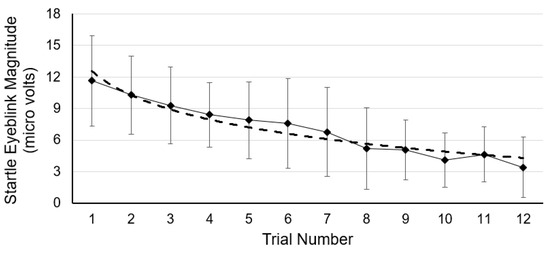
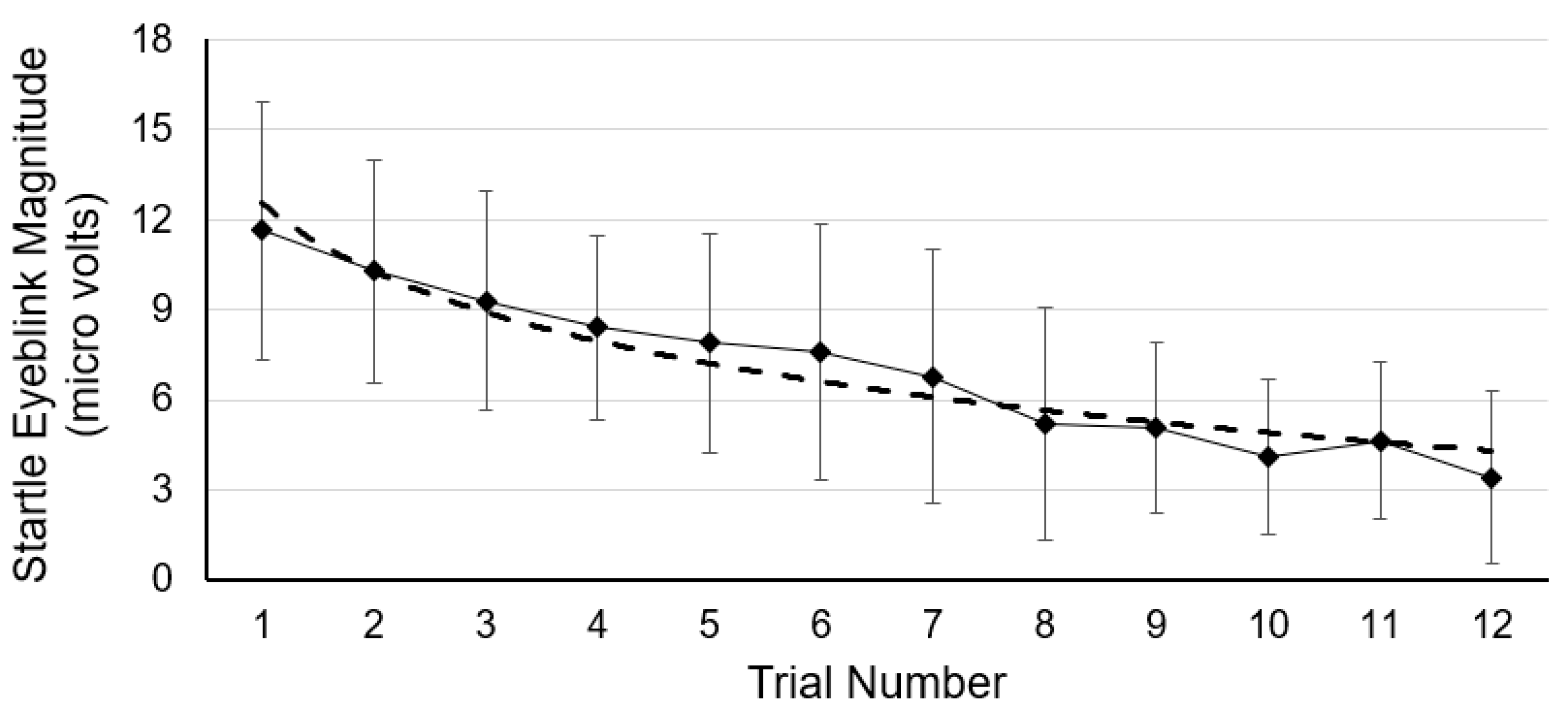
In Equation (1), Y represents the square root of the raw magnitude of a given SR trial, which reduces variability, skewness, and heteroscedacity among extremely high scores (Shalev et al., 1992); X represents the log-transformed number of a SR trial, which reflects the exponential component of the habituation function (R. F. Thompson & Spencer, 1966). The intercept, a, represents the level of initial SR reactivity, while the slope, b, represents the rate of SR habituation for a given participant and was the variable of interest. Slopes (i.e., habituation scores) are negative, which resembles the decrease in SR magnitude over time. That is, for a given participant, the magnitudes of the twelve SR trials were regressed on the variable, “lg(Trial Number).” The trial numbers were from 1 to 12, and the linear relationship between lg(Trial Number) and SR magnitude would be equivalent to an exponential function (see Figure 1). High values of habituation scores indicate slower habituation, while low habituation scores (more negative values) indicate more rapid habituation.
Figure 1.
Startle habituation pattern. The dash line indicates the habituation function (R. F. Thompson & Spencer, 1966) that was fitted to the data of startle eyeblink; error bars indicate ±1 standard error.
Statistical analyses were conducted using R 4.3.1 software packages. Relations between variables were assessed by Person correlations. To investigate whether startle habituation and cardiac vagal control predict emotion regulation scores, the effects of habituation score, vmHRV, and their interaction on ERQ suppression and reappraisal scores were estimated by separate multiple regression models:
Suppression score = β0 + β1 Habituation + β2 vmHRV + β3 Habituation ∗ vmHRV
Reappraisal score = β0 + β1 Habituation + β2 vmHRV + β3 Habituation ∗ vmHRV
In the models (Equations (2) and (3)), Suppression and Reappraisal scores are the scores of ERQ suppression and cognitive reappraisal subscales; Habituation represents the habituation score derived from the habituation function (i.e., the slope, b, in Equation (1)); and vmHRV was derived from ECG data, as described in earlier sections. In each model, the coefficient β1 and β2 represented the relationship of ERQ scores and habituation and vmHRV, respectively; and β3 indicated that the interaction between habituation and vmHRV on ERQ scores. The analyses were controlled for gender, which was not shown in the equations for the sake of simplicity. Simple slope analysis was conducted to probe the significant interaction between vmHRV and ERQ. In addition, RMSSD was entered into the regression models, as a substitute vmHRV measure, to check the validity of HF-HRV in indexing vmHRV. Statistical significance was tested with an alpha of 0.05, and the independent variables in the regression models were estimated with R2.
3. Results
3.1. Descriptive Statistics
For the full sample (N = 49), mean body mass index (BMI) was 24.46 (SD = 4.08); mean heart rate (HR) was 75.03 (SD = 12.71) beats per minute (BPM); the average root mean square of successive differences (RMSSD) was 47.41 (SD = 29.90) ms; and the average HF-HRV was 2.82 (SD = 0.48) log ms2, and the average peak frequency for the HF band was 0.23 Hz (SD = 0.03 Hz). Moreover, mean respiratory frequency was 0.22 Hz (SD = 0.04 Hz), which was consistent with the HF band (0.15–0.4 Hz) and the peak frequency. The distribution of all variables being entered into the regression models were normally distributed (skewness ranged between −0.85 to 0.28; kurtosis ranged between −0.54 to 0.98). The average magnitude of the twelve trials across all participants was 8.23 micro volts. The pattern of startle habituation was shown in Figure 1. Mean slope (habituation score) and intercept that were derived from the habituation function (Equation (1)) were −6.34 (SD = 3.10) and 11.60 (SD = 4.99), respectively.
Regarding self-report measures, mean score of suppression subscale of ERQ was 14.80 (SD = 5.09), and mean score of cognitive reappraisal was 31.10 (SD = 5.47). Correlations between ERQ scores and physiological variables are shown in Table 1. Specifically, while cognitive reappraisal was not related to any physiological measures, suppression was negatively correlated with intercept and positively correlated with slope (see Table 1). In addition, startle measures were not associated with HRV measures, suggesting that there was no issue of multilinearity in regression analysis.
Table 1.
Pearson Correlation Coefficients among Study Variables.
3.2. Effects of Startle Habituation and VmHRV on Emotion Regulation
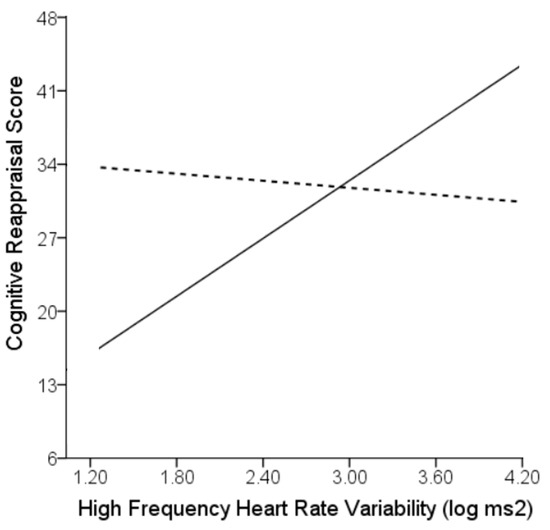
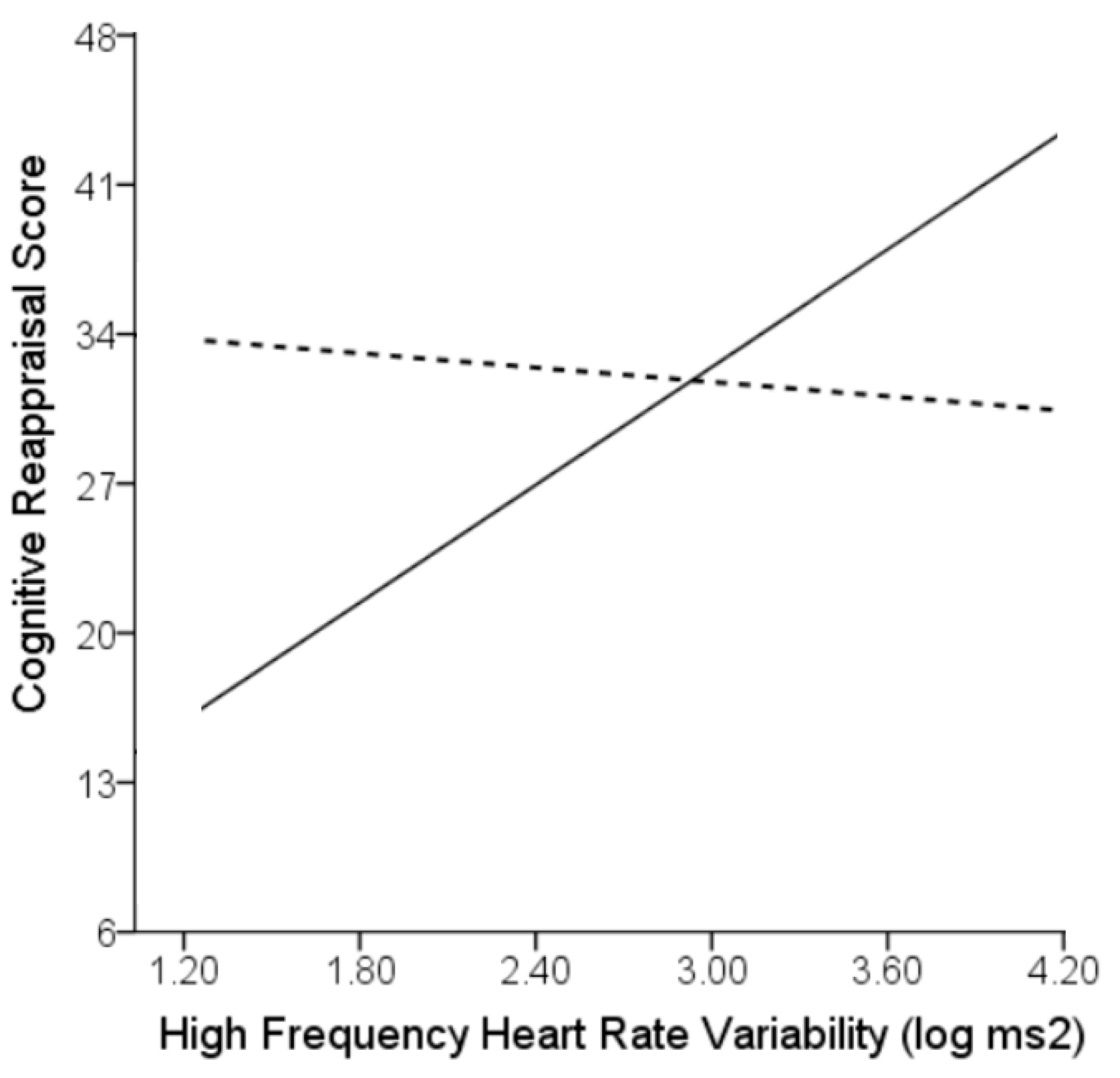
The multiple regression analyses are summarized in Table 2. Model 1 tested the effects of habituation score and HF-HRV on cognitive reappraisal. The results of Model 1 showed that all predictors accounted for a significant portion of the variance of the dependent variable, R2 = 0.11, p = 0.048, and that higher HF-HRV predicted higher cognitive reappraisal, β2 = 10.04, 95% C.I. = 0.49–19.58, p = 0.040, R2 = 0.05, but there was only a marginal trend towards a negative relationship between habituation score and cognitive reappraisal, β1 = −3.61, 95% C.I. = −7.25–0.03, p = 0.040, R2 = 0.01. Importantly, startle habituation was interacted with HF-HRV to influence cognitive reappraisal, β3 = 1.30, 95% C.I. = 0.01–2.59, p = 0.049, R2 = 0.03 (see Table 2). In addition, simple slope analysis revealed that the relationship between HF-HRV and reappraisal among individuals with high habituation scores (greater than 1 SD, indicating slower startle habituation) is positive, while that relationship among individuals with low habituation scores (smaller than −1 SD, indicating faster habituation) was not significant (see Figure 2).
Table 2.
Summary of the Multiple Regression Models.
Figure 2.
Associations between cognitive reappraisal and high-frequency heart rate variability (HF-HRV) in individuals with high and low startle habituation scores. The solid line represents the relationship between HF-HRV and reappraisal among individuals with high habituation score (indicating slower startle habituation), which the dash line represents that relationship among individuals with low habituation score (indicating faster habituation).
In contrast, although Model 2 explained a significant portion of variance of suppression scores (R2 = 0.13, p = 0.039), there was no significant relationship between individual predictors and suppression score (see Table 2). Additionally, the regression models with RMSSD as the substitute index of vmHRV provided the same pattern of the results.
4. Discussion
Emotion regulation refers to the processes through which individuals modulate their emotional states and the ways emotions are experienced and expressed. According to Gross’s (1998) process model, antecedent-focused strategies such as cognitive reappraisal engage higher-order, controlled cognitive processes and are generally associated with more adaptive outcomes. In contrast, response-focused strategies such as expressive suppression rely more on automatic processes and are linked to heightened affective reactivity. The present study examined how physiological processes relate to the habitual use of different emotion regulation strategies by assessing startle habituation and vmHRV as indices of affective reactivity and cognitive control, respectively. The findings partially supported our hypotheses: suppression was unrelated to either physiological indicator, whereas cognitive reappraisal was positively predicted by both vmHRV and startle habituation. Moreover, vmHRV and startle habituation interacted such that the positive association between vmHRV and cognitive reappraisal emerged only among individuals who exhibited slower startle habituation.
The first hypothesis regarding suppression was not supported by the results. While the regression model did not show any relationships between predictors and suppression score, the correlation coefficients indicate negative and positive associations of suppression with intercept and slope of the habituation function (see Table 1). The unadjusted correlations between the variables indicate that people with habituate startle-eliciting stimuli slower tend to use suppression more. These results were consistent with the hypothesis, suggesting that individuals whose sensory sensitivity drops rapidly may not need to suppress their affective responses. This notion is consistent with the reported association between sensation and emotion regulation (for a review see, Rodriguez & Kross, 2023). However, the relationship between suppression and startle habituation was not evident in the regression models. The discrepancies between the results of the regression model and correlations were due to that vmHRV and its interaction with startle habituation accounted for a portion of variance of suppression score. According to the process of model of emotion regulation (Gross, 1998), suppression is a response-focused emotion regulation strategy. That is, the usage of suppression occurs after affective responses being generated, and the strategy serves to modulate the responses. However, the startle response and its habituation are automatic processes, which may not be subject to the influence of suppression after its expression. An alternative account for the failure to obtain the relationship between startle habituation and suppression would be that individuals tend to use suppression may be less sensitive to the startle stimulus, as indicated by the negative correlation between suppression score and the slope of the habituation function (see Table 1).
The null findings also suggest the existence of underlying mechanisms shared by vmHRV and startle habituation. According to the Generalized Unsafety Theory of Stress (GUTS; Brosschot et al., 2017), the startle response is a default response, and subcortical brain regions mediating the startle response (e.g., the amygdala) are tonically active. The activation those brain regions are only inhibited when “safety” signals from the prefrontal cortex (PFC) were generated, which can be indicated by vmHRV (Brosschot et al., 2017; Thayer et al., 2012). In our study, vmHRV and startle habituation did not show a relationship, which might be due to a relatively small sample or there were no affective contexts (Yang & Friedman, 2017; Yang et al., 2021). Future studies should explore possible relationship between vmHRV and startle habituation.
Our second hypothesis regarding cognitive reappraisal was supported by the regression results. HF-HRV was positively associated with the use of cognitive reappraisal, consistent with prior findings (Cui et al., 2015; Fiol-Veny et al., 2019). Both the Neurovisceral Integration Model (Thayer & Lane, 2009) and the Vagal Tank Theory (Laborde et al., 2018) propose that vmHRV reflects the availability of cognitive resources for self-regulatory processes. Because cognitive reappraisal occurs early in the emotion-generative sequence—before physiological responses unfold—it requires top-down inhibition from the prefrontal cortex (PFC) over subcortical structures. Supporting this idea, research shows that reappraisal engages the PFC and recruits executive functions that, in turn, modulate amygdala activity (Ochsner & Gross, 2005). Also, in line with our hypotheses, there was a marginal trend for startle habituation to predict greater use of reappraisal, suggesting that individuals who habituate more quickly may have more cognitive resources available for regulation. When defensive responses diminish rapidly, fewer resources are needed to inhibit default threat-related reactions (Brosschot et al., 2017), potentially freeing cognitive capacity to implement antecedent-focused strategies such as reappraisal. While the positive relationship between vmHRV and cognitive appraisal is descriptive in the present study due to its cross-sectional nature, vmHRV has been shown as a modifiable physiological index. For example, vmHRV can be promoted by slow-paced breathing (Laborde et al., 2022), exercise (Routledge et al., 2010), and light therapy (Martins et al., 2025).
Importantly, the third hypothesis regarding the interaction between vmHRV and startle habituation was supported. The significant interaction term in Model 1 (see Table 2) indicates a moderation effect of startle habitation on the vmHRV-cognitive reappraisal relationship. The simple slope analysis revealed that vmHRV was positively related to the use of cognitive reappraisal only when an individual is slower in habituating the startle stimulus. These findings echo the previously discussed results in faster habituation individuals have already used cognitive reappraisal frequently due to sufficient top-down resources. Therefore, vmHRV levels may not be sensitive to the usage of cognitive reappraisal among those individuals. In contrast, individuals with slow habituation may lack top-down resources to control affective responses, thus levels of vmHRV would be sensitive to the allocated cognitive resources for appraisal. Those findings also highlight the biological underpinnings of the antecedent-focused, effortful emotion regulation strategy. Cognitive reappraisal modulates earlier stages of affective processes and is influenced by an individual’s physiological propensity to react to sensory stimuli, which extends the previously documented association between top-down control and reappraisal. Additionally, the usage of different emotional regulation strategies reflects a net outcome of a dynamic process: individuals tend to adaptively switch strategies depending on the context, and their goals and physiological propensities.
The present findings have practical implications for the treatment of psychological disorders. Maladaptive emotion regulation and atypical physiological responding have been linked to a range of psychopathological conditions, including anxiety (Ray et al., 2009), depression (Kemp et al., 2010; Yang et al., 2020), PTSD (Cohen et al., 2000), and schizophrenia (Montaquila et al., 2015). Reduced cognitive resources may underlie both low vmHRV and altered startle habituation, potentially serving as mechanisms of emotion dysregulation that increase vulnerability to mental disorders. Accordingly, interventions aimed at strengthening cognitive functioning, including those that enhance HRV, may be beneficial for individuals at risk and could be integrated into prevention and treatment programs for psychopathological conditions. In addition to psychopathology, our findings can be generalized to a wide range of cognitive processes, such decision-making, attentional control, and social cognition, and have applied values in education settings (Shi, 2025; Veltmeijer et al., 2021), transportation (J. Wang et al., 2024), interface design, cognitive performance in virtual reality (Alam et al., 2023), and human-technology interaction (Gazzanigo et al., 2025).
The findings of the present study need to be evaluated in the light of several limitations. First, emotion regulation was assessed by a self-report questionnaire in the present study. In particular, the ERQ suppression subscale in the present study showed a relatively low reliability, which might be due to the discrepancy between ratings of suppression for positive and negative emotions in the current sample and might contribute to the null finding of the subscale score and physiological indicators. Future studies should include experimental tasks to investigate the immediate effects of different emotion regulation strategies. Second, the sample size is relatively small, and all participants were healthy young adults, and the homogeneity of the sample limits the generalizability of findings. Larger, more diverse samples are expected to be recruited to replicate our findings in the future. Especially, older populations show reduced cardiovagal control and sensory processing (Arantes et al., 2022; Pohl et al., 2003), which would contribute to the different pattern of usage of emotion regulation strategies from younger adults (Urry & Gross, 2010). Third, although gender was controlled in the analyses, gender is an important influencing factor of physiological processes (Koenig & Thayer, 2016; Thayer et al., 2016; Yang et al., 2024). Fourth, computational models and neuroimaging data are needed to confirm the present findings and provide more nuanced analyses. For example, some novel neuroeconomic and implicit learning tasks (Kolobaric et al., 2023; Westbrook et al., 2023) have been developed to examine dynamic processes of emotion regulation, and startle habituation can also be modeled using growth curve analysis, autoregressive models, and time series shapelets (Yang & He, 2022).
In sum, the present study examined how vmHRV and startle habituation relate to the habitual use of emotion regulation strategies, showing that these strategies depend in part on underlying physiological processes. These findings also have practical implications for the prevention and treatment of psychopathology, as well as for promoting more adaptive emotion regulation in everyday life.
Author Contributions
Conceptualization, X.Y.; methodology, X.Y.; software, X.Y. and F.F.; validation, X.Y. and F.F.; formal analysis, X.Y. and F.F.; investigation, X.Y.; resources, X.Y.; data curation, F.F.; writing—original draft preparation, X.Y.; writing—review and editing, A.X.B.; visualization, X.Y., F.F., and A.X.B.; supervision, X.Y.; project administration, X.Y. All authors have read and agreed to the published version of the manuscript.
Funding
This research received no external funding.
Institutional Review Board Statement
This study was conducted in accordance with the Declaration of Helsinki and approved by Old Dominion University Sciences Human Subjects Review Committee (protocol code: 1837201-9 date of approval: 20 January 2025).
Informed Consent Statement
Informed consent was obtained from all subjects involved in this study.
Data Availability Statement
The raw data supporting the conclusions of this article will be made available by the authors on request.
Conflicts of Interest
The authors declare no conflicts of interest.
References
- Alam, S., Revi, G. S., Kerick, S. E., Yang, X., Robucci, R., Banerjee, N., & Spangler, D. P. (2023). Anticipatory cardiac deceleration estimates cognitive performance in virtual reality beyond tonic heart period and heart period variability. Biological Psychology, 181, 108602. [Google Scholar] [CrossRef] [Scilit]
- Arantes, F. S., Rosa Oliveira, V., Leão, A. K. M., Afonso, J. P. R., Fonseca, A. L., Fonseca, D. R. P., Mello, D. A. C. P. G., Costa, I. P., Oliveira, L. V. F., & da Palma, R. K. (2022). Heart rate variability: A biomarker of frailty in older adults? Frontiers in Medicine, 9, 1008970. [Google Scholar] [CrossRef] [Scilit]
- Beauchaine, T. P. (2015). Future directions in emotion dysregulation and youth psychopathology. Journal of Clinical Child & Adolescent Psychology, 44(5), 875–896. [Google Scholar] [CrossRef] [Scilit]
- Beauchaine, T. P., & Cicchetti, D. (2019). Emotion dysregulation and emerging psychopathology: A transdiagnostic, transdisciplinary perspective. Development and Psychopathology, 31(3), 799–804. [Google Scholar] [CrossRef] [Scilit] [PubMed]
- Beauchaine, T. P., & Thayer, J. F. (2015). Heart rate variability as a transdiagnostic biomarker of psychopathology. International Journal of Psychophysiology, 98(2), 338–350. [Google Scholar] [CrossRef] [Scilit]
- Berntson, G. G., Bigger, J. T., Eckberg, D. L., Grossman, P., Kaufmann, P. G., Malik, M., Nagaraja, H. N., Porges, S. W., Saul, J. P., Stone, P. H., & van der Molen, M. W. (1997). Heart rate variability: Origins, methods, and interpretive caveats. Psychophysiology, 34, 623–648. [Google Scholar] [CrossRef] [Scilit] [PubMed]
- Blumenthal, T., Cuthbert, B., Filion, D., Hackley, S., Lipp, O., & Van Boxtel, A. (2005). Committee report: Guidelines for human startle eyeblink electromyographic studies. Psychophysiology, 42, 1–15. [Google Scholar] [CrossRef] [Scilit] [PubMed]
- Bonanno, G. A., & Burton, C. L. (2013). Regulatory flexibility: An individual differences perspective on coping and emotion regulation. Perspectives on Psychological Science, 8(6), 591–612. [Google Scholar] [CrossRef] [Scilit]
- Braunstein, L. M., Gross, J. J., & Ochsner, K. N. (2017). Explicit and implicit emotion regulation: A multi-level framework. Social Cognitive and Affective Neuroscience, 12(10), 1545–1557. [Google Scholar] [CrossRef] [Scilit]
- Brosschot, J. F., Verkuil, B., & Thayer, J. F. (2017). Exposed to events that never happen: Generalized unsafty, the default stress response, and prolonged autonomic activity. Neuroscience & Biobehavioral Reviews, 74, 287–296. [Google Scholar] [CrossRef] [Scilit]
- Cai, R. Y., Samson, A. C., & Uljarevic, M. (2024). Emotion regulation in neurodevelopmental disorders: Current understanding and treatments. Frontiers in Psychiatry, 15, 1467834. [Google Scholar] [CrossRef] [Scilit]
- Cohen, H., Benjamin, J., Geva, A. B., Matar, M. A., Kaplan, Z., & Kotler, M. (2000). Autonomic dysregulation in panic disorder and in post-traumatic stress disorder: Application of power spectrum analysis of heart rate variability at rest and in response to recollection of trauma or panic attacks. Psychiatry Research, 96(1), 1–13. [Google Scholar] [CrossRef] [Scilit]
- Cui, L., Morris, A. S., Harrist, A. W., Larzelere, R. E., Criss, M. M., & Houltberg, B. J. (2015). Adolescent RSA responses during an anger discussion task: Relations to emotion regulation and adjustment. Emotion, 15(3), 360–372. [Google Scholar] [CrossRef] [Scilit]
- Daches, S., Seidman, A. J., Bylsma, L. M., George, C. J., Kiss, E., Kapornai, K., Baji, I., & Kovacs, M. (2025). Successful mood repair in the laboratory predicts successful mood repair in daily life for typical but not for depression-prone young adults. Emotion, 25(5), 1349–1359. [Google Scholar] [CrossRef] [Scilit]
- De Neve, D., Bronstein, M. V., Leroy, A., Truyts, A., & Everaert, J. (2023). Emotion regulation in the classroom: A network approach to model relations among emotion regulation difficulties, engagement to learn, and relationships with peers and teachers. Journal of Youth and Adolescence, 52(2), 273–286. [Google Scholar] [CrossRef] [Scilit]
- Filion, D. L., Dawson, M. E., & Schell, A. M. (1998). The psychological significance of human startle eyeblink modification: A review. Biological Psychology, 47, 1–43. [Google Scholar] [CrossRef] [Scilit] [PubMed]
- Fiol-Veny, A., Balle, M., De la Torre-Luque, A., & Bornas, X. (2019). Negative cognitive emotion regulation as a predictor of adolescent heart rate variability and entropy under social stress. Anxiety, Stress, & Coping, 32(6), 641–653. [Google Scholar] [CrossRef] [Scilit]
- Friedman, B. H., & Thayer, J. F. (1998). Autonomic balance revisited: Panic anxiety and heart rate variability. Journal of Psychosomatic Research, 44, 133–151. [Google Scholar] [CrossRef] [Scilit]
- Gandhi, T. K., Tsourides, K., Singhal, N., Cardinaux, A., Jamal, W., Pantazis, D., Kjelgaard, M., & Sinha, P. (2021). Autonomic and electrophysiological evidence for reduced auditory habituation in autism. Journal of Autism and Developmental Disorders, 51(7), 2218–2228. [Google Scholar] [CrossRef] [Scilit] [PubMed]
- Gazzanigo, M., Quesnel, A., Roldan, C., & Yang, X. (2025). Cellphone separation modulates the effects of working memory load on ex-Gaussian parameters of choice reaction time. Cognitive Research: Principles and Implications, 10(1), 72. [Google Scholar] [CrossRef] [Scilit] [PubMed]
- Gorka, S. M., McGowan, S. K., Campbell, M. L., Nelson, B. D., Sarapas, C., Bishop, J. R., & Shankman, S. A. (2013). Association between respiratory sinus arrhythmia and reductions in startle responding in three independent samples. Biological Psychology, 93, 334–341. [Google Scholar] [CrossRef] [Scilit]
- Graham, F. K. (1992). Attention: The heartbeat, the blink, and the brain. In B. A. Campbell, H. Hayne, & R. Richardson (Eds.), Attention and information processing in infants and adults: Perspectives from human and animal research (pp. 3–29). Erlbaum. [Google Scholar]
- Gross, J. J. (1998). The emerging field of emotion regulation: An integrative review. Review of General Psychology, 2(3), 271–299. [Google Scholar] [CrossRef]
- Gross, J. J. (2015). Emotion regulation: Current status and future prospects. Psychological Inquiry, 26(1), 1–26. [Google Scholar] [CrossRef] [Scilit]
- Gross, J. J., & John, O. P. (2003). Individual differences in two emotion regulation processes: Implications for affect, relationships, and well-being. Journal of Personality and Social Psychology, 85(2), 348–362. [Google Scholar] [CrossRef] [Scilit]
- Gross, J. J., & Thompson, R. A. (2007). Conceptual foundations for the field. In Handbook of emotion regulation (pp. 3–24). Guilford publications. [Google Scholar]
- Groves, P. M., & Thompson, R. F. (1970). Habituation: A dual-process theory. Psychological Review, 77(5), 419–450. [Google Scholar] [CrossRef] [Scilit] [PubMed]
- Hajric, E., Arevalo, F. N., Bruce, L., Smith, F. A., & Michael, K. (2024). Facial emotion recognition in the future of work: Social implications and policy recommendations. IEEE Transactions on Technology and Society, 6(3), 295–304. [Google Scholar] [CrossRef] [Scilit]
- Henkel, A. P., Bromuri, S., Iren, D., & Urovi, V. (2020). Half human, half machine–augmenting service employees with AI for interpersonal emotion regulation. Journal of Service Management, 31(2), 247–265. [Google Scholar] [CrossRef] [Scilit]
- Jennings, J. R., Kamarck, T., Stewart, C., Eddy, M., & Johnson, P. (1992). Alternate cardiovascular baseline assessment techniques: Vanilla or resting baseline. Psychophysiology, 29(6), 742–750. [Google Scholar] [CrossRef] [Scilit]
- Kemp, A. H., Quintana, D. S., Gray, M. A., Felmingham, K. L., Brown, K., & Gatt, J. M. (2010). Impact of depression and antidepressant treatment on heart rate variability: A review and meta-analysis. Biological Psychiatry, 67(11), 1067–1074. [Google Scholar] [CrossRef] [Scilit] [PubMed]
- Koenig, J., & Thayer, J. F. (2016). Sex differences in healthy human heart rate variability: A meta-analysis. Neuroscience & Biobehavioral Reviews, 64, 288–310. [Google Scholar] [CrossRef] [Scilit]
- Kolobaric, A., Mizuno, A., Yang, X., George, C. J., Seidman, A., Aizenstein, H. J., Kovacs, M., & Karim, H. T. (2023). History of major depressive disorder is associated with differences in implicit learning of emotional faces. Journal of Psychiatric Research, 161, 324–332. [Google Scholar] [CrossRef] [Scilit]
- Koole, S. L. (2009). The psychology of emotion regulation: An integrative review. Cognition and Emotion, 23(1), 4–41. [Google Scholar] [CrossRef] [Scilit]
- Kovacs, M., Joormann, J., & Gotlib, I. H. (2008). Emotion (dys) regulation and links to depressive disorders. Child Development Perspectives, 2(3), 149–155. [Google Scholar] [CrossRef] [Scilit]
- Laborde, S., Allen, M. S., Borges, U., Dosseville, F., Hosang, T. J., Iskra, M., Mosley, E., Salvotti, C., Spolverato, L., Zammit, N., & Javelle, F. (2022). Effects of voluntary slow breathing on heart rate and heart rate variability: A systematic review and a metaanalysis. Neuroscience & Biobehavorial Reviews, 138, 104711. [Google Scholar] [CrossRef] [Scilit]
- Laborde, S., Mosley, E., & Mertgen, A. (2018). Vagal tank theory: The three rs of cardiac vagal control functioning—Resting, reactivity, and recovery. Frontiers in Neuroscience, 12, 458. [Google Scholar] [CrossRef] [Scilit] [PubMed]
- Laborde, S., Mosley, E., & Thayer, J. F. (2017). Heart rate variability and cardiac vagal tone in psychophysiological research–recommendations for experiment planning, data analysis, and data reporting. Frontiers in Psychology, 8, 213. [Google Scholar] [CrossRef] [Scilit] [PubMed]
- LaRowe, S. D., Patrick, C. J., Curtin, J. J., & Kline, J. P. (2006). Personality correlates of startle habituation. Biological Psychology, 72(3), 257–264. [Google Scholar] [CrossRef] [Scilit]
- Ludewig, K., Geyer, M. A., Etzensberger, M., & Vollenweider, F. X. (2002). Stability of the acoustic startle reflex, prepulse inhibition, and habituation in schizophrenia. Schizophrenia Research, 55(1–2), 129–137. [Google Scholar] [CrossRef] [Scilit]
- Martins, V., Allen, M. S., Borges, U., Laterza, P., Jackovic, M., Mosley, E., Javelle, F., & Laborde, S. (2025). Effects of light exposure on vagally-mediated heart rate variability: A systematic review. Neuroscience and Biobehavioral Reviews, 176, 106241. [Google Scholar] [CrossRef] [Scilit]
- Melzig, C. A., Weike, A. I., Hamm, A. O., & Thayer, J. F. (2009). Individual differences in fear-potentiated startle as a function of resting heart rate variability: Implications for panic disorder. International Journal of Psychophysiology, 71(2), 109–117. [Google Scholar] [CrossRef] [Scilit] [PubMed]
- Mennin, D. S., McLaughlin, K. A., & Flanagan, T. J. (2009). Emotion regulation deficits in generalized anxiety disorder, social anxiety disorder, and their co-occurrence. Journal of Anxiety Disorders, 23(7), 866–871. [Google Scholar] [CrossRef] [Scilit]
- Montaquila, J. M., Trachik, B. J., & Bedwell, J. S. (2015). Heart rate variability and vagal tone in schizophrenia: A review. Journal of Psychiatric Research, 69, 57–66. [Google Scholar] [CrossRef] [Scilit]
- Ochsner, K. N., & Gross, J. J. (2005). The cognitive control of emotion. Trends in Cognitive Sciences, 9(5), 242–249. [Google Scholar] [CrossRef] [Scilit] [PubMed]
- Orr, S. P., Metzger, L. J., Lasko, N. B., Macklin, M. L., Peri, T., & Pitman, R. K. (2000). De novo conditioning in trauma-exposed individuals with and without posttraumatic stress disorder. Journal of Abnormal Psychology, 109(2), 290–298. [Google Scholar] [CrossRef] [PubMed]
- Oussi, A., & Bouvet, C. (2023). Trait emotional intelligence, perceived control, coping styles, and clinical symptoms in panic disorder. Current Psychology, 42(32), 28638–28649. [Google Scholar] [CrossRef] [Scilit]
- Pappens, M., Schroijen, M., Sutterlin, S., Smets, E., van den Bergh, O., Thayer, J. F., & van Diest, I. (2014). Resting heart rate variability predicts safety learning and fear extinction in an interoceptive fear conditioning paradigm. PLoS ONE, 9, e105054. [Google Scholar] [CrossRef] [Scilit]
- Patrick, C. J., & Hajcak, G. (2016). RDoC: Translating promise into progress. Psychophysiology, 53(3), 415–424. [Google Scholar] [CrossRef] [Scilit]
- Pencea, I., Munoz, A. P., Maples-Keller, J. L., Fiorillo, D., Schultebraucks, K., Galatzer-Levy, I., Rothbaum, B. O., Ressler, K. J., Stevens, J. S., Michopoulos, V., & Powers, A. (2020). Emotion dysregulation is associated with increased prospective risk for chronic PTSD development. Journal of Psychiatric Research, 121, 222–228. [Google Scholar] [CrossRef] [Scilit]
- Pohl, P. S., Dunn, W., & Brown, C. (2003). The role of sensory processing in the everyday lives of older adults. OTJR: Occupation, Participation and Health, 23(3), 99–106. [Google Scholar] [CrossRef] [Scilit]
- Quigley, K. S., Gianaros, P. J., Norman, G. J., Jennings, J. R., Berntson, G. G., & de Geus, E. J. (2024). Publication guidelines for human heart rate and heart rate variability studies in psychophysiology—Part 1: Physiological underpinnings and foundations of measurement. Psychophysiology, 61(9), e14604. [Google Scholar] [CrossRef] [Scilit]
- Rankin, C. H., Abrams, T., Barry, R. J., Bhatnagar, S., Clayton, D. F., Colombo, J., Coppola, G., Geyer, M. A., Glanzman, D. L., Marsland, S., McSweeney, F. K., Wilson, D. A., Wu, C.-F., & Thompson, R. F. (2009). Habituation revisited: An updated and revised description of the behavioral characteristics of habituation. Neurobiology of Learning and Memory, 92(2), 135–138. [Google Scholar] [CrossRef] [Scilit]
- Ray, W. J., Molnar, C., Aikins, D., Yamasaki, A., Newman, M. G., Castonguay, L., & Borkovec, T. D. (2009). Startle response in generalized anxiety disorder. Depression and Anxiety, 26(2), 147–154. [Google Scholar] [CrossRef] [Scilit]
- Rho, G., Callara, A. L., Scilingo, E. P., Greco, A., & Bonfiglio, L. (2024). Habituation of central and electrodermal responses to an auditory two-stimulus oddball paradigm. Sensors, 24(15), 5053. [Google Scholar] [CrossRef] [Scilit]
- Rodriguez, M., & Kross, E. (2023). Sensory emotion regulation. Trends in Cognitive Sciences, 27(4), 379–390. [Google Scholar] [CrossRef] [Scilit]
- Rothbaum, B. O., Kozak, M. J., Foa, E. B., & Whitaker, D. J. (2001). Posttraumatic stress disorder in rape victims: Autonomic habituation to auditory stimuli. Journal of Traumatic Stress: Official Publication of The International Society for Traumatic Stress Studies, 14(2), 283–293. [Google Scholar] [CrossRef] [Scilit]
- Routledge, F. S., Campbell, T. S., McFetridge-Durdle, J. A., & Bacon, S. L. (2010). Improvements in heart rate variability with exercise therapy. Canadian Journal of Cardiology, 26(6), 303–312. [Google Scholar] [CrossRef] [Scilit] [PubMed]
- Scherer, K. R. (2009). The dynamic architecture of emotion: Evidence for the component process model. Cognition and Emotion, 23(7), 1307–1351. [Google Scholar] [CrossRef] [Scilit]
- Seidman, A. J., Bylsma, L. M., Yang, X., Jennings, J. R., George, C. J., & Kovacs, M. (2024). Long-term stability of respiratory sinus arrhythmia among adults with and without a history of depression. Psychophysiology, 61(1), e14427. [Google Scholar] [CrossRef] [Scilit] [PubMed]
- Seidman, A. J., Yang, X., Westbrook, A., George, C. J., & Kovacs, M. (2023). Effects of current and past depressive episodes on behavioral performance and subjective experience during an N-back task. Journal of Behavior Therapy and Experimental Psychiatry, 81, 101852. [Google Scholar] [CrossRef] [Scilit]
- Shalev, A. Y., Ragel-Fuchs, Y., & Pitman, R. K. (1992). Conditioned fear and psychological trauma. Biological Psychiatry, 31(9), 863–865. [Google Scholar] [CrossRef] [Scilit]
- Shepherd, L., & Wild, J. (2014). Emotion regulation, physiological arousal and PTSD symptoms in trauma-exposed individuals. Journal of Behavior Therapy and Experimental Psychiatry, 45(3), 360–367. [Google Scholar] [CrossRef] [Scilit]
- Sheppes, G., Suri, G., & Gross, J. J. (2015). Emotion regulation and psychopathology. Annual Review of Clinical Psychology, 11(1), 379–405. [Google Scholar] [CrossRef] [Scilit]
- Shi, L. (2025). The integration of advanced AI-enabled emotion detection and adaptive learning systems for improved emotional regulation. Journal of Educational Computing Research, 63(1), 173–201. [Google Scholar] [CrossRef] [Scilit]
- Task Force. (1996). Heart rate variability: Standards of measurement, physiological interpretation, and clinical use. European Heart Journal, 17(3), 354–381. [Google Scholar] [CrossRef] [Scilit]
- Thayer, J. F., Åhs, F., Fredrikson, M., Sollers, J. J., III, & Wager, T. D. (2012). A meta-analysis of heart rate variability and neuroimaging studies: Implications for heart rate variability as a marker of stress and health. Neuroscience & Biobehavioral Review, 36, 747–756. [Google Scholar] [CrossRef] [Scilit]
- Thayer, J. F., & Lane, R. D. (2009). Claude Bernard and the heart-brain connection: Further elaboration of a model of neurovisceral integration. Neuroscience & Biobehavioral Reviews, 33, 81–88. [Google Scholar] [CrossRef] [Scilit]
- Thayer, J. F., Sollers, J. J., Friedman, B. H., & Koenig, J. (2016). Gender differences in the relationship between resting heart rate variability and 24-hour blood pressure variability. Blood Pressure, 25(1), 58–62. [Google Scholar] [CrossRef] [Scilit] [PubMed]
- Thompson, R. A. (1994). Emotion regulation: A theme in search of definition. Monographs of the Society for Research in Child Development, 59, 25–52. [Google Scholar] [CrossRef] [Scilit]
- Thompson, R. F., & Spencer, W. A. (1966). Habituation: A model phenomenon for the study of neuronal substrates of behavior. Psychological Review, 73(1), 16–43. [Google Scholar] [CrossRef] [Scilit]
- Urry, H. L., & Gross, J. J. (2010). Emotion regulation in older age. Current Directions in Psychological Science, 19(6), 352–357. [Google Scholar] [CrossRef] [Scilit]
- Veltmeijer, E. A., Gerritsen, C., & Hindriks, K. V. (2021). Automatic emotion recognition for groups: A review. IEEE Transactions on Affective Computing, 14(1), 89–107. [Google Scholar] [CrossRef] [Scilit]
- Wang, H., Burić, I., Chang, M. L., & Gross, J. J. (2023). Teachers’ emotion regulation and related environmental, personal, instructional, and well-being factors: A meta-analysis. Social Psychology of Education: An International Journal, 26(6), 1651–1696. [Google Scholar] [CrossRef] [Scilit]
- Wang, J., Yang, X., Wang, Z., Wei, X., Wang, A., He, D., & Wu, K. (2024). Efficient mixture-of-expert for video-based driver state and physiological multi-task estimation in conditional autonomous driving. arXiv, arXiv:2410.21086. [Google Scholar] [CrossRef] [Scilit]
- Westbrook, A., Yang, X., Bylsma, L. M., Daches, S., George, C. J., Seidman, A. J., Jennings, J. R., & Kovacs, M. (2023). Economic choice and heart rate fractal scaling indicate that cognitive effort is reduced by depression and boosted by sad mood. Biological Psychiatry: Cognitive Neuroscience and Neuroimaging, 8(7), 687–694. [Google Scholar] [CrossRef] [Scilit]
- Yang, X., Chaney, J., David, A. S., & Fang, F. (2024). Sex differences in the association between cardiac vagal control and the effects of baroreflex afferents on behavior. Hearts, 5(4), 612–627. [Google Scholar] [CrossRef] [Scilit]
- Yang, X., Daches, S., Yaroslavsky, I., George, C. J., & Kovacs, M. (2020). Cardiac vagal control mediates the relation between past depression and blood pressure several years later among young adults. Psychophysiology, 57(5), e13535. [Google Scholar] [CrossRef] [Scilit]
- Yang, X., & Friedman, B. H. (2017). Individual differences in behavioral activation and cardiac vagal control influence affective startle modification. Physiology & Behavior, 172, 3–11. [Google Scholar] [CrossRef] [Scilit]
- Yang, X., Gazzanigo, M., Fang, F., & House, S. (2025). Vagally mediated heart rate variability modulates the association between the perceived workload and the Stroop effect on behavioral performance. Physiological Reports, 13(14), e70466. [Google Scholar] [CrossRef] [Scilit] [PubMed]
- Yang, X., & He, Y. (2022). Startle habituation pattern on shapelets identifies individuals with low vagally mediated heart rate variability [abstract]. Psychophysiology, 59, S114. [Google Scholar]
- Yang, X., Spangler, D. P., Thayer, J. F., & Friedman, B. H. (2021). Resting heart rate variability modulates the effects of concurrent working memory load on affective startle modification. Psychophysiology, 58(8), e13833. [Google Scholar] [CrossRef] [Scilit]

Disclaimer/Publisher’s Note: The statements, opinions and data contained in all publications are solely those of the individual author(s) and contributor(s) and not of MDPI and/or the editor(s). MDPI and/or the editor(s) disclaim responsibility for any injury to people or property resulting from any ideas, methods, instructions or products referred to in the content. |
© 2026 by the authors. Licensee MDPI, Basel, Switzerland. This article is an open access article distributed under the terms and conditions of the Creative Commons Attribution (CC BY) license.