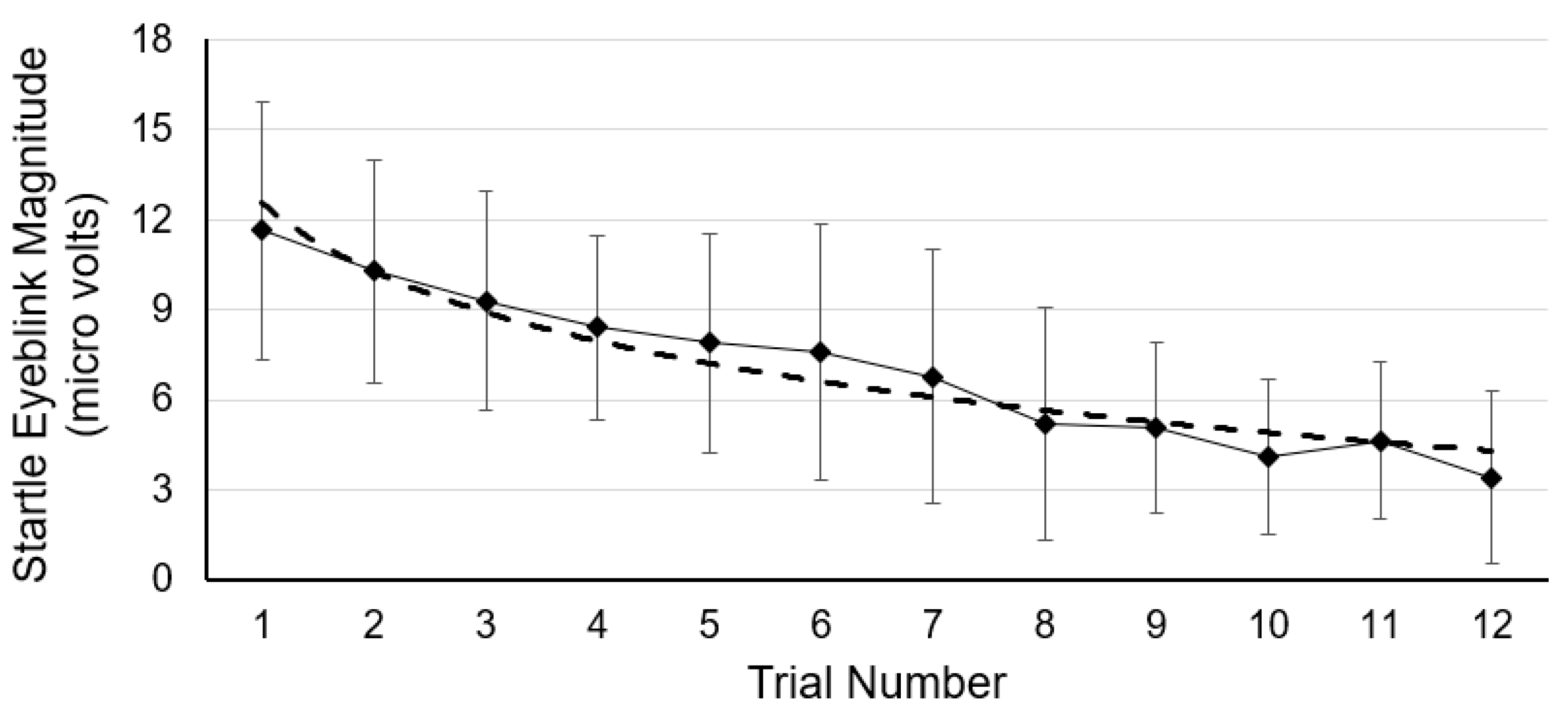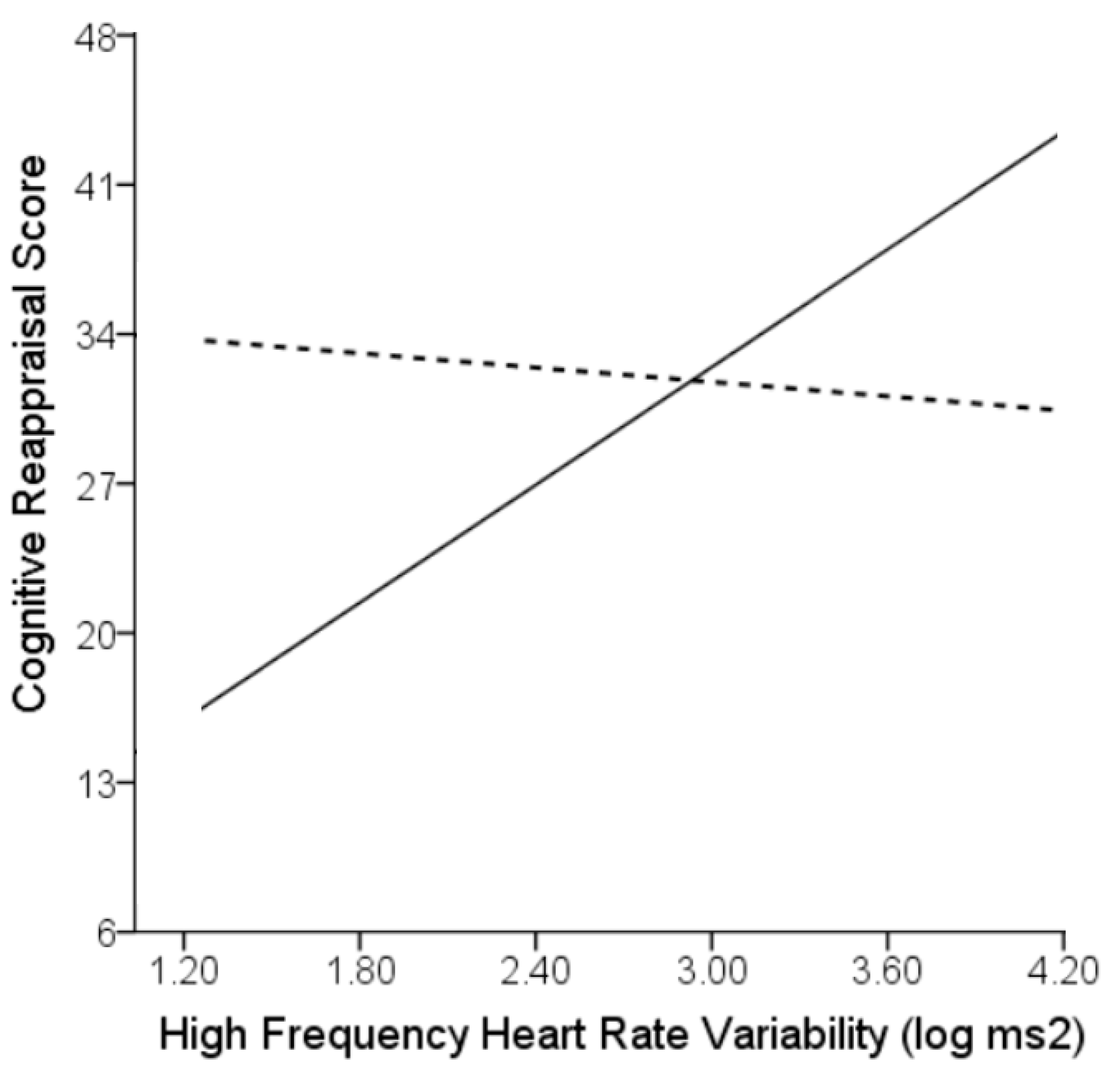

Startle Habituation and Vagally Mediated Heart Rate Variability Influence the Use of Emotion Regulation Strategies


Abstract
1. Introduction
Current Study
2. Method
2.1. Participants
2.2. Materials and Stimulus
2.3. Procedure
2.4. Physiological Recording and Data Reduction
2.5. Analytic Approach
3. Results
3.1. Descriptive Statistics
3.2. Effects of Startle Habituation and VmHRV on Emotion Regulation
4. Discussion
Author Contributions
Funding
Institutional Review Board Statement
Informed Consent Statement
Data Availability Statement
Conflicts of Interest
References
- Alam, S., Revi, G. S., Kerick, S. E., Yang, X., Robucci, R., Banerjee, N., & Spangler, D. P. (2023). Anticipatory cardiac deceleration estimates cognitive performance in virtual reality beyond tonic heart period and heart period variability. Biological Psychology, 181, 108602. [Google Scholar] [CrossRef] [Scilit]
- Arantes, F. S., Rosa Oliveira, V., Leão, A. K. M., Afonso, J. P. R., Fonseca, A. L., Fonseca, D. R. P., Mello, D. A. C. P. G., Costa, I. P., Oliveira, L. V. F., & da Palma, R. K. (2022). Heart rate variability: A biomarker of frailty in older adults? Frontiers in Medicine, 9, 1008970. [Google Scholar] [CrossRef] [Scilit]
- Beauchaine, T. P. (2015). Future directions in emotion dysregulation and youth psychopathology. Journal of Clinical Child & Adolescent Psychology, 44(5), 875–896. [Google Scholar] [CrossRef] [Scilit]
- Beauchaine, T. P., & Cicchetti, D. (2019). Emotion dysregulation and emerging psychopathology: A transdiagnostic, transdisciplinary perspective. Development and Psychopathology, 31(3), 799–804. [Google Scholar] [CrossRef] [Scilit] [PubMed]
- Beauchaine, T. P., & Thayer, J. F. (2015). Heart rate variability as a transdiagnostic biomarker of psychopathology. International Journal of Psychophysiology, 98(2), 338–350. [Google Scholar] [CrossRef] [Scilit]
- Berntson, G. G., Bigger, J. T., Eckberg, D. L., Grossman, P., Kaufmann, P. G., Malik, M., Nagaraja, H. N., Porges, S. W., Saul, J. P., Stone, P. H., & van der Molen, M. W. (1997). Heart rate variability: Origins, methods, and interpretive caveats. Psychophysiology, 34, 623–648. [Google Scholar] [CrossRef] [Scilit] [PubMed]
- Blumenthal, T., Cuthbert, B., Filion, D., Hackley, S., Lipp, O., & Van Boxtel, A. (2005). Committee report: Guidelines for human startle eyeblink electromyographic studies. Psychophysiology, 42, 1–15. [Google Scholar] [CrossRef] [Scilit] [PubMed]
- Bonanno, G. A., & Burton, C. L. (2013). Regulatory flexibility: An individual differences perspective on coping and emotion regulation. Perspectives on Psychological Science, 8(6), 591–612. [Google Scholar] [CrossRef] [Scilit]
- Braunstein, L. M., Gross, J. J., & Ochsner, K. N. (2017). Explicit and implicit emotion regulation: A multi-level framework. Social Cognitive and Affective Neuroscience, 12(10), 1545–1557. [Google Scholar] [CrossRef] [Scilit]
- Brosschot, J. F., Verkuil, B., & Thayer, J. F. (2017). Exposed to events that never happen: Generalized unsafty, the default stress response, and prolonged autonomic activity. Neuroscience & Biobehavioral Reviews, 74, 287–296. [Google Scholar] [CrossRef] [Scilit]
- Cai, R. Y., Samson, A. C., & Uljarevic, M. (2024). Emotion regulation in neurodevelopmental disorders: Current understanding and treatments. Frontiers in Psychiatry, 15, 1467834. [Google Scholar] [CrossRef] [Scilit]
- Cohen, H., Benjamin, J., Geva, A. B., Matar, M. A., Kaplan, Z., & Kotler, M. (2000). Autonomic dysregulation in panic disorder and in post-traumatic stress disorder: Application of power spectrum analysis of heart rate variability at rest and in response to recollection of trauma or panic attacks. Psychiatry Research, 96(1), 1–13. [Google Scholar] [CrossRef] [Scilit]
- Cui, L., Morris, A. S., Harrist, A. W., Larzelere, R. E., Criss, M. M., & Houltberg, B. J. (2015). Adolescent RSA responses during an anger discussion task: Relations to emotion regulation and adjustment. Emotion, 15(3), 360–372. [Google Scholar] [CrossRef] [Scilit]
- Daches, S., Seidman, A. J., Bylsma, L. M., George, C. J., Kiss, E., Kapornai, K., Baji, I., & Kovacs, M. (2025). Successful mood repair in the laboratory predicts successful mood repair in daily life for typical but not for depression-prone young adults. Emotion, 25(5), 1349–1359. [Google Scholar] [CrossRef] [Scilit]
- De Neve, D., Bronstein, M. V., Leroy, A., Truyts, A., & Everaert, J. (2023). Emotion regulation in the classroom: A network approach to model relations among emotion regulation difficulties, engagement to learn, and relationships with peers and teachers. Journal of Youth and Adolescence, 52(2), 273–286. [Google Scholar] [CrossRef] [Scilit]
- Filion, D. L., Dawson, M. E., & Schell, A. M. (1998). The psychological significance of human startle eyeblink modification: A review. Biological Psychology, 47, 1–43. [Google Scholar] [CrossRef] [Scilit] [PubMed]
- Fiol-Veny, A., Balle, M., De la Torre-Luque, A., & Bornas, X. (2019). Negative cognitive emotion regulation as a predictor of adolescent heart rate variability and entropy under social stress. Anxiety, Stress, & Coping, 32(6), 641–653. [Google Scholar] [CrossRef] [Scilit]
- Friedman, B. H., & Thayer, J. F. (1998). Autonomic balance revisited: Panic anxiety and heart rate variability. Journal of Psychosomatic Research, 44, 133–151. [Google Scholar] [CrossRef] [Scilit]
- Gandhi, T. K., Tsourides, K., Singhal, N., Cardinaux, A., Jamal, W., Pantazis, D., Kjelgaard, M., & Sinha, P. (2021). Autonomic and electrophysiological evidence for reduced auditory habituation in autism. Journal of Autism and Developmental Disorders, 51(7), 2218–2228. [Google Scholar] [CrossRef] [Scilit] [PubMed]
- Gazzanigo, M., Quesnel, A., Roldan, C., & Yang, X. (2025). Cellphone separation modulates the effects of working memory load on ex-Gaussian parameters of choice reaction time. Cognitive Research: Principles and Implications, 10(1), 72. [Google Scholar] [CrossRef] [Scilit] [PubMed]
- Gorka, S. M., McGowan, S. K., Campbell, M. L., Nelson, B. D., Sarapas, C., Bishop, J. R., & Shankman, S. A. (2013). Association between respiratory sinus arrhythmia and reductions in startle responding in three independent samples. Biological Psychology, 93, 334–341. [Google Scholar] [CrossRef] [Scilit]
- Graham, F. K. (1992). Attention: The heartbeat, the blink, and the brain. In B. A. Campbell, H. Hayne, & R. Richardson (Eds.), Attention and information processing in infants and adults: Perspectives from human and animal research (pp. 3–29). Erlbaum. [Google Scholar]
- Gross, J. J. (1998). The emerging field of emotion regulation: An integrative review. Review of General Psychology, 2(3), 271–299. [Google Scholar] [CrossRef]
- Gross, J. J. (2015). Emotion regulation: Current status and future prospects. Psychological Inquiry, 26(1), 1–26. [Google Scholar] [CrossRef] [Scilit]
- Gross, J. J., & John, O. P. (2003). Individual differences in two emotion regulation processes: Implications for affect, relationships, and well-being. Journal of Personality and Social Psychology, 85(2), 348–362. [Google Scholar] [CrossRef] [Scilit]
- Gross, J. J., & Thompson, R. A. (2007). Conceptual foundations for the field. In Handbook of emotion regulation (pp. 3–24). Guilford publications. [Google Scholar]
- Groves, P. M., & Thompson, R. F. (1970). Habituation: A dual-process theory. Psychological Review, 77(5), 419–450. [Google Scholar] [CrossRef] [Scilit] [PubMed]
- Hajric, E., Arevalo, F. N., Bruce, L., Smith, F. A., & Michael, K. (2024). Facial emotion recognition in the future of work: Social implications and policy recommendations. IEEE Transactions on Technology and Society, 6(3), 295–304. [Google Scholar] [CrossRef] [Scilit]
- Henkel, A. P., Bromuri, S., Iren, D., & Urovi, V. (2020). Half human, half machine–augmenting service employees with AI for interpersonal emotion regulation. Journal of Service Management, 31(2), 247–265. [Google Scholar] [CrossRef] [Scilit]
- Jennings, J. R., Kamarck, T., Stewart, C., Eddy, M., & Johnson, P. (1992). Alternate cardiovascular baseline assessment techniques: Vanilla or resting baseline. Psychophysiology, 29(6), 742–750. [Google Scholar] [CrossRef] [Scilit]
- Kemp, A. H., Quintana, D. S., Gray, M. A., Felmingham, K. L., Brown, K., & Gatt, J. M. (2010). Impact of depression and antidepressant treatment on heart rate variability: A review and meta-analysis. Biological Psychiatry, 67(11), 1067–1074. [Google Scholar] [CrossRef] [Scilit] [PubMed]
- Koenig, J., & Thayer, J. F. (2016). Sex differences in healthy human heart rate variability: A meta-analysis. Neuroscience & Biobehavioral Reviews, 64, 288–310. [Google Scholar] [CrossRef] [Scilit]
- Kolobaric, A., Mizuno, A., Yang, X., George, C. J., Seidman, A., Aizenstein, H. J., Kovacs, M., & Karim, H. T. (2023). History of major depressive disorder is associated with differences in implicit learning of emotional faces. Journal of Psychiatric Research, 161, 324–332. [Google Scholar] [CrossRef] [Scilit]
- Koole, S. L. (2009). The psychology of emotion regulation: An integrative review. Cognition and Emotion, 23(1), 4–41. [Google Scholar] [CrossRef] [Scilit]
- Kovacs, M., Joormann, J., & Gotlib, I. H. (2008). Emotion (dys) regulation and links to depressive disorders. Child Development Perspectives, 2(3), 149–155. [Google Scholar] [CrossRef] [Scilit]
- Laborde, S., Allen, M. S., Borges, U., Dosseville, F., Hosang, T. J., Iskra, M., Mosley, E., Salvotti, C., Spolverato, L., Zammit, N., & Javelle, F. (2022). Effects of voluntary slow breathing on heart rate and heart rate variability: A systematic review and a metaanalysis. Neuroscience & Biobehavorial Reviews, 138, 104711. [Google Scholar] [CrossRef] [Scilit]
- Laborde, S., Mosley, E., & Mertgen, A. (2018). Vagal tank theory: The three rs of cardiac vagal control functioning—Resting, reactivity, and recovery. Frontiers in Neuroscience, 12, 458. [Google Scholar] [CrossRef] [Scilit] [PubMed]
- Laborde, S., Mosley, E., & Thayer, J. F. (2017). Heart rate variability and cardiac vagal tone in psychophysiological research–recommendations for experiment planning, data analysis, and data reporting. Frontiers in Psychology, 8, 213. [Google Scholar] [CrossRef] [Scilit] [PubMed]
- LaRowe, S. D., Patrick, C. J., Curtin, J. J., & Kline, J. P. (2006). Personality correlates of startle habituation. Biological Psychology, 72(3), 257–264. [Google Scholar] [CrossRef] [Scilit]
- Ludewig, K., Geyer, M. A., Etzensberger, M., & Vollenweider, F. X. (2002). Stability of the acoustic startle reflex, prepulse inhibition, and habituation in schizophrenia. Schizophrenia Research, 55(1–2), 129–137. [Google Scholar] [CrossRef] [Scilit]
- Martins, V., Allen, M. S., Borges, U., Laterza, P., Jackovic, M., Mosley, E., Javelle, F., & Laborde, S. (2025). Effects of light exposure on vagally-mediated heart rate variability: A systematic review. Neuroscience and Biobehavioral Reviews, 176, 106241. [Google Scholar] [CrossRef] [Scilit]
- Melzig, C. A., Weike, A. I., Hamm, A. O., & Thayer, J. F. (2009). Individual differences in fear-potentiated startle as a function of resting heart rate variability: Implications for panic disorder. International Journal of Psychophysiology, 71(2), 109–117. [Google Scholar] [CrossRef] [Scilit] [PubMed]
- Mennin, D. S., McLaughlin, K. A., & Flanagan, T. J. (2009). Emotion regulation deficits in generalized anxiety disorder, social anxiety disorder, and their co-occurrence. Journal of Anxiety Disorders, 23(7), 866–871. [Google Scholar] [CrossRef] [Scilit]
- Montaquila, J. M., Trachik, B. J., & Bedwell, J. S. (2015). Heart rate variability and vagal tone in schizophrenia: A review. Journal of Psychiatric Research, 69, 57–66. [Google Scholar] [CrossRef] [Scilit]
- Ochsner, K. N., & Gross, J. J. (2005). The cognitive control of emotion. Trends in Cognitive Sciences, 9(5), 242–249. [Google Scholar] [CrossRef] [Scilit] [PubMed]
- Orr, S. P., Metzger, L. J., Lasko, N. B., Macklin, M. L., Peri, T., & Pitman, R. K. (2000). De novo conditioning in trauma-exposed individuals with and without posttraumatic stress disorder. Journal of Abnormal Psychology, 109(2), 290–298. [Google Scholar] [CrossRef] [PubMed]
- Oussi, A., & Bouvet, C. (2023). Trait emotional intelligence, perceived control, coping styles, and clinical symptoms in panic disorder. Current Psychology, 42(32), 28638–28649. [Google Scholar] [CrossRef] [Scilit]
- Pappens, M., Schroijen, M., Sutterlin, S., Smets, E., van den Bergh, O., Thayer, J. F., & van Diest, I. (2014). Resting heart rate variability predicts safety learning and fear extinction in an interoceptive fear conditioning paradigm. PLoS ONE, 9, e105054. [Google Scholar] [CrossRef] [Scilit]
- Patrick, C. J., & Hajcak, G. (2016). RDoC: Translating promise into progress. Psychophysiology, 53(3), 415–424. [Google Scholar] [CrossRef] [Scilit]
- Pencea, I., Munoz, A. P., Maples-Keller, J. L., Fiorillo, D., Schultebraucks, K., Galatzer-Levy, I., Rothbaum, B. O., Ressler, K. J., Stevens, J. S., Michopoulos, V., & Powers, A. (2020). Emotion dysregulation is associated with increased prospective risk for chronic PTSD development. Journal of Psychiatric Research, 121, 222–228. [Google Scholar] [CrossRef] [Scilit]
- Pohl, P. S., Dunn, W., & Brown, C. (2003). The role of sensory processing in the everyday lives of older adults. OTJR: Occupation, Participation and Health, 23(3), 99–106. [Google Scholar] [CrossRef] [Scilit]
- Quigley, K. S., Gianaros, P. J., Norman, G. J., Jennings, J. R., Berntson, G. G., & de Geus, E. J. (2024). Publication guidelines for human heart rate and heart rate variability studies in psychophysiology—Part 1: Physiological underpinnings and foundations of measurement. Psychophysiology, 61(9), e14604. [Google Scholar] [CrossRef] [Scilit]
- Rankin, C. H., Abrams, T., Barry, R. J., Bhatnagar, S., Clayton, D. F., Colombo, J., Coppola, G., Geyer, M. A., Glanzman, D. L., Marsland, S., McSweeney, F. K., Wilson, D. A., Wu, C.-F., & Thompson, R. F. (2009). Habituation revisited: An updated and revised description of the behavioral characteristics of habituation. Neurobiology of Learning and Memory, 92(2), 135–138. [Google Scholar] [CrossRef] [Scilit]
- Ray, W. J., Molnar, C., Aikins, D., Yamasaki, A., Newman, M. G., Castonguay, L., & Borkovec, T. D. (2009). Startle response in generalized anxiety disorder. Depression and Anxiety, 26(2), 147–154. [Google Scholar] [CrossRef] [Scilit]
- Rho, G., Callara, A. L., Scilingo, E. P., Greco, A., & Bonfiglio, L. (2024). Habituation of central and electrodermal responses to an auditory two-stimulus oddball paradigm. Sensors, 24(15), 5053. [Google Scholar] [CrossRef] [Scilit]
- Rodriguez, M., & Kross, E. (2023). Sensory emotion regulation. Trends in Cognitive Sciences, 27(4), 379–390. [Google Scholar] [CrossRef] [Scilit]
- Rothbaum, B. O., Kozak, M. J., Foa, E. B., & Whitaker, D. J. (2001). Posttraumatic stress disorder in rape victims: Autonomic habituation to auditory stimuli. Journal of Traumatic Stress: Official Publication of The International Society for Traumatic Stress Studies, 14(2), 283–293. [Google Scholar] [CrossRef] [Scilit]
- Routledge, F. S., Campbell, T. S., McFetridge-Durdle, J. A., & Bacon, S. L. (2010). Improvements in heart rate variability with exercise therapy. Canadian Journal of Cardiology, 26(6), 303–312. [Google Scholar] [CrossRef] [Scilit] [PubMed]
- Scherer, K. R. (2009). The dynamic architecture of emotion: Evidence for the component process model. Cognition and Emotion, 23(7), 1307–1351. [Google Scholar] [CrossRef] [Scilit]
- Seidman, A. J., Bylsma, L. M., Yang, X., Jennings, J. R., George, C. J., & Kovacs, M. (2024). Long-term stability of respiratory sinus arrhythmia among adults with and without a history of depression. Psychophysiology, 61(1), e14427. [Google Scholar] [CrossRef] [Scilit] [PubMed]
- Seidman, A. J., Yang, X., Westbrook, A., George, C. J., & Kovacs, M. (2023). Effects of current and past depressive episodes on behavioral performance and subjective experience during an N-back task. Journal of Behavior Therapy and Experimental Psychiatry, 81, 101852. [Google Scholar] [CrossRef] [Scilit]
- Shalev, A. Y., Ragel-Fuchs, Y., & Pitman, R. K. (1992). Conditioned fear and psychological trauma. Biological Psychiatry, 31(9), 863–865. [Google Scholar] [CrossRef] [Scilit]
- Shepherd, L., & Wild, J. (2014). Emotion regulation, physiological arousal and PTSD symptoms in trauma-exposed individuals. Journal of Behavior Therapy and Experimental Psychiatry, 45(3), 360–367. [Google Scholar] [CrossRef] [Scilit]
- Sheppes, G., Suri, G., & Gross, J. J. (2015). Emotion regulation and psychopathology. Annual Review of Clinical Psychology, 11(1), 379–405. [Google Scholar] [CrossRef] [Scilit]
- Shi, L. (2025). The integration of advanced AI-enabled emotion detection and adaptive learning systems for improved emotional regulation. Journal of Educational Computing Research, 63(1), 173–201. [Google Scholar] [CrossRef] [Scilit]
- Task Force. (1996). Heart rate variability: Standards of measurement, physiological interpretation, and clinical use. European Heart Journal, 17(3), 354–381. [Google Scholar] [CrossRef] [Scilit]
- Thayer, J. F., Åhs, F., Fredrikson, M., Sollers, J. J., III, & Wager, T. D. (2012). A meta-analysis of heart rate variability and neuroimaging studies: Implications for heart rate variability as a marker of stress and health. Neuroscience & Biobehavioral Review, 36, 747–756. [Google Scholar] [CrossRef] [Scilit]
- Thayer, J. F., & Lane, R. D. (2009). Claude Bernard and the heart-brain connection: Further elaboration of a model of neurovisceral integration. Neuroscience & Biobehavioral Reviews, 33, 81–88. [Google Scholar] [CrossRef] [Scilit]
- Thayer, J. F., Sollers, J. J., Friedman, B. H., & Koenig, J. (2016). Gender differences in the relationship between resting heart rate variability and 24-hour blood pressure variability. Blood Pressure, 25(1), 58–62. [Google Scholar] [CrossRef] [Scilit] [PubMed]
- Thompson, R. A. (1994). Emotion regulation: A theme in search of definition. Monographs of the Society for Research in Child Development, 59, 25–52. [Google Scholar] [CrossRef] [Scilit]
- Thompson, R. F., & Spencer, W. A. (1966). Habituation: A model phenomenon for the study of neuronal substrates of behavior. Psychological Review, 73(1), 16–43. [Google Scholar] [CrossRef] [Scilit]
- Urry, H. L., & Gross, J. J. (2010). Emotion regulation in older age. Current Directions in Psychological Science, 19(6), 352–357. [Google Scholar] [CrossRef] [Scilit]
- Veltmeijer, E. A., Gerritsen, C., & Hindriks, K. V. (2021). Automatic emotion recognition for groups: A review. IEEE Transactions on Affective Computing, 14(1), 89–107. [Google Scholar] [CrossRef] [Scilit]
- Wang, H., Burić, I., Chang, M. L., & Gross, J. J. (2023). Teachers’ emotion regulation and related environmental, personal, instructional, and well-being factors: A meta-analysis. Social Psychology of Education: An International Journal, 26(6), 1651–1696. [Google Scholar] [CrossRef] [Scilit]
- Wang, J., Yang, X., Wang, Z., Wei, X., Wang, A., He, D., & Wu, K. (2024). Efficient mixture-of-expert for video-based driver state and physiological multi-task estimation in conditional autonomous driving. arXiv, arXiv:2410.21086. [Google Scholar] [CrossRef] [Scilit]
- Westbrook, A., Yang, X., Bylsma, L. M., Daches, S., George, C. J., Seidman, A. J., Jennings, J. R., & Kovacs, M. (2023). Economic choice and heart rate fractal scaling indicate that cognitive effort is reduced by depression and boosted by sad mood. Biological Psychiatry: Cognitive Neuroscience and Neuroimaging, 8(7), 687–694. [Google Scholar] [CrossRef] [Scilit]
- Yang, X., Chaney, J., David, A. S., & Fang, F. (2024). Sex differences in the association between cardiac vagal control and the effects of baroreflex afferents on behavior. Hearts, 5(4), 612–627. [Google Scholar] [CrossRef] [Scilit]
- Yang, X., Daches, S., Yaroslavsky, I., George, C. J., & Kovacs, M. (2020). Cardiac vagal control mediates the relation between past depression and blood pressure several years later among young adults. Psychophysiology, 57(5), e13535. [Google Scholar] [CrossRef] [Scilit]
- Yang, X., & Friedman, B. H. (2017). Individual differences in behavioral activation and cardiac vagal control influence affective startle modification. Physiology & Behavior, 172, 3–11. [Google Scholar] [CrossRef] [Scilit]
- Yang, X., Gazzanigo, M., Fang, F., & House, S. (2025). Vagally mediated heart rate variability modulates the association between the perceived workload and the Stroop effect on behavioral performance. Physiological Reports, 13(14), e70466. [Google Scholar] [CrossRef] [Scilit] [PubMed]
- Yang, X., & He, Y. (2022). Startle habituation pattern on shapelets identifies individuals with low vagally mediated heart rate variability [abstract]. Psychophysiology, 59, S114. [Google Scholar]
- Yang, X., Spangler, D. P., Thayer, J. F., & Friedman, B. H. (2021). Resting heart rate variability modulates the effects of concurrent working memory load on affective startle modification. Psychophysiology, 58(8), e13833. [Google Scholar] [CrossRef] [Scilit]



| Variable | 1 | 2 | 3 | 4 | 5 |
|---|---|---|---|---|---|
| 1. High-Frequency Heart Rate Variability | - | ||||
| 2. Root Mean Square Successive Differences | 0.83 ** | - | |||
| 3. Intercept of Habituation Function | 0.16 | −0.02 | - | ||
| 4. Slope of Habituation Function | 0.05 | 0.05 | −0.66 ** | - | |
| 5. Cognitive Reappraisal Score | 0.08 | 0.06 | 0.15 | −0.05 | - |
| 6. Suppression Score | −0.01 | 0.05 | −0.37 ** | 0.35 * | −0.17 |
| Independent Variable | Model 1 (Cognitive Reappraisal) | Model 2 (Suppression) | ||
|---|---|---|---|---|
| β (SE) | R2 | β (SE) | R2 | |
| Startle Habituation Score | −3.61 (1.81) † | 0.01 | 0.15 (1.65) | 0.02 |
| HF-HRV | 10.04 (4.74) * | 0.05 | 0.52 (4.34) | 0.01 |
| Interaction | 1.30 (0.64) * | 0.03 | 0.12 (0.59) | 0.01 |
Disclaimer/Publisher’s Note: The statements, opinions and data contained in all publications are solely those of the individual author(s) and contributor(s) and not of MDPI and/or the editor(s). MDPI and/or the editor(s) disclaim responsibility for any injury to people or property resulting from any ideas, methods, instructions or products referred to in the content. |
© 2026 by the authors. Licensee MDPI, Basel, Switzerland. This article is an open access article distributed under the terms and conditions of the Creative Commons Attribution (CC BY) license.
Share and Cite
Yang, X.; Fang, F.; Babb, A.X. Startle Habituation and Vagally Mediated Heart Rate Variability Influence the Use of Emotion Regulation Strategies. Psychol. Int. 2026, 8, 2. https://doi.org/10.3390/psycholint8010002
Yang X, Fang F, Babb AX. Startle Habituation and Vagally Mediated Heart Rate Variability Influence the Use of Emotion Regulation Strategies. Psychology International. 2026; 8(1):2. https://doi.org/10.3390/psycholint8010002
Chicago/Turabian StyleYang, Xiao, Fang Fang, and Angela Ximena Babb. 2026. "Startle Habituation and Vagally Mediated Heart Rate Variability Influence the Use of Emotion Regulation Strategies" Psychology International 8, no. 1: 2. https://doi.org/10.3390/psycholint8010002
APA StyleYang, X., Fang, F., & Babb, A. X. (2026). Startle Habituation and Vagally Mediated Heart Rate Variability Influence the Use of Emotion Regulation Strategies. Psychology International, 8(1), 2. https://doi.org/10.3390/psycholint8010002