


Abstract
The rising prevalence of multidrug-resistant (MDR) Enterobacterales poses a major challenge for the empirical treatment of urinary tract infections (UTIs). We evaluated the in vitro activity of mecillinam against urinary Escherichia coli and Klebsiella pneumoniae isolates, including extended-spectrum β-lactamase (ESBL)-producing and non-ESBL-producing isolates. In this prospective, single-center study conducted in Spain (December 2020–March 2021), urinary isolates of E. coli and K. pneumoniae from patients with suspected UTIs were tested for susceptibility to mecillinam and other commonly used antibiotics. A total of 503 isolates were analyzed, including 285 non-ESBL-producing and 218 ESBL-producing isolates. Overall susceptibility was 96.2% (95% CI, 94.2–97.7%) for mecillinam and 98.2% for ertapenem. Mecillinam susceptibility was 96.5% (95% CI, 93.6–98.3%) among non-ESBL-producing isolates and 95.9% (95% CI, 92.3–98.1%) among ESBL-producing isolates, with MIC50 values of 0.5 mg/L and 1 mg/L, respectively. Among ESBL-producing isolates, susceptibility to fosfomycin and trimethoprim–sulfamethoxazole was 72.9% and 44.0%, respectively. These findings demonstrate high in vitro activity of mecillinam against urinary E. coli and K. pneumoniae isolates, including both ESBL-producing and non-ESBL-producing isolates, and provide microbiological evidence supporting further clinical evaluation of pivmecillinam as an oral treatment option for UTIs.
1. Introduction
The increase in antibiotic use and the ensuing rise in antimicrobial resistance (AMR) is a global public health challenge [1,2], raising interest in alternative treatment options [3,4]. Urinary tract infections (UTIs) are among the most common indications for antibiotic prescription in clinical practice and they are typically mild, uncomplicated conditions managed empirically based on local resistance patterns and clinical guidelines. However, this condition is also associated with significant unnecessary or inappropriate antibiotic use that contributes to the rise in AMR, especially in the case of asymptomatic bacteriuria [5,6].
The worldwide increase in the prevalence of multidrug-resistant (MDR) microorganisms has made this a priority for the World Health Organization (WHO) to control infectious diseases [7]. Enterobacteriaceae are of particular concern in this sense, particularly Escherichia coli and Klebsiella pneumoniae, as they are the primary causes of UTIs worldwide. In fact, due to their ability to develop resistance to multiple antibiotics, carbapenem-resistant and third-generation cephalosporin-resistant Enterobacteriaceae (the latter including extended-spectrum ß-lactamases [ESBL] producing Enterobacteriaceae) are included within the critical category of the 2024 WHO Bacterial Priority Pathogens List [8].
Treatment options for UTIs caused by ESBL- and carbapenemase-producing Enterobacterales remain limited, particularly when effective oral therapy is required [9]. In this sense, the scarcity of effective oral antimicrobial options against MDR Enterobacteriaceae limits the therapeutic options, especially in primary care where most uncomplicated UTIs (uUTIs) are treated. Currently, and based on antimicrobial susceptibility testing, oral treatment with fosfomycin (FOF), amoxicillin/clavulanic acid (AMXCLAV), nitrofurantoin (NITRO) and trimethoprim-sulfamethoxazole (TMP-SX) are potential treatment options for uUTIs in Spain [10]. However, resistance rates to quinolones and AMXCLAV are a cause for concern in this country, often limiting empirical or targeted treatment of uUTIs. In fact, according to data from the European Antimicrobial Resistance Surveillance Network (EARS-Net) for 2024, 30% of E. coli strains in Spain were resistant to fluoroquinolones and 57.7% were resistant to aminopenicillins, while 23.5% of K. pneumoniae strains were resistant to third-generation cephalosporins [11]. Accordingly, Spanish treatment guidelines recommend fosfomycin trometamol (3 g) as the empirical treatment of choice for acute uncomplicated cystitis in young women, with NITRO or TMP-SX as alternatives [10].
Pivmecillinam (PIV) is an orally administered amidinopenicillin with selective activity against Gram-negative bacteria, and it has long been the empirical first-choice antibiotic to treat uUTIs in Scandinavia and other European countries (along with FOF, TMP-SX and NITRO) [12,13,14]. More recently (April 2024), this antibiotic also received the approval of the US Food and Drug Administration (FDA) for the treatment of female adults with uUTI [12]. Although in 2017 PIV was approved by the Spanish Agency of Drugs and Medicine Products (AEMPS) for the treatment of uUTI in adults, it is still not included in the Spanish guidelines as a first-choice antimicrobial agent for the empirical treatment of this condition. The European Association of Urology (EAU) guidelines recommend administering PIV at a dose of 400 mg three times daily (t.i.d.) for 3 days to treat acute uncomplicated cystitis [15], and Norwegian national guidelines list it as an oral treatment option for acute uncomplicated pyelonephritis over 7 days at the same dose and regimen [16]. Clinical studies on the efficacy of PIV therapy for community-acquired UTIs caused by ESBL-producing Enterobacteriaceae are limited [12], and there are no studies to date validating its use as a therapeutic alternative for specific strains in Spain. Hence, the aim of our study was to assess the in vitro activity of mecillinam (MEC), the active moiety of the oral prodrug PIV, and other first-choice or commonly used antibiotics against E. coli and K. pneumoniae isolates recovered from urine samples of patients with suspected UTI in routine clinical practice at a hospital in Spain.
2. Materials and Methods
2.1. Study Design
In this prospective, single-center study, urinary isolates of E. coli and K. pneumoniae from patients with a suspected UTI were collected at the Hospital Universitario Príncipe de Asturias (Alcala de Henares, Spain) from December 2020 to March 2021. The care setting at the time of sample collection (emergency department, primary care or hospital outpatient consultations) and susceptibility to 11 antimicrobial agents were recorded during the study. Only one isolate per patient was included in the analysis. The original screening log was not retained; therefore, the total number of urine cultures screened, the number of potentially eligible isolates not included, and whether isolate inclusion was strictly consecutive could not be retrospectively established. Analyses were descriptive, and data are presented as absolute numbers and percentages. Two-sided 95% confidence intervals (CIs) for the primary MEC susceptibility proportion and the main subgroup estimates were calculated using the exact binomial (Clopper–Pearson) method in Stata/BE 17.0 (StataCorp LLC, College Station, TX, USA). No hypothesis testing was performed; therefore, differences in susceptibility rates between antimicrobial agents or analytical subgroups are presented descriptively, and no comparative statistical inference can be drawn.
2.2. Bacterial Identification
Urine samples were processed in accordance with standard laboratory practices and cultured in CPSE agar (bioMérieux, Marcy l’Étoile, France). Subsequently, the different species were identified using matrix-assisted laser desorption ionization time-of-flight mass spectrometry (MALDI-TOF MS: VITEK® MS, bioMérieux, France) prior to antimicrobial susceptibility testing (AST). Only urine samples yielding one pathogen and a bacterial count ≥1000 colony-forming units (cfu) per mL were considered positive and included in the study.
2.3. Antimicrobial Susceptibility Testing
The following antibiotics were tested: ampicillin (AMP), AMXCLAV, cefuroxime (CXM), ceftazidime (CAZ), ertapenem (ERTA), gentamicin (GEN), FOF, ciprofloxacin (CIP), NITRO, TMP-SX, and MEC. AST of the isolates to all the antibiotics tested, except MEC, was performed using the Vitek 2 system (bioMérieux, France) with AST-N426 test cards, following the manufacturer’s instructions. The MIC of MEC, the active moiety of the oral prodrug PIV, was determined using Liofilchem MTS gradient strips (Liofilchem, Roseto degli Abruzzi, Italy), according to the manufacturer’s instructions. Throughout the manuscript, susceptibility to mecillinam is discussed in the clinical context of PIV use. AST results were interpreted according to the EUCAST clinical breakpoint tables applicable during the study period (version 10.0), using the organism-specific breakpoints and clinical indications specified by EUCAST. The MEC breakpoint and its organism scope remain unchanged in the current EUCAST breakpoint tables (version 16.1); therefore, application of the current criteria would not alter the reported MEC susceptibility rates. For MEC, the EUCAST breakpoint for uncomplicated UTI was applied within its specified organism scope to all study isolates, irrespective of the underlying clinical syndrome, as patient-level clinical information was not available. Accordingly, nitrofurantoin susceptibility was interpreted for E. coli but not for K. pneumoniae. For K. pneumoniae, nitrofurantoin MIC values are presented descriptively without categorization as susceptible or resistant. For antimicrobial agents for which both categories were defined by EUCAST, isolates categorized as susceptible, standard dosing regimen (S), or susceptible, increased exposure (I), were both included in the reported susceptibility percentages. For each antimicrobial and analytical group, MIC values were ordered from lowest to highest. MIC50 and MIC90 were defined as the lowest MIC values at which at least 50% and 90% of isolates, respectively, were inhibited, and MIC ranges were defined by the lowest and highest observed MIC values. MIC50 and MIC90 were calculated using all isolates within each corresponding analytical group, with subgroup denominators reported in Table 1. The overall relative susceptibility for each antibiotic was evaluated, and subgroup analyses were performed according to ESBL production and bacterial species. OXA-48-like-producing isolates, all of which were also ESBL producers, were additionally analyzed as a nested subgroup of the ESBL-producing population.
Table 1.
In vitro susceptibility of E. coli and K. pneumoniae isolates from urine samples to mecillinam and other antimicrobial agents.
Quality control for MEC MIC testing was performed using Escherichia coli ATCC 25922, yielding an MIC of 0.094 mg/L, within the accepted quality-control range.
2.4. Detection of ESBL and Carbapenemase-Producing Bacteria
All Enterobacterales isolates were subjected to ESBL screening, performed according to the EUCAST guidelines for the detection of resistance mechanisms [17]. ESBL production was confirmed through the double-disk diffusion synergy test on Müller-Hinton agar plates (Becton Dickinson, Franklin Lakes, NJ, USA) using cefotaxime and CAZ (both with and without clavulanic acid), according to the manufacturer’s instructions. In addition, all the isolates suspected of producing carbapenemases based on a phenotypic analysis underwent PCR confirmation using the Xpert Carba-R system (Cepheid, Sunnyvale, CA, USA), an approach that detects the five most common carbapenemase gene families: KPC, VIM, IMP, OXA-48, and NDM.
3. Results
A total of 503 E. coli (456) and K. pneumoniae (47) isolates were collected in this study. Of these, 218 (43.3%) were ESBL producers (172 E. coli, 46 K. pneumoniae) and 285 (56.7%) were non-ESBL producers (284 E. coli, 1 K. pneumoniae). Given that only one non-ESBL-producing K. pneumoniae isolate was included, no meaningful comparison of susceptibility according to ESBL status could be performed for this species. At the time of collection, the samples collected from the patients with non-ESBL and ESBL-producing isolates were obtained in the emergency department (37.4% and 39.7%), in primary care (45.2% and 31.8%) or at hospital outpatient consultations (17.4% and 28.5%). Nine of the 218 ESBL-producing isolates also produced OXA-48-like carbapenemases (4 E. coli and 5 K. pneumoniae). These isolates were therefore included within the ESBL-producing group and were additionally analyzed as a specific resistance-phenotype subgroup.
Antimicrobial Susceptibility of Urinary E. coli and K. pneumoniae Isolates
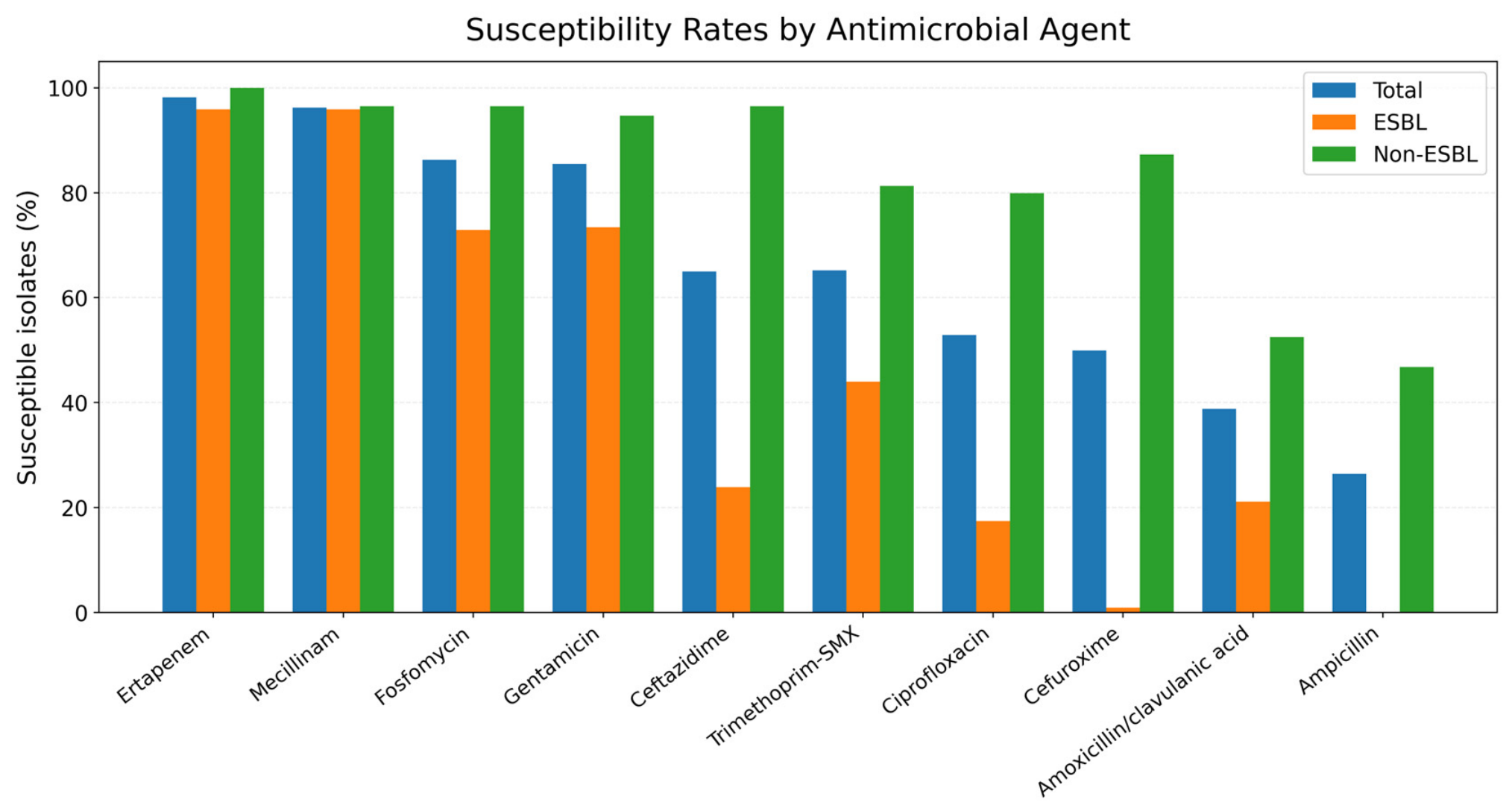
The in vitro activity (MIC, mg/L) of the antimicrobials tested, and the corresponding susceptibility rates were recorded (Table 1, Figure 1). Overall susceptibility rates were 98.2% for ERTA and 96.2% (484/503; 95% CI, 94.2–97.7%) for MEC, representing the two highest numerical rates among the antimicrobial agents evaluated. MEC showed an MIC50 of 0.75 mg/L and MIC90 of 3.0 mg/L. Susceptibility rates to FOF and GEN were 86.3% and 85.5%, respectively (Table 1, Figure 1).
Figure 1.
Susceptibility rates of E. coli and K. pneumoniae urinary isolates to selected antimicrobial agents according to ESBL production. Susceptibility rates are shown for all isolates (Total), ESBL-producing isolates, and non-ESBL-producing isolates. Susceptibility was interpreted according to EUCAST v10.0 clinical breakpoints applicable to each organism–antimicrobial combination. Nitrofurantoin was excluded because the EUCAST v10.0 clinical breakpoint for uncomplicated urinary tract infection was applicable to E. coli but not to K. pneumoniae.
In subgroup analyses, susceptibility to MEC was 95.9% (209/218; 95% CI, 92.3–98.1%) among ESBL-producing isolates and 96.5% (275/285; 95% CI, 93.6–98.3%) among non-ESBL-producing isolates; the corresponding rates for ERTA were 95.9% and 100%, respectively. MEC showed a MIC50 of 1.0 mg/L and a MIC90 of 3.0 mg/L among ESBL-producing isolates. When analyzed by bacterial species, MEC susceptibility was 95.9% among ESBL-producing E. coli isolates (165/172; 95% CI, 91.8–98.3%; MIC50/90, 0.75/4 mg/L) and 96.8% among non-ESBL-producing E. coli isolates (275/284; 95% CI, 94.1–98.5%; MIC50/90, 0.5/3 mg/L). The corresponding susceptibility rates for ERTA were 97.7% and 100%, respectively. Among ESBL-producing K. pneumoniae isolates, MEC susceptibility was 95.7% (44/46; 95% CI, 85.2–99.5%; MIC50/90, 1.5/3 mg/L), while ERTA susceptibility was 89.1%. Only one non-ESBL-producing K. pneumoniae isolate was included, precluding meaningful comparison according to ESBL status. Among the nine OXA-48-like-producing isolates, eight were susceptible to MEC (88.9%; 95% CI, 51.8–99.7%), with MIC50 and MIC90 values of 2 and 12 mg/L, respectively (Table 1). The wide confidence interval reflects the substantial uncertainty associated with this small subgroup, and the estimate should therefore be interpreted cautiously.
4. Discussion
This study demonstrates high in vitro susceptibility to MEC among urinary E. coli and K. pneumoniae isolates, with susceptibility rates of 95.9% among ESBL-producing isolates and 96.5% among non-ESBL-producing isolates. These findings are consistent with most in vitro studies reporting Enterobacterales susceptibility rates to MEC in excess of 90%, even among resistant phenotypes [13,18,19,20,21]. In our cohort, MEC retained a high numerical susceptibility rate among ESBL-producing isolates (95.9%), while 8/9 OXA-48-like-producing isolates were susceptible to MEC (88.9%; 95% CI, 51.8–99.7%). The wide confidence interval reflects the substantial uncertainty associated with this small subgroup, precluding firm conclusions regarding the in vitro activity of MEC against this resistance phenotype. Other studies have reported lower susceptibility rates to MEC [22,23], which may reflect differences in patient populations, methodologies, breakpoint criteria, or the distribution of species and resistance phenotypes, rather than a true decline in activity due to increased antibiotic selection pressure. Importantly, high in vitro susceptibility does not necessarily translate into clinical effectiveness, particularly in infections caused by ESBL-producing isolates. Bollestad et al. reported an increased risk of treatment failure among patients with ESBL-producing E. coli UTIs treated with PIV at 200 mg three times daily for ≤5 days [24], while Søraas et al. also observed a high rate of treatment failure in this population [25]. These findings highlight a potential discordance between in vitro susceptibility and clinical outcomes and suggest that treatment success may depend on factors beyond categorical susceptibility, including the dose and duration of PIV therapy. Therefore, the high susceptibility rates observed in our study should be interpreted as microbiological evidence of activity rather than as a direct surrogate for clinical efficacy.
Although the potential for MEC resistance to emerge during PIV treatment remains uncertain [25,26], its widespread employment over several decades in Nordic countries has not been associated with a significant increase in resistance [27]. Similarly, surveillance data from Germany have shown a decline in MEC resistance in E. coli between 2019 and 2021, despite a steady increase in prescriptions during this period [22]. Therefore, PIV represents a notable example of an antibiotic that, despite the relative ease of resistance selection in vitro and its extensive use in primary care, has maintained relatively stable susceptibility rates over time.
High worldwide rates of MDR among uropathogens have been highlighted in several recent studies and current research on complicated urinary tract infections (cUTIs) has largely focused on the use of novel intravenous (IV) antibiotics [4]. Among the antimicrobial agents evaluated in our study, ERTA also showed a high overall susceptibility rate (98.2%), compared with 96.2% for MEC. In this context, there is a clear need to expand the use of effective and cost-efficient oral antimicrobial options [28], as their ease of administration reduces the risks and costs associated with IV therapy, while improving treatment adherence. Accordingly, recent strategies have emphasized shortening the duration of IV therapy and prioritizing early transition to oral antibiotics in patients with cUTIs who show clinical improvement and for whom an effective oral option is available [29].
This study has several limitations. First, susceptibility was evaluated in vitro using isolates recovered from urine samples, without correlation to clinical outcomes. Second, no patient-level clinical data were collected, precluding differentiation between asymptomatic bacteriuria, uncomplicated UTIs and complicated UTIs, or attribution of susceptibility findings to any specific UTI syndrome. Accordingly, the reported categorical MEC susceptibility rates reflect application of the EUCAST breakpoint specified for uUTI to an undifferentiated population of urinary isolates and should not be extrapolated to clinical syndromes for which this breakpoint was not established, including cUTI. Although the care setting at the time of sample collection was recorded, this information was retained only in aggregate form and could not be retrospectively linked to individual antimicrobial susceptibility results. Consequently, MEC susceptibility could not be stratified by care setting, and the reported susceptibility estimates should not be interpreted as specific to primary care, emergency department, or hospital outpatient populations. For these reasons, the present study cannot establish the clinical effectiveness of PIV or determine its appropriateness for empirical treatment, and the findings should be interpreted as evidence of in vitro antimicrobial activity. Nevertheless, the large number of isolates and the inclusion of resistant phenotypes provide valuable insight into the in vitro activity of MEC against contemporary uropathogens. In addition, ESBL production was determined phenotypically without molecular characterization of the underlying ESBL genes. Therefore, we could not assess whether susceptibility to mecillinam differed according to specific ESBL genotypes. Another limitation is the single-center design and relatively short study period, which may limit the generalizability of the findings to other clinical settings or geographic regions. In addition, the high proportion of ESBL-producing isolates in our cohort (43.3%) is unlikely to reflect the epidemiology of unselected community-acquired UTIs in Spain and suggests potential enrichment for resistant isolates. Moreover, because the original screening log was not retained, the completeness and consecutiveness of isolate inclusion could not be established. Selection bias therefore cannot be excluded, and the distribution of resistance phenotypes observed in this study should not be considered representative of UTI epidemiology in Spain. Moreover, only one non-ESBL-producing K. pneumoniae isolate was included, precluding meaningful characterization of susceptibility in this subgroup or comparison with ESBL-producing K. pneumoniae. Although the small number of OXA-48-like carbapenemase-producing isolates reflects their frequency in routine clinical practice, the limited sample size prevents definitive conclusions and limits the generalizability of these findings. Despite these limitations, our results demonstrate high in vitro susceptibility rates to MEC among the strains analyzed.
Together with previously published clinical evidence on PIV, our findings add microbiological data supporting further evaluation of its role as an oral treatment option for UTIs caused by MEC-susceptible E. coli and K. pneumoniae, including ESBL-producing isolates. Further multicenter studies including different geographic regions and well-defined patient populations would be valuable to determine whether the in vitro susceptibility patterns observed in our cohort are reproducible across different clinical and epidemiological settings in Spain. In this sense, the results of a clinical trial comparing a single dose of FOF (3 g), a 2-day treatment of FOF (3 g, once daily), 3 days of PIV (400 mg, t.i.d.) or 5 days of NITRO (100 mg, t.i.d.) will provide additional evidence regarding treatment options for UTIs in Spain [30].
Given the increasing prevalence of MDR uropathogens worldwide, effective oral antimicrobial options are increasingly needed. In this study, MEC demonstrated high in vitro activity against urinary E. coli and K. pneumoniae isolates, including ESBL-producing strains. Together with the established clinical experience with PIV in other countries, these findings add locally derived microbiological data relevant to its potential role as an oral treatment option for UTIs in settings where the susceptibility of local uropathogens supports its use.
Author Contributions
Conceptualization, A.I.-v.-S.; methodology, A.I.-v.-S., R.P.-T., P.G., M.L.-R. and J.C.-G.; validation, A.I.-v.-S., M.R.-M., H.B.-M., C.G.-B. and J.V.-M.; formal analysis, A.I.-v.-S.; investigation, R.P.-T., P.G., M.R.-M., H.B.-M., C.G.-B. and J.V.-M.; resources, A.I.-v.-S., R.P.-T. and P.G.; data curation, A.I.-v.-S. and R.P.-T.; writing—original draft preparation, A.I.-v.-S., R.P.-T., P.G., M.L.-R. and J.C.-G.; writing—review and editing, A.I.-v.-S., R.P.-T., P.G., M.L.-R., J.C.-G., M.R.-M., H.B.-M., C.G.-B. and J.V.-M.; visualization, A.I.-v.-S., R.P.-T. and M.L.-R.; supervision, A.I.-v.-S., R.P.-T., P.G., M.L.-R. and J.C.-G.; project administration, R.P.-T. and M.L.-R.; funding acquisition, A.I.-v.-S., M.L.-R. and R.P.-T. All authors have read and agreed to the published version of the manuscript.
Funding
The study was supported by grants from Laboratorios Gebro Pharma. The funders did not participate in the study design and did not in any way influence the presentation of the results or conclusions.
Institutional Review Board Statement
This study was carried out in accordance with international standards to perform epidemiological studies [31] and according to Spanish law, ethical approval for the study was not required as it was conducted in vitro, using fully anonymized samples collected as part of clinical routine practice and no clinical data were gathered from the patients.
Informed Consent Statement
Not applicable.
Data Availability Statement
The original contributions presented in this study are included in the article. Further inquiries can be directed to the corresponding author.
Acknowledgments
We wish to thank all the laboratory technicians at the Príncipe de Asturias University Hospital’s Clinical Microbiology department who participated in this study. We are also grateful to Mari Paz Regalado and Mark Sefton (BiomedRed SL) for medical writing and editorial assistance. This assistance was paid through the Fundación para la Investigación Biomédica del Hospital Universitario Príncipe de Asturias using funds provided by Laboratorios Gebro Pharma. The authors retained full responsibility for the scientific content, interpretation of the data, and final approval of the manuscript.
Conflicts of Interest
Laboratorios Gebro Pharma, which markets pivmecillinam in Spain, provided funding for this study. Medical writing and editorial assistance provided by BiomedRed SL was paid through the Fundación para la Investigación Biomédica del Hospital Universitario Príncipe de Asturias using funds provided by Laboratorios Gebro Pharma. The authors declare no other conflicts of interest.
References
- Wang, L.; Chen, H.; Zhang, Y.; Tian, Y.; Hu, X.; Wu, J.; Li, X.; Jia, H.; Wang, H.; Yu, C.; et al. Global antibiotic consumption and regional antimicrobial resistance, 2010–2021: An analysis of pharmaceutical sales and antimicrobial resistance surveillance data. Lancet Glob. Health 2025, 13, e1880–e1891. [Google Scholar] [CrossRef] [Scilit]
- Klein, E.Y.; Impalli, I.; Poleon, S.; Denoel, P.; Cipriano, M.; Van Boeckel, T.P.; Pecetta, S.; Bloom, D.E.; Nandi, A. Global trends in antibiotic consumption during 2016–2023 and future projections through 2030. Proc. Natl. Acad. Sci. USA 2024, 121, e2411919121. [Google Scholar] [CrossRef] [Scilit]
- Ruiz-Pérez, R.; Newman-Portela, A.M.; Ruiz-Fresneda, M.A. Emerging global trends in next-generation alternatives to classic antibiotics for combatting multidrug-resistant bacteria. J. Clean. Prod. 2024, 478, 143895. [Google Scholar] [CrossRef] [Scilit]
- Machado, E.; Sousa, J.C. New Antibiotics for Treating Infections Caused by Multidrug-Resistant Bacteria. Antibiotics 2025, 14, 997. [Google Scholar] [CrossRef] [Scilit]
- Kim, K.H.; Yang, H.J. Asymptomatic Bacteriuria in Older Adults—Diagnosis, Management, and Future Directions: A Narrative Review. Urogenit. Tract. Infect. 2025, 20, 58–66. [Google Scholar] [CrossRef] [Scilit]
- Flokas, M.E.; Andreatos, N.; Alevizakos, M.; Kalbasi, A.; Onur, P.; Mylonakis, E. Inappropriate Management of Asymptomatic Patients With Positive Urine Cultures: A Systematic Review and Meta-analysis. Open Forum Infect. Dis. 2017, 4, ofx207. [Google Scholar] [CrossRef] [Scilit]
- World Health Organization. Global Antibiotic Resistance Surveillance Report 2025: WHO Global Antimicrobial Resistance and Use Surveillance System (GLASS); World Health Organization: Geneva, Switzerland, 2025; Available online: https://www.who.int/publications/i/item/9789240116337 (accessed on 18 January 2026).
- Sati, H.; Carrara, E.; Savoldi, A.; Hansen, P.; Garlasco, J.; Campagnaro, E.; Boccia, S.; Castillo-Polo, J.A.; Magrini, E.; Garcia-Vello, P.; et al. The WHO Bacterial Priority Pathogens List 2024: A prioritisation study to guide research, development, and public health strategies against antimicrobial resistance. Lancet Infect. Dis. 2025, 25, 1033–1043. [Google Scholar] [CrossRef] [Scilit]
- Wagenlehner, F.; Nicolle, L.; Bartoletti, R.; Gales, A.C.; Grigoryan, L.; Huang, H. A global perspective on improving patient care in uncomplicated urinary tract infection: Expert consensus and practical guidance. J. Glob. Antimicrob. Resist 2022, 28, 18–29. [Google Scholar] [CrossRef] [Scilit]
- Guía Terapéutica Antimicrobiana del SNS (Salud Humana). Plan Nacional Resistencia Antibióticos (PRAN)—Infecciones Urinarias del Tracto Inferior. 14 March 2026. Available online: https://www.resistenciaantibioticos.es/es/guia-terapeutica-antimicrobiana-del-sns-salud-humana (accessed on 20 January 2026).
- European Centre for Disease Prevention and Control (ECDC). Antimicrobial Resistance in the EU/EEA (EARS-Net)—Annual Epidemiological Report—Country Summaries—2024 Data; ECDC: Stockholm, Sweden, 2025. Available online: https://www.ecdc.europa.eu/sites/default/files/documents/antimicrobial-resistance-annual-epidemiological-report-country-summaries-2024-data.pdf (accessed on 11 January 2026).
- Kaye, K.S.; Santerre Henriksen, A.; Sommer, M.; Frimodt-Møller, N. Safety and Tolerability of Pivmecillinam During More Than Four Decades of Clinical Experience: A Systematic Review. Clin. Infect. Dis. Off. Publ. Infect. Dis. Soc. Am. 2025, 80, 280–299. [Google Scholar] [CrossRef] [Scilit]
- Kornfält Isberg, H.; Sundqvist, M.; Melander, E.; Beckman, A.; Hedin, K. Bacterial growth and antimicrobial resistance in urinary Escherichia coli isolates among men with lower UTI in Swedish primary healthcare: Retrospective data over a 4 year period. JAC-Antimicrob. Resist 2024, 7, dlae214. [Google Scholar] [CrossRef] [Scilit]
- Haugom, L.E.A.; Ruths, S.; Emberland, K.E.; Eliassen, K.E.R.; Rortveit, G.; Wensaas, K.A. Consultations and antibiotic treatment for urinary tract infections in Norwegian primary care 2006–2015, a registry-based study. BMC Fam. Pract. 2021, 22, 127. [Google Scholar] [CrossRef] [Scilit]
- Bonkat, G.; Kranz, J.; Cai, T.; Geerlings, S.E.; Köves, B.; Lambregts, M.M.C.; Mantica, G.; Pilatz, A.; Medina-Polo, J.; Schneidewind, L.; et al. EAU Guidelines on Urological Infections; European Association of Urology: Arnhem, The Netherlands, 2025; Available online: https://d56bochluxqnz.cloudfront.net/documents/full-guideline/EAU-Guidelines-on-Urological-infections-2025_2025-05-24-110339_pxmf.pdf (accessed on 8 April 2026).
- Antibiotika i Primærhelsetjenesten. Nasjonal Faglig Retningslinje. [Antibiotics in Primary Health Care. National Professional Guidelines]. Available online: https://www.helsedirektoratet.no/retningslinjer/antibiotika-i-primaerhelsetjenesten/urinveisinfeksjoner (accessed on 3 April 2026).
- Giske, C.; Martinez-Martinez, L.; Cantón, R.; Stefani, S.; Skov, R.; Glupczynski, Y.; Nordmann, P.; Wootton, M.; Miriagou, V.; Simonsen, G.S.; et al. EUCAST Subcommittee for Detection of Resistance Mechanisms and Specific Resistances of Clinical and/or Epidemiological Importance. EUCAST Guidelines for Detection of Resistance Mechanisms and Specific Resistances of Clinical and/or Epidemiological Importance. Version 2.0. July 2017. Available online: http://www.eucast.org (accessed on 3 April 2026).
- Kelly, S.; Ramsamaroo, Z.; Frost, S. Pivmecillinam Susceptibility in Clinical Practice: Contextualising Findings From a Systematic Review. Clin. Infect. Dis. Off. Publ. Infect. Dis. Soc. Am. 2025, 81, e469–e470. [Google Scholar] [CrossRef] [Scilit]
- Lodise, T.P.; Kaye, K.S.; Santerre Henriksen, A.; Kahlmeter, G. Review of the In Vitro Microbiological Activity of Mecillinam Against Common Uropathogens in Uncomplicated Urinary Tract Infection: Focus on Resistant Pathogens. Open Forum Infect. Dis. 2024, 11, ofae296. [Google Scholar] [CrossRef] [Scilit]
- Hawser, S.; Morrissey, I.; Kothari, N.; Monti, F.; Henriksen, A.S. Activity of mecillinam against USA urinary tract clinical isolates from 2017 to 2020 including isolates resistant to comparator antibiotics. J. Glob. Antimicrob. Resist 2024, 39, 137–143. [Google Scholar] [CrossRef] [Scilit]
- Tsakris, A.; Koumaki, V.; Baka, S.; Balakrishnan, I. Activity of mecillinam against OXA-48-like carbapenemase-producing Enterobacterales. J. Antimicrob. Chemother. 2022, 77, 537–538. [Google Scholar] [CrossRef] [Scilit]
- Stoltidis-Claus, C.; Rosenberger, K.D.; Mandraka, F.; Quante, X.; Gielen, J.; Hoffmann, D.; Wisplinghoff, H.; Jazmati, N. Antimicrobial resistance of clinical Enterobacterales isolates from urine samples, Germany, 2016 to 2021. Euro Surveill. 2023, 28, 2200568. [Google Scholar] [CrossRef] [Scilit]
- Titelman, E.; Iversen, A.; Kahlmeter, G.; Giske, C.G. Antimicrobial susceptibility to parenteral and oral agents in a largely polyclonal collection of CTX-M-14 and CTX-M-15-producing Escherichia coli and Klebsiella pneumoniae. APMIS 2011, 119, 853–863. [Google Scholar] [CrossRef] [Scilit]
- Bollestad, M.; Grude, N.; Solhaug, S.; Raffelsberger, N.; Handal, N.; Nilsen, H.J.S.; Romstad, M.R.; Emmert, A.; Tveten, Y.; Søraas, A.; et al. Clinical and bacteriological efficacy of pivmecillinam treatment for uncomplicated urinary tract infections caused by ESBL-producing Escherichia coli: A prospective, multicentre, observational cohort study. J. Antimicrob. Chemother. 2018, 73, 2503–2509. [Google Scholar] [CrossRef] [Scilit]
- Søraas, A.; Sundsfjord, A.; Jørgensen, S.B.; Liestøl, K.; Jenum, P.A. High rate of per oral mecillinam treatment failure in community-acquired urinary tract infections caused by ESBL-producing Escherichia coli. PLoS ONE 2014, 9, e85889. [Google Scholar] [CrossRef] [Scilit]
- Monsen, T.J.; Holm, S.E.; Ferry, B.M.; Ferry, S.A. Mecillinam resistance and outcome of pivmecillinam treatment in uncomplicated lower urinary tract infection in women. APMIS Acta Pathol. Microbiol. Immunol. Scand. 2014, 122, 317–323. [Google Scholar] [CrossRef] [Scilit]
- Frimodt-Møller, N.; Simonsen, G.S.; Larsen, A.R.; Kahlmeter, G. Pivmecillinam, the paradigm of an antibiotic with low resistance rates in Escherichia coli urine isolates despite high consumption. J. Antimicrob. Chemother. 2022, 78, 289–295. [Google Scholar] [CrossRef] [Scilit]
- Lodise, T.P.; Henriksen, A.S.; Hadley, T.; Patel, N. US-Focused Conceptual Health Care Decision-Analytic Models Examining the Value of Pivmecillinam Relative to Current Standard-of-Care Agents Among Adult Patients With Uncomplicated Urinary Tract Infections due to Enterobacterales. Open Forum Infect. Dis. 2021, 8, ofab380. [Google Scholar] [CrossRef] [Scilit]
- Trautner, B.W.; Cortés-Penfield, N.W.; Gupta, K.; Hirsch, E.B.; Horstman, M.; Moran, G.J.; Colgan, R.; O’hOro, J.C.; Ashraf, M.S.; Connolly, S.; et al. Clinical Practice Guideline by Infectious Diseases Society of America (IDSA): 2025 Guideline on Management and Treatment of Complicated Urinary Tract Infections: Timing of Intravenous to Oral Antibiotics Transition for Complicated UTI. Clin. Infect. Dis. 2026, 82, i68–i78. [Google Scholar] [CrossRef] [Scilit]
- Garcia-Sangenís, A.; Morros, R.; Aguilar-Sánchez, M.; Medina-Perucha, L.; Leiva, A.; Ripoll, J. Clinical effectiveness and bacteriological eradication of three different Short-COurse antibiotic regimens and single-dose fosfomycin for uncomplicated lower Urinary Tract infections in adult women (SCOUT study): Study protocol for a randomised clinical trial. BMJ Open 2021, 11, e055898. [Google Scholar] [CrossRef] [Scilit]
- The Council for International Organizations of Medical Sciences (CIOMS). International Ethical Guidelines for Healthrelated Research Involving Humans. 2016. Available online: https://cioms.ch/publications/product/international-ethical-guidelines-for-health-related-research-involving-humans/ (accessed on 12 March 2026).

Disclaimer/Publisher’s Note: The statements, opinions and data contained in all publications are solely those of the individual author(s) and contributor(s) and not of MDPI and/or the editor(s). MDPI and/or the editor(s) disclaim responsibility for any injury to people or property resulting from any ideas, methods, instructions or products referred to in the content. |
© 2026 by the authors. Published by MDPI on behalf of the Hellenic Society for Microbiology. Licensee MDPI, Basel, Switzerland. This article is an open access article distributed under the terms and conditions of the Creative Commons Attribution (CC BY) license.