


Abstract
To identify the determinants, prevalence, and proposed solutions for potentially avoidable hospital transfers (PAHT) of residential aged care facility (RACF) residents in Australia, a scoping review was conducted using PubMed, CINAHL, Cochrane Library and Google Scholar, covering the period from 2015 to 2025. The database search identified 1350 articles, of which 43 studies met inclusion criteria. Prevalence of PAHT ranged from of 8.5% to 95.2% when defined as specific conditions manageable by an outreach service; from 2.2% to 55.6% when defined as potentially manageable with primary care; and from 11.6% to 53% when defined as an Emergency Department (ED) presentation not requiring a hospital admission. The most frequently reported determinant of PAHT pertained to the overarching theme of RACF clinical decision-making and systemic RACF practice-based factors. Establishment of, and access to, outreach services was the main proposed solution, alongside onsite General Practitioners (GP), Advance Care Planning (ACP), and capacity building for RACF nurses. Despite Australia’s diversity, our findings demonstrate patterns and similarities in prevalence, determinants and solutions. Consensus or standardisation of denominators would enhance comparability of outcomes across studies. These findings offer opportunities to reconsider solutions in response to the chronic challenge of avoidable nursing home patient transfers.
1. Introduction
As life expectancy increases, the proportion of older adults is rapidly growing worldwide, and this demographic shift is intrinsically linked to multimorbidity, functional and cognitive decline, and increasingly complex healthcare needs [1]. Residential Aged Care Facilities (RACFs) provide an essential environment where supported living is achieved outside of hospital.
RACFs offer homelike comforts with personal touches, shared living, and dining spaces, unlike a clinical environment which can be sterile and impersonal. However, in the event of a RACF resident’s acute deterioration of health, the residential-style living environment means RACFs are often ill-equipped in terms of staffing ratios or expertise and equipment [2] to respond to such situations, often resulting in a hospital transfer. Hospital transfers can be planned and unavoidable. However, there are many occasions where a change in a resident’s health status results in a hospital transfer that could potentially be managed within the RACF [1], which we term potentially avoidable hospital transfers (PAHTs). Examples may include a blocked indwelling catheter, post-fall assessment without critical injury, urinary tract infections without severe sepsis or delirium, or uncomplicated hyperglycaemia [3,4]. The Australian Institute of Health and Welfare [3] defines potentially preventable hospitalisations as conditions that are manageable through the provision of early chronic condition management and robust primary healthcare.
However, defining what constitutes a PAHT is challenging, as it can depend on clinical judgement, available equipment, medical support, and individual resident/family preferences. Terms like “preventable,” “avoidable,” and “unnecessary” are used interchangeably throughout studies, complicating efforts to measure and reduce such transfers [1]. Central to discussions of PAHTs is ensuring older adults are not deprived of appropriate, timely, and optimal care. This requires the availability of goal-concordant and accessible alternatives to hospital care if transfer is to be avoided.
Older adults living in RACFs experience higher levels of dementia, frailty, and medical complexity compared to the wider community [5]. Hospital environments are known to present higher risk of consequential health outcomes for this population, including exacerbated risk of falls, delirium, emotional/physical distress, and other iatrogenic harm [5]. Impaired cognition and poorly defined or low-uptake of goals of care (GOC) documentation contribute to the persistence of hospital transfers for RACF residents, which can result in aggressive investigation and management that may be incongruent with individual wishes [6]. In Australia, this is particularly relevant in light of the new Aged Care Act 2024 which commenced 1 November 2025 [7]. This Act takes a rights-based approach to individualised care emphasising resident’s right to exercise choice and control in the planning and delivery of their healthcare services. Embedded in the Act are the Statement of Rights which recognises the RACF residents’ rights to independence, informed decision -making, and equitable access to services. This is highly relevant to PAHTs among RACF residents, as many transfers are associated with gaps in care and communication.
The associated risk of hospital transfers for RACF residents has led to international exploration of alternatives, including but not limited to investment in early identification and management of acute changes in residents’ health, greater utilisation of primary healthcare, robust Advance Care Planning (ACP), and acute outreach services (a broad model of care in which clinicians assess and treat residents within the RACF, often described interchangeably as in-reach or hospital-avoidance services) [1,5,6]. Despite the international evidence supporting effective solutions, synthesis of the extent of the problem and of interventions designed to respond to and reduce PAHT in Australia remain a gap in the literature. This gap underscores the significance of understanding the Australian context, where the scale of hospital transfers is considerable. In 2018–2019, 36.9% of older Australians living in RACFs experienced at least one Emergency Department (ED) transfer [8]. However, prevalence and determinants of avoidable transfers remain unclear. Therefore, the objective of this study is to fill this gap by interrogating and synthesising studies across Australia to (1) identify and describe the prevalence and determinants of PAHT, and (2) identify and describe solutions to optimise health outcomes of Australian RACF residents requiring unplanned care. The overarching aim is to stimulate discussion on whether recent interventions are effectively addressing avoidable transfers, or whether strategic reconsideration is warranted to achieve meaningful outcomes for residents.
2. Materials and Methods
A scoping review of the available literature was deemed appropriate, as it enables the identification of knowledge gaps and recommendations for future practice and research [9]. Our protocol was registered in Open Science Framework (OSF) on https://osf.io/vzt93/overview?view_only=c453b362f7914154b5b9e4b69bf929ce (accessed on 12 March 2025).
2.1. Eligibility Criteria
A publication date range of 2015 to 2025 was chosen to ensure a contemporary overview of data and patterns. Included studies were required to be published in the English language and within the Australian context. In brief, Australia comprises six states and two territories and is a mix of urban, regional, and remote areas with most people living in coastal urban regions. New South Wales (NSW) accounts for 31.8% of the national population followed by Victoria (VIC) and Queensland (QLD), while the Northern Territory (NT) has the smallest population and greatest pockets of remoteness [10].
All qualitative, quantitative, and mixed-methods studies were included, if they provided quantification or description of either (a) determinants of PAHT, (b) prevalence of PAHT, or (c) solutions proposed by the study participants and/or the authors of the included studies. In the context of our study, the population had to focus on older adults living in RACFs or titular equivalents (e.g., nursing home). “Older” was defined as per descriptors used by the authors of eligible studies, and this could be an age range, e.g., 60 years or above, or termed elderly, older, aged.
Opinion pieces, editorials, and studies without information on outcomes of interest were excluded. In addition to modelling exercises, conference abstracts, study protocols without results, research letters, and letters to editors were excluded. For more details of the inclusion criteria, see OSF for the protocol. We deviated from the original protocol by including two additional data sources, Cochrane Library and Google Scholar, which enhanced the breadth and depth of the evidence base. Cochrane Library returned no eligible records, and Google Scholar returned 100 records; all were either duplicates of records already identified or did not meet the eligibility criteria. No additional studies were included following the addition of these sources to the search strategy. Their inclusion therefore served as a confirmatory check, supporting the comprehensiveness of the primary database search. Consistent with scoping review methodology [9], a formal critical appraisal of individual studies was not undertaken. The included studies nonetheless varied considerably in design, data sources, and operational definitions of avoidability. This methodological variability means the strength of the evidence base is uneven, and findings, particularly prevalence estimates, should be interpreted with this in mind.
2.2. Databases and Search Strategy
An advanced keyword search of Pubmed, CINAHL, Cochrane Library and Google Scholar was conducted in June 2025, covering the period from 2015 to 2025. The search strategy was developed by (EKM) and subsequently validated by University of New South Wales librarian (HJ). Key search terms and MeSH terms were utilised based on four domains: “potentially avoidable hospital transfer”, “residential aged care”, “determinant”, and “Australia” (see Appendix A for full search strategy).
2.3. Screening Process and Study Selection
Following the search, all identified citations were uploaded to EndNote v21.5 for duplicate removal, then uploaded to Covidence (Veritas Health Innovation 2024) for independent title and abstract screening by paired reviewers (EKM, CD, MC, ETL) against our predefined eligibility criteria. During the second stage, (EKM) independently reviewed full-text articles and reasons for exclusion were recorded. Any discrepancies throughout the screening stages were reconciled by a third reviewer.
2.4. Data Extraction Process
Data extraction was conducted by two authors (EKM, CD). The creation of three purpose-built tables allowed for the capture of study characteristics, prevalence of PAHT, and drivers and solutions of PAHT. Prior to commencing data extraction, a small sample (n = 5) of test papers were used to pilot the extraction forms. Study characteristic data extracted included location, setting, sample size, and hospital avoidability criteria (as defined by the authors of the study). The prevalence table captured data on study numerator, denominator, and actual estimate of PAHT, accompanied by the author’s adopted definition or criteria of avoidability. The third table comprised a two-column narrative table that identified drivers and proposed solutions of PAHT.
There was no use of generative artificial intelligence at any stage of this paper.
3. Results
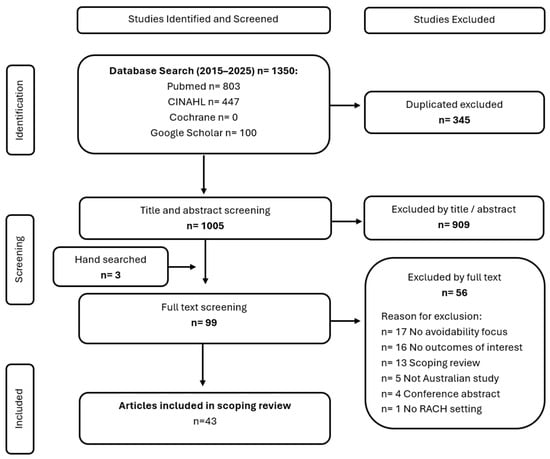
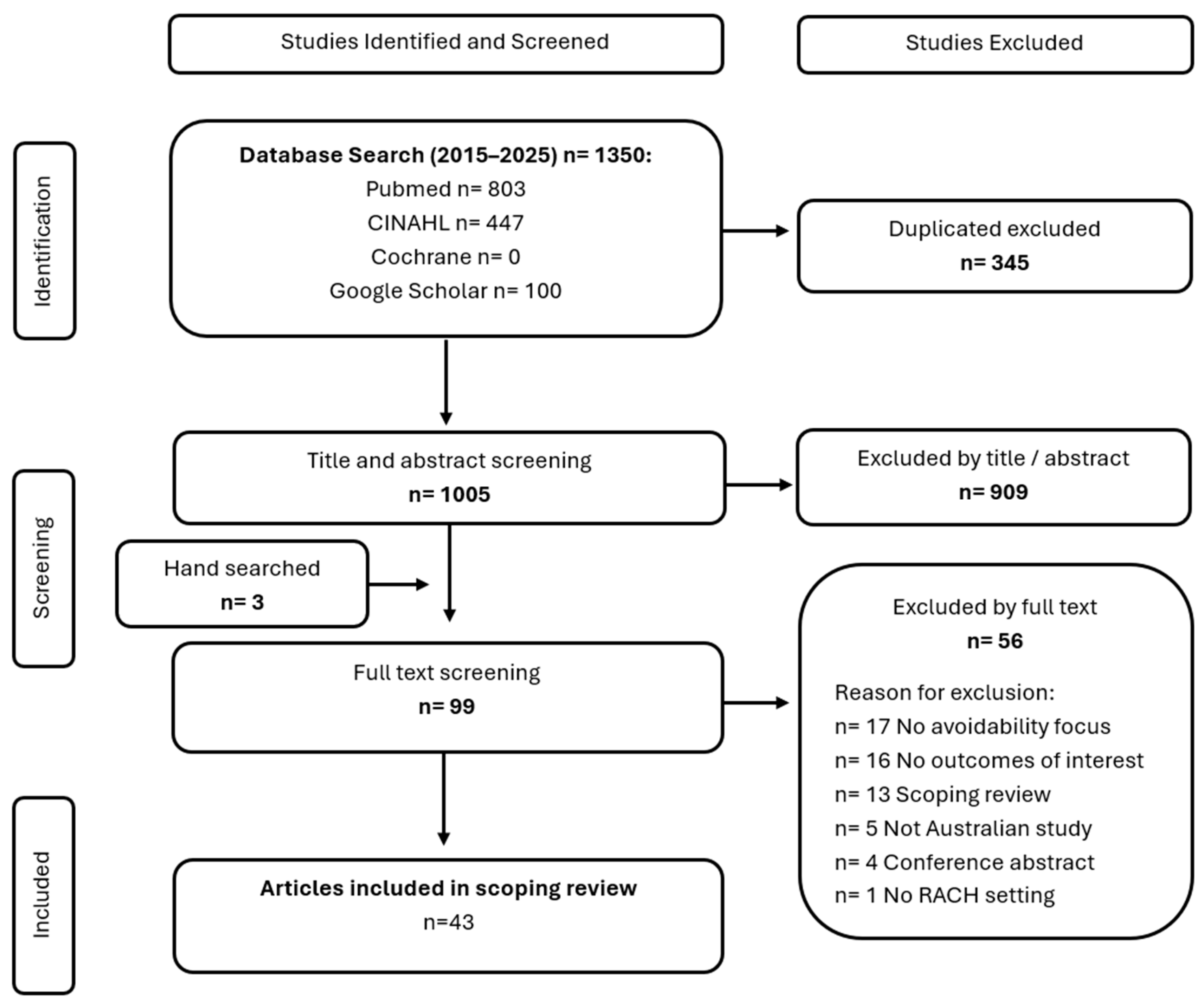
Our database search produced 1350 articles including 345 duplicates; 99 underwent full-text review, including 3 articles that were found through hand searching. A total of 43 studies met the inclusion criteria and are the subject of this review (see Figure 1). The included studies were conducted in six states and territories (from a total possible eight) covering a combined population of 344,583 Australian RACF residents, clinicians, and family members.
Figure 1.
Search results, screening process, and reasons for exclusion (PRISMA diagram).
3.1. Study Characteristics
Of the 43 included studies, 23 were quantitative, 13 qualitative, and seven mixed-methods. The majority of studies were conducted in NSW [11,12,13,14,15,16,17,18,19,20,21,22,23] (n = 13) and VIC [24,25,26,27,28,29,30,31,32,33,34,35] (n = 12), while five studies were conducted across multiple states (NSW, QLD, VIC, South Australia (SA), and Western Australia (WA)) [36,37,38,39,40,41,42]. Every multistate study included NSW; therefore, NSW was represented in 46.5% (n = 20) of all studies. Most studies were conducted exclusively in metropolitan or urban settings (n = 22, 54%), with only 9% focusing exclusively on regional or rural areas. A further 23% included both metropolitan and rural settings, while 14% did not report study setting.
Each study’s outcome/s of interest were categorised into three domains, with some studies reporting on more than one domain:
- Determinants: 25 studies (n = 12 quantitative, n = 9 qualitative, n = 4 mixed methods) identified driving factors contributing to PAHT.
- Prevalence: 24 studies (n = 19 quantitative, n = 5 mixed methods) quantified the prevalence of PAHT based on the authors’ operational definition.
- Solutions: 31 studies (n = 16 quantitative, n = 10 qualitative, n = 5 mixed methods) proposed solutions and services aimed at reducing PAHT.
A more detailed overview of study characteristics can be seen in Table 1.
Table 1.
Study characteristics of potentially avoidable hospital transfers in Australia (n = 43).
3.2. Definition of Potentially Avoidable Hospital Transfers
Although all studies reported some form of preventable, avoidable, or unnecessary hospital transfer, only 25 explicitly defined avoidability. Most defined avoidability as (1) clinical situations or conditions manageable within RACFs with outreach services or interventions (n = 15) [11,12,13,17,20,22,25,26,30,31,38,40,43,46,47]; six [15,16,33,34,39,53] as (2) conditions manageable within RACFs with robust support and continuity of primary care delivered by a GP or Nurse Practitioner (NP); or (3) presentations to ED not requiring hospital admission [28,29,32]. One study defined avoidability as ambulance attendance without ED transfer [49]. See Appendix B for detailed operational definitions.
3.3. Prevalence of Potentially Avoidable Hospital Transfers
PAHT prevalence was synthesised using each study’s operational definition of avoidability, with state-based comparisons when feasible (Appendix C).
Data sources to quantify PAHT prevalence differed. Most [15,28,29,30,31,32,33,34,43,46] solely utilised hospital/ED data (n = 10), or a combination hospital/ED and the hospital-avoidance or outreach service of interest (n = 6) [11,12,13,20,25,26]. Other data sources included RACF databases (n = 4) [38,40,49,53], ambulance service data and Registry of Senior Australians data (n = 2) [39,42]. Single studies used a combination of hospital/ED and RACF data [37], state mortality data with hospital/ED (n = 1) [16], administrative data (n = 1) [47], hospital-avoidance service data only (n = 1) [17], and one study [22] did not report its data source.
Prevalence of PAHT ranged from 8.5% to 95.2% when defined as specific conditions manageable by outreach services; 2.2% to 55.6% when defined as manageable within RACF with primary care; and 11.6% to 53% when defined as ED presentation not requiring a hospital admission. A summary of definitions, denominators, and prevalence estimates is presented in Table 2 to facilitate cross-study comparison.
Table 2.
Summary of avoidability definitions, denominators and prevalence of PAHT (n = 25).
3.3.1. Manageable by Outreach Service/Programme/Intervention
Fifteen studies (NSW, VIC, QLD, SA) quantified prevalence by evaluating interventions to reduce RACF to hospital transfers. Two studies [43,46] analysed the same intervention study of Hospital in the Nursing Home (HiNH) over the same study period, reporting the same results, and are therefore reported together (see Appendix C).
Avoidability varied widely across these fifteen studies (range 8.5–95.2%). The largest sample size (n = 4329) in this category was a quantitative study in Victoria by Street et al. [31], which examined hospital transfer rates pre- and post-implementation of an outreach service, reporting an 11% reduction in transfers. The highest reduction in PAHTs was reported in a NSW study by Huang et al. [17] with a total sample size of n = 438 episodes of care (n = 270 face-to-face care and n = 168 telemedicine) delivered by the Acute Geriatric Outreach Service, which successfully managed n = 248 residents (91.9%) face-to-face and n = 160 (95.2%) via telemedicine.
Only two interventional studies found no effect on PAHT rates. One NSW study [13] (n = 1289) reported that the Clinical Nurse Consultant-led Aged Care Emergency Service (ACE) resulted in no significant change (p = 0.56) on RACF residents presenting to ED. Similarly, the IMproving Palliative care Education and Training Using Simulation in Dementia (IMPETUS-D) [40] study with a sample size of n = 1304 RACF residents across NSW, QLD, and SA found no effect on the rate of unplanned ED transfers.
3.3.2. Manageable in RACF with Primary Care
Of the six studies defining PAHT as a condition manageable within RACFs with primary care, only one study (VIC) [34] reported more than 50% of presentations as avoidable. The largest sample size (n = 146, 963) in this category, a multistate (NSW, VIC, QLD, SA) study by Harrison et al. [39], found 14.5% of presentations to be potentially preventable through primary care provision within RACFs.
3.3.3. Not Requiring Hospital Admission
Three Victorian studies defined avoidability as ED presentations not requiring hospital admission [28,29,32]. One study [29] found greater than 50% of all presentations not requiring admission to be PAHT, while the other two studies reported PAHT prevalence below 40%.
3.4. Drivers of Avoidable Transfers and Proposed Solutions
As seen in Table 3, 25 studies from across NSW, VIC, QLD, Australian Capital Territory (ACT), and WA identified 35 individual drivers or determinants. A total of 31 studies across NSW, VIC, QLD, ACT, WA, and SA identified 33 individual solutions to reduce PAHT. Across studies, drivers were not equally represented with most categorised into the domain of clinical decision-making complexity and systemic RACF practice-based factors, while the most frequently reported solutions were in response to limited access to ongoing support.
Table 3.
Drivers (n = 25) * and proposed solutions (n = 31) * of potentially avoidable hospital transfers.
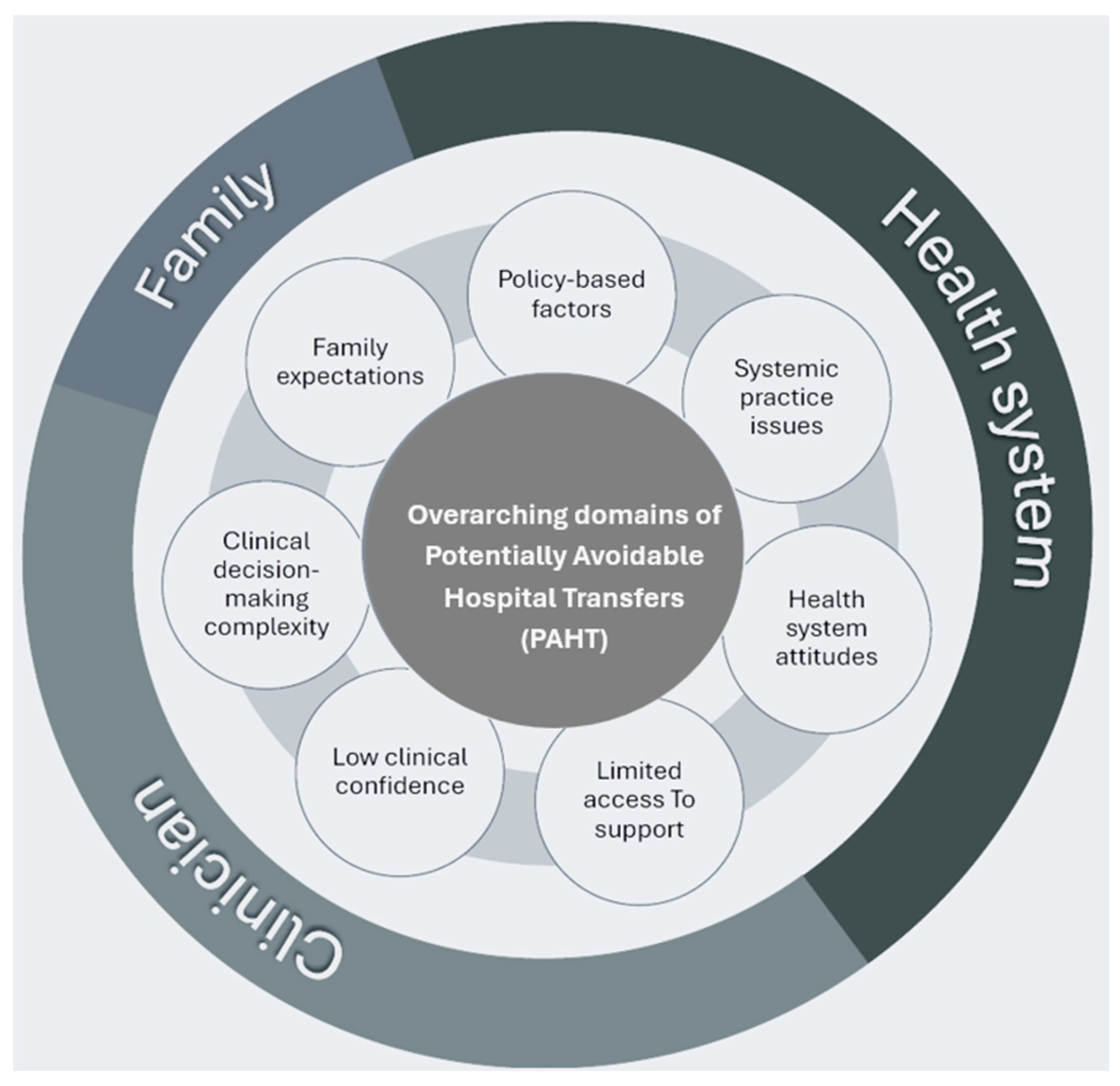
The identified drivers and solutions of PAHT were categorised into seven main domains: clinical decision-making complexity, low clinical confidence, RACF policy-based factors, systemic RACF practice-based factors, limited access to ongoing support, health system attitudes, and family expectations (see Figure 2).
Figure 2.
Overarching domains of potentially avoidable hospital transfers.
3.4.1. Clinical Decision-Making Complexity
Mentioned in 18 studies across NSW, VIC, QLD, WA, SA and the ACT, the evidence for these findings was drawn from a combination of author interpretations supported by quantitative data and qualitative interviews or surveys with RACF staff and residents’ families. The inherent complexity of the clinical decision-making process faced by RACF staff [24,27,42,49] was the main driver within this domain, identified by 25% (n = 4/16) of studies, followed by the fear of consequences arising from incorrect intervention decisions (n = 3) [23,44,49]. Other drivers identified within individual studies included inexperience among RACF Registered Nurses (RN) [21], poor recognition of resident deterioration [44], delayed identification of end of life (EOL) [21], lack of formal ACP [24,34], and poor differentiation between conditions requiring hospital-level care and those manageable within the RACF [30].
The most commonly proposed solution for this domain was the utilisation and availability of acute outreach services, proposed by RACF and outreach service staff in addition to residents’ families and supported by quantitative data of existing outreach services. This solution was suggested in eight studies [17,19,21,24,30,31,43,49] and included both onsite and telehealth support from GPs, NPs, Geriatricians, and ED nurses. The second most common solution was the implementation of robust and up-to-date ACPs [11,24,26,36,37,51] to support individualised decision-making in management of acute illness and injury (NSW, VIC, QLD, WA, SA, ACT).
3.4.2. Low Clinical Confidence
The most consistently reported driver in this domain (by three studies) [11,27,36] representing five states (VIC, NSW, QLD, WA and SA) identified low clinical confidence in assessment and management skills as a contributing factor to PAHT. In a mixed-methods study by Conway et al. [11], interviews and focus groups with RACF and ED staff identified lack of confidence among RACF RNs in performing clinical skills as a contributor to PAHT. Additional determinants identified by RACF, ED and outreach service staff and GPs included minimal support for RACF RNs in clinical decision-making [44,45] and RACF staff feeling out of their depth caring for acutely unwell residents [23].
The most commonly proposed solution to enhance clinical confidence, supported not only by participants in the primary studies but also by quantitative evidence, was the use of outreach services. These services provided clinical advice [11,17,31,37], onsite support and management of deteriorating residents [19,24,44], clinical education [11,44], and capacity-building for RACF staff [21,30,43]. Several studies also proposed evidence-based clinical care protocols, decision guides and escalation pathways to support clinical decision-making [11,37,44,53].
3.4.3. RACF Policy-Based Factors
Six studies identified specific policy as a driver of PAHT. RACF RNs and GPs in NSW identified local RACF policy that preclude nurse-initiated medications and does not support onsite management of acutely unwell residents [23] as a determinant of PAHT. Similarly, in VIC RACF staff reported that local policy inhibits many RN-level skills, such as troubleshooting indwelling catheters and administering nurse-initiated medications [27]. Qualitative interviews with RACF staff indicated that specific policies governed their decision-making, often resulting in hospital transfer irrespective of resident wishes or staff capability to provide care [27]. In addition, RACF, ED and outreach staff, along with local GPs, identified inconsistently completed and often contradictory GOC documentation as a determinant of PAHT [11,24,27,53]. For example, family requests for hospital transfer sometimes conflict with residents predefined wishes to remain in the RACF [11].
RACF managers, RNs and care staff in the ACT also reported inadequate policy guidance for identifying and managing the palliative care requirements of residents [50]. Proposed policy-based solutions included consulting evidence-based protocols and resident-informed GOC when considering hospital transfer [11,13,53], as well as engaging outreach services to provide support and equipment that enable the management of acutely unwell residents within the RACF environment [12,25].
3.4.4. Systemic RACF Practice-Based Factors
Of the ten studies reporting on determinants in this domain, 60% (30% qualitative, 20% quantitative and 10% mixed-methods) [11,23,27,28,36,49] reported RACF workforce issues, including poor skill mix, inadequate staffing levels, and a lack of specialised RACF RNs to initiate and manage acute clinical changes. Three studies [27,28,36] identified RACF RNs working in isolation as a determinant of avoidable transfers, limiting collaborative decision-making and confidence. Lack of anticipatory EOL medications or ward-stock availability during sudden deterioration [35] was identified as another contributor of PAHT, in addition to polypharmacy [36,42]. Two quantitative NSW studies identified the absence of follow-up after hospital discharge [22] and lack of physiotherapists in RACFs [16] as contributing factors.
The most frequently proposed solution to address these systemic challenges was increased availability of medical support and outreach services, particularly after hours, as reported in eight studies (NSW, VIC, QLD, WA, and SA) [13,17,24,25,28,31,37,45].
3.4.5. Limited Access to Ongoing Support
A multifaceted lack of support for RACF RNs was identified across ten studies (50% qualitative, 40% quantitative and 10% mixed-methods). This included delayed access to GPs, NPs, geriatricians and palliative care teams in NSW and VIC [15,24,28]; poor continuity of, and access to, primary care services in VIC and QLD [33,34,45]; inadequate inter-sector information sharing between RACFs, ambulance services and ED across NSW, VIC, QLD, WA and SA [14,25,36,45]; and limited availability of outreach services during after-hours and weekends, identified in one study from NSW [21].
The most commonly proposed solution (n = 4) to address this lack of support was the implementation of an onsite RACF GP. One qualitative study [45] described QLD RACF RNs’ experiences including a reduction in unnecessary hospital transfers that occurred when GP support increased, while three quantitative studies supported this solution [33,34,38]. One multistate study (VIC, QLD, NSW) [38] demonstrated the impact of a new RACF model of care employing GPs as staff members; another (VIC) [33] found that a large proportion of ED presentations involved issues that could be managed within the RACF with primary care; and a third (VIC) [34] study found that RACF residents not assessed by a GP were more likely to present to ED than those who were. Another commonly suggested solution was improved access to comprehensive outreach services, including extending operation hours [21], hospital-in-the-home style interventions such as intravenous treatments [12,25], and increased clinical support for RACF staff [25,28].
3.4.6. Health System Attitudes
The most reported driver was noted by four studies (n = 2 quantitative, n = 1 mixed methods, n = 1 qualitative) and identified poor inter-sector recognition and understanding of the unique care context and barriers faced across the RACF setting [11,13,14,25]. For example, a qualitative study of QLD RACF staff perceptions highlighted poor recognition of RACF RNs as professionals, with some feeling they were labelled as incompetent [45], while in NSW, RACF staff reported feeling a lack of respect from ambulance and ED staff [23].
Four qualitative studies using interviews and focus groups with RACF RNs, GPs, and ED RNs across NSW and QLD proposed solutions to address health system attitudes. These included utilising outreach services to bridge gaps between RACF and ambulance/ED staff through clinical support [44,45] and enhancing communication and positive working relationships [23,45]. Additionally, a NSW-based study found that ED-led virtual telehealth support for RACF staff during acute situations helped build inter-sector trust and relationships [19].
3.4.7. Family Expectations
Family pressure on RACF RNs to initiate hospital transfers was identified as the main contributing factor to PAHT reported by five studies (n = 3 quantitative, n = 2 qualitative) [24,26,36,49,53]. In the context of palliative care, a mixed-methods study conducted in NSW [15] observed families’ poor understanding of EOL trajectories and overruling of ACPs during the terminal phase of a resident’s life. In VIC, the absence of predefined individual wishes, often due to incomplete ACP documentation, was identified as a determinant of PAHT [35]. Conversely, a discrete choice experiment found that RACF residents, families, and staff share an underlying preference for hospital transfer in certain situations, such as pneumonia [41].
Proposed solutions included early and robust GOC discussions with residents and families, alongside completion of ACP documentation, as recommended by two mixed-methods studies involving RACF RNs, assistants in nursing, NPs and GPs [15,26]. Outreach services capable of providing ED-equivalent investigations and treatments within the RACF were also recommended in two studies [41,44].
4. Discussion
In this scoping review synthesis of 43 studies reporting on determinants, prevalence, and proposed solutions of PAHT among RACF residents in Australia, we identified three main sources of avoidable hospital transfers: those amenable to management by outreach services, those manageable onsite with primary care, and those not warranting hospital admission.
Multi-level interventions demonstrated effectiveness in reducing PAHT. Consistent evidence across five states and one territory, spanning both metropolitan and rural healthcare settings, supports the role of acute outreach services as a key mechanism for reducing avoidable transfers, with similar findings reported internationally [6]. The proposed solutions in this study align with the Australian Medical Association’s 2021 [2] recommendations to strengthen healthcare provision within aged care, including improved primary care access, telehealth utilisation and better interoperability between acute service, GPs and RACFs [2,54]. Given the demonstrated impact of outreach services, a national policy position is needed on whether RACFs should remain a non-acute care environment or evolve to incorporate aspects of acute care.
The provision of acute care in RACFs, supported by onsite GPs, Geriatricians, and/or continuity and expansion of outreach services, would ensure equitable access to acute care services for RACF residents. In Australia, aged care funding is divided between the Commonwealth contributing to the funding of RACFs and local State government funding the majority of outreach services. This funding arrangement creates fragmented programme delivery and gaps in continuity of care.
Our study reported an overall avoidability prevalence as a range from 8.5% to 95.2%, a variation driven largely by study methods and definitions of avoidability rather than true practice variation. In keeping with the global literature, our review found no consensus of definition for avoidability of hospital transfers from RACF [1,55]. Two dominant operational definitions emerged from our included studies: (1) conditions manageable in RACFs through robust primary care and early intervention, and (2) acute changes manageable in RACFs with support from acute outreach services. Although no consensus of a definition has been reached, similar concepts were identified in a 2016 review finding early detection and management within RACF to be one of the most common criteria for avoidability [56]. Heterogeneous definitions remain a major barrier to consistent measurement, complicating efforts to ascertain true prevalence and compare outcomes across facilities and jurisdictions. This lack of clarity is particularly salient, regarding significant investments in initiatives aiming to reduce hospital transfers, such as NSW Health’s HITH [54]. Without standardised definitions, comparing outcomes and measuring success across programmes will remain challenging.
On a larger scale, a 2019 systematic review of 77 studies [1] supports this view, reporting a wide PAHT prevalence (range 4–55%), attributed partly to the subjective nature of what is referred to as appropriateness of transfers. Conversely, in Australia, a study conducted in the ACT reported similar state-level prevalence, with Codde et al. [57] quantifying PAHT at 31% of RACF resident hospital presentations.
In attempt to consolidate our PAHT prevalence results and address definitional subjectivity, we reported our findings by avoidability criteria. However, even with this approach, we reported a wide prevalence range of PAHT, from 2.2% to 95.2% (across all avoidability criteria), suggesting that the complexity of PAHT extends beyond definitional subjectivity and reflects fundamental differences in system capacity, workforce skill mix and staffing, and integration of external services and support. This finding implies that PAHT is not solely a measurement challenge but an indicator of variation in the delivery of care. The wide range is likely to also be explained by the difference in study design (interventions, observational audits, pre/post comparisons), data sources (hospital records, RACF databases, outreach service data), studies focusing on specific conditions (e.g., falls or infections) rather than all cause transfers, and populations sampled (single-facility, multi-state, urban/rural).
Determinants and solutions were categorised into seven overarching themes, identifying 35 individual drivers and more than 30 solutions, and clearly demonstrating the complex multifaceted nature of PAHT. Most determinants reflect system-level barriers that preclude RACF staff from providing acute care within the RACF environment. Six studies explicitly identified RACF policy as a driver of PAHT, indicating that care could reasonably have been delivered within the RACF. These broad systemic drivers of PAHT, including insufficient equipment and clinical support to manage acute care needs of residents, are likely to have a causative effect on the low clinical confidence of RACF staff. This thematic approach offers a novel conceptualisation of PAHT drivers and solutions, contrasting with previous studies that utilised a single lens discussion of drivers, for example, falls as a specific clinical condition resulting in high prevalence of ED presentation [4]. Our approach captures the comprehensive interplay of system pressure, workforce capability and clinical complexity. Importantly, this synthesis shifts the framing of PAHT from being primarily condition-specific to a broader systems-level approach shaped by workforce capability, timely access of medical support, and organisational policy constraints. This conceptualisation highlights that the solution to PAHT requires coordinated system redesign in favour of isolated clinical interventions.
Many determinants speak to low clinical confidence and skill levels among RACF nurse. In hospitals, nurses respond to acute changes with immediate access to medical practitioners, providing direct consultation, coordination, and continuous clinical governance. In contrast, Australian RACF nurses operate without direct, ongoing medical oversight, with GP involvement often being episodic and delayed during acute deterioration [58]. Consequently, RACF nurses are often required to make complex clinical decisions without timely medical input. Our review found that improved GP continuity and timely medical support are proven solutions to PAHT, yet limited access remains due to GP availability and inconsistency of after-hours services [59]. While acute outreach services can mitigate these gaps, they do not address the underlying cause. This instead calls for supportive policy, robust education, and clinical support for RACF nurses to build capacity and uplift clinical capability and confidence of the RACF workforce. This is further supported by the Australian Medical Association’s 2021 [2] recommendations for stronger investment in RACF primary care and the Aged Care Royal Commission’s mandate for increased RACF workforce through care minutes [60].
Notably, no determinants explicitly identified resident choice as a driver of PAHT, although qualitative findings from Arendts et al. [41] indicated residents and families often preferred hospital transfer in certain clinical scenarios. Ten studies identified lack of ACP documentation as a contributor to PAHT, with three identifying that an absence of ACP can result in care misaligned with patient goals and wishes. These findings are particularly relevant in the context of Australia’s Aged Care Act 2024, the rights-based framework emphasising autonomy, informed decision-making, dignity, and person-centred care. The Act’s Statement of Rights reinforces older persons’ rights to participate in decisions regarding their care, including the choice of care that aligns with their preferences and values. In this context, inadequate ACP processes may compromise residents’ ability to exercise these rights, particularly during acute clinical deterioration. More broadly, the rights-based Act is highly relevant to PAHT among RACF residents, as avoidable transfers are frequently associated with gaps in timely clinical assessment, chronic disease management, communication, workforce capability, continuity of care, and access to appropriate onsite management. By positioning safe, high-quality, and person-centred care as a legal and regulatory obligation, the Act may influence clinical decision-making and hospital referral practices within RACFs by increasing expectations for comprehensive assessment, proactive care planning, and delivery of appropriate care within the residential setting where clinically feasible. However, these health reforms may currently fall short of associated funding to support aged care practice and policy but highlight the need for strengthened clinical governance, workforce capability, multidisciplinary collaboration, and ACP implementation to support residents’ preferences while reducing avoidable hospital transfers.
4.1. Future Research
The new Aged Care Act 2024, which commenced in November 2025, introduces a rights-based approach to individualised care. A key change is that RACF policy can no longer apply blanket rules and must instead support individualised care informed by good clinical judgement [7]. This reform is expected to influence clinical practice, while future research evaluating the outcome of this change would be valuable.
Beyond legislative reform, further research is needed to examine the practical realities of delivering acute care within RACFs. Significant gaps remain in understanding the long-term effectiveness and sustainability of outreach services, particularly in geographically diverse and rural and remote areas, and whether such services can complement or serve as a substitute for onsite medical practitioners. While outreach services are consistently identified as an effective strategy to reduce PAHT, their practicality and scalability are context-dependent. These services can be resource-intensive, requiring specialised clinicians, extended operating hours, access to diagnostic technology, and strong integration of primary and acute care. Such requirements may be feasible in metropolitan regions with established workforce capacity and infrastructure but pose significant challenges in rural and remote areas where workforce shortages, geographic reach, and limited after-hours coverage would constrain implementation. Sustainability and equity of access is further influenced by fragmented funding arrangements between aged care and health systems. Without careful consideration of workforce supply, funding models, and regional context, widespread scaling of outreach services might not be achievable at large scale despite demonstrated effectiveness.
The establishment of a national consensus or a set of clearly defined categories with associated indicators on what constitutes a PAHT in RACF would greatly enhance the accuracy of prevalence estimates and the evaluation of intervention effectiveness and cost-efficiency. A consensus would support the development of clinical protocols and resident-centred care, improve data quality across the healthcare sector, and reduce unwarranted variation. Finally, a public education campaign to inform families about the benefits and harms of burdensome transfers may reduce demand for acute services and improve trust in onsite nursing care for conditions that can be safely managed within RACFs.
4.2. Study Limitations
Notably, NSW and VIC are populous states with large metropolitan areas and were over-represented, while representation of WA, SA and ACT was poor, and there was no representation in Northen Territory or Tasmania. As a result, findings may not fully reflect healthcare landscapes across all Australia jurisdictions or internationally, given differing geographical and sociocultural environments. The lack of standardised avoidability criteria is likely to have reduced the accuracy of PAHT estimates. Along these lines, a major limitation of this evidence synthesis is heterogeneity across the included studies, arising from variation in definitions of avoidability, study design, data sources, and population profiles, which shaped how determinants of PAHT were identified and interpreted. Drivers such as clinical confidence, inter-sector relationships, and family expectations were found predominantly in qualitative studies, while quantitative studies more often highlighted structural contributors, including staffing levels and access to primary care, differences in state-based RACF policies, funding models, and availability of outreach services which also produced variations in results. Variation in participant groups (RNs, care staff, GPs, ED clinicians, families) further influenced the emphasis placed on certain determinants, especially regarding clinical decision-making complexity. All these contextual and workforce-related differences point to the need for nationally consistent data and policy frameworks to better understand and address PAHT.
Further, the voices of cognitively impaired residents were absent, and culturally and linguistically diverse (CALD) residents and families were represented in only one study. This gap warrants further exploration to ensure future interventions and policies are inclusive and address the needs of these underrepresented groups. As this review focused exclusively on the Australian context, the practical impact of the English-language restriction is likely to be minimal. However, we acknowledge that any non-English literature published in other languages relevant to CALD residents would not have been captured.
5. Conclusions
Across studies, consistent patterns emerged, particularly regarding the effectiveness of acute outreach services in supporting RACF staff to manage acute deterioration and reduce PAHTs. Key policy priorities should be supported with funding to support strengthening continuity of primary care in RACFs, innovative funding models, enhanced workforce capacity, interprofessional integration of health service tiers, and shared infrastructure, which might be needed to secure equitable access to outreach assessment and management services more widely in Australia. These efforts should be complemented by data collection, including capture of patient and carer experience measures, to enable accurate analysis of drivers, outcomes and associated costs. Standardisation of avoidability definitions and monitoring indicators may assist in ascertainment of unwarranted practice variation.
Author Contributions
Conceptualization, E.-K.M., M.C. and E.T.L.; methodology, E.-K.M., M.C. and E.T.L.; software, E.-K.M., M.C. and E.T.L.; validation, E.-K.M., M.C. and E.T.L.; formal analysis, E.-K.M., M.C. and E.T.L.; investigation, E.-K.M., M.C. and E.T.L.; resources, E.-K.M., M.C. and E.T.L.; data curation, E.-K.M., M.C., E.T.L. and C.D.; writing—original draft preparation, E.-K.M., M.C. and E.T.L.; writing—review and editing, S.F. and D.N.C.; visualization, E.-K.M., C.D. and S.F.; supervision, M.C. and E.T.L. All authors have read and agreed to the published version of the manuscript.
Funding
This research received no external funding.
Data Availability Statement
The data supporting the findings of this study are presented in the appendices of this article.
Acknowledgments
We thank the University of New South Wales librarian Helen Jones for assistance with refinement of the search strategy. We also thank nurse JK for her contribution to the screening process.
Conflicts of Interest
The authors declare no conflicts of interest.
Abbreviations
The following abbreviations are used in this manuscript:
| PAHT | Potentially Avoidable Hospital Transfer |
| RACF | Residential Aged Care Facility |
| EOL | End of Life |
| ED | Emergency Department |
| GP | General Practitioner |
| NP | Nurse Practitioner |
| RN | Registered Nurse |
| NSW | New South Wales |
| QLD | Queensland |
| VIC | Victoria |
| SA | South Australia |
| WA | Western Australia |
| ACT | Australian Capital Territory |
| ACP | Advanced Care Planning |
| IV | Intravenous |
| GoC | Goals of Care |
| CALD | Culturally and Linguistical Diverse |
| UTI | Urinary Tract Infection |
| HITH | Hospital in the Home |
Appendix A
Proposed Full Search Strategy
PubMed
(“emergency department*”[Title/Abstract] OR “hospital*”[Title/Abstract] OR “ED”[Title/Abstract] OR “emergency room*”[Title/Abstract] OR “emergency care”[Title/Abstract] OR “emergency presentation*”[Title/Abstract] OR “hospital transfer*”[Title/Abstract] OR “hospital admission*”[Title/Abstract] OR “hospitali*ation”[Title/Abstract] OR “hospital stay*”[Title/Abstract] OR “patient transfer*”[Title/Abstract] OR “hospital presentation*”[Title/Abstract] OR “resident transfer*”[Title/Abstract] OR “nursing home resident transfer”[Title/Abstract:~4] OR “potential resident hospital transfer”[Title/Abstract:~4] OR “potential resident hospital transfers”[Title/Abstract:~4])
OR
(“avoidable hospital transfer”[Title/Abstract:~4] OR “avoidable hospital transfers”[Title/Abstract:~4] OR “avoidable hospital admission”[Title/Abstract:~4] OR “avoidable hospital admissions”[Title/Abstract:~4] OR “avoidable patient transfer”[Title/Abstract:~4] OR “avoidable transfer”[Title/Abstract:~4] OR “avoidable transfers”[Title/Abstract:~4] OR “avoidable patient transfers”[Title/Abstract:~4] OR “potentially avoidable hospital transfer”[Title/Abstract:~4] OR “potentially avoidable hospital admissions”[Title/Abstract:~4] OR “potentially avoidable emergency department transfer”[Title/Abstract:~4] OR “potentially avoidable emergency department transfers”[Title/Abstract:~4] OR “potentially avoidable hospital presentations”[Title/Abstract:~4] OR “inappropriate hospital presentation”[Title/Abstract:~4] OR “potentially inappropriate hospital transfer”[Title/Abstract:~4] OR “unnecessary hospital transfer”[Title/Abstract:~4] OR “preventable hospital transfer”[Title/Abstract:~4] OR “non-beneficial hospital transfer”[Title/Abstract:~4] OR “burdensome hospital transfer”[Title/Abstract:~4] OR “unwarranted hospital transfer”[Title/Abstract:~4] OR “ambulatory care-sensitive conditions”[Title/Abstract:~4])
OR
(“Hospitalization”[MeSH Terms] OR “Patient Transfer”[MeSH Terms])
AND
(“RACH”[Title/Abstract] OR “RACF”[Title/Abstract] OR “aged residential care”[Title/Abstract] OR “care home*”[Title/Abstract] OR “aged care”[Title/Abstract] OR “aged care resident*”[Title/Abstract] OR “aged care home*”[Title/Abstract] OR “aged care facilit*”[Title/Abstract] OR “nursing home*”[Title/Abstract] OR “residential aged care”[Title/Abstract] OR “residential aged care facility resident”[Title/Abstract:~6] OR “aged care resident”[Title/Abstract:~6] OR “aged care facility resident”[Title/Abstract:~6] OR “nursing home resident”[Title/Abstract:~6] OR “residential aged care facility residents”[Title/Abstract:~6] OR “aged care residents”[Title/Abstract:~6] OR “aged care facility residents”[Title/Abstract:~6] OR “nursing home residents”[Title/Abstract:~6])
OR
(“Homes for the Aged”[MeSH Terms] OR “Nursing Homes”[MeSH Terms])
AND
(“determin*”[Title/Abstract] OR “prevalence*”[Title/Abstract] OR “incidence”[Title/Abstract] OR “occurrence”[Title/Abstract] OR “factor*”[Title/Abstract] OR “caus*”[Title/Abstract] OR “predisposing factor*”[Title/Abstract] OR “precipitating factor*”[Title/Abstract] OR “perspective*”[Title/Abstract] OR “appropriate*”[Title/Abstract] OR “proportion”[Title/Abstract] OR “perception*” [Title/Abstract] OR “impact of intervention”[Title/Abstract:~6])
OR
(“Causality”[MeSH Terms])
AND
(“Austral*”[Title/Abstract] OR “Queensland”[Title/Abstract] OR “Brisbane”[Title/Abstract] OR “Victoria”[Title/Abstract] OR “Melbourne”[Title/Abstract] OR “New South Wales”[Title/Abstract] OR “NSW”[Title/Abstract] OR “Sydney”[Title/Abstract] OR “South Australia”[Title/Abstract] OR “Adelaide”[Title/Abstract] OR “Western Australia”[Title/Abstract] OR “Perth”[Title/Abstract] OR “Northern Territory”[Title/Abstract] OR “Darwin”[Title/Abstract] OR “Australian Capital Territory”[Title/Abstract] OR “ACT”[Title/Abstract] OR “Canberra”[Title/Abstract] OR “Tasmania”[Title/Abstract] OR “Hobart”[Title/Abstract])
OR
(“AUSTRALIA”[MeSH Terms] OR “Australasian People”[MeSH Terms])
Appendix B
Table A1.
Operational Definitions of Avoidability for Each Included Study by State (n = 25).
Appendix C
Table A2.
Prevalence by Avoidability Criteria and Total Sample Size n = 25.
Appendix D
Table A3.
Preferred Reporting Items for Systematic Reviews and Meta-Analyses Extension for Scoping Reviews (PRISMA-ScR) Checklist.
References
- Lemoyne, S.; Herbots, H.; De Blick, D.; Remmen, R.; Monsieurs, K.; Van Bogaert, P. Appropriateness of transferring nursing home residents to emergency departments: A systematic review. BMC Geriatr. 2019, 19, 17. [Google Scholar] [CrossRef] [Scilit] [PubMed]
- Australian Medical Association. Putting Health Care Back into Aged Care. 2021. Available online: https://www.ama.com.au/articles/report-putting-health-care-back-aged-care-0 (accessed on 17 September 2025).
- Australian Institute of Health and Welfare. What Are Potentially Preventable Hospitalisations? Australian Institute of Health and Welfare: Canberra, Australia, 2022.
- Gruneir, A.; Bell, C.; Bronskill, S.; Schull, M.; Anderson, G.; Rochon, P. Frequency and Pattern of Emergency Department Visits by Long-Term Care Residents—A Population-Based Study. J. Am. Geriatr. Soc. 2010, 58, 510–517. [Google Scholar] [CrossRef] [Scilit] [PubMed]
- Chambers, D.; Cantrell, A.; Preston, L.; Marincowitz, C.; Wright, L.; Conroy, S.; Lee Gordon, A. Reducing unplanned hospital admissions from care homes: A systematic review. Health Soc. Care Deliv. Res. 2023, 11, 1–130. [Google Scholar] [CrossRef] [Scilit] [PubMed]
- Tate, K.; Cummings, G.; Jacobsen, F.; Halas, G.; Van den Bergh, G.; Devkota, R.; Shrestha, S.; Doupe, M. Strategies to Improve Emergency Transitions From Long-Term Care Facilities: A Scoping Review. Gerontologist 2024, 64, gnae036. [Google Scholar] [CrossRef] [Scilit]
- Aged Care Act 2024. 2024. Available online: https://www.legislation.gov.au/C2024A00104/asmade/text (accessed on 6 January 2026).
- Australia Royal Commission into Aged Care Quality and Safety. Hospitalisations in Australian Aged Care: 2014/2015–2018/2019; Australia Royal Commission into Aged Care Quality and Safety: Canberra, Australia, 2021; p. 11.
- Peters, M.; Godfrey, C.; Khalil, H.; McInerney, P.; Parker, D.; Soares, C. Guidance for conducting systematic scoping reviews. Int. J. Evid. Based Healthc. 2015, 13, 141–146. [Google Scholar] [CrossRef] [Scilit]
- Australian Bureau of Statistics. National, State and Territory Population; Australian Bureau of Statistics: Canberra, Australia, 2025.
- Conway, J.; Higgins, I.; Hullick, C.; Hewitt, J.; Dilworth, S. Nurse-led ED support for residential aged care facility staff: An evaluation study. Int. Emerg. Nurs. 2015, 23, 190–196. [Google Scholar] [CrossRef] [Scilit]
- Dai, J.; Liu, F.; Irwanto, D.; Kumar, M.; Tiwari, N.; Chen, J.; Xu, Y.; Smith, M.; Chan, D. Impact of an acute geriatric outreach service to residential aged care facilities on hospital admissions. Aging 2021, 4, 169–174. [Google Scholar] [CrossRef] [Scilit]
- Hullick, C.J.; Hall, A.; Conway, J.; Hewitt, J.; Darcy, L.; Barker, R.; Oldmeadow, C.; Attia, J. Reducing Hospital Transfers from Aged Care Facilities: A Large-Scale Stepped Wedge Evaluation. J. Am. Geriatr. Soc. 2021, 69, 201–209. [Google Scholar] [CrossRef] [Scilit]
- Montgomery, A.; Kearns, M.; Bolton, S.; Gill, A.; De, J.; Smerdely, P. ‘REDI TO CHAT?’ Evaluating the effect of two structured tools on the confidence of nursing and care staff working in residential aged care facilities in Australia: A pre-post survey design. Australas. J. Ageing 2022, 42, 374–381. [Google Scholar] [CrossRef] [Scilit]
- Moberley, S.; Hewitt, J.; Attia, J.; Cole, J.; Bevington, J.; Oldmeadow, C.; Howard, Z.; Hughes, R. Preferences and end of life care for residents of aged care facilities: A mixed methods study. BMC Palliat. Care 2023, 22, 124. [Google Scholar] [CrossRef] [Scilit]
- Mitsutake, S.; Lystad, R.; Okuba, T.; Long, J.; Braithwaite, J.; Hirata, T.; Mitchell, R. Differing risk factors for potentially preventable and fall-related injury readmissions of older residents in long-term care facilities after hip fracture. Arch. Gerontol. Geriatr. 2025, 131, 105779. [Google Scholar] [CrossRef] [Scilit]
- Huang, G.; Kumar, M.; Liu, X.; Irwanto, D.; Zhou, Y.; Chirapa, E.; Xu, Y.; Shulruf, B.; Chan, D.Y. Telemedicine vs. Face-to-Face for Nursing Home Residents With Acute Presentations: A Noninferiority Study. J. Am. Med. Dir. Assoc. 2023, 24, 1471–1477. [Google Scholar] [CrossRef] [Scilit]
- Sunner, C.; Giles, M.; Ball, J.; Barker, R.; Hullick, C.; Oldmeadow, C.; Foureur, M. Implementation and evaluation of a nurse-led intervention to augment an existing residential aged care facility outreach service with a visual telehealth consultation: Stepped-wedge cluster randomised controlled trial. BMC Health Serv. Res. 2023, 23, 1429. [Google Scholar] [CrossRef] [Scilit]
- Sunner, C.; Giles, M.; Kable, A.; Foureur, M. Experiences of nurses working in RACFs and EDs utilising visual telehealth consultation to assess the need for RACF resident transfer to ED: A qualitative descriptive study. J. Clin. Nurs. 2022, 32, 4694–4709. [Google Scholar] [CrossRef] [Scilit] [PubMed]
- Testa, L.; Hardy, J.; Jepson, T.; Braithwaite, J.; Mitchell, R. Health service utilisation and health outcomes of residential aged care residents referred to a hospital avoidance program: A multi-site retrospective quasi-experimental study. Australas. J. Ageing 2021, 40, e244–e253. [Google Scholar] [CrossRef] [Scilit] [PubMed]
- Testa, L.; Ryder, T.; Braithwaite, J.; Mitchell, R. Factors impacting hospital avoidance program utilisation in the care of acutely unwell residential aged care facility residents. BMC Health Serv. Res. 2021, 21, 599. [Google Scholar] [CrossRef] [Scilit] [PubMed]
- Cordato, N.; Kearns, M.; Smerdely, P.; Seeher, K.; Gardiner, M.; Brodaty, H. Management of Nursing Home Residents Following Acute Hospitalization: Efficacy of the “Regular Early Assessment Post-Discharge (REAP)” Intervention. J. Am. Med. Dir. Assoc. 2018, 19, 276.e211–276.e219. [Google Scholar] [CrossRef] [Scilit]
- Stokoe, A.; Hullick, C.; Higgins, I.; Hewitt, J.; Armitage, D.; O’Dea, I. Caring for acutely unwell older residents in residential aged-care facilities: Perspectives of staff and general practitioners. Australas. J. Ageing 2015, 35, 127–132. [Google Scholar] [CrossRef] [Scilit]
- Amadoru, S.; Rayner, J.A.; Joseph, R.; Yates, P. Factors influencing decision-making processes for unwell residents in residential aged care: Hospital transfer or Residential InReach referral? Australas. J. Ageing 2018, 37, E61–E67. [Google Scholar] [CrossRef] [Scilit]
- Kwa, J.M.; Storer, M.; Ma, R.; Yates, P. Integration of Inpatient and Residential Care In-Reach Service Model and Hospital Resource Utilization: A Retrospective Audit. J. Am. Med. Dir. Assoc. 2021, 22, 670–675. [Google Scholar] [CrossRef] [Scilit]
- Martin, R.; Hayes, B.; Hutchinson, A.; Tacey, M.; Yates, P.; Lim, W. Introducing Goals of Patient Care in Residential Aged Care Facilities to Decrease Hospitalization: A Cluster Randomized Controlled Trial. J. Am. Med. Dir. Assoc. 2019, 20, 1318–1324.e1312. [Google Scholar] [CrossRef] [Scilit]
- Rayner, J.; Fetherstonhaugh, D. What factors influence nursing home use of hospital avoidance programs? An interview study. J. Adv. Nurs. 2022, 78, 510–522. [Google Scholar] [CrossRef] [Scilit]
- Morphet, J.; Innes, K.; Griffiths, D.; Crawford, K.; Williams, A. Resident transfers from aged care facilities to emergency departments: Can they be avoided? Emerg. Med. Australas. 2015, 27, 412–418. [Google Scholar] [CrossRef] [Scilit] [PubMed]
- Tulchinsky, I.; Buckley, R.; Meek, R.; Lim, J. Potentially avoidable emergency department transfers from residential aged care facilities for possible post-fall intracranial injury. Emerg. Med. Australas. 2022, 35, 41–47. [Google Scholar] [CrossRef] [Scilit]
- Miller, J.; Bee, A.; Pattison, D.; Walker, M.; Aldridge, E.; Hackett, L.; Owen, P.; Marangon-Elliott, R.; Buntine, P. Managing falls onsite in residential aged care homes reduced hospitalisation: Mixed methods results from the Falls Outreach and Residential Mobile Assessment Team (FORMAT) pilot study. Australas. J. Ageing 2024, 43, 773–781. [Google Scholar] [CrossRef] [Scilit]
- Street, M.; Considine, J.; Livingston, P.; Ottmann, G.; Kent, B. In-reach nursing services improve older patient outcomes and access to emergency care. Australas. J. Ageing 2015, 34, 115–120. [Google Scholar] [CrossRef] [Scilit] [PubMed]
- Long, K.; Haines, T.; Clifford, S.; Sundram, S.; Srikanth, V.; Macindoe, R.; Leung, W.Y.; Hlavac, J.; Enticott, J. English language proficiency and hospital admissions via the emergency department by aged care residents in Australia: A mixed-methods investigation. Health Soc. Care Community 2022, 30, e4006–e4019. [Google Scholar] [CrossRef] [Scilit] [PubMed]
- Freed, G.; Gafforini, S.; Carson, N. Age-related variation in primary care-type presentations to emergency departments. Australas. Fam. Physician 2015, 44, 584–588. [Google Scholar]
- Gullick, D.; Islam, M. Exploring avoidable presentations from residential aged care facilities to the emergency department of a large regional Australian hospital. Australas. J. Rural. Health 2023, 31, 514–521. [Google Scholar] [CrossRef] [Scilit]
- Brownstein, H.; Hayes, B.; Simadri, A.; Tacey, M.; Holbeach, E. Care to the end: A retrospective observational study of aged care facility residents transferred to hospital in the last day of life. Inten. Med. J. 2021, 51, 27–32. [Google Scholar] [CrossRef] [Scilit]
- Cain, P.; Alan, J.; Porock, D. Emergency department transfers from residential aged care: What can we learn from secondary qualitative analysis of Australian Royal Commission data? BMJ Open 2022, 12, e063790. [Google Scholar] [CrossRef] [Scilit]
- Dyer, S.; Liu, E.; Gnanamanickam, E.; Milte, R.; Easton, T.; Harrison, S.; Bradley, C.; Ratcliffe, J.; Crotty, M. Clustered domestic residential aged care in Australia: Fewer hospitalisations and better quality of life. Med. J. Aust. 2018, 208, 433–438. [Google Scholar] [CrossRef] [Scilit] [PubMed]
- Haines, T.; Palmer, A.; Tierney, P.; Si, L.; Robinson, A. A new model of care and in-house general practitioners for residential aged care facilities: A stepped wedge, cluster randomised trial. Med. J. Aust. 2020, 212, 409–415. [Google Scholar] [CrossRef] [Scilit] [PubMed]
- Harrison, S.; Lang, C.; Eshetie, T.; Crotty, M.; Whitehead, C.; Evans, K.; Corlis, M.; Wesselingh, S.; Caughey, G.; Inacio, M. Hospitalisations and emergency department presentations by older individuals accessing long-term aged care in Australia. Australas. Health Rev. 2024, 48, 182–190. [Google Scholar] [CrossRef] [Scilit] [PubMed]
- Tropea, J.; Nestel, D.; Johnson, C.; Hayes, B.; Hutchinson, A.; Brand, C.; Le, B.; Blackberry, I.; Caplan, G.; Bicknell, R.; et al. Evaluation of IMproving Palliative care Education and Training Using Simulation in Dementia (IMPETUS-D) a staff simulation training intervention to improve palliative care of people with advanced dementia living in nursing homes: A cluster randomised controlled trial. BMC Geriatr. 2022, 22, 127. [Google Scholar] [CrossRef] [Scilit]
- Arendts, G.; Jan, S.; Beck, M.; Howard, K. Preferences for the emergency department or alternatives for older people in aged care: A discrete choice experiment. Age Ageing 2017, 46, 124–129. [Google Scholar] [CrossRef] [Scilit]
- Inacio, M.; Jorissen, R.; Wesselingh, S.; Sluggett, J.; Whitehead, C.; Maddison, J.; Forward, J.; Bourke, A.; Harvey, G.; Crotty, M.; et al. Predictors of hospitalisations and emergency department presentations shortly after entering a residential aged care facility in Australia: A retrospective cohort study. BMJ Open 2021, 11, e057247. [Google Scholar] [CrossRef] [Scilit]
- Lukin, B.; Fan, L.-J.; Zhao, J.-Z.; Sun, J.-D.; Dingle, K.; Purtill, R.; Tapp, S.; Hou, X.-Y. Emergency department use among patients from residential aged care facilities under a Hospital in the Nursing Home scheme in public hospitals in Queensland Australia. World J. Emerg. Med. 2016, 7, 183–190. [Google Scholar] [CrossRef] [Scilit]
- O’Neill, B.; Dwyer, T.; Reid-Searl, K.; Parkinson, L. Nursing staff intentions towards managing deteriorating health in nursing homes: A convergent parallel mixed-methods study using the theory of planned behaviour. J. Clin. Nurs. 2018, 27, e992–e1003. [Google Scholar] [CrossRef] [Scilit]
- Gurung, A.; Romeo, M.; Clark, S.; Hocking, J.; Dhollande, S.; Broadbent, M. The enigma: Decision-making to transfer residents to the emergency department; communication and care delivery between emergency department staff and residential aged care facilities’ nurses. Australas. J. Ageing 2022, 41, e348–e355. [Google Scholar] [CrossRef] [Scilit]
- Fan, L.; Hou, X.-Y.; Zhao, J.; Sun, J.; Dingle, K.; Purtill, R.; Tapp, S.; Lukin, B. Hospital in the Nursing Home program reduces emergency department presentations and hospital admissions from residential aged care facilities in Queensland, Australia: A quasi-experimental study. BMC Health Serv. Res. 2016, 16, 46. [Google Scholar] [CrossRef] [Scilit] [PubMed]
- Carter, H.; Lee, X.; Dwyer, T.; O’Neill, B.; Jeffrey, D.; Doran, C.; Parkinson, L.; Osborne, S.; Reid-Searl, K.; Graves, N. The effectiveness and cost effectiveness of a hospital avoidance program in a residential aged care facility: A prospective cohort study and modelled decision analysis. BMC Geriatr. 2020, 20, 527. [Google Scholar] [CrossRef] [Scilit]
- O’Neill, B.; Dwyer, T.; Reid-Searl, K.; Parkinson, L. Managing the deteriorating nursing home resident after the introduction of a hospital avoidance programme: A nursing perspective. Scand. J. Caring Sci. 2016, 31, 312–322. [Google Scholar] [CrossRef] [Scilit]
- Cox, L.S.; Naunton, M.; Peterson, G.M.; Bagheri, N.; Bennetts, J.P.; Koerner, J.; Davey, R.; Kosari, S. The rate, causes and predictors of ambulance call outs to residential aged care in the Australian Capital Territory: A retrospective observational cohort study. PLoS ONE 2024, 19, e0311019. [Google Scholar] [CrossRef] [Scilit]
- Koerner, J.; Johnston, N.; Samara, J.; Liu, W.-M.; Chapman, M.; Forbat, L. Context and mechanisms that enable implementation of specialist palliative care Needs Rounds in care homes: Results from a qualitative interview study. BMC Palliat. Care 2021, 20, 118. [Google Scholar] [CrossRef] [Scilit]
- Johnston, N.; Lovell, C.; Liu, W.-M.; Chapman, M.; Forbat, L. Normalising and planning for death in residential care: Findings from a qualitative focus group study of a specialist palliative care intervention. BMJ Support. Palliat. Care 2019, 9, e12. [Google Scholar] [CrossRef] [Scilit]
- Dollard, J.; Edwards, J.; Yadav, L.; Gaget, V.; Tivey, D.; Inacio, M.; Maddern, G.; Visvanathan, R. Stakeholders’ perspectives of mobile x-ray services in support of healthcare-in-place in residential aged care facilities: A qualitative study. BMC Geriatr. 2022, 22, 700. [Google Scholar] [CrossRef] [Scilit]
- Kosheleva, L.; Ngune, I. Registered Nurses’ Decisions Around Referral of Residents With Urinary Tract Infections: A Retrospective Cohort Study. J. Prim. Care Community Health 2020, 11, 2150132720957441. [Google Scholar] [CrossRef] [Scilit]
- Expanded Support for Aged Care Residents across the Mid North Coast [Press Release]. 2025. Available online: https://www.nsw.gov.au/ministerial-releases/expanded-support-for-aged-care-residents-across-mid-north-coast (accessed on 11 October 2025).
- Zúñiga, F.; Gaertner, K.; Weber-Schuh, S.; Löw, B.; Simon, M.; Müller, M. Inappropriate and potentially avoidable emergency department visits of Swiss nursing home residents and their resource use: A retrospective chart-review. BMC Geriatr. 2022, 22, 659. [Google Scholar] [CrossRef] [Scilit]
- Trahan, L.; Spiers, J.; Cummings, G. Decisions to Transfer Nursing Home Residents to Emergency Departments: A Scoping Review of Contributing Factors and Staff Perspectives. J. Am. Med. Dir. Assoc. 2016, 17, 994–1005. [Google Scholar] [CrossRef] [Scilit]
- Codde, J.; Frankel, J.; Arendts, G.; Babich, P. Quantification of the proportion of transfers from residential aged care facilities to the emergency department that could be avoided through improved primary care services. Australas. J. Ageing 2010, 29, 167–171. [Google Scholar] [CrossRef] [Scilit]
- The Royal Australian College of General Practitioners. Standards for General Practice Residential Aged Care, 1st ed.; The Royal Australian College of General Practitioners: Melbourne, Australia, 2023; pp. 7–24. [Google Scholar]
- Australian Government. Supply and Demand Study: General Practitioners in Australia; Care DoHaA, Ed.; Australian Government: Canberra, Australia, 2024.
- Australian Government. Linking Care Funding to Care Minutes Delivery in Residential Aged Care: Impact Analysis; Department of Health DaA, Ed.; Australian Government: Canberra, Australia, 2025.

Disclaimer/Publisher’s Note: The statements, opinions and data contained in all publications are solely those of the individual author(s) and contributor(s) and not of MDPI and/or the editor(s). MDPI and/or the editor(s) disclaim responsibility for any injury to people or property resulting from any ideas, methods, instructions or products referred to in the content. |
© 2026 by the authors. Licensee MDPI, Basel, Switzerland. This article is an open access article distributed under the terms and conditions of the Creative Commons Attribution (CC BY) license.