


Abstract
This study examines how simulation-based learning (SBL) can be integrated into challenge-based learning (CBL) through the experiential learning cycle in industrial engineering education. Although SBL and CBL are recognised as effective pedagogies, guidance on systematically embedding simulations into challenge-oriented environments remains limited. To address this, this study proposes and applies a framework that integrates SBL, CBL, and experiential learning using the Pro-Game simulator for production sequencing and combinatorial optimisation problems. A mixed-methods exploratory case study was conducted within an undergraduate industrial engineering module with 38 students. The framework was implemented through challenge-based simulation activities structured around concrete experience, reflective observation, abstract conceptualisation, and active experimentation. Descriptive findings indicated favourable self-reported motivation towards the simulation activities and high instructor-assessed competency attainment, while the institutional survey reflected positive student evaluations of the module as a whole. This study contributes theoretically by proposing a coherent integration of SBL, CBL, and experiential learning and practically by guiding the embedding of simulations into challenge-based engineering education. However, this study is limited by its single-case design, reliance on student descriptive and self-reported data, and the absence of longitudinal or comparative analyses. Future research should evaluate this framework across disciplines and contexts and examine long-term learning outcomes and broader competencies.
1. Introduction
Higher education faces increasing demands to develop students’ problem-solving, critical-thinking, and decision-making competencies in response to complex professional and societal challenges [1,2]. These demands have encouraged the adoption of active pedagogies that connect disciplinary knowledge with authentic problems and opportunities for experiential learning [3,4,5,6]. Within this context, the challenge is not merely to introduce engaging learning activities but to organise them into coherent instructional processes that support the application and development of knowledge. This concern is consistent with the broader educational objectives of Sustainable Development Goal 4 (SDG 4), particularly the emphasis on relevant skills and quality learning opportunities [7].
Challenge-based learning (CBL) engages students with authentic, open-ended challenges that require enquiry, collaboration, and the application of disciplinary knowledge [8,9,10]. Its emphasis on meaningful problems provides opportunities to develop higher-order competencies; however, the openness of such challenges also creates instructional demands. In particular, learners require appropriate guidance to connect practical engagement with conceptual understanding and purposeful action. Although the CBL literature recognises the importance of these processes, further guidance is needed on how to translate theoretical learning principles into explicit instructional arrangements [11,12,13].
Simulation-based learning (SBL) complements these characteristics by providing interactive environments in which students can manipulate variables, examine system behaviour, and evaluate alternative decisions without the consequences associated with real-world experimentation [14,15]. Research has associated simulation-supported activities with student engagement, motivation, and the development of problem-solving competencies [16]. Nevertheless, these potential benefits depend on how simulations are incorporated into the learning process. Existing reviews identify a tendency to emphasise standalone simulation activities or technological features, leaving questions about their integration with structured reflection, conceptual learning, and authentic assessment [10,11,16,17,18].
Taken together, the literature reveals complementary strengths and shared instructional challenges. CBL provides authentic problems and a structure for enquiry and action, whereas SBL enables repeated experimentation and feedback within simulated environments [8,15,19,20]. However, the relationship between these approaches requires more explicit pedagogical specification: how can simulation activities be positioned within CBL phases so that experimentation contributes to reflection, conceptual understanding, and informed action? This question reflects the broader challenge of translating active learning principles into operational instructional designs. The experiential learning cycle offers a conceptual basis for addressing this challenge by connecting concrete experience, reflective observation, abstract conceptualisation, and active experimentation [17].
To address this gap, this study proposes a pedagogical framework that integrates SBL activities into the engagement, investigation, and action phases of CBL through the experiential learning cycle. The framework is illustrated using the Pro-Game simulator, an existing tool for single-machine production sequencing and scheduling problems [21] within an undergraduate industrial engineering module. The contribution lies in integrating and implementing these approaches in instruction, rather than developing the simulator itself.
This study aims to formulate and illustrate an integrative SBL–CBL framework grounded in the experiential learning cycle and to explore its implementation within an undergraduate industrial engineering module. This study adopts an exploratory perspective, focusing on the pedagogical organisation of simulation-supported challenge activities and examining descriptive evidence of students’ competency attainment, motivation, and perceptions of their learning experience. Rather than testing the comparative effectiveness of the framework, this study aims to illustrate its practical implementation and identify considerations that may inform its adaptation to other educational contexts. Accordingly, the research question (RQ) is as follows:
How can SBL be integrated into CBL stages while maintaining an active and experiential learning approach to develop intended learning outcomes in industrial engineering education?
This study is guided by the exploratory proposition that systematically integrating SBL into CBL through the experiential learning cycle can provide a coherent instructional structure for engaging students in authentic challenges, reflection, conceptualisation, and iterative experimentation. The empirical case examines the implementation of this structure and describes associated student outcomes and perceptions without statistically generalising the observed student outcomes or testing causal relationships between the framework and those outcomes.
This article is organised into six sections. Section 2 outlines the theoretical background and how SBL integrates into CBL within the experiential learning cycle. Section 3 describes the mixed-methods design that exemplifies the SBL–CBL framework, using the Pro-Game Simulator in industrial engineering education. Section 4 presents the quantitative and qualitative results of student performance and learning outcomes in the CBL-SBL integration case. Section 5 discusses the findings, implications, limitations, and future directions. Section 6 summarises the study’s key insights and conclusions.
2. Theoretical Background
The previously identified instructional challenge concerns not simply combining SBL with CBL, but establishing how their integration supports experiential learning. CBL provides authentic challenges and opportunities for enquiry and action, while SBL offers environments for experimentation, feedback, and decision making. However, these opportunities do not ensure conceptual understanding without pedagogical organisation. The experiential learning cycle connects engagement, reflection, conceptualisation, and subsequent experimentation, underpinning the integrative framework illustrated through the Pro-Game simulator in industrial engineering education.
2.1. Simulation-Based Learning, an Overview
SBL engages learners through dynamic representations of real-world operational contexts in which decisions directly drive system outcomes in safe and controlled environments [15,22]. Grounded in constructivist principles, SBL provides an interactive, risk-free context in which students investigate complex problems, test solutions iteratively, and connect theoretical concepts to practical and real-world decision-making [23]. In engineering education, these interactive features promote enquiry-based learning, understanding through visualisation, and learner engagement in cost-effective scenarios [16,20].
However, the educational potential of SBL should be distinguished from the capabilities of simulation technologies themselves. Although simulations provide opportunities for experimentation and immediate feedback, their use does not necessarily result in conceptual understanding or transfer to professional practice [23,24]. Existing research has highlighted the limitations of approaches that prioritise software functionality, task completion, and game performance over instructional design [10,16]. Without purposeful reflection, debriefing, and alignment with intended learning outcomes and assessment criteria, simulation activities may encourage trial-and-error behaviour or performance optimisation without sufficient conceptual engagement [15,18,24]. These limitations suggest that the educational contribution of SBL depends not only on the simulated environment but also on the pedagogical arrangements through which students interpret and apply their experiences to real-world situations.
The previous literature has considered SBL and CBL alongside each other [25]. Nevertheless, examining these approaches together does not, by itself, specify how simulation-supported experiences should be connected to reflection, conceptualisation, and subsequent action. Therefore, this study addresses the need for explicit pedagogical organisation of their relationship rather than claiming to introduce an entirely new combination of teaching approaches.
2.2. Scaffolding Challenge-Based Learning with Experiential Learning
CBL is an instructional approach that engages students in solving real-world, open-ended problems that mimic the complexity of their professional lives [9]. CBL is structured around three core phases: engagement, investigation, and action [8].
The engagement phase establishes the challenge through a significant problem, a guiding big idea, and essential questions. During investigation, learners gather and interpret evidence, apply disciplinary knowledge, and examine possible responses. The action phase involves the development, testing, and refinement of proposed solutions, potentially incorporating stakeholder feedback [8,26]. Together, these phases provide a structure for organising enquiry and action. However, they do not prescribe how learners should systematically transform practical experiences into conceptual understanding, particularly when challenges involve complex and dynamic systems.
Although CBL creates opportunities for active knowledge construction and higher-order thinking [10,11,12], its open-ended character presents a pedagogical challenge: meaningful engagement with a problem does not necessarily ensure that students critically examine their experiences or develop a transferable conceptual understanding. The experiential learning cycle offers a complementary structure by connecting concrete experience, reflective observation, abstract conceptualisation, and active experimentation [17,27]. Its proposed contribution within CBL is, therefore, to make these learning processes explicit, providing a basis for organising simulation activities around reflection and informed experimentation rather than task completion alone.
2.3. The Pedagogical Synthesis: Integrating SBL into CBL Under the Experiential Learning Cycle
Although previous research has examined SBL and CBL individually and in combination, further guidance is needed on their explicit conceptual and procedural integration [10,11,25]. This study proposes Kolb’s experiential learning cycle [17] as a structure for connecting simulation-supported experience, reflection, conceptualisation, and subsequent action within CBL [13].
Experiential learning is a constructivist process in which knowledge is constructed through the transformation of experience, requiring students to perform tasks in meaningful contexts [28]. This involves a four-stage cycle: concrete experience (CE) with hands-on tasks, reflective observation (RO) for critical reflection on understanding, abstract conceptualisation (AC) for formulating new ideas, and active experimentation (AE), where conclusions are applied to new scenarios. Learning occurs as part of a continuous meaning-making process through personal and environmental interactions.
In the proposed synthesis, experiential learning stages scaffold CBL activities, whereas SBL operationalises each stage through immersive tasks. The first CBL stage, engagement, aligns with the CE component of experiential learning. Here, simulations immerse students in experiential scenarios, with the “big idea” or challenge triggering learning. Learners face uncertainty, constraints, and system interactions similar to those in real environments, which stimulate curiosity and motivation. SBL enhances this CBL phase by creating situations that support situated learning and frame applied problems.
The second CBL stage, investigation, aligns with the RO and partially with the AC. Here, learners analyse simulation outputs, interpret system behaviour, identify patterns, and evaluate alternative choices. Simulations support enquiry by allowing students to manipulate variables, test assumptions, and safely observe dynamics. Learners reflect on the discrepancies between expected and observed outcomes and connect simulation outputs to relevant theories, models, and methods, thereby supporting AC. Simulations mediate the relationship between theory and practice by transforming observations into structured understanding.
The final stage of CBL, act, aligns with AC and AE. Learners use simulations to design, test, and refine interventions for identified challenges. They formulate hypotheses, implement strategies, and evaluate their decisions through iterative simulations. Feedback allows for continuous adaptation and optimisation while reflecting on the success or failure of interventions. This process supports iterative reflection and strategy refinement by linking conceptual understanding with experimentation. SBL strengthens the act phase by enabling cycles of experimentation and refinement before applying solutions in professional practice.
The proposed synthesis rests on the complementary, but distinct, pedagogical functions of the three approaches. CBL establishes the authentic challenge and organises enquiry and action; the experiential learning cycle specifies the processes through which experience can be examined, conceptualised, and used to inform further action; and SBL provides an interactive environment in which students can experiment with decisions and observe their consequences. Their integration is therefore not simply the simultaneous use of three pedagogies but an instructional arrangement in which each contributes a different function to the learning process. Importantly, the relationships between CBL phases and experiential learning stages are not necessarily linear or exclusive: reflection, conceptualisation, and experimentation may recur throughout engagement, investigation, and action. The proposed framework makes these relationships explicit, although empirical investigation beyond the illustrative case presented here is needed to assess their educational effectiveness.
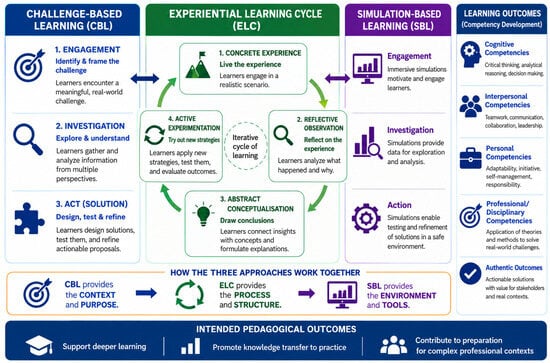
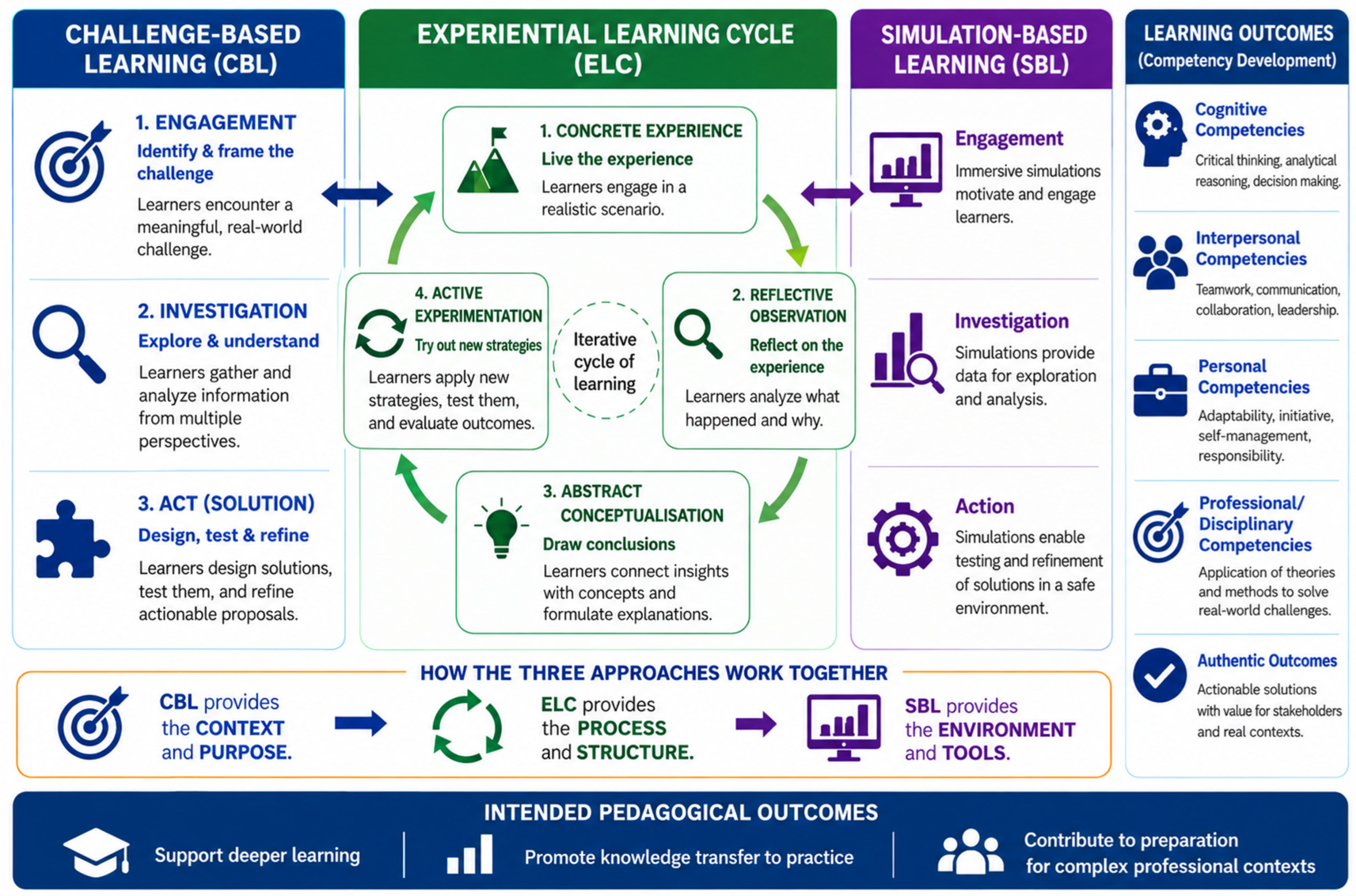
Figure 1 illustrates how the experiential learning cycle supports engagement, investigation, and action in CBL and how simulation-based learning activities implement them. The framework highlights the relationships among hands-on experience, reflective learning, and experimentation in shaping learning outcomes and competency development. The expectation is to achieve deeper learning, translate knowledge into practice, and prepare learners for complex and real-world professional contexts [29].
Figure 1.
Integrative Framework: Simulation-based Learning (SBL), Challenge-based Learning (CBL), and the Experiential Learning Cycle (source: authors’ own elaboration).
2.4. Pro-Game, a Single Machine Sequencing Simulator
The proposed framework is illustrated using the Pro-Game simulator (version 1.0), an existing interactive environment for addressing production sequencing problems [21]. This application provides a suitable context for examining pedagogical integration because sequencing decisions involve interacting constraints, competing performance objectives, and opportunities for iterative experimentation. Within the proposed instructional design, students can use simulation feedback to compare alternative decisions, interpret operational consequences, and reconsider their strategies. Therefore, the educational purpose extends beyond achieving a favourable simulation score to connecting decision-making experiences with disciplinary concepts and reflective analysis.
The Pro-Game simulator emulates single-machine sequencing problems in production. The simulator offers a visual and interactive view of combinatorial optimisation, enabling students to focus on sequencing logic without being overwhelmed by manual calculations [21]. The authors of this study did not develop the Pro-Game simulator but implemented and evaluated it in their own teaching environment.
Rather than introducing the simulator as an isolated software tool, the study incorporated it after classroom instruction and guided practice on sequencing methods, allowing students to apply their previously developed conceptual knowledge to an authentic operational challenge.
Sequencing problems involve high intrinsic cognitive complexity because learners must simultaneously consider multiple variables, constraints, and optimisation criteria. The Pro-Game simulator supports this learning process by enabling students to interact dynamically with sequencing decisions without relying exclusively on abstract calculations.
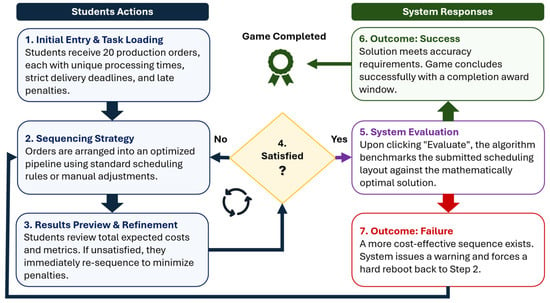
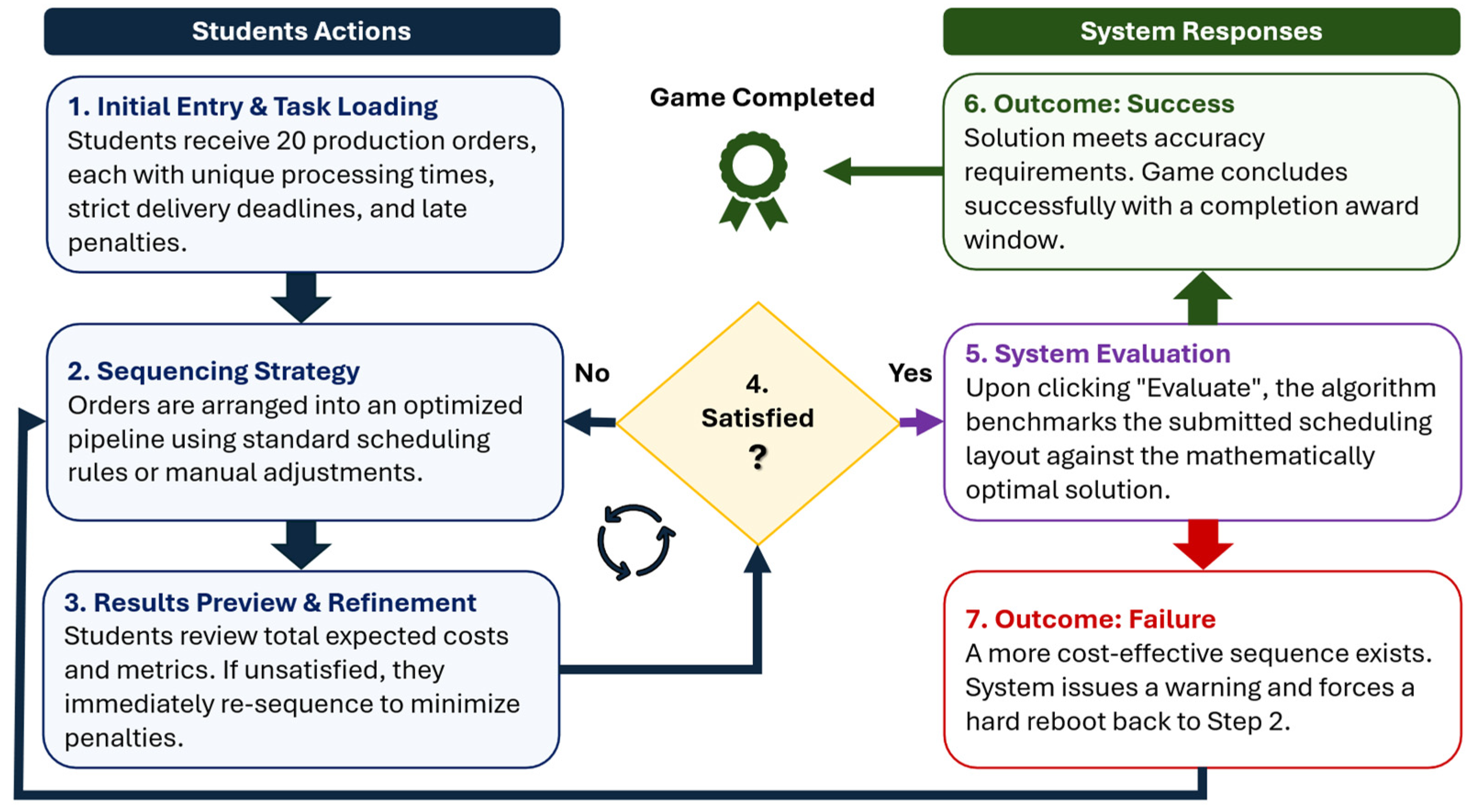
The simulator aims to determine the optimal sequence for scheduling the production of a set of items to meet performance objectives (e.g., makespan, flow time, and tardiness). Sequencing problems present various objectives, such as (i) minimising the completion date of a set of products in production, (ii) reducing delays for tasks with specific deadlines, and (iii) maximising the number of tasks that can be completed within a given timeframe. Figure 2 presents the Pro-Game simulator student journey.
Figure 2.
The Pro-Game Simulator Student Journey (source: authors’ own elaboration).
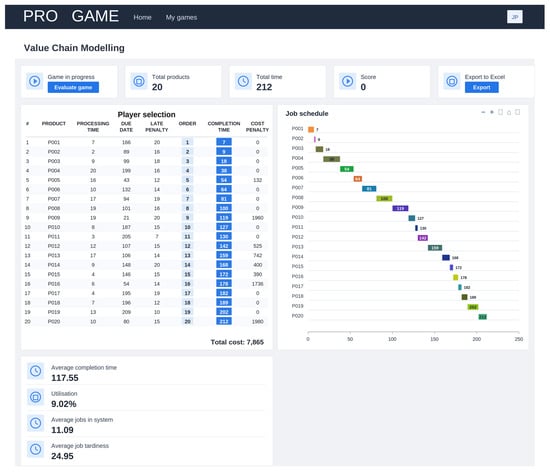
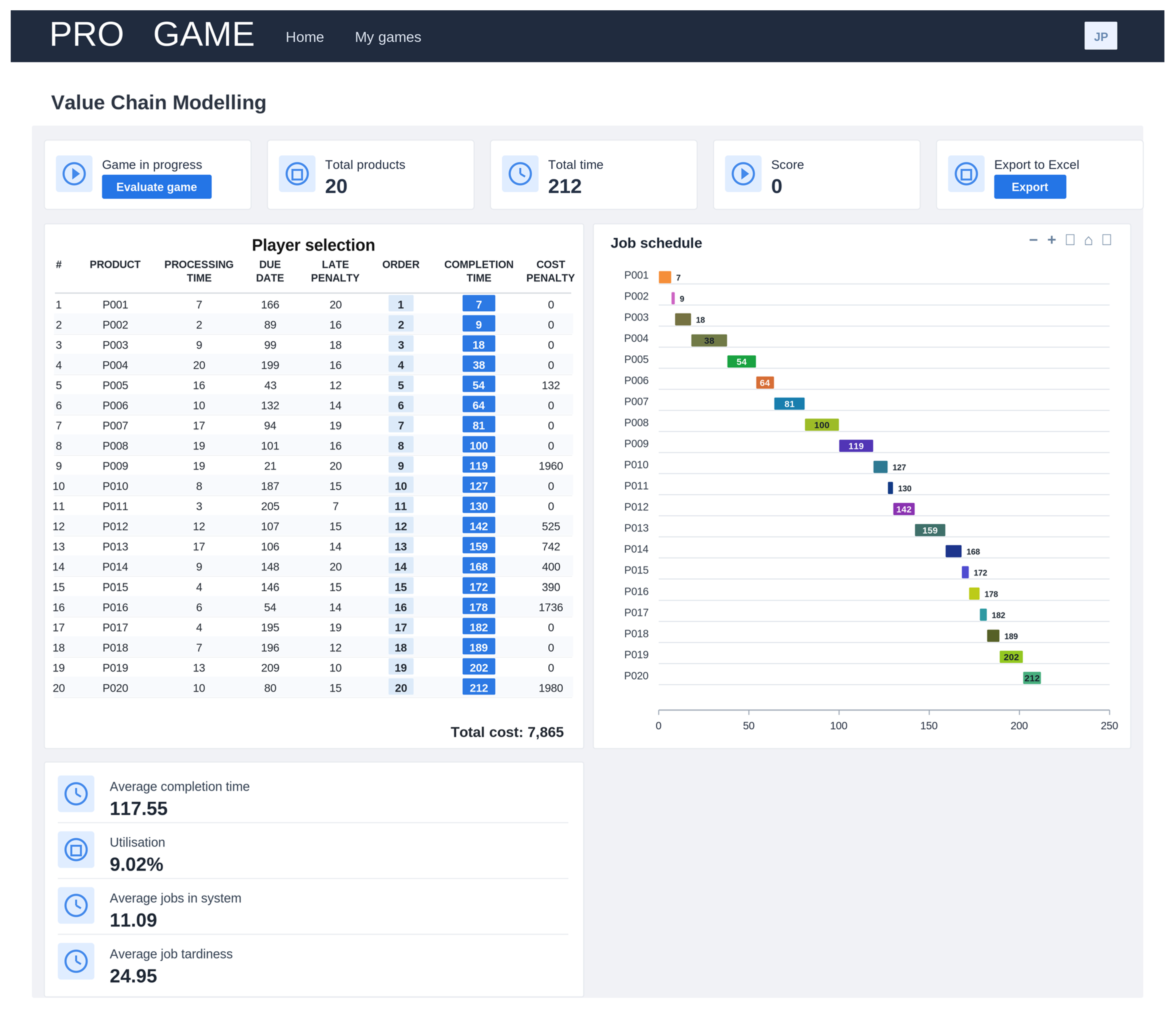
In the initial scenario, the simulated production plant operated with a single machine, and each student received a randomly generated dataset of production orders. Each order in this dataset had a deadline, processing duration, and tardiness cost, as shown in Figure 3. The simulation environment remained stable, allowing students to focus on sequencing decisions and system performance.
Figure 3.
Pro-Game Simulator Initial Interface (in Spanish, as used by students; source: authors’ own elaboration). Students determine the task sequence (1st to 20th), and a Gantt chart displays the task orders and aggregated time. The top section shows the game score and simulation time, whereas the bottom section shows the average completion time, utilisation rate, average work-in-process, and average tardiness. The screenshot illustrates the simulator interface. The displayed values are examples and do not reflect participants’ performance or results in the present study.
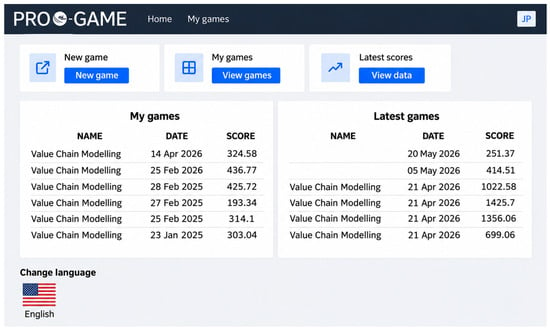
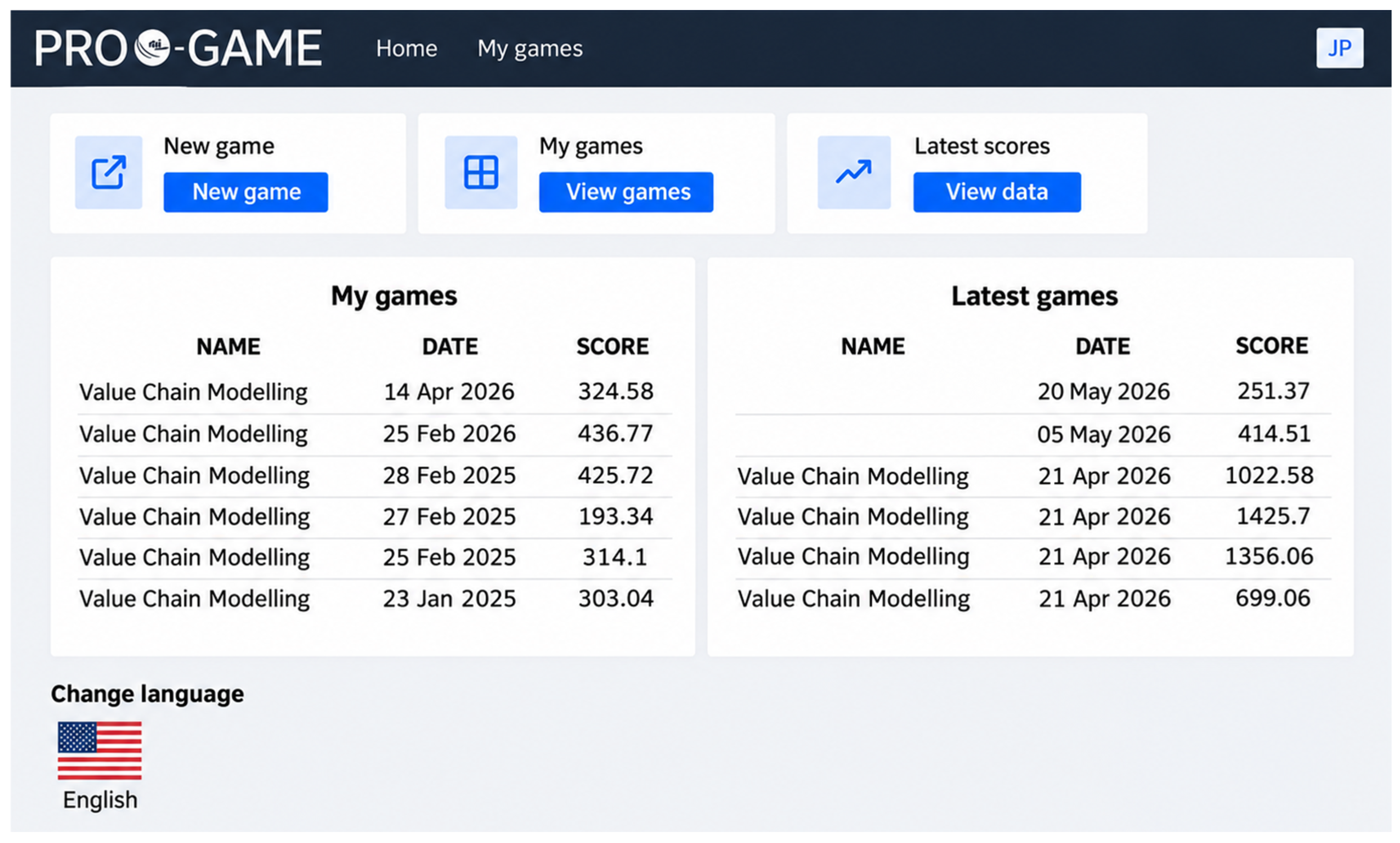
Moreover, the Pro-Game simulator is designed to support interactive and iterative decision making by allowing students to continuously rearrange production orders and immediately observe the operational consequences of their choices. Each modification recalculates the total production costs in real time, providing direct feedback that supports reflection, strategy refinement and self-regulated experimentation. Students are encouraged to focus on key operational variables such as processing times, delivery dates, and tardiness costs, which are visually linked to system performance outcomes. Once a sequencing solution is complete, the simulator computes a performance score by comparing the student’s solution cost with that of a predefined optimal solution, as shown in Figure 4.
Figure 4.
Illustrative Pro-Game Simulator Score Output. The screenshots illustrate the simulator interface and its functions. The displayed dates, scores, and other values do not correspond to the study’s implementation period, data collection, or the participating students’ performance (source: authors’ own elaboration).
By externalising complex calculations and offering visual feedback, the simulator supports experiential interaction with sequencing trade-offs, helping students bridge theory and practice in abstract domains such as combinatorial optimisation [30]. The following section presents the methodology for designing, implementing, and evaluating the simulator using the proposed approach.
3. Methodology
The pedagogical framework developed earlier provides a basis for integrating SBL into CBL through the experiential learning cycle. To illustrate its operationalisation, this study adopts an exploratory instrumental case study in an undergraduate industrial engineering module. The Pro-Game (version 1.0) simulator provides a setting for examining how authentic challenges, simulation-supported experimentation, reflection, and conceptualisation can be organised into a coherent process. The case documents implementation, student outcomes, and perceptions to inform the framework’s intended transferability to comparable settings.
3.1. Research Design
This study adopted a mixed-methods exploratory case study design [31,32] to systematically investigate the integrative framework (Figure 1) in an undergraduate industrial engineering module. The case study serves an instrumental and illustrative purpose: to examine how SBL activities can be organised within CBL through the experiential learning cycle and to describe the educational evidence associated with their implementation. Quantitative data concerning assessed competency attainment, student motivation, and module evaluations were supplemented with relevant qualitative student comments. This study did not employ a control or comparison group, random assignment, or pre- and post-intervention measures. Consequently, it was not designed to test causal hypotheses or establish the framework’s comparative effectiveness. Instead, it illustrates the operationalisation of the framework and examines descriptive findings within a bounded educational setting.
The case study concerns a seventh-semester undergraduate production management and scheduling module in an industrial engineering program in Mexico City. The module’s instructional design includes CBL as part of the curriculum. Moreover, the unit of analysis was the Pro-Game simulation activity in the module. Although broader module-level learning activities were acknowledged, they were treated as complementary elements of the Pro-Game environment rather than being modelled independently.
Consistent with its instrumental purpose, this case study aims to support the transferability of a theoretically grounded pedagogical framework and implementation procedure through a contextualised illustration in undergraduate industrial engineering education [33,34,35]. By making conceptual relationships and instructional arrangements explicit, this study offers guidance that educators may adapt to comparable settings. Its purpose is not to statistically generalise student outcomes or establish comparative effectiveness but to provide conceptual and procedural insights whose applicability depends on the characteristics of other educational contexts.
3.2. Defining the Case
The primary objective was to implement the Pro-Game simulator within an integrative framework and examine its relationship with the intended learning outcomes.
The participants comprised 38 undergraduate students (n = 38), with a demographic distribution of 71.1% males and 28.9% females. This cohort was selected because students in the middle-to-late stages of their engineering programmes are introduced to abstract concepts in combinatorial optimisation and production scheduling, which frequently pose significant challenges in achieving the intended learning outcomes [21].
The production management component of the module included production planning and control, aggregate planning, master production scheduling, material requirements planning, sequencing, and operations optimisation.
Consequently, the simulation activities were designed to develop technical competencies in production order sequencing, scheduling analysis, tardiness evaluation, and heuristic-based optimisation decision making by requiring students to apply production management concepts in realistic operational scenarios using the Pro-Game simulator.
The educational intervention was implemented in April and May 2026 during a five-week undergraduate module in the spring term. Participants completed the simulation-supported activities over three weeks, following a week of preparatory classroom instruction. Data collection took place during the final week of the module and included competency assessment, administration of the adapted AMS, and the institutional ECOA survey.
As a single exploratory case study, it provides in-depth insights into the specific context of disciplinary learning in an undergraduate industrial engineering module. However, this reliance on a single cohort restricts the generalisability of these findings. While the empirical findings remain specific to the participating cohort, the theoretically grounded framework and documented implementation procedure are intended to support transferability by providing conceptual and practical guidance that may be adapted to other educational contexts. Furthermore, the subjective nature of the survey data and varying levels of student participation may have influenced the robustness of the reported perceptions.
3.3. Data Collection
A mixed-methods data collection strategy was employed to provide a multifaceted understanding of the simulator’s implementation and results. Data collection was conducted as follows.
Primary Data (Quantitative and qualitative): Students completed two optional structured surveys consisting of (i) an adapted academic motivation scale (AMS) and (ii) the institutional student module evaluation survey (ECOA; Encuesta de Opinión de Alumnos in Spanish). Immediately following the Pro-Game activities, the students completed a structured survey based on the AMS [36]. A 7-point Likert scale (1 = strongly disagree to 7 = strongly agree) measured intrinsic motivation, extrinsic motivation, and amotivation. The original instrument was contextually adapted by replacing generic references to academic study with references to the Pro-Game simulation activities while preserving the theoretical dimensions of intrinsic motivation, extrinsic motivation, and amotivation. Accordingly, the results should be interpreted as context-specific measures of students’ opinions on their motivation toward the simulation activities rather than as a psychometric validation of the original instrument. Additionally, the ECOA survey asked students to rate intellectual challenge and teaching methodology on a 0–10 scale and provided an open-ended question inviting opinions and comments on the module. Twenty-nine students submitted open-ended responses that addressed different aspects of the module. Of these, eight responses directly concerned the simulation-supported learning activities examined in this study, whereas the remaining 21 addressed other aspects of the module.
Unlike the adapted AMS, which specifically addressed students’ motivation toward Pro-Game activities, the institutional ECOA evaluated the module as a whole and was not designed to isolate students’ perceptions of the simulator or the integrated pedagogical framework.
Primary data (performance-based): Student attainment of the module’s intended learning outcomes was assessed using an institutional analytical rubric. The rubric evaluated students’ ability to (i) propose process-improvement solutions, (ii) apply industrial engineering methods and tools, and (iii) define appropriate performance indicators to evaluate the proposed solution. Each competency dimension was assessed using a four-level performance scale ranging from 0 (incipient) to 3 (outstanding, exceeding acceptable). The analytical rubric was an institutional criterion-referenced assessment instrument routinely used to evaluate attainment of the module’s intended learning outcomes. It was designed to determine whether students demonstrated the expected competencies according to predefined performance descriptors, rather than to differentiate finely between students performing above the acceptable standard. Student performance was assessed by the module instructor using the institutional analytical rubric and its predefined performance descriptors. The same instructor taught the module, implemented the simulation-supported learning activities, and evaluated students’ competency attainment. No independent, blinded, or second-rater assessments were conducted, and no inter-rater calibration or moderation procedures were undertaken. Although the institutional rubric provided common assessment criteria, the resulting scores reflect the judgements of a single evaluator and should not be interpreted as independently validated measures of competency attainment.
Secondary Data: Secondary data comprised the module syllabus, intended learning outcomes, assessment rubrics, assignment briefs, instructional materials, and institutional documents describing the module’s structure and assessment design. These documents were used to assess the alignment between the instructional design, learning activities, and intended learning outcomes. Simulator log files were not collected or analysed. Although simulator-generated scores and reflective reports informed coursework assessment, the quantitative analysis reported in this study was based on rubric-derived competency attainment, AMS responses, and ECOA ratings.
3.4. Data Analysis
Data analysis comprised separate quantitative and qualitative phases, followed by an integrated interpretation of the findings. The findings from both analyses were subsequently considered together to examine the consistency between students’ reported learning experiences and the observed patterns of competency attainment and motivation.
The quantitative analysis used descriptive statistics, including means, standard deviations, medians, and interquartile ranges (IQR), to characterise the distribution of survey responses and student learning achievements. Quantitative data included AMS responses, institutional ECOA survey ratings, and assessment results derived from the analytical rubric, which were subsequently used to determine the attainment of learning outcomes. To complement the descriptive summary statistics, boxplots were used to examine the distributions of students’ scores for intrinsic motivation, extrinsic motivation, and amotivation, allowing consideration of central tendency, dispersion, and potential outliers.
The qualitative component comprised a descriptive categorisation of the eight open-ended ECOA comments directly related to the simulation-supported learning activities. The remaining 21 responses addressed other aspects of the module and were excluded. Each relevant comment was examined for its principal meaning and assigned to one of four descriptive categories: engagement, professional relevance, conceptual understanding, and suggestions for improvement. Where a comment addressed multiple aspects, categorisation reflected its dominant meaning. Section 4 presents the resulting categories, frequencies and illustrative excerpts.
Given the small number of relevant comments, this analysis was intended to complement the quantitative findings with contextualised student perspectives, rather than develop comprehensive themes, establish saturation, or represent the experiences of the entire cohort. The comments were considered alongside the descriptive quantitative results and were not treated as independent confirmations of the framework’s educational effectiveness.
3.5. Reporting
The final stage summarises the simulator’s implementation and results, bridging theoretical principles and educational practice. The reporting stage focuses on how the integration of SBL, CBL, and the experiential learning cycle is grounded in the module’s instructional design. The following sections present the results of this study.
4. Results
The results of the challenge execution involving the Pro-Game simulation unfolded as follows. Before the simulation activities, the students completed one week (4 h) of classroom instruction covering production planning and control, sequencing principles, priority rules, heuristic algorithms, and sequencing exercises. The Pro-Game activities were conducted over three weeks. During the first week, before the simulation activities, students were introduced to production planning and control, sequencing principles, priority rules, and heuristic algorithms. This approach ensured that the simulator was used to apply previously acquired knowledge rather than introduce new concepts. Subsequently, the instructor introduced the simulator through demonstrations, worked examples, an explanation of the coursework requirements, and guided individual practice. In the following three weeks, students completed the assignment independently, working asynchronously on the online platform until the deadline. All 38 students completed the activity individually, and it accounted for 15% of their overall module grade. The remaining assessments comprised an argumentative examination (50%) and problem-solving exercises (35%). The simulation activities were implemented within the institutional challenge-based learning (CBL) approach defined in the module syllabus.
The simulation activities were framed as a CBL task in which students were required to minimise production costs by optimising sequencing while justifying their decision-making strategies. Hence, CBL provided a platform for students to apply production management principles in practice to achieve tangible outcomes. However, this type of application requires experiential environments in which students can make and test decisions and observe their effects. Therefore, simulations were used to overcome the limitations of taking students to real-world settings for experimentation. All students participated in simulation-based learning activities as part of their regular coursework.
The intended learning outcomes focused on developing students’ ability to analyse operational constraints, apply sequencing principles, and design process improvement solutions in organisational contexts. The analytical rubric evaluated three competency dimensions.
- To propose detailed solutions for productivity enhancement through process improvements.
- To use methodologies and/or advanced tools of industrial engineering and other disciplines for process improvement.
- To define performance indicators to evaluate the impact of the solution.
These competency dimensions formed the basis of the institutional analytical rubric presented in Appendix A. The student assessment combined simulator performance with an individual reflective report explaining the rationale for the selected sequencing strategy and its practical implications. Within this context, the simulator was designed to enable students to apply production management concepts to an authentic decision-making problem involving sequencing, scheduling, and operational optimisation.
To address this challenge, each student received a unique set of 20 production orders and was required to determine a production sequence that minimised total operational cost while considering scheduling measures such as makespan and tardiness. As illustrated in Figure 2, students could run as many simulation iterations as needed to reach an optimal solution, provided that they completed the activity within three weeks. Students iteratively validated their proposed solutions using the game’s evaluation button. The game ended once the optimal solution was reached. Finally, they produced a report in which each student explained the rationale for their solution.
After completing the initial sequencing attempts, the learners reflected on their decisions, applied sequencing rules and optimisation concepts, and iteratively refined their strategies through repeated simulations.
Table 1 presents the broader pedagogical structure that supported the Pro-Game simulation activities across the stages of CBL and the experiential learning cycle.
Table 1.
The Pro-Game Simulation Integrative Pedagogical Framework (source: authors’ own elaboration).
Table 2 presents the results of the institutional ECOA survey completed by 29 of the 38 students (76.32%). The mean ratings exceeded the institutional target of 9.0 on a 0–10 scale across all reported dimensions, indicating highly favourable evaluations of the module. These ratings concern the overall educational experience, including teaching, learning activities, tutoring, and module organisation. Because the ECOA was not designed to evaluate the Pro-Game simulator or the proposed SBL–CBL framework separately, its results cannot establish students’ satisfaction with or the educational effectiveness of these specific components. Accordingly, the ECOA survey findings are reported as contextual information about the module rather than as direct evidence of the effectiveness of the simulation-supported intervention.
Table 2.
Institutional Student Opinion Survey (ECOA) Results (source: authors’ own elaboration).
The notation used in Table 2 is as follows:
- DOM—Knowledge proficiency (of the instructor) (0 = definitely no and 10 = definitely yes);
- RET—Intellectual challenge (0 = very poor, 10 = exceptional);
- ASE—Tutoring (0 = very poor, 10 = exceptional);
- MET, teaching methodology, and learning activities (0 = very poor, 10 = exceptional);
- REC: Module recommendation (0 = definitely no, 10 = definitely yes).
Regarding student learning outcome attainment, which is also related to the Pro-Game simulator, the results are presented in Table 3, where the attainment level was scored as follows: 0 = incipient, 1 = basic (below acceptable), 2 = solid (acceptable), and 3 = outstanding (exceeds acceptable).
Table 3.
Overall Learning Outcome Attainment (source: authors’ own elaboration).
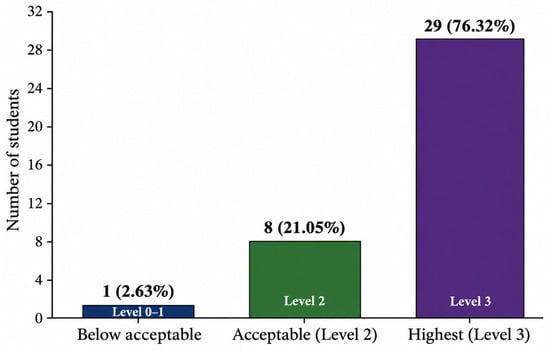
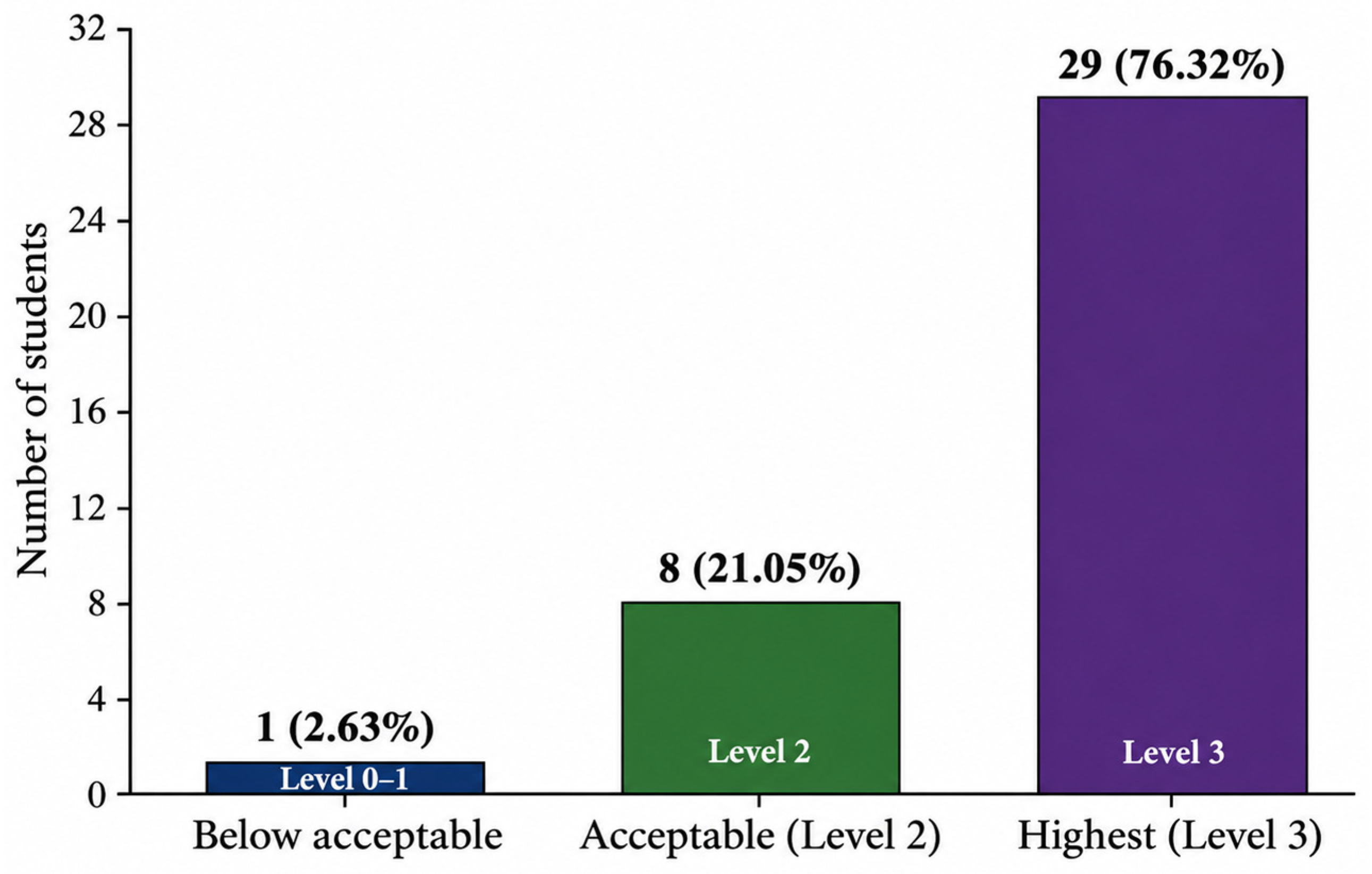
The achievement levels reported in Table 3 were derived from the overall competency score obtained by averaging the three competency dimensions assessed using an institutional analytical rubric (Appendix A). These averages were classified according to institutional achievement descriptors. Level 2 represents the minimum acceptable competency level, whereas Level 3 indicates performance exceeding the expected standard. Overall, 37 of the 38 students (97.37%) achieved at least an acceptable level, and 29 students (76.32%) were classified as Level 3. The median attainment level was 3, with an interquartile range of zero, indicating a concentration of students in the highest-reported category. Although these results indicate that most students met or exceeded the institutional competency criteria, the concentration at Level 3 limits the ability of the overall attainment classification to distinguish differences in performance among higher-achieving students. Consequently, these results should be interpreted as evidence of competency attainment within the module rather than evidence of exceptional performance or the comparative effectiveness of the pedagogical framework. Figure 5 presents the distribution of students across the overall competency attainment categories.
Figure 5.
Distribution of students across overall competency attainment categories (n = 38). The categories were derived from an institutional analytical rubric. The concentration of students at Level 3 illustrates the ceiling effect in the reported attainment classification (source: authors’ own elaboration).
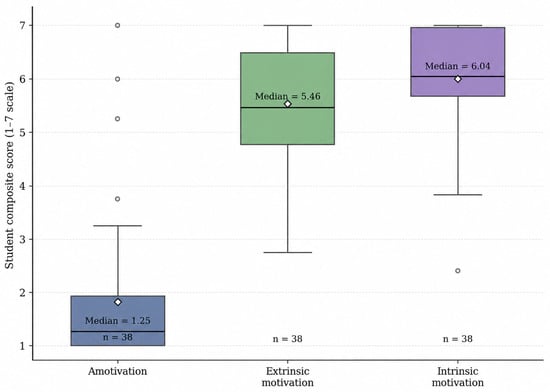
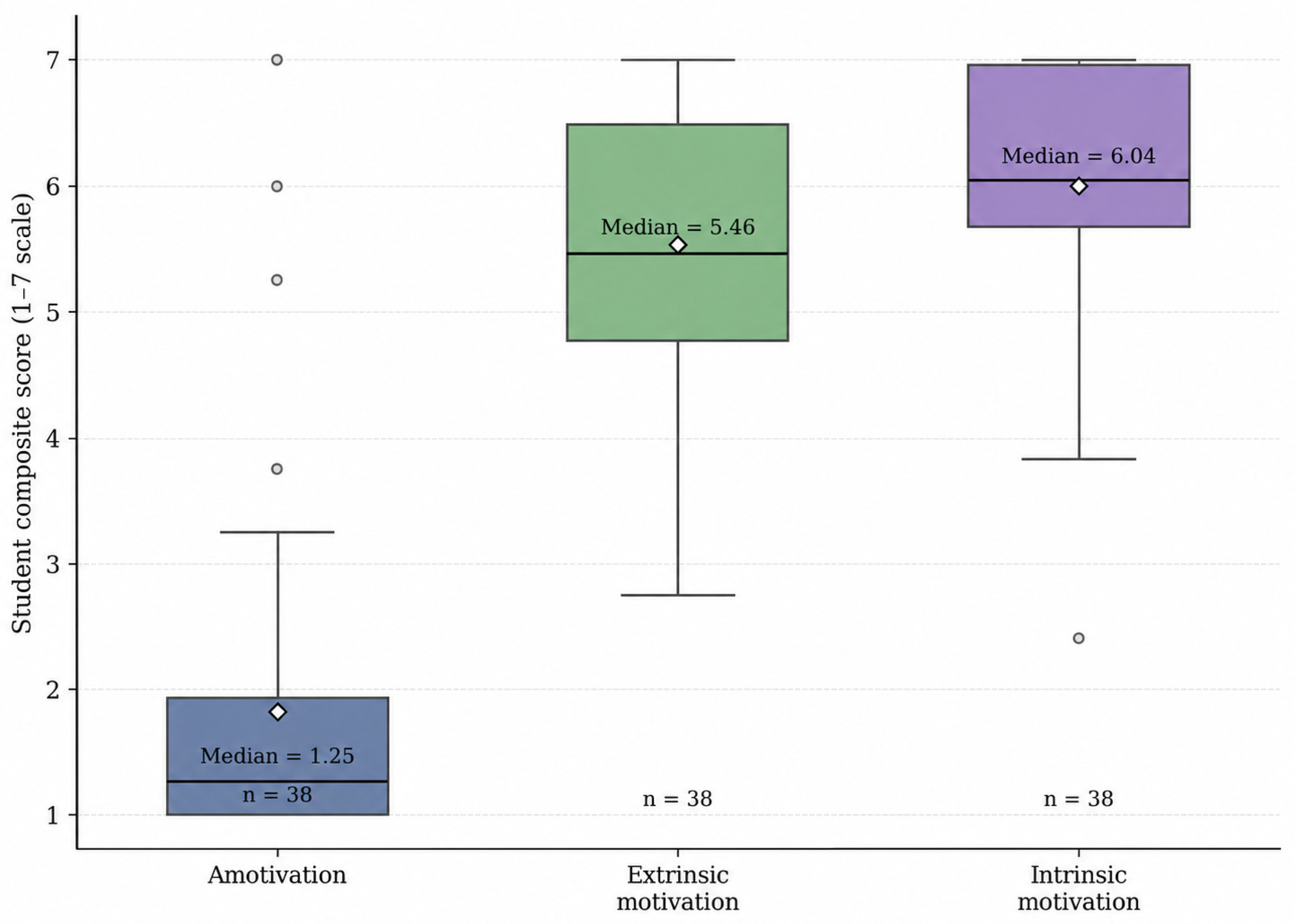
Finally, Table 4 presents the results for students’ motivation types. These results show that intrinsic motivation scored higher than amotivation and extrinsic motivation. The adapted instrument comprised seven motivation subscales, with responses recorded on a seven-point Likert scale (1 = strongly disagree; 7 = strongly agree). Figure 6 shows the distribution of student results of the three aggregated motivation dimensions.
Table 4.
Means and Standard Deviations of Motivation Dimensions, Subscales, and Items from the Adapted Academic Motivation Scale (n = 38; source: authors’ own elaboration).
Figure 6.
Distribution of student-level composite scores for amotivation, extrinsic motivation, and intrinsic motivation (n = 38). Boxes represent the interquartile range (Q1–Q3), horizontal lines indicate medians, whiskers extend to observations within 1.5 times the interquartile range, circles indicate outliers, and white diamonds represent the means. Composite scores were calculated by averaging the corresponding items of the adapted AMS (source: authors’ own elaboration).
To complement the descriptive results presented in Table 4, student-level composite scores were calculated for the three overarching motivation dimensions of the adapted AMS questionnaire. Figure 6 illustrates their distributions using boxplots, and Table 5 reports the medians, quartiles, interquartile ranges (IQR), and observed ranges. Together, these analyses provide a more detailed account of the variability in students’ self-reported motivation towards the Pro-Game simulation activities.
Table 5.
Descriptive Statistics of Student-Level Composite Motivation Scores (n = 38; source: authors’ own elaboration).
The distributions indicate relatively high intrinsic motivation (median = 6.04; IQR = 1.29) and extrinsic motivation (median = 5.46; IQR = 1.73), alongside comparatively low amotivation (median = 1.25; IQR = 0.94). However, the observed ranges show considerable differences among individual responses, particularly for amotivation, which spanned the full seven-point scale. These findings suggest that, despite generally favourable motivation scores, students’ experiences were not uniform. The distributions therefore provide a more differentiated descriptive perspective on motivation without establishing that the pedagogical framework caused the observed responses.
The qualitative component provided illustrative insights into students’ perceptions of the simulation-supported learning activities. Of the 29 open-ended comments submitted through the institutional ECOA survey, eight were relevant to this study’s focus. The other 21 comments addressed different aspects of the module and were not included in the descriptive categorisation. The eight relevant comments were grouped into four descriptive categories: engagement (n = 3), professional relevance (n = 2), conceptual understanding (n = 2), and suggestions (n = 1). Table 6 presents these categories, their frequencies, and representative excerpts. Given the small number of relevant comments, these findings should be interpreted as illustrative accounts rather than evidence of the prevalence of particular experiences across the cohort.
Table 6.
Descriptive categories of eight student comments concerning simulation-supported learning activities (source: authors’ own elaboration).
The qualitative findings should be interpreted in light of the limited scope of available responses. The eight comments relevant to the simulation-supported learning activities primarily reflected engagement, professional relevance, conceptual understanding, and suggestions for improvement. However, the open-ended ECOA question was not specifically designed to elicit critical incidents, technical difficulties, dissatisfaction, or unsuccessful learning experiences associated with the simulator. Consequently, the qualitative findings do not provide a systematic account of these potentially important aspects of implementation. The absence of such experiences from the reported categories should not be interpreted as evidence that they did not occur.
5. Discussion
5.1. Findings
The principal contribution of this study is the illustration of a coherent instructional arrangement that integrates SBL, CBL, and the experiential learning cycle. While CBL established the production sequencing challenge, the simulator provided opportunities for experimentation and feedback, and the experiential learning cycle structured reflection, conceptualisation, and subsequent actions. This integration addresses the need for more explicit guidance on embedding simulation activities in challenge-oriented environments [12,15,37]. The case illustrates how these complementary pedagogical functions can be operationalised within an undergraduate industrial engineering module, although it does not establish the framework’s comparative effectiveness.
Importantly, the experiential learning cycle was deliberately incorporated to scaffold the transition from testing sequencing strategies to interpreting their consequences, connecting observations to disciplinary concepts and refining subsequent decisions. This recursive instructional logic, rather than simulation in isolation, constitutes the proposed mechanism for integrating SBL into CBL.
The Pro-Game activities provided an interactive setting in which students could examine production sequencing decisions, observe operational consequences, and refine their strategies. By externalising calculations and representing scheduling trade-offs visually, the simulator created opportunities to apply previously taught optimisation concepts to a contextualised problem. This instructional arrangement is consistent with the literature emphasising the importance of feedback, reflection, and situated experimentation in simulation-supported education [27,30,38]. However, the study did not independently measure changes in conceptual understanding or establish that these design features reduced cognitive load. Therefore, the evidence supports describing an implemented learning process rather than causally explaining learning improvement.
The empirical findings provide complementary but distinct perspectives on the implementation. Institutional rubric assessments indicated that 37 of the 38 students attained at least an acceptable competency level, including 29 at the highest level. Nevertheless, the concentration of scores at the upper end of the scale suggests a ceiling effect, while the absence of baseline measures, a comparison group, and independent assessment prevents attributing these attainment levels to the proposed framework. The adapted AMS indicated generally favourable self-reported motivation towards the simulation activities. More specifically, intrinsic motivation (M = 6.00) exceeded extrinsic motivation (M = 5.53), while amotivation was comparatively low (M = 1.83). Together with favourable responses concerning professional preparation, these findings suggest that students perceived the activities as both intrinsically engaging and relevant to their future engineering practice, although they did not demonstrate subsequent professional competency development.
Although most students achieved acceptable competency attainment, one student remained below this threshold, and the motivation distributions also revealed less favourable individual responses. The available evidence does not establish the reasons for these differences or whether they reflect particular difficulties in simulation-supported activities.
In contrast, the institutional ECOA survey ratings reflected students’ evaluations of the overall module and cannot be interpreted as simulator-specific evidence. The eight relevant open-ended comments provided additional illustrative perspectives on engagement, professional relevance, conceptual understanding, and suggestions but were insufficient to characterise the full range of student experiences. Notably, one student requested more detailed introductory guidance and examples, suggesting that future implementations may warrant more attention to initial scaffolding.
Taken together, these findings illustrate the practical implementation of the proposed pedagogical integration within a positively evaluated educational setting. They suggest that the framework offers a useful structure for organising authentic challenges, simulation-supported experimentation, and reflective learning activities. However, the available evidence does not establish that all students benefited equally, that implementation difficulties were absent, or that the framework improved the learning outcomes independently. Its principal contribution is a theoretically grounded, contextually illustrated instructional design that can inform subsequent comparative and longitudinal studies.
5.2. Implications
5.2.1. Theoretical Implications
The theoretical contribution of this study lies in specifying the complementary instructional functions of SBL, CBL, and the experiential learning cycle within a unified pedagogical framework. Rather than treating simulation as an independent learning activity, the framework positions it as an environment for experimentation and feedback within authentic challenges, while experiential learning provides the structure for connecting experience, reflection, conceptualisation, and action. This synthesis extends existing discussions of experiential and constructivist approaches [12,21,37,39] by making the relationships among the three pedagogies explicit. It also provides a conceptual basis for examining how simulation-supported activities may contribute to learning in complex disciplinary contexts, such as production sequencing and combinatorial optimisation. This case illustrates the implementation of the framework; however, its explanatory value and educational effectiveness require further empirical investigation.
5.2.2. Practical Implications
The principal practical implication concerns the design of simulation-supported, challenge-based activities. Educators can use the proposed framework to align authentic problems, simulation tasks, reflective activities, and intended learning outcomes within a coherent instructional sequence. In the present case, students applied previously introduced sequencing concepts through iterative experiments using the Pro-Game simulator. This illustrates how simulation environments can complement disciplinary instruction by providing opportunities to examine operational trade-offs and to justify decisions. Although this approach may be adaptable to other disciplines, its suitability and educational outcomes in different contexts require further investigation.
Another potential advantage of digital simulations is their ability to provide safe and repeatable opportunities to experiment with operational decisions when comparable physical interventions are impractical. This represents a practical design consideration rather than an empirically demonstrated improvement in scalability, resource efficiency, or knowledge transfer.
Table 7 translates the proposed framework into instructional recommendations for educators. These guidelines outline how to define an authentic challenge, select an appropriate simulation, organise activities around the experiential learning cycle, facilitate reflection, and assess performance using analytical rubrics and reflective justifications. They are intended as adaptable design guidance rather than validated prescriptions for improving learning outcomes.
Table 7.
Instructional Guidelines for Implementing the Integrated SBL–CBL Framework through the Experiential Learning Cycle (source: authors’ own elaboration).
5.3. Limitations
This exploratory case study involved 38 students in a single undergraduate module and did not include a comparison group, baseline measures, or longitudinal follow-up. Consequently, the empirical findings do not support statistical generalisation, causal attribution, or conclusions about long-term learning outcomes. These limitations do not preclude the potential transferability of the theoretically grounded framework and implementation procedure, although further investigation is needed to assess their applicability and educational effectiveness in other contexts.
Assessment evidence also requires cautious interpretation. The module instructor evaluated student competency attainment using an institutional analytical rubric without independent moderation, blinded assessment or inter-rater calibration. Consequently, evaluator bias cannot be ruled out. The concentration of scores at the highest rubric level further suggests a ceiling effect, limiting the differentiation among higher-performing students. In addition, the study relied partly on self-reported motivation and module evaluations, which may have been influenced by response bias or novelty effects. The institutional ECOA survey evaluated the complete module rather than the simulator or integrated framework independently; therefore, its ratings cannot establish the contribution of the simulation-supported intervention. The study also did not directly assess broader competencies, such as teamwork, metacognition, adaptability, or reflective practice.
A further limitation is the limited qualitative evidence and implementation context. Only eight of the 29 open-ended ECOA survey responses directly addressed the simulation-supported activities, and the available instruments were not specifically designed to investigate technical difficulties, student resistance, frustration, or unsuccessful learning experiences. The absence of such experiences from the reported categories should not be interpreted as evidence that they did not occur. Furthermore, the simulator was implemented and evaluated within an author’s own teaching environment, introducing potential researcher and evaluator biases. Taken together, these limitations mean that the findings should be interpreted as descriptive evidence of the framework’s implementation and associated student outcomes and perceptions, rather than as independently validated evidence of its educational effectiveness.
5.4. Future Work
Future research should examine the proposed framework across different disciplines, institutions, and educational contexts to assess its transferability and pedagogical strength. Comparative studies involving traditional instruction, standalone SBL, and alternative active pedagogies can help distinguish the contributions of individual instructional components. Longitudinal designs are also needed to investigate knowledge retention, professional readiness, and the transfer of learning beyond the module. These investigations should incorporate independent assessments, assessor calibration, and more differentiated competency measures to address the limitations identified in the present study.
Further research should examine students’ experiences of simulation-supported challenges, including technical difficulties, frustration, resistance, and differences in learning benefits. Structured observations, interviews, and critical-incident reporting could provide insights into the instructional conditions that support or hinder learning. Future studies could also investigate more advanced simulation environments incorporating multi-machine systems, stochastic conditions, supply chain interactions, and sustainability constraints, alongside alternative approaches to scaffolding, feedback, and debriefing. Such research would help determine the conditions under which the proposed pedagogical framework can be implemented effectively across different educational settings.
6. Conclusions
This study examined how SBL can be integrated into CBL through the experiential learning cycle in industrial engineering education. In response to the research question, the proposed framework establishes complementary instructional functions: CBL provides authentic challenges and organises engagement, investigation, and action; the experiential learning cycle structures experience, reflection, conceptualisation, and experimentation; and SBL provides an interactive environment to test decisions and examine their consequences. The Pro-Game case illustrates how these functions can be organised within a coherent instructional sequence for production sequencing and combinatorial optimisation, connecting simulation-supported experimentation with disciplinary knowledge and reflective decision-making.
The empirical case illustrates how this integration was implemented. Following preparatory instruction in production sequencing principles and methods, students undertook an individual challenge using the Pro-Game simulator. They examined the operational consequences of alternative sequencing decisions, applied scheduling principles, and iteratively refined their solutions using simulation feedback. The activities connected hands-on experimentation in a simulated production environment with reflection and conceptualisation, culminating in individual reports that justified the selected strategies and their practical implications. This instructional arrangement provided a concrete illustration of how simulation activities could be organised across the engagement, investigation, and action phases of CBL through the experiential learning cycle. The associated findings indicated high instructor-assessed competency attainment and generally favourable self-reported motivation, although individual experiences varied. Student comments offered further illustrative perspectives on engagement, professional relevance, and conceptual understanding, while identifying a need for clearer introductory guidance. These descriptive findings contextualise the framework’s implementation but do not establish its independent effectiveness in improving learning outcomes.
The study’s principal contribution is conceptual and procedural. Rather than introducing a new simulation technology or an entirely new pedagogical approach, it specifies how established learning approaches can perform distinct but complementary functions within an integrated instructional design. The framework and its documented implementation procedure guide educators seeking to embed simulation-supported experimentation, reflection, and conceptualisation within authentic challenges. By making these pedagogical relationships and instructional arrangements explicit, the study offers a theoretically grounded basis for adaptation to comparable educational contexts. Its potential transferability concerns the framework and implementation procedure, rather than the statistical generalisability of the observed student outcomes.
These conclusions are bounded by the exploratory single-case design and the limitations of the available assessment, survey, and qualitative evidence. The absence of baseline measures, comparison groups, independent assessment, and longitudinal follow-up prevents causal conclusions about educational effectiveness or sustained competency development. Future research should therefore prioritise comparative and longitudinal evaluations across different disciplines and institutional contexts, incorporating independent assessments and more differentiated measures of learning. Such investigations would help establish whether, how, and under what instructional conditions the proposed integration contributes to learning outcomes and professional competency development, while examining the framework’s effectiveness and transferability beyond the illustrative case.
Author Contributions
Conceptualization, D.E.S.-N. and J.A.P.-M.; methodology, D.E.S.-N. and J.A.P.-M.; validation, D.E.S.-N. and J.A.P.-M.; formal analysis, D.E.S.-N. and J.A.P.-M.; investigation, D.E.S.-N. and J.A.P.-M.; resources, J.A.P.-M.; data curation, D.E.S.-N. and J.A.P.-M.; writing—original draft preparation, D.E.S.-N. and J.A.P.-M.; writing—review and editing, D.E.S.-N. and J.A.P.-M.; visualisation, D.E.S.-N. and J.A.P.-M.; supervision, D.E.S.-N. and J.A.P.-M.; project administration, J.A.P.-M.; funding acquisition, J.A.P.-M. All authors have read and agreed to the published version of the manuscript.
Funding
The APC was funded by the Writing Lab, Institute for the Future of Education, Tecnologico de Monterrey, Mexico.
Institutional Review Board Statement
The study was conducted in accordance with the Declaration of Helsinki, and approved by the Institutional Review Board of Universidad Panamericana, Mexico City (protocol code IRB UP-CI-2026-MX-05-ING, and 25 May 2026).
Informed Consent Statement
Verbal informed consent was obtained from the participants prior to data collection. The Institutional Review Board approved the verbal informed consent procedures, as no personally identifiable data were collected.
Data Availability Statement
The data supporting the findings of this study are available from the corresponding author upon reasonable request (J.A.P.-M.). These data are not publicly available because they contain information that could compromise the privacy of academic records.
Acknowledgments
The authors (D.E.S.-N. and J.A.P.-M.) would like to acknowledge the technical support of the Writing Lab, Institute for the Future of Education, at Tecnologico de Monterrey in the publication of this work.
Conflicts of Interest
The authors declare no competing interests relevant to the content of this article.
Abbreviations
The following abbreviations are used in this manuscript:
| AC | Abstract conceptualization |
| AMS | Academic motivation scale |
| AE | Active experimentation |
| CBL | Challenge-based learning |
| CE | Concrete experience |
| ECOA | Encuesta de opinión de alumnos (in Spanish) |
| RO | Reflective observation |
| SBL | Simulation-based Learning |
Appendix A. Institutional Analytical Rubric Used to Assess Student Learning Outcomes
Student performance was evaluated using the institutional analytical rubric shown below. The rubric aligns with the module’s intended learning outcomes and evaluates three competency dimensions across four performance levels. The overall competency score was calculated as the arithmetic mean of the three competency dimensions. This overall score was subsequently converted into the institutional four-level achievement scale (0–3) to determine learning outcome attainment. Thresholds were considered as follows: Level 0 (<1.0), Level 1 (1.0 to <2.0), Level 2 (2.0 to <3.0), and Level 3 (≥3.0). The module instructor applied the rubric to assess students’ individual reports and simulator-based solutions.
Table A1.
Institutional Analytical Rubric for Learning Outcome Assessment (source: authors’ own elaboration).
References
- Suyo-Vega, J.A.; Fernández-Bedoya, V.H.; Meneses-La-Riva, M.E. Beyond Traditional Teaching: A Systematic Review of Innovative Pedagogical Practices in Higher Education. F1000Res 2024, 13, 22. [Google Scholar] [CrossRef] [Scilit] [PubMed]
- WEF. Future of Jobs Report 2025; World Economic Forum: Cologny/Geneva, Switzerland, 2025; 290p. [Google Scholar]
- Kong, Y. The Role of Experiential Learning on Students’ Motivation and Classroom Engagement. Front. Psychol. 2021, 12, 771272. [Google Scholar] [CrossRef] [Scilit] [PubMed]
- Pedró, F. Future Skills—Back into the Future? Emerging Trends in Educational Innovation in Higher Education. In Creating the University of the Future; Ehlers, U.-D., Eigbrecht, L., Eds.; Zukunft der Hochschulbildung—Future Higher Education; Springer Fachmedien Wiesbaden: Wiesbaden, Germany, 2024; pp. 93–122. ISBN 978-3-658-42947-8. [Google Scholar]
- Doolittle, P.; Wojdak, K.; Walters, A. Defining Active Learning: A Restricted Systematic Review. Teach. Learn. Inq. 2023, 11. [Google Scholar] [CrossRef] [Scilit]
- Freeman, S.; Eddy, S.L.; McDonough, M.; Smith, M.K.; Okoroafor, N.; Jordt, H.; Wenderoth, M.P. Active Learning Increases Student Performance in Science, Engineering, and Mathematics. Proc. Natl. Acad. Sci. USA 2014, 111, 8410–8415. [Google Scholar] [CrossRef] [Scilit] [PubMed]
- United Nations. Transforming Our World: The 2030 Agenda for Sustainable Development; United Nations: New York, NY, USA, 2015. [Google Scholar]
- Johnson, L.F.; Smith, R.S.; Smythe, J.T.; Varon, R.K. Challenge-Based Learning: An Approach for Our Time; The New Media Consortium: Austin, TX, USA, 2009. [Google Scholar]
- Vilalta-Perdomo, E.L.; Membrillo-Hernández, J.; Michel-Villarreal, R.; Lakshmi, G.; Martínez-Acosta, M. (Eds.) The Emerald Handbook of Challenge Based Learning, 1st ed.; Emerald Handbooks; Emerald Publishing: Leeds, UK, 2022; ISBN 978-1-80117-490-9. [Google Scholar]
- Gallagher, S.E.; Savage, T. Challenge-Based Learning in Higher Education: An Exploratory Literature Review. Teach. High. Educ. 2023, 28, 1135–1157. [Google Scholar] [CrossRef] [Scilit]
- Leijon, M.; Gudmundsson, P.; Staaf, P.; Christersson, C. Challenge Based Learning in Higher Education– A Systematic Literature Review. Innov. Educ. Teach. Int. 2022, 59, 609–618. [Google Scholar] [CrossRef] [Scilit]
- Van Den Beemt, A.; Van De Watering, G.; Bots, M. Conceptualising Variety in Challenge-Based Learning in Higher Education: The CBL-Compass. Eur. J. Eng. Educ. 2023, 48, 24–41. [Google Scholar] [CrossRef] [Scilit]
- Hood Cattaneo, K. Telling Active Learning Pedagogies Apart: From Theory to Practice. J. New Approaches Educ. Res. 2017, 6, 144–152. [Google Scholar] [CrossRef] [Scilit]
- Lateef, F. Simulation-Based Learning: Just like the Real Thing. J. Emerg. Trauma Shock 2010, 3, 348. [Google Scholar] [CrossRef] [Scilit] [PubMed]
- Chernikova, O.; Heitzmann, N.; Stadler, M.; Holzberger, D.; Seidel, T.; Fischer, F. Simulation-Based Learning in Higher Education: A Meta-Analysis. Rev. Educ. Res. 2020, 90, 499–541. [Google Scholar] [CrossRef] [Scilit]
- Udeozor, C.; Toyoda, R.; Russo Abegão, F.; Glassey, J. Digital Games in Engineering Education: Systematic Review and Future Trends. Eur. J. Eng. Educ. 2023, 48, 321–339. [Google Scholar] [CrossRef] [Scilit]
- Kolb, D. Experiential Learning: Experience as the Source of Learning and Development; Prentice-Hall: Englewood Cliffs, NJ, USA, 1984; ISBN 978-0-13-295261-3. [Google Scholar]
- Wiggins, G. The Case for Authentic Assessment. Pract. Assess. Res. Eval. 1990, 2, 2. [Google Scholar] [CrossRef]
- Feijoo-Garcia, M.A.; Holstrom, M.S.; Magana, A.J.; Newell, B.A. Simulation-Based Learning and Argumentation to Promote Informed Design Decision-Making Processes within a First-Year Engineering Technology Course. Sustainability 2024, 16, 2633. [Google Scholar] [CrossRef] [Scilit]
- Ravi, M. Digital Simulation-Based Learning for Reaction Engineering: Activity Design and Student Metacognition. Comput. Appl. Eng. Educ. 2025, 33, e70038. [Google Scholar] [CrossRef] [Scilit]
- Palma-Mendoza, J.A.; Pacheco-Velazquez, E.A.; Arana-Solares, I.A.; Salinas-Navarro, D. Pro-Game: A Simulator to Develop an Understanding of Single Machine Sequencing Problems. In Proceedings of the 19th International Technology, Education and Development Conference, Valencia, Spain, 3–5 March 2025; pp. 7342–7350. [Google Scholar]
- Stenseth, H.V.; Steindal, S.A.; Solberg, M.T.; Ølnes, M.A.; Sørensen, A.L.; Strandell-Laine, C.; Olaussen, C.; Farsjø Aure, C.; Pedersen, I.; Zlamal, J.; et al. Simulation-Based Learning Supported by Technology to Enhance Critical Thinking in Nursing Students: Scoping Review. J. Med. Internet Res. 2025, 27, e58744. [Google Scholar] [CrossRef] [Scilit] [PubMed]
- Ross, S. Simulation-Based Learning: From Learning Theory to Pedagogical Application. IJAHSP 2021, 19, 15. [Google Scholar] [CrossRef] [Scilit]
- McGaghie, W.C.; Harris, I.B. Learning Theory Foundations of Simulation-Based Mastery Learning. Sim Healthc. 2018, 13, S15–S20. [Google Scholar] [CrossRef] [Scilit] [PubMed]
- Rosário, A.T.; Raimundo, R.; Cruz, R.N. Enhancing Business Higher Education through Simulation-Based Learning, Problem-Based Learning, and Challenge-Based Learning. WSEAS Trans. Bus. Econ. 2025, 22, 1430–1458. [Google Scholar] [CrossRef] [Scilit]
- Santos-Díaz, A.; Montesinos, L.; Barrera-Esparza, M.; del Mar Perez-Desentis, M.; Salinas-Navarro, D.E. Implementing a Challenge-Based Learning Experience in a Bioinstrumentation Blended Course. BMC Med. Educ. 2024, 24, 510. [Google Scholar] [CrossRef] [Scilit] [PubMed]
- Salinas-Navarro, D.E.; Palma-Mendoza, J.A. An Experiential Learning and Authentic Assessment Framework for Challenge-Based Learning. Educ. Sci. 2026, 16, 652. [Google Scholar] [CrossRef] [Scilit]
- Kolb, A.; Kolb, D. Eight Important Things to Know about The Experiential Learning Cycle. Aust. Educ. Lead. 2018, 40, 8–14. [Google Scholar]
- Morcke, A.M.; Dornan, T.; Eika, B. Outcome (Competency) Based Education: An Exploration of Its Origins, Theoretical Basis, and Empirical Evidence. Adv. Health Sci. Educ. 2013, 18, 851–863. [Google Scholar] [CrossRef] [Scilit] [PubMed]
- Martinelli, R.; Cristina Martins Queiroz Mariano, F.; Bertini Martins, C. Single Machine Scheduling in Make to Order Environments: A Systematic Review. Comput. Ind. Eng. 2022, 169, 108190. [Google Scholar] [CrossRef] [Scilit]
- Merriam, S.B. Qualitative Research and Case Study Applications in Education, 2nd ed.; Jossey-Bass Publishers: San Francisco, CA, USA, 1998; ISBN 978-0-7879-1009-9. [Google Scholar]
- Yin, R.K. Case Study Research and Applications: Design and Methods, 6th ed.; SAGE: Wallsend, UK, 2018; ISBN 978-1-5063-3616-9. [Google Scholar]
- Drisko, J.W. Transferability and Generalization in Qualitative Research. Res. Soc. Work Pract. 2025, 35, 102–110. [Google Scholar] [CrossRef] [Scilit]
- Vahl, M. Doing Research in the Social Domain. In Systems for Sustainability; Stowell, F.A., Ison, R.L., Armson, R., Holloway, J., Jackson, S., McRobb, S., Eds.; Springer: Boston, MA, USA, 1997; pp. 147–152. ISBN 978-1-4899-0267-2. [Google Scholar]
- de Zeeuw, G. Three Phases of Science: A Methodological Exploration; Working Paper 7; Centre for Systems and Information Sciences, University of Lincolnshire and Humberside: Hull, UK, 1996; Volume 7. [Google Scholar]
- Vallerand, R.J.; Pelletier, L.G.; Blais, M.R.; Briere, N.M.; Senecal, C.; Vallieres, E.F. The Academic Motivation Scale: A Measure of Intrinsic, Extrinsic, and Amotivation in Education. Educ. Psychol. Meas. 1992, 52, 1003–1017. [Google Scholar] [CrossRef] [Scilit]
- Salas, E.; Wildman, J.L.; Piccolo, R.F. Using Simulation-Based Training to Enhance Management Education. Acad. Manag. Learn. Educ. 2009, 8, 559–573. [Google Scholar] [CrossRef] [Scilit]
- Salinas-Navarro, D.E.; Rodríguez Calvo, E.Z. Social Lab for Sustainable Logistics: Developing Learning Outcomes in Engineering Education. In Operations Management for Social Good; Leiras, A., González-Calderón, C.A., de Brito Junior, I., Villa, S., Yoshizaki, H.T.Y., Eds.; Springer International Publishing: Cham, Switzerland, 2020; pp. 1065–1074. ISBN 978-3-030-23815-5. [Google Scholar]
- Vermunt, J.D. Understanding, Measuring and Improving Simulation-Based Learning in Higher Education: Student and Teacher Learning Perspectives. Learn. Instr. 2023, 86, 101773. [Google Scholar] [CrossRef] [Scilit]

Disclaimer/Publisher’s Note: The statements, opinions and data contained in all publications are solely those of the individual author(s) and contributor(s) and not of MDPI and/or the editor(s). MDPI and/or the editor(s) disclaim responsibility for any injury to people or property resulting from any ideas, methods, instructions or products referred to in the content. |
© 2026 by the authors. Licensee MDPI, Basel, Switzerland. This article is an open access article distributed under the terms and conditions of the Creative Commons Attribution (CC BY) license.