


Abstract
Elementos de Química Analítica Cuantitativa is a mandatory first-year course for Agronomy students at Universidad de Concepción (Chile) in which, prior to this intervention, close to 40% of students scored below passing marks on instrumental-technique assessments. During the second semester of 2025, three game-based learning activities, namely Espectro-Bingo Agronómico (atomic spectrometry), La Misión Espectral (an escape room on IR/UV-Vis/Raman spectrometry), and El Gran Desafío Cromatográfico (a board game on gas and liquid chromatography), were delivered sequentially to one cohort. This exploratory study compared students’ expectations of each activity (PRE, collected at the start of the gameplay session) with their perceptions of the experienced activity (POST), using an activity-adapted version of the validated EVINED scale (Cronbach’s α and McDonald’s ω ≥ 0.87 for all dimensions). Matching by student code yielded 115 PRE–POST records from 52 unique students (34–43 per activity). Experienced perceptions exceeded expectations for the escape room (global score: mean difference = 0.15 points on a 1–5 scale, 95% CI 0.04–0.26; Holm-adjusted p = 0.034; rank-biserial r = 0.48) but not significantly for the bingo or board game; this exploratory result was not robust to the inclusion of unmatched respondents or to mixed-model estimation. A linear mixed model accounting for repeated observations of the same students showed a small overall expectation–experience difference (b = 0.11, 95% CI 0.02–0.21) that was sensitive to model specification, and no statistically detectable variation in this difference among the three activities (activity × occasion, p = 0.75), which does not imply that the formats are equivalent. High PRE-scores (about half of item responses at the scale maximum) limited the room for upward change. The findings concern students’ immediate perceptions rather than demonstrated learning; they document the implementation of three game-based activities in one course and students’ favorable immediate perceptions of them, not the educational effectiveness or superiority of any particular format.
1. Introduction
The course Elementos de Química Analítica Cuantitativa is a mandatory first-year course in the Agronomy degree, delivered in the second semester at Universidad de Concepción. Records from previous offerings of the course, compiled by the teaching team during the diagnostic phase of this project, showed that around 40% of students obtained grades below the passing threshold on evaluations related to instrumental analytical techniques, and open-ended course-feedback comments repeatedly described the content as “very theoretical” and requested “more in-class activities.” As a first-year subject, the course also faces the well-documented challenges of sustaining attention and motivation among incoming students, along with a perceived disconnect between abstract instrumental theory (chromatography, spectrometry) and its concrete applications in agronomy.
During the process of entering higher education, it is essential to understand how different teaching methods, learning environments, and characteristic backgrounds of the student body can be important for predicting learning outcomes and quality. This matters because it constitutes a transitional process that involves adapting to new social and institutional contexts and, in some cases, even coping with changes in residence [1,2]. With the aim of improving student performance and reducing dropout rates, various universities have implemented programs designed to support first-year students in their transition to university life [3]. In this context, in addition to the support programs already implemented, reflection on teaching methodologies takes on particular importance. University faculty face the challenge of exploring alternatives to traditional teaching practices, incorporating active methodologies that foster more meaningful learning and contribute to student retention [4]. In this scenario, game-based approaches have emerged as active methodologies that may enrich the student experience and support both adaptation and deeper engagement with content. Over the past decade, such approaches have gained increasing relevance in pedagogical contexts within higher education as a way to incorporate playful dynamics into the teaching-learning process. They seek not only to foster student motivation and engagement but also to support transversal skills such as collaboration, communication, and problem-solving [5].
Two related but distinct constructs should be distinguished. Gamification, the use of game-design elements in non-game contexts [6], refers to adding components such as points, levels, badges, leaderboards, or narrative to an activity that is not itself a game; in education, it has been described as the incorporation of game-like mechanics into face-to-face or virtual learning environments to promote specific behaviors and provide immediate feedback [7,8]. Game-based learning (GBL), in contrast, refers to the use of complete games, with rules, goals, challenges, and an outcome, that have been designed or adapted for learning purposes [9]. Although both constructs share theoretical foundations and are often used interchangeably, gamification transforms a non-game activity, whereas GBL engages students in playing an actual game [8,9,10]. The three activities evaluated here (a bingo game, an escape room, and a board game) are complete games played in class; they are therefore framed as GBL activities throughout this Communication, and the gamification literature is cited where it informs the motivational mechanisms involved. Systematic reviews and meta-analyses report small-to-moderate positive effects of gamification on cognitive, motivational, and behavioral learning outcomes in both secondary and higher education; however, these effects are heterogeneous and strongly dependent on implementation context [11,12,13]. Within chemistry education specifically, game-based strategies, including digital games, escape rooms, and board or card games, have been associated with greater engagement, participation, and both cognitive and motivational outcomes relative to non-game instruction [14,15,16], and self-determination theory suggests that the competence, autonomy, and relatedness afforded by well-structured game mechanics can support more autonomous forms of motivation [17].
Two of the three game formats used in this study have independent support in the literature: escape rooms have been associated with higher engagement, enjoyment, and collaborative skills across STEM and health-science disciplines [18,19], including applications to the analytical process and to spectroscopy in introductory chemistry courses [20,21], and bingo-style review games have long been used in higher education to increase interaction with course material and content recall [22]. However, evidence for board-game formats specific to instrumental analytical chemistry remains comparatively scarce. Moreover, most studies evaluate a single, isolated session, whereas the motivational effects of game-based and gamified designs may change with repeated exposure (e.g., novelty and familiarization effects) [23,24], and little is known about how students perceive several different game-based activities delivered within the same course.
As part of the I3D-INICIA project (“Docencia que innova, investiga e impacta,” Dirección de Docencia, Universidad de Concepción), we designed and implemented three complementary game-based learning activities in sequence across the second semester of 2025, each targeting a different instrumental technique taught in the course. In this Communication, “sequential” describes the teaching schedule (three activities delivered at different points of the same semester); the study was not designed to estimate a cumulative effect of the sequence. Because the PRE-questionnaires assessed students’ expectations of each activity and the POST questionnaires assessed their perceptions of the activity they had just experienced, PRE–POST differences are interpreted as expectation–experience differences rather than as changes in a single underlying construct. This exploratory study addressed three research questions: (RQ1) Within each activity, how do students’ perceptions of the experienced activity compare with their prior expectations regarding learning and understanding, motivation and interest, and activity design/teacher role? (RQ2) Do these expectation–experience differences vary among the three game formats? (RQ3) How do students’ expectations and perceptions vary across the three activities delivered over the semester? No directional hypotheses were specified a priori. This Communication reports these preliminary survey results as part of the larger, multi-year evaluation of this teaching innovation.
2. Materials and Methods
2.1. Context and Participants
The study was carried out in the mandatory course Elementos de Química Analítica Cuantitativa, taught to first-year Agronomy students at Universidad de Concepción, Chile, during the second semester of the 2025 academic year. The course roster used for survey administration listed 64 students. Of the 52 students who contributed at least one matched PRE–POST pair, 46 had entered the degree in 2025 and 6 in 2024 (according to the enrolment year encoded in the student identifier); among the 46 who reported their age, the median age was 19 years (mean = 19.8, SD = 2.1, range 18–30). No other demographic information was collected. Students were organized into five working groups of up to 15 members for the game-based activities. The activities were part of regular teaching course and were open to all students; written informed consent referred to completing the questionnaires and to using the responses for research purposes. Student identifiers (matrícula) recorded at survey administration were used solely to match each student’s PRE and POST responses within each activity and to link records for the same student across activities; they were replaced by pseudonymous codes prior to analysis, and only de-identified records are reported here.
2.2. Game-Based Learning Activities
Each game was implemented once, with the whole class, during the weeks indicated below; the 90-min sessions allocated to each activity were consecutive sessions of the same activity, not repeated implementations. The first session was devoted to preparation (presentation of the activity, its objectives, rules, and materials), the game was played in a single session, and, in the three-session activities, the last session was devoted to reviewing the results and closing the activity. In Espectro-Bingo Agronómico, the review and wrap-up took place within the gameplay session itself. In every activity, the PRE and POST questionnaires were administered in the gameplay session (Section 2.3).
Espectro-Bingo Agronómico (Weeks 4–5, two 90-min sessions) reinforced concepts of atomic spectrometry (ICP-OES, XRF, ICP-MS, and flame and graphite-furnace atomic absorption) and their agronomic applications through a 5 × 5 bingo card in which each cell contained a technical term (50 different cards, with a free central square; Figure S1); the instructor read aloud questions drawn from a bank of approximately 75 items whose answers corresponded to the terms on the cards, and rounds were played for different winning patterns (line, diagonal, full card). The game followed a 60-min structure: a 5-min introduction of the rules and distribution of the cards, 40 min of play, 10 min of discussion in which each winner briefly explained one of the terms in the winning line and other students could comment or ask questions, and a 5-min wrap-up summarizing key concepts and agronomic applications.
La Misión Espectral (Weeks 8–9, three 90-min sessions) was an escape-room-style activity on infrared (IR), UV-Vis and Raman spectrometry, framed as a mission to help an agricultural research station select the most suitable spectrometric equipment. Five groups of up to 15 students each received a sealed envelope with the mission challenges, to be solved within 60 min using their class notes and guides, plus clues projected periodically on the screen. The challenges comprised (i) an equipment puzzle, in which groups assigned 11 coded component cards (e.g., interferometer, monochromator, laser source) to IR, UV-Vis, or Raman instruments and reported the resulting code; (ii) a ten-item multiple-choice trivia on fundamentals, whose correct answers formed the code for the next challenge; and (iii) a “concept race”, in which members took turns reading and memorizing a portion of a technique-specific text placed away from the group and dictating it to their teammates, who had to write it correctly. Each group received its own version of the puzzle codes, trivia order, and text. No fixed roles were assigned; groups organized themselves, and the rules required all members to participate: every member had to take a turn in the concept race before anyone could go a second time, and all members had to write the dictated text correctly. Groups notified the instructor when they believed they had completed the challenges, and the instructor verified their solutions. The first session was devoted to the briefing on the mission, rules, and materials and to the formation of groups; the second to the 60-min game, during which the instructor checked each group’s solutions as they were submitted; and the third to the review of the solutions with the whole class and closure (debriefing).
El Gran Desafío Cromatográfico (Weeks 12–13, three 90-min sessions) used a 50-square board game on gas chromatography (GC) and high-performance liquid chromatography (HPLC), with squares color-coded for GC questions (blue), HPLC questions (green), and special squares (yellow). Teams advanced along the board by answering questions drawn from a bank of 70 GC/HPLC items and by landing on special squares (e.g., “perfect calibration,” “pump failure,” “cross-contamination”) that produced game-like consequences such as advancing, retreating, or exchanging position with another team; some special cards involved all teams simultaneously (e.g., a “chromatography symposium” question answered by every team) or required naming good laboratory practices or safety measures. The game closed the semester-long sequence. Representative examples of the materials used in the three activities (bingo card and questions, escape-room challenges, and board-game questions and special cards) are provided in the Supplementary Materials (Section S6).
2.3. Instruments
Perceptions were measured with an activity-adapted version of the Escala de Evaluación de Innovaciones Educativas (EVINED) [25], a 24-item instrument developed by the Research and Educational Innovation team of the Dirección de Docencia, Universidad de Concepción (Chile), to measure students’ perceptions of the impact of innovative pedagogical practices in higher education. In its validation with 450 university students, EVINED showed a bifactor structure with α = 0.97 and ω = 0.98 [25]. In this structure, the general factor represents students’ overall perception of the educational innovation and underlies the total score, whereas the four specific dimensions capture content-specific variance; the general factor is therefore not an additional content dimension. For this project, item content and order were unchanged; only the referent was adapted so each item referred to the specific activity. We used two self-administered forms scored on a five-point Likert scale (1 = totalmente en desacuerdo to 5 = totalmente de acuerdo). The POST form (24 items) used retrospective wording (e.g., “La actividad favoreció mi comprensión…”) and was administered 10 min after the game concluded, in the same session (and therefore before the review/closure session of the three-session activities). The PRE-form (18 items) rephrased the same items prospectively as expectations (e.g., “Creo que la actividad favorecerá mi comprensión…”) and was administered within the first 10 min of the gameplay session, that is, after the activity, its objectives, and rules had been presented and before gameplay began. PRE-scores therefore capture students’ expectations of a specific activity after a brief introduction, not their general disposition towards the course, and POST scores capture their perception of the experienced activity. Consistent with the published structure, the 18 items common to both forms were grouped into three dimensions (Aprendizaje y comprensión, items 1–6; Motivación e interés, items 7–12; and Diseño de la actividad/rol docente, items 13–18), and the six POST-only items (19–24) formed a fourth dimension, Interacción y habilidades comunicativas (peer/instructor interaction, critical analysis, and oral/written communication). These six items were omitted from the PRE-form because they refer to interaction processes that students could judge only after taking part. Because the adapted forms were not separately validated, internal consistency was re-estimated for every dimension in the present sample (Section 3.1). However, because the PRE items were reformulated prospectively and the two forms differ in length and temporal reference, high internal consistency does not by itself establish construct validity or measurement equivalence between them; measurement invariance between the PRE and POST forms could not be tested with the present sample size. PRE–POST differences are therefore interpreted as differences between related but temporally distinct perceptions. To keep the comparisons equivalent, all global-score analyses (descriptive comparisons, Wilcoxon tests, and mixed-effects models) were computed exclusively from the 18 items common to both forms; the six POST-only items were analyzed separately and never entered any PRE–POST comparison. The complete item list, dimension assignments, and PRE/POST wording rule are provided in Table S1.
2.4. Statistical Analysis
Dimension scores were computed as the mean of their items for each respondent; only questionnaires with complete responses to the relevant items were analyzed. Analyses were conducted in Python 3.13 (pandas 3.0, NumPy 2.5, SciPy 1.18, and statsmodels 0.15); Figure 1 was produced with Matplotlib 3.11. We estimated internal consistency for each dimension and the total scale of each form and activity using Cronbach’s α and McDonald’s ω (one-factor model, principal-axis factoring). Ceiling effects were examined as the proportion of item responses at the scale maximum (5) and the proportion of students scoring 5 on all 18 common items.
Figure 1.
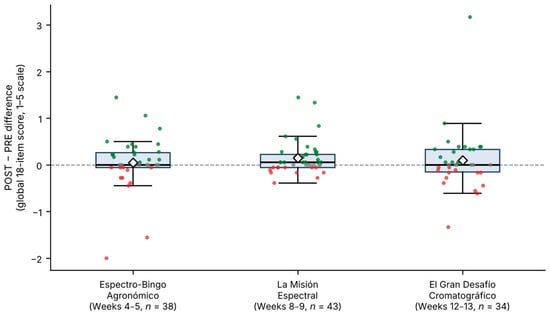
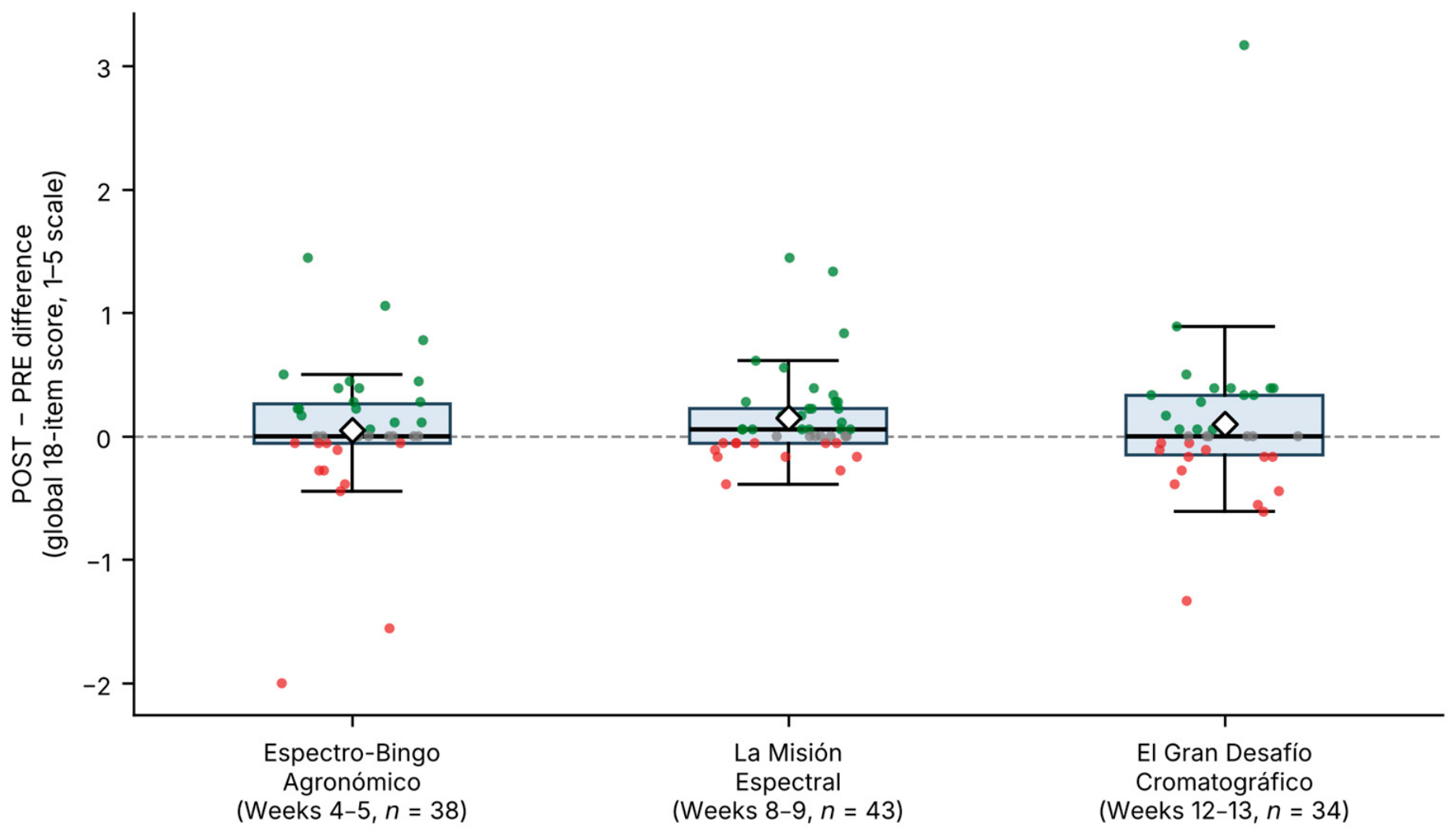
Distribution of paired POST − PRE differences in the global (18-item) score by activity. Boxes show the median and interquartile range; whiskers extend to 1.5 × IQR; diamonds show means; points show individual students (green, higher POST score; red, lower POST score; grey, no change).
Within each activity (RQ1), the PRE and POST responses of the same student were matched by student code. We tested paired differences with the two-sided Wilcoxon signed-rank test; we discarded zero differences (Wilcoxon’s method) and obtained p-values using normal approximation with tie correction and without continuity correction. W denotes the smaller of the sums of positive and negative ranks. The effect size was the matched-pairs rank-biserial correlation, rrb = (T+ − T−)/(T+ + T−), computed over non-zero differences [26], with 95% percentile bootstrap confidence intervals (5000 resamples of students). We also reported mean paired differences with 95% t-based confidence intervals, and the median and interquartile range of the paired differences. Note that the confidence intervals refer to the mean paired difference (t distribution), whereas the p-values come from the rank-based Wilcoxon test, which does not test the mean; the two are therefore not derived from the same test and need not align numerically. For transparency, paired t-test p-values, which correspond directly to the reported confidence intervals, are also given for the sensitivity analyses (Section 3.4). Two families of hypotheses were defined for multiplicity control with the Holm procedure [27]: a primary family comprising the three global (18-item) comparisons (one per activity) and a secondary, exploratory family comprising the nine dimension-level comparisons (three dimensions × three activities).
Because the same student could contribute data to more than one activity, analyses across activities (RQ2 and RQ3) used linear mixed-effects models with a random intercept for student, fitted by maximum likelihood to all available complete questionnaires (264 questionnaires from 57 students) under a missing-at-random (MAR) assumption. This assumption cannot be verified; if the probability of completing both questionnaires depended on students’ unobserved perceptions (missing not at random), the estimates could be biased. The global score (and, in exploratory models, each dimension score) was modeled as a function of activity, measurement occasion (PRE vs. POST), and their interaction. The overall expectation–experience difference was tested with a likelihood-ratio test of occasion in the model without interaction, and variation in this difference among formats was tested with a likelihood-ratio test of the activity × occasion interaction (2 df). Differences among activities in PRE and in POST scores (RQ3) were tested separately with likelihood-ratio tests of activity. As sensitivity analyses, the models were refitted to matched records only, and the mean paired difference was estimated with generalized estimating equations (GEE; exchangeable working correlation, robust standard errors) clustered by student. To examine the sensitivity of the within-activity results to unmatched respondents, the Wilcoxon tests were repeated including students with only one complete questionnaire, imputing the missing PRE score of POST-only respondents with the mean PRE score of matched students of the same activity and setting the missing POST score of PRE-only respondents equal to their PRE score (no change). The primary analyses are the within-activity Wilcoxon tests of the global score (RQ1) and the global-score mixed models (RQ2 and RQ3); all dimension-level analyses and sensitivity analyses are exploratory. The pooled Cohen’s dz is reported descriptively with a cluster-bootstrap 95% CI (resampling students). Holm adjustment was applied across the three dimension-level mixed models. Significance was set at α = 0.05.
3. Results
3.1. Participation, Instrument Reliability, and Score Distributions
Table 1 shows participant flow. Of the 64 students on the course roster, 43–49 provided PRE responses and 43–49 provided POST responses for each activity. After excluding incomplete questionnaires and students who responded at only one time point, 38, 43, and 34 complete matched pairs were available for Espectro-Bingo Agronómico, La Misión Espectral, and El Gran Desafío Cromatográfico, respectively. These 115 student–activity records came from 52 unique students: 22 contributed pairs to all three activities, 19 to two, and 11 to one. Students without a matched pair did not differ significantly from matched students in their PRE-scores (all p ≥ 0.29, Mann–Whitney U test); for La Misión Espectral, the five students with POST-only responses rated the activity lower than matched students (M = 3.60 vs. 4.40, p = 0.015), suggesting that the matched sample may slightly over-represent favorable experiences for this activity (Table S5). The implications of this difference for the within-activity result are examined in Section 3.4.
Table 1.
Participant flow and complete questionnaires by activity (course roster: 64 students).
Internal consistency was high for every dimension (Table 2): across activities and forms, α and ω ranged from 0.87 to 0.97 for the four dimensions and from 0.95 to 0.99 for the total scales. Responses were strongly concentrated at the top of the scale: among matched pairs, 47–51% of PRE item responses and 55–57% of POST item responses were at the maximum (5), and 19–24% of students gave the maximum score to all 18 PRE items (Table S4).
Table 2.
Internal consistency (Cronbach’s α/McDonald’s ω) by dimension, form, and activity.
Among matched pairs, global PRE (expectation) means, computed over the 18 items common to both forms, ranged from 4.25 (La Misión Espectral) to 4.31 (Espectro-Bingo Agronómico). Global POST (experience) means were higher for all three activities, ranging from 4.36 (Espectro-Bingo Agronómico) to 4.40 (La Misión Espectral), corresponding to mean differences of 0.05 to 0.15 points on the five-point scale (Table 3). At the dimension level, mean differences were positive except for Aprendizaje y comprensión in Espectro-Bingo Agronómico, which decreased marginally (4.35 to 4.34). The largest mean differences were observed for La Misión Espectral, particularly in the Diseño de la actividad (4.24 → 4.45) and Motivación e interés (4.18 → 4.36) dimensions. The distributions of the paired differences (Figure 1) show that the median difference was 0 for Espectro-Bingo Agronómico and El Gran Desafío Cromatográfico and 0.06 for La Misión Espectral, with substantial between-student variability in all three activities.
Table 3.
Descriptive pre-activity (expectation) and post-activity (experience) scores (1–5 scale) by dimension and activity, matched pairs only; mean (SD).
3.2. Descriptive Comparison of PRE and POST Scores
Descriptive statistics are summarized in Table 3. Within El Gran Desafío Cromatográfico, Diseño de la actividad/rol docente was the dimension with the highest POST mean (4.48), which is consistent with its highly structured, rule-based board-game format and explicit teacher-guided sequencing, whereas Interacción y habilidades comunicativas was highest for La Misión Espectral (POST = 4.46), consistent with its collaborative, group-based escape-room design. Because the POST-only dimension has no PRE counterpart, these values describe students’ impressions after the activity and cannot be interpreted as improvement in interaction or communication skills. Differences among activities in POST scores were small and not statistically significant (Section 3.4).
3.3. Within-Activity Expectation–Experience Comparisons
Wilcoxon signed-rank tests on matched pairs (Table 4) showed that, for La Misión Espectral, the global POST score exceeded the PRE-score (mean difference = 0.15, 95% CI 0.04–0.26; W = 172.0, p = 0.011, Holm-adjusted p = 0.034; rrb = 0.48, 95% CI 0.16–0.76). This was the only within-activity comparison that remained significant after Holm adjustment; however, as shown in Section 3.4, it was sensitive to the handling of unmatched respondents and should be regarded as exploratory. At the dimension level, the same activity showed unadjusted differences for Motivación e interés (p = 0.024, rrb = 0.49) and Diseño de la actividad (p = 0.006, rrb = 0.54), but these did not remain significant after Holm adjustment within the exploratory dimension-level family (adjusted p = 0.191 and 0.055, respectively); Aprendizaje y comprensión did not differ (p = 0.227). For Espectro-Bingo Agronómico and El Gran Desafío Cromatográfico, no global or dimension-level comparison was statistically significant (all unadjusted p ≥ 0.15), and the confidence intervals of the mean differences included zero. In practical terms, the largest within-activity mean difference (0.15 points in the global score of La Misión Espectral) corresponds to approximately 4% of the range of the five-point scale.
Table 4.
Wilcoxon signed-rank comparison of matched PRE (expectation) vs. POST (experience) composite dimension scores.
3.4. Analyses Across Activities Accounting for Repeated Observations
Across the 115 matched student–activity records, the global score was higher at POST for 56 records (49%), lower for 36 (31%), and unchanged for 23 (20%); pooled means were 4.28 (SD = 0.72) at PRE and 4.38 (SD = 0.65) at POST (mean difference = 0.10, cluster-bootstrap 95% CI −0.01 to 0.22; dz = 0.19, 95% CI −0.02 to 0.39). Because these records are not independent, we reported the pooled figures descriptively only, and we have withdrawn the sign test reported in the original submission.
In the linear mixed model using all available complete questionnaires (264 questionnaires from 57 students; intraclass correlation = 0.66), POST scores were on average 0.11 points higher than PRE scores (95% CI 0.02–0.21; χ2(1) = 5.05, p = 0.025; Table 5). This estimate was sensitive to the analytic specification: it was of similar magnitude but borderline when the model was restricted to matched records (b = 0.10, 95% CI 0.00–0.20; p = 0.051) and was not significant in the GEE analysis of paired differences (b = 0.11, 95% CI −0.02 to 0.23; p = 0.087). There was no evidence that the expectation–experience difference varied among the three activities (activity × occasion: χ2(2) = 0.57, p = 0.750; matched records only: p = 0.711); the activity-specific estimates were 0.06 (95% CI −0.11 to 0.23) for Espectro-Bingo Agronómico, 0.13 (−0.04 to 0.29) for La Misión Espectral, and 0.15 (−0.02 to 0.33) for El Gran Desafío Cromatográfico. Given the width of these confidence intervals, the non-significant interaction does not demonstrate that the three formats are equivalent. Exploratory dimension-level models showed a POST > PRE difference for Diseño de la actividad (b = 0.14, Holm-adjusted p = 0.030) but not for Motivación e interés (b = 0.13, adjusted p = 0.066) or Aprendizaje y comprensión (b = 0.07, adjusted p = 0.200), again with no activity × occasion interaction (all p ≥ 0.64).
Table 5.
Linear mixed-effects models of PRE (expectation) and POST (experience) scores across the three activities (random intercept for student; 264 questionnaires from 57 students).
Regarding RQ3, neither PRE scores (χ2(2) = 1.53, p = 0.466) nor POST scores (χ2(2) = 1.15, p = 0.562) differed significantly among the three activities. Descriptively, the global POST means of matched students were 4.36, 4.40, and 4.38, and the Motivación e interés POST means were 4.33, 4.36, and 4.30 for the first, second, and third activity, respectively.
Table 6 summarizes the consistency of the main results across the primary and sensitivity analyses. The overall expectation–experience difference was of similar magnitude in all specifications (0.10–0.11 points), but its statistical support depended on the specification. For La Misión Espectral, the difference was significant in the matched-pairs analysis but not when the seven unmatched respondents were included (mean difference = 0.06, 95% t-based CI −0.06 to 0.19; Wilcoxon p = 0.159; paired t-test p = 0.324), nor in the activity-specific mixed-model estimates (all available data: 0.13, 95% CI −0.04 to 0.29, p = 0.136; matched records: 0.15, 95% CI −0.01 to 0.31, p = 0.074). Because the five POST-only respondents rated this activity lower than matched students, the matched-pairs result may overstate the expectation–experience difference for the escape room, and the MAR assumption of the mixed models may not fully hold. For the other two activities, the conclusions were unchanged in all sensitivity analyses (all p ≥ 0.06).
Table 6.
Consistency of the expectation–experience difference (POST − PRE, global 18-item score) across primary and sensitivity analyses.
4. Discussion
4.1. Interpretation of Findings
Students’ perceptions of the experienced activities were, on average, slightly more favorable than their expectations. Within individual activities, this expectation–experience difference was statistically supported only for the global score of La Misión Espectral after correction for multiple testing, and this exploratory result was sensitive to the inclusion of unmatched respondents, and across activities the mixed-model estimate of the overall difference was small (about 0.1 points on a five-point scale) and sensitive to the analytic specification. Because the PRE-form measured expectations and the POST-form measured experience, these results indicate that the activities met or slightly exceeded students’ expectations; they do not demonstrate a clear increase in motivation or learning. This modest pattern is broadly consistent with meta-analytic estimates of the effects of game-based learning in chemistry education, which are typically small to moderate and heterogeneous across implementations [14,15,16]. PRE-scores were already high: about half of all PRE-item responses were at the scale maximum, and roughly one in five students gave the maximum score to every PRE-item. This ceiling effect limited the possible upward change and may partly explain the small differences observed. The high PRE-scores indicate that, once introduced to each activity, students expected it to be useful and engaging; this is consistent with the course diagnosis motivating the project, in which students had explicitly requested “more in-class activities,” but it should not be read as their disposition upon entering the course, because PRE-questionnaires were administered at the start of the gameplay session of each activity between Weeks 4 and 13.
These results are particularly relevant when considering that the intervention was conducted with first-year students, a stage characterized by transition and adaptation to new academic, social, and institutional demands [1,2]. In this context, teaching strategies not only transmit content but can also create learning experiences that foster participation, interaction, and a more active approach to knowledge [3,4]. The favorable perceptions observed across the three activities suggest that collaborative game-based activities may be well received at this stage, as they combine disciplinary content with peer interaction, active participation, and the resolution of challenges.
The descriptive differences across activities may be informative from a design perspective, but they should be interpreted with caution. La Misión Espectral, a collaborative escape-room task performed in groups of up to 15 students, was the only activity whose global expectation–experience difference was statistically significant in the within-activity analysis—a result that was not robust to the inclusion of unmatched respondents or to mixed-model estimation and therefore carries limited pedagogical weight— and it also obtained the highest POST mean in the Interacción y habilidades comunicativas dimension. However, a significant result for one activity and non-significant results for the others do not constitute evidence that the activities differ [28]. The direct test of this question, the activity × occasion interaction in the mixed model, provided no evidence of differences among formats, although, given the wide confidence intervals, it does not show that the formats are equivalent, and the model-based estimate for the board game was similar in magnitude to that for the escape room. The activities also differed in content, timing within the semester, and duration, and partly in the students who responded. The possibility that collaborative formats support relatedness and autonomous motivation, as proposed by self-determination theory [17] and by studies of educational escape rooms [18,19], therefore remains a hypothesis to be tested rather than a conclusion of the present study. Similarly, the high POST-scores for Diseño de la actividad/rol docente in El Gran Desafío Cromatográfico are consistent with the view that clear structure and scaffolding support students’ sense of competence, but this mechanism was not directly examined.
From a pedagogical perspective, these results suggest that the potential of game-based learning does not depend solely on incorporating playful elements, but rather on the quality of learning experience design and how these elements are articulated with disciplinary content, student participation, and teacher mediation. Although no statistically significant differences among the three activities were detected, their descriptive profiles across dimensions were not identical, reinforcing the need to analyze which specific design characteristics may favor motivation, interaction, and perceived learning, rather than attributing the results to game-based learning as a homogeneous strategy [14,15,16,17]. The main practical contribution of this study is therefore the detailed description of three discipline-specific designs (Section 2.2 and Supplementary Section S6), which may be transferable to similar introductory courses, rather than evidence of their educational effectiveness.
4.2. Limitations, Implications, and Future Work
A frequently reported risk in research on gamification and game-based learning is a novelty effect, whereby initial motivational effects decline with repeated exposure and may later recover as students become familiar with the format [23,24]. The present data do not allow this question to be answered. POST-scores varied slightly across the three activities (global: 4.36, 4.40, and 4.38; Motivación e interés: 4.33, 4.36, and 4.30 among matched students), and these differences were not statistically significant; however, the absence of a significant difference is not evidence of sustained motivation, and any trend across the semester is confounded with differences in content, format, and respondents. In addition, the PRE-questionnaires for the second and third activities were completed after students had already experienced earlier activities, so their expectations may have been shaped by those experiences.
Several further limitations should be acknowledged. First, the study measured students’ self-reported perceptions immediately after each activity; no objective measure of knowledge acquisition or academic performance was included, and the Aprendizaje y comprensión dimension showed no significant expectation–experience difference in any activity. The findings therefore cannot establish improved learning or a reduction in the failure rate that motivated the project. Second, without a comparison group, the observed differences cannot be attributed causally to the activities. Third, matched data were available for 34–43 students per activity, and students who responded at only one time point may differ from those included; in particular, the lower ratings of POST-only respondents in La Misión Espectral suggest that data may not be missing at random and that the matched-pairs result for this activity may be optimistic. Fourth, the adapted PRE- and POST-forms differ in temporal framing, so PRE–POST differences reflect the gap between expectations and experience rather than change in a single construct; the forms also differ in length, and their measurement equivalence was not tested, so high internal consistency does not establish that both forms measure the same construct in the same way. Fifth, scores were strongly concentrated at the top of the scale. Subsequent phases of the 18-month project will incorporate a comparison condition, longitudinal modeling of the same students across activities, academic performance indicators, and qualitative content analysis of the open-ended responses already collected alongside the Likert items.
5. Conclusions
Three game-based learning activities (a bingo game, an escape room, and a board game) were delivered at different points of the second semester of 2025 in a mandatory first-year analytical chemistry course for Agronomy students and evaluated with an activity-adapted version of a validated perception scale (115 matched PRE–POST records from 52 students). Students’ perceptions of the activities they experienced were, on average, slightly more favorable than their prior expectations. This difference reached statistical significance within the escape-room activity (La Misión Espectral) after correction for multiple testing, but this exploratory result was sensitive to the handling of unmatched respondents and to the analytic model. The overall difference across activities was small and sensitive to the analytic approach, and the data did not show differences among the three formats, although they cannot establish that the formats are equivalent. The forms showed high internal consistency at the dimension level, but scores were close to the scale maximum. These exploratory findings concern students’ immediate perceptions rather than demonstrated learning; they document the implementation of three discipline-specific game-based activities in one introductory course and students’ favorable immediate perceptions of them. The instructional designs, described in detail, may be transferable to similar courses, but their educational effectiveness, any sustained effect on motivation, and their feasibility in other contexts require a controlled, longitudinal evaluation that includes objective learning outcomes.
Supplementary Materials
The following supporting information can be downloaded at: https://www.mdpi.com/article/10.3390/higheredu5040129/s1. Table S1: EVINED items, dimension assignment, and administration form; Table S2: Detailed within-activity paired comparisons (matched pairs); Table S3: Linear mixed-effects models and GEE sensitivity analyses; Table S4: Ceiling indicators among matched pairs (18 common items); Table S5: Comparison of matched and unmatched respondents (global 18-item score); Section S6: Representative activity materials; Figure S1: Example of one of the 50 Espectro-Bingo Agronómico cards (terms in Spanish; central square free).
Author Contributions
Conceptualization, W.E.; methodology, W.E., V.L. and C.S.; software, W.E.; validation, W.E., C.E.-M. and V.L.; formal analysis, W.E.; investigation, W.E., C.E.-M., C.S., W.E.-C., A.B.-M. and I.-Y.M.; resources, V.L.; data curation, W.E.; writing—original draft preparation, W.E.; writing—review and editing, W.E., C.E.-M., C.S., W.E.-C., A.B.-M., I.-Y.M. and V.L.; visualization, W.E.; supervision, W.E. and V.L.; project administration, W.E.; funding acquisition, W.E. and V.L. All authors have read and agreed to the published version of the manuscript.
Funding
This research was funded by the Dirección de Docencia, Universidad de Concepción, through Fondos I3D “Docencia que innova, investiga e impacta” (Proyecto I3D-INICIA, grant number 2025016), a competitive institutional program that finances pedagogical innovation projects, and by the Dirección de Investigación Científica, Humanística y Tecnológica (DICHT-UNAH).
Institutional Review Board Statement
Ethical review and approval were waived for this study because it consisted of a course-embedded satisfaction survey with de-identified analysis, involving no more than minimal risk, conducted as part of routine teaching-quality evaluation activities of the Dirección de Docencia, Universidad de Concepción.
Informed Consent Statement
The game-based activities were part of regular course teaching and were open to all students, regardless of their decision to take part in the research. Written informed consent was obtained from all students whose responses were analyzed, before they completed the questionnaires; students were informed of the purpose of the study and that participation (or non-participation) in the research would not affect their course grade. Student identifiers used to match PRE and POST responses were replaced by pseudonymous codes before analysis to protect participant privacy.
Data Availability Statement
The de-identified data presented in this study are available on request from the corresponding author. The data are not publicly available due to institutional data-sharing restrictions associated with the funding project and to protect participant privacy.
Acknowledgments
The authors thank the students of Elementos de Química Analítica Cuantitativa (second semester 2025) for their participation, the Dirección de Docencia (I3D) of Universidad de Concepción for institutional and financial support, and the Dirección de Investigación Científica, Humanística y Tecnológica (DICHT-UNAH) for supporting the publication of this paper.
Conflicts of Interest
The authors declare no conflicts of interest. The funders had no role in the design of the study; in the collection, analyses, or interpretation of data; in the writing of the manuscript; or in the decision to publish the results.
Abbreviations
The following abbreviations are used in this manuscript:
| Abbreviation | Full term |
| GC | Gas chromatography |
| HPLC | High-performance liquid chromatography |
| ICP-OES | Inductively coupled plasma optical emission spectrometry |
| ICP-MS | Inductively coupled plasma mass spectrometry |
| XRF | X-ray fluorescence |
| IR | Infrared spectrometry |
| UV-Vis | Ultraviolet–visible spectrometry |
| SDT | Self-determination theory |
| EVINED | Escala de Evaluación de Innovaciones Educativas |
| I3D | Innova-Investiga-Impacta (Dirección de Docencia, Universidad de Concepción) |
| GBL | Game-based learning |
| GEE | Generalized estimating equations |
| LMM | Linear mixed-effects model |
References
- Hultberg, J.; Plos, K.; Hendry, G.; Kjellgren, K. Scaffolding Students’ Transition to Higher Education: Parallel Introductory Courses for Students and Teachers. J. Furth. High. Educ. 2008, 32, 47–57. [Google Scholar] [CrossRef] [Scilit]
- Panadero, E.; Fraile, J.; García, D. Transition to Higher Education and Assessment: A One Year Longitudinal Study. Educ. XX1 2022, 25, 15–37. [Google Scholar] [CrossRef] [Scilit]
- Heirdsfield, A.; Walker, S.; Walsh, K.; Wilss, L. Peer Mentoring for First-Year Teacher Education Students: The Mentors’ Experience. Mentor. Tutoring Partnersh. Learn. 2008, 16, 109–124. [Google Scholar] [CrossRef] [Scilit][Green Version]
- Pezoa-Fuentes, C.; Mercado-Guerra, J. Methodological Innovation and Learning Approaches in University Students: A Case Study of the Commercial Engineering Degree at the Universidad Católica del Norte, Chile. Form. Univ. 2020, 13, 111–122. [Google Scholar] [CrossRef] [Scilit]
- Balcázar, J.; Alva, L.; Flores, F.; Chamoli, A. Gamification as a Motivational Tool in University Learning: A Systematic Review. Rev. InveCom 2026, 6, e603018. [Google Scholar] [CrossRef]
- Deterding, S.; Dixon, D.; Khaled, R.; Nacke, L. From Game Design Elements to Gamefulness: Defining “Gamification”. In Proceedings of the 15th International Academic MindTrek Conference: Envisioning Future Media Environments, Tampere, Finland, 28–30 September 2011; pp. 9–15. [Google Scholar] [CrossRef] [Scilit]
- Sánchez-Nolasco, A. Gamification as a Strategy in the Training of Socio-Emotional Skills in University Teachers. Estud. Pedagóg. 2024, 50, 133–157. [Google Scholar] [CrossRef] [Scilit]
- Landers, R.N. Developing a Theory of Gamified Learning: Linking Serious Games and Gamification of Learning. Simul. Gaming 2014, 45, 752–768. [Google Scholar] [CrossRef] [Scilit]
- Plass, J.L.; Homer, B.D.; Kinzer, C.K. Foundations of Game-Based Learning. Educ. Psychol. 2015, 50, 258–283. [Google Scholar] [CrossRef] [Scilit]
- Krath, J.; Schürmann, L.; von Korflesch, H.F.O. Revealing the Theoretical Basis of Gamification: A Systematic Review and Analysis of Theory in Research on Gamification, Serious Games and Game-Based Learning. Comput. Hum. Behav. 2021, 125, 106963. [Google Scholar] [CrossRef] [Scilit]
- Hamari, J.; Koivisto, J.; Sarsa, H. Does Gamification Work?—A Literature Review of Empirical Studies on Gamification. In Proceedings of the 47th Hawaii International Conference on System Sciences, Waikoloa, HI, USA, 6–9 January 2014; pp. 3025–3034. [Google Scholar] [CrossRef] [Scilit]
- Sailer, M.; Homner, L. The Gamification of Learning: A Meta-Analysis. Educ. Psychol. Rev. 2020, 32, 77–112. [Google Scholar] [CrossRef] [Scilit]
- Ratinho, E.; Martins, C. The Role of Gamified Learning Strategies in Student’s Motivation in High School and Higher Education: A Systematic Review. Heliyon 2023, 9, e19033. [Google Scholar] [CrossRef] [Scilit] [PubMed]
- Chans, G.M.; Portuguez Castro, M. Gamification as a Strategy to Increase Motivation and Engagement in Higher Education Chemistry Students. Computers 2021, 10, 132. [Google Scholar] [CrossRef] [Scilit]
- Byusa, E.; Kampire, E.; Mwesigye, A.R. Game-Based Learning Approach on Students’ Motivation and Understanding of Chemistry Concepts: A Systematic Review of Literature. Heliyon 2022, 8, e09541. [Google Scholar] [CrossRef] [Scilit] [PubMed]
- Hu, Y.; Gallagher, T.; Wouters, P.; van der Schaaf, M.; Kester, L. Game-Based Learning Has Good Chemistry with Chemistry Education: A Three-Level Meta-Analysis. J. Res. Sci. Teach. 2022, 59, 1499–1543. [Google Scholar] [CrossRef] [Scilit]
- Ryan, R.M.; Deci, E.L. Self-Determination Theory and the Facilitation of Intrinsic Motivation, Social Development, and Well-Being. Am. Psychol. 2000, 55, 68–78. [Google Scholar] [CrossRef] [PubMed]
- Veldkamp, A.; van de Grint, L.; Knippels, M.-C.P.J.; van Joolingen, W.R. Escape Education: A Systematic Review on Escape Rooms in Education. Educ. Res. Rev. 2020, 31, 100364. [Google Scholar] [CrossRef] [Scilit]
- Lathwesen, C.; Belova, N. Escape Rooms in STEM Teaching and Learning—Prospective Field or Declining Trend? A Literature Review. Educ. Sci. 2021, 11, 308. [Google Scholar] [CrossRef] [Scilit]
- Ferreiro-González, M.; Amores-Arrocha, A.; Espada-Bellido, E.; Aliaño-González, M.J.; Vázquez-Espinosa, M.; González-de-Peredo, A.V.; Sancho-Galán, P.; Álvarez-Saura, J.Á.; Barbero, G.F.; Cejudo-Bastante, C. Escape ClassRoom: Can You Solve a Crime Using the Analytical Process? J. Chem. Educ. 2019, 96, 267–273. [Google Scholar] [CrossRef] [Scilit]
- Mahomed, M.; Sisodia, L.; Williams, D.P.; Villa-Marcos, B. Spectroscopy Unlocked: An Escape Room Activity for Introductory Chemistry Courses. J. Chem. Educ. 2024, 101, 2570–2575. [Google Scholar] [CrossRef] [Scilit]
- Tietze, K.J. A Bingo Game Motivates Students to Interact with Course Material. Am. J. Pharm. Educ. 2007, 71, 79. [Google Scholar] [CrossRef] [Scilit] [PubMed]
- Koivisto, J.; Hamari, J. The Rise of Motivational Information Systems: A Review of Gamification Research. Int. J. Inf. Manag. 2019, 45, 191–210. [Google Scholar] [CrossRef] [Scilit]
- Rodrigues, L.; Pereira, F.D.; Toda, A.M.; Palomino, P.T.; Pessoa, M.; Carvalho, L.S.G.; Fernandes, D.; Oliveira, E.H.T.; Cristea, A.I.; Isotani, S. Gamification Suffers from the Novelty Effect but Benefits from the Familiarization Effect: Findings from a Longitudinal Study. Int. J. Educ. Technol. High. Educ. 2022, 19, 13. [Google Scholar] [CrossRef] [Scilit]
- Bruna Jofré, C.; Bustos Navarrete, C.; Lobos Peña, K.; Espinoza Parcet, C.; Sáez Noriega, F.; Fernández Branada, C. Construcción y Validación de la Escala de Evaluación de Innovaciones Educativas en Educación Superior. Aula Abierta 2026, 55, 223–235. [Google Scholar] [CrossRef] [Scilit]
- Kerby, D.S. The Simple Difference Formula: An Approach to Teaching Nonparametric Correlation. Compr. Psychol. 2014, 3, 11.IT.3.1. [Google Scholar] [CrossRef] [Scilit]
- Holm, S. A Simple Sequentially Rejective Multiple Test Procedure. Scand. J. Stat. 1979, 6, 65–70. [Google Scholar]
- Gelman, A.; Stern, H. The Difference between “Significant” and “Not Significant” Is Not Itself Statistically Significant. Am. Stat. 2006, 60, 328–331. [Google Scholar] [CrossRef] [Scilit]

Disclaimer/Publisher’s Note: The statements, opinions and data contained in all publications are solely those of the individual author(s) and contributor(s) and not of MDPI and/or the editor(s). MDPI and/or the editor(s) disclaim responsibility for any injury to people or property resulting from any ideas, methods, instructions or products referred to in the content. |
© 2026 by the authors. Licensee MDPI, Basel, Switzerland. This article is an open access article distributed under the terms and conditions of the Creative Commons Attribution (CC BY) license.