


Abstract
Laboratory education in pharmacy should enable students to perform analytical procedures and critically interpret findings within a broader professional context. This study proposes a three-hour multidisciplinary laboratory exercise for senior pharmacy students, revisiting complexometric titration previously learned in Analytical Chemistry through the analysis of commercial zinc dietary supplements. Students work in pairs to calculate apparent zinc contents using EDTA titration, process data, compare results with label claims, and apply pharmacopoeial content uniformity concepts as educational benchmarks. Guided discussion connects analytical findings with formulation composition, dietary supplement regulation, and the distinction between supplements and medicines. Preliminary experiments with acid-dissolved model zinc compounds assessed linearity, recovery, and selected excipient effects. Direct titration of five commercial supplements yielded apparent zinc contents corresponding to 95.79–136.84% of label claims. Quantitative recovery and freedom from matrix interference were not established for the commercial formulations; these results therefore support discussion of method limitations rather than confirmed assessments of product quality. The contribution lies in using an established, accessible technique to connect analytical chemistry, pharmaceutical technology, bromatology, and regulatory science through authentic samples and critical data interpretation. The proposed framework offers opportunities for multidisciplinary learning, while its educational effectiveness requires structured assessment.
1. Introduction
Laboratory practice is an essential part of pharmacy education, preparing students to become future independent professionals in healthcare or industry [1]. Regarding analytical chemistry teaching, it enables students to translate theoretical concepts into practical analytical skills and to develop an understanding of the complete analytical process. In pharmacy education, this connection is particularly important because analytical results encountered in professional practice must not only be generated correctly but also critically interpreted in relation to product composition, quality requirements, and the relevant regulatory framework [2].
Volumetric analysis remains an important component of undergraduate analytical chemistry education. Chelatometry, including the titrimetric determination of zinc using ethylenediaminetetraacetic acid (EDTA), is an integral part of the Analytical Chemistry 2 course, attended by second-year students of the integrated academic studies of pharmacy at the Faculty of Medicine, University of Novi Sad, Novi Sad, Serbia [3]. Among volumetric methods, complexometric titration with EDTA provides a relatively simple and inexpensive approach for the quantitative determination of metal ions and allows students to apply fundamental concepts of complex formation, reaction stoichiometry, equilibrium, indicators, endpoint detection, and quantitative calculations. Several practical classes using complexometric titration methods for the analysis of everyday samples have already been proposed, such as the titrimetric determination of calcium in dietary supplements [4], zinc oxide in talc and ointment [5], or the determination of the calcium and magnesium ions in previously compounded intravenous fluid bags [6]. Such samples provide students with valuable insight into the practical applicability of titrimetric methods in everyday professional practice.
In general, compared to instrumental techniques such as Flame Atomic Absorption Spectrometry and Inductively Coupled Plasma Mass Spectrometry (ICP-MS), titrimetric methods offer several advantages, including simplicity and low cost, making them particularly suitable for educational settings.
Dietary supplements containing zinc provide a good model for an integrated exercise. Zinc is available in commercial supplements in different chemical forms and pharmaceutical dosage forms and at different declared doses, while the formulations may contain a variety of excipients and additional active ingredients. Consequently, analysis of commercial zinc supplements introduces students to analytical challenges that are not encountered when titrating simple standard solutions. At the same time, the use of individual dosage units enables the experimental results to be considered from the perspective of pharmaceutical quality, including the distinction between the amount of zinc declared on the product label and the variability of zinc content among individual dosage units. Complexometric determination of zinc is also described in the European Pharmacopoeia [7], providing an additional connection between a fundamental analytical chemistry technique and pharmacopoeial quality control.
Unlike medicinal products, dietary supplements are regulated as foods, and pharmacopoeial requirements are therefore not necessarily directly applicable as legally binding quality criteria. Applying selected pharmacopoeial concepts to experimental data as an educational benchmark can consequently prompt students to distinguish between an analytical result, compliance with a pharmacopoeial criterion, agreement with the declared content, and regulatory compliance. Such interpretation transforms a conventional quantitative analysis exercise into a multidisciplinary problem integrating analytical chemistry, pharmaceutical technology, bromatology, and regulatory science. Integrating knowledge across disciplines and providing opportunities to repeatedly apply previously acquired concepts in new contexts may strengthen knowledge retention and promote the development of critical thinking and problem-solving skills [8,9].
The aim of this study was to develop a three-hour multidisciplinary laboratory exercise for senior pharmacy students in which previously acquired knowledge of complexometric titration is applied to commercially available zinc dietary supplements. The novelty of the proposed laboratory exercise lies not in the analytical method itself, but in its multidisciplinary educational application. Unlike previously reported laboratory exercises primarily focused on the quantitative determination of metal ions, the present approach uses commercial zinc dietary supplements to integrate complexometric titration with the assessment of individual dosage-unit variability, comparison with label claims, and interpretation of results in the context of pharmacopoeial concepts and dietary supplement regulations. Furthermore, by revisiting an analytical technique introduced earlier in the curriculum, the exercise provides senior pharmacy students with an opportunity to apply previously acquired knowledge to a more complex, professionally relevant problem. The analytical procedure was additionally evaluated for linearity, recovery, and potential excipient interference to assess its suitability for the proposed educational application.
2. Materials and Methods
2.1. Educational Context, Target Students, and Learning Outcomes
The proposed three-hour laboratory exercise was designed for senior pharmacy students, preferably in the final year of an integrated pharmacy program. Its methodological foundation is complexometric titration, a technique introduced earlier in the curriculum as part of Analytical Chemistry. At the Faculty of Medicine, University of Novi Sad, Serbia, students acquire theoretical knowledge and practical experience in EDTA titration during Analytical Chemistry 2 in the second year of the Integrated Academic Studies of Pharmacy.
The exercise was designed to revisit this previously acquired analytical chemistry knowledge at a later stage of pharmacy education, when students have also acquired, or are concurrently acquiring, knowledge of pharmaceutical technology, bromatology, and regulatory aspects relevant to dietary supplements. Rather than introducing a new analytical technique, students are required to transfer a familiar analytical method to a more complex and professionally relevant problem involving commercially available zinc dietary supplements. Analytical Chemistry therefore provides the methodological foundation of the exercise, while pharmaceutical technology, bromatology, and regulatory science provide the broader context for interpretation of the experimental findings. The individual learning activities and their corresponding intended learning outcomes are summarized in Table 1.
Table 1.
Alignment of laboratory activities with intended learning outcomes of the proposed exercise.
Upon completion of the exercise, students are expected to be able to: (i) apply complexometric titration and critically assess its suitability for zinc determination in commercial dietary supplements; (ii) calculate apparent zinc content in individual dosage units and statistically summarize experimental data; (iii) recognize potential matrix effects and sources of interference in the analysis of multicomponent formulations; (iv) distinguish between agreement with the label-declared content and uniformity among individual dosage units; (v) interpret experimental results using relevant pharmacopoeial concepts; and (vi) critically consider the applicability of pharmacopoeial and regulatory criteria when assessing dietary supplement quality.
The laboratory procedure was carried out by two students as part of a supervised student research project. The three-hour format for approximately 20 students described below represents a proposed teaching design and was not implemented as a course-wide activity. Student learning outcomes and the educational effectiveness of the proposed exercise were not formally assessed.
2.2. Organization of the Three-Hour Laboratory Exercise
The exercise is designed for a laboratory class of approximately 20 students working in pairs. Five commercially available zinc dietary supplements (A–E) are distributed among ten student pairs, with two pairs assigned to each product. Each pair analyzes five individual dosage units independently, resulting in a combined dataset of ten individually analyzed dosage units for each dietary supplement.
At the beginning of the session, the analytical problem and learning objectives are introduced, followed by a brief review of the principles of complexometric zinc determination with EDTA. Students examine the product label of their assigned dietary supplement and identify the dosage form, chemical source of zinc, declared elemental zinc content, and formulation components potentially relevant to the analysis.
During the experimental phase, each pair separately prepares and titrates five individual dosage units. Following completion of the experimental work, the two pairs assigned to the same product combine their results to obtain a dataset of ten individual measurements. Students calculate apparent zinc content of each dosage unit and subsequently determine the mean content, standard deviation, and percentage of the label-declared zinc content.
The final part of the session is devoted to guided interpretation and discussion. Students compare experimental values and declared zinc contents, evaluate variability among individual dosage units, and consider their findings in relation to relevant pharmacopoeial concepts and the regulatory status of dietary supplements. Results obtained for the five products can subsequently be compared across the class, allowing students to discuss the potential influence of zinc source and formulation composition on analytical findings.
2.3. Materials and Reagents
The titrant, 0.01 M EDTA solution, was prepared by accurately weighing disodium ethylenediaminetetraacetate dihydrate (Lach:ner, Neratovice, Czech Republic) on an analytical balance (RADWAG, Radom, Poland), followed by dissolution in purified water and dilution to the required volume.
Eriochrome Black T (Centrohem, Stara Pazova, Serbia), prepared as a 1:100 triturate with sodium chloride, was used as the metallochromic indicator. An ammonia buffer was used to establish the titration medium at approximately pH 10, which was verified using pH indicator strips (Chemland, Stargard, Poland).
Zinc gluconate dihydrate (Fagron, Trikala, Greece) and zinc oxide (Centrohem, Stara Pazova, Serbia) were used during preliminary evaluation of the analytical procedure. Microcrystalline cellulose (VIVAPUR 101, JRS Pharma, Rosenberg, Germany), lactose monohydrate (BETAHEM, Belgrade, Serbia), and magnesium stearate (Centrohem, Stara Pazova, Serbia) were used to investigate the potential influence of representative formulation excipients.
Purified water was used for preparation of aqueous solutions, while hydrochloric acid solution (pH 1.2) was used for preparation of model zinc solutions.
2.4. Commercial Zinc Dietary Supplements
Five commercially available zinc dietary supplements, coded A–E, were selected to provide samples differing in dosage form, zinc source, declared zinc content, and qualitative formulation composition. The products were purchased from local pharmacies in Novi Sad, Serbia, and stored in their original packaging in a dry and dark place at room temperature (20–25 °C) until analysis.
The investigated products contained zinc in the form of zinc oxide, zinc citrate, or zinc gluconate, with declared elemental zinc contents of 10 or 15 mg per dosage unit. All products were within their labeled expiry dates at the time of analysis. For each product, ten individual dosage units were analyzed from a single purchased batch.
2.5. Student Experimental Procedure: Complexometric Determination of Zinc
In the proposed teaching format, each student pair would analyze five individual dosage units of the assigned dietary supplement separately. Tablets were individually pulverized using a mortar and pestle and quantitatively transferred into 100 mL Erlenmeyer flasks. For hard capsules, the contents of each capsule were directly and quantitatively transferred into the corresponding flask.
Approximately 2–4 mL of ammonia buffer was added to each sample to establish the conditions required for complexometric titration. The pH was verified using indicator strips and, when necessary, additional buffer was added until a pH of approximately 10 was achieved. A small amount of Eriochrome Black T triturate with sodium chloride was then added with a laboratory spatula.
The samples were titrated directly with 0.01 M EDTA solution until a clearly observable color change from wine-red to blue was reached. Some formulations produced turbid suspensions because of insoluble formulation components. However, the endpoint color change remained visually distinguishable. No filtration or sonication was performed during preparation of the commercial samples.
EDTA consumption was converted to an apparent zinc content using the assumed 1:1 molar stoichiometry between Zn2+ and EDTA. Results were expressed as milligrams per dosage unit and as a percentage of the label-declared zinc content. The term “apparent zinc content” denotes a value calculated from titrant consumption without confirmation of quantitative zinc recovery or exclusion of interfering components in the commercial matrix.
After completing five determinations, each pair would combine its results with those obtained by the second pair analyzing the same formulation, providing ten individual measurements per product for subsequent statistical and pharmacopoeial interpretation.
2.6. Analytical Procedure Evaluation: Linearity and Recovery
Prior to designing the student exercise, the suitability of the complexometric procedure was evaluated by the instructors in terms of linearity and recovery. These experiments were not included in the three-hour student laboratory session.
Zinc gluconate dihydrate (Fagron, Greece) was used as a model zinc source. A stock solution was prepared by accurately weighing 2803.4 mg of zinc gluconate dihydrate and quantitatively transferring it into a 250 mL volumetric flask. The substance was dissolved in hydrochloric acid solution (pH 1.2) and diluted to volume.
Aliquots of 10.0, 5.0, 2.5, 1.25, and 0.625 mL were withdrawn, corresponding to theoretical elemental zinc masses of 14.91, 7.46, 3.73, 1.86, and 0.93 mg, respectively. Ammonia buffer was added to achieve a pH of approximately 10, followed by Eriochrome Black T indicator. The solutions were titrated with 0.01 M EDTA as described above.
Linearity was evaluated by linear regression analysis of the relationship between EDTA consumption and theoretical zinc mass. Accuracy was expressed as percentage recovery according to the following equation:
Recovery (%) = (experimentally determined zinc mass/theoretical zinc mass) × 100.
2.7. Assessment of Potential Excipient Interference
The potential influence of selected excipients on the complexometric determination of zinc was also investigated by the instructors during development of the laboratory exercise and was not part of the three-hour student session. The purpose was to examine the influence of selected excipients on EDTA titration of acid-dissolved model zinc compounds.
Zinc oxide and zinc gluconate dihydrate were selected as model zinc sources. Precisely weighed amounts of zinc oxide (468.7 mg) and zinc gluconate dihydrate (2824 mg) were separately transferred into 250 mL volumetric flasks and diluted to volume with hydrochloric acid solution (pH 1.2). A 10 mL aliquot of each prepared solution contained approximately 15 mg of elemental zinc.
Aliquots were analyzed in triplicate without added excipients and following the addition of microcrystalline cellulose (200 mg), lactose monohydrate (200 mg), or magnesium stearate (60 mg). Approximately 2–4 mL of ammonia buffer was added, and the pH was verified and adjusted to approximately 10. Eriochrome Black T triturate was subsequently added, and the samples were titrated with 0.01 M EDTA until the color changed from wine-red to blue.
The experimentally determined zinc content was expressed as mean ± standard deviation (SD), and accuracy was expressed as percentage recovery relative to the theoretical elemental zinc content. Results obtained in the presence of each excipient were compared with those obtained for the corresponding zinc compound without added excipients.
Zinc citrate, present in two of the selected commercial formulations, was not included in the preliminary experiments because an appropriate reference material was unavailable.
2.8. Data Processing and Guided Interpretation
Apparent zinc content was expressed as milligrams of elemental zinc per dosage unit and as a percentage of the label-declared content. Results were summarized using the mean and SD. For each dietary supplement, results from two student pairs would be combined.
Students would first compare the mean apparent zinc content with the label claim. They would then evaluate variability among individual dosage units as a separate quality attribute using relevant concepts and acceptance criteria described in Chapter 2.9.6. Uniformity of content of single-dose preparations, European Pharmacopoeia, 11th ed. This distinction would be emphasized to demonstrate that close agreement of the mean result with the label claim does not necessarily imply uniformity among individual dosage units, and conversely, that a uniformly distributed content does not necessarily indicate agreement with the declared amount. These comparisons are intended to illustrate data interpretation and calculation procedures, rather than to establish agreement with label claims or compliance with content uniformity requirements.
In the final interpretative stage, students would be asked to consider whether pharmacopoeial requirements established for medicinal products can be directly applied as regulatory requirements to dietary supplements and to interpret the apparent contents within the regulatory framework applicable to declared nutrient values in food supplements. The analytical result therefore would serve as the starting point for a broader discussion integrating analytical chemistry, pharmaceutical technology, bromatology, and regulatory science. This discussion would is intended to demonstrate that the interpretation of an analytical result depends not only on the measured value itself, but also on the regulatory framework applicable to the product being evaluated.
2.9. Safety Considerations
Students should wear appropriate personal protective equipment, including laboratory gloves, safety goggles, and a laboratory coat. The ammonia buffer is prepared in advance by a laboratory technician under a fume hood and provided ready for use. EDTA and Eriochrome Black T may cause skin and eye irritation. All liquid waste generated during the experiments, including solutions containing zinc ions, EDTA, ammonia buffer, and excipients, should be collected in appropriately labeled waste containers and disposed of according to institutional and local regulations for chemical laboratory waste. Solid waste, including residual dosage forms, pH indicator strips, gloves, and contaminated laboratory consumables, should be discarded in designated laboratory waste containers.
3. Results
3.1. Characteristics of the Selected Dietary Supplements
The characteristics and qualitative composition of the analyzed dietary supplements (A–E) are presented in Table 2.
Table 2.
Characteristics and Composition of the Analyzed Zinc Dietary Supplements.
3.2. Linearity and Recovery Results
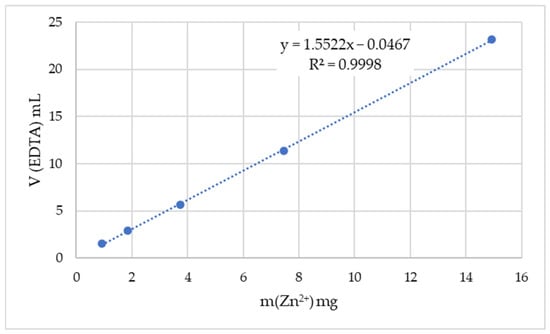
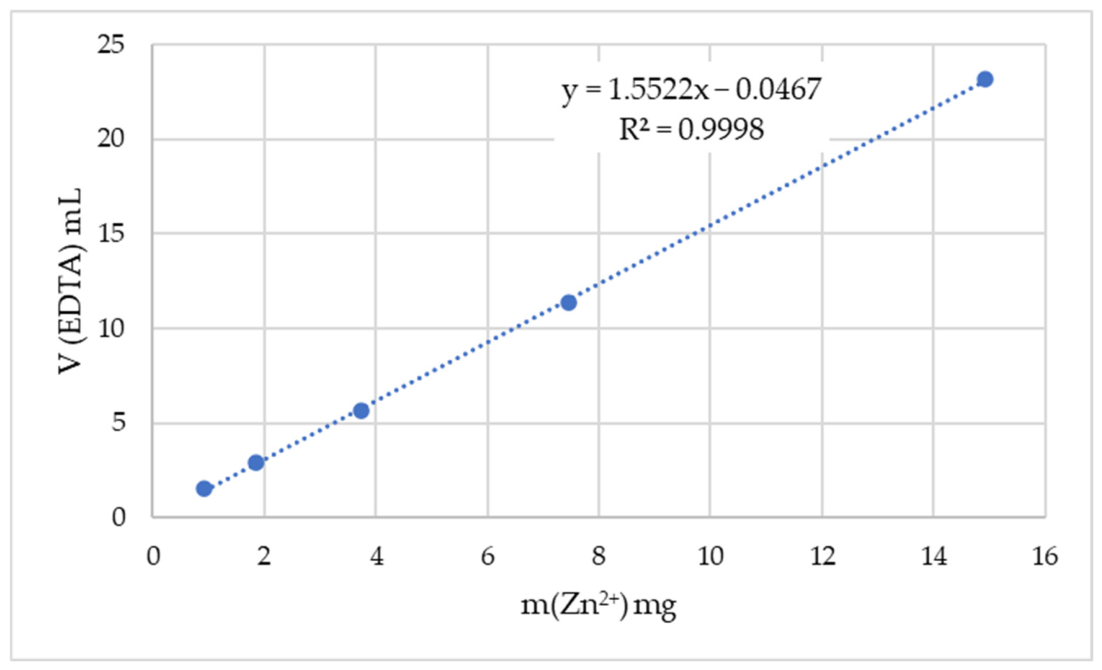
Prior to implementation of the student exercise, the complexometric procedure was evaluated in terms of linearity and recovery. A linear relationship was observed between the theoretical zinc mass and EDTA consumption over the investigated range of 0.93–14.91 mg Zn, with a coefficient of determination (R2) of 0.9998 (Figure 1).
Figure 1.
Relationship between EDTA consumption and theoretical zinc mass during complexometric zinc determination.
Experimentally determined zinc masses and corresponding recoveries are presented in Table 3. Recoveries ranged from 98.93% to 106.45%. The greatest deviation was observed at the lowest investigated zinc mass of 0.93 mg, for which a recovery of 106.45% was obtained.
Table 3.
Recovery of zinc determined by the complexometric procedure at different zinc mass levels.
3.3. Results of the Excipient Interference Assessment
The influence of selected excipients on zinc determination was investigated during development of the laboratory exercise using zinc oxide and zinc gluconate dihydrate as model zinc sources (Table 4).
Table 4.
Influence of selected excipients on the complexometric determination of zinc (n = 3).
In the absence of added excipients, recoveries of 99.91% and 99.19% were obtained for zinc oxide and zinc gluconate dihydrate, respectively. Addition of microcrystalline cellulose or lactose monohydrate resulted in recoveries ranging from 99.44% to 101.24%, with low variability among replicate determinations.
The addition of magnesium stearate was associated with higher experimentally determined zinc contents for both zinc sources. Recovery increased to 102.66% for zinc oxide and 103.70% for zinc gluconate dihydrate. The zinc gluconate dihydrate sample containing magnesium stearate also showed greater variability (15.58 ± 0.31 mg) than the corresponding samples containing microcrystalline cellulose or lactose monohydrate.
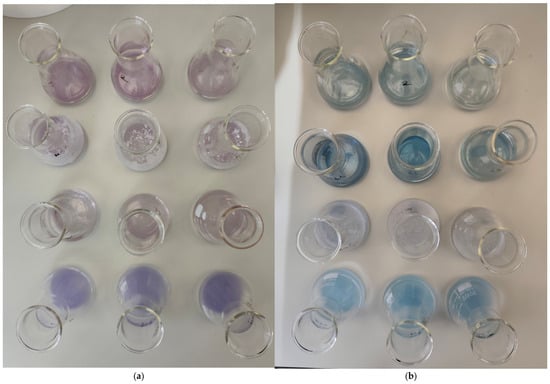
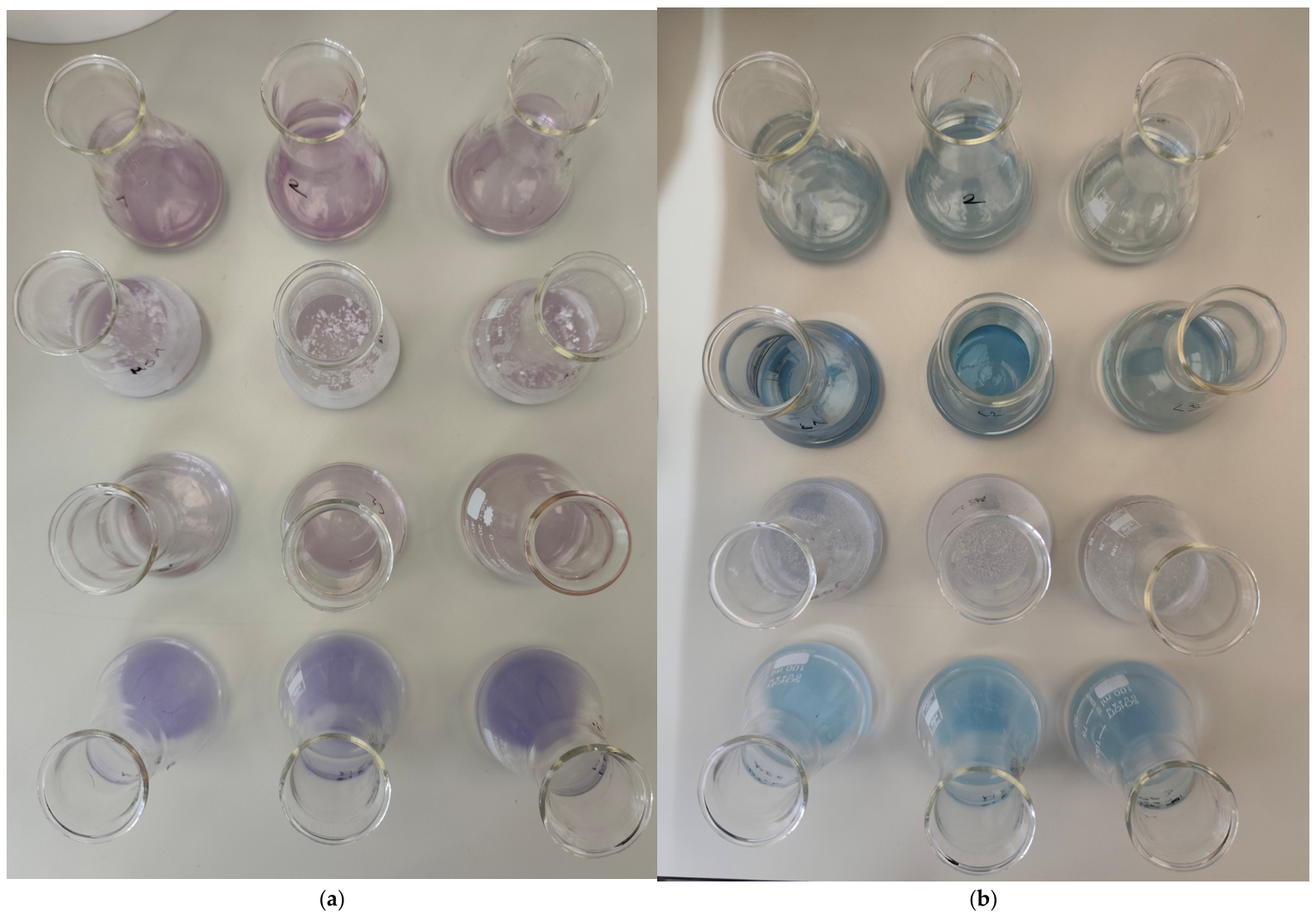
As illustrated in Figure 2, the characteristic color transition from wine-red to blue remained visually distinguishable in the presence of different excipients, despite varying degrees of turbidity, with some suspensions exhibiting a milky appearance.
Figure 2.
Visual appearance of zinc-containing titration mixtures in the presence of different excipients: (a) before the titration endpoint, showing wine-red to violet coloration and varying degrees of turbidity, including milky suspensions, and (b) after the titration endpoint, showing the characteristic blue coloration despite differences in sample turbidity.
3.4. Analysis of Commercial Zinc Dietary Supplements
The apparent zinc content calculated for ten individual dosage units of each commercial dietary supplement is summarized in Table 5. Mean apparent zinc content ranged from 9.6 ± 0.1 mg per dosage unit for formulation E to 18.2 ± 1.3 mg per dosage unit for formulation C. When expressed relative to the label claim, mean apparent zinc contents ranged from 95.79 ± 1.42% for formulation E to 136.84 ± 5.91% for formulation D.
Table 5.
Apparent zinc contents calculated from direct EDTA titration of commercial dietary supplements, expressed relative to label claims (n = 10).
Formulations A and E showed the closest agreement between apparent zinc contents and label claims, with mean values corresponding to 98.08% and 95.79% of the respective label claims. Formulations B, C, and D showed higher apparent zinc contents, corresponding to 119.14%, 121.41%, and 136.84% of their respective label claims. The largest difference between the mean apparent zinc content and the label claim was observed for formulation D.
Illustrative application of the numerical criteria in Chapter 2.9.6 of the European Pharmacopoeia, 11th Edition placed the apparent zinc contents for formulations A, B, D, and E within the applied limits, whereas formulation C fell outside them. These classifications illustrate the calculation procedure and do not establish product content uniformity, because incomplete or variable zinc recovery and analytical variability may contribute to the observed differences. Individual EDTA titration volumes, calculated zinc contents, and calculations supporting the content-uniformity assessment are provided in Supplementary Table S1.
4. Discussion
The proposed laboratory exercise illustrates how a familiar Analytical Chemistry technique can be revisited at a later stage of pharmacy education and applied to a more complex and professionally relevant problem. It extends previous educational applications of complexometric titration using pharmaceutical preparations and dietary supplements as authentic samples [4,5] by placing greater emphasis on multidisciplinary interpretation of the resulting data. This approach is particularly relevant in pharmacy education, where students must ultimately integrate knowledge acquired across individual disciplines to address complex professional problems [8]. Reinforcement of previously acquired foundational knowledge in progressively more complex contexts may additionally support knowledge retention, critical thinking, and decision making [10]. In the proposed exercise, this integration occurs vertically by revisiting complexometric titration learned earlier in Analytical Chemistry and horizontally by connecting it with pharmaceutical technology, bromatology, and regulatory science [11].
The preliminary experiments provided an initial assessment of the complexometric procedure for the proposed educational application. A linear relationship between zinc mass and EDTA consumption was observed over the investigated range (R2 = 0.9998), with recoveries close to 100% for most investigated zinc masses. The experiments involving selected excipients also illustrated the potential influence of sample composition on analytical results. Microcrystalline cellulose and lactose monohydrate had little apparent influence on zinc recovery, whereas higher measured recoveries were observed in the presence of magnesium stearate. Although EDTA forms a highly stable complex with zinc, other formulation components, including competing ligands and metal ions, may influence complexation equilibria or endpoint detection [12]. The preliminary experiments with selected excipients cannot exclude matrix effects in the complete commercial formulations. Therefore, matrix-specific recovery experiments or comparison with an independent analytical method would be needed to assess these effects more fully.
Because the preliminary experiments used acid-dissolved model compounds, they do not establish quantitative zinc recovery from commercial formulations analyzed without prior acid extraction. An acid extraction step, with sonication if necessary, could therefore be investigated before pH adjustment and titration. Its effectiveness would require experimental verification, taking into account the additional time and procedural complexity.
An important limitation of the preliminary experiments is that zinc citrate, present in formulations B and E, was not included in the preliminary analytical assessment. Therefore, its potential influence on zinc recovery remains uncertain, and the results for these formulations should be interpreted with caution. Although 16 different zinc sources are permitted for use in food supplements in the European Union under Directive 2002/46/EC [13], only zinc oxide and zinc gluconate were included in the preliminary assessment, both as acid-dissolved model compounds. These experiments do not establish the reliability of direct titration of commercial formulations A, C, or D. Future quantitative use of any commercial formulation should therefore be preceded by assessment of zinc recovery and relevant matrix effects under the intended sample preparation conditions.
Turbidity may reduce the clarity of the visual endpoint and introduce uncertainty in its determination, particularly among inexperienced students. Therefore, instructor demonstration of the characteristic color transition and supervision during titration are recommended to support consistent endpoint recognition.
The apparent zinc contents corresponded to 95.79–136.84% of label claims and were numerically within the European Commission guidance tolerance range of −20% to +45% for minerals in food supplements [14]. This comparison serves an educational purpose and does not establish product compliance, because the accuracy of the direct procedure in the commercial matrices was not confirmed. While these tolerance values are provided as guidance rather than legally binding product specifications, they are frequently used as a scientific reference for evaluating agreement between declared and analytically determined mineral content. Using the same tolerance range, Puścion-Jakubik et al. recently evaluated 80 commercial zinc-containing food supplements and found that 70% were within the recommended range, whereas 6.25% contained zinc below the lower limit and 23.75% exceeded the upper limit [15].
An important educational component of the proposed exercise is the discussion of the regulatory status of dietary supplements. Although dietary supplements are marketed in dosage forms, such as tablets or capsules, they are regulated as foods and are not subject to the same pre-market assessment and pharmaceutical quality requirements as medicinal products [13]. In particular, pharmacopoeial tests routinely applied to pharmaceutical dosage forms, such as mass and content uniformity, disintegration, friability and dissolution testing, are not mandatory quality requirements for dietary supplements [7,13]. Previous comparison of medicinal products and dietary supplements containing the same active ingredient demonstrated the relevance of this regulatory distinction and showed that differences in formulation characteristics may remain undetected when equivalent pharmaceutical-technological quality testing is not required [16,17]. Importantly, insufficient understanding of dietary supplements has been reported even among pharmaceutical science students, while targeted education significantly improved their knowledge, including their understanding of differences between dietary supplements and medicines [18,19]. Developing a clear understanding of dietary supplements is therefore particularly important for pharmacy students, given their future professional role in providing patients with appropriate information and advice on these products [18].
Another important educational feature of the exercise is the distinction between agreement with the label claim and uniformity among individual dosage units. By applying a pharmacopoeial content uniformity test to commercial dietary supplements as an educational reference, students can directly explore the difference between a useful pharmaceutical quality criterion and a legally mandatory requirement. Developing a clear understanding of these distinctions is particularly important for future pharmacists and other healthcare professionals, who are expected to critically evaluate dietary supplements and provide evidence-based information to patients and consumers.
Guided discussion is an important component of the exercise, as it connects knowledge across disciplines and incorporates elements of reflective learning, which may facilitate the transfer of theoretical knowledge to professional practice and support the development of critical-thinking and problem-solving skills [20].
An additional strength of the proposed approach is its simplicity and accessibility. Meaningful laboratory learning does not necessarily require increasingly sophisticated analytical technologies; it may also arise from creatively connecting established methods with concepts from different disciplines and applying familiar knowledge in a new context. Complexometric titration requires substantially less instrumental infrastructure than techniques commonly used for elemental analysis and can be implemented using standard laboratory equipment. It also avoids the continuous use of fuel or plasma gases required by techniques such as flame atomic absorption spectrometry or ICP-MS. Rather than increasing complexity through advanced instrumentation, the proposed exercise increases complexity through interpretation and integration of knowledge [1].
The principal limitation of the present study is that student learning outcomes were not formally assessed. Therefore, the study illustrates the educational potential and the preliminary analytical behavior of the method in model systems but does not establish that it improves knowledge retention, critical thinking, or interdisciplinary reasoning. Future implementation should include structured assessment of student learning and feedback to evaluate the educational effectiveness of the approach. Furthermore, all ten dosage units of each product originated from a single commercial batch. Although this sampling approach is consistent with the batch-specific nature of pharmacopoeial content uniformity testing, the results cannot be extrapolated to other batches or considered representative of the overall quality of the investigated products.
5. Conclusions
This three-hour laboratory exercise provides a feasible and low-cost model for integrating Analytical Chemistry with pharmaceutical technology, bromatology, and regulatory science in senior pharmacy education. Using commercial zinc dietary supplements, the exercise is designed to engage students in both complexometric titration and the interpretation of analytical results in the context of formulation, content uniformity, label claims, and regulatory requirements. The preliminary analytical assessment concerned acid-dissolved model compounds and does not establish quantitative recovery from the complete commercial formulations under the direct preparation conditions. Accordingly, all commercial results are presented as apparent values for educational discussion. Quantitative application to commercial formulations requires prior assessment of zinc recovery and relevant matrix effects. The proposed approach highlights the educational potential of creatively connecting established analytical methods with multidisciplinary knowledge and professional practice, without relying on advanced technologies.
Supplementary Materials
The following supporting information can be downloaded at https://www.mdpi.com/article/10.3390/higheredu5040127/s1. Table S1: Individual EDTA titration volumes, calculated zinc contents, and assessment of content uniformity in commercial zinc dietary supplements A–E.
Author Contributions
Conceptualization, M.V., J.J.-B. and M.L.-P.; methodology, M.V., J.J.-B. and M.L.-P.; validation, M.V., N.M. and N.T.; formal analysis, M.V. and N.M.; investigation, M.V., N.M., N.T., A.Ć. and D.V.; resources, J.J.-B. and M.L.-P.; data curation, M.V.; writing—original draft preparation, M.V.; writing—review and editing, J.J.-B., N.M., N.T., A.Ć., D.V. and M.L.-P.; visualization, M.V.; supervision, J.J.-B. and M.L.-P.; project administration, J.J.-B. and M.L.-P. All authors have read and agreed to the published version of the manuscript.
Funding
This research was supported by the Provincial Secretariat for Higher Education and Scientific Research, Project No. 003876072 2025 09418 003 000 000 001 04 004, “Integration of Digitalization and 3D Printing with Artificial Intelligence Support in the Development of Solid and Liquid Pharmaceutical Dosage Forms”.
Institutional Review Board Statement
Not applicable.
Informed Consent Statement
Not applicable.
Data Availability Statement
The original contributions presented in the study are included in the article, further inquiries can be directed to the corresponding author.
Conflicts of Interest
The authors declare no conflicts of interest.
Abbreviations
The following abbreviations are used in this manuscript:
| EDTA | Ethylenediaminetetraacetic acid |
| HPMC | Hydroxypropyl methylcellulose |
| ICP-MS | Inductively coupled plasma mass spectrometry |
| Ph. Eur. | European Pharmacopoeia |
| SD | Standard deviation |
| Zn | Zinc |
| ZnO | Zinc oxide |
References
- Jørgensen, J.T.; Malm, R.H.; Gammelgaard, B.; Christiansen, F.V. What Denotes Progression in Laboratory Learning? Ana-lysing a Pharmaceutical Bachelor Programme. Pharm. Educ. 2024, 24, 200–212. [Google Scholar] [CrossRef] [Scilit]
- Agustian, H.Y.; Finne, L.T.; Jørgensen, J.T.; Pedersen, M.I.; Christiansen, F.V.; Gammelgaard, B.; Nielsen, J.A. Learning Outcomes of University Chemistry Teaching in Laboratories: A Systematic Review of Empirical Literature. Rev. Educ. 2022, 10, e3360. [Google Scholar] [CrossRef] [Scilit]
- Kolarov, L.; Lončar, E.; Ačanski, M. Kvantitativna Hemijska Analiza: Praktikum Sa Elementima Teorije; Tehnološki Fakultet: Novi Sad, Serbia, 1996. [Google Scholar]
- Garvey, S.L.; Shahmohammadi, G.; McLain, D.R.; Dietz, M.L. Determination of Calcium in Dietary Supplements: Statistical Comparison of Methods in the Analytical Laboratory. J. Chem. Educ. 2015, 92, 167–169. [Google Scholar] [CrossRef] [Scilit]
- Simões, G.B.; Badolato, P.V.E.S.; Ignácio, M.D.; Cerqueira, E.C. Determination of Zinc Oxide in Pharmaceutical Preparations by EDTA Titration: A Practical Class for a Quantitative Analysis Course. J. Chem. Educ. 2020, 97, 522–527. [Google Scholar] [CrossRef] [Scilit]
- Kimaru, I.W.; Corigliano, A.T.; Zhao, F. Using Classical EDTA Titrations to Measure Calcium and Magnesium in Intravenous Fluid Bags. J. Chem. Educ. 2018, 95, 2238–2242. [Google Scholar] [CrossRef] [Scilit]
- European Pharmacopoeia Commission. European Pharmacopoeia, 11th ed.; European Directorate for the Quality of Medicines & HealthCare (EDQM): Strasbourg, France, 2023. [Google Scholar]
- Husband, A.K.; Todd, A.; Fulton, J. Integrating Science and Practice in Pharmacy Curricula. Am. J. Pharm. Educ. 2014, 78, 63. [Google Scholar] [CrossRef] [Scilit] [PubMed]
- Pearson, M.L.; Hubball, H.T. Curricular Integration in Pharmacy Education. Am. J. Pharm. Educ. 2012, 76, 204. [Google Scholar] [CrossRef] [Scilit] [PubMed]
- DiVall, M.; Abate, M.A.; Blake, E.W.; Carter, J.; Chadha, G.S.; Jackowski, R.M.; Khasawneh, F.T.; Taylor, J.R.; Wagner, J.L. Recommendations for Integration of Foundational and Clinical Sciences throughout the Pharmacy Curriculum. Curr. Pharm. Teach. Learn. 2020, 12, 1371–1374. [Google Scholar] [CrossRef] [Scilit] [PubMed]
- Poirier, T.I.; Fan, J.; Nieto, M.J. Survey of Pharmacy Schools’ Approaches and Attitudes toward Curricular Integration. Am. J. Pharm. Educ. 2016, 80, 96. [Google Scholar] [CrossRef] [Scilit] [PubMed]
- Harvey, D.T. Analytical Chemistry 2.1; DePauw University: Greencastle, IN, USA, 2019. [Google Scholar]
- European Parliament and Council of the European Union. Directive 2002/46/EC of the European Parliament and of the Council of 10 June 2002 on the Approximation of the Laws of the Member States Relating to Food Supplements; Official Journal of the European Communities: Luxembourg, 2002; pp. 51–57. [Google Scholar]
- European Commission. Guidance Document for Competent Authorities for the Control of Compliance with EU Legislation with Regard to the Setting of Tolerances for Nutrient Values Declared on a Label; European Commission: Brussels, Belgium, 2012. [Google Scholar]
- Puścion-Jakubik, A.; Kolenda, K.; Socha, K.; Markiewicz-Żukowska, R. Assessment of Zinc Content in Food Supplements. Foods 2026, 15, 151. [Google Scholar] [CrossRef] [Scilit] [PubMed]
- Lalić-Popović, M.N.; Vuković, M.M.; Jovičić-Bata, J.N.; Čanji-Panić, J.M.; Todorović, N.B. Comparison of Formulation Char-acteristics of Drugs and Dietary Supplements Containing Alpha-Lipoic Acid Relevant to Therapeutic Efficacy. Eur. Rev. Med. Pharmacol. Sci. 2023, 27, 3159–3170. [Google Scholar] [CrossRef] [Scilit] [PubMed]
- Vukovic, M.; Lalic-Popovic, M.; Todorovic, N.; Panic, J.C.; Veskovic, D.; Smiljanic, I.; Jovicic-Bata, J. Variability in Quality Attributes of Commercial Alpha-Lipoic Acid Dietary Supplements: Evidence from Pharmacopoeial Testing. Dissolution Technol. 2026, 33, 126–132. [Google Scholar] [CrossRef] [Scilit]
- Chiba, T.; Kobayashi, E.; Okura, T.; Sekimoto, M.; Mizuno, H.; Saito, M.; Umegaki, K. An Educational Intervention Improved Knowledge of Dietary Supplements in College Students. BMC Public Health 2020, 20, 633. [Google Scholar] [CrossRef] [Scilit] [PubMed]
- Axon, D.R.; Vanova, J.; Edel, C.; Slack, M. Dietary Supplement Use, Knowledge, and Perceptions Among Student Pharmacists. Am. J. Pharm. Educ. 2017, 81, 92. [Google Scholar] [CrossRef] [Scilit] [PubMed]
- Tsingos, C.; Bosnic-Anticevich, S.; Smith, L. Reflective Practice and Its Implications for Pharmacy Education. Am. J. Pharm. Educ. 2014, 78, 18. [Google Scholar] [CrossRef] [Scilit] [PubMed]

Disclaimer/Publisher’s Note: The statements, opinions and data contained in all publications are solely those of the individual author(s) and contributor(s) and not of MDPI and/or the editor(s). MDPI and/or the editor(s) disclaim responsibility for any injury to people or property resulting from any ideas, methods, instructions or products referred to in the content. |
© 2026 by the authors. Licensee MDPI, Basel, Switzerland. This article is an open access article distributed under the terms and conditions of the Creative Commons Attribution (CC BY) license.