


Abstract
This study sought to understand how the prevalence of employer-articulated technical and professional graduate skills shifted over a recent 13-year period to identify areas for curricular change. We analyzed 1,142,245 graduate-level mechanical engineering job advertisements posted between January 2010 and December 2022 in the United States from the Burning Glass Technologies (BGT) database. To track shifts in the prevalence of specific skills, we developed a Bayesian-optimized filter, trained on human labels, to classify relevant jobs, then modeled them using BGT’s canonical skill taxonomy. This filtering and modeling process identifies employer-desired competencies across 13 years, while demonstrating a replicable method for other disciplines and job data. We find 76 skills with an average prevalence of at least 2% that follow a clearly linear, logarithmic, or quadratic growth trajectory. The findings paint the portrait of a discipline firmly connected to its technical core, but transforming with demand for “business-aware technical liaisons” and “proficient software executors.” Business liaisons can complete technical work while managing the projects, budgets, supply chains, customer relations, and compliance mechanisms that come with it. Software executors use software-based systems to complete and communicate their organization-supporting work. Together, these profiles signal changes in graduate employability that universities can address through multiple approaches, such as collaborating with other academic units and disciplines and increasing access to bridge programs.
1. Introduction
Mechanical engineering (ME) is always evolving. Over the past decade, rapid advances in automation, digital manufacturing, data-driven modeling, artificial intelligence (AI), and globalized supply chains have reshaped engineering practice and knowledge [1,2]. As industries emerge, expand, and change, the skills mechanical engineers (MEs) need today differ meaningfully from those demanded even a decade ago. Consider when Boeing introduced the 777 in 1995, the first fully computer-designed aircraft using Dassault Systems’ CATIA computer-aided design (CAD) software and IBM [3]. At the time, CAD systems were controversial and raised concerns about the viability of the traditional drafting techniques engineers relied on. However, they are now ubiquitous across engineering programs, serving the central representational practices of engineering design [4]. Ongoing efforts to equip these systems with AI-based features represent the next frontier in this ever-changing landscape of ME, evolving with technical and social currents. Many of these technical currents draw on decades of engineering work, such as Industry 4.0 trends that integrate digital technologies into conventional engineering and manufacturing processes. For example, equipping machinery and equipment with digital sensors, employees with digital safety systems, warehouses with automated robots, and facilities with real-time monitoring reconceptualizes “manufacturing,” with consequential technical and social ramifications [5,6]. Similarly, advanced materials and nanotechnology build on sustained developments in ME toward more energy-efficient, durable, biodegradable, and thermally ideal characteristics for applications ranging from space to soil. These technical currents are entwined with social changes in ME education, the ME workforce, and broader geopolitical domains. For example, in graduate ME education, international students make up a significant share of degree recipients in US-based programs [7], yet recent political changes have challenged the long-term sustainability of this trend [8]. Similarly, the shift toward international supply chains underscores the need for engineering students to develop global competencies, such as understanding that others think and solve problems differently [2]. Together, these sociotechnical currents reflect a discipline in perpetual motion, continuously evolving at the intersection of material, digital, and social forces, yet still facing perennial questions about how best to prepare ME students to meet its needs.
Recent developments in generative AI (GenAI) systems, like ChatGPT, illustrate this tension because they can solve many conventional engineering problems [9,10,11], while students, instructors, researchers, and practitioners report routine use and varying sentiments about that use [12,13,14,15]. How should ME programs respond? Particularly graduate ME programs, where master’s and doctoral students prepare to assume positions as future industry experts, educators, scholars, regulatory officials, and businesspeople. Their work occurs across distributed settings, moving between classroom instruction, instructional roles, advising meetings, professional societies, and research groups. What knowledge, skills, and abilities should graduate ME programs emphasize with heterogeneous GenAI impacts across these settings? In response to these and similar developments across engineering disciplines, recent scholarship in engineering workforce development argues that engineering education must move beyond degree production to engage directly with labor-market dynamics and skill-formation systems [16]. For engineering programs to adequately construct and implement programs that meaningfully and adequately prepare students to enter the workforce, engineering educators must understand the workforce they construct and implement programs toward [4]. From this perspective, understanding how employers articulate skill expectations is central to aligning preparation with evolving workforce realities. Higher education institutions routinely attempt to monitor industry needs through advisory boards, co-operative agreements, collaborative curriculum design, and targeted partnerships [17,18]. While valuable, these mechanisms can be episodic, locally bounded, or influenced by a limited set of stakeholders, limiting their national or longitudinal perspective [19]. Additionally, institutions can adjust to workplace dynamics only so quickly, and program changes evolve more slowly than the industries their graduates target. Research can therefore complement existing engineering workforce development efforts by providing overarching perspectives on engineering industry trends from both the supply and demand sides of the market.
On the demand side of the engineering labor market, online job advertisements provide a readily available, multifaceted signal of market expectations. Aggregated across platforms such as Indeed, ZipRecruiter, Monster, and other professional society job boards, postings publicly articulate employers’ desired qualifications, responsibilities, tools, and competencies, which are influenced by diverse sociotechnical forces. As a result, prior research suggests job advertisements offer meaningful insights into current conceptualizations and communications of workforce demands [20,21,22], yet many studies aggregate across STEM disciplines or rely on short-term snapshots of job postings. Even fewer studies examine discipline-specific trends over extended periods, limiting our understanding of how skill demands evolve within ME. These research limitations are especially concerning for graduate ME education, where the vast majority of master’s and doctoral graduates pursue careers in engineering industry [23,24,25]. Consequently, graduate ME program directors can only evaluate narrowly scoped engineering industry labor market analyses, lowering their willingness to expend resources toward efforts that may not translate to their local contexts. However, advances in labor market analytics and large-scale text processing now make it possible to move beyond small samples toward large-scale, longitudinal, discipline-specific analyses. Leveraging content analysis techniques, including sophisticated GenAI models, researchers can examine millions of postings over extended periods, offering systematic, broad views of specific engineering labor market trends [26,27]. A longitudinal approach matters because technological and organizational change is gradual and cumulative. Accordingly, this study analyzes 1,142,245 graduate-level ME job advertisements posted in the United States and collected from the Burning Glass Technologies (BGT) database between January 2010 and December 2022. It uses a classification pipeline to isolate ME postings and BGT’s canonical taxonomy to identify and track employer-desired competencies, allowing us to examine how the prevalence of specific ME skills changes over time. This approach provides a decade-long portrayal of how employers describe ME expertise in the labor market. The following research question guides this investigation:
How has the prevalence of employer-articulated technical and professional graduate mechanical engineering skills in the United States changed from 2010 to 2022, and what do these changes reveal about employer demand for skills?
By systematically analyzing longitudinal trends in employer-articulated skill demands, this study contributes empirical evidence to ongoing conversations about curriculum modernization, workforce alignment, and the evolving nature of ME practice. More broadly, it situates ME graduate education within broader dynamics of technological change and labor-market transformation, offering insight into how engineering roles are continuously redefined in the 21st century and the potential implications for curricular adaptation in graduate ME programs.
2. Background
2.1. Balanced Mechanical Engineering Practice
ME is often described by its analytical, technical core: mechanics of materials, thermodynamics, fluid mechanics, heat transfer, dynamics, control systems, and manufacturing processes [28]. Curricula institutionalize these concepts so students can recognize and solve ME problems [29]. Recently, however, the proliferation of digital and data-driven collaboration, design, and manufacturing tools has entered ME workflows [5,6,30], embedding engineers in distributed engineering projects, from data center development and maintenance to wastewater treatment facilities to deep-water oil production. “Distributed” refers to the multiple and shifting sites where engineering work occurs—sites requiring engineers to actively negotiate problem settings, disciplinary perceptions, engineering and organizational approaches, technical capabilities, and global partnerships [4]. These physical and digital infrastructures shape ME expertise, with computational modeling systems, collaboration platforms, and emerging AI-infused technologies serving as integral components of engineering workflows [31]. For example, advanced manufacturing processes require MEs to integrate design decisions with manufacturing data streams and supply chain systems, such as Design for Six Sigma, which instructs engineers to measure and analyze data for structured organizational decision-making [32]. Thus, the transformation represents an expansion of traditional ME competencies, where mechanics, thermodynamics, and materials operate within larger sociotechnical ecosystems mediated through digital and collaborative interfaces and networks [4,29]. Accordingly, MEs are increasingly expected to navigate and use these ecosystems to perform their everyday engineering work and solve engineering problems.
Expectations have consequences, and these economic drivers create incentives for particular ME skills, where “skills” refers to a range of knowledge, abilities, and attitudes that can be learned formally or informally but are recognized as valuable for specific workplaces and tasks. The World Bank identifies economic incentives as a key component of a balanced relationship between labor market skill supply and demand [33]. In their Systems Approach for Better Education Results Workforce Development (SABER-WfD) framework, factors such as economic policies and regulatory environments, workplace practices and organizational dynamics, and employee training programs and shifts shape demand for specific skills. For example, the widespread use of statistical software to measure and evaluate engineering design distinguishes prospective employees with experience in programming languages like R and Python from those without exposure. Yet, a balanced labor market requires that the skill demand is adequately matched by skill supply, which the SABER-WfD framework conceptualizes in terms of the influences from formal educational programs, informal programs (e.g., corporate partnerships, military affiliations, and demographic distributions, among others. When aligned, “significant benefits can accrue in the form of a dynamic and more productive workforce, higher rates of employment and labor utilization, progress in the fight against poverty and tangible movement up the value chain of economic activity for the economy as a whole” [33] (p. 14). Yet misalignment is common, underscoring the need for approaches to evaluate potential areas for reform.
2.2. Graduate Mechanical Engineering Education and the Challenge of Responsiveness
Balancing the supply and demand of skills for MEs involves many stakeholders across the economic and training sides of the SABER-WfD framework. As one such stakeholder, graduate ME programs coordinate resources and instruction to ensure students are workplace-ready, but recurring tensions arise as the ME work landscape changes and institutions evolve [34]. Employers expect students with graduate ME degrees to recognize how abstract problems and theories learned during undergraduate coursework manifest as nuanced, contextual, and tangible problems. These are students who understand the incompleteness of theoretical conceptualization, embrace the contingencies present in real-world problems, and reflect on how their assumptions and judgments shape what is engineered [4,35]. Because most engineering graduate students pursue careers in the engineering workforce, instilling these lessons across cutting-edge domains is increasingly critical [24,36]. Similarly, research consistently shows that employers value holistic professional competencies alongside technical expertise [37,38,39]. Despite this, graduate engineering education has historically emphasized academic career trajectories by promoting students’ research output and scholarly acumen, and it varies widely across institutions, departments, and advisors [23,40]. Furthermore, limited research on successful industry-academic partnerships and engineering workplaces limits the feasibility of alignment [4,17,41], while the pace of institutional change creates an inherent lag in reform efforts [42]. Thus, graduate programs persistently struggle to translate engineering workplace needs and contexts into the educational environment for students [43,44].
In recent decades, national calls for reform have intensified these conversations as international competitiveness for engineers has increased, complex engineered systems extend across the economy, and engineers operate as translators between business interests and technical possibility [45]. The National Academy of Engineering [46] underscores the need for engineers capable of systems thinking, interdisciplinary collaboration, and ethical reasoning in complex technological environments, while ASME’s Vision 2030 initiative describes the importance of design integration, communication skills, and global awareness within ME programs [47]. These prior portraits of the engineering workforce are valuable, but they must be consistently appraised and revised to effectively inform information and resources coordination across graduate ME programs [4]. To continue the dialogue between industry and academia, we argue that the engineering labor market provides a readily available, persistent, large-scale, and critical signal that researchers and educators can use to appraise and revise graduate ME education. By evaluating employer-articulated expectations for positions requiring an ME graduate education, we can better color in the picture of the ME workforce against which programs can evaluate graduate student preparedness.
2.3. Engineering Job Posting Analysis
The SABER-WfD framework frames a balanced skill market in terms of the alignment and responsiveness between the demand for particular skills and their supply, with skills describing eligible workers with requisite abilities and opportunities to enact them [33]. Common approaches in engineering education examine the supply side of this conceptualization, such as focusing on current students’ perceptions of the job market and practitioners’ retrospective views of their job readiness after graduating [48,49]. These studies enrich curricular initiatives with the lived experiences of those who shape them, inform advising programs to better support students, guide initiatives to address students’ industry readiness, and help departments understand the common career sentiments and trajectories of their graduates. Yet, their scope can limit the generalizability of findings across institutions and departments, and participants’ perceptions filter views of the demand side of the skill market.
To complement supply-side studies, economists and labor market researchers have long utilized demand-side measures, such as employer surveys, to gauge graduates’ skill shortages and misalignments with professional workplaces [50]. These surveys ask about employers’ difficulty finding, training, and retaining workers, as well as their broader labor-market priorities. In doing so, they develop “links between higher education and the economy,” illustrating how higher education institutions use indicators to gauge program “relevance and external efficiency” [51] (p. 39). Job postings are another demand-side indicator, measuring employers’ desires (e.g., skills, credentials, tasks) in a relatively compact format. For example, Hershbein and Kahn [22] use job postings to show the disproportionate effects of the Great Recession on certain metropolitan areas, where greater economic challenges contributed to a subsequent increase in “upskilling,” or hiring higher-qualified workers for positions than is typical in the affected area. Similarly, Deming and Kahn [21] use postings to show how demands for school-learned technical skills can translate into initially high-salaried positions, particularly in STEM-related disciplines, but flatten over time as these skills become commonplace and new technologies supplant them. These studies benefit from the increasing digitization of labor market data, permitting computational analytics that quickly iterate through postings and extract certain features (e.g., location, salary range, qualifications). These techniques enable faster program responsiveness compared to the multi-year projects typically required for employer data collection and analysis. However, large-scale demand-side job posting analyses rarely track skill evolution in particular disciplines, leaving uncertainty about how well educational programs align with employer needs. Thus, there is an open need across disciplines for job posting analyses that support program-industry coherence.
Despite this imperative, job postings are imperfect representations, subject to variation in their structure and language, while containing noisy artifacts that can confound analysis, for example, describing a master’s in ME as “MSME,” “thesis-based master’s degree in ME,” or “BSME with 2–3 years of research experience.” Consequently, simple approaches rely on strictly specified letter sequences or keyword frequency counts to surface targeted insights into postings [52], but they are brittle solutions restricted to the pre-defined language researchers expect in postings. However, recent advances in natural language processing (NLP) can generate structured taxonomies using classification techniques that analyze broader language context at scale [53]. Using these techniques, researchers can extract and categorize nuanced job features at scale, providing meaningful signals about technological change and evolving employer expectations. They range from multi-stage rule-based string matching and taxonomy alignment to large language model (LLM)-based approaches, e.g., [54,55]. Researchers can then identify co-occurring skill clusters, detect emerging topics, and track temporal trends in occupational language, enabling systematic modeling of skill evolution rather than isolated observations of specific keywords. In engineering education, Coloyan Fleming et al. [20] use these techniques to evaluate professional and technical competencies across 26,103 engineering job postings, showing the diversity of competencies sought across educational levels, disciplines, domains, and salaries. They argue that others can perform similar evaluations to understand discipline-specific trends, longitudinal projections, and skill comparisons across divisions, which motivates the present study. That is, ME is such a large, wide-ranging discipline seeped into multifaceted areas of our contemporary world that monolithic treatments of engineering professions, while valuable for enforcing the centrality of problem-solving and collaborative skills among all engineers, are insufficient to accurately support ME programs alone. Therefore, applying computational techniques to longitudinal ME-specific job postings can provide a demand-side perspective on ME skills and how they evolve. However, performing these analyses requires a framework to organize content across postings, so the next section describes the O*NET Content Model, which we selected for this purpose.
2.4. Organizing Framework: O*NET Content Model
O*NET, the Occupational Information Network, is the U.S. Department of Labor’s primary database for occupational information, including the knowledge required for particular positions, the skills and abilities workers need, typical position activities, and other characteristics found in postings aggregated across the economy. It organizes occupations using descriptors (e.g., work contexts, specific skills) so researchers can compare and analyze different jobs, with data gathered and updated through ongoing worker surveys [56]. Its Standard Occupational Classification (SOC) coding system enables consistent identification of specific occupations, such as Mechanical Engineers (17-2141.00), and provides granular insights into common descriptors across SOC-coded jobs. The data transformation from job postings to SOC codes and descriptors leverages the O*NET Content Model, a framework that defines what data are collected for each occupation and how those data are structured [57]. The Content Model views jobs from a worker perspective (i.e., people–attributes) and a position perspective (i.e., work characteristics), using standard nomenclature so descriptors can be applied across occupations and industries. The Content Model is hierarchical and includes six top-level domains: Worker Characteristics, Worker Requirements, Experience Requirements, Occupational Requirements, Workforce Characteristics, and Occupation-Specific Information [58]. Each domain contains multiple levels and descriptor categories, providing a granular “anatomy” across occupations. The O*NET Content Model and database provide the backdrop for evaluating ME job postings because we integrate O*NET filtering, canonical skill clustering, and longitudinal modeling to analyze how ME employer-articulated jobs have evolved across job postings. In the following analysis, we use the O*NET Content Model to parse 1,142,245 ME job advertisements from 1 January 2010 to 31 December 2022, reflecting the ME discipline’s ever-changing and variegated nature.
3. Materials and Methods
3.1. Data Source
We sourced data from Burning Glass Technologies (BGT), now Lightcast, a labor market analytics company that aggregates job postings from corporate career websites, applicant tracking systems, and job boards. Its scale and structured formatting make it widely used in workforce analytics research [59,60]. The dataset covers occupational data in the United States from 1 January 2007 through 22 November 2023, but our analysis focuses on January 2010 through December 2022 to remove the large data gaps before 2010. This smaller window yielded over 372 million unique job postings, each including 57 BGT-produced variables that capture job characteristics such as job titles, descriptions, educational requirements, skills, geographic location, and O*NET Standard Occupational Classification (SOC) codes. For this analysis, we focused on six key variables: JobID (unique identifier), CleanJobTitle (standardized job title created by BGT), JobDate (posting date), JobText (job description), ConsolidatedONET (SOC code), and CanonSkillClusters (skill classifications) because they contained information used for the primary data selection scheme and job description content operated on in the downstream analysis. Of course, relying on the BGT dataset introduces several constraints, which we address in the Limitations.
3.2. Research Design
This study employed a longitudinal analysis of online job postings to examine skill demand trends for graduate-level ME jobs from 2010 to 2022 and follows a three-phase workflow: (1) data preparation and filtering, (2) classification as a “graduate ME job”, and (3) skill analysis. The following sections detail these phases, which were implemented using Python 3.13 and are openly available in the repository for this project: https://github.com/mitchg10/mech-eng-job-analysis-2010-to-2022 (accessed on 15 October 2026).
3.2.1. Phase 1: Data Preparation and Filtering
We began with 372,135,198 job postings classified under all O*NET occupations for the study period. To focus on ME, we applied the O*NET SOC code filter for Mechanical Engineers (17-2141.00). This code includes sub-disciplines, such as 17-2141.02 (Automotive Engineers) per the O*NET-SOC Taxonomy. This initial filtering yielded 1,166,271 job postings; we then conducted a missing-value analysis to ensure data quality and completeness (Table 1). We removed records with missing job titles, job descriptions, or skill clusters to ensure complete data for analysis, as these variables were essential for subsequent classification and skill analysis. After this Phase 1 filtering, the dataset contained 1,142,245 jobs, shown in Table 2.
Table 1.
Summary of missing values for entire dataset and study period.
Table 2.
Data reduction summary for Phase 1 filtering.
3.2.2. Phase 2: Graduate Mechanical Engineering Job Classification
Once filtered by O*NET-SOC code and variable completeness, the raw BGT job postings required further data cleaning to ensure an “ME job” is a graduate-level ME job (i.e., requires a master’s/doctoral degree). We sought this broad conceptualization of “graduate-level” because of dataset limitations and to provide higher-level trends for graduate programs. To build the classifier, we developed and applied a filtering process that assigns a “confidence” score (0 to 1) to each job if it contains one or more “markers.” These markers produce a numeric estimation that a particular job is a graduate ME job and are derived from manual analysis of the jobs filtered from Phase 1. This represents a key contribution of the methods used to filter job postings, diverging from prior investigations that rely solely on keyword-based searching by incorporating a multi-stage filtering scheme and probabilistic statistics to evaluate posting content. We determined the markers through an iterative process that included manually investigating and classifying a random subset of the data, then applying Bayesian optimization to find the values that best fit the set. Once fitted, the model classified the remaining posts, filtering them using the same logic that replicated manual classification on the subset.
To perform the manual investigation, we assumed the perspective of ME job hirers, conceptualizing “graduate-level ME jobs” as those that: (a) sought individuals with the relative experience concomitant with earning a graduate degree (i.e., master’s and doctoral), (b) pertained to a very broad notion of “mechanical engineering.” We assembled a random sample of 534 jobs from those filtered in Phase 1: 334 were mechanical, graduate-level postings, and 200 were either not mechanical, not graduate-level, or both. The researchers who performed this analysis have professional engineering industry experience and evaluated each post in its entirety, considering both worker- and job-oriented characteristics as described by the O*NET Content Model. Illustrating, O*NET includes active listening, critical thinking, complex problem solving, STEM concept understanding, engineering and technology design abilities, mathematical reasoning, writing and reading comprehension, production and processing abilities, and business administration as some of the requisite knowledge and skills relevant to workers filling ME positions (SOC#17-2141), that is, worker-specific characteristics. Job-oriented characteristics include developing and interpreting mechanical system designs, leveraging analytical, scientific, and CAD software, and navigating regulatory compliance, among others. Together, these worker- and job-oriented features flagged the subset, while mentions of specific degrees, years of experience requirements, and specific ME subject matters indicated the desired experience level. For example, jobs that explicitly list required qualifications suggesting deep domain expertise (e.g., advanced thermodynamic system operation) or that require prior work on engineering teams suggested master’s- and doctoral-level jobs, given the disciplinary and collaborative experiences gained while earning these degrees. Other features indicating graduate-level positions included explicit research experience and mentions of “CVs.” Given limitations in the job processing method, we were unable to disaggregate graduate-level postings by degree type, which presents an area for future work. The unstructured nature of the postings and the challenges of extracting specific descriptors made this analysis prohibitive and also prevented us from including jobs that might desire graduate-level engineering students but ask for non-engineering degrees (e.g., MD, MBA). That said, while classifying the jobs, the authors maintained notes about common phrases, keywords, software, and domains found across the postings to inform the extraction process. Once complete, this manual investigation, guided by the O*NET Content Model, worker- and job- characteristics for ME, and education-level indicators, yielded a manually filtered subset of graduate ME jobs against which we could develop a filtering scheme, visualized in Figure 1, to scale the process to the remaining postings.
Figure 1.
The mechanical engineering job confidence assignment process draws on the graduate-level ME terms identified during manual analysis (Blue). Postings are selected individually from the Phase 1 dataset (Orange) and scored by term prevalence (Yellow), then grouped as sufficient (Green) or insufficient (Red) based on a total tabulated score.
We developed and implemented the filtering process using both the manual classifications and notes on pertinent graduate-level ME job features. While Appendix A describes the process in more depth, we first assembled phrases, keywords, and other indicators of graduate-level ME positions into sets of markers. The logic is simple: the more markers a post contains, the more likely it is a graduate-level ME position. Each set of markers, therefore, captures several features identified during the manual analysis, such as ME-related job titles (e.g., “Mechanical Engineer,” “Product Design Engineer,” “Machine Design Engineer,” and “Thermal Engineer”), degree information (e.g., “MSME,” “PhD in Mechanical Engineering,” and “4-year Mechanical Engineering”), and common ME software (e.g., SolidWorks, ANSYS, and Mastercam). Additionally, several programmatic techniques enabled “fuzzy” fitting between job text and the markers, so “master’s” and “Master’s” are both captured, for example. Jobs with titles such as “Senior Mechanical Engineer” are more likely to be graduate-level ME positions than those that mention CAD, because CAD can apply beyond mechanical and graduate-level roles and tasks. To account for this, we assigned weighted point values to the markers, and we deem jobs graduate-level ME if they reach a certain threshold after accounting for all the markers they contain. Rather than manually assign the values and find the ideal threshold, we used Bayesian optimization via Tree-structured Parzen Estimation (TPE), implemented in Python 3.13 with the optuna library, to find the point values and threshold that best reproduced the manual classification on the data subset [61,62]. This process iteratively refines the values, tweaking them before evaluating the change against the manual classification “ground truth,” informing the subsequent tweak. With sufficient iterations, the optimized marker values and required threshold accurately implement contextual semantic analysis, using the manually curated markers to distinguish genuine graduate-level ME positions from roles that merely mention mechanical concepts peripherally. Running the classifier across the 1,166,271 O*NET-SOC-classified jobs yielded 1,014,433 (87.0%) ME jobs and 151,838 (13.0%) non-ME jobs. Phase 3 further processes the former bucket.
3.2.3. Phase 3: Skill Analysis
Phase 2 filtering produced a subset of the original BGT jobs classified as very likely graduate-level ME positions. The next step involved scrutinizing these posts to extract, evaluate, and plot their skills. This analysis leveraged the postings’ CanonSkillCluster data field: a BGT-curated variable containing a structured list of skills identified in each post. We have little visibility into how BGT created these fields; however, they are consistently populated across the postings, and a manual analysis suggested alignment between individual postings and their skills. This consideration is described in depth in the Limitations as an area for future methodological improvement. Nevertheless, using the CanonSkillCluster field allowed us to extract and evaluate the skills desired across the graduate-level ME postings from Section 3.2.2.
We first parsed the 1,014,433 ME job postings’ CanonSkillCluster field using a simple, flexible algorithm to handle variations in its format: “Skill Family;Skill;Skill Type,” with different skills separated by pipe delimiters (|). Each skill, then, comprises a larger skill family, such as “Python” in the family “Scripting Languages” or “Simulation” in “Engineering,” for example. The skill families let researchers identify trends across broad capability areas, but we relied on individual skills for a more granular analysis. Thus, we again filtered the Phase 2 subset to jobs with correctly formatted and populated CanonSkillCluster fields, yielding 1,002,189 unique jobs with 503 unique skills and 9,356,249 valid job-skill pairs, shown in Table 3. We then retained only those skills that appeared across the entire study period (2010–2022) and whose average prevalence across these years was (n = 76) to maintain the focus on those skills meaningfully observed across all the graduate-level ME jobs in the study. To calculate a skill’s prevalence, we divided the number of jobs with each skill per year by that year’s total number of jobs. This process yielded 13 data points per skill, representing its annual prevalence from 2010 to 2022, which we then used to describe its trend.
Table 3.
Distribution of skills per job and across the usable data subset.
To determine skill trends, we used a multi-step model selection process guided by Burnham and Anderson’s [63] techniques for approximating model fit, which use error calculations to minimize information loss. That is, we can (a) find the model that best fits a specific skill’s prevalence trend from 2010–2022, and (b) compare that prevalence trend to other skills in the dataset. This helps us determine whether a skill changed steadily, remained stable, or developed rapidly relative to others, providing signals to educators and researchers about the evolving demands of graduate-level ME positions. Before performing this analysis, however, we examined whether job posting length influences the skills. This precautionary measure ensured that we did not report spurious trends resulting from job descriptions simply increasing in length over the study period, leading to more skills per job for the later years compared to the early ones. Confirming this suspicion, we found that both average job posting length and the number of skills increased from 2010 to 2022, with correlations ranging from 0.40 to 0.50. This moderate relationship suggested that longer postings did provide more opportunities to identify skills, so we included job description length as a covariate in subsequent model selection analyses.
Next, to perform the model selection, we needed to identify a priori plausible “shapes” the skill trajectories could take because we could not and should not test the exhaustive list of potential models [63]. For example, a 10-parameter logistic regression might fit the data well, but it could suffer from limited interpretability and overfitting. Thus, restricting the number of candidate models is not a limitation, but a central methodological rationale for performing model selection. In fact, Burnham and Anderson [63] advise that candidate model selections should be theory-driven, so we considered realistic and interpretable trends a skill’s prevalence might take over the 13-year window, yielding the following five candidate models: (1) stability over time with no significant changes (), (2) steady, constant rate of change that suggests sustained, consistent shifts in demand (), (3) rapid early change that decelerates and plateaus as the market absorbs it (), (4) accelerating change with compounding growth (), and (5) accelerating or decelerating patterns with an inflection point to capture skills that rise and fall (). These five shapes cover many possible cases across the skills, yet exclude more complex cubic, spline, or higher-order polynomials that might overfit the 13 data points and generate uninterpretable classifications.
In addition to restricting trends to these plausible shapes, Burnham and Anderson [63] suggest using multiple measures of model fit to avoid relying on a single estimate for selection. Implementing this, we transformed the BGT skill clusters from their pipe-delimited format into a wide format (from 1 row/job to 1 row/skill-job pair), from which we calculated each skill’s prevalence (proportion of jobs) by year and filtered to those skills with average prevalence from 2010 to 2022. Next, we fit the five candidate models (null, linear, log, exponential, quadratic) to each skill, selecting the best one using the corrected Akaike Information Criterion (AICc) applied with the parsimony principle (i.e., when multiple models are viable, choose the simplest one). Two statistics, AICc and the quasi-AICc (QAICc) used for overdispersed data (determined when the variance inflation factor, , is significant), estimate information loss for each candidate model, allowing us to compare the relative loss between candidates. AIC values are uninterpretable on their own, so we use their differences, , to identify the model that minimizes loss. For example, we can determine whether a skill’s prevalence is best captured by a linear or logarithmic trajectory by comparing the difference in estimation error between them. However, this process identifies only a “winner” model, so we also verified assumptions using the Durbin–Watson (), Shapiro-Wilk (), and Breusch-Pagan () tests. Together, we report both model discriminability and assumption quality, detailing whether a model is confidently applied and clearly distinguished from the others. Table 4 and Table 5 indicate how model discriminability (MD) and assumption quality (AQ) are determined for each skill, where discriminability is calculated following Burnham and Anderson’s guidelines [63] (p. 70) and quality is assessed via linear regression assumption verification. The implementation leveraged the statsmodels (Version 0.14.6) and SciPy (Version 1.17.1) libraries, controlled for job text length, centered year on the global mean, and applied Jacobian correction to the log-likelihood before computing its AICc.
Table 4.
Levels of support for candidate models.
Table 5.
“Confidence” indicators based on linear assumption testing.
Lastly, once we assign a model and quality measure, we classify each skill trend based on its selected model and that model’s parameters, regardless of discriminability and quality, as shown in Table 6. These descriptive labels help interpret the trends during analysis and evaluation.
Table 6.
Trajectory classification criteria.
4. Results
The final output of this multi-phase methodology was a dataset of 76 skills with an average prevalence of at least 2% from January 2010 through December 2022. Phases 1 and 2 filtered the initial pool of 372 million job postings down to 1,142,245 that sought graduate-level MEs and were used in this analysis. Phase 3 identified shared skills across these postings, evaluated five potential models to describe each skill’s trajectory, and assessed the reliability of the best-fitting model. As a result, Phase 3 produces a dataset of 76 skills, including their starting, ending, and mean prevalences; absolute and percent changes; best-fit model characteristics; model selection metrics; and assumption-quality checks. This section reports these calculations, focusing on the skills with the highest demand, the greatest percent change, and those that increased from 2010 to 2022. Additional tables in Appendix B list all 76 skills with the same metrics, but we withhold them here due to space constraints and restrict the discussion to the skills clearly desired by ME employers.
4.1. Prevalence Changes in Different Graduate-Level ME Job Skills
Table 7 shows all 76 skills, separated by the best-fitting model (Selected Model), and the results of the model discriminability (MD) and assumption-quality (AQ) testing in Phase 3. MD indicates how different the selected model was from the other candidate models: Strong means clear separation, Moderate indicates some caution, Weak is the upper bound of confidence, and Indistinguishable means all candidate models performed about the same. AQ verifies that the selected model is trustworthy based on regression assumption testing. Clean means a skill’s prevalence data can be modeled accurately; Corrected means we applied calculation adjustments; and Compromised means the selected model should be treated with a grain of salt. This does not mean those skills or their models should be disregarded; however, we encourage readers to consider the plots for each skill in Appendix C alongside the tabular findings.
Table 7.
All 76 graduate ME skill trajectories organized by selected model and model discriminability (MD).
4.1.1. High-Demand ME Skills
We labeled skills as “high-demand” if they had an average prevalence of more than 10% from 2010 to 2022. Of these skills, “Drafting and Engineering Design” was the most common, appearing in roughly half of all ME jobs each year (Table 8). Four skills fell between 20–25% prevalence: “Product Management,” “Microsoft Office and Productivity Tools,” and “Engineering Practices.” Given the dataset’s size, 20% represents about 200,000 jobs that reference these deliverable-driven principles and technologies that sustain engineering operations. Those skills with an average prevalence between 10–20% include similar core concepts and practices like “Product Development,” “System Design and Implementation,” “Engineering Software,” Manufacturing Processes,” and “Industrial Design.” Joining them are business-related skills, such as “Business Process and Analysis,” “Scheduling,” “Budget Management,” and “Procurement.” Lastly, technical skills, such as “HVAC,” “Equipment Repair and Maintenance,” and “Technical Support,” suggest demand for on-the-ground capabilities that allow engineers to interface with users of their products. In all, we identified 16 skills as high demand based on their average prevalence in 10% or more jobs over the 10-year analysis window.
Table 8.
High-demand graduate ME skills (≥10% mean prevalence), trajectory model, and model selection results.
4.1.2. Top ME Skills by Percentage Change
Another set of interesting skills are those whose average prevalence does not exceed 10% but whose percentage change is nonetheless substantial. As shown in Table 9, “Architectural Design” showed the largest percentage change from 2010–2022, rising from 1.14% to 6.09% (435% change). Like “Construction Management,” it is best modeled with an exponential model, increasing rapidly during the period. “Schematic Diagrams” also increases, though not at pace with these other civil-related skills. Skills with significant changes related to business operations, include “Regulation and Law Compliance,” “Product Management,” “Business Development,” “Enterprise Resource Planning (ERP),” “Occupational Health and Safety,” “Contract Management,” “Supplier Relationship Management,” and “General Shipping and Receiving.” Shifts in prevalence among these civil- and business-related skills point to the range of roles MEs increasingly occupy. While foundational skills like “Chemistry” and “Physics” remain core and grew from 2010 to 2022, the predominance of skills related to contracts, project deliverables, organizational processes, and compliance suggests that MEs must be business-aware technical leaders, capable of translating business goals into technical capabilities. This expectation carries into another growing group of skills, comprising “Mathematical Software,” “Robotics,” “Data Analysis,” “Basic Computer Skills,” “Software Development,” “Simulation,” and “Data Management.” To be business-aware technical leaders, MEs must use data-driven decision-making through digital systems: a translational process between business goals and technical capabilities that requires engineers who understand data collection, analysis, storage, and interpretation. Across these rapidly changing skills, MEs extend beyond subject-matter, technical ME domain expertise to broader stakeholder networks, with employers increasingly seeking graduates who can collaborate, manage, and deliver solutions using digital data pipelines spanning localities, workflows, and organizations. However, these skills are still less than 10% prevalent on average in the current data, but should be monitored for continued growth.
Table 9.
Top 20 graduate ME skills by percent change (2010–2022), trajectory model, and model selection results.
4.1.3. Increasing ME Skills
We also highlight those skills increasing in demand and rapidly increasing, whether quadratically or exponentially, as shown in Table 10. Like the top skills by percent change, these skills have a mean prevalence of less than 10%, though their accelerating growth might soon correct that. Within this subset, we see software-related skills, like “Basic Computer Knowledge” and “Robotics,” alongside those related to data-driven research processes, such as “Research Methodology,” “Laboratory Research,” Statistics,” “Data Analysis,” and “Writing” for everything to come together. The skills also include those related to civil and construction engineering, which may reflect the inherent overlap between ME and other engineering disciplines. These skills include “Construction Management,” “Architectural Design,” “General Architecture,” and “Plumbing.” Lastly, business-related skills, such as “Supplier Relationship Management,” “Contract Management,” “Business Development,” and “Regulation and Law Compliance” represent another grouping of rapidly growing skills among the postings.
Table 10.
Graduate ME skills with increasing growth trajectories (2010–2022), trajectory model, and model selection results.
5. Discussion
In this investigation, we examined prevalence trends across different graduate-level ME job skills from January 2010 through December 2022, as communicated in job postings. We find that the “traditional” notion of an engineer who solitarily designs, analyzes, and builds, if it ever existed, no longer holds [43]. Instead, the data suggest that this notion has given way to engineers who must manage contracts, navigate compliance, coordinate supply chains, and drive business development, all proficiently across software-based systems. Therefore, to help advanced-degree graduates succeed in their early and long-term careers, ME educators must address this plurality of roles and responsibilities currently expected of MEs [20,38,49,64]. To interpret our findings, we identified two major trends, described through two profiles: the “business-aware technical liaison” and “proficient software executor.” Both profiles represent idealizations derived from the skill trends, not specific engineers, disciplines, or programs. Instead, they help interpret the trend results and inform curricular suggestions. There is no single mechanical engineering job or mechanical engineer, nor should educational programs exhaustively align themselves with workforce shifts. However, these profiles help guide programs toward broad workforce trends impacting their graduates [42].
The “business-aware technical liaison” profile acknowledges that employers want engineers who can do the technical work and manage the project, budget, supply chains, customer relations, and compliance mechanisms that come with it. MEs are increasingly expected to operate at the intersection between technical expertise rooted in specialized subject-matter knowledge and business operations: a pattern that shows up across our data in model types, tiers, and prevalence levels. For example, Table 9 shows the skills with the largest percent changes over the study period, dominated by business and organizational skills. These include: “Regulation and Law Compliance” (+184%), Product Management (+138%), Contract Management (+98%), Construction Management (+86%), Supplier Relationship Management (+83%), General Shipping and Receiving (+77%). Several of these skills roughly doubled in prevalence, and though each is less than 10% prevalent per year, 10% still represents thousands of job postings. On the other hand, a similar trend emerges among the skills averaging above 10% prevalence, including: “Product Management” (24.5%), “Business Process and Analysis” (13.9%), “Scheduling” (13.1%), “Budget Management” (12.9%), and “Procurement” (10.6%). These skills sit alongside technical engineering competencies, like “Drafting and Engineering Design” and “System Design and Implementation,” suggesting their persistent demand among employers. Overall, these trends suggest that MEs are boundary-spanning professionals [65,66] expected to work across organizations and stakeholders, internally (e.g., other engineers, internal business units) and externally (regulators, suppliers, clients). Sometimes called “heterogeneous engineering” [4] (p. 121), contemporary engineering design operates across various levels and actors (e.g., local, federal/state, regional/geographical, technical, regulatory), building toward system development and maintenance. This work requires bridging disciplinary perspectives, with engineering solutions developing and existing along both social and technical compromises [35]. For example, an ME designing a fluid-handling system for chemical processing must model flow dynamics (technical) while simultaneously negotiating supplier specifications, ensuring regulatory compliance, communicating with clients, and collaborating with non-engineering facilities staff (social). The resulting solution is a sociotechnical compromise that reflects feasibility, affordability, legality, and acceptability across stakeholders; this is the boundary-spanning coordination of heterogeneous engineering. Furthermore, the globally distributed nature of engineering workplaces suggests that engineering graduates increasingly need communicative, organizational, and business-related skills for workplace success [67]. Skills necessary, but not in lieu of, foundational abilities like “Drafting and Engineering Design,” “Physics,” “Engineering Practices,” “Chemistry,” and “Mathematics.” Rather, it is the lifelong pursuit of learning and translating between technical and social realities that historically and presently defines the engineering profession [20,34,38,68].
A complementary profile, the “proficient software executor” understands that MEs bridge technical and social work using software-based systems. An engineer cannot manage contracts and compliance without document and workflow systems, or order parts from a supplier without visiting their online resources [69]. Employers increasingly expect MEs to operate as technically grounded, digitally fluent professionals who use software for engineering analysis and to link business decisions to business operations, regulatory compliance, supply chain management, and organizational strategy. In this way, software is woven into the fabric of ME across prevalence levels and domains. For example, “Microsoft Office and Productivity Tools” averaged 23.6% prevalence (+42%) and follows a logarithmic growth pattern, as does “Computer-Aided Manufacturing” (+44%), suggesting they represent baseline digital literacy expectations [70]. This trend is echoed by the percent changes of mid-range prevalence skills, such as “Simulation” (+80%), “Mathematical Software” (+137%), “Schematic Diagrams” (+96%), and “Software Development Principles” (94%), reflecting the growing expectation that engineers can produce polished visual outputs using computational modeling software. Other computationally oriented skills accelerated during the period, such as “Data Analysis” (+103%), “Basic Computer Knowledge” (+96%), and “Data Management” (+74%). The growing number of model types and the increasing prevalence of these skills reinforce the maturation of software systems in ME practice, with foundational tools, MS Office, schematics, and CAD, representing the first wave of adoption that has stabilized. Less prevalent but growing skills, such as “Basic Computer Knowledge,” “Data Management,” “Graphic and Visual Design Software,” “Mathematical Software,” “Simulation,” “Software Development Principles,” and “Statistics,” show sustained growth. These expanding skills have not yet reached a ceiling, possibly suggesting that early office productivity tools have saturated, domain-specific systems are growing steadily, and data analytics capabilities are emerging. These findings do not suggest that all software skills are increasing, as the declining prevalence of “Project Management Software” (−13%) shows. Instead, the ME software landscape is actively reshuffling, with tools, platforms, and skills pulling one another in and out of fashion. These trends call for periodic reconsideration of the software skills and programs ME graduate programs should teach.
These two profiles, business-aware technical liaison and software-proficient executor, are not separate but holistically integrated as a representation of what ME graduates “should be” when viewed through job postings. Figure 2 visualizes this holistic ME, showing a technical foundation of software proficiency and navigability that enables business and organizational awareness. Though depicted as layers, technical, software, and business understanding must constructively support and reinforce one another over time [38,44]. Naturally, it is tempting to extrapolate these trends amid rapid developments in artificial intelligence (AI), particularly generative AI systems. Our dataset ends in December 2022, just after ChatGPT’s launch on 30 November 2022. However, from 2010 through 2022, we see software abilities proliferating across postings, with most employers seeking engineers who can fluently navigate online workflows. While it is possible that trends covering a shorter period than the study period might reveal sharper software-related increases, these trends show the demand for software skills predates the current AI landscape. Future studies should specifically examine AI-related digital competencies in graduate education and the engineering labor market post-2022 to connect these trends explicitly. Nevertheless, the variegated and pluralistic skills rising across ME job postings suggest the question is broader than recent AI trends motivating curricular evaluations. Instead, we need to consider how to prepare MEs to handle boundary-spanning tasks [71].
Figure 2.
The multiple roles of contemporary ME graduate-level engineers.
5.1. Implications
Investigating longitudinal trends across graduate-level ME job postings sheds light on the changing expectations for graduate ME preparation and alignment between higher education and engineering labor markets [16]. Importantly, program directors cannot and should not address every rising skill, given finite curricular space, implementation resources, and community support. As students progress through the ME curriculum, program, university ecosystem, and workplace experiences, they navigate different developmental contexts and resource constraints. Instead, stakeholders across these settings must recognize a shared, ongoing commitment to preparing students. This commitment requires deliberate coordination and support for students and faculty addressing interdisciplinary workplace needs. Toward such efforts, we consider actionable considerations for institutions at different levels of commitment.
First, graduate programs should actively integrate certain skills into their curricula. These skills show sustained growth during the study period and are areas where ME departments can directly influence instruction. For example, many jobs rely on a robust, deepening technical skill foundation, such as “Simulation,” “Mathematical Software,” “Engineering Software,” and “Statistics.” These skills have not plateaued and will represent ongoing gaps if not addressed. Computational and data fluency skills like “Data Analysis,” “Data Management,” “Software Development Principles,” and “Robotics” represent the “next wave” actionable through course modules, capstone requirements, or dedicated electives. Similarly, design and modeling skills, like “Graphic and Visual Design Software” and “Schematic Diagrams,” support the expectation that engineers can produce polished computational and visual outputs of engineering design processes. Many of these skills can be addressed through master’s and doctoral coursework, with faster iterations compared to undergraduate curricula. Shorter program cycles, greater elective flexibility, and smaller graduate cohorts enable pilot-and-adjust approaches to rapidly integrate these emerging skills. Subsequent studies might disentangle these trends for master’s and doctoral postings to identify areas for more nuanced recommendations. Nevertheless, a near-term option to address the labor trends presented in this study is to leverage curriculum vehicles that can be implemented on shorter time frames to build strong technical foundations.
Beyond ME departments, efforts across institutions can bolster the business and project management skills job postings demand. While programs may not explicitly offer “business-aware” courses that instruct graduate students about organizational engineering workplace dynamics, cross-campus and interdisciplinary partnerships may support these pursuits. For example, skills like “Project Management” are deeply embedded within the ME discipline [3,43,72], but specific organizational management abilities (e.g., “Contract Management,” “Business Development”) sit at the boundary between what ME programs offer and alternatives in business school, industrial engineering, or construction management. Rather than sideline these skills, programs can leverage campus resources by encouraging cross-listed coursework, supporting graduate certificates from other units, and sponsoring interdisciplinary team competitions. These efforts might lead to interdisciplinary certificates (e.g., engineering administration, intellectual property of mechanical design), dual-degree programs (e.g., ME + MBA, ME + ISE), or elective structures that institutionalize industry adaptation and student-directed pathways. The goal is not to reinvent the wheel, but to keep it spinning by increasing ME graduate students’ access to institutional resources. Ultimately, the argument here concerns breadth versus depth: that skills extend beyond typical ME graduate programs does not mean programs must stretch their resources to teach them. Instead, programs must make business literacy accessible and valued through pathways and learning support for students seeking these alternative perspectives without portraying it as diluting the technical depth of an ME graduate degree.
Lastly, some engineering skills can only be learned “on the job” [44]. These are predominantly experiential and context-dependent skills, such as operations, logistics, and industry-specific compliance and process knowledge. Programs need not formalize them, but they can encourage experiential learning to bridge the classroom-workplace learning gap. Co-ops, internships, and industry-embedded projects operate as “bridge experiences” [73,74] that expose students to the organizational contexts where certain skills become relevant. For example, skills such as “General Shipping and Receiving,” “Supplier Relationship Management,” and “Construction Management” require graduates to navigate regulatory frameworks, vendor systems, and company-specific procurement and permitting, and they are acquired through workplace immersion. However, building students’ adaptability and capacity for self-directed learning is critical to acquiring skills in these new contexts. There is no guarantee that skills learned “on the job” transfer into classrooms, nor that students explicitly recognize problem-solving contingencies and practices between contexts. Self-directed learning strengthens students’ ability to own their development, requiring metacognitive awareness of their learning habits, self-regulation to practice effective ones, and a commitment to lifelong learning to sustain growth. Programs should infuse these self-directed learning practices and values into their offerings so students enter workplaces ready to contribute actively, such as by requiring decision logs for projects and incorporating performance reflections into assessments. At the same time, many students lack access to bridge experiences, while others face stigma about the time required for bridge experiences versus publishing. Programs should consider these possibilities when promoting bridge experiences by integrating experiential and self-directed lessons into core disciplinary coursework/mentoring for all students’ benefit. Students participating in bridge experiences, for example, could be invited to discuss them with peers during research group meetings. In this way, engineers with strong interpersonal communication, systems thinking, software fluency, critical thinking, and interdisciplinary navigation skills can adapt to the specialized workplaces they will encounter. Consequently, engineers who value these skills are better positioned for future professional success.
Given the suggested additions to ME graduate programs, we also consider areas where deprioritization is possible: skills that are saturating, declining, and deeply workplace-contextual. Logarithmic trends approaching ceilings, such as MS Office and basic CAD, are baseline expectations that many students already meet, while declining skills like “Project Management Software” are less about underlying competency than particular platforms falling into and out of favor. Similarly, deeply workplace-contextual skills like “Supplier Relationship Management,” “Shipping and Receiving,” and “Construction Management” are growing and may constitute trends serviceable through broader efforts than ME graduate programs alone. These skills show where programs should trust workplace learning to fill gaps in students’ developmental trajectories, and where they should deprioritize efforts to focus resources on the critical areas that require them. This recommendation assumes much about students attending graduate ME programs, such as their background knowledge and self-advocacy abilities, while also taking many social features for granted, such as program flexibility and students’ recognition across diverse teams. We do not minimize these integral elements in educational contexts and advise considering contextual factors when evaluating our suggestions.
5.2. Limitations and Future Work
This research presents several theoretical and methodological limitations that point to future work extending these analyses. Theoretically, job postings represent a specific “frame” of the engineering labor market, which we curated through the workflow described in this paper. This analysis offers valuable insights into demand for MEs; however, we cannot conclude from this analysis alone that postings translate into hires. We do not understand how and why ME students apply for these postings, or how and why employers craft them as they do. Broadening the portrait of the engineering labor market requires investigating students’ career decision-making processes, soliciting employer perspectives, navigating regulatory policies and climates, higher education organizational landscapes, and including other stakeholder groups within the expansive network of engineering expertise. Additionally, these postings represent only those from the United States, hindering the generalizability of these findings to other engineering contexts. Further, the processing techniques could not distinguish between postings that sought specific degree types (e.g., masters, PhD), preventing us from comparing skill trends along this dimension. Future work can add granularity by disaggregating degree types and comparing labor market perspectives across student populations.
Methodologically, several limitations stem from using BGT-collected data in the analysis mechanisms employed, and this presents a significant area for future improvements. The methods rely on attributes like “CanonSkillsCluster” and “ConsolidatedONET” assigned by BGT using methods unknown to the authors, which restricts the dataset size. Further, the BGT skill taxonomy extracted from CanonSkillsCluster may lag behind actual software development, deployment, and adoption. For example, it is unlikely that specific software or activities (e.g., digital twins, GenAI) would be distinguished from existing labels like “Simulation” and “Engineering Software.” By the same token, “Basic Computer Knowledge” likely constitutes a wide range of abilities and attitudes we presently lack the granularity to explore. We hope to address this with a custom extraction scheme that targets all software applications and technologies mentioned in the job postings. Similarly, using the BGT categories introduces a significant dependency on the correctness of their code applications, such as the BGT-assigned O*NET-SOC filter, which can produce false positives if BGT applies it improperly, though Phase 2 filtering addresses this. Our future research will also explore non-BGT-O*NET-classified jobs that could also be characterized as ME. We also lack insight into the nuanced differences between ME jobs for graduating students with a doctoral degree versus those with master’s degrees or other qualifications. Consequently, we cannot provide program-tailored suggestions targeted at these very different student populations, although we acknowledge that course requirements tend to overlap within master’s and doctoral programs in the same department. Overall, these issues contribute to the heightened error risks and limitations introduced by the BGT dependency.
The model selection process used in the data analysis also introduces areas for future refinement. Beyond the limited dataset from January 2010 through December 2022, we tested only four models—linear, quadratic, logarithmic, and exponential—plus the null model, from the possible models that could fit a skill’s prevalence data points. We also evaluated only skills with an average prevalence of at least 2% and did not consider shorter-span trends in that period. Future investigations could expand both the selection models, the skills, and years considered. Additionally, when interpreting skill trends, structural changes in how postings are written could lead to Type I errors that this analysis cannot detect. For example, growth in business- and software-related skills could reflect a genuine expansion in ME roles, but it could also reflect employers trending toward specifying them more explicitly. While the regressions controlled for job length, HR standardization, BGT’s skill extraction algorithm, and other structural confounders, they could still identify trends where none exist. Yet the null and declining trends in the findings counter this potential weakness; we would expect all skills to increase if this were simply an artifact of posting length and structure. Nevertheless, we address verbosity and organizational challenges in our ongoing work to improve the skill- and qualification-extraction process. This work builds on existing research leveraging large language models (LLMs) for qualitative content analysis [75] and centers on a finely tuned, multi-step system that extracts meaningful information from job postings for subsequent human analysis. We will triangulate these results with data from semi-structured interviews with current ME graduate students about their experiences navigating the labor market [76].
6. Conclusions
We investigated over 1,000,000 U.S.-based, graduate-level ME job postings from January 2010 through December 2022, finding two dominant engineering profiles: the “business-aware technical liaison” and “software proficient executor.” The business-aware technical liaison understands their roles and responsibilities within a broader organizational ecosystem, bridging technical engineering design with regulatory frameworks, suppliers and other supply-chain stakeholders, organizational structures, and product lifecycles. They carry out these boundary-spanning activities through software-based platforms and must navigate traditional engineering design technologies, workplace-specific applications, and emerging software systems. Graduate programs cannot and should not approach these profiles as things to explicitly teach, but as guideposts when evaluating program content and focus, cross-institutional partnerships and student opportunities, and areas of experiential immersion. Unlike the undergraduate curriculum, these programs can respond more nimbly to the trends documented in this study while using the different job profiles to articulate their value to prospective students, industry partners, and institutional administrators. Such efforts ensure that graduate programs’ technical depth is complemented by computational, analytical, and cross-functional capacities that employers increasingly value and expect.
Author Contributions
Conceptualization, M.G., D.B.K., A.K., M.B. and J.R.D.; methodology, M.G., D.B.K., A.K., M.B. and J.R.D.; software, M.G. and A.K.; validation, M.G., Y.-X.S.S., A.K., R.B. and H.R.C.; formal analysis, M.G. and A.K.; investigation, M.G., Y.-X.S.S., D.B.K. and A.K.; resources, M.G. and A.K.; data curation, M.G. and A.K.; writing—original draft preparation, M.G. and Y.-X.S.S.; writing—review and editing, M.G., Y.-X.S.S., D.B.K., A.K., M.B., J.R.D., R.B. and H.R.C.; visualization, M.G. and J.R.D.; supervision, D.B.K., A.K., M.B. and J.R.D.; project administration, M.G., D.B.K., A.K., M.B. and J.R.D.; funding acquisition, D.B.K., A.K., M.B. and J.R.D. All authors have read and agreed to the published version of the manuscript.
Funding
This research was supported by the National Science Foundation under EEC 2433099, 2433100, and 2433101, and SFT 2430498.
Institutional Review Board Statement
This study was conducted in accordance with the Declaration of Helsinki, and approved by the Institutional Review Board of Virginia Tech (protocol code 24-1302, approved 4 December 2024), the University of Nebraska – Lincoln (protocol code 20241224365EX, approved 5 December 2024), and the University of Texas at Austin (protocol code STUDY00007020, approved 6 December 2024).
Data Availability Statement
Restrictions apply to the availability of these data. Data were obtained from Burning Glass Technologies, now Lightcast, and are available in partnership with them: https://lightcast.io/ (accessed on 31 May 2025). The project source code is publicly available at: https://github.com/mitchg10/mech-eng-job-analysis-2010-to-2022 (accessed on 15 October 2026). However, running this code requires access to Lightcast’s data in Parquet format.
Acknowledgments
The authors thank Abdulrahman M. Alsharif for his initial analysis of the BGT data and Chloe Wright for her support. Claude Code (Version 2.1) helped write the Python code used in the analysis, though all scripts were manually checked and corrected. Use cases were constrained to specific implementations, not methodological decisions about what code should be written. Claude Code also converted the PowerPoint pyramid in Figure 2 to LaTeX for publication. Minor copywriting and grammar suggestions were provided by Grammarly.
Conflicts of Interest
The authors declare no conflicts of interest. The funders had no role in the design of the study; in the collection, analyses, or interpretation of data; in the writing of the manuscript; or in the decision to publish the results.
Abbreviations
The following abbreviations are used in this manuscript:
| ME | Mechanical engineering |
| MEs | Mechanical engineers |
| AI | Artificial intelligence |
| GenAI | Generative AI |
| CAD | Computer-aided design |
| BGT | Burning Glass Technologies |
| SABER-WfD | Systems Approach for Better Education Results Workforce Development |
| NLP | Natural language processing |
| LLM | Large language model |
| O*NET | Occupational Information Network |
| SOC | Standard Occupational Classification |
| AICc | Corrected Akaike Information Criterion |
| QAICc | Quasi-AICc (for overdispersed data) |
| TPE | Tree-structured Parzen Estimation |
| MD | Model discriminability |
| AQ | Assumption quality |
| DW | Durbin–Watson |
| ERP | Enterprise Resource Planning |
| ML | Machine learning |
| P/R | Precision/Recall |
| TP/TN/FP/FN | True Positive/True Negative/False Positive/False Negative |
| STEM | Science, Technology, Engineering, and Mathematics |
| ISE | Industrial & Systems Engineering |
| MBA | Master of Business Administration |
| HR | Human Resources |
| PhD | Doctor of Philosophy |
| BS/MS | Bachelor of Science/Master of Science |
| BSME/MSME/PhDME | ME-specific degree abbreviations |
Appendix A. Confidence Scoring Mechanism
The system begins with the 1,166,271 jobs gathered from BGT and initially classified as ME based on their O*NET-SOC code. It then follows a hierarchical classification scheme that first makes broad categorical distinctions, followed by fine-grained sub-categorization within the relevant domain. First, we organized ME terms into six semantic categories, as shown in Table A1, and populated them with 52 terms gleaned from the validation/test datasets through manual analysis of a random sample. This process was partly driven by the skills identified by Coloyan Fleming [20], but evolved from observations and note-taking strategies [77]. In particular, note-taking while generating the validation/test datasets focused on job titles, the “meat” of the postings (i.e., responsibilities and worker characteristics), and qualification information. We categorized terms and phrases from this process into rough buckets inspired by the O*NET Content Model, which distinguishes worker-oriented, job-oriented, occupation-oriented, and cross-occupational features of contemporary multi-industry jobs. The term categories listed in Table A1 centralized these analytic categories based on simple semantic similarity.
The filtering also identifies domain-specific software proficiency as a strong indicator of ME roles. This includes: computer-aided design (CAD) software (e.g., SolidWorks, AutoCAD, and CATIA), simulation software (e.g., ANSYS, ABAQUS, and COMSOL), and manufacturing software (e.g., Mastercam and GibbsCAM). Technical software proficiency serves as a proxy for domain expertise, given their use in ME contexts. We expanded ME contexts by using industry-specific terminology that commonly co-occurs with ME roles. This includes: manufacturing sectors (automotive, aerospace, machinery), energy and power systems (turbines, generators, power generation), building systems (HVAC, mechanical systems, power generation), and material processing (metallurgy, welding, machining). Combined, the software and industry context analysis awarded points only if it found them in the job description. Unlike features like the “Core ME terms,” containing software or industry content was not a shoo-in for inclusion. Instead, a job would earn points for containing software and industry terms, but only up to a certain total. Both the number of points awarded and the maximum total values for these factors were variables; we explain this shortly.
Table A1.
Term categories and examples for the confidence scoring mechanism.
In addition to the terms, software, and industries mentioned, we also evaluated if a job contained explicit non-ME terms. If found, a job was penalized—not removed—since a job may list multiple disciplines as applicable. Examples included: software, electrical, nuclear, and civil engineering. If found, and without “mechanical” appearing after, the job was penalized. Additionally, we considered whether a job contained explicit ME degree requirements. This is a high-confidence indicator because employers typically specify degree requirements intentionally. These educational requirements also represent institutional validation of ME competency, so they are highly reliable classification signals, particularly for job seekers with this background. While the BGT data included the variables CanonMinimumDegree and CanonMaximumDegree derived from the contents of the job descriptions, they were not used for this part of the analysis. Instead, we used regular expression pattern matching (regex) to create several degree-requirement patterns, shown in Table A2. We also implemented regex for the previously mentioned terms to improve the chance they were identified in a job description. This includes word order variations (e.g., “mechanical design engineer” and “design engineer, mechanical” are the same), separator flexibility (e.g., hyphens, underscores, slashes), and morphological variations (e.g., plural forms and abbreviations). Although not as exhaustive as the degree requirements, these regex patterns expanded the total number of terms from 52 to 87 while representing the same semantic content.
All the factors—the terms, software, industries, and degrees—were then combined into a multi-dimensional confidence scoring system that utilizes Bayesian optimization to establish optimized thresholds for each factor. Hyperparameter optimization is the process of finding the best “settings” for a machine learning (ML) model. Hyperparameters are adjustable features, such as the learning rate, batch size, and number of layers, that must be tuned to achieve the best performance (e.g., highest accuracy, F1-score, etc.). The challenge in hyperparameter tuning, as we also find in this study, is that there are often too many hyperparameters with too many possible values to search exhaustively; testing every combination would take forever. Bayesian optimization is a hyperparameter optimization approach that learns from previous attempts [62]. Instead of randomly trying combinations or exhaustively testing everything, Bayesian optimization builds a probabilistic model, called a surrogate, which predicts how the hyperparameters relate to performance. The surrogate updates with new data points that store the hyperparameters and resulting performance, which in turn informs predictions about which untested combinations might perform well. These predictions balance exploration and exploitation; that is, they ask, “What’s the expected amount this new combination will beat the current best result?” We can calculate this quantity using various algorithms, such as the Tree Parzen Estimator (TPE), which splits historical results into “good” and “bad” groups based on performance [61]. It then models the relationships between potential hyperparameters and these “good” and “bad” distributions to select the next hyperparameters to test.
Table A2.
Degree requirement regex patterns for the confidence scoring mechanism.
In this study, we used TPE because it is efficient and robust in a high-dimensional parameter space (our system ultimately had 25) with complex parameter interactions. Unlike general ML hyperparameters, these interactions capture relationships between the parameters’ semantic meanings, making the optimized parameters more interpretable and scrutable. For example, any job containing an explicit degree marker in its description or core term in its title should be assigned enough points that it is classified as a ME job. The optimization, instructed to maximize the F1-score on the validation dataset, awarded jobs with an explicit degree marker 15.48 points and those with a core term in their title 8.55 points. The minimum score required to classify a job as an ME job is 7.26. Beyond these values, we applied parameters to all factors, including those aimed at identifying limitations, such as, again, the maximum score any job could earn purely from mentioning software.
We created a Python script using the Optuna TPESampler algorithm, set to maximize the F1-score on the validation dataset. The F1-score measures a classification algorithm’s overall performance by combining precision and recall to provide a balanced picture [78]. Relative to the ground truth, precision measures how many jobs classified as “ME” actually were, while recall measures how many actual ME jobs were correctly identified. An F1-score is the harmonic mean of precision and recall, penalizing extreme values more than a simple average. Therefore, maximizing the F1-score means balancing classification accuracy with avoiding overly liberal predictions. Set to maximize the F1-score, the script iteratively tests new parameter combinations and produces a JSON-formatted array of optimized thresholds for each parameter. The final parameters were selected after 150 iterations and achieved a maximum F1-score of 0.83 on the validation dataset after 113 iterations. On the test set, the classification scheme achieved the results shown in Table A3 and Table A4. The first shows the classifier’s confusion matrix, and the second shows its key metrics. Achieving this performance on the test datasets gave us the confidence to run the classifier on all the study data. The 1,166,271 O*NET-SOC-classified jobs produced 1,014,433 (87.0%) ME jobs and 151,838 (13.0%) non-ME jobs.
Table A3.
Confusion matrix for the ME classifier evaluated on the test dataset.
Table A4.
Classifier performance metrics on the test dataset.
Appendix B. Detailed Graduate Mechanical Engineering Skill Breakdown
Of the 76 shared skills, Table A5 depicts those with a null selected model, Table A6 skills with linear models, Table A7 with logarithmic, Table A8 with quadratic, and Table A9 with exponential.
Table A5.
Graduate ME skills for which the null model was selected (2010–2022), trajectory class, and model selection results.
Table A6.
Graduate ME skills for which the linear model was selected (2010–2022), trajectory class, and model selection results.
Table A7.
Graduate ME skills for which the logarithmic model was selected (2010–2022), trajectory class, and model selection results.
Table A8.
Graduate ME skills for which the quadratic model was selected (2010–2022), trajectory class, and model selection results.
Table A9.
Graduate ME skills for which the exponential model was selected (2010–2022), trajectory class, and model selection results.
Appendix C. Skill Plots Across Study Period
Figure A1–Figure A3 show prevalence plots for the 76 skills, grouped by assigned model discriminability and overlaid with the selected model from Section 3.2.3.
Figure A1.
Plotted skill trajectories with strong model discriminability.
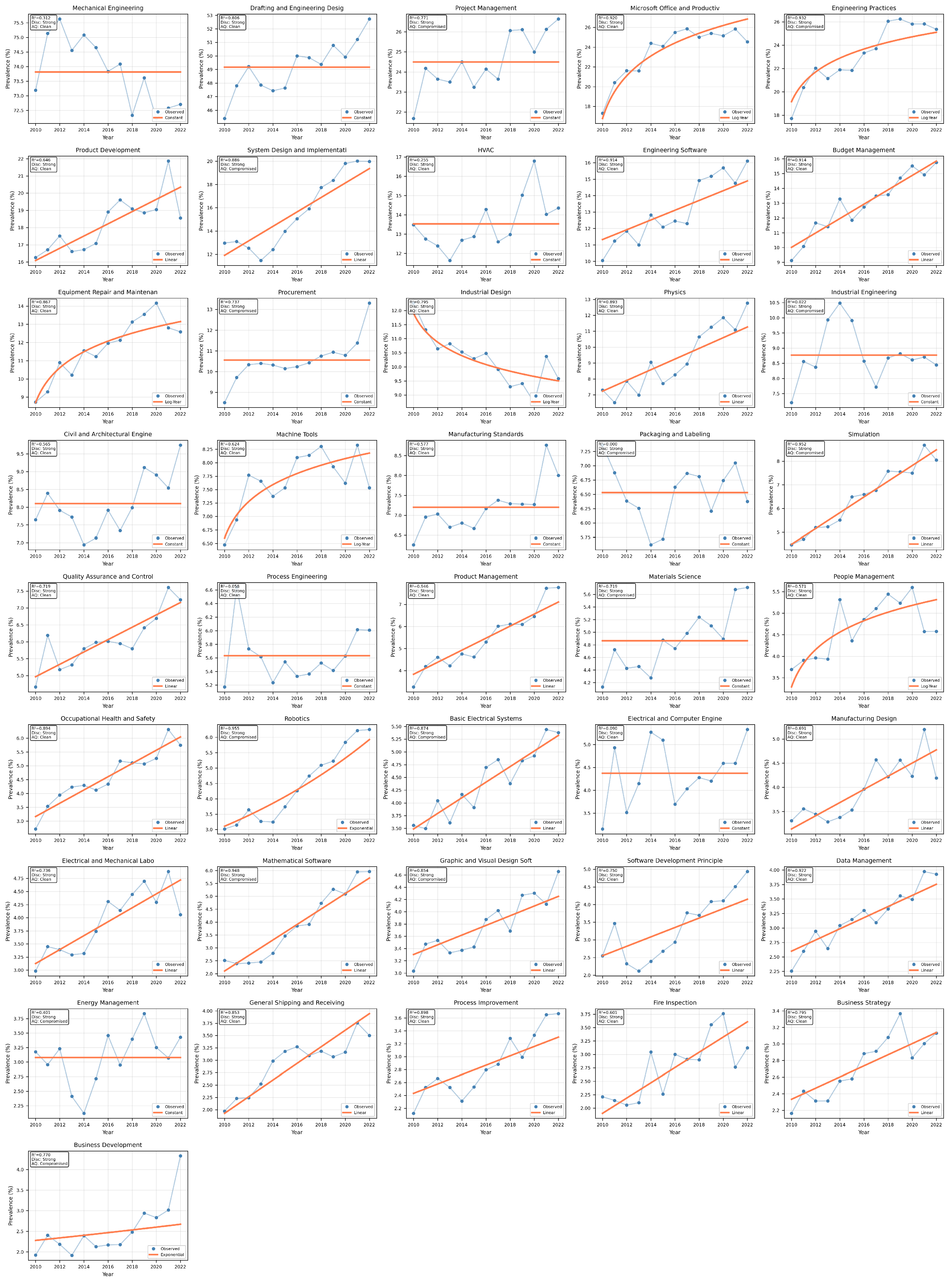
Figure A2.
Plotted skill trajectories with moderate model discriminability.
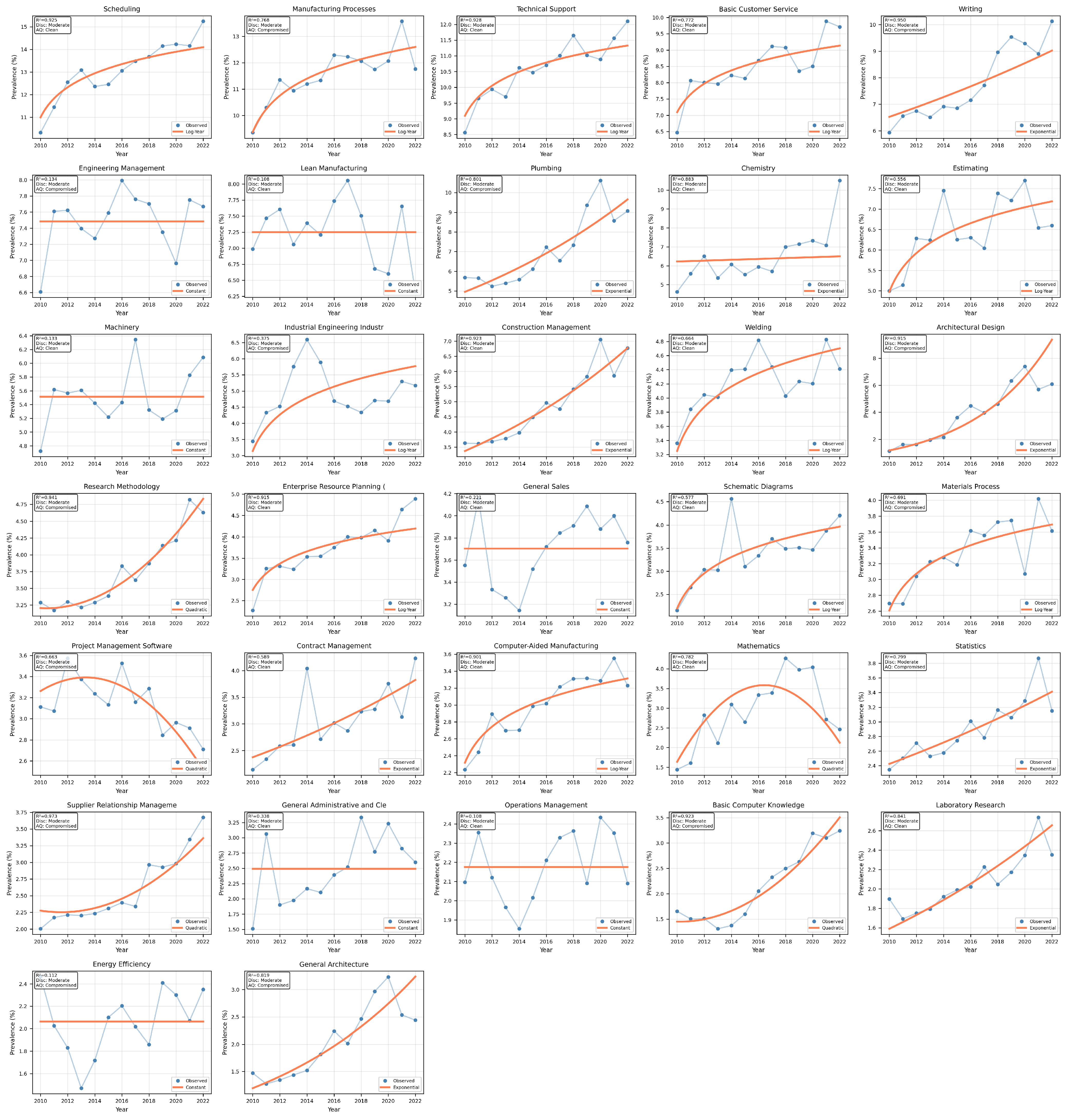
Figure A3.
Plotted skill trajectories with weak model discriminability.
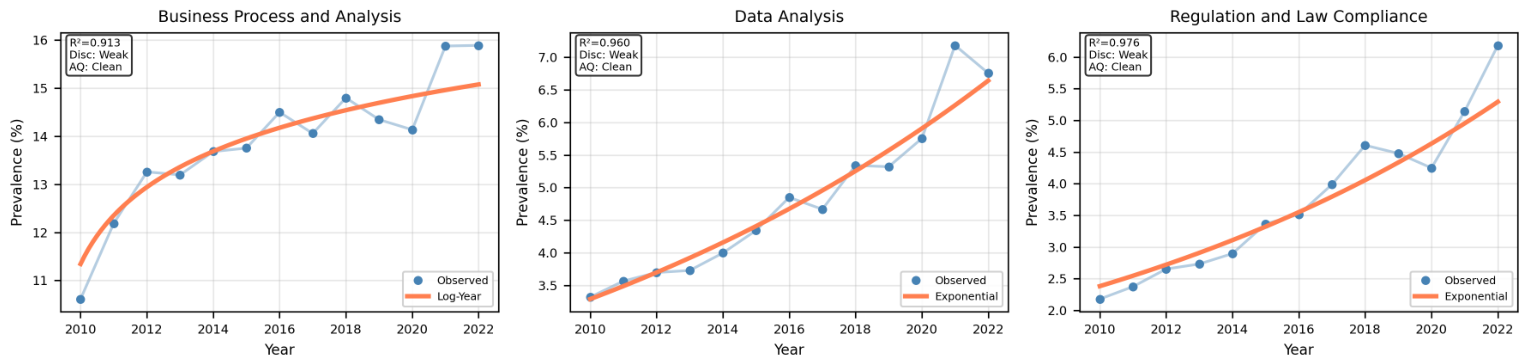
References
- Ghassoul, A.; Messaadia, M. Analyzing the required skills and competencies in industrial revolution 4.0 and 5.0: A literature review. In Proceedings of the 2023 International Conference On Cyber Management And Engineering (CyMaEn), Bangkok, Thailand, 26–27 January 2023; IEEE: New York, NY, USA, 2023; pp. 39–44. [Google Scholar] [CrossRef] [Scilit]
- Downey, G.L.; Lucena, J.C.; Moskal, B.M.; Parkhurst, R.; Bigley, T.; Hays, C.; Jesiek, B.K.; Kelly, L.; Miller, J.; Ruff, S.; et al. The globally competent engineer: Working effectively with people who define problems differently. J. Eng. Educ. 2006, 95, 107–122. [Google Scholar] [CrossRef] [Scilit]
- Petroski, H. Invention by Design: How Engineers Get from Thought to Thing, 4th ed.; Harvard University Press: Cambridge, MA, USA, 2000. [Google Scholar]
- Stevens, R.; Johri, A.; O’Connor, K. Professional engineering work. In Cambridge Handbook of Engineering Education Research; Johri, A., Olds, B.M., Eds.; Cambridge University Press: Cambridge, UK, 2014; pp. 119–138. [Google Scholar] [CrossRef] [Scilit]
- Ghobakhloo, M.; Mahdiraji, H.A.; Iranmanesh, M.; Jafari-Sadeghi, V. From Industry 4.0 digital manufacturing to Industry 5.0 digital society: A roadmap toward human-centric, sustainable, and resilient production. Inf. Syst. Front. 2024, 1–33. [Google Scholar] [CrossRef] [Scilit]
- Stanko, M.A.; Rindfleisch, A. Digital manufacturing and innovation. J. Prod. Innov. Manag. 2023, 40, 407–432. [Google Scholar] [CrossRef] [Scilit]
- Coloyan Fleming, G.; Borrego, M.; Knight, D. Engineering graduate education in the United States. In International Handbook of Engineering Education Research, 1st ed.; Routledge: New York, NY, USA, 2023; pp. 263–285. [Google Scholar] [CrossRef] [Scilit]
- Department of Homeland Security. Trump Administration Proposes New Rule to End Foreign Student Visa Abuse; Press Release: Washington, DC, USA, 2025. [Google Scholar]
- Puthumanaillam, G.; Bretl, T.; Ornik, M. The Lazy Student’s Dream: ChatGPT Passing an Engineering Course on Its Own. IFAC-PapersOnLine 2025, 59, 213–218. [Google Scholar] [CrossRef] [Scilit]
- Schleiß, J. Integrating Artificial Intelligence Competencies in Engineering Education. Ph.D. Thesis, Universitäts- und Landesbibliothek Sachsen-Anhalt, Magdeburg, Germany, 2025. [Google Scholar] [CrossRef] [PubMed]
- Swiecki, Z.; Khosravi, H.; Chen, G.; Martinez-Maldonado, R.; Lodge, J.M.; Milligan, S.; Selwyn, N.; Gašević, D. Assessment in the age of artificial intelligence. Comput. Educ. Artif. Intell. 2022, 3, 100075. [Google Scholar] [CrossRef] [Scilit]
- Barrett, A.; Pack, A. Not quite eye to A.I.: Student and teacher perspectives on the use of generative artificial intelligence in the writing process. Int. J. Educ. Technol. High. Educ. 2023, 20, 59. [Google Scholar] [CrossRef] [Scilit]
- Dewan, U.; Hingle, A.; McDonald, N.; Johri, A. Engineering educators’ perspectives on the impact of generative AI in higher education. In Proceedings of the 2025 IEEE Global Engineering Education Conference (EDUCON), London, UK, 22–25 April 2025; IEEE: New York, NY, 2025; pp. 1–10. [Google Scholar] [CrossRef] [Scilit]
- Hostetter, A.B.; Call, N.; Frazier, G.; James, T.; Linnertz, C.; Nestle, E.; Tucci, M. Student and faculty perceptions of generative artificial intelligence in student writing. Teach. Psychol. 2024, 52, 319–329. [Google Scholar] [CrossRef] [Scilit]
- Karakitsou, C.; Karayianni, I.; Leftheriotis, K.; Logotheti, A.; Avgerinou, M.D. Planets, cars, and personas: Toward an understanding of faculty perceptions of artificial intelligence through visual metaphors and projective techniques. J. Vis. Lit. 2025, 44, 272–306, Correction in J. Vis. Lit. 2025, 44, i–ii. [Google Scholar] [CrossRef] [Scilit]
- Liu, J.; Brunhaver, S. From the margins to the center: Repositioning workforce development in engineering education. J. Eng. Educ. 2025, 114, e70022. [Google Scholar] [CrossRef] [Scilit]
- Shah, R.; Gillen, A. A systematic literature review of university-industry partnerships in engineering education. Eur. J. Eng. Educ. 2023, 49, 577–603. [Google Scholar] [CrossRef] [Scilit]
- Genheimer, S.R.; Shehab, R.L. A survey of industry advisory board operation and effectiveness in engineering education. J. Eng. Educ. 2009, 98, 169–180. [Google Scholar] [CrossRef] [Scilit]
- Archer, M.S. Social Origins of Educational Systems; Classical Texts in Critical Realism; Routledge: London, UK; New York, NY, USA, 2013. [Google Scholar]
- Coloyan Fleming, G.; Klopfer, M.; Katz, A.; Knight, D. What engineering employers want: An analysis of technical and professional skills in engineering job advertisements. J. Eng. Educ. 2024, 113, 251–279. [Google Scholar] [CrossRef] [Scilit]
- Deming, D.; Kahn, L.B. Skill requirements across firms and labor markets: Evidence from job postings for professionals. J. Labor Econ. 2018, 36, S337–S369. [Google Scholar] [CrossRef] [Scilit] [PubMed]
- Hershbein, B.; Kahn, L.B. Do recessions accelerate routine-biased technological change? Evidence from vacancy postings. Am. Econ. Rev. 2018, 108, 1737–1772. [Google Scholar] [CrossRef] [Scilit]
- Leshner, A.; Scherer, L. (Eds.) Graduate STEM Education for the 21st Century; National Academies Press: Washington, DC, USA, 2018; p. 25038. [Google Scholar] [CrossRef] [Scilit] [PubMed]
- Choe, N.H.; Borrego, M. Master’s and doctoral engineering students’ interest in industry, academia, and government careers. J. Eng. Educ. 2020, 109, 325–346. [Google Scholar] [CrossRef] [Scilit]
- Committee on Understanding the Engineering Education-Workforce Continuum; National Academy of Engineering. Understanding the Educational and Career Pathways of Engineers; National Academies Press: Washington, DC, USA, 2018; p. 25284. [Google Scholar] [CrossRef] [Scilit] [PubMed]
- Drisko, J.W.; Maschi, T. Content Analysis; Pocket Guides to Social Work Research Methods; Oxford University Press: Oxford, UK, 2016. [Google Scholar]
- Rahhal, I.; Kassou, I.; Ghogho, M. Data science for job market analysis: A survey on applications and techniques. Expert Syst. Appl. 2024, 251, 124101. [Google Scholar] [CrossRef] [Scilit]
- Grote, K.H.; Hefazi, H. (Eds.) Springer Handbook of Mechanical Engineering; Springer Handbooks; Springer International Publishing: Cham, Switzerland, 2021. [Google Scholar] [CrossRef] [Scilit]
- Jonassen, D.H. Engineers as problem solvers. In Cambridge Handbook of Engineering Education Research; Johri, A., Olds, B.M., Eds.; Cambridge University Press: Cambridge, UK, 2014; pp. 103–118. [Google Scholar] [CrossRef] [Scilit]
- Rabadi, G.; Soykan, B.; Sabri, S.; Mondesire, S. Advancing digital twin education through graduate certification. In Proceedings of the 2025 Annual Modeling and Simulation Conference (ANNSIM ’25), Madrid, Spain, 26–29 May 2025. [Google Scholar]
- Allison, J.T.; Cardin, M.A.; McComb, C.; Ren, M.Y.; Selva, D.; Tucker, C.; Witherell, P.; Zhao, Y.F. Special issue: Artificial intelligence and engineering design. J. Mech. Des. 2022, 144, 020301. [Google Scholar] [CrossRef] [Scilit]
- Javier Lloréns-Montes, F.; Molina, L.M. Six Sigma and management theory: Processes, content and effectiveness. Total Qual. Manag. Bus. Excell. 2006, 17, 485–506. [Google Scholar] [CrossRef] [Scilit]
- World Bank. What Matters for Workforce Development: A Framework and Tool for Analysis; SABER Working Paper Series 79902; World Bank: Washington, DC, USA, 2013. [Google Scholar]
- Jørgensen, U. Historical accounts of engineering education. In Rethinking Engineering Education: The CDIO Approach; Crawley, E.F., Malmqvist, J., Östlund, S., Brodeur, D.R., Eds.; Springer: Boston, MA, USA, 2007; pp. 216–240. [Google Scholar] [CrossRef] [Scilit]
- Bucciarelli, L.L. Engineering Philosophy; DUP Satellite: Delft, The Netherlands, 2003. [Google Scholar]
- Wall Bortz, W.E.; Knight, D.B.; Lyles, C.H.; Kinoshita, T.; Choe, N.H.; Denton, M.; Borrego, M. A competitive system: Graduate student recruitment in STEM and why money may not be the answer. J. High. Educ. 2020, 91, 927–952. [Google Scholar] [CrossRef] [Scilit]
- Berdanier, C.G.P. A hard stop to the term “soft skills”. J. Eng. Educ. 2021, 111, 14–18. [Google Scholar] [CrossRef] [Scilit]
- Johri, A. Lifelong and lifewide learning for the perpetual development of expertise in engineering. Eur. J. Eng. Educ. 2021, 47, 70–84. [Google Scholar] [CrossRef] [Scilit]
- Pawley, A.L. What counts as ’engineering’: Toward a redefinition. In Engineering and Social Justice: In the University and Beyond; Baillie, C., Pawley, A.L., Riley, D., Eds.; Purdue University Press: West Lafayette, IN, USA, 2012; pp. 59–86. [Google Scholar] [CrossRef] [Scilit]
- Watson, J.; Lyons, J. Aligning academic preparation of engineering Ph.D. programs with the needs of industry. Int. J. Eng. Educ. 2011, 27, 1394–1411. [Google Scholar]
- Heard, E.; Neubauer, G. Factors for a successful partnership between academia and industry. Nat. Struct. Mol. Biol. 2026, 33, 551–553. [Google Scholar] [CrossRef] [Scilit] [PubMed]
- Lattuca, L.R.; Stark, J.S. Shaping the College Curriculum: Academic Plans in Context, 2nd ed; Jossey-Bass: San Francisco, CA, USA, 2009. [Google Scholar]
- Bucciarelli, L.L. Designing Engineers, First MIT Paperback ed.; MIT Press: Cambridge, MA, USA, 1994. [Google Scholar]
- Smith, K.A. The nature and development of engineering expertise. Eur. J. Eng. Educ. 1988, 13, 317–330. [Google Scholar] [CrossRef] [Scilit]
- Zussman, R. Mechanics of the Middle Class: Work and Politics Among American Engineers, 1st ed.; University of California Press: Berkeley, CA, USA, 2022. [Google Scholar]
- National Academy of Engineering. The Engineer of 2020: Visions of Engineering in the New Century; National Academies Press: Washington, DC, USA, 2004. [Google Scholar] [CrossRef] [Scilit] [PubMed]
- Kirkpatrick, A.; Danielson, S.; Warrington, R.; Smith, R.; Thole, K.; Kulacki, A.; Wepfer, W.; P.E., T. Vision 2030: Creating the future of mechanical engineering education. In Proceedings of the 2011 ASEE Annual Conference & Exposition Proceedings, Vancouver, BC, Canada, 26–29 June 2011; American Society for Engineering Education: Washington, DC, USA, 2011; pp. 22.1667.1–22.1667.12. [Google Scholar]
- Magarian, J.N.; Seering, W.P. From engineering school to careers: An examination of occupational intentions of mechanical engineering students. Eng. Manag. J. 2021, 34, 176–200. [Google Scholar] [CrossRef] [Scilit]
- Souppez, J.B.R.G. Engineering Employability Skills: Students, Academics, and Industry Professionals Perception. Int. J. Mech. Eng. Educ. 2025, 53, 125–142. [Google Scholar] [CrossRef] [Scilit]
- Brunello, G.; Wruuck, P. Skill Shortages and Skill Mismatch: A Review of the Literature. J. Econ. Surv. 2021, 35, 1145–1167. [Google Scholar] [CrossRef] [Scilit]
- Martin, M.; Sauvageot, C.; Tchatchoua, B. Constructing an Indicator System or Scorecard for Higher Education: A Practical Guide; International Institute for Educational Planning: Paris, France, 2011. [Google Scholar]
- Amaar, A.; Aljedaani, W.; Rustam, F.; Ullah, S.; Rupapara, V.; Ludi, S. Detection of fake job postings by utilizing machine learning and natural language processing approaches. Neural Process. Lett. 2022, 54, 2219–2247. [Google Scholar] [CrossRef] [Scilit]
- Reeping, D.; Hampton, C.; Özkan, D. Interrogating the use of large language models in qualitative research using the qualifying qualitative research quality framework. Stud. Eng. Educ. 2025, 6, 1–23. [Google Scholar] [CrossRef] [Scilit]
- Senger, E.; Zhang, M.; Van Der Goot, R.; Plank, B. Deep learning-based computational job market analysis: A survey on skill extraction and classification from job postings. In Proceedings of the First Workshop on Natural Language Processing for Human Resources (NLP4HR 2024), St. Julian’s, Malta, 22 March 2024; Association for Computational Linguistics: Stroudsburg, PA, USA, 2024; pp. 1–15. [Google Scholar] [CrossRef] [Scilit]
- Zhang, M. Computational job market analysis with natural language processing. arXiv 2024, arXiv:2404.18977. [Google Scholar] [CrossRef] [Scilit]
- U.S. Department of Labor’s Employment and Training Administration (ETA). O*NET Data Collection Program. 2026. Available online: https://web.archive.org/web/20261019212316/https://www.dol.gov/agencies/eta/onet/data-collection (accessed on 15 October 2026).
- Boese, R.; Lewis, P.; Frugoli, P.; Litwin, K. Summary of O*NET 4.0 Content Model and Database; Technical Report; National Center for O*NET Development: Raleigh, NC, USA, 2001. [Google Scholar]
- U.S. Department of Labor’s Employment and Training Administration (ETA). The O*NET®Content Model at O*NET Resource Center. 2026. Available online: https://www.onetcenter.org/content.html (accessed on 1 October 2026).
- Forsythe, E.; Kahn, L.B.; Lange, F.; Wiczer, D. Labor demand in the time of COVID-19: Evidence from vacancy postings and UI claims. J. Public Econ. 2020, 189, 104238. [Google Scholar] [CrossRef] [Scilit] [PubMed]
- Dawson, N.; Williams, M.A.; Rizoiu, M.A. Skill-driven recommendations for job transition pathways. PLoS ONE 2021, 16, e0254722. [Google Scholar] [CrossRef] [Scilit] [PubMed]
- Watanabe, S. Tree-structured Parzen estimator: Understanding its algorithm components and their roles for better empirical performance. arXiv 2023, arXiv:2304.11127. [Google Scholar] [CrossRef] [Scilit]
- Bergstra, J.; Bardenet, R.; Bengio, Y.; Kégl, B. Algorithms for hyper-parameter optimization. In Proceedings of the NIPS’11: 25th International Conference on Neural Information Processing Systems, Granada, Spain, 12–15 December 2011; Curran Associates Inc.: Red Hook, NY, USA, 2011; pp. 2546–2554. [Google Scholar]
- Burnham, K.P.; Anderson, D.R. (Eds.) Model Selection and Multimodel Inference; Springer: New York, NY, USA, 2004. [Google Scholar] [CrossRef] [Scilit]
- Huff, J.L.; Smith, J.A.; Jesiek, B.K.; Zoltowski, C.B.; Oakes, W.C. Identity in engineering adulthood: An interpretative phenomenological analysis of early-career engineers in the United States as they transition to the workplace. Emerg. Adulthood 2018, 7, 451–467. [Google Scholar] [CrossRef] [Scilit]
- Gieryn, T.F. Boundary-work and the demarcation of science from non-science: Strains and interests in professional ideologies of scientists. Am. Sociol. Rev. 1983, 48, 781. [Google Scholar] [CrossRef] [Scilit]
- Akkerman, S.F.; Bakker, A. Boundary crossing and boundary objects. Rev. Educ. Res. 2011, 81, 132–169. [Google Scholar] [CrossRef] [Scilit]
- Johri, A.; Jesiek, B.K. Global and international issues in engineering education. In Cambridge Handbook of Engineering Education Research, 1st ed.; Johri, A., Olds, B.M., Eds.; Cambridge University Press: Cambridge, UK, 2014; pp. 655–672. [Google Scholar] [CrossRef] [Scilit]
- Trevelyan, J. Reconstructing engineering from practice. Eng. Stud. 2010, 2, 175–195. [Google Scholar] [CrossRef] [Scilit]
- Anderson, M.; Chanthavane, S.; Broshkevitch, A.; Braden, P.; Bassford, C.; Kim, M.; Fantini, M.; Konig, S.; Owens, T.; Sorensen, C. A survey of web-based tools for collaborative engineering design. J. Mech. Des. 2021, 144, 014001. [Google Scholar] [CrossRef] [Scilit]
- Tinmaz, H.; Lee, Y.T.; Fanea-Ivanovici, M.; Baber, H. A systematic review on digital literacy. Smart Learn. Environ. 2022, 9, 21. [Google Scholar] [CrossRef] [Scilit] [PubMed]
- Webb, M. Systems to Transform Interdisciplinary Graduate Education: An Ecological Systems Analysis of STEM Graduate Students’ Longitudinal Interdisciplinary Identity-Based Motivation. Ph.D. Thesis, Virginia Tech, Blacksburg, VA, USA, 2025. [Google Scholar]
- Vincenti, W.G. What Engineers Know and How They Know It: Analytical Studies from Aeronautical History; Johns Hopkins Studies in the History of Technology; Johns Hopkins University Press: Baltimore, MD, USA; London, UK, 1993. [Google Scholar]
- Mercier, E.; Goldstein, M.H.; Baligar, P.; Jephthah Rajarathinam, R. Collaborative learning in engineering education. In International Handbook of Engineering Education Research, 1st ed.; Routledge: London, UK, 2023; pp. 402–432. [Google Scholar] [CrossRef] [Scilit]
- Brunhaver, S.R.; Korte, R.F.; Barley, S.R.; Sheppard, S.D. Bridging the gaps between engineering education and practice. In US Engineering in a Global Economy; University of Chicago Press: Chicago, IL, USA, 2018; pp. 129–163. [Google Scholar]
- Nicmanis, M.; Spurrier, H. Getting started with artificial intelligence assisted qualitative analysis: An introductory guide to qualitative research approaches with exploratory examples from reflexive content analysis. Int. J. Qual. Methods 2025, 24, 16094069251354863. [Google Scholar] [CrossRef] [Scilit]
- Clements, H.R.; Gerhardt, M.; Budhathoki, R.; Deters, J.; Borrego, M.; Katz, A.; Knight, D. Mechanical Engineering Students’ Perspectives on Career Goals, Skills, and Industry. In Proceedings of the 36th Australasian Association for Engineering Education Annual Conference, St. Lucia, Australia, 7–10 December 2025. [Google Scholar]
- Emerson, R.M.; Fretz, R.I.; Shaw, L.L. Writing Ethnographic Fieldnotes, 2nd ed.; Chicago Guides to Writing, Editing, and Publishing; University of Chicago Press: Chicago, IL, USA, 2011. [Google Scholar]
- Fawcett, T. An introduction to ROC analysis. Pattern Recognit. Lett. 2006, 27, 861–874. [Google Scholar] [CrossRef] [Scilit]
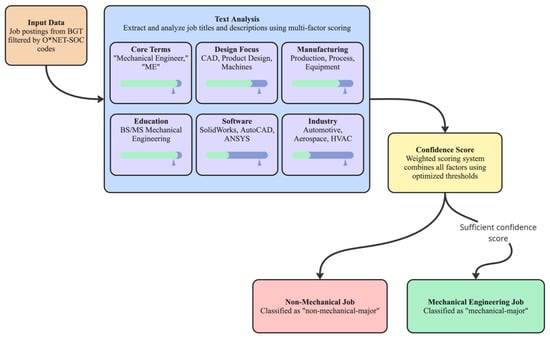
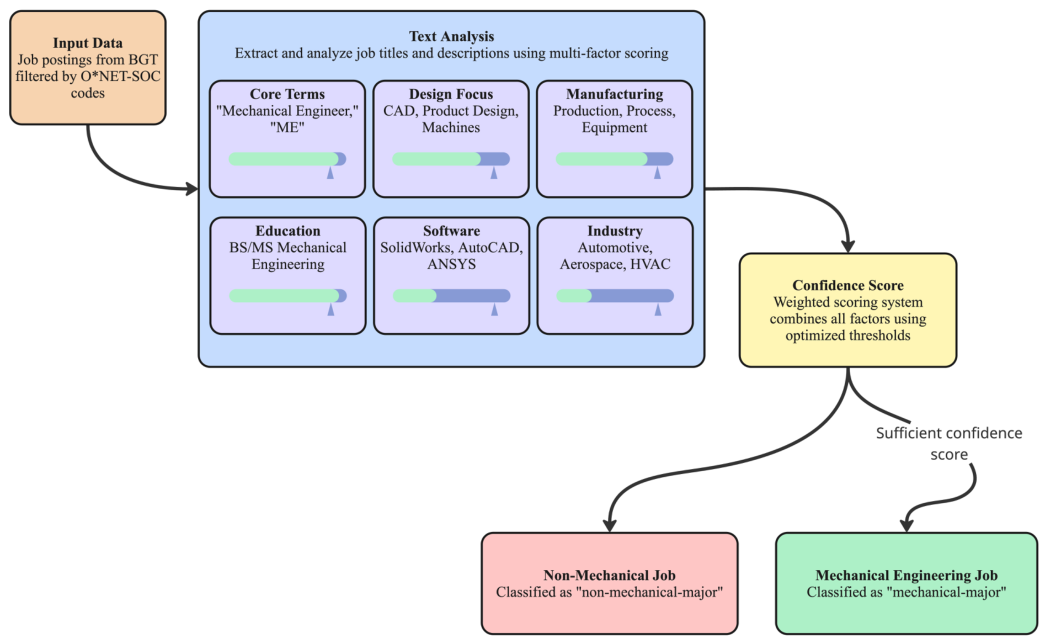
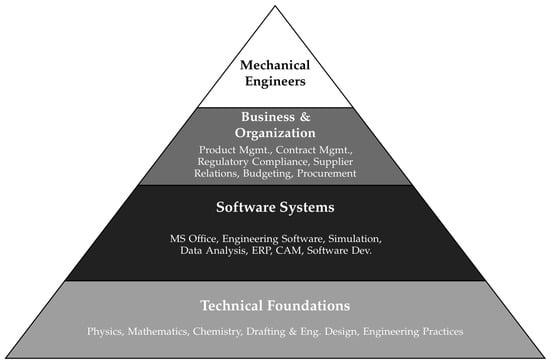
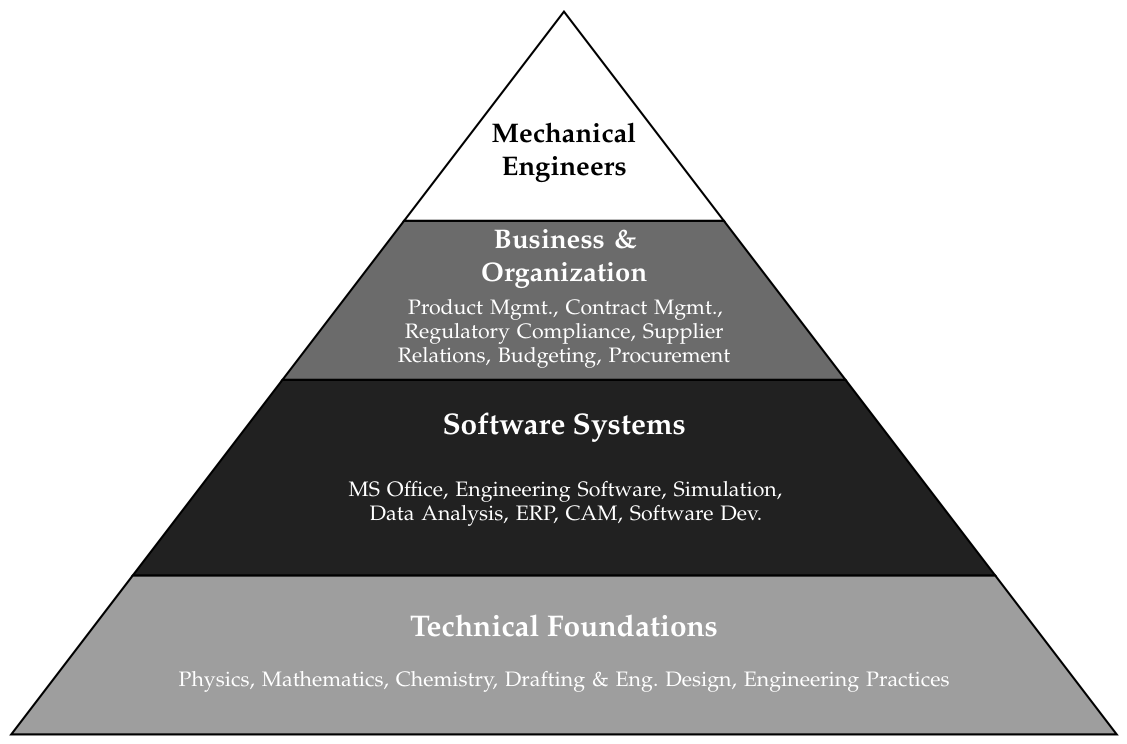

Disclaimer/Publisher’s Note: The statements, opinions and data contained in all publications are solely those of the individual author(s) and contributor(s) and not of MDPI and/or the editor(s). MDPI and/or the editor(s) disclaim responsibility for any injury to people or property resulting from any ideas, methods, instructions or products referred to in the content. |
© 2026 by the authors. Licensee MDPI, Basel, Switzerland. This article is an open access article distributed under the terms and conditions of the Creative Commons Attribution (CC BY) license.