


Abstract
Engineering literacy research has been dominated by static, competence-based frameworks that fail to explain how attributes evolve dynamically and systematically underrepresent two critical dimensions: engineering consciousness as a cognitive precursor to decision-making, and engineering culture as a value-laden, inherited dimension sustaining professional identity across generations. These gaps are particularly consequential for STEM teacher preparation, where cultivating comprehensive engineering literacy in future educators is hypothesized to create a multiplier effect on societal STEM engagement. This study develops a theoretical model through a systematized literature retrieval and critical synthesis of engineering literacy literature (2005–2025; N = 113 publications), combined with theoretical deduction grounded in system theory and synergy theory. Two research questions guide the study: (1) How is the connotation of engineering literacy systematically reconstructed under multiple transformations? (2) What is the synergistic evolution logic among its constituent elements, and how can this logic inform curriculum design for STEM teacher preparation? The design utility of the model is illustrated through a curriculum design case. The analysis yields a “multi-driver, five-dimension synergy” dynamic model comprising five interconnected elements (knowledge, competence, consciousness, ethics, and culture) that co-evolve through a “consciousness–action–culture” spiral cycle, in which culture functions as the slow variable governing the long-term evolution of the entire system. The curriculum design case (a 64 h course for pre-service teachers centered on the Hong Kong–Zhuhai–Macao Bridge) illustrates how the model guided curricular decisions in four areas: consciousness activation before skill training, distributed cultural integration, multidimensional assessment, and operationalization of the multiplier effect through a teaching transformation module. The study advances engineering literacy theory by upgrading it from a static competence inventory to a culturally embedded, consciousness-driven adaptive ecosystem and provides a potentially transferable curriculum design framework for STEM teacher preparation. As a design case, the curriculum blueprint awaits implementation and empirical validation; claims about learning outcomes, multiplier effects, and cross-cultural applicability are theoretical hypotheses rather than empirically validated findings.
1. Introduction
The global STEM landscape is being fundamentally reshaped by the dual transitions of digitalization and sustainability. Artificial intelligence, digital twins, and intelligent manufacturing have transformed the entire lifecycle of engineering activities, while resource constraints and climate change impose new boundaries on decision-making. Engineering practice has evolved from a technical activity of “making things” into a complex socio-technical system requiring practitioners to balance technical feasibility, ecological sustainability, and social value. As Li and Guo contend [1], engineering education must now achieve multiple transcendences to meet this new reality.
International engineering education standards have begun to respond. The Graduate Attributes and Professional Competencies (GAPC V4) framework has strengthened requirements for sustainable development and interdisciplinary collaboration [2]. The CDIO 3.0 standards [3] have integrated digital competence and future orientation. However, these standards remain positioned as entry-level accreditation benchmarks, focusing on measurable, minimum competence requirements. They do not explain how engineering literacy evolves dynamically, nor do they reveal the synergistic mechanisms among its internal elements.
More critically, existing research on engineering literacy exhibits three core limitations. First, most frameworks adopt a static perspective, describing literacy as a collection of elements without addressing the dynamic evolution mechanism, focusing on “what to include” rather than “how it evolves” [4,5]. Second, mainstream models emphasize knowledge, competence, and ethics while receiving limited explicit treatment of engineering culture as a core dimension, limiting their explanatory power for cross-cultural collaboration and value inheritance in global practice [6]. Third, existing studies treat literacy dimensions as independent modules, lacking exploration of the synergistic mechanisms among elements, which hinders integrated curriculum design.
These gaps have particular significance for STEM teacher preparation. The preparation of teachers who can effectively integrate engineering into K-12 STEM education has become a global priority, as evidenced by the inclusion of engineering practices in the Next Generation Science Standards [7] and comparable reforms internationally [8]. However, teacher candidates often enter preparation programs with limited exposure to engineering thinking and practice, let alone to the cultural and ethical dimensions of engineering [9,10]. If pre-service teachers themselves lack a comprehensive understanding of engineering literacy, including consciousness and culture, they cannot effectively cultivate these dimensions in their future students. This creates a critical “transmission gap” in STEM education: engineering culture, values, and ways of thinking remain invisible in K-12 classrooms because teachers themselves were never immersed in them. Addressing this gap requires theoretical frameworks that can guide the design of engineering literacy experiences specifically for teacher preparation contexts, a need that existing competence-based models, developed primarily for engineering accreditation purposes, are ill-equipped to meet.
To address these gaps, this study investigates two research questions: (1) How is the connotation of engineering literacy systematically reconstructed under the combined drive of multiple transformations? (2) What is the synergistic evolution logic among the internal constituent elements, particularly the roles of engineering consciousness and culture, and how can this logic inform curriculum design for STEM teacher preparation? Adopting a systematic literature review and theoretical modeling approach, this study constructs a five-dimensional dynamic model and indicates its internal evolution mechanism. A curriculum design case (Bridge Engineering and Innovative Teaching Practices for pre-service teachers) is then presented to illustrate how the model can guide the integration of consciousness and culture into STEM teacher preparation. This study is a theoretical model-building investigation that employs a systematized literature retrieval and critical synthesis to develop a dynamic engineering literacy model, and illustrates its design utility through a curriculum design case. The two components are not separate studies but form an integrated design: the literature synthesis and theoretical deduction generate the model, while the curriculum design case illustrates how the model can systematically guide curricular decisions. This integrated approach is intended to bridge the gap between abstract theory and actionable design principles for STEM teacher preparation.
2. Literature Review
Engineering literacy research has evolved over the past two decades. Early definitions equated literacy with the ability to apply STEM knowledge to solve engineering problems [11]. Later frameworks expanded this to include thinking habits, practical skills, and ethical awareness, forming multi-dimensional models such as the four-element framework of “knowledge-competence-consciousness-ethics” [5]. However, a critical review indicates that two dimensions remain systematically underdeveloped. Table 1 summarizes the representation of engineering consciousness and culture in major frameworks.
Table 1.
Representation of Consciousness and Culture in Major Frameworks.
Engineering consciousness refers to the internal cognitive and value orientation that guides an engineer’s perception of problems and decision-making before action is taken [14]. It encompasses systems thinking consciousness, ecological and sustainability consciousness, safety and risk consciousness, and humanistic and value consciousness. While some elements appear fragmentarily in standards, they are treated as supplementary attitudes rather than as an integral cognitive layer that dynamically interacts with competence and knowledge.
Engineering culture is even more profoundly neglected. Defined as the accumulated shared values, beliefs, norms, and spirit that shape the identity of engineering communities [6,15], it functions as the “operating system” running in the background of all engineering activity. In the Chinese context, this manifests vividly in concepts such as the craftsmanship spirit (pursuit of excellence, meticulousness), the “Two Bombs and One Satellite” spirit (self-reliance, dedication), and the manned spaceflight spirit (collaboration, responsibility) [16,17]. These cultural genes regulate behavior and inspire innovation in ways that formal ethics codes alone cannot. Yet, few mainstream engineering literacy models have positioned culture as a core dimension with a dynamic feedback role.
The neglect of culture and consciousness has particular significance for STEM teacher preparation. Research on engineering-oriented teacher professional development consistently finds that teachers’ own understanding of engineering is often narrow, limited to “building things” or “applying science”, and lacks appreciation for the socio-cultural and ethical dimensions of engineering practice [9,18]. This narrow understanding is then transmitted to K-12 students, perpetuating a reductive view of engineering. Models that explicitly incorporate consciousness and culture could provide a framework for broadening teachers’ conceptualization of engineering, thereby breaking this cycle. However, such models must also demonstrate how they can be operationalized in teacher preparation curricula, a practical gap that the present study addresses through its curriculum design case.
By overlooking consciousness and culture, existing models remain static inventories that cannot explain how engineering literacy adapts to novel contexts or how it is transmitted across generations of practitioners, including through the critical channel of teacher education. This gap motivates the present study.
The following chapter (Section 3) describes the methodological process (including the systematized retrieval and extraction protocol) through which the literature reviewed above was systematically identified and analyzed to inform the theoretical model.
3. Research Methodology
This study adopts an integrated research approach combining systematized literature retrieval and critical synthesis, theoretical modeling, and a curriculum design case illustration. The curriculum design case is not a separate empirical study but a concrete instantiation of the theoretical model, serving to demonstrate its design utility and operationalizability. The following subsections detail each methodological component.
3.1. Literature Retrieval, Extraction, and Theoretical Synthesis
3.1.1. Nature of This Study
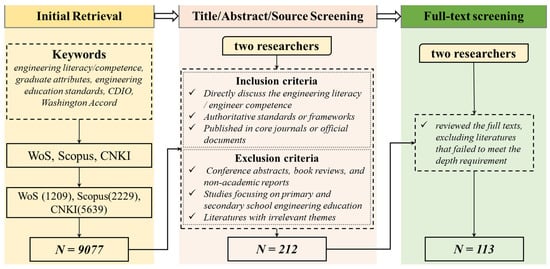
This study is not a systematic review in the preferred reporting items for systematic reviews and meta-analyses (PRISMA) 2020 sense [19]. It is a theoretical model-building investigation that employs a systematized literature retrieval and extraction process informed by the PRISMA search framework. The PRISMA Flow Diagram (Figure 1) is adopted only as a reporting tool to ensure transparency and repeatability of the search strategy, not as a protocol for a full systematic review of empirical interventions. Since our unit of analysis was conceptual propositions rather than empirical effect sizes, formal quality/risk-of-bias assessments (as required by PRISMA for intervention reviews) were not applicable.
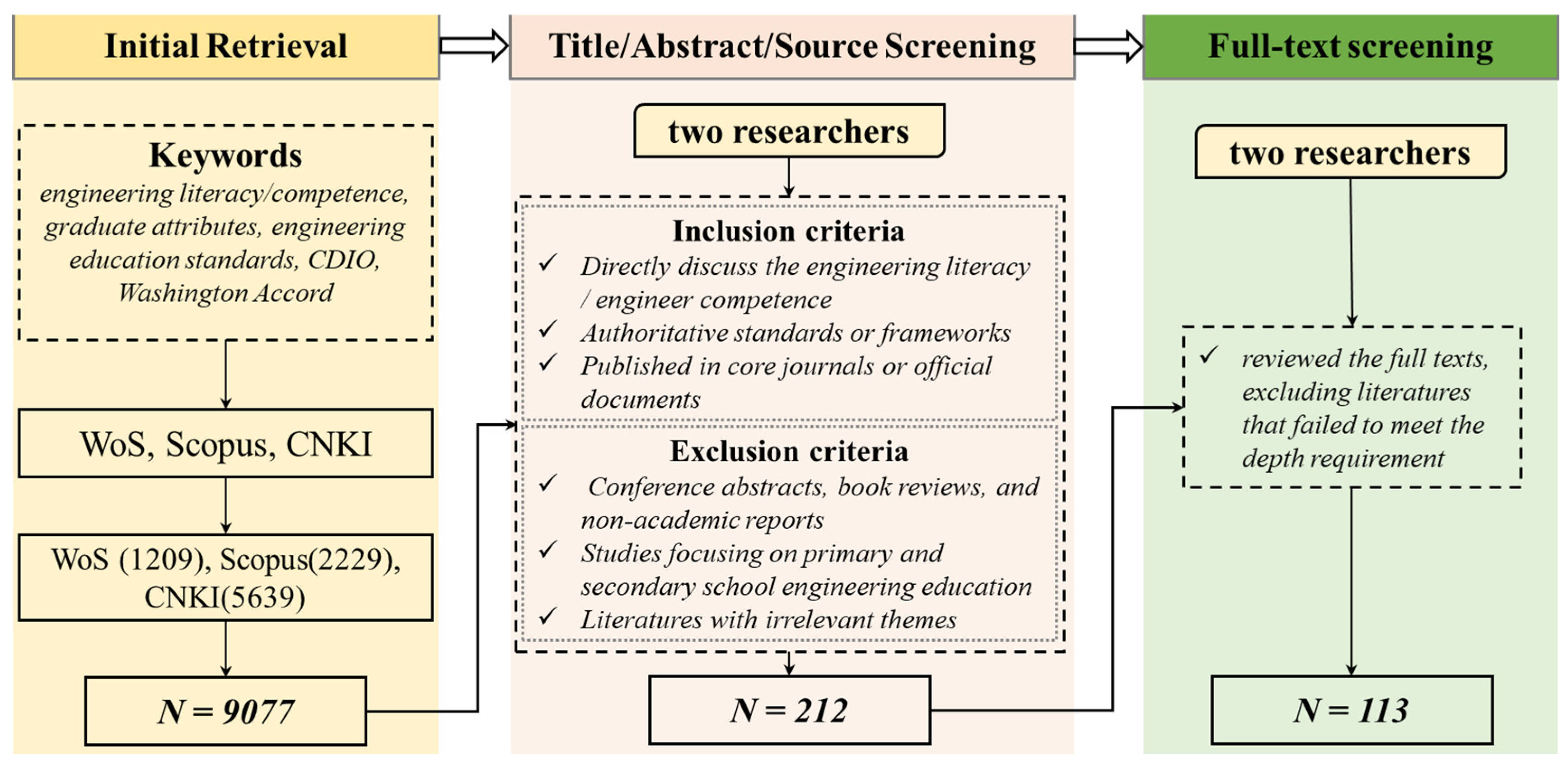
Figure 1.
PRISMA-inspired flow diagram illustrating the literature retrieval and screening process for theoretical dimension extraction. Note: This study is a theoretical model-building inquiry, not an intervention-focused systematic review; the PRISMA framework was adopted solely as a reporting tool to ensure transparency of the search process.
This positioning has two implications for the subsequent methodology. First, the search and coding procedures are designed to capture conceptual breadth rather than to estimate effect sizes; therefore, the inclusion criteria and synthesis methods focus on conceptual richness and theoretical relevance. Second, the coding process is interpretive and theory-informed rather than purely inductive; as such, we adopt a consensus-based qualitative approach rather than calculating quantitative inter-coder reliability coefficients.
3.1.2. Information Sources and Search Strategy
We systematically searched three academic databases, Web of Science Core Collection (WoS), Scopus, and CNKI (China National Knowledge Infrastructure), for literature published between January 2005 and January 2025. The starting year was selected based on two considerations: (a) the release of The Engineer of 2020: Visions of Engineering in the New Century [20], which marked a milestone in global engineering literacy research; and (b) the Symposium on Multi-/Inter-Disciplinary Engineering Education held at the East China University of Science and Technology in 2006. Additionally, we manually searched the official websites of the International Engineering Alliance (IEA), the American Society for Engineering Education (ASEE), and the European Network for Accreditation of Engineering Education (ENAEE) for accreditation standards and policy documents. All manual searches were completed by 28 January 2025.
The primary search string for WoS and Scopus combined terms related to engineering literacy, its commonly discussed dimensions, and the educational context: (“engineering literacy”) AND (knowledge OR consciousness OR competence OR ethics OR culture) AND (“engineering education” OR “engineering”).
The dimension-related terms (knowledge, consciousness, competence, ethics, culture) were derived from a preliminary scoping review of key frameworks and policy documents (e.g., GAPC V4, CDIO 3.0, Zhou et al. [5]), which already identified these as commonly discussed dimensions of engineering literacy. The purpose of including them in the search string was to systematically capture the existing literature addressing these dimensions, rather than to predetermine the final model.
For CNKI, a Chinese-language database, the search string was adapted to capture equivalent concepts: (TI = ‘工程教育’ OR TI = ‘工程素养’ OR TI = ‘新工科’ OR TI = ‘工程观’ OR TI = ‘工程师’ OR TI = ‘华盛顿协议’ OR TI = ‘CDIO’) AND (SU % = ‘工程教育’) NOT (SU = ‘实验’ OR SU = ‘课程’).
To test for potential circularity in the search strategy, we conducted a supplementary search without dimension-specific terms and also searched for adjacent concepts (e.g., professional identity, engineering habits of mind); neither procedure identified new core dimensions beyond the five reported. Details are provided in Supplementary Materials.
3.1.3. Eligibility Criteria
Studies were included if they met the following criteria: (a) directly addressed engineering literacy, graduate attributes, or professional competencies in higher engineering education; (b) were published in peer-reviewed journals, constituted official organizational standards (e.g., GAPC, CDIO, EUR-ACE), or were authoritative policy documents; (c) were written in English or Chinese. Studies were excluded if they: (a) were conference abstracts, book reviews, or non-academic reports; (b) focused exclusively on K-12 engineering education without implications for higher education or teacher preparation; or (c) had themes unrelated to the conceptualization or dimensionality of engineering literacy.
3.1.4. Screening and Selection Process
Two researchers (Z.X. and Q.F.) independently screened all titles and abstracts against the eligibility criteria. Disagreements were resolved through discussion or, when consensus could not be reached, by arbitration from a third researcher (H.L.). The full texts of potentially eligible records were then independently assessed by the same two researchers. No automation tools were used in the screening process. The screening results are documented in the PRISMA-inspired flow diagram (Figure 1), which is used solely as a reporting tool to ensure transparency; it does not imply adherence to all PRISMA 2020 requirements for systematic reviews of interventions.
3.1.5. Data Extraction and Synthesis
We employed a three-stage content analysis approach. In the first stage, information extraction, we identified key constructs, definitions, and dimensional frameworks from each included publication. This yielded an initial pool of 87 distinct conceptual elements. In the second stage, focused coding, we applied a preliminary coding scheme derived from a scoping review of key frameworks (e.g., [2,5]) and the theoretical literature. The initial coding resulted in 24 codes, which were grouped into 8 intermediate categories through iterative comparison and discussion. In the third stage, thematic aggregation, the 8 categories were merged into 5 core dimensions (Knowledge, Competence, Consciousness, Ethics, and Culture) based on three criteria: (a) semantic distinctiveness, (b) frequency of occurrence across the literature, and (c) theoretical coherence with system theory and synergy theory.
The coding protocol was developed collaboratively by the research team prior to coding. It specified the definition of coding units, preliminary categories, judgment criteria for ambiguous cases, and rules for merging or splitting categories. Both researchers independently coded 20% of the included studies to refine the protocol and ensure consistent application of categories. Given the interpretive nature of the coding, identifying conceptual dimensions rather than discrete empirical effects, we adopted a consensus-based approach: all disagreements were discussed until full agreement was reached, rather than calculating a quantitative reliability coefficient. The complete coding protocol, the full list of extracted data items, and the coding progression table are provided in Supplementary Materials.
3.2. Selection Results
The literature retrieval and screening process is summarized in the PRISMA-inspired flow diagram (Figure 1). The initial search across WoS, Scopus, and CNKI yielded 9077 records. After removing duplicates and screening titles and abstracts against the eligibility criteria, 212 records were retained for full-text assessment. Full-text review excluded 99 records that did not meet the depth or relevance requirements, resulting in 113 publications (66 English, 47 Chinese).
3.3. Theoretical Modeling
Three interrelated theories underpin the model construction. System theory [21] defines engineering literacy as a dynamic, open ecosystem exchanging material and energy with external environments. Synergy theory [22] explains the interactive relationships among the five core elements, revealing how their mutual interactions optimize overall system function. In particular, synergy theory’s concept of slow variables governing fast variables provides a theoretical basis for understanding why culture (as the slowest-evolving dimension) ultimately determines the long-term trajectory of the literacy system. Sustainable development theory [23] provides the value anchor, establishing human well-being and green low-carbon development as the core orientation of engineering literacy evolution.
The theoretical deduction was not applied after coding but interacted with it: the coding stages identified candidate dimensions, while the theoretical lenses informed the grouping of intermediate categories and the interpretation of relationships among dimensions. This interplay between inductive coding and deductive theorization is explicitly acknowledged; the resulting model is thus a product of both evidence synthesis and theoretical construction.
3.4. Curriculum Design Case
To demonstrate the practical utility of the model as a curriculum design framework, this study presents a design case [24], a detailed description of an educational artifact and the theoretical reasoning behind its design decisions. Design cases are a recognized form of educational research that contribute to knowledge by making explicit the design rationale connecting theoretical principles to concrete curricular features, without requiring implementation or empirical validation [24,25]. They are particularly appropriate when the contribution lies in demonstrating how a theoretical framework can systematically generate principled design decisions, rather than in evaluating the outcomes of those decisions. This design case follows the rigorous criteria outlined by Smith [25]: it explicitly articulates the theoretical principles underpinning all design decisions, documents the full reasoning behind curricular structure and module sequencing, and establishes clear mappings between theoretical constructs and concrete learning activities, ensuring transparency and transferability of the design knowledge.
The educational artifact presented here is a curriculum blueprint (Bridge Engineering and Innovative Teaching Practices) designed by the authors for pre-service teachers at a Chinese normal university, using the five-dimensional model as the generative framework. At the time of writing, the curriculum has been formally designed and approved but not yet implemented; consistent with the design case methodology, this paper presents the curriculum as a theory-informed design artifact and analyzes the design decisions through the lens of the theoretical model. Implementation and empirical validation constitute the planned next phase of this research program.
The design of this curriculum was not a purely theoretical exercise. It builds upon the authors’ prior experience in delivering modular engineering literacy training to pre-service teachers through extracurricular workshops (second-classroom activities). These workshops consisted of three independent modules: (1) introduction to major Chinese engineering projects, which covered the Hong Kong–Zhuhai–Macao Bridge’s site selection, ecological protection, and craftsmanship spirit; (2) digital modeling and 3D printing; and (3) UAV operation training. The present curriculum systematically integrates these previously separate modules using the HZMB as a unifying prototype, transforming fragmented workshop experiences into a coherent, project-driven course design. No systematic research data were collected during the informal workshops.
4. External Drivers and Evolution Pathways
The following results are organized into two logical directions. First, Section 4 and Section 5 present the theoretical reconstruction of engineering literacy, synthesizing the literature to derive the five-dimensional model and its synergistic evolution mechanism. Second, Section 6 presents the curriculum design case, demonstrating how the model systematically guided curricular decisions for STEM teacher preparation.
The reconstruction of engineering literacy is driven by four interrelated categories of external factors, operating through three evolutionary pathways.
4.1. Four Categories of Driving Forces
Technological–digital drivers. The widespread application of intelligent perception, digital twins, and additive manufacturing has reshaped engineering practice from design to operation. This promotes interdisciplinary knowledge integration, accelerates knowledge renewal, and expands the boundaries of engineering consciousness toward data security and algorithmic ethics. In the five-dimensional model, technological–digital drivers primarily act upon the knowledge dimension (accelerating interdisciplinary integration and obsolescence of existing knowledge) and the competence dimension (generating demand for digital tool proficiency and lifelong learning), while indirectly challenging consciousness (new ethical awareness) and ethics (data security, algorithmic fairness).
Socio-industrial drivers. The intelligent and green transformation of manufacturing has expanded talent demand from traditional sectors to intelligent manufacturing, green energy, and high-end equipment. Engineering solutions must now balance technical feasibility with ecological sustainability and social value [26]. These drivers primarily reshape the competence dimension (demand for systems thinking, innovation, and cross-disciplinary capabilities) and the consciousness dimension (awakening user-centered and humanistic awareness).
Institutional–strategic drivers. National strategies such as the Plan for Educating and Training Outstanding Engineers [13] and the European Commission’s Industry 5.0 initiative orient engineering talent cultivation toward core technology breakthroughs and human-centric sustainable development. The United Nations SDGs further establish a global value consensus. These drivers exert broad influence across all five dimensions but most directly shape the consciousness dimension (strategic and sustainability awareness) and the culture dimension (national engineering identity and value orientation).
Eco-ethical drivers. Resource constraints and ecological degradation impose hard boundaries on engineering activities, driving technological innovation in low-carbon manufacturing while promoting the reconstruction of engineering ethics [27]. These drivers act most directly upon the consciousness dimension (ecological awareness), the ethics dimension (environmental responsibility, intergenerational justice), and indirectly upon the culture dimension through the sedimentation of ecologically responsible practices into professional norms.
4.2. Three Evolution Pathways
These driving forces promote literacy reconstruction through three pathways: direct driving (technological progress and social demand positively guide literacy development, while resource constraints and ethical norms rigidly define behavioral boundaries); cascading driving (influence transmitted through intermediate links such as manufacturing digitalization or educational innovation); and closed-loop evolution (a dynamic feedback cycle wherein external demand drives literacy reconstruction, and the updated literacy system supports industrial development and technological progress, feeding back to optimize talent cultivation).
Notably, these multiple transformations are not limited to the manufacturing sector. In the domain of civil infrastructure, the emergence of mega-projects such as the Hong Kong–Zhuhai–Macao Bridge (HZM Bridge), a 55 km bridge–tunnel–island complex crossing the Pearl River Estuary, embodies the same transformative trends: digital technologies (Building Information Modeling, digital twins, BeiDou satellite-based monitoring) reshape design and construction practices; ecological constraints (the Chinese White Dolphin National Nature Reserve, navigational requirements of one of the world’s busiest shipping lanes) become rigid design boundaries; and the demand for interdisciplinary, culturally rooted engineering talent capable of indigenous innovation continues to rise [28]. This convergence makes mega-infrastructure projects an ideal scenario for observing the reconstruction of engineering literacy across all five dimensions, and also justifies their selection as the core carrier of curriculum design for STEM teacher preparation.
5. The Five-Dimensional Dynamic Engineering Literacy Model
5.1. Core Definition and Conceptual Boundaries
Based on the literature synthesis and theoretical deduction, engineering literacy is defined as: A dynamic, adaptive, comprehensive quality formed through continuous internalization in engineering learning, practice, and reflection. Centered on solving complex engineering problems, it integrates technological innovation, social demand, ecological sustainability, and humanistic value through the synergistic interaction of five core elements: knowledge, competence, consciousness, ethics, and culture.
Table 2 clarifies the boundaries between engineering literacy and related concepts, and Table 3 summarizes the five core elements of engineering literacy.
Table 2.
Conceptual boundaries between engineering literacy and related concepts.
Table 3.
Summary of the five core elements of engineering literacy.
5.2. Connotation of Five Core Elements
(1) Engineering Knowledge. Engineering knowledge is the sum of all knowledge accumulated by humans in the systematic practice of transforming nature and serving society, spanning basic scientific knowledge, professional engineering knowledge, technical skill knowledge, interdisciplinary knowledge, and social–humanistic knowledge. From the perspective of the engineering life cycle, it covers the entire process knowledge system from conceptualization, decision-making, and planning through design, implementation, operation, and evaluation [29,30]. In the context of multiple transformations, engineering knowledge is characterized by increasing interdisciplinarity and accelerated iteration, making lifelong learning essential for maintaining its currency.
(2) Engineering Competence. Engineering competence is the sum of all abilities required for engineers to carry out engineering practice and solve engineering problems by applying engineering knowledge. Synthesizing existing research [31,32], it encompasses five core components: engineering thinking ability, the core of engineering competence, including systematic and critical thinking for solving complex problems [33,34,35,36]; practical ability across the entire engineering lifecycle from decision-making and design to implementation and evaluation; organizational and management ability for cross-team, cross-cultural collaboration and resource allocation; innovation capability as the driving force for technological breakthroughs and interdisciplinary integration; and lifelong learning ability as the underlying meta-competence that sustains all other capabilities amid rapid technological change [37].
(3) Engineering Consciousness. Engineering consciousness is the thinking mode and value orientation formed by engineers in engineering practice, a dynamic reflection at the cognitive level of the nature, boundaries, and value of engineering [14,38]. It guides engineers to recognize engineering from a higher dimension, construct engineering thinking, and grasp engineering value, running through the entire life cycle of engineering activities. It comprises four interrelated components: system and safety consciousness (grasping engineering holistically, recognizing cascading effects, and prioritizing safety as a non-negotiable prerequisite); ecological and sustainability consciousness (internalizing the recognition of resource finitude and the imperative of long-term human well-being); humanistic and value consciousness (weighing social, cultural, and ethical values in all engineering decisions); and innovation and lifelong-learning consciousness (continuously updating mental models in response to technological and societal change). Functionally, consciousness operates at the pre-decision stage: it is the cognitive precursor that orients problem framing, activates relevant knowledge, and sets the direction for competence deployment before any concrete action begins. This dimension is what fundamentally distinguishes the engineering literacy framework from pure competence lists.
(4) Engineering Ethics. Engineering ethics is a value framework that regulates and guides engineering activities, a dynamic balance of interests, responsibilities, and values whose essence lies in the dialectical unity of technical utility and ethical value [39,40,41]. It encompasses four interconnected sub-dimensions: technological ethics that regulates the application of emerging technologies such as artificial intelligence, big data, and genetic engineering; interest ethics that coordinates the relationships among individuals, collectives, engineering projects, society, and the ecological environment; responsibility ethics that clarifies the scope and limits of engineering accountability, including lifelong responsibility for product quality and safety; and value ethics that actively pursues the optimal solution oriented toward people-centered development, sustainability, and human well-being. Recent scholarship on engineering ethics in the era of artificial intelligence [42,43], and on sustainability learning outcomes in engineering education [44] further underscores the dynamic expansion of ethical considerations alongside technological progress. Functionally, ethics operates at the execution stage: it provides the normative constraints and decision-making rules that govern engineering action, translating the value orientation established by consciousness into concrete behavioral boundaries.
(5) Engineering Culture. Engineering culture is the practical form of the people-oriented concept in engineering activities [45]. Synthesizing existing research [6,15,17,46], this study defines engineering culture as the sum of values, thinking modes, institutional norms, codes of conduct, and humanistic elements of engineering entities formed by the engineering community in long-term engineering practice. As a general theoretical construct, engineering culture refers to the accumulated values, norms, and spirit shared by engineering communities across contexts. Specific cultural manifestations, such as the craftsmanship spirit, the “Two Bombs and One Satellite” spirit, and the manned spaceflight spirit in the Chinese context, are contextual instantiations of this construct. Analogous professional traditions exist in other national and institutional settings, but their specific content differs. According to its manifestation form, it includes three levels: surface-level material culture embodied in the structure, form, function, and symbolic significance of engineering entities; institutional culture reflected in organizational systems, management mechanisms, rules and regulations, and codes of conduct; and deep-level spiritual culture represented by engineering spirit, the soul of engineering culture and the value belief of engineering activities. In the Chinese context, this spiritual culture manifests distinctively as the craftsmanship spirit (persistent focus, striving for perfection, meticulous attention to detail, and pursuit of excellence), the “Two Bombs and One Satellite” spirit (self-reliance, dedication, and rigorous scientific attitude), and the collaborative spirit of major national projects such as the manned spaceflight and lunar exploration programs [16]. These cultural genes play a crucial role in fostering innovative behavior and professional commitment in ways that formal ethics codes alone cannot achieve. Functionally, culture operates at the post-practice sedimentation stage: it is what remains and crystallizes after countless cycles of conscious decision-making and ethically constrained action, becoming shared professional values and inherited traditions. Engineering culture thus functions as the “long-term memory” of the literacy system: while knowledge may become outdated and specific competences may be superseded by new technologies, a robust engineering culture ensures the persistence of core values and provides an anchor amid turbulent changes.
5.3. Synergistic Evolution Mechanism
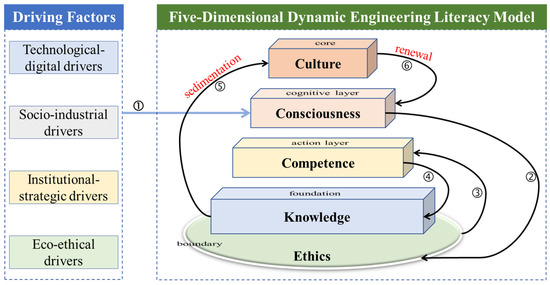
The five elements form a dynamic ecosystem through a “consciousness–action–culture” spiral cycle (Figure 2). The following subsections unpack this mechanism in detail, from its temporal logic to its governing slow variables and developmental stages.
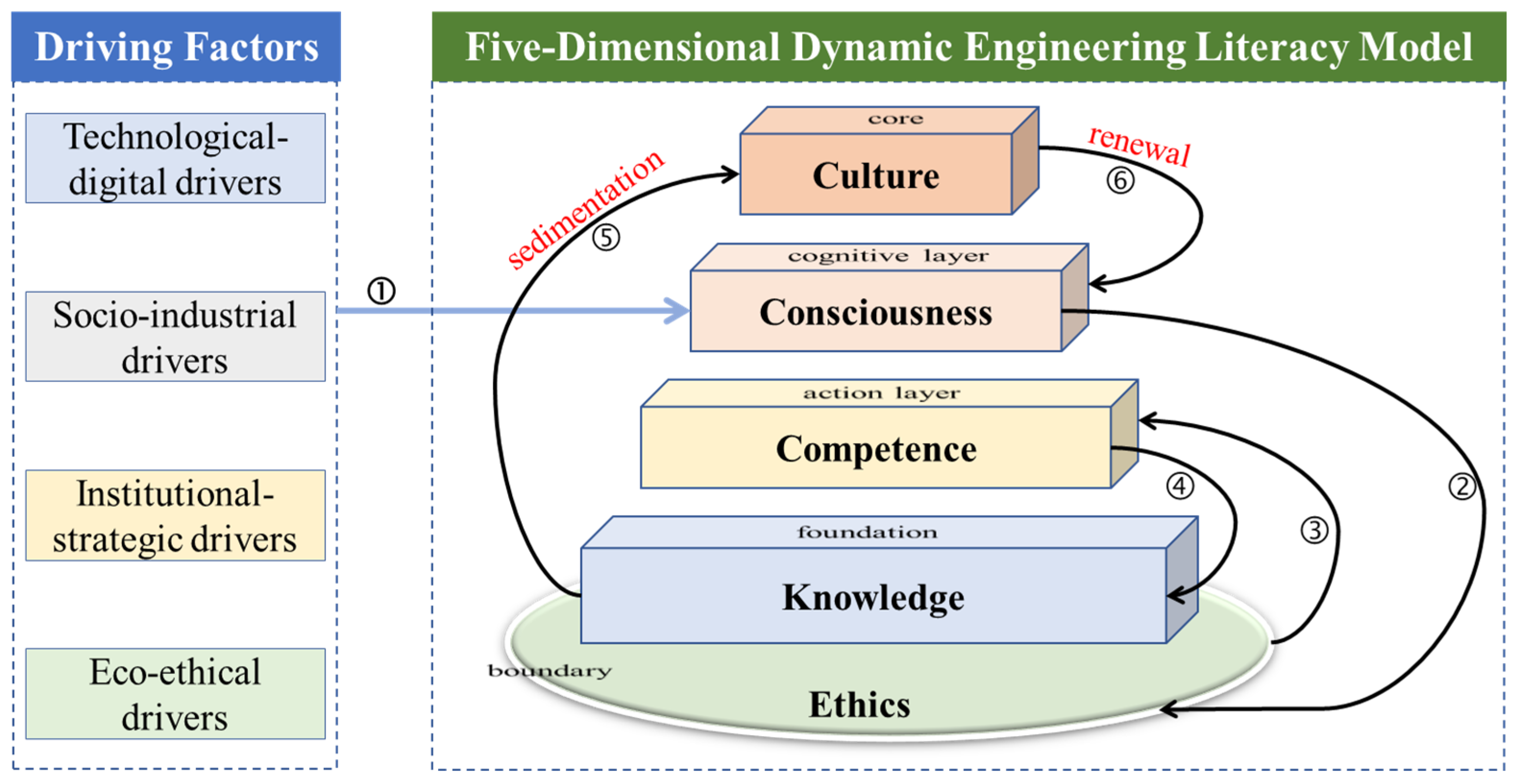
Figure 2.
Five-Dimensional Dynamic Synergy Model of Engineering Literacy.
The model illustrates a “consciousness–action–culture” spiral cycle: external demands activate engineering consciousness, which, bounded by ethics, guides the deployment of competence and knowledge; the outcomes sediment into engineering culture, which in turn renews consciousness for the next cycle. Reciprocal influences (e.g., culture shaping consciousness as background, ethics informing consciousness through reflection) are represented by the cyclic nature of the model.
Functional stratification: Dominant functional roles. To clarify the boundaries among the three most conceptually adjacent dimensions (consciousness, ethics, and culture), the model distinguishes their dominant functional roles. Consciousness operates primarily at the pre-decision stage, serving as the cognitive precursor that orients problem framing and activates value awareness before action begins. Ethics operates primarily at the execution stage, providing the normative rules and behavioral boundaries that govern action. Culture operates primarily at the post-practice sedimentation stage, representing what is crystallized and inherited after repeated cycles of conscious decision-making and ethically constrained action.
However, these temporal positions represent dominant functional roles rather than mutually exclusive temporal locations. In actual engineering practice, culture also shapes consciousness before action by providing background norms and cognitive schemas; ethical considerations arise during problem framing as well as execution; and consciousness continues to monitor and reflect during and after action. The model therefore adopts a cyclic, reciprocal view: culture is both a precondition for consciousness (as inherited background) and an outcome of consciousness-guided action (as sedimented practice). This reciprocal relationship is implicit in the spiral cycle depicted in Figure 2.
The mechanism in operation. External demands first challenge the engineer’s consciousness: a technological shift or societal need activates specific awareness. For instance, encountering the ecological constraints of a project site triggers sustainability consciousness. This consciousness then orients ethical deliberation, setting boundaries for acceptable solutions. Under the guidance of culture (the accumulated professional values and norms), competence is deployed and knowledge is applied. The outcomes of action flow back: successful practices reinforce existing cultural values; failures or ethical dilemmas trigger reevaluation of consciousness. Over time, repeated practices sediment into the cultural layer, becoming part of the inherited professional tradition. This cycle is not a simple closed loop but a spiraling upward process. Each round of practice enriches the cultural layer and elevates the baseline of consciousness, so that subsequent problem-solving is supported by a more mature value framework and more sophisticated competence, realizing adaptive upgrading of the entire literacy system.
Culture as the slow variable. Drawing on synergy theory, the model posits that the five dimensions do not evolve at equal rates. Knowledge and competence are fast variables that iterate rapidly with technological change; specific technical knowledge may become obsolete within years, and tool-operation skills require constant updating. Consciousness and ethics evolve at a moderate pace, shaped by accumulated experience and societal value shifts over a career span. Culture, however, is the slow variable that changes across generations. Because it operates at the deepest layer of shared values and professional identity, culture governs the evolutionary direction of the entire system: it provides the value backdrop against which consciousness is activated, sets the ultimate standards by which ethics are judged, and determines which competencies and knowledge are valued and preserved. This slow-variable dominance explains why engineering literacy is not merely reactive to external changes but maintains continuity and identity over time, a feature that purely competence-based models cannot account for.
Individual-level developmental stages. To further concretize the dynamic nature of the model, three developmental stages can be distinguished in an individual engineer’s literacy evolution:
- ⮚
- Stage 1: Foundational Construction Period. Knowledge and basic competence dominate; consciousness and culture are in early formation, primarily through exposure to exemplary cases and mentor narratives. Ethics is largely rule-following rather than internalized judgment.
- ⮚
- Stage 2: Practice Deepening Period. Competence rapidly expands through diverse project experience; consciousness is progressively strengthened as the engineer encounters complex trade-offs and ethical dilemmas in authentic practice; cultural values begin to be internalized through sustained professional socialization.
- ⮚
- Stage 3: Internalization and Maturity Period. Culture is deeply internalized, becoming the automatic value framework that guides decision-making without conscious deliberation; consciousness functions as a rapid, intuitive cognitive orientation; the engineer becomes not only a skilled practitioner but also a carrier and transmitter of engineering culture to the next generation.
These stages are not rigidly sequential but represent shifting centers of gravity in literacy development. They provide a basis for stage-appropriate curriculum design and, in future empirical research, for developing measurement instruments sensitive to developmental progression.
Summary of Theoretical Model. The theoretical construction yields three key outcomes: (a) a five-dimensional structure (knowledge, competence, consciousness, ethics, culture) that expands prior static frameworks; (b) a temporal–functional differentiation among consciousness (pre-decision precursor), ethics (in-action constraint), and culture (post-practice sedimentation); and (c) a synergistic evolution mechanism characterized by the “consciousness–action–culture” spiral cycle, in which culture functions as the slow variable governing long-term system evolution. These theoretical outcomes serve as the foundation for the curriculum design case presented next.
Theoretical propositions derived from the model. The following propositions are deduced from system theory and synergy theory and are presented as hypotheses for future empirical testing. They are not direct findings from the literature synthesis but rather theoretical expectations generated by the model.
- P1: Changes in engineering consciousness precede changes in competence deployment under novel engineering conditions.
- P2: Repeated engineering practices mediate the sedimentation of individual and organizational values into engineering culture.
- P3: Engineering culture moderates how external technological and societal drivers influence engineering consciousness.
- P4: In the long term, culture (slow variable) exerts a dominant influence on the evolution of knowledge and competence (fast variables), maintaining system continuity.
These propositions make the model falsifiable and provide clear directions for subsequent empirical validation.
6. Design Case: “Bridge Engineering and Innovative Teaching Practices”
6.1. Curriculum Context and Design Rationale
Bridge Engineering and Innovative Teaching Practices is a 2-credit, 64-class-hour curriculum designed for pre-service teachers across all majors at a Chinese Normal University, with no prerequisite requirements. It was developed by systematically integrating and upgrading three previously separate extracurricular workshop modules—namely, introduction to major Chinese engineering projects (covering the HZM Bridge’s site selection, ecological protection, and craftsmanship spirit), digital modeling and 3D printing, and UAV operation training—into a unified, project-driven course centered on the HZM Bridge as the prototype. The curriculum adopts project-based learning as the core pedagogy, structured around the CDIO (Conceive–Design–Implement–Operate) framework.
The HZM Bridge was selected as the central engineering case for three theoretically grounded reasons. First, as a mega-project integrating bridges, artificial islands, and an undersea tunnel, it embodies the full spectrum of engineering complexity and consequently the full range of literacy dimensions. Second, the project’s documented history provides rich material for activating engineering consciousness and exploring ethical dilemmas: the indigenous development of immersed tube installation technology after foreign companies refused to share key techniques (innovation consciousness); the rerouting of the bridge alignment to protect the Chinese White Dolphin National Nature Reserve (ecological consciousness and environmental ethics); and the achievement of millimeter-level precision in the final immersed tube joint (0.8 mm longitudinal and 2.5 mm transverse deviation) by Chief Engineer Lin Ming’s team (https://subsites.chinadaily.com.cn/zhuhai/2017-05/12/c_77320.htm accessed on 7 July 2026). Third, the bridge’s symbolic status as a landmark of China’s engineering achievement, often referred to as a “bridge of national self-reliance”, offers a powerful vehicle for cultural transmission [28].
The selection of pre-service teachers as the target audience is theoretically motivated by the model’s cultural transmission mechanism. The model posits that engineering culture is transmitted not only within the profession but also through educational channels to broader society. By equipping future teachers with engineering literacy, particularly its consciousness and cultural dimensions, the curriculum creates a multiplier effect. The transmission chain can be articulated as: pre-service teachers’ internalization of five-dimensional literacy → integration of consciousness and cultural elements into their instructional design → K-12 students’ development of a comprehensive engineering epistemology beyond narrow “building things” conceptions → broader societal STEM engagement and engineering culture recognition. This chain addresses a well-documented gap in STEM teacher preparation, where teachers often lack substantive engineering experiences that go beyond simplified design challenges [9]. From the perspective of the three-stage developmental framework, this curriculum is designed to support pre-service teachers’ transition from the foundational construction period to the practice deepening period: it prioritizes consciousness activation and cultural enlightenment as the entry point, and lays a holistic cognitive foundation before systematic competence training.
6.2. Curriculum Structure: Mapping the Five Dimensions
Table 4 illustrates how the seven curriculum modules are designed to align with the five dimensions of the engineering literacy model.
Table 4.
Curriculum modules mapped to the five-dimensional model.
6.3. Design Analysis: How the Model Guided Curricular Decisions
The following analysis illustrates the model’s capacity as a design heuristic, that is, its ability to systematically generate principled curricular decisions. It does not yet demonstrate learning outcomes or implementation fidelity, as the curriculum has not been implemented. The five-dimensional model functioned as a generative framework, systematically guiding decisions about module sequencing, cultural integration, assessment design, and the operationalization of the multiplier effect.
Consciousness Activation Before Skill Training. The model’s temporal logic, which holds that consciousness operates at the pre-decision stage, directly informed the placement of Module 2 before fabrication. Students first confront the driving question: “If you were the chief engineer, how would you determine the bridge alignment? What areas must be avoided?” By mapping navigation channels, the dolphin reserve boundary, and bathymetric contours onto layered transparencies, students visually experience the spatial constraints that shaped the actual HZM Bridge design. The role-play debate on the “White Dolphin Dilemma” further activates ecological consciousness and ethical deliberation. This design decision operationalizes the model’s proposition that consciousness must be awakened before competence can be meaningfully directed: consciousness sets the cognitive frame within which subsequent technical skills are deployed.
Distributed Cultural Integration. The model’s positioning of engineering culture as the post-practice sedimentation stage and the slow variable governing system evolution led to culture being woven throughout the curriculum rather than confined to a standalone module. Module 1 introduces the BeiDou satellite navigation system as a cultural artifact of national innovation. Module 4 frames precision measurement as a manifestation of the craftsmanship spirit, reinforced by two embedded narratives: welder Pei Xianfeng’s silver medal at the 2011 WorldSkills Competition, and Lin Ming’s team achieving millimeter-level precision in the HZM Bridge final joint. Module 6 requires students to design lesson plans that transmit these cultural values to K-12 learners. This distributed approach operationalizes the model’s theoretical claim that culture, as a slow variable, must be consistently reinforced across diverse learning experiences to achieve sedimentation.
Multidimensional Assessment Aligned with the Five Dimensions. The model’s identification of five distinct yet interacting dimensions necessitated assessment methods beyond traditional knowledge tests. The curriculum accordingly adopts a portfolio-based system requiring seven deliverables: a site selection analysis report (assessing consciousness: system and ecological), a feasibility report with geometric constraint annotation (assessing consciousness: constraint awareness; competence: design thinking), a key dimension error record (assessing culture: precision and craftsmanship), a UAV inspection report (assessing consciousness: safety; ethics: data integrity), a teaching transformation design package (assessing culture: transmission; competence: TPACK), and a reflective synthesis report (assessing holistic integration). The capstone presentation adopts a distinctive “three-role” format (engineer, inspector, teacher), making visible the multidimensional nature of engineering literacy.
Operationalizing the Multiplier Effect. Module 6 (Teaching Transformation Design) directly operationalizes the multiplier effect transmission chain. This module requires students to design K-12 STEAM-integrated lesson plans that draw on their engineering experiences, with explicit mapping to national curriculum standards and S-T-E-A-M dimensions. Students must identify which engineering consciousness elements (e.g., constraint awareness, safety consciousness) and cultural values (e.g., craftsmanship, innovation spirit) they intend to transmit, and design age-appropriate activities to achieve this transmission. This design feature is intended to enable the multiplier effect; whether such transfer occurs requires longitudinal empirical validation.
6.4. Limitations
The curriculum has not yet been formally implemented as a complete 64 h course; its effectiveness in cultivating the five dimensions awaits systematic empirical validation. While the three constituent modules were previously delivered as informal extracurricular workshops, no research data were collected during those sessions. The design case presented here illustrates the model’s capacity as a design heuristic but does not validate learning outcomes. Pilot implementation with pre-post assessment of participants’ engineering consciousness, cultural identification, and technological pedagogical content knowledge framework (TPACK) development is planned as the next research phase.
7. Discussion
To clarify the evidentiary basis of our claims, we distinguish among four types of statements in this paper: (i) findings derived directly from the literature synthesis (e.g., the underrepresentation of culture in mainstream models); (ii) theoretical propositions deduced from system theory and synergy theory (e.g., culture as the slow variable); (iii) design principles derived from the model (e.g., consciousness activation before skill training); and (iv) hypotheses requiring empirical validation (e.g., the multiplier effect, cross-cultural transferability). This distinction is intended to prevent overinterpretation and to guide future research.
7.1. Theoretical Contributions
This study makes three theoretical contributions, each anchored in specific gaps identified in the literature.
First, dimensional expansion. Addressing the gap identified by Godfrey and Parker [6] that engineering culture has been consistently underrepresented in literacy frameworks, this study formally positions culture as a core dimension and clarifies consciousness as a distinct cognitive precursor to action, extending the classic four-element model [5] to a five-dimensional synergistic system. Furthermore, the temporal–functional logic established among consciousness, ethics, and culture, “pre-decision cognition → in-action constraint → post-action sedimentation”, helps clarify the conceptual boundaries that have been ambiguous in prior frameworks. This differentiation is offered as a heuristic rather than a categorical resolution, given the reciprocal and overlapping relationships among these dimensions acknowledged in Section 5.3.
Second, mechanistic insight. Moving beyond the static descriptive approaches that have dominated the field [4], this study indicates the “consciousness–action–culture” spiral cycle. By introducing the synergy–theoretic distinction between fast variables (knowledge, competence) and the slow variable (culture) that governs long-term system evolution, the model provides a mechanistic explanation for both the responsiveness of engineering literacy to external change and its continuity of core values across time. The three-stage developmental path (foundational construction → practice deepening → internalization and maturity) further translates the macro mechanism into an individual-level developmental framework, providing a basis for stage-appropriate educational design.
Third, practical operationalization. Complementing existing accreditation standards that focus on measurable competencies [2], this study illustrates through a design case how the model can systematically guide curriculum design for STEM teacher preparation. The hypothesized multiplier effect transmission chain, from pre-service teacher literacy internalization through instructional design to K-12 student engineering epistemology development and broader societal STEM engagement, connects engineering literacy theory to the pressing practical challenge of preparing STEM-capable teachers [10]. This chain also suggests measurable indicators for future empirical research: teacher integration frequency of engineering consciousness and cultural elements in classroom instruction, and K-12 students’ breadth of engineering epistemology as assessed through validated instruments.
Compared with the ASEE P-12 Engineering Learning Framework [4], which focuses on knowledge and practice standards for K-12 learners, this model extends the scope to teacher preparation and positions culture as a core generative dimension rather than a contextual background. Relative to European studies on sustainability learning outcomes in engineering education [44] that emphasize competencies such as systems thinking and interdisciplinarity, this study further distinguishes consciousness as a pre-action cognitive layer and indicates the slow-variable governing role of culture, offering a more fine-grained explanation of dynamic evolution.
7.2. Implications for STEM Teacher Preparation
The design case yields potentially transferable principles for integrating engineering literacy into teacher preparation. First, consciousness activation should precede skill training: future teachers benefit from experiencing the constraint awareness and ethical deliberation that define authentic engineering practice before they engage in hands-on fabrication. Second, engineering culture should be a distributed through-line rather than a standalone topic, conveyed through embedded narratives, mentorship interactions, and repeated reinforcement across diverse learning experiences. Third, assessment in engineering-oriented teacher education must go beyond technical competence to capture consciousness development, cultural engagement, and teaching transformation capacity. Fourth, the hypothesized multiplier effect provides a powerful rationale for investing in engineering literacy development among pre-service teachers, an investment that may potentially generate downstream benefits across the K-12 STEM pipeline, subject to longitudinal empirical validation. The transmission chain proposed here, from pre-service teacher literacy internalization through instructional design to K-12 student engineering epistemology development, offers a testable framework for future research rather than an established finding.
These principles align with calls in the STEM education literature for teacher preparation that goes beyond simplified “design challenges” to engage future teachers with the full complexity of engineering practice, including its social, ethical, and cultural dimensions [18,47]. The five-dimensional model provides a structured framework for designing such experiences.
To address potential concerns about the model’s generalizability beyond the specific case context, we note two cross-domain transfer principles. First, case carrier substitution: for STEM teacher preparation in manufacturing-oriented contexts, the HZMB can be substituted with equivalent mega-projects such as domestically developed large aircraft (C919) or high-speed rail systems. Any engineering case that embodies the full spectrum of literacy dimensions and carries cultural significance can serve as the curricular core. For international contexts, equivalent landmark projects (e.g., the Apollo Program, the Large Hadron Collider, or national high-speed rail networks) are proposed as potentially equivalent carriers; however, their cultural transferability remains a hypothesis to be empirically examined, as the model has not yet been tested outside the Chinese context. Second, module adaptation for non-teacher audiences: for engineering programs training professional engineers rather than teachers, Module 6 (Teaching Transformation Design) can be replaced with a “Cultural Transmission and Professional Leadership” module that focuses on mentoring, public communication of engineering, and organizational culture building, preserving the cultural transmission mechanism while adapting the target audience. These adaptations illustrate the model’s potential applicability beyond its original context, suggesting that its design logic may not be confined to a single discipline or learner population. However, this remains a theoretical expectation rather than an empirically verified claim, as the model has not yet been tested outside the Chinese context.
7.3. Limitations and Future Research
Beyond the curriculum design case limitations noted in Section 6.4, this study has broader limitations. The model was constructed primarily through literature deduction and a single design illustration. A Delphi expert validation study, engaging engineering education scholars, practicing engineers, and teacher education specialists to evaluate the dimensional structure and mechanistic logic, is planned to strengthen the model’s content validity. Future research should also pursue multiple design cases across disciplines and cultural contexts, develop validated instruments to measure engineering consciousness and culture (particularly challenging given their implicit and slow-changing nature), and conduct longitudinal studies tracking the multiplier effect, specifically, whether pre-service teachers who complete the curriculum subsequently integrate engineering consciousness and culture into their own K-12 teaching, and whether this integration produces measurable changes in their students’ engineering epistemology. Cross-cultural comparative studies examining how engineering culture manifests in different national and professional contexts would further test the model’s generalizability and reveal culturally specific versus universal dimensions of engineering literacy.
8. Conclusions
This paper has argued that current conceptualizations of engineering literacy, while extensive, are incomplete. By re-centering engineering consciousness and culture alongside knowledge, competence, and ethics, we have constructed a “multi-driver, five-dimension synergy” dynamic model that offers a theoretical framework for understanding how literacy evolves in response to technological and societal transformations. The model establishes a clear functional stratification (consciousness as the pre-decision cognitive precursor, ethics as the in-action normative constraint, and culture as the post-action sedimentation and slow variable governing long-term evolution) and delineates a three-stage individual developmental path from foundational construction to internalized maturity. The spiral cycle mechanism, in which each round of practice elevates the baseline of consciousness and enriches the cultural layer, explains not only individual professional growth but also the intergenerational transmission of engineering values.
The model’s design utility was illustrated through a curriculum blueprint for pre-service STEM teachers, demonstrating how the framework can systematically guide decisions about module sequencing, cultural integration, assessment design, and the operationalization of the multiplier effect on K-12 STEM education. The study repositions engineering literacy not as a static checklist of competencies but as a culturally infused, consciousness-driven adaptive ecosystem. For STEM teacher preparation, the model offers both a theoretical lens for understanding what comprehensive engineering literacy entails and a practical framework for designing learning experiences that cultivate it. We call for STEM teacher educators to intentionally design consciousness activation moments and cultural immersion experiences, and for researchers to empirically investigate the multiplier effect through which engineering literacy, in its full multidimensionality, can be transmitted across generations of educators and learners.
Supplementary Materials
The following supporting information can be downloaded at: https://www.mdpi.com/article/10.3390/higheredu5030093/s1, Table S1: Search strings and retrieval formulas for major databases; Table S2: Illustrative examples of dimensional coding from key standards and literature; Table S3: Coding progression from extracted concepts to final five dimensions.
Author Contributions
Conceptualization, Z.X., B.X. and H.L.; methodology, Z.X. and Q.F.; investigation, Z.X. and Q.F., writing—original draft preparation, Z.X.; writing—review and editing, B.X., Q.F. and H.L.; visualization, Q.F.; funding acquisition, B.X. All authors have read and agreed to the published version of the manuscript.
Funding
This work was supported by the Beijing Normal University’s Special Project for Quality Enhancement of Teacher Education Programs (311324240581).
Institutional Review Board Statement
Not applicable.
Informed Consent Statement
Not applicable.
Data Availability Statement
The data presented in this study are available on reasonable request from the corresponding author.
Conflicts of Interest
The authors declare no conflict of interest.
References
- Li, P.; Guo, H. Engineering education needs to achieve multiple transcendence. J. Sci. Technol. Educ. Stud. 2023, 3, 2–15. (In Chinese) [Google Scholar] [CrossRef]
- International Engineering Alliance. Graduate Attributes and Professional Competences, version 4; International Engineering Alliance: Wellington, New Zealand, 2021. [Google Scholar]
- Malmqvist, J.; Edström, K.; Rosén, A. Cdio standards 3.0—Updates to the core cdio standards. In Proceedings of the 16th International CDIO Conference, Gothenburg, Sweden, 8–10 June 2020; Available online: https://www.cdio.org/sites/default/files/documents/CDIO_Proceedings_2020_Malmqvist_135.pdf (accessed on 13 May 2026).
- Strimel, G.; Huffman, T.; Grubbs, M.; Gurganus, J.; Sabarre, A.; Bartholomew, S. Framework for P-12 Engineering Learning: A Defined and Cohesive Educational Foundation for P-12 Engineering; American Society for Engineering Education: Washington, DC, USA, 2020. [Google Scholar]
- Zhou, L.; Sun, Y.; Ma, X.; Fan, H.; Tan, W. An investigation reporion the engineering literacy of universities students in shanghai. Res. High. Educ. Eng. 2016, 5, 106–111. (In Chinese) [Google Scholar]
- Godfrey, E.; Parker, L. Mapping the cultural landscape in engineering education. J. Eng. Educ. 2010, 99, 5–22. [Google Scholar] [CrossRef] [Scilit]
- States, N.L. The Next Generation Science Standards: For States, by States; The National Academies Press: Washington, DC, USA, 2013. [Google Scholar]
- European Commission. Industrial Research and Innovation Industry 5.0; Directorate-General for Research and Innovation: Brussels, Belgium, 2020. [Google Scholar]
- Hammack, R.; Ivey, T. Elementary teachers’ perceptions of k-5 engineering education and perceived barriers to implementation. J. Eng. Educ. 2019, 108, 503–522. [Google Scholar] [CrossRef] [Scilit]
- National Academies of Sciences, Engineering, and Medicine. Building capacity for teaching engineering in k-12 education. In National Academies of Sciences; The National Academies Press: Washington, DC, USA, 2020; p. 260. [Google Scholar]
- Chae, Y.; Purzer, Ş.; Cardella, M.E. Core Concepts for Engineering Literacy: The Interrelationships Among Stem Disciplines; ASEE Conferences: Louisville, Kentucky, 2010. [Google Scholar]
- European Network for Accreditation of Engineering Education. EUR-ACE® Framework Standards and Guidelines, 4th ed.; European Network for Accreditation of Engineering Education: Brussels, Belgium, 2021. [Google Scholar]
- Lin, J. The annotation of general standards for “a plan for educating and training outstanding engineers”. Res. High. Educ. Eng. 2014, 1, 12–23. (In Chinese) [Google Scholar]
- Wang, Z.b.; Wu, J. On the engineering consciousness’s system structure and function. Stud. Dialectics Nat. 2012, 28, 51–56. (In Chinese) [Google Scholar] [CrossRef]
- Schein, E.H.; Schein, P.A. Organizational Culture and Leadership, 5th ed.; Wiley: Hoboken, NJ, USA, 2016; p. 416. [Google Scholar]
- Li, Y.; Zhang, Q.; Yang, W. Crucial role of craftsmanship spirit in fostering innovative behavior among skilled talents in the manufacturing sector. Front. Psychol. 2025, 15, 1407426. [Google Scholar] [CrossRef] [Scilit] [PubMed]
- Wang, Z.; Li, C. The analysis of structure and function of engineering culture system. J. Eng. Stud. 2016, 8, 73–83. [Google Scholar] [CrossRef] [Scilit]
- Pleasants, J.; Olson, J.K. What is engineering? Elaborating the nature of engineering for k-12 education. Sci. Educ. 2019, 103, 145–166. [Google Scholar] [CrossRef] [Scilit]
- Page, M.J.; McKenzie, J.E.; Bossuyt, P.M.; Boutron, I.; Hoffmann, T.C.; Mulrow, C.D.; Shamseer, L.; Tetzlaff, J.M.; Akl, E.A.; Brennan, S.E.; et al. The prisma 2020 statement: An updated guideline for reporting systematic reviews. BMJ 2021, 372, n71. [Google Scholar] [CrossRef] [Scilit] [PubMed]
- National Academy of Engineering. Educating the Engineer of 2020: Adapting Engineering Education to the New Century; The National Academies Press: Washington, DC, USA, 2005. [Google Scholar]
- Bertalanffy, L.V. General System Theory: Foundations, Development, Applications, Revised ed.; George Braziller: New York, NY, USA, 2015. [Google Scholar]
- Haken, H. Synergetics Introduction and Advanced Topics; Springer: Berlin/Heidelberg, Germany, 2004. [Google Scholar]
- Ruggerio, C.A. Sustainability and sustainable development: A review of principles and definitions. Sci. Total Environ. 2021, 786, 147481. [Google Scholar] [CrossRef] [Scilit] [PubMed]
- Boling, E. The need for design cases: Disseminating design knowledge. Int. J. Des. Learn. 2010, 1, 1–8. [Google Scholar] [CrossRef] [Scilit]
- Smith, K.M. Producing the rigorous design case. Int. J. Des. Learn. 2010, 1, 10–20. [Google Scholar] [CrossRef] [Scilit]
- Luan, E.; Yuan, J.; Man, X.; Zhang, Z. A demand analysis of china’s engineering science and technology foreconomic and social development to 2035. Strateg. Study CAE 2017, 19, 21–26. (In Chinese) [Google Scholar] [CrossRef] [Scilit]
- Seid Ahmed, Y.; Milani, A.S. A review of strategies, challenges, and ethical implications of machine learning in smart manufacturing. Decis. Anal. J. 2025, 16, 100591. [Google Scholar] [CrossRef] [Scilit]
- Zhu, Y.; Lin, M.; Meng, F.; Liu, X.; Lin, W. The hong kong–zhuhai–macao bridge. Engineering 2019, 5, 10–14. [Google Scholar] [CrossRef] [Scilit]
- Yin, R.; Fu, Z.; Li, B. Theory of engineering knowledge as a new frontier of philosophy of engineering. Stud. Dialectics Nat. 2019, 35, 42–49. (In Chinese) [Google Scholar] [CrossRef]
- Yin, R.; Fu, Z.; Li, B. The theory of engineering knowledge based on the two kinds of material world view:One of the series of papers on engineering knowledge. Stud. Dialectics Nat. 2018, 34, 31–38. (In Chinese) [Google Scholar] [CrossRef]
- Garcés, G.; Sanz-Benlloch, A.; Montalbán-Domingo, L.; Díaz-Lantada, A. Future engineering competencies for a sustainable world: An integral framework for engineering education in the Industry 4.0 era. Int. J. Sustain. High. Educ. 2025. [Google Scholar] [CrossRef] [Scilit]
- Liu, Y.; Xiao, Y.; He, X. What core competencies should a great engineer possess? A comparative study from the perspective of engineering undergraduates in China and the United States. Eng. Educ. Rev. 2025, 2, 109–119. [Google Scholar] [CrossRef] [Scilit]
- Dalal, M.; Carberry, A.; Archambault, L. Developing a ways of thinking framework for engineering education research. Stud. Eng. Educ. 2021, 1, 108–125. [Google Scholar] [CrossRef] [Scilit]
- Engel, A. Systems thinking. Syst. Sci. Eng. Sch. 2024, 4, 114–126. [Google Scholar] [CrossRef] [Scilit]
- Li, B. Nature and cognition history of engineering thinking and its enlightenment to engineering education reform—Notes on emerging engineering education (iii). Res. High. Educ. Eng. 2018, 4, 45–54. (In Chinese) [Google Scholar]
- Zhan, X.; Sun, D.; Song, R.; Yang, Y.; Zhan, Y. Empowering students’engineering thinking: An empirical study of integrating engineering into science class at junior secondary schools. Think. Ski. Creat. 2023, 49, 101364. [Google Scholar] [CrossRef] [Scilit]
- Tuyaerts, S.; De Laet, T.; Van den Broeck, L.; Langie, G. Lifelong learning competencies for engineers: A delphi study with an industry panel. Eur. J. Eng. Educ. 2025, 50, 1010–1032. [Google Scholar] [CrossRef] [Scilit]
- Luna, M.E.O.; Arce, J.O. Fostering environmental consciousness: Insights from engineering education and sustainability initiatives. In Proceedings of the 2024 IEEE Global Engineering Education Conference (EDUCON), Kos Island, Greece, 8–11 May 2024; pp. 1–5. [Google Scholar] [CrossRef] [Scilit]
- Lynch, W.T. Teaching engineering ethics in the United States. IEEE Technol. Soc. Mag. 1997, 16, 27–36. [Google Scholar] [CrossRef]
- Zhu, G. Refilections on engineering ethics. Res. High. Educ. Eng. 2015, 4, 1–4. (In Chinese) [Google Scholar] [CrossRef] [Scilit]
- Li, Z.; Cong, H.; Wang, Q. Engineering Ethics, 2nd ed.; Tsinghua University Press: Beijing, China, 2019. (In Chinese) [Google Scholar]
- Ghosh, M. Artificial intelligence (AI) and ethical concerns: A review and research agenda. Cogent Bus. Manag. 2025, 12, 2551809. [Google Scholar] [CrossRef] [Scilit]
- Johnson, A.T. Ethics in the era of artificial intelligence. IEEE Pulse 2020, 11, 44–47. [Google Scholar] [CrossRef] [Scilit] [PubMed]
- Gutierrez-Bucheli, L.; Kidman, G.; Reid, A. Sustainability in engineering education: A review of learning outcomes. J. Clean. Prod. 2022, 330, 129734. [Google Scholar] [CrossRef] [Scilit]
- He, J. On the core of engineering management theory. Strateg. Study CAE 2013, 15, 4–11+18. (In Chinese) [Google Scholar]
- Adefioye, T. The engineering culture. In The Technical–Business Equilibrium: Mastering the Art of Balancing Technical Expertise and Business Priorities; Adefioye, T., Ed.; Apress: Berkeley, CA, USA, 2023; pp. 117–148. [Google Scholar]
- Cunningham, C.M.; Carlsen, W.S. Teaching engineering practices. J. Sci. Teach. Educ. 2014, 25, 197–210. [Google Scholar] [CrossRef] [Scilit]

Disclaimer/Publisher’s Note: The statements, opinions and data contained in all publications are solely those of the individual author(s) and contributor(s) and not of MDPI and/or the editor(s). MDPI and/or the editor(s) disclaim responsibility for any injury to people or property resulting from any ideas, methods, instructions or products referred to in the content. |
© 2026 by the authors. Licensee MDPI, Basel, Switzerland. This article is an open access article distributed under the terms and conditions of the Creative Commons Attribution (CC BY) license.