


Abstract
Research increasingly examines initial access to higher education (HE) in sub-Saharan Africa, yet less is known about the persistence of enrolled students in fragile contexts where costs are high and outcomes are uncertain. This study provides the first large-scale quantitative analysis of perceived HE worth in Guinea-Bissau, a resource-scarce Lusophone state. Drawing on Human Capital Investment (HCI), Behavioural Economics (BE), and Afrocentric perspectives on resilience and hope, we analysed survey data from 2255 students across six HE institutions (HEIs). A binary indicator of whether HE was worth the cost was used to assess ongoing valuation, and the data were analysed using sequential block-entry logistic regression after multiple imputation. Overall, 30.1% of students did not affirm that HE was worth the cost, indicating that enrolment does not guarantee sustained valuation. While cost-benefit reasoning remains important, perceptions were strongly shaped by campus climate and forward-looking expectations. Perceived advantages of HE, even without completion, outweighed the value of credentials alone, suggesting a pragmatic evaluation. We suggest anticipatory resilience as a lens for understanding students’ sustained valuations of HE amid uncertainty, grounded in anticipated benefits, institutional experience, and relational resources. Policy should prioritise campus climate, reduce financial strain, and reinforce the intrinsic value of HE.
1. Introduction
Higher education (HE) is widely regarded as a cornerstone of sustainable development and socioeconomic growth [1,2], improving employment, income, health, and civic engagement [3]. Yet HE in sub-Saharan Africa (SSA) faces systemic constraints: enrolment rose only to 9% between 2000 and 2021, far below the global average of 43% [1,4]. SSA hosts 22 of the world’s 30 countries with tertiary gender gaps favouring males [5], and remains the only region where the gender parity HE index (GPI) has not shifted in favour of females [1,4]. In 2021, the HE ratio stood at 0.79 females per male, compared with 1.12 globally [6]. Misalignment with market needs and institutional underperformance further limit the value of HE in the region [7].
Research on HE enrolment decision-making has largely focused on students in high-income countries [8]. Family income, parental socio-educational level and students’ geographic location are consistently associated with HE participation, persistence and success [9]. Yet expectations remain malleable, with institutional integration and faculty performance playing key roles in whether students continue or withdraw [10,11]. Perceived worth is not static but an ongoing evaluation that shapes persistence. Financial mechanisms matter too; loans against expected future earnings are perceived as more problematic than using savings or grant support, especially among debt-averse students [12].
In SSA, academic reputation and teaching quality have been shown to shape engagement in HE [13], with non-academic interactions particularly important for students from marginalised or underrepresented backgrounds [14]. Studies in Ghana and Nigeria indicate that service quality, institutional responsiveness and student experience predict satisfaction and perceived worth, often outweighing structural or background characteristics [15,16]. Similarly, perceived worth reflects a combination of institutional quality and lived academic experience, rather than being determined solely by expected economic returns. Research suggests that in SSA, students’ assessment of the worth of HE is shaped by ongoing interactions with institutional environments and wider life challenges, reinforcing the view of perceived worth as a dynamic, experience-dependent construct.
Scholarship on HE in SSA has expanded markedly since 2000, with 95% of publications from 1980–2019 appearing after that year; South African research has disproportionately shaped the volume and thematic focus [17], with a recent spike in research on youth resilience [18]. Lusophone and other low-income countries in the region remain underrepresented [19,20,21]. In SSA, research has focused on access, while less is known about whether and why enrolled students persist in fragile, high-cost systems with uncertain returns [20].
Focusing on the small Lusophone West African state of Guinea-Bissau, this study examined student decision-making in a nascent HE sector marked by low participation and severe resource constraints, in which an estimated three-quarters of the workforce are underqualified for their roles [1]. Nonetheless, the ultimate return on students’ HE investments remains uncertain: 30% of university graduates struggle to find suitable work, compared with 25% of secondary-school graduates [22,23]. Guinea-Bissau offers a critical case for understanding how students assess the worth of HE under severe constraints, providing insights applicable to other contexts where global policy frameworks meet local realities of scarcity and resilience.
The study investigated how students in Guinea-Bissau judge whether HE is worth the cost. The study addressed the following two research questions (RQs): (1) How do institutional and experiential factors predict students’ belief that HE is worth the cost? (2) How do students’ expectations of future returns on HE shape their assessment of its worth?
2. Conceptual Framework
Research on HE pathways often foregrounds individual qualities, such as commitment [14] and psychological strengths, including resilience or hope [24], in ways that align with neoliberal framings of students as calculating agents [25]. Our study draws on two dovetailing perspectives on human action. Human Capital Investment (HCI) theory posits that individuals are driven by a principle of action in which utility is maximised, whereas Behavioural Economics (BE) describes individuals as socialised, imperfect cost-benefit calculators [26].
HCI frames educational decisions as investments in skills and knowledge [27], treating individuals as rational investors in human capital, with cogent cost-benefit calculations optimising educational choices [8]. In line with HCI, students’ decisions can be understood as investments that weigh tangible costs against expected returns. However, students’ cost-benefit considerations are not solely bound to financial windfalls but also to the continued meeting of needs through the provision of services and support. When internal motivations are matched by external support, empirical evidence suggests that students are more content with their educational choices, indicating that learners are motivated by goals, interests, and encouragement from external sources [28].
Bounded rationality models decision-making as heuristic, reaching satisficing outcomes rather than optimisation [29,30]. Where outcomes are incalculable, BE holds that decision-making is systematically shaped by cognitive biases and heuristics, including perceptions of the scale of current investment, present bias or loss aversion, and greater perceived worth of outcomes [31,32]. Departure from the family home, degree choice, employment pursuit, and loan application all signify life-course-defining moments of uncertainty, during which cognitive biases may be aggravated [31]. In educational contexts, such heuristics may lead students to overemphasise immediate financial sacrifices relative to uncertain future returns.
Theoretical perspectives developed in high-income contexts may inadequately capture students’ educational decision-making in SSA. The hurdles students face, as preconditions for resilience, differ markedly between high- and low-income contexts [33,34] and are characterised by high levels of psychological distress, largely driven by hardship and adversity [35]. These perspectives often overlook local knowledge systems and cultural realities [36]. Thus, perspectives that frame resilience as a dynamic, context-dependent process emerging from shared social ecologies and negotiated resource networks are important [33,37].
Ncube et al. [24] suggest that Afrocentric hope offers a fitting lens for understanding resilience in SSA. According to Cherrington [38], Afrocentric hope rests on the interconnected dimensions of attachment (entailing belonging and reciprocal care), survival concerns (including safety and the fulfilment of basic material and social needs), and mastery (involving a sense of agency and capability that supports the pursuit of meaningful goals). Mason [39] depicts Afrocentric hope as a culturally grounded, multi-level, resilient stance that carries South African HE students through hardships towards imagined future possibilities.
In various fields of study, the literature describes anticipatory resilience as a proactive, future-oriented process by which individuals or systems use foresight, learning, and narrative sense-making to prepare for and adapt to uncertain disruptions [40,41,42,43]. We propose anticipatory resilience as a lens for interpreting how students evaluate whether HE is worth its cost amid uncertain returns and constrained institutional conditions. That evaluation is read through three complementary, yet interlinked, accounts: HCI treats educational participation as a cost–benefit calculation [8,27], whereas BE emphasises that decisions under uncertainty are shaped by heuristics and bounded rationality [29,30], and Afrocentric hope situates the evaluation in socially embedded, context-dependent resilience [38].
In this study, we applied anticipatory resilience cautiously as a culturally situated interpretive lens rather than as a measured construct or causal mechanism. This lens illuminates a process through which students may sustain positive valuations of HE by integrating expected benefits, current institutional conditions, and available relational resources despite material scarcity and uncertain returns.
Anticipatory resilience differs from HCI by focusing on maintenance rather than initiation of educational valuation when returns are uncertain. It further extends BE by recognising that heuristics are mediated by institutional and relational experiences. Finally, it complements Afrocentric hope by providing a lens for interpreting how relational resources sustain educational commitment.
3. Research Setting: Guinea-Bissau
3.1. Socioeconomic Background
The development of human capital in Guinea-Bissau is constrained by political volatility and economic precarity. Since independence from Portuguese colonial rule in 1974, the country has experienced armed conflict following a military uprising in 1998–1999, 17 attempted or alleged coups, and five successful coups [44], the most recent in 2025 [45]. Guinea-Bissau ranked 32nd out of 179 states in the Fragile States Index in 2024 [46]. The Human Development Index ranking is low, at 174th out of 193 countries [47]. The population profile is heavily skewed towards youth, with 42.3% aged 14 or under and 60% aged under 25 [48]. Approximately 67% of Guinea-Bissau’s roughly 2 million citizens, of whom 48% are children, live on less than US$2 per day, and over 33% live on less than US$1 per day [48]. As of 2022, 64% of adults are literate [6], up from 5% in 1975 [49].
3.2. Higher Education
The Bissau-Guinean HE sector operates under severe constraints and faces geographic inequality. The most recent Tertiary Gross Enrolment Ratio (TGER) was 3% in 2006 [6]. During the 2021–2022 academic year, an estimated 17,025 students enrolled at 31 HEIs [50]. Twenty-two of these, including the largest multidisciplinary institutions, are in or near the capital, representing three-quarters of the country’s HE student population. The World Bank [51] does not provide data on tertiary completion rates. Financial constraints are pervasive. Households and students cover more than half of national HE expenditure through tuition fees. Payment difficulties are common, and existing scholarship schemes are limited.
Guinea-Bissau’s first comprehensive legal framework for the sector was enacted in 2011 [50], before which the sector had operated without oversight. The first multi-facility university began operations in 2003 [52,53]. The development of the HE sector has been shaped by significant external influences. Regional bodies such as the Economic Community of West African States have played a key role in shaping the academic structure [54]. Until recently, legislative gaps forced students to travel abroad for postgraduate studies, resulting in a critical shortage of qualified faculty; in the academic year 2021/2022, about a third of lecturers held a Master’s-level qualification, and 3.5% held a PhD [50].
4. Materials and Methods
4.1. Survey Design
Survey data were collected in Bissau, Guinea-Bissau, between 30 November and 19 December 2022. The questionnaire was adapted from a 2017 survey platform that has been successfully used to explore adolescents’ lives and aspirations in this context [55,56]. A total of 2255 responses were collected from six of Guinea-Bissau’s principal multi-faculty HEIs. Participating HEIs accounted for 37.8% of the estimated national HE student population in the 2021–22 academic year [50].
4.2. Implementation
Students were randomly selected from a specially compiled class-based register from the six participating HEIs, totalling 9140 students. Sampling was conducted by class due to data availability. Respondents could opt to complete a digital or paper-based survey. As digital access rests on broader socioeconomic differences, internet access was provided via Wi-Fi routers in each classroom at no cost to participants during the survey’s implementation. Yet, connectivity was shaped primarily by unstable infrastructure, the varied quality of personal digital tools, and competency in accessing digital platforms, necessitating the use of a paper-based questionnaire as well. Facilitated by Planet Youth, 660 (29.3%) responses were completed digitally and 1595 (70.7%) on paper, which were digitised by the Instituto Nacional de Estudos e Pesquisas (INEP) in Bissau. During implementation, the participants expressed satisfaction with the questionnaire, which they found easy to complete.
The majority of participating HEIs do not maintain accurate attendance registers, with administrative figures not fully corresponding with in-class student numbers, limiting the calculability of a proper response rate. Only 4 students explicitly left the classroom when invited to participate; late attendees, eager to participate, were allowed to join and catch up within the time allocated for the survey; 34 questionnaires were excluded due to incomplete responses. Overall, the random sample of survey participants represents 24.6% of students in the class-based register from the six participating HEIs; compared with the academic year 2021–2022, when 17,025 HE students were registered [50], the study’s random sample likely represents about 13% of all registered HE students in Guinea-Bissau at the time of survey implementation.
4.3. Statistical Methods
The dependent variable was derived from the item: ‘To what extent do you agree with the following? University is worth it, despite the cost’. This was collapsed into agreement (Agree/Strongly Agree = 1) or disagreement/non-agreement (No idea/Disagree/Strongly Disagree = 0). The dependent variable served as a proxy for ongoing commitment, as it was recognised that a single-item measure captures only one facet of a multidimensional construct. Sequential block-entry logistic regression was used in subsequent analyses to assess the incremental explanatory contribution of each theoretical perspective. The original distribution (Strongly Disagree: 11.7%; Disagree: 8.7%; Neutral: 9.7%; Agree: 20.8%; Strongly Agree: 49.1%) was strongly skewed towards endorsement. Although dichotomisation reduces variation, it aligns with the study’s objectives, consistent with HCI and BE, to explain the conditions associated with affirmative valuation of HE under conditions of cost and uncertainty, rather than strength of agreement. Confidence intervals (CIs) are reported at the 95% level.
A preliminary linear mixed-effects model was used to assess potential institutional clustering, indicating minimal clustering of answers at the HEI level (Intraclass Correlation Coefficient = 0.03), with most variance occurring within HEIs (σ2 = 1.93 vs. 0.05 between HEIs). Given the modest observed clustering, HEI-level differences were considered unlikely to materially affect the substantive findings, although residual clustering cannot be entirely excluded.
A longlist of 31 variables was initially compiled. Several predictors captured component beliefs concerning expected returns, labour market uncertainty or educational utility. While these constructs are conceptually related to the outcome variable, they are distinct. These variables describe theoretically distinct beliefs hypothesised to contribute towards students’ overall educational valuation.
Sequential modelling was intended to reflect the study’s conceptual framework, conceptualising HE valuation as shaped by background characteristics, perceived returns on investment, and heuristic thinking. The first block included demographic and educational background characteristics as controls for baseline comparison. The second block introduced HCI variables, including perceived educational utility, associated costs and benefits. The third block incorporated BE variables capturing expectations, motivation, social influences, and HEI experiences. Sequential block introduction enabled assessment of the predictive contribution of HCI and BE factors beyond background characteristics.
Composite variables were validated using confirmatory factor analyses, followed by Cronbach’s alpha. Four composite variables were computed: campus climate, extortion and sexual harassment, academic support network, and parental background. “Don’t know/doesn’t apply” responses and missing values were excluded. Multiple imputation (20 imputations) was performed to account for listwise deletion in the regression (Supplementary Table S1). Pooled outputs are reported.
4.4. Ethical Considerations
Ethical approval for the study was obtained from the Research Ethics Committee for Public Higher Education Institutions in Iceland (SHV2022-041, 28 November 2022). The study also benefited from previously granted permission, dated 6 June 2017 (No/Ref 250/MEES/GM/2017). Students were informed of their right to refuse participation or withdraw at any time during data collection. Participation was voluntary, uncompensated, and anonymous. ChatGPT-5 Thinking was utilised to present the data graphically.
5. Results
5.1. Sample Characteristics and Perceived HE Worth
Of the 2255 randomly selected HE students, fewer females took part (n = 966, 43.4%) than males (n = 1262, 56.6%), resulting in a GPI of 0.77; 27 did not provide gender information. The average age of study participants was 25.7 years (median 25, range 17–56); males were significantly older than females, at 26.6 and 24.3 years, respectively (p < 0.001). The average age of Bissau-born girls was 24.1 years, compared to 24.8 years for those born outside the Bissau capital area; the average age of Bissau-born males was 25.2 years, compared to 27.5 years for those born elsewhere.
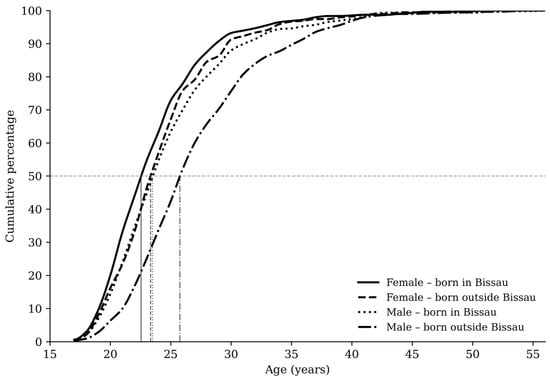
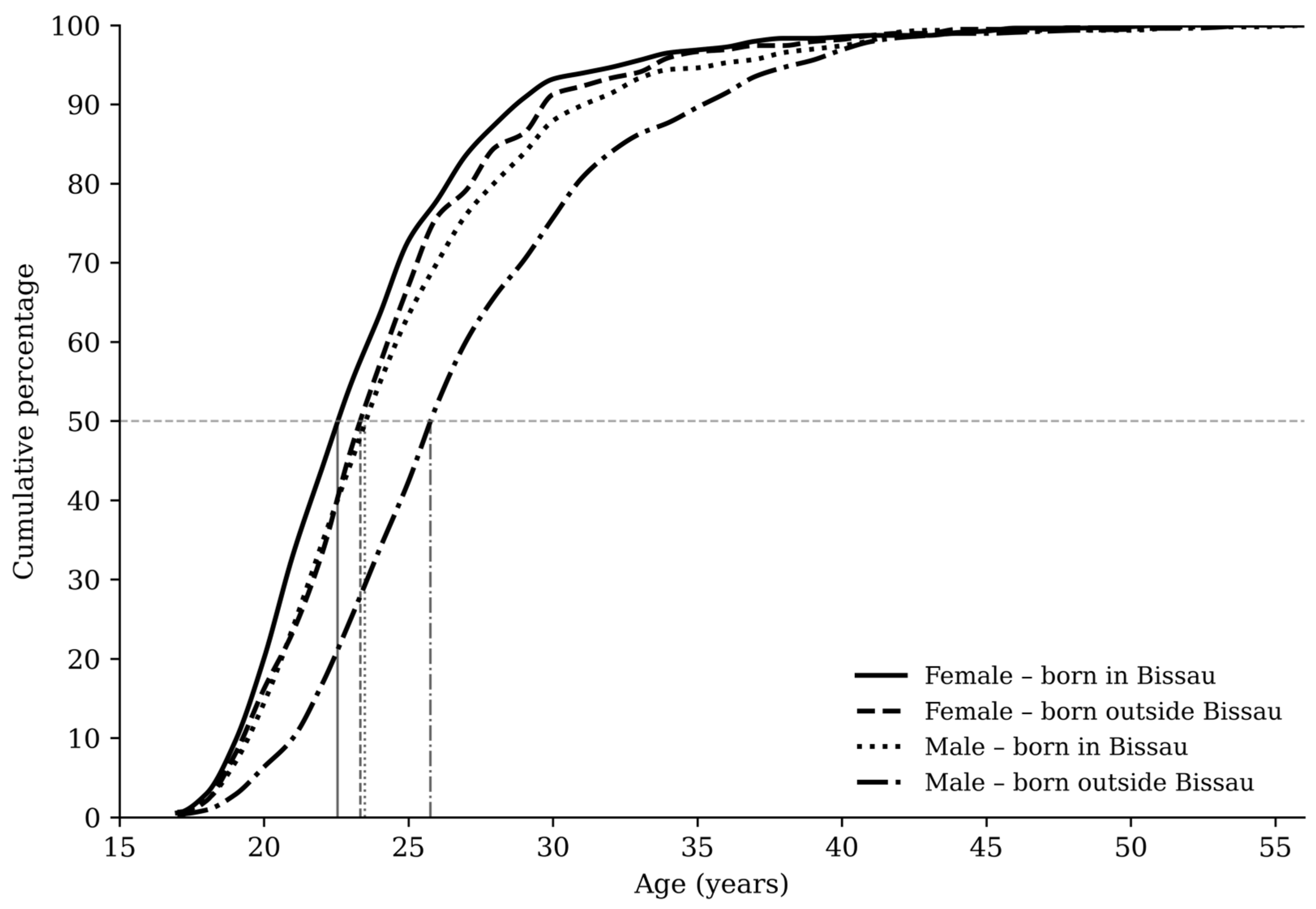
Figure 1 shows that younger students predominate in the sample, with both peak attendance by percentage and attrition occurring at younger ages among urban (Bissau-born) and rural females (non-Bissau-born) relative to urban and rural males. Enrolment among females declines sharply from age 22, with gender parity at 1.58 females per male student, falling to 0.63 thereafter. Females with an urban background comprised the largest share of the female sample (58.2%); conversely, males were predominantly rural (62.4%). Overall, urban-born students account for 46.5% of the study participants, while population data indicate that Bissau accounts for an estimated quarter of the country’s total population.
Figure 1.
Cumulative proportion of students by age, gender and origin. Grey, vertical lines show the age at the 50th percentile by sex and place-of-birth participant groups.
Table 1 shows the demographic composition of respondents by binary response to the outcome variable.
Table 1.
Selected demographic and background characteristics by perception of higher education worth.
Table 2 presents the distribution of selected independent variables across the two outcome groups: agreement or disagreement with the statement that HE is worth the cost. Overall, 69.9% of students felt that HE was worth it, irrespective of cost. Despite the sample’s educationally successful profile, late primary school enrolment remained commonplace (52.4%), and was more prevalent among males (62.3%) than among females (39.4%). Furthermore, participants reported considerable financial difficulties, including paying tuition fees.
Table 2.
Distribution of selected independent variables by perception of higher education worth.
5.2. Key Factors Associated with Perceived HE Worth
5.2.1. Initial Associations Between Student Characteristics and Perceived HE Worth
Table 3 presents bivariate correlations between the predictor variables and the outcome. Pearson’s r values of ≥0.1, ≥0.3, and ≥0.5 indicate small, medium, and large effects [57]. Positive correlations indicate that higher predictor values are associated with greater agreement that the university is worth the cost. For concision, bivariate results are presented for variables with the strongest associations with the outcome (p < 0.05), grouped into three blocks: controls, HCI, and BE.
Table 3.
Bivariate correlations between selected predictor variables and the perception that higher education is worth it despite the cost, arranged into three distinct blocks.
Control variables generally showed weak associations with the belief that the university was worth the cost (Table 3). However, students with higher grades and greater self-reported well-being and parents with high school or HE experience were slightly more likely to hold this belief, whereas students born or educated outside the capital were slightly less likely. Variables in the HCI and BE blocks showed stronger bivariate associations with the outcome than the control variables.
5.2.2. Independent Predictors of Perceived HE Worth in the Full Model
The outputs of the regression model are presented in Table 4; controls, HCI, and BE variables were entered in blocks across four models.
Table 4.
Summary of sequential block-entry logistic regression analysis predicting the belief that higher education is worth it despite the cost.
While students’ grades and self-reported well-being were significantly associated with the outcome in Model 1, the introduction of the HCI and BE variables rendered these associations non-significant. Their predictive power was subsumed by students’ institutional experiences and perceptions, indicating that these proximate factors play a greater role in their valuation of HE worth than well-being. Only age (in years) and parental attendance at high school or above were significant in the full model (Model 4).
The HCI block was the strongest relative predictor of the outcome variable, explaining a substantial proportion of the variance in the final model. BE offered slightly less explanatory power. The odds of agreeing that HE is worth the cost were 1.34 (CI = 1.24, 1.44) times higher among students who believed that HE offers an advantage, even when not completed. This effect considerably outweighed the belief that HE’s worth is contingent on completion.
Finding university studies useful and perceiving a positive campus climate were the most significant predictors in the final model. Students who found their studies useful had 1.46 times the odds (CI = 1.13, 1.90) of agreeing that HE was worth the cost. Similarly, a one-unit improvement on the campus climate scale was associated with a 35% increase in the odds (CI = 1.19, 1.53). Experiencing sexual harassment or financial extortion showed a significant negative association in the bivariate regression but not in the final model, suggesting that specific experiences of sexual harassment are subsumed by a broader consideration of campus climate.
A one-unit increase on the five-point scale measuring parental emphasis on academic performance reduced the odds of positively valuing HE by 12% (0.88, CI = 0.78, 1.00). Students who reported wanting to stop studying because it did not guarantee a future had 0.68 (CI = 0.52, 0.90) times the odds of agreeing that HE was worth the cost.
Table 5 presents the model fit statistics for all four models. Nagelkerke R2 values indicate that HCI slightly outperforms BE in explaining variance. HCI factors provided the greatest explanatory power of the three blocks, with a 9.23% increase in explained variance over the control factors alone. BE alone showed slightly poorer predictive utility, with decreases in the −2 Log Likelihood and R2 between models 2 and 3. However, the full model, incorporating both HCI and BE, was lower than the sum of the three blocks introduced individually, suggesting that HCI and BE explain the shared variance in the outcome variable and are not truly independent.
Table 5.
Model fit statistics for sequential block-entry logistic regression analyses predicting the belief that higher education is worth it despite the cost.
Model diagnostics indicated satisfactory fit and predictive performance. Across 20 imputed datasets, Hosmer–Lemeshow statistics varied (χ2 = 6.38–21.57, df = 8), reflecting some variability in calibration across imputations. The model demonstrated acceptable discrimination, with Receiver Operating Characteristic analyses across imputations showing a mean Area Under the Curve of 0.719 (range = 0.713–0.727; all p < 0.001). Multicollinearity was low, with Variance Inflation Factor values ranging from 1.07 to 1.84.
6. Discussion
This study investigated perceived HE worth among a random sample of enrolled students at six multi-faculty HEIs in Guinea-Bissau. It examined the relative contributions of HCI and BE to students’ beliefs about whether HE is worth its costs. Perceived HE worth appears most closely associated with the perceived utility of studies and a positive campus climate, whereas measured socio-economic background characteristics show weaker associations within the enrolled student population. Together, these findings suggest that the interplay of experiences, expectations, and cost–benefit reasoning is important for HE valuations under severe constraints. We interpret this process through the culturally situated lens of anticipatory resilience.
6.1. Institutional and Experiential Factors
RQ1 examined how institutional and experiential factors predict students’ belief that HE is worth the cost. Campus climate (OR = 1.35) and feeling safe at school (OR = 1.10) were positively associated with the outcome, while specific experiences of sexual harassment were incorporated into broader assessments of campus climate. Although sexual harassment and financial extortion were significant in bivariate models, neither remained significant after adjustment, suggesting that such experiences contribute to broader institutional evaluations. Academic networks and parental support were not significantly associated. Overall, institutional experiences, particularly safety, campus climate, and engagement, showed stronger associations with perceived worth than background characteristics. This aligns with evidence from SSA showing that HE students, particularly females, report safety risks in specific spaces, shaping their evaluations of campus life [58,59,60].
RQ2 examined how students’ expectations of future returns from HE shape their valuation of its worth. Perceived returns, particularly finding studies useful (OR = 1.46) and the belief that HE offers advantages even without completion (OR = 1.34), were amongst the strongest associations in the final model. Believing HE offers benefits beyond formal completion [61,62,63] was more strongly associated with perceived HE worth than the belief that its value depended upon obtaining a qualification.
While paid work hours were positively associated with perceived worth, even after controlling for financial stressors, hours spent on chores were not significantly associated with students’ sense of HE worth. Although both reduce study time, paid work may provide financial resources and labour-market exposure, whereas domestic chores are typically uncompensated obligations [20,64].
Wanting to stop studying because HE does not guarantee a future (OR = 0.68) was negatively associated with perceived HE worth and represented the largest negative association among included predictors. This finding aligns with previous research indicating that expectations of future returns are central to students’ educational evaluations and dropout intentions [65,66]. Lower perceived parental emphasis on academic success was also associated with lower perceived worth. Ongoing academic and parental support were not significant, suggesting that educational expectations may play a more important role than ongoing reinforcement [67]. Boredom (OR = 1.12) was also associated with perceived worth, consistent with prior research and highlighting the importance of immediate intellectual stimulation alongside longer-term rational justifications [68].
Positive perceptions of HE were most closely associated with campus climate and the belief that HE offers advantages even without degree completion. This aligns with quantitative research from SSA [13,15] and other publications [19,20]. Yet 30.1% of respondents reported that HE was not worth the cost, indicating that enrolment does not guarantee positive valuation. Perceived HE worth appears to reflect interactions between current experiences, anticipated returns, and cost-benefit reasoning, resonating with Afrocentric hope, which conceptualises resilience as grounded in attachment, survival, and mastery [24], rather than being explained solely by socioeconomic background or academic performance.
6.2. Theoretical Considerations
Classical HCI models explain educational investment at the point of choice but offer limited insight into how educational valuations are maintained once students are enrolled and returns remain uncertain [69]; our findings confirm that limitation. Institutional experiences, particularly campus climate and safety, remain associated with perceived HE worth even after accounting for background characteristics and expected returns. We therefore extend HCI by interpreting educational commitment as an ongoing reassessment rather than the residue of an initial investment decision. BE helps explain why that reassessment may depart from fully rational cost-benefit logic, through bounded rationality, heuristics, and systematic biases [31,32]. Yet recent HE research in SSA suggests that students’ choices are also shaped by structural constraints, institutional conditions, and social context that extend beyond individual cognition [20].
In our study, students’ evaluations of HE were associated with safety, engagement, and the academic environment, highlighting how decisions are shaped by social and institutional conditions. Alternatively, sustained belief in HE’s worth may reflect sunk costs; however, the findings are more consistent with a forward-looking, bounded-rationality account: students value HE for anticipated benefits, including the belief that HE provides benefits beyond formal accreditation. Yet evaluations remain responsive to institutional experience, a pattern that aligns with bounded rationality, whereby decisions under uncertainty incorporate both expectations and accumulated experience rather than fully optimising calculations.
The full model’s modest explanatory power suggests that considerable variation in the outcome remains unaccounted for. Thus, we propose anticipatory resilience as a context-sensitive interpretive lens for understanding how students may sustain positive valuations of HE. It integrates anticipated futures (HCI) and institutional experiences (BE) and draws upon Afrocentric hope to foreground the social and communal conditions through which educational motives are formed, maintained and acted upon [38]. Here, anticipatory resilience is not advanced as a standalone theory or a directly measured mechanism but as a proposition for future longitudinal and qualitative research to examine.
6.3. Practical Applications
Addressing inequalities in the research context requires practical responses that mobilise existing human capital despite severe resource constraints. The association between campus climate and perceived HE worth suggests prioritising the creation of respectful, engaging, and safe learning environments. Clarifying appropriate staff–student interactions, strengthening safety protocols, and establishing transparent complaint mechanisms may enhance security and institutional trust, while improving accountability even in under-resourced settings.
Believing that HE provides advantages even without completion suggests that outreach and counselling should foreground the broader intellectual and skills-based value of HE rather than a rigid completion-or-bust model. Measures include strengthening student unions, facilitating peer support networks, and expanding student-led learning opportunities, such as structured peer groups and seminars. Partnerships with regional or Lusophone HEIs to expand virtual library access could reduce reliance on physical infrastructure, improve access to learning materials, and support blended learning.
These measures should complement efforts to widen participation. The sample was predominantly urban and male (GPI = 0.77), reflecting broader participation disparities. However, neither gender nor background characteristics significantly predicted perceived HE worth in the full model, suggesting similar valuation processes among students who reach HE. Targeted tuition waivers and scholarships for financially vulnerable students therefore remain important mechanisms for reducing attrition [50], complemented by regular academic advising and early-warning systems to support students at risk of disengagement.
6.4. Strengths and Limitations
This is the first large-scale quantitative analysis of HE students in this setting. The survey methodology builds directly on a proven research instrument in this context [55,56,70,71]. The six collaborating HEIs are strategically important within Guinea-Bissau’s nascent HE system. Together, their students represent more than a third of Guinea-Bissau’s HE population; Bissau-based HEIs account for about three-quarters of all students nationwide [50]. Focusing upon the capital area captures most of the national student population, providing valuable insight into the experiences of those who access HE, although findings should not be interpreted as representing young people excluded from participation.
While the study identifies factors associated with perceived HE worth among enrolled students, it does not capture the perspectives of those for whom HE may be valuable yet remains materially inaccessible. Qualitative research should examine how educational value is constructed among both enrolled students and those excluded from participation. The cross-sectional design offers insight into current valuations but cannot establish how perceptions of worth develop over time or how they relate to subsequent persistence.
The modest explanatory power of the full model indicates that substantial variation remains unexplained. Unmeasured influences may include institutional governance, political instability, labour market conditions, peer influence, and community expectations. In addition, the cross-sectional design of the survey introduces potential self-report and common method biases, while dichotomising the outcome reduces measurement granularity. Longitudinal, multi-informant research could examine how educational valuations evolve in response to changing economic, institutional, and personal circumstances. Such work would also allow further assessment of whether anticipatory resilience provides a useful interpretive lens across fragile and resource-constrained HE contexts and whether its proposed dimensions, including future-oriented expectations, relational obligations, and adaptive reassessment of educational investments, can be empirically distinguished and measured.
7. Conclusions
This research offers the first large-scale quantitative exploration of the factors associated with the perceived worth of HE in Guinea-Bissau. Drawing on survey data from 2255 enrolled HE students, the findings suggest that persistence reflects ongoing evaluations of educational worth shaped by both rational calculation and institutional experience. We propose anticipatory resilience as an interpretive lens describing how students sustain belief in HE despite uncertain returns. Rather than a standalone theory, it integrates HCI and BE and draws upon Afrocentric hope to emphasise how expectations, experiences, and relational resources jointly sustain educational commitment.
Experiential factors, including campus climate, safety, and perceived educational utility, showed stronger associations with perceived worth than most background characteristics. Together, these findings suggest that students continually reassess educational value as circumstances change, rather than relying solely on initial cost-benefit calculations.
The sample composition is uniquely positioned to reveal the drivers of sustained valuation, rather than initial estimates of worth and entry. That one in three enrolled students did not regard HE as worth the cost suggests that enrolment alone should not be taken as evidence of sustained educational commitment. Institutional experiences remained more closely associated with perceived worth than background characteristics, underscoring the continuing importance of university environments after access has been achieved.
The findings suggest that students weigh uncertain future returns against everyday institutional experience. Policies that improve campus climate, safety, engagement, and the perceived value of learning may strengthen educational commitment, alongside financial support. The model’s modest explanatory power indicates that important contextual influences remain unmeasured, highlighting the need for longitudinal and qualitative research. Nevertheless, anticipatory resilience offers a useful interpretive lens for understanding educational valuation in fragile, resource-constrained settings, where persistence may depend less on isolated economic metrics than on the perceived coherence among investment, experience, and hoped-for-futures.
Supplementary Materials
The following supporting information can be downloaded at https://www.mdpi.com/article/10.3390/higheredu5030086/s1, Table S1: Missing data patterns and proportions for variables included in the regression analysis.
Author Contributions
Conceptualisation, J.E.B., S.H.J., A.B., Z.J., W.G.F., G.G. and J.E.; methodology, J.E.B., S.H.J., A.B., Z.J., W.G.F., G.G. and J.E.; investigation, J.E.B., Z.J., W.G.F., G.G. and J.E.; data curation, J.E.B. and G.G.; writing—original draft preparation, J.E.B.; writing—review and editing, J.E.B., S.H.J., A.B., Z.J., W.G.F., G.G. and J.E.; funding acquisition, J.E.B., A.B., G.G. and J.E.; project administration, J.E.B., A.B., Z.J., W.G.F., G.G. and J.E.; supervision, J.E.B., S.H.J., A.B., Z.J., W.G.F., G.G. and J.E.; visualisation, J.E.B. All authors have read and agreed to the published version of the manuscript.
Funding
This work was supported by the Doctoral Fund of the University of Iceland (HEI2023-94722); funds from the School of Social Sciences, University of Iceland; and Erasmus+ staff mobility and student training grants.
Institutional Review Board Statement
Ethical approval for the study was obtained from the Research Ethics Committee for Public Higher Education Institutions in Iceland (SHV2022-041, 28 November 2022). The study also benefited from previously granted permission, as of 6 June 2017 (No/Ref 250/MEES/GM/2017).
Informed Consent Statement
Informed consent was obtained from all subjects involved in the study.
Data Availability Statement
The data presented in this study are available upon reasonable request from the corresponding author.
Acknowledgments
We would like to offer our thanks to students, lecturers, rectors and the administrative teams in participating HEIs; the Minister of Superior Education for approval to conduct the research; Tania Simão for contributing towards the translation of the survey questionnaire; Instituto Nacional de Estudos e Pesquisa (INEP) for assistance in digitisation of paper questionnaire versions; and Planet Youth for their support via the establishment of the electronic data capture method for survey rollout and digitisation. During the preparation of this manuscript/study, the authors used ChatGPT-5 Thinking to produce Figure 1. The authors have reviewed and edited the output and take full responsibility for the content of this publication.
Conflicts of Interest
The authors declare no conflicts of interest.
Abbreviations
The following abbreviations are used in this manuscript:
| BE | Behavioural Economics |
| CI | confidence interval |
| GPI | Gender Parity Index |
| HCI | Human Capital Investment |
| HE | higher education |
| HEI(s) | higher education institution(s) |
| INEP | Instituto Nacional de Estudos e Pesquisa |
| OR | odds ratio |
| SSA | Sub-Saharan Africa |
| WHO5 | The World Health Organization-Five Well-Being Index |
References
- Ahmed, H.; Elmukashfi, S.T.A.; Abdullahi, H.A.; Aruomah, O.K.; Noor, A.F.; Hassan, A.; Edward, L.; Godonou, Y. Challenges and Opportunities for Higher Education in Africa: A Path to Sustainable Development. ASFI Res. J. 2025, 2, e15575. [Google Scholar] [CrossRef] [Scilit]
- Bekele, T.A.; Amponsah, S. Societal Relevance of Higher Education: An Afrocentric Theoretical Framework. Int. J. Educ. Res. 2025, 133, 102742. [Google Scholar] [CrossRef] [Scilit]
- O’Farrell, L.; Hassan, S.; Hoole, C. The University as a Just Anchor: Universities, Anchor Networks and Participatory Research. Stud. High. Educ. 2022, 47, 2405–2416. [Google Scholar] [CrossRef] [Scilit]
- UNESCO. Global Education Monitoring Report: Gender Report—Technology on Her Terms; UNESCO: Paris, France, 2024. [Google Scholar]
- UNESCO. Global Education Monitoring Report 2023: Technology in Education: A Tool on Whose Terms? UNESCO: Paris, France, 2023. [Google Scholar]
- World Bank Open Data. Available online: https://data.worldbank.org (accessed on 17 August 2026).
- Ashu, F.E.; Lavngwa, M.S.; Ngantchop, M.A.T. African Philosophies of Education and Their Relevance to School Leadership in Africa: A Guide for Educational Systems and School Leaders. Open J. Philos. 2023, 13, 32–47. [Google Scholar] [CrossRef]
- Jakob, M.; Combet, B. Educational Aspirations and Decision-Making in a Context of Poverty. A Test of Rational Choice Models in El Salvador. Res. Soc. Stratif. Mobil. 2020, 69, 100545. [Google Scholar] [CrossRef] [Scilit]
- Brownie, S.; Yan, A.-R.; Broman, P.; Comer, L.; Blanchard, D. Geographic Location of Students and Course Choice, Completion, and Achievement in Higher Education: A Scoping Review. Equity Educ. Soc. 2025, 4, 92–112. [Google Scholar] [CrossRef] [Scilit]
- Braxton, J.M.; Doyle, W.R.; Hudson, H.V., III; Hirschy, A.S.; Jones, W.A.; McLendon, M.K. Rethinking College Student Retention; John Wiley & Sons: San Francisco, CA, USA, 2014. [Google Scholar]
- Tinto, V. From Theory to Action: Exploring the Institutional Conditions for Student Retention. In Higher Education: Handbook of Theory and Research; Smart, J.C., Ed.; Springer: Dordrecht, The Netherlands, 2010; Volume 25, pp. 51–89. [Google Scholar]
- Khan, J.; Hemsley-Brown, J. Student Satisfaction: The Role of Expectations in Mitigating the Pain of Paying Fees. J. Mark. High. Educ. 2024, 34, 178–200. [Google Scholar] [CrossRef] [Scilit]
- Afful-Broni, A.; Noi-Okwei, C. Factors Influencing the Choice of Tertiary Education in A Subsaharan African University. Acad. Leadersh. Online J. 2010, 8, 20. [Google Scholar] [CrossRef] [Scilit]
- Burger, A.; Naude, L. Success in Higher Education: Differences between First-and Continuous-Generation Students. Soc. Psychol. Educ. 2019, 22, 1059–1083. [Google Scholar] [CrossRef] [Scilit]
- Amoako, G.K.; Ampong, G.O.; Gabrah, A.Y.B.; De Heer, F.; Antwi-Adjei, A. Service Quality Affecting Student Satisfaction in Higher Education Institutions in Ghana. Cogent Educ. 2023, 10, 2238468. [Google Scholar] [CrossRef] [Scilit]
- Roseline, M.; Okon, J. Students Satisfaction with Service Delivery in Federal Universities in South-South Geo-Political Zone, Nigeria. Int. J. Educ. Adm. Policy Stud. 2015, 7, 110–113. [Google Scholar] [CrossRef] [Scilit][Green Version]
- Zavale, N.C.; Schneijderberg, C. Mapping the Field of Research on African Higher Education: A Review of 6483 Publications from 1980 to 2019. High. Educ. 2022, 83, 199–233. [Google Scholar] [CrossRef] [Scilit]
- Theron, L.C.; Van Breda, A.D. The Multisystemic Roots of South African Child and Youth Resilience: A Scoping Review. PLoS ONE 2025, 20, e0336716. [Google Scholar] [CrossRef] [Scilit]
- Ilie, S.; Rose, P. Is Equal Access to Higher Education in South Asia and Sub-Saharan Africa Achievable by 2030? High. Educ. 2016, 72, 435–455. [Google Scholar] [CrossRef] [Scilit]
- Lebeau, Y.; Oanda, I.O. Higher Education Expansion and Social Inequalities in Sub-Saharan Africa; UNRISD: Geneva, Switzerland, 2020. [Google Scholar]
- Reinders, S.; Dekker, M.; Falisse, J.-B. Inequalities in Higher Education in Low- and Middle-Income Countries: A Scoping Review of the Literature. Dev. Policy Rev. 2021, 39, 865–889. [Google Scholar] [CrossRef] [Scilit]
- Correia, G.B.; Padula, A.D. A Characterization and Analysis of Entrepreneurship Ecosystems in Sub-Saharan Countries: The Case of Guinea-Bissau. J. Afr. Bus. 2025, 27, 350–375. [Google Scholar] [CrossRef] [Scilit]
- UNESCO. A Major Overhaul of the Guinea-Bissau Education System Is Well Overdue (Country Note No. 26); UNESCO: Paris, France, 2016; Available online: https://unesdoc.unesco.org/ark:/48223/pf0000247043 (accessed on 20 August 2026).
- Ncube, B.; Theron, L.; Haffejee, S. Resilience to Structural Violence: An Exploration of the Multisystemic Resources That Enable Youth Hope. S. Afr. J. Psychol. 2024, 54, 331–347. [Google Scholar] [CrossRef] [Scilit]
- Zembylas, M. Against the Psychologization of Resilience: Towards an onto-Political Theorization of the Concept and Its Implications for Higher Education. Stud. High. Educ. 2020, 46, 1966–1977. [Google Scholar] [CrossRef] [Scilit]
- Coleman, J.S. Social Capital in the Creation of Human Capital. Am. J. Sociol. 1988, 94, S95–S120. [Google Scholar] [CrossRef] [Scilit]
- Daniel, A.; Watermann, R. The Role of Perceived Benefits, Costs, and Probability of Success in Students’ Plans for Higher Education. A Quasi-Experimental Test of Rational Choice Theory. Eur. Sociol. Rev. 2018, 34, 539–553. [Google Scholar] [CrossRef] [Scilit]
- Lubon, C.K.; Pragados, F.; Barcelona, H.; Pada, J. Examining Motivation and Satisfaction among Students in Higher Education Contexts. Psychol. Educ. A Multidiscip. J. 2025, 43, 1019–1022. [Google Scholar] [CrossRef] [Scilit]
- Sent, E.-M. Rationality and Bounded Rationality: You Can’t Have One Without the Other. Eur. J. Hist. Econ. Thought 2018, 25, 1370–1386. [Google Scholar] [CrossRef] [Scilit]
- Simon, H. A Behavioral Model of Rational Choice. Q. J. Econ. 1955, 69, 99–118. [Google Scholar] [CrossRef] [Scilit]
- Lavecchia, A.M.; Liu, H.; Oreopoulos, P. Behavioral Economics of Education: Progress and Possibilities. In Handbook of the Economics of Education; Hanushek, E.A., Machin, S., Woessmann, L., Eds.; Elsevier: Amsterdam, The Netherlands, 2016; Volume 5, pp. 1–74. [Google Scholar] [CrossRef] [Scilit]
- Koch, A.; Nafziger, J.; Nielsen, H.S. Behavioral Economics of Education. J. Econ. Behav. Organ. 2015, 115, 3–17. [Google Scholar] [CrossRef] [Scilit]
- Miller-Graff, L.E. The Multidimensional Taxonomy of Individual Resilience. Trauma. Violence Abus. 2022, 23, 660–675. [Google Scholar] [CrossRef] [Scilit]
- Ungar, M. Resilience, Trauma, Context, and Culture. Trauma. Violence Abus. 2013, 14, 255–266. [Google Scholar] [CrossRef] [Scilit]
- Julius, B.; Putteeraj, M.; Somanah, J. A Systematic Review of University Students’ Mental Health in Sub-Saharan Africa. Transform. High. Educ. 2024, 9, 10. [Google Scholar] [CrossRef] [Scilit]
- Kaya, H.O.; Seleti, Y.N. African Indigenous Knowledge Systems and Relevance of Higher Education in South Africa. Int. Educ. J. Comp. Perspect. 2013, 12, 30–44. Available online: https://openjournals.library.sydney.edu.au/IEJ/article/view/7436 (accessed on 15 August 2026).
- Ungar, M.; Theron, L. Resilience and Mental Health: How Multisystemic Processes Contribute to Positive Outcomes. Lancet Psychiatry 2020, 7, 441–448. [Google Scholar] [CrossRef] [Scilit]
- Cherrington, A.M. A Framework of Afrocentric Hope: Rural South African Children’s Conceptualizations of Hope. J. Community Psychol. 2018, 46, 502–514. [Google Scholar] [CrossRef] [Scilit]
- Mason, H.D. The Duality of Hope and Challenges: A Phenomenological Study of First-Year University Students’ Experiences in South Africa. Front. Psychol. 2024, 15, 1470943. [Google Scholar] [CrossRef] [Scilit]
- Betts, T.; Hintz, E.A.; Buzzanell, P.M. Emplotting Anticipatory Resilience: An Antenarrative Extension of the Communication Theory of Resilience. Commun. Monogr. 2022, 89, 211–234. [Google Scholar] [CrossRef] [Scilit]
- Boumis, J.K.; Kuang, K.; Wilson, S.R.; Hintz, E.A.; Buzzanell, P.M. Family Communication Patterns Predict Anticipatory Resilience and the Enactment of Resilience Processes. J. Fam. Commun. 2023, 23, 22–40. [Google Scholar] [CrossRef] [Scilit]
- Muñoz-Erickson, T.A.; Selkirk, K.; Hobbins, R.; Miller, C.; Feagan, M.; Iwaniec, D.M.; Miller, T.R.; Cook, E.M. Anticipatory Resilience: Bringing Back the Future into Urban Planning and Knowledge Systems. In Resilient Urban Futures; Hamstead, Z.A., Iwaniec, D.M., McPhearson, T., Berbés-Blázquez, M., Cook, E.M., Muñoz-Erickson, T.A., Eds.; Springer International Publishing: Cham, Switzerland, 2021; pp. 159–172. [Google Scholar]
- Tschakert, P.; Dietrich, K.A. Anticipatory Learning for Climate Change Adaptation and Resilience. Ecol. Soc. 2010, 15, 23. [Google Scholar] [CrossRef] [Scilit]
- World Bank Overview: Guinea-Bissau. Available online: https://www.worldbank.org/en/country/guineabissau/overview (accessed on 23 October 2025).
- Negoce, N.; Chibelushi, W. Was It a Coup or Was It a “Sham”? Behind Guinea-Bissau’s Military Takeover. BBC News, 3 December 2025. Available online: https://www.bbc.com/news/articles/c1m8nm22785o (accessed on 15 August 2026).
- The Fund for Peace. Fragile States Index Annual Report 2024; The Fund for Peace: Washington, DC, USA, 2024; p. 89. [Google Scholar]
- UNDP. Human Development Report 2025: A Matter of Choice: People and Possibilities in the Age of AI; United Nations: New York, NY, USA, 2025. [Google Scholar]
- UNICEF. UNICEF Guinea Bissau Annual Report 2024; UNICEF: New York, NY, USA, 2025; p. 16. [Google Scholar]
- Nugroho, D. Time to Teach. Teacher Attendance and Time on Task in Primary Schools in Guinea-Bissau; UNICEF Office of Research Innocenti: Florence, Italy, 2021. [Google Scholar]
- Cabrito, B.; Cardoso, C.; Pinto, C.; Réfega, S.; Branco, J.L.C. Estudo Diagnóstico do Ensino Superior e Investigação Científica: Oportunidades e Recomendações; FEC—Fundação Fé e Cooperação: Bissau, Guiné-Bissau, 2022. [Google Scholar]
- World Bank Gross Graduation Ratio, Tertiary (%). Available online: https://genderdata.worldbank.org/en/indicator/se-ter-cmpl-zs (accessed on 29 October 2025).
- Monteiro, J.J.H. Universidade na Guiné-Bissau—Por um Estado Mais Proactivo e Estratego. In Que Universidades? Para que Conhecimentos? História, Práticas e Desafios da Educação Superior na Guiné-Bissau; Freire, J.C.d.S., Cardoso, C.E.M., Monteiro, J.J.H., Mané, F.A., Franco, S.C., Eds.; INEAF: Belém, PA, Brazil, 2020; pp. 32–75. [Google Scholar]
- Sucuma, A. A participação do Estado e ensino superior no processo de desenvolvimento da Guiné-Bissau. In Proceedings of the Anais do 3º Encontro Internacional de Política Social e 10º Encontro Nacional de Política Social, Vitória, ES, Brazil, 22–25 June 2015; Volume 1. Available online: https://periodicos.ufes.br/einps/article/view/9958 (accessed on 20 August 2026).
- Silva, R.; Gonçalves dos Santos, J.; Pacheco, J. Crossed Looks: Globalisations and Curriculum in Guinea-Bissau. Comp. A J. Comp. Int. Educ. 2015, 45, 978–999. [Google Scholar] [CrossRef] [Scilit]
- Gunnlaugsson, G.; Baboudóttir, F.N.; Baldé, A.; Jandi, Z.; Boiro, H.; Einarsdóttir, J. Public or Private School? Determinants for Enrolment of Adolescents in Bissau, Guinea-Bissau. Int. J. Educ. Res. 2021, 109, 101851. [Google Scholar] [CrossRef] [Scilit]
- Bollom, J.E.; Baldé, A.; Jandi, Z.; Boiro, H.; Gunnlaugsson, G.; Einarsdóttir, J. Equality of Opportunity: Social Determinants of University Expectation amongst School Attending Adolescents in Bissau, Guinea-Bissau. Int. J. Educ. Res. 2023, 117, 102129. [Google Scholar] [CrossRef] [Scilit]
- Cohen, J. A Power Primer. Psychol. Bull. 1992, 112, 155–159. [Google Scholar] [CrossRef]
- Amoatemaa, A.; Kyeremeh, D.; Arthur, Y. Students Perception of Campus Safety: A Case of Kumasi Campus of University of Education, Winneba, Ghana. Asian Res. J. Arts Soc. Sci. 2017, 3, 1–9. [Google Scholar] [CrossRef] [Scilit]
- Sepadi, M.M.; Chadyiwa, M. Health and Safety Challenges in South African Universities: A Qualitative Review of Campus Risks and Institutional Responses. Int. J. Environ. Res. Public Health 2025, 22, 989. [Google Scholar] [CrossRef] [Scilit]
- Shefer, T.; Strebel, A.; Ngabaza, S.; Clowes, L. Student Accounts of Space and Safety at a South African University: Implications for Social Identities and Diversity. S. Afr. J. Psychol. 2018, 48, 61–72. [Google Scholar] [CrossRef] [Scilit]
- Cunninghame, I.; Pitman, T. Framing the Benefits of Higher Education Participation from the Perspective of Non-Completers. High. Educ. Res. Dev. 2020, 39, 926–939. [Google Scholar] [CrossRef] [Scilit]
- Giani, M.S.; Attewell, P.; Walling, D. The Value of an Incomplete Degree: Heterogeneity in the Labor Market Benefits of College Non-Completion. J. High. Educ. 2020, 91, 514–539. [Google Scholar] [CrossRef] [Scilit]
- Madikizela-Madiya, N. The Question of Access and Spatial Justice in Universities in Sub-Saharan Africa: A Capabilities Approach. Transform. High. Educ. 2021, 6, 10. [Google Scholar] [CrossRef] [Scilit]
- Gao, S.; Darvas, P.; Shen, Y.; Bawany, B. Sharing Higher Education’s Promise Beyond the Few in Sub-Saharan Africa; World Bank: Washington, DC, USA, 2017. [Google Scholar]
- Gonzalez, B.; Mendes, T.P.; Pinto, R.; Correia, S.V.; Albuquerque, S.; Paulino, P. Predictors of Higher Education Dropout Intention in the Post-Pandemic Era: The Mediating Role of Academic Exhaustion. PLoS ONE 2025, 20, e0327643. [Google Scholar] [CrossRef] [Scilit]
- Palomino, J.C.V.; Ortega, A.M. Dropout Intentions in Higher Education: Systematic Literature Review. J. Effic. Responsib. Educ. Sci. 2023, 16, 149–158. [Google Scholar] [CrossRef] [Scilit]
- Alesina, A.; Hohmann, S.; Michalopoulos, S.; Papaioannou, E. Intergenerational Mobility in Africa. Econometrica 2021, 89, 1–35. [Google Scholar] [CrossRef] [Scilit]
- Tze, V.M.; Klassen, R.M.; Daniels, L.M. Patterns of Boredom and Its Relationship with Perceived Autonomy Support and Engagement. Contemp. Educ. Psychol. 2014, 39, 175–187. [Google Scholar] [CrossRef] [Scilit]
- Marginson, S. Limitations of Human Capital Theory. Stud. High. Educ. 2019, 44, 287–301. [Google Scholar] [CrossRef] [Scilit]
- Bollom, J.E.; Baldé, A.; Jandi, Z.; Boiro, H.; Einarsdóttir, J.; Gunnlaugsson, G. Social Determinants of Narcotics Use Susceptibility among School-Attending Adolescents in Bissau, Guinea-Bissau: A Cross-Sectional Analysis. Adolescents 2021, 1, 306–320. [Google Scholar] [CrossRef] [Scilit]
- Gunnlaugsson, G.; Whitehead, T.A.; Baboudóttir, F.N.; Baldé, A.; Jandi, Z.; Boiro, H.; Einarsdóttir, J. Use of Digital Technology among Adolescents Attending Schools in Bissau, Guinea-Bissau. Int. J. Environ. Res. Public Health 2020, 17, 8937. [Google Scholar] [CrossRef] [Scilit]

Disclaimer/Publisher’s Note: The statements, opinions and data contained in all publications are solely those of the individual author(s) and contributor(s) and not of MDPI and/or the editor(s). MDPI and/or the editor(s) disclaim responsibility for any injury to people or property resulting from any ideas, methods, instructions or products referred to in the content. |
© 2026 by the authors. Licensee MDPI, Basel, Switzerland. This article is an open access article distributed under the terms and conditions of the Creative Commons Attribution (CC BY) license.