


Abstract
Adjustment to university unfolds over time, whereas a single-time-point survey can describe only concurrent patterns in students’ experience. This exploratory, descriptive study examined first-year students’ overall appraisal of group work (GW) in an elective, cross-faculty “University and Career” course at a Japanese private university. We assessed its association with four self-reported indicators: class satisfaction (a proximal, coursework-domain measure), university-life satisfaction and friendship satisfaction (broader measures of students’ experience), and career-goal clarity (a course-relevant vocational measure). A voluntary, anonymous survey was administered in the final (15th) session, before grades were assigned. The analytical sample comprised 564 students who had self-selected into the elective course. Each indicator was regressed on GW appraisal using ordinary least squares with heteroskedasticity-robust standard errors; complementary analyses used ordinal logistic models, and all models adjusted for demographic background, faculty, peer-network quantity, and friendship orientation. A more positive GW appraisal was associated with all four indicators (unstandardized b = 0.35 for class satisfaction, 0.33 for university-life satisfaction, 0.21 for friendship satisfaction, and 0.21 for career-goal clarity; all false-discovery-rate-adjusted p < 0.01), and the estimates were stable across sensitivity analyses of coding and missing-data handling; for friendship satisfaction and career-goal clarity, however, the associations were concentrated in the top rating category, and the career association fell below conventional significance when retrospectively reported prior attitude toward group work was conditioned on. Because all focal measures were single-item self-reports collected at one time point, these findings describe concurrent associations among student ratings, most proximally between GW appraisal and satisfaction with classes, rather than effects of group work on adjustment.
1. Introduction
The transition into university is a process that unfolds over the first year and beyond, in which students engage with new academic demands, build new peer relationships, and begin to consider their futures. Research on this transition has conceptualized adjustment as multidimensional, encompassing academic, social, personal–emotional, and institutional facets [1,2] and has emphasized that social integration and a sense of belonging are central to persistence and student success [3,4,5,6]. Capturing adjustment in this developmental sense requires repeated measurement over time. The present study is more modest in scope: it uses a single-time-point survey, administered at the end of the first semester, to describe how students’ appraisal of one common first-year learning activity, group work (GW), was concurrently associated with a small set of self-reported indicators of the first-year experience. We frame this study as exploratory and descriptive throughout.
Peer relationships are a useful starting point for describing the first-year experience, and prior work indicates that the quality of new friendships, rather than their sheer number, is most consistently associated with adjustment and well-being during the transition [7,8]. This motivates our analytical approach: when describing how GW appraisal relates to other aspects of students’ experience, we condition on indicators of peer-network quantity and on students’ orientation toward peers, so that the reported associations are not simply restatements of differences in peer contact. Because these peer variables were measured at the same time as the focal variables, however, they may be consequences or correlates of the GW experience rather than pre-existing background factors; we therefore present the models as nested descriptive specifications, not as a sequence of causal adjustments.
Universities increasingly organize first-year learning around active and collaborative pedagogies, and the benefits of these approaches have been documented primarily for academic outcomes [9,10,11]. Cooperative-learning theory further proposes that when collaboration is structured around positive interdependence and individual accountability, working with peers can support positive relationships and well-being [12]; conversely, the same framework implies that group work lacking such structure may involve unequal participation or contribution, so favorable experiences cannot be assumed. Importantly, the focal variable in this study is students’ appraisal of the GW experience (a single overall rating) rather than exposure to group work or its observed quality. All participants took the same course with the same GW components, and a favorable appraisal may reflect many things: satisfaction with the course or instructor, the composition of one’s groups, pre-existing adjustment or sociability, dispositional response tendencies, or expectations about group work. This is especially relevant for class satisfaction, because rating the group work in a course and rating one’s classes and lectures overall are closely related evaluative judgments within the same domain of coursework experience. We therefore treat class satisfaction as the most proximal indicator, with substantial conceptual overlap with GW appraisal, rather than as evidence about a distinct academic domain.
Why might GW appraisal relate to the other indicators? Several non-exclusive accounts are plausible. Group work that students experience as worthwhile may accompany a stronger sense of connection to the university, which belonging perspectives link to overall satisfaction with university life [3,4]. Group interaction also creates occasions for contact with new peers, which may accompany more satisfying friendships. In a course whose group discussions centered on career-related themes, students who engaged with those discussions may also report clearer career goals; at the same time, career-goal clarity is not unambiguously favorable, because career-adaptability theory treats exploration of possible selves and vocational options as a component of adaptive career development [13], and we treat it as a course-relevant vocational indicator rather than as an adjustment domain. Equally, all of these associations are consistent with the reverse account, in which students who are already more satisfied or more socially confident appraise group work more favorably. The present design cannot distinguish these accounts; our aim is to describe the conditional associations precisely and to test their robustness.
These questions are relevant in Japan, where active learning has been promoted as national policy [14,15] and group work is frequently embedded in first-year and career-education courses. Two Japanese studies are closest to ours: Kambara et al. [16] related students’ self-evaluated attainment of course goals in a first-year career-design course to subjective adjustment, and Nakayama et al. [17] examined motivation toward interpersonal relationships in a first-year group-work course. Neither positioned students’ overall appraisal of the GW experience itself as the focal variable, nor did they examine several concurrent experience indicators under a common set of peer-related covariates. The present study adds this descriptive evidence from a cross-faculty elective course, treating the Japanese setting as a context with distinctive features (university-wide first-year career education and limited cross-faculty contact opportunities) rather than as a generic non-Western addition.
Using cross-sectional survey data from 564 first-year students, we address two exploratory research questions. RQ1 asks how students’ overall GW appraisal is associated with each of the four indicators (class satisfaction, university-life satisfaction, friendship satisfaction, and career-goal clarity), conditioning on demographic background, faculty, peer-network quantity, and friendship orientation. RQ2 asks how stable these associations are to alternative codings of the focal predictor and covariates, to multiplicity adjustment, and to alternative treatments of missing data. We specify no directional hypotheses; the estimand throughout is the partial association between concurrent ratings.
2. Materials and Methods
2.1. Study Design and Context
This study used a cross-sectional, single-cohort survey design in which all variables were measured once. The setting was Kurume University, a private comprehensive university in Japan. Data were collected in “University and Career,” an elective first-year course taken by students from across the university’s faculties. The course aims to help students, at the point of entry to university, set goals and plans for their four years of study while considering their post-graduation futures.
The course consisted of 15 weekly 90 min sessions and was offered in seven class sections taught by three instructors; the syllabus, workbook, handouts, and session plans were common across sections, and the instructors coordinated before each session to standardize delivery. Every session included group work, typically two to five short activities of about 5–10 min each, in which students first considered a theme individually and then discussed it in groups or presented prepared assignments to one another. Themes included part-time work, internships, travel and study abroad, international exchange, generic workplace competencies, and future career plans; in the final session, students presented their four-year goals and career plans within their groups. Groups were assigned by the instructors, typically comprised four to five students, and were in principle cross-faculty. Group membership was reorganized on approximately four occasions across the 15 sessions, so students typically worked with the same group for two to three consecutive sessions. Discussion roles were rotated at each session so that students did not repeatedly occupy the same role. The lead instructor and two teaching assistants circulated among groups during the activities. Grades were based on individual post-session reflection reports; the products of the group work itself were not graded, although engagement reflected in the individual reports contributed to the participation-based evaluation.
2.2. Participants and Procedure
The survey was administered in July 2023, during the final (15th) session of the course, approximately four months after university entry and before course grades were assigned; no examination was used in the course. Participation was announced in class and was voluntary and anonymous, and consent was obtained through a confirmation item at the start of the web survey. The survey link was made available in the course materials on the university’s e-learning system. Of the 811 first-year students enrolled in the course, 570 completed the survey (a response rate of 70.3%); completion took approximately 10 min. After excluding students who declined consent to research use (n = 6), the analytical sample comprised 564 first-year students. The course enrolled 811 of approximately 1300 first-year students at the university, or roughly 62% of the cohort; because the course was an elective, the sample was nonetheless self-selected through enrollment.
The sample comprised 326 men (57.8%), 225 women (39.9%), 4 students who selected “other” (0.7%), and 9 who did not report gender (1.6%). By faculty, the sample included the Faculty of Commerce (188; 33.3%), the Faculty of Law (128; 22.7%), four departments of the Faculty of Letters (183; 32.4%), and two departments of the Faculty of Human Health Sciences (65; 11.5%). Most students lived in the family home (322; 57.1%), followed by living alone (183; 32.4%), a student dormitory (53; 9.4%), and other arrangements (6; 1.1%). Age was not collected in the survey (see Section 4.6).
2.3. Ethical Considerations
This study was approved by the Mii Campus Research Ethics Committee of Kurume University (approval No. 538). Students were informed, in writing and orally, of the purpose of the study, the voluntary nature of participation, the handling of personal information, and the fact that responding or not responding would not affect their grades or course standing. Consent was obtained through a confirmation step on the web survey, and the responses of the six students who declined consent were excluded from all analyses.
2.4. Measures
All items were newly developed in Japanese for this survey; no cognitive interviews or pilot testing were conducted, and no validity evidence beyond the present data is available for the individual items. These are limitations discussed in Section 4.6. All items were answered on a single survey occasion: the GW items refer to the group work experienced across the course, the outcome and covariate items refer to students’ circumstances at the time of the survey, and the retrospective prior-attitude item is identified as such below. The Student Adaptation to College Questionnaire was not administered in this study; the multidimensional-adjustment literature [1,2] serves only as background, and no correspondence between the present single items and its domains is claimed. The exact wording of all central items and their response options are presented in Table 1 (English translations by the authors); scoring direction and the covariate items are given in Supplementary Table S1. The four outcome indicators are single-item self-reports; we position them not as measures of adjustment domains but as follows: class satisfaction as a proximal, coursework-domain indicator with conceptual overlap with the focal predictor; university-life satisfaction and friendship satisfaction as broader concurrent experience indicators; and career-goal clarity as a course-relevant vocational indicator.
Table 1.
Item wording, response options, and variable roles for the central measures.
2.4.1. Group-Work Appraisal and Group-Process Items
The focal predictor was the single overall GW appraisal item. Three further GW-related items were administered but were not combined with it into a composite. The item on prior attitude toward group work is a retrospective report collected at the same time point; it is conceptually distinct from post-experience appraisals and cannot be treated as a baseline measure, so it is used only as a covariate in a sensitivity model (Section 2.5). The items on stimulation received from members and contact exchange are treated as separate group-process indicators and are reported descriptively in Supplementary Table S7; because these four items are not plausibly reflective indicators of a single latent construct, internal-consistency indices are not an appropriate basis for combining them, and no composite is used in any analysis.
2.4.2. Covariates
Demographic and background characteristics. In the primary models, gender was coded as female = 1, male = 0; the 4 students selecting “other” and the 9 not reporting gender could not be included in this binary coding, and their responses are instead retained in sensitivity analyses that either omit gender or keep all four response categories (Section 2.5). Residence was represented by dummies for living alone and dormitory residence (reference = family home); the 6 students reporting other arrangements could not be represented in this coding, and their responses are retained in a sensitivity analysis with all four categories (Section 2.5). Club or circle membership was coded 1 if the student belonged to any club, circle, or committee (membership status at the time of the survey). Pre-admission university preference was a single 4-category item (“Please indicate your preference ranking for Kurume University”: first choice to fourth-or-lower choice), scored so that higher values indicate a lower stated preference and treated as continuous; a categorical treatment is examined in sensitivity analyses. Faculty (eight faculty/department categories) was included as a set of fixed effects in all models.
Peer-network quantity. Three ordinal, banded-count items captured the number of friends on campus, the number of close friends, and the number of people with whom students exchanged contact information after enrollment. These were treated as continuous in the primary models (implying a monotone scoring rather than exact interval spacing) and as nominal categories in sensitivity analyses. Because the fourth and fifth bands of the post-enrollment contact-exchange item overlap at the value 30 on the original form, that item is interpreted as an ordered response scale rather than as exact counts.
Friendship orientation. Ten behavioral items covering everyday peer-related behaviors and preferences were newly written by the authors for this survey; no formal item-generation framework or external item pool was used. A five-item scale (initiating invitations, asking for information, wanting more friends, wanting to socialize, and keeping in touch with others via social media; Cronbach’s = 0.81) was formed as the mean of available items for respondents answering at least four items; the five items were selected on the basis of the exploratory factor analysis of the ten items in this sample together with conceptual screening (for example, the social-media-posting item was excluded as reflecting general posting behavior rather than approach to peers; Supplementary Table S5). Because item generation, selection, and application all occurred within the same sample, the scale should be regarded as exploratory. A factor analysis based on polychoric correlations, appropriate for ordinal items, is reported as a sensitivity analysis in the Supplementary Materials.
2.5. Analytical Strategy
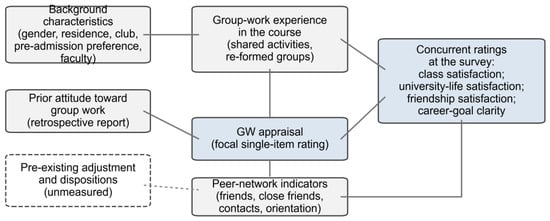
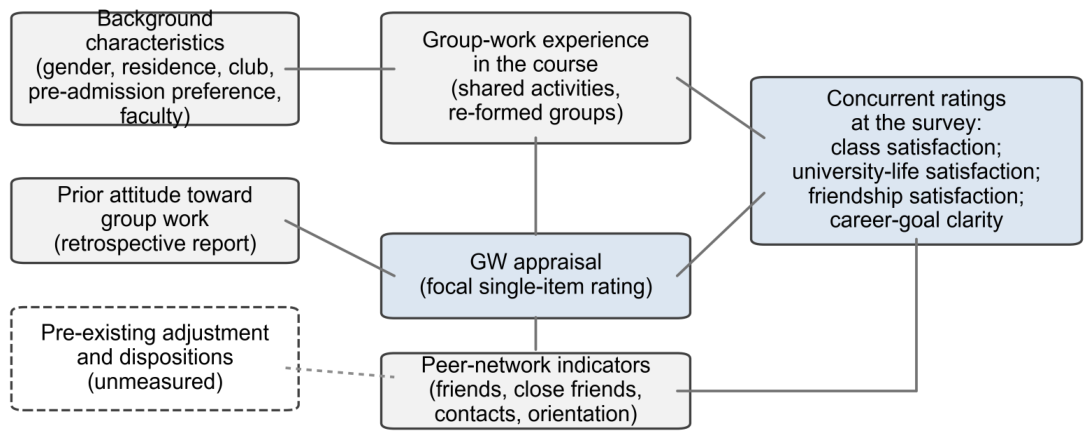
Estimand and model sequence. The estimand throughout is the partial association between concurrent ratings: specifically, the coefficient on GW appraisal in a regression of each indicator, conditional on the covariate set. We estimated three nested descriptive models. M1 included demographic and background characteristics measured at the survey (gender, residence, club membership, and pre-admission preference) and faculty fixed effects. M2 added the peer-network quantity items and friendship orientation, and M3 added GW appraisal as the primary model. Several M2 covariates were concurrent with the GW experience and may have been its consequences or correlates. The sequence is therefore not progressive causal adjustment: conditioning on these variables neither identifies an independent or direct effect nor necessarily preserves the association of interest. Figure 1 distinguishes background characteristics, the group-work experience and its appraisal, peer-network indicators, and the concurrent outcome ratings. Two further models are reported as supplementary. M1b added the retrospective prior-attitude item to M3 as a sensitivity covariate. M4 added friendship satisfaction to M3 for the other three outcomes; it is an exploratory conditional model, not a test of independence from friendship satisfaction.
Figure 1.
Conceptual and temporal positions of the study variables. All variables were measured on a single occasion; connectors indicate conceptual relations, not causal direction. The dashed element denotes pre-existing adjustment and dispositions, which were not measured in this study.
Estimation and inference. The primary inference concerns the four M3 coefficients on GW appraisal (one per outcome). Each outcome was analyzed in a separate parallel regression; the four indicators were not modeled jointly, and no claim of simultaneous multi-domain modeling is made. OLS models were estimated on the raw response scales with HC3 heteroskedasticity-robust standard errors; parametric analyses are generally robust for ordered rating data of this kind [18], and the ordinal-outcome and categorical-predictor analyses described below probe the cases where this approximation matters most. Unstandardized coefficients with 95% confidence intervals are the primary effect summaries, and fully standardized coefficients are reported as auxiliary descriptive quantities. Model comparisons (M1 vs. M2 vs. M3, estimated on a common complete-case sample per outcome) used robust Wald tests based on the HC3 covariance matrix, together with . Benjamini–Hochberg false-discovery-rate adjustment was applied to the four primary p-values as a sensitivity analysis; correlation-table p-values were FDR-adjusted separately as their own family. As complementary analyses treating the outcomes as ordered categories, cumulative-link (proportional-odds logistic) models were estimated for M3. We formally tested the proportional-odds assumption for GW appraisal with likelihood-ratio tests against models allowing threshold-specific GW coefficients. The assumption was not rejected for university-life satisfaction (p = 0.187), but it was rejected for friendship satisfaction (p = 0.007) and career-goal clarity (p = 0.009); the test could not be computed for class satisfaction. We therefore estimated partial proportional-odds models with threshold-specific GW coefficients for the two outcomes showing violations, and cutpoint-specific binary logistic coefficients for all outcomes are provided in the Supplementary Materials. Likelihood-ratio tests for the remaining covariates (excluding the faculty fixed effects, for which the tests were not computed) indicated additional violations for some covariates and outcomes (Supplementary Table S3e), so the cumulative-link estimates should be read as approximate summaries. Accordingly, the ordinal results are treated as complementary rather than primary.
Distribution of the focal predictor. GW appraisal was strongly skewed (87% of responses in the top two categories; category frequencies in Table 2), so a 1-point linear summary may mask non-linearity. In a sensitivity analysis, GW appraisal was recoded into three categories (≤3, 4, and 5; the 8 responses of 1–2 were merged with 3 because of sparseness), and category contrasts (reference = 4), covariate-adjusted category means, and marginally standardized adjusted probabilities of reporting 4 or above on each outcome (from binary logistic models with the same covariate set) were estimated.
Table 2.
Descriptive statistics for the focal predictor and main study variables.
Missing data. Primary models used listwise deletion within each outcome (N = 526–535 of 564). Per-variable missingness is reported in the Supplementary Materials. Responses of “other” for gender and residence are response categories rather than item nonresponse; because they could not be represented in the primary codings, they were not part of the primary complete-case samples, but they are retained in the sensitivity variants below and are reported separately from nonresponse. Six sensitivity variants were estimated: omitting gender; retaining all four gender categories; retaining all four residence categories; treating the banded peer-network items (friends, close friends, and contact exchanges) as nominal categories; treating pre-admission preference as categorical; and multiple imputation (m = 20) of item nonresponse in the numeric analysis variables, with faculty and residence dummies included as complete predictors in the imputation model and estimates pooled by Rubin’s rules. The imputation used chained equations with continuous approximations for ordinal items (an implementation constraint of the software program; ordinal-model imputation was not used). In the imputed models, residence entered as its four complete categories (no residence values were imputed), and gender was not included. Robustness was judged by the stability of the four primary coefficients across variants.
Software. Analyses were conducted in Python 3.10 using pandas, statsmodels, scipy, and factor_analyzer; figures were produced with matplotlib. Analysis scripts fix random seeds, and package versions are recorded with the scripts. Class-section, instructor, and work-group identifiers could not be recovered from course records in a form linkable to the anonymous survey responses, so the clustering of students within sections or groups could not be modeled; Section 4.6 discusses the implications, together with the design features (standardized delivery across the seven sections and the periodic reorganization of group membership) that bear on this concern. Tests were two-sided with = 0.05.
3. Results
3.1. Descriptive Statistics and Bivariate Correlations
Table 2 presents descriptive statistics, including medians and interquartile ranges given the ordinal response formats. GW appraisal was high (M = 4.30, SD = 0.73, Mdn = 4, n = 562), with a marked ceiling: in total, 1 student answered 1, 7 answered 2, 65 answered 3, 237 answered 4, and 252 answered 5 (87% in the top two categories). The four outcome indicators had means above the scale midpoint: class satisfaction (M = 3.58, SD = 0.86), university-life satisfaction (M = 3.71, SD = 0.95), friendship satisfaction (M = 3.78, SD = 1.09), and career-goal clarity (M = 3.37, SD = 1.23). Response distributions for these items are shown in Supplementary Figure S1.
Spearman correlations among the main variables, with 95% confidence intervals and FDR-adjusted p-values computed for the correlation family, are reported in Supplementary Table S2; Table 3 summarizes the coefficients. GW appraisal correlated positively with all four indicators ( = 0.34 with class satisfaction, 0.34 with university-life satisfaction, 0.22 with friendship satisfaction, and 0.22 with career-goal clarity). Friendship satisfaction correlated substantially with class satisfaction ( = 0.50) and university-life satisfaction ( = 0.54), whereas career-goal clarity correlated only weakly with the other indicators ( ≤ 0.28).
Table 3.
Spearman rank-order correlations among the main variables.
3.2. Nested Models: Conditional Associations of GW Appraisal
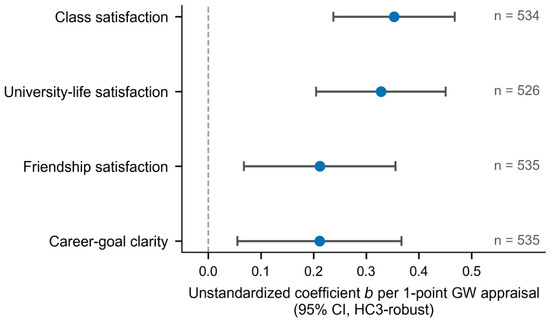
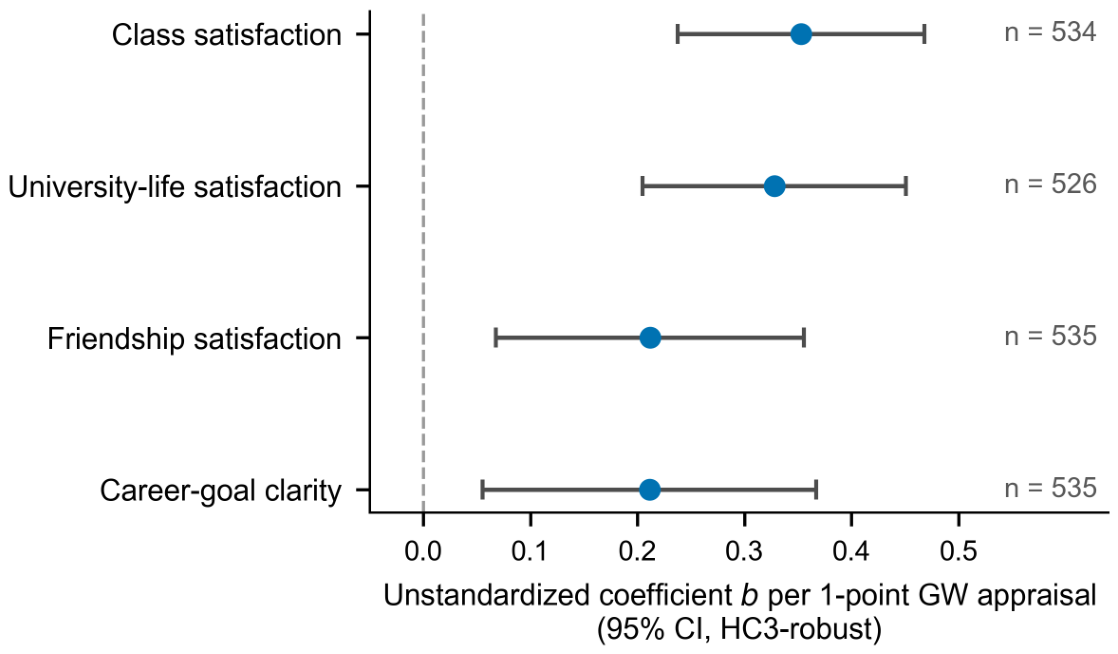
Table 4 reports the nested model sequence (M1–M3) for each outcome, estimated on a common complete-case sample per outcome. Adding GW appraisal (M2→M3) increased explained variance for every outcome ( = 0.079 for class satisfaction, 0.055 for university-life satisfaction, 0.018 for friendship satisfaction, and 0.014 for career-goal clarity; robust Wald tests p = 0.008 or smaller). Table 5 reports the primary M3 estimates. A one-point more positive GW appraisal was associated with higher concurrent ratings on all four indicators: class satisfaction, b = 0.35 (95% CI [0.24, 0.47], p < 0.001); university-life satisfaction, b = 0.33 (95% CI [0.20, 0.45], p < 0.001); friendship satisfaction, b = 0.21 (95% CI [0.07, 0.36], p = 0.004); and career-goal clarity, b = 0.21 (95% CI [0.06, 0.37], p = 0.008). All four coefficients remained significant after FDR adjustment (adjusted p < 0.001, < 0.001, 0.005, and 0.008). The auxiliary standardized coefficients were = 0.30, 0.25, 0.14, and 0.13, respectively. Although the point estimates were higher for class satisfaction and university-life satisfaction than for friendship satisfaction and career-goal clarity, we did not formally test differences between coefficients, and their confidence intervals overlap; no ordering should be treated as established. Figure 2 displays the four primary estimates.
Table 4.
Nested descriptive models: fit and incremental contribution of GW appraisal.
Table 5.
Primary model (M3): association of GW appraisal with each concurrent indicator.
Figure 2.
Unstandardized coefficients (b) with 95% confidence intervals for GW appraisal associated with each concurrent indicator (primary model M3). Error bars are HC3-robust 95% CIs; models adjust for demographic background, faculty fixed effects, peer-network quantity, and friendship orientation. n = 526–535 per model.
Among the covariates in M3, the number of close friends was associated with class satisfaction (b = 0.14, p = 0.043), university-life satisfaction (b = 0.14, p = 0.019), and friendship satisfaction (b = 0.18, p = 0.047); the number of friends was associated with university-life satisfaction (b = 0.13, p = 0.014) and friendship satisfaction (b = 0.22, p < 0.001), and post-enrollment contact exchanges with university-life satisfaction (b = 0.11, p = 0.014). Female students reported higher class satisfaction (b = 0.18, p = 0.025). The friendship-orientation scale was not significantly associated with any outcome, and faculty fixed effects reached significance only in isolated categories (one for friendship satisfaction and two for career-goal clarity).
In the supplementary conditional models, adding friendship satisfaction (M4) attenuated but did not remove the GW coefficients for the other outcomes (class satisfaction, b = 0.28, p < 0.001; university-life satisfaction, b = 0.24, p < 0.001; career-goal clarity, b = 0.17, p = 0.037). Adding the retrospective prior-attitude item (M1b) left the coefficients for class satisfaction (b = 0.35) and university-life satisfaction (b = 0.31) essentially unchanged, modestly attenuated the friendship-satisfaction coefficient (b = 0.19, p = 0.013), and attenuated the career-goal-clarity coefficient to b = 0.14 (95% CI [−0.02, 0.29], p = 0.086), with prior attitude itself associated with career-goal clarity (b = 0.19, p < 0.001). Because prior attitude was reported retrospectively at the same time point, this attenuation is itself only a concurrent pattern, but it indicates that the career-related association is the least separable from students’ general disposition toward group work.
3.3. Categorical Treatment of GW Appraisal
Treating GW appraisal as three categories (≤3, 4, 5; reference = 4) showed that the shape of the association differed across outcomes. For class satisfaction and university-life satisfaction, both contrasts were significant and the covariate-adjusted category means increased monotonically (class satisfaction: 2.99, 3.54, and 3.79 for ≤3, 4, and 5; adjusted probability of reporting ≥4: 0.16, 0.56, and 0.66). For friendship satisfaction and career-goal clarity, only the contrast between ratings of 5 and 4 was significant (friendship, b = 0.26, p = 0.014; career, b = 0.39, p < 0.001), whereas the contrast between ratings of ≤3 and 4 was not (friendship, p = 0.331; career, p = 0.885; adjusted means for career-goal clarity: 3.22, 3.20, and 3.58). For these two indicators, the linear association was therefore driven mainly by students giving the top rating and should not be read as a uniform gradient across the response scale.
3.4. Robustness Across Coding and Missing-Data Variants
Six sensitivity variants were examined: omitting gender; retaining all four gender categories; retaining all four residence categories; treating the banded peer-network items as nominal categories; treating pre-admission preference as categorical; and multiple imputation (m = 20). Across all variants, the four primary coefficients changed by no more than 0.025 from the primary estimates (class satisfaction range 0.349–0.356; career-goal clarity range 0.198–0.228), and all remained significant at p < 0.05 (the largest p = 0.015). Under multiple imputation (N = 564), estimates were b = 0.35 for class satisfaction, 0.34 for university-life satisfaction, 0.23 for friendship satisfaction, and 0.23 for career-goal clarity. Full results are reported in the Supplementary Materials.
4. Discussion
4.1. Principal Findings
In this study of an elective first-year course, students who appraised their group-work experience more favorably also reported greater concurrent satisfaction with the class, with university life, and with their friendships, as well as clearer career goals, after conditioning on demographic background, faculty, peer-network quantity, and friendship orientation. The associations survived FDR adjustment and were stable across coding and missing-data variants. Two qualifications emerged from the additional analyses: for friendship satisfaction and career-goal clarity, the association was concentrated in the contrast between ratings of 5 and 4, with no detectable difference between ratings of 4 and 3 or lower, and the career-related association attenuated below conventional significance once students’ retrospectively reported prior attitude toward group work was conditioned on. All of these patterns are concurrent associations among self-reported ratings; the accounts that could generate them are considered next.
4.2. Interpreting the Pattern of Associations
The numerically largest point estimate, for class satisfaction, is also the least informative, because appraising the group work in a course and appraising one’s classes overall are closely related evaluative judgments within the same domain. We read this coefficient as a proximal association with substantial conceptual overlap, further inflated, potentially, by common method variance shared among all self-reported ratings collected on one occasion [19]. The associations with university-life satisfaction and friendship satisfaction are consistent with integration and belonging perspectives, in which feeling connected to peers accompanies a more satisfying university experience [3,4,5], and with cooperative-learning accounts in which structured peer interdependence supports positive relationships [12]. Consistency is not confirmation: the design cannot distinguish whether favorable group experiences accompany the growth of satisfaction, whether satisfied and socially confident students experience group work more favorably, or whether stable dispositions raise all ratings together. Descriptively, the conditional models show that the GW–outcome associations are not simply restatements of how many friends or contacts students had ( beyond the peer-variable models = 0.014–0.079).
4.3. Relation to Prior Research in Japan and Contextual Features
The findings extend the small body of Japanese research on first-year group-work courses [16,17] by focusing on students’ overall appraisal of the GW experience and by describing its associations with several indicators under a common covariate set. The setting also has features that may affect how the associations should be read. First-year career education of this kind is institutionalized in Japanese universities within a national policy emphasis on active learning [14,15], so career-themed group discussion for entering students is a typical rather than exceptional context. A majority of the students in this sample commuted from the family home (57.1%). Based on the authors’ knowledge of the institution, the course was also one of few settings in which students from different faculties worked together. Such a course may carry more of the burden of early network formation for commuting students with limited campus contact opportunities than it would in a residential system. These are the authors’ contextual observations, not measured variables or tested moderators; comparative designs would be needed to examine them.
4.4. The Social and Career-Related Indicators
The categorical analyses qualify the two numerically smaller associations. For friendship satisfaction and career-goal clarity, students rating the group work 4 did not differ appreciably from those rating it 3 or lower; only the top raters differed. Combined with the ceiling in GW appraisal (87% in the top two categories), this cautions against reading the linear coefficients as uniform gradients. For career-goal clarity, the association also attenuated (b = 0.21 to 0.14, p = 0.086) when the retrospective prior-attitude item was conditioned on, indicating that this association is the least separable from students’ general disposition toward group work. More fundamentally, career-goal clarity should not be equated with favorable vocational development: lower clarity may reflect ongoing exploration of possible selves and vocational options, which career-adaptability theory treats as part of adaptive career development [13], and higher clarity does not by itself show that such exploration has taken place. We therefore treat the career finding as a course-relevant descriptive pattern warranting replication with validated career-development measures.
4.5. Practical Implications
The defensible practical implication is informational. Students’ appraisals of group work are easy to collect, and in this cohort, they were associated with several concurrent self-reported ratings of the first-year experience beyond peer-network quantity. Course teams may find such appraisals useful as aggregate feedback for course design and for monitoring how the group-work component is being received. Because the present survey was anonymous and did not identify groups, using similar items to notice individual students or groups in difficulty would require separately designed, non-anonymous measurement with appropriate attention to consent, privacy, and the risk of misclassification. The results do not show that improving group work would improve satisfaction or career clarity; claims of that kind require longitudinal or experimental evidence, and meta-analytical work on first-year programs cautions that average effects of single courses tend to be modest [20].
4.6. Limitations and Future Research
Several limitations bound these findings. The cross-sectional, single-occasion design establishes no temporal ordering: all variables, including the covariates, were measured concurrently, and conditioning on concurrent peer variables may itself remove or distort part of the association of interest. All central measures were newly developed single items without pilot testing or external validity evidence. Single-item measures have support mainly for concrete overall satisfaction judgments in other domains [21], and that evidence does not validate the present items as measures of adjustment constructs. The friendship-orientation scale was developed and applied in the same sample and should be regarded as exploratory. GW appraisal also showed a strong ceiling, producing range restriction and the threshold patterns described above.
Generalizability and dependence are further concerns. The sample was self-selected through enrollment in one elective course in one cohort at one private university; age was not collected; and comparisons between respondents and nonrespondents were not available. In addition, the data lacked class-section and work-group identifiers, so dependence of observations within sections or groups could not be modeled, and the reported standard errors may be too narrow to the extent that such dependence exists. Two design features may limit but do not remove this concern: delivery was standardized across the seven sections (common syllabus, workbook, and materials, with instructor coordination), and group membership was reorganized on approximately four occasions across the term, so no single group configuration was maintained throughout; dependence within the shorter-lived groupings nonetheless remains possible. Faculty fixed effects were included, but instructor- or section-level differences remain possible.
Unmeasured confounders, including prior adjustment, academic performance, attendance, personality, mental health, and socioeconomic background, could underlie the observed associations, and the multiple-imputation sensitivity analysis approximated ordinal items with continuous models. Future research should use longitudinal measurement beginning at entry, validated multi-item measures, and group- and section-level identifiers that permit multilevel modeling. It should also measure group-work structure and process rather than global appraisal alone and use designs that support stronger inferences, including belonging-focused interventions [22].
5. Conclusions
In this elective, cross-faculty first-year course at a Japanese private university, students who appraised their group-work experience more favorably also reported greater satisfaction with the class, university life, and their friendships, as well as clearer career goals. These associations persisted after conditioning on demographic background, faculty, and peer-network variables, and remained similar under multiplicity adjustment and under alternative treatments of coding and missing data. For the social and career-related indicators, they arose mainly from the contrast between the top rating and a rating of 4. Because all focal measures were single-item self-reports collected at one time point, the findings describe patterns among student ratings, most proximally between group-work appraisal and class satisfaction, and do not show that group work improves the first-year experience. Within those bounds, this study provides a descriptive baseline from a Japanese cross-faculty setting for longitudinal and multi-institutional work.
Supplementary Materials
The following supporting information can be downloaded at: https://www.mdpi.com/article/10.3390/higheredu5030085/s1. Table S1: Item wording, response options, and scoring direction; Table S2: Spearman correlations with 95% confidence intervals and FDR-adjusted p-values; Table S3: Model results and diagnostics; Table S4: Categorical treatment of GW appraisal; Table S5: Friendship-orientation scale—factor analyses; Table S6: Missingness and sensitivity variants; Table S7: Group-process indicators (descriptive); Figure S1: Distribution of the focal and outcome items.
Author Contributions
Conceptualization, K.S. and S.S.; methodology, K.S. and S.S.; investigation, K.S.; resources, K.S.; data curation, K.S. and S.S.; formal analysis, software, and visualization, S.S.; writing—original draft, S.S.; writing—review and editing, K.S. and S.S. All authors have read and agreed to the published version of the manuscript.
Funding
This research received no external funding.
Institutional Review Board Statement
This study was conducted in accordance with the Declaration of Helsinki and was approved by the Mii Campus Research Ethics Committee of Kurume University (approval No. 538; approval date 30 June 2023).
Informed Consent Statement
Informed consent was obtained from all participants through a consent-confirmation step on the web survey. Responses from students who declined consent were excluded from all analyses.
Data Availability Statement
The data presented in this study are not publicly available owing to the ethical restrictions associated with survey data from a single cohort, which carry a risk of re-identification. The analysis code, the study codebook, and the machine-readable results files underlying the Supplementary Tables are available from the corresponding author upon reasonable request.
Acknowledgments
The authors would like to thank the students who participated in this study. During the preparation of this study, the second author used Claude (Anthropic) for code development assistance. The authors have reviewed and edited the output and take full responsibility for the content of this publication.
Conflicts of Interest
The authors declare no conflicts of interest.
References
- Baker, R.W.; Siryk, B. Student Adaptation to College Questionnaire (SACQ): Manual; Western Psychological Services: Los Angeles, CA, USA, 1989. [Google Scholar]
- Credé, M.; Niehorster, S. Adjustment to college as measured by the Student Adaptation to College Questionnaire: A quantitative review of its structure and relationships with correlates and consequences. Educ. Psychol. Rev. 2012, 24, 133–165. [Google Scholar] [CrossRef] [Scilit]
- Tinto, V. Leaving College: Rethinking the Causes and Cures of Student Attrition, 2nd ed.; University of Chicago Press: Chicago, IL, USA, 1993. [Google Scholar]
- Strayhorn, T.L. College Students’ Sense of Belonging: A Key to Educational Success for All Students, 2nd ed.; Routledge: New York, NY, USA, 2018. [Google Scholar] [CrossRef] [Scilit]
- Allen, K.A.; Kern, M.L.; Rozek, C.S.; McInerney, D.M.; Slavich, G.M. Belonging: A review of conceptual issues, an integrative framework, and directions for future research. Aust. J. Psychol. 2021, 73, 87–102. [Google Scholar] [CrossRef] [Scilit] [PubMed]
- Samoila, M.E.; Vrabie, T. First-year seminars through the lens of Vincent Tinto’s theories of student departure: A systematic review. Front. Educ. 2023, 8, 1205667. [Google Scholar] [CrossRef] [Scilit]
- Buote, V.M.; Pancer, S.M.; Pratt, M.W.; Adams, G.; Birnie-Lefcovitch, S.; Polivy, J.; Wintre, M.G. The importance of friends: Friendship and adjustment among 1st-year university students. J. Adolesc. Res. 2007, 22, 665–689. [Google Scholar] [CrossRef] [Scilit]
- Pittman, L.D.; Richmond, A. University belonging, friendship quality, and psychological adjustment during the transition to college. J. Exp. Educ. 2008, 76, 343–362. [Google Scholar] [CrossRef] [Scilit]
- Freeman, S.; Eddy, S.L.; McDonough, M.; Smith, M.K.; Okoroafor, N.; Jordt, H.; Wenderoth, M.P. Active learning increases student performance in science, engineering, and mathematics. Proc. Natl. Acad. Sci. USA 2014, 111, 8410–8415. [Google Scholar] [CrossRef] [Scilit] [PubMed]
- Springer, L.; Stanne, M.E.; Donovan, S.S. Effects of small-group learning on undergraduates in science, mathematics, engineering, and technology: A meta-analysis. Rev. Educ. Res. 1999, 69, 21–51. [Google Scholar] [CrossRef]
- Kuh, G.D.; Cruce, T.M.; Shoup, R.; Kinzie, J.; Gonyea, R.M. Unmasking the effects of student engagement on first-year college grades and persistence. J. High. Educ. 2008, 79, 540–563. [Google Scholar] [CrossRef] [Scilit]
- Johnson, D.W.; Johnson, R.T.; Smith, K.A. Cooperative learning: Improving university instruction by basing practice on validated theory. J. Excell. Coll. Teach. 2014, 25, 85–118. [Google Scholar]
- Savickas, M.L.; Porfeli, E.J. Career Adapt-Abilities Scale: Construction, reliability, and measurement equivalence across 13 countries. J. Vocat. Behav. 2012, 80, 661–673. [Google Scholar] [CrossRef] [Scilit]
- Central Council for Education. Towards a Qualitative Transformation of University Education for Building a New Future (Report); Ministry of Education, Culture, Sports, Science and Technology (MEXT): Tokyo, Japan, 2012. (In Japanese) [Google Scholar]
- Ito, H.; Takeuchi, S. Active learning in Japan: Breaking barriers at individual, institutional, and policy levels. Policy Futur. Educ. 2021, 19, 950–967. [Google Scholar] [CrossRef] [Scilit]
- Kambara, A.; Yamamoto, R.; Yuguchi, K.; Miho, N. The effect of taking first career education class on freshmen’s subjective adjustment to college. Jpn. J. Career Educ. 2019, 37, 45–54. (In Japanese) [Google Scholar] [CrossRef] [PubMed]
- Nakayama, R.; Nakanishi, Y.; Nagahama, F.; Nakajima, M. Interpersonal motivation in a First Year Experience class influences freshmen’s university adjustment. Jpn. J. Psychol. 2015, 86, 170–176. (In Japanese) [Google Scholar] [CrossRef] [Scilit] [PubMed][Green Version]
- Norman, G. Likert scales, levels of measurement and the “laws” of statistics. Adv. Health Sci. Educ. 2010, 15, 625–632. [Google Scholar] [CrossRef] [Scilit] [PubMed]
- Podsakoff, P.M.; MacKenzie, S.B.; Lee, J.Y.; Podsakoff, N.P. Common method biases in behavioral research: A critical review of the literature and recommended remedies. J. Appl. Psychol. 2003, 88, 879–903. [Google Scholar] [CrossRef] [Scilit] [PubMed]
- Permzadian, V.; Credé, M. Do first-year seminars improve college grades and retention? A quantitative review of their overall effectiveness and an examination of moderators of effectiveness. Rev. Educ. Res. 2016, 86, 277–316. [Google Scholar] [CrossRef] [Scilit]
- Wanous, J.P.; Reichers, A.E.; Hudy, M.J. Overall job satisfaction: How good are single-item measures? J. Appl. Psychol. 1997, 82, 247–252. [Google Scholar] [CrossRef] [PubMed]
- Walton, G.M.; Cohen, G.L. A brief social-belonging intervention improves academic and health outcomes of minority students. Science 2011, 331, 1447–1451. [Google Scholar] [CrossRef] [Scilit] [PubMed]

Disclaimer/Publisher’s Note: The statements, opinions and data contained in all publications are solely those of the individual author(s) and contributor(s) and not of MDPI and/or the editor(s). MDPI and/or the editor(s) disclaim responsibility for any injury to people or property resulting from any ideas, methods, instructions or products referred to in the content. |
© 2026 by the authors. Licensee MDPI, Basel, Switzerland. This article is an open access article distributed under the terms and conditions of the Creative Commons Attribution (CC BY) license.