


Abstract
Generative artificial intelligence (GenAI) has intensified concerns about academic integrity, yet little is known about discrepancies between students’ self-reported frequencies in AI-assisted academic cheating and the frequencies they attribute to their peers. Using an anonymous cross-sectional survey, this study collected responses from 863 undergraduates at a science and technology university in Vietnam. Participants rated ten AI-assisted academic cheating behaviors from two perspectives: the frequency they attributed such behaviors to their classmates, referred to as perceived peer cheating (PPC), and the frequency they reported such behaviors for themselves, referred to as self-reported cheating (SRC). Split-plot ANOVAs were conducted to compare PPC and SRC ratings and to examine whether the magnitude of the discrepancy varied by gender and student seniority. The results show that PPC ratings were significantly higher than SRC ratings for all ten behaviors, with partial eta-squared values ranging from 0.060 to 0.196. Cheating perspective × gender interactions and cheating perspective × student seniority interactions were each significant for three behaviors; however, all interaction effects were small (ηp2 ≤ 0.025). Overall, the study reveals a consistent discrepancy between self-reported and peer-attributed frequencies of AI-assisted academic cheating. This discrepancy highlights the limitations of using either direct self-reports or peer-attributed frequencies alone to estimate the actual prevalence of AI-assisted academic cheating.
1. Introduction
The rapid development of generative artificial intelligence (GenAI) tools is bringing profound changes to higher education environments, particularly in the ways students approach and complete academic tasks [1,2]. AI systems based on large language models, such as ChatGPT, Copilot, and Gemini, allow users to generate text, solve problems, and process information with an unprecedented level of automation [3,4,5]. As a result, these tools offer significant potential to support personalized learning and improve academic productivity [3,4,5]. However, alongside these pedagogical benefits, the use of AI in education also raises serious concerns regarding academic integrity. One prominent concern is AI-assisted academic cheating, in which students use AI tools to produce assignments, essays, or exam responses without their own genuine intellectual involvement [6]. For example, a survey of 376 undergraduates in Mexico found that 85% admitted engaging in at least one form of academic cheating [7]. Moreover, AI systems are now capable of generating high-quality academic content that is difficult to detect using plagiarism-detection tools such as Turnitin and iThenticate, which further complicates efforts to ensure the authenticity of academic assessment in higher education [8].
Recent studies suggest that AI tools may not only support surface-level learning tasks but also perform well on professional examinations or standardized tests in fields such as law [9] or medicine [10,11]. This development raises concerns that AI could be used to replace meaningful learning processes, thereby undermining the value of academic credentials and the fairness of student evaluation. The rapid advancement of AI technology has outpaced the development of institutional policies, resulting in ambiguity regarding acceptable AI use in academic contexts [12,13]. Moreover, AI-assisted academic cheating involves not only the generation of entire academic products but also more subtle practices, such as paraphrasing text, generating reference lists, or obtaining assistance in solving assignments without appropriately acknowledging the use of AI [6,7]. These practices blur the boundary between legitimate learning support and academic misconduct, requiring educators to reconsider what constitutes acceptable AI use in academic work [14].
While a growing body of research has examined AI-assisted academic cheating in higher education, most existing studies have focused primarily on the prevalence of AI use, students’ attitudes toward AI, or their intentions to cheat [15,16]. Comparatively little attention has been given to discrepancies between students’ reports of their own behavior and the frequencies they attribute to their peers. Meanwhile, GenAI tools blur the lines between legitimate learning support and cheating, making judgments about the acceptability of cheating behavior dependent on how students interpret the role of AI in completing academic tasks [17]. To our knowledge, no studies have directly compared students’ self-reported engagement in AI-assisted academic cheating with the frequencies they attribute to their peers for the same behaviors. Ignoring this potential discrepancy may limit our understanding of how self-reported and peer-attributed accounts of AI-assisted academic cheating differ. Therefore, this study examines whether undergraduate students report lower frequencies of their own engagement in AI-assisted academic cheating than the frequencies they attribute to their peers for the same behaviors.
2. Review of Related Literature
2.1. Academic Cheating in Higher Education
Academic cheating refers to dishonest behaviors in educational settings in which students violate integrity principles to gain unfair advantages or mislead others to achieve academic outcomes [17]. Common forms include plagiarism, using unauthorized materials, and fabricating data or research results. Such behaviors undermine core educational values such as fairness, honesty, and intellectual integrity [18], and negatively affect the reputations of educational institutions and the value of higher education credentials. Academic cheating is a long-standing problem in higher education and is shaped not only by individual choices but also by institutional factors [17], such as group norms, rule enforcement, and the ethical climate within institutions [19,20]. Furthermore, how students understand and practice integrity is strongly influenced by academic culture, pedagogical practices, and broader social values, meaning that definitions of cheating may vary across contexts [21]. These arguments suggest that AI-assisted academic cheating may be a new variant of an old problem, amplified by technology and normative ambiguity.
2.2. AI-Assisted Academic Cheating and the Blurring of Normative Boundaries
In the GenAI era, AI-assisted academic cheating is often described as using AI to produce academic work without commensurate intellectual effort [6,7], such as generating an entire essay or assignment, paraphrasing text to avoid detection, or generating fabricated reference lists. A notable challenge is that institutional policies often lag behind technological change, creating ambiguity about the rules, complicating enforcement, and giving students more freedom in interpreting what is “allowed” [13]. For example, in the context of AI-assisted writing misconduct, many students may even reframe GenAI-enabled cheating as a legitimate academic survival strategy rather than wrongdoing [22]. To address this situation, proposed interventions often focus on: (i) redesigning assessments so that AI cannot easily replace students’ own work (e.g., oral defenses, in-person presentations, process-based evidence) and (ii) enhancing students’ digital literacy and AI ethics [8,23,24]. However, AI not only creates new opportunities for academic misconduct but also increases uncertainty about how particular uses should be classified. Whether a practice is interpreted as legitimate assistance or cheating may depend on the purpose of AI use, the amount of human intellectual contribution, and the extent to which AI substitutes for core academic work. Such ambiguity may contribute to discrepancies between students’ reports of their own behavior and the frequencies they attribute to their peers.
2.3. Self–Other Asymmetry as a Possible Explanatory Lens
From a moral psychology perspective, prior research suggests that individuals often apply different moral standards when judging their own behavior versus the behavior of others, a phenomenon commonly described as self–other asymmetry in moral perception [25]. According to self-concept maintenance theory, people may engage in some level of dishonest behavior while still maintaining a self-image as a moral person by reinterpreting or rationalizing their actions [26]. In the context of AI-assisted learning, the “assistive tool” nature of generative systems may further strengthen this self-justification, allowing students to interpret their own AI use as a legitimate form of assistance rather than cheating [17]. In contrast, when judging similar behaviors performed by others, students may have less access to contextual details or personal motives, leading to harsher evaluations [27]. Applied to AI-assisted academic work, these theories suggest that students may interpret or report their own AI use more leniently than comparable behavior by others.
2.4. Underreporting in Self-Reports of AI-Assisted Cheating
Several recent empirical studies suggest that students may attempt to conceal AI-assisted academic cheating when asked directly. For example, a study in Indonesia using list experiments with 305 anonymous students produced higher estimates of cheating than direct questioning, suggesting that some students concealed cheating because of shame and social pressure [28]. Similarly, a study in Vietnam using list experiments with 1386 undergraduates showed that the indirectly reported rate of AI-assisted academic cheating was nearly three times higher than the rate obtained through direct questioning [15]. Explanations such as performance pressure, lack of time, and peer influence are often used to justify or downplay the seriousness of cheating in self-reports [15,22,28]. Many students believe that using GenAI for graded work (e.g., tests and essays) constitutes cheating, whereas using these tools for learning or research outside graded assessments may be acceptable [29]. Overall, although these studies did not directly compare students’ self- and peer-related ratings, their findings suggest that self-reports of misconduct may be influenced by self-presentation motives and social pressure. Consequently, students may understate their own engagement in AI-assisted academic cheating when responding to direct questions.
2.5. Influence of Gender and Student Seniority
Recent studies also suggest that students’ perceptions of AI-assisted academic cheating may vary by personal characteristics. For example, a study in Vietnam found gender- and seniority-based differences in AI-assisted academic cheating tendencies [15]. Specifically, female students in later years of study were more likely to cheat than newly enrolled female students, whereas male students exhibited similar levels of cheating across years of study [15]. In another study, female students reported witnessing more academic cheating than male students did, and male students may have a more tolerant view of academic cheating than female students [30]. Another related study also indicated that female students reported lower rates of academic cheating than male students in both traditional face-to-face and online education [31]. Conversely, two other studies noted no gender differences in academic cheating among university students [30,32]. These mixed findings suggest that gender may be associated with both students’ reported cheating and their perceptions of peer cheating. Student seniority may also be relevant because patterns of cheating have been shown to vary across years of study and may differ by gender [15]. Given this evidence, gender and student seniority were included in the present study’s model to further explain patterns of AI-assisted academic cheating.
2.6. Research Gap Leading to the Current Study
The reviewed literature points to two closely related gaps. First, the rapid expansion of GenAI has made the boundary between permissible academic assistance and misconduct increasingly context-dependent. Second, existing research has largely examined students’ self-reported AI use and their perceptions of peer behavior as separate sources of information. To our knowledge, no studies have yet directly compared these two perspectives using identical descriptions of AI-assisted academic cheating behaviors within the same sample. Therefore, it remains unclear whether self-reported and peer-attributed frequencies provide similar or systematically different representations of such behavior. Addressing this issue is important because conclusions based exclusively on either self-reports or perceptions of peers may offer only a partial account of students’ experiences with AI-assisted academic cheating. The present study addresses this gap through paired, behavior-specific comparisons across forms of AI-assisted academic cheating and further examines whether the magnitude of the discrepancy varies by gender and student seniority.
Research question 1: Do students attribute higher frequencies of AI-assisted academic cheating to their peers than they report for themselves across the same behaviors?
Research question 2: Does the magnitude of the discrepancy between peer-attributed and self-reported frequencies vary by gender or student seniority?
3. Methods
3.1. Research Design
This study used a cross-sectional survey design to examine discrepancies between students’ self-reported frequencies of AI-assisted academic cheating and the frequencies they attributed to their classmates. For each behavior, participants provided both a perceived peer cheating (PPC) rating and a self-reported cheating (SRC) rating. The PPC–SRC difference was interpreted as a discrepancy between peer-attributed and self-reported frequencies. It was not interpreted as a direct estimate of how much more frequently peers actually engaged in cheating or as evidence of differences in moral judgment. The survey was conducted between 25 October and 22 November 2025. Before beginning the survey, students were informed about the purpose of the study and were notified that the collected data would be used solely for academic research purposes. Participation was voluntary, and submission of a completed questionnaire indicated informed consent to participate in the study. No personally identifiable information was collected, and participants could discontinue the survey at any point without any consequences. These procedures were designed to minimize potential discomfort and reduce social desirability bias in reporting sensitive behaviors. The study was conducted in accordance with the Declaration of Helsinki, and approved by the Scientific Board of the Faculty of Education, Hanoi University of Science and Technology, Vietnam (FED-SRB-2025-010, date: 1 October 2025).
3.2. Participants
Using a convenience sampling method, we surveyed undergraduate students from Hanoi University of Science and Technology, where engineering and technology disciplines constitute a substantial part of the academic environment. At the time of data collection, institutional policies specifically addressing AI-assisted academic cheating were still under development. This institutional context may be relevant to how students understood and evaluated AI-assisted academic behaviors. The survey link was distributed via student online groups (class-based communication platforms). Only undergraduate students enrolled at the university were invited to participate. A total of 881 responses were collected during the survey period. After removing incomplete or invalid responses, 863 valid questionnaires were retained for subsequent statistical analyses. Table 1 provides detailed information about the characteristics of the sample.
Table 1.
Participant characteristics.
As shown in Table 1, the sample included 615 male students (71.3%) and 248 female students (28.7%), broadly reflecting the male-dominated enrollment profile of the institution [33]. Second-year students formed the largest seniority group (n = 475, 55.0%), and participants represented ten fields of study.
3.3. Measurement Instrument
The instrument contained ten AI-assisted academic cheating behaviors adapted from a recent qualitative study [17]. These behaviors were retained because they represented concrete forms of AI-assisted cheating identified in students’ accounts. They provided a common basis for comparing self-reported and peer-attributed ratings and were not intended as an exhaustive inventory of emerging GenAI-enabled misconduct. Each behavior was rated using a five-point frequency scale ranging from 1 (never) to 5 (very often). For each behavior, participants provided two ratings: (a) how often they perceived their classmates as engaging in the behavior and (b) how often they themselves engaged in the same behavior. The same behavioral description was used for both ratings. Given the sensitive nature of academic cheating behaviors, the use of a Likert-type scale was considered appropriate for capturing self-reported and perceived peer behaviors. Direct numerical reporting of cheating frequency is often prone to recall bias and social desirability effects, leading to underreporting or inaccurate estimates. In contrast, a five-point Likert-type scale allows respondents to provide more cognitively manageable and less threatening evaluations of behavioral frequency. This approach is also particularly suitable for perceived peer cheating, where respondents can only estimate general tendencies rather than report exact occurrences. Accordingly, the scale was interpreted as reflecting relative frequency or behavioral tendency rather than precise counts.
Using data from the 863 valid responses, Cronbach’s alpha was calculated separately for the ten PPC ratings and the ten SRC ratings. As summarized in Table 2, the coefficients were 0.930 for PPC and 0.932 for SRC, both exceeding 0.70 [34,35], indicating high internal consistency within each set of ratings.
Table 2.
AI-assisted academic cheating behaviors and internal consistency of the PPC and SRC rating sets.
3.4. Data Analysis
Data were analyzed using IBM SPSS (Statistical Package for the Social Sciences) Version 26. A separate split-plot ANOVA was conducted for each of the ten AI-assisted academic cheating behaviors. Cheating perspective (PPC vs. SRC) was specified as the within-subject factor, whereas gender and student seniority were specified as between-subject factors. The main effect of cheating perspective addressed RQ1, and the cheating perspective × gender and cheating perspective × student seniority interactions addressed RQ2. While Likert-type responses are ordinal in nature, they are commonly treated as approximately continuous in large-sample behavioral research, allowing the application of parametric statistical techniques [35,36,37].
The assumptions underlying the split-plot ANOVAs were assessed before conducting the main analyses [38]. As the within-subject factor comprised only two levels, the assumption of sphericity was inherently satisfied. Levene’s tests indicated variance heterogeneity for several outcomes, most notably the SRC ratings (Appendix A.1). The largest-to-smallest cell variance ratios were below 2.0 for all PPC outcomes and for five of the ten SRC outcomes; the remaining SRC ratios ranged from 2.020 to 2.982 (Appendix A.2). Although these results indicate some heterogeneity of variance, the variance ratios were moderate, and residual skewness and kurtosis remained within the prespecified thresholds of |skewness| < 2 and |kurtosis| < 4 [39] (Appendix A.3). Given the large overall sample, the split-plot ANOVAs were retained, while effects involving the between-subject factors were interpreted cautiously [40].
The analysis procedure included (a) descriptive statistics for all variables; (b) tests of the main effect of the within-subject factor (cheating perspective); (c) tests of the main effects of the between-subject factors (gender and student seniority); and (d) tests of interaction effects between cheating perspective and student characteristics. In the split-plot ANOVA with two repeated measures and a large sample of 863, the model yielded degrees of freedom of df1 = 1 and df2 = 855 (critical F ≈ 3.86 at α = 0.05) [38]. For student seniority with four levels, degrees of freedom were df1 = 3 and df2 = 855 (critical F ≈ 2.62 at α = 0.05) [38]. Therefore, observed F values exceeding these thresholds were considered statistically significant at α = 0.05.
4. Results
4.1. Descriptive Statistics
Table 3 presents descriptive statistics for the two rating perspectives: PPC and SRC.
Table 3.
Descriptive statistics for peer-attributed and self-reported frequencies of AI-assisted academic cheating.
As shown in Table 3, for all ten behaviors, the average PPC ratings were higher than the average SRC ratings. These descriptive findings indicate a consistent pattern in which students attributed higher frequencies of AI-assisted academic cheating to classmates than they reported for themselves. Because the response scale captured relative frequency, however, the mean values should not be interpreted as estimates of actual cheating prevalence.
4.2. Within-Subject Effects
The results of the within-subject effects analysis are presented in Table 4. The analysis examined whether there were significant differences between students’ PPC and SRC ratings across the ten AI-assisted academic cheating behaviors.
Table 4.
Within-subject effects across ten dependent variables.
As shown in Table 4, the main effects of cheating perspective were statistically significant for all ten behaviors with F(1, 855) > 3.86 and p < 0.001. Partial eta-squared values ranged from 0.060 to 0.196. The largest effects were observed for FullTaskAI (ηp2 = 0.196), NoVerification (ηp2 = 0.166), and LowContribution (ηp2 = 0.128). Therefore, the results provide consistent evidence that participants attributed higher frequencies of AI-assisted academic cheating to their peers than they reported for themselves. These effects reveal a discrepancy in frequency ratings but do not identify the mechanism responsible for that discrepancy.
4.3. Between-Subject Effects
Table 5 presents the between-subject effects, which indicate whether ratings of AI-assisted academic cheating differed by gender and student seniority.
Table 5.
Between-subject effects across ten dependent variables.
As shown in Table 5, most between-subject effects of gender and student seniority were not statistically significant. Gender was not associated with ratings averaged across PPC and SRC for any of the ten behaviors. Student seniority was significantly associated with FullTaskAI, F(3, 855) = 2.665, p = 0.047, ηp2 = 0.009, and NoVerification, F(3, 855) = 3.889, p = 0.009, ηp2 = 0.013. Both effects were small. Overall, the between-subject results provide only limited evidence that student seniority was associated with ratings averaged across PPC and SRC.
4.4. Cheating Perspective × Gender Interaction
As shown in Table 4, at the conventional α = 0.05 level, cheating perspective × gender interactions were statistically significant for three AI-assisted academic cheating behaviors: ExamAI, FakeReferences, and UseWhenBanned. The interaction effects were significant for ExamAI, F(1, 855) = 10.983, p = 0.001, ηp2 = 0.013; FakeReferences, F(1, 855) = 3.915, p = 0.048, ηp2 = 0.005; and UseWhenBanned, F(1, 855) = 5.239, p = 0.022, ηp2 = 0.006. Detailed estimated marginal means are reported in Table 6.
Table 6.
Estimated marginal means for significant cheating perspective × gender interactions.
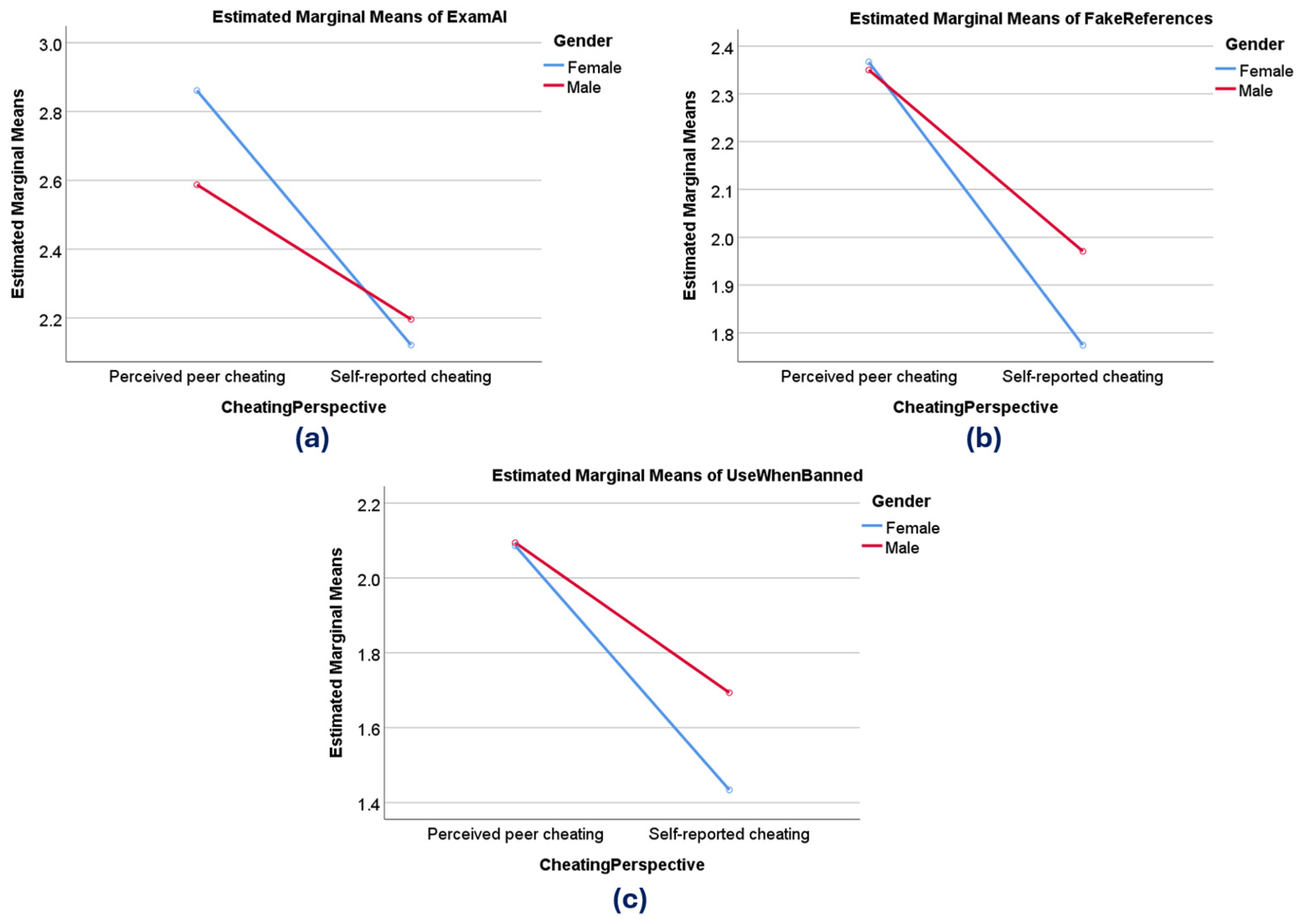
As shown in Table 6, the PPC–SRC discrepancies were larger among female students than among male students across all three behaviors. For ExamAI, this pattern reflected higher PPC ratings and slightly lower SRC ratings among female students. For FakeReferences and UseWhenBanned, PPC ratings were similar across gender groups, whereas SRC ratings were lower among female students. Although statistically significant, the behavior-specific gender interaction effects were small (ηp2 = 0.005–0.013), as shown in Table 4. Figure 1 illustrates these gender interaction patterns.
Figure 1.
Cheating perspective × gender interactions for (a) ExamAI, (b) FakeReferences, and (c) UseWhenBanned.
As illustrated in Figure 1, female students reported lower SRC ratings than male students across all three behaviors, while their PPC ratings were similar or higher. This difference was most evident for ExamAI, where female students had higher PPC ratings but lower SRC ratings than male students. For FakeReferences and UseWhenBanned, PPC ratings were similar across gender groups, while SRC ratings were lower among female students.
4.5. Cheating Perspective × Student Seniority Interaction
As shown in Table 4, at the conventional α = 0.05 level, cheating perspective × student seniority interactions were statistically significant for three behaviors: ExamAI, FakeReferences, and UseWhenBanned. The interaction effects were significant for ExamAI, F(3, 855) = 7.275, p < 0.001, ηp2 = 0.025; FakeReferences, F(3, 855) = 3.278, p = 0.020, ηp2 = 0.011; and UseWhenBanned, F(3, 855) = 4.112, p = 0.007, ηp2 = 0.014. The estimated marginal means are presented in Table 7.
Table 7.
Estimated marginal means for significant cheating perspective × student seniority interactions.
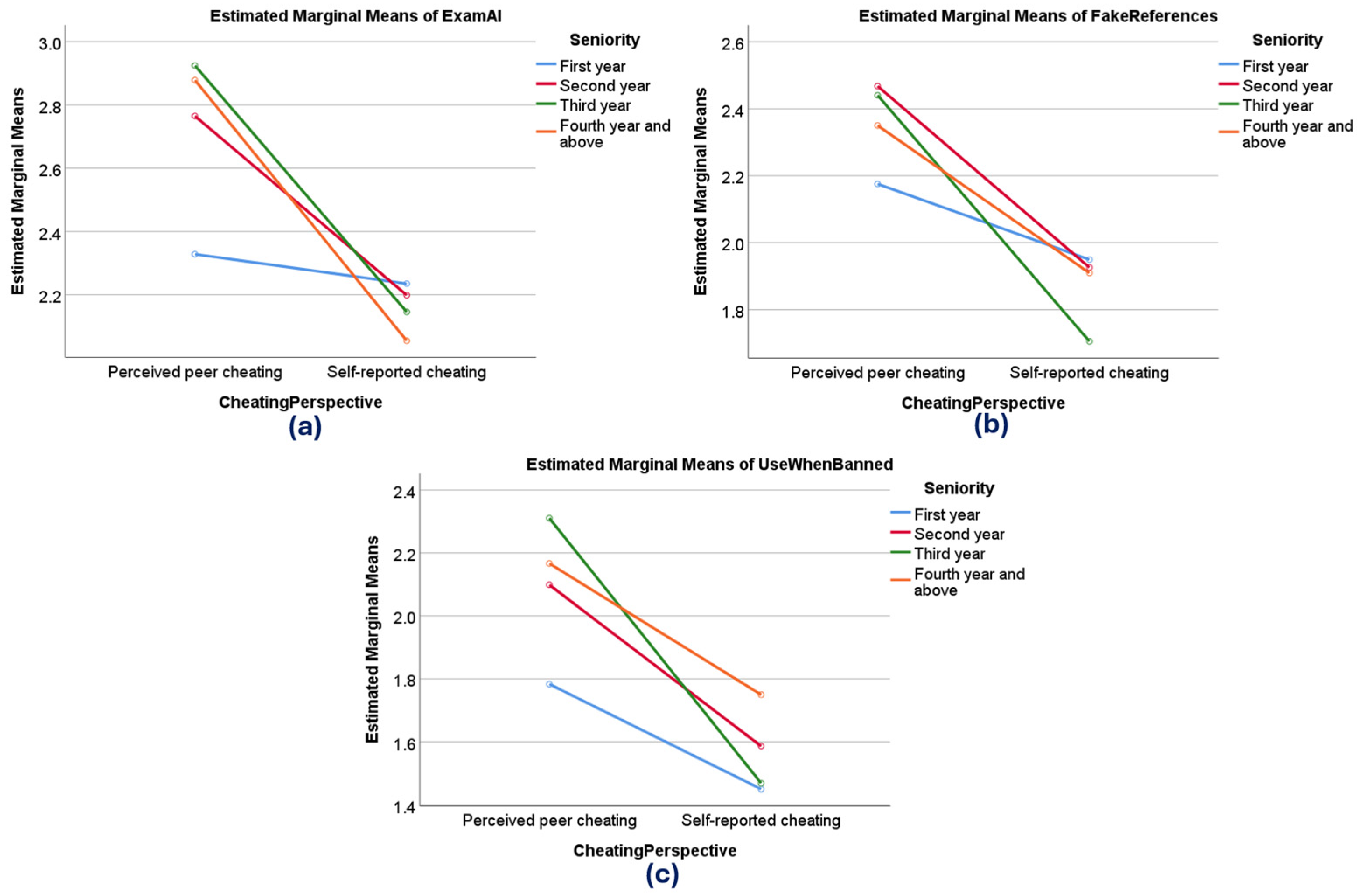
As shown in Table 7, the PPC–SRC patterns differed across student seniority groups for ExamAI, FakeReferences, and UseWhenBanned. For ExamAI, PPC and SRC ratings were very similar among first-year students, but the gap was larger in later years and largest among fourth-year-and-above students. For FakeReferences and UseWhenBanned, the gap was smallest among first-year students and largest among third-year students. Overall, these patterns differed across behaviors and did not increase consistently with student seniority. The interaction effect sizes were small (ηp2 = 0.011–0.025). Figure 2 shows these interaction patterns.
Figure 2.
Cheating perspective × student seniority interactions for (a) ExamAI, (b) FakeReferences, and (c) UseWhenBanned.
As illustrated in Figure 2, PPC and SRC ratings were closest among first-year students across all three behaviors. For ExamAI, the gap became wider in later years and was largest among fourth-year-and-above students. For FakeReferences and UseWhenBanned, the gap was largest among third-year students and then became smaller among fourth-year-and-above students.
5. Discussion and Conclusions
5.1. Main Findings and Comparison with Previous Research
This study identified a consistent discrepancy between students’ self-reported frequencies of AI-assisted academic cheating and the frequencies they attributed to their peers. PPC ratings were significantly higher than SRC ratings across all ten behaviors, with effect sizes ranging from 0.060 to 0.196. The consistency of this pattern across different behaviors constitutes the study’s strongest empirical finding. By contrast, gender- and seniority-related interactions were found for only three behaviors (ExamAI, FakeReferences, and UseWhenBanned) and had small effect sizes. Therefore, these interaction findings should be regarded as secondary and behavior-specific rather than as general demographic explanations for AI-assisted academic cheating.
Several non-exclusive explanations may account for the observed PPC–SRC discrepancy. First, students may underreport their own misconduct because of social desirability, self-presentation concerns, or fear of academic consequences. This explanation is consistent with previous research showing that direct questioning may produce lower estimates of AI-assisted academic cheating than indirect reporting methods [15,28]. Self-concept maintenance theory suggests that people may preserve a moral self-image, even when engaging in dishonest behavior, by reinterpreting or rationalizing their actions [26]. Social pressure, a desire to maintain a positive personal image, or concerns about academic consequences may cause students to underreport their own cheating [15,22,28]. Second, the PPC and SRC ratings had different referents. PPC referred to the behavior of a group of classmates, whereas SRC referred to the behavior of an individual respondent. Therefore, participants considered multiple classmates when rating PPC but only themselves when rating SRC. Third, students may have incomplete or selectively available information about their classmates’ actual use of AI. Finally, self–other asymmetry may lead individuals to interpret or report their own questionable behavior more leniently than comparable behavior by others [25]. Incomplete information about peers and self–other asymmetry were not directly measured and therefore remain plausible but untested explanations.
The present findings are consistent with previous research indicating that direct self-reports may underestimate sensitive academic misconduct [15,28] and that students’ perceptions of peer behavior may influence academic integrity norms [19,20]. However, the current study extends this literature by comparing self-reported and peer-attributed frequencies for the same ten AI-assisted academic cheating behaviors using paired ratings from the same participants. This paired, behavior-specific approach suggests that the PPC–SRC discrepancy was not limited to one specific form of AI use but occurred across a range of practices, from completing entire assignments to using fabricated references and accepting AI outputs without verification. Nevertheless, the discrepancy should be understood as a difference in reported frequencies rather than as an estimate of actual cheating prevalence or direct evidence of moral judgment.
The interaction findings indicate that the magnitude of the PPC–SRC discrepancy was not identical across gender and student seniority groups for some behaviors. Female students showed larger discrepancies than male students for ExamAI, FakeReferences, and UseWhenBanned, primarily because their SRC ratings were lower. Student seniority was also associated with differences in the discrepancy for these three behaviors. However, the seniority-related patterns were not uniform across academic years and should not be interpreted as a simple linear increase across years of study. These findings partially align with previous research reporting gender- and seniority-related variation in academic cheating [15,30]. Nevertheless, the interaction effect sizes in the present study were small (ηp2 = 0.005–0.025), and most between-subject main effects were not statistically significant. The only significant between-subject effects were the small seniority effects for FullTaskAI and NoVerification. Therefore, gender and student seniority should not be considered general explanations for AI-assisted academic cheating. Instead, they appear to be associated with limited, behavior-specific variation in the discrepancy between self-reported and peer-attributed frequencies. This pattern partially aligns with prior research suggesting that the relationship between gender and academic cheating is not consistent across contexts and that, in many cases, no clear differences are observed between male and female students [30,32].
5.2. Practical Implications
The findings of this study have several implications for institutional policy, academic integrity research, and teaching practice. First, institutions should avoid treating either direct self-reports or peer-attributed frequencies as simple estimates of the actual prevalence of AI-assisted academic cheating. Self-reports may be affected by underreporting, whereas peer-attributed ratings may be influenced by the number of peers considered, incomplete information, or assumptions about peer behavior. Therefore, multiple data sources and confidential or indirect reporting methods may be needed when institutions assess sensitive academic integrity behaviors. Second, the consistent PPC–SRC discrepancy may also have implications for peer norms. If students perceive AI-assisted cheating as common among their peers, they may gradually view such behavior as normal. This perception may also influence their own behavior over time. Therefore, universities should provide clear guidance on which uses of AI are acceptable and which constitute cheating. Ethical AI literacy education should also help establish shared norms for responsible and acceptable AI use among students. Third, educators should reinforce these expectations through teaching and assessment. Students should be taught to document, verify, and appropriately acknowledge their use of AI tools. Educators may also adopt process-oriented assessment practices, such as oral explanations, reflective accounts of AI use, and evidence of drafting and revision. These measures may reduce uncertainty regarding acceptable AI use and support a more transparent culture of academic integrity.
5.3. Limitations
This study has several limitations. First, the findings were based on participants’ self-reported and peer-attributed ratings of sensitive behavior. The SRC ratings may be affected by social desirability, self-presentation, and underreporting, whereas the PPC ratings may reflect incomplete information or assumptions about classmates’ behavior. The observed discrepancy may reflect differences in participants’ willingness to disclose their own behavior rather than differences in actual engagement alone. A useful avenue for future work would be to combine direct self-reports with an indirect elicitation method, such as a randomized list experiment, to test whether underreporting contributes to the PPC–SRC discrepancy. Second, the study measured frequency ratings rather than moral condemnation, perceived acceptability, or judgments of seriousness. Therefore, the findings should not be interpreted as direct evidence of self–other asymmetry in moral judgment. Future studies could include separate measures of behavioral frequency and moral judgment. Third, the five-point Likert ratings captured relative behavioral tendencies rather than precise counts. Therefore, the results should not be interpreted as estimates of the actual prevalence of AI-assisted academic cheating. Fourth, the ten behaviors examined in this study were intended to provide a common set of AI-assisted cheating behaviors rather than an exhaustive list. Future studies could examine discipline-specific behaviors. For example, these may include unauthorized AI-generated code in information technology, AI-generated technical designs or calculations in engineering, and AI-generated laboratory reports in science. Such studies could help clarify whether PPC–SRC discrepancies differ across disciplinary tasks. Fifth, participants were recruited through convenience sampling from a single science and technology university. The sample included more male than female students and was dominated by second-year students. No sampling weights or gender-stratified robustness analyses were applied. These sampling characteristics limit a more in-depth assessment of the stability and generalizability of interaction effects involving gender and student seniority. Future studies should replicate these findings using a sample with greater gender balance drawn from multiple institutions. Finally, the institution’s formal policies addressing AI-assisted academic cheating were still under development at the time of data collection. The study did not directly assess participants’ awareness and understanding of these policies, limiting the ability to examine whether policy clarity influenced their ratings.
5.4. Conclusions
This study provides evidence of a consistent discrepancy between students’ self-reported frequencies of AI-assisted academic cheating and the frequencies they attributed to their peers. Across all ten behaviors, peer-attributed ratings were significantly higher than self-reported ratings. The magnitude of the discrepancy varied by gender and student seniority for three specific behaviors, including ExamAI, FakeReferences, and UseWhenBanned, but these interaction effects were small and should not be generalized across all forms of AI-assisted academic cheating. This discrepancy reflects a difference in frequency ratings rather than direct evidence of actual differences in cheating frequency or moral judgment. Nevertheless, the findings underscore the importance of distinguishing between self-reported and peer-attributed frequencies and using multiple sources of evidence when assessing AI-assisted academic cheating.
Author Contributions
Conceptualization, H.V.N.; methodology, H.V.N. and M.T.T.D.; software, H.V.N.; validation, H.V.N.; formal analysis, H.V.N.; investigation, H.V.N. and M.T.T.D.; resources, H.V.N.; data curation, H.V.N.; writing—original draft preparation, H.V.N.; writing—review and editing, H.V.N. and M.T.T.D.; visualization, H.V.N.; supervision, H.V.N.; project administration, H.V.N.; funding acquisition, H.V.N. All authors have read and agreed to the published version of the manuscript.
Funding
This research was funded by Hanoi University of Science and Technology (HUST), grant number T2024-PC-003.
Institutional Review Board Statement
The study was conducted in accordance with the Declaration of Helsinki and approved by the Scientific Board of the Faculty of Education, Hanoi University of Science and Technology, Vietnam (FED-SRB-2025-010, date: 1 October 2025).
Informed Consent Statement
Informed consent was obtained from all subjects involved in the study.
Data Availability Statement
The dataset supporting the findings of this study is available in the Figshare repository (https://doi.org/10.6084/m9.figshare.31550494, accessed on 13 August 2026).
Acknowledgments
The authors gratefully acknowledge the colleagues who assisted in distributing the survey invitation to undergraduate students. The authors also thank all students who voluntarily participated in the study.
Conflicts of Interest
The authors declare no conflicts of interest.
Abbreviations
The following abbreviations are used in this manuscript:
| PPC | Perceived peer cheating |
| SRC | Self-reported cheating |
| CP | Cheating perspective (PPC vs. SRC) |
| GenAI | Generative artificial intelligence |
Appendix A
Appendix A.1
Table A1.
Levene’s test of equality of error variances.
Appendix A.2
Table A2.
Cell variances and largest-to-smallest variance ratios across gender × student seniority groups.
Appendix A.3
Table A3.
Assessment of residual normality for the dependent variables.
References
- Mai, D.T.T.; Da, C.V.; Hanh, N.V. The Use of ChatGPT in Teaching and Learning: A Systematic Review through SWOT Analysis Approach. Front. Educ. 2024, 9, 1328769. [Google Scholar] [CrossRef] [Scilit]
- Can, V.D.; Nguyen, V.H. The Relationship between Perceived Usability and Perceived Credibility of Middle School Teachers in Using AI Chatbots. Cogent Educ. 2025, 12, 2473851. [Google Scholar] [CrossRef] [Scilit]
- Baidoo-Anu, D.; Owusu Ansah, L. Education in the Era of Generative Artificial Intelligence (AI): Understanding the Potential Benefits of ChatGPT in Promoting Teaching and Learning. J. AI 2023, 7, 52–62. [Google Scholar] [CrossRef] [Scilit]
- Tlili, A.; Shehata, B.; Adarkwah, M.A.; Bozkurt, A.; Hickey, D.T.; Huang, R.; Agyemang, B. What If the Devil Is My Guardian Angel: ChatGPT as a Case Study of Using Chatbots in Education. Smart Learn. Environ. 2023, 10, 15. [Google Scholar] [CrossRef] [Scilit]
- Mai, D.T.T.; Hanh, N.V. Whether English Proficiency and English Self-Efficacy Influence the Credibility of ChatGPT-Generated English Content of EMI Students. Int. J. Comput.-Assist. Lang. Learn. Teach. (IJCALLT) 2024, 14, 1–21. [Google Scholar] [CrossRef] [Scilit]
- Oravec, J.A. Artificial Intelligence Implications for Academic Cheating: Expanding the Dimensions of Responsible Human-AI Collaboration with ChatGPT. J. Interact. Learn. Res. 2023, 34, 213–237. [Google Scholar] [CrossRef] [Scilit]
- Lau, J.; Bonilla Esquivel, J.L.; Sanabria Barrios, D.J.; Gárate, A. Academic Integrity of Undergraduates: The CETYS University Case. In Proceedings of the Information Literacy in a Post-Truth Era; Kurbanoğlu, S., Špiranec, S., Ünal, Y., Boustany, J., Kos, D., Eds.; Springer International Publishing: Cham, Switzerland, 2022; pp. 567–575. [Google Scholar] [CrossRef] [Scilit]
- Chaudhry, I.S.; Sarwary, S.A.M.; El Refae, G.A.; Chabchoub, H. Time to Revisit Existing Student’s Performance Evaluation Approach in Higher Education Sector in a New Era of ChatGPT—A Case Study. Cogent Educ. 2023, 10, 2210461. [Google Scholar] [CrossRef] [Scilit]
- Kelly, S.M. ChatGPT Passes Exams from Law and Business Schools. Available online: https://edition.cnn.com/2023/01/26/tech/chatgpt-passes-exams/index.html (accessed on 26 January 2023).
- Subramani, M.; Jaleel, I.; Mohan, S.K. Evaluating the Performance of ChatGPT in Medical Physiology University Examination of Phase I MBBS. Adv. Physiol. Educ. 2023, 47, 270–271. [Google Scholar] [CrossRef] [Scilit] [PubMed]
- Abdel-Messih, M.S.; Kamel Boulos, M.N. ChatGPT in Clinical Toxicology. JMIR Med. Educ. 2023, 9, e46876. [Google Scholar] [CrossRef] [Scilit] [PubMed]
- Rodrigues, M.; Silva, R.; Borges, A.P.; Franco, M.; Oliveira, C. Artificial Intelligence: Threat or Asset to Academic Integrity? A Bibliometric Analysis. Kybernetes 2025, 54, 2939–2970. [Google Scholar] [CrossRef] [Scilit]
- Sallam, M.; Salim, N.; Barakat, M.; Al-Tammemi, A. ChatGPT Applications in Medical, Dental, Pharmacy, and Public Health Education: A Descriptive Study Highlighting the Advantages and Limitations. Narra J. 2023, 3, e103. [Google Scholar] [CrossRef] [Scilit] [PubMed]
- Yan, D. Impact of ChatGPT on Learners in a L2 Writing Practicum: An Exploratory Investigation. Educ. Inf. Technol. 2023, 28, 13943–13967. [Google Scholar] [CrossRef] [Scilit]
- Nguyen, H.M.; Goto, D. Unmasking Academic Cheating Behavior in the Artificial Intelligence Era: Evidence from Vietnamese Undergraduates. Educ. Inf. Technol. 2024, 29, 15999–16025. [Google Scholar] [CrossRef] [Scilit]
- Greitemeyer, T.; Kastenmüller, A. A Longitudinal Analysis of the Willingness to Use ChatGPT for Academic Cheating: Applying the Theory of Planned Behavior. Technol. Mind Behav. 2024, 5, 90–97. [Google Scholar] [CrossRef] [Scilit]
- Hanh, N.V.; Duyen, N.T. AI-Assisted Academic Cheating: A Conceptual Model Based on Postgraduate Student Voices. Front. Comput. Sci. 2025, 7, 1682190. [Google Scholar] [CrossRef] [Scilit]
- Lim, V.K.G.; See, S.K.B. Attitudes Toward, and Intentions to Report, Academic Cheating Among Students in Singapore. Ethics Behav. 2001, 11, 261–274. [Google Scholar] [CrossRef] [Scilit] [PubMed]
- McCabe, D.L.; Trevino, L.K. Academic Dishonesty: Honor Codes and Other Contextual Influences. J. High. Educ. 1993, 64, 522–538. [Google Scholar] [CrossRef] [Scilit]
- McCabe, D.L.; Trevino, L.K.; Butterfield, K.D. Cheating in Academic Institutions: A Decade of Research. Ethics Behav. 2001, 11, 219–232. [Google Scholar] [CrossRef] [Scilit] [PubMed]
- Macfarlane, B.; Zhang, J.; Pun, A. Academic Integrity: A Review of the Literature. Stud. High. Educ. 2014, 39, 339–358. [Google Scholar] [CrossRef] [Scilit]
- Giray, L.; Jacob, J.; Encanto, V.; Mansilungan, C.J. Cheating Writing with Generative AI: Exploring Student Motivations Using the Theory of Planned Behavior. J. Acad. Ethics 2025, 24, 19. [Google Scholar] [CrossRef] [Scilit]
- Nikolic, S.; Daniel, S.; Haque, R.; Belkina, M.; Hassan, G.M.; Grundy, S.; Lyden, S.; Neal, P.; Sandison, C. ChatGPT versus Engineering Education Assessment: A Multidisciplinary and Multi-Institutional Benchmarking and Analysis of This Generative Artificial Intelligence Tool to Investigate Assessment Integrity. Eur. J. Eng. Educ. 2023, 48, 559–614. [Google Scholar] [CrossRef] [Scilit]
- Jeon, J.; Lee, S. Large Language Models in Education: A Focus on the Complementary Relationship between Human Teachers and ChatGPT. Educ. Inf. Technol. 2023, 28, 15873–15892. [Google Scholar] [CrossRef] [Scilit]
- Valdesolo, P.; DeSteno, D. The Duality of Virtue: Deconstructing the Moral Hypocrite. J. Exp. Soc. Psychol. 2008, 44, 1334–1338. [Google Scholar] [CrossRef] [Scilit]
- Mazar, N.; Amir, O.; Ariely, D. The Dishonesty of Honest People: A Theory of Self-Concept Maintenance. J. Mark. Res. 2008, 45, 633–644. [Google Scholar] [CrossRef] [Scilit]
- Pronin, E.; Lin, D.Y.; Ross, L. The Bias Blind Spot: Perceptions of Bias in Self Versus Others. Pers. Soc. Psychol. Bull. 2002, 28, 369–381. [Google Scholar] [CrossRef] [Scilit]
- Pariyanti, E.; Wibowo, M.; Sultan, Z.; Siolemba Patiro, S.P. Navigating the Ethical Dilemma in Digital Learning: Balancing Artificial Intelligence with Spiritual Integrity to Address Cheating. J. Appl. Res. High. Educ. 2025, 18, 1031–1043. [Google Scholar] [CrossRef] [Scilit]
- Kazley, A.S.; Andresen, C.; Mund, A.; Blankenship, C.; Segal, R. Is Use of ChatGPT Cheating? Students of Health Professions Perceptions. Med. Teach. 2025, 47, 894–898. [Google Scholar] [CrossRef] [Scilit] [PubMed]
- Ip, E.J.; Pal, J.; Doroudgar, S.; Bidwal, M.K.; Shah-Manek, B. Gender-Based Differences Among Pharmacy Students Involved in Academically Dishonest Behavior. Am. J. Pharm. Educ. 2018, 82, 6274. [Google Scholar] [CrossRef] [Scilit] [PubMed]
- Yazici, S.; Durak, H.Y.; Dünya, B.A.; Şentürk, B. Online versus Face-to-Face Cheating: The Prevalence of Cheating Behaviours during the Pandemic Compared to the Pre-Pandemic among Turkish University Students. J. Comput. Assist. Learn. 2023, 39, 231–254. [Google Scholar] [CrossRef] [Scilit]
- Ezquerra, L.; Kolev, G.I.; Rodriguez-Lara, I. Gender Differences in Cheating: Loss vs. Gain Framing. Econ. Lett. 2018, 163, 46–49. [Google Scholar] [CrossRef] [Scilit]
- Tuyet, N.T.; Long, N.T.; Van Hanh, N. The Effect of Positive Learning Culture in Students’ Blended Learning Process. J. E-Learn. Knowl. Soc. 2020, 16, 68–75. [Google Scholar] [CrossRef] [PubMed]
- Cortina, J.M. What Is Coefficient Alpha? An Examination of Theory and Applications. J. Appl. Psychol. 1993, 78, 98. [Google Scholar] [CrossRef]
- Nguyễn, V.H.; Lê, H.H.; Nguyễn, T.H.G. Phân Tích Thống Kê Trong Nghiên Cứu Giáo Dục; Bach Khoa Publishing: Hanoi, Vietnam, 2024. [Google Scholar]
- Sullivan, G.M.; Artino, A.R., Jr. Analyzing and Interpreting Data from Likert-Type Scales. J. Grad. Med. Educ. 2013, 5, 541–542. [Google Scholar] [CrossRef] [Scilit] [PubMed]
- Long, N.T.; Hanh, N. Van A Structural Equation Model of Blended Learning Culture in the Classroom. Int. J. High. Educ. 2020, 9, 99–115. [Google Scholar] [CrossRef] [Scilit]
- Peers, I. Statistical Analysis for Education and Psychology Researchers: Tools for Researchers in Education and Psychology, 1st ed.; Routledge: London, UK, 2006. [Google Scholar]
- Kim, H.-Y. Statistical Notes for Clinical Researchers: Assessing Normal Distribution (2) Using Skewness and Kurtosis. Restor. Dent. Endod. 2013, 38, 52–54. [Google Scholar] [CrossRef] [Scilit] [PubMed]
- Field, A. Discovering Statistics Using IBM SPSS Statistics; Sage Publications: Thousand Oaks, CA, USA, 2024. [Google Scholar]

Disclaimer/Publisher’s Note: The statements, opinions and data contained in all publications are solely those of the individual author(s) and contributor(s) and not of MDPI and/or the editor(s). MDPI and/or the editor(s) disclaim responsibility for any injury to people or property resulting from any ideas, methods, instructions or products referred to in the content. |
© 2026 by the authors. Licensee MDPI, Basel, Switzerland. This article is an open access article distributed under the terms and conditions of the Creative Commons Attribution (CC BY) license.