
How Live Streaming Commerce Platforms Drive Consumer Purchase Intention: Dual Mediation of Trust and Perceived Value in a UK Sample


Abstract
1. Introduction
2. Literature Review and Hypothesis Development
2.1. Theoretical Background
2.2. Streamer Credibility
2.3. Perceived Interactivity
2.4. Product Demonstration Quality
2.5. Consumer Trust and Perceived Value
2.6. Mediation Hypotheses
3. Methodology
3.1. Research Design and Context
3.2. Sample and Data Collection
3.3. Measurement Scales
3.4. Control Variables
3.5. Data Analysis Procedure
4. Results
4.1. Common Method Bias
4.2. Measurement Model
4.3. Structural Model and Hypothesis Testing
4.4. Mediation Analysis
5. Discussion
5.1. General Discussion
5.2. Theoretical Implications
5.3. Practical Implications
5.4. Limitations and Future Research
6. Conclusions
Funding
Institutional Review Board Statement
Informed Consent Statement
Data Availability Statement
Conflicts of Interest
Appendix A. Measurement Items
| Code | Measurement Item |
| Streamer Credibility (adapted from Ohanian [31] and Lou and Yuan [6]) | |
| SC1 | The live streamer I watched was knowledgeable about the products they presented. |
| SC2 | The live streamer appeared to be trustworthy. |
| SC3 | The live streamer was experienced in the product category. |
| SC4 | The live streamer was a reliable source of product information. |
| Perceived Interactivity (adapted from Liu [37] and Jiang et al. [63]) | |
| INTER1 | The live stream allowed me to communicate with the streamer in real time. |
| INTER2 | I felt that the live stream was responsive to my questions and comments. |
| INTER3 | The live stream offered effective two-way communication. |
| INTER4 | I could actively participate in the live streaming session. |
| Product Demonstration Quality (adapted from Jiang and Benbasat [45] and Xu et al. [46]) | |
| PDQ1 | The product demonstration in the live stream provided detailed information about the product’s features. |
| PDQ2 | The product was presented thoroughly during the live stream, showing its key attributes clearly. |
| PDQ3 | The product demonstration was visually rich and realistic. |
| PDQ4 | The live stream covered all the important aspects of the product, including how it works and how it appears. |
| Consumer Trust (adapted from McKnight et al. [48]) | |
| CT1 | The live streamer is honest about the products presented during the live stream. |
| CT2 | The live streamer keeps the commitments they make about the products. |
| CT3 | The live streamer acts in viewers’ best interests when recommending products. |
| CT4 | The live streamer would do their best to help viewers with questions about the products. |
| Perceived Value (adapted from Kim et al. [33], following Zeithaml [15]) | |
| PV1 | Considering the money I spend, shopping through live streaming offers good value. |
| PV2 | Considering the time I spend watching, shopping through live streaming is worthwhile. |
| PV3 | Considering the effort involved, shopping through live streaming is rewarding. |
| PV4 | Overall, live streaming shopping delivers good value to me. |
| Purchase Intention (adapted from Dodds et al. [64] and Pavlou [26]) | |
| PI1 | I am likely to purchase products demonstrated during live streaming sessions. |
| PI2 | I intend to purchase products demonstrated during live streaming sessions. |
| PI3 | I would consider purchasing products demonstrated during live streaming sessions. |
| PI4 | I am willing to purchase products demonstrated during live streaming sessions. |
| Note(s): All items were rated on a seven-point Likert scale (1 = strongly disagree to 7 = strongly agree). | |
References
- Research and Markets. Live Commerce Global Market Report 2024; Research and Markets: Dublin, Ireland, 2024. [Google Scholar]
- Cai, J.; Wohn, D.Y. Live streaming commerce: Uses and gratifications approach to understanding consumers’ motivations. In Proceedings of the 52nd Hawaii International Conference on System Sciences, Maui, HI, USA, 8–11 January 2019; pp. 2548–2557. [Google Scholar] [CrossRef]
- Sun, Y.; Shao, X.; Li, X.; Guo, Y.; Nie, K. How live streaming influences purchase intentions in social commerce: An IT affordance perspective. Electron. Commer. Res. Appl. 2019, 37, 100886. [Google Scholar] [CrossRef]
- McKinsey & Company. It’s Showtime! How Live Commerce Is Transforming the Shopping Experience; McKinsey & Company: New York, NY, USA, 2021. [Google Scholar]
- McKinsey & Company. Ready for Prime Time? The State of Live Commerce; McKinsey & Company: New York, NY, USA, 2023; Available online: https://www.mckinsey.com/capabilities/growth-marketing-and-sales/our-insights/ready-for-prime-time-the-state-of-live-commerce (accessed on 19 April 2026).
- Lou, C.; Yuan, S. Influencer marketing: How message value and credibility affect consumer trust of branded content on social media. J. Interact. Advert. 2019, 19, 58–73. [Google Scholar] [CrossRef]
- Kang, K.; Lu, J.; Guo, L.; Li, W. The dynamic effect of interactivity on customer engagement behavior through tie strength: Evidence from live streaming commerce platforms. Int. J. Inf. Manag. 2021, 56, 102251. [Google Scholar] [CrossRef]
- Fang, J.; Chen, L.; Wen, C.; Prybutok, V.R. Co-viewing experience in video websites: The effect of social presence on e-loyalty. Int. J. Electron. Commer. 2018, 22, 446–476. [Google Scholar] [CrossRef]
- Lu, B.; Chen, Z. Live streaming commerce and consumers’ purchase intention: An uncertainty reduction perspective. Inf. Manag. 2021, 58, 103509. [Google Scholar] [CrossRef]
- Mattathil, A.P.; George, B.; Henthorne, T.L. Trust as behavioral architecture: How e-commerce platforms shape consumer judgment and agency. Platforms 2026, 4, 2. [Google Scholar] [CrossRef]
- Luo, X.; Lim, W.M.; Cheah, J.H.; Lim, X.J.; Dwivedi, Y.K. Live streaming commerce: A review and research agenda. J. Comput. Inf. Syst. 2025, 65, 376–399. [Google Scholar] [CrossRef]
- Mehrabian, A.; Russell, J.A. An Approach to Environmental Psychology; MIT Press: Cambridge, MA, USA, 1974. [Google Scholar]
- Hovland, C.I.; Janis, I.L.; Kelley, H.H. Communication and Persuasion; Yale University Press: New Haven, CT, USA, 1953. [Google Scholar]
- Sweeney, J.C.; Soutar, G.N. Consumer perceived value: The development of a multiple item scale. J. Retail. 2001, 77, 203–220. [Google Scholar] [CrossRef]
- Zeithaml, V.A. Consumer perceptions of price, quality, and value: A means-end model and synthesis of evidence. J. Mark. 1988, 52, 2–22. [Google Scholar] [CrossRef]
- Doong, S.H. Comparing the effect of interactivity and reputation on purchase intention in live commerce: A serial mediation study. J. Mark. Anal. 2022, 10, 329–340. [Google Scholar] [CrossRef] [PubMed]
- Committee of Advertising Practice. An Influencer’s Guide to Making Clear That Ads Are Ads; Committee of Advertising Practice: London, UK, 2018; Available online: https://www.asa.org.uk/static/uploaded/3af39c72-76e1-4a59-b2b47e81a034cd1d.pdf (accessed on 2 June 2026).
- Friestad, M.; Wright, P. The persuasion knowledge model: How people cope with persuasion attempts. J. Consum. Res. 1994, 21, 1–31. [Google Scholar] [CrossRef] [PubMed]
- Boerman, S.C.; Willemsen, L.M.; Van Der Aa, E.P. “This Post Is Sponsored”: Effects of Sponsorship Disclosure on Persuasion Knowledge and Electronic Word of Mouth in the Context of Facebook. J. Interact. Mark. 2017, 38, 82–92. [Google Scholar] [CrossRef]
- Utz, C.; Degeling, M.; Fahl, S.; Schaub, F.; Holz, T. (Un)informed Consent: Studying GDPR Consent Notices in the Field. In Proceedings of the 2019 ACM SIGSAC Conference on Computer and Communications Security (CCS ’19), London, UK, 11–15 November 2019; Association for Computing Machinery: New York, NY, USA, 2019; pp. 973–990. [Google Scholar] [CrossRef]
- Information Commissioner’s Office. Cookies and Similar Technologies (Guide to PECR); Information Commissioner’s Office: Wilmslow, UK, 2018; Available online: https://ico.org.uk/for-organisations/direct-marketing-and-privacy-and-electronic-communications/guide-to-pecr/cookies-and-similar-technologies/ (accessed on 2 June 2026).
- Li, W.; Cujilema, S.; Hu, L.; Xie, G. How Social Scene Characteristics Affect Customers’ Purchase Intention: The Role of Trust and Privacy Concerns in Live Streaming Commerce. J. Theor. Appl. Electron. Commer. Res. 2025, 20, 85. [Google Scholar] [CrossRef]
- Merritt, K.; Zhao, S. The power of live stream commerce: A case study of how live stream commerce can be utilised in the traditional British retailing sector. J. Open Innov. Technol. Mark. Complex. 2022, 8, 71. [Google Scholar] [CrossRef]
- Hajli, N. Social commerce constructs and consumer’s intention to buy. Int. J. Inf. Manag. 2015, 35, 183–191. [Google Scholar] [CrossRef]
- Adaba, G.B.; Frimpong, F.; Mwainyekule, L. Empirical analysis of social media influencers’ effect on consumer purchase intentions and behavior. Platforms 2025, 3, 11. [Google Scholar] [CrossRef]
- Pavlou, P.A. Consumer acceptance of electronic commerce: Integrating trust and risk with the technology acceptance model. Int. J. Electron. Commer. 2003, 7, 101–134. [Google Scholar] [CrossRef]
- Lu, B.; Fan, W.; Zhou, M. Social presence, trust, and social commerce purchase intention: An empirical research. Comput. Hum. Behav. 2016, 56, 225–237. [Google Scholar] [CrossRef]
- Eroglu, S.A.; Machleit, K.A.; Davis, L.M. Atmospheric qualities of online retailing: A conceptual model and implications. J. Bus. Res. 2001, 54, 177–184. [Google Scholar] [CrossRef]
- Peng, C.; Kim, Y.G. Application of the stimuli-organism-response (S-O-R) framework to online shopping behavior. J. Internet Commer. 2014, 13, 159–176. [Google Scholar] [CrossRef]
- Syamsuar, D.; Witarsyah, D. The role of perceived value and risk in shaping purchase intentions in live-streaming commerce: Evidence from Indonesia. J. Theor. Appl. Electron. Commer. Res. 2025, 20, 298. [Google Scholar] [CrossRef]
- Ohanian, R. Construction and validation of a scale to measure celebrity endorsers’ perceived expertise, trustworthiness, and attractiveness. J. Advert. 1990, 19, 39–52. [Google Scholar] [CrossRef]
- Zhou, X.; Lou, C. Modeling the effects of streamer characteristics and platform affordances in livestreaming e-commerce: A mixed-methods approach. J. Curr. Issues Res. Advert. 2024, 45, 112–139. [Google Scholar] [CrossRef]
- Kim, H.W.; Xu, Y.; Gupta, S. Which is more important in Internet shopping, perceived price or trust? Electron. Commer. Res. Appl. 2012, 11, 241–252. [Google Scholar] [CrossRef]
- Guo, J.; Li, Y.; Xu, Y.; Zeng, K. How live streaming features impact consumers’ purchase intention in the context of cross-border e-commerce? A research based on SOR theory. Front. Psychol. 2021, 12, 767876. [Google Scholar] [CrossRef] [PubMed]
- Qing, C.; Jin, S. What drives consumer purchasing intention in live streaming e-commerce? Front. Psychol. 2022, 13, 938726. [Google Scholar] [CrossRef] [PubMed]
- Yang, G.; Chaiyasoonthorn, W.; Chaveesuk, S. Exploring the influence of live streaming on consumer purchase intention: A structural equation modeling approach in the Chinese E-commerce sector. Acta Psychol. 2024, 249, 104415. [Google Scholar] [CrossRef] [PubMed]
- Liu, Y. Developing a scale to measure the interactivity of websites. J. Advert. Res. 2003, 43, 207–216. [Google Scholar] [CrossRef]
- Wang, K.; Zhang, C.; Li, S.; Tong, X.; Liao, D. Do the characteristics of live streaming matter? The evidence from China on consumer purchase intention. Span. J. Mark. ESIC 2026, 30, 237–257. [Google Scholar] [CrossRef]
- Sokolova, K.; Kefi, H. Instagram and YouTube bloggers promote it, why should I buy? How credibility and parasocial interaction influence purchase intentions. J. Retail. Consum. Serv. 2020, 53, 101742. [Google Scholar] [CrossRef]
- Kim, D.J.; Ferrin, D.L.; Rao, H.R. A trust-based consumer decision-making model in electronic commerce: The role of trust, perceived risk, and their antecedents. Decis. Support Syst. 2008, 44, 544–564. [Google Scholar] [CrossRef]
- Chen, Y.H.; Barnes, S. Initial trust and online buyer behaviour. Ind. Manag. Data Syst. 2007, 107, 21–36. [Google Scholar] [CrossRef]
- Jiang, Y.; Lee, H.-T.; Li, W. The effects of live streamer’s expertise and entertainment on the viewers’ purchase and follow intentions. Front. Psychol. 2024, 15, 1383736. [Google Scholar] [CrossRef] [PubMed]
- Park, H.J.; Lin, L.M. The effects of match-ups on the consumer attitudes toward internet celebrities and their live streaming contents in the context of product endorsement. J. Retail. Consum. Serv. 2020, 52, 101934. [Google Scholar] [CrossRef]
- Liu, X.; Zhang, L.; Chen, Q. The effects of tourism e-commerce live streaming features on consumer purchase intention: The mediating roles of flow experience and trust. Front. Psychol. 2022, 13, 995129. [Google Scholar] [CrossRef] [PubMed]
- Jiang, Z.; Benbasat, I. Investigating the influence of the functional mechanisms of online product presentations. Inf. Syst. Res. 2007, 18, 454–470. [Google Scholar] [CrossRef]
- Xu, X.; Wu, J.H.; Li, Q. What drives consumer shopping behavior in live streaming commerce? J. Electron. Commer. Res. 2020, 21, 144–168. [Google Scholar]
- Zhang, N. Product presentation in the live-streaming context: The effect of consumer perceived product value and time pressure on consumer’s purchase intention. Front. Psychol. 2023, 14, 1124675. [Google Scholar] [CrossRef] [PubMed]
- McKnight, D.H.; Choudhury, V.; Kacmar, C. Developing and validating trust measures for e-commerce: An integrative typology. Inf. Syst. Res. 2002, 13, 334–359. [Google Scholar] [CrossRef]
- Wang, K.; Wu, J.; Sun, Y.; Chen, J.; Pu, Y.; Qi, Y. Trust in human and virtual live streamers: The role of integrity and social presence. Int. J. Hum.-Comput. Interact. 2024, 40, 8274–8294. [Google Scholar] [CrossRef]
- Gefen, D.; Karahanna, E.; Straub, D.W. Trust and TAM in online shopping: An integrated model. MIS Q. 2003, 27, 51–90. [Google Scholar] [CrossRef]
- Fang, Y.; Qureshi, I.; Sun, H.; McCole, P.; Ramsey, E.; Lim, K.H. Trust, satisfaction, and online repurchase intention: The moderating role of perceived effectiveness of e-commerce institutional mechanisms. MIS Q. 2014, 38, 407–427. [Google Scholar] [CrossRef]
- Wongkitrungrueng, A.; Assarut, N. The role of live streaming in building consumer trust and engagement with social commerce sellers. J. Bus. Res. 2020, 117, 543–556. [Google Scholar] [CrossRef]
- Gan, C.; Wang, W. The influence of perceived value on purchase intention in social commerce context. Internet Res. 2017, 27, 772–785. [Google Scholar] [CrossRef]
- Kim, H.W.; Chan, H.C.; Gupta, S. Value-based adoption of mobile internet: An empirical investigation. Decis. Support Syst. 2007, 43, 111–126. [Google Scholar] [CrossRef]
- Shang, Q.; Ma, H.; Wang, C.; Gao, L. Effects of background fitting of e-commerce live streaming on consumers’ purchase intentions: A cognitive-affective perspective. Psychol. Res. Behav. Manag. 2023, 16, 149–168. [Google Scholar] [CrossRef] [PubMed]
- Market Data Forecast. Europe Live Streaming Market Size, Share & Growth Report; Market Data Forecast: Hyderabad, India, 2024; Available online: https://www.marketdataforecast.com/market-reports/europe-live-streaming-market (accessed on 9 March 2026).
- Retail Economics; TikTok. Social Commerce Market in the UK Projected to more than Double to Reach £16 Billion by 2028; Retail Economics & TikTok: 2024. Available online: https://newsroom.tiktok.com/retail-economics-report?lang=en-GB (accessed on 9 March 2026).
- TikTok Newsroom UK. TikTok Shop: The Future of Shopping Fueled by Discovery E-Commerce; TikTok: 2025. Available online: https://newsroom.tiktok.com/discover-tiktok-shop?lang=en-GB (accessed on 19 March 2026).
- Peer, E.; Brandimarte, L.; Samat, S.; Acquisti, A. Beyond the Turk: Alternative platforms for crowdsourcing behavioral research. J. Exp. Soc. Psychol. 2017, 70, 153–163. [Google Scholar] [CrossRef]
- Palan, S.; Schitter, C. Prolific.ac—A subject pool for online experiments. J. Behav. Exp. Financ. 2018, 17, 22–27. [Google Scholar] [CrossRef]
- Hair, J.F.; Black, W.C.; Babin, B.J.; Anderson, R.E. Multivariate Data Analysis, 8th ed.; Cengage Learning: Andover, UK, 2019. [Google Scholar]
- Chin, W.W. The partial least squares approach to structural equation modeling. In Modern Methods for Business Research; Marcoulides, G.A., Ed.; Lawrence Erlbaum Associates: Mahwah, NJ, USA, 1998; pp. 295–336. [Google Scholar]
- Jiang, Z.; Chan, J.; Tan, B.C.; Chua, W.S. Effects of interactivity on website involvement and purchase intention. J. Assoc. Inf. Syst. 2010, 11, 34–59. [Google Scholar] [CrossRef]
- Dodds, W.B.; Monroe, K.B.; Grewal, D. Effects of price, brand, and store information on buyers’ product evaluations. J. Mark. Res. 1991, 28, 307–319. [Google Scholar] [CrossRef]
- Punj, G. Effect of consumer beliefs on online purchase behavior: The influence of demographic characteristics and consumption values. J. Interact. Mark. 2011, 25, 134–144. [Google Scholar] [CrossRef]
- Hernández, B.; Jiménez, J.; Martín, M.J. Age, gender and income: Do they really moderate online shopping behaviour? Online Inf. Rev. 2011, 35, 113–133. [Google Scholar] [CrossRef]
- Lian, J.W.; Yen, D.C. Online shopping drivers and barriers for older adults: Age and gender differences. Comput. Hum. Behav. 2014, 37, 133–143. [Google Scholar] [CrossRef]
- Qu, Y.; Khan, J.; Su, Y.; Tong, J.; Zhao, S. Impulse buying tendency in live-stream commerce: The role of viewing frequency and anticipated emotions influencing scarcity-induced purchase decision. J. Retail. Consum. Serv. 2023, 75, 103534. [Google Scholar] [CrossRef]
- Anderson, J.C.; Gerbing, D.W. Structural equation modeling in practice: A review and recommended two-step approach. Psychol. Bull. 1988, 103, 411–423. [Google Scholar] [CrossRef]
- Podsakoff, P.M.; MacKenzie, S.B.; Lee, J.Y.; Podsakoff, N.P. Common method biases in behavioral research: A critical review of the literature and recommended remedies. J. Appl. Psychol. 2003, 88, 879–903. [Google Scholar] [CrossRef] [PubMed]
- Fornell, C.; Larcker, D.F. Evaluating structural equation models with unobservable variables and measurement error. J. Mark. Res. 1981, 18, 39–50. [Google Scholar] [CrossRef]
- Preacher, K.J.; Hayes, A.F. Asymptotic and resampling strategies for assessing and comparing indirect effects in multiple mediator models. Behav. Res. Methods 2008, 40, 879–891. [Google Scholar] [CrossRef] [PubMed]
- Zhao, X.; Lynch, J.G.; Chen, Q. Reconsidering Baron and Kenny: Myths and truths about mediation analysis. J. Consum. Res. 2010, 37, 197–206. [Google Scholar] [CrossRef]
- Williams, L.J.; Hartman, N.; Cavazotte, F. Method variance and marker variables: A review and comprehensive CFA marker technique. Organ. Res. Methods 2010, 13, 477–514. [Google Scholar] [CrossRef]
- Hu, L.T.; Bentler, P.M. Cutoff criteria for fit indexes in covariance structure analysis: Conventional criteria versus new alternatives. Struct. Equ. Model. 1999, 6, 1–55. [Google Scholar] [CrossRef]
- Nunnally, J.C.; Bernstein, I.H. Psychometric Theory, 3rd ed.; McGraw-Hill: New York, NY, USA, 1994. [Google Scholar]
- Henseler, J.; Ringle, C.M.; Sarstedt, M. A new criterion for assessing discriminant validity in variance-based structural equation modeling. J. Acad. Mark. Sci. 2015, 43, 115–135. [Google Scholar] [CrossRef]
- Na, R.; Hu, A.; Zeng, Q.; Ge, R.; Hao, R. Unveiling the relationship between virtual streamer characteristics and consumer purchase intention in live streaming commerce: Insights from source credibility perspective. Electron. Mark. 2025, 35, 68. [Google Scholar] [CrossRef]
- Yun, R.; Meng, J. Investigating the streamer’s halo and viewer’s bandwagon effects in live-stream sales. Int. J. Electron. Commer. 2025, 29, 557–592. [Google Scholar] [CrossRef]
- Li, L.; Chen, X.; Zhu, P. How do e-commerce anchors’ characteristics influence consumers’ impulse buying? An emotional contagion perspective. J. Retail. Consum. Serv. 2024, 76, 103587. [Google Scholar] [CrossRef]
- Li, M.; Wang, Q.; Cao, Y. Understanding Consumer Online Impulse Buying in Live Streaming E-Commerce: A Stimulus-Organism-Response Framework. Int. J. Environ. Res. Public Health 2022, 19, 4378. [Google Scholar] [CrossRef] [PubMed]



| Characteristic | n | % | Characteristic | n | % |
|---|---|---|---|---|---|
| Gender | Age group | ||||
| Male | 171 | 35.8 | 18–24 | 101 | 21.1 |
| Female | 296 | 61.9 | 25–34 | 168 | 35.1 |
| Non-binary | 9 | 1.9 | 35–44 | 104 | 21.8 |
| Prefer not to say | 2 | 0.4 | 45–54 | 66 | 13.8 |
| 55 or above | 39 | 8.2 | |||
| Education | Annual household income | ||||
| Secondary school | 107 | 22.4 | Under £20,000 | 110 | 23 |
| Bachelor’s degree | 227 | 47.5 | £20,001–£40,000 | 128 | 26.8 |
| Master’s degree | 102 | 21.3 | £40,001–£60,000 | 121 | 25.3 |
| Doctoral degree | 15 | 3.1 | £60,001–£80,000 | 67 | 14 |
| Other | 27 | 5.6 | Over £80,000 | 52 | 10.9 |
| Usage frequency | Preferred platform | ||||
| Daily | 35 | 7.3 | TikTok Shop | 159 | 33.3 |
| 3–4 times a week | 61 | 12.8 | Instagram Live | 73 | 15.3 |
| About once a week | 101 | 21.1 | Amazon Live | 65 | 13.6 |
| 2–3 times a month | 125 | 26.2 | Facebook Live | 36 | 7.5 |
| About once a month | 103 | 21.5 | YouTube Shopping | 39 | 8.2 |
| Less often (a few times a year) | 53 | 11.1 | Whatnot | 95 | 19.9 |
| Other | 11 | 2.3 | |||
| Model fit: χ2 = 526.394 (p < 0.001), df = 237, χ2/df = 2.221 CFI = 0.956, TLI = 0.949, RMSEA = 0.051, 90% CI [0.045, 0.056], PCLOSE = 0.424; SRMR = 0.0447 | |||||
| Constructs | Items | SL | CR | AVE | MSV |
| Streamer | 1. The live streamer I watched was knowledgeable about the products they | 0.743 | 0.837 | 0.565 | 0.437 |
| Credibility | presented | ||||
| (a = 0.838) | 2. The live streamer appeared to be trustworthy | 0.674 | |||
| 3. The live streamer was experienced in the product category | 0.875 | ||||
| 4. The live streamer was a reliable source of product information | 0.699 | ||||
| Perceived | 1. The live stream allowed me to communicate with the streamer in | 0.719 | 0.869 | 0.626 | 0.309 |
| Interactivity | real time | ||||
| (a = 0.868) | 2. I felt that the live stream was responsive to my questions and comments | 0.867 | |||
| 3. The live stream offered effective two-way communication | 0.708 | ||||
| 4. I could actively participate in the live streaming session | 0.856 | ||||
| Product | 1. The product demonstration in the live stream provided detailed | 0.853 | 0.839 | 0.568 | 0.350 |
| Demonstration | information about the product’s features | ||||
| Quality | 2. The product was presented thoroughly during the live stream, showing its | 0.696 | |||
| (a = 0.840) | key attributes clearly | ||||
| 3. The product demonstration was visually rich and realistic | 0.733 | ||||
| 4. The live stream covered all the important aspects of the product, including | 0.722 | ||||
| how it works and how it appears | |||||
| Consumer | 1. The live streamer is honest about the products presented during the live | 0.828 | 0.858 | 0.603 | 0.437 |
| Trust | stream | ||||
| (a = 0.858) | 2. The live streamer keeps the commitments they make about the products | 0.716 | |||
| 3. The live streamer acts in viewers’ best interests when recommending | 0.833 | ||||
| products | |||||
| 4. The live streamer would do their best to help viewers with questions | 0.722 | ||||
| about the products | |||||
| Perceived | 1. Considering the money I spend, shopping through live streaming offers | 0.755 | 0.880 | 0.649 | 0.484 |
| Value | good value | ||||
| (a = 0.879) | 2. Considering the time I spend watching, shopping through live streaming | 0.873 | |||
| is worthwhile | |||||
| 3. Considering the effort involved, shopping through live streaming is | 0.680 | ||||
| rewarding | |||||
| 4. Overall, live streaming shopping delivers good value to me | 0.895 | ||||
| Purchase | 1. I am likely to purchase products demonstrated during live streaming | 0.884 | 0.885 | 0.661 | 0.484 |
| Intention | sessions | ||||
| (a = 0.884) | 2. I intend to purchase products demonstrated during live streaming sessions | 0.734 | |||
| 3. I would consider purchasing products demonstrated during live streaming | 0.902 | ||||
| sessions | |||||
| 4. I am willing to purchase products demonstrated during live streaming | 0.714 | ||||
| sessions | |||||
| Construct | M | SD | SC | INTER | PDQ | CT | PV | PI |
|---|---|---|---|---|---|---|---|---|
| SC | 4.57 | 1.16 | 0.752 | 0.428 | 0.301 | 0.628 | 0.430 | 0.478 |
| INTER | 4.50 | 1.20 | 0.457 | 0.791 | 0.380 | 0.485 | 0.534 | 0.397 |
| PDQ | 4.54 | 1.18 | 0.289 | 0.399 | 0.753 | 0.475 | 0.548 | 0.442 |
| CT | 4.56 | 1.17 | 0.661 | 0.506 | 0.471 | 0.777 | 0.544 | 0.616 |
| PV | 4.53 | 1.23 | 0.420 | 0.556 | 0.592 | 0.563 | 0.806 | 0.646 |
| PI | 4.66 | 1.22 | 0.489 | 0.428 | 0.462 | 0.649 | 0.696 | 0.813 |
| Model fit: χ2 = 595.974 (p < 0.001), df = 320, χ2/df = 1.862, CFI = 0.959, TLI = 0.951, RMSEA = 0.043, 90% CI [0.037, 0.048], PCLOSE = 0.991; SRMR = 0.0412 | |||||
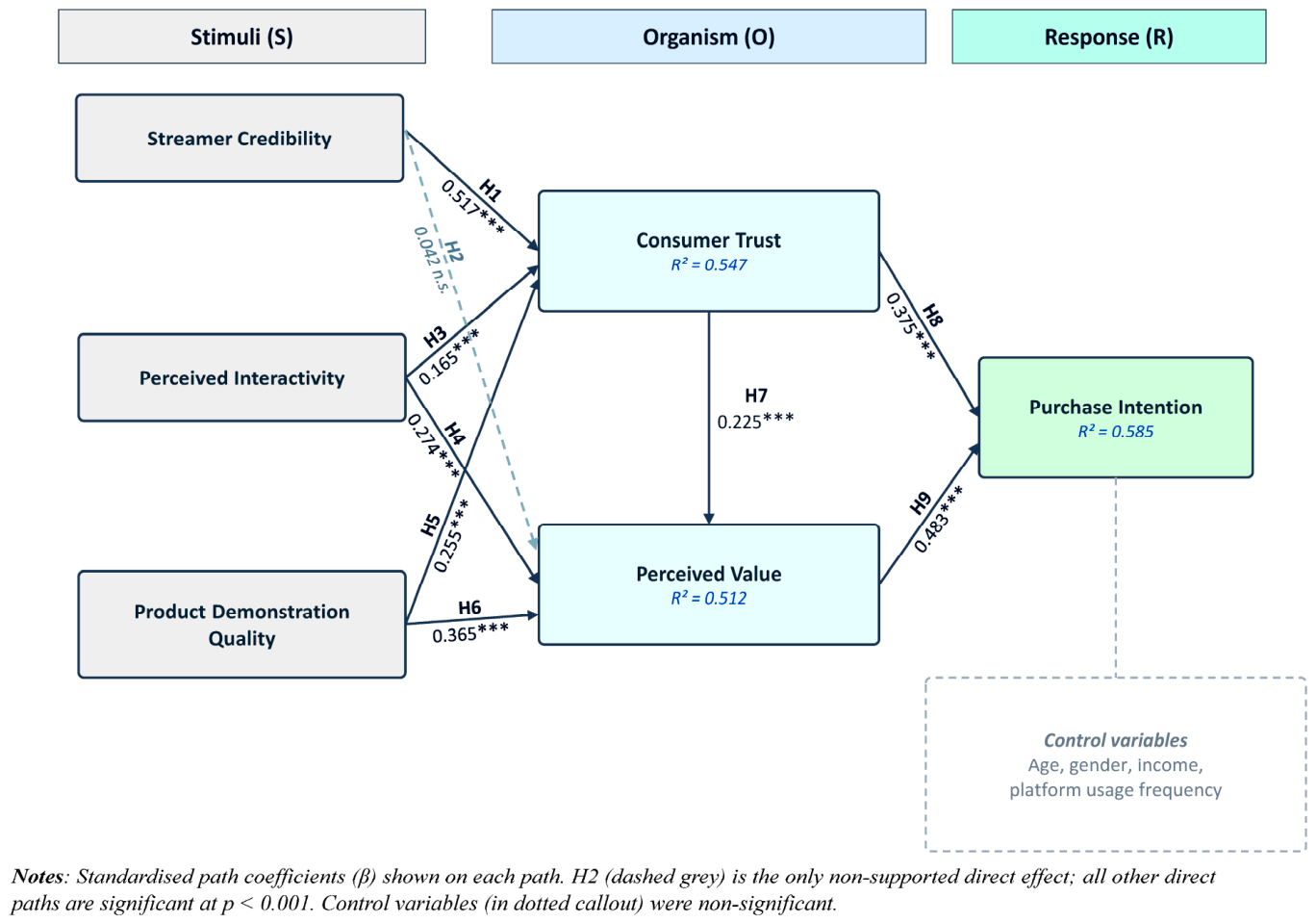
| Path | β | SE | C.R. | p | Result |
| Hypothesised paths | |||||
| H1: SC → CT | 0.517 | 0.067 | 9.397 | *** | Supported |
| H2: SC → PV | 0.042 | 0.068 | 0.706 | n.s. | Not supported |
| H3: INTER → CT | 0.165 | 0.050 | 3.350 | *** | Supported |
| H4: INTER → PV | 0.274 | 0.047 | 5.442 | *** | Supported |
| H5: PDQ → CT | 0.255 | 0.054 | 5.412 | *** | Supported |
| H6: PDQ → PV | 0.365 | 0.056 | 6.940 | *** | Supported |
| H7: CT → PV | 0.225 | 0.062 | 3.393 | *** | Supported |
| H8: CT → PI | 0.375 | 0.051 | 7.715 | *** | Supported |
| H9: PV → PI | 0.483 | 0.057 | 9.523 | *** | Supported |
| Control variable paths | |||||
| Age → PI | −0.019 | 0.038 | −0.521 | n.s. | - |
| Gender → PI | 0.020 | 0.080 | 0.588 | n.s. | - |
| Usage Frequency → PI | −0.025 | 0.031 | −0.733 | n.s. | - |
| Income → PI | −0.032 | 0.036 | −0.890 | n.s. | - |
| Indirect Path | Effect | LL 95% CI | UL 95% CI | Sig. | Result | |
|---|---|---|---|---|---|---|
| H10a | SC → CT → PI | 0.249 | 0.167 | 0.349 | <0.001 | Supported |
| H10b | INTER → CT → PI | 0.066 | 0.029 | 0.112 | 0.001 | Supported |
| H10c | PDQ → CT → PI | 0.115 | 0.070 | 0.179 | <0.001 | Supported |
| H11a | SC → PV → PI | 0.026 | −0.054 | 0.108 | 0.514 | Not supported |
| H11b | INTER → PV → PI | 0.140 | 0.089 | 0.201 | <0.001 | Supported |
| H11c | PDQ → PV → PI | 0.212 | 0.146 | 0.289 | <0.001 | Supported |
| H12a | SC → CT → PV → PI | 0.072 | 0.030 | 0.129 | <0.001 | Supported |
| H12b | INTER → CT → PV → PI | 0.019 | 0.006 | 0.041 | 0.001 | Supported |
| H12c | PDQ → CT → PV → PI | 0.033 | 0.014 | 0.065 | <0.001 | Supported |
Disclaimer/Publisher’s Note: The statements, opinions and data contained in all publications are solely those of the individual author(s) and contributor(s) and not of MDPI and/or the editor(s). MDPI and/or the editor(s) disclaim responsibility for any injury to people or property resulting from any ideas, methods, instructions or products referred to in the content. |
© 2026 by the author. Licensee MDPI, Basel, Switzerland. This article is an open access article distributed under the terms and conditions of the Creative Commons Attribution (CC BY) license.
Share and Cite
Tsimonis, G. How Live Streaming Commerce Platforms Drive Consumer Purchase Intention: Dual Mediation of Trust and Perceived Value in a UK Sample. Platforms 2026, 4, 10. https://doi.org/10.3390/platforms4020010
Tsimonis G. How Live Streaming Commerce Platforms Drive Consumer Purchase Intention: Dual Mediation of Trust and Perceived Value in a UK Sample. Platforms. 2026; 4(2):10. https://doi.org/10.3390/platforms4020010
Chicago/Turabian StyleTsimonis, Georgios. 2026. "How Live Streaming Commerce Platforms Drive Consumer Purchase Intention: Dual Mediation of Trust and Perceived Value in a UK Sample" Platforms 4, no. 2: 10. https://doi.org/10.3390/platforms4020010
APA StyleTsimonis, G. (2026). How Live Streaming Commerce Platforms Drive Consumer Purchase Intention: Dual Mediation of Trust and Perceived Value in a UK Sample. Platforms, 4(2), 10. https://doi.org/10.3390/platforms4020010