


Abstract
Lymphoid neoplasms such as multiple myeloma (MM), indolent non-Hodgkin lymphoma, and chronic lymphocytic leukemia are increasingly managed as chronic, relapsing conditions characterized by prolonged surveillance, repeated treatment transitions, and cumulative self-management demands. These trajectories expose patients and caregivers to persistent illness uncertainty, fluctuating fear of progression, symptom and comorbidity burden, communication challenges, and treatment-related workload. This theory-informed framework development paper uses an overview of selected psycho-oncological, hematological, nursing, theoretical, and patient-reported outcome literature to propose the LUMINA framework: Longitudinal illness trajectory, Uncertainty fields, Multidimensional symptom and comorbidity load, Information and interaction context, Navigation work and self-management load, and Adaptive outcomes and alignment. LUMINA is intended as a hypothesis-generating conceptual structure to organize clinically relevant domains, clarify potential relationships among uncertainty, symptom burden, communication, navigation work, and adaptive outcomes, and guide future assessment, validation, and intervention research in chronic lymphoid neoplasms. The framework builds on prior theories of illness uncertainty, treatment burden, workload–capacity balance, fear of recurrence/progression, and lymphoma-specific qualitative work on uncertainty management and psychosocial adaptation. Potential research applications include structured assessment, shared decision-making research, and domain-matched supportive-care concepts; however, these applications remain theoretical and require empirical testing. Future studies should evaluate feasibility, acceptability, construct validity, domain overlap, predictive validity beyond quality of life, and the clinical utility of LUMINA-informed research profiles. Until such validation is available, LUMINA should be interpreted as a conceptual model rather than a validated clinical tool or care pathway.
1. Introduction
Lymphoid neoplasms—including multiple myeloma (MM), indolent non-Hodgkin lymphomas (iNHL), and chronic lymphocytic leukemia (CLL)—have undergone a major therapeutic transformation over the past two decades. At the population level, non-Hodgkin lymphoma continues to represent a substantial and evolving global disease burden, with recent Global Burden of Disease analyses projecting persistent burden through 2040 [1]. Survival gains driven by targeted agents, immunomodulatory drugs, monoclonal antibodies, and cellular immunotherapies have turned many of these malignancies into chronic, relapsing illnesses managed over years or decades [2,3,4,5,6,7,8,9]. This shift from episodic, time-limited treatment to longitudinal care trajectories is characterized by recurrent relapses, prolonged surveillance phases (e.g., watch and wait), maintenance strategies, and continuous oral therapies [10,11].
Lymphoid malignancies are prototypical disorders at the interface of immune system dysfunction, lymphoid tissue involvement, and long-term care pathways. As diseases of lymphoid organs and immune-lymphatic function, they provide a pertinent model for linking lymphatics-relevant biology with long-term patient-centered care [12]. Their management commonly entails sustained monitoring, infection-risk mitigation, repeated interactions with specialized services, and cumulative supportive care needs [13]. Along these trajectories, psycho-oncological outcomes are not peripheral; they influence symptom appraisal, self-management, healthcare utilization, adherence to long-term therapy, and ultimately quality of life (QoL) for patients and caregivers [14,15,16].
Many patients live with a persistent sense of uncertainty about relapse timing, treatment durability, side effects, functional trajectories, and future roles [14,15,17]. In parallel, treatment burden accumulates through symptom clusters, polypharmacy, time-intensive logistics, administrative and coordination work, and—depending on healthcare context—financial toxicity and opportunity costs [18]. Evidence from hematologic malignancy and lymphoma-specific studies indicates that uncertainty, prognostic understanding, distress, symptom burden, quality of life, communication, financial toxicity, and treatment workload are clinically relevant but often investigated in partially separate research traditions [14,15,16,17,18,19,20,21,22,23,24,25,26,27,28,29,30,31,32]. Existing theoretical models, including Uncertainty in Illness Theory and Burden of Treatment Theory, provide important foundations for understanding uncertainty appraisal and workload–capacity imbalance [19,22]. Disease-specific qualitative and patient-reported outcome studies further describe uncertainty management, watch-and-wait experiences, survivorship transitions, unmet supportive-care needs, and symptom impacts in lymphoma, CLL, and MM [16,20,21,24,25,26,27,28,32,33,34]. However, these contributions have not yet been organized into a single lymphoid-neoplasm-specific conceptual framework that jointly considers longitudinal trajectory, uncertainty fields, symptom and comorbidity load, communication context, navigation work, and adaptive outcomes. LUMINA is therefore proposed as a theory-informed conceptual model to provide a structured language for future assessment, hypothesis generation, intervention development, and empirical validation across chronic lymphoid neoplasm trajectories.
The added value of LUMINA is conceptual rather than immediately clinical. It aims to make interacting sources of vulnerability visible, distinguish domains that are often conflated under broad terms such as distress or quality of life, and generate empirically testable hypotheses about which combinations of uncertainty, symptom burden, communication context, and navigation workload may predict later distress, functioning, treatment engagement, caregiver strain, or goal-concordant care.
This framework development paper has three aims: (1) to outline the theoretical and empirical concepts that informed the development of LUMINA; (2) to present LUMINA as a hypothesis-generating conceptual model for organizing chronic uncertainty and treatment burden in MM, iNHL, and CLL; and (3) to identify future research directions for feasibility testing, construct validation, patient-reported outcome assessment, and psycho-oncological intervention development at the interface of psycho-oncology and lymphoid hematology.
2. Results
2.1. Literature-Informed Conceptual Foundations
2.1.1. Uncertainty in Illness Theory
Mishel’s Uncertainty in Illness Theory conceptualizes uncertainty as the inability to determine the meaning of illness-related events, arising from ambiguity, complexity, lack of information, and unpredictability [35]. In this model, uncertainty influences psychological adjustment through appraisal processes (e.g., interpreting uncertainty as danger vs. opportunity) and coping responses. Across chronic and cancer conditions, higher illness uncertainty is consistently associated with poorer psychological well-being and impaired quality of life, even when controlling for disease status and symptom burden.
Lymphoid neoplasms present a particularly uncertainty-dense context: many entities are biologically heterogeneous; trajectories are often relapsing with variable treatment durability; and the clinical meaning of “incurable” may coexist with long survival and evolving treatment landscapes. These features create sustained uncertainty not only about prognosis and relapse timing, but also about treatment sequencing, cumulative toxicity, long-term functioning, and life planning. Consequently, uncertainty in lymphoid neoplasms is best conceptualized as longitudinal and multi-field-extending beyond a single event (e.g., diagnosis) to repeated transitions across the care continuum.
2.1.2. Lymphoma-Specific Uncertainty Management and Psychosocial Adaptation
Prior lymphoma-specific qualitative work provides an important foundation for LUMINA [19,36]. In a grounded theory study of young and middle-aged patients with lymphoma, managing uncertainty was identified as the central behavioral pattern through which patients attempted to restore normality. The study distinguished inherent illness uncertainty from perceived uncertainty and described strategies including reconstructing certainty, adaptive coping, defensive buffering, and compensatory changing [36]. These findings support the conceptualization of uncertainty not merely as a psychological symptom, but as a dynamic process shaped by disease characteristics, patient perceptions, social resources, and cultural context.
Similarly, qualitative work in young adults transitioning after Hodgkin lymphoma treatment has highlighted the importance of positive reframing, acceptance, normalization, peer support, and preparation for the future [19]. This literature shows that psychosocial adaptation after lymphoma treatment involves both internal coping processes and external relational or informational resources. LUMINA builds on these prior contributions by integrating lymphoma-specific uncertainty and adaptation work with broader domains of treatment burden, symptom/comorbidity load, communication context, navigation work, and adaptive outcomes.
2.1.3. Burden of Treatment and Workload–Capacity Frameworks
Burden of Treatment Theory describes the work that patients and their support networks undertake to manage healthcare demands and how this workload interacts with capacity (e.g., functional ability, cognitive resources, social support, financial resources) to shape outcomes such as adherence, healthcare utilization, and well-being [20]. In chronic conditions, treatment burden accumulates through medication management, monitoring, appointments, administrative and coordination tasks, and lifestyle adaptations, particularly when care is complex and distributed across multiple providers.
Complementary workload–capacity frameworks emphasize that patient complexity and worse outcomes often arise from imbalances between cumulative healthcare workload and the patient’s capacity to meet these demands, creating self-reinforcing feedback loops over time. These concepts are highly applicable to lymphoid neoplasms, where patients may experience prolonged oral targeted therapy, polypharmacy, frequent monitoring, infection risk management, and recurrent changes in therapy. Importantly, treatment burden is not reducible to symptom severity: the organizational and cognitive work of navigating chronic hematologic cancer care can remain high even in periods of relative clinical stability.
2.1.4. Financial Toxicity and Time Burden as Core Dimensions of Treatment Burden
Financial toxicity refers to the objective and subjective financial burden of cancer care and is increasingly recognized as a clinically relevant patient-reported outcome associated with psychological distress, reduced quality of life, and non-adherence [21]. The concept has been operationalized with validated instruments such as the Comprehensive Score for financial Toxicity (COST), enabling routine assessment and research integration [22]. Although financial burden varies substantially across health systems, lymphoid neoplasms can entail long durations of therapy and monitoring, repeated relapses, employment disruption, and indirect costs, making financial toxicity a key element of chronic treatment burden.
Time burden (“time toxicity”) encompasses the time spent traveling, waiting, receiving therapy, and managing care logistics. In lymphoid neoplasms—especially with infusion-based regimens or frequent monitoring—time burden can be substantial for both patients and caregivers and may affect role functioning, social participation, and preference-sensitive treatment decisions. Conceptually, time and financial toxicity are best treated as integral components of the Navigation and self-management domain in LUMINA rather than as secondary considerations.
2.1.5. Fear of Recurrence/Progression and Distress as Psycho-Oncological Outputs and Targets
Fear of cancer recurrence/progression represents a central psychosocial construct in chronic and relapsing cancers and can be measured with validated instruments such as the Fear of Cancer Recurrence Inventory (FCRI) [37]. In lymphoid neoplasms, relapse risk often persists indefinitely; therefore, fear of progression/recurrence and uncertainty frequently become chronic background states rather than episodic reactions. These constructs intersect with symptom burden, perceived control, information/interaction context, and treatment workload, jointly shaping distress trajectories and quality of life.
Taken together, Uncertainty in Illness Theory, Burden of Treatment Theory, workload–capacity frameworks, and psycho-oncological constructs such as fear of recurrence provide a strong conceptual foundation for an integrative model tailored to lymphoid neoplasms. The LUMINA framework proposed below translates these concepts into a hypothesis-generating conceptual structure that may inform future assessment, communication research, and intervention development across MM, iNHL, and CLL trajectories.
2.2. Development of the LUMINA Framework
2.2.1. Longitudinal Trajectories and Surveillance States
Across MM, iNHL, and CLL, psycho-oncological burden is shaped by chronic and often relapsing disease trajectories. Patients may move through diagnosis, surveillance or watch and wait, treatment initiation, response, maintenance or continuous therapy, relapse, later-line treatment, and, for some, palliative or end-of-life care. These transitions are clinically meaningful because they may alter uncertainty, symptom burden, workload, information needs, and adaptive outcomes. In MM, sequential lines of therapy and maintenance strategies can generate prolonged exposure to treatment-related demands [2,38,39]. In iNHL and CLL, surveillance and watch-and-wait phases may generate high uncertainty despite limited immediate treatment burden [23,24,25,26].
2.2.2. Uncertainty, Prognostic Understanding, and Fear of Progression
Uncertainty is a recurring theme across lymphoid neoplasms. In MM, discordance between communicated prognosis and patients’ internalized understanding of incurability has been documented, suggesting that information provision alone may not ensure shared meaning [39]. In iNHL and CLL, surveillance and watch and wait can create a sustained state of ambiguity in which patients live with an incurable or potentially relapsing disease while receiving limited or no active treatment [23,24,25,26]. Lymphoma-specific qualitative work further shows that patients actively attempt to manage uncertainty by reconstructing certainty, adapting coping strategies, buffering threat, and seeking a new normality [36]. These findings support uncertainty as a dynamic process rather than a static psychological variable.
2.2.3. Symptom, Comorbidity, and Functional Burden
Symptom and comorbidity burden contribute substantially to distress and QoL impairment across lymphoid neoplasms. Fatigue, pain, sleep disturbance, mobility limitations, infection risk, treatment toxicities, and comorbid conditions may interact with uncertainty and self-management demands [16,27,28,39,40]. However, symptom burden is not always proportional to psychological burden. Patients in surveillance states may experience high uncertainty despite relatively low symptom intensity, whereas patients receiving continuous or later-line therapies may experience combined symptom, toxicity, and workload burden.
2.2.4. Communication, Information, and Interaction Context
Communication shapes how patients interpret prognosis, treatment options, surveillance rationales, symptom changes, and future planning. Prior lymphoma survivorship work suggests that patients value preparation for future challenges, including body image, fertility, relationships, work, and social participation [19]. Information and interaction context therefore functions as a mediator between disease trajectory and adaptive outcomes: clear, repeated, preference-sensitive communication may reduce threat appraisal, whereas inconsistent or insufficient information may amplify uncertainty.
2.2.5. Navigation Work, Self-Management, Time Burden, and Financial Toxicity
The work of being a patient includes appointment coordination, medication management, laboratory monitoring, infection-risk behaviors, administrative tasks, financial concerns, transport, waiting time, and caregiver involvement. In chronic lymphoid neoplasms, this workload may persist for years and may increase during treatment transitions, relapse, continuous therapy, or complex supportive-care regimens. Time burden and financial toxicity are therefore not secondary issues, but central components of treatment burden that may influence distress, adherence, healthcare engagement, and patient preferences [33,34,38].
2.2.6. Adaptive Outcomes: Distress, QoL, Coping, Functioning, and Alignment
Adaptive outcomes include anxiety, depression, fear of progression, post-traumatic stress symptoms, QoL, functional status, social participation, coping, activation, adherence, and perceived alignment between care and patient goals. Recent lymphoma literature supports the relevance of coping and nurse-led support for psychosocial outcomes [29], but the evidence base remains heterogeneous and often cross-sectional. Therefore, LUMINA should be interpreted as an integrative conceptual structure that organizes plausible pathways rather than as a validated causal model.
2.2.7. Cross-Entity Synthesis
Across MM, iNHL, and CLL, the literature supports several recurring patterns: chronic trajectories generate repeated uncertainty; uncertainty interacts with symptom and comorbidity burden; communication shapes appraisal and perceived control; navigation and self-management work accumulate over time; and adaptive outcomes extend beyond QoL to include distress, functioning, social participation, adherence, caregiver strain, and goal-concordant care. These recurring themes motivated the development of LUMINA as a cross-entity conceptual framework for chronic lymphoid neoplasms.
2.3. The LUMINA Framework: Domains and Conceptual Relationships
2.3.1. Rationale and Overview
LUMINA is proposed as a theory-informed conceptual framework for organizing psycho-oncological and supportive-care constructs in chronic lymphoid neoplasms. It is intended to support conceptual clarity and future empirical research by providing a structured language for describing how longitudinal disease trajectories, uncertainty, symptom and comorbidity load, communication context, navigation work, and adaptive outcomes may interact over time. It should not be interpreted as a validated assessment instrument, risk score, or clinical pathway.
It integrates six interacting domains:
- L—Longitudinal illness trajectory;
- U—Uncertainty fields;
- M—Multidimensional symptom and comorbidity load;
- I—Information and interaction context;
- N—Navigation work and self-management load;
- A—Adaptive outcomes and alignment.
The domains are conceptually related but have distinct primary functions. The L domain describes the patient’s position in the disease and treatment trajectory. The U domain captures ambiguity, unpredictability, and fear related to prognosis, treatment, roles, and future planning. The M domain captures disease-related symptoms, treatment toxicities, comorbidities, and functional limitations. The I domain captures the communication and information environment through which illness meaning is shaped. The N domain captures the practical, cognitive, logistical, financial, and temporal work required to manage care. The A domain captures downstream psychological, functional, behavioral, and goal-alignment outcomes. Partial overlap between domains is expected and should be tested empirically in future validation studies. Table 1 provides an illustrative mapping of the six LUMINA domains to representative constructs and commonly used patient-reported, clinical, and psychosocial assessment instruments.
LUMINA is intended to (1) organize concepts relevant to future assessment and documentation research, (2) highlight domains that may be relevant for shared decision-making, including workload, time burden, and financial burden, and (3) inform the development and testing of psycho-oncological and supportive-care interventions. The framework is designed to map conceptually onto established patient-reported outcome constructs and validated instruments, thereby reducing the need for de novo measurement development in future studies.
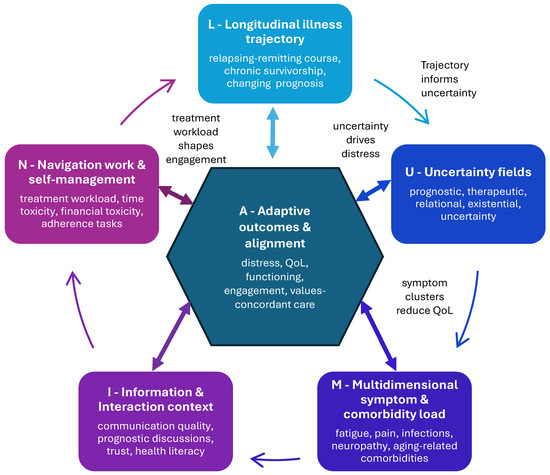
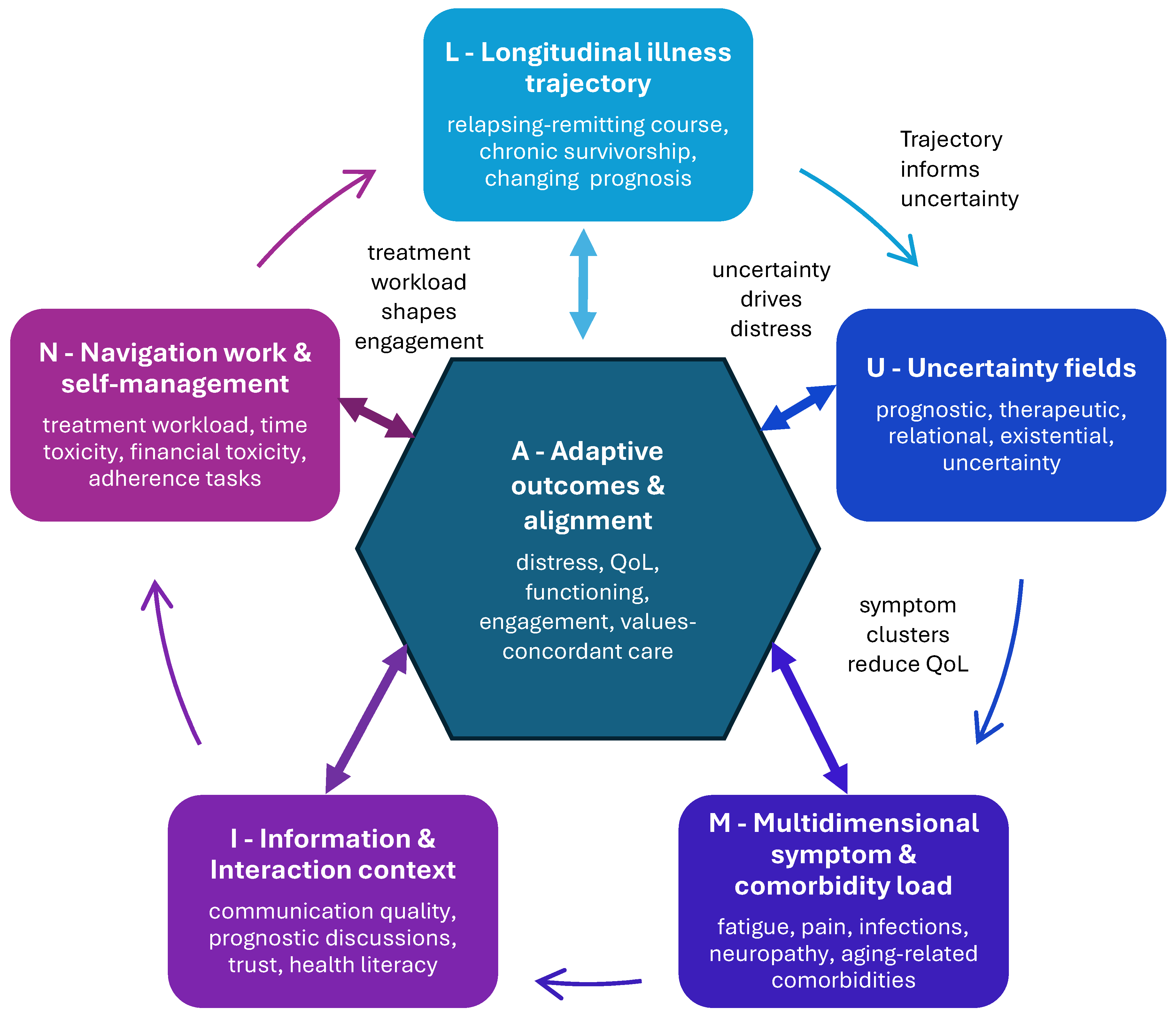
Because the six LUMINA domains describe interacting aspects of chronic lymphoid cancer care, partial conceptual and measurement overlap is expected. Future validation studies should therefore examine domain distinctiveness, redundancy, and bridge constructs using psychometric and longitudinal methods. The proposed relationships among the six LUMINA domains are summarized visually in Figure 1, which illustrates the framework as an interacting, hypothesis-generating conceptual model rather than as a validated clinical pathway.
Figure 1.
The proposed LUMINA framework as a theory-informed conceptual model. The figure illustrates six interacting domains hypothesized to shape psycho-oncological and supportive-care outcomes in chronic lymphoid neoplasms: longitudinal illness trajectory, uncertainty fields, multidimensional symptom and comorbidity load, information and interaction context, navigation work and self-management load, and adaptive outcomes and alignment. The framework has not yet been empirically validated.
2.3.2. Domain Definitions and Conceptual Implications
L—Longitudinal Illness Trajectory
This domain captures the chronic, relapsing-remitting course typical of MM, iNHL, and CLL, including transitions such as diagnosis → surveillance/watch and wait → treatment initiation → response → maintenance → relapse → next line(s) → (for some) end-of-life. Importantly, psycho-oncological vulnerability can persist across treatment lines rather than being confined to early disease phases, as shown in MM cohorts where distress and QoL impairment were present across the continuum and not strongly differentiated by line of therapy [39]. L operationalizes “where the patient is” in the trajectory and identifies transitions where uncertainty and workload typically intensify (e.g., first relapse, therapy escalation, hospitalization, initiation of continuous oral therapy).
Conceptual implication for future research: Future studies could examine whether major trajectory transitions are associated with changes in uncertainty fields (U), symptom/toxicity load (M), and navigation demands (N), and whether transition-sensitive assessment improves the identification of psycho-oncological vulnerability.
U—Uncertainty Fields
Lymphoid neoplasms expose patients and caregivers to multiple, interacting uncertainty fields:
- Prognostic uncertainty: relapse timing, survival horizon, durability of response.
- Therapeutic uncertainty: which option will work, toxicity trade-offs, sequence of therapies.
- Relational uncertainty: roles in family/work, caregiver expectations, dependence/independence.
- Existential uncertainty: meaning, identity, future planning.
Empirical work in MM demonstrates a clinically relevant discordance between communicated incurability and patients’ personal endorsement of incurability/terminal status—an uncertainty mechanism that persists even in treated cohorts [39]. Similar patterns of prognostic uncertainty and complex understanding of prognosis have been documented in iNHL at diagnosis [26]. In CLL, “watchful waiting” can become a sustained uncertainty state, where living with cancer under observation shapes daily appraisal and coping [23,24].
Conceptual implication for future research: Future communication studies could examine whether distinguishing different uncertainty fields and repeatedly assessing patients’ understanding over time improves prognostic awareness, perceived control, distress, or shared decision-making outcomes.
M—Multidimensional Symptom and Comorbidity Load
M integrates disease-related symptoms, treatment toxicities, symptom clusters, and comorbidities/aging-related vulnerabilities. In MM, symptom burden (e.g., fatigue, pain, sleep problems, mobility limitations) is strongly associated with anxiety/depression and QoL, and perceived control moderates these relationships [27]. In iNHL and CLL, symptom burden may be low in early phases yet coexist with high psychological burden driven by uncertainty (U), while relapsed/refractory phases and chronic targeted therapy can increase cumulative toxicity and functional limitations [16,30].
Conceptual implication for future research: Future longitudinal studies could test whether changes in symptom clusters predict uncertainty, treatment workload, distress, and quality of life, and whether integrated symptom and psycho-oncological assessment provides additional explanatory value beyond symptom measurement alone.
I—Information and Interaction Context
I reflects how information is delivered, understood, and revisited over time: clarity, timing, framing, consistency across providers, and the relational climate (trust, empathy, shared decision-making). Prognostic discordance in MM and iNHL (being told “incurable” but not internalizing it) underscores that information transfer alone does not guarantee shared meaning [26,39]. For CLL, qualitative work highlights how communication during watch and wait shapes acceptance and distress trajectories [41]. I also includes health literacy and the patient’s information environment (digital content, peer communities), which can either reduce uncertainty or amplify threat appraisal.
Conceptual implication for future research: Future studies could evaluate whether structured assessment of patients’ current understanding, information preferences, and meaning-making improves communication quality, reduces uncertainty, and supports goal-concordant decision-making.
A—Adaptive Outcomes and Alignment
A includes psycho-oncological outcomes (anxiety, depression, PTSD-like symptoms, fear of progression/recurrence), HRQoL, functioning, social participation, activation, and treatment engagement/adherence. It also includes alignment: the degree to which care plans match patient goals, values, and life context. Misalignment—e.g., high-visit regimens for patients prioritizing independence and minimal time toxicity—can intensify distress and erode trust even when treatment is clinically effective. In MM, distress can remain substantial across treatment lines and is not confined to first-line therapy [39]. In indolent lymphoma, distress may be present while mental health service uptake remains low, indicating system-level gaps that affect outcomes [16,32].
Conceptual implication for future research: Future validation studies could examine whether LUMINA-informed domain profiles predict adaptive outcomes such as distress, quality of life, functioning, caregiver strain, treatment engagement, and perceived alignment between care plans and patient goals.
Table 1.
Mapping of LUMINA domains to representative constructs and commonly used instruments.
2.3.3. Positioning LUMINA Relative to Existing Models
LUMINA is designed to integrate (not replace) established frameworks:
- It embeds uncertainty theory in a chronic lymphoid trajectory (L), operationalizing how repeated transitions (relapse, therapy switching, watch and wait) generate sustained uncertainty fields (U) [26,39,41,42].
- It incorporates Burden of Treatment Theory and workload–capacity concepts into Navigation/self-management (N), explicitly linking workload (time/financial/organizational demands) to adaptive outcomes and engagement [18,33,43].
- It aligns with disease-specific PRO conceptualization in CLL and may improve conceptual usability in future research by connecting symptom/impact domains to communication and navigation constructs [28,40].
3. Discussion
3.1. Potential Applications and Future Research Directions
The following applications are proposed as hypothesis-generating research directions rather than clinical recommendations, care standards, risk algorithms, or implementation guidance. Their purpose is to illustrate how LUMINA could support future feasibility, validation, communication, and intervention-development studies.
3.1.1. Structured Assessment Research
LUMINA may provide a pragmatic structure for organizing future patient-reported outcome and screening studies across chronic lymphoid neoplasm trajectories. Rather than introducing a new measurement instrument, the framework could help align established measures with clinically relevant domains such as uncertainty, symptom and comorbidity burden, communication context, navigation workload, and adaptive outcomes. Future studies should test whether brief LUMINA-informed assessment profiles are feasible, acceptable, non-redundant, and clinically meaningful.
3.1.2. Communication and Shared Decision-Making Research
The Information and interaction domain highlights communication as a potential modifier of uncertainty appraisal, perceived control, treatment engagement, and goal alignment. Future studies could examine whether structured discussions of prognosis, surveillance rationale, treatment workload, symptom expectations, caregiver involvement, and patient priorities improve understanding, reduce distress, or support shared decision-making. These concepts remain research hypotheses and should not be interpreted as validated communication recommendations.
3.1.3. Intervention-Development Hypotheses
LUMINA may also help generate domain-matched intervention hypotheses for future testing. For example, high uncertainty profiles may justify studies of uncertainty-focused psychoeducation, fear-of-progression interventions, or structured prognosis framing; high navigation-workload profiles may justify studies of navigation support, time-burden reduction, financial counseling, or adherence support; high symptom/comorbidity profiles may justify integrated symptom-management and psycho-oncological approaches; and low alignment or high distress profiles may justify stepped psycho-oncology, goal clarification, or family-based support. These examples are illustrative and require empirical testing before any clinical implementation.
3.1.4. Illustrative LUMINA-Informed Research Hypotheses Across MM, iNHL, and CLL
Table 2 presents illustrative, non-validated research hypotheses generated from the LUMINA framework across selected disease contexts and care phases in MM, iNHL, and CLL.
Table 2.
Illustrative research hypotheses generated from the LUMINA framework by disease context and care phase.
3.2. Staged Validation Agenda
Because LUMINA is currently a proposed conceptual framework, future research should proceed in stages. Complex modeling approaches such as structural equation modeling, network analysis, and phenotype-based intervention trials should be considered longer-term goals rather than immediate requirements.
3.2.1. Stage 1: Feasibility and Acceptability
Initial studies should test whether brief LUMINA-informed assessment can be completed by patients and used by clinical teams without excessive burden. Outcomes should include completion rates, time required, missing data, patient acceptability, clinician acceptability, perceived usefulness, and workflow compatibility.
3.2.2. Stage 2: Construct Validity and Domain Overlap
Subsequent studies should examine whether the six domains can be empirically distinguished while acknowledging expected overlap. Factor analytic approaches, correlation matrices, and redundancy analyses may be used before more complex modeling is attempted.
3.2.3. Stage 3: Predictive Validity
Prospective longitudinal studies should test whether LUMINA domain profiles predict later distress, QoL, functional status, adherence, treatment engagement, healthcare utilization, supportive-care needs, palliative-care referral, caregiver burden, and patient-reported workload.
3.2.4. Stage 4: Advanced Modeling and Intervention Development
Only after feasibility and preliminary validity are established should more complex approaches such as structural equation modeling, network analysis, latent class analysis, or LUMINA-stratified intervention trials be pursued.
3.3. Strengths and Limitations
This manuscript has several strengths. It addresses an increasingly relevant psycho-oncological challenge in chronic lymphoid neoplasms and proposes an integrated conceptual structure for uncertainty, treatment burden, symptom and comorbidity load, communication, navigation work, and adaptive outcomes. It also draws on theoretical, qualitative, quantitative, and patient-reported outcome literature across hematology, psycho-oncology, nursing science, and supportive care.
Several limitations must also be acknowledged. First, LUMINA is based on selective, author-driven conceptual integration of theoretical, empirical, qualitative, and patient-reported outcome literature rather than on a formal systematic, scoping, integrative, or reproducible narrative review. Consequently, the manuscript does not provide exhaustive evidence capture, database-specific reproducible search strings, study-selection counts, a PRISMA flow diagram, a systematic assessment of study quality, or pooled estimates. The literature was used to support conceptual framework development rather than to claim complete identification or inclusion of all eligible publications. Second, the framework-development process was conducted by a single author, which may increase interpretive and selection bias. Third, the six-domain structure represents a proposed conceptual organization and has not yet been empirically validated. Its feasibility, acceptability, domain distinctiveness, construct validity, predictive validity, and clinical utility remain unknown. Fourth, the proposed research applications are derived from conceptual reasoning and selected literature rather than from LUMINA-specific intervention trials. Fifth, health-system differences may strongly influence navigation workload, financial toxicity, access to psycho-oncological care, and implementation feasibility.
Accordingly, LUMINA should be interpreted as a hypothesis-generating conceptual framework. It may support future research design, patient-reported outcome selection, and conceptual organization, but it should not yet be considered a validated clinical tool, risk-stratification system, or evidence-based care pathway.
4. Materials and Methods
This manuscript is a theory-informed conceptual framework development paper. It does not report a systematic review, scoping review, integrative review, or meta-analysis. Instead, the LUMINA framework was developed through conceptual integration of established theories, selected empirical and qualitative literature, disease-specific patient-reported outcome research, and clinically relevant psycho-oncological problem patterns observed across chronic lymphoid neoplasm trajectories. The literature was used to inform, support, and refine the conceptual model rather than to provide an exhaustive, reproducible, or quantitatively synthesized evidence base.
4.1. Literature-Informed Conceptual Grounding
To ground the framework in relevant literature, selected empirical, qualitative, theoretical, conceptual, measurement, and patient-reported outcome publications were identified through targeted searches and citation tracking. PubMed/MEDLINE was used as the primary biomedical database, supplemented by targeted searches in Scopus, Web of Science, CINAHL, PsycINFO, and Embase where interdisciplinary psycho-oncological, nursing, or supportive-care literature was relevant. Search concepts combined lymphoid neoplasms and chronic hematologic malignancies with illness uncertainty, fear of progression or recurrence, prognostic understanding, distress, quality of life, symptom burden, comorbidity, treatment burden, self-management, navigation work, financial toxicity, time burden, communication, shared decision-making, caregiver burden, and patient-reported outcomes.
The purpose of this literature overview was not to enumerate all available studies or to provide a reproducible evidence synthesis. Rather, it was to identify theoretical anchors, disease-specific empirical observations, measurement approaches, and recurring clinical concepts relevant to the development of a conceptual framework for chronic uncertainty and treatment burden in MM, iNHL, and CLL.
4.2. Literature Selection Logic
Publications were considered conceptually relevant when they addressed at least one of the following areas: chronic lymphoid neoplasm trajectories; illness uncertainty; fear of progression or recurrence; prognostic understanding; distress; quality of life; symptom or comorbidity burden; treatment burden; workload–capacity balance; self-management; navigation work; financial toxicity; time burden; communication; shared decision-making; caregiver burden; or patient-reported outcome measurement. Adult MM, iNHL, CLL, lymphoma, and broader chronic hematologic malignancy literature was prioritized. Seminal theoretical and measurement papers from outside lymphoid neoplasms were included when they provided necessary conceptual grounding, for example, for uncertainty theory, treatment burden, financial toxicity, or fear of recurrence/progression.
Because the goal was framework development rather than formal evidence synthesis, publications were selected for conceptual relevance, theoretical contribution, disease-specific relevance, or measurement relevance.
4.3. Conceptual Extraction and Model-Building Logic
Conceptual information was extracted from selected sources rather than quantitative study-level data. Extracted elements included the disease context, care phase, psycho-oncological construct, patient-reported or clinical outcome, measurement approach, theoretical contribution, and potential relevance for supportive-care assessment or intervention development. These elements were used to identify recurring concepts across chronic lymphoid neoplasm trajectories and to map them onto established theoretical constructs, including illness uncertainty, treatment burden, workload–capacity balance, fear of recurrence/progression, financial toxicity, time burden, and patient-centered outcomes.
This process was conducted by the single author and was interpretive rather than algorithmic. It therefore represents an author-driven conceptual integration rather than an independently replicated evidence-selection process.
4.4. Framework Development
The LUMINA framework was developed to organize recurring psycho-oncological and supportive-care concepts that appear across chronic lymphoid neoplasm trajectories. The following subsections describe the conceptual reasoning that led to the six LUMINA domains. These subsections should not be interpreted as a formal thematic synthesis of all available literature, but as a literature-informed explanation of why each domain was included in the proposed model.
The LUMINA prototype was developed through iterative theory-informed conceptual model building. First, clinically recurring psycho-oncological problem patterns were identified across chronic lymphoid trajectories, including surveillance and watch-and-wait phases, treatment initiation, relapse, continuous or maintenance therapy, cumulative symptom burden, communication challenges, and increasing self-management demands. Second, these problem patterns were compared with relevant theoretical models and empirical literature to identify conceptual domains that were both clinically meaningful and theoretically grounded. Third, candidate domains were refined according to their relevance across MM, iNHL, and CLL; their potential modifiability through psycho-oncological, supportive-care, communication, or navigation interventions; and their compatibility with established patient-reported outcome constructs and instruments.
The resulting six-domain structure should therefore be understood as a proposed conceptual organization supported by selected literature, not as a domain structure inductively derived from a formal literature synthesis.
5. Conclusions
Chronic lymphoid neoplasms such as MM, iNHL, and CLL are associated with prolonged disease trajectories, repeated treatment transitions, persistent uncertainty, cumulative symptom and comorbidity burden, and substantial navigation and self-management demands. These factors may jointly shape psychological distress, QoL, functioning, treatment engagement, caregiver burden, and alignment between care and patient goals.
The LUMINA framework is proposed as a theory-informed conceptual model to organize these interacting dimensions across chronic lymphoid neoplasms. By distinguishing Longitudinal illness trajectory, Uncertainty fields, Multidimensional symptom and comorbidity load, Information and interaction context, Navigation work and self-management load, and Adaptive outcomes and alignment, LUMINA may provide a useful structure for future psycho-oncological assessment and intervention research.
However, LUMINA remains hypothesis-generating. Prospective studies are needed to evaluate feasibility, acceptability, domain structure, predictive validity, and clinical utility before the framework can be recommended for routine clinical implementation.
Funding
Anna Fleischer was supported by the Clinician Scientist College TWINSIGHT at the Medical Faculty of the University of Würzburg, which is funded by the Else Kröner-Fresenius Foundation.
Institutional Review Board Statement
Not applicable.
Informed Consent Statement
Not applicable.
Data Availability Statement
Not applicable. No new data were created or analyzed in this study.
Conflicts of Interest
A.F. received honoraria from GSK, BMS and Janssen.
References
- Wang, S.; Zhou, H.; Liu, Y.; Li, Y.; Nie, L. Trends and projections of Non-Hodgkin lymphoma burden (1990–2040): A global burden of disease 2021 analysis. BMC Public Health 2025, 25, 1223. [Google Scholar] [CrossRef] [Scilit]
- Rajkumar, S.V. Multiple myeloma: 2024 update on diagnosis, risk-stratification, and management. Am. J. Hematol. 2024, 99, 1802–1824. [Google Scholar] [CrossRef] [Scilit]
- Fleischer, A.; Roll, M.; Frenking, J.H.; Panther, F.; Gelbrich, G.; Strunz, P.; Riedhammer, C.; Peter, J.; Mersi, J.; Waldschmidt, J.; et al. Talquetamab-Related Dysgeusia in Multiple Myeloma Compared to BCMA-Targeted Bispecifics and High-Dose Melphalan. Cancer Med. 2025, 14, e71401. [Google Scholar] [CrossRef] [Scilit] [PubMed]
- Pennings, E.R.A.; Spanjaart, A.M.; Thielen, F.W.; Oerlemans, S.; Fleischer, A.; Sanges, C.; Da Silva, M.G.; Cabrerizo, Y.; Lecot, P.; Roux-Opstaele, L.; et al. Patient-reported outcomes in patients with hematologic malignancies treated with CAR T-cell therapy in Europe. Blood Adv. 2025, 9, 6380–6393. [Google Scholar] [CrossRef] [Scilit] [PubMed]
- Fleischer, A.; Zapf, L.; Allgaier, J.; Jordan, K.; Gelbrich, G.; Pryss, R.; Schobel, J.; Bittrich, M.; Einsele, H.; Kortüm, M.; et al. A patient survey indicates quality of life and progression-free survival as equally important outcome measures in multiple myeloma clinical trials. J. Cancer Res. Clin. Oncol. 2023, 149, 12897–12902. [Google Scholar] [CrossRef] [Scilit]
- Jurczyszyn, A.; Bator, M.; Vesole, D.H.; Salman, T.; Richardson, P.G.; Anderson, K. New therapies in multiple myeloma: Benefits and limitations. Pol. Arch. Intern. Med. 2025, 135, 16994. [Google Scholar] [CrossRef] [Scilit]
- Leslie, L.A. Novel Therapies for Follicular Lymphoma and Other Indolent Non-Hodgkin Lymphomas. Curr. Treat. Options Oncol. 2021, 22, 111. [Google Scholar] [CrossRef] [Scilit]
- Molica, S.; Allsup, D. Pirtobrutinib in Chronic Lymphocytic Leukemia: Navigating Resistance and the Personalisation of BTK-Targeted Therapy. Cancers 2025, 17, 2974. [Google Scholar] [CrossRef] [Scilit] [PubMed]
- Bakker, M.; Kuipers, M.T.; Kersten, M.J.; Tonino, S.H.; Serroukh, Y.I. Perspectives on T-cell engaging therapies in relapsed/refractory indolent non-Hodgkin lymphoma. Curr. Opin. Oncol. 2025, 37, 393–400. [Google Scholar] [CrossRef] [Scilit]
- Muchtar, E.; Kay, N.E.; Parikh, S.A. Early intervention in asymptomatic chronic lymphocytic leukemia. Clin. Adv. Hematol. Oncol. 2021, 19, 92–103. [Google Scholar]
- McKeague, S.; Seymour, J.F. Triplet regimens for frontline treatment of CLL-Great company or just a crowd? Hemasphere 2026, 10, e70303. [Google Scholar] [CrossRef] [Scilit]
- Taylor, J.; Xiao, W.; Abdel-Wahab, O. Diagnosis and classification of hematologic malignancies on the basis of genetics. Blood 2017, 130, 410–423. [Google Scholar] [CrossRef] [Scilit]
- Minson, A.; Tam, C.; Dickinson, M.; Seymour, J.F. Targeted Agents in the Treatment of Indolent B-Cell Non-Hodgkin Lymphomas. Cancers 2022, 14, 1276. [Google Scholar] [CrossRef] [Scilit] [PubMed]
- Levin, T.T.; Li, Y.; Riskind, J.; Rai, K. Depression, anxiety and quality of life in a chronic lymphocytic leukemia cohort. Gen. Hosp. Psychiatry 2007, 29, 251–256. [Google Scholar] [CrossRef] [Scilit]
- Holtzer-Goor, K.M.; Schaafsma, M.R.; Joosten, P.; Posthuma, E.F.M.; Wittebol, S.; Huijgens, P.C.; Mattijssen, E.J.M.; Vreugdenhil, G.; Visser, H.; Peters, W.G.; et al. Quality of life of patients with chronic lymphocytic leukaemia in The Netherlands: Results of a longitudinal multicentre study. Qual. Life Res. 2015, 24, 2895–2906. [Google Scholar] [CrossRef] [Scilit] [PubMed]
- Sugimoto, M.; Yagasaki, K.; Matsuki, E.; Shimizu, T.; Sakurai, M.; Kataoka, K.; Doorenbos, A.Z. Unmet Needs and Health-Related Quality of Life Among Patients with Relapsed/Refractory Indolent Non-Hodgkin Lymphoma: A Mixed-Methods Study. Psychooncology 2025, 34, e70103. [Google Scholar] [CrossRef] [Scilit] [PubMed]
- Sportoletti, P.; Laurenti, L.; Chiarenza, A.; Gaidano, G.; Albi, E.; Mauro, F.R.; Trentin, L.; Vallisa, D.; Pane, F.; Cuneo, A.; et al. Patients’ preferences for chronic lymphocytic leukemia treatment: The CHOICE study. Hematol. Oncol. 2024, 42, e3216. [Google Scholar] [CrossRef] [Scilit]
- Sears-Smith, M.; Knight, T.G. Financial Toxicity in Patients with Hematologic Malignancies: A Review and Need for Interventions. Curr. Hematol. Malig. Rep. 2023, 18, 158–166. [Google Scholar] [CrossRef] [Scilit]
- Matheson, L.; Boulton, M.; Lavender, V.; Collins, G.; Mitchell-Floyd, T.; Watson, E. The Experiences of Young Adults with Hodgkin Lymphoma Transitioning to Survivorship: A Grounded Theory Study. Oncol. Nurs. Forum 2016, 43, E195–E2014. [Google Scholar] [CrossRef] [Scilit]
- May, C.R.; Eton, D.T.; Boehmer, K.; Gallacher, K.; Hunt, K.; MacDonald, S.; Mair, F.S.; May, C.M.; Montori, V.M.; Richardson, A.; et al. Rethinking the patient: Using Burden of Treatment Theory to understand the changing dynamics of illness. BMC Health Serv. Res. 2014, 14, 281. [Google Scholar] [CrossRef] [Scilit]
- Zafar, S.Y.; Abernethy, A.P. Financial toxicity, Part. I: A new name for a growing problem. Oncology 2013, 27, 80–81, 149. [Google Scholar]
- de Souza, J.A.; Yap, B.J.; Wroblewski, K.; Blinder, V.; Araújo, F.S.; Hlubocky, F.J.; Nicholas, L.H.; O’Connor, J.M.; Brockstein, B.; Ratain, M.J.; et al. Measuring financial toxicity as a clinically relevant patient-reported outcome: The validation of the Comprehensive Score for financial Toxicity (COST). Cancer 2017, 123, 476–484. [Google Scholar] [CrossRef] [Scilit]
- Evans, J.; Ziebland, S.; Pettitt, A.R. Incurable, invisible and inconclusive: Watchful waiting for chronic lymphocytic leukaemia and implications for doctor-patient communication. Eur. J. Cancer Care 2012, 21, 67–77. [Google Scholar] [CrossRef] [Scilit]
- McCaughan, D.; Roman, E.; Sheridan, R.; Hewison, A.; Smith, A.G.; Patmore, R.; Howell, D.A. Patient perspectives of ‘Watch and Wait’ for chronic haematological cancers: Findings from a qualitative study. Eur. J. Oncol. Nurs. 2023, 65, 102349. [Google Scholar] [CrossRef] [Scilit]
- Newcomb, R.A.; Johnson, P.C.; Yang, D.; Holmbeck, K.; Choe, J.; Nabily, A.; Lark, P.; Dhawale, T.; Amonoo, H.L.; El-Jawahri, A. Coping and Perception of Prognosis in Patients with Indolent Non-Hodgkin’s Lymphoma. Oncologist 2024, 29, 441–449. [Google Scholar] [CrossRef] [Scilit]
- Howell, D.A.; McCaughan, D.; Smith, A.G.; Patmore, R.; Roman, E. Incurable but treatable: Understanding, uncertainty and impact in chronic blood cancers-A qualitative study from the UK’s Haematological Malignancy Research Network. PLoS ONE 2022, 17, e0263672. [Google Scholar] [CrossRef] [Scilit] [PubMed]
- Zaleta, A.K.; Miller, M.F.; Olson, J.S.; Yuen, E.Y.; LeBlanc, T.W.; Cole, C.E.; McManus, S.; Buzaglo, J.S. Symptom Burden, Perceived Control, and Quality of Life Among Patients Living with Multiple Myeloma. J. Natl. Compr. Cancer Netw. 2020, 18, 1087–1095. [Google Scholar] [CrossRef] [Scilit]
- Eek, D.; Blowfield, M.; Krogh, C.; Chung, H.; Eyre, T.A. Development of a Conceptual Model of Chronic Lymphocytic Leukemia to Better Understand the Patient Experience. Patient 2021, 14, 75–87. [Google Scholar] [CrossRef] [Scilit]
- Wang, Y.; Chen, T.; Niu, H. Psychosocial burden and coping strategies among lymphoma patients: A nurse-led hematology care approach. Front. Psychol. 2026, 17, 1783426. [Google Scholar] [CrossRef] [Scilit] [PubMed]
- Roman, E.; Howell, D.; Smith, A.; Crouch, S.; Bagguley, T.; Painter, D.; Sheridan, R.; McCaughan, D.; Blase, J.; Curson, W.; et al. Programme Grants for Applied Research. In Pathways of Patients with Chronic Haematological Malignancies: A Report from the UK’s Population-Based HMRN; National Institute for Health and Care Research: Southampton, UK, 2024. [Google Scholar]
- Parker, C.; Berkovic, D.; Ayton, D.; Zomer, E.; Liew, D.; Wei, A. Patient Perceived Financial Burden in Haematological Malignancies: A Systematic Review. Curr. Oncol. 2022, 29, 3807–3824. [Google Scholar] [CrossRef] [Scilit] [PubMed]
- Beaven, A.W.; Samsa, G.; Zimmerman, S.; Smith, S.K. Quality of Life is Similar between Long-term Survivors of Indolent and Aggressive Non-Hodgkin Lymphoma. Cancer Investig. 2016, 34, 279–285. [Google Scholar] [CrossRef] [Scilit]
- Banerjee, R.; Cowan, A.J.; Ortega, M.; Missimer, C.; Carpenter, P.A.; Oshima, M.U.; Salit, R.B.; Vo, P.T.; Lee, C.J.; Mehta, R.S.; et al. Financial Toxicity, Time Toxicity, and Quality of Life in Multiple Myeloma. Clin. Lymphoma Myeloma Leuk. 2024, 24, 446–454.e3. [Google Scholar] [CrossRef] [Scilit] [PubMed]
- Huntington, S.F.; Weiss, B.M.; Vogl, D.T.; Cohen, A.D.; Garfall, A.L.; Mangan, P.A.; Doshi, J.A.; Stadtmauer, E.A. Financial toxicity in insured patients with multiple myeloma: A cross-sectional pilot study. Lancet Haematol. 2015, 2, e408–e416. [Google Scholar] [CrossRef] [Scilit]
- Mishel, M.H. Uncertainty in illness. Image J. Nurs. Sch. 1988, 20, 225–232. [Google Scholar] [CrossRef] [Scilit]
- Wang, C.; Wu, Y.; Hu, R. Managing uncertainty: A grounded theory study of restoring normality in young and middle-aged patients with lymphoma. Int. J. Nurs. Sci. 2025, 12, 393–400. [Google Scholar] [CrossRef] [Scilit] [PubMed]
- Simard, S.; Savard, J. Fear of Cancer Recurrence Inventory: Development and initial validation of a multidimensional measure of fear of cancer recurrence. Support. Care Cancer 2009, 17, 241–251. [Google Scholar] [CrossRef] [Scilit]
- Rifkin, R.M.; Bell, J.A.; DasMahapatra, P.; Hoole, M.; Lowe, M.; Curran, C.; Campbell, S.; Hou, P.; Romanus, D. Treatment Satisfaction and Burden of Illness in Patients with Newly Diagnosed Multiple Myeloma. Pharmacoecon. Open 2020, 4, 473–483. [Google Scholar] [CrossRef] [Scilit] [PubMed]
- O’dOnnell, E.K.; Shapiro, Y.N.; Yee, A.J.; Nadeem, O.; Hu, B.Y.; Laubach, J.P.; Branagan, A.R.; Anderson, K.C.; Mo, C.C.; Munshi, N.C.; et al. Quality of life, psychological distress, and prognostic perceptions in patients with multiple myeloma. Cancer 2022, 128, 1996–2004. [Google Scholar] [CrossRef] [Scilit]
- Markowitz, J.T.; Mazerolle, F.; Lovell, T.; Hess, L.M.; Abada, P.B.; Regnault, A.; Payakachat, N. Mixed-methods research to support the use of new lymphoma-specific patient-reported symptom measures derived from the EORTC item library. J. Patient Rep. Outcomes 2024, 8, 8. [Google Scholar] [CrossRef] [Scilit]
- Rittenmeyer, L.; Huffman, D.; Alagna, M.; Moore, E. The experience of adults who choose watchful waiting or active surveillance as an approach to medical treatment: A qualitative systematic review. JBI Database Syst. Rev. Implement. Rep. 2016, 14, 174–255. [Google Scholar] [CrossRef] [Scilit]
- Mishel, M.H. The measurement of uncertainty in illness. Nurs. Res. 1981, 30, 258–263. [Google Scholar] [CrossRef] [Scilit] [PubMed]
- Leppin, A.L.; Montori, V.M.; Gionfriddo, M.R. Minimally Disruptive Medicine: A Pragmatically Comprehensive Model for Delivering Care to Patients with Multiple Chronic Conditions. Healthcare 2015, 3, 50–63. [Google Scholar] [CrossRef] [Scilit]

Disclaimer/Publisher’s Note: The statements, opinions and data contained in all publications are solely those of the individual author(s) and contributor(s) and not of MDPI and/or the editor(s). MDPI and/or the editor(s) disclaim responsibility for any injury to people or property resulting from any ideas, methods, instructions or products referred to in the content. |
© 2026 by the author. Licensee MDPI, Basel, Switzerland. This article is an open access article distributed under the terms and conditions of the Creative Commons Attribution (CC BY) license.