


Abstract
This paper presents the results of studying the effects of chemical amelioration and periodic flooding and its effects on the agrochemical properties of chestnut soils, the structure of microbial communities, and the productivity of natural grass stands in Western Kazakhstan. The research was conducted in 2024–2025 at a site within the Ural-Kushum irrigation and water-supply system, applying gypsum (6000 and 12,000 kg/ha) and elemental sulfur (3000 and 6000 kg/ha). It was found that of ameliorants altered the agrochemical parameters of the soil, particularly in the upper soil layer (0–20 cm): pH decreased, while the content of nitrate nitrogen, available phosphorus, and sulfur increased, whereas the potassium content showed comparatively minor changes. The maximum effect was observed at application rates of 12,000 kg/ha for gypsum and 6000 kg/ha for sulfur. High-throughput sequencing revealed that microbial communities consisted of 97.70% bacteria, with approximately 2.20% of taxa remaining unclassified at the kingdom level. In the control treatment, Pseudomonadota (43.63–47.88%), Acidobacterium (13.09–18.11%), Bacillota (9.74–13.15%), and Acidobacteria (up to 33.10% in the top layer, with a sharp decline down the soil profile) dominated. The application of gypsum and sulfur induced a redistribution of taxa: a decrease in the abundance of Pseudomonadota in the top layer, an increase in Acidobacterium and Verrucomicrobium, and a reduction in Acidobacterium in deeper horizons, especially at higher rates of ameliorants. The productivity of the grass stand increased under the influence of the ameliorants, as evidenced by a growth in plant height and hay yield, the maximum values reaching 2060 kg/ha with the application of 6000 kg/ha of gypsum. A strong correlation was observed between grass stand density and yield (r = 0.99). The obtained results confirm that chemical amelioration under periodic flooding conditions exerts a comprehensive influence on soil agrochemical properties, microbial community structure, and grass stand productivity.
1. Introduction
Periodic flooding of agricultural lands is widely practiced in arid and semi-arid regions worldwide, including in Western and Central Asia, the Middle East, North Africa, the Horn of Africa, and Latin America. The largest areas under spate irrigation are concentrated in Pakistan, which is the world’s leading user of this type of irrigation. In several regions, such as North Africa, a reduction in the area under spate irrigation has been observed in recent decades due to the construction of dams on ephemeral streams. Conversely, the Horn of Africa, primarily Ethiopia and Eritrea, is experiencing rapid growth in areas under flood irrigation, driven by demographic pressure and the development of previously underutilized floodplains [1].
In the arid zone of Western Kazakhstan, the productivity of forage vegetation is highly heterogeneous. The flat terrain, characterized by closed, saucer-shaped depressions, has favored the concentration of natural flood-prone agricultural land with meadow vegetation within the West Kazakhstan Region. Despite the significant potential of these lands, many sites exhibit low productivity due to the poor condition of the reclamation infrastructure, high salinity of groundwater, and the degradation of valuable grass species. These constraints reduce the efficiency of forage land use and underscore the urgent need for measures aimed at restoring soil fertility and increasing forage yields.
Under conditions of atmospheric precipitation deficits and the absence of permanent rivers, periodic flooding of agricultural lands serves as one of the key mechanisms for regulating the soil water regime [2,3,4]. Controlled flooding facilitates moisture accumulation within the soil profile, enhances nutrient availability, and promotes the formation of a stable vegetative cover.
The effectiveness of this method is determined by the depth, duration, and frequency of flooding. Optimizing floodwater delivery regimes—including the regulation of flooding periods, field management, and water discharge control—can significantly enhance water-use efficiency. For instance, in eastern Sudan, the modernization of traditional systems increased water-use efficiency from less than 50% to over 70%, improving wetting uniformity and reducing flooding duration by 20–40% [5].
The positive impact of flooding is also associated with the transport of fine-grained sediments. In the Yellow River floodplain, it has been established that the deposition of alluvial sediments improves soil structure and forms highly fertile floodplain soils with favorable hydro-physical properties [6].
Practical and theoretical studies demonstrate that optimizing surface irrigation regimes increases the uniformity of soil wetting and minimizes water losses. In the Bardenas district of Spain, water application modeling has shown that adjusting irrigation parameters improves moisture distribution across fields [7]. A separate study on the impact of field longitudinal slopes revealed potential water savings through optimal design [8]. In the lower reaches of the Yellow River (China), optimizing border dimensions contributed to more homogeneous soil wetting [9]. In the Indus River basin (Pakistan), the application of precision surface irrigation methods, considering application depth and the warabandi regime, achieved efficiency coefficients of approximately 80% [10].
1.1. Flooding Effects on Soil Properties and Microbial Communities
Despite the potential benefits, prolonged and uncontrolled periodic flooding can lead to the degradation of the soil–vegetation cover. Research by Mallem et al. [11], conducted in the arid zone of northeastern Algeria, demonstrated that continuous flooding was accompanied by a sharp decline in the Normalized Difference Water Index (NDWI), a reduction in vegetation cover area, and a more than 2.3-fold increase in the soil salinity index. The deterioration of water and salt regimes, resulting from alternating wetting and drying phases, creates unfavorable conditions for the functioning of soil ecosystems.
Recent studies have shown that the alternation of flooding and drying phases is one of the key factors determining the composition, ecological interactions, and functional organization of soil microbial communities. Yang et al. [12] demonstrated that periodic flooding alters ecological interactions among microorganisms and affects the efficiency of carbon metabolism processes. Zhu et al. [13] showed that flooding intensity, in combination with land-use type, significantly influences the composition of bacterial communities in floodplain soils, including changes in the relative abundance of members of the phyla Pseudomonadota, Acidobacterium, and Chloroflexota.
These findings emphasize that regulating the water regime alone does not always ensure agro-landscape sustainability and must be supplemented by measures aimed at restoring the chemical and biological state of soils. Nutrient cycling and key biogeochemical processes in soil are largely mediated by microbial activity [14]. The structure and functional diversity of microbial communities determine soil fertility, agroecosystem resilience, and their capacity to recover from stressful impacts [15,16].
The high sensitivity of the soil microbiome to changes in the hydrological regime is accompanied by considerable ecological resilience. Freitas et al. [17] demonstrated that, after 11 consecutive flooding and drying cycles, overall bacterial diversity remained relatively stable; however, the relative composition of the bacterial community changed. In particular, the relative abundance of Pseudomonadota, Chloroflexota, and Verrucomicrobium increased, whereas the abundance of Acidobacterium decreased, indicating the adaptation of different taxonomic groups to cyclic changes in moisture conditions.
It has been shown that optimizing the water regime positively affects the microbiological status of soils. For example, in the irrigated soils of the Heihe River basin (China), controlled water distribution led to an increase in organic carbon, nitrogen, and phosphorus content, as well as an increase in α-diversity of microbial communities, particularly in fine-textured (heavier) soils [18].
Changes in taxonomic structure are accompanied by functional reorganization of the microbial community. Zhang et al. [19] demonstrated that cyclic flooding followed by drying alters the metabolic pathways of microorganisms involved in carbon dioxide fixation in soils subjected to periodic flooding. The authors showed that the nature of these changes is associated with moisture conditions and the physicochemical properties of the soil.
At the same time, salinization—which frequently accompanies periodic flooding under arid conditions—exerts a pronounced inhibitory effect on soil microbial biomass and enzymatic activity. In semi-arid conditions in India, irrigation with saline water reduced microbial biomass carbon by 30–51% and the activity of key enzymes by 20–55% [20], indicating a disruption of biogeochemical cycles.
An additional factor exacerbating the negative effects of periodic flooding is soil salinization. Under conditions of prolonged waterlogging, oxygen deficiency combined with the accumulation of readily soluble salts leads to a decline in the activity of aerobic microorganisms, disruption of organic matter transformation processes, and alteration of nutrient cycling. According to Minnegaliev et al. [21], periodically flooded soils differ in the composition of bacterial and archaeal communities compared with non-flooded areas, confirming the important role of the hydrological regime in shaping the soil microbiome.
The obtained results indicate that maintaining a favorable physicochemical state of the soil is essential not only for preventing soil degradation processes but also for preserving microbiological activity and ensuring the sustainable functioning of the soil ecosystem. In this regard, chemical amelioration is considered one of the most effective approaches for improving the properties of saline soils and restoring their biological potential under conditions of periodic flooding.
1.2. Chemical Amelioration and Study Rationale
Chemical amelioration, particularly the application of gypsum and sulfur, is considered one of the most effective methods for improving the chemical, physical, and biological properties of saline and sodic soils [22,23]. Gypsum application improves soil aggregation [24], reduces clay dispersion, prevents soil crust formation [25], increases hydraulic conductivity and aeration [26,27], and helps mitigate erosion processes [28,29].
A number of studies have shown that gypsum and sulfur-containing ameliorants positively influence the growth and productivity of forage grasses, increasing calcium and sulfur content in plant biomass without compromising forage quality [30,31,32,33].
Of particular interest are studies combining chemical reclamation with the activation of microbiological processes. In a study by Stamford et al. [34] on sodic soils in the semi-arid region of Pernambuco (Brazil), the effects of gypsum and sulfur combined with microbial inoculation of Acidithiobacillus were investigated. The combination of sulfur and gypsum at a 50:50 ratio, with an application rate of 2.4–3.2 t/ha of each component, proved to be the most effective, providing the greatest reduction in pH, exchangeable sodium, and soil electrical conductivity compared to the sole application of gypsum or sulfur. In experiments by de Souza et al. (2024) [35], the application of agricultural gypsum alongside inoculation with Azospirillum brasilense on nutrient-poor lateritic soils (Typic Oxisols) also exerted a pronounced reclamation effect. An increase in calcium content, sum of exchangeable bases, and cation exchange capacity—including within subsoil horizons—was noted, along with an enhancement of soil biological activity. The impact on crop yields was secondary, occurring as a direct consequence of the improved soil reclamation status.
Although the positive effects of controlled periodic flooding and chemical amelioration on soil properties have been demonstrated in individual studies, their combined impact on soil microbial communities under the arid conditions of Western Kazakhstan has not yet been investigated. Periodic flooding alters soil water and aeration regimes, as well as nutrient transport processes, whereas the application of gypsum and sulfur improves the physicochemical properties of the soil by reducing sodicity and alleviating salt stress. The combined action of these factors may create more favorable conditions for microbial development, promote the restoration of agronomically valuable taxonomic groups, and enhance the stability of soil ecosystem functioning. Therefore, assessing the effects of such an integrated treatment on the structure of the soil microbiome is of considerable scientific and practical interest.
Based on the above, it was hypothesized that the combined application of gypsum and sulfur under controlled periodic flooding conditions would improve soil properties, induce favorable changes in the structure of the soil microbial community, and increase vegetation productivity. The aim of this study was to assess the effects of gypsum and sulfur on soil chemical properties, the structure of the soil microbial community, and vegetation productivity under conditions of controlled periodic flooding in the West Kazakhstan Region.
2. Materials and Methods
2.1. Research Objects and Experimental Design
The field experiments were carried out during the 2024–2025 growing seasons under periodic flooding conditions at an experimental site within the Ural–Kushum irrigation and water-supply system. The experimental plot area was 300 m2, with a flooding rate adjusted to 2000–3000 m3/ha. The research site is located in the vicinity of Algabas village, Akzhaik District, West Kazakhstan Region.
Soil sampling was performed both prior to and following the application of chemical ameliorants. The site is characterized by weakly sodic, heavy loamy chestnut soils (Kastanozems) with low baseline salinity (0.442–0.463%). The ionic composition is dominated by Na+ and Cl−, corresponding to sodium–chloride salinity. The content of CO32− and HCO3− is negligible. Overall, soil salinity decreases with depth, although a localized increase in Na+ and Cl− ions was observed within the 20–40 cm horizon due to vertical salt migration.
For soil chemical amelioration, gypsum in the form of calcium sulfate dihydrate was applied at rates of 6000 and 12,000 kg/ha, alongside powdered elemental sulfur applied at rates of 3000 and 6000 kg/ha. The amendments were applied in June 2024 using mechanical spreaders, following the recession of the spring flood and subsequent soil drying. Incorporation of the ameliorants into the soil was carried out using disk implements to ensure uniform distribution across the soil surface. An identical agrotechnical tillage treatment was performed on the control plots to maintain consistent experimental conditions. To evaluate the effects of soil amendments, five experimental treatments were established: V1—control (without soil amendments), V2—gypsum applied at a rate of 6000 kg/ha, V3—gypsum applied at a rate of 12,000 kg/ha, V4—elemental sulfur applied at a rate of 3000 kg/ha, and V5—elemental sulfur applied at a rate of 6000 kg/ha. Soil samples from all experimental treatments were collected in June 2025.
Vegetation was surveyed using the quadrat method with quadrats measuring 1 × 1 m2. Four sampling quadrats were established in each experimental treatment and evenly distributed within the experimental plot. All plant species occurring within each quadrat were recorded, and the number of individuals of each species was determined.
Differences between the treatment variants were evaluated using a one-way analysis of variance (ANOVA). For post hoc pairwise comparisons, Tukey’s Honestly Significant Difference (Tukey’s HSD) test was applied at a significance level of p < 0.05. Statistically significant differences between the variants were denoted by compact letter displays (a, b, c) within the table.
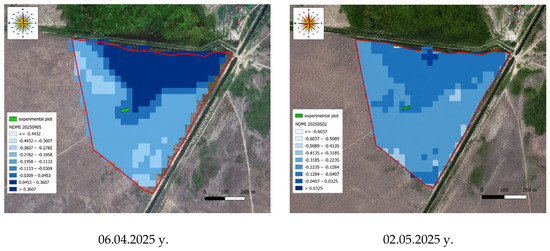
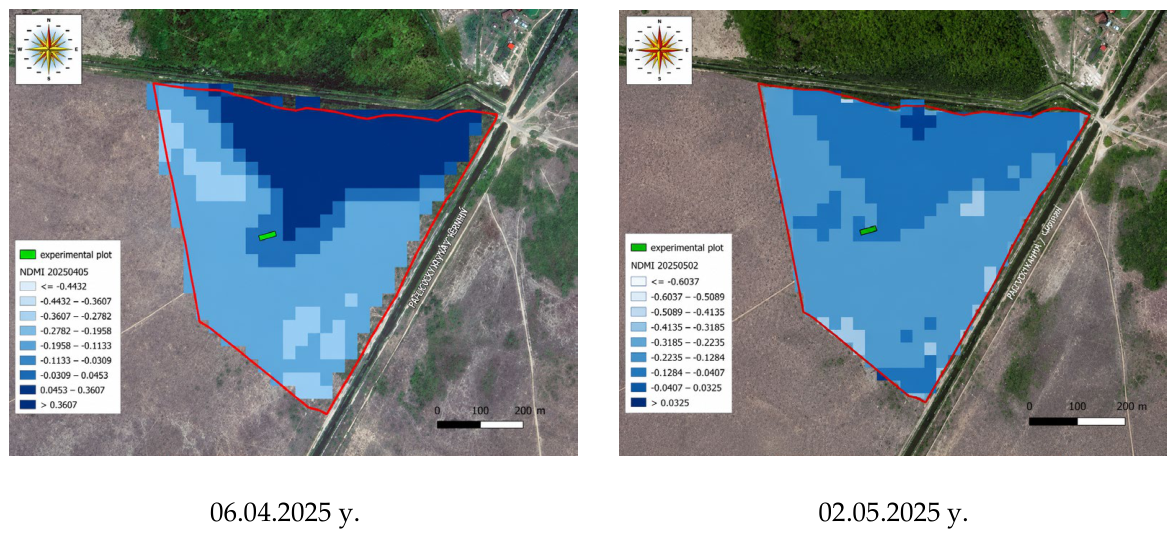
The flooding regime was assessed using two complementary approaches: direct field measurements and remote sensing data. During the flooding period, water depth at the experimental site was measured using a staff gauge, which allowed characterization of the site’s hydrological conditions and verification of the actual presence of flooding. Simultaneously, Landsat 8–9 satellite imagery obtained from the United States Geological Survey database (USGS, 2024) [31,36] was used to assess the spatial extent and dynamics of flooding. The Normalized Difference Water Index (NDWI) [31,32,36,37] was calculated to delineate open water surfaces and waterlogged areas (Figure 1). Comparison of field measurements with NDWI-derived data improved the reliability of delineating flood boundaries and characterizing flooding conditions at the experimental site.
Figure 1.
Spatiotemporal dynamics of the estuary plot boundaries, determined via the NDWI index based on Landsat 9 satellite data.
The NDWI index was applied to delineate the boundaries of water bodies and analyze their spatiotemporal dynamics. The index is calculated based on the green and near-infrared (GREEN-NIR) band ratio, taking advantage of the high reflectance of water in the green spectrum and its low reflectance in the near-infrared spectrum, where the values for vegetation and soils are at their maximum. Due to this property, NDWI is effectively utilized for monitoring water features [38,39,40].
The NDWI values ranged from −1 to +1: high values (around +1) indicate the presence of open water, intermediate values (−0.2 to 0.2) correspond to flooded or waterlogged surfaces, and low values (−1 to −0.3) represent arid or dry areas devoid of surface water [41].
2.2. Chemical and Metagenomic Soil Analysis
2.2.1. Soil Sampling and Preparation
Soil samples were collected in June 2025 from three distinct depths (0–20, 20–40, and 40–60 cm) using a five-point composite sampling method for each treatment variant. Following thorough homogenization, each composite sample was split into two subsamples: one part was air-dried and sieved for subsequent chemical analyses, while the second part was immediately transferred to portable freezers at −20 °C for transport. Upon arrival at the laboratory, these samples were stored at −50 °C for subsequent high-throughput microbial sequencing. All soil chemical analyses were performed in triplicate.
2.2.2. Chemical Analyses
Soil pH was determined potentiometrically in a 1:5 (w/v) soil-to-water suspension using a digital pH meter. Soil organic carbon (SOC) content was measured via wet oxidation using a potassium dichromate solution in sulfuric acid, followed by the quantification of reduced chromium using a photoelectric colorimeter. Nitrate nitrogen was determined by the ion-selective electrode method after extraction with aluminum potassium sulfate or potassium sulfate solutions. Available (mobile) phosphorus and potassium were extracted using an ammonium carbonate solution (10 g/dm3). Subsequently, the extracted phosphorus was determined colorimetrically on a photoelectric colorimeter, while available potassium was quantified using flame photometry. The content of available sulfur was determined by extracting mobile sulfur fractions from the soil with a potassium chloride solution. Sulfates were precipitated using barium chloride, and their concentration was measured turbidimetrically as barium sulfate based on the optical density of the suspension. Soluble starch was utilized as a suspension stabilizer.
2.2.3. DNA Extraction, 16S rRNA Amplification, and Sequencing
Total genomic DNA was extracted from the soil samples using the PureLink™ Microbiome DNA Purification Kit (Invitrogen, Carlsbad, CA, USA) according to the manufacturer’s instructions. The concentration and purity of the isolated DNA were assessed using a Qubit Fluorometer (Thermo Scientific, Waltham, MA, USA) and a Tecan NanoPlate (Tecan, Männedorf, Switzerland). Amplification of the 16S rRNA gene fragment was performed using the universal primers 8F (5′-AGAGTTTGATCCTGGCTCAG-3′) and R806 (5′-GGACTACCAGGGTATCTAAT-3′) in a final reaction volume of 25 µL containing 2× KAPA HiFi HotStart ReadyMix [42]. High-throughput sequencing was executed on the Illumina MiSeq platform in a paired-end mode (paired-end, 2 × 300 bp) using the MiSeq Reagent Kit v3. To increase base-calling complexity, a 15% PhiX control spike-in was added to the library.
2.2.4. Bioinformatics and Data Processing
The quality of the raw sequence reads was evaluated and filtered using Trimmomatic software. Following the removal of low-quality reads and adapter trimming, the high-quality paired-end reads were taxonomically classified using the Kaiju program (Trimmomatic v0.39 and Kaiju v1.10.1). The NCBI BLAST non-redundant protein database (nr + euk, downloaded in May 2025) was employed as a reference database with default parameters. The downstream processing and analysis of the MiSeq sequencing data were performed within the QIIME (QIIME 2, version 2024.10) software pipeline.
3. Results
3.1. Soil Chemical Properties
To evaluate the effects of periodic flooding and chemical amelioration on soil parameters, key soil chemical properties were determined, including pH, soil organic carbon, nitrate nitrogen, and available forms of phosphorus, potassium, and sulfur. Table 1 presents the analytical results for the control plots and the treatment variants amended with different application rates of gypsum and elemental sulfur across three soil depths: 0–20, 20–40, and 40–60 cm.
Table 1.
Soil chemical properties across different experimental treatments and depths.
3.2. Microbial Community Diversity and Composition
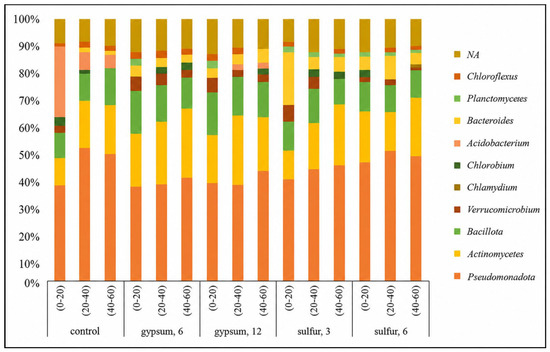
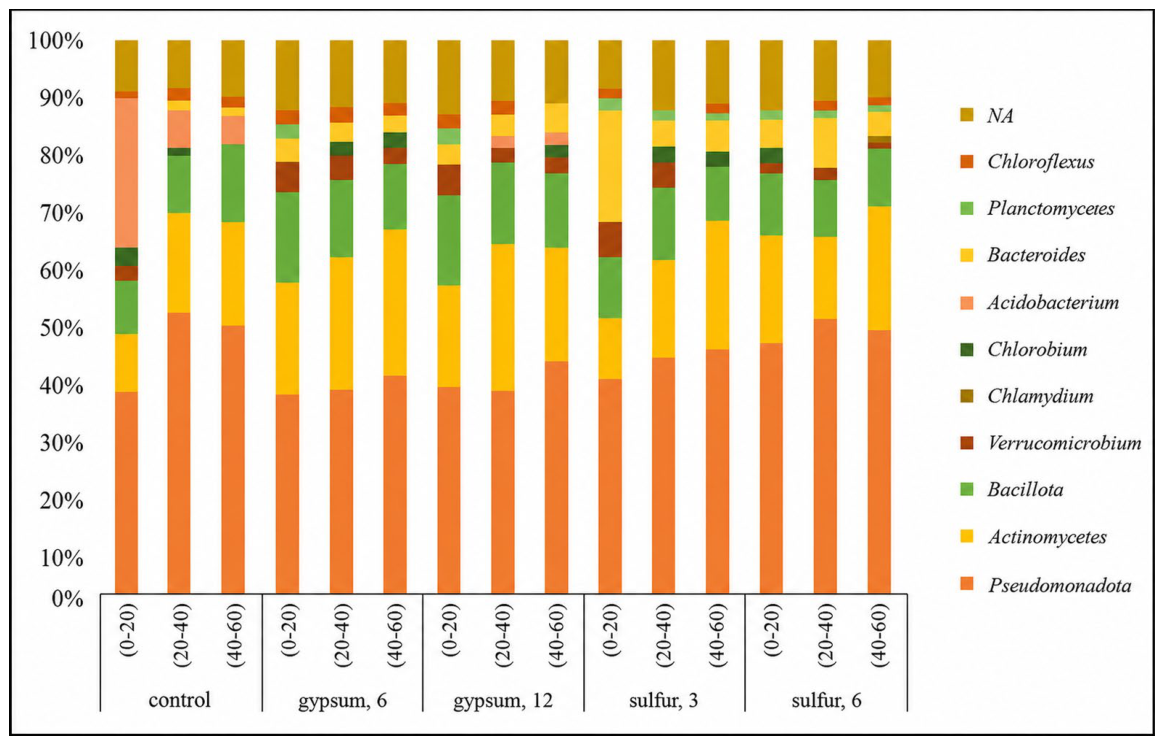
Figure 2 illustrates the qualitative and quantitative composition of the soil microbial communities across the experimental treatments and ameliorant application rates at the phylum level. Bacteria accounted for 97.70% of the community, while only 2.20% of the taxa remained unclassified at the kingdom level. In the control treatment, the total number of sequence reads was 513,347, of which 73,644 reads were unclassified.
Figure 2.
Relative abundance of soil microbial communities at the phylum level across different chemical ameliorant treatments, %.
The application of varying doses of gypsum and elemental sulfur exerted a distinct influence on the bacterial community structure across the soil profile. In the control plots, the community was dominated by Pseudomonadota (43.63–47.88%), with their relative abundance slightly increasing within the 20–40 cm soil layer. The next most dominant phyla were Acidobacterium (13.09–18.11%) and Bacillota (9.74–13.15%). A high relative abundance of Acidobacterium (33.10%) was recorded in the top 0–20 cm layer, followed by a sharp decline with depth (down to 5.10–6.18%). The proportion of unidentifiable bacteria ranged from 9.26% to 11.85%.
Evaluation of the effect of gypsum applied at a rate of 6000 kg/ha revealed a decrease in Pseudomonadota abundance in the topsoil layer (33.37%) compared to the control. Concurrently, the proportion of Acidobacterium increased down the soil profile (18.86–24.47%). In the 0–20 cm layer, the Bacillota content increased to 15.62%. Compared to the control, a drastic reduction in Acidobacterium representation was observed, leading to their near-complete absence across the soil layers. This was accompanied by an increase in the proportion of Verrucomicrobium, while the content of unidentified bacteria remained relatively stable (11.36–13.12%).
The application of gypsum at a dose of 12,000 kg/ha was accompanied by a moderate increase in the proportion of Pseudomonadota in the 40–60 cm layer (up to 38.66%). The maximum abundance of Acidobacterium was recorded in the 20–40 cm layer (24.93%). The proportion of Bacillota remained stable (12.51–14.74%). The presence of Acidobacterium was detected predominantly in the deeper horizons and did not exceed 2.00%. Overall, the higher application rate of gypsum facilitated a redistribution of the taxonomic structure, enhancing the role of Acidobacterium and resulting in a more structured microbial community profile.
Under the influence of elemental sulfur at a dose of 3000 kg/ha, the Pseudomonadota community maintained its dominance at levels comparable to the control (39.20–43.52%). An increase in the relative abundance of Verrucomicrobium (6.85%) and Bacteroides (23.14%) was observed in the topsoil layer, whereas members of Acidobacterium (up to 22.45%) exhibited higher abundance in the underlying horizon. The proportion of Bacillota (9.30–12.87%) remained relatively low.
Increasing the elemental sulfur dose to 6000 kg/ha resulted in the maximum relative abundance of Pseudomonadota (46.31%) in the 20–40 cm layer, an increased representation of Acidobacterium (22.34%) in the bottom layer, and a decline in the Verrucomicrobium fraction throughout the entire soil profile (0.84–2.42%). The abundance of Bacteroides (8.42%) in the 20–40 cm layer exceeded control values, while the proportion of Chlorobium (2.45%) showed a slight increase in the 0–20 cm layer.
A comparative analysis of the different ameliorant treatments demonstrated that gypsum, particularly at a dose of 6000 kg/ha, decreased the proportion of Pseudomonadota in the topsoil and promoted the expansion of Acidobacterium. This shift may indicate altered trophic conditions and accelerated organic matter mineralization processes. The higher dose of gypsum intensified taxonomic redistribution in the deeper horizons, resulting in a stabilization of the dominant phyla. Sulfur, at both investigated doses, sustained high Pseudomonadota abundance; however, at the 3000 kg/ha rate, it induced a substantial increase in Bacteroides within the topsoil. The application of sulfur at 6000 kg/ha led to a more pronounced vertical stratification of the microbial community across the profile and stimulated Acidobacterium growth in the lower horizon.
In conclusion, the structure of the soil bacterial communities was significantly shaped by the dose-dependent effects of the applied ameliorants. Gypsum predominantly favored the expansion of Acidobacterium while reducing the proportion of Pseudomonadota in the surface soil layer. Conversely, elemental sulfur maintained the dominance of Pseudomonadota and stimulated the development of Bacteroides at the lower application rate. The most pronounced modifications in the taxonomic structure occurred in the 0–20 cm layer, whereas in the underlying horizons, the impact of the ameliorants was primarily manifested as a spatial redistribution of dominant microbial groups.
Analysis of key alpha-diversity indicators confirms the hypothesis that ameliorant application acts as a strong driver for restoring soil biological complexity. According to the obtained data, species richness and Shannon diversity index values show a pronounced positive response to gypsum and elemental sulfur application compared with the control treatments (Table 2).
Table 2.
Alpha diversity and community structure of the soil microbial microbiome.
The maximum values were recorded under the application of gypsum at a rate of 12,000 kg/ha in the 0–20 cm soil layer (3231), which is substantially higher than the control values (2303–2435). This trend indicates the activation of latent microbial groups and an expansion of soil ecological capacity induced by chemical amelioration.
Simpson’s index values (0.97–0.99) across all treatment variants demonstrate the absence of dominance by individual taxa and high evenness within the microbial community. This structural characteristic is critical for maintaining the resilience of biogeochemical processes under conditions of periodic flooding.
A decline in species richness was observed with increasing soil depth (for instance, under the application of elemental sulfur at 6000 kg/ha, richness decreased from 2973 in the 20–40 cm layer to 1959 in the 40–60 cm layer). However, even within the deeper 40–60 cm horizon, the amelioration treatment (gypsum at 12,000 kg/ha) sustained a high Shannon index (6.27), thereby demonstrating a strong subsoil impact.
Throughout the 2024–2025 period, stable and elevated Shannon index values were maintained (6.25–6.27 for the 12,000 kg/ha treatment), confirming the long-term establishment of a resilient and sustainable soil microbial community.
3.3. Plant Species Composition and Productivity
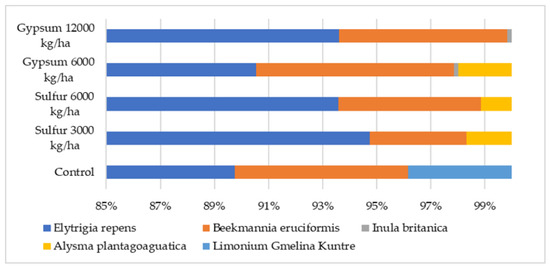
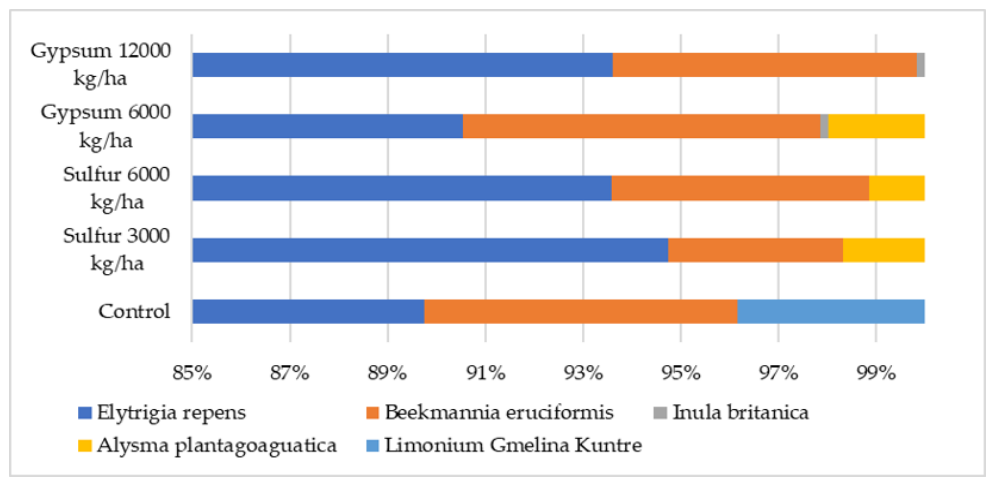
Across the entire flooded territory, an average of up to 22 plant species was recorded. Because the soil profile exhibits a bowl-shaped microrelief, a decrease in elevation correlates with an increase in both flooding duration and volume, which subsequently drives the formation of distinct plant associations. Within the selected study plot, characterized by a flooding volume of 2000–3000 m3/ha, forage grasses (Poaceae) predominated, with an overall species richness ranging from 4 to 6 species. Figure 3 illustrates the relative abundance and composition of natural vegetation on the control plots compared to the chemically amended treatments.
Figure 3.
Relative composition of natural vegetation within the flooded area, %.
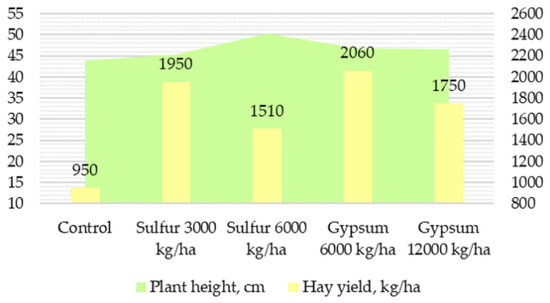
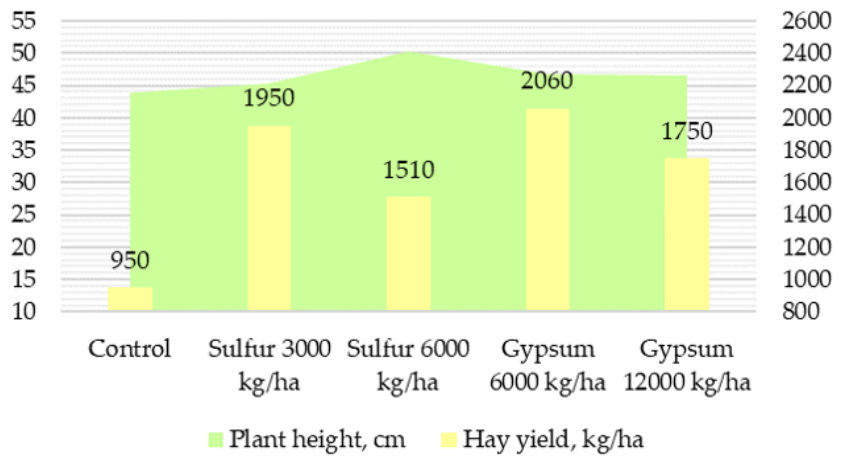
Figure 4 illustrates the plant height and hay yield parameters within the flooded area as a function of the chemical soil amelioration treatments.
Figure 4.
Plant height (cm) and hay yield (kg/ha) within the flooded area under chemical soil amelioration, 2025.
A positive effect of gypsum and elemental sulfur application on plant growth and hay yield was observed relative to the control. The data obtained for vegetation productivity during the first year of the experiment indicated only a minor trend toward variation among the treatment options. Due to the high coefficient of variation across replicates, these observed differences did not achieve statistical significance (p > 0.05).
4. Discussion
4.1. Soil Agrochemical Properties
Analysis of soil agrochemical indicators revealed that the application of chemical ameliorants significantly influenced the chemical properties of the topsoil layer (0–20 cm), whereas the modifications observed in the middle (20–40 cm) and lower (40–60 cm) layers were statistically non-significant. In the control treatment, pH values were 8.2 in the 0–20 cm layer, 8.4 in the 20–40 cm layer, and 8.5 in the 40–60 cm layer, with no statistically significant differences detected between the layers (all values assigned to group “a”). The application of gypsum and elemental sulfur reduced topsoil pH to 7.9 under gypsum at 6000 kg/ha and to 7.7 under both gypsum at 12,000 kg/ha and sulfur at 6000 kg/ha. These decreases were statistically significant compared with the control (p < 0.05), whereas the differences among treatments in the middle and lower layers remained statistically non-significant. These findings are consistent with Xiao et al. (2025) [43], who reported that the application of flue-gas desulfurization (FGD) gypsum decreased the pH of the upper layers of alkaline soils from 8.5 to 7.6–7.8 and improved ionic balance. They also align with Wang et al. (2023) [44], who noted a reduction in soil pH from 8.0–8.2 down to 7.66–7.71 following chemical reclamation.
The humus content in the control treatment decreased from 2.4% in the topsoil to 0.6–0.8% in the lower horizon. In the 0–20 cm layer, a significant reduction in humus content was observed only under the 6000 kg/ha gypsum treatment (2.2%, group “b”), while the other variants showed no statistically significant differences from the control. In the middle and lower layers, the differences between treatments were likewise non-significant. According to previous studies, the application of gypsum and sulfur without organic amendments does not lead to an increase in soil organic matter content; rather, a positive synergistic effect is observed only when combined with organic materials [45]. Research by Ali et al. (2024) [46] and Gashi et al. (2025) [47] highlighted the stabilization of organic matter in alkaline soils upon ameliorant application, which generally corroborates our results, as humus content was maintained at the control level across all variants except for the 6 t/ha gypsum treatment.
Available nitrogen in the topsoil of the control plots was 7.3 mg/kg (group “b”). Significantly higher values were recorded in the treatments with gypsum at 6000 and 12,000 kg/ha and sulfur at 6000 kg/ha (7.9–8.2 mg/kg, group “a”). In the 20–40 cm layer, the maximum concentrations were documented under the 12,000 kg/ha gypsum and 6000 kg/ha sulfur variants. No significant differences among the treatments were found in the deepest layer. These data are in agreement with Bello et al. [48] and Wang et al. [44], where the co-application of gypsum and organic amendments enhanced nitrogen availability and its cycling within the upper soil horizons.
Analysis of mobile phosphorus content demonstrated a positive effect of chemical ameliorants across all studied soil layers. In the upper 0–20 cm horizon, gypsum at a dose of 6000 kg/ha increased the P2O5 дo 36.3 ± 0.2 mg/kg (a 5.8% increase relative to the control, which stood at 34.3 ± 0.2 mg/kg), while the 12,000 kg/ha dose boosted it to 41.2 ± 0.2 mg/kg (a 20.1% increase). Similar trends were observed by Xiao et al. (2025), where gypsum application enhanced the P2O5 content by 15–20% in the surface soil [43]. Elemental sulfur applications at doses of 3000 and 6000 kg/ha raised P2O5 33.2 ± 0.2 mg/kg (3.2%) and 35.2 ± 0.2 mg/kg (2.9%), respectively.
In the 20–40 cm layer, the P2O5 content increased to 35.8 ± 0.2 mg/kg under the 6000 kg/ha gypsum treatment and to 34.7 ± 0.2 mg/kg under the 12,000 kg/ha treatment, corresponding to increases of 5.9% and 2.7%, respectively. Sulfur application enhanced P2O5 content to 30.8–32.8 mg/kg (a 2.9–8.9% increase). In the lower 40–60 cm horizon, the concentration of mobile phosphorus reached 31.8 ± 0.2 mg/kg under 12,000 kg/ha of gypsum (a 22.8% increase) and 28.9 ± 0.2 mg/kg under 6000 kg/ha of gypsum (11.6%), whereas sulfur application resulted in values of 24.2–26.7 mg/kg (a 1.2–3.1% increase).
Available potassium (K2O) in the topsoil of the control was 317.8 mg/kg (group “a”). The application of gypsum at 12,000 kg/ha and sulfur at 6000 kg/ha statistically reduced the K2O content to 286.4 and 304.5 mg/kg, respectively (group “b”). In the middle and lower soil layers, the differences were minor, which is supported by the data of Ali et al. [46] who noted that K2O concentrations change minimally during chemical soil reclamation. The total sulfur content in the topsoil of the control was 6.4 mg/kg (group “b”), whereas the application of gypsum at 12,000 kg/ha and elemental sulfur at 6000 kg/ha increased it to 8.8 and 9.8 mg/kg, respectively (group “a”). In the 20–40 and 40–60 cm layers, the differences between the treatment variants were less pronounced. These results coincide with Xiao et al. (2025), where sulfur input increased the S content by 30–40% in the upper horizon [43]. Consequently, the most effective treatments for improving the soil chemical state were gypsum at 12,000 kg/ha and elemental sulfur at 6000 kg/ha, both of which decreased the topsoil pH and significantly enhanced the concentrations N-NO3, P2O5, and S. The upper soil layer (0–20 cm) proved to be more responsive to ameliorant application, whereas the middle and lower horizons exhibited a weaker response.
4.2. Microbiome Taxonomic Structure and Ecological Succession
The transformation of the microbiome structure under the influence of chemical ameliorants (gypsum and elemental sulfur) indicates an ecosystem transition from a state of chemical stress to a new phase of functional equilibrium. The observed predominance of the bacterial domain (97.70%) over unclassified taxa underscores the high adaptive plasticity of prokaryotes under conditions of anthropogenic soil property correction. These findings align with previous studies showing that the chemical reclamation of saline soils reduces exchangeable sodium content and alleviates salt stress, which is accompanied by an increase in microbial activity and enhanced organic carbon mineralization processes [49]. These shifts indicate an elevated functional activity of the soil microbiome as environmental conditions improve.
The dominance of Pseudomonadota in the control plots (43.63–47.88%) is characteristic of soils with highly dynamic available nutrient pools, where representatives of this phylum function as typical copiotrophic organisms. Similar patterns have been identified in the periodically flooded soils of the Southern Urals reservoirs, where Pseudomonadota formed the core of the microbial pool under conditions of active organic matter exchange and an unstable hydrological regime [21].
The reduction in their relative abundance to 33.37% in the topsoil horizon upon gypsum application (6000 kg/ha), coupled with the concomitant increase in Acidobacterium (up to 24.93%), indicates a shift in the successional stage of the microbial community. The increased representation of Acidobacterium is considered an indicator of soil environmental stabilization and enhanced organic matter mineralization. This corroborates the results of investigations into the effects of flooding and subsequent soil recovery, where Acidobacterium emerged as a key group during the late stages of microbial succession [50]. Owing to their well-developed enzymatic apparatus and high resilience to osmotic stress, Acidobacterium actively participate in the transformation of recalcitrant organic compounds, thereby promoting the stable functioning of the soil system.
The response mechanisms to gypsum and sulfur amendments are linked to the restructuring of the microbial community and alterations in the ecological niches of individual taxa. The sharp decline or disappearance of Acidobacterium following gypsum application is consistent with the well-known dependence of this phylum on environmental acidity, as members of Acidobacterium are predominantly associated with acidic soils. The correction of soil acid–base status induced by calcium-bearing ameliorants leads to a reduction in their competitive advantage, an effect that has also been documented during shifts in the hydrological regimes of floodplain territories in Kazakhstan and other regions [51,52].
Sulfur application was accompanied by an increase in the proportion of Bacteroides (up to 23.14%), reflecting a specific metabolic response of this group, which is linked to the decomposition of complex organic substrates. A similar increase in Bacteroides has been observed during short-term flooding of agricultural soils, where changes in redox conditions stimulated microorganisms involved in the accelerated transformation of organic matter [53]. It is highly probable that the acidifying effect of sulfur promotes the mobilization of previously unavailable organic compounds, thereby generating new ecological niches for representatives of this phylum.
The stable presence of Bacillota and Verrucomicrobium indicates the formation of a resilient “core” microbial community possessing high stress tolerance. Representatives of Bacillota are capable of endospore formation, allowing them to survive extreme fluctuations in moisture and salinity regimes, which is highly characteristic of floodplain and periodically waterlogged soils [54].
The most pronounced transformation of the taxonomic structure within the 0–20 cm layer is driven by the direct contact of microbial associations with the ameliorants and active gas exchange. A similar vertical differentiation of the microbiome has been noted in studies of flooded agroecosystems, where the surface horizon exhibited maximum sensitivity to anthropogenic disturbances, whereas deeper layers responded more inertly to the impacts [55]. The structural alignment observed in the lower horizons (20–60 cm) under the increased gypsum dose of 12,000 kg/ha provides evidence of calcium and sulfate migration down the soil profile, which initiates a systemic restructuring of the entire soil biota.
The obtained results demonstrate that the application of gypsum at a dose of 6000 kg/ha yields the most balanced microbiome structure by stimulating the development of agronomically valuable groups (Acidobacterium, Verrucomicrobium), whereas sulfur acts as a more pronounced driver of Bacteroides proliferation. Similar conclusions regarding the role of targeted correction of soil properties as a mechanism for restoring ecosystem functions are presented in frameworks addressing soil ecosystem services management and agroecosystem resilience [56].
The observed shifts in soil agrochemical parameters, alpha diversity, and microbiome taxonomic structure under gypsum and elemental sulfur amendments carry distinct agroecological significance. The reduction in topsoil pH and the simultaneous enrichment of available nitrogen, phosphorus, and sulfur fractions at specific ameliorant application rates are accompanied by an increase in species richness and the Shannon index, reflecting an expansion of microbial taxonomic diversity. The structural reorganization of the microbiome, manifested by a decline in the relative abundance of Acidobacterium alongside an increase in Acidobacterium, Bacillota, and Bacteroides, demonstrates a fundamental shift in environmental conditions and a redistribution of dominant functional groups. Collectively, these findings indicate an overall improvement in soil trophic status and the establishment of more favorable conditions for grassland canopy development, confirming the high efficacy of chemical amelioration under estuary-type (liman) irrigation.
4.3. Sward Structure and Forage Productivity
In the sward structure of the experimental plot, palatable forage grasses predominated, specifically couch grass (Elymus repens L.) and slough grass (Beckmannia eruciformis L.), which constituted the bulk of the vegetation biomass and are highly suitable for livestock feed. The remaining species, which occurred in minor amounts—including British yellowhead (Inula britannica L.), common water-plantain (Alisma plantago-aquatica L.), and Gmelin’s sea-lavender (Limonium gmelinii Willd.)—are non-forage species and were documented solely to characterize the overall floristic composition.
The relative abundance of Elymus repens on the experimental plot varied from 89.6% in the control to 94.7% under the 3 t/ha elemental sulfur treatment, calculated as a ratio to the total plant count. The highest absolute density of Elymus repens was documented under the 6000 kg/ha gypsum treatment (622.3 ind./m2), while the lowest was recorded in the control variant (210.3 ind./m2). Beckmannia eruciformis was present across all treatment variants, with a relative abundance ranging from 3.6% to 7.3%. Inula britannica was observed exclusively under the gypsum amendments (0.14–0.18%). Alisma plantago-aquatica was detected under both sulfur application rates (3000 and 6000 kg/ha) as well as under the 6000 kg/ha gypsum variant. Limonium gmelinii was recorded only within the control plots (3.8%). The mean plant height in the control variant was 43.8 cm. The maximum height was observed under the 6 t/ha sulfur treatment, reaching 50.2 cm (+14.6% relative to the control). The variants featuring gypsum (6000 and 12,000 kg/ha) and sulfur (3000 kg/ha) also enhanced plant height to 46.8, 46.6, and 45.4 cm, respectively. The maximum hay yield was achieved under the 6000 kg/ha gypsum treatment, yielding 2060 kg/ha, which is 2.2 times higher than the control (950 kg/ha). The application of sulfur at 3000 kg/ha also significantly contributed to the biomass increase (1950 kg/ha), whereas increasing the sulfur dose further to 6 t/ha was accompanied by a decline in yield. The 12,000 kg/ha gypsum variant resulted in a hay yield of 1750 kg/ha.
A weak direct correlation (r = 0.28) was observed between plant height and biomass weight, indicating that taller plants did not consistently produce a substantially higher hay yield. Conversely, a near-perfect direct correlation (r = 0.99) was established between the number of plants per square meter and the final yield, pointing to a direct dependence of hay mass on sward density.
International studies indicate that optimizing growth conditions for couch grass (via fertilizer inputs, canopy density regulation, and mowing schedule management) enhances its growth and biomass accumulation. Specifically, Martineau, Leroux, & Seoane [57] reported an upgrade in couch grass productivity following fertilization; Malhi, Foster, & Gill [58] demonstrated increased biomass driven by nitrogen fertilization and timely harvesting; and Rasmussen et al. [59] highlighted the influence of stand density and agronomic care on the competitive ability of the species. These reported trends strongly corroborate our data, where the application of gypsum and elemental sulfur within the flooded area promoted an increase in Elymus repens density, height, and subsequent hay yield, confirming that the productivity of this species is primarily determined by stand density and enhanced environmental growth conditions.
5. Conclusions
The maximum integrated and synergistic effect on the soil–microbiome–plant system was achieved under the application of gypsum at a rate of 6000 kg/ha. This treatment ensured the maximum hay yield (2060 kg/ha), a reduction in topsoil pH to 7.9, and an improvement in the content of available phosphorus (36.3 mg/kg) and total sulfur (7.2 mg/kg). Furthermore, it promoted the formation of the most balanced microbial community structure, characterized by a pronounced representation of functionally important soil bacterial groups. Consequently, this treatment exhibited the optimal combination of agrochemical and biological parameters and was considered the most effective under the specific conditions of this study.
In terms of individual soil nutrient indicators, the highest efficiency was recorded under the 12,000 kg/ha gypsum treatment. This treatment provided the maximum accumulation of available phosphorus (up to 41.2 mg/kg) and triggered a distinct redistribution of microbial taxa, significantly increasing the proportion of Acidobacterium. This structural shift indicates accelerated organic matter mineralization and nutrient transformation processes.
The treatment involving elemental sulfur at a dose of 6000 kg/ha was characterized by the greatest improvement in plant nitrogen and sulfur nutrition (N-NO3− up to 8.2 mg/kg; S up to 9.8 mg/kg), resulting in the maximum plant height (50.2 cm). This amendment also induced the most pronounced restructuring of the microbial community by increasing the relative abundance of Bacteroides and Verrucomicrobium, reflecting enhanced microbiological activity and modified soil trophic conditions.
The application of elemental sulfur at a lower dose of 3000 kg/ha provided the second-highest hay yield (1950 kg/ha) and induced more balanced and stable shifts in both agrochemical and microbiological parameters without causing extreme deviations.
Future research directions will focus on the co-application of chemical amelioration and targeted microbial inoculation to further stimulate microbiological processes and enhance agroecosystem resilience under arid and semi-arid conditions.
Author Contributions
Conceptualization, A.N. and M.O.; methodology, A.N.; software, R.J.; validation, M.O., Y.A. and S.D.; formal analysis, N.U. and D.S.; investigation, A.N.; resources, D.S.; data curation, R.J.; writing—original draft preparation, A.N.; writing—review and editing, A.N.; visualization, A.N.; supervision, A.N.; project administration, A.N.; funding acquisition, A.N. All authors have read and agreed to the published version of the manuscript.
Funding
This study was funded by the Ministry of Science and Higher Education of the Republic of Kazakhstan as part of grant funding for the project AP23489274, “Development of a Technology for Improving the Ecological and Reclamation State of Estuaries and Increasing Their Productivity”.
Institutional Review Board Statement
Not applicable.
Informed Consent Statement
Not applicable.
Data Availability Statement
The data presented in this study are available from the corresponding author upon reasonable request. Sequencing data generated in this study are available upon reasonable request for academic and non-commercial use. The datasets are not publicly deposited in a repository but can be shared upon justified request.
Acknowledgments
The authors acknowledge Zhangir Khan West Kazakhstan Agrarian-Technical University (WKAU) for providing institutional support and facilitating the implementation of this research.
Conflicts of Interest
The authors declare no conflicts of interest.
References
- FAO. Guidelines on Spate Irrigation; Irrigation and Drainage Paper No. 65; Food and Agriculture Organization of the United Nations: Rome, Italy, 2010; 233p. [Google Scholar]
- Hiben, M.G.; Embaye, T.-A.G. Spate irrigation in Tigray: The challenges and suggested ways to overcome them. In Flood-Based Farming for Food Security and Adaptation to Climate Change in Ethiopia: Potential and Challenges; IWMI: Colombo, Sri Lanka, 2014; pp. 170–179. [Google Scholar] [CrossRef]
- Oudra, M. Spate irrigation in North Africa: Development perspectives. Irrig. Drain. 2008, 57, 293–303. [Google Scholar] [CrossRef] [Scilit]
- Komakech, H.C.; Mul, M.L.; Van der Zaag, P.; Rwehumbiza, F.B.R. Water allocation and management in an emerging spate irrigation system in Makanya catchment, Tanzania. Agric. Water Manag. 2011, 98, 1719–1726. [Google Scholar] [CrossRef] [Scilit]
- Fadul, E.; Masih, I.; De Fraiture, C.; Suryadi, F.X. Irrigation performance under alternative field designs in a spate irrigation system with large field dimensions. Agric. Water Manag. 2020, 231, 105989. [Google Scholar] [CrossRef] [Scilit]
- Pi, H.; Zhang, X.; Li, S.; Webb, N.P. Influence of crop rotation, irrigation, fertilization, and tillage on soil aggregate properties and erosion potential. Aeolian Res. 2024, 67, 100925. [Google Scholar] [CrossRef] [Scilit]
- Lecina, S.; Playán, E.; Isidoro, D.; Dechmi, F.; Causapé, J.; Faci, J.M. Irrigation evaluation and simulation at the Irrigation District V of Bardenas (Spain). Agric. Water Manag. 2005, 73, 223–245. [Google Scholar] [CrossRef] [Scilit]
- González, C.; Cervera, L.; Moret-Fernández, D. Basin irrigation design with longitudinal slope. Agric. Water Manag. 2011, 98, 1516–1522. [Google Scholar] [CrossRef] [Scilit]
- Chen, B.; Ouyang, Z.; Sun, Z.; Wu, L.; Li, F. Evaluation of border irrigation performance improvement. Irrig. Sci. 2013, 31, 715–728. [Google Scholar] [CrossRef] [Scilit]
- Anwar, A.A.; Ahmad, W.; Bhatti, M.T.; Haq, Z. Precision surface irrigation in the Indus Basin Irrigation System. Irrig. Sci. 2016, 34, 347–359. [Google Scholar] [CrossRef] [Scilit]
- Mallem, S.E.; Tatar, H.; Boultif, M. A diachronic analysis of vegetation cover in a spate irrigation perimeter: Case study of El Feidh, Biskra, Algeria. Rev. Roum. Géogr./Rom. J. Geogr. 2025, 69, 77–99. [Google Scholar] [CrossRef] [Scilit]
- Yang, Y.; Li, Z.; Chen, Y.; Zhang, Y.; Lu, L. Periodic flooding alters ecological processes and carbon metabolism efficiency of riparian soil microbial communities in the Three Gorges Reservoir area, China. J. Environ. Manag. 2025, 376, 124534. [Google Scholar] [CrossRef] [Scilit] [PubMed]
- Zhu, K.; Ye, F.; Mei, Y.; Jia, W.; Zhu, X.; Li, S.; Wu, S.; Zhang, S.; Huang, P. The complex interplay of flooding intensity and land use on soil microbial communities in riparian zones: Insights for ecological restoration. Catena 2025, 248, 108549. [Google Scholar] [CrossRef] [Scilit]
- Chaudhary, S.; Sindhu, S.S.; Dhanker, R.; Kumari, A. Microbes-mediated sulphur cycling in soil: Impact on soil fertility and crop production. Microbiol. Res. 2023, 271, 127340. [Google Scholar] [CrossRef] [Scilit] [PubMed]
- Jiao, S.; Chen, W.; Wang, J.; Du, N.; Li, Q.; Wei, G. Soil microbiomes with distinct assemblies through vertical soil profiles drive nutrient cycling. Microbiome 2018, 6, 146. [Google Scholar] [CrossRef] [Scilit] [PubMed]
- Hu, M.; Sardans, J.; Sun, D.; Yan, R.; Wu, H.; Ni, R.; Peñuelas, J. Microbial diversity and keystone species drive soil multifunctionality following mangrove restoration. Environ. Res. 2024, 251, 118715. [Google Scholar] [CrossRef] [Scilit] [PubMed]
- Freitas, A.S.; Carlos, F.S.; Martins, G.L.; Monteiro, G.G.T.N.; Roesch, L.F.W. Bacterial resilience and community shifts under 11 draining-flooding cycles in rice soils. Microb. Ecol. 2024, 87, 149. [Google Scholar] [CrossRef] [Scilit] [PubMed]
- Sun, K.; Yang, R.; Che, Z.; Zhao, W.; Song, S.; Ren, H. Soil texture modulates microbial responses to irrigation. Soil Tillage Res. 2026, 256, 106838. [Google Scholar] [CrossRef] [Scilit]
- Zhang, S.; Zhang, Z.; Chen, X.; Li, S.; Qin, Y.; Xia, Y.; Wang, Y.; Wang, F. Effect of soil flooding and drying on the metabolic pathways of CO2-fixing microorganisms along an elevation gradient in the Three Gorges Reservoir drawdown area. Soil Use Manag. 2024, 40, e13021. [Google Scholar] [CrossRef] [Scilit]
- Ankush, P.R.; Kumar, R.; Singh, V.; Harender; Singh, V.K. Soil microbial and nutrient dynamics under salinity. Int. Agrophys. 2020, 34, 451–462. [Google Scholar] [CrossRef] [Scilit]
- Minnegaliev, A.; Abakumov, E.; Suleymanov, R.; Zaitsev, G.; Davydychev, A.; Dorogaya, E.; Zverev, A.; Andronov, E.; Asylbaev, I. Soil microbial communities in flood zones of reservoirs. Ecologies 2024, 5, 233–247. [Google Scholar] [CrossRef] [Scilit]
- Shainberg, I.; Sumner, M.E.; Miller, W.P.; Farina, M.P.W.; Pavan, M.A.; Fey, M.V. Use of gypsum on soils: A review. Adv. Soil Sci. 1989, 9, 1–111. [Google Scholar] [CrossRef] [Scilit]
- Wallace, A. Use of gypsum on soil for sustainable agriculture. Commun. Soil Sci. Plant Anal. 1994, 25, 109–116. [Google Scholar] [CrossRef] [Scilit]
- Amézketa, E. Soil aggregate stability: A review. J. Sustain. Agric. 1999, 14, 83–151. [Google Scholar] [CrossRef] [Scilit]
- Amézketa, E.; Aragüés, R.; Gazol, R. Efficiency of gypsum and sulfuric acid in sodic soils. Agron. J. 2005, 97, 983–990. [Google Scholar] [CrossRef] [Scilit]
- King, K.W.; Williams, M.R.; Dick, W.A.; LaBarge, G.A. Gypsum reduces phosphorus loss. J. Environ. Qual. 2016, 45, 1722–1730. [Google Scholar] [CrossRef] [Scilit] [PubMed]
- Kost, D.; Nester, J.; Dick, W.A. Gypsum improves water quality. J. Soil Water Conserv. 2018, 73, 22A–24A. [Google Scholar] [CrossRef] [Scilit]
- Dick, W.A.; Kost, D.; Nakano, N. A Review of Agricultural and Other Land Application Uses of Flue Gas Desulfurization Products; EPRI: Palo Alto, CA, USA, 2006. [Google Scholar]
- Watts, D.B.; Dick, W.A. Sustainable uses of FGD gypsum. J. Environ. Qual. 2014, 43, 246–252. [Google Scholar] [CrossRef] [Scilit] [PubMed]
- Korzune, M.; Ávila, F.W.; Botelho, R.V.; Muller, M.M.L.; Petranski, P.H.; Pinto, E.L.C.T.; Aksenen, T.; Jadoski, S.O.; Rampim, L. Gypsum effects on forage grasses. Crop Pasture Sci. 2021, 72, 899–912. [Google Scholar] [CrossRef] [Scilit]
- Ryant, P.; Skládanka, J. Effect of sulfur on grass yield. Acta Agric. Scand. B Soil Plant Sci. 2009, 59, 208–216. [Google Scholar] [CrossRef] [Scilit]
- Stout, W.L.; Priddy, D.S.; Johnson, L.E. Gypsum effects on forage quality. Grass Forage Sci. 2006, 61, 250–259. [Google Scholar] [CrossRef] [Scilit]
- Chaganti, V.N.; Culman, S.W.; Dick, W.A.; Kost, D. Gypsum effects on corn nitrogen response. Agron. J. 2019, 111, 1109–1117. [Google Scholar] [CrossRef] [Scilit]
- Stamford, N.P.; Figueiredo, M.V.; Junior, S.d.S.; Freitas, A.D.S.; Santos, C.E.R.; Junior, M.A.L. Gypsum and sulfur effects on salinity and cowpea. Sci. Hortic. 2015, 192, 287–292. [Google Scholar] [CrossRef] [Scilit]
- de Souza, I.N.; Cristovam, M.E.P.; Moraes, E.L.; Modesto, V.C.; Ribeiro, N.A.A.; Girardi, V.A.M.; Júnior, N.C.d.S.; Matos, A.M.S.; Salles, J.S.; Gasparini, C.S.; et al. Gypsum and biofertilizer effects on soil fertility. Plants 2025, 14, 3230. [Google Scholar] [CrossRef] [Scilit] [PubMed]
- USGS. EarthExplorer. Available online: https://earthexplorer.usgs.gov/ (accessed on 2 June 2026).
- GIS-Lab. Landsat Band Combinations Guide. Available online: http://gis-lab.info/qa/landsat-bandcomb.html (accessed on 2 June 2026).
- McFeeters, S.K. The use of the Normalized Difference Water Index (NDWI) in the delineation of open water features. Int. J. Remote Sens. 1996, 17, 1425–1432. [Google Scholar] [CrossRef] [Scilit]
- Xu, H. Modification of normalised difference water index (NDWI) to enhance open water features in remotely sensed imagery. Int. J. Remote Sens. 2006, 27, 3025–3033. [Google Scholar] [CrossRef] [Scilit]
- Hernosa, F.; Susilo, B.; Erlansari. Flood risk mapping using remote sensing with NDVI, NDWI and SAW method. J. Rekursif 2020, 8, 144–152. [Google Scholar]
- Laonamsai, C.; Style, J.; Julphunthong, P.; Saprathet, T.; Kimmany, B.; Ganchanasuragit, T.; Chomcheawchan, P.; Tomun, N. Use of NDWI, MNDWI, SAVI, WRI and AWEI for erosion and deposition estimation. Hydrology 2023, 10, 70. [Google Scholar] [CrossRef] [Scilit]
- Bates, S.T.; Berg-Lyons, D.; Caporaso, J.G.; Walters, W.A.; Knight, R.; Fierer, N. Examining the global distribution of archaeal populations in soil. ISME J. 2011, 5, 908–917. [Google Scholar] [CrossRef] [Scilit] [PubMed]
- Xiao, Q.; Wei, W.; Wu, H.; Wu, K.; Gong, X.; Li, M.; Wang, S.; Yin, L. Effect of Combined Application of Desulfurization Gypsum and Soil Amendment KIA on Saline-Alkali Soil Improvement. Agronomy 2025, 15, 53. [Google Scholar] [CrossRef] [Scilit]
- Wang, P.; Liu, Q.; Fan, S.; Wang, J.; Mu, S.; Zhu, C. Gypsum and biochar for improving saline-alkali soils. Land 2023, 12, 1717. [Google Scholar] [CrossRef] [Scilit]
- Walia, M.K.; Dick, W.A. Gypsum and carbon amendments influence soil carbon fractions. PLoS ONE 2023, 18, e0283722. [Google Scholar] [CrossRef] [Scilit] [PubMed]
- Ali, O.A.M.; Zayed, B.A.; Abou El-Enin, M.M.; El Sheikha, A.F.; Kheir, A.M.S.; El-Tahlawy, Y.A.; Nada, W.M.; Shaaban, A. Saline soil improvement using gypsum and genotype interaction. J. Soil Sci. Plant Nutr. 2024, 24, 2413–2436. [Google Scholar] [CrossRef] [Scilit]
- Gashi, N.; Szőke, Z.; Czakó, A.; Fauszt, P.; Dávid, P.; Mikolás, M.; Stündl, L.; Gál, F.; Remenyik, J.; Sándor, Z.; et al. Gypsum and tillage practices for combating soil salinity. Agriculture 2025, 15, 658. [Google Scholar] [CrossRef] [Scilit]
- Bello, S.K.; Alayafi, A.H.; Al-Solaimani, S.G.; Abo-Elyousr, K.A.M. Mitigating soil salinity with gypsum and bio-organic amendments. Agronomy 2021, 11, 1735. [Google Scholar] [CrossRef] [Scilit]
- Liu, Y.; Wu, R.; Chen, J.; Zhu, Z.; Ding, S.; Wang, S.; Ge, T. Gypsum application increases microbial activity in saline soils. Appl. Soil Ecol. 2025, 208, 106004. [Google Scholar] [CrossRef] [Scilit]
- Naasko, K.; Martin, T.; Zakolski, E.; Mann, M.; Malacrinò, A.; Novais, W.; Lindsey, A.; Sprunger, C. Effects of short-term flooding on soil microbial communities. Ann. Appl. Biol. 2026, 188, 971–982. [Google Scholar] [CrossRef] [Scilit]
- Aitzhanova, M.; Zhaparova, S.; Zhamanbayeva, M.; Satimbekova, A. Soil consequences of spring flooding in Kazakhstan floodplain. Sustainability 2025, 17, 10378. [Google Scholar] [CrossRef] [Scilit]
- Laiskhanov, S.; Sharapkhanova, Z.; Myrzakhmetov, A.; Levin, E.; Taukebayev, O.; Nurmagambetuly, Z.; Kaster, S. Geo-ecological analysis of flooding in western Kazakhstan. Urban Sci. 2025, 9, 20. [Google Scholar] [CrossRef] [Scilit]
- Ling, C.; Liang, D.; Gao, L.; Zhou, Q.; Huang, H. Flooding effects on soil properties and microbial communities. iScience 2026, 29, 114650. [Google Scholar] [CrossRef] [Scilit] [PubMed]
- Rayburg, S.; Neave, M.; Thompson-Laing, J. Flood frequency and soil heterogeneity in floodplains. Soil Syst. 2023, 7, 63. [Google Scholar] [CrossRef] [Scilit]
- Rupngam, T.; Messiga, A.J. Flooding dynamics and agricultural productivity interactions. Sustainability 2024, 16, 6141. [Google Scholar] [CrossRef] [Scilit]
- Blanco-Canqui, H. Biochar and soil ecosystem services. GCB Bioenergy 2021, 13, 291–304. [Google Scholar] [CrossRef] [Scilit]
- Martineau, Y.; Leroux, G.D.; Seoane, J.R. Forage quality of quackgrass vs. timothy. Anim. Feed Sci. Technol. 1994, 47, 53–60. [Google Scholar] [CrossRef] [Scilit]
- Malhi, S.S.; Foster, A.; Gill, K.S. Nitrogen fertilization effects on quackgrass forage yield. Can. J. Plant Sci. 2003, 83, 779–784. [Google Scholar] [CrossRef] [Scilit]
- Rasmussen, I.A.; Melander, B.; Askegaard, M.; Kristensen, K.; Olesen, J.E. Elytrigia repens dynamics in cropping systems. Eur. J. Agron. 2014, 58, 18–27. [Google Scholar] [CrossRef] [Scilit]

Disclaimer/Publisher’s Note: The statements, opinions and data contained in all publications are solely those of the individual author(s) and contributor(s) and not of MDPI and/or the editor(s). MDPI and/or the editor(s) disclaim responsibility for any injury to people or property resulting from any ideas, methods, instructions or products referred to in the content. |
© 2026 by the authors. Licensee MDPI, Basel, Switzerland. This article is an open access article distributed under the terms and conditions of the Creative Commons Attribution (CC BY) license.