
Communication

Insecticidal Properties of Dysphania ambrosioides (Chenopodioideae) Essential Oil: An In Vitro Insecticidal Investigation Against Spodoptera frugiperda (Noctuidae) Larvae

by
Tyler M. Wilson
1,*,
Isabel P. Lykken
1,
Christopher R. Bowerbank
1 and
Michael C. Rotter
2
1
D. Gary Young Research Institute, Lehi, UT 84043, USA
2
Department of Biology, Utah Valley University, Orem, UT 84058, USA
*
Author to whom correspondence should be addressed.
Agrochemicals 2026, 5(3), 30; https://doi.org/10.3390/agrochemicals5030030 (registering DOI)

Submission received: 8 April 2026 / Revised: 1 July 2026 / Accepted: 3 July 2026 / Published: 5 July 2026
(This article belongs to the Section Plant Growth Regulators and Other Agrochemicals)

Abstract

The agricultural industry largely relies on conventional pesticides to maintain healthy, pest-free crops. Application of conventional insecticides is the go-to method for cultivating important food crops, such as corn and sorghum, free of Spodoptera frugiperda (fall armyworm) infestations. However, conventional insecticides have purported negative environmental and health impacts. Natural plant extracts, such as essential oils, are viewed as a promising alternative to conventional insecticides. In the current study, Dysphania ambrosioides (epazote) essential oil was embedded into an artificial diet and fed at two different concentrations to fall armyworms during a 10-day period. Final weights of the 5% epazote treatment group were statistically less (F6343 = 136.2 p < 0.001) than control groups. The 5% epazote treatment group also experienced the highest mortality rate (62%) of any treatment group (X2 = 831.4, DF = 6, p < 0.001). Findings suggest that epazote essential oil has potential as an effective, natural insecticidal ingredient. This research is of importance to the fields of agronomy and health sciences.

1. Introduction

Dysphania ambrosioides (L.) Mosyakin & Clemants (epazote) is an aromatic plant in the Amaranthaceae family and Chenopodioideae subfamily [1]. This plant is native to Central and South America but is also widely distributed and cultivated throughout the world [1,2,3]. Epazote has been used in traditional medicines for treating wounds, aiding in ailments such as pain and swellings, and to treat parasitic diseases [4,5,6]. In addition, it has a rich history as a food supplement, likely due to its antiparasitic properties [7,8,9]. Modern research on epazote has largely focused on, among other applications, using plant extracts for antimicrobial and insecticidal purposes [5,6,10,11,12].
Spodoptera frugiperda (J.E. Smith, 1797) (fall armyworm) is a moth in the Noctuidae family [13]. Fall armyworms are native to the Americas but are now found throughout much of the globe and are considered an invasive agricultural pest [14]. Many important agricultural plants in the Asteraceae, Fabaceae, and Poaceae families are host plants to fall armyworms, and crops are decimated by them [15]. These damages worldwide by fall armyworms are estimated to cost over 9 billion USD annually [16]. Crop damages are widespread due to the voracious pest being both polyphagous and migratory [17]. Control of fall armyworm populations has largely been approached using conventional insecticides, although with limited success due to insect adaptability and plasticity [17].
Essential oils, and other natural plant products, such as neem oil, have been routinely studied as natural alternatives to conventional insecticides [4,11,12,18]. Epazote essential oil has been investigated for insecticidal (antifeedant, repellant, fumigant, topical) properties against, among other insects, flour beetles (Tribolium castaneum, T. confusum) [19,20], darkling beetles (Alphitobius diaperinus) [21], maize weevils (Sitophilus zeamais) [22,23], moth species (Tuta absoluta, Plutella xylostella) [24,25], and mosquitoes and flies (Culex quinquefasciatus, Musca domestica) [26,27]. The essential oil profile of epazote varies based on origin, cultivation, extraction technique, and, likely, inherent genetic variation [28]. Studies have established that prominent compounds of the essential oil include ascaridole (49.5–61.9%), α-terpinene (18.0–49.1%), and p-cymene (12.0–29.0%) [19,20,21,23,26]. Throughout studies, the bicyclic monoterpenoid peroxide ascaridole (and its isomers) is largely credited for the antiparasitic and insecticidal properties of the essential oil [28].
The current study is, to the authors’ knowledge, the first investigation of insecticidal properties of epazote essential oil (ascaridole isomer content = 43.2%) against fall armyworm larvae. Caterpillar larvae were reared on identical artificial diets for seven days post-hatching. Larvae were then separated into seven different study groups and fed an artificial diet with added treatments. Larvae mortality and average weight fluctuations were tracked daily for a 10-day period, and control groups were compared to treatment groups with various concentrations of epazote essential oil or neem oil. The high ascaridole (5%) treatment group amassed less weight and experienced higher mortality than other treatment groups. The findings in this study suggest that epazote essential oil could be used as a reliable and natural insecticidal ingredient.

2. Materials and Methods

2.1. Essential Oil Production and Analysis

Organic epazote (D. ambrosioides) seed was procured from Strictly Medicinal Seeds (Williams, OR, USA) and grown in greenhouse conditions at the Young Living Research Greenhouse (Lehi, UT, USA). Once fully grown (flowering) and seeds began developing, plant material was harvested, dried for 48 h in ambient conditions (20 ± 2 °C), and frozen (−20 ± 2 °C) until distillation.
Laboratory-scale distillation was as follows: 3 L of water was added to the bottom of a 12 L distillation chamber (Albrigi Luigi S.R.L., Grezzana, Italy); dried epazote leaf was then added to the distillation chamber, hydrodistilled for 2 h, and volatile oil was separated with a cooled condenser and Florentine flask. The EO samples were filtered and stored in sealed amber glass bottles at room temperature (20 ± 2 °C) until analysis.
Epazote essential oil was analyzed, and compounds were identified and quantified by gas chromatography/mass spectrometry (GC/MS) using an Agilent 7890B GC/5977B MSD (Agilent Technologies, Santa Clara, CA, USA) and an Agilent J&W DB-5, with dimensions 60 m × 0.25 mm, 0.25 μm film thickness, and a fused silica capillary column. Operating conditions: 0.1 μL of sample (20% soln. for essential oils in ethanol), 100:1 split ratio, initial oven temp. of 40 °C with an initial hold time of 5 min, and oven ramp rate of 4.5 °C per min to 310 °C with a hold time of 5 min. The electron ionization energy was 70 eV, with a scan range of 35–650 amu, scan rate of 2.4 scans per s, source temp. of 230 °C, and quadrupole temp. of 150 °C. Compounds were identified using the Adams volatile oil library [29] using a Chemstation library search in conjunction with retention indices. For compounds that were not present in the Adams volatile oil library (isoascaridole), identifications were made using the NIST (2020) reference library and retention indices (KI) were manually calculated using C7-C30 alkane standards (Sigma-Aldrich, St. Louis, MO, USA) [30].

2.2. Artificial Diet Formulation

Fall armyworm caterpillars were reared on an artificial diet. Individual ingredients for the artificial diet are provided in Table 1. The artificial diet was prepared by initially making up portions #1–3 and setting them aside. Water (200.0 g from portion #4) was brought to a boil and set aside; gelatin was manually added and mixed with the remaining 78.2 g of water (ambient temperature) for 30 s and hot water (200.0 g) was added and mixed for an additional 30 s and then added to Blendtec Total Blender model ES3 (Blendtec, Orem, UT, USA). Contents were blended for 50 s. Portion #5 was added and blended for an additional 50 s. A total of 20 g of portion #3 was added and blended for an additional 50 s. Portion #6 was added and blended for an additional 50 s. A total of 0.5 g of portion #1 and 0.7 g of portion #2 were added and blended for an additional 50 s. As a final ingredient, 40.0 g of the treatment (Table 2) was added and blended for an additional 50 s. Approximately 30 g of blended solution was immediately added to 400 mm × 15 mm individual polystyrene Petri dishes (CAT. # 2910P) (KORD-Valmark, Bristol, PA, USA), placed in the fridge (2.5 ± 1 °C), and allowed to cool and solidify for 12+ hours. Artificial diets were kept in the fridge until use.
Details for the treatment ingredients are found in Table 2. Organic neem oil was procured from Essential Wholesale & Labs (Portland, OR, USA) and Tween 80 (polysorbate 80) from Bulk Apothecary (Aurora, OH, USA).

2.3. Caterpillar Rearing and Feeding

Fall armyworm eggs were procured (Frontier Agricultural Sciences, Newark, DE, USA) and larvae were reared in lab settings (22 ± 1 °C, 40% RH ± 5, light cycle 12:12) on an artificial diet for 7 days post-hatching. Caterpillar larvae were then randomly selected, accurately weighed individually using an analytical balance (Mettler Toledo, Columbus, OH, USA), placed in an individual 400 mm x 15 mm polystyrene Petri dish (KORD-Valmark, Bristol, PA, USA), provided approximately 750 mg of artificial diet, and placed (in groups of 25 petri dishes) in an 11.4 L plastic container with a lid (Sterilite Corporation, Townsend, MA, USA). Each treatment group contained 50 specimens (350 specimens in total).
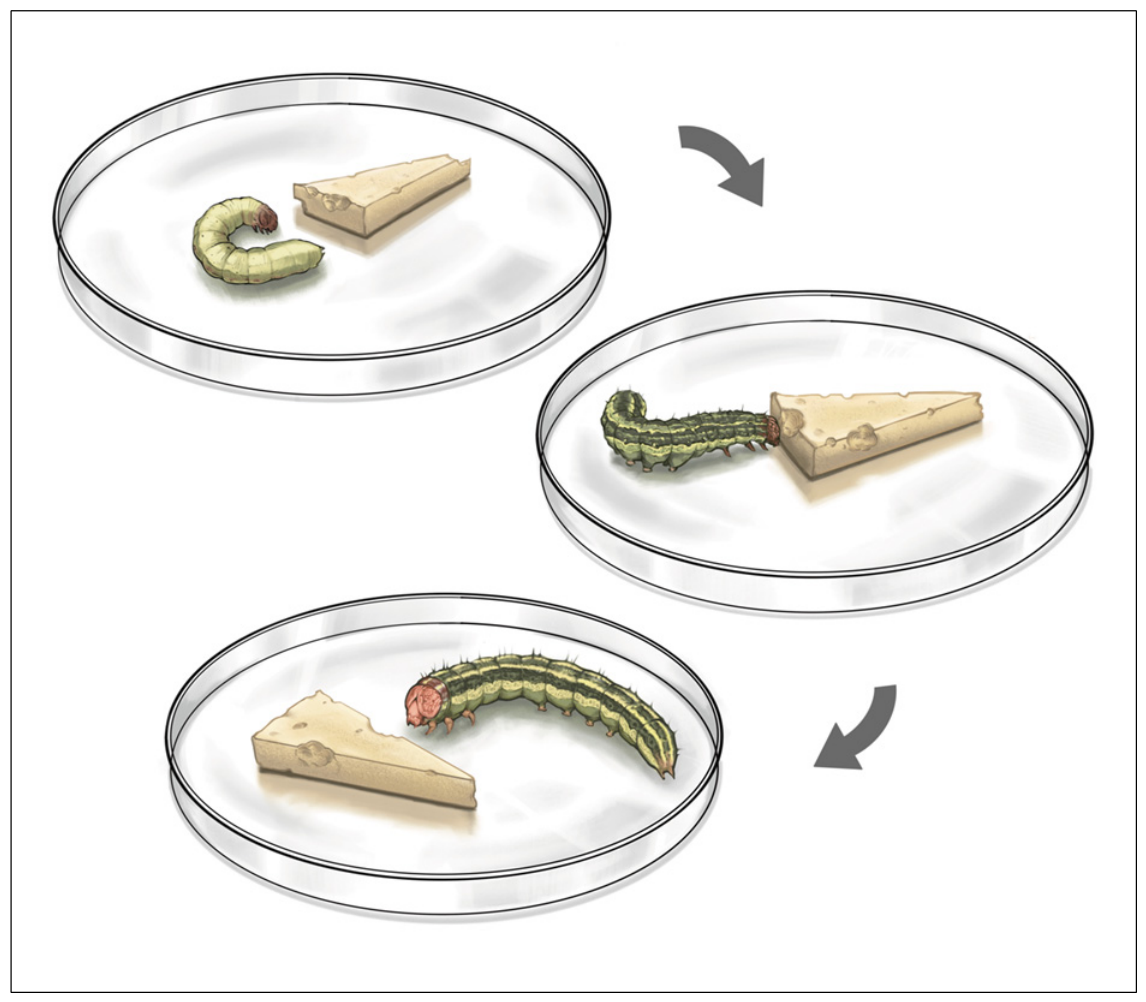
Daily observations were taken for a 10-day period. Each day, caterpillar mortality and daily weight changes were tracked, caterpillars were provided with a new Petri dish, and a new portion of respective artificial diet was provided (Figure 1).
Significant differences in final-day (day 10) weights were evaluated using a one-way ANOVA with a Tukey HSD post hoc test and differences in the survival between treatment groups were assessed using a chi-squared contingency table. All statistics were completed in R [30].

3. Results

Epazote essential oil was analyzed by GC to determine the volatile profile. Prominent compounds (>5.0%) included α-terpinene (29.2%), limonene (7.4%), ascaridole (25.2%), and isoascaridole (18.0%). The complete volatile profile is provided in Table 3.
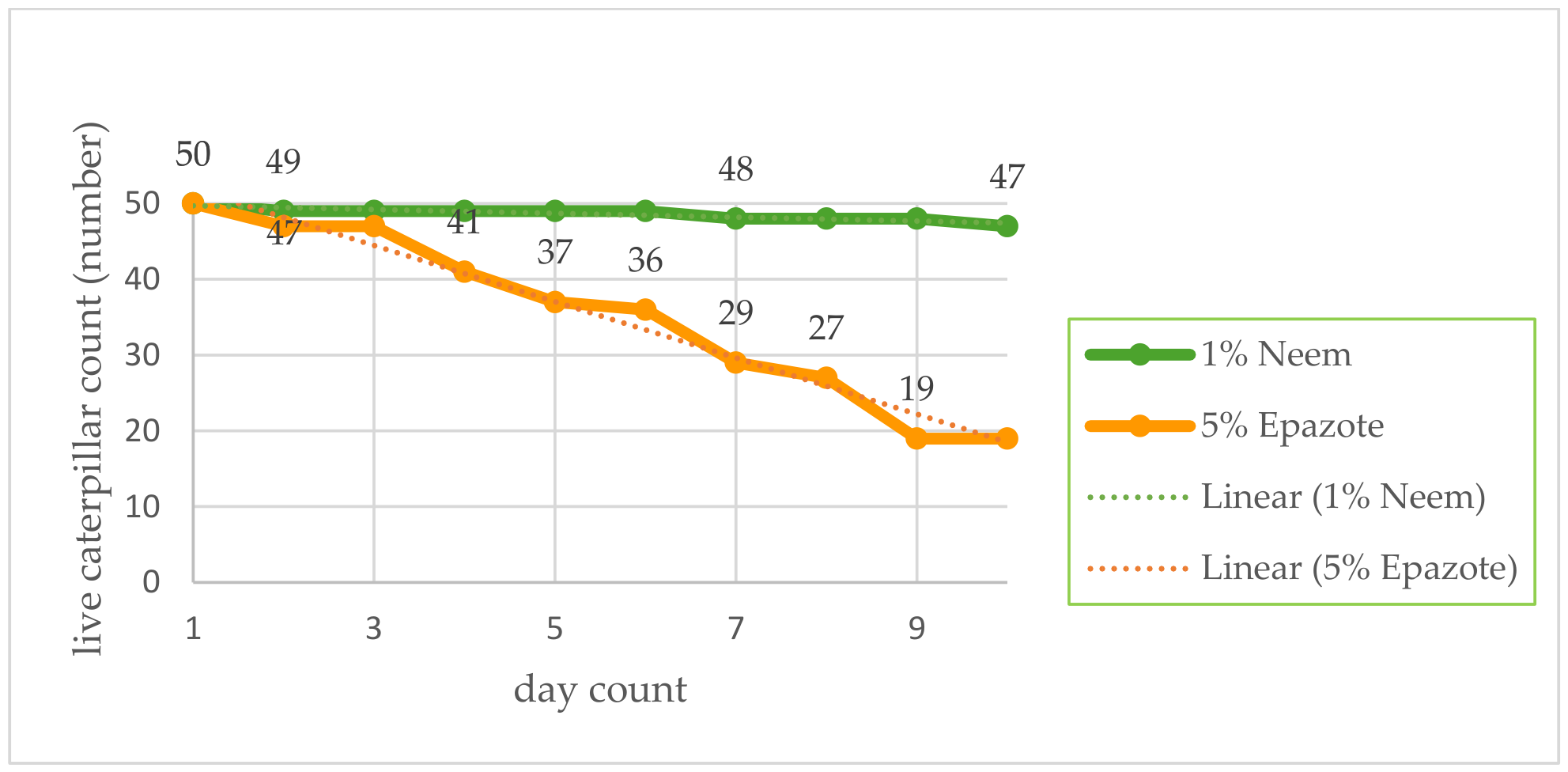
Throughout the 10-day study, fall armyworm caterpillar mortality was only observed in the 1% neem group (three fatalities) and 5% epazote group (31 fatalities). Details of caterpillar mortality for both groups are found in Figure 2.
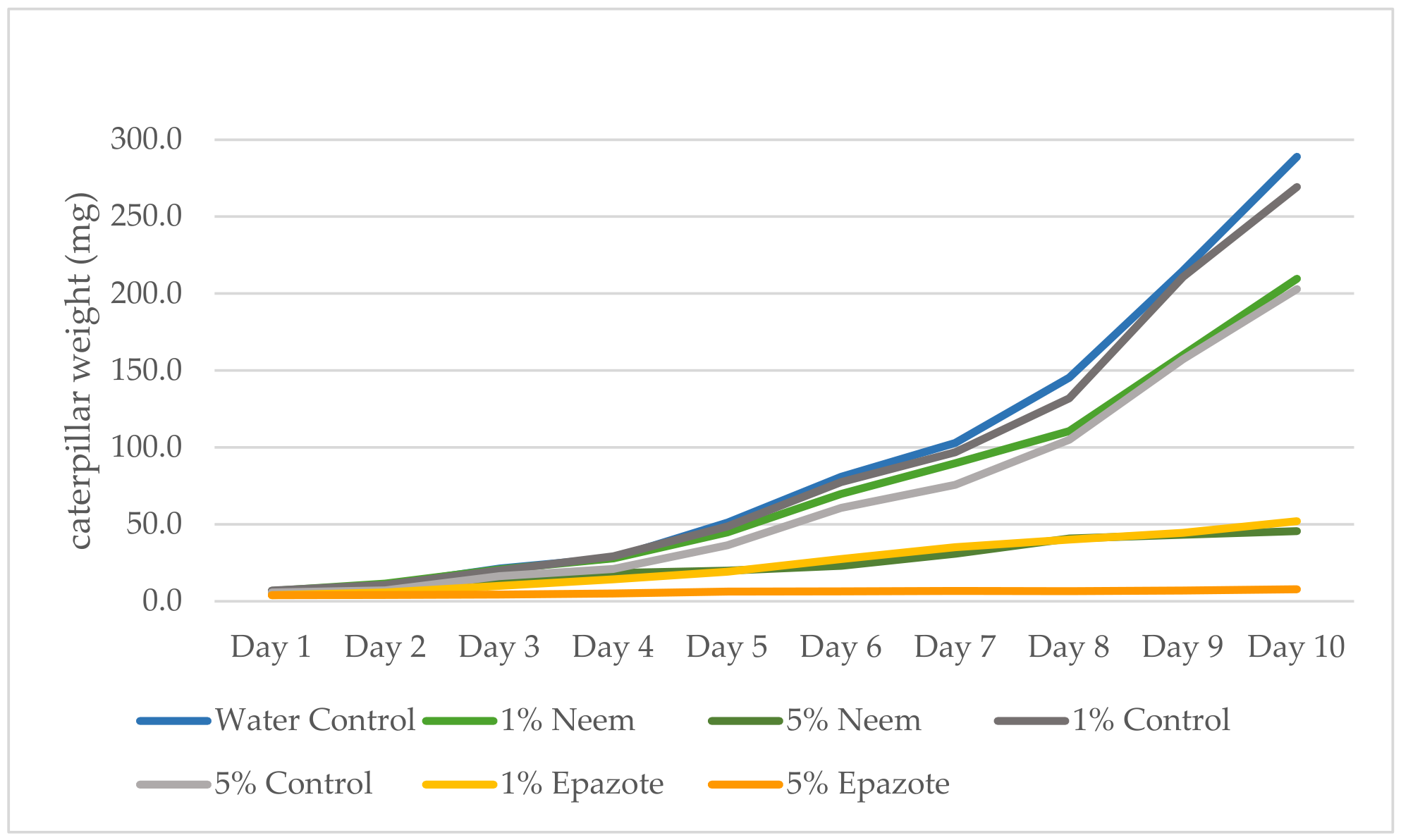
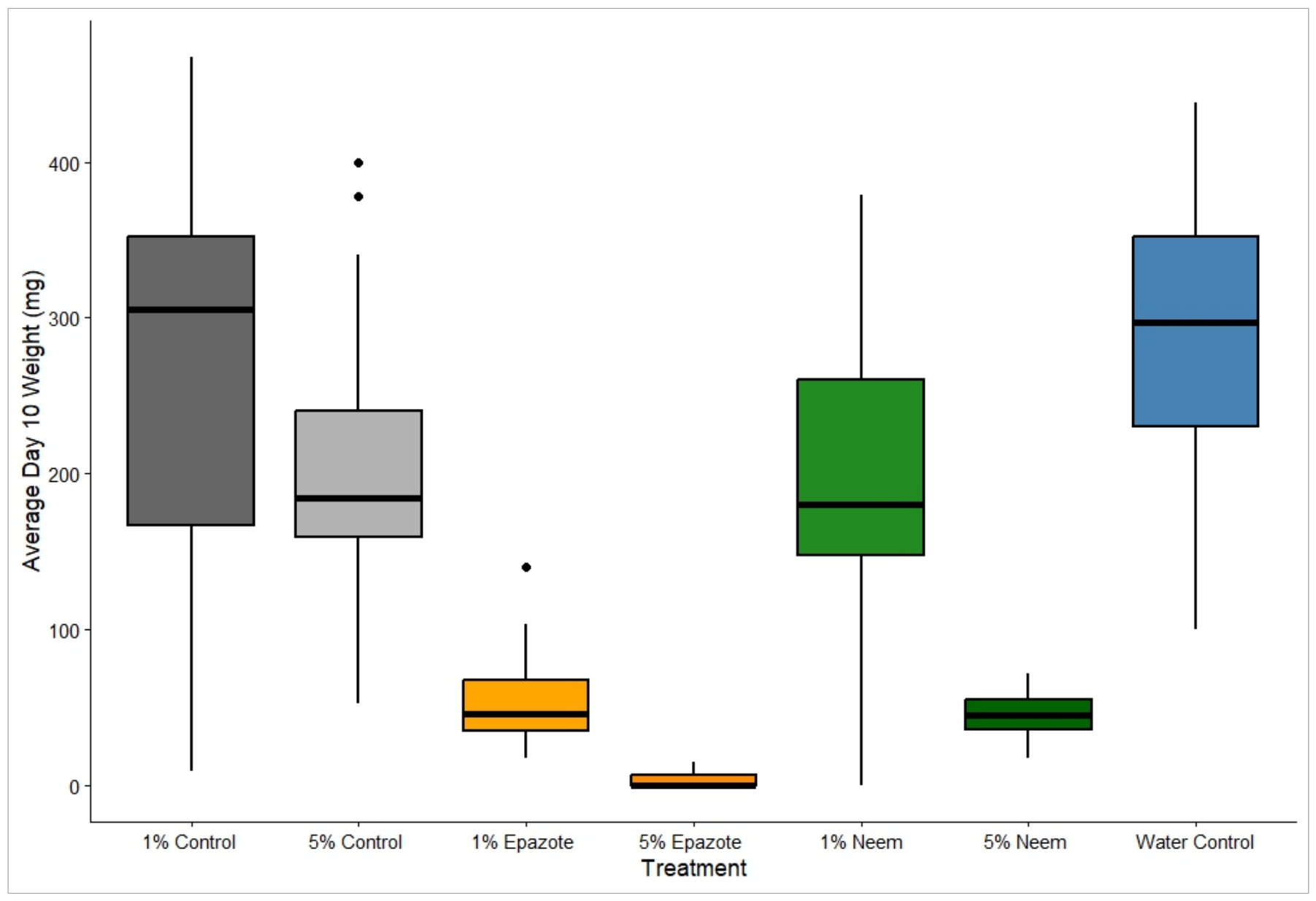
Additionally, average caterpillar mass (accounting only for living caterpillars) was measured and calculated daily. By day 10, caterpillars from the water control group weighed the most (avg. = 289.0 mg, σ = 79.6), followed by the 1% control group (avg. = 269.3 mg, σ = 114.5), 1% neem group (avg. = 209.8 mg, σ = 78.1), 5% control group (avg. = 203.0 mg, σ = 73.4), 1% epazote group (avg. = 52.1 mg, σ = 25.1), 5% neem group (avg. = 45.7 mg, σ = 13.2), and 5% epazote group (avg. = 7.8 mg, σ = 3.3). Final differences were statistically different (F6343 = 136.2, p < 0.001). Across all pairwise comparisons (Tukey HSD) both epazote treatment groups had significantly lower end rates than all other groups (p < 0.05), with the exception of the 5% neem group being statistically similar (p = 0.9) to the 1% epazote group. Daily weight trends for each group can be viewed in Figure 3 and final weights (day 10) can be viewed in Figure 4.

4. Discussion

Prominent compounds (>5.0%) in the analyzed epazote essential oil include α-terpinene (29.2%), limonene (7.4%), ascaridole (25.2%), and isoascaridole (18.0%). Of those compounds, ascaridole isomers are often credited for the insecticidal properties of epazote essential oil [22,28]. Other researchers have investigated epazote essential oil with ascaridole isomer content (relative area %) ranging between approximately 50 and 90% [19,31,32]. Variability in ascaridole content is likely due to any number of abiotic and/or biotic factors (cultivation practices, plant maturation, extraction techniques, etc.) and is beyond the scope of the current study. Additionally, both the current and previous studies [19,20,21,22,23,26] have focused little on insecticidal properties specific to other prominent compounds in epazote essential oil (α-terpinene, p-cymene, etc.). In the study by Chu and associates [22], α-terpinene was found to be both a prominent and bioactive (insecticidal) compound in epazote essential oil. While that same study investigated bioactivity of ascaridole (demonstrating higher insecticidal activity of the isolated compound compared to epazote essential oil), bioactivity investigations of isolated α-terpinene were not conducted. Future studies should investigate insecticidal properties of epazote essential oil with a high ascaridole content and how other prominent aromatic compounds (α-terpinene, etc.) contribute to these insecticidal properties.
In the current study, caterpillar larvae were provided with an identical artificial diet, which had the same composition as the water control group. Once caterpillars were seven days post-hatching, they were randomly selected and sorted into one of seven groups (n = 50 per group) and provided different artificial diets. While producing each artificial diet (see the Materials and Methods Section) 40 mL of different additives (water for the water control, etc.) were added as a final step. The 1% and 5% controls were included to investigate potential, inadvertent insecticidal properties of the solubilizer (Tween 80). The solubilizer was an essential ingredient in the formulation to homogenously incorporate epazote essential oil or neem oil, at different concentrations, into the artificial diets. While there was no caterpillar mortality from either the 1% or 5% control groups (Figure 2), caterpillar larvae gained weight at a slightly slower rate compared to the water control (Figure 3). In fact, the 1% neem group gained weight at a similar rate as the 5% control group, suggesting that the solubilizer (which was used in all diets with the exception of the water control) somewhat deters weight gain in caterpillars. While these were observational trends, they were not statistically significant.
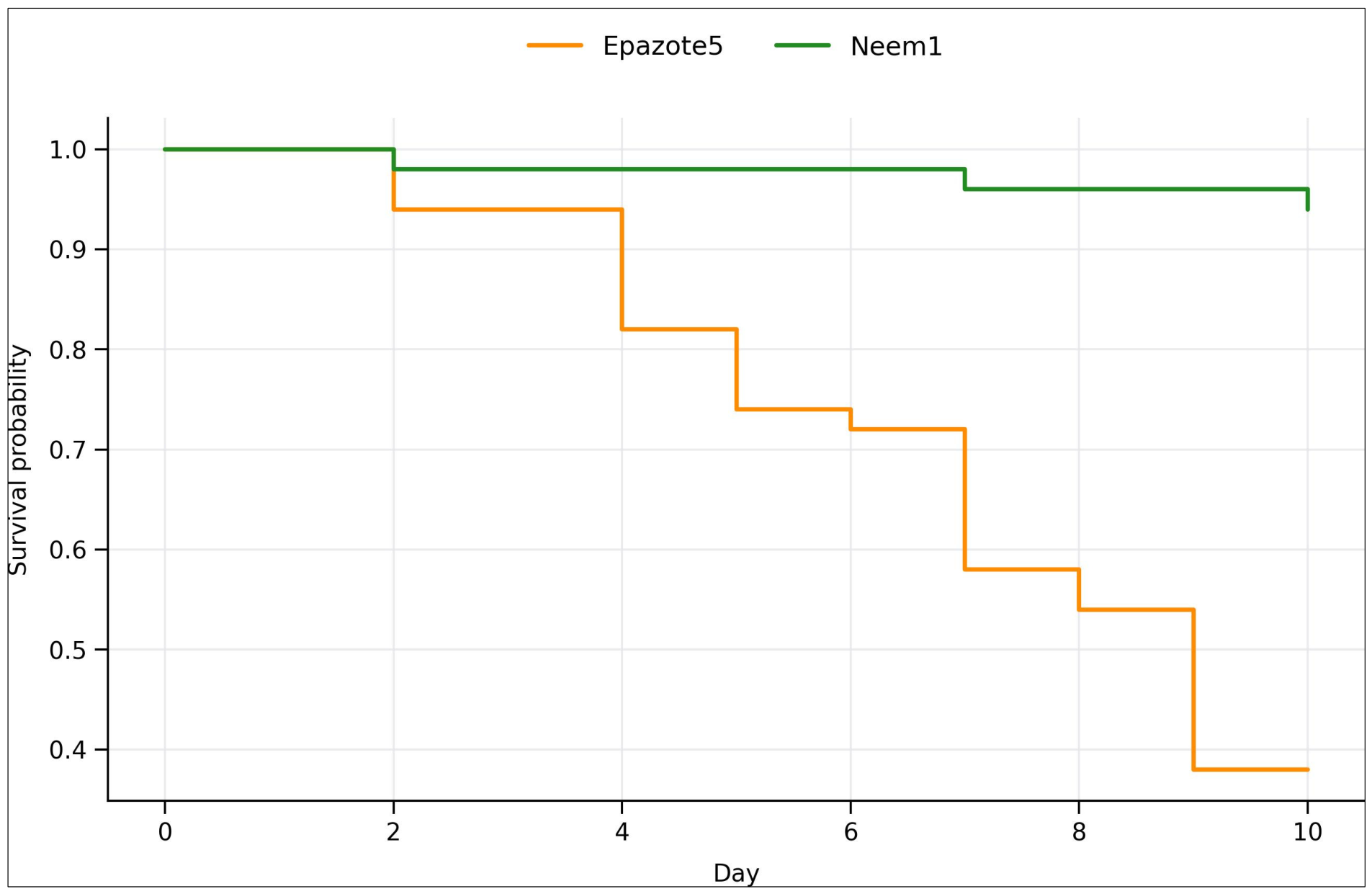
Caterpillar fatalities in the 1% neem group could likely be overlooked. While neem oil is known to possess insecticidal properties [33], the absence of deaths in the 5% neem group suggests that the three deaths in the lower concentration group were outliers. Of more importance is the overall trend with the daily weight gain of the 1% neem and 5% neem groups (Figure 5). Neem oil, which is widely applied in organic agricultural practices as a natural insecticide [18,33], is also known to have several drawbacks, including inhibiting plant germination and proper growth [34]. In the current study, the concentrations of neem employed mirrored those of epazote essential oil treatments. This was done to investigate how well epazote essential oil performed compared to a common natural alternative. While all concentrations of neem and epazote essential oil treatment groups amassed weight at a slower rate compared to control groups, epazote essential oil treatment groups (particularly at the 5% concentration) outperformed both neem treatment groups both in terms of caterpillar weight accumulation and larvae mortality. Future studies should investigate potential plant phototoxicity, or other herbicidal properties, of epazote essential oil.
The 31 caterpillar larvae deaths in the 5% epazote group are significant (X2 = 831.4, DF = 6, p < 0.001). While the 1% epazote group did not experience any mortality, the caterpillars in that group gained weight at a slower rate (increasing to approx. 13x their initial weight over the 10-day period) compared to all control groups. The 5% epazote group gained weight at an even slower rate (approx. doubling their initial weight over the 10-day period). Future studies should investigate the exact mechanism of action of epazote essential oil against fall armyworm and determine if the insecticidal properties observed in this study are due to antifeedant properties, direct toxicity, or other mechanisms. Additionally, future studies should investigate the potential for fall armyworms, and other insect pests, to develop resistance to epazote essential oil.

5. Conclusions

The agricultural industry largely replies on conventional insecticides to maintain healthy, pest-free crops. Compared to conventional insecticides, essential oils, and other plant extracts, are viewed as a reliable and purportedly safer insecticidal ingredients. Epazote essential oil was investigated for its insecticidal properties against fall armyworm. Caterpillars in the high-ascaridole treatment group (5%) amassed weight at a slower rate and experienced higher mortality than other treatment groups. Epazote has potential as an effective, natural insecticidal ingredient and should be the topic of future research. Future studies should focus on the insecticidal mechanism of action of epazote essential oil. Additionally, results should be replicated in planta since in vitro insecticidal studies have inherent limitations.

Supplementary Materials

The following supporting information can be downloaded at: https://www.mdpi.com/article/10.3390/agrochemicals5030030/s1, Table S1: Caterpillar data.

Author Contributions

Conceptualization, T.M.W. and I.P.L.; methodology, T.M.W. and M.C.R.; software, T.M.W.; validation, C.R.B.; formal analysis, T.M.W.; resources, C.R.B.; data curation, T.M.W. and M.C.R.; writing—original draft preparation, T.M.W.; writing—review and editing, I.P.L., M.C.R. and C.R.B.; supervision, C.R.B. and M.C.R.; funding acquisition, C.R.B. All authors have read and agreed to the published version of the manuscript.

Funding

This research was funded by Young Living Essential Oils.

Institutional Review Board Statement

Not applicable.

Informed Consent Statement

Not applicable.

Data Availability Statement

The original contributions presented in this study are included in the article/Supplementary Materials. Further inquiries can be directed to the corresponding author(s).

Acknowledgments

The authors wish to express gratitude to the D. Gary Young Research Institute and Utah Valley University for the support of this research.

Conflicts of Interest

The authors declare no conflicts of interest. The funders had no role in the design of the study; in the collection, analyses, or interpretation of data; in the writing of the manuscript; or in the decision to publish the results.

References

  1. World Flora Online. Available online: http://www.worldfloraonline.org/taxon/wfo-0000658867 (accessed on 25 March 2026).
  2. Kandsi, F.; Conte, R.; Marghich, M.; Lafdil, F.Z.; Alajmi, M.F.; Bouhrim, M.; Mechchate, H.; Hano, C.; Aziz, M.; Gseyra, N. Phytochemical Analysis, Antispasmodic, Myorelaxant, and Antioxidant Effect of Dysphania ambrosioides (L.) Mosyakin and Clemants Flower Hydroethanolic Extracts and Its Chloroform and Ethyl Acetate Fractions. Molecules 2021, 26, 7300. [Google Scholar] [CrossRef] [PubMed]
  3. Kandsi, F.; Elbouzidi, A.; Lafdil, F.Z.; Meskali, N.; Azghar, A.; Addi, M.; Hano, C.; Maleb, A.; Gseyra, N. Antibacterial and Antioxidant Activity of Dysphania ambrosioides (L.) Mosyakin and Clemants Essential Oils: Experimental and Computational Approaches. Antibiotics 2022, 11, 482. [Google Scholar] [CrossRef] [PubMed]
  4. Kamdem, B.P.; Le Doux Kamto, E.; Paumo, H.K.; Katata-Seru, L.M.; Pegnyemb, D.E.; Igne, F.E. Chemical Constituents, Ethnomedicinal Uses, Pharmacology, and Toxicity of Dysphania ambrosioides (L.) Mosyakin & Clemants, Formerly Chenopodium Ambrosioides L. Nat. Prod. J. 2022, 12, 31–73. [Google Scholar] [CrossRef]
  5. Kandsi, F.; Lafdil, F.Z.; El Hachlafi, N.; Jeddi, M.; Bouslamti, M.; El Fadili, M.; Seddoqi, S.; Gseyra, N. Dysphania ambrosioides (L.) Mosyakin and Clemants: Bridging traditional knowledge, photochemistry, preclinical investigations, and toxicological validation for health benefits. Naunyn-Schmiedeberg’s Arch. Pharmacol. 2024, 397, 969–1001. [Google Scholar] [CrossRef] [PubMed]
  6. Heredia Severino, A.; Fernandez-Lopez, J.; Borras-Rocher, F.; Viuda-Martos, M. Essential Oils and Extracts from Epazote (Dysphania ambrosioides): A Phytochemical Treasure with Multiple Applications. Plants 2025, 14, 1903. [Google Scholar] [CrossRef] [PubMed]
  7. Escobar-López, S.Y.; Espinoza-Ortega, A.; Salazar-García, F.; Martínez-Campos, Á.R. Analysis of antibacterial effect of chili (Capsicum annuum spp.) and epazote (Chenopudium ambrosioides) used in the manufacture of botanero cheese. Rev. Mex. Cienc. Pecu. 2017, 8, 211–217. [Google Scholar] [CrossRef]
  8. Manzanero-Medina, G.I.; Vásquez-Dávila, M.A.; Lustre-Sánchez, H.; Pérez-Herrera, A. Ethnobotany of food plants (quelites) sold in two traditional markets of Oaxaca, Mexico. S. Afr. J. Bot. 2020, 130, 215–223. [Google Scholar] [CrossRef]
  9. Sánchez-Ramos, C.; Vibrans, H.; Rivas-Guevara, M.; Linares-Mazari, E.; García-Moya, E.; Saynes-Vásquez, A. Preserving Healthy Eating Habits: Quelites in the Food System of a Nahua Mountain Community, Mexico. In Ethnobotany of the Mountain Regions of Mexico; Ethnobotany of Mountain Regions; Casas, A., Blancas Vázquez, J.J., Eds.; Springer: Cham, Switzerland, 2022. [Google Scholar] [CrossRef]
  10. Mokni, R.E.; Youssef, F.S.; Jmii, H.; Khmiri, A.; Bouazzi, S.; Jlassi, I.; Jaidane, H.; Dhaouadi, H.; Ashour, M.L.; Hammami, S. The Essential Oil of Tunisian Dysphania ambrosioides and its Antimicrobial and Antiviral Properties. J. Essent. Oil-Bear. Plants 2019, 22, 282–294. [Google Scholar] [CrossRef]
  11. Mwanauta, R.W.; Mtei, K.A.; Ndakidemi, P.A. Prospective bioactive compounds from Vernonia amygdalina, Lippia javanica, Dysphania ambrosioides and Tithonia diversifolia in controlling legume insect pests. Agric. Sci. 2014, 5, 1129–1139. [Google Scholar] [CrossRef]
  12. Zohra, T.; Ovais, M.; Khalil, A.T.; Qasim, M.; Ayaz, M.; Shinwari, Z.K. Extraction optimization, total phenolic, flavonoid contents, HPLC-DAD analysis and diverse pharmacological evaluations of Dysphania ambrosioides (L.) Mosyakin & Clemants. Nat. Prod. Res. 2019, 33, 136–142. [Google Scholar] [CrossRef] [PubMed]
  13. Catalogue of Life. Available online: https://www.catalogueoflife.org/data/taxon/4Z9P3 (accessed on 25 March 2026).
  14. Wee Tek Tay, R.L.; Meagher, C.C.; Groot, A.T. Spodoptera frugiperda: Ecology, Evolution, and Management Options of an Invasive Species. Ann. Rev. Entomol. 2023, 68, 299–317. [Google Scholar] [CrossRef] [PubMed]
  15. Montezano, D.G.; Sosa-Gómez, D.R.; Specht, A.; Roque-Specht, V.F.; Sousa-Silva, J.C.; Paula-Moraes, S.D.; Peterson, J.A.; Hunt, T.E. Host plants of Spodoptera frugiperda (Lepidoptera: Noctuidae) in the Americas. Afric. Entomol. 2018, 26, 286–300. [Google Scholar] [CrossRef]
  16. Overton, K.; Maino, J.L.; Day, R.; Umina, P.A.; Bett, B.; Carnovale, D.; Ekesi, S.; Meagher, R.; Reynolds, O.L. Global crop impacts, yield losses and action thresholds for fall armyworm (Spodoptera frugiperda): A review. Crop Prot. 2021, 145, 105641. [Google Scholar] [CrossRef]
  17. Paredes-Sánchez, F.A.; Rivera, G.; Bocanegra-García, V.; Martínez-Padrón, H.Y.; Berrones-Morales, M.; Niño-García, N.; Herrera-Mayorga, V. Advances in Control Strategies against Spodoptera frugiperda. A Review. Molecules 2021, 26, 5587. [Google Scholar] [CrossRef] [PubMed]
  18. Mossa, A.T.H. Green pesticides: Essential oils as biopesticides in insect-pest management. J. Environ. Sci. Technol. 2016, 9, 354. [Google Scholar] [CrossRef]
  19. Annaz, H.; Cacciola, F.; Ouabou, M.; Bouadid, I.; Ezzanad, A.; Kounnoun, A.; Jbilou, R.; Eddouks, M.; Bouayad, N.; Rharrabe, K. Insecticidal and behavioral effects of Dysphania ambrosioides seed essential oil against Tribolium castaneum under laboratory and simulated storage conditions. J. Stored Prod. Res. 2025, 115, 102839. [Google Scholar] [CrossRef]
  20. Kasrati, A.; Sakar, E.H.; Aljaiyash, A.; Hirri, A.; Tamegart, L.; Abbad, I.; Alaoui Jamali, C. Chemical Profiling, Insecticidal, and Phytotoxic Effect of Essential Oils from Leaves and Inflorescence of Moroccan Chenopodium ambrosioides (L.). Plants 2024, 13, 483. [Google Scholar] [CrossRef] [PubMed]
  21. Arena, J.S.; Omarini, A.B.; Zunino, M.P.; Peschiutta, M.L.; Defagó, M.T.; Zygadlo, J.A. Essential oils from Dysphania ambrosioides and Tagetes minuta enhance the toxicity of a conventional insecticide against Alphitobius diaperinus. Indust. Crops Prod. 2018, 122, 190–194. [Google Scholar] [CrossRef]
  22. Chu, S.S.; Feng Hu, J.; Liu, Z.L. Composition of essential oil of Chinese Chenopodium ambrosioides and insecticidal activity against maize weevil, Sitophilus zeamais. Pest. Manag. Sci. 2011, 67, 714–718. [Google Scholar] [CrossRef] [PubMed]
  23. Frankenberger, L.; Rover, S.; da Silva, T.L.; Faita, M.R.; Barcelos-Oliveira, J.L.; Poltronieri, A.S.; Meyre-Silva, C.; Biavatti, M.W. Chemical Composition of Dysphania ambrosioides from Hydroponics and Soil and Its Activity Against Sitophilus zeamais. Rev. Bras. Farmacogn. 2022, 32, 230–237. [Google Scholar] [CrossRef]
  24. Barbosa, F.S.; Leite, G.L.D.; Alves, S.M.; Nascimento, A.F.; D’Ávila, V.D.A.; Costa, C.A.D. Insecticide effects of Ruta graveolens, Copaifera langsdorffii and Chenopodium ambrosioides against pests and natural enemies in commercial tomato plantation. Acta Sci. Agron. 2011, 33, 37–43. [Google Scholar] [CrossRef]
  25. Wei, H.; Liu, J.; Li, B.; Zhan, Z.; Chen, Y.; Tian, H.; Lin, S.; Gu, X. The toxicity and physiological effect of essential oil from Chenopodium ambrosioides against the diamondback moth, Plutella xylostella (Lepidoptera: Plutellidae). Crop Prot. 2015, 76, 68–74. [Google Scholar] [CrossRef]
  26. Pavela, R.; Maggi, F.; Lupidi, G.; Mbentcha, H.; Woguem, V.; Womeni, H.M.; Barboni, L.; Tapondjou, L.A.; Benelli, G. Clausena anisata and Dysphania ambrosioides essential oils: From ethno-medicine to modern uses as effective insecticides. Environ. Sci. Pollut. Res. 2018, 25, 10493–10503. [Google Scholar] [CrossRef] [PubMed]
  27. Almadiy, A.A. Chemical profile, mosquitocidal, and biochemical effects of essential oil and major components of Dysphania ambrosioides against Culex quinquefasciatus Say. Environ. Sci. Pollut. Res. 2020, 27, 41568–41576. [Google Scholar] [CrossRef] [PubMed]
  28. Singh, P.; Pandey, A.K. Dysphania ambrosioides essential oils: From pharmacological agents to uses in modern crop protection—A review. Phytochem. Rev. 2022, 21, 141–159. [Google Scholar] [CrossRef]
  29. Adams, R.P. Identification of Essential Oil Components by Gas Chromatography/Mass Spectrometry, 4th ed.; Allured Publishing: Carol Stream, IL, USA, 2007. [Google Scholar]
  30. R Foundation for Statistical Computing. Available online: https://www.R-project.org/ (accessed on 26 March 2026).
  31. Al-kaf, A.G.; Crouch, R.A.; Denkert, A.; Porzel, A.; Al-Hawshabi, O.S.S.; Ali, N.A.A.A. Chemical composition and biological activity of essential oil of Chenopodium ambrosioides from Yemen. Am. J. Essent. Oils Nat. Prod. 2016, 4, 20–22. [Google Scholar] [CrossRef]
  32. Salimena, J.P.; Monteiro, F.P.; de Souza, P.E.; de Souza, J.D. Extraction of essential oil from inflorescences of Dysphania ambrosioides and its activity against Botrytis cinerea. J. Med. Plant. Res. 2015, 9, 1006–1012. [Google Scholar] [CrossRef]
  33. Benelli, G.; Canale, A.; Toniolo, C.; Higuchi, A.; Murugan, K.; Pavela, R.; Nicoletti, M. Neem (Azadirachta indica): Towards the ideal insecticide? Nat. Prod. Res. 2017, 31, 369–386. [Google Scholar] [CrossRef] [PubMed]
  34. Xuan, T.D.; Eiji, T.; Hiroyuki, T.; Mitsuhiro, M.; Khanh, T.D.; Chung, I.M. Evaluation on phytotoxicity of neem (Azadirachta indica. A. Juss) to crops and weeds. Crop Prot. 2004, 23, 335–345. [Google Scholar] [CrossRef]
Figure 1. Illustration of fall armyworm caterpillar rearing, feeding, and care process. Each day, caterpillars were observed for mortality, weights were measured to determine growth rate, caterpillars were provided with a new Petri dish, and a new portion of artificial diet (embedded with different treatments) was provided. Illustrated by Zach Nielsen.
Agrochemicals 05 00030 g001
Figure 2. Daily mortality rate of fall armyworm caterpillars in the 1% neem and 5% epazote groups. There were no observed mortalities during the 10-day trial in the other groups (water control, 5% neem, 1% control, 5% control, 1% epazote).
Agrochemicals 05 00030 g002
Figure 3. Daily fall armyworm caterpillar weights (averages) for each control and treatment group. The group that grew the most (water control) amassed more than 40× their initial weight during the 10-day period, while the group that grew the least (5% epazote) amassed approx. 2× their initial weight during the 10-day period.
Agrochemicals 05 00030 g003
Figure 4. Average fall armyworm caterpillar weights (day 10) for each treatment group.
Agrochemicals 05 00030 g004
Figure 5. Kaplan–Meier survival curves for 1% neem and 5% epazote treatments during the trial. These two treatments had the only mortality with the 1% neem treatment having a non-significant number of deaths (3 of 50) while the 5% epazote had a high mortality rate (30/50).
Agrochemicals 05 00030 g005
Table 1. Ingredients for artificial caterpillar diet. Details include ingredient name, ingredient source, and quantity (g).
Portion NumberIngredient NameIngredient SourceQuantity
1NiacinDual Health Body & Mind Inc. (Cleveland, OH, USA)0.5 g
1Calcium PantothenateBulk Supplements (Henderson, NV, USA)0.5 g
1RiboflavinBulk Supplements (Henderson, NV, USA)0.25 g
1Thiamine HCLBulk Supplements (Henderson, NV, USA)0.125 g
1Pyridoxine HCLBulk Supplements (Henderson, NV, USA)0.125 g
1Folic AcidBulk Supplements (Henderson, NV, USA)0.125 g
1BiotinBulk Supplements (Henderson, NV, USA)0.01 g
1Cyanocobalamin (1% solution)Bulk Supplements (Henderson, NV, USA)0.1 g
1Deionized WaterElix Advantage 15 System (Millipore Sigma, Burlington, MA, USA)100 g
2Choline L-BitartrateBulk Supplements (Henderson, NV, USA)17.6 g
2Deionized WaterElix Advantage 15 System (Millipore Sigma, Burlington, MA, USA)100 g
3CaseinBulk Supplements (Henderson, NV, USA)125 g
3Wesson’s Salt MixFrontier Agricultural Sciences (Newark, DE, USA)40 g
3Sorbic AcidTalsen Chemicals (New York, NY, USA)10 g
3Methyl ParabenJosh’s Frogs (Owosso, MI, USA)5 g
3Ascorbic AcidNuSci (Brea, CA, USA)20 g
4Deionized WaterElix Advantage 15 System (Millipore Sigma, Burlington, MA, USA)278.2 g
4GelatinKnox (Chicago, IL, USA)30 g
5Wheat GermKretschmer (Seattle, WA, USA)60 g
6PhenylalanineBulk Supplements (Henderson, NV, USA)0.6 g
Table 2. Details for control/treatment groups for artificial caterpillar diet. Details include treatment group name, ingredients and quantity, and mixing instructions.
Treatment NameIngredient(s), QuantityMixing Instructions
Water ControlDeionized Water (40.0 g)n/a
1% EpazoteDeionized Water (38.4 g), epazote oil (0.4 g), Tween 80 (1.2 g)300 rpm for 60 min
5% EpazoteDeionized Water (32.0 g), epazote oil (2.0 g), Tween 80 (6.0 g)300 rpm for 60 min
1% NeemDeionized Water (38.4 g), neem oil (0.4 g), Tween 80 (1.2 g)300 rpm for 60 min
5% NeemDeionized Water (32.0 g), neem oil (2.0 g), Tween 80 (6.0 g)300 rpm for 60 min
1% ControlDeionized Water (38.8 g), Tween 80 (1.2 g)300 rpm for 60 min
5% ControlDeionized Water (34.0 g), Tween 80 (6.0 g)300 rpm for 60 min
Table 3. Volatile compounds detected in epazote essential oil. The compound name, KI, and relative area % are reported. Values less than 0.1% are denoted as trace (tr). KI is the Kovat’s Index value and was previously calculated by Robert Adams using a linear calculation on a DB-5 column [29].
Compound NameKIRelative Area %
α-Pinene9320.2
Camphene946tr
Sabinene9690.7
β-Pinene9740.1
δ-3-Carene10080.1
α-Terpinene101429.2
p-Cymene10204.5
Limonene10247.4
γ-Terpinene10540.4
Terpinolene10860.1
(E)-p-Mentha-2,8-dien-1-ol11192.5
(Z)-p-Mentha-2,8-dien-1-ol11330.6
(E)-Pinocarveol1135tr
Pinocarvone1160tr
(E)-p-Mentha-1(7),8-dien-2-ol11870.8
Myrtenol11940.1
(Z)-Carveol12260.2
(Z)-p-Mentha-1(7),8-dien-2-ol12270.9
Ascaridole123425.2
Carvone12391.0
(Z)-Piperitone epoxide12500.3
Thymol12893.7
Carvacrol12982.1
Isoascaridole1 130918.0
Total98.1
1 Compound was not found in the Adam’s Library [29] and was manually calculated.
Disclaimer/Publisher’s Note: The statements, opinions and data contained in all publications are solely those of the individual author(s) and contributor(s) and not of MDPI and/or the editor(s). MDPI and/or the editor(s) disclaim responsibility for any injury to people or property resulting from any ideas, methods, instructions or products referred to in the content.