


Abstract
Silicate rocks represent alternative K sources when finely ground, reducing production costs and dependence on imported fertilizers. Therefore, this study aimed to evaluate the effects of potassium (K) dose, application timing, and fertilizer sources on the concentrations and accumulation of K, silicon (Si), and sodium (Na) in maize diagnostic leaves, straw, and grains under a no-tillage system in Savanna. The soil was classified as Typic Haplustox (Oxisol). The experiment followed a randomized block design in a 2 × 4 × 3 factorial scheme, with two application times (30 days before sowing soybean and at sowing soybean), four K2O rates (0, 40, 80, and 120 kg ha−1), and three sources (KCl, Potasil, and Ekosil). K fertilization was applied by broadcasting without incorporation, before the preceding crop. Potasil provided a higher foliar Si concentration, and Si accumulation in grain and straw increased with the increment of K fertilization using the Potasil. Early fertilization promoted greater K accumulation in maize straw. For grain K accumulation, moderate K2O doses favor greater accumulation, with Ekosil and Potasil showing superior results compared to KCl. There was less sodium accumulation in the grains with Ekosil compared to KCl. Agronomic efficiency is maximized at 40 kg ha−1 of K2O, with Ekosil showing the best performance for maize crop. These findings indicate that alternative K sources, applied at optimized rates, improve crop nutrition and promote sustainability in soybean–maize crop rotation.
1. Introduction
Under the current scenario of global climate change, crop productivity has been negatively impacted, threatening both economic profitability and food security worldwide [1]. A major challenge is how to increase agricultural output without encroaching on new land frontiers. Over the past decades, Brazil has transitioned from a food importer to one of the world’s largest exporters. Owing to its vast land availability and abundant water resources, the country plays a strategic role in meeting the growing global demand for food [1].
As the world’s largest producer and exporter of soybeans (Glycine max L.) [2], Brazil has experienced continuous expansion of cultivated areas. This growth raises concerns regarding adequate plant nutrition to ensure that crops reach their full genetic potential and provide higher returns for farmers [3]. In the case of maize (Zea mays L.), which is commonly grown in succession with soybean, Brazil is currently the world’s largest exporter and the third-largest producer of this cereal [2]. National production reached 139,695.8 million tons in the 2024/2025 harvest [4]. The adoption of technologies such as modern agricultural machinery, genetically modified seeds, and improved nutrient and soil fertility practices has been fundamental to sustaining and increasing grain productivity [5].
Regarding nutrient management, to produce 9000 kg ha−1 of maize, the crop requires approximately 132 kg ha−1 of K2O, 32% of which is allocated to grains and removed from the field [6]. Potassium (K) is essential for maintaining soil cover in no-tillage systems, straw formation, root development, stalk strength, uniform maturation, precocity of female inflorescences, and higher grain mass, while also supporting photosynthesis, cell turgor, water and nutrient transport, and cell membrane stability [7]. The majority of K uptake occurs before tasseling, representing 70% of the total absorbed during the cycle, making this stage critical to prevent grain abortion and reduced yield. Soil fertility is one of the main factors determining high crop productivity, and appropriate practices such as liming and fertilization are essential to achieve this goal [8]. The use of mineral fertilizers is an efficient and indispensable strategy for substantially increasing yields [9]. However, in Brazil, approximately 85% of mineral fertilizers are imported, which significantly affects production costs and exposes farmers to fluctuations in international markets and exchange rates.
Among K fertilizers, potassium chloride (KCl) is the most widely used in Brazil; however, losses through K leaching can reach 50–70% [10]. In this context, it reported that polymer-coated fertilizers are more efficient than conventional fertilizers, as they reduce nutrient losses caused by leaching [11]. Brazil has abundant silicate rocks, which are aggregates of minerals characterized by slow disintegration and dissolution under natural conditions. When ground, these rocks represent a potential alternative source of K [12]. Because nutrient release from silicate rock powders occurs gradually, they may better match crop requirements over time, reducing the risk of root damage caused by high salt concentrations and ensuring a more homogeneous distribution of nutrients. These characteristics favor both nutrient availability and plant physiological demand [13]. Additionally, both the type of K source and the applied dose influence enzymatic activity and photosynthesis, while mitigating biotic and abiotic stresses such as salinity and oxidative stress. Alternative sources to KCl can reduce the risk of chloride toxicity and improve the nutritional efficiency of maize [14].
In soils, K is present in the solution phase at levels sufficient to meet part of crop demand [15]. Exchangeable K is ionically bound to negative charges and represents the main fraction capable of replenishing the soil solution for plant uptake [16]. Thus, K is absorbed primarily in its soluble form, whether in soil or water bodies [17]. However, inadequate K fertilization can result in depletion of soil reserves, whereas excessive application may increase leaching losses, even in soils with medium to high cation exchange capacity [18]. According to [19], the concentration of K+ in the leachate rises proportionally with increasing K2O application rates. Therefore, appropriate management of K fertilization is essential to minimize nutrient losses and avoid soil K depletion [20].
The hypothesis was that residual K uptake by maize grown in succession to soybean would be more efficient when K was applied earlier, using alternative silicate sources such as Potasil (phonolite) or Ekosil (hydro-thermalized phonolite/potassic rock with lower Na content). These sources were expected to provide a stronger residual effect due to their gradual nutrient release. Therefore, this study aimed to evaluate the effects of K dose, application timing (30 days before sowing soybean and at sowing soybean), and fertilizer source on the concentrations and accumulation of K, Si, and Na in maize diagnostic leaves, straw, and grains under a no-tillage system in the Brazilian Savanna. Furthermore, it sought to determine the agronomic efficiency of these fertilizers to enhance K utilization and overall nutrient use efficiency under tropical conditions.
2. Materials and Methods
Experiments involving soybean cultivation in the summer season, cited in this paper [21], followed by maize in succession over two years, under rainfed conditions in the 2021/2022 and 2022/2023 seasons in an experimental area were conducted at 22°25′05″ S and 51°20′30″ W, Selvíria, State of Mato Grosso do Sul, at an altitude of 335 m, in Brazilian Savanna. The soil at the experimental site is classified as a Typic Haplustox (Oxisol), (420, 50, and 530 g kg−1 of sand, silt, and clay, respectively) [22], and has been under no-tillage cultivation for the past 25 years, with barley, common beans, castor bean, maize, soybean, and wheat before these experiments.
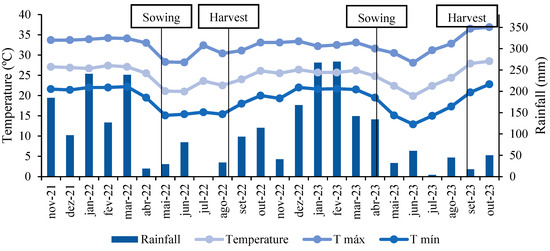
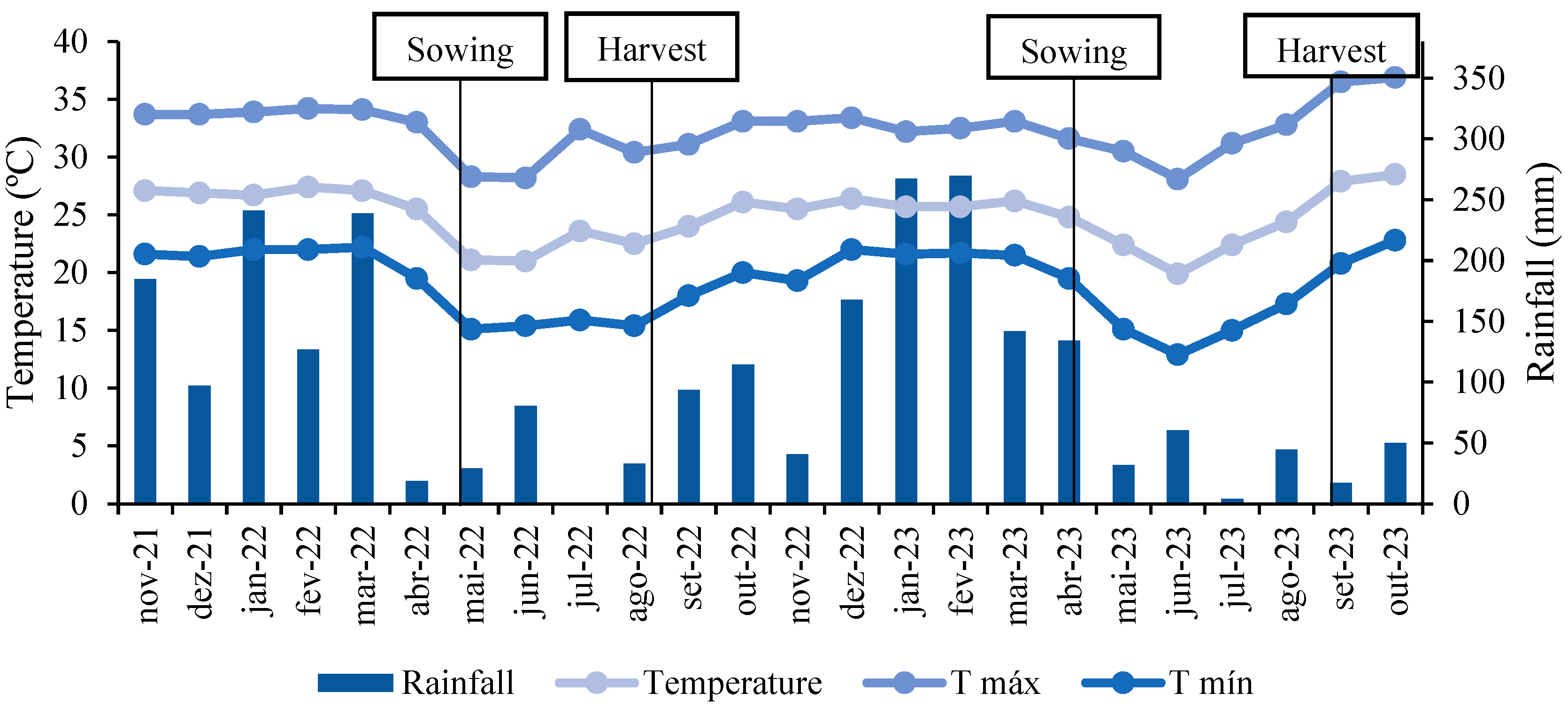
To assess soil chemical attributes, 20 soil samples were collected from a depth of 0.00–0.20 m across the experimental area and analyzed by the methodology of Cantarella et al. (2022) [23] (Table 1). The climate classification of the region, according to Köppen, is Aw, with an average annual rainfall of 1370 mm, and an average annual temperature of 23.5 °C. The monthly climate data during the experiment are presented in Figure 1.
Table 1.
Initial soil chemical properties at a depth of 0.00–0.20 m.
Figure 1.
Rainfall and average temperature recorded by the meteorological station during the experiments, from December 2021 to September 2023, in Selvíria—MS, Brazil.
The experiment was designed in randomized blocks in a 2 × 4 × 3 factorial scheme with four replications. The treatments consisted of two application times (30 days before soybean sowing and at the time of sowing), four K2O doses (0, 40, 80, and 120 kg ha−1), and three sources (KCl; Potasil “phonolite”; and Ekosil “hydro-thermalized phonolite/potassium rock”—Table 2). Each plot consisted of five-meter rows, allocated exactly in the same place in both experiments, eight rows with 0.50 m between rows, DKB 363 PRO3 used as the maize cultivar, 3.6 seeds sown per linear meter, and 60 thousand plants per hectare. K fertilization treatments were applied manually and without soil incorporation. Based on soil analysis (Table 1), fertilization was performed with 62 kg ha−1 of P2O5 using triple superphosphate fertilizer, applied below and next to the seeds, in the maize sowing furrow. In the maize crop, when plants reached the V5 phenological growth stage [24], nitrogen topdressing was applied at a rate of 150 kg ha−1 N using urea as the source. The maize growing cycle, from plant emergence to grain harvest, was 125 days.
Table 2.
Sources of chemical properties.
In the maize experiment, plant samples were oven-dried at 60 °C until they were constantly weighted and subsequently ground in a Willey mill. The following evaluations were performed: leaf K, Na, and Si concentrations, determined from 20 leaves collected from the middle third of the main ear insertion at the female flowering stage, following the methodology described by [23]. After mechanical threshing, grain yield was determined and expressed in kg ha−1 at 13% moisture (wet basis). K, Na, and Si accumulation in grains and straw was calculated by multiplying the respective nutrient concentrations by the dry mass of grains or straw, with results expressed in kg ha−1 (Equation (1)). Agronomic efficiency (AE) was calculated with the following equation (Equation (2)):
Equation (1). Nutrient accumulation was calculated as the product of dry matter (grain or straw) and the corresponding nutrient concentration.
Equation (2). Agronomic efficiency (AE) was calculated as the increase in yield per unit of nutrient applied, expressed as a percentage, following methodology of Fageria et al. (2011) [25]; Jalal et al. (2021) [26].
The data obtained were subjected to preliminary tests of normality and homoscedasticity. After this, the results were analyzed using analysis of variance (ANOVA) and a Tukey test at 5% probability to compare the means of the times of application of K and K sources. The effect of residual K2O doses was adjusted to regression equations using the SISVAR program [27].
3. Results
3.1. Potassium, Silicon and Sodium Concentrations in Diagnostic Leaves of Maize
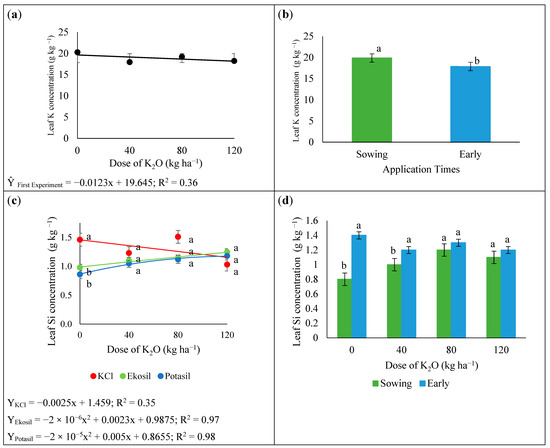
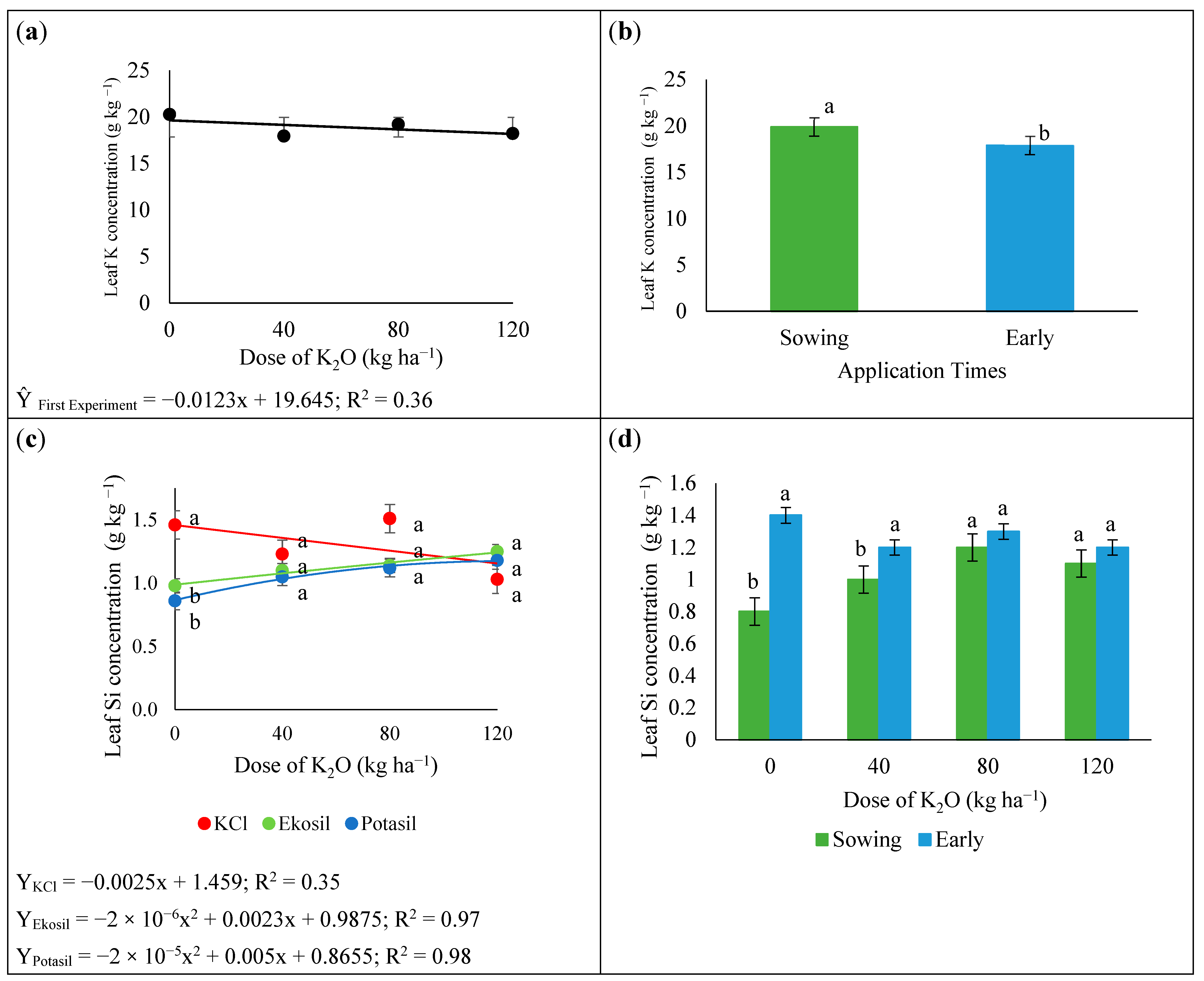
Regarding K dose, a decreasing linear trend was observed (Figure 2a), indicating that higher K doses correspond to lower K concentrations in the diagnostic leaf. Concerning application time, significant effects were found for K (Figure 2b), particularly at sowing in the first experiment and as a residual in the second experiment.
Figure 2.
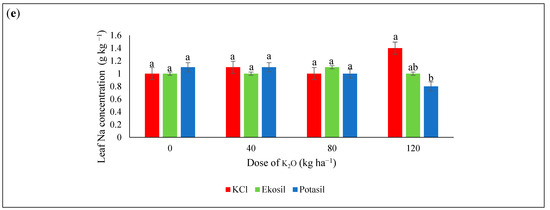
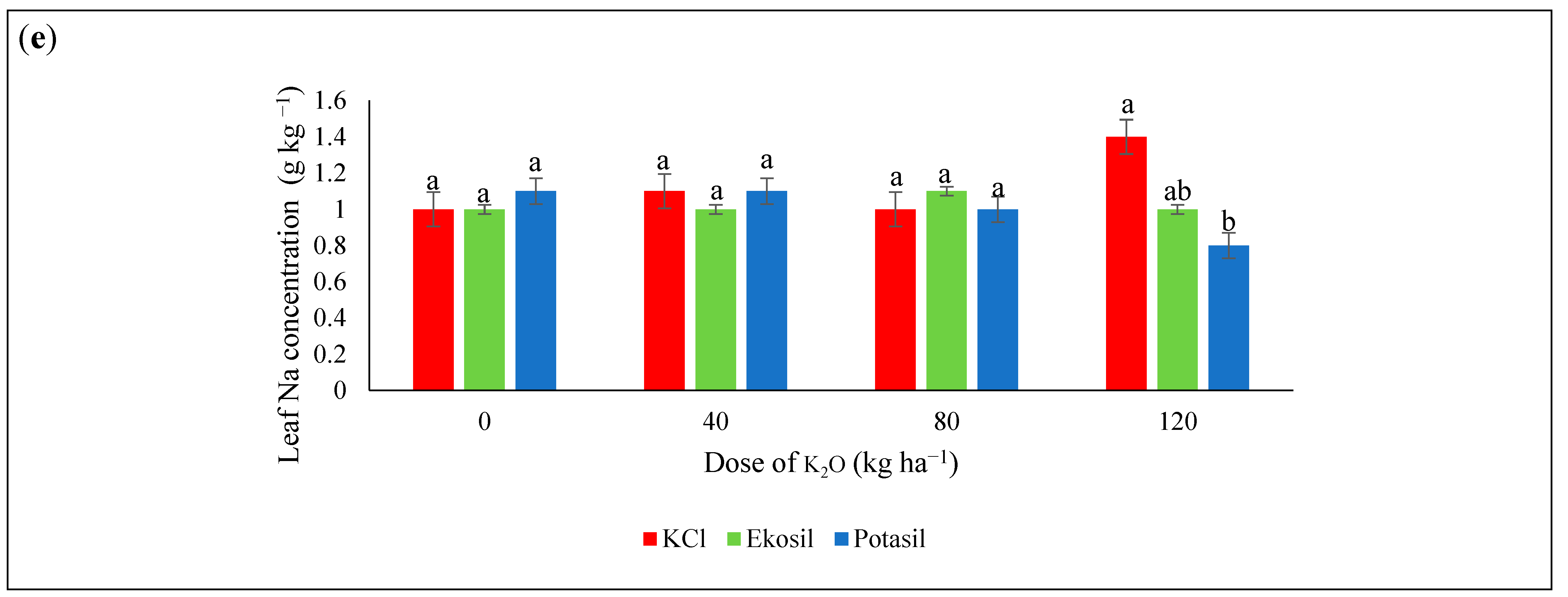
Both show effects for first experiment. (a) Effect of K2O doses on leaf K concentration; (b) effect of application timing on leaf K concentration; (c) interaction between K2O source and dose on leaf Si concentration; (d) interaction between K2O dose and application timing on leaf Si concentration; (e) interaction between K2O source and dose on leaf Na concentration for second experiment. Different letters indicate significant differences at p < 0.05 according to the F-test.
The interaction between K source and K2O dose was significant for Si concentration (p < 0.05; Figure 2c). For KCl, a decreasing linear trend was observed, indicating lower leaf Si concentration at higher doses, whereas Potasil and Ekosil showed increasing linear trends, with higher doses resulting in greater Si concentration. No significant effect of K2O dose was observed in Year 2. At 80 kg ha−1, KCl was superior to Ekosil, while at 120 kg ha−1, Ekosil showed the highest Si concentration. The interaction between K2O dose and application timing was also significant for leaf Si concentration (Figure 2d). There was no adjustment for doses applied at sowing, whereas earlier application showed a decreasing linear trend: the higher the early doses, the lower the Si concentration in diagnostic leaves.
For leaf Na concentration, the interaction between K2O source and dose was significant (p < 0.05; Figure 2e), although no clear dose-dependent trend was observed within each source. At 120 kg ha−1 K2O, KCl resulted in the highest Na concentration compared to other sources.
3.2. Potassium, Silicon and Sodium Accumulation in Maize Straw
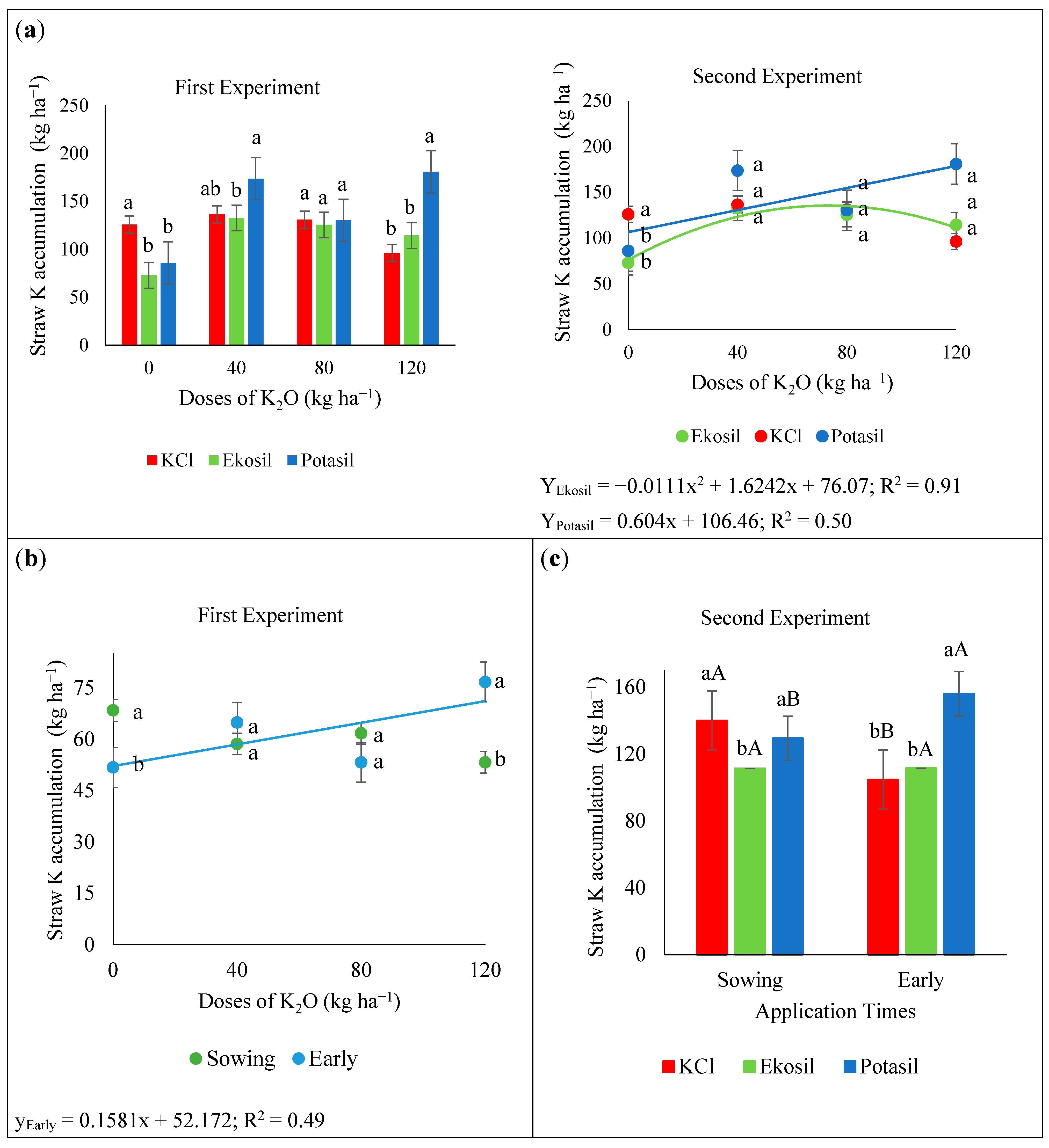
According to Figure 3, K accumulation in maize straw showed a positive linear response to early fertilization, with higher K doses increasing straw K content. At the 120 kg ha−1 dose, early fertilization resulted in significantly greater K accumulation compared to fertilization at sowing. In the source × dose interaction (Figure 3a), significant effects were observed. At 40 kg ha−1, both KCl and Potasil were superior; at 120 kg ha−1 in Year 2, Potasil showed the highest accumulation. The regression adjustments indicated a quadratic response for Ekosil, with an optimum dose of 73.16 kg ha−1, no adjustment for KCl, and a positive linear adjustment for Potasil. For the dose × timing interaction (Figure 3b), significance was observed, with a linear response to early application. In the source × timing interaction (Figure 3c), KCl showed higher accumulation when applied at sowing, while Potasil performed better with early application. Among sources, Potasil at sowing showed the best performance, whereas both KCl and Potasil stood out in residual application.
Figure 3.
(a) Source × dose interaction for straw K accumulation. (b) Dose × timing interaction for straw K accumulation. (c) Source × timing interaction for straw K accumulation. Lowercase letters indicate differences between timings within the interaction, and uppercase letters indicate differences between sources within the interaction, according to Tukey’s test at the 1% probability level.
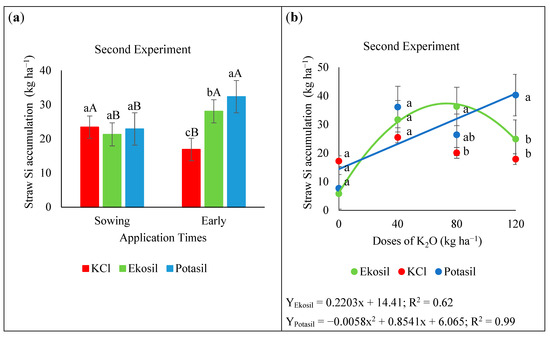
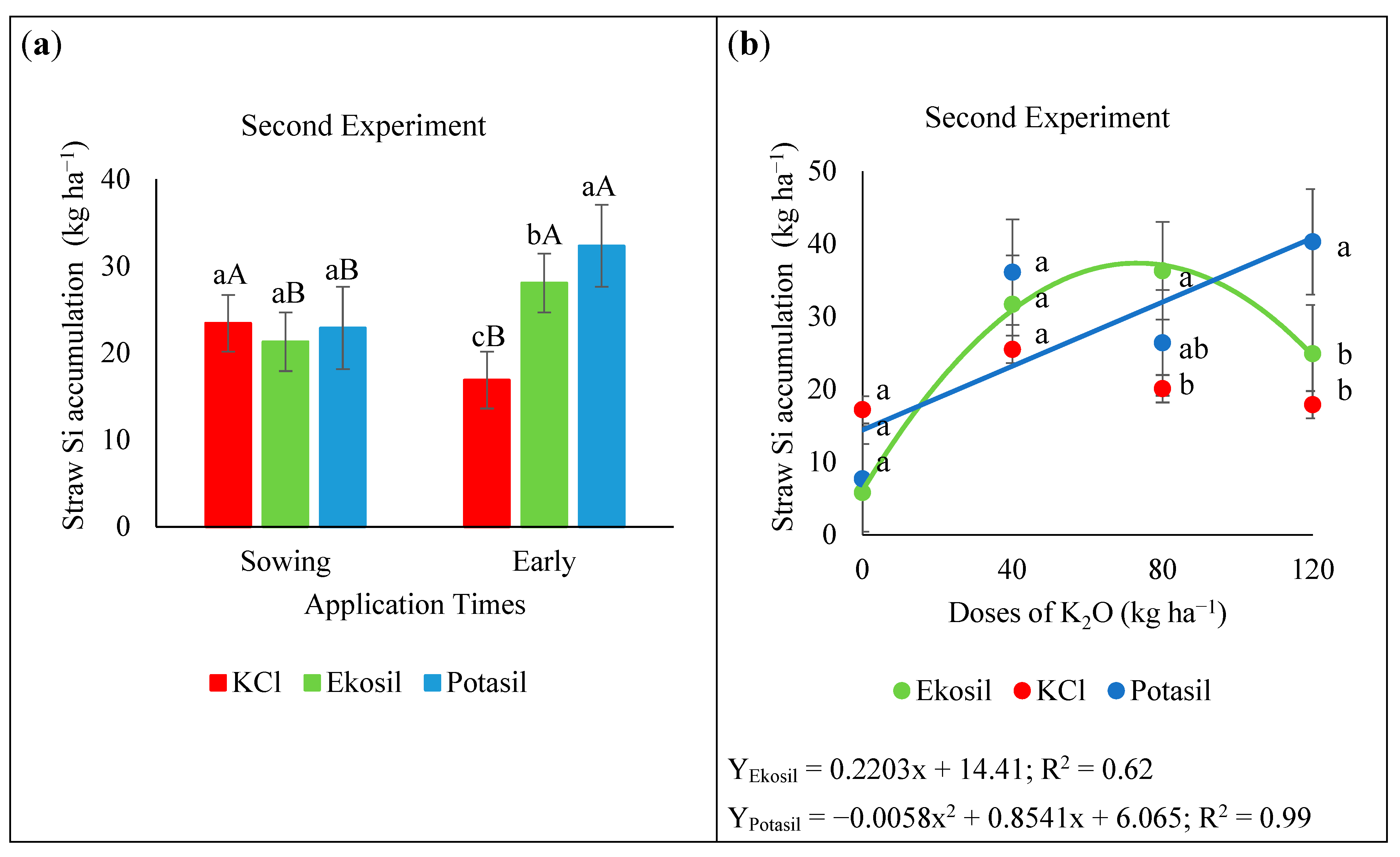
For straw Si accumulation, the interaction between source and timing (Figure 4a) indicated that Potasil performed better with early application, while no significant effect was observed for the other sources. Regarding dose, Ekosil and Potasil applied at sowing were superior, whereas residual applications showed no significant source effect. The source × dose interaction (Figure 4b) was significant, with higher Si accumulation for Ekosil and Potasil at 80 kg ha−1 and for Potasil at 120 kg ha−1. Regression analysis showed a positive linear fit for Ekosil and a quadratic fit for Potasil, with an optimum dose of 73.63 kg ha−1 in Year 2. In contrast, Si content showed a negative linear response to increasing K2O doses, indicating that higher K levels reduced Si assimilation.
Figure 4.
(a) Time and source interaction effect for straw Si accumulation. (b) Effect of the interaction between doses and sources for straw Si accumulation. Different lowercase letters for time, different uppercase letters for F-test, different letters differ 5% level by the F-test.
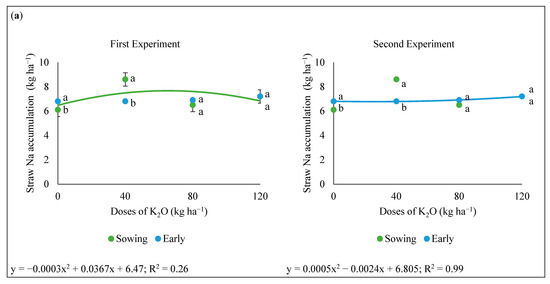
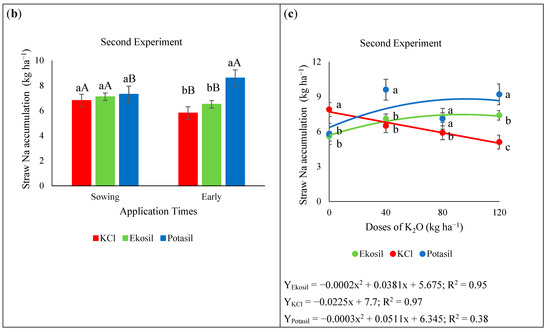
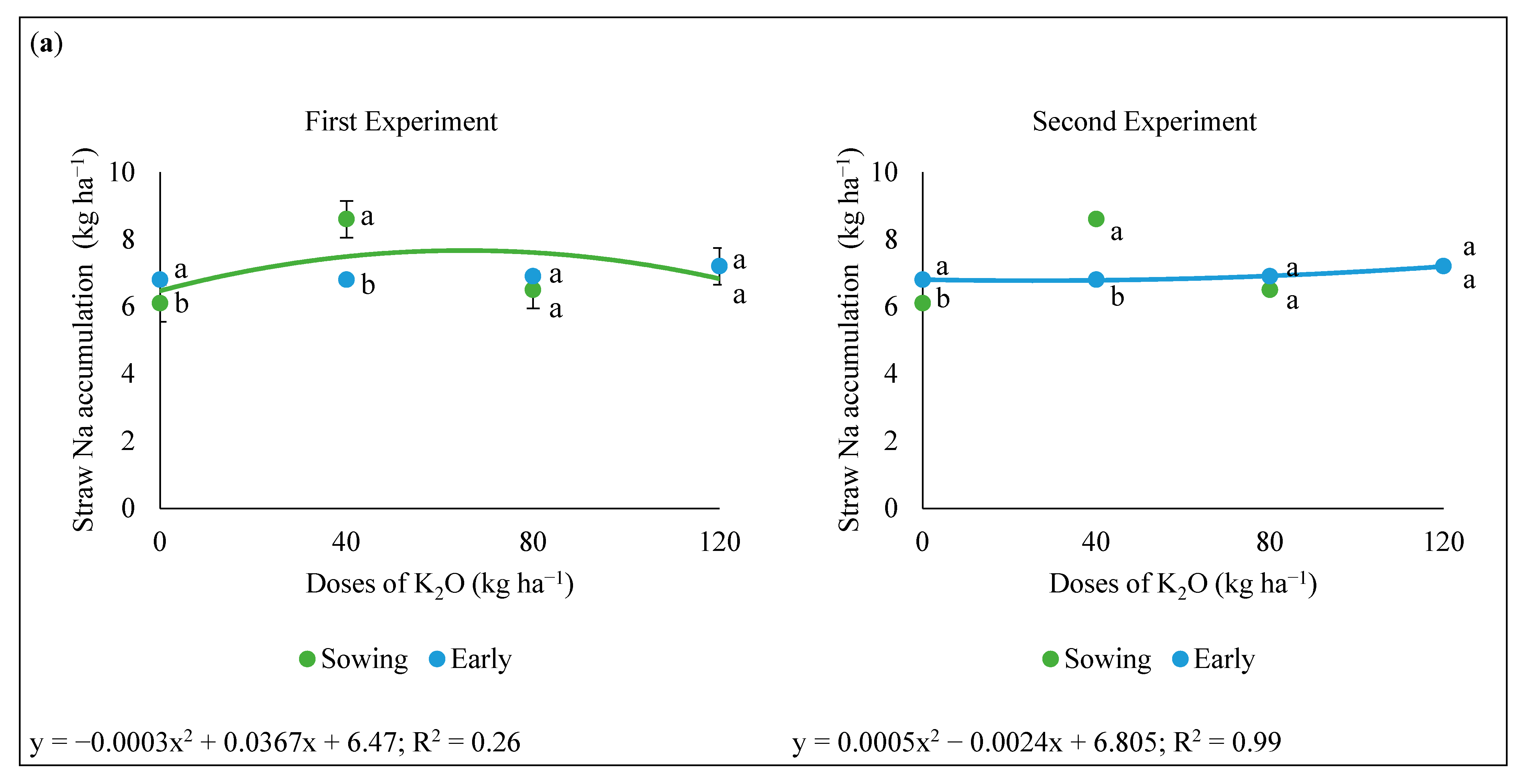
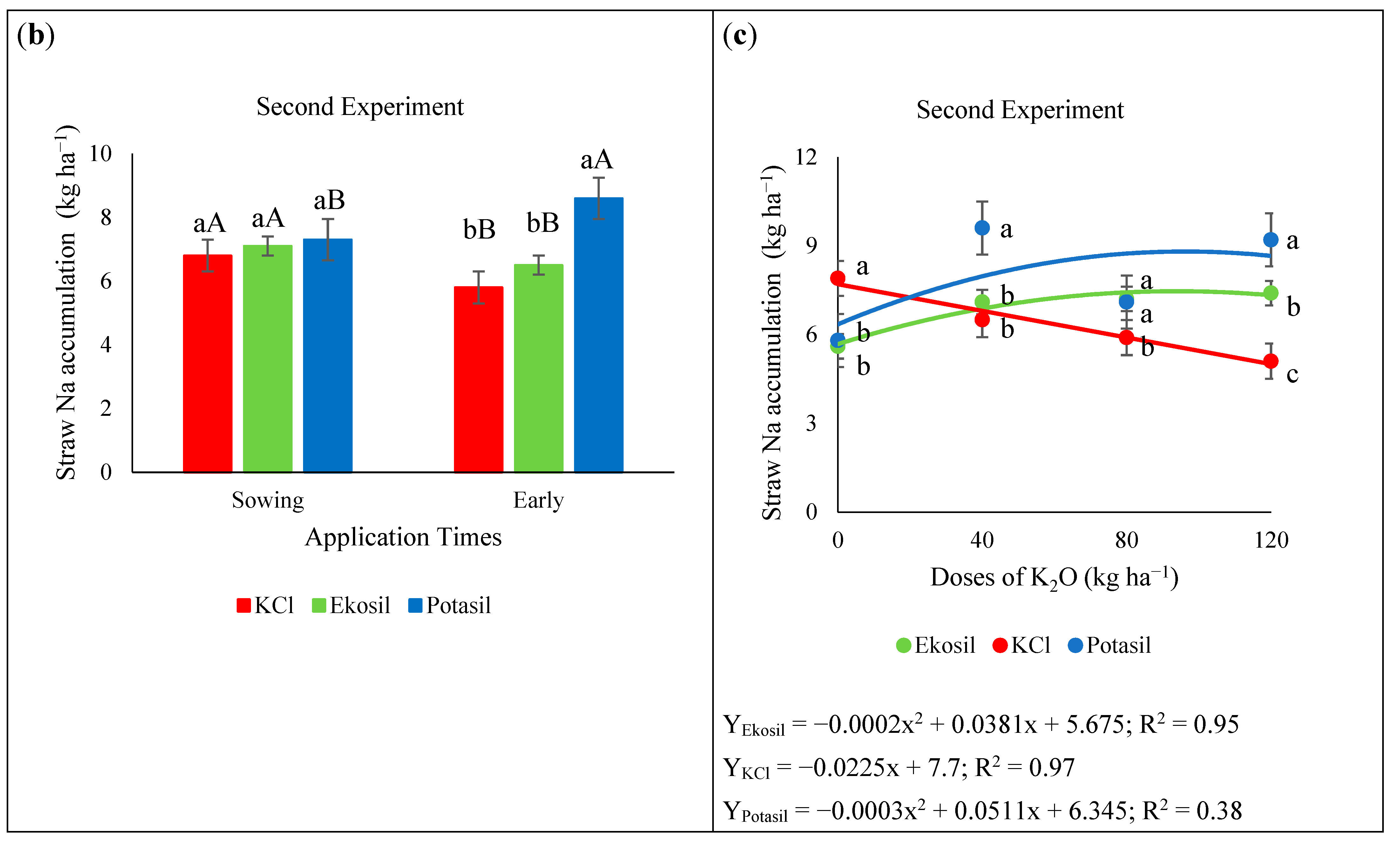
For Na accumulation in straw, the dose × timing interaction (Figure 5a) revealed a decreasing linear adjustment under fertilization at sowing, where Na concentration declined with increasing K2O doses. A significant difference occurred only at 0 kg ha−1, where sowing application was higher than early application. In Year 2, the dose × timing interaction was significant: early application showed a quadratic fit with an optimum dose of 61.17 kg ha−1, while sowing application peaked at 40 kg ha−1. In the source × timing interaction (Figure 5b), Ekosil and KCl were more effective at sowing, while Potasil was more effective when applied early. Among K sources, early applied Potasil showed the highest values. The source × dose interaction (Figure 5c) was also significant: at 0 kg ha−1, KCl performed best; at 40 kg ha−1, Potasil; at 80 kg ha−1, both Ekosil and Potasil; and at 120 kg ha−1, Potasil. Regression fits showed a quadratic response for Ekosil (optimum 95.25 kg ha−1), a negative linear response for KCl, and a quadratic response for Potasil (optimum 85.17 kg ha−1).
Figure 5.
(a) Dose and timing interaction for straw Na accumulation. (b) Source and timing interaction for straw Na accumulation. (c) Effect of the interaction between doses and sources for straw Na accumulation. Different lowercase letters for time, different uppercase letters for F, different letters differ 5% level by the F-test.
3.3. Potassium, Silicon and Sodium Accumulation in Maize Grains
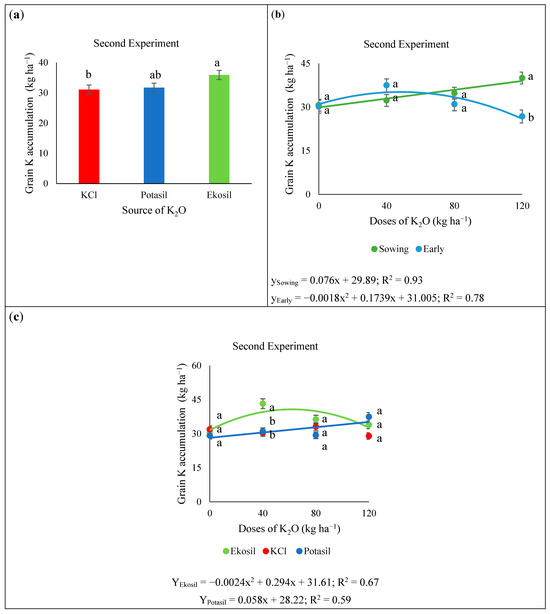
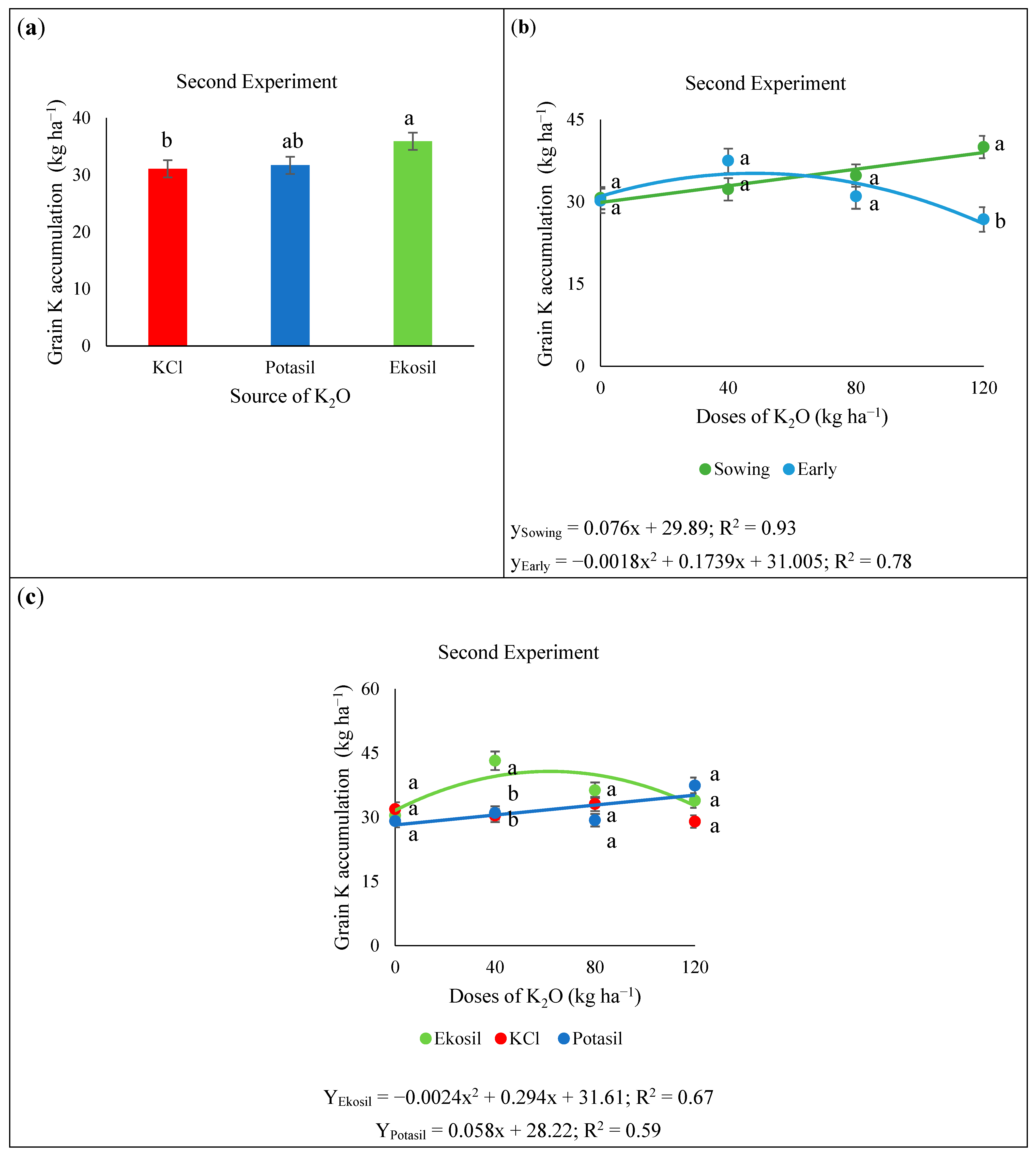
The isolated effect of source (Figure 6a) showed that Ekosil was the most effective K2O source for K accumulation in maize grains. In the dose × timing interaction (Figure 6b), a significant effect was observed at 120 kg ha−1, with application at sowing resulting in higher grain K accumulation. Regression analysis indicated a positive linear fit for sowing application and a quadratic fit for early application, with an optimum dose of 48.31 kg ha−1. In the source × dose interaction (Figure 6c), a significant effect was observed at 40 kg ha−1, where Ekosil was superior. The regression model showed a quadratic fit for Ekosil, with an optimum dose of 61.25 kg ha−1, and a positive linear fit for Potasil.
Figure 6.
(a) Isolated effect of K source on grain K accumulation. (b) Interaction effect between K2O dose and application timing on grain K accumulation. (c) Interaction effect between K2O dose and source on grain K accumulation. Different lowercase letters for time, different letters differ 5% level by the F-test.
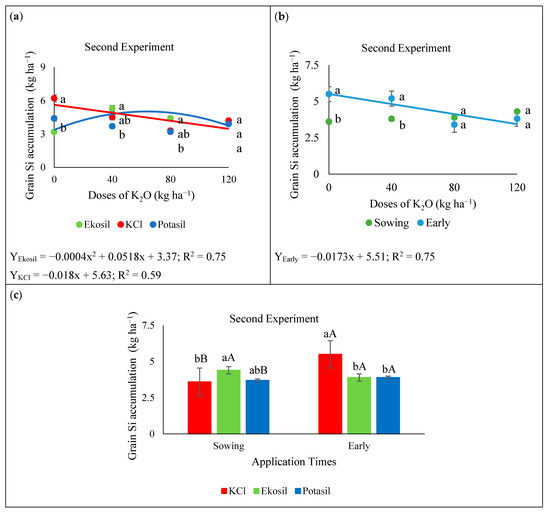
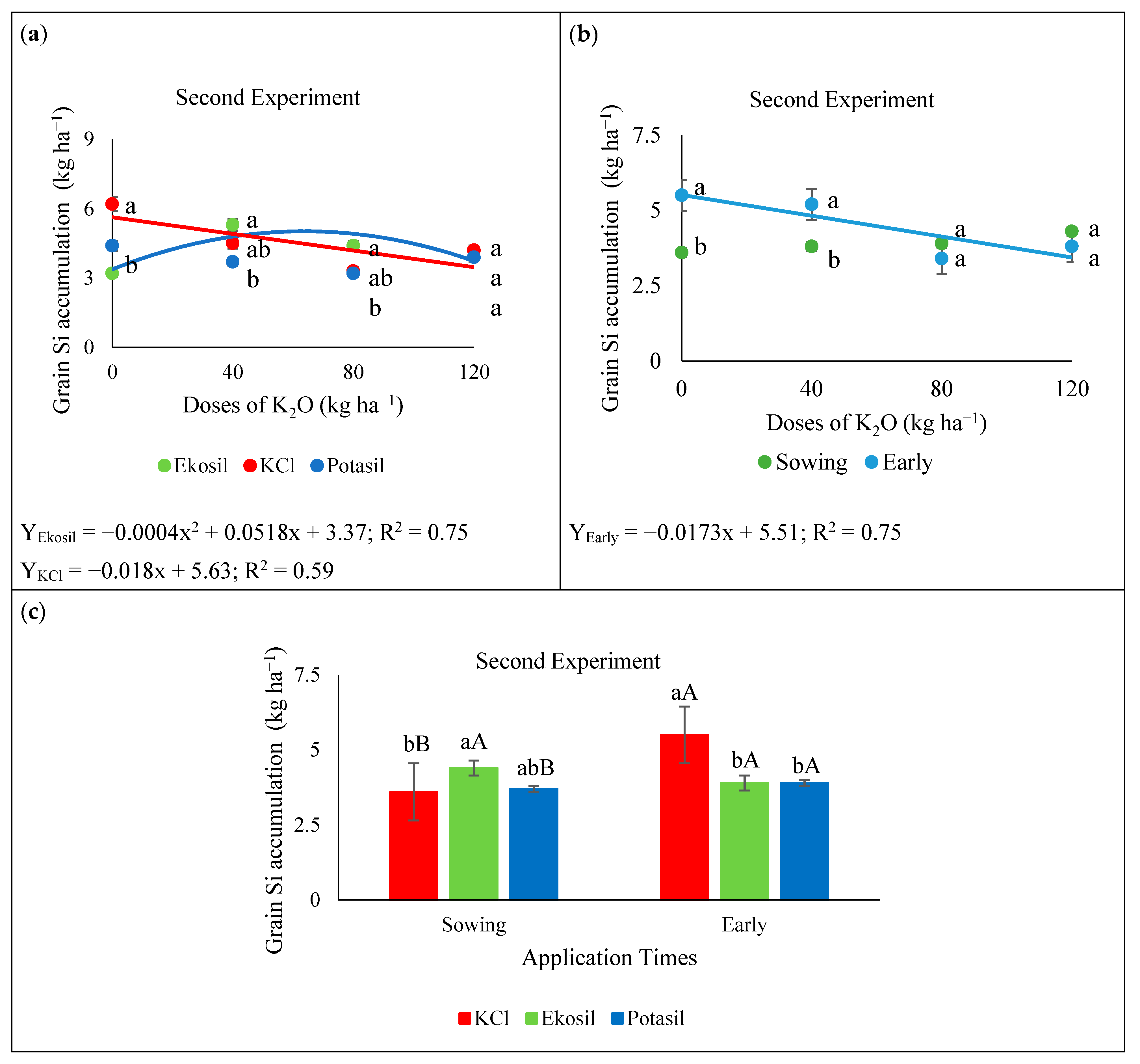
For grain Si accumulation, the interaction between source and dose (Figure 7a) showed a significant effect at dose 0, with KCl standing out, and at doses of 40 and 80 kg ha−1, with emphasis on Ekosil and KCl. Both sources showed a quadratic response, with an optimal dose of 64.75 kg ha−1 for Ekosil. In the interaction between dose and timing (Figure 7b), there was a significant effect at doses of 0 and 40 kg ha−1, with emphasis on early application, which showed a negative linear trend. In the interaction between source and timing (Figure 7c), KCl showed a significant effect under early application. Overall, KCl applied early and Ekosil applied at sowing were the most effective treatments.
Figure 7.
(a) Interaction between K2O source and dose for grain Si accumulation. (b) Interaction between K2O dose and application timing for grain Si accumulation. (c) Interaction between K2O source and application timing for grain Si accumulation. Different lowercase letters for time, different uppercase letters for F, different letters differ 5% level by the F-test.
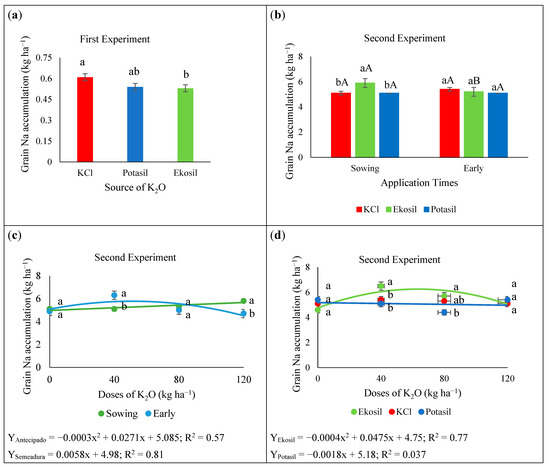
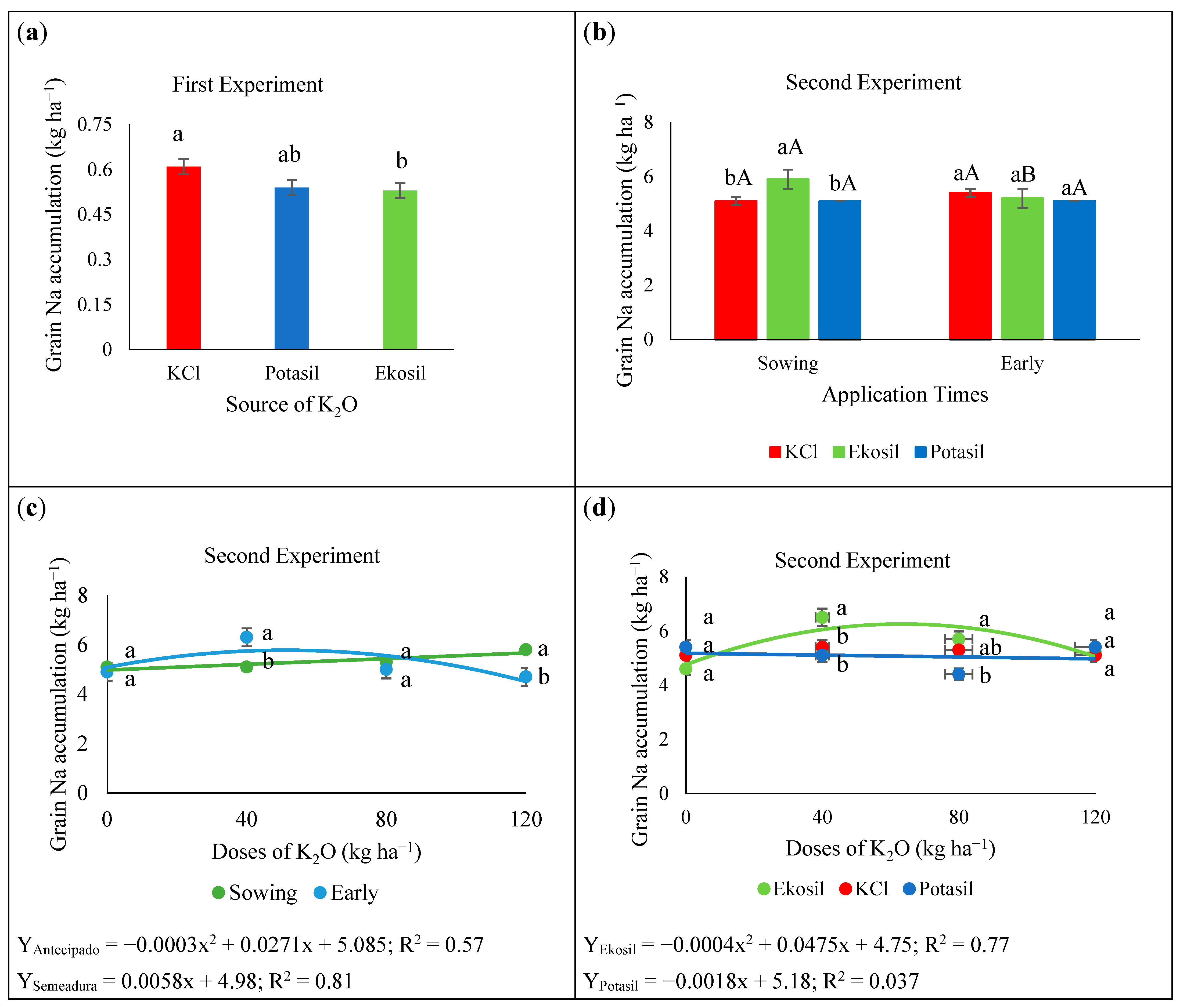
For grain Na accumulation, the isolated K source effect (Figure 8a) highlighted KCl in Year 1. In the interaction between source and timing (Figure 8b), Ekosil showed a significant effect under early application, while Ekosil applied at sowing was also noteworthy. In the interaction between dose and timing (Figure 8c), there was a significant effect at doses of 40 and 120 kg ha−1, with early application showing both a positive linear trend and a quadratic response, with an optimal dose of 45.17 kg ha−1. In the interaction between source and dose (Figure 8d), significant effects were observed at doses of 40 and 80 kg ha−1, with emphasis on KCl and Ekosil. Ekosil showed a quadratic fit with an optimal dose of 45.17 kg ha−1, while Potasil also followed a quadratic trend. Additional analyses confirmed that for the interaction between timing and dose, no significant regression adjustment was observed for either early application or sowing. However, at doses of 0 and 40 kg ha−1, sowing application was statistically superior to early application. For the interaction between application timing within K2O sources, only KCl showed a significant difference, with early fertilization outperforming sowing. In the interaction between doses within sources, only KCl showed a quadratic adjustment. At dose 0, KCl was statistically superior compared to the other sources. Moreover, residual KCl applied at sowing differed significantly from other sources. For grain Na accumulation, Potasil and Ekosil consistently showed lower values compared to KCl.
Figure 8.
(a) Isolated source effect on grain Na accumulation. (b) Interaction between K2O source and application timing for grain Na accumulation. (c) Interaction between application timing and dose for grain Na accumulation. (d) Interaction between K2O source and dose for grain Na accumulation. Different lowercase letters for time, different uppercase letters for F, different letters differ 5% level by the F-test.
3.4. Fertilizer Agronomic Efficiency in Maize Crops
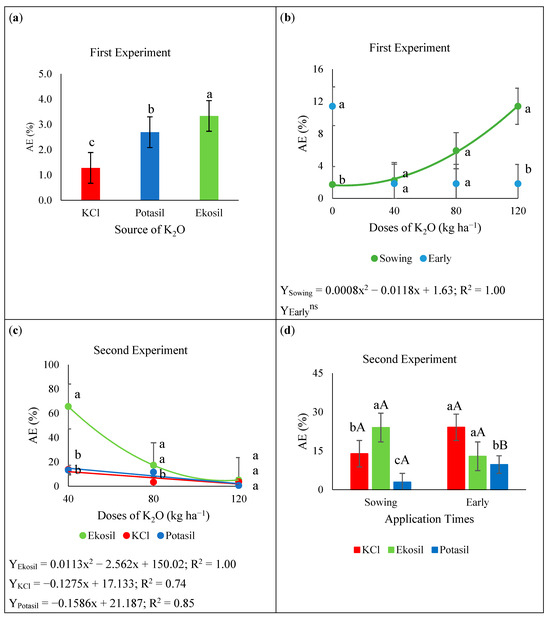
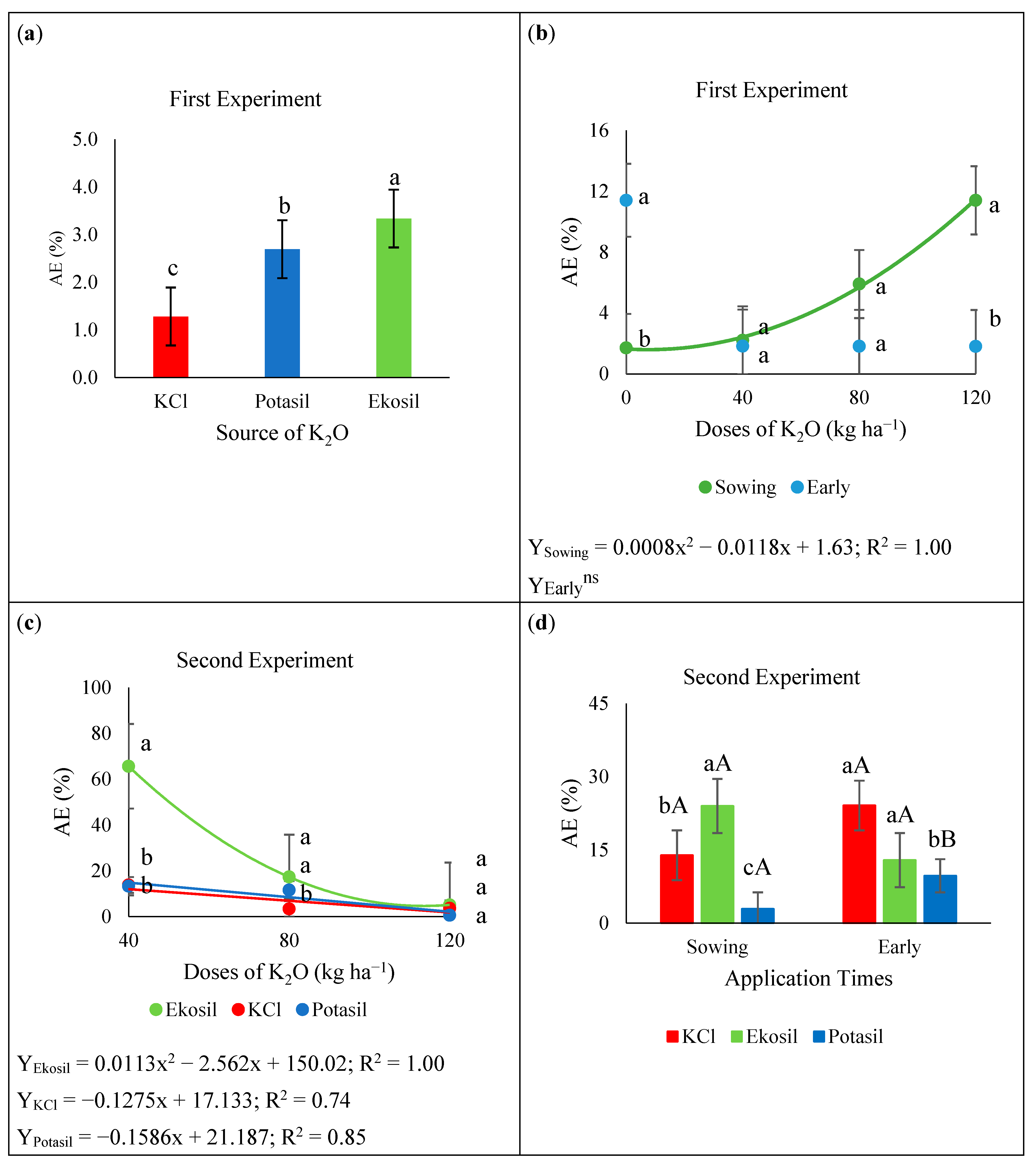
A significant effect (p < 0.05) was observed for agronomic efficiency (AE). For K2O doses, AE reached 22.03% at 40 kg ha−1, following a negative quadratic trend. Regarding sources, Ekosil stood out with an average AE of 21.9% (Figure 9a). For application timing, early application was superior, with an average of 11.4%. In the interaction between K2O dose and application timing (Figure 9b), at a dose of 0 kg ha−1, early application was more effective, whereas at 120 kg ha−1, application at sowing was superior. For early application, Ekosil and Potasil performed better than KCl, with a quadratic adjustment observed. For the interaction between K2O source and dose (Figure 9c), at 40 kg ha−1, Ekosil stood out with an average agronomic efficiency (AE) of 65.6%. At 80 kg ha−1, no significant differences were observed between Ekosil and Potasil, but both were superior to KCl. When considering the effect of source within dose, Ekosil showed a quadratic fit, while KCl and Potasil showed a decreasing linear fit. In the interaction between K2O source and timing (Figure 9d), no significant differences between timings were observed for Ekosil. However, KCl performed better under early application, while Potasil was more effective at sowing. Comparing sources within timing, Ekosil was superior at sowing, while both Ekosil and KCl were more effective under early application.
Figure 9.
(a) Isolated effect of source for agronomic efficiency (AE). (b) Interaction between dose and timing for AE. (c) Interaction between source and dose for AE. (d) Interaction between source and timing for AE. Different lowercase letters for time, different uppercase letters for F, different letters differ 5% level by the F-test.
4. Discussion
The reduction in leaf K concentration at higher K2O doses cannot be interpreted solely as a dilution effect associated with increased biomass accumulation, although greater dry matter production may partially contribute to this response. An alternative and more mechanistically consistent explanation involves nutrient interaction dynamics in the rhizosphere and within plant tissues [28]. Elevated external K concentrations can alter cation balance, affecting the uptake and translocation of other elements, including Ca, Mg and potentially Si, due to competition for transport sites and changes in membrane electrochemical gradients. Additionally, high K supply may reduce root membrane permeability selectivity or modify the activity of high-affinity K transporters, leading to altered partitioning between tissues rather than proportional increases in leaf concentration. In soils receiving silicate-based sources, increased Si availability may also influence K dynamics indirectly by modifying root physiology, apoplastic binding sites, and transpiration patterns, which affect mass-flow-mediated nutrient transport.
The higher Si accumulation with Potasil and Ekosil indicates their potential as slow-release silicate sources, enhancing Si uptake compared to KCl. The differential response to application timing suggests that applying K earlier can improve soil fertility establishment, benefiting residual uptake in the succeeding maize crop. This residual benefit is particularly important for Si, as it accumulates in grasses, such as maize, and appears to benefit from residual availability, supporting nutrient cycling across seasons, as also reported by [29].
The positive effect of KCl on Na accumulation at high doses suggests that Na can partially compensate for some metabolic roles of K under certain conditions, contributing to osmotic regulation, enzyme activity, and water potential maintenance [30]. These findings highlight the importance of choosing appropriate K sources and doses to optimize both primary and secondary nutrient uptake in maize. The positive linear response of K accumulation in straw to early fertilization highlights the importance of early nutrient availability for maize under no-tillage systems. When K is supplied earlier, plants can absorb and store more of the nutrient during initial growth, resulting in greater accumulation in vegetative tissues, consistent with findings from [31]. The differences observed among sources suggest that alternative potassium fertilizers, such as Potasil and Ekosil, provide distinct release dynamics compared to KCl. Potasil, in particular, showed superior performance at higher doses, which may be attributed to its gradual release and lower risk of leaching, favoring a continuous supply of K during crop development. The quadratic adjustment for Ekosil indicates that intermediate doses may optimize nutrient availability, while very high doses may not increase K accumulation proportionally. This behavior reinforces the need for appropriate dose management depending on the fertilizer source [32]. Finally, the interaction between source and timing demonstrates that while KCl tends to provide immediate availability when applied at sowing, silicate-based sources such as Potasil perform better when applied in advance, due to their slower solubility and residual effect. This supports the use of alternative sources as a strategy to improve K use efficiency and nutrient cycling in no-tillage systems [32], for subsequent agricultural crops.
The results indicate that Ekosil stands out as an effective K source for corn stover accumulation, likely due to its gradual nutrient release, which matches crop demand more efficiently [3]. The positive response to sowing application at higher doses highlights the importance of synchronizing K availability with crop uptake, ensuring greater accumulation in straw. Early application, despite showing a quadratic fit, reached its optimum at a lower dose (48.31 kg ha−1), suggesting that beyond this level, K availability may not translate into higher accumulation, possibly due to nutrient saturation or competition with other cations. The interaction between sources and doses further reinforces the efficiency of Ekosil, particularly at intermediate doses, while Potasil showed a consistent linear increase with dose. This difference suggests that the two alternative silicate-based sources have distinct release dynamics, which can be strategically explored in management systems to improve nutrient use efficiency [32]. Overall, the findings emphasize the relevance of choosing the right source and timing for K fertilization to maximize stover accumulation, which is essential for nutrient cycling and soil cover in no-tillage systems.
The results for silicon highlight that its accumulation depends strongly on the fertilizer source and application timing. Potasil was particularly effective when applied early, suggesting that slow-release and silicate-based fertilizers may provide more consistent Si availability. However, the negative linear relationship between K2O dose and Si accumulation indicates a competitive effect between K and Si, reinforcing the importance of balanced nutrient management to avoid limiting Si uptake. These findings align with previous reports emphasizing the role of Si in tropical agriculture and its management challenges, consistent with previous reports [33]. These results suggest that Si accumulation is influenced not only by the source but also by the timing of K fertilization [33]. The quadratic response for Ekosil indicates that intermediate doses optimize Si uptake, while KCl shows greater efficiency under early application. This highlights the importance of adjusting both source and timing to enhance Si availability in maize, consistent with findings in tropical soils where nutrient cycling and timing play critical roles [33].
For Na, the interactions suggest a more complex dynamic, where both source and application timing play critical roles. The quadratic response for Potasil and Ekosil indicates that intermediate doses optimize Na accumulation, while excessive doses may reduce uptake efficiency. KCl, in contrast, showed a negative linear response, reflecting its less favorable impact on Na dynamics in straw. The results also suggest that Na can partially substitute for K in maize metabolism, particularly under limited K availability, contributing to osmotic regulation and enzyme activation. This corroborates the findings of [34] who highlighted the potential of Na as a complementary nutrient when carefully managed to avoid toxicity. The results demonstrate that Na accumulation in maize grain is highly dependent on the source of K fertilizer, with KCl consistently providing higher Na levels than Ekosil or Potasil. The quadratic responses for Ekosil and Potasil suggest that moderate doses (40 kg K2O ha−1) may enhance Na uptake, but their overall contribution remains lower than that of KCl. The superiority of KCl, especially under early application, supports the hypothesis that this source provides greater amounts of Na to the crop. These findings align with the view that source selection plays a critical role in nutrient interactions and must be carefully considered to optimize fertilization strategies [34].
These results indicate that synchronizing K2O application with crop demand improves nutrient use efficiency, corroborating previous findings that emphasize the importance of proper K management in agricultural systems [35,36]. The superior performance of Ekosil and Potasil under early application may be attributed to their differentiated composition, which favors higher solubility and gradual nutrient release, increasing K availability in the soil. The quadratic adjustment observed for Ekosil suggests that it is more efficient at moderate doses, while the decreasing linear fits for KCl and Potasil indicate that their performance may be limited at higher doses, possibly due to soil K fixation, consistent with findings by He et al. (2022) [37].
The variability in efficiency across K sources and timings suggests that the choice of fertilizer and application strategy should consider soil attributes, climatic conditions, and nutrient release dynamics. Differences in soil K dynamics, such as leaching and adsorption, as well as the synchronization between nutrient release and plant demand, may explain these patterns. Further studies are necessary to better understand these interactions, particularly in high-yield systems.
5. Conclusions
Potasil provided a higher foliar Si concentration. Potassium concentration in diagnostic leaf is greater with the potassium fertilization 30 days before soybean sowing.
Early potassium fertilization promoted greater K accumulation in maize straw in clay soil. Si accumulation in the straw increased with the increment of potassium fertilization using the Potasil source. This is interesting for greater straw persistence in agricultural areas in Cerrado soils.
For grain K accumulation, moderate K2O doses favor greater accumulation, with Ekosil and Potasil showing superior results compared to KCl. There was greater Si grain accumulation with increased potassium fertilization using Potasil and less accumulation of Na in the grains with Ekosil compared to KCl.
Agronomic efficiency is maximized at 40 kg ha−1 of K2O, with Ekosil showing the best performance for maize crop. Potassium application 30 days before soybean sowing proves superior agronomic efficiency for maize crop in the first experiment.
Author Contributions
Conceptualization, M.C.B. and M.C.M.T.F.; methodology, M.C.B. and C.E.d.S.O.; software, C.E.d.S.O.; validation, M.C.B. and C.E.d.S.O.; formal analysis, M.C.B., W.C.N.I., L.F.R.d.S. and G.C.F.; resources, M.C.M.T.F.; data curation, B.H.L., W.C.N.I., G.C.F., C.E.d.S.O.; writing—review, B.B.G., T.A.R.N., L.F.R.d.S., K.d.S.S. and E.C.d.S.; visualization, B.H.L., W.C.N.I., L.F.R.d.S. and G.C.F.; supervision, M.C.M.T.F.; project administration, B.B.G., B.H.L., T.A.R.N., W.C.N.I., G.C.F., K.d.S.S., E.C.d.S. and M.C.M.T.F. All authors have read and agreed to the published version of the manuscript.
Funding
This review received funding from “Coordenação de Aperfeiçoamento de Pessoal de Nível Superior” (CAPES) for the Master studies of the first author, and National Council for Scientific and Technological Development (CNPq) productivity research grant (award number 314497/2023-4) of the corresponding author.
Institutional Review Board Statement
Not applicable.
Informed Consent Statement
Not applicable.
Data Availability Statement
The original contributions presented in this study are included in the article. Further inquiries can be directed to the corresponding author.
Acknowledgments
We acknowledge CAPES and CNPq for their financial support, and the fertilizer company “Yoorin Fertilizantes”.
Conflicts of Interest
The authors declare no conflicts of interest.
References
- Cavalheiro, D.; Faoro, R.; Miri, D.; Fochesatto, L.; Stiegemeier, J.; Jonas Cardoso, J.; Chais, C.; Matte, J.; Ganzer, P.P.; Olea, P. A Tecnologia da Informação No Agronegócio: Uma Revisão Bibliográfica; Educs (Universidade de Caxias do Sul): Caxias do Sul, Brazil, 2018; p. 16.
- Lovera, L.H.; Nunes, A.L.; Cortez, L. Release USDA. In Milho: Safra 2023/2024; Federation of Agriculture and Livestock of Mato Grosso do Sul–FAMASUL: Campo Grande, Brazil, 2023. [Google Scholar]
- Macedo, L.O.; Boaretto, R.M.; Jacobassi, R.; Carr, N.F.; Quaggio, J.A.; Mattos, D., Jr. Use of Sparingly Soluble Micronutrients Sources for Citrus Production. Citrus Res. Technol. 2017, 38, 1–10. [Google Scholar] [CrossRef] [Scilit]
- 12° Levantamento—Safra 2024/25. Available online: https://www.gov.br/conab/pt-br/atuacao/informacoes-agropecuarias/safras/safra-de-graos/boletim-da-safra-de-graos/12o-levantamento-safra-2024-25/12o-levantamento-safra-2024-25 (accessed on 3 November 2025).
- Herrendorf, B.; Schoellman, T. Why Is Measured Productivity so Low in Agriculture? Rev. Econ. Dyn. 2015, 18, 1003–1022. [Google Scholar] [CrossRef] [Scilit]
- Rodrigues, M.A.D.C.; Buzetti, S.; Teixeira Filho, M.C.M.; Garcia, C.M.P.; Andreotti, M. Adubação com KCl revestido na cultura do milho no Cerrado. Rev. Bras. Eng. Agrícola Ambient. 2014, 18, 127–133. [Google Scholar] [CrossRef] [Scilit]
- Mallarino, A.P. Phosphorus and Potassium Fertilization for Corn and Soybean During 40 Years in Northeast Iowa Final Study Report, September 2024; Iowa State University Research and Demonstration Farms Progress Reports: Ames, IA, USA, 2024. [Google Scholar]
- Artuzo, F.D.; Foguesatto, C.R.; de Souza, Â.R.L.; da Silva, L.X. Costs management in maize and soybean production. Rev. Bus. Manag. 2018, 20, 273–294. [Google Scholar] [CrossRef] [Scilit]
- Galvão, J.C.C.; Miranda, G.V.; Trogello, E.; Fritsche-Neto, R. Sete décadas de evolução do sistema produtivo da cultura do milho. Rev. Ceres 2014, 61, 819–828. [Google Scholar] [CrossRef] [Scilit]
- Wu, L.; Liu, M. Preparation and Properties of Chitosan-Coated NPK Compound Fertilizer with Controlled-Release and Water-Retention. Carbohydr. Polym. 2008, 72, 240–247. [Google Scholar] [CrossRef] [Scilit]
- Al-Zahrani, S.M. Utilization of Polyethylene and Paraffin Waxes as Controlled Delivery Systems for Different Fertilizers. Ind. Eng. Chem. Res. 2000, 39, 367–371. [Google Scholar] [CrossRef] [Scilit]
- Resende, A.V.; Martins, E.; Oliveira, C.G.; Sena, M.C.; Machado, C.T.T.; Kinpara, D.I.; Oliveira-Filho, E.C. Potassium Supply and Research on the Use of “In Natura” Rocks in Brazilian Agriculture. Espaço Geogr. 2006, 9, 19–42. [Google Scholar]
- Tavares, L.C.; Tunes, L.M.D.; Brunes, A.P.; Fonseca, D.Â.R.; Rufino, C.D.A.; Barros, A.C.S.A.; Melo, S.D.C. Potássio via Recobrimento de Sementes de Soja: Efeitos Na Qualidade Fisiológica e No Rendimento. Cienc. Rural 2013, 43, 1196–1202. [Google Scholar] [CrossRef] [Scilit]
- Rehman, B.; Zulfiqar, A.; Attia, H.; Sardar, R.; Saleh, M.A.; Alamer, K.H.; Alsudays, I.M.; Mehmood, F.; Zaman, Q.U. Seed Priming with Potassium Nitrate Can Enhance Salt Stress Tolerance in Maize. Phyton 2024, 93, 1819–1838. [Google Scholar] [CrossRef] [Scilit]
- Silva, L.E.B.; Silva, J.C.d.S.; de Souza, W.C.L.; Lima, L.L.C.; dos Santos, R.L.V. Desenvolvimento Da Cultura Do Milho (Zea mays L.): Revisão de Literatura. Divers. J. 2020, 5, 1636–1657. [Google Scholar] [CrossRef] [Scilit]
- Mendes, W.D.C.; Alves Júnior, J.; Cunha, P.C.R.D.; Silva, A.R.D.; Evangelista, A.W.P.; Casaroli, D. Potassium Leaching in Different Soils as a Function of Irrigation Depths. Rev. Bras. Eng. Agrícola Ambient. 2016, 20, 972–977. [Google Scholar] [CrossRef] [Scilit]
- Fiorini, I.V.A.; Pinho, R.G.V.; Pires, L.P.M.; Santos, Á.O.; Fiorini, F.V.A.; Cancellier, L.L.; Resende, E.L. Avaliação de Fontes de Enxofre e Das Formas de Micronutrientes Revestindo o NPK Na Cultura Do Milho. Rev. Bras. Milho Sorgo 2016, 15, 20–29. [Google Scholar] [CrossRef] [Scilit]
- Han, Y.; Ma, W.; Zhou, B.; Salah, A.; Geng, M.; Cao, C.; Zhan, M.; Zhao, M. Straw Return Increases Crop Grain Yields and K-Use Efficiency under a Maize-Rice Cropping System. Crop J. 2021, 9, 168–180. [Google Scholar] [CrossRef] [Scilit]
- Brito, F.L.; Rolim, M.M.; Pedrosa, E.M.R. Teores de potássio e sódio no lixiviado e em solos após a aplicação de vinhaça. Rev. Bras. Eng. Agrícola Ambient. 2021, 9, 52–56. [Google Scholar] [CrossRef] [Scilit]
- Malaquias, C.A.A.; Santos, A.J.M. Adubação organomineral e NPK na cultura do milho (Zea mays L.). Pubvet 2017, 11, 501–512. [Google Scholar] [CrossRef] [Scilit]
- Barbosa, M.C.; Fernandes, G.C.; Lima, B.H.; Rosa, L.G.P.; Ito, W.C.N.; de Souza, L.F.R.; Jalal, A.; Nogueira, T.A.R.; Oliveira, C.E.d.S.; Ghaley, B.B.; et al. The Effects of Potassium Dose, Timing, and Source in Soybean Crops in Brazilian Savannah Oxisol. Sustainability 2025, 17, 934. [Google Scholar] [CrossRef] [Scilit]
- Soil Survey Staff. Keys to Soil Taxonomy, 13th ed.; USDA—Natural Resources Conservation Service: Washington, DC, USA, 2022.
- Cantarella, H.; Quaggio, J.A.; Mattos, D., Jr.; Boaretto, R.M.; van Raij, B. Boletim 100: Recomendações de Adubação e Calagem Para o Estado de São Paulo; IAC: Campinas, SP, Brazil, 2022. [Google Scholar]
- Bernardi, A.C.d.C.; de Oliveira Júnior, J.P.; Leandro, W.M.; Mesquita, T.G.d.S.; de Freitas, P.L.; Carvalho, M.d.C.S. Doses e formas de aplicação da adubação potássica na rotação soja, milheto e algodão em sistema plantio direto. Pesqui. Agropecuária Trop. 2009, 39, 158–167. [Google Scholar]
- Fageria, N.K.; dos Santos, A.B.; Cobucci, T. Zinc nutrition of lowland rice. Commun. Soil Sci. Plant Anal. 2011, 42, 1719–1727. [Google Scholar] [CrossRef] [Scilit]
- Jalal, A.; Galindo, F.S.; Boleta, E.H.M.; Oliveira, C.E.S.; dos Reis, A.R.; Nogueira, T.A.R.; Moretti Neto, M.J.; Mortinho, E.S.; Fernandes, G.C.; Teixeira Filho, M.C.M. Common bean yield and zinc use efficiency in association with diazotrophic bacteria co-inoculations. Agronomy 2021, 11, 959. [Google Scholar] [CrossRef] [Scilit]
- Ferreira, D.F. Sisvar: Um Programa Para Análises e Ensino de Estatística. Available online: https://des.ufla.br/~danielff/programas/sisvar.html (accessed on 7 December 2023).
- Cao, Y.; Li, K.; Li, Y.; Zhao, X.; Wang, L. MYB Transcription Factors as Regulators of Secondary Metabolism in Plants. Biology 2020, 9, 61. [Google Scholar] [CrossRef] [Scilit] [PubMed]
- Barrow, N.J.; Hartemink, A.E. The Effects of pH on Nutrient Availability Depend on Both Soils and Plants. Plant Soil 2023, 487, 21–37. [Google Scholar] [CrossRef] [Scilit]
- Linam, F.; Limmer, M.A.; Tappero, R.; Seyfferth, A.L. Rice Husk and Charred Husk Amendments Increase Porewater and Plant Si but Water Management Determines Grain As and Cd Concentration. Plant Soil 2022, 477, 135–152. [Google Scholar] [CrossRef] [Scilit]
- Uhlig, D.; Berns, A.E.; Wu, B.; Amelung, W. Mean Nutrient Uptake Depths of Cereal Crops Change with Compost Incorporation into Subsoil—Evidence from 87Sr/86Sr Ratios. Plant Soil 2023, 489, 613–628. [Google Scholar] [CrossRef] [Scilit]
- Savarese, C.; Cozzolino, V.; Verrillo, M.; Vinci, G.; De Martino, A.; Scopa, A.; Piccolo, A. Combination of Humic Biostimulants with a Microbial Inoculum Improves Lettuce Productivity, Nutrient Uptake, and Primary and Secondary Metabolism. Plant Soil 2022, 481, 285–314. [Google Scholar] [CrossRef] [Scilit]
- Lamlom, S.F.; Abdelghany, A.M.; Ren, H.; Ali, H.M.; Usman, M.; Shaghaleh, H.; Alhaj Hamoud, Y.; El-Sorady, G.A. Revitalizing Maize Growth and Yield in Water-Limited Environments through Silicon and Zinc Foliar Applications. Heliyon 2024, 10, e35118. [Google Scholar] [CrossRef] [Scilit]
- Gusmão, T.A.S.; Alexandre, A.M.; Souza, N.G.G.D.; Sassi, K.K.B.; Gusmão, R.P.D.; Moreira, R.T. Partial Replacement of Sodium Chloride by Potassium Chloride in the Formulation of French Bread: Effect on the Physical, Physicochemical and Sensory Parameters. Food Sci. Technol. 2017, 37, 55–62. [Google Scholar] [CrossRef] [Scilit]
- Yin, M.; Li, Y.; Hu, Q.; Yu, X.; Huang, M.; Zhao, J.; Dong, S.; Yuan, X.; Wen, Y. Potassium Increases Nitrogen and Potassium Utilization Efficiency and Yield in Foxtail Millet. Agronomy 2023, 13, 2200. [Google Scholar] [CrossRef] [Scilit]
- Liu, H.; Su, B.; Liu, R.; Wang, J.; Wang, T.; Lian, Y.; Lu, Z.; Yuan, X.; Song, Z.; Li, R. Conservation Tillage Mitigates Soil Organic Carbon Losses While Maintaining Maize Yield Stability Under Future Climate Change Scenarios in Northeast China: A Simulation of the Agricultural Production Systems Simulator Model. Agronomy 2024, 15, 1. [Google Scholar] [CrossRef] [Scilit]
- He, B.; Xue, C.; Sun, Z.; Ji, Q.; Wei, J.; Ma, W. Effect of Different Long-Term Potassium Dosages on Crop Yield and Potassium Use Efficiency in the Maize–Wheat Rotation System. Agronomy 2022, 12, 2565. [Google Scholar] [CrossRef] [Scilit]

Disclaimer/Publisher’s Note: The statements, opinions and data contained in all publications are solely those of the individual author(s) and contributor(s) and not of MDPI and/or the editor(s). MDPI and/or the editor(s) disclaim responsibility for any injury to people or property resulting from any ideas, methods, instructions or products referred to in the content. |
© 2026 by the authors. Licensee MDPI, Basel, Switzerland. This article is an open access article distributed under the terms and conditions of the Creative Commons Attribution (CC BY) license.