


Abstract
Vernonia amygdalina Delile (Asteraceae), commonly known as bitter leaf, is a tropical shrub that may potentially serve as a biopesticide against the Colorado potato beetle Leptinotarsa decemlineata (Say) (Coleoptera: Chrysomelidae), a key pest of potatoes. The beetle’s behavioral response to the methanolic leaf extract of V. amygdalina was evaluated in this study. Using no-choice, dual-choice, and wind-tunnel assays under laboratory conditions, we evaluated responses of larvae and adults to potato leaf discs treated with V. amygdalina extract in a randomized complete block design, measuring feeding behavior, leaf damage levels, and remaining leaf area. The results showed that V. amygdalina had no biocidal effects against the beetle, as no mortality was incurred. However, dose-linked antifeedant effects were evident in both no-choice and dual-choice arenas. Vernonia amygdalina minimized leaf-area loss most effectively at the highest concentration, especially against the larvae. The extract showed no olfactory repellency but acted as an antifeedant, possibly through contact or taste (gustatory) receptors. The consistent behavioral avoidance at higher concentrations suggests that V. amygdalina acts as a form of deterrent against the Colorado potato beetle.
1. Introduction
Vernonia amygdalina Delile (Asteraceae), or bitter leaf, is a bitter-tasting leafy plant used as food and medicines. Though native to Africa, V. amygdalina was introduced to northeastern India for medicinal uses and to the US and Brazil for culinary purposes [1,2]. Vernonia amygdalina and closely related V. cinerea exhibited strong pesticidal effects when applied as oil extract against stored-grain pests and as aqueous or alcoholic extracts against mosquito larvae [3,4,5,6]. It also has antimicrobial, anti-inflammatory, and antihelminthic properties [7,8,9]. Otabor et al. [5] demonstrated that ~0.76 g/L of V. amygdalina leaf extract can kill 50% of Culex quinquefasciatus Say (Diptera: Culicidae). Plant extracts may represent a promising source of novel compounds that may help manage different pests.
Potato (Solanum tuberosum L. (Solanaceae))—a crop of global value, native to South America, but cultivated across 150+ countries [10]—is susceptible to insect herbivory. In many areas, its key pest is Colorado potato beetle, Leptinotarsa decemlineata (Say) (Coleoptera: Chrysomelidae). The beetle is multivoltine and lays ~600 eggs over its lifetime. Eggs hatch into larvae that develop through four instars to become adults. All instars and the adult defoliate potato quickly and are capable of rapidly evolving resistance to multiple classes of insecticides [11,12,13]. By adapting to solanaceous crops’ toxic glycoalkaloids, which it detoxifies [13], L. decemlineata seems to be primed for other xenobiotics—a plausible reason for its swift resistance to insecticides.
Botanicals, derived from plants’ secondary metabolites, offer an alternative to synthetic pesticides and may deter pests such as the Colorado potato beetle [14,15,16,17]. For instance, an extract of Azadirachta indica A. Juss (Meliaceae) substantially reduced the beetle defoliation by three- to five-fold [18]. The beetle’s larvae were more affected than the adults [19]. To the contrary, adult Colorado potato beetles were more sensitive to the extracts of Humulus lupulus L. (Cannabaceae) than the larvae [17].
Plants in the family Asteraceae may be a valuable source of antifeedants against the Colorado potato beetle [20,21,22]. The acerbity of V. amygdalina and V. cinerea, alongside their reported toxicity towards different pests, e.g., maize weevil (Sitophilus zeamais (Motschulsky) (Coleoptera: Curculionidae)), bean weevil (Callosobruchus maculata (Fabricius) (Coleoptera: Bruchiidae)), mosquito larvae (Diptera: Culicidae), tobacco cutworm (Spodoptera litura Fabricius (Lepidoptera: Noctuidae)), and jute hairy caterpillar (Spilosoma obliqua) [3,5,6,23] might disrupt the Colorado potato beetle’s feeding. Chemicals isolated from V. cinerea, namely stigmasterol, luteolin-7-0-glucopyranoside, stigmasterol–β-D-glucopyranoside and dotriacontanoic acid, showed >94% deterrence to jute hairy caterpillar Spilosoma obliqua (Lepidoptera: Erebidae) and Spodoptera litura [3]. Similar effects might arise for V. amygdalina against the Colorado potato beetle. Consequently, this study aimed to evaluate the influence of methanolic extracts of V. amygdalina leaves on the feeding behavior of the Colorado potato beetle. The specific objectives were to examine the behavioral responses of first instars, third instars, and adults of Colorado potato beetle in no-choice, dual-choice, and wind-tunnel arenas for preference, avoidance (deterrence), and leaf damage assessments.
2. Materials and Methods
2.1. Preparation of Leaf Extract
The leaves of Vernonia amygdalina used in this study were air dried for four weeks until they attained hand-felt crispy dryness. After the leaves were dried, they were pulverized using a Waring Commercial blender (model 33BL79700) and sieved through a mesh (size 40, U.S.A. Standard stainless steel sieve ASTM E-11 specification by Fisher Scientific Company, Pittsburgh, PA, USA). Large mesh-impassable fragments were sieved and further pulverized manually with a Ketch-Mühle pestle and mortar. We combined both mechanically and manually milled V. amygdalina leaves (subsequently referred to as ‘powder’), which constitutes a total amount of 350 g, in a glass jar wrapped in aluminum foil and stored in a refrigerator at 4 °C until needed for solvent extraction (approximately three weeks later).
The powder was suspended in methanol (A412-4, lot 184364 certified ACS, Fisher Scientific Company), a common high-polarity solvent, at a 1:10 w/v ratio. The suspension was kept in the dark to protect any photosensitive constituents for three days and agitated for ten seconds daily to facilitate dissolution of leaf-associated constituents. Subsequently, No. 1 Whatman filter paper (Cat. #1001917) was used to obtain filtrate from the solution. The methanolic filtrate was thereafter evaporated over a water bath set at 65 °C (methanol boiling point) using a rotary evaporator (model: RE-201D, series: 202410068), equipped with an institution-wide vacuum air at 0.05 MPa (equiv. 7.25 psi). After a 3-h runtime, the concentrated solution was further dried under a fume hood for five days, eventually producing approximately 15 g of a semi-solid but malleable paste as a residual. The paste was collected and stored in an amber glass vial at 4 °C until needed (about three weeks after storage), thus avoiding possible photo or thermal degradation of constituents.
2.2. Preparation of Test Solutions
One gram of the leaf extract in the form of a malleable paste was measured with an analytical balance (OHAUS AR2140, 210 g max. weight and 0.0001 g readability, Parsippany, NJ, USA) and reconstituted in methanol at a 1:10 w/v ratio to obtain a stock solution of leaf extract (i.e., 0.1 g/mL). From that stock, other concentrations were serially diluted at a rate of 1:10 v/v using aerosol barrier micropipette tips (Fisher brand Cat. #02-707-51) to obtain additional three treatments, namely, high (0.01 g/mL), medium (0.001 g/mL), and low (0.0001 g/mL). The assays were set up in Fisher brand plastic Petri dishes (100 mm × 15 mm) lined with wet paper towels. The dishes were covered with their lids and placed in the Percival environmental chamber (model I-33VL, Percival Scientific, Inc., Perry, IA 50220, USA) as soon as each setup, which constituted a statistical block, was treated. The environmental chamber was set at 26 °C under 16:8 [L:D] h photoperiodicity.
2.3. Test Leaves
Fully opened young leaves that were damage-free were plucked from healthy-looking greenhouse-grown potato plants of similar age (about 6 weeks old) for the subsequent excision of leaf discs. The discs were cut using a clean glass tube (inner diameter = 1.33 cm), which was pressed against the leaf surface placed on a glass slab. The source plants were cultivated under ambient greenhouse conditions with an average temperature of 25.5 ± 0.1 °C (range: 20.6 °C and 31.0 °C), and a relative humidity of 30.1 ± 0.7% (range: 20.0% to 51.2%) recorded using a HOBO temperature/relative humidity data logger (MX1101). At planting, 3 g of 14-14-14 NPK fertilizer was evenly applied to each pot, and the plants were watered evenly once every two days. While leaf discs were used for no-choice and dual-choice assays, a potato leaflet was used for the wind tunnel assay. The leaf discs were treated with 20 µL of each designated treatment on each side of a leaf using a micropipette. A camel-hair brush was used to spread the applied solution on the leaf disc and then allowed to air dry before exposure to the test insects (first instar, third instars, and adults).
2.4. Test Insects
Unfed 24 h old first instars, newly emerged third instars, and unsexed young adults (<1 week old) were used for the assays (no-choice, dual-choice, and wind tunnel). The test insects were sourced from the University of Maine Research Farm in Aroostook County, Presque Isle, where the laboratory population is annually re-mixed with 50% of the wild population to ensure genetic diversity. The parent beetles were reared on Solanum tuberosum L. (cultivar: ‘Reba’) in meshed cages as described by Galimberti and Alyokhin [24].
2.5. No-Choice Assay
In no-choice assay, a single leaf disc was offered per test insect. The leaf discs were either treated with the designated concentrations of leaf extracts namely stock solution, high, medium, and low concentrations of the leaf extract, or with methanol or water as checks (or controls). The leaf discs were treated on both sides using micropipettes for application. Each surface was allowed to dry for approximately 2 min before flipping the disc to treat the other side; likewise, they were allowed to air dry before placing each in the test arena made of a clean Petri dish lined with moist filter paper. Separately, a single larva (or unsexed adult beetle) was introduced into the middle of the arena. The test insects were introduced close to the offered leaf disc (at <0.5 cm) for easy host recognition. The data were collected at 24 h and 48 h. The trials were set up in a randomized complete block design, replicated ten times. After the designated observation time, leaf damage was assessed through visual ratings as percentage leaf damage. The remaining leaf area after 48 h was measured using a LiCor area meter (model LI-3100) (cm2), NE, USA. Feeding inhibition (FI) was calculated as FI = (C − T)/C × 100, where C = the percentage damage observed on control leaf discs treated with methanol only, and T = the percentage damage observed on leaf discs treated with extracts. Negative values were set to zero.
2.6. Dual-Choice Assay
The larval or adult beetle’s responses were further tested in a dual-choice arena using a treated pair and a check pair of leaf discs positioned equidistantly along the four cardinal directions. While ten unfed newly hatched first instars were released into each test arena, only two newly eclosed third instars and two young (<a week old) adults were used. The treatments were stock solution, high concentration, medium concentration, low concentration, methanol check, and water check. The experiment was biologically replicated ten times. For first instars, ten larvae were released per Petri dish. Two larvae were used for third instar, and two unsexed adults were used for the adult stage. In each case, insects were released at the middle of a 90 mm Petri dish containing four leaf discs, with a 2–3 cm space between leaf discs as suggested by Pavela and coworkers [25]. Four leaf discs were placed into each Petri dish arena. Two of them were treated with the extract while the remaining two were treated with methanol. For the solvent test, two of the discs were treated with water, and two with methanol. Insect distributions and percent leaf damage were quantified at 24 h and 48 h, while the remaining leaf area was quantified using the LiCor area meter (model LI-3100; NE, USA). Percentage deterrence (PD) was determined using damage as a proxy: PD = (C − T)/(C + T) × 100; where C is the mean of visually estimated (%) damage in check leaf discs, and T is the mean of visually estimated (%) damage for leaf discs treated with extracts. A higher PD indicates stronger deterrence.
2.7. Wind Tunnel Assay
In evaluating beetles’ responses to potato leaves treated with 0.1 g/ml of V. amygdalina’s leaf extract, young unsexed adult beetles (<1 week old) were singly released into a push–pull wind tunnel. The tunnel had fresh potato leaves at the upstream end from which a consistent airflow (0.8 m/s) carried plant volatiles downstream. The push–pull effects were guaranteed by the Nidec Beta SL electric-propelled fans (Nippon Densan Corp., Kyoto, Japan). Each test beetle was observed for 30 minutes along a centimeter graduated tunnel from the beetle-release point (0 cm) through three decision lines (30 cm, 40 cm, and 50 cm). The leaf holder was situated at 55 cm but separated from the insect arena by a wire gauze. When a beetle crossed the final decision line (i.e., at 50 cm), the trial was terminated immediately, and the beetle was recorded as responsive. The experiment was repeated 30 times, using 30 different beetles, including those that became non-responsive after their release into the wind tunnel, albeit actively mobile before their selection. Each treated and untreated leaflet was used as a block and reused randomly five times.
The test arena was cleaned with 75% ethanol, and fumes were suctioned off under a fume hood after every run to avoid odor contamination. Trials were run at ambient laboratory conditions (25 ± 2 °C), using similar age beetles starved 24 h before the trial. Data were obtained by treatment type (treated and check leaves), choice (one = yes or zero = no response), and decision points along the tunnel (30, 40, and 50 cm). The beetle’s time to traverse these decision points (in seconds) was recorded as a repeated-measure response variable.
2.8. Statistical Analyses
Assumptions of normality and homogeneity were checked using Shapiro–Wilk and Levene’s tests, respectively. Data that failed these assumptions were analyzed using the Kruskal–Wallis test (leaf area), the Wilcoxon test (comparing treated and check leaves in the same Petri dish), GLMMs (beta [percentage leaf damage, feeding inhibitions and deterrence] or negative binomial regression [insect distribution]) in glmmTMB package version 1.1.11 [26,27] after validating model fit. Leaf damage (%) was expressed as proportions and transformed to meet the beta regression condition (0 < y < 1) using the Smithson and Verkuilen [28] adjustment, y adj = [y (n − 1) + 0.5]/n, where n is the sample size. The adjusted response (y adj) was modeled with a logit link, including dosage, exposure time, and treatment pair (and their interactions) as fixed effects and the replicate as a random effect to account for block-level and repeated-measures structure. In wind tunnel responses, a linear mixed-effects model was fitted by restricted maximum likelihood (REML) to evaluate the effects of treatment and decision point on response time, with a block included as a random effect to capture variation associated with repeated use of the same leaf. Feeding inhibition and a deterrence index were derived as percentage leaf damage in no-choice and dual-choice assays, respectively. Both were analyzed using generalized linear mixed models with beta regression, accounting for both fixed and random effects. Deterrent dose (DD50) was computed to quantify the concentration of the extract required to achieve 50% reductions in leaf damage. Model selections were based on Akaike’s Information Criterion (AIC) and Likelihood Ratio Tests, with QQ plots used to assess residual normality. Post hoc comparisons were adjusted for multiple testing using the Benjamini–Hochberg correction in the FSA package [29], at α = 0.05. All analyses were performed in R version 4.5.1. [30].
3. Results
3.1. No-Choice Assay
3.1.1. First Instar
Concerning mortality, none of the first instars died during any of the observation periods. The estimated leaf damage showed that the percentage of leaf damage by first instars was significantly affected by the dosage of V. amygdalina methanolic leaf extract and by exposure time, with no significant interaction between the two factors (Table 1). After 24 h, the leaf discs treated with medium and low concentrations were similarly damaged as the water check, while leaves treated with the medium concentration were significantly lower than the methanol check (Table 2). However, the percentages of leaf damage were significantly lower for the discs treated with the two highest concentrations—high (5.1%) and stock (4.4%) (Table 2). After 48 h, both the stock solution and the high-concentration treatments maintained their protective effect. Percentage leaf damage remained below 10% and was similar between the two highest concentrations but differed significantly from the lower concentrations (medium: 27.9% and low: 43.6%) and checks (methanol: 52.1% and water: 34.3%; Table 2). Table 2 also shows that the medium concentration had significantly less damage than methanol, but not water.
Table 1.
Variance analyses of percentage damage inflicted on potato leaf discs by the Colorado potato beetle in a no-choice assay.
Table 2.
Estimated leaf damage and remaining leaf area after potato leaflets were exposed to Colorado potato beetle in a no-choice assay.
The remaining leaf area after 48 h of exposure to the first instars of the Colorado potato beetle showed that the average leaf area of potato leaf discs that remained unconsumed was significantly larger for the stock-concentration treatment (1.23 cm2) compared to the leaf discs treated with lower dosages (~0.70 cm2). However, the leaf discs treated with the stock solution did not differ significantly from those treated with the high concentration, which, in turn, did not differ from water check, but differed from those treated with methanol (Table 2). Methanol had the smallest remaining leaf area (0.62 cm2), followed closely by low and medium concentrations of the extract (both resulting in similar remaining leaf area at 0.70 cm2), and then by water with an average of 0.89 cm2 of remaining leaf discs. However, none of the treatments (i.e., medium, low, methanol and water) were significantly different from each other (Table 2).
3.1.2. Third Instar
In terms of mortality, none of the third instars died during any of the observation periods. The estimated leaf damage for the third instars showed that the percentage of leaf damage was significantly affected by the dosage of V. amygdalina methanolic leaf extract and by the exposure time, with a significant interaction between both factors (Table 1). At 24 h, water checks, methanol checks, low, and medium extract concentrations had the most defoliation, ranging from 66.7 to 72.65% of their area eaten. That was significantly higher compared to the leaf discs treated with the high concentration (30.7%) and the stock concentration of the extract (5.7%) (Table 1). The discs treated with stock concentration were significantly less impacted in 24 h than the leaf discs treated with high concentration (Table 2). The impacts became much greater at 48 h, but only the stock treatment retained its protective effect that guaranteed < 6% foliar loss. Leaf discs treated with the high concentration showed reduced damage, averaging 70.7%, which was lower than the damage observed in the water check, but comparable to the medium, low, and methanol check treatments (Table 2). Nonetheless, the percentage damage in high-concentration treatment was significantly worse than in the stock treatment (p < 0.0001).
The remaining leaf area showed that the average leaf area of potato leaf discs protected by V. amygdalina extract after 48 h of exposure to third instars showed that the leaf discs treated with the stock solution (1.38 cm2) outperformed those treated with a high concentration of V. amygdalina extract by nearly three times (0.47 cm2). The difference was even larger with the leaf discs treated with medium concentration (0.22 cm2) and low concentration (0.34 cm2). Water check leaf discs were completely consumed. The methanol check had a similar amount of leaf area left compared to the discs treated with low and medium concentrations and was not statistically different from any other treatment (Table 2).
3.1.3. Adults
No mortality was detected during the no-choice assay with V. amygdalina methanolic leaf extract in either 24 h or 48 h after exposure. The estimated leaf damage showed that the damage inflicted by the adult beetles was significantly affected by the different dosages of V. amygdalina methanolic leaf extract, but not by exposure time nor by their interaction (Table 1). Numerically, at 24 h, the leaf discs treated with the stock solution had the lowest percentage of area eaten (22.8%), followed by 24.9% and 33.5% on similarly impacted leaf discs that received high and medium concentrations (p > 0.05) (Table 2). The most impacted were the leaf discs treated with low concentration and the checks (Table 2). Nonetheless, the medium concentration-treated leaves were not different from methanol or water at either time point. In 48 h, both treatments with the stock concentration and treatment with the high concentration decreased Colorado potato beetle’s herbivory (<30% leaf damaged), followed by the treatment with the medium concentration at 46.5% (Table 2).
After 48 h, the stock and high concentrations resulted in the largest remaining leaf areas, followed by the medium concentration (Table 2).
3.2. Dual-Choice Assay
3.2.1. First Instar
Zero mortality was observed for the first instars in the dual-choice arena with V. amygdalina methanolic leaf extract throughout the trial. The estimated percentage damage on leaf discs was significantly affected by the treatment dosage of V. amygdalina leaf extract, exposure time, leaf treatment, and all two-way and three-way interactions (Table 3).
Table 3.
Variance analyses for Colorado potato beetles’ responses as quantified in percentage leaf damage and insect distribution during a dual-choice assay.
For group comparisons, after 24 h, the first instars caused significantly less damage (2.24%) to leaf discs treated with the stock solution compared to the other four treatments. In the same period, leaf discs treated with high concentration incurred 6.94% damage, which differed significantly (p < 0.05) from those treated with medium concentration (25.96%). The medium concentration also differed from the low concentration, whereas both the medium and low treatments showed comparable damage to the check leaf discs for both control solvents (Table 4). The check leaf discs in the stock arena incurred the highest estimated damage (61.63%), followed by those in high- (59.2%) and medium-concentration (48.84%) arenas, but differed significantly from the leaf discs treated with medium concentration and the check leaf discs treated with water (Table 4). After 48 h, only the leaf discs treated with the stock solution, with 2.24% damage, had significantly less impact than the other treatments, which had >91% damage. Among the checks, none differed significantly from one another (all had >92% damage). Pairwise comparison further confirmed that only the leaf discs treated with the stock solution were significantly less damaged than their check leaf discs (Table 4). All other leaf discs treated with extract-laced treatments were like their respective check leaf discs, including the solvent tests (Table 4).
Table 4.
Estimated leaf damage inflicted on potato leaf discs treated with methanolic leaf extract of Vernonia amygdalina in a dual choice by first and third instars of Colorado potato beetle with 95% CIs and post hoc mean separations, following a beta regression model with family set to logit link.
When comparing among the treated leaf discs, the remaining leaf area after 48 h showed that the stock-concentration treatment had the largest feeding reduction effect (1.34 cm2; 95% CI: 1.24–1.44 cm2), which was significantly higher than those of the other four treatments. The undamaged leaf areas for the four treatments were statistically similar, ranging from 0.16 to 0.27 cm2. Also revealed was the statistical similarity of the check leaf discs. Pairwise comparison affirmed that the leaf discs treated with the stock solution were better protected than the checks, unlike the others, which did not differ from their respective checks (Table 5).
Table 5.
Statistical analyses of undamaged potato leaf area after exposure to Colorado potato beetles in dual choice after 48 h.
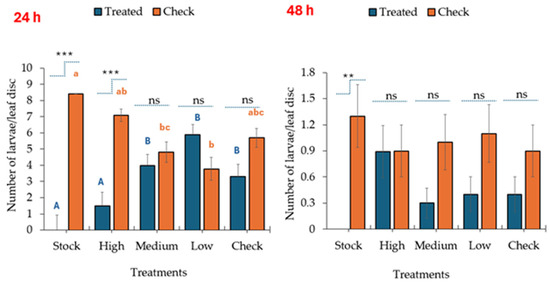
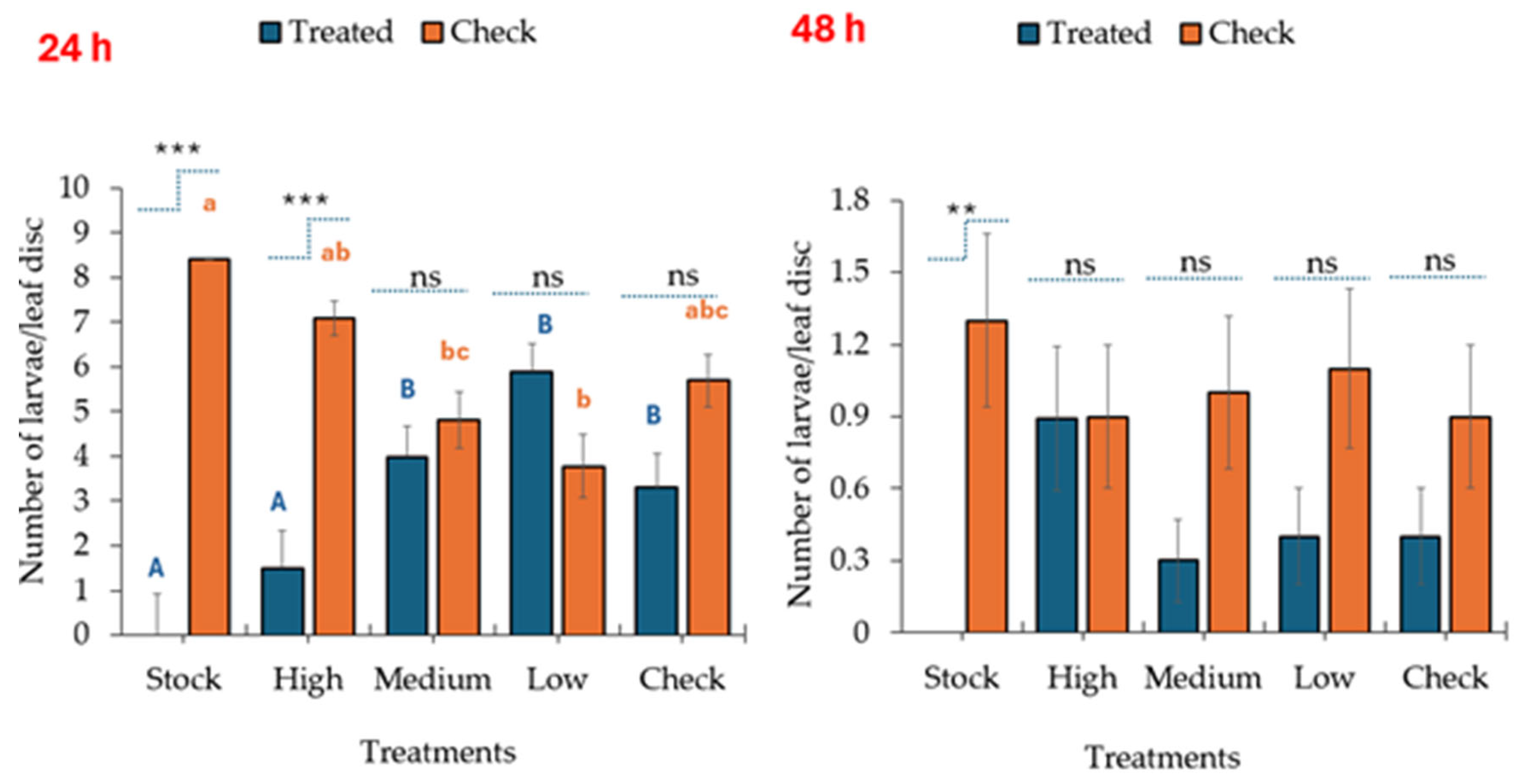
The number of first instars found on a leaf disc was significantly influenced by the dosage of V. amygdalina leaf extract, exposure time, and whether the leaf was treated with the extract. Dosage significantly interacted with leaf type, but not with the other factors (Table 3). Group comparisons revealed that the leaf discs treated with stock concentrations were significantly less visited by the first instars as seen with zero incidence, followed by the discs treated with high concentrations averaged at 1.5 larvae; both had a similar number of larvae but differed significantly from others [medium (3.99 larvae), low (5.09 larvae), and methanol check (3.3 larvae)]. Although the average number of larvae found on checks paired in the same Petri dish arenas with the discs treated with stock concentration was significantly higher than on checks paired with the discs treated with medium and low concentrations, it was not different from the average on water checks after 24 h (see methanol check, Figure 1). Pairwise comparisons revealed that in 24 h, a significantly lower number of larvae were observed on leaf discs treated with the stock solution (count = 8.4; W = 0, p ≤ 0.0001) and the high concentration (7.09; W = 6, p ≤ 0.001) than on their respective checks. On all other treatments within the same period, larval numbers were similar. In 48 h, only the larval counts on leaf discs treated with the stock solution were significantly lower (W = 0, p = 0.015) than on check leaf discs located in the same arenas (Figure 1).
Figure 1.
Number of first instars of the Colorado potato beetle that were found on leaf discs in the dual-choice arena after 24 h and 48 h. Pairwise comparisons were represented with the dotted lines above the bars, alongside their respective differences (*** < 0.001, ** = < 0.01, ns = not significant). Group means after 24 h marked with the same uppercase letter (treated) or lowercase letter (controls) do not differ significantly at the 5% level. By 48 h, no statistical differences were detected; therefore, no letter groupings are shown.
3.2.2. Third Instar
No death was observed among the third instars in the dual-choice arena with V. amygdalina methanolic leaf extract throughout the trial. The extent of estimated leaf damage inflicted by third instars in dual choice was significantly influenced by the dosage of V. amygdalina leaf extract, exposure time, and whether the leaf disc was treated with the extract or not. Also, the dosage significantly interacted with leaf disc treatment status, but there were no significant interactions among other factors (Table 3).
After 24 h, third instars caused significantly greater damage (>72%) on leaf discs treated with low concentration and the methanol check, but were comparable to the medium concentration. The medium concentration was also similar to the high concentration (41.34%) but not to the stock solution (4.85%) (Table 4). However, the damage on leaf discs treated with high concentration also differed significantly (p < 0.05) from those on leaf discs treated with the stock solution. Among the checks, no significant differences were observed after 24 h, with all of them showing more than 73% damage. After 48 h, leaf discs treated with the stock solution incurred the least damage (5.85%), which was significantly lower than the comparable levels of damage recorded for the other treatments and checks (all > 83%). There were no significant differences among the checks (Table 4).
Pairwise comparisons in 24 h revealed that leaf discs treated with the stock solution were significantly less damaged by third instars than their check counterparts (Table 4). A similar pattern was observed between leaf discs treated with high concentration and check leaf discs, and between leaf discs treated with medium concentration and checks. In contrast, damage levels did not differ significantly between the discs treated with low concentration and the checks. Similarly, there was no significant difference in the solvent test between methanol- and water-treated discs (Table 4). In 48 h, pairwise comparisons revealed that leaf discs treated with stock solution were still significantly less damaged than their check counterparts, as were the leaf discs treated with high concentration and check leaf discs (Table 4).
Comparison among treated leaf discs revealed that the stock solution accounted for the largest average remaining leaf area that was undamaged (1.28 cm2; 95% CI: 1.22–1.34 cm2), and it was significantly higher than those of the other treatments, including the checks. Meanwhile, the average remaining leaf discs of the other four treatments were statistically similar, ranging from 0.11 to 0.23 cm2. In addition, there was statistical similarity among the checks. Pairwise comparison also showed that the leaf discs treated with the stock solution suffered significantly less area loss than the checks remaining in the same Petri dish arenas. The leaf discs treated with other concentrations did not differ from their check counterparts (Table 5). The third instars in the dual-choice were randomly distributed with no significant effects from V. amygdalina methanolic leaf extract.
3.2.3. Adults
No biocidal effect was observed among the adults with V. amygdalina methanolic leaf extract within the two days of their exposure. The average percentage leaf damage that was caused by adult beetles in dual choice was significantly influenced by the dosage of V. amygdalina leaf extract, exposure time, and whether the leaf was treated with the extract. Also, dosage significantly interacted with leaf type, but there were no significant interactions among the other factors (Table 3). In 24 h, the check (methanol), low-, and medium-concentration treatments suffered a significantly higher percentage of leaf damage (>83%) than the high-concentration treatment (42%) and stock solution, which was ≈15% (Table 6). Meanwhile, leaf discs treated with stock and high concentrations also differed significantly from each other. There were no statistically significant differences among the other pairs (p > 0.05). Leaf discs treated with stock concentration were less damaged than their check counterparts located in the same Petri dish arenas (Table 6). The leaf discs treated with high concentration were also less impacted than their checks in 24 h. Except for the leaf discs treated with stock solution (27.3%), all other group comparisons after 48 h showed no significant differences, with leaf damage exceeding 81% in each case, while all checks had damage exceeding 88% each (Table 6). Only leaf discs treated with the stock solution were significantly less impacted than their check counterparts (Table 6).
Table 6.
Estimated leaf damage inflicted on potato leaf discs treated with methanolic leaf extract of Vernonia amygdalina by adult Colorado potato beetle in a dual-choice arena.
Comparison among the treated leaf discs showed that the largest remaining undamaged leaf area (0.93 cm2; 95% CI: 0.67–1.20 cm2) was on the discs treated with the stock concentration, which was significantly higher than those of the other four treatments (Table 5). The undamaged leaf areas of these other treatments were statistically similar, ranging from 0.00 to 0.31 cm2. In contrast, all check leaf discs were completely consumed. Pairwise comparison further indicated that leaf discs treated with the stock solution were significantly better protected than their counterpart check leaf discs (Table 5).
Adult beetles were randomly distributed in the dual-choice assay, as none of the V. amygdalina methanolic leaf extracts had significant effects on their position. Likewise, neither exposure time, nor whether the leaf discs were treated or checks, significantly influenced their location within the Petri dishes at the time of observations.
3.3. Feeding Inhibition
Vernonia amygdalina significantly inhibited feeding by first instars of the Colorado potato beetle, with inhibition remaining stable over time and no significant interaction between dosage and time (Table 7). The stock concentration was the most inhibitory (86.9%), followed by the high concentration (85.0%); both were statistically similar but significantly higher than the medium, low, and checks (ranging from 13.1 to 40.5% after 24 h and 13.1 to 38.6% after 48 h) (Table 8). Similarly, V. amygdalina was significantly inhibitory to third instar feeding, with inhibition stable over time and no significant dosage–time interaction. The only dose that produced a strong inhibitory effect on third instars was the stock concentration (91.7%) at both 24 and 48 h; the other concentrations were statistically like the checks, except the high concentration at 24 h, which showed moderate inhibition (Table 8). Lastly, although V. amygdalina exhibited some moderate inhibitory tendencies against adult feeding, the inhibition remained stable over time with no significant dosage–time interaction (Table 7). Numerically, the strongest inhibition occurred at the stock concentration (63.0% after 24 h and 64.1% after 48 h); however, they did not significantly differ from water check (37.0% feeding inhibition), while medium and low concentrations compared closely with methanol as well as with stock and high concentrations (Table 8).
Table 7.
Variance analyses for feeding inhibition by the different treatments over the observation time for the three tested stages of the Colorado potato beetle.
Table 8.
Average feeding inhibition by Vernonia amygdalina at varying concentrations in no-choice assays.
3.4. Deterrence Index
Results consistently showed a dose-dependent deterrence across insect stages. For the first instars, the effect varied by exposure period, with a significant interaction between the period and the dose. Both stock and high-concentration treatments similarly deterred first instars from feeding in 24 h with over 78% deterrence, unlike medium, low, and checks, which had weak deterrence with <23% (ranging from 9.65 to 22.3%; Table 9). Nonetheless, only stock concentration retained a significant deterrence of over 90% to first instars after 48 h of exposure; all other treatments were like the checks with <10%. The deterrent doses, DD50, were 0.005 mg and 0.115 mg of V. amygdalina methanolic leaf extract per ml of alcohol in 24 h and 48 h, respectively (Table 9).
Table 9.
The deterrent index and dose of Vernonia amygdalina at varying concentrations in dual-choice assays.
The deterrence of third instars was significantly affected by dose and exposure period, with no significant interaction. The leaf discs treated with the stock solution accounted for 93.4% deterrence against the third instars in 24 h, which was significantly higher than 38.4% deterrence for leaf discs treated with a high concentration. The medium concentration was similar to the high and low concentrations, as well as the check, but was significantly lower than the stock concentration (Table 9). Only leaf discs treated with stock solution significantly retained their deterrence at 91.6% after 48 h; all others were like the checks with <12% deterrence. The deterrent doses, DD50, were 1.118 mg and 0.323 mg of Vernonia amygdalina methanolic leaf extract per ml of alcohol in 24 h and 48 h, respectively (Table 9).
The adult stage also exhibited a significant dose-dependent deterrent response, along with a significant interaction between dose and exposure period, although the main effect of exposure period alone was not significant. At 24 h, the stock concentration produced the highest deterrence (81.7%) against adult beetles, while the high concentration showed a significantly lower deterrence of 41.3%. The remaining treatments, medium, low, and checks, were comparable and had deterrence, ranging from 14.5% to 18.8% (Table 9). After 48 h, the leaf discs treated with the stock solution had less than 50% deterrence, which was only significantly higher than the leaf discs in checks (13.8%), while others were akin to both extremes. The estimated deterrent doses were 0.052 mg and 0.032 mg of V. amygdalina methanolic leaf extract per ml of alcohol in 24 h and 48 h, respectively (Table 9).
3.5. Wind Tunnel Response
The beetles’ responses did not differ significantly across treatments (F = 0.803, df = 1, p = 0.371), decision points (F = 0.205, df = 2, p = 0.815), or their interaction (F = 0.118, df = 2, p = 0.889) (50 cm; z = 0, p = 1).
4. Discussion
The findings of this study demonstrate that the methanolic leaf extract of Vernonia amygdalina had no biocidal effects, at least through feeding on treated foliage, on the Colorado potato beetle (larvae and adults). At the same time, it possessed antifeedant properties. Across all stages examined (first instars, third instars, and adults) in no-choice and dual-choice assays, the extract consistently inhibited feeding at higher concentrations. Such behavioral deterrence could complement integrated pest management strategies, as modifying beetle feeding behavior can protect foliage. This response is consistent with the action of silphinen, a class of sesquiterpenes isolated from the aerial part of another plant in the family Asteraceae, Senecio palmensis. That plant was shown to be a strong deterrent to the second instars through the adult Colorado potato beetle [21].
In no-choice assays, leaf damage by first and third instars remained below 10% during both observation periods, while adult damage at the highest dose increased modestly from ~22% to ~30% compared to the larvae. The undamaged leaf areas of leaf discs treated with solution at a concentration of 0.1 g/mL were comparable across the three studied stages of the Colorado potato beetle (1.23 cm2 for first instars, 1.38 cm2 for third instars, and 1.25 cm2 for adults). They were similar to the initial area of the provided leaf discs (1.39 cm2), indicating minimal foliar loss even when insects had no alternative food source.
In dual-choice assays, V. amygdalina produced similar results: first instars caused < 3% damage on treated leaf discs, which was a substantial reduction relative to the checks (methanol or water), while the other, more diluted treatments lacked such an advantage. Larval distribution mirrored those results, with notably fewer larvae visiting leaf discs treated with the stock solution (0.1 g/mL of V. amygdalina leaf extract), suggesting reduced palatability. The deterrent compounds in the stock concentration likely weakened upon dilution, which explains the feeding patterns that were observed. While leaf discs treated with stock solution sustained only ≈5–6% damage (≈1.28 cm2), third instars inflicted heavy damage on more diluted treatments, perhaps due to their higher mobility, stronger feeding capacity or lack of feeding deterrent. Adults caused ≈15% damage on leaf discs treated with the stock solution (0.1 g/mL) of V. amygdalina, but quickly overwhelmed leaf discs treated with lower concentrations. These patterns align with known botanical antifeedants, such as V. cinerea and the false daisy Eclipta prostrata (Asteraceae), which partly suppressed feeding in third instar larvae of Spodoptera litura L. without exerting any toxic effects [23]. Nonetheless, the study also revealed that the golden shower tree Cassia fitula (Fabaceae) had a superior deterrent effect than the Asteraceae. Similar deterrence, where a seemingly susceptible plant is deemed unpalatable, has been reported for extracts of Solanum berthaultii, a close relative of cultivated potato [14].
Colorado potato beetles feed most intensely during the third and fourth instars stages and adulthood, although feeding declines for females during oviposition [31]. Because feeding duration correlates with accumulated plant damage, an effective antifeedant can suppress early-instar development through starvation. Vernonia amygdalina shows such potential, especially at higher extract concentrations. The stronger inhibition in first and third instars suggests that immature stages are more susceptible, possibly owing to lower detoxification capabilities or increased sensitivity to secondary metabolites. In contrast, adults displayed moderate and less consistent inhibition, indicating greater tolerance or behavioral adaptation. The absence of dose–time interactions and the stability of response across stages suggest that V. amygdalina acts quickly and maintains its deterrent effect throughout the assay period. These characteristics support its potential use as a botanical agent for early-stage suppression of L. decemlineata, though its moderate impact on adults suggests that complementary control tactics or formulation enhancement would be necessary for broader population management. Further research should focus on identifying active phytochemicals and their structures, assessing field persistence, and evaluating non-target effects might be helpful.
Insects confined to harmful or deterrent foods may deploy behavioral, biochemical, and physiological adaptive shifts [21,23,32]. The behavioral responses, including avoidance, reduced feeding, altered feeding bouts, regurgitation, and rapid excretion, may serve as their first line of defense. Avoidance and feeding deterrence were observed in this study and they varied with extract concentration, though other possible behaviors (e.g., feeding bouts, regurgitation, and excretion rates) were not assessed. Attempts to feed on leaf discs treated with extracts and a lack of response when tested in the wind tunnel both indicate minimal olfactory involvement but likely a strong gustatory rejection. Phagostimulants and phagodeterrents modulate diverse gustatory receptor genes distributed across oral and tarsal structures in insects. Evidence from Drosophila (Diptera: Drosophilidae) shows that these receptors can be co-expressed and differentially activated depending on stimulus type [33]. Whether Colorado potato beetle gustatory receptor genes respond similarly to V. amygdalina remains unknown.
Secondary metabolites are present in a wide array of plant families, including Solanaceae influence insect behaviors. Solanum berthaultii and S. tarijense reduced feeding by the Colorado potato beetle following differential deterrents localized on hosts’ glandular trichomes, and yet-to-be documented volatile secondary metabolites [14,34]. Elsewhere, the secondary metabolites derived from Cassia fistula (Fabaceae) substantially inhibited Helicoverpa armigera (Lepidoptera: Noctuidae) and Spodoptera litura [35,36], while those extracted from Jatropha gossypifolia adversely affected Spodoptera frugiperda (Lepidoptera: Noctuidae) [37]. Comparable to the effects of Jatropha integerrima on S. litura and H. armigera [38], Vernonia cinerea affected S. litura negatively [3]. The present study provides the first evidence that Vernonia amygdalina exerts feeding deterrence on the Colorado potato beetle. This finding suggests that closely related species (e.g., V. amygdalina and V. cinerea) may display equivalent bioactive effects against different insect taxa, such as the chrysomelid beetle and noctuid moth enunciated above. Notably, Chrysanthemum cinerariifolium, which is the source of pyrethrum and its synthetic analogues (pyrethroids) and Vernonia species, belong to the same family, Asteraceae. Thus, it is plausible that Vernonia extracts possess a similar broad-spectrum activity, as previously implied for V. amygdalina and V. cinerea as C. cinerariifolium, which is a valuable source of pyrethrin renowned for its repellence and biocidal actions [22,39]. Beyond feeding deterrence, plant secondary metabolites in extracts may cause growth inhibition, developmental delays, reduced reproduction and mobility, neurotoxicity, metabolic disruption, respiratory stress, oxidative damage, cytotoxicity, hormonal imbalance, and even mortality [17,20,25,40,41,42,43,44,45], though these effects were not assessed in the present study. Such bioactive compounds may involve a suite of alkaloids, flavonoids, terpenoids, phenolics, saponins, and tannins, which are rife in different plant families, including Annonaceae, Lamiaceae, Leguminosae, Meliaceae, Piperaceae, Rutaceae, Solanaceae, and Verbenaceae [18,19,25,45], but may not be equally effective due to the structural differences in molecules.
In this present study, deterrence was greatest at the stock concentration (i.e., 0.1 g/mL) of V. amygdalina leaf’s extract, denoting that the active deterrent compounds were at their effective sensory thresholds only at the high dose. Therefore, much of the deterrent futility of the other doses may be attributed to our serial dilution, which may have substantially reduced the quality and quantity of chemistries necessary to elicit a graded response. In fact, the multiple-fold dilutions from the 0.1 g/mL stock to 1:10 (high), 1: 100 (medium) or 1:1000 (low) concentrations may have been too widely spaced to capture subtle, dose-dependent changes in extract effectiveness or bioactivity; hence, the observed overlap among all but the stock treatment. Nonetheless, the pattern aligns with other botanicals whose deterrence intensifies with increasing concentration [23]. Identifying a field-relevant concentration without excessive application costs or phytotoxic effects on the target crop will be essential in future studies.
Feeding inhibition followed a similar dose-dependent trend: first instars, third instars, and adults exhibited 86.9%, 91.7%, and 64% inhibition, respectively, compared with checks, which had <20% and <25% for larvae and adults, respectively. This strong suppression suggests potent gustatory or post-ingestive effects, although the precise mechanism remains unclear. High inhibition at the stock concentration demonstrates the extract’s potential to protect foliage from larval feeding, though efficacy against adults was notably lower. The steep decline in deterrence at diluted concentrations further indicates that the active compounds in V. amygdalina fell below a critical sensory threshold at a concentration of 0.01 g/mL or less, upon diluting the stock solution serially. Additionally, the feeding inhibition reveals that V. amygdalina may be less potent against the adult beetle than the larvae, given their feeding inhibition rates, but this interpretation should be treated with caution given the dilution effect previously stated. Nonetheless, such tendencies conform with Balako et al. [19], where azadirachtin inhibited the beetle’s larvae more than the adults, and the contrary may also hold [17].
The outcomes of V. amygdalina extract against the beetle may vary in the field; however, in the worst-case, theoretically possible scenario, the beetle’s impact on the yield of treated plants may be negligible when a few foliage injuries occur. This is because potato is capable of tolerating complete defoliation late in the season, 10–60% during mid-season, and 30–40% defoliation during early growth stages without a substantial yield loss [46,47,48,49,50]. Apparently, when bioactive extracts such as V. amygdalina are incorporated into managing the beetle, some injuries would not cause substantial yield loss [47,48,50]. Thus, V. amygdalina holds promise for minimizing feeding pressure by the Colorado potato beetle. The performance of V. amygdalina against the beetle in the current study compares favorably to the efficacy of V. cinerea against Spodoptera litura [23]. Since both the beetle and moth larvae employ a similar biting-and-chewing feeding strategy [51], and the plants are congeneric, the observed outcome was a predictable parallel.
5. Conclusions
Antifeedant effects are a vital pest management strategy that primarily reduce food intake and may result in chronic mortality as a secondary effect [25]. That V. amygdalina functioned as an antifeedant (feeding inhibitor or deterrent), effectively altering the feeding behavior of the Colorado potato beetle, holds significance when integrating pest management strategies. Speculatively, the pronounced effects at the highest concentration may suggest a non-linear dose–response relationship following the dilution rate that was employed. A dose-dependent deterrent response should be elicited once a specific threshold is reached or exceeded; below this threshold, the response may be absent [17,32]. In agreement with Pavela et al. [25], it might be apt for future work to evaluate the extract’s stability, environmental persistence, and non-target impacts to refine its application strategies and enhance field reliance as the Colorado potato beetle is sensitive to V. amygdalina secondary metabolites.
Author Contributions
Conceptualization, I.E. and A.A.; methodology, I.E. and A.A.; software, I.E.; validation, I.E.; formal analysis, I.E.; investigation, I.E.; resources, I.E. and A.A.; data curation, I.E.; writing—original draft preparation, I.E.; writing—review and editing, A.A. and I.E.; visualization, I.E.; supervision, A.A.; project administration, A.A.; funding acquisition, A.A. All authors have read and agreed to the published version of the manuscript.
Funding
This research was funded by the USDA-NIFA-SCRI (2023-51181-41160) and US USDA-NIFA Hatch Project (M0-32609). The views, findings, and conclusions expressed in this publication are solely those of the author(s) and should not be interpreted as representing official U.S. Department of Agriculture or U.S. Government policy or determinations.
Institutional Review Board Statement
Not applicable.
Informed Consent Statement
Not applicable.
Data Availability Statement
The raw data supporting the conclusions of this article will be made available by the authors on request.
Acknowledgments
We thank Conner Michael May at the University of Maine, Orono, Maine for providing technical assistance, and Aaron Buzza of the University of Maine Research Station at Preque Isle, Maine for providing a native-speaker check.
Conflicts of Interest
The authors declare no conflicts of interest.
References
- Pandey, A.; Pradheep, K.; Sharma, N. Potential introduced medicinal plant African bitter leaf (Vernonia amygdalina Delile) in India: Botany, propagation and uses. Med. Plants 2014, 6, 272. [Google Scholar]
- Kaur, D.; Kaur, N.; Chopra, A.A. Comprehensive review on phytochemistry and pharmacological activities of Vernonia amygdalina. J. Pharmacogn. Phytochem. 2019, 8, 2629–2636. [Google Scholar]
- Tandon, M.; Shukla, Y.N.; Tripathi, A.K.; Singh, S.C. Insect antifeedant principles from Vernonia cinerea. Phytother. Res. 1998, 12, 195–199. [Google Scholar] [CrossRef] [Scilit]
- Ofori, D.A.; Anjarwalla, P.; Jamnadass, R.; Stevenson, P.C.; Smith, P. Pesticidal Plant Leaflets 9 Vernonia amygdalina; World Agroforestry Centre: Nairobi, Kenya, 2013. [Google Scholar]
- Otabor, J.I.; Rotimi, J.; Opoggen, L.; Egbon, I.N.; Uyi, O.O. Phytochemical constituents and larvicidal efficacy of methanolic extracts of Cymbopogon citratus, Ocimum gratissimum and Vernonia amygdalina against Culex quinquefasciatus larvae. J. Appl. Sci. Environ. Manag. 2019, 23, 701–709. [Google Scholar] [CrossRef] [Scilit]
- Obiefule, I.E.; Nwankwo, N.E.; Ogbuefi, E.O.; Uzochukwu, C.U. Toxicity of Vernonia amygdalina leaf powder against Callosobruchus maculatus (F.) (Coleoptera: Chrysomelidae) on stored cowpea (Vigna unguiculata L. Walp). Acta Entomol. Zool. 2025, 6, 200–205. [Google Scholar] [CrossRef] [Scilit]
- Oyeyemi, I.T.; Akinlabi, A.A.; Adewumi, A.; Aleshinloye, A.O.; Oyeyemi, O.T. Vernonia amygdalina: A folkloric herb with anthelminthic properties. Beni-Suef Univ. J. Basic Appl. Sci. 2018, 7, 43–49. [Google Scholar] [CrossRef] [Scilit]
- Egbunu, A.A.; Audu, P.A.; Adang, L.K.; Alege, G.O.; Isah, A.O. Efficacy of Vernonia amygdalina (Bitterleaf) Methanol extract against intestinal helminths of free ranged chickens (Gallus gallus domesticus) reared in Lokoja Kogi State Nigeria. Sci. Afr. 2025, 24, 259–268. [Google Scholar] [CrossRef] [Scilit]
- Galadima, A.M.; Chidimma, A.J.; Abubakar, I.; Ibrahim, S.; Said, S.S. Phytochemicals composition and anti-bacterial activity of methanol leaves extract of Vernonia amygdalina. Biol. Med. Nat. Prod. Chem. 2025, 14, 519–527. [Google Scholar] [CrossRef] [Scilit]
- Alyokhin, A.; Rondon, S.I.; Gao, Y. Potatoes and Their Pests: Setting the Stage. In Insect Pests of Potato: Global Perspective on Biology and Management; Academic Press: Cambridge, MA, USA, 2022; pp. 3–5. [Google Scholar]
- Mota-Sanchez, D.; Hollingworth, R.M.; Grafius, E.J.; Moyer, D.D. Resistance and Cross-resistance to Neonicotinoid Insecticides and Spinosad in the Colorado potato beetle, Leptinotarsa decemlineata (Say) (Coleoptera: Chrysomelidae). Pest Manag. Sci. 2005, 62, 30–37. [Google Scholar] [CrossRef] [Scilit]
- Sparks, T.C.; Nauen, R. IRAC: Mode of Action Classification and Insecticide Resistance Management. Pestic. Biochem. Physiol. 2015, 121, 122–128. [Google Scholar] [CrossRef] [Scilit]
- Alyokhin, A.; Rondon, S.I.; Gao, Y. Insect Pest of Potato: Global Perspectives on Biology and Management; Academic Press: Cambridge, MA, USA, 2022. [Google Scholar]
- Yencho, G.C.; Renwick, J.A.A.; Steffens, J.C.; Tingey, W.M. Leaf Surface Extracts of Solanum berthaultii Hawkes Deter Colorado potato beetle Feeding. J. Chem. Ecol. 1994, 20, 991–1007. [Google Scholar] [CrossRef] [Scilit]
- Gökçe, A.; Whalon, M.E.; Çam, H.; Yanar, Y.; Demirtaş, İ.; Gören, N. Plant extract contact toxicities to various developmental stages of Colorado potato beetles (Coleoptera: Chrysomelidae). Ann. Appl. Biol. 2006, 149, 197–202. [Google Scholar] [CrossRef] [Scilit]
- Gökçe, A.; Whalon, M.E.; Çam, H.; Yanar, Y.; Demirtaş, İ.; Gőren, N. Contact and residual toxicities of 30 plant extracts to Colorado potato beetle larvae. Arch. Phytopathol. Plant Prot. 2007, 40, 441–450. [Google Scholar] [CrossRef] [Scilit]
- Gökçe, A.; Isaacs, R.; Whalon, M.E. Dose–response relationships for the antifeedant effects of Humulus lupulus extracts against larvae and adults of the Colorado potato beetle. Pest Manag. Sci. 2012, 68, 476–481. [Google Scholar] [CrossRef] [Scilit]
- Hiiesaar, K.; Švilponis, E.; Metspalu, L.; Jõgar, K.; Mänd, M.; Luik, A.; Karise, R. Influence of Neem-Azal T/S on feeding activity of Colorado potato beetles (Leptinotarsa decemlineata Say). Agron. Res. 2009, 7, 251–256. [Google Scholar]
- Balaško, M.K.; Neral, K.; Nađ, B.; Bažok, R.; Drmić, Z.; Čačija, M. Azadirachtin Efficacy in Colorado potato beetle and western flower thrips control. ResearchGate 2021, 38, 401–410. [Google Scholar] [CrossRef] [Scilit]
- Hough-Goldstein, J.A. Antifeedant effects of common herbs on the Colorado potato beetle (Coleoptera: Chrysomelidae). Environ. Entomol. 1990, 19, 234–238. [Google Scholar] [CrossRef] [Scilit]
- Gonzalez-Coloma, A.; Reina, M.; Cabrera, R.; Castañera, P.; Gutierrez, C. Antifeedant and toxic effects of sesquiterpenes from Senecio palmensis to Colorado potato beetle. J. Chem. Ecol. 1995, 21, 1255–1270. [Google Scholar] [CrossRef] [Scilit] [PubMed]
- Shimira, F.; Uğur, S.; Özdemir, Ş.M.; Mendi, Y.Y. Future and prospect use of pyrethrum (Chrysanthemum cinerariifolium) as part of the Integrated Pest and Disease Management (IPDM) Tool in Turkey. Turk. J. Agric. Food Sci. Technol. 2021, 9, 150–158. [Google Scholar] [CrossRef] [Scilit]
- Arivoli, S.; Tennyson, S. Antifeedant activity of leaf extracts against Spodoptera litura Fabricius 1775 (Lepidoptera Noctuidae) highlighting the mechanism of action. Lond. J. Res. Sci. Nat. Form. 2020, 20, 67–80. [Google Scholar]
- Galimberti, A.; Alyokhin, A. Lethal and sublethal effects of mineral oil on potato pests. J. Econ. Entomol. 2018, 111, 1261–1267. [Google Scholar] [CrossRef] [Scilit]
- Pavela, R.; Kovaříková, K.; Novák, M. Botanical Antifeedants: An alternative approach to pest control. Insects 2025, 16, 136. [Google Scholar] [CrossRef] [Scilit]
- Brooks, M.E.; Kristensen, K.; van Benthem, K.J.; Magnusson, A.; Berg, C.W.; Nielsen, A.; Skaug, H.J.; Mächler, M.; Bolker, B.M. glmmTMB balances speed and flexibility among packages for zero-inflated generalized linear mixed modeling. R J. 2017, 9, 378–400. [Google Scholar] [CrossRef] [Scilit]
- McGillycuddy, M.; Popovic, G.; Bolker, B.M.; Warton, D.I. Parsimoniously fitting large multivariate random effects in glmmTMB. J. Stat. Softw. 2025, 112, 1–19. [Google Scholar] [CrossRef] [Scilit]
- Smithson, M.; Verkuilen, J. A better lemon squeezer? Maximum-Likelihood Regression with beta-distributed dependent variables. Psychol. Methods 2006, 11, 54–71. [Google Scholar] [CrossRef] [Scilit]
- Ogle, D.H.; Doll, J.C.; Wheeler, A.P.; Dinno, A. FSA: Simple Fisheries Stock Assessment Methods Version 0.10.0 from CRAN. 2025. Available online: https://rdrr.io/cran/FSA/ (accessed on 22 September 2025).
- R Core Team. R: A Language and Environment for Statistical Computing, Vienna, Austria. Available online: https://www.r-project.org/ (accessed on 22 September 2025).
- Özsari, P.; Karsavuran, Y. Feeding behavior of Leptinotarsa decemlineata (say) (Coleoptera: Chrysomelidae) (Colorado potato beetle) and the amount of damage on potato plant. Appl. Ecol. Environ. Res. 2025, 23, 5721–5733. [Google Scholar] [CrossRef] [Scilit]
- Dethier, V.G.; Browne, B.L.; Smith, C.N. The designation of chemicals in terms of the responses they elicit from insects. J. Econ. Entomol. 1960, 53, 134–136. [Google Scholar] [CrossRef] [Scilit]
- Fujii, S.; Yavuz, A.; Slone, J.; Jagge, C.; Song, X.; Amrein, H. Drosophila sugar receptors in sweet taste perception, olfaction, and internal nutrient sensing. Curr. Biol. 2015, 25, 621–627. [Google Scholar] [CrossRef] [Scilit] [PubMed]
- Pelletier, Y.; Dutheil, J. Behavioural Responses of the Colorado potato beetle to trichomes and leaf surface chemicals of Solanum tarijense. Entomol. Exp. Appl. 2006, 120, 125–130. [Google Scholar] [CrossRef] [Scilit]
- Duraipandiyan, V.; Ignacimuthu, S.; Gabriel Paulraj, M. Antifeedant and larvicidal activities of rhein isolated from the flowers of Cassia fistula L. Saudi J. Biol. Sci. 2011, 18, 129–133. [Google Scholar] [CrossRef] [Scilit] [PubMed]
- Thushimenan, S.; Baskaran, J.; Baranitharan, M. Antifeedant and toxicity of indigenous medicinal plants extracts against Spodoptera litura (Fab) (Lepidoptera: Noctuidae). Int. J. Zool. Appl. Biosci. 2016, 1, 106–110. [Google Scholar]
- Bullangpoti, V.; Wajnberg, E.; Audant, P.; Feyereisen, R. Antifeedant activity of Jatropha gossypifolia and Melia azedarach senescent leaf extracts on Spodoptera frugiperda (Lepidoptera: Noctuidae) and their potential use as synergists. Pest Manag. Sci. 2012, 68, 1255–1264. [Google Scholar] [CrossRef] [Scilit]
- Chinnamani, T. Antifeedant and larvicidal activities of ethyl acetate extract of Jatropha integerrima against Spodoptera litura and Helicoverpa armigera. Int. J. Zool. 2018, 3, 10–14. [Google Scholar]
- Wandahwa, P.; Van Ranst, E.; Van Damme, P. Pyrethrum (Chrysanthemum cinerariaefolium Vis.) Cultivation in West Kenya: Origin, ecological conditions and management. Ind. Crops Prod. 1996, 5, 307–322. [Google Scholar] [CrossRef] [Scilit]
- Alford, R.A.; Cullen, J.A.; Storch, R.H.; Bentley, M.D. Antifeedant activity of Limonin against the Colorado potato beetle (Coleoptera: Chrysomelidae). J. Econ. Entomol. 1987, 80, 575–578. [Google Scholar] [CrossRef] [Scilit]
- Gols, G.J.Z.; Van Loon, J.J.A.; Messchendorp, L. Antifeedant and toxic effects of drimanes on Colorado potato beetle larvae. Entomol. Exp. Appl. 1996, 79, 69–76. [Google Scholar] [CrossRef] [Scilit]
- Dwivedi, S.; Kushalan, S.; Paithankar, J.G.; D’Souza, L.C.; Hegde, S.; Sharma, A. Environmental toxicants, oxidative stress and health adversities: Interventions of phytochemicals. J. Pharm. Pharmacol. 2022, 74, 516–536. [Google Scholar] [CrossRef] [Scilit]
- Bhatla, S.C.; Lal, M.A. Secondary Metabolites. In Plant Physiology, Development and Metabolism; Bhatla, S.C., Lal, M.A., Eds.; Springer Nature: Singapore, 2023; pp. 765–808. [Google Scholar]
- Mathur, V.; Dokka, N.; Raghunathan, G.; Rathinam, M.; Parashar, M.; Srivastava, S.; Sreevathsa, R. Beyond Bitter: Plant triterpenoids in the battle against herbivorous insects. J. Exp. Bot. 2025, 76, 4441–4457. [Google Scholar] [CrossRef] [Scilit]
- Isman, M.B. Botanical insecticides, deterrents, and repellents in modern agriculture and an increasingly regulated world. Annu. Rev. Entomol. 2006, 51, 45–66. [Google Scholar] [CrossRef] [Scilit]
- Cranshaw, W.S.; Radcliffe, E.B. Effect of defoliation on yield of potatoes. J. Econ. Entomol. 1980, 73, 131–134. [Google Scholar] [CrossRef] [Scilit]
- Hare, D.J. Impact of Defoliation by the Colorado potato beetle on potato yields. J. Econ. Entomol. 1980, 73, 369–373. [Google Scholar] [CrossRef] [Scilit]
- Ferro, D.N.; Morzuch, B.J.; Margolies, D. Crop loss assessment of the Colorado potato beetle (Coleoptera: Chrysomelidae) on potatoes in Western Massachusetts. J. Econ. Entomol. 1983, 76, 349–356. [Google Scholar] [CrossRef] [Scilit]
- Shields, E.J.; Wyman, J.A. Effect of defoliation at specific growth stages on potato yields. J. Econ. Entomol. 1984, 77, 1194–1199. [Google Scholar] [CrossRef] [Scilit]
- Zehnder, G.W.; Evanylo, G.K. Influence of Colorado potato beetle sample counts and plant defoliation on potato tuber production. Am. Potato J. 1988, 65, 725–736. [Google Scholar] [CrossRef] [Scilit]
- Gullan, P.J.; Cranston, P.S. The Insects: An Outline of Entomology; John Wiley & Sons: Hoboken, NJ, USA, 2014. [Google Scholar]

Disclaimer/Publisher’s Note: The statements, opinions and data contained in all publications are solely those of the individual author(s) and contributor(s) and not of MDPI and/or the editor(s). MDPI and/or the editor(s) disclaim responsibility for any injury to people or property resulting from any ideas, methods, instructions or products referred to in the content. |
© 2026 by the authors. Licensee MDPI, Basel, Switzerland. This article is an open access article distributed under the terms and conditions of the Creative Commons Attribution (CC BY) license.