


Abstract
Gambling disorder (GD) constitutes a worldwide social and economic burden and is associated with impaired functioning and reduced quality of life. GD shares important mechanistic substrates with obsessive–compulsive disorder (OCD), including dysfunction of cortico-striato-thalamo-cortical circuitry and dysregulation of serotonergic pathways involved in impulsivity, compulsivity, and impaired inhibitory control. On this basis, selective serotonin reuptake inhibitors (SSRIs), widely used in several psychiatric disorders, have been investigated as potential pharmacological treatments for GD. Evidence concerning fluoxetine, fluvoxamine, paroxetine, sertraline, citalopram, and escitalopram is heterogeneous and overall limited. Some early single-blind, randomized, and open-label studies have reported reductions in gambling urges, severity, and compulsive symptoms. However, larger and more rigorous placebo-controlled trials have frequently failed to demonstrate consistent superiority over placebo. Interpretation of these findings is further limited by small sample sizes, short observation periods, high dropout rates, heterogeneous outcome measures, and substantial placebo response. While SSRIs remain biologically plausible candidates for modulating the compulsive and impulsive dimensions of GD, current evidence does not support their routine use as first-line pharmacological treatment. Their role appears most justified in the presence of psychiatric comorbidity or within individualized, phenotype-oriented treatment strategies.
1. Introduction
The gambling is a global public health concern and it constitutes a worldwide social and economic burden. The World Health Organization identifies it as risking money on an event with an uncertain outcome, with the possibility of gaining an increased return [1].
The fifth edition of the Diagnostic and Statistical Manual (DSM-5) categorizes gambling disorder (GD) as a Substance-Related and Addictive Disorder, characterized by a behavioral pattern associated with impaired functioning and reduced quality of life related to financial, social, occupational deficits, mental illness, and suicide [1,2,3].
Current research from a psychiatric perspective indicates a consistent prevalence of personality disorders among compulsive gamblers, who exhibit the condition of addiction rather than only an impulse-control impairment [4].
According to the International Classification of Disorders, 10th Revision (ICD-10), Pathological gambling is considered a disorder consisting of frequent, repeated episodes of gambling that dominate the patient’s life with a compulsive pattern [5], and it might be linked with obsessive–compulsive disorder (OCD) due to intrusive thoughts focusing on specific themes and repetitive behavior that generates distress and is linked to OCD [6].
OCD is a heterogeneous psychiatric condition characterized by the presence of obsessions, namely recurrent and intrusive thoughts, urges, or images that are experienced as unwanted and distressing, and compulsions, consisting of repetitive behaviors or mental acts performed in response to these obsessions. These symptoms are typically aimed at reducing anxiety or preventing perceived negative feelings, although they are either not connected to the feared events or are excessive [2,7]. Patients with OCD exhibit significant variability in both the quantity and type of comorbid disorders present [7,8]. Patients with similar comorbidity profiles may share important characteristics related to the genesis, pathophysiology, and progression of their illness [7,9]. GD and OCD are both linked to heightened compulsivity; some researchers as of today contend that GD may be categorized as an obsessive–compulsive spectrum disorder [10,11].
As of today, none of the SSRIs approved for psychiatric disorders (citalopram, escitalopram, fluoxetine, paroxetine, fluvoxamine, or sertraline) are indicated for GD by the FDA, EMA, or NICE [12,13]. This regulatory position is reflected in the global lack of guidelines and recommendations supporting pharmacological treatments for GD. The NICE guideline Gambling-related harms: identification, assessment and management (NG248, 2025) recommends psychological interventions as first-line treatment and assesses pharmacological approaches only within an evidence review. This review does not recommend the use of SSRIs and identifies an opioid antagonist, naltrexone; these are the only agents discussed as potential options in specialist settings, based on limited evidence [13]. At the international level, documents issued by the American Psychiatric Association (APA), the World Health Organization (WHO), Canadian Centre on Substance Use and Addiction (CCSA) and the Royal Australian and New Zealand College of Psychiatrists (RANZCP) do not include therapeutic or pharmacological recommendations for GD [1,14,15].
Over the past two decades, online gambling has expanded rapidly, emerging as a more complex phenomenon than land-based gambling. Carried out via digital devices such as smartphones, tablets and computers, online gambling has characteristics that increase both its accessibility and its risks, including round-the-clock availability, high interactivity, anonymity and ease of access [16]. Recent evidence suggests that involvement in online gambling is one of the main factors associated with the development of gambling-related problems [17], particularly among young men, who are especially vulnerable to online casino games, fast-paced betting and emerging forms such as skin betting. The differences between land-based and online gambling do not relate solely to how people access and engage with these activities, but also extend to preventive and therapeutic aspects. Online environments, in fact, have specific characteristics that require different prevention and harm-reduction strategies to those developed for land-based gambling. Currently, it remains unclear to what extent the knowledge and interventions developed for offline gambling can be effectively transferred to digital contexts, highlighting a significant scientific gap regarding the identification of the most effective preventive measures in online environments [18]. However, the literature indicates that the most widely supported approaches to the treatment of online gambling include cognitive behavioral therapy and multi-level public health strategies, comprising universal, selective and targeted interventions aimed at preventing and reducing the individual and social harms associated with gambling. For this reason, this review will not cover the therapeutic aspects of online gambling, but only those of offline gambling.
2. Pathways
The pathogenesis of GD and OCD is complex and multifactorial, depending on the interaction between genetic predisposition, environmental factors, and neurobiological alterations [2,5]. Both conditions share a behavioral dimension characterized by impulsivity, identified as the pursuit of pleasure, and compulsivity, considered to be the avoidance of harm. These dimensions are related to a dysfunction of fronto-striatal networks, leading to a progressive shift from goal-directed behavior, which is flexible and outcome-driven, to habitual behavior, which is rigid and automatic. This transition represents a core element in the pathophysiology of both disorders and reflects a dysregulation of the cortico-striatal-thalamic-cortical (CSTC) system, responsible for integrating cognitive control, motivation, and action selection [6]. Within the CSTC system, different functional circuits can be identified. The dorsal cognitive loop is involved in working memory, planning, and cognitive flexibility, and its dysfunction contributes to the behavioral rigidity observed in OCD. The ventral motivational loop regulates decision-making processes based on reward evaluation and motivational input, modulating reinforcement sensitivity and outcome anticipation. In OCD, this system is associated with hyperactivation related to error monitoring and harm anticipation, whereas in GD it is linked to altered reward evaluation, delay aversion, and reduced sensitivity to losses [19,20]. The sensorimotor loop, including the supplementary motor area (SMA) and the posterior putamen (pPut), is involved in habit formation and the execution of automatic behaviors. Its hyperactivation promotes the persistence of repetitive actions independently of their outcome. In addition, the hyperdirect pathway, connected with the subthalamic nucleus (STN), plays a crucial role in the rapid inhibition of impulsive responses [19,20]. The imbalance across these circuits promotes the transition from voluntary control to habitual and compulsive behavior. The functional balance of CSTC circuits is modulated by the interaction between serotonergic, dopaminergic, and glutamatergic systems, which act in an integrated manner. The serotonergic system plays a key role in the inhibitory control and top-down modulation of prefrontal regions: its dysregulation is central in OCD, where it contributes to hyperactivity of error-monitoring circuits, while in GD it is associated with reduced functional connectivity between the nucleus accumbens (NAcc) and the dorsolateral prefrontal cortex (dlPFC), promoting impulsive behavior [21]. Furthermore, alterations in serotonin signaling represent a core feature of OCD, where the desensitization of terminal autoreceptors in the orbitofrontal cortex (OFC) may contribute to the normalization of output toward the striatum [22,23]. Dopamine plays a central role in reward processing and learning mechanisms. At the striatal level, it modulates medium spiny neurons (MSNs) through two main pathways: the direct pathway, mediated by D1 receptors and facilitating action selection, projecting to the substantia nigra pars reticulata (SNr) and globus pallidus internus (GPi), and the indirect pathway, mediated by D2 receptors and exerting an inhibitory function, projecting to the globus pallidus externus (GPe), which appears to be less expressed in OCD [22,23]. In addition, dopamine is crucial in reward prediction error (RPE) signaling: phasic dopamine release encodes the discrepancy between expected and received outcomes, while tonic dopamine regulates baseline motivation and response thresholds. In this context, GD and OCD share an alteration in reinforcement learning processes, characterized by an asymmetry between learning from negative outcomes (alpha −) and positive outcomes (alpha +) [24]. In OCD, higher sensitivity to negative prediction errors promotes avoidance behaviors, whereas in GD reduced learning from negative feedback and overestimation of positive outcomes contribute to the persistence of risky choices despite losses [22,23]. The glutamatergic system represents the main excitatory cortical input to the striatum and contributes to the drive of cortico-striatal projections. Alterations in glutamatergic metabolism (Glx), particularly in the anterior cingulate cortex (ACC) and in the striatum, reflect hyperactivity of excitatory projections. This, together with an imbalance between the glutamatergic (excitatory) and GABAergic (inhibitory) systems, promotes a relative overactivation of the direct pathway compared to the indirect one, impairing the inhibition of compulsive thoughts and behaviors [19,20]. Beyond the CSTC circuits, additional regions contribute to the integration of emotional and decision-making processes. Among these, the insula, particularly its anterior portion, plays a key role in emotional regulation, risk evaluation, and reward anticipation. In OCD, the anterior insula is associated with increased sensitivity to negative stimuli and heightened activation during loss anticipation, contributing to persistent error monitoring and difficulty disengaging from perceived threats [20,25]. In GD, the insula acts as a mediator between craving, distorted beliefs, and reward-based learning: enhanced encoding of positive reward prediction errors contributes to the overestimation of wins and the maintenance of cognitive distortions such as the illusion of control and the gambler’s fallacy. As GD severity increases, insular responses during loss anticipation become progressively amplified, resembling the hyperreactive pattern observed in OCD and promoting avoidance-driven strategies [20,24,25].
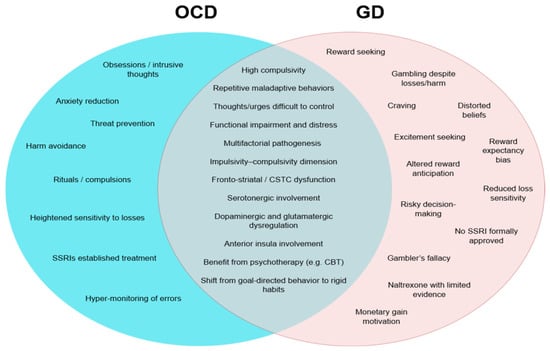
This study aims to bridge the gap between neurobiological reasoning and clinical outcomes by critically evaluating the clinical data regarding the use of SSRIs in GD. The present research and molecular understanding could clarify the potential relevance of SSRIs in several GD subtypes and comorbidities, particularly OCD (Figure 1).
Figure 1.
Similarities and differences between OCD and GD. Cortico-striatal-thalamic-cortical, CTSC; gambling disorder, GD; obsessive–compulsive disorder, OCD; SSRI, selective serotonin reuptake inhibitor.
3. SSRIs
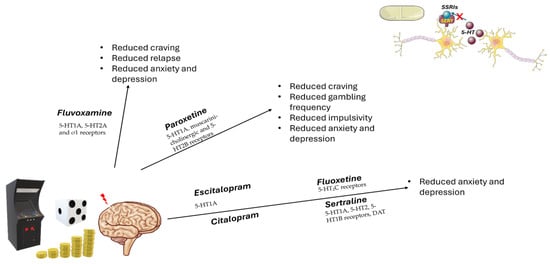
In the last few years, in the absence of official guidelines, various pharmacological treatments have been tested to improve the clinical picture of patients affected by gambling. Specifically, drugs that inhibit serotonin (5-HT) reuptake, SSRIs, act by blocking SERT and increasing the availability of serotonin in the synaptic space, consequently enhancing serotonergic firing [26]. They modulate the serotonergic system, which according to some hypotheses is involved in the compulsive aspects of the disorder (Figure 2). SSRIs are commonly used in the treatment of major depressive disorder, obsessive–compulsive disorder, social anxiety disorders, generalized anxiety disorder, and post-traumatic stress disorder [27]. The most common side effects associated with SSRI use in the early stages of therapy are nausea, headache, diarrhea, irritability, insomnia, and asthenia. They are dose-dependent effects that tend to regress within a few weeks. In long-term treatments, the most common adverse event is sexual dysfunction. A serious side effect common to SSRIs is serotonin syndrome [28].
Figure 2.
SSRIs’ role in gambling disorder (GD). SSRIs are a class of antidepressant that act as inhibitors of the presynaptic SERT, the protein responsible for the reuptake of serotonin from the synaptic cleft back into the presynaptic neuron.
The SSRI class of drugs is characterized by common drug interactions: they antagonize the anticonvulsant effects of antiepileptics by reducing the seizure threshold; SSRIs may increase the plasma concentration of some antivirals such as ritonavir; SSRIs antagonize the anticonvulsant effects of barbiturates (reducing the seizure threshold); and SSRIs increase the plasma concentration of bupropion. Co-administration of duloxetine and SSRIs results in increased serotonergic effects [29,30].
3.1. Fluoxetine
The molecular chemical formula of fluoxetine is C17H18F3NO. It exists in isomeric form and is available as a racemic formulation, similarly to sertraline and citalopram. Fluoxetine has a bioavailability of approximately 80% and a half-life of 48–72 h. Its active metabolite, norfluoxetine, has a markedly longer half-life (t½ ≈ 180 h) and reaches higher plasma concentrations. The volume of distribution ranges from 12 to 87 L/kg, with plasma protein binding of approximately 95%. A steady state is achieved after 5–11 weeks. Fluoxetine is primarily eliminated via the urine, with a reported clearance of 9.6 mL/min/kg in healthy subjects [31]. Fluoxetine inhibits the serotonin transporter (SERT) at the presynaptic terminal, leading to sustained increases in synaptic serotonin levels. It shows relatively low affinity for dopaminergic, adrenergic, cholinergic, muscarinic, and histaminergic receptors, which contributes to a more favorable tolerability profile compared with tricyclic antidepressants. Fluoxetine also interacts with the 5-HT2C receptor, a mechanism that has been suggested to increase noradrenaline and dopamine levels in the prefrontal cortex [31]. Fluoxetine is typically administered at doses of 20–60 mg/day (up to 80 mg/day in selected cases). Approved indications include major depressive disorder (20–60 mg/day), obsessive–compulsive disorder (20–60 mg/day), and bulimia nervosa (60 mg/day) [32]. Reported adverse effects involve multiple systems and include respiratory, cardiovascular, central nervous system, dermatological, and gastrointestinal symptoms [30]. Fluoxetine is a potent inhibitor of CYP2D6 and is subject to multiple clinically relevant drug–drug interactions, including increased bleeding risk when combined with NSAIDs or anticoagulants and an elevated risk of serotonin syndrome when co-administered with MAO inhibitors or St. John’s wort [33]. Despite its established efficacy in obsessive–compulsive disorder and other impulse-related conditions, no clinical trials or observational studies have specifically evaluated fluoxetine in patients with GD. Evidence in this context is limited to isolated case reports describing its use within multimodal treatment strategies targeting compulsivity and impulsivity. For example, a single case report described fluoxetine administered in combination with risperidone as part of a comprehensive therapeutic approach in a patient with online GD, with reported clinical improvement; however, the combined intervention precludes any inference regarding the efficacy of fluoxetine as monotherapy [34]. Other published reports similarly document anecdotal use of fluoxetine alongside psychotherapeutic or pharmacological interventions, underscoring the exploratory nature of the available evidence and the need for further confirmatory studies. [35,36].
3.2. Fluvoxamine
The molecular chemical formula of fluvoxamine is C15H21F3N2O2 [37]. It is well absorbed and the bioavailability is 90%. The half-life is about 14–18 h with a steady-state time of 10 days. Like other SSRIs, it is highly lipophilic with a volume of distribution of 25 L/kg and a PP binding of 80%. Fluvoxamine is extensively metabolized by the liver and is a potent inhibitor of CYP1A2 and 2C19 [37,38]. Fluvoxamine is a SERT inhibitor which, on one hand, selectively binds to the sodium-dependent serotonin transporter blocking the reuptake of serotonin, while on the other hand enhances the actions of serotonin on 5HT1A autoreceptors. Studies have also demonstrated that fluvoxamine has no affinity for α1- or α2-adrenergic, β-adrenergic, muscarinic, dopamine D2, histamine H1, GABA-benzodiazepine, opiate, other 5-HT1, or 5-HT2 receptors, despite having an affinity for binding to σ1 receptors [37,39].
Fluvoxamine is indicated for the treatment of major depressive episodes and for obsessive–compulsive disorder (OCD) and it is also used for bulimia nervosa [40,41]. It is used in doses ranging from 50 to 300 mg per day [42].
The most common side effects associated with fluvoxamine are nausea (~16%), with somnolence (~7%) and asthenia also found (~6%) [43,44]. Other common side effects associated with long-term use of fluvoxamine include vomiting, abdominal pain, diarrhea, dyspepsia, agitation and anxiety, sleep disorders and nightmares, derealization of cognitive processes, palpitations, and tachycardia [45,46]. Frequent adverse events are drowsiness and constipation. Other systemic side effects may include anorexia, dry mouth, tremor, headache, dizziness, fatigue, malaise, akathisia. Fluvoxamine is potentially associated with dilated cardiomyopathy [47]. As various serotonin receptors, including 5-HT2A receptors, are involved in the effects of SSRIs, endocrinological side effects have also been associated with the use of fluvoxamine and include delayed milk production, anorgasmia, and menstrual disorders, while at the urinary level there may be an increased frequency of urination (pollakiuria) and loss of urine (enuresis) [48,49]. Regarding drug interactions, fluvoxamine interacts with: MAO inhibitors, linezolid, alprazolam, zolpidem, bromazepam, diazepam, carbamazepine, citalopram, clopidogrel, clozapine, lidocaine, lithium, methadone and propranolol [43]. It also interacts with drugs like tramadol, triptans, other SSRIs, and St. John’s wort, which influence serotonin activity.
Regarding the relationship between GD and OCD, in 1998, Professor Hollander and his colleagues conducted one of the earliest clinical investigations (short-term, single-blind clinical trial) exploring whether fluvoxamine could be effective for the treatment of patients with GD and concomitant OCD [50]. In the study, sixteen patients with GD (DSM-IV) and a South Oaks Gambling Screen score greater than 5, underwent an 8-week placebo phase, and 10 of these patients completed an 8-week single-blind clinical trial with fluvoxamine. The outcome measures were the severity and frequency of gambling behaviors, urges and compulsive aspects of gambling and overall clinical improvement (Clinical Global Impression scores) [51]. Seven patients out of the 10 treated patients who completed the study were deemed responders, with reduced gambling urges, decreased frequency and intensity of gambling behavior, improved control over compulsive gambling impulses and overall clinical improvement. Specifically, they experienced a reduction in scores on the Yale–Brown Obsessive–Compulsive Scale for Gambling Disorder (YBOCS-PG) greater than 25%. The results of this preliminary study suggest that fluvoxamine may be effective in reducing the urge to gamble as GD shares neurobiological features with OCD, particularly involving serotonergic circuits. Important limitations of this study were the lack of a placebo control group and the short period of observation [51].
In 2000 Prof. Hollander conducted a 16-week randomized, double-blind, placebo-cross-over trial (8 weeks fluvoxamine vs. 8 weeks placebo) on 15 male subjects (10 completed). Fluvoxamine was well tolerated and still associated with greater improvement in overall gambling severity and urges compared with placebo, but evidence showed significant interaction with order of treatment, so it may be more effective in the treatment of GD in an acute trial, as an early placebo effect in GD treatment appears to diminish over time [52].
Subsequently, a 6-month, parallel-group, placebo-controlled trial with 32 pathological gamblers treated with fluvoxamine 200 mg/day was carried out [53]. In this study, fluvoxamine did not show a statistically significant benefit over placebo in the overall sample; however, subgroup analyses suggested it might have been beneficial in male and younger patients. Unfortunately, high placebo response and dropout rates (59%) limited conclusions. Interestingly, naturalistic long-term follow-up outcome studies demonstrated that among pathological gamblers who respond to a 6-month trial of medication, most patients seem to maintain full response during a 6-month medication-free follow-up phase [54].
Despite the limited evidence, overall, fluvoxamine appears to be effective in GD treatment. However, further studies are needed to demonstrate the effectiveness of fluvoxamine in treating patients with GD and OCD.
An interesting study published in 2009 demonstrated that the treatment response to fluvoxamine in a pathological gambler can be observed not only by subjective self-report, but also by objective fMRI results, opening the possibility of more in-depth and specific studies [55].
3.3. Paroxetine
The molecular chemical formula of paroxetine is C19H20FNO3 and it is readily absorbed from the gastrointestinal tract [56]. Due to the first-pass metabolism effect, its bioavailability ranges from 30 to 60% and its half-life is about 20–23 h, with a time to reach a steady state of 7 to 14 days of oral therapy [56,57]. Paroxetine is highly lipophilic, with a volume of distribution of 28–31 L/kg and a PP binding of 94%. About 2/3 of a single paroxetine dose is found to be excreted in urine and in faces, and almost all of the dose is eliminated as metabolites; 2–3% is found to be excreted as unchanged paroxetine. The apparent oral clearance of paroxetine is 167 L/h [57,58].
Paroxetine has the highest affinity and is one of the most selective inhibitors to SERT. As serotonin accumulates it enhances the serotonergic function of the 5-HT1A receptor, leading to decreased anxiety and depressive moods [56,58]. Paroxetine shows a clinically insignificant affinity for adrenergic alpha-1 and alpha-2 receptors and β-adrenergic receptors, dopamine D1 and D2 receptors, histamine H1 receptors and serotonin 5-HT1A, 5-HT2A and 5-HT2C receptors. This drug shows some affinity for muscarinic cholinergic receptors and 5-HT2B receptors [59,60].
Paroxetine is used in a dosage of 20–60 mg/day. It is indicated for major depression (20–50 mg/day), OCD (start 10 to 40–60 mg/day), panic-attack disorder with or without agoraphobia (start to 10 to 60 mg/day), social anxiety (20–50 mg/day), DAG (20–50 mg/day), and post-traumatic stress disorder (20–50 mg/day) [59,61]. Among all SSRIs, paroxetine has the highest incidence of withdrawal syndrome (the lowest is found for fluoxetine) [62,63].
Side effects include nausea, drowsiness, tremor, xerostomia, insomnia, sexual dysfunction, ejaculation disorders, reduced libido, dizziness, constipation, diarrhea, vomiting, dyspepsia, abdominal pain, decreased appetite, weight loss, taste disturbance, arthralgia, myalgia, myasthenia [64]. In prolonged treatments, the most frequent side effects were headache (19%), sweating (14%), asthenia (12%), insomnia (12%) and drowsiness (12%) [65].
Paroxetine metabolism occurs in the liver and is largely mediated by cytochrome CYP2D6 with contributions from CYP3A4 [38,60]. Therefore, drugs that inhibit or induce these cytochromes may increase or decrease the plasma concentration of paroxetine, respectively, through metabolic inhibition or induction. Significant drug interactions are found with: valproic acid, MAO inhibitors, antacids (if paroxetine is suspended), anticoagulants, antiplatelet agents (NSAIDs, ASA, ticlopidine), antivirals, aripiprazole, and propranolol. Paroxetine also interacts with drugs with high serum protein binding, drugs that induce hepatic metabolism (carbamazepine, phenytoin, phenobarbital), drugs metabolized by the CYP2D6 isoenzyme (tricyclic antidepressants), neuroleptics, and risperidone. Other interactions are with St. John’s wort, linezolid and isoniazid (drugs with MAOI activity) [65].
A double-blind placebo-controlled trial on the efficacy and safety of paroxetine in the treatment of GD showed its efficacy in reducing gambling symptoms compared to placebo [63]. Patients selected based on DSM-IV criteria for GD and scoring > or = 5 on the South Oaks Gambling Screen underwent a 1-week placebo run-in phase, which was followed by 8-week treatment with paroxetine or placebo (N = 23 paroxetine 20–60 mg/day, N = 22 placebo). Patients on paroxetine showed greater improvement on the Gambling Symptom Assessment Scale (G-SAS) and the Clinical Global Impressions (CGI) scale. Unfortunately, in a larger 16-week, double-blind, placebo-controlled multicenter study (N = 36 paroxetine 10–60 mg/day, N = 40 placebo), paroxetine did not show statistically significant superiority over placebo on primary measures of gambling severity, although it consistently had a higher percentage of responders at each visit (CGI) [66].
In a further RCT study on impulsivity and compulsivity in GD, 18 patients received paroxetine and 20 received placebo and, although no differences in the Pathological Gambling Modification of the Yale–Brown Obsessive–Compulsive Scale (PG-YBOCS) score were found between the two groups, the results suggest that this treatment may be beneficial for the obsessiveness/compulsiveness and impulsivity characteristics of Pathological Gambling (Eysenck Impulsiveness Questionnaire; Padua Inventory) [67].
Unfortunately, the overall sum of evidence in the literature on the use of paroxetine in GD with obsessive–compulsive disorder is conflicting and inconclusive, so it has been suggested that identifying and precisely characterizing the disorder’s subtypes is necessary in order to facilitate more tailored treatment approaches [68,69].
3.4. Sertraline
The molecular chemical formula of sertraline is C17H17Cl2N [70]. Sertraline is absorbed readily through the gastrointestinal tract and its bioavailability has been estimated to be above 44%. Its half-life is about 22–27 h and time to reach a steady state is about 5–7 days. Like other SSRIs, it is highly lipophilic and widely distributed with a volume of distribution of 20 L/kg and is also highly bound to serum proteins with a PP binding about 98–99% [71]. Since sertraline is extensively metabolized, excretion of the unchanged drug in the urine is a minor route of elimination, with 12–14% of unchanged sertraline excreted in the feces. Sertraline is heavily metabolized in the liver and has one major active metabolite, N-desmethyl-sertraline (DMS) [38,70].
Sertraline inhibits serotonin reuptake by selectively binding to the SERT on the presynaptic neuronal membrane and blocking serotonin recycling from the synapse, thereby increasing serotonergic activity. Sertraline does not cause significant blockades of dopamine or norepinephrine reuptake. As serotonin accumulates, it potentiates the serotonergic function of the 5-hydroxytryptamine 1A (5-HT1A) receptor, leading to a decrease in anxiety and depressive moods. On the other hand, evidence indicates that sertraline given repeatedly decreases the responsiveness of 5-HT1A (presynaptic) and 5-HT2 receptors but increases the responsiveness of 5-HT1B receptors to respective agonists [72]. It has no cardiovascular, anticholinergic, antidopaminergic, convulsant, or monoamine oxidase inhibitory effects [70,73].
Sertraline is indicated for the management of major depressive disorder (MDD), post-traumatic stress disorder (PTSD), OCD, panic disorder (PD), premenstrual dysphoric disorder (PMDD), and social anxiety disorder (SAD). It is used at dosages of 25–200 mg/day. It is used in various dosages for major depressive episodes and the prevention of recurrences (50–200 mg/day), panic-attack disorders with or without agoraphobia, PTSD and social anxiety disorder (50–200 mg/day) and OCD (50mg/day) [38]. The most common side effects associated with the use of sertraline in the early stages of therapy include nausea, headache, diarrhea, irritability, insomnia and asthenia [74]. These dose-dependent effects tend to subside within a few weeks. In long-term treatment, the most common adverse event is sexual dysfunction (decreased libido, delayed ejaculation, anorgasmia). Cardiovascular adverse effects may include palpitations, hot flushes, tachycardia, myocardial infarction, bradycardia, postural hypotension, and QTc interval extension. Sertraline has been associated with the onset of erythromelalgia in the treatment of Raynaud’s syndrome [26]. Fatigue, dizziness, drowsiness, tremors, agitation, ataxia, difficulty concentrating, diaphoresis, paresthesia, depression, anxiety, hypertonia, and tinnitus are other common central side effects. Gastrointestinal effects may also occur, such as nausea, diarrhea, xerostomia, taste disturbance, constipation, abdominal pain, vomiting, dyspepsia, and flatulence. Metabolic side effects may include low blood sodium levels (hyponatremia), syndrome of inappropriate antidiuretic hormone (ADH) secretion, low potassium levels (hypokalemia, sporadic reports), low blood glucose levels (hypoglycemia), and high blood cholesterol levels (hypercholesterolemia). Among SSRIs, sertraline is associated with the highest risk of urinary incontinence [75].
Sertraline interacts with some drugs like MAO inhibitors, pimozide, anticoagulants, antiplatelet agents (NSAIDs, ASA, ticlopidine), antiepileptics, antivirals, barbiturates, bupropion, and clozapine. Furthermore, sertraline interacts with entacapone, St. John’s wort, oxycodone, duloxetine, linezolid and isoniazid (drugs with MAOI activity), methylphenidate, lithium, rifampicin, sibutramine, tramadol and tryptophan [38,75].
Regarding the relationship between GD and OCD, many case reports described successful sertraline treatment (often associated with psychotherapy) in individuals with GD where remission of gambling behavior was observed with sertraline [76,77]. These reports suggested that sertraline is safe, well tolerated and effective in the treatment of obsessive–compulsive syndrome with a drug range from 50 to 200 mg daily, although many authors believe that higher doses of sertraline, approximately 150–200 mg per day, are necessary for effective treatment of obsessive–compulsive disorder [77,78].
In 2005, the largest double-blind, randomized placebo-controlled trial evaluating sertraline’s effectiveness for GD over 6 months of treatment was conducted. The study compared sertraline 50–150 mg/d vs placebo and found no statistically significant difference in reduction in gambling symptoms between the two groups (response rates ~74% vs ~72%, p = 0.9). In conclusion, there is no robust epidemiological evidence and very limited case reports suggesting possible remission under sertraline treatment and this is not generalizable; further evidence is needed to confirm or rule out the use of sertraline in patients with GD and OCD [79].
3.5. Citalopram
The molecular chemical formula of citalopram is C20H21FN2O [80]. Citalopram is administered as a racemic mixture, whose S-enantiomer is escitalopram, and is highly lipophilic, as are other SSRIs. Biotransformation occurs mainly at the hepatic level, primarily via CYP2C19 and CYP3A4. The elimination half-life is approximately 36 h (32–38 h), and a steady state is reached within 6–10 days. Citalopram has a bioavailability of approximately 80%, a volume of distribution of about 15 L/kg, and plasma protein binding of around 80% [38]. Regarding elimination, approximately 12–23% of an oral dose is recovered unchanged in the urine, while about 10% is excreted in the feces. Following intravenous administration, approximately 10% of the dose is recovered in urine as unchanged citalopram and 5% as demethylcitalopram. Systemic clearance is approximately 330 mL/min. Citalopram acts as a highly selective inhibitor of the SERT, with minimal affinity for histaminergic, cholinergic, or noradrenergic receptors compared with tricyclic antidepressants. It shows little or no affinity for 5-HT1A, 5-HT2A, dopamine D1 and D2, α1-, α2-, and β-adrenergic, histamine H1, GABAergic, muscarinic cholinergic, and benzodiazepine receptors [80]. The therapeutic dosage ranges from 10 to 60 mg/day. Approved indications include major depressive disorder (20–40 mg/day) and panic disorder with or without agoraphobia (10–40 mg/day) [81]. Reported adverse effects involve multiple systems and include respiratory, cardiovascular, central nervous system, dermatological, and gastrointestinal symptoms, as well as QTc prolongation [79]. Citalopram is subject to clinically relevant drug–drug interactions due to its metabolism via CYP3A4 and CYP2C19. Inhibitors or inducers of these enzymes may alter plasma concentrations, and concomitant use with anticoagulants or antiplatelet agents may increase bleeding risk. The risk of serotonin syndrome is increased when citalopram is combined with MAO inhibitors, triptans, or St. John’s wort [80,82]. The interest in citalopram for the treatment of GD derives from its selective serotonergic mechanism and from the conceptualization of gambling behaviors as sharing phenomenological features with obsessive–compulsive symptomatology, including repetitive urges, intrusive thoughts, and impaired inhibitory control [83]. On this basis, citalopram has been investigated in a limited clinical context for GD. In an open-label study, Zimmerman et al. evaluated the effects of citalopram in 15 patients with GD treated for up to 12 weeks, reporting reductions in gambling severity together with improvements in depressive symptoms and quality of life [84]. These effects were maintained in the subgroup of nine patients who completed the study. However, the absence of a control group, the small sample size, and the high dropout rate limit the strength and generalizability of these findings, which should therefore be considered preliminary [83,84]. No conclusive evidence has yet been found regarding the use of citalopram in patients with PD and OCD, so further research is needed.
3.6. Escitalopram
The molecular chemical formula of escitalopram is C20H21FN2O [85]. Escitalopram is the S-enantiomer of citalopram and, like other selective serotonin reuptake inhibitors (SSRIs), it is highly lipophilic. It has a bioavailability of approximately 80%, an elimination half-life of 27–32 h, a volume of distribution of 12–15 L/kg, and plasma protein binding of about 80%. The steady state is typically reached within 7–10 days [38]. Following oral administration, approximately 8% of the administered dose is eliminated in the urine as unchanged escitalopram and about 10% as S-desmethylcitalopram [85]. Metabolism is primarily hepatic, mediated mainly by CYP2C19 and CYP3A4 and, to a lesser extent, by CYP2D6. Oral plasma clearance is approximately 600 mL/min, with renal clearance accounting for about 7% of total clearance. The apparent hepatic clearance accounts for the majority of drug elimination. Escitalopram enhances serotonergic neurotransmission by binding to the orthosteric site of the SERT molecule, the same site as endogenous serotonin. In addition, it binds to a secondary allosteric site on the SERT molecule, thereby stabilizing transporter inhibition and prolonging serotonin reuptake blockade. This dual orthosteric and allosteric mechanism is thought to increase extracellular serotonin levels and may contribute to its clinical efficacy [85]. Sustained elevations in synaptic serotonin led to desensitization of presynaptic 5-HT1A autoreceptors, a process considered important for the delayed onset of antidepressant effects. Escitalopram shows minimal affinity for other receptor systems, including histaminergic and muscarinic receptors, and limited off-target activity may account for some of its adverse effects [38,85]. The recommended therapeutic dosage ranges from 10 to 30 mg/day. Escitalopram is approved for the treatment of major depressive episodes (10–20 mg/day), panic disorder with or without agoraphobia (5–20 mg/day), social anxiety disorder (5–20 mg/day), and generalized anxiety disorder (10–20 mg/day) [38,85]. Its tolerability profile and pattern of drug–drug interactions are broadly similar to those of citalopram [86,87]. The interest in escitalopram for the treatment of GD derives from its high selectivity for the serotonin transporter and its combined orthosteric and allosteric inhibition of serotonin reuptake, which may enhance serotonergic modulation of compulsive and impulsive behaviors [83]. On this basis, escitalopram has been investigated in GD in a single prospective open-label study. In a 10-week trial, Nerone et al. treated 19 adult patients with GD using escitalopram, starting at 10 mg/day and titrating up to a maximum of 30 mg/day according to clinical response and tolerability [88]. Gambling severity and clinical status were assessed at baseline and at regular follow-up intervals, with the modified YBOCS-PG used as the primary outcome measure, alongside Clinical Global Impression scales. Fourteen patients (73.7%) were classified as responders, and escitalopram was generally well tolerated. These findings are broadly consistent with other open-label observations reporting improvements in gambling-related symptoms following escitalopram administration in patients with GD and comorbid anxiety [89], as well as with earlier open-label studies evaluating citalopram, the parent compound of escitalopram, in GD. Overall, the evidence for escitalopram in GD and in GD associated with OCD, such as citalopram, remains limited to uncontrolled studies and should be regarded as preliminary [38,84,89].
4. Discussion and Conclusions
In this paper we reviewed clinical evidence from the literature on the use of SSRIs in GD (Table 1), finding a discrepancy between neurobiological plausibility and clinical efficacy. In fact, on one hand, from a pathophysiological perspective, GD shares important mechanistic substrates with OCD, particularly involving dysfunction of the CSTC circuitry and dysregulation of serotonergic, dopaminergic, and glutamatergic systems [69,90,91]. Both conditions reflect maladaptive reinforcement learning processes and a progressive shift from goal-directed behavior to rigid habit formation. Furthermore, serotonergic imbalance has been implicated in impulsivity modulation, top-down inhibitory control, as well as fronto-striatal connectivity relevant to gambling-related urges and loss of control [92,93,94]. However, on the other hand, when evaluating clinical evidence, the effective support remains inconsistent. The available literature studies on fluoxetine, fluvoxamine, paroxetine, sertraline, citalopram, and escitalopram are characterized by small sample sizes, high dropout rates, heterogeneous outcome measures, short observation periods and substantial placebo response rates. While some early single-blind and randomized trials suggested reductions in gambling urges and severity, particularly with fluvoxamine and paroxetine [52,66], larger and more rigorous studies failed to demonstrate robust superiority over placebo [50,51]. Open-label investigations of citalopram and escitalopram have reported promising response rates, yet the absence of control groups and limited generalizability prevent definitive conclusions [84,89]. Sertraline and fluoxetine, despite their established role in OCD and impulse-control disorders, lack convincing evidence in GD [79]. These findings suggest that the heterogeneity of GD may lessen treatment effects when SSRIs are tested on unstratified populations. In fact, as GD encompasses distinct clinical phenotypes, including predominantly impulsive reward-seeking profiles, compulsive harm-avoidant patterns resembling OCD, emotionally vulnerable subtypes with mood dysregulation, and individuals with significant substance-use comorbidity [95,96], it is plausible that serotonergic modulation may be more relevant for compulsive–anxious subtypes, whereas reward-driven and dopaminergically mediated phenotypes may respond more favorably to opioid antagonists or other neuromodulatory strategies [97]. This conceptualization aligns with the limited but relatively stronger evidence supporting naltrexone, particularly in individuals with heightened reward sensitivity or a family history of substance-use disorders [98]. The role of serotonergic agents in GD may extend beyond direct anti-gambling effects; in fact, SSRIs could indirectly contribute to improved clinical outcomes by enhancing cognitive flexibility, reducing negative affect, attenuating anxiety-driven gambling episodes, and stabilizing mood fluctuations that precipitate relapse. Given the high comorbidity between GD and depressive, anxiety, and obsessive–compulsive spectrum disorders, SSRIs may remain clinically appropriate when targeting these co-occurring conditions, even if their effect on gambling behavior per se is modest [99].
Table 1.
Selective serotonin reuptake inhibitor (SSRI) drugs for gambling disorder (GD): targets and main clinical effects. 5-HT, serotonin; DAT, dopamine transporter; OCD, obsessive–compulsive disorder; RCT, randomized clinical trial; SERT, serotonin transporter.
Another point of interest is interindividual variability which, in pharmacology, refers to the differences in biological responses among individuals, often caused by genetic, environmental, or lifestyle factors [100]. A limitation of the included clinical studies is the lack of consideration of interindividual variability in response to SSRIs. Among the most studied contributors of these interindividual differences are pharmacokinetics (especially CYP450 metabolism) and pharmacodynamics (serotonin transporter biology) [101]. Evidence on CYP2C19 shows that it can substantially shift exposure to key SSRIs (escitalopram, sertraline, citalopram), regulating concentration (up to 3.3-fold higher or 20% lower based on genotype), frequency of switching and treatment failure pathways [102]. An interesting meta-analysis quantified genotype–exposure effects in patients treated with SSRIs (escitalopram, sertraline) supporting genotype-based dosing decisions [103]. Several studies have suggested the possibility of pharmacogenetic-guided therapy for SSRIs, but clinical evidence has shown modest results (even though it is supported when used to aid decision-making) [104,105].
On the other hand, SERT (SLC6A4) polymorphisms seem to provide biologic plausibility for variable SSRI pharmacodynamics (e.g., higher serotonin reuptake activity), but evidence still concludes no actionable prescribing recommendation due to inconsistent clinical associations [106]. Though only limited data exist on the cost-effectiveness of preemptive and multigene testing across disease states, pharmacogenetic-guided therapy seems to be able to improve tolerability and reduce trial-and-error [107]. Interindividual SSRI response variability is better supported clinically by pharmacokinetic (CYP450) differences than by SERT (SLC6A4) polymorphisms, though both can contribute. As such, future studies should take this evidence into consideration.
4.1. Neurobiological and Clinical Discrepancy
Taking everything into consideration, there appears to be a discrepancy between the strong neurobiological rationale supporting the use of SSRIs in GD and the inconsistent or largely negative clinical findings. This apparent mismatch can be justified by several factors supported by the literature. At first, we showed through the text how mechanistic plausibility is well established and provides a strong rationale, as GD shares key neurobiological features with obsessive–compulsive disorder, including dysfunction of the CSTC circuitry and alterations in serotonergic modulation of behavioral inhibition and decision-making and top-down control [104]. However, clinical outcomes remain inconsistent, and this discrepancy is probably a consequence of the marked heterogeneity of GD populations. As discussed in the manuscript, GD encompasses distinct phenotypes (e.g., impulsive/reward-driven vs compulsive/harm-avoidant), which likely differ in their underlying neurobiology and treatment responsiveness; as such, unstratified clinical trials may dilute treatment effects, particularly for serotonergic agents that are more likely to benefit compulsive–anxious subtypes. Another important factor is the methodological limitations of the available studies, as many trials are characterized by small sample sizes, high placebo response rates, short follow-up periods, and heterogeneous outcome measures, all of which reduce statistical power and the ability to detect clinically meaningful effects. High placebo response rates, in particular, are well documented in behavioral addictions and are known to be able to obscure modest pharmacological benefits. Finally, interindividual variability in pharmacological response is rarely accounted for in clinical trials but may further contribute to differences in outcomes and underestimation of treatment effects in subgroup populations [101,108].
Taken together, these considerations suggest that the observed mismatch does not necessarily invalidate the biological rationale but rather reflects the limitations of current study designs and the complexity of GD as a heterogeneous disorder.
4.2. Future Perspectives
Future research should move beyond unstratified trial designs and adopt stratified, phenotype-based approaches that reflect the biological and clinical heterogeneity of GD. In particular, the identification of clinically meaningful subgroups such as compulsive–anxious, impulsive–reward-driven, or emotionally dysregulated phenotypes may allow a more targeted evaluation of SSRI efficacy, which is likely diluted in heterogeneous populations. Enrichment strategies based on symptom dimensions, comorbidities, or neurocognitive profiles could also improve treatment alignment to the underlying pathophysiology. In parallel, combination therapies, especially cognitive behavioral therapy, represent a promising avenue [109,110].
Given the multifactorial neurobiology of GD, integrating SSRIs with agents targeting complementary systems like opioid antagonists (for reward dysregulation) or glutamatergic modulators (for cognitive control) may enhance therapeutic outcomes compared with monotherapy, but it should be noted that combination pharmacotherapy (≥2 drugs, including an SSRI) is not evidence-supported as a routine strategy for GD at the moment [111]. Similarly, combining pharmacological interventions with structured psychotherapeutic approaches, such as cognitive behavioral therapy or motivational interventions, should be systematically evaluated within controlled trial frameworks. Finally, the development of biomarker-driven strategies is essential to advance precision psychiatry in GD. Potential candidates include pharmacogenetic markers (e.g., CYP450 metabolism profiles) but also neuroimaging, which is able to reflect abnormalities in the CSTC (e.g., fMRI, PET…) and peripheral or central indicators of serotonergic and dopaminergic activity. Although current evidence remains preliminary, integrating multimodal biomarkers into clinical trial design may enable patient stratification, prediction of treatment response, and optimization of therapeutic selection. At present, these approaches remain largely unexplored in GD and warrant dedicated investigation in future studies.
In conclusion, while SSRIs remain biologically plausible candidates for modulating compulsive and impulsive dimensions of GD, current evidence does not support their routine use as first-line pharmacological treatments. Their role appears most justified in the presence of psychiatric comorbidity or within individualized, phenotype-oriented strategies but the overall quality of evidence remains insufficient to justify regulatory approval or formal guideline endorsement. The discrepancy between neurobiological plausibility and clinical efficacy highlights the heterogeneity of GD and underscores the need for stratified, phenotype-driven research approaches based on adequately powered randomized controlled trials with longer-term outcomes.
Author Contributions
Conceptualization, N.C. and R.G.; methodology, A.M. and G.G.; software, D.D. validation, S.T., L.M. and G.G.; formal analysis, S.T. and L.M.; investigation, D.D., L.M., R.G. and N.C.; resources, L.M. and G.G.; data curation, D.D.; writing—original draft preparation, A.M. and S.T.; writing—review and editing, N.C., R.G. and L.M.; visualization, S.T.; supervision, D.D. and A.M.; project administration, G.G. All authors have read and agreed to the published version of the manuscript.
Funding
This research received no external funding.
Institutional Review Board Statement
Not applicable.
Informed Consent Statement
Not applicable.
Data Availability Statement
No new data were created or analyzed in this study. Data sharing is not applicable to this article.
Conflicts of Interest
The authors declare no conflicts of interest.
Abbreviations
The following abbreviations are used in this manuscript:
| GD | Gambling Disorder |
| SSRI | Selective Serotonin Reuptake Inhibitor |
| DSM | Diagnostic and Statistical Manual |
| ICD-10 | International Classification of Disorders, 10th Revision |
| OCD | Obsessive–Compulsive Disorder |
| FDA | Food and Drug Administration |
| EMA | European Medicines Agency |
| NICE | National Institute for Health and Care Excellence |
| APA | American Psychiatric Association |
| WHO | World Health Organization |
| CCSA | Canadian Centre on Substance Use and Addiction |
| RANZCP | Royal Australian and New Zealand College of Psychiatrists |
| STN | Subthalamic Nucleus |
| SERT | Serotonin Transporter |
| MSN | Medium Spiny Neurons |
| CSTC | Cortico-Striatal-Thalamic-Cortical |
References
- Gambling. Available online: https://www.who.int/news-room/fact-sheets/detail/gambling (accessed on 11 February 2026).
- American Psychiatric Association. Diagnostic and Statistical Manual of Mental Disorders: DSM-5, 5th ed.; American Psychiatric Association: Washington, DC, USA, 2013; ISBN 978-0-89042-554-1. [Google Scholar]
- Grant, J.E.; Odlaug, B.L.; Chamberlain, S.R. Gambling Disorder, DSM-5 Criteria and Symptom Severity. Compr. Psychiatry 2017, 75, 1–5. [Google Scholar] [CrossRef] [Scilit]
- Vaddiparti, K.; Cottler, L.B. Personality Disorders and Pathological Gambling. Curr. Opin. Psychiatry 2017, 30, 45–49. [Google Scholar] [CrossRef] [Scilit]
- Kemali, D. ICD-10: Classificazione delle Sindromi e dei Disturbi Psichici e Comportamentali: Descrizioni Cliniche e Direttive Diagnostiche Criteri Diagnostici per la Ricerca; Edra (Masson): Milan, Italy; Organizzazione Mondiale Della Sanità: Milan, Italy, 2014; ISBN 978-88-214-2316-1. [Google Scholar]
- Riggs, D.S.; Foa, E.B. Obsessive-Compulsive Disorder. In Comprehensive Handbook of Personality and Psychopathology: Vol. 2: Adult Psychopathology; John Wiley & Sons, Inc.: Hoboken, NJ, USA, 2006; pp. 169–188. ISBN 978-0-471-48838-5. [Google Scholar]
- van Oudheusden, L.J.B.; van de Schoot, R.; Hoogendoorn, A.; van Oppen, P.; Kaarsemaker, M.; Meynen, G.; van Balkom, A.J.L.M. Classification of Comorbidity in Obsessive-Compulsive Disorder: A Latent Class Analysis. Brain Behav. 2020, 10, e01641. [Google Scholar] [CrossRef] [Scilit]
- Pinto, A.; Mancebo, M.C.; Eisen, J.L.; Pagano, M.E.; Rasmussen, S.A. The Brown Longitudinal Obsessive Compulsive Study: Clinical Features and Symptoms of the Sample at Intake. J. Clin. Psychiatry 2006, 67, 703–711. [Google Scholar] [CrossRef] [Scilit] [PubMed]
- Leckman, J.F.; Denys, D.; Simpson, H.B.; Mataix-Cols, D.; Hollander, E.; Saxena, S.; Miguel, E.C.; Rauch, S.L.; Goodman, W.K.; Phillips, K.A.; et al. Obsessive-Compulsive Disorder: A Review of the Diagnostic Criteria and Possible Subtypes and Dimensional Specifiers for DSM-V. Depress. Anxiety 2010, 27, 507–527. [Google Scholar] [CrossRef] [Scilit] [PubMed]
- Scherrer, J.F.; Xian, H.; Slutske, W.S.; Eisen, S.A.; Potenza, M.N. Associations between Obsessive-Compulsive Classes and Pathological Gambling in a National Cohort of Male Twins. JAMA Psychiatry 2015, 72, 342–349. [Google Scholar] [CrossRef] [Scilit] [PubMed]
- Hollander, E.; Wong, C.M. Obsessive-Compulsive Spectrum Disorders. J. Clin. Psychiatry 1995, 56, 3–6; discussion 53–55. [Google Scholar] [CrossRef] [Scilit]
- Kishi, T.; Ikuta, T.; Sakuma, K.; Okuya, M.; Hatano, M.; Matsuda, Y.; Iwata, N. Antidepressants for the Treatment of Adults with Major Depressive Disorder in the Maintenance Phase: A Systematic Review and Network Meta-Analysis. Mol. Psychiatry 2023, 28, 402–409. [Google Scholar] [CrossRef] [Scilit]
- Pharmacological Interventions for the Treatment of Disordered and Problem Gambling-Dowling, N-2022|Cochrane Library. Available online: https://www.cochranelibrary.com/cdsr/doi/10.1002/14651858.CD008936.pub2/full (accessed on 11 February 2026).
- Prevention and Treatment of Gambling-Related Harm. Available online: https://www.ranzcp.org/clinical-guidelines-publications/clinical-guidelines-publications-library/gambling-related-harm (accessed on 11 February 2026).
- Gamblingguidelines.Ca. Available online: https://gamblingguidelines.ca/ (accessed on 11 February 2026).
- Ghelfi, M.; Scattola, P.; Giudici, G.; Velasco, V. Online Gambling: A Systematic Review of Risk and Protective Factors in the Adult Population. J. Gambl. Stud. 2024, 40, 673–699. [Google Scholar] [CrossRef] [Scilit]
- Montiel, I.; Ortega-Barón, J.; Basterra-González, A.; González-Cabrera, J.; Machimbarrena, J.M. Problematic Online Gambling among Adolescents: A Systematic Review about Prevalence and Related Measurement Issues. J. Behav. Addict. 2021, 10, 566–586. [Google Scholar] [CrossRef] [Scilit]
- Marionneau, V.; Ruohio, H.; Karlsson, N. Gambling Harm Prevention and Harm Reduction in Online Environments: A Call for Action. Harm. Reduct. J. 2023, 20, 92. [Google Scholar] [CrossRef] [Scilit]
- Endres, D.; Schiele, M.A.; von Zedtwitz, K.; Dressle, R.J.; Maier, A.; Hohagen, F.; Baldermann, J.C.; Coenen, V.A.; Jelinek, L.; Domschke, K.; et al. Obsessive-Compulsive Disorder—A State-of-the-Art Review. Neurosci. Biobehav. Rev. 2025, 177, 106320. [Google Scholar] [CrossRef] [Scilit]
- Stein, D.J.; Costa, D.L.C.; Lochner, C.; Miguel, E.C.; Reddy, Y.C.J.; Shavitt, R.G.; van den Heuvel, O.A.; Simpson, H.B. Obsessive–Compulsive Disorder. Nat. Rev. Dis. Primer 2019, 5, 52. [Google Scholar] [CrossRef] [Scilit] [PubMed]
- Bellmunt-Gil, A.; Majuri, J.; Arponen, E.; Kaasinen, V.; Joutsa, J. Abnormal Frontostriatal Connectivity and Serotonin Function in Gambling Disorder: A Preliminary Exploratory Study. J. Behav. Addict. 2023, 12, 670–681. [Google Scholar] [CrossRef] [Scilit]
- Clark, L.; Boileau, I.; Zack, M. Neuroimaging of Reward Mechanisms in Gambling Disorder: An Integrative Review. Mol. Psychiatry 2019, 24, 674–693. [Google Scholar] [CrossRef] [Scilit]
- Mora-Maltas, B.; Baenas, I.; Etxandi, M.; Lucas, I.; Granero, R.; Fernández-Aranda, F.; Tovar, S.; Solé-Morata, N.; Gómez-Peña, M.; Moragas, L.; et al. Association between Endocrine and Neuropsychological Endophenotypes and Gambling Disorder Severity. Addict. Behav. 2024, 153, 107968. [Google Scholar] [CrossRef] [Scilit] [PubMed]
- Suzuki, S.; Zhang, X.; Dezfouli, A.; Braganza, L.; Fulcher, B.D.; Parkes, L.; Fontenelle, L.F.; Harrison, B.J.; Murawski, C.; Yücel, M.; et al. Individuals with Problem Gambling and Obsessive-Compulsive Disorder Learn through Distinct Reinforcement Mechanisms. PLoS Biol. 2023, 21, e3002031. [Google Scholar] [CrossRef] [Scilit]
- Choi, J.-S.; Shin, Y.-C.; Jung, W.H.; Jang, J.H.; Kang, D.-H.; Choi, C.-H.; Choi, S.-W.; Lee, J.-Y.; Hwang, J.Y.; Kwon, J.S. Altered Brain Activity during Reward Anticipation in Pathological Gambling and Obsessive-Compulsive Disorder. PLoS ONE 2012, 7, e45938. [Google Scholar] [CrossRef] [Scilit]
- Daws, L.C.; Koek, W.; Mitchell, N.C. Revisiting Serotonin Reuptake Inhibitors and the Therapeutic Potential of “Uptake-2” in Psychiatric Disorders. ACS Chem. Neurosci. 2013, 4, 16–21. [Google Scholar] [CrossRef] [Scilit]
- Carhart-Harris, R.L.; Nutt, D.J. Serotonin and Brain Function: A Tale of Two Receptors. J. Psychopharmacol. 2017, 31, 1091–1120. [Google Scholar] [CrossRef] [Scilit] [PubMed]
- Strawn, J.R.; Mills, J.A.; Poweleit, E.A.; Ramsey, L.B.; Croarkin, P.E. Adverse Effects of Antidepressant Medications and Their Management in Children and Adolescents. Pharmacotherapy 2023, 43, 675–690. [Google Scholar] [CrossRef] [Scilit] [PubMed]
- Mandrioli, R.; Protti, M.; Mercolini, L. New-Generation, Non-SSRI Antidepressants: Therapeutic Drug Monitoring and Pharmacological Interactions. Part 1: SNRIs, SMSs, SARIs. Curr. Med. Chem. 2018, 25, 772–792. [Google Scholar] [CrossRef] [Scilit]
- Baker, G.B.; Fang, J.; Sinha, S.; Coutts, R.T. Metabolic Drug Interactions with Selective Serotonin Reuptake Inhibitor (SSRI) Antidepressants. Neurosci. Biobehav. Rev. 1998, 22, 325–333. [Google Scholar] [CrossRef] [Scilit]
- PubChem Fluoxetine. Available online: https://pubchem.ncbi.nlm.nih.gov/compound/3386 (accessed on 13 February 2026).
- Fluoxetin NM—Referral|European Medicines Agency (EMA). Available online: https://www.ema.europa.eu/en/medicines/human/referrals/fluoxetin-nm (accessed on 13 February 2026).
- Fluoxetina—Prozac, Fluoxeren e Altri (Pharmamedix). Available online: https://www.pharmamedix.com/principio.php?pa=Fluoxetina (accessed on 13 February 2026).
- Bai, M.; Huang, E.; Du, H.; Yang, L.; Zhang, X.; Yang, Y.; Yan, Z.; Wang, W. Fluoxetine Combined with Risperidone in Treatment of Online Gambling Disorder-Case Report. Heliyon 2023, 9, e13772. [Google Scholar] [CrossRef] [Scilit]
- shasthri, G.; Monalisa, K.; Srivastava, A. Gambling Disorder a Case Report. Indian. J. Psychiatry 2022, 64, S666. [Google Scholar] [CrossRef] [Scilit]
- Kuentzel, J. Motivational Interviewing and Fluoxetine for Pathological Gambling Disorder: A Single Case Study. N. Am. J. Psychol. 2003, 5, 229–248. [Google Scholar]
- PubChem Fluvoxamine. Available online: https://pubchem.ncbi.nlm.nih.gov/compound/5324346 (accessed on 13 February 2026).
- Katzung, B.G. (Ed.) Basic and Clinical Pharmacology, 3rd. ed.; Appleton & Lange: Norwalk, Connecticut, 1988; ISBN 978-0-8385-0553-3. [Google Scholar]
- Ishikawa, M.; Ishiwata, K.; Ishii, K.; Kimura, Y.; Sakata, M.; Naganawa, M.; Oda, K.; Miyatake, R.; Fujisaki, M.; Shimizu, E.; et al. High Occupancy of Sigma-1 Receptors in the Human Brain after Single Oral Administration of Fluvoxamine: A Positron Emission Tomography Study Using [11C]SA4503. Biol. Psychiatry 2007, 62, 878–883. [Google Scholar] [CrossRef] [Scilit]
- Dieckmann, L.H.J.; Haddad, M.; Wendt Viola, T.; Franco Scarante, F.; Rodrigues da Silva, N.; de Mari, J.J. An Overview of the Systematic Reviews About the Efficacy of Fluvoxamine on Depression. Pharmaceuticals 2025, 18, 711. [Google Scholar] [CrossRef] [Scilit]
- Fichter, M.M.; Leibl, C.; Krüger, R.; Rief, W. Effects of Fluvoxamine on Depression, Anxiety, and Other Areas of General Psychopathology in Bulimia Nervosa. Pharmacopsychiatry 1997, 30, 85–92. [Google Scholar] [CrossRef] [Scilit] [PubMed]
- Floxyfral—Referral|European Medicines Agency (EMA). Available online: https://www.ema.europa.eu/en/medicines/human/referrals/floxyfral (accessed on 13 February 2026).
- Fluvoxamina—Dumirox, Maveral e Altri (Pharmamedix). Available online: https://www.pharmamedix.com/principio.php?pa=Fluvoxamina (accessed on 13 February 2026).
- Wagner, W.; Plekkenpol, B.; Gray, T.E.; Vlaskamp, H.; Essers, H. Review of Fluvoxamine Safety Database. Drugs 1992, 43, 48–53; discussion 53–54. [Google Scholar] [CrossRef] [Scilit] [PubMed]
- Ebert, D.; Albert, R.; May, A.; Merz, A.; Murata, H.; Stosiek, I.; Zahner, B. The Serotonin Syndrome and Psychosis-like Side-Effects of Fluvoxamine Clinical Use—An Estimation of Incidence. Eur. Neuropsychopharmacol. J. Eur. Coll. Neuropsychopharmacol. 1997, 7, 71–74. [Google Scholar] [CrossRef] [Scilit]
- Wagner, W.; Zaborny, B.A.; Gray, T.E. Fluvoxamine. A Review of Its Safety Profile in World-Wide Studies. Int. Clin. Psychopharmacol. 1994, 9, 223–227. [Google Scholar] [CrossRef] [Scilit] [PubMed]
- Montastruc, G.; Favreliere, S.; Sommet, A.; Pathak, A.; Lapeyre-Mestre, M.; Perault-Pochat, M.-C.; Montastruc, J.-L. French Association of Regional PharmacoVigilance Centres. Drugs and Dilated Cardiomyopathies: A Case/Noncase Study in the French PharmacoVigilance Database. Br. J. Clin. Pharmacol. 2010, 69, 287–294. [Google Scholar] [CrossRef] [Scilit]
- Spigset, O.; Mjorndal, T. The Effect of Fluvoxamine on Serum Prolactin and Serum Sodium Concentrations: Relation to Platelet 5-HT2A Receptor Status. J. Clin. Psychopharmacol. 1997, 17, 292–297. [Google Scholar] [CrossRef] [Scilit] [PubMed]
- Rinne, T.; de Kloet, E.R.; Wouters, L.; Goekoop, J.G.; de Rijk, R.H.; van den Brink, W. Fluvoxamine Reduces Responsiveness of HPA Axis in Adult Female BPD Patients with a History of Sustained Childhood Abuse. Neuropsychopharmacol. Off. Publ. Am. Coll. Neuropsychopharmacol. 2003, 28, 126–132. [Google Scholar] [CrossRef] [Scilit]
- Hollander, E.; DeCaria, C.M.; Mari, E.; Wong, C.M.; Mosovich, S.; Grossman, R.; Begaz, T. Short-Term Single-Blind Fluvoxamine Treatment of Pathological Gambling. Am. J. Psychiatry 1998, 155, 1781–1783. [Google Scholar] [CrossRef] [Scilit]
- Lesieur, H.R.; Blume, S.B. The South Oaks Gambling Screen (SOGS): A New Instrument for the Identification of Pathological Gamblers. Am. J. Psychiatry 1987, 144, 1184–1188. [Google Scholar] [CrossRef] [Scilit]
- Hollander, E.; DeCaria, C.M.; Finkell, J.N.; Begaz, T.; Wong, C.M.; Cartwright, C. A Randomized Double-Blind Fluvoxamine/Placebo Crossover Trial in Pathologic Gambling. Biol. Psychiatry 2000, 47, 813–817. [Google Scholar] [CrossRef] [Scilit]
- Blanco, C.; Petkova, E.; Ibáñez, A.; Sáiz-Ruiz, J. A Pilot Placebo-Controlled Study of Fluvoxamine for Pathological Gambling. Ann. Clin. Psychiatry Off. J. Am. Acad. Clin. Psychiatr. 2002, 14, 9–15. [Google Scholar] [CrossRef] [Scilit]
- Dannon, P.N.; Lowengrub, K.; Musin, E.; Gonopolsky, Y.; Kotler, M. 12-Month Follow-up Study of Drug Treatment in Pathological Gamblers: A Primary Outcome Study. J. Clin. Psychopharmacol. 2007, 27, 620–624. [Google Scholar] [CrossRef] [Scilit]
- Chung, S.-K.; You, I.-H.; Cho, G.-H.; Chung, G.-H.; Shin, Y.-C.; Kim, D.-J.; Choi, S.-W. Changes of Functional MRI Findings in a Patient Whose Pathological Gambling Improved with Fluvoxamine. Yonsei Med. J. 2009, 50, 441–444. [Google Scholar] [CrossRef] [Scilit]
- PubChem Paroxetine. Available online: https://pubchem.ncbi.nlm.nih.gov/compound/43815 (accessed on 13 February 2026).
- Marks, D.M.; Park, M.-H.; Ham, B.-J.; Han, C.; Patkar, A.A.; Masand, P.S.; Pae, C.-U. Paroxetine: Safety and Tolerability Issues. Expert Opin. Drug Saf. 2008, 7, 783–794. [Google Scholar] [CrossRef] [Scilit]
- Kaye, C.M.; Haddock, R.E.; Langley, P.F.; Mellows, G.; Tasker, T.C.; Zussman, B.D.; Greb, W.H. A Review of the Metabolism and Pharmacokinetics of Paroxetine in Man. Acta Psychiatr. Scand. Suppl. 1989, 350, 60–75. [Google Scholar] [CrossRef] [Scilit] [PubMed]
- Foster, R.H.; Goa, K.L. Paroxetine: A Review of Its Pharmacology and Therapeutic Potential in the Management of Panic Disorder. CNS Drugs 1997, 8, 163–188. [Google Scholar] [CrossRef] [Scilit] [PubMed]
- Davis, B.A.; Nagarajan, A.; Forrest, L.R.; Singh, S.K. Mechanism of Paroxetine (Paxil) Inhibition of the Serotonin Transporter. Sci. Rep. 2016, 6, 23789. [Google Scholar] [CrossRef] [Scilit]
- Paroxetine—Referral|European Medicines Agency (EMA). Available online: https://www.ema.europa.eu/en/medicines/human/referrals/paroxetine (accessed on 13 February 2026).
- Haddad, P. Newer Antidepressants and the Discontinuation Syndrome. J. Clin. Psychiatry 1997, 58, 17–21; discussion 22. [Google Scholar]
- Hosenbocus, S.; Chahal, R. SSRIs and SNRIs: A Review of the Discontinuation Syndrome in Children and Adolescents. J. Can. Acad. Child. Adolesc. Psychiatry J. Acad. Can. Psychiatr. Enfant. Adolesc. 2011, 20, 60–67. [Google Scholar]
- Boyer, W.F.; Blumhardt, C.L. The Safety Profile of Paroxetine. J. Clin. Psychiatry 1992, 53, 61–66. [Google Scholar]
- Paroxetina—Seroxat, Daparox, Sereupin e Altri (Pharmamedix). Available online: https://www.pharmamedix.com/principio.php?pa=Paroxetina (accessed on 13 February 2026).
- Grant, J.E.; Kim, S.W.; Potenza, M.N.; Blanco, C.; Ibanez, A.; Stevens, L.; Hektner, J.M.; Zaninelli, R. Paroxetine Treatment of Pathological Gambling: A Multi-Centre Randomized Controlled Trial. Int. Clin. Psychopharmacol. 2003, 18, 243–249. [Google Scholar] [CrossRef] [Scilit]
- Blanco, C.; Potenza, M.N.; Kim, S.W.; Ibáñez, A.; Zaninelli, R.; Saiz-Ruiz, J.; Grant, J.E. A Pilot Study of Impulsivity and Compulsivity in Pathological Gambling. Psychiatry Res. 2009, 167, 161–168. [Google Scholar] [CrossRef] [Scilit]
- Farkouh, R.; Audette-Chapdelaine, S.; Brodeur, M. Pharmacotherapy and Gambling Disorder: A Narrative Review. J. Addict. Dis. 2024, 42, 274–288. [Google Scholar] [CrossRef] [Scilit]
- Pettorruso, M.; Di Carlo, F.; Di Lorenzo, G.; Gelormini, C.; Guidotti, R.; Martinotti, G.; Grant, J.E. Comparing Efficacy of Serotonergic, Opioidergic, and Glutamatergic Drugs in Gambling Disorder: A Pooled Analysis of Response Trajectories versus Placebo. J. Psychiatr. Res. 2025, 185, 112–118. [Google Scholar] [CrossRef] [Scilit]
- PubChem Sertraline. Available online: https://pubchem.ncbi.nlm.nih.gov/compound/68617 (accessed on 13 February 2026).
- Kristensen, J.H.; Ilett, K.F.; Dusci, L.J.; Hackett, L.P.; Yapp, P.; Wojnar-Horton, R.E.; Roberts, M.J.; Paech, M. Distribution and Excretion of Sertraline and N-Desmethylsertraline in Human Milk. Br. J. Clin. Pharmacol. 1998, 45, 453–457. [Google Scholar] [CrossRef] [Scilit]
- Maj, J.; Moryl, E. Effects of Sertraline and Citalopram given Repeatedly on the Responsiveness of 5-HT Receptor Subpopulations. J. Neural Transm. Gen. Sect. 1992, 88, 143–156. [Google Scholar] [CrossRef] [Scilit]
- Zoloft—Referral|European Medicines Agency (EMA). Available online: https://www.ema.europa.eu/en/medicines/human/referrals/zoloft (accessed on 13 February 2026).
- Shu, Y.; Wu, Y.; Guo, J.; Cheng, F.; Zhang, J.; Zhu, X. The Real-World Safety Profile of Sertraline: Pharmacovigilance Analysis of the FAERS Database. J. Affect. Disord. 2025, 379, 362–369. [Google Scholar] [CrossRef] [Scilit]
- Sertralina—Zoloft, Tatig e Altri (Pharmamedix). Available online: https://www.pharmamedix.com/principio.php?pa=Sertralina (accessed on 13 February 2026).
- Ros, L.T. An Uncontrollable Gambling Addiction. Bratisl. Lek. Listy 2008, 109, 459–460. [Google Scholar]
- Meroni, M.C.; Lo Giudice, A.; Kotzalidis, G.D.; Biondi, M. Improvement of Pathologic Gambling Symptoms after Administration of Sertraline: A Case Report. J. Clin. Psychopharmacol. 2004, 24, 350–351. [Google Scholar] [CrossRef] [Scilit]
- Milovanović, S.; Leposavić, L.; Barisić, J.; Nikolić-Balkoski, G. [Record of successful sertraline treatment of a pathological gambler]. Srp. Arh. Celok. Lek. 2006, 134, 60–63. [Google Scholar] [CrossRef] [Scilit]
- Saiz-Ruiz, J.; Blanco, C.; Ibáñez, A.; Masramon, X.; Gómez, M.M.; Madrigal, M.; Díez, T. Sertraline Treatment of Pathological Gambling: A Pilot Study. J. Clin. Psychiatry 2005, 66, 28–33. [Google Scholar] [CrossRef] [Scilit]
- PubChem Citalopram. Available online: https://pubchem.ncbi.nlm.nih.gov/compound/2771 (accessed on 13 February 2026).
- Sharbaf Shoar, N.; Fariba, K.A.; Padhy, R.K. Citalopram. In StatPearls; StatPearls Publishing: Treasure Island (FL), 2025. [Google Scholar]
- Citalopram—Elopram, Seropram e Altri (Pharmamedix). Available online: https://www.pharmamedix.com/principio.php?pa=Citalopram (accessed on 13 February 2026).
- Fineberg, N.A.; Brown, A.; Reghunandanan, S.; Pampaloni, I. Evidence-Based Pharmacotherapy of Obsessive-Compulsive Disorder. Int. J. Neuropsychopharmacol. 2012, 15, 1173–1191. [Google Scholar] [CrossRef] [Scilit]
- Zimmerman, M.; Breen, R.B.; Posternak, M.A. An Open-Label Study of Citalopram in the Treatment of Pathological Gambling. J. Clin. Psychiatry 2002, 63, 44–48. [Google Scholar] [CrossRef] [Scilit]
- PubChem Escitalopram. Available online: https://pubchem.ncbi.nlm.nih.gov/compound/146570 (accessed on 13 February 2026).
- PSUSA/00001265/201612—Periodic Safety Update Report Single Assessment|European Medicines Agency (EMA). Available online: https://www.ema.europa.eu/en/medicines/psusa/psusa-00001265-201612 (accessed on 13 February 2026).
- Escitalopram—Cipralex, Entact e Altri—(Pharmamedix). Available online: https://www.pharmamedix.com/principio.php?pa=Escitalopram (accessed on 13 February 2026).
- Black, D.W.; Shaw, M.; Forbush, K.T.; Allen, J. An Open-Label Trial of Escitalopram in the Treatment of Pathological Gambling. Clin. Neuropharmacol. 2007, 30, 206–212. [Google Scholar] [CrossRef] [Scilit]
- Grant, J.E.; Potenza, M.N. Escitalopram Treatment of Pathological Gambling with Co-Occurring Anxiety: An Open-Label Pilot Study with Double-Blind Discontinuation. Int. Clin. Psychopharmacol. 2006, 21, 203–209. [Google Scholar] [CrossRef] [Scilit]
- Maraone, A.; Tarsitani, L.; Pinucci, I.; Pasquini, M. Antiglutamatergic Agents for Obsessive-Compulsive Disorder: Where Are We Now and What Are Possible Future Prospects? World J. Psychiatry 2021, 11, 568–580. [Google Scholar] [CrossRef] [Scilit]
- Kaasinen, V.; Honkanen, E.A.; Lindholm, K.; Jaakkola, E.; Majuri, J.; Parkkola, R.; Noponen, T.; Vahlberg, T.; Voon, V.; Clark, L.; et al. Serotonergic and Dopaminergic Control of Impulsivity in Gambling Disorder. Addict. Biol. 2023, 28, e13264. [Google Scholar] [CrossRef] [Scilit]
- Cools, R.; Nakamura, K.; Daw, N.D. Serotonin and Dopamine: Unifying Affective, Activational, and Decision Functions. Neuropsychopharmacology 2011, 36, 98–113. [Google Scholar] [CrossRef] [Scilit]
- Cools, R.; Roberts, A.C.; Robbins, T.W. Serotoninergic Regulation of Emotional and Behavioural Control Processes. Trends Cogn. Sci. 2008, 12, 31–40. [Google Scholar] [CrossRef] [Scilit]
- Crockett, M.J.; Clark, L.; Tabibnia, G.; Lieberman, M.D.; Robbins, T.W. Serotonin Modulates Behavioral Reactions to Unfairness. Science 2008, 320, 1739. [Google Scholar] [CrossRef] [Scilit]
- Blaszczynski, A.; Nower, L. A Pathways Model of Problem and Pathological Gambling. Addiction 2002, 97, 487–499. [Google Scholar] [CrossRef] [Scilit]
- Ledgerwood, D.M.; Petry, N.M. Subtyping Pathological Gamblers Based on Impulsivity, Depression, and Anxiety. Psychol. Addict. Behav. 2010, 24, 680–688. [Google Scholar] [CrossRef] [Scilit]
- Grant, J.E.; Kim, S.W.; Hollander, E.; Potenza, M.N. Predicting Response to Opiate Antagonists and Placebo in the Treatment of Pathological Gambling. Psychopharmacology 2008, 200, 521–527. [Google Scholar] [CrossRef] [Scilit]
- Kim, S.W.; Grant, J.E. An Open Naltrexone Treatment Study in Pathological Gambling Disorder. Int. Clin. Psychopharmacol. 2001, 16, 285–289. [Google Scholar] [CrossRef] [Scilit]
- Nicholson, R.; Mackenzie, C.; Afifi, T.O.; Keough, M.; Sareen, J. An Examination of Comorbid Psychiatric Disorders in Disordered Gamblers Versus Other Substance-Related Disorders. J. Gambl. Stud. 2019, 35, 829–847. [Google Scholar] [CrossRef] [Scilit]
- Galli, M.; Terracina, S.; Schiera, E.; Mancone, M.; Frati, L.; Angiolillo, D.J.; Pulcinelli, F.M. Interindividual Variability in Platelet Reactivity among Individuals with or without Antiplatelet Therapy: Results from a Large Tertiary Care Hospital. J. Thromb. Thrombolysis 2025, 58, 71–83. [Google Scholar] [CrossRef] [Scilit]
- Bousman, C.A.; Stevenson, J.M.; Ramsey, L.B.; Sangkuhl, K.; Hicks, J.K.; Strawn, J.R.; Singh, A.B.; Ruaño, G.; Mueller, D.J.; Tsermpini, E.E.; et al. Clinical Pharmacogenetics Implementation Consortium (CPIC) Guideline for CYP2D6, CYP2C19, CYP2B6, SLC6A4, and HTR2A Genotypes and Serotonin Reuptake Inhibitor Antidepressants. Clin. Pharmacol. Ther. 2023, 114, 51–68. [Google Scholar] [CrossRef] [Scilit] [PubMed]
- Jukić, M.M.; Haslemo, T.; Molden, E.; Ingelman-Sundberg, M. Impact of CYP2C19 Genotype on Escitalopram Exposure and Therapeutic Failure: A Retrospective Study Based on 2087 Patients. Am. J. Psychiatry 2018, 175, 463–470. [Google Scholar] [CrossRef] [Scilit] [PubMed]
- Milosavljevic, F.; Bukvic, N.; Pavlovic, Z.; Miljevic, C.; Pešic, V.; Molden, E.; Ingelman-Sundberg, M.; Leucht, S.; Jukic, M.M. Association of CYP2C19 and CYP2D6 Poor and Intermediate Metabolizer Status With Antidepressant and Antipsychotic Exposure: A Systematic Review and Meta-Analysis. JAMA Psychiatry 2021, 78, 270–280. [Google Scholar] [CrossRef] [Scilit] [PubMed]
- Danilo, A.; Omar, O.; Arora, T.; Östlundh, L.; Ramaraj, R.; Javaid, S.; Govender, R.D.; Ali, B.R.; Patrinos, G.P.; Allan, H.Y.; et al. Effectiveness of Pharmacogenomic Tests Including CYP2D6 and CYP2C19 Genomic Variants for Guiding the Treatment of Depressive Disorders: Systematic Review and Meta-Analysis of Randomized Controlled Trials. Neurosci. Biobehav. Rev. 2022, 144, 104965. [Google Scholar] [CrossRef] [Scilit]
- Taylor, M.J.; Sen, S.; Bhagwagar, Z. Antidepressant Response and the Serotonin Transporter Gene-Linked Polymorphic Region. Biol. Psychiatry 2010, 68, 536–543. [Google Scholar] [CrossRef] [Scilit]
- Kraft, J.B.; Peters, E.J.; Slager, S.L.; Jenkins, G.D.; Reinalda, M.S.; McGrath, P.J.; Hamilton, S.P. Analysis of Association between the Serotonin Transporter and Antidepressant Response in a Large Clinical Sample. Biol. Psychiatry 2007, 61, 734–742. [Google Scholar] [CrossRef] [Scilit]
- Morris, S.A.; Alsaidi, A.T.; Verbyla, A.; Cruz, A.; Macfarlane, C.; Bauer, J.; Patel, J.N. Cost Effectiveness of Pharmacogenetic Testing for Drugs with Clinical Pharmacogenetics Implementation Consortium (CPIC) Guidelines: A Systematic Review. Clin. Pharmacol. Ther. 2022, 112, 1318–1328. [Google Scholar] [CrossRef] [Scilit]
- Galli, M.; Terracina, S.; Schiera, E.; De Corci, S.; Sangiorgi, D.; Mancone, M.; Frati, L.; Sciarretta, S.; Angiolillo, D.J.; Pulcinelli, F.M. Sex-Related Variations in Platelet Reactivity in Presence or Absence of Antiplatelet Therapy. Eur. Heart J. Cardiovasc. Pharmacother. 2025, 11, 509–517. [Google Scholar] [CrossRef] [Scilit] [PubMed]
- Mide, M.; Mattiasson, J.; Norlin, D.; Sehlin, H.; Rasmusson, J.; Ljung, S.; Lindskog, A.; Petersson, J.; Saavedra, F.; Gordh, A.S. Internet-Delivered Therapist-Assisted Cognitive Behavioral Therapy for Gambling Disorder: A Randomized Controlled Trial. Front. Psychiatry 2023, 14, 1243826. [Google Scholar] [CrossRef] [Scilit] [PubMed]
- Kovanen, L.; Basnet, S.; Castrén, S.; Pankakoski, M.; Saarikoski, S.T.; Partonen, T.; Alho, H.; Lahti, T. A Randomised, Double-Blind, Placebo-Controlled Trial of As-Needed Naltrexone in the Treatment of Pathological Gambling. Eur. Addict. Res. 2016, 22, 70–79. [Google Scholar] [CrossRef] [Scilit] [PubMed]
- Ioannidis, K.; Del Giovane, C.; Tzagarakis, C.; Solly, J.E.; Westwood, S.J.; Parlatini, V.; Bowden-Jones, H.; Grant, J.E.; Cortese, S.; Chamberlain, S.R. Pharmacological Management of Gambling Disorder: A Systematic Review and Network Meta-Analysis. Compr. Psychiatry 2025, 137, 152566. [Google Scholar] [CrossRef] [Scilit]

Disclaimer/Publisher’s Note: The statements, opinions and data contained in all publications are solely those of the individual author(s) and contributor(s) and not of MDPI and/or the editor(s). MDPI and/or the editor(s) disclaim responsibility for any injury to people or property resulting from any ideas, methods, instructions or products referred to in the content. |
© 2026 by the authors. Licensee MDPI, Basel, Switzerland. This article is an open access article distributed under the terms and conditions of the Creative Commons Attribution (CC BY) license.