


Abstract
Early clinical exposure (ECE) has been associated with increased confidence, professionalism, and career exploration in undergraduate medical education. Student-run free clinics (SRFCs), such as the Health Outreach Project (HOP) at Drexel University College of Medicine, provide opportunities for preclinical students to engage in patient care and community outreach. This qualitative study explored medical students’ perceptions of participation in HOP. Fourteen third- and fourth-year medical students with prior HOP experience participated in four semi-structured focus groups conducted virtually over Zoom. Data were analyzed using an inductive thematic analysis approach. Four major themes emerged: (1) early clinical exposure and clinical skills development, (2) community engagement and patient-centered perspectives, (3) professional identity formation and career exploration, and (4) opportunities, limitations, and emotional challenges of outreach work. Participants described HOP as an important source of authentic clinical exposure that increased confidence in patient interactions and broadened awareness of social determinants of health and underserved populations. Students also reflected on the influence of HOP on professional identity formation, career interests, and perspectives on patient-centered care, while acknowledging frustrations related to systemic barriers and limited resources. These findings suggest that students perceive SRFCs as valuable experiential learning environments that support clinical preparedness and professional development early in medical training.
1. Introduction
Undergraduate medical education in the United States typically consists of preclinical training focused on foundational science and clinical skills, followed by clinical training centered on hands-on patient care through formal clerkships. Although the preclinical years introduce students to clinical skills and career exploration, the clinical years often play a larger role in specialty selection and professional development [1]. Moreover, early clinical exposure (ECE) has been shown to foster professionalism, enhance confidence, and better prepare students for clinical learning environments [2,3]. Participation in student-run free clinics (SRFCs) has additionally been associated with increased empathy, interprofessional collaboration, and exposure to underserved patient populations [4,5,6,7,8]. While different institutions provide ECE opportunities in different ways, most offer some variation in a student-run free clinic (SRFC) [5,9,10]. By the 2010s, outreach programs became an integrated part of medical school curricula and were present in over 75% of allopathic medical schools in the United States [11]. The Drexel University College of Medicine (DUCOM) Health Outreach Project (HOP) is one such example.
1.1. The Health Outreach Project at DUCOM
The HOP program at DUCOM was established in the late 1990s as part of a broader movement to incorporate community outreach into medical education (Drexel University College of Medicine, n.d.). HOP is a student-led network of free clinics and community-based health education initiatives designed to serve diverse patient populations and communities in need. In addition to clinical services, HOP includes projects focused on health advocacy, medical literacy, preventive medicine, and harm reduction [12]. In 2015, HOP partnered with Arc Philadelphia to establish a clinic supporting individuals with intellectual disabilities, which was among the first programs of its kind in the United States [13]. Through these clinics and community projects, HOP aims to expose students to diverse clinical environments while supporting the development of clinical, communication, patient education, leadership, and organizational skills.
1.2. Early Clinical Exposure and Clinical Preparedness
Medical students’ transition into clinical clerkships can be stressful and overwhelming because of the volume of information, increasing clinical responsibilities, and evaluative nature of medical training [14]. Early clinical exposure (ECE) may help ease this transition by allowing students to develop foundational clinical and interpersonal skills prior to entering clerkships [15,16].
Student-run free clinics (SRFCs) provide opportunities for medical students to gain hands-on experience in history taking, patient communication, physical examination, teamwork, and systems-based practice within real-world clinical environments [10,17,18]. Participation in SRFCs has been associated with increased confidence in clinical skills, preparedness for clerkships, and comfort working within interprofessional teams [6]. These programs may also support leadership development, communication skills, and professional identity formation by exposing students to advocacy-oriented care and the complexities of healthcare delivery early in training [17,18].
In addition to their educational value, SRFCs frequently serve underserved communities disproportionately affected by chronic disease and barriers to healthcare access [19]. Through these experiences, students may develop greater cultural competence, empathy, and awareness of healthcare disparities and social determinants of health [20,21]. Participation in SRFCs has also been associated with continued interest in serving underserved populations and practicing in community-oriented settings [22].
1.3. SRFC Participation and Career/Specialty Choice
Medical students often seek opportunities during the preclinical years to explore potential career interests through shadowing and community engagement experiences. These early experiences may influence career exploration, professional identity formation, and preparedness for clinical training [23,24] A multicohort study found that SRFC volunteering and greater participation in clinic shifts were associated with a higher likelihood of matching into primary care, particularly family medicine [25]. Additional studies have similarly suggested that exposure to SRFCs may influence students’ interest in primary care and underserved medicine [26]. However, findings across the literature remain mixed, as other studies observed little to no overall relationship between SRFC participation and specialty selection [27,28]. Variability in program structure, institutional priorities, and levels of student engagement may partially contribute to these inconsistent findings.
1.4. Structural and Operational Challenges of SRFCs
Despite their educational and community benefits, SRFCs face several structural and operational challenges. Limited funding may restrict available resources and the scope of services offered, potentially affecting both patient care and students’ perceptions of the effectiveness of their work [29,30]. Many SRFCs also face difficulties maintaining long-term leadership continuity because student leadership positions are often held for only one year [31]. Additionally, shortages of volunteer physicians due to the demands of clinical practice may negatively affect continuity of care, patient access to services, and the consistency of the educational experience for student volunteers [11].
1.5. Study Purpose
Although SRFCs have become increasingly integrated into medical education, much of the existing literature has focused on measurable educational outcomes such as clinical preparedness, empathy, and specialty choice. Comparatively fewer studies have qualitatively explored how medical students perceive the influence of these experiences on their professional identity formation, patient-centered perspectives, and career development. This gap is particularly relevant as SRFCs continue to expand across medical schools in the United States.
Given the exploratory nature of the study, a specific educational or professional identity theory was not used to guide data collection or analysis. Instead, the study was informed by a constructivist qualitative perspective, which recognizes that individuals construct meaning through their lived experiences and social interactions [32,33]. This approach was selected to allow students’ perceptions of HOP participation to emerge inductively from the data rather than being interpreted through a predetermined theoretical lens.
The purpose of this study was to explore medical students’ perceptions of participation in the Drexel University College of Medicine Health Outreach Project (HOP), with particular focus on its perceived impact on clinical preparedness, patient interactions, professional development, and career exploration. Additionally, this study aimed to examine students’ perceptions of the benefits, limitations, and emotional challenges associated with participation in SRFC-based outreach work.
2. Methods
2.1. Study Setting and Participants
This qualitative study aimed to explore medical students’ perceptions of how participation in the Health Outreach Project (HOP) influenced clinical preparedness, patient-centered perspectives, professional identity formation, and career exploration. The study was conducted at Drexel University College of Medicine (DUCOM), a large allopathic medical school in Philadelphia, PA, USA, with an established student-run outreach network consisting of free clinics and community-based health initiatives.
All third- and fourth-year medical students (M3 and M4) enrolled at DUCOM who previously participated in any HOP clinic or community project were eligible to participate. Third- and fourth-year students were intentionally selected because they had completed their preclinical training and gained substantial clinical exposure through clerkships. This allowed participants to reflect retrospectively on how their earlier HOP experiences influenced their transition to clinical training, patient interactions, professional development, and career exploration. Recruitment was conducted through institutional listserv email invitations distributed to M3 and M4 students. Participation was voluntary, and no incentives were provided. A total of 14 students participated across 4 focus groups (Table 1).
Table 1.
Participant Demographics.
2.2. Data Collection
A total of four semi-structured focus group interviews were conducted virtually over Zoom, with each session lasting approximately one hour. Focus groups consisted of approximately 3–4 participants per session. All focus groups were conducted and facilitated by the same investigator (CM), with assistance from the principal investigator (HA). The focus group guide consisted of open-ended questions designed to elicit students’ reflections on their experiences in HOP, including perceived impacts on clinical preparedness, patient interactions, professional identity formation, and career exploration (see Supplemental File). Follow-up prompts were used when appropriate to encourage elaboration and clarification of responses. Sessions were not audio- or video-recorded. Instead, Zoom’s automated transcription service was used to capture the textual data generated during each focus group session. The decision not to retain audio or video recordings was made to promote participant comfort and encourage open discussion regarding experiences within a school-affiliated program. Prior to study initiation, the research team pilot-tested Zoom-generated transcripts against recorded discussions and found them to be highly accurate. Following each focus group, the interviewer reviewed the transcript immediately while the discussion remained fresh in memory and corrected any transcription errors when necessary. Only minor corrections were required. Transcripts were subsequently de-identified prior to analysis.
2.3. Data Analysis
Data were analyzed using an inductive thematic analysis approach grounded in a constructivist qualitative framework [32]. The analysis aimed to identify recurring themes and shared meanings within participants’ reflections on the educational and professional impact of their experiences with HOP.
All data were de-identified and assigned unique participant identifiers prior to analysis to ensure confidentiality. Participants were labeled numerically (e.g., Participant 1–14) along with their year of study. These identifiers were also used when reporting representative quotations in the Results section. For example, “P10-M4” refers to Participant 10, a fourth-year medical student. Data were analyzed using an inductive thematic analysis approach to identify recurring patterns and shared experiences across focus groups. As analysis progressed, recurring patterns were consistently identified across focus groups, and no substantially new themes emerged during review of the later sessions. The research team therefore determined that thematic sufficiency had been achieved for the study aims.
Initial open coding was conducted independently by three members of the research team (CM, GU, and KS) to identify preliminary concepts and recurring patterns directly from the data without applying a predetermined coding framework. Because the analysis was inductive in nature, no a priori codebook was used. Instead, codes were generated directly from the data and were iteratively reviewed, consolidated, and refined as analysis progressed. Related codes were subsequently grouped into broader thematic categories based on shared concepts and patterns identified across participants’ responses. A fourth member of the team (HA) subsequently reviewed and synthesized the independent coding analyses, facilitating an iterative process of comparison and interpretation to refine the thematic structure, consistent with approaches to qualitative content analysis [33,34]. Areas of disagreement were discussed collaboratively until consensus was reached, and themes were continuously refined to ensure internal coherence and grounding in the data. This inductive process allowed themes to emerge organically while maintaining close attention to participants’ reflections on clinical preparedness, professional development, and experiences related to HOP participation.
Several measures were employed to enhance the credibility and trustworthiness of the analysis [35,36]. Multiple coders independently reviewed the transcripts to improve analytic rigor and reduce individual interpretive bias. Team-based discussions and consensus meetings were used throughout the coding process to promote consistency in theme development and interpretation. An audit trail documenting coding revisions and thematic decisions was maintained during analysis. In addition, representative participant quotations were retained to ensure that identified themes remained grounded in the original data and accurately reflected participant perspectives.
2.4. Reflexivity and Researcher Positionality
The research team consisted of medical students and a faculty investigator. At the time of the study, the student researchers were second-year medical students, whereas all focus group participants were third- or fourth-year medical students. The focus groups were facilitated by the first author (CM), who did not have personal relationships with any participants and held no evaluative or supervisory role. Recruitment emails were distributed through the institutional listserv by the principal investigator (HA). The principal investigator is a faculty member in the Department of Neurobiology and Anatomy and has no involvement in the Health Outreach Project (HOP), including its administration, operations, or student leadership. The research team recognized that participants were discussing experiences within a school-affiliated program and therefore sought to minimize potential power dynamics by using voluntary recruitment, maintaining confidentiality, and conducting focus groups in a non-evaluative setting. Throughout data analysis, multiple researchers independently reviewed transcripts and engaged in collaborative discussions to challenge assumptions and reduce individual interpretive bias.
3. Results
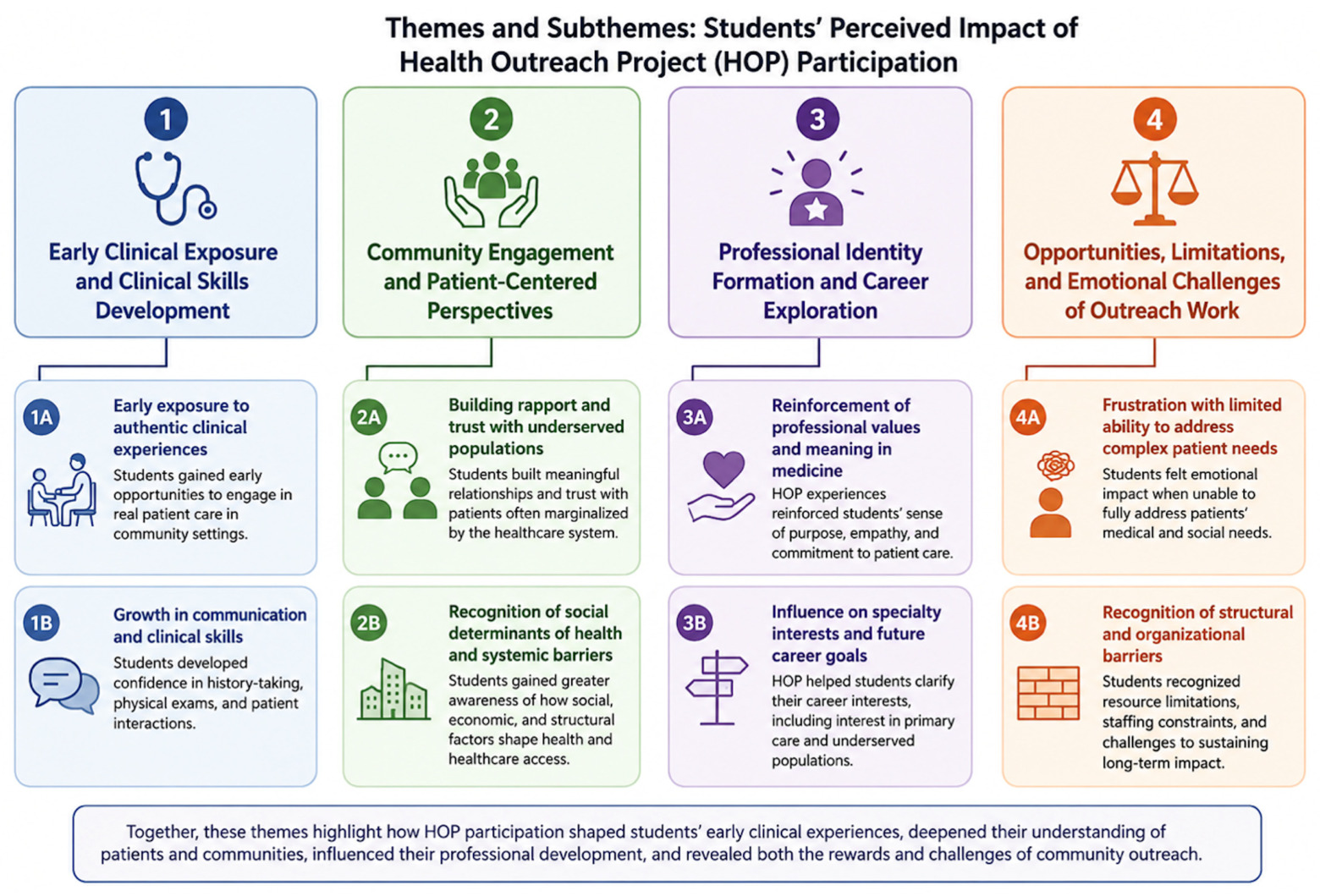
A total of 14 students participated across 4 focus groups. Participants described a wide range of experiences across HOP clinics and community outreach initiatives. Four major themes emerged from the data analysis: (1) early clinical exposure and clinical skills development, (2) community engagement and patient-centered perspectives, (3) professional identity formation and career exploration, and (4) opportunities, limitations, and emotional challenges of outreach work (Figure 1).
Figure 1.
Themes and subthemes describing students’ perceived impact of participation in the Health Outreach Project (HOP). Major themes are presented in the top row, with related subthemes displayed beneath each category.
3.1. Theme 1: Early Clinical Exposure and Clinical Skills Development
Participants consistently described HOP as one of their first meaningful opportunities to engage in authentic clinical experiences during the preclinical years of medical school. Students emphasized that HOP provided hands-on exposure to patient care, increased comfort in patient-facing settings, and helped bridge the gap between classroom learning and clinical medicine.
3.1.1. Early Exposure to Authentic Clinical Experiences
Many participants described HOP as their first opportunity to participate in “real” clinical interactions outside of standardized patient encounters and classroom-based learning during the preclinical years. Students frequently contrasted these experiences with the heavily academic structure of the preclinical curriculum.
“It allowed you to really get involved and do something clinical, like what you think you’re going to be doing in medical school and not just studying glycolysis 8000 times over… I think that opportunity, especially such early engagement, can really enhance the medical experience… it shows you unique things, like working with unique populations.”(P4-M4)
“Especially first year, it’s so much studying and flashcards, and so it’s really nice to actually work with people and work in a clinical setting… understanding what types of antibiotics they have on the van, and what types of tests they run… I feel like it really added to my knowledge in that way as well.”(P9-M3)
3.1.2. Growth in Communication and Clinical Skills
Students also described gaining practical clinical and communication skills through repeated patient encounters. They noted improvements in history-taking, physical examination skills, and patient interviewing, while also learning to navigate more realistic and unpredictable patient interactions.
“It’s really your first clinical experience. Like, a real on-the-ground, you’re practicing medicine, even though you don’t know what you’re doing, but you’re learning… throughout this process of going to HOP weekly… I really started building a foundation of how to practice medicine.”(P10-M4)
“Patients don’t read textbooks. They don’t read the script on how to answer your questions… HOP allowed me to use that experience to help broaden how I ask questions and how I approach patients… it helps you ask the questions and dive deeper with a better perspective.”(P4-M4)
3.2. Theme 2: Community Engagement and Patient-Centered Perspectives
Students frequently described HOP as an opportunity to connect with underserved communities and develop a deeper understanding of patients lived experiences. Experiences working with individuals affected by disability, housing instability, substance use disorders, and limited access to healthcare broadened their’ perspectives on patient care and the social determinants of health.
3.2.1. Building Rapport and Trust with Underserved Populations
Students emphasized the importance of listening to patients, developing trust, and forming meaningful interpersonal connections with individuals often marginalized within healthcare systems.
“A lot of people who didn’t have regular access to primary care… had a lot they wanted to unload, both personal traumas and… they never had someone who listened to them, so they really just wanted someone to speak to them… doing our intake would take a really long time, because we wanted to spend enough adequate time listening to them and building rapport.”(P1-M4)
“What I learned in that clinic was relational… how you build trust with other people, right? It’s not the medical knowledge that we have, but more so the ways that we can relate… because you can’t build trust without connection.”(P13-M3)
3.2.2. Recognition of Social Determinants of Health and Systemic Barriers
Participants described gaining greater awareness of how social and structural barriers influence patients’ health outcomes and healthcare access. Several students reflected on learning to approach patients more thoughtfully and avoid assumptions about patient behaviors or adherence.
“Being in HOP, I felt like I had opportunities to kind of learn more ways to ask questions… Is it you don’t actually want to take it, or you can’t get to the pharmacy, you can’t afford it, you don’t have insurance?… I think HOP allowed me to broaden how I ask questions and how I approach patients, rather than just, ‘oh, so you’re just not taking your meds.’”(P4-M4)
“What I learned is we’re taught medicine one type of way, but there’s so many ways to modify and adapt… the physical exam, the questions that we ask, and how we ask them to make sure that it’s comfortable for everyone… and it doesn’t apply just to people with disabilities. It applies to every patient that walks into our room.”(P13-M3)
3.3. Theme 3: Professional Identity Formation and Career Exploration
Participants viewed HOP as influential in shaping both their professional values and their understanding of future career interests. Many students reflected on how HOP reinforced the humanistic aspects of medicine and clarified what types of patient populations, clinical environments, and physician roles felt meaningful to them.
3.3.1. Reinforcement of Professional Values and Meaning in Medicine
Students frequently perceived HOP as a reminder of why they pursued medicine, particularly during academically demanding preclinical years. Participants also reflected on learning humility, empathy, and patient-centeredness through their interactions with community members.
“It was nice for everyone to be able to see the community and kind of be reminded of why we went to medical school… the first two years were so inundated with books, so the thing I remember most is getting out and how I felt doing that.”(P8-M3)
“One of the program coordinators framed it very differently. She was like, ‘these are participants, these are volunteers that are helping you learn… they’re offering their time for you to learn how to best serve someone.’… Perspective matters.”(P13-M3)
3.3.2. Influence on Specialty Interests and Future Career Goals
Experiences within HOP influenced participants’ perceptions of different specialties and future career goals, although these impacts varied among students. Some participants described increased interest in primary care and underserved medicine, whereas others clarified specialties they did not wish to pursue.
“It can show you what you want to do with your career… it gives you that experience where you get to do things earlier, get more engaged, and learn more things about yourself along with the medicine you practice.”(P4-M4)
“Where I am now as a fourth year who’s applying and wanting a career in primary care, I feel like having background in harm reduction is so important… I think it taught me a lot about having an approach of kindness and understanding.”(P2-M4)
“We went the complete opposite directions after our exposure to HOP. [One of us was] like, ‘yes, I’m gonna do primary care,’ and [the other was] like, ‘I’m not gonna do primary care.’”(P1-M4)
3.4. Theme 4: Opportunities, Limitations, and Emotional Challenges of Outreach Work
Although participants overwhelmingly described HOP as meaningful and rewarding, many also discussed frustrations associated with resource limitations, inability to address systemic issues, and the emotional complexity of caring for patients with significant unmet needs.
3.4.1. Frustration with Limited Ability to Address Complex Patient Needs
Students described feeling emotionally impacted by the magnitude of patients’ medical and social challenges, particularly when they felt unable to provide long-term solutions or adequately address the root causes of illness.
“I struggled a lot with feeling like we spent a lot of time talking and listening to them unpack their traumas… but at the end of the day, I didn’t feel like I was able to do enough or make a difference… we were not in a position to take care of their actual needs adequately.”(P1-M4)
“We couldn’t offer people housing or jobs, and we couldn’t undo the things that caused their trauma early in their lives… it’s just such a larger issue socially and geographically.”(P2-M4)
3.4.2. Recognition of Structural and Organizational Barriers
Participants additionally reflected on the broader structural limitations affecting outreach organizations and underserved communities, including limited staffing, insufficient resources, and the difficulty of sustaining longitudinal impact through short-term volunteer experiences.
“The thing that struck me most was how few people it took to run a place like this that was so important for the community… this was maybe less than 20 people max that I was seeing working there every day.”(P12-M4)
“Especially in our limited period of time in a less than one-year position, we can’t really get at addressing the root causes of a lot of our patients’ suffering.”(P2-M4)
Collectively, these findings suggest that participation in the HOP provided students with meaningful early clinical exposure while simultaneously shaping their perspectives on patient care, professional identity, and community engagement.
4. Discussion
This qualitative study explored medical students’ perceptions of participation in the Health Outreach Project (HOP) at Drexel University College of Medicine and identified four major themes related to early clinical exposure, community engagement, professional identity formation, and the emotional and structural complexities of outreach work. Overall, participants perceived HOP as a meaningful component of their medical education that enhanced clinical preparedness, broadened perspectives on patient care, and contributed to personal and professional development. At the same time, students recognized the limitations inherent in community outreach settings and reflected critically on the systemic barriers faced by underserved populations.
4.1. Early Clinical Exposure and Clinical Preparedness
Students consistently described HOP as one of their earliest opportunities for authentic clinical engagement during medical school. Participants emphasized that these experiences helped bridge the gap between classroom learning and patient care by providing exposure to real-world clinical interactions, communication challenges, and patient-centered decision making. These findings align with prior literature demonstrating that early clinical exposure can improve student confidence, professionalism, and preparedness for clinical training [15,16].
Students also reported increased comfort with history-taking, patient interviewing, and navigating unpredictable patient encounters. These findings are consistent with prior studies reporting that SRFC participation improves students’ confidence in clinical skills and preparedness for clerkships [6,10]. Additionally, our participants frequently contrasted HOP with standardized patient encounters and preclinical coursework, emphasizing that community-based clinical exposure allowed them to apply knowledge in more realistic and meaningful contexts.
4.2. Community Engagement and Patient-Centered Perspectives
A major finding of this study was the extent to which participants perceived HOP as shaping their understanding of underserved populations and the social determinants of health. Participants described developing greater awareness of how housing instability, substance use disorders, disability, trauma, and limited healthcare access influence patient outcomes and healthcare behaviors. Students frequently reflected on learning to approach patients with greater empathy and flexibility rather than relying on assumptions about adherence or motivation.
These findings are consistent with prior literature demonstrating that SRFC participation is associated with increased cultural competence, empathy, and awareness of healthcare disparities [20,21]. Our participants additionally emphasized the importance of rapport-building and listening to patients’ lived experiences, reinforcing the role of SRFCs in fostering patient-centered care and relational communication skills.
Several students specifically reflected on learning harm reduction approaches and adapting communication styles to accommodate diverse patient needs, including individuals with intellectual disabilities and substance use disorders [21,37]. These findings suggest that SRFC experiences may provide important opportunities for students to develop more flexible, patient-centered approaches to communication and care early in medical training, particularly when working with medically and socially complex populations.
4.3. Professional Identity Formation and Career Exploration
Participants also described HOP as influential in shaping their evolving professional identities and future career interests. Many students viewed HOP as a reminder of the humanistic and service-oriented aspects of medicine during academically intensive preclinical years. These findings align with prior literature suggesting that service-learning experiences and longitudinal community engagement contribute meaningfully to professional identity formation in medical education [38,39].
Experiences within HOP additionally influenced students’ perceptions of future career paths, particularly regarding primary care, underserved medicine, and advocacy-oriented specialties. However, participants’ reflections also demonstrated that exposure to outreach settings sometimes clarified what types of practice environments students did not envision for themselves. This nuanced finding mirrors existing literature regarding the relationship between SRFC participation and specialty choice. While some studies have demonstrated associations between SRFC participation and increased interest in primary care [25,26], other studies have found minimal impact on specialty selection overall [27,28]. Our findings suggest that SRFC participation may play a broader role in career exploration by helping students reflect on their values, preferred patient populations, and professional priorities.
4.4. Opportunities, Limitations, and Emotional Challenges of Outreach Work
Although participants overwhelmingly described HOP as meaningful and rewarding, many also reflected on the emotional challenges associated with caring for underserved populations with significant unmet social and medical needs. Students described frustration with their inability to address larger structural issues such as housing insecurity, trauma, substance use, and limited access to longitudinal care. Participants additionally recognized organizational limitations within outreach settings, including staffing constraints, limited resources, and difficulty sustaining long-term interventions through student-led volunteer models. These findings are consistent with prior literature describing operational challenges faced by SRFCs, including limited funding, leadership turnover, and physician volunteer shortages [11,29,31].
However, our findings further highlight the emotional impact these limitations may have on students themselves. While exposure to underserved communities may foster empathy and advocacy-oriented thinking, it may also expose students to feelings of helplessness and uncertainty regarding their ability to create meaningful systemic change, particularly when confronting broader structural inequities that extend beyond clinical care [40].
4.5. Implications for Medical Education
The findings of this study suggest that SRFCs such as HOP may serve as valuable adjuncts to traditional preclinical medical education by providing opportunities for experiential learning, patient interaction, and professional identity formation early in training. Participants consistently described these experiences as helping contextualize classroom learning and increase preparedness for clinical training. Experiences involving disability care, harm reduction, substance use disorders, and housing instability appeared particularly influential in shaping students’ perspectives on patient-centered care and social determinants of health.
At the same time, the emotional and structural challenges described by participants underscore the importance of mentorship, debriefing opportunities, and institutional support for students involved in outreach work. Providing structured reflection and faculty guidance may help students process emotionally difficult experiences while fostering sustainable engagement with underserved communities.
4.6. Study Limitations
Several limitations should be considered when interpreting findings of this study. First, this was a single-institution qualitative study involving a relatively small sample of medical students, which may limit generalizability to other institutions or outreach programs. Participants who volunteered for focus groups may also have had particularly strong experiences with HOP, introducing potential self-selection bias. Second, because the study relied on retrospective reflections, responses may have been influenced by recall bias or subsequent clinical experiences. Additionally, focus group settings may have limited participants’ willingness to share dissenting opinions despite efforts to maintain confidentiality.
An additional limitation relates to data capture and transcription. Focus groups were transcribed using Zoom’s automated transcription service rather than traditional audio-recording followed by manual transcription. Although transcripts were reviewed and verified by the interviewer immediately after each session and only minor corrections were required, automated transcription may introduce transcription errors. Furthermore, the decision not to retain audio or video recordings limited the ability to perform subsequent independent verification of transcripts. However, this approach was intentionally selected to enhance participant comfort and facilitate open discussion of experiences within a school-affiliated program.
Finally, this study explored students’ perceived educational and professional impact rather than objective educational outcomes. Future research may benefit from longitudinal or mixed-methods approaches examining how participation in SRFCs influences measurable clinical preparedness, professional development, residency selection, and long-term practice patterns.
5. Conclusions
Participation in the Health Outreach Project (HOP) was perceived by students as a meaningful component of their medical education that contributed to early clinical exposure, development of communication and clinical skills, and greater understanding of underserved communities and social determinants of health. Students additionally described HOP as influential in shaping their professional identities, approaches to patient care, and perspectives on future career goals. At the same time, participants recognized the emotional and structural challenges associated with outreach work, including limitations in resources, continuity of care, and the ability to address broader systemic inequities. These findings suggest that student-run free clinics may serve as valuable educational environments that support experiential learning, reflective professional development, and patient-centered care early in medical training. However, these findings should be interpreted in light of the study’s limitations, including the single-institution design, relatively small sample size, reliance on retrospective self-report, and focus on perceived rather than objectively measured outcomes. Further research is needed to better understand the long-term educational and professional impact of participation in SRFCs across diverse institutional settings.
Supplementary Materials
The following supporting information can be downloaded at: https://www.mdpi.com/article/10.3390/ime5030060/s1.
Author Contributions
C.A.M. conceived the study idea, initiated the IRB process, and conducted data collection. H.M.A. designed the study and participated in data collection. C.A.M., G.M.U. and K.S.S. independently analyzed the data. D.E.B., T.-A.G.O. and A.L. prepared the initial manuscript draft. H.M.A. and D.E.B. finalized the manuscript. H.M.A. supervised the study, including data collection, data analysis, and manuscript preparation. All authors contributed to interpretation of the findings, critically reviewed earlier drafts, approved the final manuscript, and agreed to its submission to the journal. During manuscript preparation, the authors used Drexel University’s institutionally licensed version of OpenAI’s ChatGPT Edu (GPT-5.5) to assist with language refinement and clarity and to generate Figure 1. All content, interpretations, and final editorial decisions were made by the authors. All authors have read and agreed to the published version of the manuscript.
Funding
The authors did not receive support from any organization for the submitted work.
Informed Consent Statement
All procedures performed in this study have been performed following the Declaration of Helsinki. This study was reviewed and granted the “exempt” status by the Institutional Review Board (IRB) at Drexel University (protocol # 2504011178). All participants involved in the study were invited to participate voluntarily. The need for written informed consent to participate was waived by the IRB.
Data Availability Statement
Majority of data generated and analyzed during this study are included in this published article. Complete raw datasets generated in this study are available from the corresponding author on reasonable request.
Conflicts of Interest
The authors declare that they have no competing interests.
References
- Karthik, N.; Greenfield, M.; Otteson, T. The perceived impact of curricular and non-curricular factors on specialty interests and choice during medical school at a single center in the United States. BMC Med. Educ. 2023, 23, 730. [Google Scholar] [CrossRef] [Scilit] [PubMed]
- AkbariRad, M.; Khadem-Rezaiyan, M.; Ravanshad, S.; Rafiee, M.; Firoozi, A.; Zolfaghari, S.A.; Aghaei, H.R.; Zadehahmad, R.; Azarkar, S.; Moodi Ghalibaf, A. Early clinical exposure as a highly interesting educational program for undergraduate medical students: An interventional study. BMC Med. Educ. 2023, 23, 292. [Google Scholar] [CrossRef] [Scilit] [PubMed]
- Liu, C.I.; Tang, K.P.; Wang, Y.C.; Chiu, C.H. Impacts of early clinical exposure on undergraduate student professionalism: A qualitative study. BMC Med. Educ. 2022, 22, 435. [Google Scholar] [CrossRef] [Scilit] [PubMed]
- Adel, F.W.; Berggren, R.E.; Esterl, R.M.; Ratelle, J.T. Student-run free clinic volunteers: Who they are and what we can learn from them. BMC Med. Educ. 2021, 21, 356. [Google Scholar] [CrossRef] [Scilit] [PubMed]
- Alghalyini, B.; Zaidi, A.R.Z.; Khaled, R.; Adem, F.; Alswes, M.A.; Hafez, B.; Zaidi, F.Z. Developing a tool to evaluate the impact of a student-led community-engaging health promotion project on knowledge translation skills in medical students. BMC Med. Educ. 2024, 24, 1534. [Google Scholar] [CrossRef] [Scilit] [PubMed]
- Kalistratova, V.S.; Nisanova, A.; Shi, L.Z. Student-run free clinics may enhance medical students’ self-confidence in their clinical skills and preparedness for clerkships. Med. Educ. Online 2024, 29, 2348276. [Google Scholar] [CrossRef] [Scilit] [PubMed]
- Knepp, K.; Fischbein, R.; Bonfine, N.; Hall, A.; Baughman, K.; Campbell, M.; Fernandez, A. Medical student perceptions and attitudes related to interprofessional collaboration at a student-run free clinic. J. Interprof. Educ. Pract. 2022, 29, 100556. [Google Scholar] [CrossRef] [Scilit]
- McIntire, B.; Greni, S.; Radil, S.; Menning, M. A Look into Motivations and Barriers to Student Involvement at the SHARING Clinic, a Student-Run Free Clinic. J. Stud.-Run Clin. 2022, 8. [Google Scholar] [CrossRef] [Scilit]
- Prestes Vargas, J.; Smith, M.; Chipchase, L.; Morris, M.E. Impact of interprofessional student led health clinics for patients, students and educators: A scoping review. Adv. Health Sci. Educ. 2025, 30, 321–345. [Google Scholar] [CrossRef] [Scilit] [PubMed]
- Rupert, D.D.; Alvarez, G.V.; Burdge, E.J.; Nahvi, R.J.; Schell, S.M.; Faustino, F.L. Student-run free clinics stand at a critical junction between undergraduate medical education, clinical care, and advocacy. Acad. Med. 2022, 97, 824–831. [Google Scholar] [CrossRef] [Scilit] [PubMed]
- Smith, S.; Thomas, R.; Cruz, M.; Griggs, R.; Moscato, B.; Ferrara, A. Presence and characteristics of student-run free clinics in medical schools. JAMA 2014, 312, 2407–2410. [Google Scholar] [CrossRef] [Scilit] [PubMed]
- Drexel University College of Medicine. HOP Community Projects. Available online: https://drexel.edu/medicine/community-engagement/hop-clinics/philadelphia/community-projects/ (accessed on 1 May 2026).
- SpArc Philadelphia. The Arc of Philadelphia, Part of the SPARC Philadelphia Family. Available online: https://sparcphilly.org/arc_philadelphia/home.html (accessed on 1 May 2026).
- Schei, E.; Johnsrud, R.E.; Mildestvedt, T.; Pedersen, R.; Hjörleifsson, S. Trustingly bewildered: How first-year medical students make sense of their learning experience in a traditional, preclinical curriculum. Med. Educ. Online 2018, 23, 1500344. [Google Scholar] [CrossRef] [Scilit] [PubMed]
- Austin, J.P.; Baskerville, M.; Bumsted, T.; Haedinger, L.; Nonas, S.; Pohoata, E.; Rogers, M.; Spickerman, M.; Thuillier, P.; Mitchell, S.H. Development and evaluation of a simulation-based transition to clerkship course. Perspect. Med. Educ. 2020, 9, 379–384. [Google Scholar] [CrossRef] [Scilit] [PubMed]
- Ryan, M.S.; Feldman, M.; Bodamer, C.; Browning, J.; Brock, E.; Grossman, C. Closing the gap between preclinical and clinical training: Impact of a transition-to-clerkship course on medical students’ clerkship performance. Acad. Med. 2020, 95, 221–225. [Google Scholar] [CrossRef] [Scilit] [PubMed]
- Huang, K.; Maleki, M.; Regehr, G.; McEwen, H. Examining the Educational Value of Student-Run Clinics for Health Care Students. Acad. Med. 2021, 96, 1021–1025. [Google Scholar] [CrossRef] [Scilit] [PubMed]
- Meah, Y.S.; Smith, E.L.; Thomas, D.C. Student-run health clinic: Novel arena to educate medical students on systems-based practice. Mt. Sinai J. Med. 2009, 76, 344–356. [Google Scholar] [CrossRef] [Scilit] [PubMed]
- Cheney, A.M.; Baltrushes, N.; Gehlbach, D.; Navarro, A. Becoming a leader for underserved patients—The importance of student run free clinics. Front. Health Serv. 2024, 4, 1509964. [Google Scholar] [CrossRef] [Scilit] [PubMed]
- Modi, A.; Fascelli, M.; Daitch, Z.; Hojat, M. Evaluating the relationship between participation in student-run free clinics and changes in empathy in medical students. J. Prim. Care Community Health 2017, 8, 122–126. [Google Scholar] [CrossRef] [Scilit] [PubMed]
- Sheu, L.C.; Zheng, P.; Coelho, A.D.; Lin, L.D.; O’Sullivan, P.S.; Ten Cate, O. Learning through service: Student perceptions on volunteering at interprofessional hepatitis B student-run clinics. J. Cancer Educ. 2011, 26, 228–233. [Google Scholar] [CrossRef] [Scilit] [PubMed]
- Porterfield, D.S.; Konrad, T.R.; Porter, C.Q.; Leysieffer, K.; Martinez, R.M.; Niska, R.; Potter, F. Caring for the Underserved: Current Practice of Alumni of the National Health Service Corps. J. Health Care Poor Underserved 2003, 14, 256–271. [Google Scholar] [CrossRef] [Scilit] [PubMed]
- O’Doherty, D.; Culhane, A.; O’Doherty, J.; Harney, S.; Glynn, L.; McKeague, H.; Kelly, D. Medical students and clinical placements: A qualitative study of the continuum of professional identity formation. Educ. Prim. Care 2021, 32, 202–210. [Google Scholar] [CrossRef] [Scilit] [PubMed]
- Schei, E.; Knoop, H.S.; Gismervik, M.N.; Mylopoulos, M.; Boudreau, J.D. Stretching the comfort zone: Using early clinical contact to influence professional identity formation in medical students. J. Med. Educ. Curric. Dev. 2019, 6, 1–8. [Google Scholar] [CrossRef] [Scilit] [PubMed]
- Thomson, K.B.; Mirpuri, P.; Chen, M. The impact of volunteering with a student-run free clinic on medical student specialty selection. BMC Med. Educ. 2022, 22, 714. [Google Scholar] [CrossRef] [Scilit] [PubMed]
- Dunleavy, S.; Paladine, H.L. Effect of student-run free clinics on Family Medicine match rates: A multisite, regression discontinuity study. Fam. Med. 2024, 56, 422–427. [Google Scholar] [CrossRef] [Scilit] [PubMed]
- Brown, A.; Ismail, R.; Gookin, G.; Hernandez, C.; Logan, G.; Pasarica, M. The Effect of Medical Student Volunteering in a Student-Run Clinic on Specialty Choice for Residency. Cureus 2017, 9, e967. [Google Scholar] [CrossRef] [Scilit] [PubMed]
- McCray, E.; Atkinson, W.R.; McCray, C.E.; Hubler, Z.; Maher, Y.; Waguia, R.; Kearney, M.; Kaprielian, V. Impact of Medical Student Participation in Student-Run Clinics on Education, Residency Selection, and Patient Care: A Review of Selected Articles. Cureus 2022, 14, e26183. [Google Scholar] [CrossRef] [Scilit] [PubMed]
- Mazander, M.; Rumenapp, J.; Lee, D.; Ong, C.; Floramo, E.; Benjamins, M.; Chen, M. Quantifying the educational value of a student-run free clinic. Fam. Med. 2024, 56, 176–179. [Google Scholar] [CrossRef] [Scilit] [PubMed]
- Vu, A.; Hsu, A.R.; Baumel, N.M.; Holthe, J.; Ho, J.Y.; Goldberg, S.Y.; Cerecedo, L.G.; Abou-Haiba, N.; Kuchler, R.; Fanning, Z.; et al. Preventative care in student-run free clinics: A narrative review on feasibility, ethics, and recommendations. BMC Med. Educ. 2024, 24, 1345. [Google Scholar] [CrossRef] [Scilit] [PubMed]
- Sandhu, N.K.; Pasick, L.J.; Rosenzweig, S.; Gadegbeku, A.; Croke, C.; Goldberg, E. Closing the loop: Strategies and key approaches to initiate, evaluate and expand student-run free clinics. Free Clin. Res. Collect. 2018, 4. Available online: https://www.themspress.org/journal/index.php/freeclinic/article/view/346 (accessed on 1 May 2026).
- Braun, V.; Clarke, V. Using thematic analysis in psychology. Qual. Res. Psychol. 2006, 3, 77–101. [Google Scholar] [CrossRef] [Scilit]
- Kuckartz, U. Qualitative Text Analysis: A Guide to Methods, Practice and Using Software; SAGE Publications: Thousand Oaks, CA, USA, 2014. [Google Scholar]
- Mayring, P. Qualitative Content Analysis: Theoretical Foundation, Basic Procedures and Software Solution; Klagenfurt, Austria, 2014; Available online: https://nbn-resolving.org/urn:nbn:de:0168-ssoar-395173 (accessed on 1 May 2026).
- Lincoln, Y.S.; Guba, E.G. Naturalistic Inquiry; SAGE Publications: Thousand Oaks, CA, USA, 1985. [Google Scholar]
- Patton, M.Q. Enhancing the quality and credibility of qualitative analysis. Health Serv. Res. 1999, 34, 1189–1208. [Google Scholar] [PubMed]
- Hawk, M.; Coulter, R.W.S.; Egan, J.E.; Fisk, S.; Friedman, M.R.; Tula, M.; Kinsky, S.; Kertesz, S.G. Harm reduction principles for healthcare settings. Harm Reduct. J. 2017, 14, 70. [Google Scholar] [CrossRef] [Scilit] [PubMed]
- Mount, G.R.; Kahlke, R.; Melton, J.; Varpio, L. A critical review of professional identity formation interventions in medical education. Acad. Med. 2022, 97, S96–S106. [Google Scholar] [CrossRef] [Scilit] [PubMed]
- Sarraf-Yazdi, S.; Teo, Y.N.; How, A.E.H.; Teo, Y.H.; Goh, S.; Kow, C.S.; Lam, W.Y.; Wong, R.S.M.; Ghazali, H.Z.B.; Lauw, S.K.; et al. A scoping review of professional identity formation in undergraduate medical education. J. Gen. Intern. Med. 2021, 36, 3511–3521. [Google Scholar] [CrossRef] [Scilit] [PubMed]
- Metzl, J.M.; Hansen, H. Structural competency: Theorizing a new medical engagement with stigma and inequality. Soc. Sci. Med. 2014, 103, 126–133. [Google Scholar] [CrossRef] [Scilit] [PubMed]

Disclaimer/Publisher’s Note: The statements, opinions and data contained in all publications are solely those of the individual author(s) and contributor(s) and not of MDPI and/or the editor(s). MDPI and/or the editor(s) disclaim responsibility for any injury to people or property resulting from any ideas, methods, instructions or products referred to in the content. |
© 2026 by the authors. Published by MDPI on behalf of the Academic Society for International Medical Education. Licensee MDPI, Basel, Switzerland. This article is an open access article distributed under the terms and conditions of the Creative Commons Attribution (CC BY) license.