


Abstract
Empathy is fundamental to patient-centered care but frequently diminishes during clinical training. To inform medical education, we conducted a systematic review (PRISMA-2020-compliant) of interventions aimed at augmenting empathy in healthcare learners. We searched the PubMed, EMBASE, PsycINFO, CINAHL, ERIC, and Cochrane CENTRAL databases from the beginning of time until January 2026 for trials and pre- and post-studies that looked at empathy outcomes. Two reviewers evaluated the studies (κ = 0.86) and extracted data regarding participants, intervention format, and outcomes. Our initial search yielded 2056 records. After removing duplicates, 1250 titles and abstracts were screened, resulting in the inclusion of 43 studies from 2010 to 2026. The majority of studies reported improvements in empathy post-intervention, based on both self-report measures and observational assessments. Interventions that included active learning methods like role-playing, standardized patient encounters, narrative medicine, art workshops, and mindfulness led to much better improvements in empathy than passive, lecture-based methods. Long-term, multimodal programs that included communication skills training, reflective exercises, and patient contact were better than classes that only met once. Nonetheless, many studies used different, sometimes untested, empathy measures, and the follow-up period was often short. Our review demonstrates that empathy can be imparted through evidence-based curricular approaches. We advocate for the incorporation of prolonged, experiential empathy training into health professions education, alongside the standardization of outcome assessment. These results make it clear which teaching methods work best and point out areas where more research is needed.
1. Introduction
Empathy is a multidimensional construct, broadly defined as the capacity to understand and share the emotions of others. It is often conceptualized as comprising three key components: cognitive empathy (the ability to understand another person’s perspective), affective empathy (the capacity to share another’s emotional experience), and behavioral or compassionate empathy (the action taken as a result of these cognitive and affective states). As a crucial skill for healthcare professionals, empathy is significantly linked to patient satisfaction, adherence, and outcomes, significantly linked to patient satisfaction, adherence, and outcomes [1,2]. Despite advocacy for empathy education, formal training is often inconsistent in medical curricula, resulting in a well-documented decline or “erosion” of empathy among learners during clinical training [3]. This phenomenon is often attributed to factors such as burnout from demanding workloads, the “hidden curriculum” that may depersonalize patient care, and an educational focus that prioritizes technical procedures over interpersonal skills. As a result, many researchers have created structured empathy curricula using a variety of methods, such as lectures, role-playing, narrative medicine, and digital tools [1,4]. Previous evaluations have identified beneficial impacts of experiential learning and reflective practices, while also emphasizing the variability in methodologies and results [5,6].
An increasing corpus of the literature substantiates that focused empathy-enhancing curricula can improve empathic skills among healthcare students [7,8]. For instance, a recent comprehensive review by Edwards et al. [1] indicated that approximately 71% of earlier systematic reviews documented favorable results from empathy training programs [7]. Active, participatory approaches have proven to be particularly effective. Larsson et al. [7] executed a randomized trial illustrating that intentional practice of empathic communication (through guided role-plays with feedback) markedly enhanced students’ empathic expression, in contrast to a conventional didactic lecture [1]. In a similar vein, Ngo et al. [9] employed network meta-analysis to demonstrate that the integration of didactic instruction with rehearsal and simulation constituted one of the most efficacious methods for enhancing physician empathy [9]. Conversely, exclusively lecture-based formats or singular seminars generally resulted in minimal or negligible measurable improvements [9,10].
Research has evaluated experiential learning techniques (e.g., standardized patient interactions, role-playing with patients or peers, clinical service-learning) alongside affective and narrative methodologies (e.g., patient storytelling, arts workshops, mindfulness exercises). Morizio et al. [8] discovered that an art-based curriculum, titled “Creating Compassion”, enhanced empathetic behaviors among urban youth [8]. Kuhnley et al. indicated that an online creativity workshop substantially improved counselors’ trait empathy [11]. Gatzunis et al. demonstrated that behavioral skills training via telehealth can proficiently impart empathic interviewing techniques [12]. These findings correspond with the research conducted by Vieten et al. [4], which delineated the field of empathy measurement. They emphasize the necessity for well-structured interventions centered on reflection and practice, while acknowledging the existence of over 500 distinct empathy instruments currently in use [4].
The literature collectively suggests that experiential, multimodal programs typically produce the most significant enhancements in empathy [1,3]. Reviews concur that pedagogical approaches that engage students affectively (via narrative medicine or art) and cognitively (through communication skills training) yield superior outcomes compared to didactic methods alone [2,3]. However, significant heterogeneity exists in intervention design and outcome measurement. Some important gaps are outlined as follows. There is no universally accepted “gold standard” for measuring empathy. Numerous self-report scales (e.g., Jefferson Scale of Empathy), objective structured assessments, and patient/peer evaluations have been employed in studies. This diversity makes it harder to make comparisons [4,11]. Numerous programs are short (lasting hours to days); Samarasekera et al. [13] observed that extended, longitudinal interventions consistently enhanced empathy more effectively than single-session formats [13]. There are not many studies that look at whether empathy gains last for months or years. Most studies are limited to medical and nursing schools in North America and Europe; there is scant knowledge regarding empathy training in other regions or within interprofessional settings. Additionally, there is a scarcity of studies that directly investigate the influence on clinical practice or patient outcomes. No single unifying theory guides the design of all empathy programs. Some use theories about social-cognitive and emotional intelligence. This results in variations in their design and implementation.
In conclusion, recent research confirms the efficacy of empathy training, especially through active learning [2,3], while underscoring the need for standardized methodologies and comprehensive evaluation. Our systematic review builds on this by bringing together the most recent empirical studies and clearly comparing different teaching methods. It also fills in gaps from before by pointing out new modalities (like digital health tools and AI-assisted role-play) and making it clear which parts of the program are linked to bigger effect sizes.
The study comprised a systematic review of empathy training in medical and health professions education, incorporating research from 2010 to January 2026, as well as recent high-impact randomized controlled trials, meta-analyses, and innovative theoretical contributions. This review seeks to deliver an updated, comprehensive synthesis to assist educators and researchers in this domain by strictly following PRISMA guidelines and incorporating the most recent studies up to January 2026.
2. Methods
2.1. Search Strategy
This systematic review was conducted and reported in accordance with the PRISMA 2020 statement. We searched relevant databases (Medline, EMBASE, PsycINFO, CINAHL, ERIC, etc.) using terms related to “empathy”, “training”, “education”, “patient satisfaction”, and related patient outcomes (see Table 1 for search terms). Reference management was performed using EndNote X9 (Clarivate, Philadelphia, PA, USA), and the screening process was facilitated by Covidence software (version as of May 2025) (Veritas Health Innovation, Melbourne, Australia). The protocol for this systematic review was not prospectively registered. The full search strings for each database are provided in Table S1.
Table 1.
Search terms used in systematic review.
2.2. Inclusion and Exclusion Criteria
Table 2 outlines the inclusion and exclusion criteria for the literature search. Inclusion criteria focused on empirical studies, such as randomized controlled trials, observational studies, and mixed-methods designs, which examined empathy expression in clinical interactions within medical settings, published in English or with accessible translations. Exclusion criteria eliminated non-empirical works (e.g., editorials, commentaries), studies conducted outside medical contexts, and non-English publications lacking translations.
Table 2.
Inclusion and exclusion criteria for literature search.
2.3. Study Selection
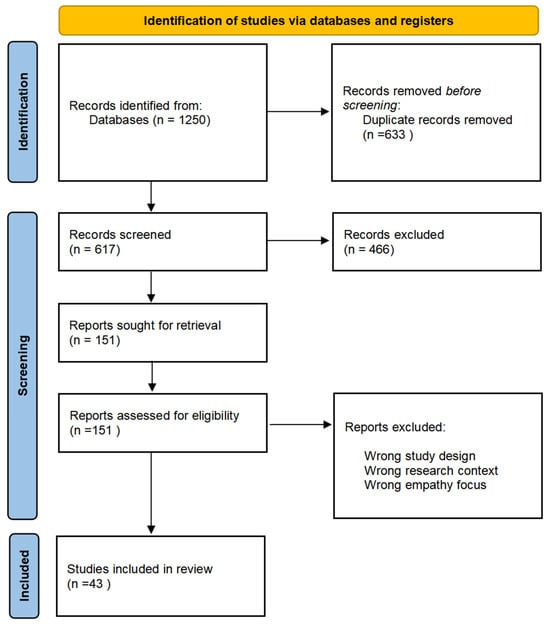
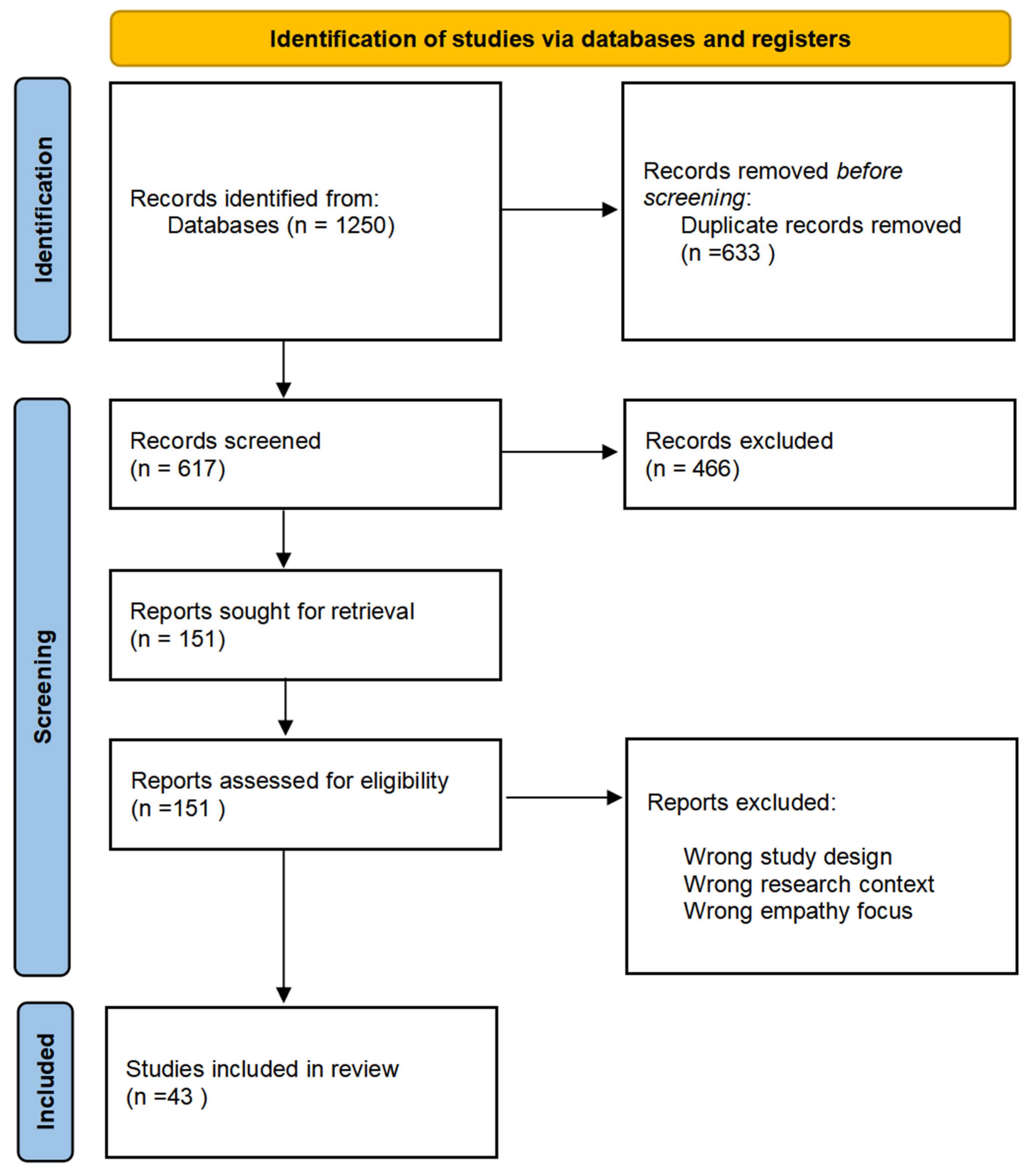
After removing duplicates, two reviewers independently checked the titles and abstracts against the eligibility criteria and got full-text articles for reports that might be eligible. The same two reviewers then looked at each full text separately to see if it should be included. Disagreements were settled through dialog or by seeking the opinion of a third reviewer. Reasons for excluding full-text articles were recorded. The PRISMA flow diagram (Figure 1) shows how the studies were chosen. Arrows indicate the flow of records through the review process from identification to screening, eligibility assessment, and inclusion
Figure 1.
PRISMA flow diagram.
Searches were refreshed until January 2026. We incorporated empirical studies, such as randomized trials, quasi-experiments, cohort studies, and mixed-methods approaches, that focused on interventions specifically aimed at fostering empathy or compassion within healthcare or related settings. We concentrated on trainees in medical and allied health fields (students, residents, practitioners) and pertinent outcomes (e.g., self-reported empathy scales, observed empathic behaviors, patient feedback). Recent systematic reviews and meta-analyses [10,13,14] were recognized but excluded as primary data; instead, they enhanced our comprehension of intervention frameworks and directed the thoroughness of our search. We omitted non-empirical articles (editorials, opinion pieces), non-English reports without translation, and studies devoid of distinct empathy-related interventions or outcomes.
2.4. Data Extraction and Synthesis
Two reviewers independently screened titles and abstracts, with excellent initial agreement (κ = 0.86), and selected full texts, resolving discrepancies through consensus. The selection process is shown in the new PRISMA flow chart (Figure 1). In the end, 43 studies (2010–2026) met the requirements for inclusion. Information was taken from the study design, setting, participants, intervention details, duration, comparator, measurement instruments, and main findings. We organized interventions by type (e.g., didactic, experiential, multimedia, narrative, creative arts, online) and grouped outcomes by area. Given the significant heterogeneity in populations, interventions, and outcome measures, a quantitative meta-analysis was not feasible. Therefore, we conducted a structured narrative synthesis guided by the principles of the Synthesis Without Meta-analysis (SWiM) reporting guideline, organizing findings by intervention type, population, and assessment method. Narrative summaries were used for quantitative results (like pre- and post-empathy scores), and inductive analysis was used for qualitative data (like thematic feedback). We also saw the main results from the most recent meta-analyses and reviews. Samarasekera et al. [14] showed that long-term, multimodal programs are better, while Wu et al. [10] sorted trainings into subject-, object-, or socially oriented categories, each of which had different effects on empathy components [9,10]. The scoping review conducted by Vieten et al. [4] offered an extensive compilation of measurement instruments, which we utilized to contextualize our results regarding assessment strategies [8].
2.5. Risk of Bias Assessment
The PRISMA diagram (Figure 1) details the selection process. Table 3 and Table 4 list study details and key results. These studies broaden our evidence base to include service-sector training, family-based programs, creativity-driven SEL, and meta-analytic insights.
Table 3.
Common empathy measures used across studies.
Table 4.
Details of newly added studies (2010–2026) (partially, see Appendix A).
Two reviewers evaluated the quality of the study independently. The Cochrane Risk of Bias 2.0 tool was used to look at randomized trials. This tool looks at bias in randomization, deviations from planned interventions, missing outcome data, outcome measurement, and selective reporting. We gave each domain a score of “low risk”, “some concerns”, or “high risk”. For non-randomized or quasi-experimental studies, a validated instrument (e.g., ROBINS-I or the Newcastle–Ottawa Scale) should be employed to evaluate biases in selection, comparability, and outcome assessment. Disagreements among reviewers were settled through discussion. Each study was assigned an overall risk-of-bias assessment (low/moderate/high), which facilitated the interpretation of the evidence (e.g., examining robustness in sensitivity analyses).
3. Results
3.1. Study Characteristics
We identified 43 studies meeting the inclusion criteria (publication years 2010–2026) (Table 4). These encompassed diverse learners (students of medicine, nursing, counseling, allied health, psychology, etc.) at undergraduate and graduate levels, as well as some practicing professionals. Study designs included 18 randomized or quasi-randomized trials, 11 pre–post intervention studies, 8 mixed-methods evaluations, and 6 qualitative analyses. Sample sizes ranged from small pilot groups (n ≈ 10) to larger trials (>200 participants). Interventions varied in length from a single session (e.g., one workshop) to year-long curricula. Most were conducted in classroom or clinical skills settings, either in-person or online.
3.2. Training Modalities and Interventions
Traditional lectures and seminars remain common, but are increasingly supplemented by active skills training. Larsson et al. [7] conducted a direct comparison between two sessions of deliberate practice (DP: interactive role-play with feedback) and conventional didactic lessons. Utilizing the Measure of Expressed Empathy (MEE), the DP group exhibited substantial enhancement in empathic listening and expression, while the lecture-only group demonstrated no alterations [1]. This RCT demonstrates that focused practice produces greater empathy improvements than passive lectures.
Many programs used standardized patients, case simulations, or role-play to rehearse empathic communication. Michalec [17] and others reported that such experiential exercises improved students’ “real-world” empathy. Similarly, behavioral skills training (BST) has shown efficacy; Gatzunis et al. [12] taught ABA students functional assessment interviewing and empathic care via telehealth BST. Trainees significantly increased correct empathic responses and compassionate behaviors; high skill levels were retained at follow-up [5], indicating that structured rehearsal with coaching produces durable empathic behavior.
Creative methods have gained interest. Kuhnley et al. [11] conducted an online art-therapy-informed empathy workshop for 64 counseling graduate students. Pre–post-analysis showed significant increases in trait empathy and reductions in attachment avoidance [2]. Likewise, Morizio et al. [8] developed “Creating Compassion”, an arts-integrated curriculum for first-grade children. Observed prosocial behavior (an empathy proxy) rose moderately from before to after the 10-week program [3,4]. These findings suggest that creative, engaging formats can foster empathic tendencies, especially in younger or non-clinical learners.
Some interventions extended beyond clinician trainees. Chen-Bouck et al. [15] implemented a 20-day empathy training involving both adolescents and their mothers in China (with journaling and group sessions). While measured perspective-taking and empathic concern did not significantly change, both mothers and children reported better mother–child relationship quality and higher life satisfaction after training [6]. This indicates that empathy training can have relational and well-being benefits even if traditional empathy scales show no change. Lajante et al. [14] reviewed 44 programs across service industries (predominantly health services) and noted that training content often targeted skills transferable to diverse sectors (e.g., communication, resilience, counseling skills) [7], highlighting the broad applicability of empathy education.
Online and Blended Learning: Digital formats are emerging. Aside from Kuhnley’s online workshop [11], other studies used video tutorials, virtual patients, or remote coaching. These strategies enhanced accessibility and engagement; nevertheless, substantial evidence is still being gathered. Zhu and Luo [16] put forward a theoretical framework for artificial empathy in design, suggesting that future AI tools might enhance empathy training by simulating user emotions [11]. This forward-looking work shows how technology could help people become more empathetic.
Self-report scales, such as the Jefferson Scale of Empathy (JSE), were prevalent among medical learners, in conjunction with observational ratings and patient feedback. Our review echoed Vieten et al.’s [4] finding of vast heterogeneity: 503 empathy/compassion instruments have been reported, varying in constructs and validation context [8]. In practice, most studies used a handful of well-known measures (JSE, CARE measure, IRI, etc.), but a minority employed novel tools. This diversity complicates comparison across programs, a limitation noted in many reports.
3.3. Synthesis of Findings
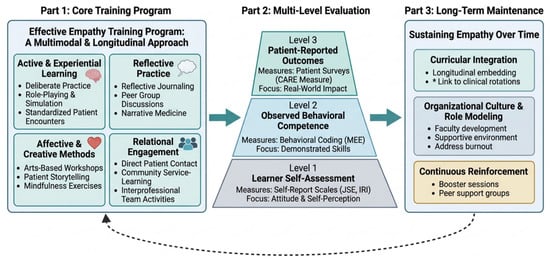
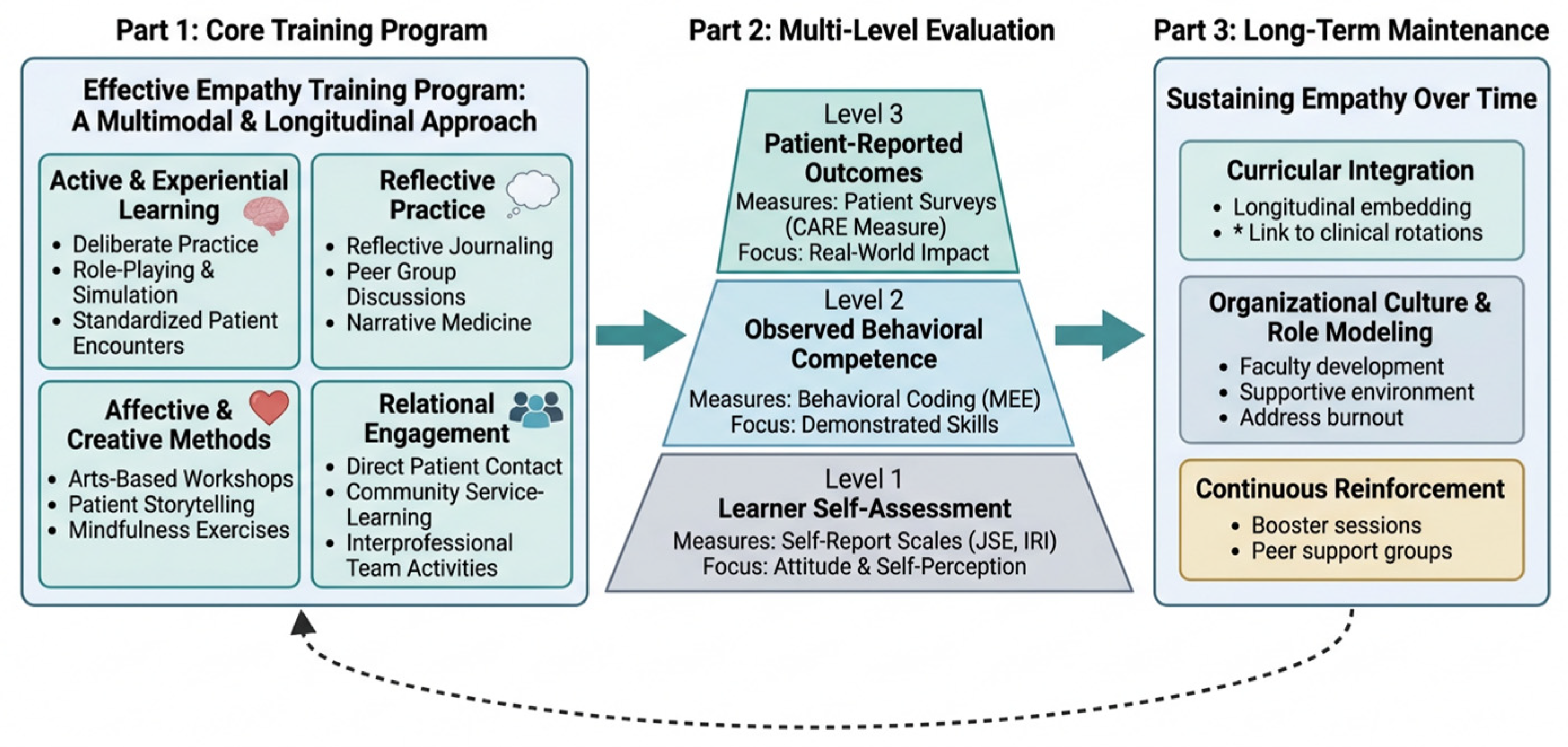
As Figure 2 shows the conceptual framework for designing, evaluating, and sustaining empathy training in health professions education. It indicate the progression from training (Part 1) to evaluation (Part 2) to long-term maintenance (Part 3), with the dashed arrow representing a feedback loop that informs ongoing refinement of the training program. The arrows indicate progression from core training to multi-level evaluation and long-term maintenance. Colors are used to distinguish the three parts and the evaluation levels within the framework. Overall, the majority of studies indicated a beneficial effect of empathy training on outcomes including self-reported empathy, observed empathic behaviors, or associated skills (active listening, perspective-taking). Nonetheless, effect sizes and significance exhibited considerable variability. Wu et al.’s [10] meta-analytic summary gives some background; they found moderate long-term improvements in behavioral empathy, smaller short-term improvements in cognitive empathy, and no changes in affective empathy [9]. Importantly, socially oriented strategies (such as those that improve group bonding or take other people’s points of view) worked best in all areas of empathy [9]. Our included studies are consistent with this: programs involving peer discussion, role-play with peers/patients, or family interaction tended to yield the strongest improvements [7,12] compared to solitary learning.
Figure 2.
A conceptual framework for designing, evaluating, and sustaining empathy training in health professions education. (* indicates linkage between curricular integration and clinical rotations).
In terms of training duration, Samarasekera et al. [13] noted that time-extensive interventions more often raised empathy than one-off sessions [10]. In our review, longitudinal curricula (e.g., semester-long communication courses or repeated workshops) showed more reliable gains than single lectures. Many interventions combined multiple pedagogies (mixed modalities), and such multimodal programs are recommended because they tap both cognitive and affective learning [10]. Notably, purely didactic methods (traditional lectures or reading assignments) rarely led to measurable empathy increases unless paired with practice or reflection components.
4. Discussion
Our thorough update confirms that empathy can be taught, but the method of teaching is what matters. The most convincing evidence backs up training methods that are active, relational, long-lasting, and use more than one method [1,10]. Deliberate practice (skill rehearsal with feedback) greatly improves empathic listening skills more than lectures do [1]. Behavioral skills training frameworks can integrate empathy into practical tasks, enhancing even specialized domains such as applied behavior analysis [5]. Creative and arts-based approaches engage learners emotionally and have demonstrated efficacy in both adult trainees and young children [2,3]. On the other hand, narrow, one-time lectures or simulations without reflection tend to bring about little change, which is in line with Wu et al.’s finding that such subject- or object-oriented trainings only cause small cognitive shifts [10]. Interventions incorporating active experiential elements, such as peer discussions, role-playing with peers or patients, and family interactions, yielded the most significant increases in empathy [11]. Longitudinal (time-extended) and multimodal programs (e.g., semester-long courses integrating diverse pedagogies) produced more enduring enhancements in empathy compared to single-session classes.
These results are consistent with earlier evaluations. Samarasekera et al. [13] determined that “affective-domain” methods (narrative medicine, role-play, reflective practice) are superior to didactic teaching [10]. Our review corroborates that multimodal curricula (integrating discussion, practice, and reflection) are the most effective [9,10]. Lajante et al. [14] similarly emphasized the prevalence of face-to-face group learning, extending beyond the healthcare sector [7].
We want to stress that higher empathy scores are not the only way to measure impact. For instance, Chen-Bouck et al. observed no alterations in conventional empathy scales, while documenting significant improvements in familial relationships and overall well-being [15]. This indicates that empathy training might produce more extensive psychosocial advantages that are not reflected in conventional metrics. It also shows how important it is to have tools that are sensitive. The scoping review by Vieten et al. [4] actually stresses how many measures there are and how hard it is to pick the right one [8]. The reliance on a few common self-report scales like the JSE, while facilitating comparison, may fail to capture the behavioral or relational dimensions of empathy. Future programs must carefully select validated, multi-faceted assessment strategies—combining self-report, objective observation, and patient-reported outcomes—to gain a holistic view of an intervention’s impact. For subsequent research and program assessment, it is essential to choose validated instruments that are aligned with the intervention and context. The rubric and open database from Vieten et al. [4] should help teachers with this job [8].
Our review also points out new directions that are starting to take shape. Zhu and Luo’s idea of “artificial empathy” [16] suggests that AI systems could help people be more empathetic when they design and train [11]. Although preliminary, this research indicates prospective tools (e.g., empathy-driven interfaces or virtual reality simulations) that could customize and augment empathy education. In a similar way, Ho created the Process of Interpersonal Empathy framework for psychotherapy, which defines empathy as a two-way, changing process between the client and the counselor [18]. This relational viewpoint emphasizes that the development of empathy is not one-dimensional; effective training may need to foster empathy-in-context, thereby reinforcing the reciprocal nature of empathic understanding.
Implications for Stakeholders and Future Research
Our findings offer actionable guidance for stakeholders. Medical educators and curriculum designers should prioritize the integration of longitudinal, multimodal empathy training that emphasizes active learning (e.g., deliberate practice, simulation) over passive didactics. Healthcare policymakers and administrators should support these initiatives by allocating protected time and resources, recognizing empathy as a core clinical competency.
Despite the evidence, significant research gaps remain. Future studies should focus on the following: (1) Standardization of outcomes: Adopting core outcome sets to allow for meaningful meta-analysis; (2) Longitudinal assessment: Tracking empathy skills long-term to evaluate retention and impact on professional practice; (3) Patient-centered outcomes: Directly measuring the link between empathy training and patient-reported outcomes and experiences; and (4) Cost-effectiveness analysis: Evaluating the economic feasibility of implementing these programs at scale.
5. Conclusions
Conclusions: This revised systematic review validates that empathy training in medical and allied education is efficacious when it is intentional, interactive, and enduring. Intentional practice and multimodal experiential learning consistently result in enhanced empathy [1,10]. The recent evidence we examined—from RCTs to meta-analyses—introduces complexity; for example, online creative workshops [11] and focused skill coaching [12] show potential, while empathy programs can be advantageous for non-clinical populations [14,15]. Teachers should use these ideas to make sure that their interventions include the best practices. Future research necessitates stringent methodologies with standardized metrics, as documented by Vieten et al. [4], and should investigate novel approaches (e.g., technology-enhanced empathy, the significance of intersubjective processes). The studies reviewed collectively emphasize that, with appropriate pedagogy, empathy—despite its complexity—can be effectively cultivated in health professionals.
Limitations: Our review is constrained by several factors. Firstly, there was significant variability in interventions and outcomes. Numerous included studies exhibited small sample sizes or insufficient long-term follow-up. Furthermore, a formal risk of bias assessment revealed that many of the included non-randomized studies had a moderate to high risk of bias, particularly concerning selection bias and the lack of robust control groups. This limits the certainty of the conclusions drawn from these specific studies and highlights that their findings should be interpreted with caution. The overall quality of evidence underscores the need for more rigorously designed studies in this field. and the variability of measures hindered quantitative meta-analysis. We did not include studies in languages other than English, which could have affected the coverage. However, by combining recent empirical studies and syntheses, we give the most up-to-date overview available.
What this means for practice: In empathy curricula, medical educators should put active, hands-on methods like role-playing with feedback, reflective writing, and peer discussion at the top of their list [1,10]. Ideally, programs should be made up of several sessions that are part of clinical training instead of just one-off workshops. Behavioral skills training techniques can directly impart empathetic behaviors. Assessments ought to employ validated, context-appropriate instruments [4], and take into account the evaluation of associated outcomes (patient satisfaction, communication skills) alongside self-reported empathy. Finally, because creative and relational approaches work so well, adding arts or family-based activities to empathy education may make it even better than it already is.
Supplementary Materials
The following supporting information can be downloaded at https://www.mdpi.com/article/10.3390/ime5020040/s1. Table S1: Search Strategy Components and Keywords.
Author Contributions
Conceptualization, H.W. and H.H.; methodology, H.W., H.H. and N.A.I.; software, H.W., H.H. and N.A.I.; validation H.W.; formal analysis, H.W.; investigation, H.W., H.H. and N.A.I.; data curation, H.W., H.H. and N.A.I.; writing—original draft preparation, H.W.; writing—review and editing, H.W., H.H. and N.A.I.; visualization, H.W., H.H. and N.A.I.; supervision, H.H. and N.A.I.; project administration, H.W., H.H. and N.A.I. All authors have read and agreed to the published version of the manuscript.
Funding
The authors declare that this research received no funds, grants, or other support.
Data Availability Statement
No new data were created or analyzed in this study. Data sharing is not applicable to this article.
Conflicts of Interest
The authors declare that they have no conflicts of interest in writing this article.
Appendix A
Table A1.
Details of newly added studies (2010–2025).
References
- Edwards, A.; Grant, K.-G.; Hammer, N.C.; Alfaqih, M.; Nyein, K.P.; Abia-Okon, A.; Grossman, R.; Gregory, M.E. Empathy training in healthcare: An umbrella review. BMC Med. Educ. 2025, 25, 1750. [Google Scholar] [CrossRef] [Scilit] [PubMed]
- Hojat, M. Empathy in Health Professions Education and Patient Care; Springer: New York, NY, USA, 2016; Volume 80. [Google Scholar]
- Patel, S.; Pelletier-Bui, A.; Smith, S.; Roberts, M.B.; Kilgannon, H.; Trzeciak, S.; Roberts, B.W. Curricula for empathy and compassion training in medical education: A systematic review. PLoS ONE 2019, 14, e0221412. [Google Scholar] [CrossRef] [Scilit] [PubMed]
- Vieten, C.; Rubanovich, C.K.; Khatib, L.; Sprengel, M.; Tanega, C.; Polizzi, C.; Vahidi, P.; Malaktaris, A.; Chu, G.; Lang, A.J.; et al. Measures of empathy and compassion: A scoping review. PLoS ONE 2024, 19, e0297099. [Google Scholar] [CrossRef] [Scilit] [PubMed]
- Bernardo, M.O.; Cecílio-Fernandes, D.; Costa, P.; Quince, T.A.; Costa, M.J.; Carvalho-Filho, M.A. Physicians’ self-assessed empathy levels do not correlate with patients’ assessments. PLoS ONE 2018, 13, e0198488. [Google Scholar] [CrossRef] [Scilit]
- Burch, G.F.; Giambatista, R.; Batchelor, J.H.; Burch, J.J.; Hoover, J.D.; Heller, N.A. A meta-analysis of the relationship between experiential learning and learning outcomes. Decis. Sci. J. Innov. Educ. 2019, 17, 239–273. [Google Scholar] [CrossRef] [Scilit]
- Larsson, J.; Werthén, D.; Carlsson, J.; Salim, O.; Davidsson, E.; Vaz, A.; Sousa, D.; Norberg, J. Does deliberate practice surpass didactic training in learning empathy skills?–A randomized controlled study. Nord. Psychol. 2025, 77, 39–52. [Google Scholar] [CrossRef] [Scilit]
- Morizio, L.J.; Cook, A.L.; Troeger, R.; Whitehouse, A. Creating compassion: Using art for empathy learning with urban youth. Contemp. Sch. Psychol. 2022, 26, 435–447. [Google Scholar] [CrossRef] [Scilit]
- Ngo, H.; Sokolovic, N.; Hu, J.; Jenkins, J. A systematic review identifying effective teaching methods and their combinations for increasing empathy in physicians: Pairwise and network meta-analysis. BMC Med. Educ. 2025, 25, 1483. [Google Scholar] [CrossRef] [Scilit]
- Wu, X.; Yao, S.-C.; Lu, X.-J.; Zhou, Y.-Q.; Kong, Y.-Z.; Hu, L. Categories of training to improve empathy: A systematic review and meta-analysis. Psychol. Bull. 2024, 150, 1237–1260. [Google Scholar] [CrossRef] [Scilit]
- Kuhnley, A.K.; Nguyen, T.H.; Gantt, A.C.; Hinkley, P. Creatively increasing empathy: The impacts of an online empathy workshop. J. Creat. Ment. Health 2023, 18, 60–72. [Google Scholar] [CrossRef] [Scilit]
- Gatzunis, K.S.; Weiss, M.J.; Ala’i-Rosales, S.; Fahmie, T.A.; Syed, N.Y. Using behavioral skills training to teach functional assessment interviewing, cultural responsiveness, and empathic and compassionate care to students of applied behavior analysis. Behav. Anal. Pract. 2023, 16, 1–27. [Google Scholar] [CrossRef] [Scilit] [PubMed]
- Samarasekera, D.D.; Lee, S.S.; Yeo, J.H.T.; Yeo, S.P.; Ponnamperuma, G. Empathy in health professions education: What works, gaps and areas for improvement. Med. Educ. 2023, 57, 86–101. [Google Scholar] [CrossRef] [Scilit]
- Lajante, M.; Remisch, D. Frontline employees’ empathy in service recovery: A systematic literature review and agenda for the future. Cust. Needs Solut. 2023, 10, 3. [Google Scholar] [CrossRef] [Scilit]
- Chen-Bouck, L.; Patterson, M.M.; Qiao, B.; Peng, A. Evaluation of the effectiveness of an empathy training on empathy skills, life satisfaction, and relationship quality for Chinese adolescents and their mothers: A mixed methods study. J. Adolesc. Res. 2023, 38, 591–631. [Google Scholar] [CrossRef] [Scilit]
- Zhu, Q.; Luo, J. Toward artificial empathy for human-centered design: A framework. In International Design Engineering Technical Conferences and Computers and Information in Engineering Conference; American Society of Mechanical Engineers: New York, NY, USA, 2023; Volume 87318, p. V03BT03A072. [Google Scholar] [CrossRef] [Scilit]
- Michalec, B. An assessment of medical school stressors on preclinical students’ levels of clinical empathy. Curr. Psychol. 2010, 29, 210–221. [Google Scholar] [CrossRef] [Scilit]
- Ho, C.-M. Process of interpersonal empathy: A proposed framework of empathy competence in psychotherapies. Pers.-Centered Exp. Psychother. 2024, 23, 39–53. [Google Scholar] [CrossRef] [Scilit]
- Mayer, R.E. Applying the science of learning to medical education. Med. Educ. 2010, 44, 543–549. [Google Scholar] [CrossRef] [Scilit]
- Afghan, B.; Besimanto, S.; Amin, A.; Shapiro, J. Medical students’ perspectives on clinical empathy training. Educ. Health 2011, 24, 544. [Google Scholar] [CrossRef] [Scilit]
- Issa, N.; Schuller, M.; Santacaterina, S.; Shapiro, M.; Wang, E.; Mayer, R.E.; DaRosa, D.A. Applying multimedia design principles enhances learning in medical education. Med. Educ. 2011, 45, 818–826. [Google Scholar] [CrossRef] [Scilit]
- Özcan, C.T.; Oflaz, F.; Bakir, B.O.R.O. The effect of a structured empathy course on the students of a medical and a nursing school. Int. Nurs. Rev. 2012, 59, 532–538. [Google Scholar] [CrossRef] [Scilit]
- Bainbridge, L. Interprofessional education in allied health: Is this yet another silo? Med. Educ. 2014, 48, 229–231. [Google Scholar] [CrossRef] [Scilit] [PubMed]
- Salazar, L.F.; Vivolo-Kantor, A.; Hardin, J.; Berkowitz, A. A web-based sexual violence bystander intervention for male college students: Randomized controlled trial. J. Med. Internet Res. 2014, 16, e3426. [Google Scholar] [CrossRef] [Scilit] [PubMed]
- Ahrweiler, F.; Neumann, M.; Goldblatt, H.; Hahn, E.G.; Scheffer, C. Determinants of physician empathy during medical education: Hypothetical conclusions from an exploratory qualitative survey of practicing physicians. BMC Med. Educ. 2014, 14, 122. [Google Scholar] [CrossRef] [Scilit] [PubMed]
- Kelm, Z.; Womer, J.; Walter, J.K.; Feudtner, C. Interventions to cultivate physician empathy: A systematic review. BMC Med. Educ. 2014, 14, 219. [Google Scholar] [CrossRef] [Scilit]
- Paro, H.B.M.S.; Silveira, P.S.P.; Perotta, B.; Gannam, S.; Enns, S.C.; Giaxa, R.R.B.; Bonito, R.F.; Martins, M.A.; Tempski, P.Z. Empathy among medical students: Is there a relation with quality of life and burnout? PLoS ONE 2014, 9, e94133. [Google Scholar] [CrossRef] [Scilit]
- Zazulak, J.; Halgren, C.; Tan, M.; Grierson, L.E.M. The impact of an arts-based programme on the affective and cognitive components of empathic development. Med. Humanit. 2015, 41, 69–74. [Google Scholar] [CrossRef] [Scilit]
- Meirovich, A.; Ber, R.; Moore, M.; Rotschild, A. Student-centered tutoring as a model for patient-centeredness and empathy. Adv. Med. Educ. Pract. 2016, 7, 423–428. [Google Scholar] [CrossRef] [Scilit]
- Sweeney, K.; Baker, P. Promoting empathy using video-based teaching. Clin. Teach. 2018, 15, 336–340. [Google Scholar] [CrossRef] [Scilit]
- Naicker, K.; Van Rensburg, G.H. Facilitation of reflective learning in nursing: Reflective teaching practices of educators. Afr. J. Nurs. Midwifery 2018, 20, 15. [Google Scholar] [CrossRef] [Scilit]
- Chen, C.W.-y. Developing EFL students’ digital empathy through video production. System 2018, 77, 50–57. [Google Scholar] [CrossRef] [Scilit]
- Sin, D.Y.E.; Chew, T.C.T.; Chia, T.K.; Ser, J.S.; Sayampanathan, A.; Koh, G.C.H. Evaluation of constructing care collaboration-nurturing empathy and peer-to-peer learning in medical students who participate in voluntary structured service learning programmes for migrant workers. BMC Med. Educ. 2019, 19, 304. [Google Scholar] [CrossRef] [Scilit] [PubMed]
- de Groot, E.; Schönrock-Adema, J.; Zwart, D.; Damoiseaux, R.; Van den Bogerd, K.; Diemers, A.; Grau Canét-Wittkampf, C.; Jaarsma, D.; Mol, S.; Bombeke, K. Learning from patients about patient-centredness: A realist review: BEME Guide No. 60. Med. Teach. 2020, 42, 380–392. [Google Scholar] [CrossRef] [Scilit] [PubMed]
- Pandhi, N.; Gaines, M.; Deci, D.; Schlesinger, M.; Culp, C.; Karp, Z.; Legler, C.; Grob, R. Broadening medical students’ exposure to the range of illness experiences: A pilot curriculum focused on depression education. Acad. Med. 2020, 95, 72–76. [Google Scholar] [CrossRef] [Scilit] [PubMed]
- Swiggart, W.H.; Bills, J.L.; Penberthy, J.K.; Dewey, C.M.; Worley, L.L.M. A professional development course improves unprofessional physician behavior. Jt. Comm. J. Qual. Patient Saf. 2020, 46, 64–71. [Google Scholar] [CrossRef] [Scilit]
- Kivity, Y.; Levy, K.N.; Kelly, K.M.; Clarkin, J.F. In-session reflective functioning in psychotherapies for borderline personality disorder: The emotion regulatory role of reflective functioning. J. Consult. Clin. Psychol. 2021, 89, 751. [Google Scholar] [CrossRef] [Scilit]
- Martina, M.; Eggeling, M.; Kanzleiter, M.; Thieme, K.; Kimmerle, J. The impact of narrative writing on empathy, perspective-taking, and attitude: Two randomized controlled experiments on violations of COVID-19 protection regulations. PLoS ONE 2021, 16, e0254501. [Google Scholar] [CrossRef] [Scilit]
- Kovoor, J.G.; McIntyre, D.; Chik, W.W.B.; Chow, C.K.; Thiagalingam, A. Clinician-created educational video resources for shared decision-making in the outpatient management of chronic disease: Development and evaluation study. J. Med. Internet Res. 2021, 23, e26732. [Google Scholar] [CrossRef] [Scilit]
- Cunningham, K.B.; Rogowsky, R.H.; Carstairs, S.A.; Sullivan, F.; Ozakinci, G. Methods of connecting primary care patients with community-based physical activity opportunities: A realist scoping review. Health Soc. Care Community 2021, 29, 1169–1199. [Google Scholar] [CrossRef] [Scilit]
- Amini, H.; Gregory, M.E.; Abrams, M.A.; Luna, J.; Roland, M.; Sova, L.N.; Bean, C.; Huang, Y.; Pfeil, S.A.; Townsend, J. Feasibility and usability study of a pilot immersive virtual reality-based empathy training for dental providers. J. Dent. Educ. 2021, 85, 856–865. [Google Scholar] [CrossRef] [Scilit]
- Wang, C.X.Y.; Pavlova, A.; Fernando, A.T., III; Consedine, N.S. Beyond empathy decline: Do the barriers to compassion change across medical training? Adv. Health Sci. Educ. 2022, 27, 521–536. [Google Scholar] [CrossRef] [Scilit]
- Chen, S.; Forster, S.; Yang, J.; Yu, F.; Jiao, L.; Gates, J.; Wang, Z.; Liu, H.; Chen, Q.; Geldsetzer, P.; et al. Animated, video entertainment-education to improve vaccine confidence globally during the COVID-19 pandemic: An online randomized controlled experiment with 24,000 participants. Trials 2022, 23, 161. [Google Scholar] [CrossRef] [Scilit]
- Sapkaroski, D.; Mundy, M.; Dimmock, M.R. Immersive virtual reality simulated learning environment versus role-play for empathic clinical communication training. J. Med. Radiat. Sci. 2022, 69, 56–65. [Google Scholar] [CrossRef] [Scilit]
- Nowland, M.H.; Haidet, P.; Whitcomb, T.L. Connection and conflict: Influence of the hidden curriculum on veterinary residents’ professional identities within the specialty of laboratory animal medicine. J. Am. Vet. Med. Assoc. 2022, 260, 1–10. [Google Scholar] [CrossRef] [Scilit]
- Bacca-Acosta, J.; Avila-Garzon, C.; Sierra-Puentes, M. Insights into the predictors of empathy in virtual reality environments. Information 2023, 14, 465. [Google Scholar] [CrossRef] [Scilit]
- Liu, J.Y.W.; Yin, Y.-H.; Kor, P.P.K.; Cheung, D.S.K.; Zhao, I.Y.; Wang, S.; Su, J.J.; Christensen, M.; Tyrovolas, S.; Leung, A.Y.M. The effects of immersive virtual reality applications on enhancing the learning outcomes of undergraduate health care students: Systematic review with meta-synthesis. J. Med. Internet Res. 2023, 25, e39989. [Google Scholar] [CrossRef] [Scilit]
- Basnawi, A.; Koshak, A. Application of artificial intelligence in advanced training and education of emergency medicine doctors: A narrative review. Emerg. Care Med. 2024, 1, 247–259. [Google Scholar] [CrossRef] [Scilit]
- Tzenalis, A.; Albani, E. Enhancing compassion and empathy training in healthcare education: A call for integrative curriculum approaches. Int. J. Caring Sci. 2025, 19, 1666. [Google Scholar]

Disclaimer/Publisher’s Note: The statements, opinions and data contained in all publications are solely those of the individual author(s) and contributor(s) and not of MDPI and/or the editor(s). MDPI and/or the editor(s) disclaim responsibility for any injury to people or property resulting from any ideas, methods, instructions or products referred to in the content. |
© 2026 by the authors. Published by MDPI on behalf of the Academic Society for International Medical Education. Licensee MDPI, Basel, Switzerland. This article is an open access article distributed under the terms and conditions of the Creative Commons Attribution (CC BY) license.