


Abstract
Background: The changing benefit–risk profile of low-dose aspirin, particularly in primary cardiovascular prevention, requires periodic reassessment of long-term therapy in primary care. This study evaluated real-world aspirin pharmacotherapy, potentially inappropriate use, pharmacotherapeutic risk, and factors associated with deprescribing. Methods: This retrospective observational study included 4668 patients receiving aspirin 100 mg in primary care from January 2020 to August 2026. Clinical characteristics, prevention strategy, treatment initiation, concomitant pharmacotherapy, bleeding-related risk factors, documented adverse events during aspirin therapy, and therapeutic decisions were evaluated. Potentially inappropriate aspirin use was characterized descriptively according to documented clinical and pharmacotherapeutic information, while multivariable logistic regression was used to identify factors independently associated with documented aspirin discontinuation (deprescribing). Results: Potentially inappropriate aspirin use was identified in 25.9% of patients and was markedly more frequent in primary than secondary prevention (52.3% vs. 1.8%; p < 0.001). Compared with patients classified as having appropriate use, those with potentially inappropriate use were older (70.0 vs. 64.7 years) and more frequently received oral anticoagulants (21.3% vs. 6.5%) and had polypharmacy (57.5% vs. 50.1%), previous gastrointestinal bleeding (7.5% vs. 2.7%), and concomitant NSAID exposure (15.6% vs. 12.3%). At least one documented adverse event during aspirin therapy occurred in 28.8% of patients. Aspirin was discontinued in 8.5%, while 5.1% required further benefit–risk reassessment. Documented discontinuation (deprescribing) was independently associated with primary prevention (aOR 1.83, 95% CI 1.30–2.56), potentially inappropriate use (aOR 4.05, 95% CI 2.94–5.58), documented adverse events during aspirin therapy (aOR 3.61, 95% CI 2.87–4.53), and previous gastrointestinal bleeding (aOR 4.38, 95% CI 2.96–6.47). Conclusions: Potentially inappropriate low-dose aspirin use was concentrated in primary prevention and was characterized by a distinct clinical and pharmacotherapeutic risk profile. Documented aspirin discontinuation was associated with several clinically relevant benefit–risk signals, including potentially inappropriate use, documented adverse events during aspirin therapy, previous gastrointestinal bleeding, and primary-prevention use. Structured reassessment of indication, bleeding history, concomitant medications, and adverse effects may help identify patients requiring individualized aspirin deprescribing.
1. Introduction
Low-dose aspirin remains a cornerstone of antiplatelet pharmacotherapy for patients with established atherosclerotic cardiovascular disease, where its role in secondary prevention is well established [1]. In contrast, its use for primary cardiovascular prevention has become increasingly selective because the expected reduction in ischemic events must be balanced against the risk of gastrointestinal and other clinically relevant bleeding [2]. Contemporary recommendations therefore emphasize individualized assessment rather than routine aspirin use in patients without established cardiovascular disease [3].
Evidence from major randomized trials has substantially reshaped this benefit–risk assessment. In the ASCEND trial, aspirin reduced serious vascular events among patients with diabetes without established cardiovascular disease, but this benefit was accompanied by an increased risk of major bleeding [4]. The ARRIVE trial similarly showed that aspirin did not significantly reduce the primary cardiovascular endpoint in individuals considered to be at moderate cardiovascular risk, while gastrointestinal bleeding events occurred more frequently with aspirin [5]. Among community-dwelling older adults without established cardiovascular disease in the ASPREE trial, aspirin did not significantly reduce cardiovascular events but increased the risk of major hemorrhage [6]. These findings are supported by meta-analytic evidence showing that, in primary prevention populations, reductions in cardiovascular events are accompanied by an increased risk of major bleeding, resulting in relatively small absolute differences between benefit and harm [7].
Consequently, aspirin appropriateness cannot be determined solely by the presence of cardiovascular risk factors. Age, previous gastrointestinal bleeding or peptic ulcer disease, renal impairment, polypharmacy, and concomitant medications can substantially modify the individual pharmacotherapeutic risk profile. Gastrointestinal injury remains an important safety consideration during aspirin therapy, particularly in patients with additional gastrointestinal risk factors [8]. Concurrent exposure to oral anticoagulants represents another clinically important concern, as combined aspirin and anticoagulant therapy is associated with greater bleeding risk than anticoagulant therapy alone [9]. These considerations are particularly relevant in primary care, where long-term pharmacotherapy is frequently managed in patients with multiple chronic conditions and complex medication regimens.
Current European and US recommendations reflect this shift toward individualized decision-making. Contemporary evidence supports a selective approach to aspirin for primary prevention, in which cardiovascular risk is weighed against bleeding risk and treatment is considered only in appropriately selected patients [10]. Similarly, the 2022 US Preventive Services Task Force recommends individualized decisions regarding initiation of low-dose aspirin for selected adults aged 40–59 years with a 10% or greater 10-year cardiovascular disease risk and recommends against initiating aspirin for primary prevention in adults aged 60 years or older [11].
Despite these changes, real-world aspirin use may not consistently reflect contemporary recommendations. Primary care studies have identified substantial guideline-discordant aspirin use for primary prevention, highlighting the need for systematic reassessment and deprescribing when continued therapy is no longer supported by the individual benefit–risk profile [12]. Structured pharmacist-led deprescribing strategies may help address persistent inappropriate aspirin use; implementation of an aspirin deprescribing algorithm in primary care was associated with a significant reduction in inappropriate aspirin use among adults older than 70 years receiving aspirin for primary cardiovascular prevention [13].
A clinically meaningful evaluation of long-term aspirin therapy therefore requires an integrated approach that extends beyond indication alone and incorporates prevention strategy, treatment initiation, duration of exposure, comorbidities, bleeding-related factors, concomitant pharmacotherapy, adverse effects, and subsequent therapeutic decisions. Accordingly, this study evaluates low-dose aspirin 100 mg pharmacotherapy in real-world primary care practice, characterizes pharmacotherapeutic risk profiles and potentially inappropriate use, and evaluates factors associated with aspirin deprescribing.
2. Materials and Methods
2.1. Study Design and Setting
This retrospective observational study was conducted within the Family Medicine and Specialized Internal Medicine Services of the Main Family Medicine Center (QKMF), Ferizaj, Kosovo. The study included existing medical and clinical documentation covering the period from January 2020 to August 2026. The study focused on low-dose aspirin 100 mg pharmacotherapy in real-world primary care practice, evaluating patterns of use according to cardiovascular prevention strategy, treatment initiation, pharmacotherapeutic risk profile, potentially inappropriate use, treatment safety, and therapeutic decisions, with particular emphasis on factors associated with deprescribing. No direct patient contact was undertaken, and the study involved no clinical intervention or modification of routine patient management.
2.2. Study Population and Patient Selection
The final analysis included 4668 patients with documented use of low-dose aspirin 100 mg and sufficient clinical and pharmacotherapeutic information for the predefined study analyses. Inclusion criteria were documented use of aspirin 100 mg during the study period and availability of information required to characterize the indication, cardiovascular prevention strategy, and pharmacotherapeutic exposure. Cases in which the available documentation did not permit reliable determination of aspirin use or the principal variables required for analysis were excluded. Only one analytical record per patient was included to avoid repeated counting of the same individual.
The final cohort consisted of 2224 patients classified as receiving aspirin for primary prevention and 2444 receiving aspirin for secondary prevention.
2.3. Data Collection and Classification
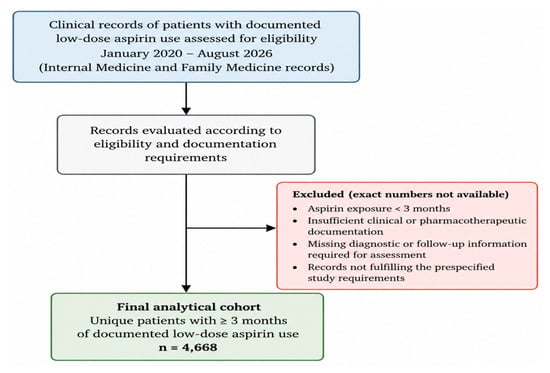
Data were retrospectively extracted from existing medical and clinical records and organized into a structured database comprising 50 parameters. Potentially eligible aspirin users were identified from available internal medicine and family medicine clinical records during the study period. The study population represented a prevalent-user cohort: eligible patients had documented low-dose aspirin use for at least three months before inclusion. Records were reviewed consecutively during data collection, and only patients with sufficient clinical and pharmacotherapeutic documentation to evaluate the prespecified study variables were retained in the analytical cohort. Records documenting aspirin use but lacking the clinical, diagnostic, or follow-up information required for pharmacotherapeutic assessment were excluded. Because the exact number of records initially screened before application of these eligibility criteria was not prospectively recorded, an exact screened-to-included denominator could not be reconstructed retrospectively.
Each patient contributed only once to the analytical cohort. When multiple clinical encounters were available for the same patient, these were treated as longitudinal documentation for that individual rather than as separate observations. Repeated visits, which commonly occurred as part of periodic clinical follow-up, laboratory assessment, specialist review, or pharmacotherapeutic adjustment, were used to complete the available clinical and treatment history. The final analytical cohort comprised 4668 unique patients meeting the eligibility and documentation requirements.
The source dataset was constructed specifically to evaluate patients with documented low-dose aspirin use and did not include a corresponding denominator of patients receiving care during the study period who were not using aspirin. Accordingly, the study was designed as an aspirin-user cohort rather than a population-based utilization study, and the prevalence of aspirin use within the overall primary care population could not be estimated.
Variables were grouped into demographic and clinical characteristics, cardiovascular risk factors, history of atherosclerotic disease, comorbidities, available clinical and laboratory parameters, characteristics of aspirin pharmacotherapy, concomitant therapies, gastrointestinal and bleeding risk factors, documented adverse effects, and therapeutic decisions. Baseline characteristics included age, sex, body mass index, current smoking, arterial hypertension, diabetes mellitus, dyslipidemia, chronic kidney disease, prior myocardial infarction, prior ischemic stroke or transient ischemic attack, peripheral artery disease, and prior percutaneous coronary intervention or stent placement. Arterial hypertension, diabetes mellitus, and dyslipidemia were identified from pre-existing diagnoses documented in the patients’ medical records and were coded as present or absent accordingly. These conditions were not newly diagnosed or retrospectively reclassified by the investigators using study-specific blood pressure, glycemic, or lipid thresholds. Estimated glomerular filtration rate, duration of aspirin use, and number of chronic medications were also evaluated.
Pharmacotherapeutic exposures and safety-related factors included polypharmacy, defined as the use of five or more medications, concomitant use of nonsteroidal anti-inflammatory drugs, oral anticoagulants and other antiplatelet agents, proton pump inhibitor gastroprotection, history of peptic ulcer disease, history of gastrointestinal bleeding, and anemia.
Data were analyzed according to the information available in the clinical documentation. Clinical information that was not documented was not created or imputed. No minimum follow-up beyond the requirement for at least three months of documented aspirin exposure was imposed. Because inclusion required ongoing aspirin exposure and sufficiently documented clinical follow-up, the study design may be subject to prevalent-user (survivor) and documentation-related selection bias; these limitations were considered when interpreting the findings. The patient selection process, eligibility assessment, and construction of the final analytical cohort are illustrated in Figure 1.
Figure 1.
Flow diagram of study cohort selection.
2.4. Assessment of Low-Dose Aspirin Pharmacotherapy
Aspirin pharmacotherapy was characterized according to cardiovascular prevention strategy, duration of use, mode of treatment initiation, and source of recommendation. Aspirin use was classified as primary or secondary cardiovascular prevention based on the documented cardiovascular history. Secondary prevention was identified in the context of documented atherosclerotic cardiovascular disease, including a history of myocardial infarction, ischemic stroke or transient ischemic attack, peripheral artery disease, or documented coronary intervention. Aspirin use in the absence of such a history was classified in the context of primary prevention.
Aspirin initiation was classified as prescription-based or without-prescription initiation. The source of recommendation was further evaluated according to the documented categories: cardiologist, family physician, internist, neurologist, other physician, pharmacist advice, self-initiation, or family/friend advice. These categories were used to evaluate the association between treatment initiation pathways and potentially inappropriate aspirin use.
For temporal characterization, the index assessment was defined as the documented clinical evaluation at which sufficient information was available to characterize aspirin pharmacotherapy and the patient’s clinical and pharmacotherapeutic profile. All included patients had at least three months of documented aspirin exposure before this assessment. Clinical history and pre-existing conditions, including previous gastrointestinal bleeding, were ascertained from documentation preceding or available at the index assessment, whereas adverse events were identified from records documenting events occurring during aspirin exposure. The investigator-derived assessment of potentially inappropriate aspirin use was subsequently based on the clinical and pharmacotherapeutic information available in the record. The final therapeutic decision—continuation, discontinuation, or further benefit–risk reassessment—was obtained from the documented clinical management following reassessment. Accordingly, adverse events documented during treatment could have contributed to subsequent clinical management decisions and were interpreted as associated clinical factors rather than prospective predictors of deprescribing.
2.5. Pharmacotherapeutic Risk Profiling and Safety Assessment
Pharmacotherapeutic risk profiling was based on an integrated assessment of characteristics that could influence the balance between expected cardiovascular benefit and potential risk associated with aspirin therapy. The profile included age, renal function assessed by estimated glomerular filtration rate, chronic kidney disease, history of peptic ulcer disease, history of gastrointestinal bleeding, anemia, duration of treatment, concomitant use of nonsteroidal anti-inflammatory drugs, oral anticoagulants and other antiplatelet agents, proton pump inhibitor gastroprotection, and polypharmacy. These factors were compared between patients classified as having appropriate aspirin use and those with potentially inappropriate aspirin use, allowing characterization of the pharmacotherapeutic risk profile beyond the cardiovascular indication alone. Treatment safety was assessed on the basis of adverse effects documented during aspirin use. The analyzed events included dyspepsia, bruising/ecchymosis, epistaxis, and gastrointestinal bleeding during treatment. History of peptic ulcer disease, history of gastrointestinal bleeding, concomitant nonsteroidal anti-inflammatory drug use, oral anticoagulant use, other antiplatelet therapy, and proton pump inhibitor gastroprotection were evaluated in relation to the presence of at least one documented adverse event during aspirin therapy. Adverse effects were interpreted as events documented during aspirin pharmacotherapy rather than as individually confirmed causal relationships with aspirin.
2.6. Assessment of Potentially Inappropriate Use and Deprescribing
Potentially inappropriate aspirin use was treated as a binary analytical outcome (present/absent). This variable was derived retrospectively by the investigators from information extracted from the clinical records and was not based on a pre-existing clinician-recorded designation of aspirin use as appropriate or inappropriate. The assessment was structured around the documented indication for aspirin, the cardiovascular prevention strategy (primary or secondary prevention), the documented source of treatment initiation, and patient-level clinical and pharmacotherapeutic characteristics relevant to the expected benefit–risk balance of aspirin therapy.
For primary prevention, particular attention was given to whether a sufficiently clear preventive indication was documented and to the presence of characteristics that could shift the benefit–risk balance against continued aspirin exposure, including advanced age, previous gastrointestinal bleeding or peptic ulcer disease, renal impairment, and concomitant use of medications associated with increased bleeding risk, particularly nonsteroidal anti-inflammatory drugs, oral anticoagulants, and other antiplatelet agents. Aspirin use initiated without a documented professional recommendation was considered an additional signal requiring pharmacotherapeutic reassessment rather than, by itself, definitive evidence of inappropriate therapy. In secondary prevention, the presence of a documented atherosclerotic cardiovascular indication was considered separately, and concomitant antithrombotic therapy or bleeding-risk factors were not interpreted in isolation as establishing inappropriate aspirin use.
Accordingly, classification as potentially inappropriate reflected an investigator-derived assessment of the totality of the documented clinical and pharmacotherapeutic information rather than any single risk factor. No formal point-based score, weighted algorithm, or single-variable decision rule was applied to generate this classification. The designation “potentially inappropriate” was deliberately used because the retrospective data did not permit reconstruction of every element of prospective clinical decision-making or a standardized 10-year cardiovascular risk estimate for every patient. It therefore indicates aspirin exposure warranting pharmacotherapeutic reconsideration and does not establish that aspirin was contraindicated, that aspirin caused a documented adverse event, or that discontinuation was necessarily required. In the final analytical cohort, 3460 patients were classified as having appropriate aspirin use and 1208 as having potentially inappropriate aspirin use. The individual clinical and pharmacotherapeutic characteristics contributing to this reassessment are therefore presented descriptively rather than modeled as independent determinants of the investigator-derived appropriateness classification, thereby avoiding circular inference between classification components and the outcome itself.
Final therapeutic status was classified into three categories: continuation of aspirin, discontinuation of aspirin, and further benefit–risk reassessment. For the purposes of this study, deprescribing was operationalized as a documented clinical decision to discontinue aspirin and therefore did not constitute a separate therapeutic outcome from documented discontinuation. The term “discontinuation” describes the recorded final treatment status, whereas “deprescribing” refers to that same discontinuation when interpreted as the clinical medication-withdrawal decision evaluated in the analytical model. Unlike the investigator-derived appropriateness classification, final therapeutic status was obtained from the clinical record and reflected the documented management decision following clinical reassessment. Where temporary interruption was documented pending additional diagnostic evaluation or specialist assessment, this was not classified as deprescribing unless the subsequent clinical record documented a decision to discontinue aspirin. Documented reasons for discontinuation were classified as no longer appropriate or unclear indication, adverse effect or intolerance, bleeding or gastrointestinal safety concern, concomitant anticoagulant therapy, polypharmacy or medication burden, or another clinical reason.
Documented clinical reassessment was analyzed as a separate characteristic and was available in 64.8% of patients; it was not considered synonymous with the final therapeutic status available for analysis. Adverse events recorded during aspirin therapy were treated as documented clinical events and were not assumed to have a causal relationship with aspirin unless such attribution was explicitly documented in the source record.
2.7. Study Outcomes
The principal study assessments focused on the pharmacotherapeutic risk profile of low-dose aspirin users and factors associated with aspirin deprescribing in real-world primary care practice.
The analyses included baseline clinical and pharmacotherapeutic characteristics, patterns of aspirin use according to primary and secondary cardiovascular prevention, mode and source of treatment initiation, potentially inappropriate aspirin use, pharmacotherapeutic risk profile, documented adverse effects, final therapeutic status, and reasons for deprescribing. Clinical and pharmacotherapeutic characteristics related to the investigator-derived classification of potentially inappropriate aspirin use were evaluated descriptively and were not modeled as independent determinants of that classification. Multivariable analysis was restricted to factors associated with aspirin deprescribing, operationalized in this study as the documented clinical decision to discontinue aspirin, as defined in Section 2.6. Patients whose final therapeutic status was further benefit–risk reassessment were considered separately and were not classified as having undergone deprescribing.
2.8. Statistical Analysis
Data were analyzed using descriptive, bivariable, and multivariable statistical methods. Continuous variables were presented as mean ± standard deviation (SD), while categorical variables were presented as frequencies and percentages, n (%).
The Welch t test was used to compare continuous variables between two groups. Pearson’s chi-square test was used for comparisons of categorical variables. These tests were applied to comparisons according to cardiovascular prevention strategy and aspirin appropriateness status. To complement hypothesis testing with estimates of the magnitude and precision of between-group differences, absolute differences with 95% confidence intervals (95% CIs) were additionally reported for the principal two-group comparisons. For continuous variables, these were expressed as mean differences with Welch-based 95% CIs, whereas for categorical variables they were expressed as absolute differences in proportions (percentage points) with 95% CIs.
Associations between the presence of at least one documented adverse event during aspirin therapy and clinical or pharmacotherapeutic factors were evaluated using the Pearson chi-square test. For these two-group comparisons, absolute differences in proportions (percentage points) with 95% CIs were also reported. For analysis of final therapeutic status, the Pearson chi-square test was applied across the three categories of continuation, discontinuation, and further benefit–risk reassessment. Within the primary-prevention subgroup, selected clinical and pharmacotherapeutic characteristics relevant to reassessment of aspirin therapy were additionally summarized descriptively according to the investigator-derived appropriateness classification. Because several of these characteristics contributed to that classification and were not mutually exclusive, no inferential comparisons or regression modeling were performed for this descriptive analysis.
A multivariable binary logistic regression model was constructed to evaluate factors independently associated with the documented clinical decision to discontinue aspirin (deprescribing), with discontinuation compared against continuation as the binary outcome. Consistent with the prespecified operational definition, discontinuation and deprescribing represented the same analytical outcome rather than separate outcomes requiring independent models. Patients classified as requiring further benefit–risk reassessment were excluded from this binary model. Covariates included age, sex, primary prevention, potentially inappropriate aspirin use, any documented adverse event during aspirin therapy, history of peptic ulcer disease, history of gastrointestinal bleeding, concomitant nonsteroidal anti-inflammatory drug use, oral anticoagulant use, other antiplatelet therapy, polypharmacy, and duration of aspirin use modeled per 12 months of exposure. Results of the logistic regression analysis were reported as adjusted odds ratios (aORs) with 95% confidence intervals (95% CIs) and p values. Multicollinearity among the included predictors was assessed using variance inflation factors (VIFs). Model discrimination was evaluated using the area under the receiver operating characteristic curve (AUC), and calibration was assessed using the Hosmer–Lemeshow goodness-of-fit test. The number of observations and discontinuation events included in the final regression model was also reported. All statistical tests were two-sided, and p < 0.05 was considered statistically significant.
2.9. Ethical Considerations
The study was approved by the Ethics Committee of the Main Family Medicine Center (QKMF), Ferizaj, Kosovo, under protocol number QKMF-FE/EC/2026/01-166, with approval granted on 15 July 2026. Approval covered the retrospective observational study entitled “LOW DOSE ASPIRIN PHARMACOTHERAPY IN PRIMARY CARE PHARMACOTHERAPEUTIC RISK PROFILING AND DETERMINANTS OF DEPRESCRIBING IN REAL WORLD PRACTICE” and the use of existing medical and clinical documentation covering the period from January 2020 to August 2026.
The study involved no direct patient contact, clinical intervention, or modification of routine patient management. Data were handled confidentially and analyzed exclusively in coded and non-identifiable form. Given the retrospective design, the absence of direct patient contact or intervention, and the use of coded, non-identifiable data derived from existing clinical records, the requirement for individual informed consent was waived by the Ethics Committee. The study was conducted in accordance with the ethical principles of the Declaration of Helsinki.
3. Results
A total of 4668 patients receiving low-dose aspirin were included in the analysis. The mean age was 66.1 ± 10.8 years, and 53.4% were men. Secondary cardiovascular prevention accounted for 52.4% of aspirin use, while 47.6% received aspirin for primary prevention. Among the 2444 patients receiving aspirin for secondary prevention, 1253 (51.3%) had a documented history of myocardial infarction, 752 (30.8%) had a prior ischemic stroke or transient ischemic attack, 423 (17.3%) had peripheral artery disease, and 867 (35.5%) had undergone prior percutaneous coronary intervention or stent placement. These categories were not mutually exclusive, as individual patients could have more than one documented manifestation of atherosclerotic cardiovascular disease. More than half of the cohort had hypertension, and 52.0% met criteria for polypharmacy. Aspirin had been initiated without a prescription in 27.8% of patients. Potentially inappropriate aspirin use was identified in 25.9% of the study population, whereas at least one documented adverse event during aspirin therapy was present in 28.8%. Clinical reassessment was documented in 64.8% of patients. Aspirin was continued in 86.4%, discontinued in 8.5%, and 5.1% required further benefit–risk reassessment. The analyses below characterize aspirin pharmacotherapy according to prevention strategy, initiation pathway, pharmacotherapeutic risk profile, safety outcomes, and therapeutic decisions, with potentially inappropriate aspirin use characterized descriptively and multivariable analysis used to evaluate independent factors associated with aspirin deprescribing. The baseline clinical and pharmacotherapeutic characteristics of the study population are summarized in Table 1.
Table 1.
Baseline Clinical and Pharmacotherapeutic Characteristics of Low Dose Aspirin Users.
Differences in clinical and pharmacotherapeutic characteristics between primary and secondary prevention groups are presented in Table 2.
Table 2.
Comparison of clinical and pharmacotherapeutic characteristics according to cardiovascular prevention strategy.
Patients receiving aspirin for primary prevention were younger and had a shorter duration of aspirin exposure than those receiving aspirin for secondary prevention. The largest absolute between-group difference was observed for potentially inappropriate aspirin use (+50.5 percentage points; 95% CI, +48.4 to +52.7), followed by without-prescription initiation (+15.5 percentage points; 95% CI, +12.9 to +18.0) and aspirin discontinuation (+8.7 percentage points; 95% CI, +7.0 to +10.3). Differences in male sex, hypertension, and chronic kidney disease were small and their 95% confidence intervals included zero. The distribution of aspirin appropriateness according to treatment initiation and recommendation pathways is presented in Table 3.
Table 3.
Treatment Initiation and Appropriateness of Low Dose Aspirin Pharmacotherapy.
Initiation mode and source of the initial recommendation represent two related but distinct variables. Initiation mode was classified as prescription-based or without-prescription initiation, whereas the source variable identifies the documented person or professional associated with the initial recommendation or initiation pathway. Percentages are calculated within each category. The reported p values represent global Pearson chi-square tests for the overall distribution of appropriateness status across the categories of each variable and should not be interpreted as separate category-specific tests. Potentially inappropriate use differed according to both initiation mode and source of the initial recommendation. It was more frequent among patients with without-prescription initiation than among those with prescription-based initiation (33.2% vs. 23.1%; p < 0.001). Across recommendation-source categories, the highest proportions were observed among patients reporting pharmacist advice, family/friend advice, and self-initiated use. These findings are descriptive and support consideration of the treatment-initiation pathway during pharmacotherapeutic reassessment. Clinical and pharmacotherapeutic characteristics according to the investigator-derived aspirin appropriateness classification are compared in Table 4.
Table 4.
Clinical and pharmacotherapeutic characteristics according to aspirin appropriateness classification.
Patients classified as having potentially inappropriate aspirin use were older and had lower eGFR and shorter aspirin exposure. The largest absolute categorical differences were observed for oral anticoagulant use (14.7 percentage points higher in the potentially inappropriate group; 95% CI, 12.3 to 17.2), PPI gastroprotection (12.1 percentage points higher; 95% CI, 8.9 to 15.3), and polypharmacy (7.5 percentage points higher; 95% CI, 4.2 to 10.7). Previous GI bleeding, NSAID use, anemia, peptic ulcer disease, and chronic kidney disease were also more frequent in the potentially inappropriate-use group, whereas other antiplatelet therapy was slightly more frequent in the appropriate-use group. Importantly, these differences should be interpreted within the context of the investigator-derived appropriateness classification. As several of the evaluated characteristics contributed to the classification itself, the observed comparisons do not represent independent associations and should not be used to infer that these characteristics independently predict potentially inappropriate aspirin use. Documented adverse events during aspirin therapy and associated clinical and pharmacotherapeutic characteristics are summarized in Table 5.
Table 5.
Documented adverse events during aspirin therapy and associated clinical and pharmacotherapeutic risk factors.
At least one documented adverse event during aspirin therapy was documented in 1344 patients (28.8%). Dyspepsia was the most frequent individual event, followed by bruising/ecchymosis, epistaxis, and gastrointestinal bleeding during use. The largest absolute difference between patients with and without documented adverse events during aspirin therapy was observed for concomitant NSAID use (+6.9 percentage points; 95% CI, +4.7 to +9.3), followed by oral anticoagulant use (+3.9 percentage points; 95% CI, +1.9 to +6.0), peptic ulcer disease (+3.7 percentage points; 95% CI, +1.7 to +5.8), and other antiplatelet therapy (+3.7 percentage points; 95% CI, +1.6 to +5.9). PPI gastroprotection showed no meaningful absolute difference between groups (−0.7 percentage points; 95% CI, −3.8 to +2.5). Final therapeutic decisions, documented reasons for discontinuation, and selected patient characteristics are presented in Table 6.
Table 6.
Final therapeutic decisions, reasons for discontinuation, and distribution of selected clinical and pharmacotherapeutic characteristics.
Clinical and pharmacotherapeutic reassessment characteristics within the primary-prevention subgroup are summarized descriptively in Table 7.
Table 7.
Clinical and Pharmacotherapeutic Reassessment Characteristics in the Primary-Prevention Subgroup.
Interpretation. Among 2224 primary-prevention aspirin users, 1164 (52.3%) were classified as having potentially inappropriate use. All primary-prevention patients aged ≥70 years, those without a clearly documented aspirin indication, and those receiving concomitant oral anticoagulant therapy were contained within the potentially inappropriate-use group. Previous gastrointestinal bleeding was likewise confined to this group, whereas peptic ulcer disease, NSAID exposure, chronic kidney disease, reduced eGFR, other antiplatelet therapy, and polypharmacy occurred in both classifications. Without-prescription initiation was common in both groups and therefore should be interpreted as a trigger for reassessment rather than as a stand-alone marker of inappropriate use. This descriptive presentation avoids the circular interpretation that would arise from modeling reassessment characteristics as independent determinants of an outcome partly constructed from those same characteristics. The multivariable logistic regression results for factors associated with documented aspirin discontinuation are presented in Table 8.
Table 8.
Independent Factors Associated with Documented Aspirin Discontinuation (Deprescribing).
4. Discussion
The present study demonstrates that potentially inappropriate low-dose aspirin use remains clinically relevant in real-world primary care and is strongly related to both the indication for treatment and the patient’s pharmacotherapeutic risk profile. Potentially inappropriate use was identified in 25.9% of the overall cohort but was markedly concentrated in primary prevention, where 52.3% of patients were classified as having potentially inappropriate aspirin use, compared with only 1.8% in secondary prevention. Importantly, the 52.3% estimate represents an investigator-derived retrospective pharmacotherapeutic classification based on the clinical and medication information available in the medical records. It should not be interpreted as the prevalence of formally adjudicated or guideline-defined inappropriate aspirin use. This finding is consistent with contemporary evidence showing that inappropriate aspirin exposure remains common in primary prevention. Hira et al. reported inappropriate aspirin use in 27.6% of evaluable patients receiving aspirin for primary prevention in the NCDR PINNACLE Registry [14]. However, direct comparisons of prevalence estimates should be approached cautiously because the definitions and assessment methods used to identify inappropriate aspirin use may differ between studies. The substantially higher proportion observed within the primary-prevention subgroup in our study emphasizes the importance of periodically reconsidering an indication that may have originated under earlier preventive strategies.
The pathway through which aspirin therapy was initiated also appears clinically relevant. Without-prescription initiation was more frequent in primary than secondary prevention (35.9% vs. 20.4%), representing an absolute difference of 15.5 percentage points (95% CI, 12.9–18.0). Population-based evidence has similarly demonstrated substantial aspirin overuse among individuals without an appropriate primary-prevention indication, with 26.9% of those without an indication reporting regular aspirin use [15]. In the present study, however, without-prescription initiation was common among both primary-prevention appropriateness classifications and should therefore be interpreted as a signal prompting pharmacotherapeutic reassessment rather than as an independent marker of inappropriate use. This distinction highlights the value of reconstructing the treatment-initiation pathway when reviewing long-term aspirin exposure in routine primary care.
Potentially inappropriate use was also characterized by a distinct pharmacotherapeutic profile. Patients in this group were older, had lower eGFR, and more frequently had previous gastrointestinal bleeding, NSAID exposure, oral anticoagulation, and polypharmacy. Importantly, the magnitude of these differences was heterogeneous: oral anticoagulant use showed the largest absolute categorical difference (14.7 percentage points higher in the potentially inappropriate-use group; 95% CI, 12.3–17.2), followed by PPI gastroprotection (12.1 percentage points higher; 95% CI, 8.9–15.3) and polypharmacy (7.5 percentage points higher; 95% CI, 4.2–10.7). These characteristics should not be interpreted as independent determinants because several contributed to the investigator-derived appropriateness assessment itself. Rather, their coexistence illustrates the multidimensional clinical and medication-related information encountered when long-term aspirin therapy is reassessed. The relevance of medication-level review is also supported by evidence that pharmacist assessment can identify aspirin exposure among patients receiving anticoagulant therapy and facilitate discontinuation when aspirin lacks a continuing indication [16]. Safety findings further reinforce this interpretation. At least one documented adverse event during aspirin therapy was present in 28.8% of patients, with dyspepsia, bruising/ecchymosis, epistaxis, and gastrointestinal bleeding representing the recorded events. Documented adverse events during aspirin therapy were significantly associated with previous peptic ulcer disease, previous gastrointestinal bleeding, NSAID use, oral anticoagulation, and other antiplatelet therapy. These findings are consistent with a recent evaluation of aspirin prescribing among adults aged ≥60 years, in which previous gastrointestinal bleeding and peptic ulcer disease were significantly associated with subsequent gastrointestinal bleeding, reinforcing the importance of gastrointestinal risk assessment when reassessing aspirin therapy in older patients [17]. The present findings therefore support incorporating both previous gastrointestinal history and current interacting pharmacotherapy into routine aspirin safety assessment.
The deprescribing analysis should be interpreted primarily as a characterization of how documented clinical and pharmacotherapeutic signals were reflected in real-world treatment decisions rather than as evidence of unexpected causal determinants. Aspirin was discontinued in 8.5% of patients, while a further 5.1% required additional benefit–risk reassessment. The leading documented reasons for discontinuation were a no longer appropriate or unclear indication (40.0%) and adverse effects or intolerance (33.2%). In the adjusted analysis, discontinuation was associated with primary prevention (aOR 1.83), potentially inappropriate aspirin use (aOR 4.05), documented adverse events during aspirin therapy (aOR 3.61), and previous gastrointestinal bleeding (aOR 4.38). Although the direction of these associations is clinically expected, their value in this study lies in quantifying their relative magnitude within routine primary care and placing them alongside initiation pathways, concomitant pharmacotherapy, adverse-event documentation, and the separate category of patients requiring further reassessment. Thus, the contribution of the analysis is not the demonstration that bleeding-related concerns can lead to aspirin discontinuation, but the real-world characterization of how multiple benefit–risk signals coexist and are reflected in documented therapeutic management.
Recent real-world studies support structured reassessment as a practical mechanism for translating these signals into treatment decisions. In an outpatient setting, a pharmacist-led intervention resulted in aspirin discontinuation in a substantial proportion of eligible adults aged ≥70 years without documented ASCVD [18]. More broadly, a recent systematic review of aspirin deprescribing interventions found that all included studies incorporated a prompt to trigger deprescribing and that multidisciplinary approaches achieved the highest reported deprescribing rates, supporting structured and individualized strategies for patients receiving aspirin for primary prevention [19]. Recent evidence further supports structured implementation strategies for aspirin deprescribing; among adults aged ≥70 years without known atherosclerotic cardiovascular disease, pharmacist-led identification and primary care provider education facilitated aspirin discontinuation, with provider education representing a particularly efficient approach to deprescribing in the outpatient setting [20]. Our results complement these intervention studies by identifying real-world patient characteristics that may help trigger pharmacotherapeutic reassessment, including potentially inappropriate aspirin use, previous gastrointestinal bleeding, documented adverse events during aspirin therapy, and competing pharmacotherapy.
The strengths of this study include its large primary care cohort, detailed characterization of concomitant pharmacotherapy, and integrated assessment of aspirin appropriateness, treatment-related adverse events, and documented deprescribing decisions. Nevertheless, the retrospective design precludes causal inference, and the analysis depends on the completeness and accuracy of routine clinical documentation. The study also lacked longitudinal adjudicated cardiovascular outcome data and mortality data; therefore, the clinical consequences of continuation or discontinuation of aspirin could not be evaluated in terms of subsequent myocardial infarction, ischemic stroke, cardiovascular death, or all-cause mortality. Although gastrointestinal bleeding and other bleeding-related events documented in routine clinical records were captured, major bleeding events were not independently adjudicated using a standardized bleeding definition. In addition, validated cardiovascular and bleeding risk scores were not consistently available in the source records and could not be retrospectively reconstructed for all patients. Consequently, the primary-prevention findings should not be interpreted as a formal guideline-concordance assessment based on validated cardiovascular or bleeding risk scores, and the observed pharmacotherapeutic classifications and deprescribing decisions cannot establish their effects on subsequent cardiovascular or major bleeding outcomes. Documented adverse events during aspirin therapy cannot establish individual causality, and residual confounding from unmeasured clinical factors or patient preferences remains possible. Overall, the findings support a structured pharmacotherapeutic approach in which long-term aspirin therapy is periodically reassessed according to current indication, prevention strategy, bleeding history, concomitant medication exposure, and documented treatment-related adverse effects.
5. Conclusions
In this retrospective primary care cohort, potentially inappropriate low-dose aspirin use was identified predominantly among patients receiving aspirin for primary prevention and was associated descriptively with several clinical and pharmacotherapeutic characteristics relevant to benefit–risk reassessment. Aspirin discontinuation was independently associated with potentially inappropriate therapy, documented adverse events during aspirin therapy, previous gastrointestinal bleeding, and primary-prevention use. These findings identify patient and treatment characteristics that may help inform periodic review of long-term aspirin pharmacotherapy in routine primary care. However, because the study was retrospective and documentation-based and did not evaluate subsequent cardiovascular events, adjudicated major bleeding, or mortality, the findings do not establish that pharmacotherapeutic reassessment or deprescribing improves clinical outcomes. Prospective studies incorporating validated cardiovascular and bleeding risk assessment and longitudinal clinical outcomes are needed to determine the clinical impact of structured aspirin reassessment strategies.
Author Contributions
Conceptualization, Z.T. and F.B.A.; methodology, Z.T. and F.B.A.; investigation, Z.T. and F.A.; formal analysis, F.B.A.; writing—original draft preparation, Z.T. and F.B.A.; writing—review and editing, F.B.A.; supervision, F.B.A. All authors have read and agreed to the published version of the manuscript.
Funding
This research received no external funding.
Institutional Review Board Statement
The study was approved by the Ethics Committee of the Main Family Medicine Center (QKMF), Ferizaj, Kosovo, under protocol number QKMF-FE/EC/2026/01-166, with approval granted on 15 July 2026 and was conducted in accordance with the ethical principles of the Declaration of Helsinki.
Informed Consent Statement
Patient consent was waived due to the retrospective study design and the use of coded, non-identifiable clinical data.
Data Availability Statement
The data supporting the findings of this study are not publicly available due to patient confidentiality, ethical restrictions, and institutional data protection policies. The dataset contains confidential patient-level clinical information and cannot be shared with third parties, including upon request. All relevant aggregated findings are presented in the article.
Conflicts of Interest
The authors declare no conflicts of interest.
References
- Virani, S.S.; Newby, L.K.; Arnold, S.V.; Bittner, V.; Brewer, L.C.; Demeter, S.H.; Dixon, D.L.; Fearon, W.F.; Hess, B.; Johnson, H.M.; et al. 2023 AHA/ACC/ACCP/ASPC/NLA/PCNA Guideline for the Management of Patients with Chronic Coronary Disease: A Report of the American Heart Association/American College of Cardiology Joint Committee on Clinical Practice Guidelines. J. Am. Coll. Cardiol. 2023, 82, 833–955. [Google Scholar] [CrossRef] [Scilit] [PubMed]
- Arnett, D.K.; Blumenthal, R.S.; Albert, M.A.; Buroker, A.B.; Goldberger, Z.D.; Hahn, E.J.; Himmelfarb, C.D.; Khera, A.; Lloyd-Jones, D.; McEvoy, J.W.; et al. 2019 ACC/AHA Guideline on the Primary Prevention of Cardiovascular Disease: A Report of the American College of Cardiology/American Heart Association Task Force on Clinical Practice Guidelines. J. Am. Coll. Cardiol. 2019, 74, e177–e232. [Google Scholar] [CrossRef] [Scilit] [PubMed]
- Visseren, F.L.J.; Mach, F.; Smulders, Y.M.; Carballo, D.; Koskinas, K.C.; Bäck, M.; Benetos, A.; Biffi, A.; Boavida, J.-M.; Capodanno, D.; et al. 2021 ESC Guidelines on cardiovascular disease prevention in clinical practice. Eur. Heart J. 2021, 42, 3227–3337. [Google Scholar] [CrossRef] [Scilit] [PubMed]
- ASCEND Study Collaborative Group; Bowman, L.; Mafham, M.; Wallendszus, K.; Stevens, W.; Buck, G.; Barton, J.; Murphy, K.; Aung, T.; Haynes, R.; et al. Effects of Aspirin for Primary Prevention in Persons with Diabetes Mellitus. N. Engl. J. Med. 2018, 379, 1529–1539. [Google Scholar] [CrossRef] [Scilit] [PubMed]
- Gaziano, J.M.; Brotons, C.; Coppolecchia, R.; Cricelli, C.; Darius, H.; Gorelick, P.B.; Howard, G.; Pearson, T.A.; Rothwell, P.M.; Ruilope, L.M.; et al. Use of aspirin to reduce risk of initial vascular events in patients at moderate risk of cardiovascular disease (ARRIVE): A randomised, double-blind, placebo-controlled trial. Lancet 2018, 392, 1036–1046. [Google Scholar] [CrossRef] [Scilit] [PubMed]
- McNeil, J.J.; Wolfe, R.; Woods, R.L.; Tonkin, A.M.; Donnan, G.A.; Nelson, M.R.; Reid, C.M.; Lockery, J.E.; Kirpach, B.; Storey, E.; et al. Effect of Aspirin on Cardiovascular Events and Bleeding in the Healthy Elderly. N. Engl. J. Med. 2018, 379, 1509–1518. [Google Scholar] [CrossRef] [Scilit] [PubMed]
- Zheng, S.L.; Roddick, A.J. Association of Aspirin Use for Primary Prevention with Cardiovascular Events and Bleeding Events: A Systematic Review and Meta-analysis. JAMA 2019, 321, 277–287. [Google Scholar] [CrossRef] [Scilit] [PubMed]
- Zhang, W.-T.; Wang, M.-R.; Hua, G.-D.; Li, Q.-Y.; Wang, X.-J.; Lang, R.; Weng, W.-L.; Xue, C.-M.; Zhu, B.-C. Inhibition of Aspirin-Induced Gastrointestinal Injury: Systematic Review and Network Meta-Analysis. Front. Pharmacol. 2021, 12, 730681. [Google Scholar] [CrossRef] [Scilit] [PubMed]
- Ghule, P.; Panic, J.; Malone, D.C. Risk of bleeding with concomitant use of oral anticoagulants and aspirin: A systematic review and meta-analysis. Am. J. Heal. Pharm. 2024, 81, 494–508. [Google Scholar] [CrossRef] [Scilit] [PubMed]
- Aimo, A.; De Caterina, R. Aspirin for primary prevention of cardiovascular disease: Advice for a decisional strategy based on risk stratification. Anatol. J. Cardiol. 2020, 23, 70–78. [Google Scholar] [CrossRef] [Scilit] [PubMed]
- US Preventive Services Task Force; Davidson, K.W.; Barry, M.J.; Mangione, C.M.; Cabana, M.; Chelmow, D.; Coker, T.R.; Davis, E.M.; Donahue, K.E.; Jaén, C.R.; et al. Aspirin Use to Prevent Cardiovascular Disease: US Preventive Services Task Force Recommendation Statement. JAMA 2022, 327, 1577–1584. [Google Scholar] [CrossRef] [Scilit] [PubMed]
- Chipalkatti, N.; Barnes, G.D.; Bashaw, L.; Davie, A.; Griggs, J.J.; Harrod, M.; Kurlander, J.E.; Medaugh, C.; Packard, R.; Powell, C.; et al. Guideline concordance of aspirin use for primary prevention in adult outpatients. Blood Adv. 2024, 8, 6207–6214. [Google Scholar] [CrossRef] [Scilit] [PubMed]
- Sano, U.; Uricchio, M.; Redling, T.; Zeffren, N.; Bente, J. Development and implementation of a pharmacist-led aspirin deprescribing algorithm in older adults. J. Am. Geriatr. Soc. 2025, 73, 2081–2087. [Google Scholar] [CrossRef] [Scilit] [PubMed]
- Hira, R.S.; Gosch, K.L.; Kazi, D.S.; Yeh, R.W.; Kataruka, A.; Maddox, T.M.; Shah, T.; Jneid, H.; Bhatt, D.L.; Virani, S.S. Potential impact of the 2019 ACC/AHA guidelines on the primary prevention of cardiovascular disease recommendations on the inappropriate routine use of aspirin and aspirin use without a recommended indication for primary prevention of cardiovascular disease in cardiology practices: Insights from the NCDR PINNACLE Registry. Circ. Cardiovasc. Qual. Outcomes 2022, 15, e007979. [Google Scholar] [CrossRef] [Scilit] [PubMed]
- Luepker, R.V.; Oldenburg, N.C.; Misialek, J.R.; Hof, J.R.V.; Finnegan, J.R.; Eder, M.; Duval, S. Aspirin use and misuse for the primary prevention of cardiovascular diseases. Am. J. Prev. Med. 2021, 60, 513–519. [Google Scholar] [CrossRef] [Scilit] [PubMed]
- Domaleczny, B.J.; Lewis, S.J.; Richardson, J.L.; Eid, H.R. Impact of pharmacist intervention to deprescribe inappropriate aspirin therapy in an outpatient anticoagulation clinic at a community hospital. Am. Hear. J. Plus Cardiol. Res. Pr. 2022, 17, 100165. [Google Scholar] [CrossRef] [Scilit] [PubMed]
- Potthast, K.L.; Billups, S.J.; Fixen, D.R.; Titus, O.; Saseen, J.J.; Linnebur, S.A. Evaluation of aspirin prescribing and gastrointestinal bleeding in adults 60 years of age and older in a large, academic health system. Sr. Care Pharm. 2024, 39, 218–227. [Google Scholar] [CrossRef] [Scilit] [PubMed]
- Ramos, V.H.; Hayes, L.; Simmons, K.; Trudeau, B.; Boka, A. Pharmacist-led deprescribing of aspirin in older people in an outpatient setting. Sr. Care Pharm. 2024, 39, 212–217. [Google Scholar] [CrossRef] [Scilit] [PubMed]
- Lobkovich, A.; Ferrari, H.; Martirosov, A.L.; Mohammad, I.; Berlie, H.; Garwood, C.; Lipari, M. Aspirin deprescribing interventions for primary prevention: A systematic review and proposed guidance for deprescribing. Pharmacother. J. Hum. Pharmacol. Drug Ther. 2026, 46, e70121. [Google Scholar] [CrossRef] [Scilit] [PubMed]
- Koen, S.; Cavaletto, M.; Garris, L.; Hewitt, J. Pharmacist-led deprescribing of aspirin for primary prevention of cardiovascular disease among geriatric veterans. Fed. Pract. 2025, 42, 22–28. [Google Scholar] [CrossRef] [Scilit] [PubMed]

Disclaimer/Publisher’s Note: The statements, opinions and data contained in all publications are solely those of the individual author(s) and contributor(s) and not of MDPI and/or the editor(s). MDPI and/or the editor(s) disclaim responsibility for any injury to people or property resulting from any ideas, methods, instructions or products referred to in the content. |
© 2026 by the authors. Licensee MDPI, Basel, Switzerland. This article is an open access article distributed under the terms and conditions of the Creative Commons Attribution (CC BY) license.