


Abstract
Background: Hypertension remains one of the leading modifiable risk factors for cardiovascular morbidity and mortality worldwide. Although antihypertensive medications demonstrate substantial efficacy in randomized clinical trials, their real-world use, tolerability, and follow-up patterns are influenced by patient characteristics, treatment regimens, comorbidities, and healthcare utilization. Pharmacoepidemiological evidence from routine primary healthcare remains limited. Objective: To characterize real-world antihypertensive prescribing patterns, evaluate treatment safety, and identify clinical factors associated with early clinical reassessment among patients with hypertension. Methods: This retrospective pharmacoepidemiological study included 1212 adults with hypertension treated in the Family Medicine and Internal Medicine services of the Main Primary Healthcare Center in the Municipality of Obiliq, Kosovo, between January 2024 and July 2026. Demographic characteristics, comorbidities, baseline blood pressure, antihypertensive therapy, dosing frequency, treatment pattern, concomitant medications, statin use, adverse drug reactions, early clinical reassessment within 7–30 days, and hospitalization were evaluated. Categorical associations were examined using chi-square or Fisher’s exact tests, mean blood pressure values across drug classes were compared using one-way ANOVA, and multivariable logistic regression was used to identify factors independently associated with documented adverse drug reactions. Results: The mean age was 63.4 ± 12.5 years; 60.8% of patients were women and 80.1% lived in rural areas. Grade 2 and Grade 3 hypertension accounted for 42.7% and 39.4% of patients, respectively. Losartan 40 mg was the most frequently prescribed medication (56.4%), followed by lisinopril 5 mg (25.7%). Adverse drug reactions were documented in 25.2% of patients and differed significantly across antihypertensive classes (p < 0.001). Early clinical reassessment was recorded in 96.9% of patients with available follow-up information and was significantly associated with treatment pattern and antihypertensive drug class (both p < 0.001). Hospitalization occurred in nine patients and was associated with baseline blood pressure grade (p = 0.014). In multivariable analysis, calcium-channel blocker therapy (adjusted OR 3.67, 95% CI 1.72–7.82) and other antihypertensive classes (adjusted OR 3.72, 95% CI 1.90–7.31) were associated with higher odds of documented adverse reactions, whereas chronic treatment (adjusted OR 0.68, 95% CI 0.50–0.93) and statin use (adjusted OR 0.73, 95% CI 0.54–0.98) were associated with lower odds. Conclusions: This study provides real-world pharmacoepidemiological evidence on antihypertensive prescribing, treatment safety, and early clinical reassessment in primary care. The findings highlight substantial variation in documented adverse reactions across drug classes and support closer, individualized monitoring of antihypertensive therapy in routine clinical practice.
1. Introduction
Hypertension is one of the most common chronic non-communicable diseases and remains the leading modifiable risk factor for cardiovascular morbidity and premature mortality worldwide [1]. It affects more than one billion adults globally and is responsible for a substantial proportion of myocardial infarction, stroke, heart failure, chronic kidney disease, peripheral arterial disease, and cardiovascular mortality [1]. Although considerable progress has been achieved in the prevention and treatment of hypertension, blood pressure control remains suboptimal in many healthcare systems, particularly in routine primary healthcare practice [2].
The 2024 European Society of Cardiology (ESC) Guidelines emphasize that hypertension should no longer be viewed solely as an isolated elevation of blood pressure but rather as a progressive cardiovascular disorder requiring comprehensive cardiovascular risk assessment, individualized treatment, and continuous long-term follow-up [1]. Current recommendations support early identification of high-risk individuals, implementation of lifestyle interventions, and timely initiation of evidence-based antihypertensive therapy to reduce cardiovascular complications [1]. Despite these recommendations, a considerable proportion of treated patients continue to have uncontrolled blood pressure, suggesting that multiple patient-related and treatment-related factors influence therapeutic effectiveness [3].
Several classes of antihypertensive medications, including angiotensin-converting enzyme inhibitors, angiotensin receptor blockers, calcium-channel blockers, thiazide and thiazide-like diuretics, and β-blockers, have consistently demonstrated efficacy and cardiovascular risk reduction in randomized clinical trials [4]. However, treatment response varies considerably among individuals owing to differences in age, sex, cardiovascular risk profile, duration of hypertension, comorbidities, medication adherence, adverse drug reactions, treatment persistence, and healthcare utilization [5]. Consequently, treatment effectiveness depends not only on the pharmacological properties of antihypertensive agents but also on the complex interaction between clinical, behavioral, and healthcare-related factors [5].
Randomized controlled trials remain the gold standard for evaluating drug efficacy because they minimize bias through randomization and standardized treatment protocols [6]. Nevertheless, participants enrolled in randomized clinical trials often differ substantially from patients encountered in everyday clinical practice. Strict inclusion and exclusion criteria, intensive clinical monitoring, and higher treatment adherence may limit the generalizability of trial findings to routine healthcare settings [6]. Therefore, evidence generated under experimental conditions should be complemented by studies evaluating treatment effectiveness under real-world clinical conditions [7].
During the last decade, Real-World Evidence (RWE) has emerged as an increasingly important component of evidence-based medicine and pharmacoepidemiological research [7]. RWE is generated from routinely collected healthcare data, including electronic health records, administrative databases, disease registries, pharmacy records, and observational studies, allowing investigators to evaluate treatment effectiveness, medication utilization, drug safety, adherence, healthcare resource utilization, and long-term clinical outcomes in routine medical practice [7]. Compared with randomized clinical trials, real-world effectiveness studies help bridge the gap between premarketing clinical trials and routine clinical practice by evaluating treatment effectiveness using routinely collected healthcare data under real-world clinical conditions [8]. Hypertension represents one of the clinical conditions for which real-world evidence is particularly valuable because long-term management is delivered predominantly in primary healthcare rather than specialized tertiary care settings [2]. Family Medicine and Internal Medicine services play a central role in the diagnosis of hypertension, initiation and adjustment of antihypertensive therapy, monitoring of adverse drug reactions, reinforcement of medication adherence, and long-term cardiovascular risk reduction for the majority of patients with hypertension [1]. Consequently, routinely collected clinical data from primary healthcare settings provide valuable opportunities to evaluate the real-world effectiveness of antihypertensive therapy and identify factors associated with successful blood pressure control [8].
Recent real-world evidence studies have highlighted the growing importance of evaluating antihypertensive treatment using routinely collected healthcare data, particularly in patient populations that are underrepresented in randomized clinical trials [9]. Furthermore, identifying demographic, clinical, and therapeutic factors associated with early clinical reassessment may help characterize follow-up practices and support individualized antihypertensive management. Despite the increasing availability of real-world data, pharmacoepidemiological evidence regarding early follow-up patterns after antihypertensive treatment remains limited in many primary healthcare settings [9]. Therefore, the present retrospective pharmacoepidemiological study aimed to characterize real-world antihypertensive utilization patterns, evaluate treatment safety, and identify demographic, clinical, and therapeutic factors associated with documented early clinical reassessment within 7–30 days in routine primary healthcare practice.
2. Materials and Methods
2.1. Study Design and Setting
This retrospective observational pharmacoepidemiological study was conducted to characterize the real-world utilization and safety of antihypertensive therapy and to identify demographic, clinical, and therapeutic factors associated with early clinical reassessment among adult patients with arterial hypertension. The study was based on a retrospective review of routinely collected electronic medical records and clinical documentation without any intervention in patient diagnosis, treatment, or follow-up. Because of its observational retrospective design, all analyses were performed after routine clinical care had been completed, and no aspect of patient management was influenced by the study. The study was conducted at the Main Primary Healthcare Center in the Municipality of Obiliq, Kosovo, specifically within its Specialized Internal Medicine Services, where patients with arterial hypertension were managed by internal medicine specialists as part of routine outpatient clinical care. These services provide specialist assessment, pharmacological management, and follow-up of patients with hypertension within the primary healthcare setting. Data were extracted from electronic medical records and routine clinical documentation covering the period from January 2024 to July 2026, providing a comprehensive overview of antihypertensive prescribing patterns, treatment safety, and routine follow-up practices in primary healthcare.
2.2. Study Population
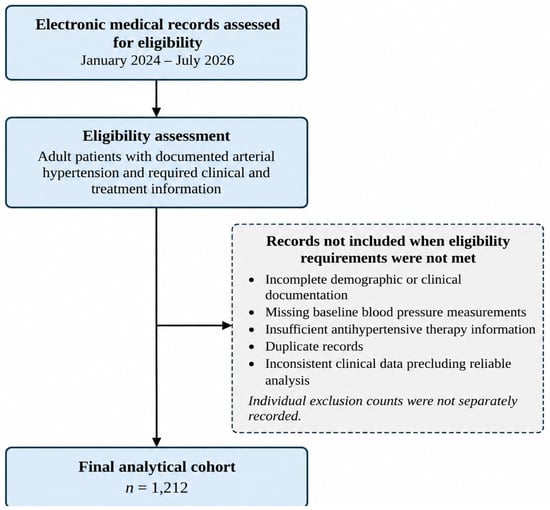
The study population consisted of 1212 adult patients with a documented diagnosis of arterial hypertension who received follow-up and treatment in the Family Medicine and Internal Medicine services during the study period. All patients were managed in the outpatient setting at the time of the index clinical assessment and were not hospitalized at study entry. Hospitalization, when documented, was considered a subsequent clinical event occurring during the study period rather than the setting of the initial assessment. Patients were consecutively included based on the predefined eligibility criteria and the availability of complete clinical documentation. For patients with multiple documented visits during the study period, only the first eligible visit was selected for inclusion in the analytical dataset, and the date of this visit was defined as the index date. Eligibility at the index visit was determined according to the documented diagnosis of arterial hypertension and the predefined study inclusion criteria. Subsequent visits by the same patient were not considered separate treatment episodes, ensuring that each patient contributed only one index antihypertensive treatment episode to the primary analysis. Follow-up information from subsequent clinical documentation was used, where applicable, only to assess the predefined follow-up outcomes. The record-selection process is summarized in Figure 1. Because screening was performed retrospectively from routine clinical records and records not meeting the eligibility requirements were not enumerated in a separate screening log, the total number of records initially reviewed and the individual numbers excluded for each reason were not available.
Figure 1.
Study flow diagram of patient selection. Note: Records that did not meet the eligibility requirements were not enumerated in a separate screening log during retrospective data extraction; therefore, the total number of records initially assessed and the individual numbers excluded for each reason were not available.
2.3. Inclusion and Exclusion Criteria
Patients aged 18 years or older with a documented diagnosis of arterial hypertension who had received at least one antihypertensive medication during the study period were eligible for inclusion. To ensure complete evaluation of treatment patterns and clinical outcomes, only patients with documented baseline blood pressure measurements, complete demographic and clinical information, and available records regarding antihypertensive therapy were included. Information on early clinical reassessment, when available, was extracted from routine clinical documentation and analyzed as part of healthcare utilization during follow-up. The study cohort included patients evaluated during routine outpatient visits to the Main Primary Healthcare Center. At the index clinical assessment, patients could present with uncontrolled hypertension or a hypertensive crisis requiring initiation or intensification of antihypertensive therapy in the outpatient setting. Patients who required referral for inpatient management following the initial assessment remained eligible because hospitalization was analyzed as a subsequent clinical outcome rather than an inclusion criterion. Patients receiving routine follow-up for chronic comorbid conditions continued to be managed within the specialized Internal Medicine Services and Family Medicine Services according to standard primary healthcare practice. Patients with incomplete demographic or clinical documentation, missing baseline blood pressure measurements, insufficient information regarding antihypertensive therapy, duplicated medical records, or inconsistent clinical data that precluded reliable statistical analysis were excluded from the study.
2.4. Study Variables
Data extracted from the electronic medical records included age, sex, place of residence, diagnosis of arterial hypertension, duration of hypertension, the antihypertensive medication documented for the index treatment episode, treatment duration, daily dosing frequency, baseline blood pressure values, concomitant non-antihypertensive medications, statin therapy recorded as a separate medication-exposure variable, documented adverse drug reactions, treatment adherence, history of hospitalization, and documentation of an early clinical reassessment visit performed within 7–30 days following initiation or continuation of antihypertensive therapy. For the medication-utilization analyses, each patient contributed one index antihypertensive medication, corresponding to the antihypertensive therapy documented in the structured treatment field at the first eligible (index) visit. Accordingly, the medication distributions reported in this study represent the documented index antihypertensive medication and should not be interpreted as confirmed monotherapy. The available structured treatment field did not permit comprehensive reconstruction of all concomitant antihypertensive combinations; therefore, combination therapy beyond the documented index medication was not systematically evaluated. Concomitant medication use and statin therapy were extracted from separate fields in the clinical records and were therefore analyzed as distinct variables. The concomitant-medication variable captured other medications documented alongside antihypertensive treatment, whereas statin use was assessed separately to characterize lipid-lowering pharmacotherapy. The primary outcome of the study was documentation of an early clinical reassessment within 7–30 days after initiation or continuation of antihypertensive therapy, reflecting routine follow-up practice in primary healthcare. Secondary outcomes included antihypertensive prescribing patterns, documented adverse drug reactions, hospitalization, treatment adherence, concomitant non-antihypertensive medication use, and separately documented statin therapy as indicators of medication utilization and treatment safety in routine clinical practice.
2.5. Operational Definitions
For the purposes of this study, early clinical reassessment was defined as a documented follow-up visit occurring within 7–30 days after initiation or continuation of antihypertensive therapy, as recorded in the patients’ electronic medical records. This variable reflected routine clinical follow-up practice and did not imply achievement of blood pressure control, as follow-up blood pressure measurements were not consistently available in the database. Treatment adherence was assessed according to documentation of regular medication use recorded in the patients’ medical records. Adverse drug reactions (ADRs) were considered present when documented by the treating physician as being associated with antihypertensive therapy. ADR ascertainment was therefore based on routine physician documentation rather than on a standardized causality assessment instrument. The available records did not provide sufficiently standardized information to classify ADR severity or to establish a uniform temporal interval between treatment exposure and ADR occurrence. In addition, the structured dataset contained a single ADR field for each patient; therefore, the analysis was based on the documented ADR status/event recorded in that field and did not permit systematic assessment of multiple concurrent ADRs in the same patient. Accordingly, the reported ADRs should be interpreted as physician-documented suspected treatment-related reactions rather than independently adjudicated causal events. Hospitalization was defined as any documented hospital admission occurring during the study period due to hypertension-related or associated clinical conditions.
2.6. Statistical Analysis
Data were coded and analyzed using IBM SPSS Statistics version 29.0 (IBM Corp., Armonk, NY, USA). Descriptive statistics were performed for all study variables. Categorical variables are presented as frequencies and percentages, whereas continuous variables are summarized as means ± standard deviations (SDs) or medians with ranges, as appropriate.
Associations between categorical variables were evaluated using the Chi-square test or Fisher’s exact test, where appropriate. Differences in mean systolic and diastolic blood pressure across antihypertensive drug classes were assessed using one-way analysis of variance (ANOVA). A multivariable logistic regression model was constructed to identify independent factors associated with documented adverse drug reactions (ADRs). Variables considered clinically relevant and those demonstrating significant associations in the univariable analyses were entered into the multivariable model. Adjusted odds ratios (ORs) with 95% confidence intervals (95% CIs) were calculated. A two-sided p-value < 0.05 was considered statistically significant.
2.7. Ethical Considerations
The study was conducted after obtaining ethical approval for retrospective research from the competent Ethics Committee of the Main Primary Healthcare Center in the Municipality of Obiliq, Kosovo (Reference No. MFMC-OB/EC/2026/126; approval date: 10 July 2026). As this was a retrospective study based exclusively on existing electronic medical records and clinical documentation, no direct patient contact occurred and no intervention was performed during patient management. All collected data were fully anonymized prior to statistical analysis by removing all personal identifiers, thereby ensuring patient confidentiality and privacy throughout the study. The study was conducted in accordance with the ethical principles of the Declaration of Helsinki and applicable regulations governing the protection of personal data and biomedical research.
2.8. Reporting Standards
The design, conduct, and reporting of this study were prepared in accordance with the Strengthening the Reporting of Observational Studies in Epidemiology (STROBE) Statement for observational studies. Adherence to these reporting recommendations was intended to enhance methodological transparency, ensure comprehensive reporting of study findings, and improve the scientific quality and reproducibility of the research.
3. Results
The final analytical dataset comprised 1212 patients with documented arterial hypertension managed under routine clinical conditions. The 7–30-day outcome represents documented early clinical reassessment rather than objectively confirmed blood pressure control, as follow-up blood pressure measurements were not consistently available. One implausible age value was excluded from age-based analyses only, while the remaining valid data from that record were retained. The demographic characteristics of the study population are presented in Table 1.
Table 1.
Demographic characteristics of the study population.
Table 2.
Recorded comorbid conditions.
Table 3.
Baseline blood pressure profile.
Table 4.
Real-world prescribing of index antihypertensive medications.
Table 5.
Index antihypertensive drug class and treatment characteristics.
Table 6.
Concomitant non-antihypertensive medication use and separately documented statin therapy.
Table 7.
Documented adverse drug reactions.
Table 8.
Association between antihypertensive drug class and documented adverse drug reactions.
Table 9.
Factors associated with early clinical reassessment within 7–30 days.
Table 10.
Hospitalization according to demographic and clinical characteristics.
Table 11.
Comparison of baseline blood pressure across antihypertensive drug classes.
Table 12.
Multivariable logistic regression of factors associated with documented adverse drug reactions.
4. Discussion
This real-world pharmacoepidemiological study evaluated antihypertensive medication utilization, treatment safety, early clinical reassessment, and hospitalization among adults with arterial hypertension managed in routine primary healthcare. Prescribing was predominantly centered on renin–angiotensin system inhibitors, clinically relevant differences in documented adverse drug reactions were observed across antihypertensive drug classes, early clinical reassessment was documented for most patients with available follow-up information, and hospitalization was uncommon and concentrated among patients with more severe baseline hypertension. These findings provide real-world evidence on antihypertensive medication use and safety in primary healthcare [10].
One of the principal findings was the predominance of angiotensin receptor blockers and angiotensin-converting enzyme inhibitors, which together accounted for nearly nine out of every ten antihypertensive prescriptions. This pattern is broadly consistent with contemporary hypertension management strategies and the established role of renin–angiotensin system blockade in cardiovascular risk management. Similar prescribing trends have been reported in real-world evaluations of antihypertensive treatment, although prescribing patterns may vary according to healthcare systems, medication availability, reimbursement policies, and physician practice [11].
Medication safety represented another important finding. Approximately three-quarters of patients had no documented adverse drug reactions; however, the frequency of documented reactions differed significantly across antihypertensive drug classes. In multivariable analysis, calcium-channel blocker therapy and other antihypertensive classes were independently associated with higher odds of documented adverse reactions relative to ACE inhibitor therapy, whereas chronic treatment and statin use were associated with lower odds. These findings should be interpreted as associations rather than causal effects because of the observational design of the study [5,12]. The lower odds of documented adverse reactions among patients receiving chronic treatment may partly reflect previous treatment optimization, medication switching, or discontinuation of less well-tolerated therapies.
The inverse association between statin use and documented adverse drug reactions also requires cautious interpretation. Statin therapy is unlikely to directly reduce antihypertensive drug toxicity and may instead represent a marker of differences in cardiovascular risk management, clinical monitoring, or other patient characteristics not fully captured in the available records. Consequently, this association should not be interpreted as evidence of a protective pharmacological interaction between statins and antihypertensive medications. Real-world safety surveillance remains useful for identifying such treatment-related patterns in heterogeneous populations encountered in routine clinical practice [7].
Early clinical reassessment was documented in 96.9% of patients with available follow-up information. Importantly, this outcome represents documentation of a follow-up visit within 7–30 days and not achievement of blood pressure control, because repeated blood pressure measurements were not consistently available. Early reassessment provides an opportunity to evaluate treatment tolerability, adherence, adverse reactions, and the need for therapeutic modification. The high proportion of documented reassessment therefore indicates that early follow-up was commonly recorded within the participating primary healthcare services.
Hospitalization was rare, with only nine events documented, and was significantly associated with baseline hypertension grade, with most events occurring among patients with Grade 3 hypertension. Given the small number of hospitalizations, this finding should be interpreted cautiously and should not be used to infer that outpatient antihypertensive management itself reduced hospitalization risk. Nevertheless, the concentration of events among patients with more severe baseline hypertension identifies a clinically relevant pattern that warrants evaluation in larger studies.
The study has several strengths, including a relatively large cohort managed under routine clinical conditions, the use of routinely collected medical records, and evaluation of prescribing patterns, adverse drug reactions, early clinical reassessment, and hospitalization within the same primary healthcare population. Multivariable modelling further allowed assessment of factors independently associated with documented adverse drug reactions.
Several limitations should also be acknowledged. The retrospective observational design precludes causal inference, and the findings depend on the completeness and accuracy of routine clinical documentation. Follow-up blood pressure measurements were not consistently available; therefore, early clinical reassessment reflected documented follow-up attendance rather than objective blood pressure control. Adverse drug reactions were based on routine physician documentation rather than standardized causality assessment; therefore, under-recording or variation in attribution is possible, and ADR severity, a uniform exposure-to-event interval, and multiple concurrent ADRs could not be systematically evaluated. In addition, the study was conducted at a single primary healthcare center, limiting the generalizability of the findings.
5. Conclusions
This real-world pharmacoepidemiological study provides comprehensive evidence on antihypertensive medication utilization, treatment safety, and early clinical reassessment among patients with arterial hypertension managed in primary healthcare. The findings demonstrate that prescribing practices were largely consistent with contemporary evidence-based recommendations, with renin–angiotensin system inhibitors representing the predominant therapeutic approach. At the same time, clinically significant differences in documented adverse drug reactions were observed across antihypertensive drug classes, emphasizing the importance of individualized medication selection and continuous safety monitoring in routine clinical practice. The study further highlights the value of structured early clinical reassessment following initiation or continuation of antihypertensive therapy as an integral component of hypertension management in primary healthcare. Routine follow-up facilitates timely evaluation of treatment tolerability, supports medication optimization, and may contribute to reducing unnecessary hospital admissions through early identification and management of treatment-related problems. Overall, these findings reinforce the important role of real-world pharmacoepidemiological research in complementing evidence generated by randomized clinical trials and in supporting evidence-based therapeutic decision-making. Future multicenter prospective studies incorporating standardized follow-up blood pressure measurements, medication persistence, and long-term cardiovascular outcomes are warranted to further optimize individualized hypertension management strategies and strengthen the evidence base for routine primary healthcare practice.
Author Contributions
Conceptualization, A.H.A. and F.A.; Methodology, A.H.A. and F.A.; Investigation, N.L.B. and A.H.A.; Data curation, N.L.B.; Formal analysis, A.H.A. and F.A.; Writing—original draft preparation, A.H.A.; Writing—review and editing, F.A.; Supervision, F.A. All authors have read and agreed to the published version of the manuscript.
Funding
This research received no external funding.
Institutional Review Board Statement
The study was conducted in accordance with the Declaration of Helsinki and approved by the competent Ethics Committee of the Main Primary Healthcare Center in the Municipality of Obiliq, Kosovo (Reference No. MFMC-OB/EC/2026/126; approval date: 10 July 2026) through an institutional ethical approval issued for retrospective studies. The study was conducted using fully anonymized electronic medical records, and all procedures complied with the institutional ethical requirements for retrospective research.
Informed Consent Statement
Patient informed consent was waived due to the retrospective nature of the study and the use of fully anonymized electronic medical records.
Data Availability Statement
The data supporting the findings of this study are not publicly available because they contain confidential patient information. The data may be made available by the corresponding author upon reasonable request and with permission from the Main Primary Healthcare Center in the Municipality of Obiliq, Kosovo.
Conflicts of Interest
The authors declare no conflicts of interest.
References
- McEvoy, J.W.; McCarthy, C.P.; Bruno, R.M.; Brouwers, S.; Canavan, M.D.; Ceconi, C.; Christodorescu, R.M.; Daskalopoulou, S.S.; Ferro, C.J.; Gerdts, E.; et al. 2024 ESC Guidelines for the management of elevated blood pressure and hypertension. Eur. Heart J. 2024, 45, 3912–4018. [Google Scholar] [CrossRef] [Scilit] [PubMed]
- Bager, J.E.; Manhem, K.; Andersson, T.; Hjerpe, P.; Bengtsson-Boström, K.; Ljungman, C.; Mourtzinis, G. Hypertension: Sex-related differences in drug treatment, prevalence and blood pressure control in primary care. J. Hum. Hypertens. 2023, 37, 662–670. [Google Scholar] [CrossRef] [Scilit] [PubMed]
- Burnier, M.; Egan, B.M. Adherence in hypertension. Circ. Res. 2019, 124, 1124–1140. [Google Scholar] [CrossRef] [Scilit] [PubMed]
- Al-Makki, A.; DiPette, D.; Whelton, P.K.; Murad, M.H.; Mustafa, R.A.; Acharya, S.; Beheiry, H.M.; Champagne, B.; Connell, K.; Cooney, M.T.; et al. Hypertension Pharmacological Treatment in Adults: A World Health Organization Guideline Executive Summary. Hypertension 2022, 79, 293–301. [Google Scholar] [CrossRef] [Scilit] [PubMed]
- Li, X.; Bijlsma, M.J.; de Vos, S.; Bos, J.H.J.; Mubarik, S.; Schuiling-Veninga, C.C.M.; Hak, E. Comparative effectiveness of antihypertensive monotherapies in primary prevention of cardiovascular events: A real-world longitudinal inception cohort study. Front. Pharmacol. 2024, 15, 1357567. [Google Scholar] [CrossRef] [Scilit] [PubMed]
- Malmivaara, A. Applicability of evidence from randomized controlled trials and systematic reviews to clinical practice: A conceptual review. J. Rehabil. Med. 2021, 53, jrm00202. [Google Scholar] [CrossRef] [Scilit] [PubMed]
- Hernandez, R.K.; Critchlow, C.W.; Dreyer, N.A.; Lash, T.L.; Reynolds, R.F.; Sørensen, H.T.; Lange, J.L.; Gatto, N.M.; Sobel, R.E.; Lai, E.C.; et al. Advancing principled pharmacoepidemiologic research to support regulatory and healthcare decision making: The era of real-world evidence. Clin. Pharmacol. Ther. 2025, 117, 927–937. [Google Scholar] [CrossRef] [Scilit] [PubMed]
- von Osmanski, B.I.; Petersen, J.; Petersen, C.T.; Bentsen, A.H.; Jimenez-Solem, E.; Ankarfeldt, M.Z. Methods Applied to Assess Real-World Effectiveness of Drugs: A Scoping Review. Pharmacol. Res. Perspect. 2026, 14, e70244. [Google Scholar] [CrossRef] [Scilit] [PubMed]
- Sofue, T. Development of real-world evidence studies for hypertension in Japan. Hypertens. Res. 2025, 48, 423–424. [Google Scholar] [CrossRef] [Scilit] [PubMed]
- Rouette, J.; McDonald, E.G.; Schuster, T.; Brophy, J.M.; Azoulay, L. Treatment and prescribing trends of antihypertensive drugs in 2.7 million UK primary care patients over 31 years: A population-based cohort study. BMJ Open 2022, 12, e057510. [Google Scholar] [CrossRef] [Scilit] [PubMed]
- Damania, H.; Kolhe, D.; Kadam, S.; Rajput, J.; Devarshi, S.P.; Shaikh, A.; Badani, R. Evaluation of Prescription Pattern of Antihypertensives and Its Compliance with Joint National Committee 8 Guidelines in Hospital Setting. J. Assoc. Physicians India 2024, 72, e1–e5. [Google Scholar] [CrossRef] [Scilit] [PubMed]
- Guo, Z.; Di, J.; Zhang, Z.; Chen, S.; Mao, X.; Wang, Z.; Yan, Z.; Li, X.; Tian, Z.; Mu, C.; et al. Antihypertensive drug-associated adverse events in osteoarthritis: A study of a large real-world sample based on the FAERS database. Front. Pharmacol. 2024, 15, 1404427. [Google Scholar] [CrossRef] [Scilit] [PubMed]
Disclaimer/Publisher’s Note: The statements, opinions and data contained in all publications are solely those of the individual author(s) and contributor(s) and not of MDPI and/or the editor(s). MDPI and/or the editor(s) disclaim responsibility for any injury to people or property resulting from any ideas, methods, instructions or products referred to in the content. |
© 2026 by the authors. Licensee MDPI, Basel, Switzerland. This article is an open access article distributed under the terms and conditions of the Creative Commons Attribution (CC BY) license.