


Abstract
Identifying the nectar sources of stingless bees is essential for understanding plant–pollinator interactions and for promoting sustainable meliponiculture. Traditionally, this has been achieved through melissopalynological analysis of honey; however, this approach has certain limitations. Here, we aimed to evaluate whether pollen analysis of bee crop nectar can reliably identify nectar sources for stingless bees. We conducted palynological analyses of honey samples (n = 12) and crop nectar samples (n = 757, considering individual foragers), and conducted field surveys to determine nectar sources for the stingless bee Tetragonula pagdeni in West Bengal, India. From the honey analysis, 42 pollen types were identified, with Eucalyptus tereticornis as the predominant pollen type. In contrast, 67 pollen types were recorded from the crop nectar samples. The most frequently occurring pollen types were Acacia auriculiformis, Borassus flabellifer, Eucalyptus tereticornis, Peltophorum pterocarpum, Tridax procumbens, and Ziziphus mauritiana. Through field surveys, 73 plant species were identified as nectar sources. By integrating these methods, 85 plant species were recognised as nectar sources for stingless bees. The findings indicate that palynological analysis of bees’ crop nectar is an effective method for identifying the nectar sources of a bee species. Furthermore, combining palynological analysis of crop nectar with melissopalynological analysis of honey provides a more comprehensive and potentially more accurate assessment of nectar sources than reliance on honey analysis alone.
1. Introduction
The interaction between flowering plants and their bee pollinators constitutes a fundamental biological partnership that plays a key role in maintaining the structural and functional integrity of tropical and subtropical ecosystems. By providing essential reproductive services, these bees ensure the survival of diverse flora and the maintenance of regional biodiversity across fragmented landscapes. This relationship is clearly demonstrated in West Bengal’s agro-ecosystems, where bees play a vital role in pollinating wild flora alongside key economic crops [1,2,3,4]. To maintain colony homeostasis, bees actively forage for nectar and pollen, the primary biological rewards offered by flowering plants. This resource acquisition is driven by specific nutritional requirements: nectar serves as the principal carbohydrate source for energy metabolism and honey synthesis, and pollen provides the essential proteins, lipids, and micronutrients necessary for brood nourishment. The availability and diversity of these seasonal resources directly dictate colony growth, honey yield, and the overall efficiency of pollination services [5,6]. The nectar-collection strategy of stingless bees involves frequent floral visits, supported by pheromone-mediated recruitment to profitable floral patches. Once harvested, the nectar undergoes dehydration and enzymatic modification in cerumen pots, transforming into honey. Unlike Apis honey, stingless bee honey frequently contains suspended pollen due to the close architectural arrangement of the storage pots, resulting in a dark-amber honey valued for its unique therapeutic properties [7,8].
Determining the nectar sources exploited by bees is essential for understanding plant–pollinator interactions and evaluating forage availability. Furthermore, identifying these sources is critical for authenticating honey origin and for identifying keystone plants that sustain colonies during resource-scarce, drought periods. Various approaches have been employed to identify these botanical sources, ranging from direct field observations of foraging behaviour to analyses of pollen loads on the bees’ bodies. Melissopalynological examination (i.e., the microscopic analysis of pollen within honey) remains a traditional standard for identifying floral origins. Despite its utility, melissopalynology has significant limitations: it is labour-intensive, requires highly specialised taxonomic expertise, and can sometimes misrepresent nectar sources if a plant produces little pollen but much nectar, or vice versa. Sometimes, honey may contain pollen of non-nectariferous plants. In addition, melissopalynological studies of honey are restricted to honey-producing bees, such as honeybees and stingless bees. More recently, DNA metabarcoding has emerged as a high-resolution tool for taxonomic identification [9,10]. But, this method also has some demerits, including PCR bias, primer specificity issues, and quantitative limitations. However, collecting honey samples during the floral dearth is very difficult, and for cavity-nesting species, it requires damaging wild colony nests. Therefore, there is a growing need for alternative methods for determining nectar sources for bees.
Stingless bees (Tetragonula spp.) are highly eusocial, honey-producing bees that establish perennial colonies in sheltered cavities such as tree trunks, cracks, hollow logs and old wall crevices [11,12,13]. Their foraging behaviour is highly specialised. Due to their diminutive size, stingless bees can access minute, tubular, and concealed floral structures that remain inaccessible to large bee species [14,15,16,17]. In India, only a limited number of melissopalynological studies have been conducted on stingless bees (e.g., Vijayakumar & Jeyaraaj [18]; Layek & Karmakar [19]; Hazra et al. [20]; Layek et al. [21]). In addition to melissopalynological investigations, Bisui et al. [22] analysed body-surface pollen to identify nectar sources of stingless bees. However, pollen analysis of crop nectar is very limited, and our approaches will likely be the first to be applied to stingless bees. There is a lack of direct evidence linking crop nectar pollen composition to actual nectar sources, a lack of comparative studies between honey pollen and crop pollen under field conditions, and limited research in tropical stingless bee systems. Therefore, research on assessing the effectiveness of analysing pollen in bees’ crop nectar to determine nectar sources is demanding.
The present study aimed to assess the suitability of crop nectar analysis for identifying nectar sources of stingless bees, alongside melissopalynological examination of honey and field surveys. We hypothesised that analysing pollen from bees’ crop nectar would be an effective approach for determining the botanical origin of nectar, and that integrating this method with melissopalynological analysis of honey would provide a more comprehensive and efficient assessment of nectar sources in stingless bees.
2. Materials and Methods
2.1. Experimental Site
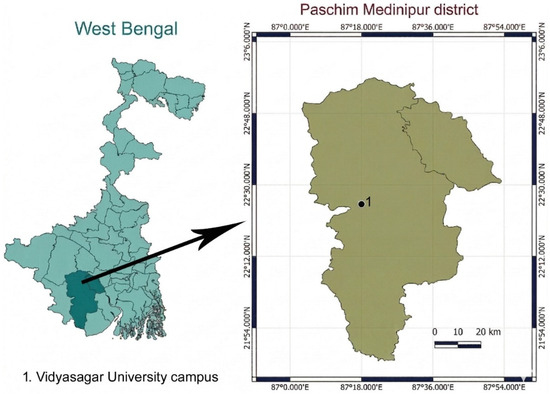
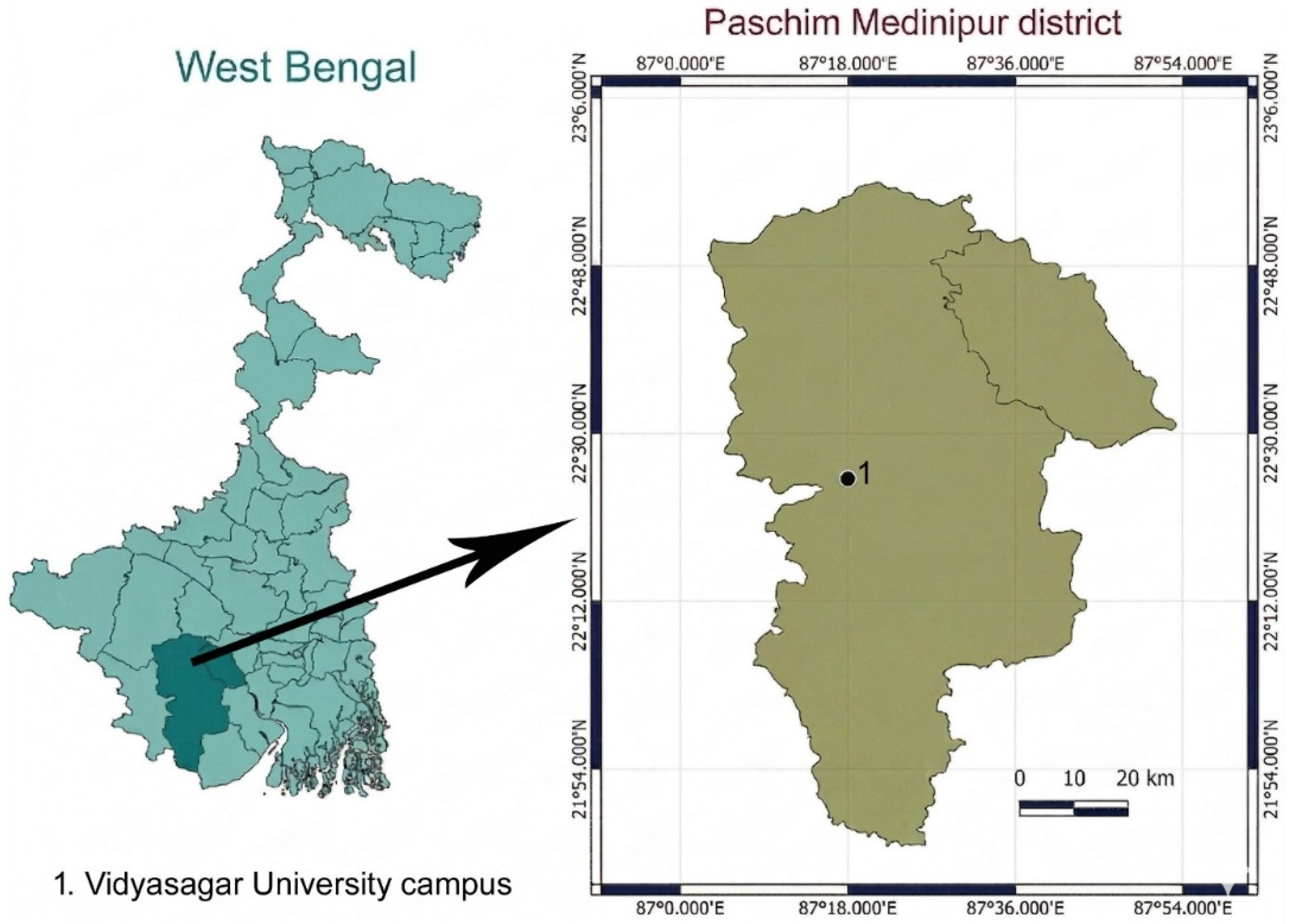
The study was conducted at Vidyasagar University, Paschim Medinipur, West Bengal, India (22°25′48.10″ N, 87°17′53.94″ E; Figure 1). The site, Midnapore Sadar, is a semi-urban area with limited agricultural activity. The region experiences a tropical climate with mean temperatures of 26–30 °C (summer maximum up to 45 °C; winter minima ~20 °C) and annual rainfall of ~1436 mm. Paschim Medinipur is predominantly agrarian, with heterogeneous topography and diverse vegetation, including deciduous forests dominated by Shorea robusta, Tectona grandis, Madhuca longifolia, Terminalia spp. and Dalbergia sissoo [23]. Grasslands and wetlands (ponds, lakes, and marshes) support aquatic and semi-aquatic flora. Major crops include rice, wheat, pulses, oilseeds, and vegetables, while orchards commonly cultivate mango, banana, guava, and papaya. Soils range from alluvial and lateritic to red soils and hard rock uplands, and agriculture is largely rainfall-dependent.
Figure 1.
Map showing the study area.
2.2. Collection of Honey Samples
Twelve honey samples were collected from two stingless bee (Tetragonula pagdeni Schwarz) colonies maintained within the Vidyasagar University campus during 2019. Samples were collected alternately using these two hives, with an interval of about two months between two successive sample collections from a hive (managing one honey sample for each month). Honey was collected from the honey pots using a glass dropper or pipette, with 30–50 g per sample.
2.3. Collection of Bees’ Crop Nectar
The bees’ crop nectar samples were collected from the same two colonies from which honey was collected. The low number of sampling colonies was a limitation in our present study. During sampling, hive entrances were partially obstructed using fine wire mesh or soft materials to slow returning foragers. Nectar foragers with distended abdomens and the absence of corbicular pollen loads or resin loads were captured with sterile forceps. Gentle abdominal pressure induced regurgitation of crop nectar, and ~0.4 µL was transferred to a clean glass slide from the mouthparts. We carefully took the crop nectar samples on a slide without touching the body parts on the slide (except the mouth part of the forager) to avoid pollen contamination from the bee’s body surface. On a sampling day, 10–15 bees were sampled, yielding 757 crop-nectar samples (50–65 per month), with each individual forager’s crop content counted as one sample. Sampling was conducted approximately once per week at three daily intervals: morning (08:00–10:00 h), near midday (12:00–12:30 h), and late afternoon (15:00–17:00 h) during 2019.
2.4. Palynological Analysis of Honey
For quantitative analysis, pollen concentration was determined by adding Lycopodium spores (7560 spores per 100 µL) to 10 g of honey, followed by dilution, centrifugation, and microscopic enumeration (Primo Star, Zeiss, Germany). The total number of pollen grains was calculated by the following equation: Pt = P/S × St. Where Pt is the total number of pollen grains per 10 g of honey, P is the number of pollen grains counted, S is the Lycopodium spores counted, and St is the number of spores added. Honey samples were assigned to pollen concentration classes [24]: class I (<20,000), class II (20,000–100,000), class III (>100,000–500,000), class IV (>500,000–1,000,000) and class V (>1,000,000) grains per 10 g of honey.
For qualitative analysis, honey samples were processed following Louveaux et al. [25], modified by Jones and Bryant [26]. Ten grams (~7 mL) of honey were dissolved in lukewarm distilled water, mixed with 95% ethanol, and centrifuged at 4000 rpm (1658× g) (Remi R-8C, Remi Elektrotechnik Limited, India). The sediment was treated with 20% KOH, heated (100 °C, 5–10 min), re-centrifuged, rinsed, ethanol-washed, and mounted in glycerine jelly for microscopic examination. Pollen identification was performed using reference slides from local flora and regional pollen atlases; taxa were identified to species level where possible, otherwise assigned to pollen types following De Klerk and Joosten [27].
Approximately 100 grains were counted per sample and classified as predominant (>45%), secondary (16–45%), important minor (3–15%), or minor (<3%), defining unifloral, bifloral, and multifloral honeys. We classified the honey samples as (i) unifloral (if a honey sample contained a predominant pollen type) or (ii) polyfloral/multifloral (if it did not contain a predominant pollen type) [28,29]. Frequency classes across samples were defined as very frequent (>50%), frequent (20–50%), infrequent (10–<20%), and rare (<10%).
2.5. Palynological Analysis of Bees’ Crop Nectar
Each crop-nectar sample (~0.4 µL) was mounted in glycerine jelly on a clean glass slide, gently heated, cover slipped, and sealed for microscopic examination. Pollen grains were counted by scanning the entire coverslip using systematic transects. The identified pollen types were recorded, and their monthly percentages were calculated. Pollen occurrence was classified as very frequent (>30%), frequent (>10–30%), less frequent (3–10%), and rare (<3%), and annual occurrence patterns were also assessed.
2.6. Field Surveys
Vegetation surveys were conducted within a 2 km radius of the apiaries at ~15-day intervals throughout the year to document bee-visited flowering plants and to prepare reference pollen slides. A field survey was conducted 3 times on a study day: in the morning (08:00–09:00 h), near noon (13:00–14:00 h), and in the afternoon (16:00–17:00 h). All the bloomed plants were observed, whether visited by stingless bees or not, and the type of resource visited was recorded. Reference slide prepared from the bloomed flowers.
2.7. Data Analyses
Pollen diversity was calculated sample-wise (honey) and month-wise (crop nectar) using the Shannon-Weaver index [30]: H′ = , where pi is the proportion of each pollen type.
Evenness was estimated using Pielou’s index [31]: J′ = , where H′ is the diversity index, and H′max is the natural logarithm of the total pollen types in the sample (or in a month for crop nectar). The J′ index can range from 0 to 1. A higher J′ value indicates higher evenness, meaning the proportions of all pollen types are almost equal within the sample or month-wise.
Descriptive statistics (mean ± SD) were calculated. We tested the assumptions of the parametric test, including normality (Shapiro–Wilk test), homogeneity of variances (Levene’s test), and the presence or absence of outliers (using box plots). Differences in pollen counts among samples were assessed using the non-parametric Kruskal–Wallis test, while independent t-tests compared monthly pollen richness and diversity indices between honey and crop-nectar samples. Non-parametric Mann–Whitney U test conducted to compare pollen type between honey samples and crop nectar samples (considering individual samples). Statistical significance was set at p ≤ 0.05. Analyses were performed using Microsoft Excel 2021 (Microsoft Corporation, USA) and SPSS v.26.0 (IBM Corporation, USA).
3. Results
3.1. Pollen Analysis of Honey
Quantitative pollen analysis showed that the number of pollen grains in 10 g of Tetragonula pagdeni honey varied from 18,839.52 to 116,662.51 grains (Table S1 in Supplementary Materials), with a mean concentration of 53,696.27 ± 33,656.73 grains (mean ± SD). Out of the 12 honey samples analysed, four (33.33%) were assigned to class I, six (50%) to class II, and two (16.67%) to class III.
Forty-two pollen types covering twenty-two plant families were identified by analysing twelve honey samples (Table 1). The majority of the pollen types came from nectariferous plants; a few (e.g., Holoptelea integrifolia, Trema orientale, and Luffa aegyptiaca) came from non-nectariferous or less nectariferous plants or plants that do not collect nectar. Of the twelve samples, four were unifloral. Eucalyptus tereticornis was the predominant pollen type. In total, four honey samples were of the bifloral type. Two honey samples were multifloral.
Table 1.
Representation of pollen types obtained from honey samples (H1 to H12) of Tetragonula pagdeni collected in West Bengal, India.
The number of pollen types per honey sample ranged from 9 to 13, with a mean of 10.83 ± 1.19. The diversity indices ranged from 1.31 to 2.03 (1.74 ± 0.25). The values of the equitability index (J′) ranged between 0.55 and 0.85.
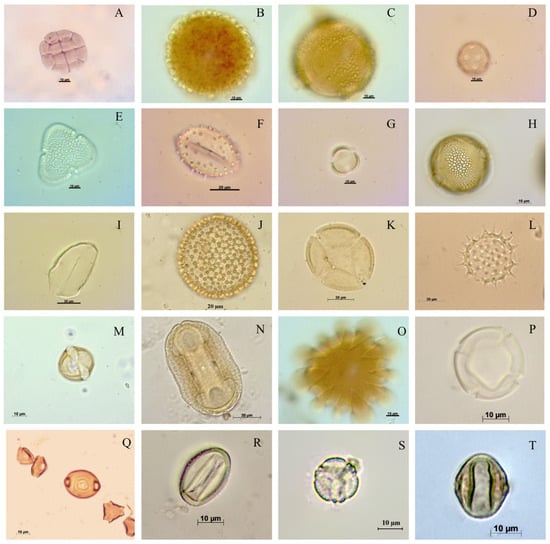
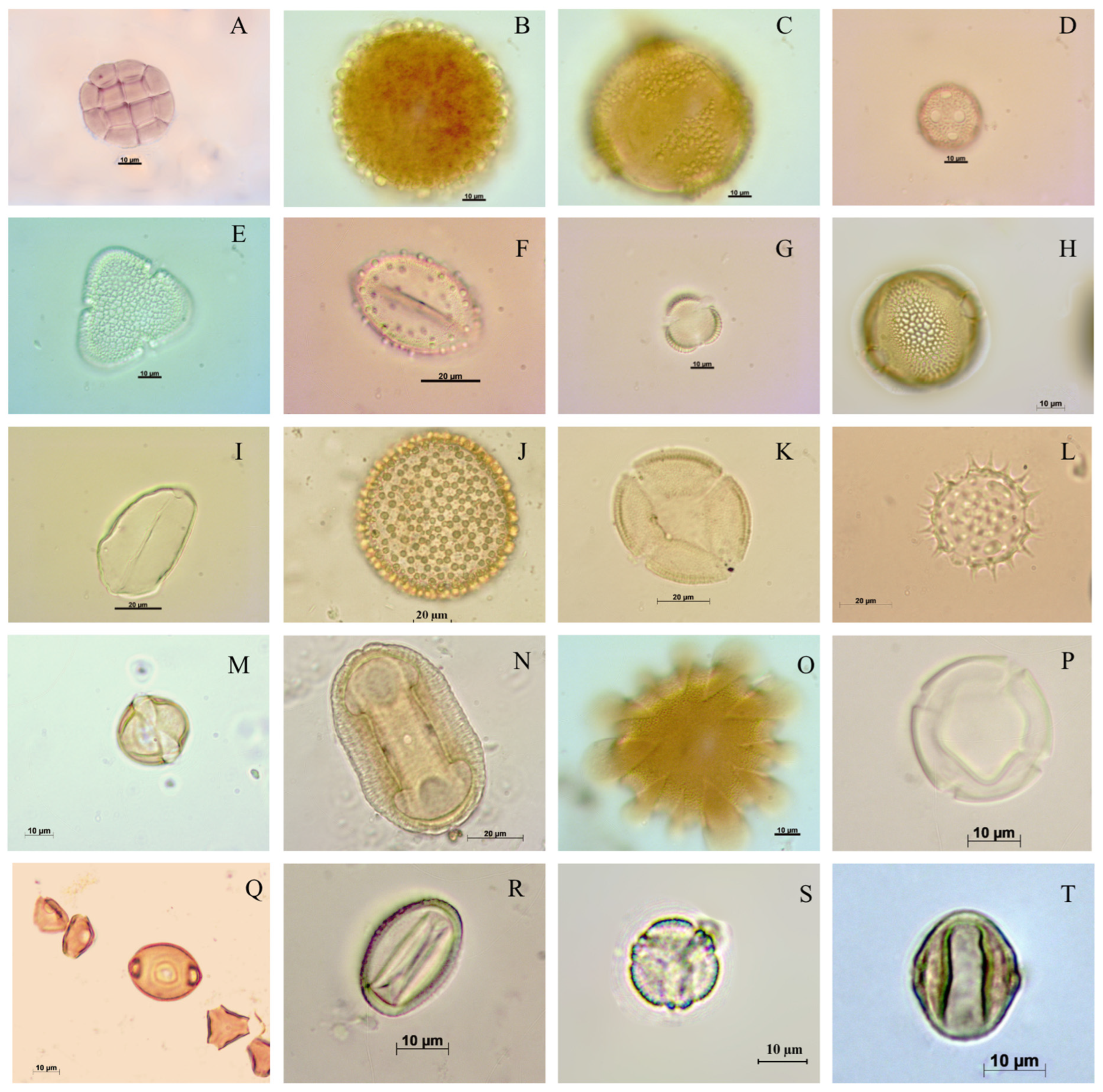
The investigation of the frequency distribution of pollens in honey samples confirms that Acacia auriculiformis, Borassus flabellifer, Eucalyptus tereticornis, and Peltophorum pterocarpum were very frequent pollen types (Table 2, Figure 2).
Table 2.
Frequency distribution of pollen types obtained from honey samples of Tetragonula pagdeni.
Figure 2.
Microphotographs of some pollen types obtained from honey and crop nectar analysis of Tetragonula pagdeni in West Bengal, India. (A) Acacia auriculiformis, (B,C) Alangium salviifolium, (D) Amaranthaceae type, (E) Bombax ceiba, (F) Borassus flabellifer, (G) Brassicaceae type, (H) Coccinia grandis, (I) Cocos nucifera, (J) Croton bonplandianus, (K) Euphorbia milii, (L) Helianthus annuus, (M) Melaleuca citrina, (N) Petunia × atkinsiana, (O) Sesamum indicum, (P) Swietenia mahagoni, (Q) Syzygium cumini, (R) Tectona grandis, (S) Tinospora cordifolia, (T) Trema orientale.
3.2. Pollen Analysis of Crop Nectar
Among the 757 analysed crop-nectar samples, 707 (93.39%) contained pollen (Table 3). Most pollen-bearing nectar samples contained a single pollen type (87.45%; implying floral constancy of the bee species during resource collection), followed by two (4.36%), three (1.06%), and more than three types (0.53%). The number of pollen grains per crop-nectar sample (~0.4 µL) ranged from 0 to 400, with a mean of 11.19 ± 36.64 grains (mean ± SD; N = 757).
Table 3.
Month-wise representation of different numbers of pollen taxa found in crop nectar loads of Tetragonula pagdeni.
Quantitative crop nectar pollen analysis revealed a range of pollen grains in crop nectar between 1 and 400. The highest pollen loads per sample were recorded for Justicia simplex (117.67 ± 198.61; n = 3; ranged: 2–347), Celosia argentea (107.2 ± 169.26; n = 5; ranged: 1–400), Alternanthera sessilis (117 ± 134.60; n = 4; ranged: 2–297), Syzygium cumini (63.24 ± 75.55; n = 32; ranged: 2–243), Tridax procumbens (50.56 ± 108.48; n = 39; ranged: 1–336), Trema orientale (32.09 ± 39.08; n = 23; ranged: 1–169), Solanum sisymbriifolium (26.15 ± 27.28; n = 20; ranged: 1–90), and E. tereticornis (8.46 ± 15.79; n = 64; ranged: 1–75).
Lower pollen counts were observed in nectar from Ocimum tenuiflorum (1.86 ± 0.77; n = 14; range: 1–3; median: 2), Alstonia scholaris (1.89 ± 0.93; n = 9; range: 1–3; median: 2), Croton bonplandianus (2.10 ± 1.05; n = 10; range: 1–4; median: 2), Bergera koenigii (2.17 ± 1.17; n = 6; range: 1–4; median: 2), and Petunia × atkinsiana (2.57 ± 0.98; n = 7; range: 1–4; median: 3) (Table 4).
Table 4.
Total occurrence of different pollen species obtained from the crop nectar of Tetragonula pagdeni in West Bengal, India.
Examination of the bees’ crop nectar yielded 67 pollen types distributed across 31 plant families (Table 4; Figure 2). Most of these taxa are derived from nectariferous plant species, whereas only a small proportion originated from anemophilous or comparatively less nectariferous plants such as Holoptelea integrifolia, Luffa aegyptiaca, Solanum sisymbriifolium, Streblus asper, and Trema orientale. A year-round assessment indicated that the most frequently occurring pollen types were Peltophorum pterocarpum (10.33%), Eucalyptus tereticornis (9.05%), Tridax procumbens (5.52%), Ziziphus mauritiana (5.37%), Delonix regia (5.09%), and Acacia auriculiformis (3.96%).
Considering the month-wise frequency of pollen types in crop nectar, Eucalyptus tereticornis and Peltophorum pterocarpum were the most frequent (Table 5). Other frequent pollen types identified in crop nectar were Acacia auriculiformis, Alstonia scholaris, Delonix regia, Helianthus annuus, Luffa aegyptiaca, Mangifera indica, Mikania micrantha, Phoenix roebelenii, Streblus asper, Syzygium cumini, Tectona grandis, Ziziphus mauritiana, and Ziziphus oenopolia. Month-wise analysis revealed that the number of pollen types ranged between 12 and 24 (16.42 ± 3.40, mean ± SD). March and April had more pollen types, whereas September, October, and December had fewer. Diversity indices (H′) ranged between 2.14 and 2.93 as revealed from month-wise data analyses. The equitability index (J′) values ranged between 0.82 and 0.94.
Table 5.
Month-wise representation of pollen types obtained from bees’ crop-nectar pollen analysis in West Bengal and the values of the diversity index (H′) and equitability index (J′).
When both honey and crop-nectar samples were evaluated together, a total of 75 pollen types representing 34 plant families were documented (Table S2). Fabaceae (10 taxa) and Asteraceae (9 taxa) were the most species-rich families. Species-level identification was achieved for 69 of the recorded morphotypes. Of the 75 pollen types, 70 were attributed to nectariferous plant species, whereas five pollen types (viz. Holoptelea integrifolia, Luffa aegyptiaca, Solanum sisymbriifolium, Streblus asper, and Trema orientale) originated from non-nectariferous or comparatively less nectariferous plants.
Considering individual honey samples and individual bees’ crop nectar, the number of pollen types differed between the two methodologies (Mann–Whitney U = 0.00, p < 0.001, N = 769), with higher values in honey samples than in crop nectar. However, monthly comparisons (one honey per month and 51–70 bees’ crop nectar per month) showed significant differences in pollen richness between crop-nectar and honey samples (df = 22, t = 5.11, p < 0.001), with crop-nectar consistently yielding more pollen types. Similarly, the Shannon-Weaver diversity index (H′) varied significantly between the two sample types (df = 22, t = 8.02, p < 0.001), with higher diversity values observed in crop-nectar samples throughout the year.
3.3. Field Surveys in Determining Nectariferous Plants
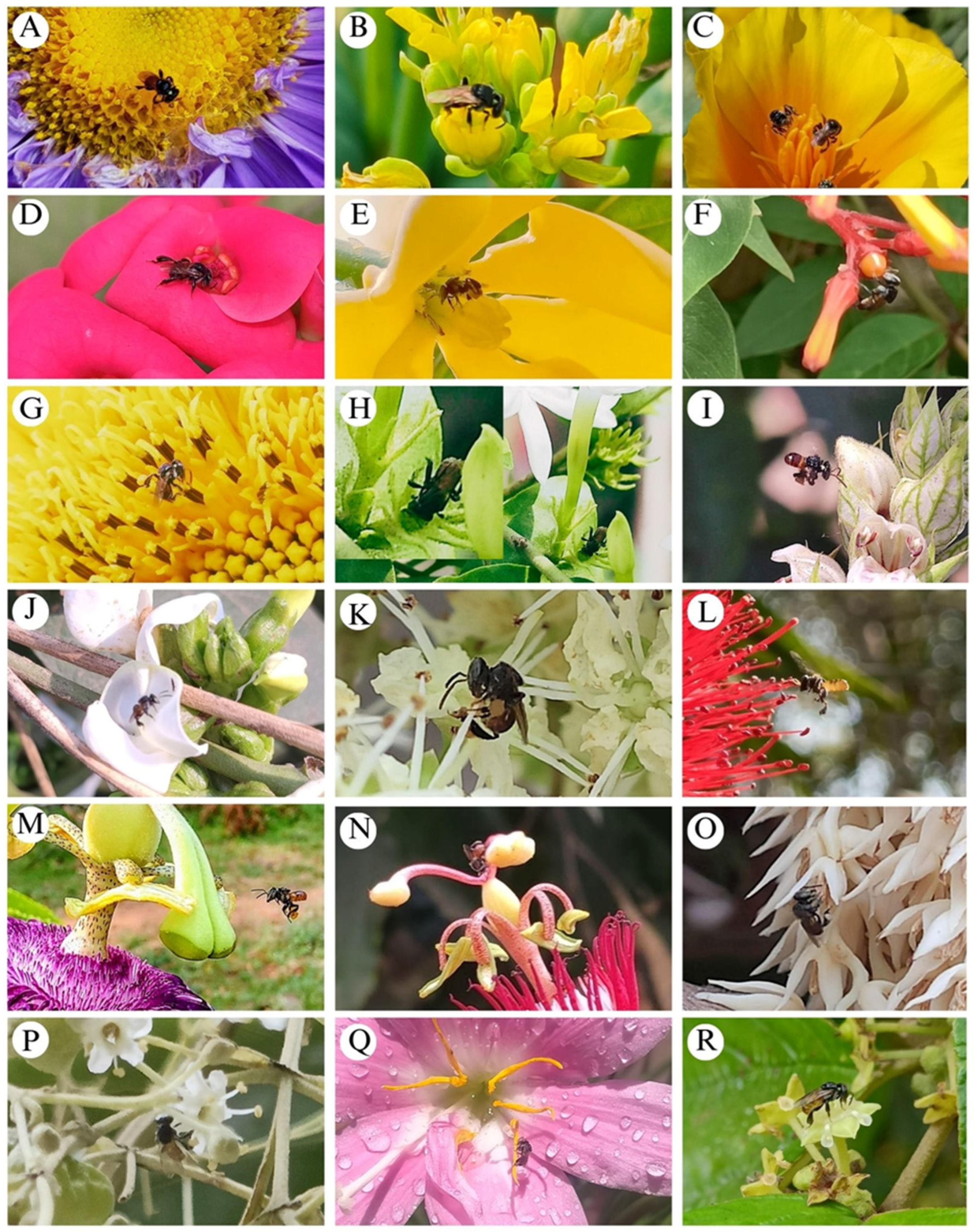
During field observations, 73 plant species from 32 plant families were identified (Table S3), with most species confirmed via analysis of crop nectar and honey pollen. However, several plants visited by stingless bees for nectar did not have corresponding pollen in honey and crop nectar samples. These included Antigonon leptopus, Calliandra haematocephala, Cosmos bipinnatus, Gardenia carinata, Gazania rigens, Lablab purpureus, Lawsonia inermis, Litchi chinensis, Petunia × atkinsiana, and Xerochrysum bracteatum. The frequently visited plant families were Acanthaceae, Asteraceae, Fabaceae, Lamiaceae, and Myrtaceae. The following plants were identified as extensively visited by bees during field observations: Acacia auriculiformis, Delonix regia, Eucalyptus tereticornis, Helianthus annuus, Lannea coromandelica, Peltophorum pterocarpum, Syzygium cumini, and Ziziphus mauritiana (Figure 3).
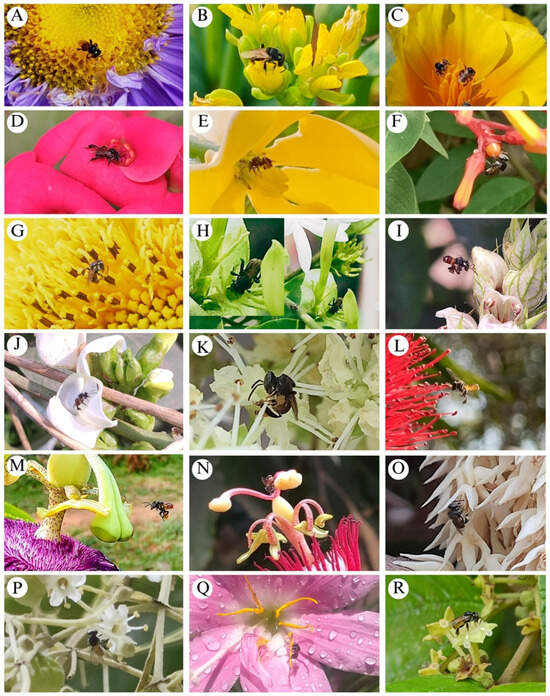
Figure 3.
Stingless bees (Tetragonula pagdeni) visiting flowers. (A) Aster sinensis, (B) Brassica juncea, (C) Eschscholzia californica, (D) Euphorbia milii, (E) Gardenia carinata, (F) Hamelia patens, (G) Helianthus annuus, (H) Jasminum multiflorum, (I) Justicia betonica, (J) Lablab purpureus, (K) Lawsonia inermis, (L) Melaleuca citrina, (M) Passiflora incarnata, (N) Passiflora vitifolia, (O) Phoenix roebelenii, (P) Tectona grandis, (Q) Zephyranthus rosea, (R) Ziziphus mauritiana.
3.4. Efficiency of Three Methods for Determining Nectariferous Plants
In total, 85 plant species were identified as nectariferous plants for the bee species. Considering the total recognised nectariferous plant, the largest number derived from field observations (n = 73, 85.88%), followed by crop nectar pollen analysis (n = 67, 78.82%), and honey pollen analysis (n = 42, 49.41%).
4. Discussion
4.1. Pollen Analysis of Honey
Quantitative pollen analysis of honey revealed that pollen concentration ranged from 18,839.52 to 116,662.51 grains per 10 g of honey. Half of the honey samples were classified under Maurizio’s class II. Comparable pollen contents have been reported by several researchers [28,32]. Pollen concentration of honey indicates the honey collection modes; generally, a pipetted honey had less pollen than squeezed honey. The pollen concentration in honey is influenced by factors such as the bee species, the floral morphology of the foraged plants and the method of honey collection [33,34].
Qualitative assessment revealed that most honey samples contained pollen types from plants blooming during the honey collection period. A total of 42 pollen types were recorded from the honey samples. The Shannon-Weaver diversity index (H′) indicated high pollen diversity in multifloral or polyfloral honey, with the highest value recorded in May (H5: 2.03), reflecting a diversified floral resource for the bee species. In contrast, unifloral honey exhibited lower diversity values, indicating less diversified floral resource utilisation and the dominance of a particular plant species as a nectar source. Slightly higher diversity values have been reported for Scaptotrigona sp. honey [35]. Evenness (J′) was highest in May (0.85), consistent with previous findings of A. cerana, A. mellifera, and stingless bee honey [36,37,38,39]. The most represented plant families were Asteraceae, Fabaceae, Myrtaceae, and Arecaceae, underscoring their importance as nectar and honey sources for bees, as documented in earlier studies [32,36,37,40,41]. These plant families may have species diversity within the study areas. Unifloral honey samples were predominantly derived from Eucalyptus tereticornis, consistent with the global economic values of unifloral Eucalyptus honey [28,42,43,44,45]. This timber-yielding plant is planted in many areas, including roadsides and forests, and sampling of colony foragers may reveal high exploitation of the plant as a nectar source.
Some honey samples contained pollen from non-nectariferous taxa such as Trema orientale, Luffa aegyptiaca, and Holoptelea integrifolia. The presence of pollen from nectariferous and less-nectariferous plants in honey samples has been reported by several researchers [21,46,47,48,49]. Such pollen may originate from environmental contamination or from pollen foragers switching to nectar foraging on subsequent trips. Stingless bees visit these plants to collect pollen [19,23], thereby facilitating incidental transfer to nectar or honey stores.
4.2. Pollen Analysis of Crop Nectar
The quantity of pollen grains in crop-nectar samples ranged from 0 to 400 grains per sample. Some species (e.g., Albizia lebbeck, Croton bonplandianus, Ocimum tenuiflorum, and Petunia × atkinsiana) exhibited comparatively low pollen counts, whereas some others (e.g., Eucalyptus tereticornis, Trema orientale, and Tridax procumbens) showed higher pollen abundance. Pollen content of a plant species in a bee’s crop nectar may depend on flower morphology, pollen production of the plant species and on the bee species. The elevated pollen counts in nectar samples of non-nectariferous (or less-nectariferous) plants (e.g., Trema orientale) may reflect pollen consumption by foragers, whereas overrepresentation in nectariferous taxa such as Eucalyptus tereticornis and Syzygium cumini likely results from prolific pollen production and floral morphology [50,51].
Analysis of the crop nectar of Tetragonula pagdeni revealed 67 pollen types (or species), among which the majority came from nectariferous plants. The most frequent pollen types were Eucalyptus tereticornis and Peltophorum pterocarpum. The dominance of Eucalyptus tereticornis in crop nectar matches the outputs of honey analysis. Pollen from non-nectariferous or less-nectariferous plants (e.g., Solanum sisymbriifolium, Streblus asper, and Trema orientale) was also detected in nectar samples, likely due to incidental ingestion during pollen feeding. Asteraceae pollen was abundant in crop-nectar samples; however, it has been reported to be underrepresented in other melissopalynological studies [52,53]. Conversely, taxa such as Albizia lebbeck, Alstonia scholaris, and Ocimum tenuiflorum were under-represented, consistent with observations of Von Der Ohe [54]. Most crop nectar samples contained a single pollen type. This is due to floral constancy (i.e., during a single foraging trip, they visit a single plant species) of the bee species. Floral uniformity in bee foraging is well documented [55,56,57]. However, multiple pollen types were also detected in several nectar samples. The presence of multiple pollen types in crop nectar may result from residual pollen from colony nutritional demand. Month-wise and total pollen diversity in crop nectar exceeded that of honey samples, likely due to smaller honey sample sizes. Consequently, diversity index (H′) values were higher for crop nectar than for individual honey samples.
In the present study, nectar sources of Tetragonula pagdeni were examined to address the paucity of information on the bee-visited plants of this stingless bee species. Knowledge derived from pollen analyses of stingless bee nectar and honey remains limited [28,42,48,58,59]. Previous investigations have examined crop nectar in bees; for instance, Wilson et al. [60] analysed pollen from solitary Hawaiian bees collected from crop contents, while Biesmeijer et al. [61] examined nectar obtained by manual abdominal pressure. Such approaches represent valuable alternatives to conventional melissopalynology for identifying true nectar-foraging plants and are particularly useful for non-honey-producing bees. Though in our present study, the number of sampling colonies was very low, and the crop’s nectar of individual foragers was considered as individual samples. These may slightly compromise the assumption of statistical independence and limit the ecological representativeness of the findings.
Monthly pollen spectra indicated higher pollen diversity in Tetragonula pagdeni during February–April and July–August for nectariferous spectra. Reduced pollen diversity during the rainy season and early winter corresponded with limited floral availability and reduced foraging activity under adverse weather conditions. Floral scarcity preceding Eucalyptus flowering in early winter contrasts with the abundance of nectar and pollen during its bloom, supplemented by winter-flowering taxa such as sunflower, aster, cosmos, California poppy, Calendula officinalis, and Chrysanthemum indicum. Peak resource flow occurred during spring, followed by summer and winter, with minimal flow during the monsoon season, consistent with earlier reports [34,62,63]. Monthly pollen diversity may be somewhat a reflection of the diversity of entomophilous flora in a given region, though it is largely influenced by the foraging preference of a bee species.
The diversity of pollen types (value of H′) in crop nectar samples remained higher in March and April, and lower in December. Pollen diversity may be influenced by foraging behaviour, floral accessibility, and the flowering duration of bee-visited plants. Pielou’s evenness (J′) values differed between nectar and honey samples, with the most uniform collections observed in May. Comparable diversity and evenness values have been reported by other works for rock bees, stingless bees, and Apis cerana [21,64].
4.3. Nectariferous Plants Observed During Field Survey
In addition to melissopalynological analysis of honey and crop nectar samples, systematic field surveys were conducted to identify nectariferous plant species and to prepare reference pollen slides. Field observations strengthened nectar source identification in several important ways. First, the preparation of authenticated reference pollen slides enabled more accurate taxonomic determination of pollen types detected in honey and crop nectar samples. Second, field verification enabled discrimination among (i) nectar-providing plants, (ii) pollen-providing plants, and (iii) plants that produce both pollen and nectar for the target bee species. Third, direct observations facilitated the documentation of additional nectariferous plant species not represented in the analysed honey or crop nectar samples.
Interestingly, certain pollen types detected in honey samples corresponded to plant species bearing nectariferous flowers from which Tetragonula pagdeni was not observed collecting nectar. This discrepancy may be attributed to restricted nectar accessibility due to floral morphology or to selective foraging behaviour influenced by nectar quality parameters such as sugar concentration and secondary metabolites. Conversely, several plant taxa, including Acacia auriculiformis, Delonix regia, Eucalyptus tereticornis, Helianthus annuus, Lannea coromandelica, Peltophorum pterocarpum, Syzygium cumini, and Ziziphus mauritiana, were recorded as nectar sources during field observations but were not detected in the honey and crop nectar pollen spectra. The absence of these taxa in Palynological analyses may reflect low floral abundance within the principal foraging range, limited sampling intensity, differential pollen representation, or selective nectar foraging without substantial pollen transfer.
Bee flora can be determined using complementary approaches, including direct field observations, palynological analysis of honey and pollen loads, and examination of pollen from gut contents or body surfaces [22,60].
In the present study, an integrated melissopalynological analysis of honey, crop-nectar analysis, and systematic field surveys were conducted to characterise the use of nectariferous plants by Tetragonula pagdeni in West Bengal, India. The convergence of these independent but complementary methodologies provides a more robust and comprehensive characterisation of nectar source utilisation than any single approach applied in isolation.
4.4. Merits and Demerits of Crop Nectar Pollen Analysis
Crop nectar pollen analysis technique has several advantages over other techniques, like (i) easy collection of nectar foragers, (ii) collection without damaging the nest structures, (iii) accurate depiction of blooming flora for the particular period, (iv) effectiveness during floral dearth period when honey production is very low, (v) determination of flower constancy level of foragers as gut content of an individual forager can be consider, and (vi) applicability to foraging species, not restricted to honey-producing bees.
In addition to these advantages, this technique has some limitations. Some are as follows: (i) crop nectar analysis does not involve acetolysis; therefore, pollen grains often retain obscuring cytoplasmic contents, which limits detailed morphological resolution and frequently prevents identification up to the species level; (ii) like honey pollen analysis, this method also revealed some pollen types that may not be actual nectar sources (may be of non-nectariferous plants) for the forager species. However, in future, pollen processing (e.g., acetolysis) can be applicable if a greater amount of crop nectar is collected from a large number of foragers altogether.
5. Conclusions
Although melissopalynological analysis of honey is widely used to determine nectar sources, reliance on a single approach may not fully capture the foraging spectrum of stingless bees. Therefore, in the present study, we assessed the suitability of an alternative method (i.e., pollen analysis of bees’ crop nectar) by conducting melissopalynological analyses of honey and crop nectar, and by conducting systematic field surveys. A large number of pollen types (here, 67, mostly from nectariferous plants) were identified from crop nectar analysis, and from melissopalynological study of honey (here, 42 pollen types). The pollen types obtained from crop nectar included those from honey analysis, thereby highlighting the key nectar sources (e.g., Eucalyptus tereticornis and Peltophorum pterocarpum) for the bee species. Despite some limitations (e.g., occurrence of pollen of non-nectariferous plants), pollen analysis of crop nectar remained very effective for determining nectar sources for a bee species. However, an integrative approach combining two or more methods provides a more comprehensive assessment of nectar source utilisation than any single method applied in isolation.
Supplementary Materials
The following supporting information can be downloaded at: https://www.mdpi.com/article/10.3390/applbiosci5020042/s1, Table S1: Quantitative pollen content of honey (PG/10 g of honey) and representative classes; Table S2: Pollen types obtained from pollen analysis of honey and crop nectar samples of Tetragonula pagdeni in West Bengal, India; Table S3: List of nectariferous plants for the Tetragonula pagdeni observed during the field survey in West Bengal, India.
Author Contributions
Conceptualisation: P.K. and U.L.; methodology: N.D. and R.M.; formal analysis: N.D. and U.L.; investigation: N.D. and R.M.; data curation: N.D.; writing—original draft: N.D.; writing—review and editing: P.K. and U.L.; visualisation: N.D.; supervision: P.K. All authors have read and agreed to the published version of the manuscript.
Funding
This research received no external funding.
Institutional Review Board Statement
Not applicable.
Informed Consent Statement
Not applicable.
Data Availability Statement
All data supporting the findings of this study are available in the paper or in the Supplementary Materials.
Acknowledgments
We thank the authorities of Vidyasagar University and Rampurhat College for providing the necessary laboratory facilities.
Conflicts of Interest
The authors declare no conflicts of interest.
References
- Rahman, A.; Das, P.K.; Rajkumari, P.; Saikia, J.; Sharmah, D. Stingless bees (Hymenoptera: Apidae: Meliponini): Diversity and distribution in India. Int. J. Sci. Res. 2015, 4, 77–81. [Google Scholar]
- Basanna, M.; Rajanand, M.C. Study of External Nest Appearances and Foraging Behavior of Tetragonula nr. pagdeni. SSR Inst. Int. J. Life Sci. 2021, 7, 2921–2930. [Google Scholar] [CrossRef] [Scilit]
- Layek, U.; Das, N.; Kumar De, S.; Karmakar, P. The botanical origin of cerumen and propolis of Indian stingless bees (Tetragonula iridipennis Smith): Pollen spectrum does not accurately indicate latex and resin sources. Apidologie 2023, 54, 18. [Google Scholar] [CrossRef] [Scilit]
- Ghosh, S.; Abrol, D.P.; Jung, C. The state of beekeeping in India: Insights, gaps, and emerging opportunities. Entomol. Res. 2025, 55, e70069. [Google Scholar] [CrossRef] [Scilit]
- Wallace, H.M.; Lee, D.J. Resin-foraging by colonies of Trigona sapiens and T. hockingsi (Hymenoptera: Apidae, Meliponini) and consequent seed dispersal of Corymbia torelliana (Myrtaceae). Apidologie 2010, 41, 428–435. [Google Scholar] [CrossRef] [Scilit]
- Shanahan, M.; Spivak, M. Resin use by stingless bees: A review. Insects 2021, 12, 719. [Google Scholar] [CrossRef] [Scilit]
- Divya, K.K.; Amritha, V.S.; Aparna, B.; Devanesan, S. Biochemical and antioxidant properties of honey from Tetragonula iridipennis (Smith) of Southern Kerala. Indian J. Entomol. 2018, 80, 1011–1016. [Google Scholar] [CrossRef] [Scilit]
- Wright, G.A.; Nicolson, S.W.; Shafir, S. Nutritional physiology and ecology of honey bees. Annu. Rev. Entomol. 2018, 63, 327–344. [Google Scholar] [CrossRef] [Scilit]
- Galimberti, A.; De Mattia, F.; Bruni, I.; Scaccabarozzi, D.; Sandionigi, A.; Barbuto, M.; Labra, M. A DNA barcoding approach to characterize pollen collected by honeybees. PLoS ONE 2014, 9, e109363. [Google Scholar] [CrossRef] [Scilit]
- Vaudo, A.D.; Dyer, L.A.; Leonard, A.S. Pollen nutrition structures bee and plant community interactions. Proc. Natl. Acad. Sci. USA 2024, 121, e2317228120. [Google Scholar] [CrossRef] [Scilit]
- Vazhacharickal, P.J.; Jose, J.; Jagadish, K.S.; Eswarappa, G. Meliponiculture Around the Globe: An Overview of Challenges and Opportunities with a Special Focus to Kerala, India; Amazon Publishers: Seattle, WA, USA, 2020. [Google Scholar]
- Hora, Z.A.; Bayeta, A.G.; Negera, T. Nesting ecology and nest characteristics of stingless bees (Apidae: Meliponini) in Oromia Regional State, Ethiopia. Int. J. Trop. Insect Sci. 2023, 43, 409–417. [Google Scholar] [CrossRef] [Scilit]
- Layek, U.; Karmakar, P. Distribution patterns, nesting ecology and nest characteristics of the stingless bees (Tetragonula pagdeni Schwarz) in West Bengal, India. Conservation 2025, 5, 63. [Google Scholar] [CrossRef] [Scilit]
- Raju, A.S.; Muthuraman, M.; Viraktamath, S.; Devanesan, S.; Abrol, D.P.; Rahman, A. Foraging sources of honey bees and stingless bees. In Morphometry and Phylogeography of Honey Bees and Stingless Bees in India; Department of Entomology, University of Agricultural Sciences (UAS): Dharwad, India, 2013; pp. 158–171. [Google Scholar]
- Maia-Silva, C.; Hrncir, M.; da Silva, C.I.; Imperatriz-Fonseca, V.L. Survival strategies of stingless bees (Melipona subnitida) in an unpredictable environment, the Brazilian tropical dry forest. Apidologie 2015, 46, 631–643. [Google Scholar] [CrossRef] [Scilit]
- Giannini, T.C.; Alves, D.A.; Alves, R.; Cordeiro, G.D.; Campbell, A.J.; Awade, M.; Bento, J.M.S.; Saraiva, A.M.; Imperatriz-Fonseca, V.L. Unveiling the contribution of bee pollinators to Brazilian crops with implications for bee management. Apidologie 2020, 51, 406–421. [Google Scholar] [CrossRef] [Scilit]
- Sharon, A.; Anupama, K.; Guetat-Bernard, H.; Prasad, S.; Lazar, J.; Indhu, A.; Varadharajan, A.; Landy, F.; Narpavi, S.; Andrieu, J.; et al. Native Bees and Pollination in the Puducherry Bioregion; Institut Français de Pondichéry: Pondicherry, India, 2022; pp. xiii–55. [Google Scholar]
- Vijayakumar, K.; Jeyaraaj, R. Floral sources for stingless bees in Nellithurai Village, Tamilnadu, India. Ambient Sci. 2016, 3, 69–74. [Google Scholar] [CrossRef] [Scilit]
- Layek, U.; Karmakar, P. Nesting characteristics, floral resources, and foraging activity of Trigona iridipennis Smith in Bankura district of West Bengal, India. Insect. Soc. 2018, 65, 117–132. [Google Scholar] [CrossRef] [Scilit]
- Hazra, T.; More, S.; Murmu, M.; Mahato, S.; Ghorai, N.; Bera, S.; Khan, M.A. Palynological characterization of stingless bee Tetragonula iridipennis Smith (Hymenoptera: Apidae: Meliponini) honey from Chotanagpur Plateau, Eastern India. Bee World 2021, 98, 89–93. [Google Scholar] [CrossRef] [Scilit]
- Layek, U.; De, S.K.; Das, N.; Karmakar, P. Nectar sources of stingless bees (Tetragonula pagdeni Schwarz) in southern West Bengal, India assessed through pollen analysis of honey and field surveys. Palynology 2026, 50, 2633176. [Google Scholar] [CrossRef] [Scilit]
- Bisui, S.; Layek, U.; Karmakar, P. Determination of nectar resources through body surface pollen analysis: A study with the stingless bee Tetragonula iridipennis smith (Apidae: Meliponini) in West Bengal, India. Sociobiology 2021, 68, e6173. [Google Scholar] [CrossRef] [Scilit]
- Bisui, S.; Layek, U.; Karmakar, P. Comparing the pollen forage pattern of stingless bee (Trigona iridipennis Smith) between rural and semi-urban areas of West Bengal, India. J. Asia-Pac. Entomol. 2019, 22, 714–722. [Google Scholar] [CrossRef] [Scilit]
- Maurizio, A. Microscopy of honey. In A Comprehensive Survey of Honey; Crane, E., Ed.; Heinemann: London, UK, 1975; pp. 240–257. [Google Scholar]
- Louveaux, J.; Maurizio, A.; Vorwohl, G. Methods of melissopalynology. Bee World 1978, 59, 139–157. [Google Scholar] [CrossRef] [Scilit]
- Jones, G.D.; Bryant, V.M., Jr. The use of ETOH for the dilution of honey. Grana 2004, 43, 174–182. [Google Scholar] [CrossRef] [Scilit]
- De Klerk, P.; Joosten, H. The difference between pollen types and plant taxa: A plea for clarity and scientific freedom. E&G Quat. Sci. J. 2007, 56, 162–171. [Google Scholar] [CrossRef] [Scilit]
- Layek, U.; Karmakar, P. Pollen analysis of Apis dorsata Fabricius honeys in Bankura and Paschim Medinipur districts, West Bengal. Grana 2018, 57, 298–310. [Google Scholar] [CrossRef] [Scilit]
- Hussein, O.; Seid, A. Botanical origins of honeys from pollen analysis during the main honey flow across agro-ecologies in Kelala District, South Wollo, Ethiopia. Heliyon 2024, 10, e21. [Google Scholar] [CrossRef] [Scilit] [PubMed]
- Shannon, C.E.; Weaver, W. The Mathematical Theory of Communication; University of Illinois Press: Urbana, IL, USA, 1949. [Google Scholar]
- Pielou, E.C. The measurement of diversity in biological collections. J. Theor. Biol. 1966, 13, 131–144. [Google Scholar] [CrossRef] [Scilit]
- Costa, M.C.; Vergara-Roig, V.A.; Kivatinitz, S.C. A melissopalynological study of artisanal honey produced in Catamarca (Argentina). Grana 2013, 52, 229–237. [Google Scholar] [CrossRef] [Scilit]
- Lazar, J.; Prasad, S.; Das, L.; Anupama, K.; Kumaresan, V. Nectar and pollen resources of the honey bee (Apis cerana) in Merveille: An ecorestoration site near Puducherry, Southern India. J. Econ. Taxon. Bot. 2023, 47, 136–150. [Google Scholar] [CrossRef] [Scilit]
- Layek, U.; Mondal, R.; Karmakar, P. Honey sample collection methods influence pollen composition in determining true nectar-foraging bee plants. Acta Bot. Bras. 2020, 34, 478–486. [Google Scholar] [CrossRef] [Scilit]
- Rezende, A.C.; Absy, M.L.; Ferreira, M.G.; Marinho, H.A. Honey botanical origin of stingless bees (Apidae meliponini) in the Nova América community of the Sateré Mawé indigenous tribe, Amazon, Brazil. Grana 2020, 59, 304–318. [Google Scholar] [CrossRef] [Scilit]
- Ramírez-Arriaga, E.; Navarro-Calvo, L.A.; Díaz-Carbajal, E. Botanical characterisation of Mexican honeys from a subtropical region (Oaxaca) based on pollen analysis. Grana 2011, 50, 40–54. [Google Scholar] [CrossRef] [Scilit]
- Song, X.Y.; Yao, Y.F.; Yang, W.D. Pollen analysis of natural honeys from the central region of Shanxi, North China. PLoS ONE 2012, 7, e49545. [Google Scholar] [CrossRef] [Scilit] [PubMed]
- Moraes, F.J.; Garcia, R.C.; Galhardo, D.; Camargo, S.C.; Pires, B.G.; Pereira, D.J.; de Sousa, P.H. Pollen analysis of honey samples produced in the counties of Santa Helena and Terra Roxa, Western Region of Paraná, Southern Brazil. Sociobiology 2019, 66, 327–338. [Google Scholar] [CrossRef] [Scilit]
- Souza, R.R.; Pimentel, A.D.; Nogueira, L.L.; de Abreu, V.H.; de Novais, J.S. Resources collected by two Melipona Illiger, 1806 (Apidae: Meliponini) species based on pollen spectrum of honeys from the Amazon Basin. Sociobiology 2020, 67, 268–280. [Google Scholar] [CrossRef] [Scilit]
- Sánchez, A.C.; Lupo, L.C. Pollen analysis of honeys from the northwest of Argentina: Province of Jujuy. Grana 2017, 56, 462–474. [Google Scholar] [CrossRef] [Scilit]
- Lawag, I.L.; Lim, L.Y.; Joshi, R.; Hammer, K.A.; Locher, C. A comprehensive survey of phenolic constituents reported in monofloral honeys around the globe. Foods 2022, 11, 1152. [Google Scholar] [CrossRef] [Scilit]
- Oddo, L.P.; Piazza, M.G.; Sabatini, A.G.; Accorti, M. Characterization of unifloral honeys. Apidologie 1995, 26, 453–465. [Google Scholar] [CrossRef] [Scilit]
- Sniderman, J.K.; Matley, K.A.; Haberle, S.G.; Cantrill, D.J. Pollen analysis of Australian honey. PLoS ONE 2018, 13, e0197545. [Google Scholar] [CrossRef] [Scilit]
- Bobis, O.; Moise, A.R.; Ballesteros, I.; Reyes, E.S.; Durán, S.S.; Sánchez-Sánchez, J.; Cruz-Quintana, S.; Giampieri, F.; Battino, M.; Alvarez-Suarez, J.M. Eucalyptus honey: Quality parameters, chemical composition and health-promoting properties. Food Chem. 2020, 325, 126870. [Google Scholar] [CrossRef] [Scilit]
- Radaeski, J.N.; Bauermann, S.G. Contributions to melissopalynology studies in southern Brazil: Pollen analysis in the honeys from Apis mellifera, Tetragonisca angustula, Melipona quadrifasciata quadrifasciata, Scaptotrigona bipunctata, Plebeia remota and Plebeia droryana. Palynology 2021, 45, 477–486. [Google Scholar] [CrossRef] [Scilit]
- Pearson, W.D.; Braiden, V. Seasonal pollen collection by honeybees from grass/shrub highlands in Canterbury, New Zealand. J. Apic. Res. 1990, 29, 206–213. [Google Scholar] [CrossRef] [Scilit]
- Stawiarz, E. Pollen of non-nectariferous plants in the microscopic image of honeys of some communes of the Swietokrzyskie voivodship. Acta Agrobot. 2009, 62, 53–58. [Google Scholar] [CrossRef] [Scilit]
- Onyango, P.; Nyunja, R.; Opande, G.; Sikolia, S.F. Inventory, reward value and diversity of Apis mellifera nectariferous and polleniferous forage in eastern Mauforest, Kenya. Int. J. Sci. Res. Publ. 2019, 9, 55–65. [Google Scholar] [CrossRef] [Scilit]
- Paredes, R.; Bryant, V.M. Pollen analysis of honey samples from the Peruvian Amazon. Palynology 2020, 44, 344–354. [Google Scholar] [CrossRef] [Scilit]
- Bryant, V.M., Jr.; Jones, G.D. The r-values of honey: Pollen coefficients. Palynology 2001, 25, 11–28. [Google Scholar] [CrossRef] [Scilit]
- Erdtman, G. Handbook of Palynology. An Introduction to the Study of Pollen Grains and Spores; Hafner: New York, NY, USA, 1969; 486p. [Google Scholar]
- Seijo, M.C.; Aira, M.J.; Méndez, J. Palynological differences in the pollen content of Eucalyptus honey from Australia, Portugal and Spain. Grana 2003, 42, 183–190. [Google Scholar] [CrossRef] [Scilit]
- Floris, I.; Satta, A.; Ruiu, L. Honeys of Sardinia (Italy). J. Apic. Res. 2007, 46, 198–209. [Google Scholar] [CrossRef] [Scilit]
- Von Der Ohe, W.; Oddo, L.P.; Piana, M.L.; Morlot, M.; Martin, P. Harmonized methods of melissopalynology. Apidologie 2004, 35, S18–S25. [Google Scholar] [CrossRef] [Scilit]
- Free, J.B. The flower constancy of honeybees. J. Anim. Ecol. 1963, 32, 119–131. [Google Scholar] [CrossRef] [Scilit]
- Hill, P.S.; Wells, P.H.; Wells, H. Spontaneous flower constancy and learning in honey bees as a function of colour. Anim. Behav. 1997, 54, 615–627. [Google Scholar] [CrossRef] [Scilit]
- Klein, S.; Pasquaretta, C.; He, X.J.; Perry, C.; Søvik, E.; Devaud, J.M.; Barron, A.B.; Lihoreau, M. Honey bees increase their foraging performance and frequency of pollen trips through experience. Sci. Rep. 2019, 9, 6778. [Google Scholar] [CrossRef] [Scilit]
- Malacalza, N.H.; Caccavari, M.A.; Fagúndez, G.; Lupano, C.E. Unifloral honeys of the province of Buenos Aires, Argentine. J. Sci. Food Agric. 2005, 85, 1389–1396. [Google Scholar] [CrossRef] [Scilit]
- Vossler, F.G. Flower visits, nesting and nest defence behaviour of stingless bees (Apidae: Meliponini): Suitability of the bee species for meliponiculture in the Argentinean Chaco region. Apidologie 2012, 43, 139–161. [Google Scholar] [CrossRef] [Scilit]
- Wilson, E.E.; Sidhu, C.S.; LeVAN, K.E.; Holway, D.A. Pollen foraging behaviour of solitary Hawaiian bees revealed through molecular pollen analysis. Mol. Ecol. 2010, 19, 4823–4829. [Google Scholar] [CrossRef] [Scilit]
- Biesmeijer, J.C.; Smeets, M.J.; Richter, J.A.; Sommeijer, M.J. Nectar foraging by stingless bees in Costa Rica: Botanical and climatological influences on sugar concentration of nectar collected by Melipona. Apidologie 1999, 30, 43–55. [Google Scholar] [CrossRef] [Scilit]
- Mattu, V.K.; Verma, L.R. Studies on the annual foraging cycle of Apis cerana indica F. in Simla hills of Northwest Himalayas. Apidologie 1985, 16, 1–8. [Google Scholar] [CrossRef] [Scilit]
- Nisa, B.U.; Ahmad, M.; Parray, M.A.; Pathania, S.S.; Khan, I.; Mushtaq, H. Seasonal pattern of foraging activity in Apis cerana (indica) for assessment of colony performance index and weight gain in Kashmir valley. SKUAST J. Res. 2023, 25, 348–353. [Google Scholar] [CrossRef] [Scilit]
- Ferreira, M.G.; Absy, M.L. Pollen niche and trophic interactions between colonies of Melipona (Michmelia) seminigra merrillae and Melipona (Melikerria) interrupta (Apidae: Meliponini) reared in floodplains in the Central Amazon. Arthropod-Plant Interact. 2015, 9, 263–279. [Google Scholar] [CrossRef] [Scilit]

Disclaimer/Publisher’s Note: The statements, opinions and data contained in all publications are solely those of the individual author(s) and contributor(s) and not of MDPI and/or the editor(s). MDPI and/or the editor(s) disclaim responsibility for any injury to people or property resulting from any ideas, methods, instructions or products referred to in the content. |
© 2026 by the authors. Licensee MDPI, Basel, Switzerland. This article is an open access article distributed under the terms and conditions of the Creative Commons Attribution (CC BY) license.