


Abstract
Background: Hip abductor tendon tears are commonly associated with age-related degeneration and female sex. However, their frequent coexistence with lumbar spine disease could suggest a potential relationship between these conditions. Materials and Methods: A systematic review was conducted in accordance with PRISMA guidelines using PubMed, Embase, and the Cochrane Library to investigate the prevalence of lumbar spine disease among patients with hip abductor tendon pathology, its association with hip abductor morphology and function, and its influence on postoperative outcomes following hip abductor repair. Findings were synthesized narratively according to clinical phenotype and study design. Results: Seven studies were included: two observational case–control study, one cross-sectional studies and four monocentric retrospective case series. Included studies encompassed surgical hip abductor repair cohorts, lumbar decompressive surgery cohorts, imaging-based lumbar spine disease cohorts, chronic nonspecific low back pain cohorts, and a large population-level database analysis. Across multiple clinical settings, lumbar spine disease was frequently reported among patients with hip abductor pathology, and imaging and functional studies described reduced gluteus medius morphology or strength in patients with lumbar spine conditions. Population-level data reported an increased incidence of gluteal tendon tears following lumbar spine diagnoses or interventions. Conclusions: The main finding of this systematic review is an association between spine conditions and hip abductor pathology. Further prospective studies are required to better define causality and clinical implications.
1. Introduction
Hip abductor tendon tears are frequently associated with age-related degeneration, female sex, and elevated body mass index (BMI) [1,2]. However, growing evidence suggests an association between hip abductor pathology and disorders of the lumbar spine and spinopelvic complex [1,2]. Previous studies have reported a high prevalence of concomitant lumbar spine disease among patients with gluteal tendon tears, while population-level analyses have identified increased rates of gluteal tendon tear diagnoses among individuals with lumbar spine conditions [3,4]. This association has also been observed among patients with a history of lumbar corticosteroid injections or surgical interventions [3,4].
Several biomechanical and neuroanatomical mechanisms have been proposed to explain this relationship. Lumbar spine disorders may influence sagittal alignment, compensatory movement patterns, and neuromuscular control, potentially affecting pelvic stability and hip abductor function [3,5,6,7,8]. Conversely, hip abductor insufficiency may alter pelvic mechanics and increase mechanical demands on the lumbosacral spine [3,5,7,8]. However, the extent to which these potential interactions contribute to structural tendon degeneration or the progression of lumbar spine disease remains uncertain. Thus, improved characterization of this relationship may be clinically relevant. Patients with concurrent lumbar disease may present with atypical symptoms and delayed diagnosis, or diminished response to hip-targeted interventions. Similarly, lumbar-driven neuromuscular dysregulation may impair outcomes following surgical repair of the gluteus medius (GMed)/minimus. A clearer understanding of these interactions may inform counseling and treatment sequencing.
The primary objective of this systematic review was to evaluate the available evidence regarding the association between lumbar spine conditions and hip abductor pathology. Specifically, we aimed to assess the prevalence of concomitant lumbar spine disease among patients with hip abductor tendon pathology, investigate the relationship between lumbar spine conditions and hip abductor morphology and function, and evaluate the potential influence of concurrent lumbar spine disease on postoperative outcomes following hip abductor repair. To address these objectives, the following research questions (RQs) were formulated:
RQ1: What is the prevalence of lumbar spine pathology among patients with hip abductor tendon disease?
RQ2: How does lumbar spine disease influence hip abductor function and clinical presentation?
RQ3: What is the impact of concurrent lumbar spine disease on outcomes after surgical repair of hip abductor tears?
2. Results
2.1. Studies Characteristics
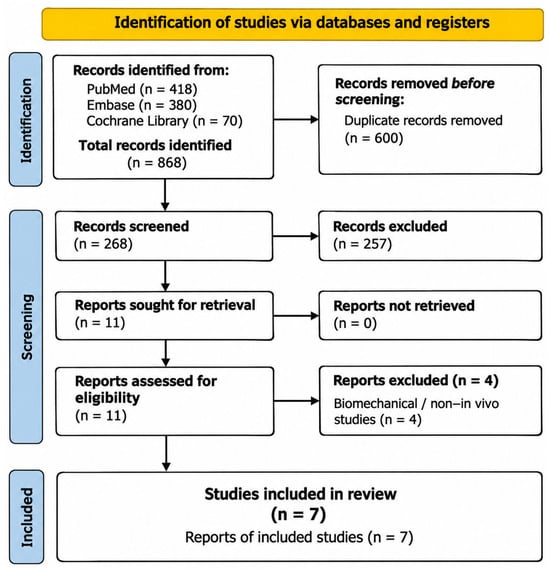
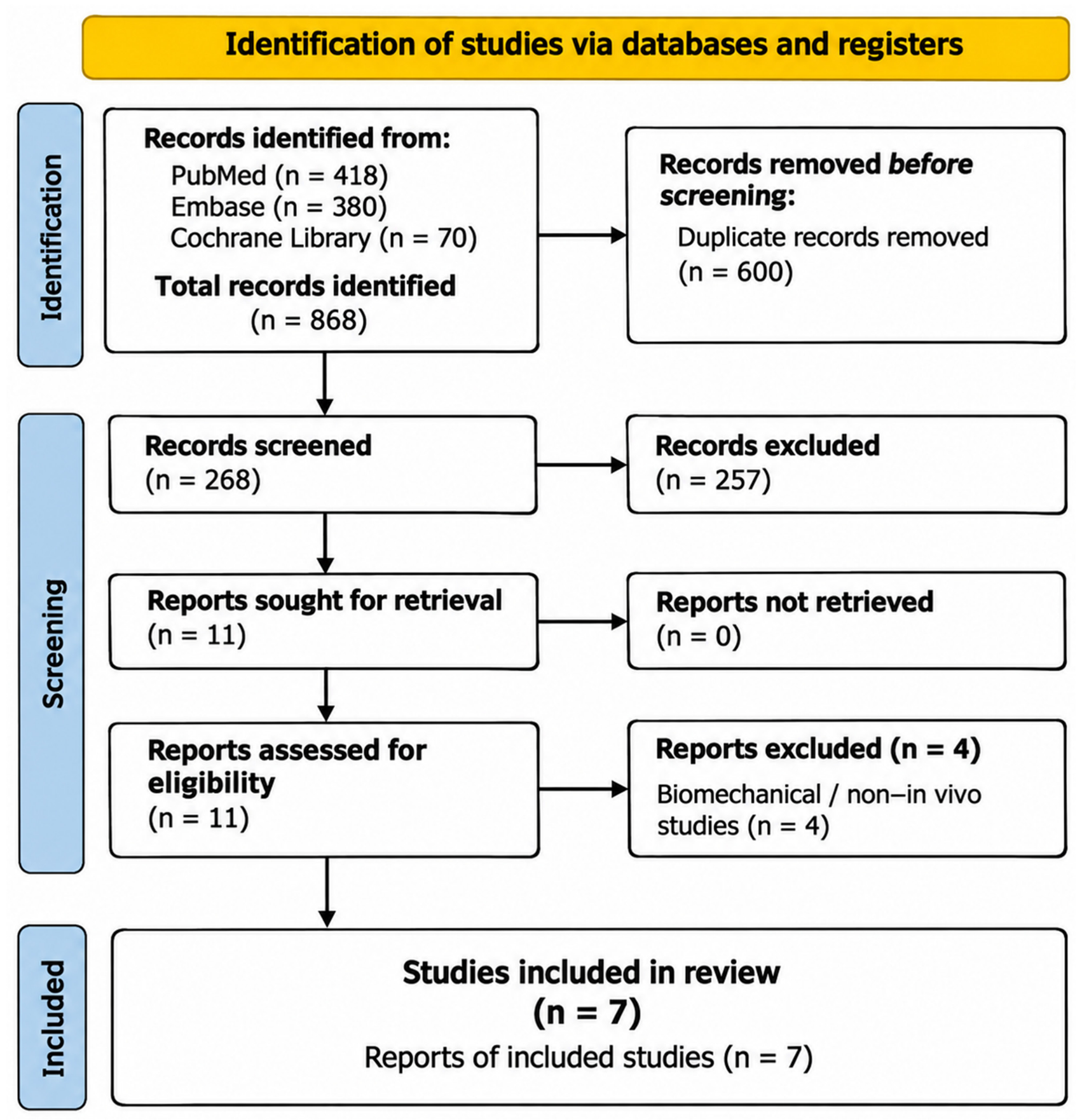
The initial search yielded a total of 268 potentially relevant articles after duplicate removal. After title and abstract selection, 257 articles were excluded. Eleven full-text articles were assessed for eligibility. Four were excluded because they were biomechanical/non in-vivo studies, leaving seven studies for qualitative synthesis [4,9,10,11,12,13,14]. The study selection process is summarized in Figure 1.
Figure 1.
Flowchart of the selection process according to the PRISMA (Preferred Reporting Items for Systematic Reviews and Meta-Analyses) 2020 guidelines.
The seven included studies comprised two observational case–control studies [11,14], four retrospective case series [9,10,12,13], and one cross-sectional design studies [4].
Publication years ranged from 2012 to 2024. Key study characteristics and extracted data are presented in Table 1. Given clinical and methodological heterogeneity, studies were interpreted and presented within predefined evidence domains based on phenotype, diagnostic standard, and clinical setting. Findings were not pooled across domains, and inferences were limited to within-domain interpretation.
Table 1.
Summary of included studies.
2.2. Hip Abductors Surgical Repair Cohorts
Three studies [9,12,13] investigated lumbar spine pathology in patients undergoing hip abductor tendon repair. These studies included 201 surgical cases in the original cohorts, of which 192 were included in the reported analyses. Specifically, Saltzman et al. included 38 of 47 initially enrolled patients, Paul et al. analyzed 23 patients, and Uppstrom et al. reported 131 surgical cases involving 130 individual patients. Among the 192 analyzed cases, 160 (83.3%) were female and 32 (16.7%) were male, with a weighted mean age of 62.6 years.
Uppstrom et al. conducted a retrospective case series evaluating L4–S1 pathology prevalence among 131 surgical cases involving 130 individual patients undergoing GMed repair. L4–S1 pathology was defined as prior L4–S1 decompressive surgery or epidural injections, or electromyography-verified radiculopathy. They reported that among patients undergoing isolated GMed repair, 29.0% had confirmed L4–S1 pathology, and an additional 12.2% showed central or foraminal L4–S1 nerve compression on lumbar MRI. Among patients undergoing combined GMed repair and total hip arthroplasty, 46.2% had confirmed L4–S1 pathology, while 7.6% showed MRI evidence of L4–S1 involvement [13].
Paul et al. conducted a retrospective case series evaluating the prevalence of lumbar pathology and postoperative outcomes following GMed repair in 23 surgical cases involving 22 individual patients [12]. They reported prior lumbar interventions in 73.0% of patients, including epidural injections (21.7%), laminectomy (34.8%), and spinal fusion (30.4%), with some patients receiving multiple procedures [14]. Postoperative iHOT-12 scores were comparable between patients with and without lumbar spine disease, whereas HOS–Activities of Daily Living scores were lower in patients with lumbar spine disease, although this difference did not reach statistical significance.
Saltzman et al. performed a retrospective case series assessing patient-reported outcomes in a consecutive cohort of patients undergoing gluteus medius repair. Patients were assessed with dedicated scoliosis radiographs evaluating sagittal balance (SVA) and Cobb angle [9]. They reported significant improvement in PROs after GMed repair (p < 0.001), but patients with positive sagittal balance (SVA > 0 cm) or scoliosis (Cobb angle >10°) had significantly worse postoperative outcomes [9].
2.3. Lumbar Decompressive Surgery Cohorts
Sasaji et al. assessed GMed weakness by manual muscle testing in 26 consecutive patients before and after lumbar decompressive surgery for L5 radiculopathy due to lumbar disc herniation (LDH) or central/foraminal stenosis [10]. They reported that GMed weakness assessed by manual muscle testing improved in 88% of patients following lumbar decompressive surgery, with complete recovery observed in 65% of cases [10].
2.4. Imaging-Based Lumbar Spine Disease Cohorts
Chong et al. case–control study compared GMed morphology on T2-weighted MRI in 48 patients with LSCS and unilateral buttock pain versus 48 matched controls [11]. They found reduced GMed cross-sectional area (CSA) on the symptomatic side in 81% of lumbar spine stenosis patients [11].
2.5. Chronic Nonspecific Low Back Pain Cohorts
Cooper et al. case–control study compared 150 subjects with chronic non-specific LBP defined as pain anywhere from the inferior rib margin to the gluteal fold for more than 3 months) with a matched cohort of 75 control subjects [14]. They reported that individuals with chronic nonspecific low back pain had significantly weaker GMed strength on manual muscle testing, more frequent Trendelenburg sign, and greater tenderness over the gluteals, greater trochanter, and paraspinals compared with matched controls (p < 0.001) [14].
2.6. Population-Level Database Analyses
In a large population-based analysis using administrative diagnostic codes from the U.S., Lavu et al. assessed gluteal tear prevalence in patients who received lumbar spine diagnoses or underwent lumbar injections and/or lumbar surgeries [4]. Among 8,475,800 patients with a history of lumbar spine disease, lumbar injections, and/or lumbar surgery, 458,311 (5.4%) had a diagnosis of gluteal tendon tears, corresponding to a relative risk of 13.6 (95% CI: 13.6–13.6). After adjustment for age, sex, and obesity, survival analysis over a 13-year period (2010–2023) identified increased hazards of subsequent gluteal tendon tear diagnosis among patients with a previous lumbar spine diagnosis (HR: 4.8; 95% CI: 4.5–5.1), lumbar injections (HR: 7.7; 95% CI: 6.2–9.5), or lumbar surgery (HR: 6.6; 95% CI: 5.3–8.1) recorded in 2010.
2.7. Risk of Bias
Quality assessment was performed using the Newcastle–Ottawa Scale and the Joanna Briggs Institute (JBI) Critical Appraisal Checklists, with tools selected according to study design. Although most studies fulfilled several methodological appraisal criteria, important limitations remained across the included evidence. Regarding the prevalence of concomitant lumbar spine disease among patients with hip abductor tendon pathology, heterogeneous diagnostic criteria and selected surgical populations introduced potential selection and classification biases, thereby limiting the generalizability of prevalence estimates [4,12,13]. Studies investigating hip abductor morphology and function were predominantly cross-sectional or observational, limiting the assessment of temporal relationships and the ability to distinguish neurological muscle dysfunction from structural tendon injury [10,12,14]. Furthermore, studies evaluating postoperative outcomes following hip abductor repair were limited by relatively small sample sizes, retrospective designs, heterogeneous spinal conditions, and incomplete control of potential confounders [9,12]. The population-level database study was additionally subject to potential diagnostic misclassification due to reliance on administrative codes without systematic imaging confirmation [4]. Consequently, favorable checklist scores did not necessarily indicate a low overall risk of bias, and confidence in individual findings was limited by these study-specific methodological considerations. The results of the quality assessment are summarized in Table 2, Table 3, Table 4, Table 5 and Table 6.
Table 2.
Adapted version of the Newcastle–Ottawa Scale quality assessment scale (NOS) for cross-sectional studies, as proposed by Modesti et al. (★ = 1 point; ★★ = 2 points according to the Newcastle–Ottawa Scale scoring system).
Table 3.
Newcastle–Ottawa Scale quality assessment scale (NOS) for case–control studies (★ = 1 point; ★★ = 2 points according to the Newcastle–Ottawa Scale scoring system).
Table 4.
JBI Critical Appraisal Checklist for Analytical Cross-Sectional Studies.
Table 5.
JBI Critical Appraisal Checklist for Case Series.
Table 6.
JBI Critical Appraisal Checklist for Case–Control Study.
3. Discussion
This systematic review synthesizes the available evidence on the relationship between lumbar spine disease and hip abductor pathology across multiple clinical contexts. Collectively, the included studies suggest a coexistence of these conditions, herein referred to as the spine–abductor association. This term is used as a descriptive and conceptual framework rather than a diagnostic or causal entity. The body of evidence is predominantly observational, thereby precluding causal inference. Accordingly, findings should be interpreted as hypothesis-generating, and conclusions are restricted to within-domain associations. Since the overall certainty of evidence remains low, further prospective studies are required to better define causality and clinical impact.
Across surgical, imaging-based, and population-level cohorts, lumbar spine disease was frequently reported among patients with hip abductor pathology. Age- and sex-related factors may represent shared demographic contributors to the observed association. Hip abductor tears were more commonly observed in older individuals and females, a demographic pattern shared with degenerative lumbar spine conditions [15]. In a large population-based analysis, patients with gluteus medius tears were significantly older than those without tears, and females accounted for a greater proportion of the affected cohort [4].
Several studies reported a high prevalence of lumbar spine disease among patients undergoing hip abductor repair. In population-level data, a substantial proportion of patients diagnosed with gluteal tendon tears had a documented history of lumbar spine disease [4]. Single-institution surgical cohorts similarly reported frequent coexistence of lumbar pathology among patients treated for gluteus medius tears, including prior lumbar interventions and MRI evidence of lumbosacral disease [12,13]. Although prevalence estimates varied according to diagnostic criteria and study design, these findings were consistently reported across distinct clinical settings.
Spinal alignment and lumbar disease were suggested to influence outcomes following hip abductor repair. However, findings regarding the influence of concomitant lumbar spine disease on postoperative outcomes following hip abductor repair were inconsistent. Paul et al. [12] did not find statistically significant differences in postoperative scores between patients with and without lumbar spine disease. Conversely, Saltzman et al. [9] reported significantly worse postoperative outcomes among patients with sagittal imbalance or coronal plane deformity, despite overall improvements following gluteus medius repair. These differences may reflect heterogeneity in lumbar spine conditions and spinal alignment parameters, surgical populations, and outcome measures. Moreover, the small sample sizes and retrospective designs limit definitive conclusions regarding the independent influence of lumbar spine disease on outcomes following hip abductor repair.
Functional and imaging-based studies further described alterations in hip abductor morphology and performance across different lumbar spine-related clinical populations. Imaging studies reported reduced gluteus medius cross-sectional area in patients with lumbar spinal canal stenosis [11], whereas a case–control study of chronic nonspecific low back pain identified reduced hip abductor strength, a higher prevalence of a positive Trendelenburg sign, and increased tenderness compared with matched controls [14]. However, chronic nonspecific low back pain does not necessarily indicate structural lumbar spine disease, and neither reduced muscle cross-sectional area nor impaired abductor function establishes the presence of tendon injury. These findings should therefore be interpreted as evidence of morphological and functional associations rather than structural tendon pathology or causal relationships.
Several biomechanical mechanisms have been proposed to contextualize the observed associations, although these remain hypothetical and were not directly investigated by the studies included in this systematic review. Altered lumbar mobility associated with degenerative changes or previous spinal surgery may influence spinopelvic alignment and hip biomechanics [16]. These alterations have been proposed to contribute to femoroacetabular and ischiofemoral impingement [17,18,19]. Furthermore, age-related sagittal imbalance may modify femoral positioning and increase mechanical demands on the anterior gluteal fibers, where tendon tears frequently occur [20]. Collectively, these proposed alterations in hip biomechanics could contribute to increased abductor loading and tendon degeneration. However, these pathways remain speculative, and their potential contribution to structural tendon injury requires further prospective biomechanical and clinical investigation.
Neuroanatomical mechanisms may also contribute to the observed association. Compression of the L4–S1 nerve roots, which contribute to the superior gluteal nerve, may result in gluteus medius weakness or atrophy [21,22]. Electromyographic and imaging studies reporting altered muscle activation patterns and reduced muscle bulk among patients with lumbar spine disease are consistent with a potential neurological contribution to hip abductor dysfunction [23]. Similarly, improvements in hip abductor strength following lumbar decompressive surgery suggest a possible neurological component of muscle weakness [10]. However, these findings concern muscle function and morphology rather than structural tendon integrity.
Altered gait mechanics may represent an additional potential pathway linking lumbar spine conditions and hip abductor dysfunction. Neurogenic claudication and radiculopathy may be accompanied by compensatory gait patterns, potentially modifying mechanical demands on the hip abductors [24,25,26]. Similarly, coronal plane deformities such as scoliosis may contribute to asymmetric loading, although their direct effects on hip abductor tendon integrity remain uncertain [23,27,28]. Altered gluteus medius activation patterns during gait have also been reported among patients with scoliosis [29]. Nevertheless, whether these functional and biomechanical adaptations contribute to tendon overload or degeneration has not been established and requires further prospective investigation.
From a clinical perspective, the observed coexistence of lumbar spine conditions and hip abductor dysfunction highlights the importance of considering both conditions during clinical evaluation, particularly in patients presenting with gait abnormalities or a history of lumbar spine disease. Recognition of concomitant pathology may be relevant to patient counseling and decisions regarding surgical timing. However, the available evidence does not establish whether specific diagnostic strategies or treatment sequences improve clinical outcomes.
This systematic review has several limitations. First, the absence of specific search terms related to gluteal tendon pathology, greater trochanteric pain syndrome, sagittal imbalance, and spinal deformity may have reduced search sensitivity and resulted in the omission of potentially relevant studies. Second, the available evidence was predominantly derived from level IV studies, with some level III evidence from observational case–control studies. The predominance of retrospective and uncontrolled study designs inherently limits causal inference. Plus, several studies involved relatively small sample sizes, heterogeneous inclusion criteria, and selected clinical populations, potentially introducing selection bias and limiting generalizability. Furthermore, considerable heterogeneity existed in the definitions of both lumbar spine conditions and hip abductor pathology. In particular, structural tendon lesions, muscle weakness, atrophy, and functional impairment were investigated across different studies, although these findings represent distinct clinical entities. Similarly, lumbar spine involvement was variably defined through clinical history, imaging findings, previous interventions, or nonspecific low back pain, limiting comparability across populations. Diagnostic modalities and imaging protocols were also heterogeneous, with inconsistent assessment of muscle morphology and tendon integrity. Moreover, several studies did not adequately control for potential confounding factors. The predominantly cross-sectional and retrospective nature of the evidence further limits the assessment of temporal relationships between lumbar spine conditions and hip abductor pathology. Regarding surgical outcomes, variability in operative techniques, incomplete preoperative data, heterogeneous patient-reported outcome measures, and differences in follow-up duration limited direct comparisons and precluded quantitative synthesis. Population-level database analyses were additionally subject to potential diagnostic misclassification and incomplete clinical characterization, particularly because tendon injuries identified through administrative codes were not systematically confirmed by imaging. Finally, although the Newcastle–Ottawa Scale and Joanna Briggs Institute critical appraisal tools yielded generally favorable assessments, these findings should be interpreted cautiously, as fulfillment of individual methodological criteria does not overcome the limitations inherent to retrospective and uncontrolled studies. Overall, these methodological considerations limit the strength of the available evidence and preclude definitive conclusions regarding causality and the influence of concomitant lumbar spine conditions on surgical outcomes.
4. Materials and Methods
4.1. Protocol and Registration
This systematic review was conducted in accordance with 2020 PRISMA guidelines. The protocol was registered in PROSPERO (CRD420251184800).
4.2. Search Strategy and Selection Process
A systematic literature search was conducted in PubMed/MEDLINE, Embase, and the Cochrane Library, with the last search performed in April 2025. The search strategy combined free-text terms related to hip abductor pathology and lumbar spine conditions using Boolean operators (AND, OR). Grey literature sources or preprint servers were not searched, because they may introduce publication bias by potentially excluding relevant unpublished or non-peer-reviewed studies. A representative PubMed search string was: ((hip abductor OR gluteus medius OR gluteus minimus OR abductor tendon OR gluteal tendon) AND (lumbar spine OR lumbosacral OR spine OR lumbar disease OR lumbar stenosis OR lumbar radiculopathy)). Full database-specific search strategies are detailed in Appendix A. The search strategy was peer-reviewed using the PRESS checklist. After removal of duplicates, two reviewers (M.M. and B.D.M.) independently screened all titles and abstracts for eligibility. Full texts of potentially relevant studies were then assessed independently. Prior to the screening process, a calibration exercise was conducted on a subset of studies. Inter-rater agreement between reviewers was assessed using Cohen’s kappa coefficient, demonstrating substantial agreement (κ = 0.87). Discrepancies during screening or data extraction were resolved through discussion or consultation with a third reviewer (E.K.). No automation tools were used in the screening process.
4.3. Eligibility Criteria
Eligible studies included adults (≥18 years) with hip abductor pathology and/or lumbar spine disease. Eligible studies were considered according to the specific hip abductor condition investigated, distinguishing structural tendon pathology (tears or tendinopathy) from muscle dysfunction (weakness, atrophy, or functional impairment). Similarly, lumbar spine conditions were differentiated according to their clinical presentation and diagnostic characterization. These conditions were not considered interchangeable, and findings were synthesized accordingly. Studies were required to evaluate the association between hip abductor and lumbar spine pathology, including prevalence, functional or surgical outcomes. Studies considered were randomized controlled trials, prospective and retrospective cohort studies, case–control studies, and case series with ten or more patients. Only studies published in English were included. No date restrictions were applied during the literature search; all studies published up to the 15 April 2025 were considered for inclusion regardless of publication year.
4.4. Data Collection Process
Data extraction was performed independently by two reviewers (M.M. and B.D.M.) using a standardized form. Extracted information included study characteristics, participant demographics, diagnostic criteria, interventions, and reported outcomes. Disagreements were resolved by consensus.
4.5. Data Items
Data items included: study design and sample size; patient demographics (age, sex, BMI); diagnostic methods for hip abductor and lumbar pathology; pre- and postoperative findings; patient-reported outcome measures (PROs); imaging or biomechanical results; and surgical outcomes when applicable.
4.6. Risk of Bias Assessment
Risk of bias was assessed independently by two reviewers (M.M. and V.L.). For observational studies, the Newcastle-Ottawa Scale (NOS) was used to evaluate selection, comparability, and outcome domains. For cross-sectional studies, an adapted version of the Newcastle–Ottawa Scale (NOS), as proposed by Modesti et al. [30] was used. In addition, the Joanna Briggs Institute (JBI) critical appraisal checklists were used for case series and cross-sectional studies [31], providing a complement ary assessment tailored to their methodological characteristics. Appraisal findings were interpreted considering individual methodological domains and the limitations inherent to each study design, rather than relying exclusively on numerical quality scores. Agreement between reviewers was excellent (Cohen’s κ = 0.92), and disagreements were resolved by consensus. No automation tools were used.
4.7. Effect Measures
For studies reporting quantitative associations, effect measures such as risk ratios, odds ratios, and mean differences were extracted or recorded when available.
4.8. Synthesis Methods
Due to heterogeneity in study design, populations, and outcomes, results were synthesized using a structured narrative approach. Findings were interpreted according to study design. No causal inferences were drawn across designs. Given variability across studies, outcome definitions were recorded as reported by the original authors. Hip abductor tears were defined based on imaging (MRI or ultrasound), intraoperative findings, or surgical indication, depending on study design. Lumbar spine involvement encompassed a range of definitions, including documented lumbar diagnoses, imaging evidence of central or foraminal stenosis, electromyography-confirmed radiculopathy, or history of lumbar interventions (e.g., injections or surgery). Radiculopathy was defined as clinically diagnosed nerve root involvement confirmed by imaging or electromyography when available. Due to heterogeneity in definitions, prevalence and association estimates were interpreted descriptively rather than quantitatively pooled.
5. Conclusions
The available literature suggests that lumbar spine conditions frequently coexist with hip abductor tendon pathology, although prevalence estimates vary across clinical populations and diagnostic criteria. Furthermore, lumbar spine conditions have been associated with alterations in hip abductor morphology and function, but a direct relationship with structural tendon injury has not been established. Evidence regarding the influence of concomitant lumbar spine disease on outcomes following hip abductor repair remains limited and inconsistent. Overall, these findings support an association between lumbar spine conditions and different aspects of hip abductor pathology, although causal relationships remain uncertain. Further prospective studies are warranted to clarify these relationships and their implications for clinical evaluation, patient counseling, and surgical decision-making.
Author Contributions
Conceptualization: M.M. and F.D.R.; methodology: M.M., V.L. and B.D.M.; investigation: M.M., V.L., G.A. and P.C.; data curation: M.M., V.L., G.A. and P.C.; formal analysis: M.M. and V.L.; writing—original draft preparation: M.M.; writing—review and editing: M.M., B.D.M., V.L., G.A., P.C., E.K. and F.D.R.; supervision: B.D.M., E.K. and F.D.R. All authors have read and agreed to the published version of the manuscript.
Funding
This research received no external funding.
Institutional Review Board Statement
Not applicable.
Informed Consent Statement
Not applicable.
Data Availability Statement
No new data were created or analyzed in this study. Data sharing is not applicable to this article.
Conflicts of Interest
The authors declare no conflicts of interest.
Appendix A
Pubmed:
((“hip abductor”[Title/Abstract] OR “hip abductors”[Title/Abstract] OR
“gluteus medius”[Title/Abstract] OR “gluteus minimus”[Title/Abstract] OR
“abductor tendon*”[Title/Abstract] OR “gluteal tendon*”[Title/Abstract])
AND
(“lumbar spine”[Title/Abstract] OR spine[Title/Abstract] OR lumbosacral[Title/Abstract] OR
“lumbar disease”[Title/Abstract] OR “lumbar stenosis”[Title/Abstract] OR
“lumbar radiculopathy”[Title/Abstract]))
Embase:
(‘hip abductor*’:ti,ab OR ‘gluteus medius’:ti,ab OR ‘gluteus minimus’:ti,ab OR
‘abductor tendon*’:ti,ab OR ‘gluteal tendon*’:ti,ab)
AND
(‘lumbar spine’:ti,ab OR spine:ti,ab OR lumbosacral:ti,ab OR
‘lumbar disease’:ti,ab OR ‘lumbar stenosis’:ti,ab OR ‘lumbar radiculopathy’:ti,ab)
Cochrane Library:
((“hip abductor*” OR “gluteus medius” OR “gluteus minimus” OR
“abductor tendon*” OR “gluteal tendon*”)
AND
(“lumbar spine” OR spine OR lumbosacral OR “lumbar disease” OR
“lumbar stenosis” OR “lumbar radiculopathy”))
References
- Kenanidis, E.; Kyriakopoulos, G.; Kaila, R.; Christofilopoulos, P. Lesions of the abductors in the hip. EFORT Open Rev. 2020, 5, 464–476. [Google Scholar] [CrossRef] [Scilit] [PubMed] [PubMed Central]
- Albers, I.S.; Zwerver, J.; Diercks, R.L.; Dekker, J.H.; Van den Akker-Scheek, I. Incidence and prevalence of lower extremity tendinopathy in a Dutch general practice population: A cross sectional study. BMC Musculoskelet. Disord. 2016, 17, 16. [Google Scholar] [CrossRef] [Scilit] [PubMed] [PubMed Central]
- Kameda, M.; Tanimae, H.; Kihara, A.; Matsumoto, F. Does low back pain or leg pain in gluteus medius syndrome contribute to lumbar degenerative disease and hip osteoarthritis and vice versa? A literature review. J. Phys. Ther. Sci. 2020, 32, 173–191. [Google Scholar] [CrossRef] [Scilit] [PubMed] [PubMed Central]
- Lavu, M.S.; Hecht, C.J., 2nd; Kaelber, D.C.; Grammatopoulos, G.; Homma, Y.; Kamath, A.F. Spine-Abductor Syndrome: Novel Associations Between Lumbar Spine Disease and Hip Gluteal Muscle Pathology. J. Bone Jt. Surg. Am. 2024, Epub ahead of print. [Google Scholar] [CrossRef] [Scilit] [PubMed]
- Sadler, S.; Cassidy, S.; Peterson, B.; Spink, M.; Chuter, V. Gluteus medius muscle function in people with and without low back pain: A systematic review. BMC Musculoskelet. Disord. 2019, 20, 463. [Google Scholar] [CrossRef] [Scilit] [PubMed] [PubMed Central]
- Nadler, S.F.; Malanga, G.A.; DePrince, M.; Stitik, T.P.; Feinberg, J.H. The relationship between lower extremity injury, low back pain, and hip muscle strength in male and female collegiate athletes. Clin. J. Sport Med. 2000, 10, 89–97. [Google Scholar] [CrossRef] [Scilit] [PubMed]
- Pilz, B.; Vasconcelos, R.A.; Teixeira, P.P.; Mello, W.; Oliveira, I.O.; Ananias, J.P.; Timko, M.; Grossi, D.B. Comparison of Hip and Lumbopelvic Performance Between Chronic Low Back Pain Patients Suited for the Functional Optimization Approach and Healthy Controls. Spine J. 2020, 20, 1613–1622. [Google Scholar]
- Cynn, L.-S.; Oh, J.-S.; Kwon, O.-Y.; Yi, C.-H. Effects of Lumbar Stabilization Using a Pressure Biofeedback Unit on Muscle Activity and Lateral Pelvic Tilt During Hip Abduction in Sidelying. Arch. Phys. Med. Rehabil. 2006, 87, 1454–1458. [Google Scholar] [CrossRef] [Scilit] [PubMed]
- Saltzman, B.M.; Louie, P.K.; Clapp, I.M.; Beck, E.C.; Neal, W.H.; Ukwuani, G.C.; Nho, S.J. Assessment of association between spino-pelvic parameters and outcomes following gluteus medius repair. Arthroscopy 2019, 35, 1092–1098. [Google Scholar] [CrossRef] [Scilit] [PubMed]
- Sasaji, T.; Horaguchi, K.; Yamada, N.; Iwai, K. Improvement of hip abductor muscle weakness after lumbar decompressive surgery. Ups. J. Med. Sci. 2012, 117, 426–429. [Google Scholar] [CrossRef] [Scilit] [PubMed]
- Chong, F.; Fan, W.; Liu, L.; Zhang, Y.; Lin, H.; Huang, B. Correlation Between Atrophy of the Gluteus Medius Muscle and Symptoms of Lumbar Spinal Stenosis. World Neurosurg. 2023, 172, e177–e184. [Google Scholar] [CrossRef] [Scilit] [PubMed]
- Paul, K.D.; Hargreaves, M.; Manfredi, J.N.; Cooke, B.; Crawford, A.; Evely, T.; Brabston, E.; Casp, A.; Momaya, A.; Marshall, T.P.; et al. High incidence of lumbar pathology in patients undergoing endoscopic gluteus medius repair. J. Orthop. 2024, 47, 18–22. [Google Scholar] [PubMed]
- Uppstrom, T.J.; Siljander, B.R.; Menta, S.V.; Baldwin, R.B.; Cecere, R.; DeFrancesco, C.J.; Kelly, B.T.; Ranawat, A.; Ranawat, A.S. High rate of concomitant lumbo-sacral spine pathology in the setting of hip abductor tendon repair. J. Arthroplast. 2024, 39, S61–S66. [Google Scholar] [CrossRef] [Scilit] [PubMed]
- Cooper, N.A.; Scavo, K.M.; Strickland, K.J.; Tipayamongkol, N.; Nicholson, J.D.; Bewyer, D.C.; Sluka, K.A. Prevalence of gluteus medius weakness in people with chronic low back pain compared to healthy controls. Eur. Spine J. 2016, 25, 1258–1265. [Google Scholar] [CrossRef] [Scilit] [PubMed]
- Kim, Y.K.; Kang, D.; Lee, I.; Kim, S.Y. Differences in the Incidence of Symptomatic Cervical and Lumbar Disc Herniation According to Age, Sex and National Health Insurance Eligibility: A Pilot Study on the Disease’s Association with Work. Int. J. Environ. Res. Public Health 2018, 15, 2094. [Google Scholar] [CrossRef] [Scilit] [PubMed] [PubMed Central]
- DelSole, E.M.; Vigdorchik, J.M.; Schwarzkopf, R.; Errico, T.J.; Buckland, A.J. Total hip arthroplasty in the spinal defor-mity population: Does degree of sagittal deformity affect rates of safe zone placement, instability, or revision? J. Arthroplast. 2017, 32, 1910–1917. [Google Scholar] [CrossRef] [Scilit] [PubMed]
- Vaswani, R.; White, A.E.; Feingold, J.; Ranawat, A.S. Hip-Spine Syndrome in the Nonarthritic Patient. Arthroscopy 2022, 38, 2930–2938. [Google Scholar] [CrossRef] [Scilit] [PubMed]
- Kheterpal, A.B.; Harvey, J.P.; Husseini, J.S.; Martin, S.D.; Torriani, M.; Bredella, M.A. Hip abductor tears in ischiofemoral impingement. Skelet. Radiol. 2020, 49, 1747–1752. [Google Scholar] [CrossRef] [Scilit] [PubMed]
- Khoury, A.N.; Hatem, M.; Bowler, J.; Martin, H.D. Hip-spine syndrome: Rationale for ischiofemoral impingement, femoroacetabular impingement and abnormal femoral torsion leading to low back pain. J. Hip Preserv Surg. 2020, 7, 390–400. [Google Scholar] [CrossRef] [Scilit] [PubMed] [PubMed Central]
- Boymans, T.A.E.J.; Veldman, H.D.; Noble, P.C.; Heyligers, I.C.; Grimm, B. The Femoral Head Center Shifts in a Mediocaudal Direction During Aging. J. Arthroplast. 2017, 32, 581–586. [Google Scholar] [CrossRef] [Scilit] [PubMed]
- Katz, J.N.; Zimmerman, Z.E.; Mass, H.; Makhni, M.C. Diagnosis and Management of Lumbar Spinal Stenosis: A Review. JAMA 2022, 327, 1688–1699. [Google Scholar] [CrossRef] [Scilit] [PubMed]
- Zhu, L.; Lin, H.D.; Chen, A.M. Accurate segmental motor innervation of human lower-extremity skeletal muscles. Acta Neurochir. 2015, 157, 123–128. [Google Scholar] [CrossRef] [Scilit] [PubMed]
- Shin, S.S.; Yoo, W.G. Stepping over an obstacle in patients with lumbar spinal stenosis: Trunk and lower extremities of kinematic and muscle activation normalized by double limb support. A preliminary study. Technol. Health Care 2019, 27, 1–11. [Google Scholar] [CrossRef] [Scilit] [PubMed]
- Kreiner, D.S.; Shaffer, W.O.; Baisden, J.L.; Gilbert, T.J.; Summers, J.T.; Toton, J.F.; Hwang, S.W.; Mendel, R.C.; Reitman, C.A.; North American Spine Society. An evidence-based clinical guideline for the diagnosis and treatment of degenerative lumbar spinal stenosis (update). Spine J. 2013, 13, 734–743. [Google Scholar] [CrossRef] [Scilit] [PubMed]
- Gottschalk, F.; Kourosh, S.; Leveau, B. The functional anatomy of tensor fasciae latae and gluteus medius and minimus. J. Anat. 1989, 166, 179–189. [Google Scholar] [PubMed] [PubMed Central]
- Gandbhir, V.N.; Lam, J.C.; Lui, F.; Rayi, A. Trendelenburg Gait. In StatPearls; StatPearls Publishing: Treasure Island, FL, USA, 2024. [Google Scholar]
- Vogt, L.; Pfeifer, K.; Portscher And, M.; Banzer, W. Influences of nonspecific low back pain on three-dimensional lumbar spine kinematics in locomotion. Spine 2001, 26, 1910–1919. [Google Scholar] [CrossRef] [Scilit] [PubMed]
- Grimaldi, A. Assessing lateral stability of the hip and pelvis. Man. Ther. 2011, 16, 26–32. [Google Scholar] [CrossRef] [Scilit] [PubMed]
- Mahaudens, P.; Banse, X.; Mousny, M.; Detrembleur, C. Gait in adolescent idiopathic scoliosis: Kinematics and electromyographic analysis. Eur. Spine J. 2009, 18, 512–521. [Google Scholar] [CrossRef] [Scilit] [PubMed] [PubMed Central]
- Modesti, P.A.; Reboldi, G.; Cappuccio, F.P.; Agyemang, C.; Remuzzi, G.; Rapi, S.; Perruolo, E.; Parati, G. ESH Working Group on CV Risk in Low Resource Settings. Panethnic Differences in Blood Pressure in Europe: A Systematic Review and Meta-Analysis. PLoS ONE 2016, 11, e0147601. [Google Scholar] [CrossRef] [Scilit] [PubMed] [PubMed Central]
- Moola, S.; Munn, Z.; Tufanaru, C.; Aromataris, E.; Sears, K.; Sfetcu, R.; Currie, M.; Lisy, K.; Qureshi, R.; Mattis, P.; et al. Systematic reviews of etiology and risk. In JBI Manual for Evidence Synthesis; Aromataris, E., Lockwood, C., Porritt, K., Pilla, B., Jordan, Z., Eds.; JBI: North Adelaide, SA, Australia, 2024. [Google Scholar] [CrossRef] [Scilit]

Disclaimer/Publisher’s Note: The statements, opinions and data contained in all publications are solely those of the individual author(s) and contributor(s) and not of MDPI and/or the editor(s). MDPI and/or the editor(s) disclaim responsibility for any injury to people or property resulting from any ideas, methods, instructions or products referred to in the content. |
© 2026 by the authors. Licensee MDPI, Basel, Switzerland. This article is an open access article distributed under the terms and conditions of the Creative Commons Attribution (CC BY) license.