


Abstract
Rambutan peel, an abundant agro-industrial by-product, is a rich source of ellagitannins (ETs) and represents a promising substrate for the sustainable production of ellagic acid (EA) through solid-state fermentation (SSF). This study aimed to optimize EA release from rambutan peel ETs by SSF using Saccharomyces cerevisiae 227 in column reactors. We applied a central composite design (CCD) to evaluate and optimize the effects of temperature, NaCl concentration, and peptone supplementation on EA production. We also used HPLC/ESI/MS to identify and quantify EA. Maximum EA yields were obtained under central experimental conditions (treatments 15 and 16: 35 °C, 0.53 g/L NaCl, and 8 g/L peptone), reaching 8.36 ± 1.58 and 8.23 ± 0.52 mg/g, respectively. The predictive model estimated a maximum EA production of 8.29 mg/g, experimentally validated, at 34.6 °C, 0.58 g/L NaCl, and 8.26 g/L peptone, yielding 8.27 ± 0.47 mg/g. HPLC/ESI/MS analysis further confirmed EA formation and the presence of biodegradation products derived from geraniin and corilagin, indicating effective ET biotransformation. These findings establish optimized conditions for EA production from rambutan peel ETs via SSF and demonstrate the feasibility of implementing a sustainable bioprocess for the valorization of this agro-industrial residue.
1. Introduction
The integration of bioactive compounds into the food and medical sectors has become increasingly important. Consequently, functional foods have emerged as an essential category, as they contain biologically active components that exert beneficial effects on one or more bodily functions. Furthermore, these foods are often processed through biotechnology to enhance their therapeutic properties [1]. One such compound is ellagic acid (EA; C14H6O8), a polyphenol of great interest due to its chemical stability, attributed to its hydroxyl groups, which confer biological properties such as antioxidant, antimicrobial, oxidative stress, anti-inflammatory, and anti-obesity properties [2,3,4]. Their incorporation into functional foods represents a significant challenge, as the aim is to neutralize reactive oxygen species and regulate gene expression related to inflammation. Consequently, the development of EA-enriched foods depends on several factors, particularly stability; in this regard, techniques such as microencapsulation in biopolymer matrices have been employed to protect the compound and ensure controlled release [5]. This compound is naturally present in pomegranate peel, mango, walnuts, creosote bush leaves, and rambutan peel [6].
Rambutan (Nephelium lappaceum L.) is a widely consumed tropical fruit, both fresh and processed. However, the peel of this fruit is discarded and considered agro-industrial waste of great interest because it is considered a rich source of bioactive compounds, particularly ellagitannins (ETs) [7,8,9,10,11]. ETs are compounds belonging to the hydrolyzable tannins, which are phenolic compounds associated with the tannin group. They are composed of esters that include one or more units of hexahydroxydiphenic acid (HHDP) and galloyl units attached to a central sugar nucleus. Different characteristics of ETs include their non-crystalline appearance, ranging in color from pale yellow to light brown, and a bitter taste [12]. Among these ETs, geraniin and corilagin are the main components [13]. The importance of identifying these compounds lies in the fact that their polyphenolic chemical structures can be exploited and transformed through biodegradation processes to release EA that is bound.
EA has traditionally been released from ETs by applying acid or alkaline hydrolysis. However, these methods exhibit several drawbacks, including low yields, high production cost, and the formation of undesirable by-products [14]. Conventional extraction techniques, such as maceration at room temperature and Soxhlet extraction, are used to extract polyphenolic compounds from various plants. These techniques use solvents such as ethyl acetate, acetone, chloroform, ethanol, methanol, and water. However, solvent extraction has disadvantages, such as excessive solvent use, pollution, and time and energy consumption [15]. On the other hand, the adoption of green technologies such as ultrasound-assisted extraction, microwave-assisted extraction, and supercritical fluid extraction has proven effective for EA recovery. However, these processes are still limited by high energy consumption, substantial solvent requirements, and inherent operational complexities [8,14].
A sustainable biotechnological alternative for EA release is solid-state fermentation (SSF). This technique stands out for its use of agro-industrial waste substrates as a source of carbon and energy for the microorganism. The use of inert supports such as polyurethane foam (PUF), which has no nutritional value and needs to be impregnated with the liquid culture medium to supply the necessary nutrients and allow the microorganism to develop [16], low water consumption compared to the other fermentation processes, reduced risk of contamination during the process, and the use of GRAS (Generally Recognized As Safe) microorganisms such as Saccharomyces cerevisiae, which has played an essential role in this field due to its ability to biologically degrade complex structures such as geraniin and corilagin into EA. These benefits, combined with low energy consumption and the ability to replicate the natural environment of various microorganisms, consolidate SSF as a robust and sustainable alternative for the efficient extraction of bioactive phenolic compounds [2,17,18]. The efficiency of EA release through SSF will depend on the factors evaluated in the biotechnological process. For this reason, it is essential to have tools that allow for precise control of these variables. In this framework, response surface methodology (RSM) is a valuable mathematical-statistical tool that allows process conditions to be optimized and interactions between factors to be evaluated, reducing the number of experiments required and providing a cost-effective, robust design through the implementation of experimental designs such as the central composite design (CCD). Within the field of bioprocesses, RSM is key to maximizing the production of bioactive compounds of interest and optimizing culture media, temperature, and substrate concentration. Furthermore, this methodology allows the identification of optimal conditions using second-order polynomial models, thereby ensuring greater efficiency and facilitating scaling up to an industrial level [19,20]. Under this premise, the objective of this study was to optimize the SSF process in column reactors to produce EA from rambutan peel ETs.
2. Materials and Methods
2.1. Substrate
The substrate in this study was ETs from rambutan peel (Soconusco, Chiapas, Mexico). ETs extraction was using previously reported conditions: a hybrid ultrasound/microwave process (1 L of water and 62.5 g of rambutan peel powder; ultrasound: 25 kHz; microwave: 2450 kHz for 20 min). Subsequently, the partial purification was performed using chromatography on an Amberlite XAD-16 (Sigma-Aldrich, St. Louis, MO, USA) column with water to remove undesirable compounds and absolute ethanol to elute the target compounds. Evaporation of the ethanolic fraction was in a conventional oven at 40 °C, and partially purified ETs were stored in light-protected plastic containers [13,21].
2.2. Microorganism
Saccharomyces cerevisiae 227 (collection of Instituto Tecnológico de Durango, Mexico) was the microorganism in this study. The reactivation of the strain was made using PDA agar incubated at 30 °C for 3 days. Once reactivated, the cell count was obtained using a Neubauer chamber.
2.3. Solid-State Fermentation Extraction-Assisted of EA
Solid-state fermentation was carried out in polypropylene column reactors (14 cm × 3 cm) using ETs from rambutan peel (7.5 g/L) and polyurethane foam (PUF) as an inert support (3 dry support). The culture medium was adjusted to pH 5.0 and inoculated with 1.5 × 10⁷ cells/g to achieve a final moisture of 60%. To optimize the EA release from an initial content of 0.71 mg/g (control), a central composite design (CCD) was implemented based on the parameters reported by De La Rosa-Esteban et al. (2025) [22]. The independent variables evaluated included temperature (29.7, 33, 35, 37, and 40.36 °C), NaCl (0, 0.23, 0.53, 0.83, and 1.33 g/L), and peptone (2.64, 6, 8, 10, and 13.36 g/L). Each variable was assessed at three levels (low, medium, and high), including two axial points (−α and α) and six central points (Table 1). The response variable was EA concentration, measured after 24 h of recovery. Identification and quantification of EA were via HPLC/ESI/MS. All experiments were done in triplicate.
Table 1.
Experimental matrix and evaluated factors of the central composite design.
2.4. Quantification and Identification of EA by HPLC/ESI/MS
The characterization and quantification of the recovered EA were analyzed by HPLC/ESI/MS. (Varian Prostar, Santa Clara, CA, USA) following the methodology described by De León-Medina et al. (2025) [23]. The fermented extracts were filtered (0.45 um). The analyses via Reverse Phase–High Performance Liquid Chromatography were performed on a Varian HPLC system comprising an autosampler (Varian ProStar 410, USA), a ternary pump (Varian ProStar 230I, USA), and a PDA detector (Varian ProStar 330, USA). Also, a liquid chromatograph–ion trap mass spectrometer (Varian 500-MS IT Mass Spectrometer, USA) equipped with an electrospray ion source was used. Samples (5 µL) were injected into a Denali C18 column (150 mm × 2.1 mm, 3 µm, Grace, Palo Alto, CA, USA). The oven temperature was 30 °C. The eluents were formic acid (0.2%, v/v; solvent A) and acetonitrile (solvent B). The applied gradient was initial, 3% B; 0–5 min, 9% B linear; 5–15 min, 16% B linear; 15–45 min, 50% B linear. The column was then washed and reconditioned. The flow rate was 0.2 mL/min, and the elution readings were 254, 280, 320, and 550 nm. The entire effluent (0.2 mL/min) was injected into the mass spectrometer source without splitting. All MS experiments were performed in negative mode [M-H]-. Nebulizing gas was nitrogen, and helium was the damping gas. The ion source parameters were a spray voltage of 5.0 kV and capillary voltage and temperature of 90.0 V and 350 °C, respectively. Data were collected and processed using MS Workstation software (V 6.9). The first sample analysis was in full-scan mode over the m/z range 50–2000. MS/MS analyses were performed on a series of selected precursor ions. EA concentration was determined by referencing a standard calibration curve of ellagic acid ranging from 0 to 1000 ppm.
2.5. Statistical Analysis
A central composite design (CCD) was constructed and analyzed using STATISTICA 7.0 (StatSoft, Tulsa, OK, USA) (Table 1). The resulting data were subjected to ANOVA and post hoc comparison using Tukey’s test (p < 0.05) in OriginPro 2024. All experiments were performed in triplicate, and the corresponding results are reported. The influence of each factor was assessed through a Pareto chart based on the absolute values of statistically significant effects. Optimal conditions were estimated from the regression coefficients of each term and their interactions, with significance established at p < 0.05. Experimental data and regression coefficients were fitted using the linear regression model presented in Equation (1).
where Y represents the response variable (EA, expressed in mg/g); Xi and Xj represent the independent variables; k represents the number of variables evaluated; and β0, βi, βii, and βij are the regression coefficients for the intercept, linear and quadratic terms, and interaction effect.
2.6. Validation of the Model
Optimal conditions for obtaining EA from rambutan peel ETs (temperature, NaCl, and peptone) were determined from the predictive surface response equation. Comparison between the experimental values and predicted values was used to validate the model.
3. Results
3.1. Ellagic Acid Release and Influence Factors
Table 2 presents the results of the EA release and the coded levels of the variables studied in the CCD. Although maximum EA release is observed in treatments 15 and 16, which correspond to the central treatments, yielding 8.36 ± 1.58 and 8.23 ± 0.52 mg/g, respectively, under SSF conditions of 35 °C temperature, 0.53 g/L NaCl, and 8 g/L peptone.
Table 2.
Experimental matrix of the treatments of the CCD with respect to EA release.
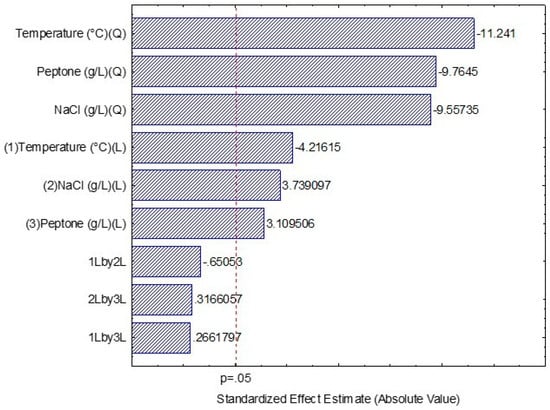
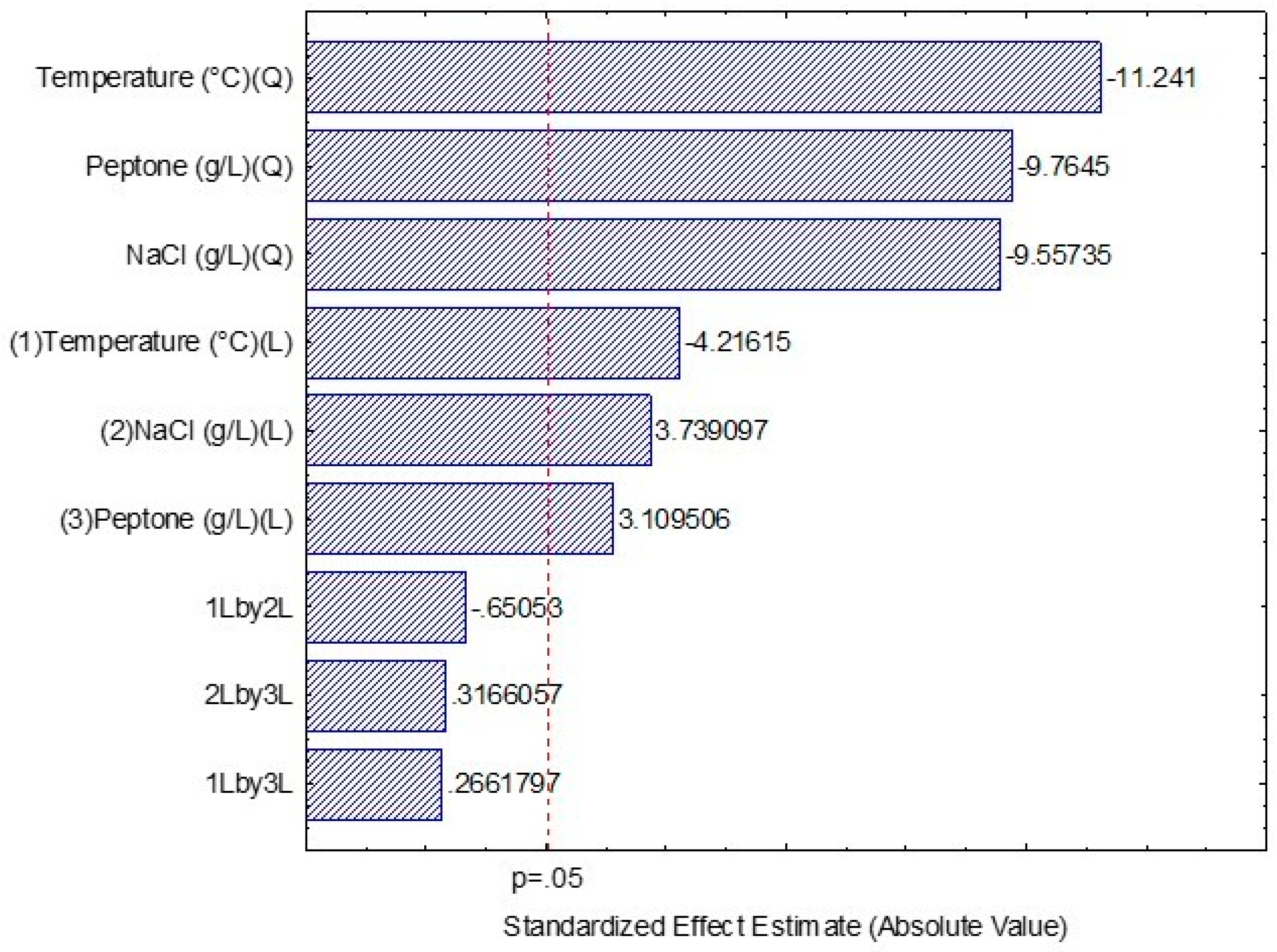
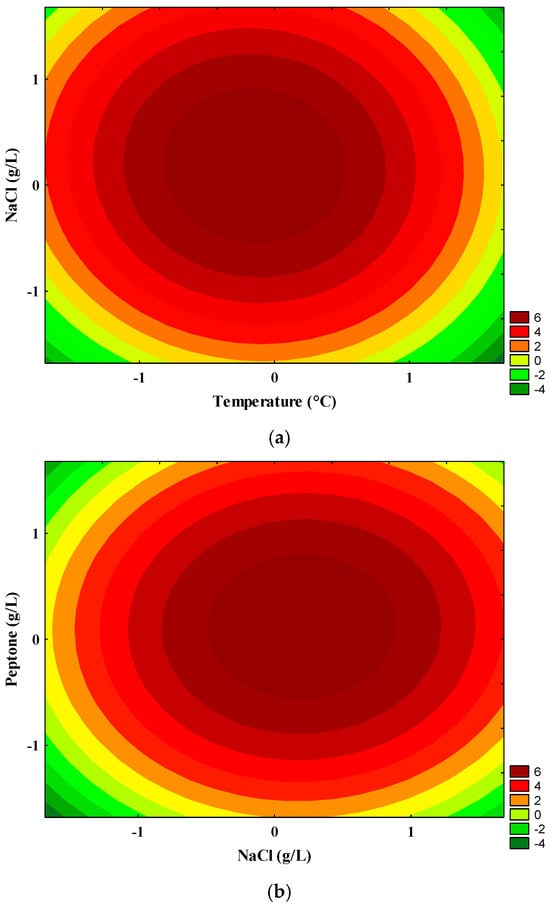
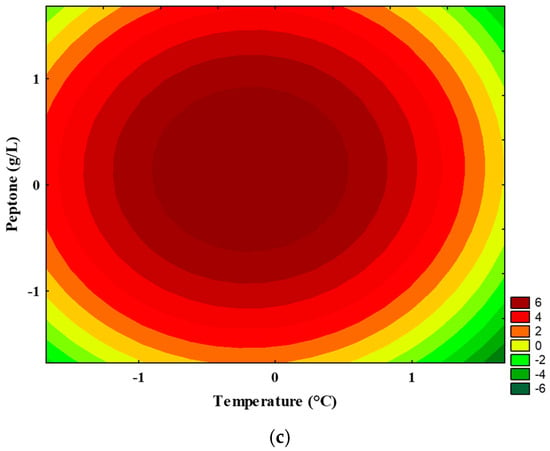
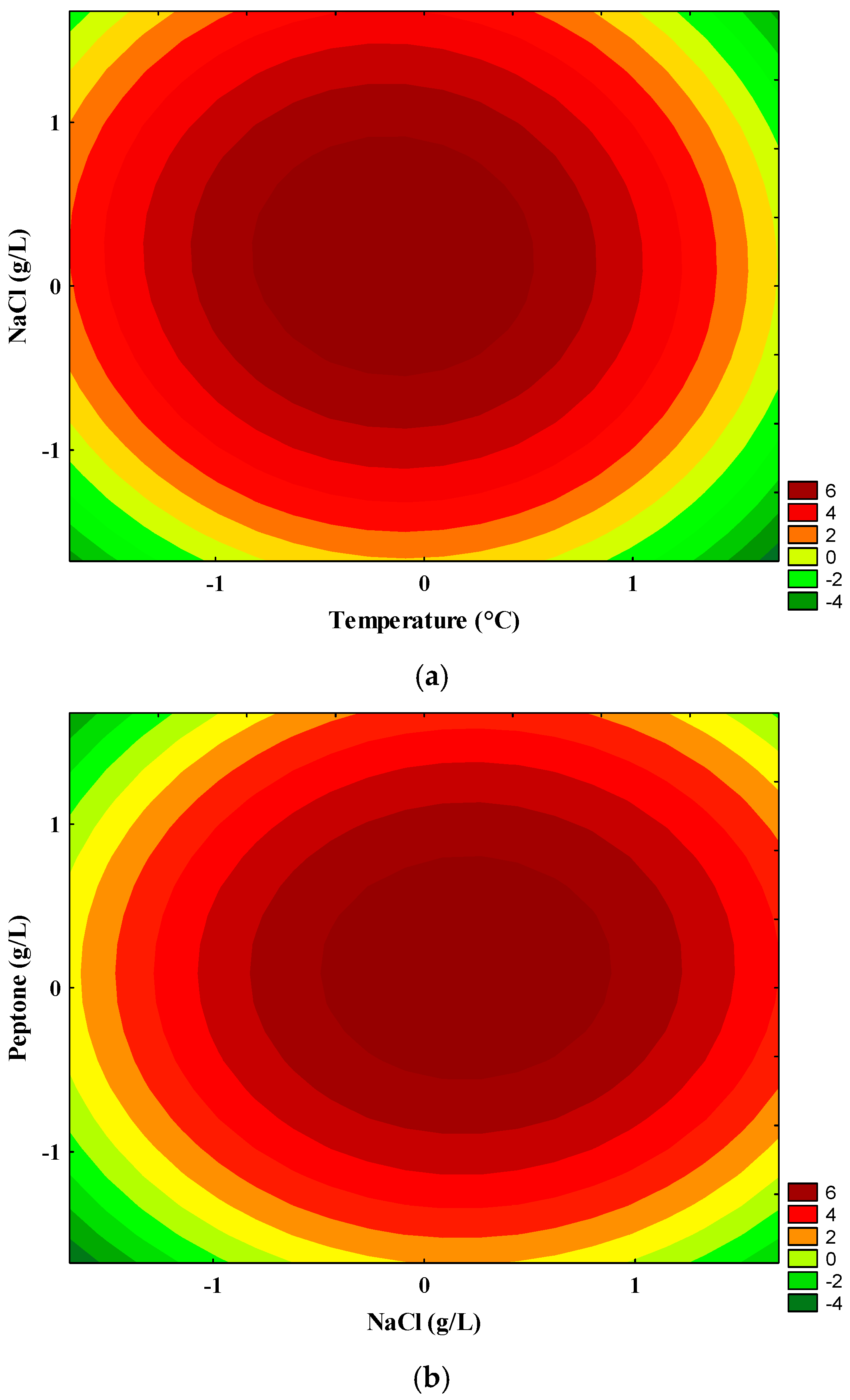
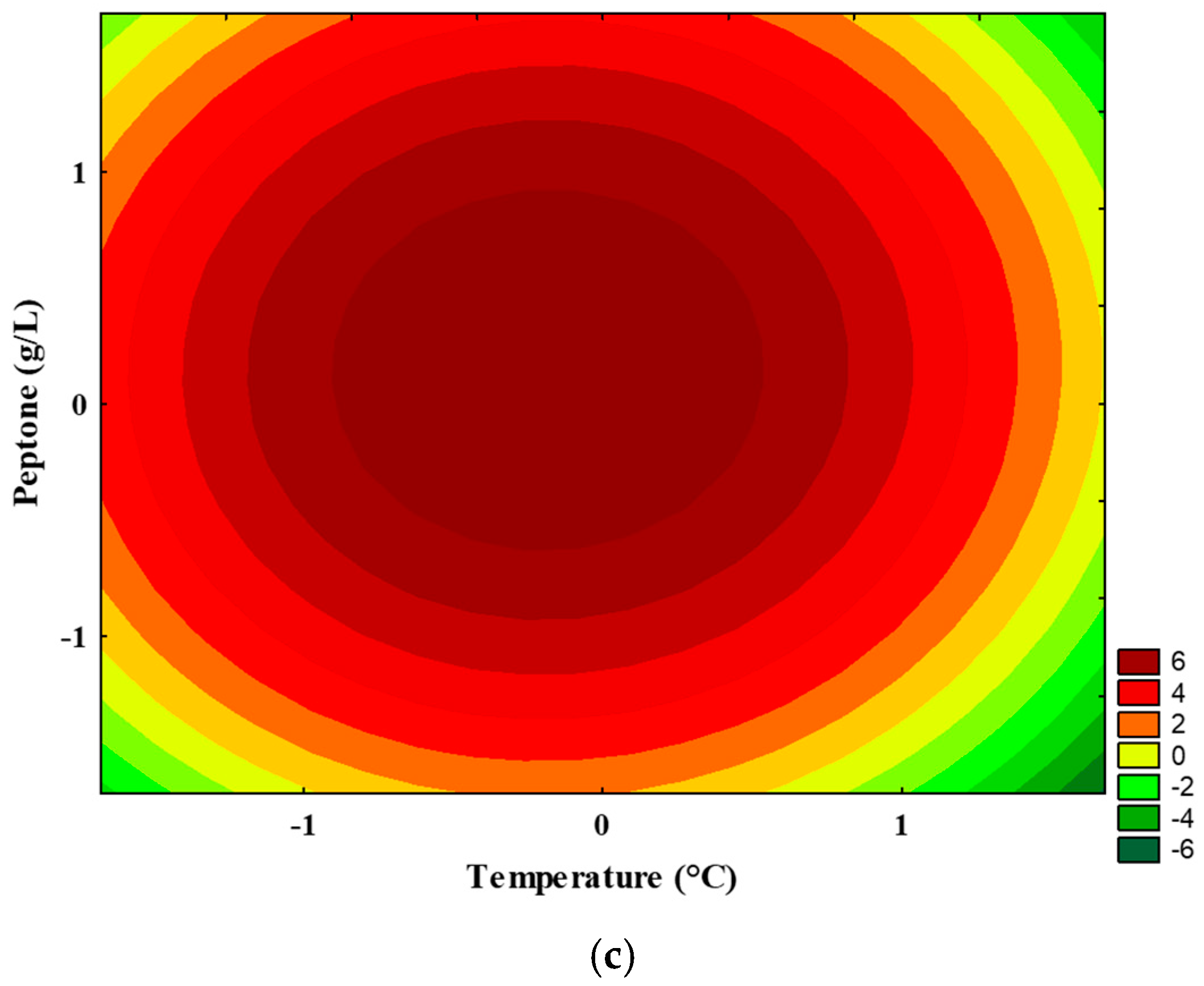
Figure 1 presents the Pareto chart for the CCD, identifying the factors that significantly affected EA release. Although all the factors evaluated (temperature, NaCl, and peptone) were significant in their linear (L) and quadratic (Q) forms, exceeding the dotted line (α = 0.05), the negative terms in their quadratic forms indicate the existence of optimal values for each factor. On the other hand, the interaction among the three factors was not significant, so contour diagrams of their interactions were constructed (Figure 2).
Figure 1.
Pareto chart of CCD.
Figure 2.
Interaction between factors in EA release: (a) temperature vs. NaCl; (b) NaCl vs. peptone; and (c) temperature vs. peptone. Temperature (°C): −α = 29.7; −1 = 33; 0 = 35; 1 = 37; α = 40.36; NaCl (g/L): −α = 0; −1 = 0.23; 0 = 0.53; 1 = 0.83; α = 1.33; Peptone (g/L): −α = 2.64; −1 = 6; 0 = 8; 1 = 10; α = 13.36.
3.2. Optimal Conditions of EA Release
Figure 2 shows contour diagrams that illustrate the behavior of two factors in relation to the response variable. The contour diagrams show a greater release of EA at central temperature levels (level 0; Figure 2a), central NaCl levels (level 0; Figure 2b), and central peptone levels (level 0; Figure 2c), which are consistent with the results presented in Table 1 for treatments 15 and 16 (central treatments). Regarding its optimization on EA release, a second-order polynomial model (Equation (1)), experimental data, and regression coefficients were obtained using linear and multiple regressions, as shown in Equation (2):
According to the simplified model (Equation (2)), EAmax = 8.29 mg/g. To validate the model, another experimental design was done under the following conditions: temperature 34.6 °C, NaCl 0.58 g/L, and peptone 8.26 g/L. These conditions were determined to be optimal based on the statistical analysis. The EA experimental value obtained was 8.27 ± 0.47 mg/g.
3.3. HPLC/ESI/MS Analysis of Phenolic Compounds
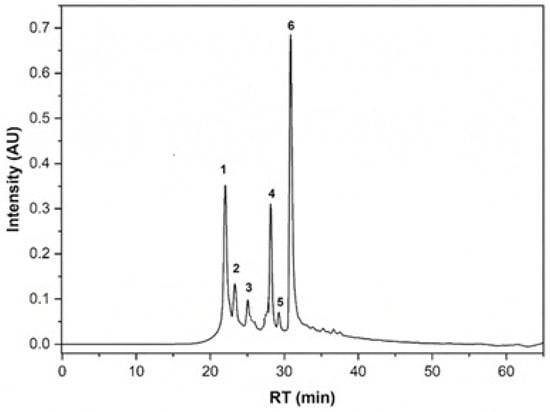
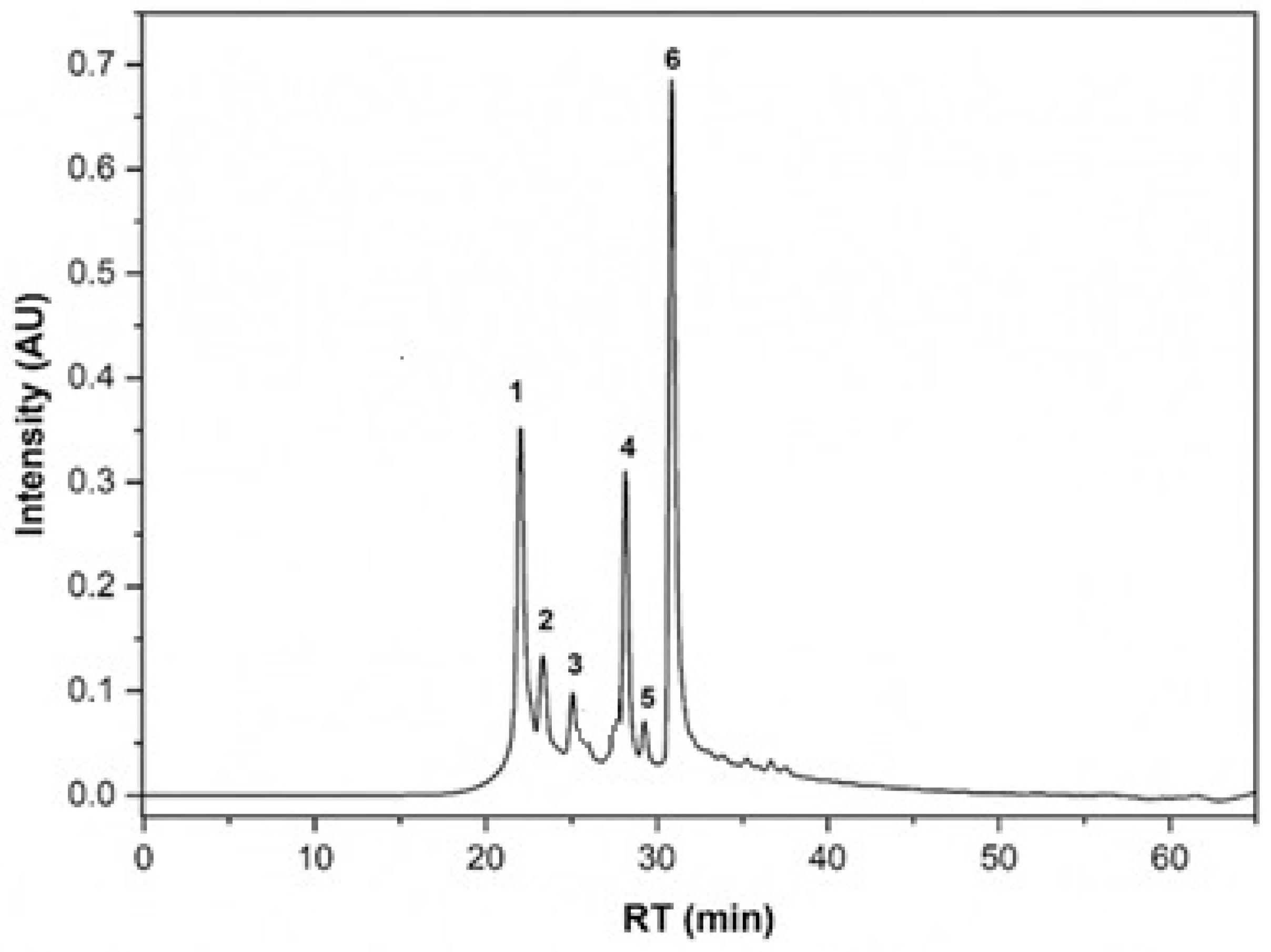
Figure 3 and Table 3 show the compounds identified in SSF extracts under optimal conditions by HPLC/ESI/MS. Six compounds were identified, including EA and compounds derived from the biodegradation of geraniin, the major compound present in rambutan peel.
Figure 3.
Chromatogram obtained by HPLC/ESI/MS analysis of the compounds identified in the fermented extract under optimal SSF conditions.
Table 3.
Profile of bioactive compounds identified in the extract fermented by S. cerevisiae under optimal SSF conditions.
4. Discussion
The choice of fermentation model is a critical point in bioprocess design. On the one hand, submerged fermentation (SmF) has been the industry standard due to its ease of control, but on the other hand, SSF has reemerged as the superior option for producing specific metabolites, such as ellagic acid, because it mimics the natural habitats of the microorganisms used. In addition, SSF allows agro-industrial waste or compounds derived from it to be used as a source of carbon and energy, eliminating the need for expensive synthetic culture media and promoting the circular economy.
Regarding EA production, a study reported by Murugan et al. (2020) [24] reported an EA production of 0.2 mg/g using SSF with Aspergillus niger on mango waste. On the other hand, Ascacio-Valdés et al. (2025) [25] achieved a yield of 1.20 mg/g of EA from creosote bush leaves, using SSF with the Aspergillus niger GH1 strain. Likewise, Chávez-González et al. (2012) [26] obtained EA production of 19.70 and 26.50 µg/mL from green tea and pomegranate peel, respectively, using SSF with Aspergillus aculeactus. The values obtained were higher than those reported above, attributed to the type of substrate used, including its phenolic composition, as well as the content of available ETs for hydrolysis. Similarly, Madrigal-Chávez et al. (2023) [4] determined that unconventional yeasts such as C. utilis ITM LB02, C. parapsilosis ITM LB33, and D. hansenii ISA 1510 are capable of producing EA in a fermentation medium containing strawberry pulp. Therefore, the use of fungi and yeasts, such as those mentioned above, can produce EA by virtue of their ETs.
Molinet (2025) [27] and Ying et al. (2020) [28] mention that temperature is a critical factor in the fermentation process, as it influences the physiology of the microorganism. In this sense, the tolerant growth temperature range of S. cerevisiae can reach 42 °C, making this strain highly tolerant. Likewise, an increase in temperature can accelerate chemical and enzymatic reactions in cells, promoting cell multiplication. However, this increase should not exceed the thermal tolerance limit of microorganisms [29]. Culture media components, such as peptone, are preferred for industrial bioprocesses due to their low cost and nutrient content [30]. Tan et al. (2025) [31] mention that peptone is a nitrogen source for the development of S. cerevisiae. Walls et al. (2022) [30] mention that the absence of a nitrogen source in the culture medium can cause a drastic change in the cell morphology of yeast, so it is important to add a nitrogen source. Smidova et al. (2019) [32] note that an adequate concentration of monovalent cations, such as Na+ (NaCl), is essential for cell function. However, too high or too low values of this ion can act as a potent stress factor for cells.
The negligible variance between the predicted and experimental outcomes evidences the high degree of accuracy and the statistical robustness inherent in the applied RSM. Coefficient determination indicates (R2 = 0.84) that the model explains 84% of the response variability; the remaining 16% is attributed to interactions among the evaluated factors, such as the nitrogen source (peptone) and osmotic stress induced by NaCl, which influence the microorganism’s enzyme secretion. The optimal temperature of around 35 °C aligns with the mesophilic characteristics of the microbial strains commonly implicated in ellagitannin biodegradation. However, NaCl emerges as a critical factor, functioning either as a cofactor or as an osmotic agent, markedly reducing EA release [33,34]. Furthermore, this behavior is due to the implementation of biological systems. Therefore, the conditions identified as optimal (temperature 34.6 °C, NaCl 0.58 g/L, and peptone 8.26 g/L) are consistent with the general characteristics of the microorganism, as discussed in this section. The EA result obtained in this study represents a significant improvement. Gulsunoglu-Konuskan et al. (2021) [14] used a CCD to optimize the SSF process using chestnut shell and Aspergillus japonicus ZGM4. The authors obtained a yield of 2.72 ± 0.21 mg/g of EA, which is close to the predicted value of 2.88 ± 0.18 mg/g.
On the other hand, De la Cruz et al. (2014) [35] optimized culture conditions for the production of ellagitannase by Aspergillus niger. This enzyme is associated with the biodegradation pathway of ETs, which releases EA. Optimization is key, as ellagitannase activity depends on the strain and substrate used, as well as pH and temperature. A study by Wang et al. (2018) [36] developed an optimization process for antisolvent recrystallization to improve the purity of recovered EA. The model enabled the identification of optimal process conditions, including the solvent/antisolvent ratio, crystallization temperature, reaction time, and stirring speed. Dias Assunção et al. (2017) [37] demonstrated the optimization of extraction conditions using a Box–Behnken experimental design to maximize EA production from Eugenia uniflora L. The results demonstrate the importance of RSM in elucidating the interactions among variables in the ultrasound-assisted extraction process. In another study, Sepúlveda et al. (2014) [38] evaluated the production of EA through SMF using pomegranate peel as a substrate and Aspergillus niger GH1. They employed a Box–Behnken design to identify the optimal conditions for maximizing the production of this compound, including substrate concentration, pH, and stirring speed. Comparing these results with the present study highlights the critical importance of optimizing operating parameters to maximize the production and release of bioactive compounds such as ellagic acid [39]. This process represents a significant challenge for the biotechnology industry due to the intrinsic complexity of solid-state fermentation. In this research, results from CCD demonstrated superior ability to model factorial interactions compared to other response surface methods. The competitive advantage of CCD lies in its geometric structure, which integrates a factorial design with central and axial points (±α). This configuration not only allows for accurate estimation of the response curvature but also offers higher resolution at the extremes of the experimental space.
In contrast, the Box–Behnken design, although efficient in the number of runs, has lower accuracy at the boundaries of the design domain and is considered more sensitive to fluctuations in boundary conditions. Therefore, the implementation of CCD for EA not only maximizes compound performance but also provides a more robust theoretical and practical framework that facilitates transition to industrial-scale up. These findings reinforce the value of CCD as an essential approach for unraveling the multifactorial dynamics governing EA release while offering a scalable strategy for valorizing agro-industrial waste, such as rambutan peel.
In this context, the valorization of agro-industrial waste through fermentation bioprocesses represents a critical frontier in modern biotechnology. ETs, molecules considered complex and present in different plant sources, have enormous bioactive potential; however, their molecular complexity limits their bioavailability and direct application. The use of microorganisms (such as yeasts) enables the synthesis of specific enzymes that hydrolyze specific bonds in ellagitannins. This process is essential for the release of ellagic acid, a molecule with high added value. Unlike chemical hydrolysis, fermentation is considered a sustainable, specific, and economical method. Some reports attribute the biodegradation of ETs, such as geraniin, to various enzymatic activities, including β-glucosidase, tannase, xylanase, and cellulase. These enzymes catalyze the hydrolysis of β-1,4 bonds within the geraniin structure, facilitating the release of hexahydroxydiphenyl (HHDP) groups. These groups subsequently undergo spontaneous intramolecular lactonization, ultimately leading to the accumulation of EA [4,40]. A study reported by Izábal et al. (2023) [41] demonstrated that S. cerevisiae can biodegrade pomegranate peel ETs. This metabolic process is attributed to specific enzymes, most notably ellagitannase, which plays a key role in the biodegradation of these polyphenolic compounds. Likewise, EA accumulation was demonstrated. A study by López-Cardenas et al. (2023) [42] identified nine bioactive compounds in fermented extracts of cascalote pods using RP-HPLC-ESI-MS, including geraniin, corilagin, and EA. Similarly, Gómez et al. (2024) [43] detected 12 compounds in Rosa rugosa petals using HPLC/ESI/MS, among which EA and ellagic acid glycoside stand out. Therefore, to achieve efficient biodegradation of ellagitannins, the selected microorganism must have a high capacity for enzyme secretion and survive in media containing high concentrations of polyphenols, such as ETs. In this regard, the most efficient groups of microorganisms for producing EA are filamentous fungi and yeasts; fungi are widely used due to their innate ability to penetrate solid substrates and robust enzymatic systems, which enable their efficient application in solid-state fermentative bioprocess models. On the other hand, yeasts can be used in solid fermentation processes when an even faster process is necessary, due to their ability to metabolize phenolic compounds and convert them into higher-value metabolites, even though, in previous years, they were not considered to be microorganisms that degrade polyphenolic compounds.
EA has demonstrated potential antioxidant activity, suggesting that this compound can be incorporated into food packaging, as it improves functionality and aids in food preservation [44,45]. Furthermore, corilagin exerts protective effects on the liver, highlighting its role in preventing fibrosis and managing acute liver failure. Likewise, it exhibits biological properties and significant antioxidant activity against free radicals [46]. Ceci et al. (2020) [47] reported that EA could be incorporated into micro- or nanoparticle systems for administration to improve its pharmacokinetics and therapeutic properties.
5. Conclusions
Rambutan peel ellagitannins are an efficient and sustainable substrate for the release of ellagic acid through solid-state fermentation. Using column reactors and Saccharomyces cerevisiae yeast, the biodegradation of the main ellagitannins in rambutan peel, such as geraniin, was identified. In addition, optimal parameters were established using a central composite design, and it was found that interactions among temperature, NaCl concentration, and peptone supplementation are decisive for achieving higher ellagic acid production. The release of ellagic acid was obtained at 35 °C, with 0.53 g/L NaCl and 8 g/L peptone, yielding concentrations of 8.36 ± 1.58 and 8.23 ± 0.52 mg/g, respectively (treatments 15 and 16). The model’s accuracy was confirmed under the adjusted optimal conditions (34.6 °C, 0.58 g/L of NaCl, and 8.26 g/L of peptone), yielding 8.27 ± 0.47 mg/g of ellagic acid, a value very close to the model’s estimate (8.29 mg/g). Through the identification of compounds by HPLC/ESI/MS, the presence of ellagic acid was confirmed, as well as the presence of biodegradation products derived from geraniin, the major compound in rambutan peel. Likewise, Saccharomyces cerevisiae can biodegrade this type of compound. Therefore, these results suggest that implementing solid-state fermentation and using statistical tools, such as CCD, could reduce time and costs, and the number of experiments evaluated, thereby maximizing the release of bioactive compounds, such as EA. Furthermore, the bioactive compounds identified have previously been reported to exhibit diverse biological activities, highlighting their potential applications in the pharmaceutical and functional food industries.
Author Contributions
Conceptualization, J.A.A.-V. and J.J.B.-F.; methodology, K.D.L.R.-E., M.L.C.-G., N.P.M.-R. and L.S.; validation, C.N.A., J.J.B.-F. and J.A.A.-V.; formal analysis, L.S., N.P.M.-R. and C.N.A.; investigation, K.D.L.R.-E., J.J.B.-F. and J.A.A.-V.; writing—original draft preparation, K.D.L.R.-E. and N.P.M.-R.; writing—review and editing, L.S., C.N.A. and J.J.B.-F.; supervision, J.J.B.-F. and J.A.A.-V. All authors have read and agreed to the published version of the manuscript.
Funding
This research received no external funding.
Institutional Review Board Statement
Not applicable.
Data Availability Statement
The original contributions presented in this study are in the article. Further inquiries can be directed to the corresponding authors.
Acknowledgments
Karen De La Rosa-Esteban thanks SECIHTI (Secretaria de Ciencia, Humanidades, Tecnología e Innovación), Mexico, for the scholarship support.
Conflicts of Interest
The authors declare no conflicts of interest.
Abbreviations
The following abbreviations are in this manuscript:
| ETs | Ellagitannins |
| EA | Ellagic acid |
| SSF | Solid-state fermentation |
| SBF | Submerged fermentation |
| HPLC/ESI/MS | High-performance liquid chromatography electrospray ionization |
| RSM | Response Surface Methodology |
| PUF | Polyurethane foam |
| CCD | Central composite design |
References
- Arshad, Z.; Shahid, S.; Hasnain, A.; Yaseen, E.; Rahimi, M. Functional Foods Enriched with Bioactive Compounds: Therapeutic Potential and Technological Innovations. Food Sci. Nutr. 2025, 13, e71024. [Google Scholar] [CrossRef] [Scilit]
- Brück, W.M.; Daniel, D.; Droz-dit-busset, L.; Baudin, M.; Nicolet, N.; Andlauer, W. Fermentative Liberation of Ellagic Acid from Walnut Press Cake Ellagitannins. Foods 2022, 11, 3102. [Google Scholar] [CrossRef] [Scilit] [PubMed]
- Buenrostro-Figueroa, J.; Mireles, M.; Asacacio-Valdés, J.A.; Aguilera-Carbó, A.; Sepúlveda, L.; Contreras-Esquivel, J.; Rodriguez-Herrera, R.; Aguilar, C.N. Enzymatic Biotransformation of Pomegranate Ellagitannins: Initial Approach to Reaction Conditions. Iran. J. Biotechnol. 2020, 18, e2305. [Google Scholar] [CrossRef] [Scilit] [PubMed]
- Madrigal-Chávez, R.; Ruíz-Pompa, K.; Márquez-López, A.; Valencia Flores, D.C.; Chávez-Parga, M.D.C.; González-Hernández, J.C. Optimization of the ellagic acid synthesis process at the bioreactor level using non-conventional yeasts. Braz. J. Pharm. Sci. 2023, 59, e21508. [Google Scholar] [CrossRef] [Scilit]
- Wojtunik-Kulesza, K.; Nizinski, P.; Krajewska, A.; Oniszczuk, M.; Oniszczuk, A. Therapeutic Potential of Ellagic Acid in Liver Diseases. Molecules 2025, 30, 2596. [Google Scholar] [CrossRef] [Scilit] [PubMed]
- Liu, F.; Zhang, Y.; Yu, Q.; Shen, Y.; Zheng, Z.; Cheng, J.; Zhang, W.; Ye, Y. Exploration of the binding between ellagic acid, a potentially risky food additive, and bovine serum albumin. Food Chem. Toxicol. 2019, 134, 110867. [Google Scholar] [CrossRef] [Scilit]
- Ngyen, D.T.C.; Nguyen, N.T.T. Environmental Technology & Innovation Effective transformation of rambutan residues into value-added chemicals and materials for multiple applications. Environ. Tecnol. Innov. 2025, 37, 103917. [Google Scholar] [CrossRef] [Scilit]
- Huynh, T.B.; Do, T.A.S.; Tran, T.K.A.; Dang-Bao, T. Optimization of Microwave-Assisted Extraction of Polyphenolics from Rambutan (Nephelium lappaceum L.) Peels using Response Surface Methodology and Central Composite Design. Eng. Technol. Appl. Sci. Res. 2025, 15, 22431–22436. [Google Scholar] [CrossRef] [Scilit]
- Klongdee, S.; Katekhong, W.; Jittanit, W.; Matsukawa, S.; Klinkesorn, U. Encapsulation of polyphenol rich extract from rambutan (Nephelium lappaceum L.) peel for applications as dual functional ingredient in ice cream. Sci. Rep. 2025, 15, 30564. [Google Scholar] [CrossRef] [Scilit]
- Zhang, T.; Zhou, X.; Wang, K.; Sun, L.; Zhuang, Y. A review: Extraction, phytochemicals, and biological activities of rambutan (Nephelium lappaceum L.) peel extract. Heliyon 2022, 8, e11314. [Google Scholar] [CrossRef] [Scilit]
- Jahurul, M.H.A.; Azzatul, F.S.; Sharifudin, M.S.; Norliza, M.J.; Hasmadi, M.; Lee, J.S.; Patricia, M.; Jinap, S.; Ramlah George, M.R.; Firoz Khan, M.; et al. Functional and nutritional properties of rambutan (Nephelium lappaceum L.) seed and its industrial application: A review. Trends Food Sci. Technol. 2020, 99, 367–374. [Google Scholar] [CrossRef] [Scilit]
- Rajasekaran, S.; Rajasekar, N.; Sivanantham, A. Therapeutic potential of plant-derived tannins in non-malignant respiratory diseases. J. Nutr. Biochem. 2021, 94, 108632. [Google Scholar] [CrossRef] [Scilit]
- Hernandez-Hernandez, C.; Estrada-Gil, L.E.; Lozano-Sepúlveda, A.; Rivas-Estilla, A.M.; Govea-Salas, M.; Morlett-Chávez, J.; Aguilar, C.N.; Ascacio-Valdés, J.A. Antiviral Activity of Rambutan Peel Polyphenols Obtained Using Green Extraction Technology and Solvents. Sustain. Chem. 2025, 6, 14. [Google Scholar] [CrossRef] [Scilit]
- Gulsunoglu-Konuskan, Z.; Karbancioglu-Guler, F.; Kilic-Akyilmaz, M. Development of a bioprocess for production of ellagic acid from chestnut (Castanea sativa Mill.) waste by fermentation with Aspergillus spp. Food Biosci. 2021, 42, 101058. [Google Scholar] [CrossRef] [Scilit]
- Crafack, M.; Keul, H.; Eskildsed, C.E.; Petersen, M.A.; Saerens, S.; Blennow, A.; Skovmand-Larsen, M.; Swiegers, J.H.; Petersen, G.B.; Heimdal, H.; et al. Impact of starter cultures and fermentation techniques on the volatile aroma and sensory profile of chocolate. Food Res. Int. 2014, 63, 306–316. [Google Scholar] [CrossRef] [Scilit]
- Costa, J.A.V.; Treichel, H.; Kumar, V.; Pandey, A. Advances in Solid-State Fermentation. In Current Developments in Biotechnology and Bioengineering; Elsevier: Amsterdam, The Netherlands, 2018; pp. 1–17. [Google Scholar] [CrossRef] [Scilit]
- Ordoñez-Cano, A.J.; Ramírez-Esparza, U.; Méndez-González, F.; Alvarado-González, M.; Baeza-Jiménez, R.; Sepúlveda-Torre, L.; Prado-Barragán, L.A.; Buenrostro-Figueroa, J.J. Recovery of Phenolic Compounds with Antioxidant Capacity Through Solid-State Fermentation of Pistachio Green Hull. Microorganism 2025, 13, 35. [Google Scholar] [CrossRef] [Scilit]
- Kyriakoudi, A.; Zymvrakaki, E.; Kalogiouri, N.; Mour, I. Recovery of Ellagic Acid from Pomegranate Peels with the Aid of Ultrasound-Assisted Alkaline Hydrolysis. Molecules 2024, 29, 2424. [Google Scholar] [CrossRef] [Scilit]
- Hawashi, M.; Altway, A.; Widjaja, T.; Gunawan, S. Optimization of process conditions for tannin content reduction in cassava leaves during solid state fermentation using Saccharomyces cerevisiae. Heliyon 2019, 5, e02298. [Google Scholar] [CrossRef] [Scilit]
- Ding, X.; Yao, L.; Hou, Y.; Wang, G.; Fan, J.; Qian, L. Optimization of Culture Conditions During the Solid—State Fermentation of Tea Residue Using Mixed Strains. Waste Biomass Valorization 2020, 11, 6667–6675. [Google Scholar] [CrossRef] [Scilit]
- Estrada-Gil, L.; Contreras-Esquivel, J.C.; Flores-Gallegos, C.; Zugasti-Cruz, A.; Govea-Salas, M.; Mata-Gómez, M.A.; Rodríguez-Herrera, R.; Ascacio-Valdés, J.A. Recovery of Bioactive Ellagitannins by Ultrasound/Microwave-Assisted Extraction from Mexican Rambutan Peel (Nephelium lappaceum L.). Molecules 2022, 27, 1592. [Google Scholar] [CrossRef] [Scilit]
- De La Rosa-Esteban, K.; Sepúlveda, L.; Buenrostro-Figueroa, J.; Chávez-González, M.L.; Sáenz-Galindo, A.; Aguilar, C.N.; Ascacio-Valdés, J.A. Sustainable Production of Ellagic Acid via Solid-State Fermentation with Saccharomyces cerevisiae in Column Reactors. Environ. Qual. Manag. 2025, 35, e70232. [Google Scholar] [CrossRef] [Scilit]
- De León-Medina, J.C.; Sepúlveda, L.; Buenrostro-Figueroa, J.J.; Mata-Gómez, M.A.; Flores-Gallegos, A.C.; Rodríguez-Herrera, R.; Aguilar, C.N.; Ascacio-Valdés, J.A. Production and evaluation of ellagitannase activity using a pure geraniin substrate. Food Bioprod. Process. 2025, 149, 112–117. [Google Scholar] [CrossRef] [Scilit]
- Murugan, A.; Rubavathi, A.; Kannan, V.; Parthiban, A. Bioconversion of Mango Pulp Industrial Waste into Ellagic acid Using Aspergillus niger. bioRxiv 2020. [Google Scholar] [CrossRef] [Scilit]
- Ascacio-Valdés, A.; Barrera-Martínez, C.L.; Ascacio-Valdés, J.A.; Sepúlveda, L. Bioproduction of Nordihydroguaiaretic and Ellagic Acid fromCreosote Bush Leaves (Larrea tridentata) Using Solid-State Fermentation with Aspergillus niger GH1. Fermentation 2025, 11, 229. [Google Scholar] [CrossRef] [Scilit]
- Chávez-González, M.; Rodríguez-Durán, L.V.; Balagurusamy, N.; Prado-Barragán, A.; Rodríguez, R.; Contreras, J.C.; Aguilar, C.N. Biotechnological Advances and Challenges of Tannase: An Overview. Food Bioprocess Technol. 2012, 5, 445–459. [Google Scholar] [CrossRef] [Scilit]
- Molinet, J.; Stelkens, R. The evolution of thermal performance curves in response to rising temperatures across the model genus yeast. Proc. Natl. Acad. Sci. USA 2025, 122, e2423262122. [Google Scholar] [CrossRef] [Scilit] [PubMed]
- Lip, K.Y.F.; García-Rios, E.; Costa, C.E.; Guillamón, J.M.; Domingues, L.; Teixeira, J.; Van Gulik, W.M. Selection and subsequent physiological characterization of industrial Saccharomyces cerevisiae strains during continuous growth at sub- and- supra optimal temperatures. Biotechnol. Rep. 2020, 26, e00462. [Google Scholar] [CrossRef] [Scilit]
- Takeyama, M.M.; de Carvalho, M.C.; Carvalho, H.S.; Silva, C.R.; Uetanabaro, A.P.T.; da Costa, A.M.; Evaristo, J.A.M.; Nogueira, F.C.S.; Fai, A.E.C.; Koblitz, M.G.B. Pectinases Secretion by Saccharomyces cerevisiae: Optimization in Solid-State Fermentation and Identification by a Shotgun Proteomics Approach. Molecules 2022, 27, 4981. [Google Scholar] [CrossRef] [Scilit]
- Walls, L.E.; Martinez, J.L.; Rios-Solis, L. Enhancing Saccharomyces cerevisiae Taxane Biosynthesis and Overcoming Nutritional Stress-Induced Pseudohyphal Growth. Microorganisms 2022, 10, 163. [Google Scholar] [CrossRef] [Scilit]
- Tan, L.; Zhang, Y.; Liu, P.; Wu, Y.; Huang, Z.; Hu, Z.; Liu, Z.; Wang, Y.; Zheng, Y. System metabolic engineering modification of Saccharomyces cerevisiae to increase SAM production. Bioresour. Bioprocess. 2025, 12, 19. [Google Scholar] [CrossRef] [Scilit] [PubMed]
- Smidova, A.; Stankova, K.; Petrvalska, O.; Lazar, J.; Sychrova, H.; Obsil, T.; Zimmermannova, O.; Obsilova, V. The activity of Saccharomyces cerevisiae Na+, K+/H+ antiporter Nha1 is negatively regulated by 14-3-3 protein binding at serine 481. Biochim. Biophys. Acta (BBA) Mol. Cell Res. 2019, 1866, 118534. [Google Scholar] [CrossRef] [Scilit]
- Zhang, L.; Huang, C.; Harboe, A.; Lene, M.; Nils, J. The Effects of NaCl and Temperature on Growth and Survival of Yeast Strains Isolated from Danish Cheese Brines. Curr. Microbiol. 2020, 77, 3377–3384. [Google Scholar] [CrossRef] [Scilit] [PubMed]
- Stratford, M.; Steels, H.; Novodvorska, M.; Archer, D.B.; Avery, S.V. Extreme Osmotolerance and Halotolerance in Food-Relevant Yeasts and the Role of Glycerol-Dependent Cell Individuality. Front. Microbiol. 2019, 9, 3238. [Google Scholar] [CrossRef] [Scilit]
- De la Cruz, R.; Ascacio, J.A.; Buenrostro, J.; Sepúlveda, L.; Rodríguez, R.; Prado-Barragán, A.; Contreras, J.C.; Aguilera, A.; Aguilar, C.N. Optimization of Ellagitannase Production by Aspergillus Niger GH1 by Solid State Fermentation. Prep. Biochem. Biotechnol. 2015, 45, 617–631. [Google Scholar] [CrossRef] [Scilit]
- Wang, L.; Lian, B.; Wu, W.; Deng, Y.; Liu, Y.; Wang, L.; Li, Y.; Wang, Z.; Zhao, X. Optimization of Ellagic Acid Purification from Pomegranate Husk by Antisolvent Recrystallization. Chem. Eng. Technol. 2018, 41, 1188–1198. [Google Scholar] [CrossRef] [Scilit]
- Dias Assunção, P.I.; Cardoso da Conceição, E.; Borges, L.L.; Marciano de Paula, J.A. Development and Validation of a HPLC-UV Method for the Evaluation of Ellagic Acid in Liquid Extracts of Eugenia uniflora L. (Myrtaceae) Leaves and Its Ultrasound-Assisted Extraction Optimization. Evid.-Based Complement. Altern. Med. 2017, 2017, 1501038. [Google Scholar] [CrossRef] [Scilit] [PubMed]
- Sepúlveda, L.; Buenrostro-Figueroa, J.J.; Ascacio-Valdés, J.A.; Aguilera-Carbó, A.F.; Rodríguez-Herrera, R.; Contreras-Esquivel, J.C.; Aguilar, C.N. Submerged Culture for Production of Ellagic Acid from Pomegranate Husk by Aspergillus niger GH1. Micol. Apl. Int. 2014, 26, 27–35. [Google Scholar]
- Torgbo, S.; Rugthaworn, P.; Sukatta, U.; Sukyai, P. Biological characterization and quantification of rambutan (Nephelium lappaceum L.) peel extract as a potential source of valuable minerals and ellagitannins for industrial applications. ACS Omega 2022, 7, 34647–34656. [Google Scholar] [CrossRef] [Scilit]
- Evtyugin, D.D.; Magina, S.; Evtuguin, D.V. Recent Advances in the Production and Applications of Ellagic Acid and Its Derivatives. A Review. Molecules 2020, 25, 2745. [Google Scholar] [CrossRef] [Scilit]
- Izábal-Carvajal, A.L.; Sepúlveda, L.; Chávez-González, M.L.; Torres-León, C.; Aguilar, C.N.; Ascacio-Valdés, J.A. Extraction of Bioactive Compounds via Solid-State Fermentation Using Aspergillus niger GH1 and Saccharomyces cerevisiae from Pomegranate Peel. Waste 2023, 1, 806–814. [Google Scholar] [CrossRef] [Scilit]
- López-Cárdenas, F.; Ochoa-Reyes, E.; Baeza-Jiménez, R.; Tafolla-Arellano, J.C.; Ascacio-Valdés, J.A.; Buenrostro-Figueroa, J.J. Solid-State Fermentation as a Sustainable Tool for Extracting Phenolic Compounds from Cascalote Pods. Fermentation 2023, 9, 823. [Google Scholar] [CrossRef] [Scilit]
- Gomez-Macías, E.; Mellado, M.; Mellado, J.; Ascacio Valdés, J.A.; Martínez-Ávila, G.C.G.; Nuñez Colima, J.A.; Aguilera Carbó, A.; Aguilar González, C.N. Polyphenolic content, phytochemical profile composition, and bioactive properties of Castilla Rose (Purshia plicata). Multidiscip. Sci. J. 2024, 16, 1–13. [Google Scholar] [CrossRef] [Scilit]
- Swiontek Brzezinska, M.; Shinde, A.H.; Kaczmarek-Szczepańska, B.; Jankiewicz, U.; Urbaniak, J.; Boczkowski, S.; Zasada, L.; Ciesielska, M.; Dembińska, K.; Pałubicka, K.; et al. Biodegradability Study of Modified Chitosan Films with Cinnamic Acid and Ellagic Acid in Soil. Polymers 2024, 16, 574. [Google Scholar] [CrossRef] [Scilit] [PubMed]
- Sukatta, U.; Rugthworn, P.; Khanoonkon, N.; Anongjanya, P.; Kongsin, K.; Sukyai, P.; Harnkarnsujarit, N.; Sothornvit, R.; Chollakup, R. Rambutan (Nephelium lappaceum) peel extract: Antimicrobial and antioxidant activities and its application as a bioactive compound in whey protein isolate film. Songklanakarin J. Sci. Technol. 2021, 43, 37–44. [Google Scholar]
- Li, X.; Li, X.; Deng, Y.; Chen, L.; Zheng, Z.; Ming, Y. Protective Effect of Corilagin on Alcoholic Liver Injury. Nat. Prod. Commun. 2024, 19, 1–10. [Google Scholar] [CrossRef] [Scilit]
- Ceci, C.; Graziani, G.; Faraoni, I.; Cacciotti, I. Strategies to Improve Ellagic Acid Bioavailability: From Natural or Semisynthetic Derivatives to Nanotechnological Approaches Based on Innovative Carriers. Nanotechnology 2020, 31, 382001. [Google Scholar] [CrossRef] [Scilit]

Disclaimer/Publisher’s Note: The statements, opinions and data contained in all publications are solely those of the individual author(s) and contributor(s) and not of MDPI and/or the editor(s). MDPI and/or the editor(s) disclaim responsibility for any injury to people or property resulting from any ideas, methods, instructions or products referred to in the content. |
© 2026 by the authors. Licensee MDPI, Basel, Switzerland. This article is an open access article distributed under the terms and conditions of the Creative Commons Attribution (CC BY) license.