Article

Evaluating Household Hazardous Waste Management Systems in Greece

1
School of Chemical and Environmental Engineering, Technical University of Crete (TUC), University Campus, 73100 Chania, Greece
2
Institute of GeoEnergy, Foundation for Research and Technology-Hellas (FORTH/IG), 73100 Chania, Greece
*
Author to whom correspondence should be addressed.
Waste 2026, 4(2), 14; https://doi.org/10.3390/waste4020014
Submission received: 2 March 2026 / Revised: 14 April 2026 / Accepted: 24 April 2026 / Published: 29 April 2026

Abstract

The growing generation of household hazardous waste (HHW) presents critical environmental and public health challenges worldwide. This study investigates prevailing trends in HHW management and analyzes the socio-economic and demographic determinants that influence public perceptions, attitudes, and behaviors toward HHW recycling practices. A comparative mass flow analysis is also conducted to evaluate the limitations of current HHW management practices in Greece and outline policy implementation plans. Statistical findings indicate that income significantly influences recycling behavior. Individuals with annual incomes between €10,001 and €30,000 are less likely to engage in HHW recycling, whereas those earning over €70,000 demonstrate higher levels of recycling participation. The public recognizes the need for green collection points for appropriate HHW management. However, no statistically significant correlation is found between income levels and perceived importance of these facilities. This outcome is attributed to the high proportion (46.7%) of dichotomous variables in the χ2 independence test, exceeding the recommended threshold of 25%, which limits interpretability. Such findings indicate the complex interplay of behavioral and socio-economic variables in HHW recycling. The study highlights the importance of targeted public policies, educational interventions, and infrastructure improvements to increase recycling participation and promote sustainable HHW management in Greece.

1. Introduction

The term Household Hazardous Waste (HHW) refers to hazardous materials generated in domestic settings that enter the municipal solid waste stream. These materials, though produced in relatively small quantities per household, collectively pose significant environmental and public health risks when improperly managed [1,2]. HHW includes substances that exhibit characteristics such as flammability, corrosiveness, reactivity, and toxicity, thereby requiring special handling, treatment, and disposal procedures [3]. Typical examples of HHW comprise spent batteries, cleaning products (e.g., bleach, ammonia-based agents), fluorescent tubes, paints, varnishes, adhesives, solvents, obsolete electronic equipment, pesticides, and expired or unused pharmaceuticals [4].
Effective HHW management begins with accurate classification, which is a prerequisite for implementing appropriate handling protocols and ensuring regulatory compliance [5]. Classification methodologies are not standardized globally, as they are shaped by distinct legislative frameworks and institutional priorities across jurisdictions. In the European Union (EU), the classification of hazardous waste is governed by the European Waste Catalogue (EWC), a harmonized list that assigns specific waste codes and denotes hazardous items with an asterisk (*) [6]. In the United States, hazardous waste classification is established under the Resource Conservation and Recovery Act (RCRA) [7]. Variations in regulatory frameworks across countries underscore the challenges in proper HHW management, emphasizing the need for policy development and public education initiatives to support sustainable handling practices [8].
Households generate an average of approximately 50 kg of HHW annually, which is improperly discarded along with municipal solid waste (MSW) [1,9]. This widespread mismanagement highlights the critical need for effective hazardous waste management programs to mitigate associated environmental and health risks [10]. A fundamental first step is the separate collection of HHW. Once segregated, the HHW can be dropped off at designated collection points, which may be permanent facilities or mobile units used periodically [3]. Subsequent treatment technologies vary depending on the waste type and may include thermal methods (such as incineration, pyrolysis, and gasification), as well as various physicochemical and biological treatments [7,11].
In Greece, official data regarding the management of household hazardous waste (HHW) is currently unavailable. However, the National Hazardous Waste Management Plan outlines various treatment methods based on the waste source and composition [12]. These methods encompass comprehensive strategies such as sorting and separate collection at designated sites, solidification/stabilization, thermal treatment, physicochemical treatment, recycling/regeneration, and final disposal in specially engineered hazardous waste landfills. The plan specifically identifies following practices: incineration and sterilization for medical waste; regeneration for waste oils; chemical treatment for polychlorinated biphenyl (PCB)-containing waste; and asbestos-containing materials are directed to secure landfill disposal. In cases where domestic facilities are unavailable, hazardous waste is exported abroad in compliance with the Basel Convention, the international treaty that governs the transboundary movement of hazardous waste [13,14]. Austria, by contrast, operates an extensive and highly organized HHW management system, characterized by effective sorting and targeted treatment technologies. The system relies heavily on separate collection protocols, implemented through both permanent municipal collection points and mobile units, all strictly adhering to the country’s stringent environmental legislation [15]. Furthermore, certain retail stores and pharmacies facilitate the collection of specific HHW items through convenient take-back programs, notably for expired pharmaceuticals [16]. Treatment methods in Austria seamlessly integrate advanced thermal and physicochemical processes.
Regulatory frameworks and technical standards establish the foundation for HHW management, yet their effectiveness depends on how people understand, perceive, and manage hazardous waste in their daily lives. This human dimension remains insufficiently explored, with limited evidence on how household practices, public awareness, and risk perception influence disposal performance, even though these factors directly determine participation in source separation schemes. This study addresses this gap by examining the behavioral drivers of HHW management in Greece, where empirical data on citizen behavior remain scarce despite their critical role in system effectiveness. By linking observed practices and perceptions with system level outcomes, the study provides new insights into why existing frameworks underperform and supports the design of management strategies that are aligned with actual public behavior. The aim of this study is to assess citizens’ perceptions, knowledge, and practices concerning the management of HHW. A structured questionnaire survey is conducted to investigate public awareness and behavior related to HHW management in Greece. The questionnaire consists of four sections focusing on demographic characteristics, knowledge regarding HHW and its management, attitudes toward HHW, and self-reported waste management practices. Following data collection, statistical analysis is performed to identify potential correlations between demographic variables and respondents’ levels of awareness, attitudes, and perception associated with HHW management. Furthermore, a comprehensive mass flow analysis is conducted to critically evaluate the shortcomings and inefficiencies of the existing HHW management framework in Greece. It identifies specific gaps in current practices including collection, treatment, and disposal, and it guides the development of strategic policy recommendations and robust implementation plans aimed at substantially improving system performance and regulatory compliance.

2. Research Methodology

2.1. Questionnaire Design and Data Collection

The data was collected using an online questionnaire (Google Forms) specifically designed for this study (Table 1). The questionnaire was informed by relevant scientific literature on HHW management and similar survey-based studies. It was structured into four main sections, comprising a total of nineteen questions. The first section gathered sociodemographic information, including gender, age, educational level, professional status, and income (Table 2). The second section assessed participants’ knowledge and awareness of HHW, focusing on their ability to identify hazardous items, understand the need for specialized handling, and recognize the existence of designated collection points (Table 3). The third section examined participants’ attitudes toward the environmental significance and potential risks of HHW, their evaluation of public information and collection infrastructure, and their views on the effectiveness of various awareness-raising strategies (Table 4). The final section explored participants’ actual disposal practices related to HHW (Table 5).
The sample comprises 307 respondents from various regions of Greece who fully completed the questionnaire. Data collection was conducted in March 2025 through an online survey distributed via social media and the university’s official website. The final sample included students, employed and unemployed individuals, and retirees, covering a broad range of ages, income levels, and educational backgrounds. The survey included multiple-choice and Yes/No questions, as well as 3-point and 5-point Likert scales to assess participants’ perceptions and attitudes. In addition, a multiple-choice grid was used to evaluate the perceived effectiveness of different strategies for promoting recycling, while one open-ended question invited participants to share personal suggestions and comments regarding proper HHW recycling. All responses were automatically recorded, enabling direct data export and subsequent statistical analysis using SPSS software. The questionnaire items, particularly those addressing attitudes, were adapted from established literature to ensure content validity. To minimize ambiguity, the survey underwent a thorough internal review process, ensuring that the terminology was both scientifically accurate and accessible to the public. Although some questions addressed related themes, they were intentionally designed to capture distinct dimensions of HHW management, including the distinction between a strategy’s perceived importance and its actual effectiveness.

2.2. Statistical Analysis

Following the collection of survey responses, the data was systematically processed and analyzed using IBM SPSS Statistics (Version 28.0). Prior to analysis, all responses were coded and converted into numerical format to ensure compatibility with the SPSS software. The analytical procedure consisted of two primary stages. In the first stage, frequency distributions were calculated for selected variables and expressed as percentages. The results were presented using tables, pie charts, and bar charts to provide a comprehensive overview of respondents’ answers. These distributions illustrated the frequency of each response option, offering insights into general response patterns among participants. Beyond descriptive frequencies, inferential statistical analyses were employed to examine the relationships between sociodemographic factors and participants’ knowledge, attitudes, and HHW practices. This approach enables a more robust assessment of underlying patterns within the data.
In the second stage, the study investigated potential relationships between participants’ demographic characteristics and their knowledge, attitudes, and behaviors regarding HHW. The Chi-Square test of Independence was employed to identify associations between categorical variables, such as gender. Significant associations were further clarified using the Phi coefficient (φ), enabling assessment of both the presence and strength of relationships. To ensure statistical validity, no expected frequency was below 1, and the proportion of cells with expected frequencies less than 5 did not exceed 20%. Statistical significance was established at a = 0.05 significance level (equivalently at p-value < 0.05), indicating that observed associations were unlikely to have occurred by chance.
The strength of statistically significant associations was assessed using the Phi coefficient (φ), which ranges from −1 (perfect negative association) to +1 (perfect positive association). The magnitude of φ was interpreted according to conventional benchmarks: values between 0.00 and 0.10 indicated a weak association, 0.10 to 0.30 a moderate association, 0.30 to 0.50 a strong association, and values above 0.50 a very strong association. These analyses build on the descriptive results and provide a clearer understanding of how demographic factors influence HHW management practices.

2.3. Mass Flow Analysis

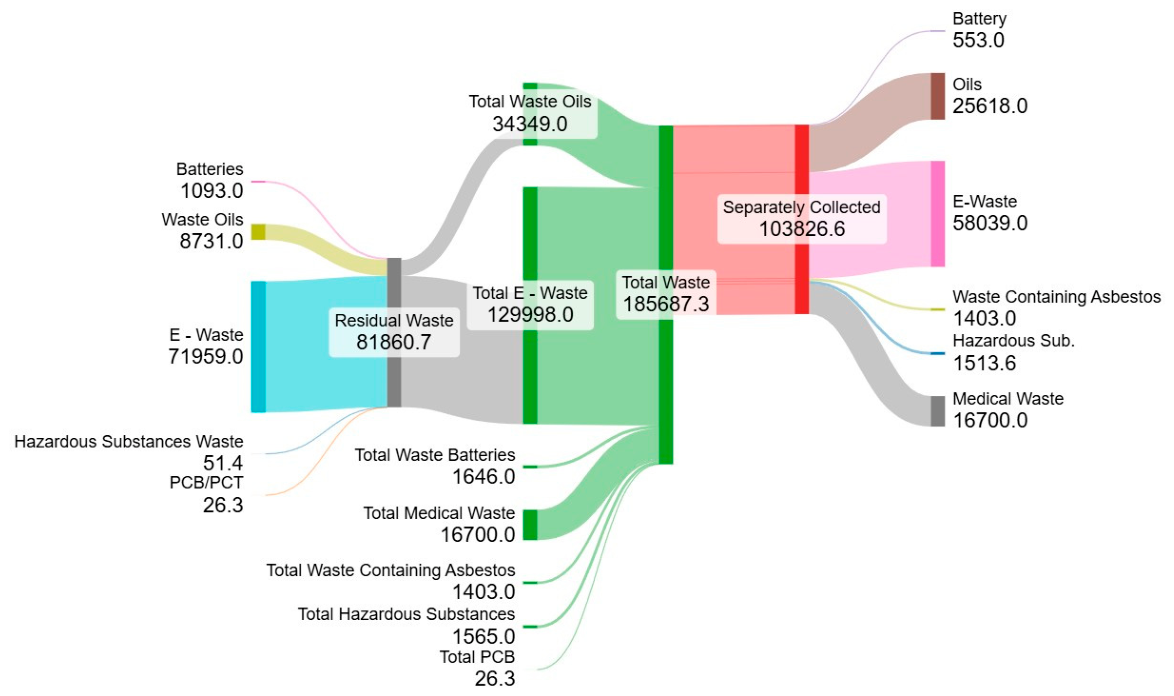
The mass flow analysis of total hazardous waste generation in Greece was conducted using official governmental data sourced from the National Hazardous Waste Management Plan [12]. The available data pertain to the year 2018, since accurate figures for HHW are lacking due to the absence of separate collection systems for this waste stream. Existing data primarily represents hazardous waste generated by businesses and organizations, as these entities are required to report their waste through the Waste Registry Management (WRM) system, a governmental platform for declaring hazardous waste production. Unofficial estimates of HHW quantities are occasionally available in research articles and other public documents. The mass flow diagram was created using SankeyMatic and illustrates multiple hazardous waste streams. From left to right, the diagram depicts the flow of hazardous waste mixed with municipal solid waste (MSW), alongside the stream of separately collected hazardous waste. The central node reflects the total collected quantity and its subsequent distribution across various treatment or disposal pathways.

3. Results

3.1. Descriptive Analysis of Sociodemographic Characteristics

The minimum target sample size for this survey was set at 250 completed questionnaires; ultimately, a total of 307 valid responses were collected. The questionnaire included five sociodemographic variables, with responses categorized as “other” excluded from the analysis due to their low frequency. Gender distribution revealed that most respondents were female (69%), while males accounted for approximately 31% of the sample (Figure S1). Regarding age, most participants (63.7%) were between 19 and 35 years old, followed by 15.7% in the 45–54 age range, 12.4% aged 55 and above, and 8.2% between 36 and 44 years. No underage participants were recorded (Figure S2). In terms of educational level, the largest proportion of respondents (63.1%) had completed higher education, while 18.6% had completed secondary education. Those holding a master’s degree accounted for 12.1% and 3.3% had obtained a doctoral degree (Figure S3). With respect to professional status, students constituted the largest group (45.1%), followed closely by employed individuals (42.2%). Smaller proportions were unemployed (5.6%) or retired (3.9%) (Figure S4). Income distribution showed that most participants (55.6%) reported annual earnings between €10,001 and €30,000, followed by 20.9% earning between €30,001 and €50,000. Additionally, 14.4% reported earnings below €10,000, 5.2% between €50,001 and €70,000, and 3.9% above €70,001. These descriptive statistics outline the sample’s profile, providing the necessary context for the inferential analyses that follow.

3.2. Descriptive Analysis of Participants’ Knowledge, Attitudes, and Practices Regarding HHW

This section presents descriptive statistics on participants’ knowledge, attitudes, and reported practices (K-A-P) related to HHW and its management. Following the three components of the K-A-P model, the results are organized accordingly, with responses for each item summarized using frequency distributions.
The analysis revealed that approximately 77.1% of participants were familiar with the definition of HHW. A large majority (94.4%) reported having detergents and cleaning products in their households. Furthermore, 82% of respondents acknowledged that HHW requires special treatment, and 83.3% indicated that it can be disposed of at designated collection points (Table 2).
Regarding participants’ attitudes, the majority (68.3%) recognized pharmaceutical waste as hazardous. Key barriers to HHW recycling included the lack of collection points (80.4%), insufficient knowledge of proper disposal procedures (46.1%), and limited time (20.7%) (Table S1). Additionally, a considerable portion of participants emphasized the environmental importance of proper HHW management (49.3%), supported the installation of green collection sites in malls, stores, and public spaces (67.3%), and valued public participation in recycling efforts (49.3%) (Table S2). Notably, 74.5% of respondents considered state-provided information on HHW recycling to be inadequate, while only one participant regarded it as sufficient (Table S3).
When evaluating awareness-raising strategies, participants found social media campaigns offering recycling advice (31.7%) and academic seminars and university programs (33.7%) to be the most effective. In contrast, posters and pamphlets in public spaces and stores were perceived as less effective (27.8%) (Table S4).
Concerning disposal practices, 60.5% of participants reported disposing of HHW at special collection points, 46.7% segregated it from other household waste, 43.5% recycled it, 34.6% disposed of it in regular garbage, and only 6.5% reported reusing HHW. Regarding pharmaceutical waste specifically, the majority (59.5%) discarded it in the garbage, 31% returned it to pharmacies, and 22.2% used designated collection points (Table 3). These descriptive findings provide the foundation for the subsequent correlation analyses, which examine how sociodemographic factors influence knowledge, attitudes, and practices related to HHW management.

3.3. Correlation Analysis Between Sociodemographic Variables and K-A-P Responses

Correlation analysis was conducted to examine potential associations between participants’ knowledge, attitudes, and practices (K-A-P) regarding HHW management and their sociodemographic characteristics (i.e., gender, age, educational level, professional status, and income). The analysis employed the Pearson Chi-Square test, with particular attention given to p-values for statistical significance and the Phi coefficient (φ) to assess the strength of associations between categorical variables.
Associations that did not reach statistical significance (p > 0.05) are reported in Table 6 as “ns” (not significant), indicating no evidence of association. In cases where p-values were below 0.05 but the Chi-Square test assumptions were violated, specifically where more than 20% of cells had expected frequencies below 5, the results were denoted as “N/A.” Focusing on these significant associations helps clarify the factors behind HHW management practices, moving the analysis beyond basic descriptions.
The findings are summarized in Table 5, with several statistically significant associations identified. Gender was significantly associated with the practice of returning pharmaceutical waste to pharmacies (p = 0.037), with a Phi coefficient of φ = 0.120, indicating a weak to moderate association. Age showed a highly significant association (p < 0.001) with the perceived importance of proper HHW management for environmental protection, with a Phi coefficient of φ = 0.330, reflecting a strong association. Educational level was significantly associated with the perception that lack of knowledge hinders recycling (p = 0.038), with φ = 0.166, suggesting a weak to moderate relationship. Professional status was significantly related to the disposal of pharmaceutical waste in regular garbage bin (p < 0.001), with a Phi coefficient of φ = 0.297, indicating a moderate to strong association. Income showed a statistically significant association with the practice of disposing HHW at designated collection points (p = 0.024), with φ = 0.195, reflecting a weak to moderate relationship. Collectively, these inferential findings demonstrate that demographic variables are key determinants of HHW related awareness and behavior, providing a more detailed understanding of the factors influencing waste management patterns in the studied population.

4. Discussion

4.1. Cross-Tabulation Matrix and Significance Testing

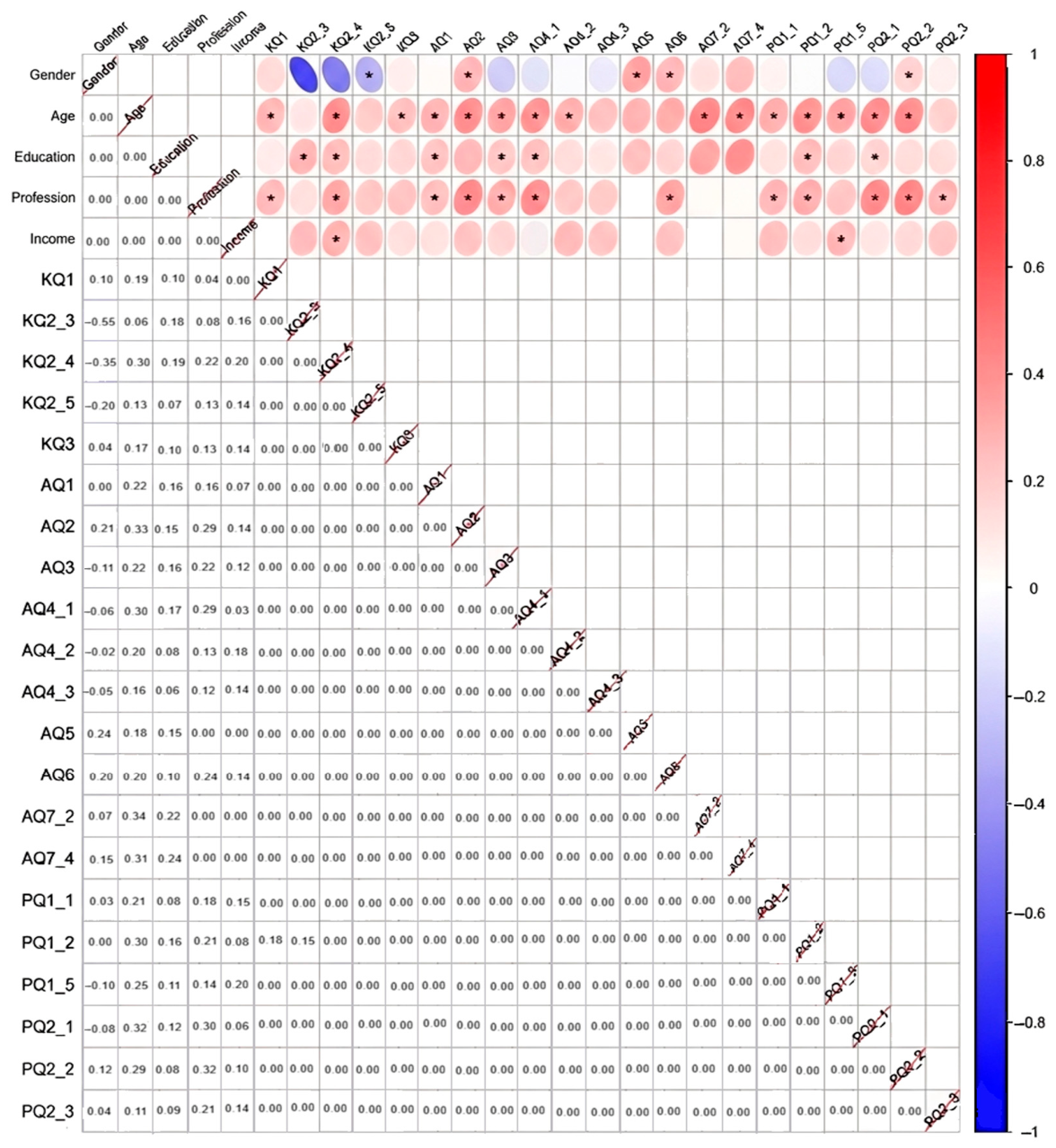
Figure 1 presents an overview of the associations between participants’ sociodemographic characteristics and their responses to knowledge, attitude, and practice (KAP) questions regarding HHW management. KAP-based variables are widely used in waste management studies to assess awareness, practices and gaps in relation to appropriate management [17]. The upper triangle of the matrix illustrates the direction and strength of the relationships using colored elliptical symbols. Red ellipses represent positive associations, while blue ellipses indicate negative associations. The size and shape of the ellipses convey the strength of each association, where larger and more circular shapes denote stronger relationships, whereas smaller and more elongated ellipses reflect weaker ones [18]. Statistically significant associations (p < 0.05) are marked with an asterisk (*). Blank areas or missing symbols indicate variable pairs that failed to meet the assumptions of the Pearson Chi-Square test, particularly where more than 20% of the expected frequencies were below 5. The lower triangle of the matrix presents the Phi coefficient (φ) values, which measure the strength of association between categorical variables. The φ values range from –1 (perfect negative association) to +1 (perfect positive association), with values close to zero suggesting no meaningful relationship [19].
Gender showed weak to moderate associations with KAP variables, with only five statistically significant relationships. Notably, gender was the only demographic variable with negative correlations. The strongest negative correlation was observed with KQ2_3, indicated by a bright blue ellipse, and the only statistically significant negative relationship was found with KQ2_5. Age exhibited stronger and more consistent associations with a wide range of K-A-P variables. Several statistically significant associations were observed, particularly with items such as AQ2, AQ4_1, AQ7_2, and PQ2_1. This suggests that age is a key factor shaping both attitudes and practices toward HHW. The observed differences likely reflect variations in lifestyle, experience, and social context across age groups. For example, younger individuals (19–35) may prioritize convenience or have had limited exposure to environmental education, whereas older groups often follow more established household routines and exhibit a stronger sense of responsibility. These findings indicate that the patterns are not solely driven by chronological age but by the underlying habits and social norms that characterize each group. It is essential to ensure that all citizens are adequately informed and educated about the European Union’s regulatory requirements on the separate collection of HHW, as stipulated in Directive (EC) 2020/851 [20]. Public awareness and engagement play a pivotal role in achieving compliance and promoting environmentally sound HHW practices.
Educational level was moderately associated with several KAP variables, with seven statistically significant associations. Stronger associations appeared where participants’ understanding of HHW and preferred disposal methods are involved. Statistically significant associations suggest that higher educational attainment contributes to improved HHW awareness and responsible behavior. Professional status showed moderate to strong associations, especially with AQ2, AQ4_1, PQ2_1, and PQ2_2. These results indicate that employment context (student, employed, unemployed) may influence how people perceive and manage HHW. Income presented the weakest overall associations, with only two variables showing statistically significant relationships implying that income plays a relatively minor role in influencing HHW management. These results enable formal testing of research hypotheses, showing that certain demographic factors significantly influence HHW related behavior, while others, such as income, do not exhibit a statistically significant effect.
In context, many other studies have performed statistical analysis to investigate socioeconomic characteristics with waste management practices. Óskarsson et al. [21] have found that municipalities in the Arctic regions with unique climate characteristics and resource limitations should develop policies and receive government support to improve waste management practices and promote sustainability. In a related study, Pereira et al. [1] found no statistically significant differences among sociodemographic groups regarding their perception of the hazardous characteristics of HHW. This finding highlights the importance of targeted awareness campaigns aimed at improving public understanding of the specific characteristics that render household products hazardous.

4.2. Mass Flow Analysis of Hazardous Waste in Greece

Figure 2 illustrates the mass flow diagram of hazardous waste in Greece for the year 2018, providing valuable insights into prevailing waste management patterns and associated challenges. The data represented pertains exclusively to hazardous waste originating from the commercial sector, due to the absence of reliable data on household hazardous waste. This data gap is acknowledged in the National Hazardous Waste Management Plan [12].
The diagram is divided into two distinct waste flow streams: on the left, hazardous waste that is either co-disposed of with MSW or illegally stored in unauthorized facilities; and on the right, hazardous waste that is separately collected through designated systems. A critical insight from this analysis is that approximately 44% of hazardous waste generated in Greece is managed ineffectively, bypassing specialized treatment processes required for safe disposal. This inefficiency reflects broader systemic challenges, including underdeveloped infrastructure, fragmented regulatory frameworks, insufficient collection points, and limited public awareness. Although some progress has been made in recent years, Greece continues to face significant difficulties in achieving effective segregation and safe disposal of hazardous waste. Inadequate management practices pose serious environmental and public health risks particularly the mixing of hazardous materials such as electronic waste (e-waste), waste oils, and batteries with general municipal waste and their subsequent disposal in landfills.
The remaining 56% of hazardous waste generated in Greece is managed through separate collection systems. Within this stream, electronic waste (e-waste) accounts for the largest share, followed by waste oils and medical waste. However, the effectiveness of separate collection remains limited. As highlighted by Zamparas and Kalavrouziotis [22], even in regions with well-defined regulatory frameworks, source segregation is frequently incomplete or inconsistently applied. This lack of compliance at the household or generator level significantly undermines the overall efficiency and integrity of the hazardous waste management system, leading to cross-contamination, increased treatment costs, and elevated environmental risks [23].
A comparable situation is observed in Ukraine, where hazardous waste is often mismanaged due to inadequate treatment infrastructure and limited segregation systems. In contrast, Austria demonstrates a well-organized and legally robust hazardous waste management framework, built upon mandatory separate collection and specialized treatment processes in line with stringent national legislation. Austria maintains comprehensive data on hazardous waste, including that generated by households. According to Ischenko et al. [15], approximately 65% of HHW is collected separately through designated collection points and retail outlets, while only 35% is improperly disposed of with mixed municipal waste reflecting a relatively effective system, albeit with room for further optimization.

4.3. Policy Recommendations

Greece must intensify its efforts toward enhancing HHW management through system improvements and strengthened policy implementation. The questionnaire results indicate that most citizens lack awareness of proper household hazardous waste disposal practices, while also perceiving that public authorities provide insufficient information on the issue. Effective HHW management begins with well-defined classification systems and a robust regulatory framework. HHW typically encompasses products that possess hazardous properties including toxicity, flammability, corrosivity, and reactivity. Although such waste is generated in relatively small quantities at the household level, their improper disposal can result in significant environmental degradation and public health risks. When HHW is improperly mixed with MSW, it leads to the contamination of the organic fraction with various chemical pollutants. As a result, the compost produced from such mixed waste streams becomes unsuitable for agricultural applications due to potential risks to soil health and crop safety [24]. Accurate classification plays a vital role not only in identifying such hazardous constituents but also in informing appropriate storage, transportation, and treatment measures. While regulatory approaches differ internationally, the Directive EU 2020/851 [20] mandates the separate collection of HHW to promote source segregation and mitigate disposal related hazards. Pereira et al. [1] highlight that effective classification must be complemented by public awareness, adequate infrastructure, and strong policy enforcement to ensure the safe and sustainable management of HHW at the local level. Our findings support this view, indicating that improving public awareness and providing households with clear and accessible guidance are essential for the success of such local management strategies.
Policy measures aimed at improving HHW management should explicitly incorporate stricter requirements for product labeling and packaging. This is particularly urgent, as the survey data indicates that many citizens still struggle to identify which household products are hazardous. Clearer labeling would directly address this issue, enabling consumers to more easily recognize and separate household hazardous waste at the source. Under EU legislation specifically Regulation (EC) No 1272/2008 [25] on the Classification, Labelling and Packaging (CLP) of substances and mixtures, manufacturers and suppliers are obligated to clearly label hazardous household products with standardized hazard pictograms, signal words, and safety instructions. When properly implemented, labeling not only serves as a risk communication tool but also enables households to recognize and segregate hazardous items from general waste streams [26]. Moreover, appropriate packaging ensures safe handling, storage, and disposal, reducing the likelihood of accidental release or contamination. Aligning national HHW policies with the CLP regulation is essential for enhancing public awareness, facilitating proper waste segregation at the source, and supporting the overall efficiency of HHW collection system.
The efficient collection of HHW depends significantly on the strategic distribution of dedicated collection bins and access to specialized drop-off facilities (green collection points). This is clearly reflected in our survey findings, where the lack of easily accessible collection points emerged as one of the primary barriers preventing citizens from disposing of HHW properly. For this reason, policy frameworks must mandate the provision of clearly labeled and easily accessible HHW bins at both community and retail levels, particularly for common hazardous items such as batteries, small electronics, and expired pharmaceuticals. To achieve this, the development of green collection points in high traffic public areas, local shops, and commercial centers is essential. Such a network would ensure that disposing of common hazardous items, such as batteries, small electronics, and expired pharmaceuticals, becomes a convenient part of the public’s daily routine. Effective implementation requires coordination between local governments, waste service providers, and retailers to ensure adequate bin placement, regular collection schedules, and public communication [27]. Integration of bin distribution strategies into broader waste legislation such as through mandatory take-back schemes or extended producer responsibility (EPR) programs can enhance compliance and promote environmentally sound management, as emphasized by EU directives and supported in recent studies on best practices in HHW management.
In addition, the development of standardized data collection and reporting mechanisms (exemplified by Austria’s documented approach) is critical for evaluating the performance of HHW management systems [15]. Reliable data on waste quantities, composition, collection rates, and disposal practices not only enable continuous performance monitoring but also support policymaking at both municipal and national levels. Such systems could identify gaps in implementation and ensure regulatory compliance contributing to more transparent, accountable, and adaptive HHW management. Ultimately, improved data availability would enable more targeted public information strategies, directly addressing the specific knowledge gaps identified in this study.
In conclusion, improving HHW management in Greece requires an integrated approach combining regulatory frameworks, effective collection systems, clear labeling protocols, and strong public engagement. Aligning with EU directives, promoting equitable access, and implementing data-driven monitoring tools are essential for reducing the environmental and health risks associated with HHW. Our findings emphasize that the success of these measures depends primarily on the active engagement of citizens in recycling and household hazardous waste collection initiatives. Through a combination of legislative action, stakeholder collaboration, and behavioral change strategies, a safer and more sustainable HHW system can be achieved.

5. Conclusions

This study explored citizens’ knowledge, perceptions, and behaviors regarding HHW management. Survey findings revealed that age was the most influential demographic factor, with individuals aged 19–35 more likely to engage in improper disposal practices compared to those aged 55 and above. Educational attainment emerged as the second most impactful variable, while professional status and gender exhibited limited associations. Income, in contrast, did not show a consistent correlation with respondents’ knowledge, attitudes, or practices. These findings highlight a pronounced generational gap in environmental awareness, suggesting that younger demographics represent a critical target group for future HHW intervention and education strategies.
Beyond these demographic insights, participants expressed a clear demand for improved access to information, an increased number of collection points, and the development of modern HHW management facilities. Respondents also emphasized the role of the state in organizing awareness campaigns to promote responsible HHW practices. The results highlight that strengthening public engagement and refining communication strategies are as critical as the technical infrastructure itself. Additionally, there is a pressing need for competent authorities to enhance data availability and transparency regarding the quantities of HHW. Such improvements would support more accurate life cycle assessments and enable better decision-making. In this context, the establishment of a systematic data collection framework becomes particularly important, as it is essential for building a comprehensive national HHW database that can inform future policy planning and infrastructure development.

Supplementary Materials

The following supporting information can be downloaded at: https://www.mdpi.com/article/10.3390/waste4020014/s1, Table S1. Frequency distribution (Yes/No) of responses on attitude questions about hazardous household waste management; Table S2. Frequency distribution of responses on attitudes questions about the importance of household hazardous waste management; Table S3. Frequency distribution of responses on attitudes questions about the perceived sufficiency of household hazardous waste management; Table S4. Frequency distribution of responses on attitudes questions about the perceived effectiveness of household hazardous waste management measures; Figure S1. Pie chart illustrating participants’ gender; Figure S2. Bar chart illustrating participants’ age; Figure S3. Bar chart illustrating participants’ educational level; Figure S4. Pie chart illustrating participants’ professional status; Figure S5. Bar chart illustrating participants’ income.

Author Contributions

All authors contributed to the study conception and design. Material preparation, data collection and analysis were performed by M.M., T.D. and A.G. The first draft of the manuscript was written by M.M. and all authors commented on previous versions of the manuscript. All authors have read and agreed to the published version of the manuscript.

Funding

The authors declare that no funds, grants, or other support were received during the preparation of this manuscript.

Institutional Review Board Statement

Not applicable.

Informed Consent Statement

Not applicable.

Data Availability Statement

The datasets generated during and/or analysed during the current study are available from the corresponding author on reasonable request.

Conflicts of Interest

The authors have no relevant financial or non-financial interests to disclose.

References

  1. Pereira, C.; Ramos, M.; Martinho, G. Key factors to improve the management of household hazardous waste. J. Environ. Manag. 2025, 393, 126940. [Google Scholar] [CrossRef]
  2. Chaiyarit, J.; Saengpae, K.; Jomkathok, K.; Roshom, P.; Seehatab, T.; Intarasaksit, P. Knowledge, behavior, and household hazardous waste composition: Implications for environmental health in Nakhon Nayok Province, Thailand. Thai Environ. Eng. J. 2025, 39, 9–17. [Google Scholar]
  3. Inglezakis, V.J.; Moustakas, K. Household hazardous waste management: A review. J. Environ. Manag. 2014, 150, 310–321. [Google Scholar] [CrossRef] [PubMed]
  4. Slack, R.; Gronow, J.; Voulvoulis, N. Hazardous components of household waste. Crit. Rev. Environ. Sci. Technol. 2004, 34, 419–445. [Google Scholar] [CrossRef]
  5. Miafodzyeva, S.; Brandt, N. Recycling behaviour among householders: Synthesizing determinants via a Meta-analysis. Waste Biomass Valor. 2013, 4, 221–235. [Google Scholar] [CrossRef]
  6. Zorpas, A.A. Strategy development in the framework of waste management. Sci. Total Environ. 2020, 716, 137088. [Google Scholar] [CrossRef] [PubMed]
  7. Kumar, A.; Thakur, A.K.; Gaurav, G.K.; Klemeš, J.J.; Sandhwar, V.K.; Pant, K.K.; Kumar, R. A critical review on sustainable hazardous waste management strategies: A step towards a circular economy. Environ. Sci. Pollut. Res. 2023, 30, 105030–105055. [Google Scholar] [CrossRef]
  8. Wang, J.; Cevik, M.; Amin, S.H.; Parsaee, A.A. Mixed-integer linear programming models for the paint waste management problem. Transp. Res. Part E Logist. Transp. Rev. 2021, 151, 102343. [Google Scholar] [CrossRef]
  9. Letcher, T.M.; Slack, R. Chemicals in waste: Household hazardous waste. In Waste (A Handbook for Waste Management); Academic Press: Cambridge, MA, USA, 2019. [Google Scholar] [CrossRef]
  10. Al-Khatib, I.A.; Kontogianni, S.; Nabaa, H.A.; Alshami, N.; Al-Sari, M.I. Public perception of hazardousness caused by current trends of municipal solid waste management. Waste Manag. 2015, 36, 323–330. [Google Scholar] [CrossRef]
  11. Das, S.; Lee, S.-H.; Kumar, P.; Kim, K.-H.; Lee, S.S.; Bhattacharya, S.S. Solid waste management: Scope and the challenge of sustainability. J. Clean. Prod. 2019, 228, 658–678. [Google Scholar] [CrossRef]
  12. Ministry of Environment and Energy-MEN. National Hazardous Waste Management Plan; Government gazette; Environmental Protection Agency: Washington, DC, USA, 2020.
  13. Saleh, H.M.; Hassan, A.I.; Aglan, R.F. Introductory chapter: Foundations and Challenges in Hazardous Waste Management. In Advances and Challenges in Hazardous Waste Management; IntechOpen: London, UK, 2024. [Google Scholar] [CrossRef]
  14. Liu, K.; Tan, Q.; Yu, J.; Wang, M. A global perspective on e-waste recycling. Circ. Econ. 2023, 2, 100028. [Google Scholar] [CrossRef]
  15. Ishchenko, V.; Dworak, S.; Fellner, J. Hazardous household waste management in Ukraine and Austria. J. Mater. Cycles Waste Manag. 2023, 26, 635–641. [Google Scholar] [CrossRef]
  16. Wang, L.S.; Aziz, Z.; Wang, E.S.; Chik, Z. Unused medicine take-back programmes: A systematic review. J. Pharm. Policy Pract. 2024, 17, 2395535. [Google Scholar] [CrossRef]
  17. Aku, T.A.; Jato, J.; Atsu, L.D.; Oteng, D.; Ben, I.O.; Somuah, S.O.; Odoi, H.; Orman, E.; Dodoo, C.; Jani, Y.; et al. Knowledge and practices on household disposal of unused antimicrobials in Ho municipality, Ghana. Int. J. Environ. Res. Public Health 2025, 22, 1519. [Google Scholar] [CrossRef]
  18. Chriki, S.; Payet, V.; Pflanzer, S.B.; Ellies-Oury, M.-P.; Liu, J.; Hocquette, É.; Rezende-de-Souza, J.H.; Hocquette, J.-F. Brazilian consumers’ attitudes towards so-called “Cell-based meat”. Foods 2021, 10, 2588. [Google Scholar] [CrossRef]
  19. Agresti, A. Categorical Data Analysis, 2nd ed.; John Wiley & Sons: Hoboken, NJ, USA, 2002. [Google Scholar]
  20. European Commission (EC). Separate Collection of Household Hazardous Waste; 2020/C 375/01; EC: Brussels, Belgium, 2020; Available online: https://eur-lex.europa.eu/legal-content/EN/TXT/?uri=oj:JOC_2020_375_R_0001 (accessed on 1 December 2025).
  21. Óskarsson, G.K.; Sveinn Agnarsson, S.; Davíðsdóttir, B. Evaluating municipal solid waste management efficiency in Iceland: A data envelopment analysis of socioeconomic and geographic influences. Environ. Sustain. Indic. 2025, 26, 100676. [Google Scholar] [CrossRef]
  22. Zamparas, M.; Kalavrouziotis, I. Healthcare waste management in Greece. The example of Health Region of Western Greece, Peloponnese, Epirus and Ionian Islands. Glob. NEST J. 2018, 20, 96–102. [Google Scholar] [CrossRef][Green Version]
  23. Alabi, O.A.; Creczynski Pasa, T.B.; Adebo, T.C. Environmental contamination and public health effects of household hazardous waste. J. Biomed. Res. Environ. Sci. 2023, 4, 1323–1340. [Google Scholar] [CrossRef]
  24. Ayilara, M.S.; Olanrewaju, O.S.; Babalola, O.O.; Odeyemi, O. Waste management through composting: Challenges and potentials. Sustainability 2020, 12, 4456. [Google Scholar] [CrossRef]
  25. European Commission (EC). Classification, Labelling and Packaging of Substances and Mixtures; 1272/2008; EC: Brussels, Belgium, 2008; Available online: https://eur-lex.europa.eu/eli/reg/2008/1272/oj/eng (accessed on 1 December 2025).
  26. Da Silva, E.; Baun, A.; Berggren, E.; Worth, A. Optimising testing strategies for classification of human health and environmental hazards—A proof-of-concept study. Toxicol. Lett. 2020, 335, 64–70. [Google Scholar] [CrossRef]
  27. Trushna, T.; Krishnan, K.; Soni, R.; Singh, S.; Kalyanasundaram, M.; Annerstedt, K.S.; Pathak, A.; Purohit, M.; Lundbog, C.S.; Sabde, Y.; et al. Interventions to promote household waste segregation: A systematic review. Heliyon 2024, 10, e24332. [Google Scholar] [CrossRef] [PubMed]
Figure 1. Matrix of association measures (Phi Coefficients) for categorical Variables. The matrix presents the φ coefficients of association derived from the Pearson Chi-Square test for all combinations of the categorical variables. The lower triangle displays the φ coefficient values, while the upper triangle visually represents the magnitude and direction of the association (red for positive association, blue for negative association). Statistically significant associations (typically at p < 0.05) are indicated by an asterisk (*).
Waste 04 00014 g001
Figure 2. Mass flow diagram of hazardous waste in Greece ((left): hazardous waste disposed with mixed municipal solid waste; (right): hazardous waste collected separately).
Waste 04 00014 g002
Table 1. Overview of the survey questionnaire.
Section 1: Sociodemographic Profile
  • Gender
    • Male
    • Female
    • Other
2.
Age
  • <18
  • 19–35
  • 35–44
  • 45–54
  • >55
3.
Educational Attainment
  • Compulsory Education
  • Secondary Education
  • Higher Education
  • Postgraduate Education
  • PhD
4.
Professional Status
  • Student
  • University student
  • Employed
  • Unemployed
  • Retired
  • Other
5.
Annual Household Income
  • <10,000
  • 10,001–30,000
  • 30,001–50,000
  • 50,001–70,000
  • >70,001
Section 2: Awareness and Current Practices
6.
Are you familiar with the term “Household Hazardous Waste”?
  • Yes
  • No
7.
Which of the following categories of household hazardous waste are currently present in your residence?
  • Waste batteries
  • Detergents and cleaning products (e.g., bleach)
  • Paints, varnishes and solvents
  • Fluorescent light bulbs
  • Electrical waste (e-waste)
  • Pharmaceutical waste
  • Pesticides
  • Other
8.
Are you aware that household hazardous waste requires specialized handling and disposal procedures?
  • Yes
  • No
9.
What is your primary method for disposing of household hazardous waste?
  • Separation from general household waste
  • Disposal in residual waste bins
  • Recycling via standard recycling systems
  • Reuse
  • Disposal at specialized collection points (e.g., green points)
  • Other
10.
Are you aware of the existence of “Green Points” or specialized collection sites for hazardous waste (e.g., pharmaceuticals, light bulbs, batteries, automotive batteries, thermometers, cleaning agents, etc.)?
  • Yes
  • No
11.
Do you consider pharmaceutical waste to be hazardous?
  • Yes
  • No
12.
What is your current practice for disposing of expired or unused pharmaceutical products?
  • Disposal via municipal solid waste streams
  • Return to pharmacy
  • Disposal at specialized collection points
  • Other
13.
How important do you consider the proper management of household hazardous waste to be for environmental protection?
  • Extremely important
  • Very important
  • Moderately important
  • Slightly important
  • Not at all important
14.
In your opinion, is the information provided by state authorities regarding the recycling of household hazardous waste sufficient?
  • Yes, sufficient
  • Yes, but not sufficiently targeted
  • Insufficient
Section 3: Attitudes, Barriers and Perspectives
15.
What are the primary barriers preventing you from recycling household hazardous waste?
  • Lack of procedural knowledge
  • Lack of collection points
  • Lack of time
16.
Do you consider the installation of “Green Points” (collection sites) in public spaces, retail stores, and commercial centers to be important?
  • Extremely important
  • Very important
  • Moderately important
  • Slightly important
  • Not at all important
17.
How important do you perceive the role of citizen participation to be in initiatives related to the collection and recycling of household hazardous waste?
  • Extremely important
  • Very important
  • Moderate important
  • Slightly important
  • Not at all important
18.
Please evaluate the effectiveness of the following communication methods in promoting the recycling of household hazardous waste
  • Social media awareness campaigns with recycling tips and guidelines
  • Educational programs and seminars in schools and universities
  • Development of an interactive mobile application
  • Production and distribution of posters and informational leaflets in retail stores and public spaces
19.
Additional suggestions or comments regarding the management and recycling of household hazardous waste (Optional).
Table 2. Sociodemographic characteristics of the participants.
Questions
SQ1Gender
SQ2Age
SQ3Educational Attainment
SQ4Professional Status
SQ5Annual Household Income
Table 3. Frequency (percentage) distribution of responses to knowledge-based questions on HHW management.
QuestionsFrequency
YesNo
KQ1Are you familiar with the term “Household hazardous waste”?236 (77.1%)70 (22.9%)
KQ2_1Are there any waste batteries in your home?284 (92.8%)22 (7.2%)
KQ2_2Are there any detergents and cleaning products in your residence?289 (94.4%)17 (5.6%)
KQ2_3Are there any paints, varnishes, solvents in your residence?125 (40.8%)181 (59.2%)
KQ2_4Are there any fluorescent light bulbs in your residence?78 (25.5%)228 (74.5%)
KQ2_5Are there any electrical waste (e-waste) in your residence?192 (62.7%)114 (37.3%)
KQ2_6Are there any pharmaceutical waste in your residence?250 (81.7%)56 (18.3%)
KQ2_7Are there any pesticides in your residence?202 (66.0%)104 (34.0%)
KQ3Are you aware that household hazardous waste requires specialized handling and disposal procedures? 251 (82.0%)55 (18.0%)
KQ4Are you aware of the existence of “Green Points” or specialized collection sites for hazardous waste (e.g., pharmaceuticals, light bulbs, batteries, automotive batteries, thermometers, cleaning agents, etc.)?255 (83.3%)51 (16.7%)
Table 4. Assessment of participants’ attitudes toward HHW management (questions).
Questions
AQ1Do you consider pharmaceutical waste to be hazardous?
AQ2How important do you consider the proper management of household hazardous waste to be for environmental protection?
AQ3In your opinion, is the information provided by state authorities regarding the recycling of household hazardous waste sufficient?
AQ4_1Does lack of procedural knowledge = prevent you from recycling your HHW?
AQ4_2Does lack of collection points prevent you from recycling your HHW?
AQ4_3Does lack of time prevent you from recycling your HHW?
AQ5Do you consider the installation of “Green Points” (collection sites) in public spaces, retail stores, and commercial centers to be important?
AQ6How important do you perceive the role of citizen participation to be in initiatives related to the collection and recycling of household hazardous waste?
AQ7_1How successful do you think social media awareness campaigns with recycling tips and guidelines?
AQ7_2How successful do you think educational programs and seminars in schools and universities?
AQ7_3How successful do you think it would be the development of an interactive mobile application?
AQ7_4How successful do you think the production and distribution of posters and informational leaflets in retail stores and public spaces?
Table 5. Frequency distribution (percentage) of responses on practice questions about HHW management.
QuestionsFrequency
YesNo
PQ1_1Do you separate your HHW from the rest?143 (46.7%)163 (53.3%)
PQ1_2Do you dispose of your HHW in residual waste bins?106 (34.6%)200 (65.4%)
PQ1_3Do you recycle your HHW via standard recycling systems?133 (43.5%)173 (56.5%)
PQ1_4Do you reuse your HHW?20 (6.5%)286 (93.5%)
PQ1_5Do you dispose of your HHW at specialized collection points (e.g., green points)?185 (60.5%)121 (39.5%)
PQ2_1Do you dispose of your pharmaceutical waste via municipal solid waste streams?182 (59.5%)124 (40.5%)
PQ2_2Do you return your pharmaceutical waste to the pharmacy?95 (31.0%)211 (69.0%)
PQ2_3Do you dispose of your pharmaceutical waste at specialized collection points?68 (22.2%)238 (7.8%)
Table 6. Association of sociodemographic factors and knowledge, attitude, practice scores.
GENDER AGE E. LEVEL P. STATUS INCOME
Chi Squarep-ValuePhi Chi Squarep-ValuePhi Chi Squarep-ValuePhi Chi Squarep-ValuePhi Chi Squarep-ValuePhi
KQ12.7270.099 0.095ns11.1470.0110.191 3.0700.3810.100ns9.0650.0280.175 0.5290.971 0.042ns
KQ2_12.8250.093 −0.096ns0.1160.990 0.020N/A7.8440.049 0.160N/A2.4120.491 0.090ns1.3660.8500.068N/A
KQ2_20.2490.618 −0.290ns0.4030.940 0.036N/A18.085<0.001 0.243N/A1.9330.586 0.081ns2.8280.587 0.098N/A
KQ2_30.9050.342 −0.550ns1.1790.758 0.062ns10.5130.0150.185 1.7350.629 0.077ns7.2580.123 0.157ns
KQ2_40.3710.542 −0.350ns28.306<0.0010.304 11.5340.0090.194 13.8970.0030.217 12.4000.0150.205
KQ2_511.712<0.001−0.196 5.1600.160 0.130ns1.6640.645 0.074ns5.0550.168 0.131ns5.6240.229 0.138ns
KQ2_60.3480.555 −0.340ns4.2540.235 0.118ns1.5090.680 0.070ns5.4460.142 0.136ns4.7350.316 0.126ns
KQ2_70.8520.356 −0.053ns3.2760.351 0.103ns3.0230.388 0.099ns0.4990.919 0.041ns4.2060.392 0.118ns
KQ30.4940.482 0.040ns8.8760.0310.170 3.2410.356 0.103ns4.7760.189 0.127ns2.1200.714 0.085ns
KQ42.1460.143 0.084ns6.1340.105 0.142ns1.7600.624 0.076ns3.1920.363 0.104ns6.8640.143 0.152ns
AQ10.0080.931 0.005ns15.2030.0020.223 8.0340.0450.162 7.9280.0480.164 1.6530.7990.075ns
AQ213.5830.0010.211 33.316<0.0010.330 6.4990.370 0.146ns25.201<0.0010.292 5.9490.704 0.136ns
AQ33.8240.051−0.112 15.3490.0020.224 7.8790.0490.160 14.3880.0020.220 4.2250.3760.119ns
AQ4_10.9310.335 −0.055ns26.583<0.0010.295 8.4270.0380.166 24.777<0.0010.289 0.3290.988 0.033ns
AQ4_20.1090.741 −0.019ns12.5200.0060.202 1.9860.575 0.081ns4.7970.187 0.127ns9.3020.0540.177ns
AQ4_30.7010.402 −0.048ns7.8140.050.160 0.9920.803 0.057ns4.6180.202 0.125ns5.4430.245 0.136ns
AQ517.657<0.0010.241 9.9010.129 0.180ns6.9650.324 0.151ns8.2710.219 0.167N/A4.4540.135 0.154N/A
AQ612.0800.0070.199 12.6040.050.203 3.1460.790 0.101ns16.5040.0110.236 4.9270.765 0.142N/A
AQ7_13.0280.553 0.100ns16.0770.188 0.229ns11.8090.224 0.196ns10.2980.327 0.187N/A8.4920.746 0.169N/A
AQ7_21.6280.804 0.073ns36.412<0.0010.345 14.5760.103 0.218ns28.796<0.001 0.312N/A16.7080.1610.238N/A
AQ7_32.4450.654 0.090ns11.3540.500 0.193ns13.3370.344 0.209ns15.8660.070 0.232N/A14.2830.283 0.220N/A
AQ7_46.4370.169 0.146ns29.3620.0030.310 18.1900.110 0.244ns18.0650.034 0.247N/A20.4170.060 0.263N/A
PQ1_10.1900.663 0.025ns13.2210.0040.208 1.7550.625 0.076ns9.9720.0190.184 6.3310.176 0.146ns
PQ1_20.0010.975 0.002ns 27.219<0.0010.298 8.3430.0390.165 13.3750.0040.213 2.0330.730 0.083ns
PQ1_32.8150.093 0.096ns2.1920.534 0.085ns3.9840.263 0.114ns2.1930.533 0.086ns4.0350.401 0.117ns
PQ1_40.0040.953 0.003ns2.8110.422 0.096N/A2.7680.429 0.095N/A3.3520.340 0.106ns2.2900.683 0.088ns
PQ1_52.9200.087 −0.098ns19.074<0.0010.250 3.5600.313 0.108ns5.6600.129 0.138ns11.2190.0240.195
PQ2_11.8270.177 −0.078ns31.026<0.0010.318 4.2110.240 0.117ns26.050<0.0010.297 0.9060.924 0.055ns
PQ2_24.3640.0370.120 26.532<0.0010.294 2.1390.544 0.084ns30.561<0.0010.321 2.8190.589 0.098ns
PQ2_30.5620.453 0.043ns3.8120.282 0.112ns2.2020.532 0.085ns13.0410.0050.210 6.0900.193 0.143ns
Disclaimer/Publisher’s Note: The statements, opinions and data contained in all publications are solely those of the individual author(s) and contributor(s) and not of MDPI and/or the editor(s). MDPI and/or the editor(s) disclaim responsibility for any injury to people or property resulting from any ideas, methods, instructions or products referred to in the content.