


Abstract
Cloud storage systems require strong and efficient encryption methods to ensure data security and reliability. However, selecting the most suitable encryption algorithm remains a challenge due to variations in performance, overhead, and reliability. This study aims to introduce a comparative analysis of five encryption algorithms—Advanced Encryption Standard (AES), Blowfish, Rivest-Shamir-Adleman (RSA), Elliptic Curve Cryptography (ECC), and Advanced Encryption Standard one-time password AES-OTP with RSA hybrid model (AES-OTP with RSA)—to identify the most suitable algorithm to protect sensitive data in cloud storage systems. The evaluation of these algorithms was based on encryption/decryption time, data size overhead, encryption/decryption throughput, performance metrics (accuracy, precision, recall, and F1-score), and error metrics mean square error and mean absolute error (MSE and MAE), using datasets of various sizes. The results indicated that AES provided the fastest encryption and decryption time, minimal overhead, and the highest throughput and accuracy, while Blowfish also performed efficiently but with slightly higher error rates. RSA and ECC, although secure, were slower and demonstrated more overhead. The hybrid AES-OTP with RSA model achieved a good balance between speed and secure key management. This study highlights the trade-offs between speed, security, and storage efficiency, offering guidance in selecting appropriate encryption algorithms for cloud-based data protection.
Keywords:
encryption algorithms; cloud storage; comparative; evaluation metrics; speed; overhead; performance 1. Introduction
In today’s digital environment, data have become known as an essential asset, driving the functions of cloud services, IoT networks, and AI-driven platforms. However, due to the exponential growth of interconnected systems and the escalating reliance on data sharing, protecting the confidentiality, integrity, and availability of data has become significant. Cryptography serves as the fundamental mechanism to ensure secure communication and data security using techniques such as encryption and decryption [1]. These procedures transform readable data into unreadable ciphertext and vice versa, protecting sensitive data from unauthorized access [2].
The increase in cloud computing applications has presented new challenges and threats, especially with respect to data privacy, unauthorized access, and cyberattacks. Although cloud systems provide scalability and cost-effectiveness, the storage and transmission of data remotely render it vulnerable to potential attacks. Encryption is crucial in cloud environments to guarantee that data are available to authorized users, even when sent over insecure networks [3]. In the context of IoT, where devices communicate wirelessly and frequently have limited computational resources, encryption is important for protecting data transmission and maintaining user trust [4].
Cryptographic algorithms are primarily classified into symmetric encryption algorithms (e.g., AES, DES, Blowfish) and asymmetric encryption algorithms (e.g., RSA, ECC). Symmetric techniques use one shared key for encryption and decryption processes, resulting in faster speeds and fewer computational demands, whereas asymmetric techniques use pairs of public and private keys, providing greater protection but costing additional processing overhead [5]. Each type plays certain roles within modern security frameworks: symmetric encryption techniques are optimal for large data transfers due to their efficiency, while asymmetric encryption techniques are preferred for secure key exchange and digital signatures [2].
Various studies have investigated the comparative strengths of different algorithms. AES has consistently been demonstrated as a reliable and high-performance symmetric algorithm, while RSA and ECC are distinguished by their robust key management and scalability within public key infrastructure (PKI) frameworks [1]. Performance evaluations conducted underscore the importance of choosing encryption algorithms tailored to certain application settings, such as IoT and cloud security, which were lightweight or high-performance vital [6].
In recent years, the application of artificial intelligence (AI) to cybersecurity has provided additional layers of complexity and potential. AI algorithms, especially in intrusion detection and anomaly detection systems, entail encryption schemes that are both secure and adaptable, as well as scalable. Encryption and AI can collaborate to create dynamic, robust security frameworks that can protect against advanced attacks in multi-agent scenarios [6].
With all these advancements, there is still no universally optimal encryption algorithm. The effectiveness of each encryption algorithm depends on several factors, such as the size of data, the required level of security, computational resources, and real-time processing. Many comparative studies exist, but few offer a comprehensive analysis that includes both performance and error metrics (e.g., encryption time, decryption time, data sizes, accuracy, and MSE, etc.) across various algorithms under some consistent circumstances.
This study aims to present a comparative analysis for several data encryption algorithms, such as AES, Blowfish, RSA, ECC, and the hybrid AES-OTP with RSA model, in order to determine the most efficient encryption algorithm for securing data on cloud storage systems. The comparison focuses on essential factors such as encryption/decryption time and throughput, differences in data sizes, performance accuracy, and error rates. To accomplish this goal, the study focuses on these objectives:
- Measure the encryption and decryption time for each algorithm to analyze the efficiency and responsiveness of each.
- Compare the differences between the data sizes before and after encryption to evaluate the storage impact of each one.
- Measure how much data can be processed over time during encryption and decryption operations in each algorithm to determine their speed and efficiency
- Introduce controlled distortion and noise data for simulating real cloud storage scenarios to evaluate how accurate and reliable each algorithm is.
- Find out which algorithm is the best balanced among the others in terms of speed, security, storage, efficiency, and reliability in cloud environments.
Subsequently, the rest of this paper is introduced as follows. Section 2 conducts previous work on data encryption algorithms for cloud storage systems. Section 3 outlines the methodology and design utilized in this study. Section 4 illustrates the empirical findings of the comparative analysis study. Section 5 interprets the findings and demonstrates the observations. Section 6 concludes the main work of this study with guidance for future work suggestions.
2. Literature Review
Encryption algorithms play an important role in protecting sensitive data from unauthorized access. For each of the symmetric, asymmetric, and hybrid techniques, they are commonly used, where each of these techniques offers distinct characteristics in terms of security, computational resources, and speed. Therefore, this section conducts the main studies related to prominent encryption algorithms. The main purpose is to highlight these algorithms, defining their performance characteristics, application in the real world, and the current limitations of the studies.
2.1. Advanced Encryption Standard (AES)
The Advanced Encryption Standard (AES) is a symmetric encryption algorithm used to secure data, where it encrypts and decrypts data using the same key. Due to its speed and robustness, AES is commonly applied in cloud storage, wireless networks, and financial systems to protect sensitive data.
Recent updates to AES have addressed new challenges in cloud environments, where data security and performance efficiency are both so important. In [7], a modified AES-based framework was proposed that incorporates the double round key technique to enhance the cryptographic system. The findings indicated a significant improvement, with the encryption speed rising from 800 to 1000 blocks per second. Furthermore, improved AES reduced energy consumption by 14.43 percent, network traffic by 11.53 percent, and data latency by 15.67 percent. These changes enhance AES’s applicability for current cloud systems, particularly those requiring fast and secure real-time data processing. This study clearly shows that adding small changes to AES can give better performance in cloud storage systems.
Furthermore, in [8], a hybrid encryption model was proposed that combined AES and RSA to protect data in the cloud. It uses AES to encrypt original data, where RSA is used to secure key exchange. This dual-layer algorithm ensures the speed of AES to encrypt large data and the reliability of RSA to manage keys securely. The results indicate that the proposed model is adequate for cloud environments; it provides scalability and security. This study clearly shows the robustness and speed in encryption performance due to the usefulness and effectiveness of AES in hybrid algorithms.
Furthermore, in [9], a dynamic AES encryption system with blockchain-based key management was proposed to secure data on the cloud. The proposed system assigns a unique AES key to each file, which improves confidentiality even if the system is partially compromised. These unique keys are stored and verified using blockchain techniques, while elliptic curve cryptography (ECC) secures the transmission process. As a result, this system provides stronger file-level security and a decentralized key management system, where it shows that AES is more adaptive to evolving cloud-based and distributed storage systems.
In summary, AES is an important algorithm used in modern encryption systems due to its efficiency, simplicity, and robustness. Current research is enhancing AES for dynamic and secure setup in cloud computing environments via architectural improvements, hybrid encryption models, and integration with technologies like blockchain and ECC. These innovations enhance AES’s role in securing large systems where performance and reliability are critical.
2.2. Blowfish
Blowfish is a symmetric encryption algorithm recognized for its speed and simplicity. It is frequently used in applications that require fast and efficient data protection, particularly in limited-resource environments. Although useful for some applications, it is typically considered less suitable for securing huge data volumes compared to modern encryption algorithms.
Recent studies have explored the applicability of Blowfish in cloud storage environments, often through integration with other encryption algorithms. In [10], a study proposed an improved Blowfish encryption algorithm for cloud security that uses clustering of data with the K-medoids algorithm to generate keys based on data sensitivity. The model aims to improve performance and security. The findings show that the encryption and decryption time of the model is faster compared to the RSA and AES algorithms, and the control of sensitive data is enhanced. The study clearly highlights the efficiency and adaptability of Blowfish, making it viable for cloud storage systems.
In [11], a hybrid encryption model was proposed that combines the Paillier and Blowfish algorithms. The proposed model consists of two stages: using the homomorphic Paillier algorithm to encrypt data first, then using the Blowfish algorithm to further secure data. Objects are to enhance performance and security. The findings show that encryption and decryption time are improved, encrypted data size is reduced, and model performance is improved compared to the AES-RSA combination. The study highlights the role of Blowfish in enhancing performance and security for hybrid models, showing its suitability for scalable, efficient, and attack-resistant cloud systems.
In [12], a hybrid encryption model was proposed that combines the Blowfish and RSA algorithms to improve the data security in cloud storage systems. The proposed model uses Blowfish for data encryption and RSA to secure the encryption key. It is a dual-layer model that secures data during transmission and storage, and reduces key compromise risk. The results show that the encryption time in Blowfish is reduced compared to RSA alone. The study highlights that Blowfish is suitable for hybrid algorithms requiring fast execution and low computational cost, such as cloud environments.
In summary, Blowfish is an efficient encryption algorithm for systems that prioritize performance and efficiency over extensive data block encryption. Its integration into hybrid models helps to reduce its limitations and enhance its functionality in secure cloud storage systems. Studies indicate that when Blowfish is optimized and integrated with current algorithms, it can still provide competitive performance and security.
2.3. Rivest-Shamir-Adleman (RSA)
Rivest-Shamir-Adleman (RSA) is one of the asymmetric encryption algorithms that uses public and private keys for encryption and decryption processes. Some of RSA’s benefits are to secure the key exchange, digital signature, and encryption of sensitive data. In contrast to symmetric encryption algorithms, secret keys are not required, making it suitable for untrusted networks. However, it is slower and potentially less efficient for large-scale or real-time applications such as cloud storage systems.
Recent advances have proposed various RSA enhancements and hybrid models to improve performance and security. In [13], an improved RSA was proposed to improve security and reduce the risk of repeated ciphertext output, which is common in RSA, and attackers can exploit this risk. The proposed model evolves the key generation approach of RSA by conducting a third prime number and adjusting the encryption procedure to consider the position of characters in the message. These adjustments complicate the guessing of common patterns or outputs. The results show that the RSA algorithm offers more resistance to known-plaintext and brute-force attacks with a small increase in computational time.
In [14], a hybrid encryption model was proposed combining RSA and NTRU to improve data security in cloud storage systems. The proposed model uses RSA to secure key exchange and NTRU to encrypt data. The results show that the model offers robust protection for data during transmission and storage, addressing challenges of key cloud systems, such as secure key distribution and computational performance. The study highlights that RSA continues to be suitable as a trusted and secure technique for key management within hybrid encryption models.
In [15], a hybrid encryption model HE-RSA was proposed for enhancing the RSA performance and security in cloud environments. The proposed model combines small-e RSA and efficient RSA techniques, performing various key exponents and a dual encryption process to reduce the common vulnerabilities of RSA, such as timing, brute-force, and selected ciphertext attacks. RSA small-e minimizes the encryption time using a smaller public exponent, and efficient RSA evolves the decryption process by redefining the totient function. The results show that the performance evaluations of HE-RSA indicate an improvement in encryption, decryption, and key generation speed compared to standard RSA. The study highlights RSA adaptability through optimization, offering extra efficient and practical performance in cloud environments.
In summary, the studies demonstrate that the RSA algorithm continues to play an important role in novel encryption algorithms. With the limitations of RSA in speed and security, recent enhancements and hybrid models have helped to control these challenges. Researchers have made RSA faster and more suitable for cloud environments by combining it with other algorithms, such as NTRU, or modifying its functionality internally. The advancements demonstrate that RSA is still a flexible and reliable option for secure key management and data security.
2.4. Elliptic Curve Cryptography (ECC)
Elliptic curve cryptography (ECC) is one of the asymmetric encryption algorithms that uses public and private keys for secure communication. It is known to provide robust security with smaller key sizes compared to algorithms such as RSA. Due to its efficiency and low resource usage, ECC is suitable for cloud storage environments, mobile applications, and Internet of Things (IOT) systems, where lightweight performance and robust security are required.
Recent studies have emphasized the benefits of ECC in secure cloud storage and hybrid encryption models. In [16], a secured cloud storage model was proposed using the public key infrastructure (PKI) based on ECC. The proposed model secures the stored data and transmission over an untrusted network by encrypting data on the client side and managing key exchange through ECC. The results show that ECC reduces message size, computational cost, and transmission overhead compared to the RSA algorithm. The study highlights that ECC efficiency and scalability make it suitable for cloud storage systems of multi-users.
In [17], a hybrid encryption model was proposed that combines ECC and AES to enhance cloud and data security. The proposed model uses ECC to encrypt the AES key and AES to encrypt the data. The results indicate that the model achieved better efficiency and robust security, especially for multimedia data such as audio and image files. The study highlights ECC’s role in offering secure key exchange while maintaining the whole system’s performance; it makes it suitable for secure cloud communication and storage.
In [18], an enhanced ECC-based model was proposed for secure cloud storage using reversible polynomial hashing and advanced deduplication. The proposed model allows organizations to perform deduplication before storing data in the cloud, followed by a cross-organization deduplication technique done by the cloud provider. The integration of reversible polynomial hashing ensures data integrity, while ECC ensures secure access control and encryption. The results of the model show that storage redundancy is reduced, data sharing and searching functions are improved, and the dependency on cloud providers for security is minimized. The study highlights ECC’s effectiveness in offering security and efficiency in cloud memory management.
In summary, the studies demonstrated that ECC is an efficient and secure encryption algorithm for cloud storage systems. Its use in hybrid models and integration with different techniques, such as deduplication and hashing, prove its flexibility to address the modern requirements for security. Compared to traditional asymmetric algorithms like RSA, ECC offers robust encryption with small key sizes and minimized resource consumption, making it an effective and practical option for secure and scalable cloud storage environments.
2.5. Hybrid Encryption Algorithms
Hybrid encryption models combine symmetric and asymmetric encryption algorithms to enhance security and performance. Typically, a symmetric algorithm like AES or Blowfish is used to encrypt data because of its high speed in encryption, while an asymmetric algorithm like RSA or ECC is used to securely exchange the keys of encryption because of its secure communication in encryption. The hybrid model helps to protect data effectively, especially in cloud storage environments where data security is required during storage and transmission.
In [19], a hybrid encryption model was proposed that combines AES-OTP for data encryption and RSA for secure key exchange. In addition, the model introduced a key management technique to update and handle encryption keys and also a time-limited access control for access restriction within a certain period of time. The results show that the model achieved high accuracy and reliability in data security in cloud storage systems. The study highlights the success of the hybrid model in combining flexibility, speed, and security, making the model suitable for cloud environments that require dynamic and strong protection techniques.
In [20], a hybrid security model was proposed that integrates several encryption techniques, such as RC4, AES, and Vigenere Cipher, along with LZMA compression to secure real-time data streams in cloud environments. The combination of compression with encryption improves efficiency and security for cloud-based storage and transmission. The results show robust data security and efficient space optimization. The study highlights the value of the hybrid model in achieving the balance between performance and security, making it suitable for real-time cloud data storage and transmission.
In [21], a hybrid model was proposed that combines RSA and AES with an additional preprocessing step using a tokenizer of byte pair encoding (BPE). The proposed model first tokenizes the data to increase randomness, then encrypts the data using RSA, followed by AES, which enhances overall security. It helps secure data against traditional and quantum-based attacks. The results indicate that the model provides stronger security compared to single-layer algorithms. The research highlights how well the proposed hybrid model improves data security using layered algorithms, making it suitable for securing sensitive data in cloud storage and communication environments.
In summary, the studies demonstrated the growing importance of hybrid encryption models in securing cloud environments. These models provide flexibility, efficiency, and robustness for data security by combining the speed of symmetric algorithms with the secure key exchange of asymmetric algorithms, along with techniques such as tokenization, adaptive key control, and compression. The findings highlight that hybrid models are a scalable and practical option that meets the complex security demands of recent cloud systems.
3. Methodology
This section outlines the methodology used for evaluation and comparison of the chosen encryption algorithms. The design of this study ensures consistency in the test conditions while using real-world data. The evaluation focuses on encryption and decryption performance, the impact of data size, data processing speed, and the level of reliability in cloud storage environments. The algorithms are selected, implemented, and then tested under the same circumstances using identical data for valid comparison and results.
3.1. Selected Encryption Algorithms
For this study, five encryption algorithms were selected for analysis due to their widespread adoption, structural characteristics, and significance in modern cryptography practices. The selected encryption algorithms are AES, Blowfish, RSA, ECC, and AES-OTP with RSA. The following list describes each algorithm briefly:
- AES: It is a symmetric algorithm that encrypts and decrypts data using the same secret key. In cloud storage systems, it encrypts files before upload and decrypts them upon download for authorized users. In this study, we use a 128-bit AES key due to the small size of the datasets, which gives a balance between strong security and low computational overhead, resulting in faster encryption and decryption.
- Blowfish: It is a symmetric algorithm known for its speed, using one key for both encryption and decryption. In cloud environments, it is common practice to encrypt data in chunks before uploading and decrypt them for authorized users after download. In this study, we adopt a 128-bit Blowfish key, which is appropriate for small datasets and provides strong security with minimal computational overhead.
- RSA: It is an asymmetric algorithm that uses a public key for encryption and a private key for decryption. In cloud storage systems, symmetric keys encrypt data, while RSA encrypts these symmetric keys with the recipient’s public key, allowing only the owner of the private key to decrypt them. This technique is efficient for securing smaller data segments due to RSA’s slower performance with larger files, and it is well supported by cloud services. In this study, we use RSA-2048 to ensure a strong level of security for the symmetric key, essential to maintaining the confidentiality of the safeguarded data.
- ECC: It is an asymmetric algorithm that uses a public key for encryption and a private key for decryption. In cloud environments, data are encrypted with a symmetric key, which is then secured using ECC by encrypting them with the recipient’s public key, allowing decryption only with the corresponding private key. In this study, we use 256-bit ECC curves for their strong security, lower computational demands, and efficient encryption processes, ensuring that only authorized users can access sensitive data while enhancing data integrity and confidentiality.
- AES-OTP with RSA: It is a hybrid model proposed in [19] that integrates AES for data encryption, uses a one-time password (OTP) for authentication purposes, and employs RSA to secure AES keys. In cloud storage systems, this model improves security by guaranteeing that only authorized users have access to the data, employing a distinct OTP for every session. In this study, we use AES-128 for efficient data encryption, RSA-2048 for secure key exchange, and time-based one-time password (TOTP) for added security. Together, these methods improve how we manage keys and control access while reducing potential risks.
3.2. Experimental Setup
We use several tools to accomplish the objectives of this study. We utilize Microsoft Excel 2021 to compile the datasets that will serve as input for encryption and decryption processes. We used the Python 3.12 programming language to properly implement each encryption algorithm. Particularly, we utilized the cryptography and Crypto libraries for cipher implementation and key operations, while hashlib was used for secure hashing/HMAC. During implementation, pandas handles Excel datasets and organizes experimental logs, NumPy performs vectorized computations for throughput summaries, and sklearn (scikit-learn) offers utility functions for reproducible splits, fundamental metrics, and basic trend modeling. We utilize the resultant tables to generate figures for visual assistance after evaluating all algorithms.
The hardware specifications include a PC device running Windows 11 Pro OS with an Intel® Core™ i5 processor, 16 GB of RAM, and a 1 TB SSD, along with all the necessary tools. To work efficiently, the computer is configured to a high-performance power mode. As a result, the hardware does not influence the test results, since it has sufficient memory and speed to perform the tasks effectively. To simulate a cloud storage workflow, the computer locally applies the envelope encryption technique, which involves starting the encryption process to encrypt data and save it on a local disk, followed by starting the decryption process to decrypt the encrypted data and save it.
3.3. Evaluation Metrics
We prepared a set of datasets to simulate real-world cloud storage scenarios. The datasets are a collection of different healthcare data with various sizes ranging from 4 to 8 KB, with an average of 6 KB. We use these files as input data to evaluate the encryption and decryption processes.
We used various evaluation metrics to effectively compare the efficiency, reliability, and performance of the algorithms. The selected metrics evaluate the computational efficiency and accuracy of the encryption and decryption processes in the context of cloud storage systems. Here are the metrics that we use:
- Average Encryption Time: This assessment measures the average time it takes each algorithm to encrypt the dataset. We used the same datasets for each selected algorithm to ensure consistency. The encryption time is recorded for each dataset, and then the average encryption time is measured. Lower encryption time means better efficiency and performance for real-time or large-scale data encryption in cloud storage systems
- Average Decryption Time: This assessment measures the average time it takes each algorithm to decrypt the dataset. We used the same datasets for each selected algorithm to ensure consistency. We record the decryption time and measure its average. This metric is important for evaluating the usability and responsiveness of the algorithm during data retrieval in cloud storage systems.
- Comparison of Data Sizes: This assessment evaluates the impact of encryption on data. The original size of the data against the size of encrypted data, overhead data (the difference between original and encrypted data), and additional components, such as digital signatures and encrypted keys. This comparison helps to determine the storage efficiency and bandwidth implications of each encryption algorithm in cloud storage environments.
- Throughput: This assessment evaluates how much data can be handled over time, which determines how quickly each algorithm can process data during encryption and decryption operations. This metric is important for encryption algorithms to evaluate their speed and efficiency, especially in systems that consider real-time as a demand, like cloud storage environments.
- Performance metrics: This assessment evaluates the reliability and accuracy of the encryption and decryption process using metrics such as accuracy, precision, recall, and F1 score. These metrics are measured by comparing the binary representation of original and decrypted data to identify the data distortions that may occur in encryption and decryption processes during storage or transmission in the cloud.
- Error Metrics: This assessment looks at how much the decrypted data have changed or been damaged by using measures such as mean squared error (MSE) and mean absolute error (MAE). These metrics are useful in quantifying the resilience and accuracy of encryption algorithms, particularly when minor noise or transmission-related corruption is introduced.
4. Results
This section shows the results of the comparison of the encryption algorithms that were selected based on many evaluation metrics related to cloud storage systems. We conducted all the tests using the same datasets.
4.1. Average Encryption Time
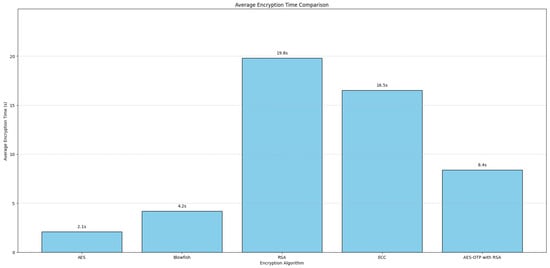
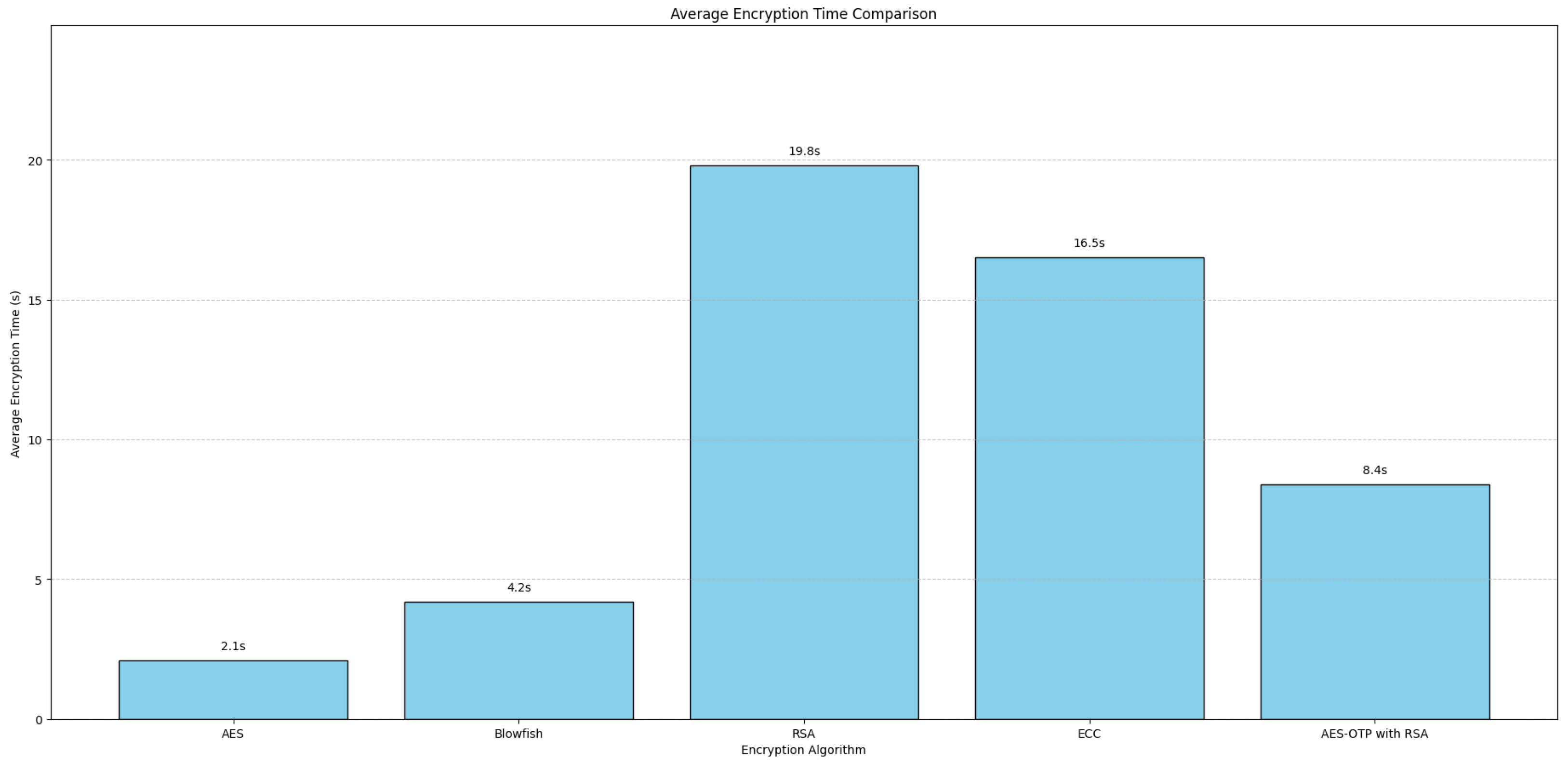
The average encryption time is measured for all selected algorithms by each algorithm performing the encryption process. As shown in Table 1, the results indicate that the symmetric algorithms demonstrated the fastest encryption process. AES achieved the smallest encryption time of 2.1 s, whereas Blowfish achieved 4.2 s. However, asymmetric algorithms demonstrated much longer time, where RSA achieved the longest encryption time of 19.8 s and ECC achieved 16.5 s. The hybrid AES-OTP with RSA demonstrated a moderate time of 8.4 s, considering the complexity of key management while maintaining the efficiency of data encryption. The finding highlights the benefits of symmetric algorithms in time-sensitive environments, while hybrid models can provide the balance between performance and security in cloud systems. Figure 1 visually illustrates the results of the average encryption time for all selected algorithms.
Table 1.
Average encryption time for different algorithms.
Figure 1.
Average processing time for encryption operations.
4.2. Average Decryption Time
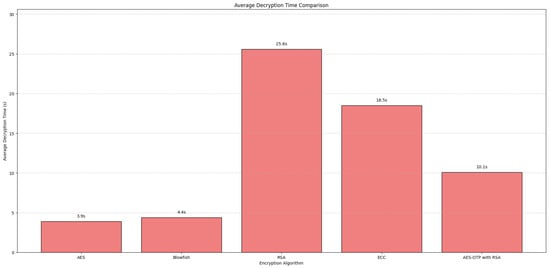
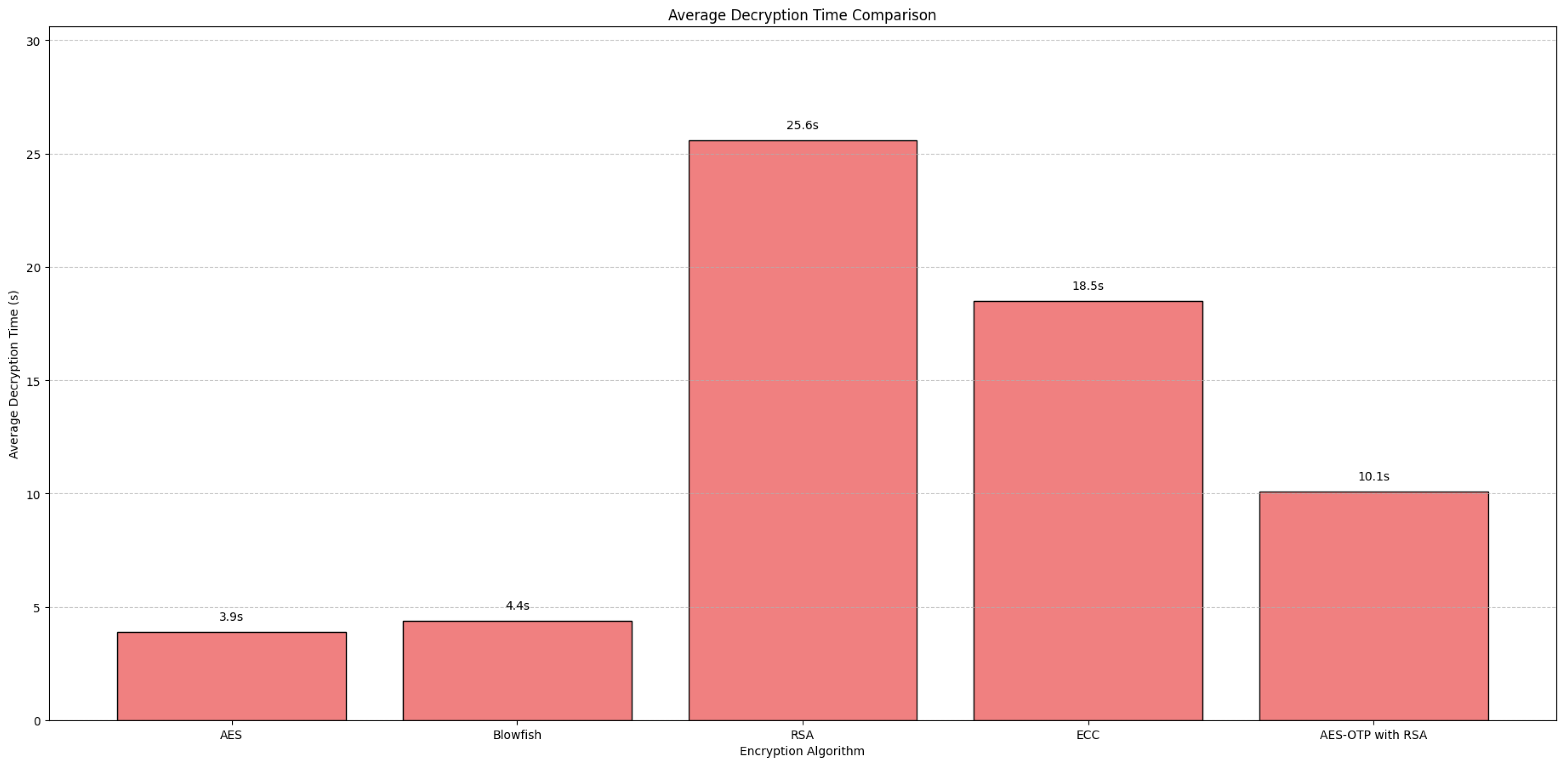
The average decryption time is measured for all selected algorithms by each algorithm performing the decryption process. The same as the average encryption time, Table 2 shows that the AES and Blowfish algorithms demonstrated the shortest time in the decryption process, with an average time of 3.9 and 4.4 s, respectively. In contrast, RSA shows the longest decryption time of 25.6 s due to the complexity of the private key, whereas ECC achieved 18.7 s but was still slower than symmetric algorithms. The hybrid AES-OTP and RSA model demonstrated a moderate time of 10.1 s, considering the steps involved in key recovery. These findings suggest that symmetric algorithms are more suitable for systems that need rapid data access, while hybrid models still provide the balance between security and speed in cloud storage systems. Figure 2 visually illustrates the results of the average decryption time for all selected algorithms.
Table 2.
Average decryption time for different algorithms.
Figure 2.
Average processing time for decryption operations.
4.3. Comparison of Data Sizes
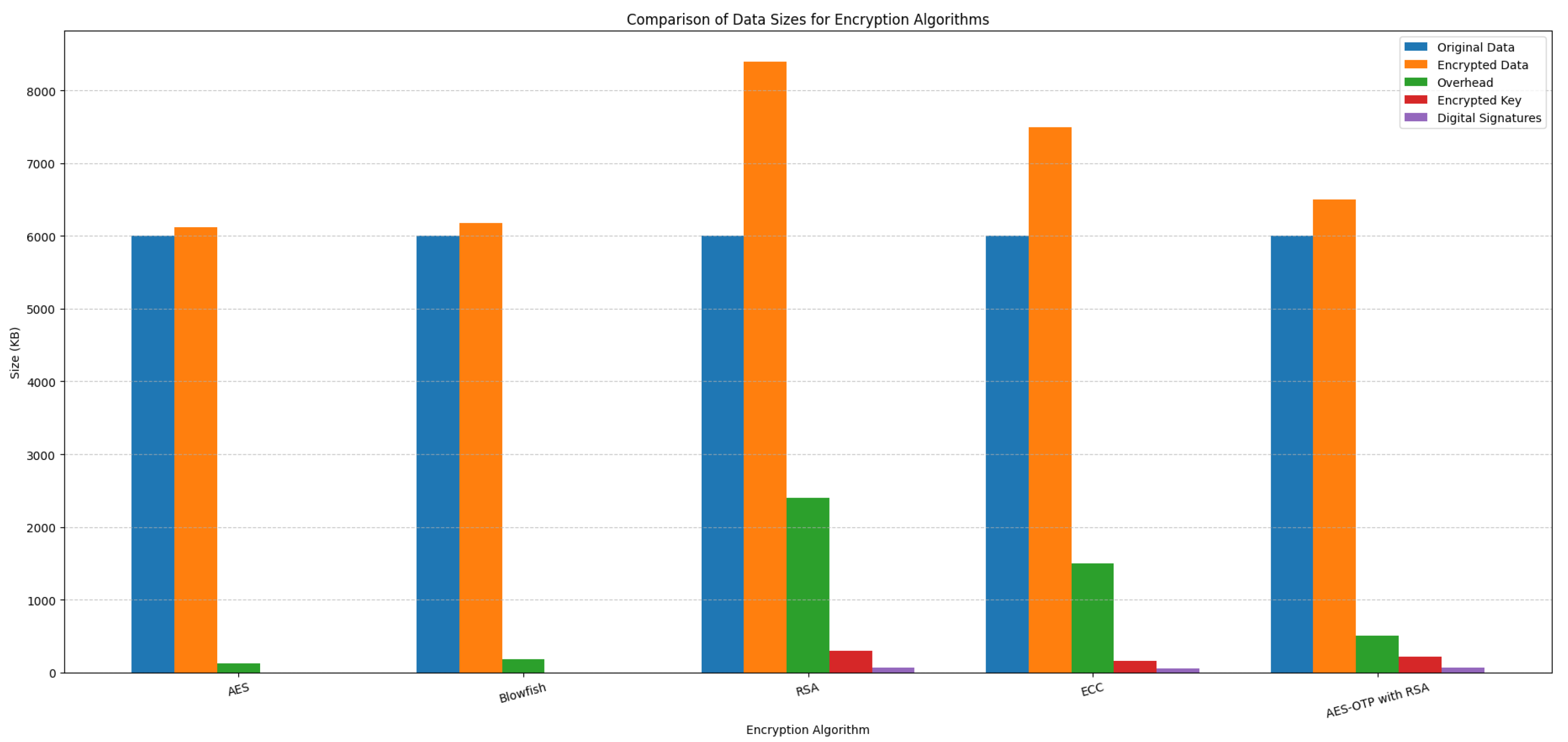
By comparing data sizes across the encryption algorithms, the results reveal important variations in the overhead data, which can affect the transmission and storage in data security applications. The original data size ranges from 4000 to 8000 KB, where the average data size is 6000 KB. Table 3 shows that AES demonstrated the smallest overhead, increasing the data size from 6000 to 6120 KB, which means an overhead of 120 KB only, while Blowfish demonstrated a slightly higher overhead of 180 KB. In contrast, RSA and ECC have higher overhead due to their asymmetric features and additional components involved. RSA resulted in the highest value, an overall overhead of 2400 KB, while ECC achieved 1500 KB. The hybrid AES-OTP with RSA model achieved a balanced overhead of 500 KB. The findings indicate that symmetric encryption algorithms like AES and ECC are more efficient in storage, while asymmetric and hybrid algorithms cause higher overhead due to key management and authentication techniques. Figure 3 illustrates all the results of the comparison of data sizes for all selected algorithms.
Table 3.
Comparison of data sizes for different encryption algorithms.
Figure 3.
Impact of different algorithms on data size and overhead.
4.4. Encryption and Decryption Throughput
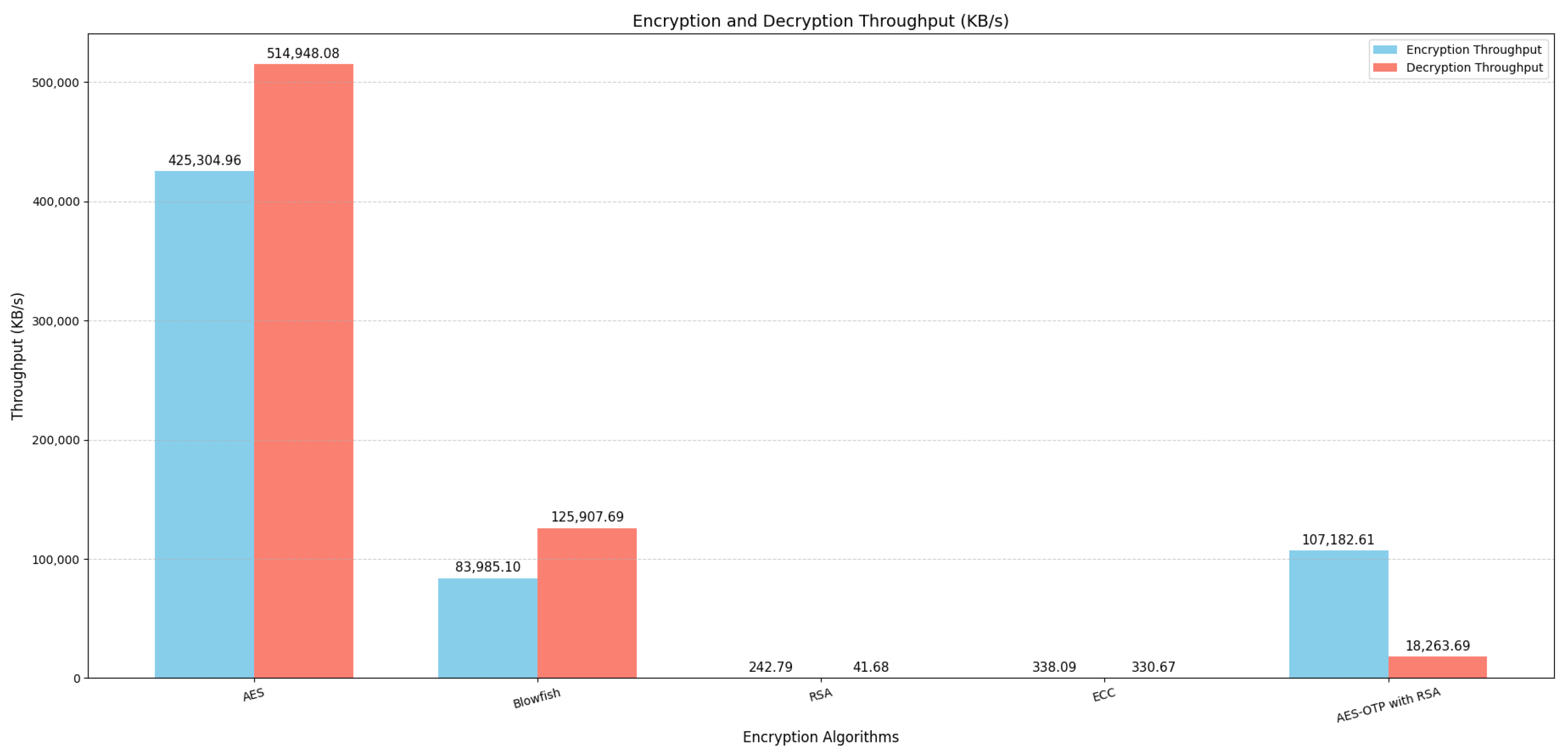
The results of the throughput analysis provide valuable insight into the suitability and efficiency of the algorithms for various data processing cases. Table 4 shows that AES achieved the highest throughput of 425,304.96 KB/s in encryption and 514,948.08 KB/s in decryption, proving its effectiveness for data processing performance. Blowfish achieved moderate throughput, especially in decryption, which is 125,907.69 KB/s, making it a suitable option for environments with small throughput demands. However, RSA and ECC had much lower throughput results, especially RSA, which only reached 41.68 KB/s in decryption, showing that these asymmetric algorithms struggle with large amounts of data. The hybrid AES-OTP with RSA model achieved a relatively high encryption throughput of 107,182.61 KB/s, where an obvious decline in decryption throughput was observed of 18,263.69 KB/s. Figure 4 illustrates the differences visually, comparing the throughput of the encryption and decryption processes among the encryption algorithms.
Table 4.
Comparison of encryption and decryption throughput for different algorithms.
Figure 4.
Visualization of encryption and decryption throughput.
4.5. Performance Metrics
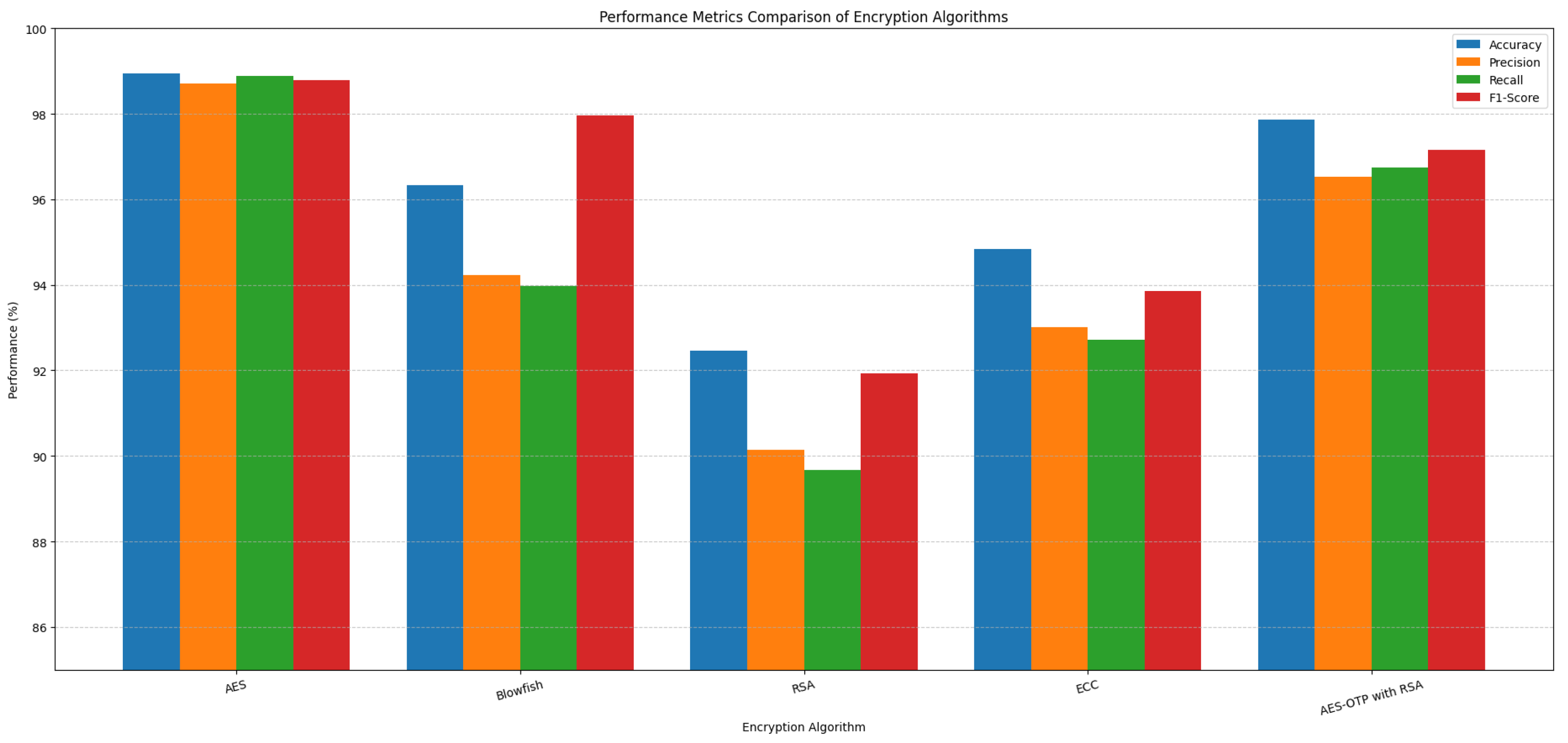
Performance metrics evaluation assesses the effectiveness and reliability of algorithms dealing with encryption and decryption processes. Table 5 shows the results of the performance metrics for the encryption algorithms. Performance metrics analysis, including accuracy, precision, recall, and the F1 score, supports the reliability of symmetric and hybrid algorithms. AES demonstrated the highest accuracy, followed by AES-OTP with RSA. Furthermore, Blowfish achieved excellent performance but slightly lower reliability under controlled error conditions. RSA and ECC exhibited reduced performance in this area, showing their sensitivity to decryption mismatches and key inconsistencies. The error metrics further demonstrated these findings, revealing that AES and AES-OTP with RSA exhibited the smallest differences between the original and decrypted data. Figure 5 illustrates the performance metrics for each encryption algorithm, involving accuracy, precision, recall, and F1-score.
Table 5.
Comparison of performance metrics for different algorithms.
Figure 5.
Representation of performance metrics for reliability of different algorithms.
4.6. Error Metrics
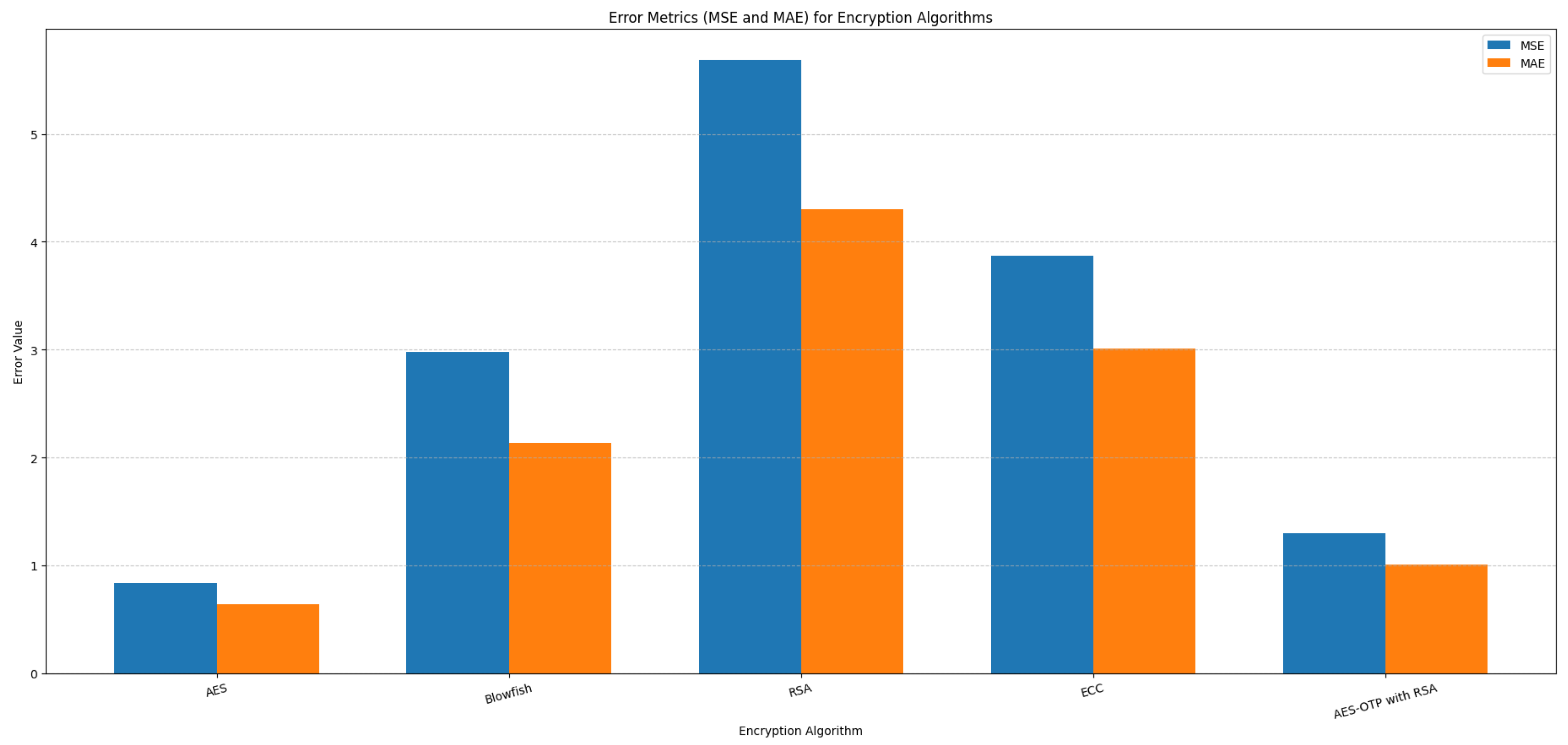
The error metrics measure the accuracy loss and data distortion during the encryption and decryption processes. As shown in Table 6, the results of the error metrics indicate that the AES algorithm had the lowest MSE of 0.837 and MAE of 0.642, reflecting high accuracy and low distortion during encryption and decryption. Furthermore, AES-OTP with RSA showed low error rates, making it a reliable option. However, RSA achieved the highest error rates, MSA of 5.587 and MAE of 4.298, followed by Blowfish and ECC, indicating more deviation between the data and the decrypted data. After all, symmetric algorithms such as AES demonstrate lower error performance compared to symmetric and hybrid models. Figure 6 illustrates all the results of the error metrics.
Table 6.
Comparison of error metrics for different algorithms.
Figure 6.
Representation of error metrics for resilience of different algorithms.
5. Discussion
The analysis of the average time for encryption and decryption reveals various roles. Symmetric algorithms are suitable for data encryption in cloud environments, with AES suggested as the best choice for large, high-throughput, and read-intensive workloads. Blowfish is still more practical for traditional and older systems. On the other hand, asymmetric algorithms are entirely unsuitable for bulk payloads in the processes of encryption and decryption. They should be confined to the envelope encryption technique, which involves using symmetric keys for data encryption while using asymmetric keys only to encrypt or decrypt a small amount of data, such as the data encryption key (DEK). This separation reduces end-to-end latency and computational cost while ensuring strong security and operational simplicity, such as enabling partial reads, routine key rotation, and seamless integration with Key Management Services (KMS). When an additional access check is necessary, the AES-OTP with RSA hybrid configuration is suitable. AES provides fast data plane performance, the One-Time Password (OTP) offers a second factor for access control, and RSA is used exclusively for key encryption, resulting in modest overhead for enhanced control without compromising throughput.
The findings indicate a clear trade-off between the amount of data that grows and the type of encryption that is used. Symmetric algorithms like AES and Blowfish lead to the least increase in storage, making them suitable for handling large data where saving space and bandwidth is significant. However, asymmetric algorithms such as RSA and ECC significantly increase data size because they add additional information, including encrypted keys and digital signatures, which can be costly for smaller or frequently shared files. AES-OTP with the RSA model falls somewhere in between; while its data increase is closer to symmetric algorithms, it still requires more bytes for key management and digital signatures. This combination offers better access control with only a moderate increase in storage. Overall, the results present a set of clear options: store data in AES to save space, secure keys with ECC and RSA, and choose the hybrid option when the added security and public key wrapping benefits outweigh the extra data size.
The findings present an obvious difference between symmetric and asymmetric algorithms with respect to throughput in cloud storage systems. The AES demonstrates superior performance in encryption and decryption processes, making it the optimal choice for handling large data. On the other hand, Blowfish, while exhibiting slower performance, is still relevant for older system compatibility. Asymmetric algorithms reveal crucially lower throughput, suggesting that their applications should be restricted to the envelope encryption technique, especially for key encryption, while AES handles data bulk processing. AES-OTP with the RSA model demonstrates moderate encryption rates; unfortunately, it is restricted by the complexity of RSA, specifically influencing the decryption speed. The findings make the hybrid model more appropriate for scenarios that prioritize access control over high-throughput data retrieval. Finally, the study recommends using AES for data protection, RSA or ECC for key management purposes, and choosing the hybrid model when access control is required.
AES is suitable for handling data in cloud storage systems due to its highest accuracy and lowest error rate when it is referring to encryption and decryption. This makes it the most suitable option for large data that require a lot of processing. AES-OTP with the RSA model is an appropriate selection for scenarios that need verification due to secure access control with the addition of OTP. Asymmetric algorithms are more appropriate choices for key management security. ECC is more efficient because it needs less data and works better. RSA works better with systems and infrastructure that are already in place. Blowfish is better for traditional and older systems, where moderate accuracy is all that is required. At the end, AES should be used to handle data, ECC and RSA should be used to secure keys, and AES-OTP and RSA models are preferred when a high level of security is needed.
In conclusion, the discussion emphasizes the optimal division of roles in encryption schemes, which is based on five evidence strands. In the context of bulk and read-intensive tasks, symmetric algorithms, particularly AES, are preferred for encryption and decryption times, while Blowfish is recognized for its older applications. Asymmetric algorithms are not suitable for payloads, where they are typically used for key management. Symmetric algorithms speed up data processing, but RSA and ECC add a large amount of data. AES has the highest throughput and accuracy rates; on the other hand, asymmetric algorithms are slow. Mainly, AES is the suitable technique to secure data, ECC or RSA is the suitable technique to protect keys, and hybrid models are suitable for cases where you need an extra layer of protection without lowering quality.
6. Conclusions
This study introduced a comparative analysis of encryption algorithms such as AES, Blowfish, RSA, ECC, and AES-OTP with RSA to evaluate their efficiency and security for data in cloud storage systems. The evaluation used datasets of varying sizes, and each algorithm was evaluated based on the time of encryption and decryption, data size overhead, throughput, performance metrics (accuracy, precision, recall, F1 score), and error metrics (MSE, MAE).
The results indicated that AES offered the best overall performance, with the fastest processing speed, low overhead, and high reliability. Furthermore, Blowfish performed well but with higher error rates. RSA and ECC, while secure, were slower and less efficient for small file encryption. The hybrid AES-OTP with RSA model provided a strong balance between speed and secure key management.
In the future, the work may test encryption efficiency on more and larger datasets, incorporate real-time cloud scenarios, and evaluate other hybrid algorithms and quantum encryption techniques. Further studies can investigate the combination of better key management systems and blockchain security algorithms to make cloud storage encryption more flexible and reliable.
At the end, the highlights of this work offer useful information about the robustness and trade-offs of different encryption approaches, guiding the choice of suitable algorithms for efficient, secure, and scalable cloud storage environments.
Author Contributions
Conceptualization, A.I.A. and M.T.B.O.; methodology, A.I.A.; software, A.I.A.; validation, A.I.A. and M.T.B.O.; formal analysis, A.I.A.; investigation, A.I.A.; resources, M.T.B.O.; data curation, A.I.A.; writing—original draft preparation, A.I.A.; writing—review and editing, M.T.B.O.; visualization, A.I.A.; supervision, M.T.B.O.; project administration, M.T.B.O. All authors have read and agreed to the published version of the manuscript.
Funding
This research received no external funding.
Institutional Review Board Statement
Not applicable.
Informed Consent Statement
Not applicable.
Data Availability Statement
The data presented in this study are available on request from the corresponding author.
Conflicts of Interest
The authors declare no conflicts of interest.
References
- Pronika, P.; Tyagi, S.S. Performance analysis of encryption and decryption algorithm. Indones. J. Electr. Eng. Comput. Sci. 2021, 23, 1030–1038. [Google Scholar] [CrossRef] [Scilit]
- Maqsood, F.; Ahmed, M.; Ali, M.M.; Shah, M.A. Cryptography: A comparative analysis for modern techniques. Int. J. Adv. Comput. Sci. Appl. (IJACSA) 2017, 8, 442–448. [Google Scholar] [CrossRef] [Scilit]
- Thakkar, B.; Thankachan, B. A survey for comparative analysis of various cryptographic algorithms used to secure data on cloud. Int. J. Eng. Res. Technol. (IJERT) 2020, 9, 753–756. [Google Scholar]
- Kureshi, R.R.; Mishra, B.K. A comparative study of data encryption techniques for data security in the IoT device. In Internet of Things and Its Applications; Dahal, K., Giri, D., Neogy, S., Dutta, S., Kumar, S., Eds.; Lecture Notes in Electrical Engineering; Springer Nature: Singapore, 2022; Volume 825, pp. 451–460. [Google Scholar]
- Kshetri, N.; Rahman, M.M.; Rana, M.M.; Osama, O.F.; Hutson, J. algoTRIC: Symmetric and asymmetric encryption algorithms for cryptography—A comparative analysis in the AI era. Int. J. Adv. Comput. Sci. Appl. 2024, 15, 1–14. [Google Scholar] [CrossRef] [Scilit]
- Ghaz, A.; Seddiki, A.; Nouioua, N. Comparative study of encryption algorithms applied to the IoT. Eurasia Proc. Sci. Technol. Eng. Math. (EPSTEM) 2022, 21, 469–476. [Google Scholar] [CrossRef] [Scilit]
- Awan, I.A.; Shiraz, M.; Hashmi, M.U.; Shaheen, Q.; Akhtar, R.; Ditta, A. Secure framework enhancing AES algorithm in cloud computing. Secur. Commun. Netw. 2020, 2020, 8863345. [Google Scholar] [CrossRef] [Scilit]
- Durge, R.S.; Deshmukh, V.M. Securing cloud data: A hybrid encryption approach with RSA and AES for enhanced security and performance. J. Integr. Sci. Technol. 2025, 13, 1060. [Google Scholar] [CrossRef] [Scilit]
- Shakor, M.Y.; Khaleel, M.I.; Safran, M.; Alfarhood, S.; Zhu, M. Dynamic AES encryption and blockchain key management: A novel solution for cloud data security. IEEE Access 2024, 12, 26334–26343. [Google Scholar] [CrossRef] [Scilit]
- Hussaini, S. Cyber security in cloud using Blowfish encryption. Int. J. Inf. Technol. (IJIT) 2020, 6, 13–19. [Google Scholar]
- Seth, B.; Dalal, S.; Le, D.-N.; Jaglan, V.; Dahiya, N.; Agrawal, A.; Sharma, M.M.; Prakash, D.; Verma, K.D. Secure cloud data storage system using hybrid Paillier–Blowfish algorithm. Comput. Mater. Contin. 2021, 67, 780–798. [Google Scholar] [CrossRef] [Scilit]
- Sathish Kumar, G.; Premalatha, K.; Aravindhraj, N.; Nivaashini, M.; Karthiga, M. Secured cryptosystem using Blowfish and RSA algorithm for the data in public cloud. Int. J. Recent Technol. Eng. (IJRTE) 2018, 7, 45–49. [Google Scholar]
- Balani, V.; Kharya, C.; Shivhare, S.N.; Singh, T.P. An enhanced RSA algorithm to counter repetitive ciphertext threats empowering user-centric security. Scalable Comput. Pract. Exp. 2024, 25, 4669–4682. [Google Scholar] [CrossRef] [Scilit]
- Altarawneh, K.; Altarawni, I.; Almaiah, M.; Hammad, M.; Alkhdour, T.; Alali, R.; Lutfi, A.; Alrawad, M. A hybrid model of RSA and NTRU for securing of cloud computing. J. Theor. Appl. Inf. Technol. 2024, 102, 2854–2866. [Google Scholar]
- Moghaddam, F.F.; Alrashdan, M.T.; Karimi, O. A hybrid encryption algorithm based on RSA small-e and efficient-RSA for cloud computing environments. J. Adv. Comput. Netw. 2013, 1, 238–241. [Google Scholar] [CrossRef] [Scilit]
- Yin, X.; Liu, Z.; Lee, H.J. An efficient and secured data storage scheme in cloud computing using ECC-based PKI. In 16th International Conference on Advanced Communication Technology (ICACT); IEEE: Piscataway, NJ, USA, 2014; pp. 523–527. [Google Scholar]
- Kumar, S.; Kumar, D. Securing of cloud storage data using hybrid AES–ECC cryptographic approach. J. Mob. Multimed. 2022, 19, 363–388. [Google Scholar] [CrossRef] [Scilit]
- Joy, J.; Devaraju, S. Securing cloud memory through efficient deduplication using ECC algorithm. Educ. Adm. Theory Pract. 2024, 30, 9421–9429. [Google Scholar]
- Shivaramakrishna, D.; Nagaratna, M. A novel hybrid cryptographic framework for secure data storage in cloud computing: Integrating AES-OTP and RSA with adaptive key management and time-limited access control. Alex. Eng. J. 2023, 84, 275–284. [Google Scholar] [CrossRef] [Scilit]
- Abdo, A.; Karamany, T.S.; Yakoub, A. A hybrid approach to secure and compress data streams in cloud computing environment. J. King Saud Univ.—Comput. Inf. Sci. 2024, 36, 101999. [Google Scholar] [CrossRef] [Scilit]
- Durge, R.S.; Deshmukh, V.M. Advancing cryptographic security: A novel hybrid AES–RSA model with byte-level tokenization. Int. J. Electr. Comput. Eng. (IJECE) 2024, 14, 4306–4314. [Google Scholar] [CrossRef] [Scilit]

Disclaimer/Publisher’s Note: The statements, opinions and data contained in all publications are solely those of the individual author(s) and contributor(s) and not of MDPI and/or the editor(s). MDPI and/or the editor(s) disclaim responsibility for any injury to people or property resulting from any ideas, methods, instructions or products referred to in the content. |
© 2026 by the authors. Licensee MDPI, Basel, Switzerland. This article is an open access article distributed under the terms and conditions of the Creative Commons Attribution (CC BY) license (https://creativecommons.org/licenses/by/4.0/).