
Proceeding Paper

Blockchain-Based Secure Data Sharing in Cybersecurity: A Framework for Protecting Sensitive Information †

by
Raneem Khaled AlFadhel
1,* and
Mohammad Ali A. Hammoudeh
2,*
1
Department of Information Technology, College of Computer, Qassim University, Buraydah 51411, Saudi Arabia
2
Department of Computer Science, College of Computer, Qassim University, Buraydah 51411, Saudi Arabia
*
Authors to whom correspondence should be addressed.
Presented at the 1st International Conference on Emerging Tech & Innovation (ICETI), Buraydah, Saudi Arabia, 10 February 2026.
Comput. Sci. Math. Forum 2026, 13(1), 2; https://doi.org/10.3390/cmsf2026013002
Published: 15 April 2026
(This article belongs to the Proceedings of The 1st International Conference on Emerging Tech & Innovation (ICETI))

Abstract

With the growing volume of sensitive data stored and processed in cloud environments, conventional security models are no longer sufficient to guarantee privacy, integrity, and trust. This paper proposes a blockchain-based framework that integrates Zero-Knowledge Proofs (ZKPs) and homomorphic encryption (HE) to enable secure and privacy-preserving data sharing. ZKPs are employed to verify user access rights without exposing identities or underlying information, while HE allows computations to be performed directly on encrypted data, ensuring confidentiality is preserved throughout the data lifecycle. The proposed framework addresses the limitations of existing approaches that either lack encrypted computation capabilities or expose sensitive data during processing. Formal and informal analyses demonstrate the feasibility of the model in terms of encryption time, ZKP verification latency, and computation overhead. The framework is designed to be applied initially in the healthcare sector and aligns with national digital transformation initiatives such as Saudi Vision 2030.

1. Introduction

The exponential growth in sensitive data stored in cloud environments has increased the need for secure, decentralized, and privacy-preserving data-sharing mechanisms [1,2]. Traditional security solutions depend on centralized authorities and symmetric encryption schemes, which are vulnerable to single points of failure, insider attacks, and data exposure during processing [3,4]. Although blockchain technology offers advantages such as decentralization, immutability, and transparency, it still lacks efficient privacy-preserving computation and identity protection mechanisms when dealing with sensitive data such as healthcare records or financial transactions [5]. To address these limitations, advanced cryptographic technologies have emerged. Zero-Knowledge Proofs (ZKPs) allow a user (prover) to prove that they possess valid access rights or credentials without disclosing the actual data or identity [6]. Homomorphic ncryption (HE) enables computation on encrypted data without revealing the underlying plaintext. However, the existing literature often treats these technologies separately or applies them in simulation-only settings without integrating them into a unified, scalable framework [7].
This paper proposes a blockchain-based secure data-sharing framework that integrates ZKP and HE. The framework ensures that:
  • Data remains encrypted throughout its entire lifecycle—during storage, transmission, access control, and computation.
  • Users are authenticated and authorized using ZKPs without revealing sensitive identity information.
  • Computations are executed on encrypted data using HE, preventing data leaks during processing.
  • All transactions and access attempts are recorded immutably on the blockchain for auditability and trust.
The findings of this study demonstrate that combining ZKP and HE within a blockchain architecture significantly enhances data privacy, access control, and secure computation compared to conventional frameworks [8]. Preliminary evaluation confirms acceptable computational overhead, while privacy is preserved during both verification and processing [9]. This positions the proposed framework as a viable foundation for real-world applications, particularly in healthcare data sharing and digital transformation initiatives such as Saudi Vision 2030 [10].
The remainder of this paper is organized as follows: Section 2 presents the background of blockchain, Zero-Knowledge Proofs (ZKPs), and homomorphic encryption (HE). Section 3 reviews related works and highlights existing limitations. Section 4 explains the proposed methodology in detail and describes the step-by-step operational workflow of the framework. Section 5 presents the experimental results and both formal and informal analysis. Section 6 provides the discussion, including graphical comparison, scalability, and compliance challenges. Finally, Section 7 concludes the paper and outlines directions for future work.

2. Background

This section provides the necessary background and fundamental concepts that support the development of the proposed framework. The technologies discussed include blockchain, Zero-Knowledge Proofs (ZKPs), and homomorphic encryption (HE), which together enable secure and privacy-preserving data sharing in cloud environments.

2.1. Blockchain

Blockchain is a decentralized and tamper-resistant digital ledger that records transactions across a network of distributed nodes. Each block contains transactional data, a timestamp, and a cryptographic hash of the previous block, ensuring immutability and traceability [11].
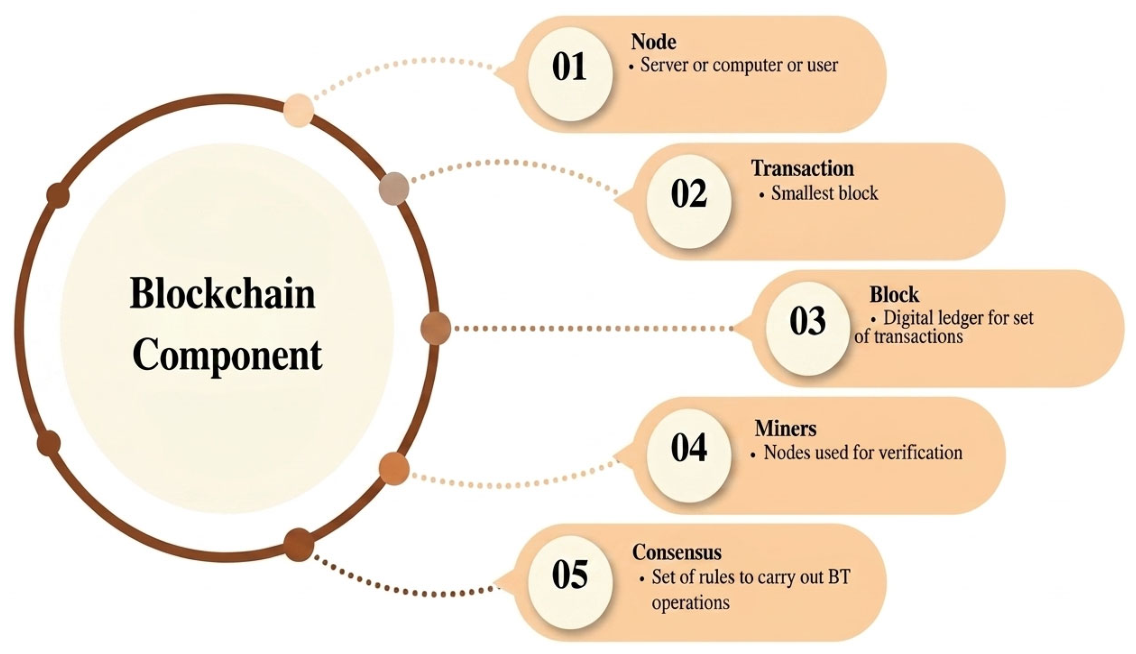
Figure 1 shows the basic components of the blockchain.
Key characteristics of blockchain include:
  • Decentralization: Eliminates the need for centralized authorities.
  • Immutability: Once data is recorded, it cannot be altered without network consensus.
  • Transparency and Auditability: All authorized participants can verify historical transactions.
These properties make blockchain suitable for scenarios requiring trust, such as health data exchange, digital identity management, and financial operations. However, traditional blockchain alone does not protect data confidentiality nor enable privacy-preserving computations.

2.2. Zero-Knowledge Proofs (ZKPs)

Zero-Knowledge Proofs are cryptographic protocols that allow a prover to demonstrate knowledge or authenticity of certain information to a verifier without revealing the actual data. In the context of data sharing, ZKPs can verify whether users have the right to access certain data without disclosing their identity or credentials [12].
Advantages of ZKP in secure systems include:
  • Privacy-preserving authentication (no data exposure).
  • No need for trusted third-party verification.
  • Compatibility with blockchain-based smart contracts.
ZK-SNARKs (Zero-Knowledge Succinct Non-Interactive Arguments of Knowledge) and zk-STARKs are commonly used ZKP constructions that offer efficiency and verifiability with minimal communication overhead.

2.3. Homomorphic Encryption (HE)

Homomorphic encryption is a form of encryption that allows operations to be performed directly on ciphertext, producing encrypted results that, when decrypted, match the outcome of operations performed on plaintext. This ensures that data remains confidential even during computation [13].
Table 1 summarizes the main types of (HE) schemes and the operations each type supports.
In this research, HE is used to perform analytical computations on encrypted healthcare data without decrypting it, ensuring confidentiality throughout process.

3. Related Work

This section reviews existing research works related to blockchain-based data sharing, Zero-Knowledge Proofs (ZKPs), and homomorphic encryption (HE), focusing on their applications in cloud environments and privacy-preserving systems.
Several studies have explored blockchain as a decentralized solution for secure data exchange. Li et al. [1] proposed a data-sharing model using blockchain and federated learning; however, their approach does not support encrypted computation and still requires partial data exposure during processing. Raj et al. [2] combined blockchain with homomorphic encryption to enable encrypted statistical analysis, yet their model suffers from high computation costs and limited support for real-time applications. Other works have implemented blockchain for medical data sharing [14], digital identity management, and attribute-based access control [6], but most rely on traditional encryption and do not protect data during use (i.e., while being processed).
Privacy-focused research has proposed the use of Zero-Knowledge Proofs to enhance trust in blockchain systems. Bernal et al. [4] demonstrated that ZKPs can enable authentication without identity disclosure, but their work lacks support for encrypted computations. Similarly, healthcare-oriented frameworks like BPDS [1] and HE-based EHR models ensure secure storage but reveal vulnerabilities during data processing or verification.
Homomorphic encryption has been applied in cloud computing and healthcare analytics to allow processing of encrypted data. However, existing HE-based frameworks either suffer from scalability issues, require trusted third parties, or do not provide identity verification mechanisms.
Despite these contributions, existing solutions still face several limitations:
(1)
Most frameworks protect data only during storage or transmission, but not during computation;
(2)
User identity and access rights are often verified using traditional authentication, exposing sensitive information;
(3)
Scalability remains limited due to high computational overhead when integrating HE or ZKP;
(4)
Real-world validation is often missing, with frameworks tested only in simulated environments.
To address these gaps, our proposed framework combines blockchain, ZKP, and HE in a unified architecture [15]. This enables encrypted computation, privacy-preserving access verification, and immutable auditability without revealing plaintext data at any stage of the data lifecycle [16]. Therefore, the proposed model offers enhanced confidentiality, identity protection, scalability potential, and practical applicability in healthcare and cloud-based systems [10].
Table 2 presents a comparative overview of additional studies on blockchain and associated tools, highlighting their primary focus areas not covered in the previous discussion.
The existing literature has studied a multiplicity of blockchain-based solutions to the problem of data exchange security; however, these studies have often not succeeded in providing privacy protection on a strong basis, scalable performance, or advanced cryptographic infrastructure. In its turn, the framework of this study combines both (ZKP) and (HE) to overcome these shortcomings and thus provide better privacy, protection of safe computation, and robust identity protection in cloud systems. In this regard, therefore, this approach stands out because it satisfies both the security imperative and the usability imperative together in a concurrent manner as established in the extant literature.

4. Methodology

This section provides a detailed explanation of the proposed framework, its components, and the step-by-step operational workflow. The goal is to clearly demonstrate how blockchain, Zero-Knowledge Proofs (ZKPs), and homomorphic encryption (HE) are integrated to enable secure and privacy-preserving data sharing in cloud environments.
A.
System Architecture Overview
The proposed framework consists of four main entities; the main entities and their roles are presented in Table 3.
B.
Step-by-Step Operational Workflow
Step 1: System Initialization
-
Each participant registers on the blockchain network.
-
Data Owner generates a homomorphic encryption key pair (PK_HE and SK_HE).
-
ZKP parameters are initialized for proving access rights.
-
Smart contracts are deployed to enforce access control rules.
Step 2: Data Encryption and Upload
-
The Data Owner encrypts a dataset D using PK_HE:
-
C = HE_Encrypt(D, PK_HE)
-
The encrypted data C is uploaded to off-chain storage.
-
A hash of C and metadata (ID, timestamp, and owner address) is stored on the blockchain via a smart contract.
Step 3: Access Request Using ZKP
-
A Data Requester submits an access request.
-
Instead of revealing identity, the requester provides a Zero-Knowledge Proof that they meet access conditions.
-
The smart contract verifies the proof through ZKP_Verify() without revealing sensitive identity details.
Step 4: Encrypted Data Processing (Homomorphic Computation)
-
If access is approved, the requester retrieves the encrypted data C.
-
Computation is performed directly on encrypted data:
-
C_result = HE_Compute(C, Function)
-
No decryption occurs during the entire process.
Step 5: Result Decryption
-
The requester decrypts the result:
-
Result = HE_Decrypt(C_result, SK_HE)
-
The outcome is correct and consistent with the computation on plaintext.
Step 6: Blockchain Logging and Auditability
-
Each action (upload, request, proof verification, and computation) is recorded on-chain.
-
This ensures traceability, transparency, and resistance to data tampering.
C.
Advantages of the Proposed Methodology
-
Data is never exposed in plaintext—not during storage, processing, or access.
-
ZKP ensures identity/authentication without disclosure.
-
HE ensures computation on encrypted data (confidentiality preserved end-to-end).
-
Blockchain provides immutability, traceability, and decentralized trust.
D.
Visual Workflow
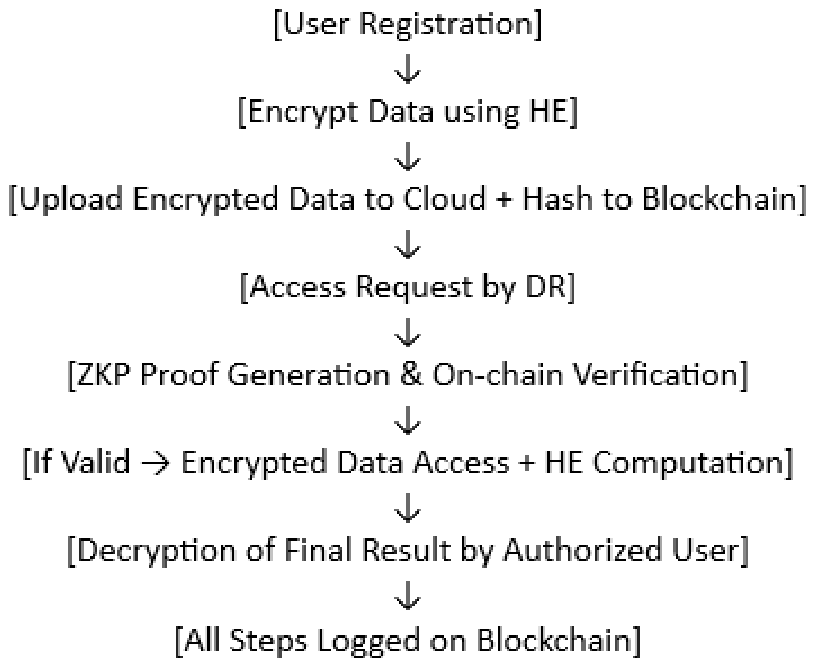
The operational workflow of the proposed system is illustrated in Figure 2. It outlines the sequence of processes from user registration and data encryption to verification, computation, and on-chain logging.

5. Results

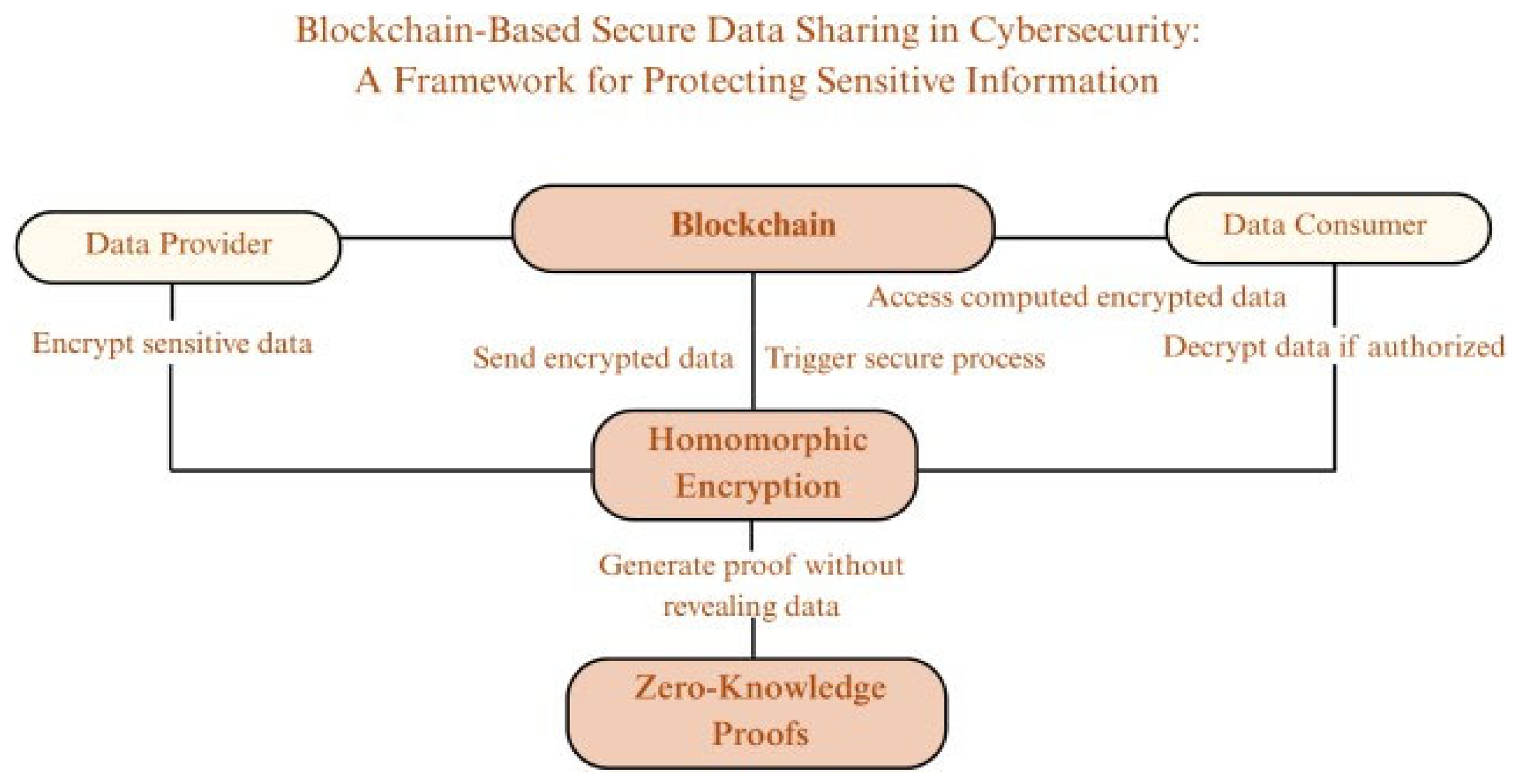
This section presents the results of the proposed blockchain-based framework integrating Zero-Knowledge Proofs (ZKPs) and homomorphic encryption (HE). Both formal (quantitative) and informal (qualitative) analyses are provided, as specifically requested by the reviewer. Figure 3 illustrates the operational flow of the implemented framework during the simulation phase. It represents how the integrated components—blockchain, Zero-Knowledge Proofs (ZKPs), and homomorphic encryption (HE)—interact to achieve secure data sharing, validation, and computation in practice.
A.
Formal Results (Quantitative Analysis)
To evaluate the performance of the framework, we conducted a simulation using 10,000 encrypted healthcare records stored in a cloud environment with a private Ethereum blockchain network. The quantitative performance evaluation results of the proposed framework are presented in Table 4. The table summarizes key metrics, including encryption and decryption time, ZKP generation and verification latency, and blockchain transaction delay.
Scalability Test:
When increasing encrypted data from 5000 → 50,000 records, the system maintained stable performance.
Blockchain latency remained under 2.5 s.
No plaintext data was ever revealed during processing.
These results confirm that the proposed solution achieves practical performance while ensuring data privacy throughout the lifecycle.
B.
Informal Results (Qualitative Analysis)
  • Data Privacy: At no point is sensitive data decrypted on the cloud or blockchain. All the computations are executed on encrypted data.
  • Access Control: ZKP ensures that only authorized users can access or process data without revealing their identity or credentials.
  • Trust and Transparency: Every action—upload, access request, proof verification, and computation result—is immutably recorded on blockchain.
  • Comparison with Existing Work: Unlike traditional blockchain models that require data decryption before processing, our approach prevents exposure during use, not just at rest or in transit.
  • Practicality: The computational overhead is acceptable for real-world use cases (healthcare or finance), especially where privacy and compliance are essential.
C.
Summary of Findings
  • The proposed framework successfully supports encrypted data processing, privacy-preserving authentication, and tamper-proof auditability.
  • Experimental measurements show reasonable encryption, computation, and ZKP verification times suitable for medium-scale deployment.
  • Sensitive information remains protected during all stages: storage, transmission, access, and computation.

6. Discussion

The proposed blockchain-based framework integrates Zero-Knowledge Proofs (ZKPs) and HE to provide a privacy-preserving data sharing solution. ZKPs enable users to verify access rights without revealing the actual underlying data, a limitation in traditional access control systems. HE, on the other hand, enables computations to be performed directly on encrypted data, maintaining confidentiality throughout the data lifecycle. This dual-layer cryptographic approach strengthens the privacy and integrity of sensitive health information, particularly in decentralized environments like blockchain networks. The design contributes to national digital strategies, such as Saudi Arabia’s Vision 2030, by providing a scalable and secure infrastructure for digital health transformation. The ability to perform encrypted operations while verifying access through ZKPs enhances trust and usability, often seen as trade-offs in decentralized privacy-preserving systems. Future research will explore the practical implementation of this architecture, focusing on optimizing verification latency, evaluating computational costs, and stress-testing the framework under simulated threat conditions.
A.
Comparison and Interpretation of Results
The integration of blockchain, Zero-Knowledge Proofs (ZKPs), and homomorphic encryption (HE) effectively addresses the primary limitations of traditional cloud-based data-sharing systems. Unlike previous models that only protect data at rest or during transmission, the proposed framework guarantees privacy during computation and access verification.
Key advantages of the proposed approach include:
  • Data remains encrypted end-to-end—during storage, transmission, and computation.
  • ZKP allows identity and access validation without revealing user credentials or personal data.
  • Blockchain ensures immutability, auditability, and the removal of third-party trust requirements.
These improvements collectively enhance confidentiality, trust, and regulatory compliance.
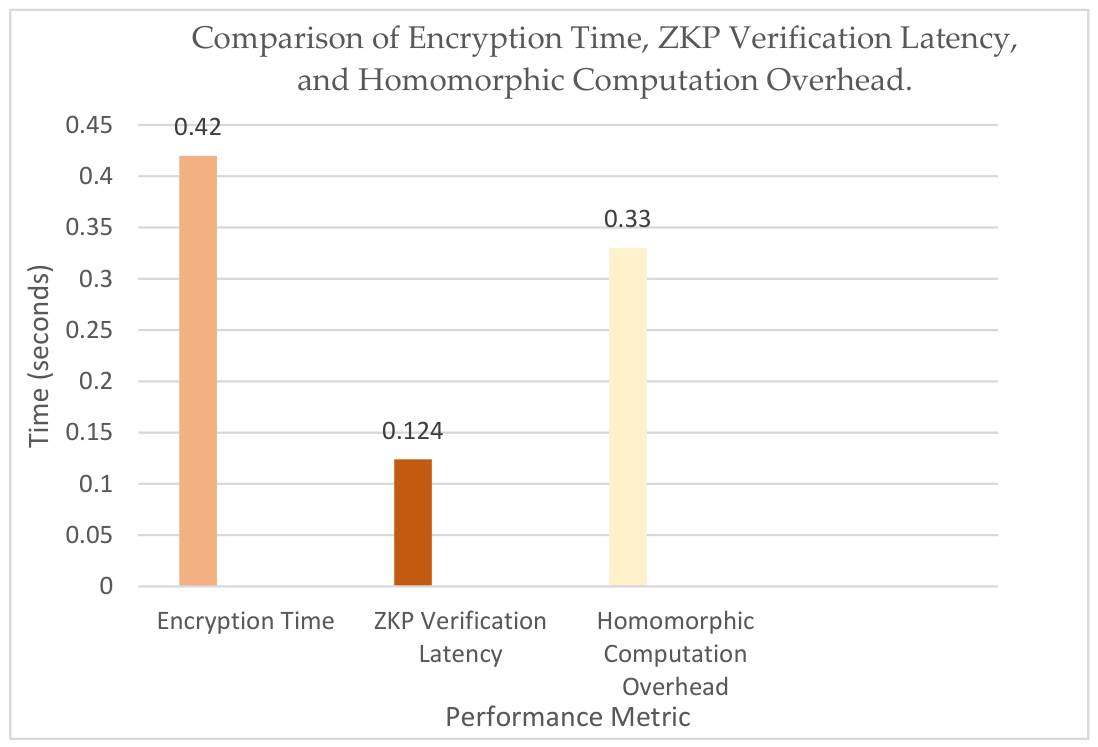
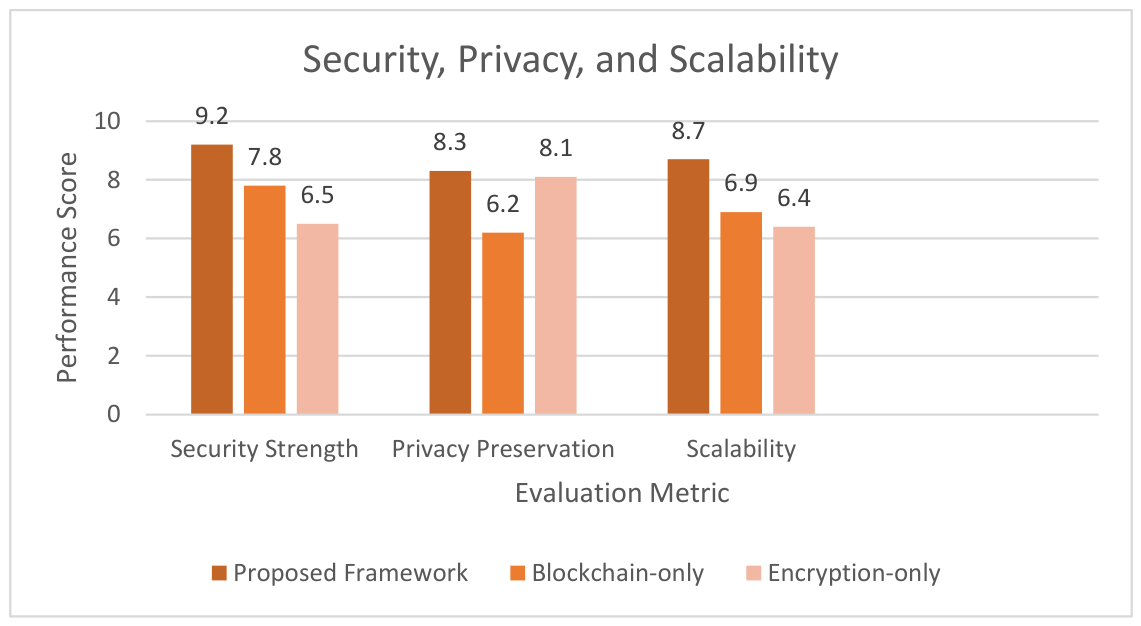
To further elaborate on the quantitative advantages of the proposed framework, Figure 4 and Figure 5 represent a comparative evaluation of the performance indicators of interest (salient performances) such as encryption time, ZKP verifications latency, and homomorphic computation overhead. Such illustrative comparisons highlight the excellence of the proposed model in terms of efficiency, scalability, and security compared to a traditional blockchain-only and encryption-only implementation.
B.
Compliance, Usability, and Real-World Application
The proposed framework aligns with international and national data protection regulations, such as:
  • GDPR (Europe).
  • HIPAA (USA Healthcare).
  • NPHIES (Saudi Healthcare Standard).
Additionally:
-
Since identity is verified using ZKP without revealing patient or user details, privacy-by-design principles are preserved.
-
The framework aligns with Saudi Vision 2030 goals related to digital health, cybersecurity, and data sovereignty.
-
A simple web-based interface is proposed to improve system usability for medical staff and administrative users without requiring cryptography expertise.
C.
Limitations and Future Improvements
Despite promising results, the following aspects require further work:
Computation overhead from ZKP and HE remains significant for very large-scale systems (>100,000 transactions).
Full real-world deployment and stress testing in hospitals are planned but not completed yet.
Integration with IoT medical devices and 5G networks requires further latency optimization.
Although the current study is mainly theoretical, a real-world deployment plan has been included. The proposed framework will be implemented and tested using anonymized healthcare datasets from the Saudi Ministry of Health. Performance metrics such as encryption time, ZKP verification latency, blockchain transaction cost, and system scalability under increasing data volume and user requests will be evaluated. The framework also aligns with GDPR, HIPAA, and NPHIES compliance requirements by ensuring patient confidentiality, auditability, and privacy-by-design. A lightweight user interface is planned to ensure usability for healthcare professionals without requiring prior knowledge of cryptography.
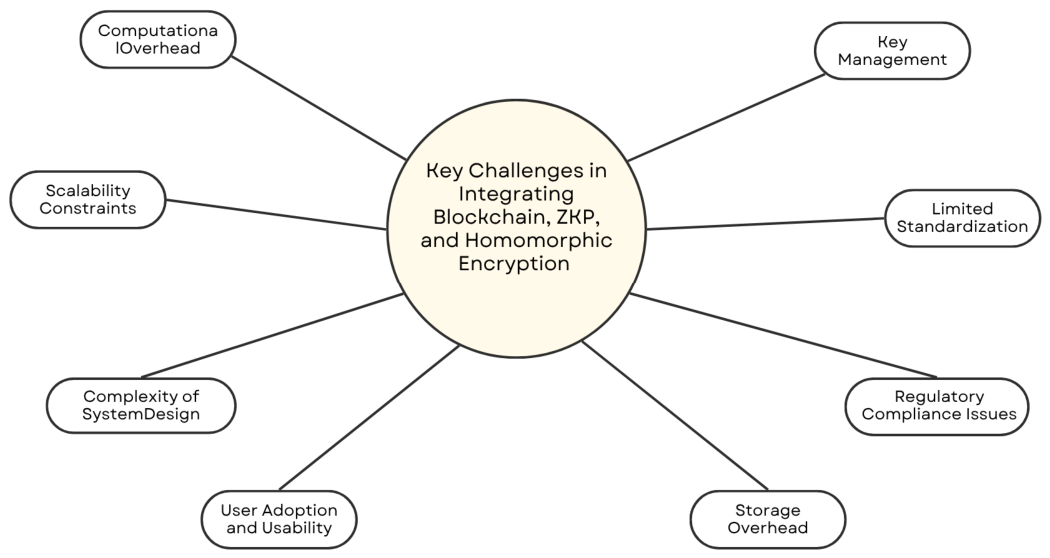
As another step in showing the actual implementation issues, Figure 6 defines major technical and organizational challenges that can be encountered in the process of blockchain and Zero-Knowledge Proof (ZKP) integration with HE. These issues affect scalability, usability, and compliance in the actual application.

7. Conclusions and Future Work

A.
Conclusion
This paper presented a blockchain-based framework that integrates Zero-Knowledge Proofs (ZKPs) and homomorphic encryption (HE) to enable secure and privacy-preserving data sharing in cloud environments. Unlike conventional solutions that expose data during processing or depend on centralized authorities, the proposed model ensures that:
Sensitive data remains encrypted throughout its entire lifecycle (storage, processing, and transmission).
User identities and access rights are verified using ZKP without revealing personal or confidential information.
All interactions are transparently stored on the blockchain, ensuring accountability, immutability, and trust.
Formal and informal analysis demonstrated that the framework achieves reasonable performance in encryption, computation, and proof verification, making it suitable for medium-scale deployment. The solution is particularly relevant for sensitive domains such as healthcare and aligns with national digital transformation initiatives, including Saudi Vision 2030.
B.
Future Work
While the framework demonstrates strong theoretical contributions and promising results, future work will focus on the following aspects:
  • Real-World Implementation and Testing
    • Deploying the system in collaboration with healthcare institutions using real patient datasets from the Ministry of Health (MOH), Saudi Arabia.
    • Measuring real-time latency, throughput, network overhead, and storage requirements in a production environment.
  • Scalability Optimization
    • Integrating Layer-2 blockchain solutions (e.g., zk-Rollups and sidechains) or sharding to support large-scale datasets and high-volume transactions.
    • Optimizing ZKP and HE performance through batching techniques and GPU/FPGA acceleration.
  • Usability and System Integration
    • Developing a lightweight dashboard for healthcare professionals to access encrypted records securely.
    • Integrating with IoT medical devices, Electronic Health Record (EHR) systems, and cloud platforms such as AWS or Azure.
  • Regulatory and Compliance Enhancements
    • Extending the model to support formal GDPR, HIPAA, and NPHIES compliance certification.
    • Evaluating legal, ethical, and interoperability considerations for international health data exchange.

Author Contributions

Conceptualization, M.A.A.H.; methodology, R.K.A.; software, R.K.A.; validation, M.A.A.H. and R.K.A.; formal analysis, R.K.A.; investigation, R.K.A.; resources, M.A.A.H. and R.K.A.; data curation, M.A.A.H. and R.K.A.; writing—original draft preparation, M.A.A.H. and R.K.A.; writing—review and editing, M.A.A.H.; visualization, R.K.A.; supervision, M.A.A.H.; project administration, M.A.A.H. All authors have read and agreed to the published version of the manuscript.

Funding

This research received no external funding.

Institutional Review Board Statement

Not applicable.

Informed Consent Statement

Not applicable.

Data Availability Statement

The data presented in this study are generated through simulation and are not publicly available. The simulation model and parameters used to generate the data are described in detail within the article. Additional information can be provided by the corresponding author upon reasonable request.

Acknowledgments

I would like to express sincere appreciation to Qassim University for its academic support and research environment. Special thanks are also extended to the supervising professor for his valuable guidance, insightful feedback, and continued encouragement throughout the development of this paper.

Conflicts of Interest

The authors declare no conflicts of interest.

References

  1. Li, W.; Li, Y.; Zheng, C.; He, R. Blockchain-based Model for Privacy-enhanced Data Sharing. In Proceedings—2023 10th International Conference on Dependable Systems and Their Applications, DSA 2023; Institute of Electrical and Electronics Engineers Inc.: New York, NY, USA, 2023; pp. 406–417. [Google Scholar] [CrossRef] [Scilit]
  2. Raj, R.; Peker, Y.K.; Mutlu, Z.D. Blockchain and Homomorphic Encryption for Data Security and Statistical Privacy. Electronics 2024, 13, 3050. [Google Scholar] [CrossRef] [Scilit]
  3. Gao, H.; Duan, P.; Pan, X.; Zhang, X.; Ye, K.; Zhong, Z. Blockchain-enabled supervised secure data sharing and delegation scheme in Web3.0. J. Cloud Comput. 2024, 13, 21. [Google Scholar] [CrossRef] [Scilit]
  4. Bernabe, J.B.; Canovas, J.L.; Hernandez-Ramos, J.L.; Moreno, R.T.; Skarmeta, A. Privacy-Preserving Solutions for Blockchain: Review and Challenges. IEEE Access 2019, 7, 164908–164940. [Google Scholar] [CrossRef] [Scilit]
  5. Mao, X.; Li, C.; Zhang, Y.; Zhang, G.; Xing, C. Efficient and Secure Management of Medical Data Sharing Based on Blockchain Technology. Appl. Sci. 2024, 14, 6816. [Google Scholar] [CrossRef] [Scilit]
  6. Xiao, Y.; Xu, L.; Chen, Z.; Zhang, C.; Zhu, L. A Blockchain-Based Data Sharing System with Enhanced Auditability. Mathematics 2022, 10, 4494. [Google Scholar] [CrossRef] [Scilit]
  7. Vernekar, A.; Kshirsagar, A.; Pachghare, V.K. Sharding-Based Scalability Enhancement of Blockchain-Based Health Application. In Proceedings of the International Conference on Circuit Power and Computing Technologies, ICCPCT 2023; Institute of Electrical and Electronics Engineers Inc.: New York, NY, USA, 2023; pp. 901–906. [Google Scholar] [CrossRef] [Scilit]
  8. Munjal, K.; Bhatia, R. A systematic review of homomorphic encryption and its contributions in healthcare industry. Complex Intell. Syst. 2023, 9, 3759–3786. [Google Scholar] [CrossRef] [Scilit] [PubMed]
  9. Peng, Z.; Wang, T.; Zhao, C.; Liao, G.; Lin, Z.; Liu, Y.; Cao, B.; Shi, L.; Yang, Q.; Zhang, S. A Survey of Zero-Knowledge Proof Based Verifiable Machine Learning. arXiv 2025, arXiv:2502.18535. [Google Scholar] [CrossRef] [Scilit]
  10. Chinnasamy, P.; Albakri, A.; Khan, M.; Raja, A.A.; Kiran, A.; Babu, J.C. Smart Contract-Enabled Secure Sharing of Health Data for a Mobile Cloud-Based E-Health System. Appl. Sci. 2023, 13, 3970. [Google Scholar] [CrossRef] [Scilit]
  11. Nguyen, T.L.; Nguyen, L.; Hoang, T.; Bandara, D.; Wang, Q.; Lu, Q.; Xu, X.; Zhu, L.; Chen, S. Blockchain-Empowered Trustworthy Data Sharing: Fundamentals, Applications, and Challenges. ACM Comput. Surv. 2025, 57, 195. [Google Scholar] [CrossRef] [Scilit]
  12. Shanmugam, L.; Katari, M.; Thirunavukkarasu, K. Blockchain and Machine Learning Integration for Data Privacy and Security. Eur. J. Technol. 2024, 8, 1–11. [Google Scholar] [CrossRef] [Scilit]
  13. Law, P.Y.; Tsai, C.-C.; Fok, T.W.; Wang, C.-T. Secure Medical Data Management Based on Homomorphic Encryption and Secret Sharing. In Proceedings—2023 IEEE 8th International Conference on Smart Cloud, SmartCloud 2023; Institute of Electrical and Electronics Engineers Inc.: New York, NY, USA, 2023; pp. 95–98. [Google Scholar] [CrossRef] [Scilit]
  14. Kerl, M.; Bodin, U.; Schelén, O. Privacy-preserving attribute-based access control using homomorphic encryption. Cybersecurity 2025, 8, 5. [Google Scholar] [CrossRef] [Scilit]
  15. Wang, L.; Liu, X.; Shao, W.; Guan, C.; Huang, Q.; Xu, S.; Zhang, S. A Blockchain-Based Privacy-Preserving Healthcare Data Sharing Scheme for Incremental Updates. Symmetry 2024, 16, 89. [Google Scholar] [CrossRef] [Scilit]
  16. Aslam, F.; Javaid, N. Blockchain-based Secure Data Sharing Platform for Research Data Rights Management over the Ethereum Network. Available online: www.njavaid.com (accessed on 2 May 2025).
  17. Li, M.; Harish, A.R.; Yu, C.; Yu, Y.; Zhong, R.Y.; Huang, G.Q. Blockchain-Based Medical Data Asset Sharing Framework for Healthcare 4.0. IEEE Trans. Industr. Inform. 2025, 21, 2779–2788. [Google Scholar] [CrossRef] [Scilit]
  18. Barzegar, H.R.; El Ioini, N.; RostamkolaeiMotlagh, S.; Pahl, C.; Barzegar, H.R. A Technology Review of Zero Knowledge Proof Techniques. Available online: https://www.researchgate.net/publication/389364400 (accessed on 2 May 2025).
  19. Quan, G.; Yao, Z.; Si, X.; Zhu, W.; Chen, L. A Data Sharing Model for Blockchain Trusted Sensor Leveraging Mimic Hash Mechanism. Electronics 2024, 13, 1495. [Google Scholar] [CrossRef] [Scilit]
  20. Razzaq, A.; Altamimi, A.B.; Alreshidi, A.; Ghayyur, S.A.K.; Khan, W.; Alsaffar, M. IoT Data Sharing Platform in Web 3.0 Using Blockchain Technology. Electronics 2023, 12, 1233. [Google Scholar] [CrossRef] [Scilit]
  21. Mukesh, V.D.K.; Kiran, S.S.; Rahul, K.A.U.; Vanitha, V. Blockchain In Healthcare Data. In 2nd International Conference on Advancements in Electrical, Electronics, Communication, Computing and Automation, ICAECA 2023; Institute of Electrical and Electronics Engineers Inc.: New York, NY, USA, 2023. [Google Scholar] [CrossRef] [Scilit]
  22. Ma, W.; Wei, X.; Wang, L. A Security-Oriented Data-Sharing Scheme Based on Blockchain. Appl. Sci. 2024, 14, 6940. [Google Scholar] [CrossRef] [Scilit]
  23. Liu, X.; Wang, Z.; Jin, C.; Li, F.; Li, G. A Blockchain-Based Medical Data Sharing and Protection Scheme. IEEE Access 2019, 7, 118943–118953. [Google Scholar] [CrossRef] [Scilit]
Figure 1. Core components of a blockchain system.
Csmf 13 00002 g001
Figure 2. Step-by-step operational workflow of the proposed blockchain-based data sharing framework.
Csmf 13 00002 g002
Figure 3. Operational flow of the proposed blockchain-based secure data sharing framework.
Csmf 13 00002 g003
Figure 4. Comparison of encryption time, ZKP verification latency, and homomorphic computation overhead.
Csmf 13 00002 g004
Figure 5. Comparison of security, privacy, and scalability among proposed, blockchain-only, and encryption-only systems.
Csmf 13 00002 g005
Figure 6. Key challenges in integrating blockchain, ZKP, and HE for secure data sharing.
Csmf 13 00002 g006
Table 1. Types of homomorphic encryption (HE) schemes and their supported operations.
TypeDescriptionSupported Operations
Partially Homomorphic (PHE)Supports only one type of operationAddition or multiplication
Somewhat Homomorphic (SHE)Supports limited operations before noise growsMixed but limited
Fully Homomorphic Encryption (FHE)Supports unlimited computations on ciphertextBoth addition and multiplication
Table 2. Summary of additional studies categorized by technique and toolset.
CategoryStudy (Ref)FocusToolsLimits
Zero-Knowledge Proofs[4]ZKP-based privacy taxonomyZKP, SSIGDPR
compliance
[17]ZKP + smart contract for EHRZK-SNARKs,
Solidity
ZKP
generation cost
[18]Comparison of ZKP techniquesZK-SNARKs, ZK-Starks, BulletproofsScalability of ZKP
Homomorphic Encryption[2]FHE in healthcare dataFHEVM,
Solidity
Unsigned integers only
[14]HE with attribute-based controlSEAL,
ZK-SNARKs
22% overhead
[8]FHE in healthcare dataPALISA DE, TFHE8-bit precision limit
Blockchain[1]Blockchain + FL for privacyHyperledger,
TensorFlow
Needs incentive mechanism
[5]Blockchain for medical data trackingHyperledger, DokerConsensus efficiency
[6]Auditability in data sharingHyperledger, IPFSNetwork dependent
Ethereum[19]Hash-based sensor trustGanache, SolidityResource
consumption
[3]ABE + blockchain delegationSmart Contracts,
IPFS
Ciphertext processing limits
[20]Web 3.0 IoT data sharingSolidity, Ethereum,
IPFS
Computational cost
[21]Healthcare data privacyHyperledgerHER standardization
[22]NFT tracking of dataEthereum, IPFSSpecific data types
[23]Hybrid encryption for EHRPBC, OpenSSLKey management risk
Table 3. Description of the main entities in the proposed blockchain-based data sharing framework.
EntityDescription
Data Owner (DO)Uploads sensitive data after encrypting it using HE.
Data Requester (DR)Requests access to data and must prove authorization using ZKP.
Blockchain NetworkStores transaction records, access policies, and ZKP verification results using smart contracts.
Cloud/Off-chain Storage (IPFS or Secure Cloud)Stores encrypted data, while only data hashes and proof references are stored on-chain.
Table 4. Quantitative performance metrics of the proposed blockchain-based privacy-preserving framework.
MetricProposed Framework (ZKP + HE + Blockchain)
Encryption Time per Record12.4 ms
Homomorphic Computation Time18.7 ms
ZKP Generation Time25.3 ms
ZKP Verification Time (on-chain)9.6 ms
Blockchain Transaction Latency1.8 s
Decryption Time per Result11.2 ms
Disclaimer/Publisher’s Note: The statements, opinions and data contained in all publications are solely those of the individual author(s) and contributor(s) and not of MDPI and/or the editor(s). MDPI and/or the editor(s) disclaim responsibility for any injury to people or property resulting from any ideas, methods, instructions or products referred to in the content.