


Simple Summary
Vector-borne zoonotic diseases sometimes require public health action before all evidence is available. Relevant evidence may come from human cases, vectors, animal hosts, environmental conditions, or models. Acting early may prevent disease, yet surveillance, control strategies, advisories, and environmental measures can also create burdens for communities, workers, farmers, animal owners, ecosystems, and local economies. This manuscript sets out a practical One Health ethical framework with seven steps: characterise integrated evidence and transmission plausibility, assess precaution, evaluate proportionality, identify burdens, map One Health trade-offs, build legitimacy, and collect feedback to evaluate impact and adapt decisions.
Abstract
Decisions about vector-borne zoonotic disease control often have to be made before the evidence is complete. Human surveillance, entomological observations, animal reservoir or sentinel data, environmental indicators, and modelling outputs may provide warning before human disease patterns are clear. In some settings, early action can prevent harm, yet it can also impose social, economic, ecological, animal-welfare, liberty-related, and trust-related burdens. Technical risk assessment remains necessary, although it may need to be complemented by ethical analysis. In this conceptual manuscript, we propose a seven-step One Health ethical decision-making framework that links integrated evidence and transmission plausibility to precaution, proportionality, equity, One Health trade-offs, legitimacy, feedback, impact evaluation, and adaptation. Its contribution lies not in introducing new ethical principles, but in integrating them into an iterative governance sequence and proposing medical bioethics mediation for persistent value conflict. Illustrative domains include West Nile virus, dengue, Zika, Crimean–Congo haemorrhagic fever, and other mosquito-, tick-, and sand fly-borne zoonotic threats.
1. Introduction
Vector-borne zoonotic disease control may require decisions before human case patterns are fully established. Evidence can emerge from human surveillance, vector surveillance, animal reservoir or sentinel data, environmental and climatic indicators, demographic and geographic information, and predictive models. Taken together, these sources support structured risk assessment and early warning, although they may differ in timing, spatial resolution, and implications for action. Early intervention may prevent disease, yet it may also create social, ecological, economic, animal-welfare, and trust-related burdens [1,2].
We selected vector-borne zoonotic diseases for this framework precisely because surveillance in this field routinely integrates well-developed epidemiological, entomological, animal, environmental, climatic, demographic, and geographic indicators. Here, a ‘signal’ means a decision-relevant observation from one of these surveillance streams, not an isolated or determinative indicator. In practice, decisions generally arise from the combined pattern. Component indicators may differ in timing, spatial resolution, predictive value, and implications for action. Responsibilities and intervention burdens extend across animal health, vector ecology, environmental management, municipal services, agriculture, occupational settings, and communities [3,4,5,6,7,8]. This multisource setting therefore provides a useful case for examining the residual ethical questions of how evidence is weighted, which proportionate response is selected, and how cross-sector burdens and disagreements are addressed. The same sequence could be adapted and evaluated in other public health emergencies, including COVID-19 and pandemic influenza such as the 2009 influenza A(H1N1) pandemic, although disease-specific application requires separate analysis.
Contemporary public health practice appropriately uses structured risk assessment as a basis for intervention planning, and the framework does not imply a disconnect between the two. The ethical gap considered here arises when risk assessment identifies a credible threat and several feasible responses but does not determine which measure is most justified or how intrusive it may be. It also does not resolve who should bear the costs, how ecological and social trade-offs should be weighed, or how disagreement should be handled. For instance, pathogen-positive vector pools may justify intensified action, but technical risk assessment alone may not determine whether targeted larval control, broader adulticiding, public advisories, or continued surveillance is preferable when municipalities differ in infrastructure, ecological sensitivity, exposure, and community trust. Public health ethics, outbreak ethics, surveillance ethics, vector-borne disease ethics guidance, and One Health governance address these complementary questions [2,9,10,11,12]. The proposed sequence brings them into a process of accountable, revisable action.
Our objective is to present a conceptual, policy-oriented decision sequence rather than disease-specific technical guidance or a detailed epidemiological review. It places familiar ethical principles in a One Health decision sequence that helps stakeholders characterise residual uncertainty, justify precaution, calibrate intervention, distribute burdens fairly, map human–animal–environment trade-offs, build legitimacy, and evaluate feedback and impacts. That practical orientation matters when vector seasonality, weather events, municipal capacity, travel, agriculture, or public concern limit the time available for deliberation. Because a conceptual framework can remain abstract, the sequence, diagrams, and examples are intended to show how it can inform decisions without reducing ethical judgment to epidemiological thresholds. Section 2 defines the ethical difficulty, Section 3 identifies the principles, Section 4 presents the seven-step framework, Section 5 addresses disagreement and mediation, Section 6 provides disease-specific applications, Section 7 presents policy, evaluation, and research priorities, and Section 8 concludes.
The framework emerged from a conceptual integration of the relevant public health ethics, outbreak ethics, surveillance ethics, vector-control, and One Health governance literature and the authors’ previous work and interdisciplinary initiatives in One Health governance and medical bioethics mediation [1,2,6,8,11,12]. This process did not involve a systematic literature review, a formal review protocol, or a formal expert-consensus process. Its distinct contribution is complementary: it translates established principles into an iterative One Health decision sequence and proposes medical bioethics mediation as a structured mechanism for addressing value conflict and persistent disagreement under uncertainty [9,10,13,14].
The proposal is designed to sit alongside established operational guidance. WHO guidance on integrated vector management and the Global Vector Control Response emphasises evidence-based combinations of interventions, intersectoral action, community engagement, monitoring, and sustainability [6,7,15]. CDC integrated mosquito management guidance specifies surveillance, source reduction, larval and adult control, resistance testing, education, and evaluation [16]. ECDC guidance tailors surveillance to pre-disease and outbreak stages [17,18], while WOAH standards address animal surveillance, reporting, and disease-specific measures [19]. The review literature likewise emphasises integrated surveillance and response [20,21]. Rather than duplicating these technical functions, the present framework makes explicit how proportionality, burden distribution, animal and environmental trade-offs, legitimacy, and feedback should inform choices among technically feasible options.
The framework is deliberately not limited to one country or region. It can be used in endemic settings, in receptive areas seeking to prevent pathogen introduction or local establishment, and during active transmission or outbreaks. Even so, application must reflect the disease ecology, surveillance thresholds, legal authorities, institutional responsibilities, and community conditions of the relevant jurisdiction [15,18].
The framework’s intended endpoint is a shared, practical governance language through which public health, veterinary, environmental, municipal, academic, and community stakeholders can make uncertainty visible, choose proportionate action, and revise decisions as evidence and impacts change.
2. Why Vector-Borne Zoonoses Create Ethical Difficulty
Vector-borne disease surveillance is designed to support decisions under incomplete information by integrating multiple evidence streams through structured risk assessment and predictive modelling. In practice, these processes can substantially reduce uncertainty and support timely action. The ethical difficulty addressed here concerns residual, decision-relevant uncertainty. Combined indicators may differ in reliability, timing, spatial resolution, or implications. Intervention effects may be incompletely known, responsibility may be distributed, and acceptable burdens may remain contested. The governance question, then, is how action should be justified when evidence remains incomplete and responsibility or social acceptance is unsettled [2,6,11,22,23].
2.1. Decisions Are Needed Before Evidence Is Complete
Recognition of human cases may be delayed by incubation periods, care-seeking patterns, diagnostic uncertainty, limited laboratory capacity, underrecognition, and underreporting. Uncertainty may arise at the first point of care: fever may be nonspecific, exposure histories may not be elicited, referral pathways may be slow, and laboratory confirmation may be unavailable or delayed. Together, these factors can contribute to misclassification and underreporting, especially where diagnostic capacity and clinical awareness are limited [20].
Vector observations make sense only within a transmission system. The presence or increasing abundance of a putative vector does not by itself establish transmission risk. Assessment should consider the competence of the vector population, together with its density, survival, biting rate, feeding preferences, seasonality, and extrinsic incubation period. It should also account for competent animal reservoirs or amplifying hosts, pathogen prevalence, human or animal contact, and environmental suitability. Animal reservoir or sentinel data and predictive models may strengthen this assessment, although their meaning depends on data quality, spatial coverage, diagnostic capacity, model assumptions, and the local ecology of transmission [17,18,19,24].
An established vector–host system may therefore be receptive without showing transmission of the pathogen under consideration. At a UK zoo where competent Culex mosquitoes and susceptible avian hosts were present and avian malaria transmission had been observed, integrated testing of 2878 Culex females and 18 dead wild birds found no West Nile virus or Usutu virus. Mosquito testing also found no Sindbis virus. Ecological receptivity and documented pathogen circulation are distinct questions [25].
Animal surveillance and reservoir management also create direct ethical concerns. Capture, sampling, confinement, movement restrictions, vaccination where relevant and available, habitat intervention, or reservoir control may impose welfare costs on wildlife, livestock, or companion animals, while uncertain host competence can lead to unnecessary intervention or stigma. Such measures require disease-specific evidence, proportionality, veterinary oversight, and attention to ecological function and to the burdens placed on animal owners and workers [12,13,17,19].
These challenges are often more pronounced in resource-constrained settings. Limited diagnostics, weak surveillance, constrained laboratory capacity, informal livestock production, underreporting, and cultural or linguistic barriers can delay recognition while reducing the ability of affected communities to act on advice. Authorities may consequently be asked to act before more complete or higher-quality evidence is available and before all groups can interpret or respond to risk on equal terms. This creates an ethical concern about unequal capacity.
Uncertainty also surrounds intervention effects. Available evidence may not fully establish whether a measure will work, how quickly any benefit will appear, whether communities will accept it, what ecological effects will follow, or whether costs will fall on groups that are already disadvantaged. These are questions of implementation and governance in addition to technical performance.
2.2. The Risks of Action and Inaction Both Matter
When action is delayed, preventable illness, death, fear, and avoidable pressure on health systems may follow. Outbreak ethics and vector-control guidance thus support consideration of early preventive measures when serious harm is plausible and evidence is still developing [1,2,6].
Acting too early or too broadly can expose people to unnecessary burdens, damage trust, stigmatise places or groups, disrupt livelihoods, harm animals or ecosystems, and divert resources from more pressing risks. Precaution is best applied alongside proportionality, public justification, and review [9,10,13].
The risks of delay and premature intervention create both practical and ethical pressure. Authorities may be criticised for waiting too long if harm occurs. If the anticipated risk does not materialise, they may instead be judged to have acted too aggressively. Ethical governance needs to compare the consequences of delayed action with those of premature or excessive action. Timing, reversibility, expected benefits, and burden should inform whether a precautionary response is proportionate.
Experience from documented outbreaks illustrates both sides of the timing problem. During the 2019–2021 dengue outbreak in the Marshall Islands, vector control began early on Ebeye, where the reported attack rate was 1.3%. On Majuro, control began only after positive case identification, transmission persisted, and the reported attack rate reached 7.1%. This observational comparison cannot establish causation, but the lower reported attack rate after earlier control and the continued transmission after later control show why timing is ethically relevant [26]. The contrasting 2016 Puerto Rico Naled proposal, discussed in Section 5, shows a different consequence: insufficient preparation and consultation contributed to opposition and withdrawal of support, although the effect that spraying would have had on incidence remains unknown [2].
2.3. Responsibilities Are Fragmented Across Sectors
Responsibility is rarely concentrated in a single institution. Human health authorities may lead case detection, clinical guidance, communication, and outbreak response, while veterinary services may hold animal or sentinel data. Environmental agencies may interpret ecological indicators or control effects, and municipalities may manage drainage, waste, public spaces, housing conditions, and local vector-control logistics. Agriculture, livestock, tourism, occupational groups, and local communities may also be directly affected, making clearly defined roles essential.
Distributed One Health governance can improve integration, yet it may also blur accountability. Each agency usually controls only part of the evidence and part of the response. One Health sources emphasise integrated surveillance, multisectoral coordination, and governance across human, animal, and environmental systems [6,8,22,27]. Community trust can erode when risk is described as serious while messages conflict, implementation stalls, or accountability remains unclear.
When responsibility is fragmented, sectors may apply different evidentiary thresholds. Human health, veterinary, environmental, municipal, and academic actors may place different weight on human cases, vector data, animal infection, ecological conditions, operational feasibility, or community acceptability. Universities and public or private research institutes can coordinate the acquisition, validation, synthesis, and independent analysis of decision-relevant information under formal arrangements with responsible agencies. They can support surveillance design, laboratory methods, modelling, forecasting, evidence synthesis, evaluation, and workforce development, but statutory decisions and public accountability remain with the competent public bodies. A defensible process therefore needs to clarify responsibility for evidence, action, communication, burden mitigation, and review. Coordination gaps can otherwise leave municipalities unable to implement public health recommendations, environmental concerns addressed only after decisions, or relevant animal and research data outside communication planning [8,20,22,27,28,29].
2.4. Interventions May Be Intrusive, Uneven, or Contested
Control options include intensified monitoring, vector and animal surveillance, immunisation where relevant and available, public advisories, source reduction, habitat modification, insecticide spraying, occupational guidance, and community-level control. In some zoonotic or operational contexts, measures may also include restrictions on animal movement or trade or temporary access restrictions during vector-control operations. Each option carries different ethical implications, especially because vector control may directly affect homes, farms, workplaces, wetlands, streets, and municipal spaces.
These burdens are seldom distributed evenly. Rural communities, farmers, animal owners, outdoor workers, migrants, low-income groups, tourism-dependent areas, and environmentally vulnerable communities may face higher exposure, have less capacity to reduce risk, or experience greater consequences from public health action. Labelling an area as high risk may serve the public while damaging particular farms, neighbourhoods, or municipalities. The literature on equity and spatial justice suggests that exposure and intervention burdens may follow existing social and geographic disadvantages [30,31].
Even technically plausible measures can be contested. Insecticide spraying may be defended as rapid risk reduction yet opposed because of environmental concern, perceived health risk, distrust, or lack of consultation. Community-based control may be appropriate, but it is ethically problematic if authorities transfer responsibility to residents without resources or structural support [2,32,33,34]. More intrusive measures require stronger justification. The burden of a public advisory may vary for outdoor workers, migrants, farmers, or communities with limited housing and municipal infrastructure.
2.5. One Health Trade-Offs Complicate Simple Risk–Benefit Reasoning
Standard public health risk–benefit assessment appropriately considers whether an intervention is expected to reduce disease burden. A One Health ethical analysis retains this central criterion but broadens the assessment to include effects on animal health and welfare, ecosystems, biodiversity, agriculture, livelihoods, municipal responsibilities, institutional capacity, and public trust. The purpose is not to replace standard risk assessment. Rather, it is to make cross-sector consequences and the distribution of benefits and burdens explicit.
Take insecticide use: it may reduce vectors quickly but can also raise concerns about non-target species, ecological damage, resistance, environmental sustainability, and community acceptance. Adaptation to climate-related changes in vector-borne disease risk may reduce future risk, although it requires investment, intersectoral planning, and choices about which communities are prioritised [5,6,12,35]. A One Health analysis brings these trade-offs into the decision process so that they can be acknowledged, justified, minimised where possible, and revisited as evidence changes [12,13].
2.6. Mistrust and Disagreement Are Governance Risks
Mistrust affects implementation as well as legitimacy. Uncertainty, fragmented responsibility, and uneven burdens create conditions in which scientific, political, environmental, and community actors may disagree not only about facts, but also about which risks matter most, who should decide, and whose burdens are acceptable. Designating a risk area may be necessary for prevention but can also create stigma or reputational harm for named neighbourhoods, farms, wetlands, municipalities, or regions.
Risk communication requires similar care. Authorities may simplify uncertainty to secure compliance, but overstated certainty can damage trust if predictions change or interventions fail to produce visible results. Surveillance and outbreak ethics sources support transparent communication, accountability, and engagement as conditions for legitimate public health action [1,2,11]. Disagreement belongs within the ethical analysis, rather than being treated as a communication failure after a technical decision has already been made.
3. Ethical Principles for Action Under Uncertainty
Taken together, these concerns suggest that technical risk assessment should be complemented by precaution, proportionality, least restrictive effective alternatives, equity, transparency and accountability, ecological responsibility, structured participation, and impact evaluation. These principles guide decisions while evidence is changing and provide a basis for revision once outcomes or unintended effects become visible.
3.1. Precaution
Precaution becomes relevant before certainty is achieved. When plausible harm is serious and delay may narrow the opportunity for prevention, authorities may have reason to prepare, warn, intensify surveillance, or begin preventive measures expected to impose comparatively limited social, economic, or ecological burdens before definitive evidence of human disease is available [1,2,13,36]. Such action requires explicit justification and should, where appropriate, begin with less burdensome measures.
Yet precaution is not an unrestricted authorisation to intervene. Uncertainty should be documented, public reasons should be provided, and decisions should be reviewed as evidence changes [1,9,11]. Preparedness, early warning, and less burdensome preventive measures may be justified on partial evidence, whereas more restrictive measures require stronger justification.
3.2. Proportionality and Least Restrictive Effective Alternatives
In practice, proportionality asks whether intervention intensity matches the severity, likelihood, urgency, and uncertainty of risk. This matters because public health measures often affect people who are not ill and may restrict behaviour, impose costs, or alter environments for a collective benefit [9,10,37,38].
The principle of least restriction, in turn, asks whether the same public health aim can be achieved with fewer restrictions, lower social cost, or less avoidable ecological or social harm [2,10,37]. Graduated responses are especially useful in uncertain settings. Enhanced surveillance, targeted communication, community engagement, and less burdensome environmental measures may precede more intrusive interventions where risk allows. Stronger measures call for stronger public justification, clear review criteria, and support for the groups they affect [1,2,13].
3.3. Equity, Reciprocity, and Procedural Justice
Equity directs attention to how disease exposure and intervention burdens are distributed. Rural communities, low-income groups, farmers, outdoor workers, migrants, animal owners, tourism-dependent areas, and environmentally vulnerable regions may carry greater burdens from disease exposure, surveillance, control measures, public advisories, or risk-area labelling [2,6,30,31]. Such patterns may reflect existing vulnerability rather than occurring randomly.
Reciprocity links equitable burden-sharing with practical support. In practice, if groups are asked to accept burdens for collective protection, information, protective equipment, municipal services, occupational guidance, compensation, or other support may be owed. Public health success often depends on cooperation, trust, and local knowledge [1,9,10,32]. Procedural justice also has practical value since affected groups can reveal barriers and unintended effects that central surveillance data may miss.
3.4. Transparency, Accountability, and Trust
Transparent communication states what is known, unknown, and changing, and explains why action is being taken despite uncertainty. Surveillance ethics, outbreak ethics, and vector-borne disease ethics guidance support making evidence, uncertainty, justification, and review visible [1,2,11,23]. Communication should neither imply greater certainty than the evidence supports nor obscure the judgment involved.
Accountability becomes especially important when public health, veterinary, environmental, agricultural, and municipal authorities share responsibility and affected communities encounter several agencies during the same event. It clarifies responsibility for evidence, decisions, communication, implementation, support, and review. Trust has operational as well as ethical significance: if affected groups distrust the process, technically justified measures may be resisted, misunderstood, or poorly implemented [2,32,39].
3.5. Ecological Responsibility and One Health Solidarity
A One Health analysis reaches beyond human infection rates and depends on integration across disciplines. Human surveillance and clinical expertise need to be interpreted jointly with veterinary and wildlife health, medical and veterinary entomology, ecology, environmental and climate science, agriculture, social science, economics, ethics, and municipal implementation. This matters because animals may serve as reservoirs, amplifying hosts, sentinels, or dead-end hosts, while control measures can affect animal welfare, biodiversity, ecosystem services, and livelihoods [5,8,12,22,27,40].
Ecological responsibility brings animal health and welfare, biodiversity, ecosystem function, insecticide effects, resistance, and the longer-term consequences of repeated control into the assessment. One Health solidarity can be understood as shared responsibility across sectors and communities when risks and responses cross human, animal, and environmental boundaries. It also encourages consideration of sustainable alternatives, including habitat management and appropriately assessed biological control, rather than treating a single chemical intervention as the default [2,15,16].
3.6. Participation and Structured Dialogue
Participation contributes practical knowledge and process legitimacy because vector-control measures often take place in homes, farms, workplaces, neighbourhoods, wetlands, and municipal spaces. Sources on community engagement and co-creation support partnerships that improve the sustainability and acceptability of vector control [32,33,34]. When engagement begins early, it can identify practical barriers and unintended effects before implementation.
Observed controversies over aerial spraying and concerns about drone-supported dengue surveillance show that acceptability may depend on timely notice, credible evidence, discussion of alternatives, environmental safeguards, and confidence that authorities are acting in affected communities’ interests [34,41].
When values conflict, structured dialogue can support decision-making. Mediation-oriented processes may, in some cases, clarify interests and support implementation [14]. Mediation remains a supporting mechanism, but decisions under uncertainty should be communicated, discussed, justified, and revised through processes that affected groups can recognise as legitimate.
Consider a setting in which West Nile virus-positive Culex pools are detected without human cases. Precaution may support intensified surveillance, source reduction, clinical alerts, and public advice, while proportionality may favour targeted larval control before broader adult mosquito control. Equity and reciprocity draw attention to outdoor workers and municipalities with limited capacity, for whom additional support may be necessary. At the same time, transparency requires an explanation of why infected vectors do not determine future human disease, and ecological responsibility calls for assessment of non-target effects. Veterinary, environmental, municipal, and community input can strengthen the legitimacy of the response. Impact evaluation then informs whether that response should continue, escalate, narrow, or stop.
4. A One Health Ethical Decision-Making Framework
Building on the principles set out in Section 3, this section organises ethical assessment into seven operational steps. The sequence complements epidemiological, operational, and legal judgment. It is iterative, not a fixed escalation ladder.
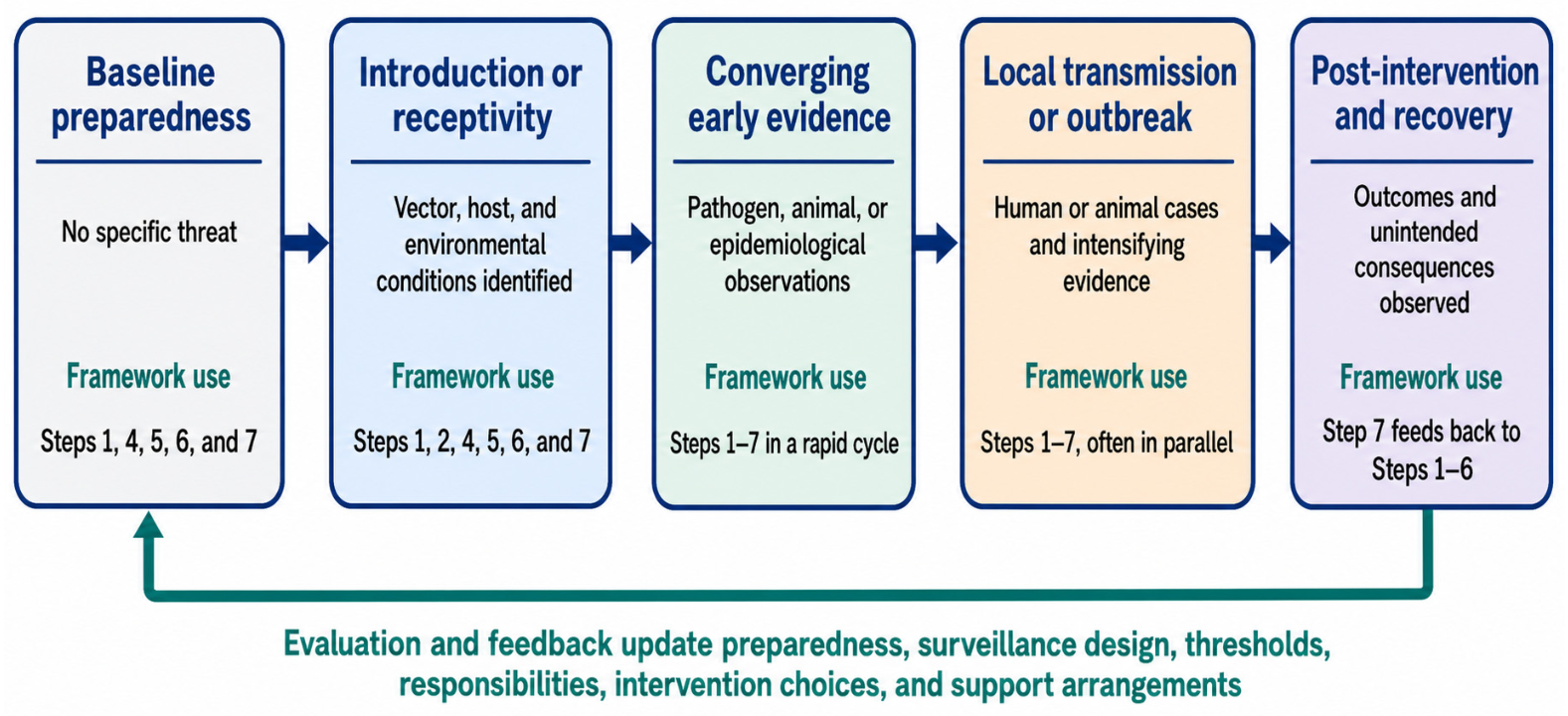
The seven steps are listed below. Figure 1 places the framework within the manuscript’s logical structure, while Figure 2 and Figure 3 show stakeholder roles and timing across preparedness, response, and recovery. In practice, steps may be revisited, undertaken in parallel, or accelerated as evidence changes. Step 7 explicitly returns feedback and impact information to the preceding steps.
- Characterise integrated evidence and transmission plausibility.
- Assess whether precautionary action is justified.
- Evaluate proportionality and least restrictive effective alternatives.
- Identify burdens, equity implications, and reciprocal support.
- Map One Health trade-offs across human, animal, and environmental systems.
- Build legitimacy through participation, communication, and structured dialogue.
- Collect feedback, evaluate intended and unintended impacts, and adapt the decision.
The framework is intended to support decisions in three broad settings: routine control in endemic areas, preparedness where a competent vector, host, or pathogen may be introduced or become established, and response during local transmission or an outbreak. Depending on the setting, a surveillance team may detect infected vectors, a veterinary service may identify animal infection, an environmental agency may identify ecological conditions for transmission, or a municipality may face a choice about intensified control. The framework does not replace disease-specific technical expertise. Instead, it organises ethical questions when integrated evidence points toward action but does not settle the choice among feasible responses.
Although jurisdiction-neutral, the framework is a decision aid rather than a protocol. It needs to be adapted to national and regional law, surveillance capacity, disease ecology, health-system organisation, and community context. Legal responsibilities, surveillance thresholds, and vector-control procedures differ across countries and between endemic, introduction-prevention, and outbreak settings. The framework guides ethical reasoning without replacing WHO, WOAH, CDC, ECDC, national, or local technical guidance.
Figure 1.
Exact manuscript sections, the seven-step decision framework, its three application settings, and the feedback cycle linking evaluation to renewed evidence assessment.
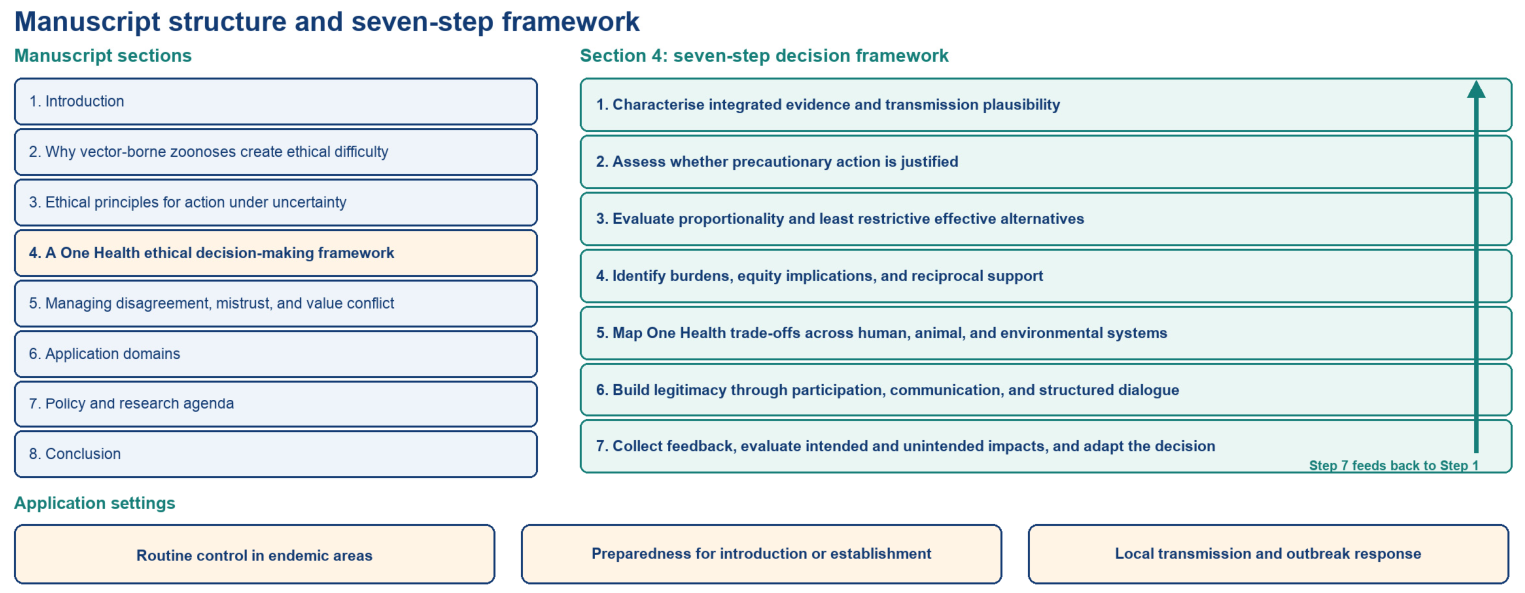
Figure 2.
Illustrative, non-exclusive stakeholder roles across the seven-step framework. L indicates a coordinating or leading role where mandated, C a contribution of evidence, expertise, or implementation, P participation or consultation, and I-A informed or affected status. Multiple roles may apply, and any actor may also be informed or affected according to context. Academic and research institutions contribute methods, evidence synthesis, forecasting, evaluation, and training without displacing statutory accountability.
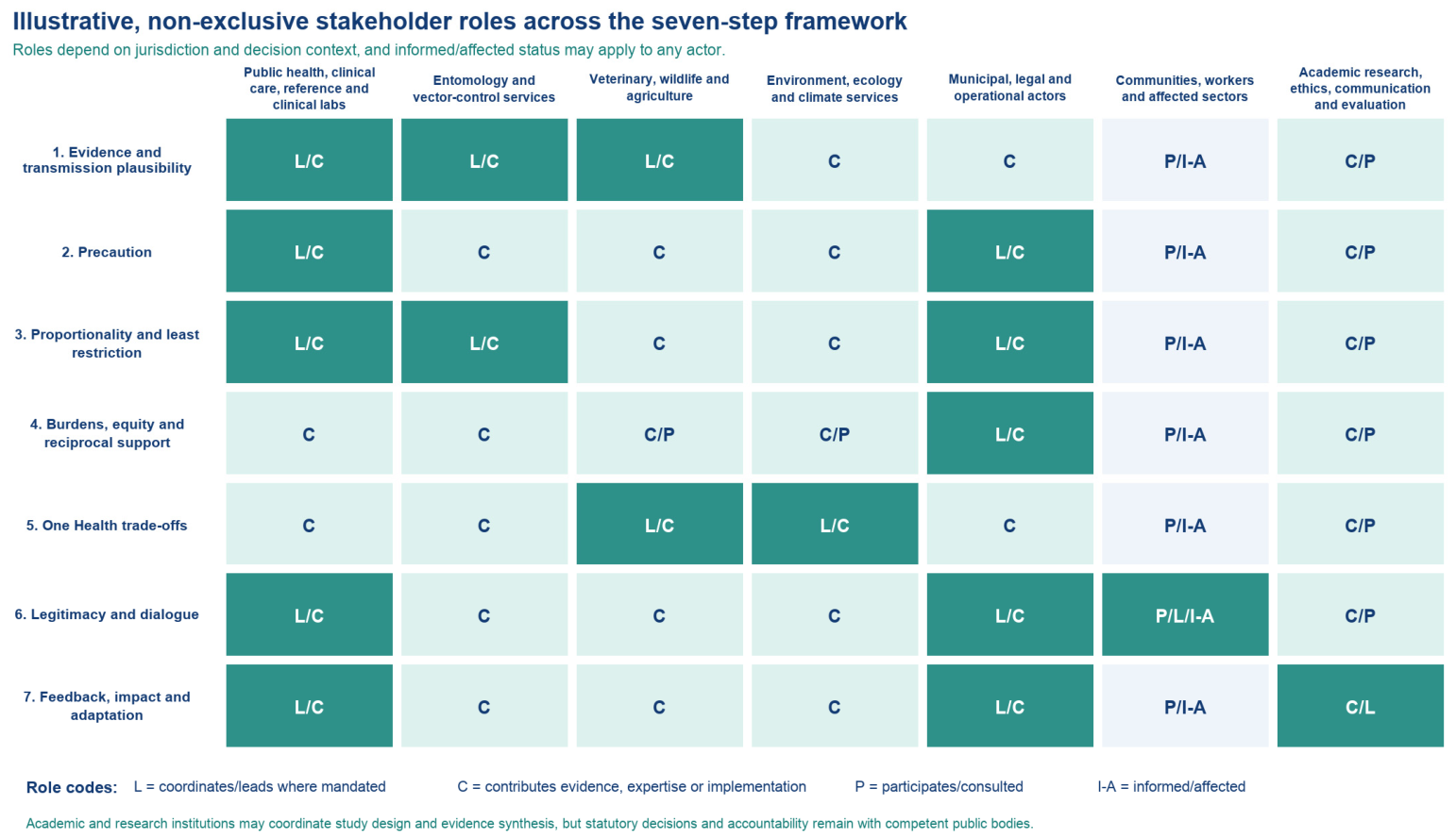
Figure 3.
Use of the seven-step framework across routine endemic control, preparedness for the risk of introduction or establishment, local transmission or outbreak response, and recovery.
4.1. Characterise the Evidence and Uncertainty
Step 1 characterises integrated evidence and transmission plausibility. A surveillance ‘signal’ is a decision-relevant observation from human, entomological, animal reservoir or sentinel, environmental, climatic, diagnostic, modelling, or intervention-monitoring data. It is not assumed to be sufficient on its own. The assessment documents what is known, what is unknown but consequential, and how the combined evidence supports or weakens a plausible transmission pathway.
The distinction between vector presence, vector competence, and vectorial capacity is fundamental. Vector competence refers to the intrinsic ability of a vector population to acquire, maintain, and transmit a pathogen, whereas vectorial capacity also reflects density, survival, biting frequency, host contact, and the extrinsic incubation period. Host or reservoir competence, feeding patterns, bridge-vector behaviour, pathogen prevalence, environmental suitability, and contact with susceptible people or animals also shape transmission risk. The presence of a vector is thus a reason for verification and surveillance, not by itself evidence that local transmission is occurring [17,18,19,24].
Different sources and types of uncertainty should first be assessed separately and then brought together in a transmission-plausibility statement. A vector, for example, may be abundant but uninfected, infected but a poor bridge feeder, or competent in laboratory studies while local host contact is limited. At the other end of the spectrum, pathogen-positive vectors, competent amplifying hosts, favourable seasonal conditions, and compatible human or animal cases may converge. Step 1 should therefore specify the pathogen, vector, host or reservoir, exposed population, environment, proposed intervention, and the evidence that would change the assessment.
Expressing the trigger as a sentence, rather than only as a dashboard colour, supports transparency and later review. For example, the statement ‘pathogen-positive Culex pools have been detected in two neighbouring municipalities without confirmed human cases’ records the signal, geography, missing human evidence, and decision threshold. Assessment can then consider reliability, timeliness, geographic representativeness, remaining uncertainties about transmission, severity, exposure and intervention effects, and the evidence that would change the decision. Surveillance ethics and the One Health surveillance literature support making the basis of public health action transparent, including the limits of data quality, representativeness, and timeliness [11,22,23]. An uncertainty statement should specify whether uncertainty concerns data quality, timeliness, spatial coverage, diagnostic classification, vector competence, animal reservoir relevance, environmental suitability, model assumptions, or intervention effects, and what evidence would change the decision [1,2,6].
Table 1 should not be read as an escalation ladder. Observations may occur together, and a single observation can support several responses at the same time. For example, increasing vector abundance may justify verification, source reduction, community engagement, and expanded pathogen or host surveillance. Additional control becomes more plausible when abundance converges with competent vectors, pathogen detection, suitable hosts, and exposure.
Table 1.
Integrated evidence patterns and possible non-sequential response packages.
4.2. Assess Whether Precautionary Action Is Justified
Step 2 assesses whether the severity and plausibility of harm, the time available to act, the reversibility of proposed measures, and the consequences of waiting justify precautionary action despite incomplete evidence.
The opportunity for prevention may narrow as transmission develops. Waiting for confirmed human cases can be ethically problematic if earlier vector, animal, or environmental signals suggest plausible preventable harm. At the same time, precautionary action can be poorly calibrated. Decisions should therefore compare the risks of waiting with the risks of acting too soon and select measures that can be scaled, revised, or withdrawn as evidence improves.
Every precautionary measure should have explicit review criteria. Public health ethics sources emphasise that preventive action under uncertainty should be justified by public reasons and remain open to revision [1,9,10]. Zoonotic disease ethics introduces a One Health constraint because measures taken to reduce human disease risk may also affect animals, ecosystems, livelihoods, and community relationships [2,13]. New human, vector, animal, or environmental data should trigger reassessment of whether the action should continue, escalate, narrow, or stop [1,36]. This can reduce the risk of maintaining burdensome measures after their justification weakens or failing to escalate when evidence strengthens.
4.3. Evaluate Proportionality and Least Restrictive Alternatives
Step 3 calibrates response intensity to the severity, likelihood, urgency, and uncertainty of the threat, using graduated measures where feasible. This allows early action without treating every early signal as grounds for maximum intervention.
Where evidence is limited and risk is plausible but not severe, intensified surveillance, targeted communication, community engagement, and less burdensome environmental measures may be preferable to restrictive or ecologically disruptive interventions. As the integrated evidence strengthens, it may justify more intensive measures, but the accompanying public justification should become correspondingly stronger. Public health ethics frameworks support balancing expected health benefits, individual and collective burdens, fairness, and procedural justification [2,9,10,37].
The principle of least restriction asks which feasible option can reasonably achieve the public health objective while imposing the least unnecessary burden. Yet a weaker measure may still be unfair if avoidable risk is shifted onto groups with the least capacity to respond. Disease-specific restrictions on animal movement or trade, changes in land use, or temporary access restrictions during vector-control operations may be defensible in some settings when epidemiologically and legally justified. These measures are distinct from population-wide human mobility restrictions more typical of respiratory outbreaks. Any such measure should be justified through risk, expected benefit, alternatives considered, duration, review criteria, and support for affected groups [1,2,13].
4.4. Identify Who Bears the Burden
Step 4 asks two related questions: who is at risk of disease, and who bears the burdens of surveillance, prevention, and control? Because vector-borne zoonotic risk and response capacity are uneven, some groups may be asked to change work practices, accept vector-control activities near homes or farms, restrict animal movements, tolerate monitoring, accept vaccination where relevant and available, or absorb losses associated with a risk-area label.
Some burdens are direct. The intervention itself may impose costs, inconvenience, chemical exposure, animal-movement restrictions, land-use limitations, and obligations to maintain private property for public health purposes. Other, less direct effects may include stigma, lost income, reputational harm, reduced tourism, occupational disruption, and distrust. The literature addressing equity suggests that disease risk and intervention burdens can track existing social vulnerability, spatial disadvantage, and environmental exposure [2,30,31,35].
Burden assessment should not stop at identifying costs. It should also consider what support is available. In practice, reciprocity may require protective equipment, financial or practical assistance, compensation mechanisms, occupational guidance, translation and outreach, or municipal services that reduce exposure without shifting responsibility solely onto households. Mapping burdens before implementation can inform the choice of intervention, while continued assessment allows fairness to be evaluated as consequences become visible. Some burdens can be predicted, such as costs to farmers or outdoor workers, whereas others emerge later, such as stigma, community mistrust, or ecological effects. This wider view helps avoid interpreting limited compliance as only a behavioural problem while overlooking the conditions that shape feasible action.
4.5. Map One Health Trade-Offs
Step 5 brings together One Health trade-offs among human health protection, animal health and welfare, biodiversity, ecosystem management, agriculture, livelihoods, municipal responsibility, and public trust. The central questions are whose interests are protected, whose may be harmed, and whether avoidable harms can be reduced.
Some One Health trade-offs arise immediately. Insecticide use, for example, may reduce vector density while raising concerns about non-target species, ecological effects, community acceptance, and environmental sustainability. Municipal actions involving drainage, waste management, and public-space maintenance also depend on unevenly distributed local capacity. Animal or vector surveillance can provide shared benefits but still place costs or reputational risks on specific owners, farms, or places.
Other One Health trade-offs emerge only over time. A measure justified during one season may become ethically questionable if it becomes routine without evaluation, ecological harms accumulate, resistance reduces effectiveness, or communities experience repeated interventions as imposed rather than justified. Investment in environmental management, municipal infrastructure, occupational protection, vaccination where relevant and available, and community partnership may lessen future reliance on emergency control. The One Health ethics literature suggests that collaboration across human, animal, and environmental sectors does not, by itself, resolve value conflicts [5,8,12]. Where relevant interests cannot be fully reconciled, authorities should identify them, reduce avoidable harms, and revisit trade-offs as evidence changes. Official vector-control and One Health governance sources support integrated approaches that connect surveillance, prevention, capacity building, and community engagement [6,7,8,27].
4.6. Build Legitimacy Through Structured Dialogue
Step 6 concerns process legitimacy. A decision may be technically sound and ethically reasoned yet still fail if affected groups do not understand, trust, or accept the process. Relevant actors include public health authorities, clinical and national reference laboratories, veterinary and wildlife services, entomologists and vector-control programmes, environmental and climate agencies, municipalities, universities and public or private research institutes, agriculture and livestock sectors, legal stakeholders, occupational groups, communities, animal owners, environmental organisations, and vulnerable groups. Figure 2 maps illustrative, non-exclusive roles. Statutory and operational bodies coordinate where mandated. Technical sectors and academic institutions contribute data, methods, evaluation, and training, while communities contribute local knowledge and may also be directly affected.
Stakeholders may interpret proposed interventions differently, including insecticide use, surveillance technologies, property-level measures, animal management, public advisories, or restrictions that affect livelihoods. Structured dialogue can clarify evidence, burdens, alternatives, and review points [2,11,32,33,34]. It may also reveal value disagreement that a technical memorandum may not capture.
We present medical bioethics mediation as a supporting governance mechanism rather than a substitute for public decision-making. Mediation-oriented processes may be useful when disagreement persists or stakeholders interpret the same evidence through different values and experiences [14,39]. It is worth planning this conflict-management capacity in advance, before mistrust becomes entrenched and leaves little room for constructive dialogue.
4.7. Collect Feedback, Evaluate Impact, and Adapt
Step 7 collects feedback, evaluates intended and unintended impacts, and adapts the decision. Monitoring should include disease and vector outcomes, implementation fidelity, community experience, distribution of burdens, animal-health and welfare effects, ecological consequences, costs, resistance, and trust. Findings then return to Steps 1–6, allowing evidence assessments, response intensity, support measures, stakeholder involvement, and review criteria to be revised.
Importantly, evaluation begins during implementation rather than only after an outbreak. Baseline indicators should be defined during preparedness. Process feedback should be collected during early warning and control, and outcome and impact evaluation should continue through recovery. Criteria for continuation, escalation, narrowing, withdrawal, or substitution are best defined in advance and reviewed with affected actors.
Figure 3 traces use of the framework across the three decision settings: routine control in endemic areas, preparedness for the risk of introduction or establishment, and response during local transmission or an outbreak. Not every step has the same intensity in every phase, and several steps may need to proceed in parallel during urgent decisions. Feedback from Step 7 completes the governance cycle by updating surveillance design, thresholds, responsibilities, intervention choices, and support arrangements [6,8,21,22].
5. Managing Disagreement, Mistrust, and Value Conflict
Disagreement may concern empirical claims, values, or both. Many disputes over vector control persist because stakeholders agree that risk exists but disagree about acceptable intervention intensity, ecological consequences, economic burden, property-level responsibilities, animal management, or whether authorities can be trusted. Treating a disagreement about values as a knowledge deficit can deepen mistrust. Ethical governance therefore needs to distinguish scientific uncertainty from value conflict and create a process for both.
Communication, in this context, needs to make uncertainty explicit. Providing more information alone may not resolve disagreement. Outbreak ethics guidance, surveillance ethics, and vector-borne disease ethics guidance instead support communication that makes evidence, uncertainty, justification, and review visible [1,2,11,23]. Evidence on community engagement similarly suggests that partnership, co-creation, and acceptability matter in vector-control settings [32,33,34,41,42].
The documented Zika case illustrates the practical purpose of this section. WHO guidance describes how a proposed 2016 aerial Naled programme in Puerto Rico was initially supported by authorities but introduced without adequate preparation of municipal leaders, clinicians, environmental groups, beekeepers, and the public. Opposition and mistrust intensified, and support was withdrawn. Because the effect of spraying on incidence is unknown, the case does not establish which technical option was correct. The case instead shows that stakeholders should address the evidence, environmental concerns, local decision authority, feasible alternatives, and public justification before announcing an urgent intervention [2,34].
In practice, the sequence is intended for use before insecticide spraying, public risk-area designation, intensified surveillance, environmental intervention, property-level control, animal-related measures, or other contested action. Urgent situations may require several steps to proceed rapidly or in parallel, but action should still include reasons, proportionality assessment, burden mapping, and a plan for review [1,2,11]. By separating evidence thresholds, ecological concerns, property access, economic burdens, prior distrust, and acceptable risk, the sequence can make complex vector-control disputes more manageable.
Mediation-oriented processes may be helpful in some cases. Whether formal mediation will improve vector-control outcomes remains uncertain, but such processes may clarify interests, separate scientific uncertainty from value disagreement, compare options, and support a process that affected actors can understand even if they do not fully agree with the outcome [14]. Its role is necessarily limited, since the central contribution remains the One Health ethical decision-making framework. Box 1 translates conflict management into operational steps by starting with the decision, separating empirical uncertainty from value conflict, mapping burdens, and requiring communication and review points.
Conflict may arise among institutional stakeholders or between responsible agencies and communities. Inter-institutional disputes can be coordinated by a designated One Health incident or governance lead. Where values remain contested, an independent mediator with public health, veterinary, environmental, or bioethics competence may assist. Authority–community disputes require a convenor or neutral mediator trusted by affected communities, together with community representatives and transparent ground rules. In both settings, the process should distinguish empirical uncertainty from value disagreement, compare alternatives, identify burdens, record reasons, and define review points.
Legitimacy does not depend on complete agreement. Affected actors should nevertheless understand the reasons for action and see that burdens and alternatives were considered. They should also know who is accountable and be confident that decisions can be reviewed as evidence changes. Disagreement may remain, but these elements can make a process feel reasoned and accountable rather than arbitrary or imposed [1,9,10,39].
Box 1. Stepwise structured dialogue for contested vector-control decisions.
- Clarify the decision that must be made.
- State the evidence and uncertainty.
- Identify affected actors.
- Distinguish scientific disagreement from value disagreement.
- Map burdens and trade-offs.
- Identify proportionate options.
- Agree on communication, monitoring, and review points.
- Revise decisions as evidence changes.
6. Application Domains
Although the framework is not disease-specific, its application must be tailored to the disease. The examples that follow identify distinct transmission cycles, competent vectors and hosts, epidemiological outcomes, control options, and One Health trade-offs rather than treating vector-borne diseases as interchangeable.
6.1. West Nile Virus and Integrated Human–Animal–Vector Surveillance
West Nile virus (Orthoflavivirus nilense, WNV) is maintained primarily in a mosquito–bird–mosquito cycle. Wild birds serve as reservoir or amplifying hosts, Culex mosquitoes are important vectors, and humans and equids are generally incidental dead-end hosts. Approximately 80% of human infections are asymptomatic, about 20% cause febrile illness, and fewer than 1% develop neuroinvasive disease. Roughly one in ten people with neuroinvasive disease dies. Equine morbidity and lethality vary by outbreak: in the 2010 Central Macedonia outbreak, neurological disease was estimated in 19% of infected horses and the reported fatality rate was 30%. Wildlife effects are highly species-dependent, so a single lethality estimate would be misleading. Marked mortality occurs in susceptible bird species, whereas other birds remain asymptomatic. These differences explain why mosquito, wild-bird, equine, human, and blood-safety surveillance provide complementary information [17,19,43].
Assessment of WNV transmission should distinguish Culex presence or abundance from pathogen-positive pools, bird mortality or serological evidence, equine cases, and human disease. Vector presence alone does not establish transmission. Plausibility increases when competent Culex populations, infected mosquitoes or birds, suitable seasonal conditions, and bridge feeding converge. A proportionate response may combine source reduction, larval control, targeted adult mosquito control when justified, personal-protection advice, clinical and blood-safety alerts, veterinary communication, and equine vaccination where available [15,16,17,19]. Box 2 applies the seven-step framework to this surveillance pattern.
Box 2. Worked example: applying the seven-step framework to a West Nile virus surveillance pattern.
A municipality detects increased Culex abundance and WNV-positive vector pools in an area with susceptible wild-bird reservoirs, but no confirmed human or equine cases. The decision is which integrated control, clinical, veterinary, and communication measures to initiate.
1. Characterise integrated evidence and transmission plausibility: confirm vector species, infection, spatial coverage, bird and equine evidence, seasonality, bridge-feeding potential, and uncertainty about near-term human exposure.
2. Assess whether precautionary action is justified: consider timing, plausible severity, reversibility, and the consequences of waiting for human cases.
3. Evaluate proportionality and least restrictive effective alternatives: compare intensified trapping, source reduction, targeted larval control, clinical alerts, and public advisories before broader intrusive measures.
4. Identify burdens, equity implications, and reciprocal support: assess effects on households, outdoor workers, municipalities, tourism areas, and low-income neighbourhoods, and specify needed support.
5. Map One Health trade-offs: weigh human health protection against insecticide effects, biodiversity, animal surveillance demands, municipal capacity, and public trust.
6. Build legitimacy through participation, communication, and structured dialogue: communicate the signal and uncertainty, involve relevant stakeholders, document reasons, and discuss alternatives.
7. Collect feedback, evaluate intended and unintended impacts, and adapt the decision: monitor vector infection, human and equine outcomes, ecological effects, implementation, community experience, and burdens, continue, escalate, narrow, substitute, or withdraw measures as findings change.
6.2. Dengue, Aedes-Borne Arboviruses, and Community Cooperation
Dengue is caused by four principal dengue virus serotypes (DENV-1, DENV-2, DENV-3, and DENV-4) and is transmitted predominantly in an urban human–Aedes–human cycle, with Aedes aegypti as the primary vector and Aedes albopictus contributing in some settings. Humans are the principal amplifying hosts within this cycle. WHO estimates 100–400 million infections annually. Many infections are asymptomatic or mild, but severe dengue can occur. Case fatality can exceed 20% without appropriate treatment and can be reduced to below 1% with early detection and proper clinical care. Domestic water storage, small containers, housing, urban services, human mobility, temperature, and rainfall shape transmission [44].
Dengue control consequently depends on coordination among households, neighbourhoods, municipalities, clinicians, and laboratories. Source reduction and container management, targeted larval control, appropriate adult mosquito control, clinical alerts, case management, and community participation should be selected on the basis of integrated evidence rather than vector indices alone. Here, the One Health dimension lies chiefly in the interaction of human health with urban ecosystems, water and waste systems, insecticide effects, resistance, and unequal household or municipal capacity [15,32,33,41,42,44]. Box 3 applies the framework to this dengue early-warning pattern.
Box 3. Worked example: applying the seven-step framework to a dengue early-warning pattern.
A city observes rising suspected dengue cases, increasing Aedes indices, and favourable rainfall conditions, with uneven household and municipal capacity for source reduction.
1. Characterise integrated evidence and transmission plausibility: integrate suspected and confirmed cases, DENV serotype, vector density and infection where available, spatial coverage, climate, water storage, and diagnostic uncertainty.
2. Assess whether precautionary action is justified: consider early source reduction, targeted larval control, clinical alerts, and intensified surveillance before transmission is fully characterised.
3. Evaluate proportionality and least restrictive effective alternatives: compare household and municipal measures with broader adult vector control in expected benefit, intrusiveness, and reversibility.
4. Identify burdens, equity implications, and reciprocal support: identify low-income households, schools, outdoor workers, and municipalities that need practical or financial support.
5. Map One Health trade-offs: assess water practices, waste systems, non-target effects, resistance, livelihoods, and unequal capacity.
6. Build legitimacy through participation, communication, and structured dialogue: involve communities in feasible source reduction, explain uncertainty, and respond to concerns about control methods.
7. Collect feedback, evaluate intended and unintended impacts, and adapt the decision: monitor cases, vector indices, implementation, acceptability, resistance, and burdens against predefined escalation or withdrawal criteria.
6.3. Zika and Contested Vector-Control Interventions
Zika virus is transmitted mainly by Aedes vectors, although transmission can also occur sexually and from a pregnant person to the fetus. Most infections are asymptomatic or mild, and death from acute infection is uncommon. The principal severe burden arises from congenital Zika syndrome and neurological complications. These features make vector control inseparable from reproductive-health communication, privacy, stigma, and the unequal ability to avoid exposure [2,34,45].
Zika-specific assessment should distinguish imported from locally acquired infection, competent Aedes populations, mosquito-borne from sexual or vertical transmission, and risk to pregnant people. When authorities recommend intensified control, they need to explain evidence, urgency, expected benefits, reproductive-health implications, environmental effects, alternatives, and review criteria. The 2016 Puerto Rico controversy over proposed aerial application of Naled illustrates how a technically motivated response can lose legitimacy when local authorities, clinicians, environmental groups, and communities have not been adequately engaged [2]. Box 4 applies the framework to this contested vector-control decision.
Box 4. Worked example: applying the seven-step framework to a Zika vector-control decision.
Imported and possible locally acquired Zika infections occur in an area with competent Aedes vectors, while an aerial-control proposal raises reproductive-health, environmental, and community concerns.
1. Characterise integrated evidence and transmission plausibility: distinguish imported and locally acquired infection, vector evidence, sexual or vertical transmission, and diagnostic uncertainty.
2. Assess whether precautionary action is justified: consider targeted surveillance, accessible communication, and proportionate vector control before transmission is fully characterised.
3. Evaluate proportionality and least restrictive effective alternatives: compare options by expected benefit, intrusiveness, reversibility, and evidentiary strength.
4. Identify burdens, equity implications, and reciprocal support: assess unequal effects on pregnant people, households with limited capacity to avoid exposure, and communities facing repeated property-level intervention or stigma.
5. Map One Health trade-offs: consider ecological effects, reproductive-health implications, equity, and public trust.
6. Build legitimacy through participation, communication, and structured dialogue: involve municipal leaders, clinicians, environmental groups, and affected communities before announcing contested control.
7. Collect feedback, evaluate intended and unintended impacts, and adapt the decision: monitor epidemiological signals, implementation, environmental effects, acceptability, and reasons for escalation, modification, or withdrawal.
6.4. Crimean–Congo Haemorrhagic Fever and Tick–Livestock–Occupational Transmission
Crimean–Congo haemorrhagic fever virus (CCHFV) is maintained in tick–vertebrate cycles, with Hyalomma vectors acting as important vectors and reservoirs through transstadial and transovarial maintenance. Livestock usually show no clinical disease but can develop viraemia, thereby exposing farmers, veterinarians, abattoir workers, and others handling blood or tissues. Humans may be infected through vector bites, contact with infected animal tissues, or nosocomial transmission, and the reported human case-fatality rate is approximately 10–40%. The presence of Hyalomma vectors alone is insufficient evidence of transmission. Assessment needs to integrate vector infection and abundance, livestock movement and serology, occupational exposure, compatible human illness, seasonality, and geography [46]. Box 5 applies the framework to this occupational-risk pattern.
Box 5. Worked example: applying the seven-step framework to a CCHFV occupational-risk pattern.
Hyalomma vectors and livestock serological evidence are detected in a receptive area without confirmed human cases, raising decisions about occupational protection, surveillance, and targeted control.
1. Characterise integrated evidence and transmission plausibility: integrate vector infection and abundance, livestock movement and serology, occupational exposure, compatible illness, seasonality, and diagnostic uncertainty.
2. Assess whether precautionary action is justified: consider occupational advice, protective equipment, safe slaughter practices, and clinical or laboratory alerts before human cases increase.
3. Evaluate proportionality and least restrictive effective alternatives: compare targeted acaricide use, animal surveillance, and movement measures with feasibility, evidence, and ecological effects.
4. Identify burdens, equity implications, and reciprocal support: assess effects on farmers, veterinarians, abattoir workers, livestock owners, and resource-limited services, and provide practical support.
5. Map One Health trade-offs: consider human safety, animal health and welfare, trade, acaricide resistance, wildlife ecology, and livelihoods.
6. Build legitimacy through participation, communication, and structured dialogue: involve veterinary, occupational, public health, livestock, and community stakeholders in explaining evidence and alternatives.
7. Collect feedback, evaluate intended and unintended impacts, and adapt the decision: monitor exposure, cases, vector and animal findings, implementation, acceptance, trade effects, and ecological consequences.
6.5. Broader Vector-Borne Zoonotic Illustrations
Rift Valley fever, leishmaniasis, plague, and other vector-borne zoonoses offer further applications with distinct mosquito, sand fly, flea, animal-host, and environmental pathways. Each requires disease-specific assessment rather than applying a mosquito-control template unchanged. The CCHFV example above places the framework in a non-mosquito vector system, whereas WNV emphasises an enzootic bird-mosquito cycle and dengue emphasises a predominantly human–Aedes urban cycle [28,30,46].
The same ethical questions recur across these application domains, even though the epidemiological answers differ: what integrated evidence supports transmission, which action is justified, who bears the burden, what One Health trade-offs arise, how legitimacy can be supported, and what feedback should change the decision. The framework remains a governance structure rather than a disease algorithm.
7. Policy and Research Agenda
The approach is intended for use across the full timeline shown in Figure 3, from baseline preparedness and risk of introduction through early warning, outbreak control, and recovery. Preparedness, in this account, includes governance, feedback, research, and evaluation capacity as well as technical capacity.
7.1. Embed Ethics in Surveillance and Early Warning
Surveillance outputs should be connected to defined decisions and transmission pathways. Relevant evidence may come from human case reporting, laboratory confirmation, vector competence and capacity, pathogen detection in vectors, animal reservoirs or sentinels, feeding patterns, environmental and climate indicators, land-use information, and models. Real-time early-warning systems can then pair risk estimates with limitations and show how combined evidence bears on preparedness or control.
Cross-sector dashboards and predictive tools, including artificial intelligence (AI)-supported models, may support earlier warning, but they should be interpreted alongside veterinary, entomological, ecological, and community knowledge. Risk levels should be accompanied by information about uncertainty, data quality, bias, explainability, performance, accountability, and unequal capacity to act [11,21,22,23,47,48]. Research on sustainable control should also evaluate habitat management, bacterial larvicides, other biological approaches, and resistance management within the same ethical and impact framework [2,15,16].
7.2. Predefine Proportionate Response Pathways
Pre-agreed pathways can link evidence and uncertainty to graduated action, including enhanced surveillance and internal coordination for low-confidence observations, public advisories or municipal preparedness for converging evidence, and targeted vector control, environmental measures, disease-specific restrictions on animal movement or trade where justified, or expanded surveillance for stronger or more urgent evidence. Such pathways improve readiness without automating decisions.
Each response tier still requires context-specific judgment. The assessment should specify how severe the plausible harm is, how uncertain the evidence remains, how reversible the measure is, what burdens will be imposed, which groups will be affected, and what would trigger escalation or de-escalation. Official vector-control and outbreak guidance supports integrated preparedness and early action, while public health ethics sources support proportionality, public justification, and review [1,2,6,9,10]. Actions may reasonably differ across settings because evidence, exposure, feasibility, and burdens can vary even when the pathogen is the same.
7.3. Build Equity, Accountability, and Participation into Preparedness
Preparedness planning should identify vulnerability before a crisis develops. Rural communities, low-income groups, migrants, outdoor workers, farmers, animal owners, tourism-dependent areas, and environmentally vulnerable settings may bear disproportionate disease risk or intervention burden. Identifying vulnerability does not, by itself, provide the support that affected groups may need. Plans should include occupational protection, accessible communication, municipal services, practical assistance, compensation where relevant, or support for animal owners and farmers when groups are asked to reduce exposure or accept burdens for collective protection [1,2,30,31,35].
Decision and participation mechanisms are also best established before an emergency. Public health authorities, national reference laboratories, clinical laboratories, veterinary services, environmental agencies, municipalities, universities and public or private research institutes, agriculture and livestock representatives, occupational groups, community organisations, tourism stakeholders, and environmental organisations may all have a role. One Health governance documents and the implementation literature identify multisectoral coordination, surveillance integration, and institutional collaboration as core preparedness functions [6,8,27,29]. Academic partnerships should specify responsibilities for study design, laboratory and field methods, data integration, forecasting, independent evaluation, and capacity building while preserving public accountability and community participation. Community engagement should begin before conflict emerges [32,33,34,41,42], with clear mechanisms for participation, documentation, and response to community concerns.
7.4. Evaluate Ethical Preparedness and Intervention Consequences
Evaluation should put Step 7 into practice by assessing disease and vector outcomes alongside proportionality, equity, acceptability, trust, ecological impact, animal-welfare consequences, sustainability, costs, resistance, implementation fidelity, and unintended effects. Feedback from responsible agencies and affected groups should be compared with predefined baselines and used to revise the decision. Ideally, review criteria are established before interventions begin [2,15,16,23,35].
Further research is needed to understand how observations from human, vector, animal, environmental, and model-based sources are integrated and interpreted, and how disease risk and intervention burdens are distributed. It should also examine how environmental and animal-welfare trade-offs are weighed and whether structured dialogue improves acceptability, clarifies value conflict, reduces mistrust, or helps identify proportionate alternatives. The proposed indicators are intended to make ethical preparedness auditable, not to serve as definitive proof that a decision is ethical. Table 2 summarises the proposed domains and example indicators.
Table 2.
Ethical preparedness indicators for vector-borne zoonotic disease control.
These indicators can support institutional learning before, during, and after uncertain events or contested responses. Evaluation should consider delayed action, over-escalation, unclear responsibility, inequitable burden, ecological harm, animal-health effects, loss of trust, implementation failure, and whether feedback changed subsequent decisions. Taken together, they remain practical prompts rather than a definitive measure of ethical quality.
Universities and public or private research institutes can support the acquisition and interpretation of critical evidence across the management cycle, but they should not displace accountable public services or community participation. Table 3 identifies focused research contributions and the ethical safeguards needed when uncertainty and vulnerability affect study design, interpretation, and the capacity to act [8,20,22,27,28,29].
Table 3.
Targeted academic and research contributions across vector-borne disease management.
7.5. Use Implementation Networks as Evaluation Settings
Existing initiatives offer practical settings in which the framework could be tested. VectorNet links medical and veterinary entomology and maintains harmonised European vector-distribution data [49,50]. EDENext integrated vector, host, ecological, epidemiological, modelling, and risk-perception research [51,52]. CLIMOS develops climate-informed early-warning and decision-support tools for sand fly-borne diseases using One Health and EcoHealth approaches [53,54]. The official initiative links are retained in References [46,47,48], and scientific publications are cited beside each initiative. Together, these programmes illustrate how data integration, modelling, animal health, environmental change, and stakeholder involvement can be connected rather than treated as separate workstreams.
Such evaluation should also include institutions and partnerships in the Global South. WHO/TDR projects in Uganda and Kenya, Senegal and Nigeria, Tanzania and Rwanda, and South Africa and Rwanda are putting One Health into practice for leishmaniasis, mosquito-borne diseases, fascioliasis, schistosomiasis, and other climate-sensitive risks [55]. Alongside broader African vector-research and One Health networks [28,29], these partnerships could test whether the seven steps improve cross-sector interpretation, participation, burden mitigation, sustainable control, feedback, and adaptation without assuming that European governance structures can be transferred unchanged.
7.6. Limitations of the Framework
The framework remains conceptual and has not yet been validated empirically. It cannot establish whether use of the seven-step sequence or medical bioethics mediation improves decision quality, acceptability, timeliness, equity, health outcomes, animal-health outcomes, or ecological sustainability. The examples are illustrative rather than evaluations of actual decisions. Disease-specific technical guidance, legal duties, and epidemiological thresholds remain necessary.
Applicability is likely to vary across health systems, governance structures, legal settings, resource levels, surveillance capacities, and patterns of community trust. Intersectoral coordination, meaningful participation, documentation, and review may be difficult where authority or resources are fragmented. Mediation may also be inappropriate, infeasible, or insufficient in some disputes. Because the framework was developed through conceptual integration rather than a systematic review or formal consensus process, the relevant literature or perspectives may also have been missed. Pilot application and comparative evaluation across settings are needed before broader claims about practical effectiveness can be made.
8. Conclusions
Control of vector-borne zoonotic diseases often requires action before evidence is complete, although vector presence alone does not establish transmission risk. Ethical preparedness should therefore accompany integrated epidemiological, entomological, veterinary, ecological, and operational preparedness. The proposed seven-step framework characterises transmission plausibility, justifies precaution, calibrates interventions, distributes burdens fairly, maps One Health trade-offs, supports legitimate processes, and uses feedback and impact evaluation to adapt decisions. Its practical value now needs to be tested across health systems, disease ecologies, and governance structures.
Author Contributions
Conceptualization, O.L. and P.K. Methodology, O.L. and P.K. Investigation, O.L., K.K., X.K., P.B., D.J., E.M., X.R., G.B., G.K., G.M. and P.K. Resources, O.L., K.K., X.K., P.B., D.J., E.M., X.R., G.B., G.K., G.M. and P.K. Writing—original draft preparation, O.L. and P.K. Writing—review and editing, O.L., K.K., X.K., P.B., D.J., E.M., X.R., G.B., G.K., G.M. and P.K. Supervision, P.K. Project administration, O.L. and P.K. All authors have read and agreed to the published version of the manuscript.
Funding
This research received no external funding.
Institutional Review Board Statement
Not applicable. This manuscript is a conceptual and policy-oriented article and did not involve human participants, animals, or the collection of primary data.
Informed Consent Statement
Not applicable.
Data Availability Statement
No new data were created or analysed in this study. Data sharing is not applicable to this article.
Acknowledgments
During the preparation of the final draft of this manuscript, the authors used ChatGPT (GPT-5, OpenAI, San Francisco, CA, USA) to assist with English-language editing, structure, punctuation, and formatting. The authors reviewed and edited the output and take full responsibility for the content of this publication.
Conflicts of Interest
The authors declare no conflicts of interest.
Abbreviations
The following abbreviations are used in this manuscript:
| AI | Artificial intelligence |
| CCHFV | Crimean–Congo haemorrhagic fever virus |
| DENV | Dengue virus |
| ECDC | European Centre for Disease Prevention and Control |
| EFSA | European Food Safety Authority |
| USUV | Usutu virus |
| WHO | World Health Organization |
| WNV | West Nile virus |
| ZIKV | Zika virus |
| CDC | Centers for Disease Control and Prevention |
| IVM | Integrated vector management |
| WOAH | World Organisation for Animal Health |
References
- World Health Organization. Guidance for Managing Ethical Issues in Infectious Disease Outbreaks; World Health Organization: Geneva, Switzerland, 2016. [Google Scholar]
- World Health Organization. Ethics and Vector-Borne Diseases: WHO Guidance; World Health Organization: Geneva, Switzerland, 2020. [Google Scholar]
- Zinsstag, J.; Schelling, E.; Waltner-Toews, D.; Tanner, M. From One Medicine to One Health and Systemic Approaches to Health and Well-Being. Prev. Vet. Med. 2011, 101, 148–156. [Google Scholar] [CrossRef] [Scilit]
- Karesh, W.B.; Dobson, A.; Lloyd-Smith, J.O.; Lubroth, J.; Dixon, M.A.; Bennett, M.; Aldrich, S.; Harrington, T.; Formenty, P.; Loh, E.H.; et al. Ecology of Zoonoses: Natural and Unnatural Histories. Lancet 2012, 380, 1936–1945. [Google Scholar] [CrossRef] [Scilit]
- Rodriguez, J. One Health Ethics and the Ethics of Zoonoses: A Silent Call for Global Action. Vet. Sci. 2024, 11, 394. [Google Scholar] [CrossRef] [Scilit]
- World Health Organization. Global Vector Control Response 2017–2030; World Health Organization: Geneva, Switzerland, 2017; ISBN 9789241512978. [Google Scholar]
- World Health Assembly. Global Vector Control Response: An Integrated Approach for the Control of Vector-Borne Diseases; WHA70.16; World Health Organization: Geneva, Switzerland, 2017. [Google Scholar]
- Food and Agriculture Organization of the United Nations; United Nations Environment Programme; World Health Organization; World Organisation for Animal Health. One Health Joint Plan of Action (2022–2026): Working Together for the Health of Humans, Animals, Plants and the Environment; Food and Agriculture Organization of the United Nations: Rome, Italy, 2022. [Google Scholar] [CrossRef] [Scilit]
- Childress, J.E.; Faden, R.R.; Gaare, R.D.; Gostin, L.O.; Kahn, J.; Bonnie, R.J.; Kass, N.E.; Mastroianni, A.C.; Moreno, J.D.; Nieburg, P. Public Health Ethics: Mapping the Terrain. J. Law Med. Ethics 2002, 30, 170–178. [Google Scholar] [CrossRef] [Scilit]
- Kass, N.E. An Ethics Framework for Public Health. Am. J. Public Health 2001, 91, 1776–1782. [Google Scholar] [CrossRef] [Scilit]
- World Health Organization. WHO Guidelines on Ethical Issues in Public Health Surveillance; World Health Organization: Geneva, Switzerland, 2017. [Google Scholar]
- van Herten, J.; Bovenkerk, B.; Verweij, M. One Health as a Moral Dilemma: Towards a Socially Responsible Zoonotic Disease Control. Zoonoses Public Health 2019, 66, 26–34. [Google Scholar] [CrossRef] [Scilit]
- van Herten, J.; Bovenkerk, B. The Precautionary Principle in Zoonotic Disease Control. Public Health Ethics 2021, 14, 180–190. [Google Scholar] [CrossRef] [Scilit]
- Lioupi, O.; Kostoulas, P.; Monti, G.; Griva, K.; Billinis, C.; Tsiamis, C. Harnessing Medical Bioethics Mediation to Advance One Health Governance. Vet. Sci. 2026, 13, 8. [Google Scholar] [CrossRef] [Scilit]
- World Health Organization. Handbook for Integrated Vector Management; World Health Organization: Geneva, Switzerland, 2012; ISBN 9789241502801. [Google Scholar]
- Centers for Disease Control and Prevention. Integrated Mosquito Management. Available online: https://www.cdc.gov/mosquitoes/php/toolkit/integrated-mosquito-management-1.html (accessed on 31 July 2026).
- European Centre for Disease Prevention and Control; European Food Safety Authority. Surveillance, Prevention and Control of West Nile Virus and Usutu Virus Infections in the EU/EEA; European Centre for Disease Prevention and Control: Stockholm, Sweden, 2023.
- European Centre for Disease Prevention and Control. Guidelines for the Surveillance of Native Mosquitoes in Europe; European Centre for Disease Prevention and Control: Stockholm, Sweden, 2014. [CrossRef]
- World Organisation for Animal Health. West Nile Fever. In Terrestrial Animal Health Code; Chapter 8.21; World Organisation for Animal Health: Paris, France, 2024. [Google Scholar]
- Charnley, G.E.C.; Alcayna, T.; Almuedo-Riera, A.; Antoniou, C.; Badolo, A.; Bartumeus, F.; Boodram, L.L.; Bueno-Marí, R.; Codeço, C.; Coelho, F.C.; et al. Strengthening Resilience to Emerging Vector-Borne Diseases in Europe: Lessons Learnt from Countries Facing Endemic Transmission. Lancet Reg. Health-Eur. 2025, 53, 101271. [Google Scholar] [CrossRef] [Scilit]
- Sharan, M.; Vijay, D.; Yadav, J.P.; Bedi, J.S.; Dhaka, P. Surveillance and Response Strategies for Zoonotic Diseases: A Comprehensive Review. Sci. One Health 2023, 2, 100050. [Google Scholar] [CrossRef] [Scilit]
- Bordier, M.; Uea-Anuwong, T.; Binot, A.; Hendrikx, P.; Goutard, F.L. Characteristics of One Health Surveillance Systems: A Systematic Literature Review. Prev. Vet. Med. 2020, 181, 104560. [Google Scholar] [CrossRef] [Scilit]
- Gilbert, G.L.; Degeling, C.; Johnson, J. Communicable Disease Surveillance Ethics in the Age of Big Data and New Technology. Asian Bioeth. Rev. 2019, 11, 173–187. [Google Scholar] [CrossRef] [Scilit]
- Kramer, L.D.; Ciota, A.T. Dissecting Vectorial Capacity for Mosquito-Borne Viruses. Curr. Opin. Virol. 2015, 15, 112–118. [Google Scholar] [CrossRef] [Scilit]
- Hernandez-Colina, A.; Seechurn, N.; Costa, T.; Lopez, J.; Baylis, M.; Hesson, J.C. Surveillance of Culex spp. Vectors and Zoonotic Arboviruses at a Zoo in the United Kingdom. Heliyon 2024, 10, e26477. [Google Scholar] [CrossRef] [Scilit]
- León, T.M.; McCready, J.; Chutaro, E.; McAllister, J.; Solomon, B.; Hapairai, L.K. Outbreak of Dengue Virus Serotype 3, Republic of the Marshall Islands, 2019–2021. Emerg. Infect. Dis. 2026, 32, 619–622. [Google Scholar] [CrossRef] [Scilit]
- Kelly, T.R.; Machalaba, C.; Karesh, W.B.; Crook, P.Z.; Gilardi, K.; Nziza, J.; Uhart, M.M.; Robles, E.A.; Saylors, K.; Joly, D.O.; et al. Implementing One Health Approaches to Confront Emerging and Re-Emerging Zoonotic Disease Threats: Lessons from PREDICT. One Health Outlook 2020, 2, 1. [Google Scholar] [CrossRef] [Scilit]
- Obame-Nkoghe, J.; Agossou, A.E.; Mboowa, G.; Kamgang, B.; Caminade, C.; Duke, D.C.; Githeko, A.K.; Ogega, O.M.; Elloue, N.E.; Sarr, F.B.; et al. Climate-Influenced Vector-Borne Diseases in Africa: A Call to Empower the Next Generation of African Researchers for Sustainable Solutions. Infect. Dis. Poverty 2024, 13, 26. [Google Scholar] [CrossRef] [Scilit]
- Mwatondo, A.; Rahman-Shepherd, A.; Hollmann, L.; Chiossi, S.; Maina, J.; Kurup, K.K.; Hassan, O.A.; Coates, B.; Khan, M.; Spencer, J.; et al. A Global Analysis of One Health Networks and the Proliferation of One Health Collaborations. Lancet 2023, 401, 605–616. [Google Scholar] [CrossRef] [Scilit]
- Bardosh, K.L.; Ryan, S.; Ebi, K.; Welburn, S.; Singer, B. Correction to: Addressing Vulnerability, Building Resilience: Communi-ty-Based Adaptation to Vector-Borne Diseases in the Context of Global Change. Infect. Dis. Poverty 2018, 7, 5. [Google Scholar] [CrossRef] [Scilit]
- Choolayil, A.C.; Devaraju, P.; Jabir, M.; Srirama, S.; Kumar, B.; Balakrishnan, V.; Vissvesaran, S. Spatial Justice and Health (in)equity: The Case of Vector-Borne Diseases. Humanit. Soc. Sci. Commun. 2026, 13, 164. [Google Scholar] [CrossRef] [Scilit]
- Bartumeus, F.; Costa, G.B.; Eritja, R.; Kelly, A.H.; Finda, M.; Lezaun, J.; Okumu, F.; Quinlan, M.M.; Thizy, D.C.; Toe, L.P.; et al. Sustainable Innovation in Vector Control Requires Strong Partnerships with Communities. PLoS Neglected Trop. Dis. 2019, 13, e0007204. [Google Scholar] [CrossRef] [Scilit]
- Dambach, P.; Louis, V.R.; Standley, C.J.; Montenegro-Quinonez, C.A. Beyond Top-down: Community Co-Creation Approaches for Sustainable Dengue Vector Control. Glob. Health Action 2024, 17, 2426348. [Google Scholar] [CrossRef] [Scilit] [PubMed]
- Schoch-Spana, M.; Watson, C.; Ravi, S.; Meyer, D.; Pechta, L.E.; Rose, D.A.; Lubell, K.M.; Podgornik, M.N.; Sell, T.K. Vector Control in Zika-Affected Communities: Local Views on Community Engagement and Public Health Ethics During Outbreaks. Prev. Med. Rep. 2020, 18, 101059. [Google Scholar] [CrossRef] [Scilit]
- World Health Organization. Operational Framework for Building Climate Resilient and Low Carbon Health Systems; World Health Organization: Geneva, Switzerland, 2023. [Google Scholar]
- Public Health Ontario. Precautionary Principle: Applications Relevant to Public Health Emergency Preparedness; Public Health Ontario: Toronto, ON, Canada, 2022. [Google Scholar]
- Nuffield Council on Bioethics. Public Health: Ethical Issues; Nuffield Council on Bioethics: London, UK, 2007. [Google Scholar]
- Ten Have, M.; de Beaufort, I.D.; Mackenbach, J.P.; van der Heide, A. An Overview of Ethical Frameworks in Public Health: Can They Be Supportive in the Evaluation of Programs to Prevent Overweight? BMC Public Health 2010, 10, 638. [Google Scholar] [CrossRef] [Scilit]
- Bollyky, T.J.; Petersen, M.B. A Practical Agenda for Incorporating Trust into Pandemic Preparedness and Response. Bull. World Health Organ. 2024, 102, 440–447. [Google Scholar] [CrossRef] [Scilit]
- World Health Organization Special Programme for Research and Training in Tropical Diseases. Multisectoral Approach for the Prevention and Control of Vector-Borne Diseases; World Health Organization: Geneva, Switzerland, 2020. [Google Scholar]
- Annan, E.; Guo, J.; Angulo-Molina, A.; Wan Yaacob, W.F.; Aghamohammadi, N.; Guetterman, T.C.; Yavasoglu, S.I.; Bardosh, K.; Dom, N.C.; Zhao, B.; et al. Community Acceptability of Dengue Fever Surveillance Using Unmanned Aerial Vehicles: A Cross-Sectional Study in Malaysia, Mexico, and Turkey. Travel Med. Infect. Dis. 2022, 49, 102360. [Google Scholar] [CrossRef] [Scilit]
- Yulfi, H.; Panggabean, M.; Darlan, D.M.; Siregar, I.S.S.; Rozi, M.F. Community-Based Intervention in Mosquito Control Strategy: A Systematic Review. Narra J. 2025, 5, e1015. [Google Scholar] [CrossRef] [Scilit]
- Bouzalas, I.G.; Diakakis, N.; Chaintoutis, S.C.; Brellou, G.D.; Papanastassopoulou, M.; Danis, K.; Vlemmas, I.; Seuberlich, T.; Dovas, C.I. Emergence of Equine West Nile Encephalitis in Central Macedonia, Greece, 2010. Transbound. Emerg. Dis. 2016, 63, e219–e227. [Google Scholar] [CrossRef] [Scilit]
- World Health Organization. Dengue. Available online: https://www.who.int/news-room/fact-sheets/detail/dengue-and-severe-dengue (accessed on 31 July 2026).
- World Health Organization. Zika Virus. Available online: https://www.who.int/news-room/fact-sheets/zika-virus (accessed on 31 July 2026).
- World Health Organization. Crimean-Congo Haemorrhagic Fever. Available online: https://www.who.int/news-room/fact-sheets/detail/crimean-congo-haemorrhagic-fever (accessed on 31 July 2026).
- World Health Organization. Ethics and Governance of Artificial Intelligence for Health; World Health Organization: Geneva, Switzerland, 2021; ISBN 9789240029200. [Google Scholar]
- World Health Organization. Regulatory Considerations on Artificial Intelligence for Health; World Health Organization: Geneva, Switzerland, 2023; ISBN 9789240078871. [Google Scholar]
- European Centre for Disease Prevention and Control. European Network for Medical and Veterinary Entomology (VectorNet). Available online: https://www.ecdc.europa.eu/en/about-us/partnerships-and-networks/disease-and-laboratory-networks/vector-net (accessed on 31 July 2026).
- Wint, G.R.W.; Balenghien, T.; Berriatua, E.; Braks, M.; Marsboom, C.; Medlock, J.; Schaffner, F.; Van Bortel, W.; Alexander, N.; Alten, B.; et al. VectorNet: Collaborative Mapping of Arthropod Disease Vectors in Europe and Surrounding Areas since 2010. Eurosurveillance 2023, 28, 2200666. [Google Scholar] [CrossRef] [Scilit]
- European Commission. Biology and Control of Vector-Borne Infections in Europe (EDENext), Grant Agreement 261504 CORDIS. Available online: https://cordis.europa.eu/project/id/261504 (accessed on 31 July 2026).
- Vayssier-Taussat, M.; Cosson, J.F.; Degeilh, B.; Eloit, M.; Fontanet, A.; Moutailler, S.; Raoult, D.; Sellal, E.; Ungeheuer, M.-N.; Zylbermann, P. How a Multidisciplinary ’One Health’ Approach Can Combat the Tick-Borne Pathogen Threat in Europe. Future Microbiol. 2015, 10, 809–818. [Google Scholar] [CrossRef] [Scilit]
- European Commission. Climate Monitoring and Decision Support Framework for Sand Fly-Borne Diseases Detection and Mitigation (CLIMOS), Grant Agreement 101057690 CORDIS. Available online: https://cordis.europa.eu/project/id/101057690 (accessed on 31 July 2026).
- Wang, D.; Hof, A.R.; Matson, K.D.; van Langevelde, F.; CLIMOS data providers. Understanding and Predicting the Geographic Distributions of Phlebotomine Sand Flies in and around Europe. Clim. Change 2025, 178, 205. [Google Scholar] [CrossRef] [Scilit]
- World Health Organization Special Programme for Research and Training in Tropical Diseases. One Health and Vector-Borne Diseases. Available online: https://tdr.who.int/activities/one-health-and-vector-borne-diseases (accessed on 31 July 2026).

Disclaimer/Publisher’s Note: The statements, opinions and data contained in all publications are solely those of the individual author(s) and contributor(s) and not of MDPI and/or the editor(s). MDPI and/or the editor(s) disclaim responsibility for any injury to people or property resulting from any ideas, methods, instructions or products referred to in the content. |
© 2026 by the authors. Licensee MDPI, Basel, Switzerland. This article is an open access article distributed under the terms and conditions of the Creative Commons Attribution (CC BY) license.