


Abstract
Despite growing recognition of blockchain technology’s potential to enhance traceability, verifiability, and integrity in financial reporting, empirical evidence from regulated banking environments in developing economies remains scarce. This study investigates whether blockchain adoption is positively associated with transparency and accounting disclosure in digital financial reports among Jordanian listed banks. A structured questionnaire was distributed to managers, financial managers, and accountants across 15 banks listed on the Amman Stock Exchange, yielding 312 valid responses. Partial Least Squares Structural Equation Modeling (PLS-SEM) with 5000 bootstrap subsamples was employed for data analysis. The results show that blockchain adoption is positively and significantly associated with transparency (β = 0.361, p < 0.001) and accounting disclosure (β = 0.437, p < 0.001), explaining 13.0% and 19.1% of the variance, respectively. These findings suggest that blockchain-enabled systems are perceived by banking professionals as contributing to greater reporting credibility. By providing empirical evidence from a developing economy banking sector, this study indicates that blockchain adoption may serve as a governance-supporting mechanism associated with improved perceived transparency and disclosure quality.
Keywords:
blockchain technology; digital transformation; transparency; accounting disclosure; financial reporting quality; PLS-SEM; Jordanian banks JEL Classification:
G21; M41; O33; G34
1. Introduction
The digital transformation of accounting information systems (AIS) has substantially reshaped the preparation, verification, and dissemination of financial information within the banking sector [1]. As financial reporting increasingly depends on digital infrastructures, stakeholders demand higher levels of transparency, reliability, and real-time accessibility of accounting data. In banking institutions—where regulatory oversight, public confidence, and systemic stability are closely linked to reporting credibility—the quality of financial disclosure remains a central governance concern [2].
Despite advances in digital reporting platforms, centralized accounting systems may remain vulnerable to manipulation, delayed verification, and information asymmetry between managers and stakeholders [3,4]. Such asymmetry can weaken governance mechanisms and reduce stakeholder trust in disclosed financial information. These challenges have intensified in environments characterized by rapid technological change and increased regulatory scrutiny. Consequently, improving transparency and accounting disclosure in digital financial reports has become a strategic priority for banks operating in dynamic financial systems [3,5].
Blockchain technology has emerged as a decentralized ledger system designed to record transactions securely through cryptographic validation and consensus mechanisms [6]. Unlike traditional centralized databases, blockchain maintains synchronized records across distributed nodes, thereby reducing reliance on a single controlling authority. From an accounting perspective, blockchain-enabled systems are often associated with enhanced traceability of transactions, automated validation processes, and immutable audit trails [7,8]. These characteristics suggest that blockchain adoption may be positively associated with improved perceptions of transparency and accounting disclosure within digital financial reporting environments.
Although the theoretical relevance of blockchain to accounting and auditing has been widely discussed [9,10], empirical evidence directly linking blockchain adoption to measurable reporting-quality outcomes remains limited. Existing studies have frequently examined conceptual implications, technological readiness, or audit-related applications [7,9], with comparatively fewer quantitative investigations assessing its association with transparency and accounting disclosure in regulated banking environments. Furthermore, prior research often treats reporting quality as a broad construct, without clearly distinguishing between transparency—defined as clarity, timeliness, and verifiability of information—and accounting disclosure—defined as adequacy, completeness, and credibility of reported financial data [10,11].
This distinction is particularly relevant in developing economies, where institutional maturity, regulatory enforcement, and digital infrastructure development may influence how technological innovations interact with financial reporting practices [7]. In the Jordanian context, banks operate within a developing financial environment that is progressively integrating digital technologies while maintaining compliance with international reporting standards. However, it remains unclear whether perceived adoption of blockchain technology is significantly associated with enhanced transparency and accounting disclosure in digital financial reports among listed banks.
To address this gap, the present study examines the relationship between blockchain technology adoption and the level of transparency and accounting disclosure in digital financial reports among banks listed on the Amman Stock Exchange. Using a quantitative research design and Partial Least Squares Structural Equation Modeling (PLS-SEM), the study empirically evaluates whether blockchain adoption is positively associated with perceived improvements in these two distinct reporting-quality dimensions.
This study contributes to the literature in three primary ways. First, it provides empirical evidence from a developing economy where blockchain–financial reporting research remains limited [7]. Second, it differentiates between transparency and accounting disclosure as conceptually distinct constructs, thereby offering a more nuanced assessment of reporting quality [10,11]. Third, it extends agency, stakeholder, and legitimacy perspectives by empirically testing whether blockchain-enabled reporting mechanisms may reduce information asymmetry and strengthen accountability within the banking sector [8,10,11].
The remainder of this article is structured as follows. Section 2 reviews the relevant literature and develops the theoretical framework. Section 3 presents the research methodology. Section 4 reports the empirical findings. Section 5 discusses theoretical and practical implications, limitations, and directions for future research.
2. Literature Review and Hypothesis Development
2.1. Prior Empirical Evidence and Identified Research Gap
Blockchain technology has attracted increasing attention in accounting and information systems research. Early contributions primarily adopted conceptual and analytical perspectives. For example, Dai and Vasarhelyi [12] discussed how blockchain architecture may transform accounting information systems through real-time verification and immutable ledgers. Similarly, Coyne and McMickle [13] examined blockchain’s potential to reshape accounting infrastructure, although their analysis remained theoretical. Ref. [14] explored governance implications of distributed ledger technologies, suggesting that blockchain mechanisms may reduce information asymmetry; however, the study did not empirically test transparency or disclosure outcomes within formal financial reporting systems.
Subsequent research extended blockchain discussions into auditing and traceability contexts. Rozario and Vasarhelyi [15] investigated blockchain-enabled audit analytics, emphasizing fraud detection and continuous assurance. Schmitz and Leoni [16] analyzed blockchain within accounting and auditing research agendas, focusing on systemic transformation rather than measurable disclosure outcomes. Other studies have examined cybersecurity and transaction validation aspects [17,18] but without directly assessing regulated banking financial reporting quality.
More recent accounting-oriented studies have explored perceptions of blockchain adoption and its influence on reporting practices [9,13,14,16,17]. For example, Rashwan and Qowaider [19] discussed the potential role of blockchain in improving digital financial reporting quality. Pimentel and Boulianne [20] reviewed blockchain developments within accounting research and practice. However, empirical evidence directly linking blockchain adoption to specific reporting-quality dimensions such as transparency and accounting disclosure remains limited.
Importantly, many prior studies treat reporting quality as a broad construct without distinguishing between transparency (clarity, traceability, timeliness) and accounting disclosure (adequacy, completeness, credibility). This conceptual aggregation may obscure the differential effects of technological adoption across reporting dimensions. Furthermore, empirical investigations within developing banking environments remain scarce [7].
Institutional context is particularly relevant. Regulatory enforcement intensity, governance mechanisms, and digital infrastructure maturity may shape how blockchain adoption interacts with reporting systems. Despite this, limited research empirically examines listed banks in emerging markets where technological governance mechanisms may complement evolving institutional structures [3,6,7].
Accordingly, this study addresses two gaps:
- (1)
- The limited empirical testing of blockchain adoption and its association with distinct reporting-quality constructs; and
- (2)
- The scarcity of evidence from developing economy banking sectors.
2.2. Blockchain Technology and Accounting Information Systems
Blockchain originated as a distributed ledger system designed to record transactions through cryptographic validation and consensus mechanisms [9]. Unlike centralized databases, blockchain maintains synchronized transaction records across multiple nodes, reducing reliance on a single controlling authority. Once validated, transactions are time-stamped and recorded in a manner that resists retroactive alteration.
Within accounting information systems (AIS), blockchain has been discussed as a tool that may enhance transaction traceability, auditability, and verification efficiency [16]. Its decentralized validation mechanisms may reduce opportunities for post-entry manipulation, while immutable records may strengthen confidence in stored financial information. Prior research suggests that blockchain-enabled systems may automate reconciliation processes, reduce manual intervention, and improve internal control structures [9,17].
From a financial reporting perspective, blockchain does not automatically enhance improved disclosure; rather, it introduces structural features—such as transparency of transaction history and automated verification—that may be associated with improved perceptions of reporting reliability [14,18]. However, empirical testing of these associations remains limited, particularly in regulated banking environments.
2.3. Transparency in Digital Financial Reporting
Transparency in financial reporting refers to the clarity, accessibility, traceability, and verifiability of disclosed financial information [10]. Transparent reporting reduces uncertainty and mitigates information asymmetry between management and external stakeholders [10,11]. In digital reporting environments, transparency is influenced not only by disclosure policies but also by technological infrastructure.
Digital financial reporting systems increase reporting speed and accessibility; however, they may still rely on centralized verification mechanisms. Without strong validation controls, digital reports may remain susceptible to selective disclosure or delayed recognition practices. Blockchain’s distributed ledger architecture may enhance traceability and audit trails by embedding transaction histories within verifiable digital records [14,16].
From an agency theory perspective, transparency reduces managerial discretion over information withholding and supports monitoring efficiency [10,11]. Blockchain adoption may therefore be positively associated with perceived transparency if stakeholders believe that decentralized validation mechanisms strengthen reporting integrity.
Based on this reasoning, the following hypothesis is proposed:
H1.
Adoption of blockchain technology is positively associated with the level of transparency in digital financial reports.
2.4. Accounting Disclosure and Information Quality
Accounting disclosure refers to the adequacy, completeness, credibility, and regulatory compliance of financial information provided to stakeholders [11]. High-quality disclosure enhances decision-usefulness and reduces information asymmetry between principals (shareholders) and agents (managers) [10,11].
Technological advancements in accounting systems have been associated with improved reporting efficiency and accuracy [14,18]. Blockchain-enabled systems may strengthen disclosure credibility by linking reported figures directly to validated transaction records. However, disclosure remains influenced by managerial judgment, governance structures, and regulatory requirements. Therefore, blockchain adoption may contribute to improved perceptions of disclosure quality rather than deterministically guaranteeing it.
From a stakeholder theory perspective, organizations respond to the information needs of multiple stakeholder groups. Enhanced disclosure practices support stakeholder confidence and organizational accountability. From a legitimacy theory perspective, adoption of advanced reporting technologies may signal commitment to transparency and regulatory compliance.
Accordingly, blockchain adoption may be positively associated with perceived improvements in accounting disclosure within digital financial reports.
Thus, the second hypothesis is proposed:
H2.
Adoption of blockchain technology is positively associated with the level of accounting disclosure in digital financial reports.
2.5. Theoretical Framework
This study integrates the agency theory, stakeholder theory, and legitimacy theory to explain the relationship between blockchain adoption and reporting quality.
The agency theory posits that information asymmetry arises when managers possess private information not fully observable by shareholders [10,11]. Mechanisms that enhance transparency and verifiability reduce agency costs. Blockchain’s decentralized validation and immutable record features may be perceived as reducing opportunities for opportunistic reporting behavior.
The stakeholder theory emphasizes that organizations must address the information needs of diverse stakeholder groups. Transparent and comprehensive financial reporting enhances trust and long-term relational stability.
The legitimacy theory suggests that organizations seek alignment between their practices and societal expectations. Adoption of advanced digital reporting technologies may signal responsiveness to evolving transparency norms and regulatory expectations.
By integrating these perspectives, this study conceptualizes blockchain adoption as a technological governance mechanism that may be associated with enhanced transparency and accounting disclosure in digital financial reporting environments.
To clarify the positioning of the present study, Table 1 summarizes selected empirical blockchain–accounting studies and highlights the unresolved research gap.
Table 1.
Selected Empirical Blockchain–Accounting Studies and Identified Gaps.
As shown in Table 1, prior research has either (i) focused on conceptual blockchain implications [15,19], (ii) examined governance effects outside formal banking financial reporting [12], (iii) concentrated on auditing and fraud detection rather than disclosure outcomes [20], or (iv) analyzed non-banking industries and developed markets [14,15].
Limited empirical evidence directly tests whether blockchain adoption enhances perceived transparency and perceived accounting disclosure within listed banking institutions in a developing economy context.
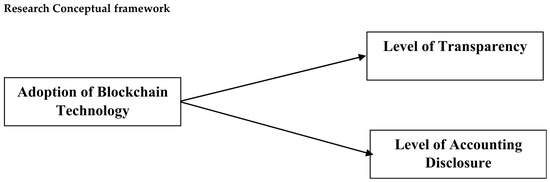
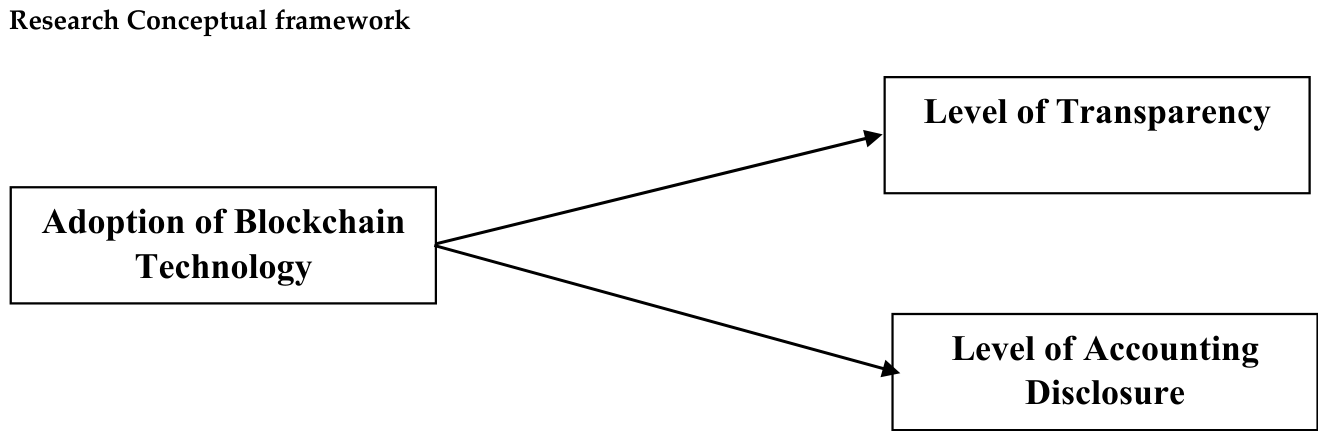
As shown in Figure 1, the conceptual framework developed by the author (2025) highlights the interconnections between the main constructs of the research.
Figure 1.
Conceptual framework. Source: Author, 2025.
3. Research Methodology
3.1. Research Design
This study adopts a quantitative research design to examine whether perceived adoption of blockchain technology is positively associated with perceived levels of transparency and accounting disclosure in digital financial reports. A structured survey instrument was used to collect primary data from banking professionals involved in financial reporting processes.
The quantitative approach was selected to allow for empirical testing of hypothesized relationships using Partial Least Squares Structural Equation Modeling (PLS-SEM), which is appropriate for predictive and theory-development research involving latent constructs [18].
3.2. Population, Sampling Procedure, and Data Collection
The target population comprised commercial banks listed on the Amman Stock Exchange (ASE). Fifteen listed banks were included in the study. These institutions operate within a regulated financial environment and are subject to digital reporting and disclosure requirements.
Respondents were selected from key stakeholder groups directly involved in financial reporting processes, including bank managers, financial managers, and accountants. These groups were considered appropriate due to their professional knowledge of blockchain integration and digital financial reporting practices within their institutions.
Data collection was conducted through formal coordination with participating banks. After obtaining institutional permission, the survey link was distributed electronically through official internal communication channels within each bank. In some cases, administrative representatives facilitated dissemination to eligible staff members.
Participation was voluntary, anonymous, and confidential. No personally identifiable information was collected. Respondents were also informed that the survey was for academic research purposes only.
A total of 387 questionnaires were distributed across selected commercial banks, out of which 312 valid responses were received, yielding an overall response rate of approximately 80.6%. While the aggregate response rate was reported, response rates at the individual bank level were not systematically recorded. This limitation is acknowledged, as institution-specific response patterns could provide additional analytical insights.
3.3. Measurement of Variables
All constructs were measured using previously validated instruments adapted to the banking context namely: Blockchain Adoption (BT) with 10 items adapted from [13], Transparency (TR) with 10 items adapted from [13], and Accounting Disclosure (AD) with 10 items adapted from [17]. All items were measured using a five-point Likert scale: 1 = Strongly Disagree, 2 = Disagree, 3 = Neutral, 4 = Agree and 5 = Strongly Agree (see Appendix A).
The constructs under study were operationalized as:
Blockchain Adoption (BT)—the perceived extent to which blockchain technology is integrated into the bank’s accounting and reporting systems, including distributed ledger validation and security mechanisms.
Transparency (TR)—the perceived clarity, timeliness, traceability, and verifiability of digital financial reporting.
Accounting Disclosure (AD)—the perceived adequacy, completeness, credibility, and regulatory compliance of disclosed financial information.
3.4. Data Analysis Technique
Data were analyzed using SmartPLS 4 software. Partial Least Squares Structural Equation Modeling (PLS-SEM) was employed due to its suitability for prediction-oriented research, complex models involving multiple constructs, moderate sample sizes, and non-normal data distributions [18].
PLS-SEM is widely applied in technology adoption and accounting information systems research [18]. The hypotheses were tested using bootstrapping with 5000 subsamples, two-tailed testing, and standardized path coefficients. This procedure enhances robustness and reduces estimation bias.
In addition to path coefficients (β) and t-values, the following were also explicitly assessed: coefficient of determination (R2), Effect sizes (f2), Predictive relevance (Q2 using blindfolding), and Standardized coefficients. These measures provide a comprehensive evaluation of structural model quality.
3.5. Assessment of the Measurement Model
Measurement model evaluation followed established PLS-SEM guidelines [19,20]. Internal consistency reliability was assessed using Cronbach’s Alpha, and Composite Reliability (CR) values above 0.70 were considered acceptable [19]. Convergent validity was assessed using Outer loadings (threshold ≥ 0.708 preferred) and Average Variance Extracted (AVE ≥ 0.50). Indicators with loadings below acceptable thresholds were carefully examined. Where items were removed, deletion decisions were made only when statistical criteria were not satisfied, and the construct’s content validity remained theoretically preserved. Discriminant validity was evaluated using Heterotrait–Monotrait ratio (HTMT) and Cross-loadings. HTMT values below the recommended thresholds confirmed adequate discriminant validity. Cross-loadings were examined to confirm that the indicators loaded highest on their intended constructs.
3.6. Structural Model Evaluation
The structural model was evaluated using the following criteria: Path coefficients (β), Statistical significance (t-values, p-values), R2 values, Effect sizes (f2), and Predictive relevance (Q2).
R2 values indicate the proportion of variance explained in the endogenous constructs. Effect sizes (f2) were interpreted to assess the magnitude of each exogenous construct’s contribution. Q2 values above zero indicate predictive relevance of the model.
All coefficients reported are standardized.
3.7. Assessment of Common Method Bias (CMB)
Given that data were collected using a single survey instrument and cross-sectional design, potential common method bias (CMB) was addressed using both procedural and statistical remedies. Procedural remedies assure anonymity and confidentiality.
Voluntary participation was emphasized, clear and neutral wordings were used, construct sections were psychologically separated within the questionnaire, whilst ambiguous or leading questions were avoided.
Two statistical approaches were employed:
- (i)
- Harman’s Single-Factor Test
The exploratory factor analysis indicated that no single factor accounted for a majority of the variance, suggesting that CMB is unlikely to be a serious concern.
- (ii)
- Full Collinearity VIF Test
Variance Inflation Factor (VIF) values were examined to detect potential common method bias. All VIF values were below the conservative threshold of 3.3, indicating that CMB does not materially threaten the validity of the findings.
These results provide reasonable assurance that common method bias is unlikely to distort the structural relationships.
3.8. Ethical Considerations
The study was conducted in accordance with ethical research principles. Institutional permissions were obtained from participating banks prior to data collection. Participation was voluntary, responses were anonymous, and data were used exclusively for academic research purposes.
4. Results
4.1. Descriptive Statistics
Descriptive statistics were computed to summarize the characteristics of the dataset. The mean values ranged from 3.450 (Transparency) to 4.150 (Blockchain Adoption), indicating generally positive perceptions of blockchain integration and reporting quality among the respondents. Standard deviations ranged between 0.760 and 0.920, suggesting moderate variability in responses.
Skewness and kurtosis values were within acceptable ranges (absolute values below 2), indicating approximate normality of data distribution. Although PLS-SEM does not require strict normality assumptions, these results provide additional support for data adequacy.
The final sample consisted of 312 valid responses, comprising accountants, financial managers, and bank managers involved in financial reporting processes.
Table 2 presents the descriptive statistics for the key constructs used in the study. The results indicate that the respondents generally expressed positive perceptions toward blockchain adoption, with a mean value of 4.15. The mean scores for accounting disclosure and transparency are 3.78 and 3.45 respectively, suggesting moderately positive perceptions of reporting quality among the respondents. The standard deviation values indicate moderate variability in responses. In addition, skewness and kurtosis values fall within acceptable ranges, suggesting that the data do not exhibit severe deviations from normality.
Table 2.
Descriptive Statistics of Study Variables.
4.2. The Measurement Model
The evaluation model’s main objective is to filter the data in order to evaluate and then confirm the validity and reliability of the constructs before assessing the preciseness of the indicators. A score of 0.4 was found to be appropriate when data reliability indicators were evaluated. However, when using composite dependability, a score of 0.7 is considered excellent in terms of internal consistency. Validity of convergence is assessed using AVE, which must be 0.5 or greater [26,27]. For discriminatory validity, factor load should be used to exclude those of which loading upon another concept is higher than its own loadings [19,20,28]. As a result, the following components were removed to meet the measurement model requirements: BT1, BT2, BT9, BT10, AD2, AD4, AD5, AD10, TR4, TR5, TR8, TR9, and TR10 because they did not meet the required minimum level [19,20]. As none of the items have a score less than 0.4, it was determined that the measure used in this study is valid.
Table 3.
Measurement Model Assessment.
Table 3 presents the results of the measurement model assessment. All retained indicators exhibit acceptable outer loadings exceeding the recommended threshold of 0.708, indicating satisfactory indicator reliability. Internal consistency reliability was assessed using Cronbach’s Alpha and Composite Reliability (CR), and all constructs exceeded the recommended threshold of 0.70. Convergent validity was evaluated using Average Variance Extracted (AVE), with derived values ranging from 0.544 to 0.606, exceeding the recommended minimum value of 0.50. These results confirm that the measurement model demonstrates adequate reliability and convergent validity.
Discriminant validity was assessed using the Heterotrait–Monotrait (HTMT) ratio of correlations. As shown in Table 4, all HTMT values are below the recommended threshold of 0.85, indicating that the constructs are empirically distinct. This confirms that blockchain technology, transparency, and accounting disclosure represent separate conceptual constructs within the model. Therefore, discriminant validity is established.
Table 4.
Discriminant validity.
While cross-loadings were examined during the analysis phase, they are not reported to conserve space. Discriminant validity is sufficiently supported using HTMT values.
4.3. Hypothesis Testing
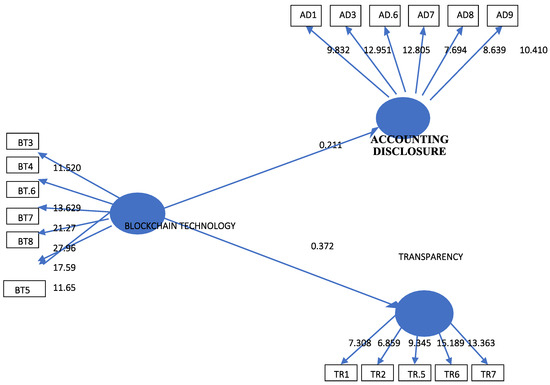
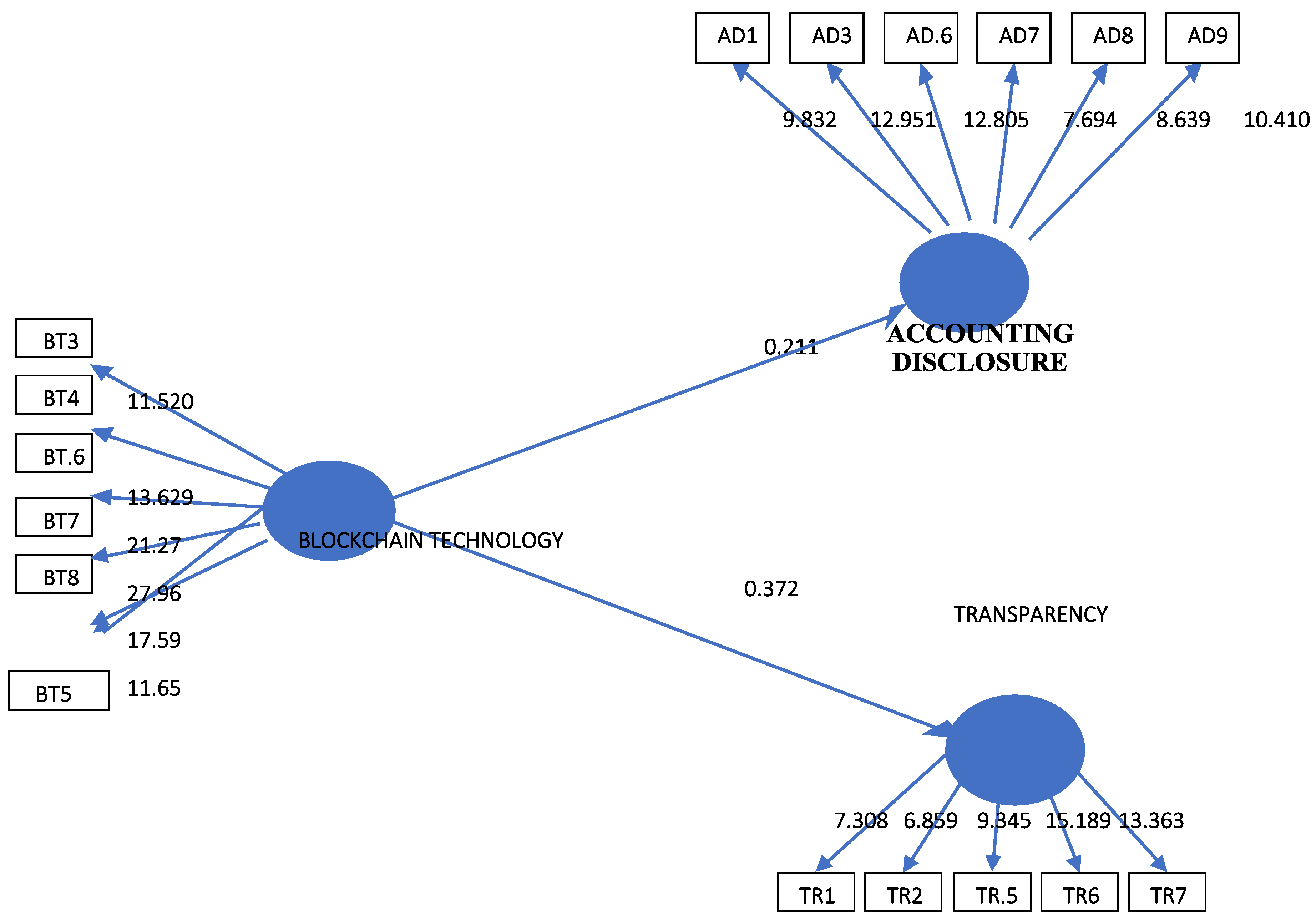
Once the assessment model’s concept validity and reliable operation requirements were met, the PLS Algorithm and Bootstrapping via Smart PLS 3.0 had to be implemented in order to assess the study’s stated hypotheses. Table 5 displays the findings of the hypothesis assessment. The statistical study shown in Table 5 indicates that the Level of Transparency in digital reporting quality is positively and significantly impacted by the use of Blockchain Technology, or BT (=0.361; t = 7.736). Additionally, BT considerably raises the Accounting Disclosure threshold for the quality of digital reporting (=0.437; t = 9.687; H2 supported). In conclusion, both of the potential direct connections between the underlying exogenous and indigenous constructs are supported by empirical evidence, which is consistent with formulations of the respective hypotheses. Refer to Figure 2 and Table 5 listed below:
Table 5.
Structural Model Results.
Figure 2.
Structural Model.
Table 5 presents the structural model results obtained using the bootstrapping procedure with 5000 subsamples. The results indicate that blockchain technology is positively associated with transparency (β = 0.361, t = 7.736, p < 0.001), supporting Hypothesis 1. Similarly, blockchain technology is positively associated with accounting disclosure (β = 0.437, t = 9.687, p < 0.001), supporting Hypothesis 2. These results suggest that the respondents perceive blockchain-enabled systems as contributing to improved transparency and disclosure within digital financial reporting.
Table 6 presents the explanatory power and predictive relevance of the structural model. The coefficient of determination (R2) indicates that blockchain technology explains 13.0% of the variance in transparency and 19.1% of the variance in accounting disclosure. These values suggest moderate explanatory power within behavioral research contexts.
Table 6.
Model Explanatory Power and Predictive Relevance.
The effect size (f2) analysis indicates that blockchain technology has a small-to-moderate effect on transparency (f2 = 0.150) and a moderate effect on accounting disclosure (f2 = 0.210). Furthermore, predictive relevance which was assessed using the blindfolding procedure shows Q2 values above zero for both constructs, confirming that the model possesses acceptable predictive relevance.
All reported coefficients, tables, and figures were cross-validated against the final SmartPLS output to enhance complete internal consistency.
5. Discussion
This study examined the association between perceived blockchain adoption and two important dimensions of digital financial reporting quality, namely transparency and accounting disclosure, within the context of Jordanian listed banks. The empirical results indicate that blockchain technology adoption is positively and significantly associated with both transparency and accounting disclosure in digital financial reports. These findings suggest that respondents perceive blockchain-enabled accounting information systems as potentially contributing to improved visibility, traceability, and credibility of financial information. However, consistent with the cross-sectional and perceptual design of the study, the findings should be interpreted as indicating statistical associations rather than definitive causal effects. Improvements in reporting quality are likely shaped by a combination of technological infrastructure, governance practices, and institutional conditions.
The findings can first be interpreted through the perspective of the agency theory, which emphasizes the challenge of information asymmetry between managers and shareholders [21,29,30]. When managers possess superior access to internal financial information, the risk of opportunistic reporting behavior may increase. Traditional mechanisms such as auditing, regulatory supervision, and corporate governance structures have historically been used to mitigate this asymmetry. The positive relationship observed between blockchain adoption and financial reporting quality suggests that technological infrastructure may complement these governance mechanisms by embedding verification processes within accounting information systems. Blockchain’s distributed ledger architecture, immutable records, and decentralized validation processes may strengthen the traceability and auditability of financial transactions, thereby supporting monitoring processes that reduce opportunities for data manipulation [22,23,31]. In this sense, blockchain adoption may be perceived as a technological governance mechanism that enhances the credibility of financial information while supporting existing oversight structures.
The results also resonate with broader developments in digital transformation within accounting and reporting systems. Recent research highlights that digital technologies are increasingly reshaping how financial information is recorded, verified, and communicated across organizations. For instance, the study on Digital Transformation in Accounting: Elevating Effectiveness Across Accounting, Auditing, Reporting and Regulatory Compliance emphasizes that emerging digital infrastructures—including blockchain, data analytics, and integrated reporting platforms—can enhance the efficiency and transparency of financial reporting processes by improving data integration and verification mechanisms. These technological transformations may strengthen reporting environments by reducing manual processing errors and improving the traceability of financial transactions. The present findings provide empirical support for this broader digital transformation perspective by suggesting that blockchain adoption is perceived by financial professionals as positively associated with improved reporting transparency and disclosure practices.
The findings are also consistent with insights from the stakeholder theory, which emphasizes that organizations must respond to the information needs of a wide range of stakeholders, including investors, regulators, creditors, and the public. Stakeholders depend on reliable financial disclosures to evaluate organizational performance, assess risks, and make investment decisions. Within increasingly digital financial ecosystems, ensuring the credibility and accessibility of financial information has become an essential component of stakeholder engagement. The positive associations identified in this study suggest that blockchain adoption may strengthen stakeholders’ perceptions of the reliability and completeness of financial disclosures. As blockchain systems maintain decentralized and tamper-resistant transaction records, stakeholders may perceive reduced risks of information manipulation or selective disclosure. Consequently, blockchain-enabled systems may enhance stakeholder confidence by supporting more credible and verifiable financial reporting environments.
The integration of blockchain technology within financial reporting processes can also be interpreted through the lens of the legitimacy theory. According to the legitimacy theory, organizations seek to align their activities and practices with prevailing societal expectations in order to maintain public trust and institutional legitimacy. In the contemporary financial environment, transparency, accountability, and technological innovation have become increasingly important components of legitimate organizational behavior. Financial institutions, particularly banks operating within regulated environments, face strong pressures to demonstrate responsible governance and credible reporting practices. The adoption of advanced digital technologies such as blockchain may therefore serve both substantive and symbolic roles in strengthening organizational legitimacy. Substantively, blockchain systems may enhance the verification and traceability of financial transactions. Symbolically, adopting innovative digital technologies may signal a commitment to modern governance standards and regulatory compliance. The positive associations observed in this study suggest that the respondents perceive blockchain adoption as supporting the credibility and legitimacy of financial reporting systems in the banking sector.
An important insight emerging from the empirical analysis is the differential strength of the relationships between blockchain adoption and the two reporting constructs examined. While blockchain adoption is positively associated with both transparency and accounting disclosure, the relationship with accounting disclosure appears relatively stronger. This distinction may reflect the operational characteristics of blockchain technology, which directly affect how financial transactions are recorded, validated, and stored in accounting information systems. These technological features may have a more immediate influence on the credibility and completeness of disclosed financial information. Transparency, on the other hand, encompasses broader communication attributes such as clarity, accessibility, and interpretability of financial reports. Such attributes may depend not only on technological systems but also on managerial reporting practices, regulatory frameworks, and disclosure policies. The findings therefore highlight the importance of distinguishing transparency from disclosure as conceptually separate dimensions of financial reporting quality.
The results also align with research on digital financial reporting innovations such as XBRL (eXtensible Business Reporting Language). For example, the study The Influence of XBRL Technology on the Quality of Financial Reporting: Exploring Mediating Variables in the Indian Context demonstrates that structured digital reporting technologies can improve financial reporting quality by enhancing data standardization, comparability, and accessibility. Similarly to blockchain, XBRL-based reporting systems facilitate the digital processing and verification of financial information. The integration of such technologies within accounting information systems may therefore contribute to improved reporting environments by strengthening data transparency and consistency. The present study extends this line of research by examining how blockchain adoption—another emerging digital reporting technology—relates to perceptions of transparency and disclosure within banking institutions.
Beyond theoretical implications, this study provides important contextual contributions by focusing on the banking sector in an emerging economy. Much of the existing literature on blockchain and accounting has concentrated on conceptual discussions or empirical evidence from developed economies [24,25,32]. By examining Jordanian listed banks, this research provides empirical evidence from a developing institutional environment where regulatory modernization and digital transformation are actively evolving. In such contexts, technological governance mechanisms may complement institutional oversight structures and play an important role in strengthening financial reporting credibility.
6. Contributions
Overall, this study contributes to the literature on digital transformation in accounting by empirically examining how blockchain adoption is associated with perceived improvements in financial reporting transparency and disclosure. By integrating the agency theory, stakeholder theory, and legitimacy theory, the research demonstrates how technological infrastructure may interact with governance and disclosure mechanisms in shaping perceptions of reporting credibility. At the same time, the findings highlight that technological adoption represents only one component of broader financial reporting ecosystems. Future research employing longitudinal designs, objective reporting metrics, and multi-country comparisons would further clarify how blockchain-enabled systems influence financial reporting practices over time.
All empirical outputs, including tables, figures, and model estimates, were carefully reviewed and harmonized to enhance consistency and alignment with the final estimation results.
Author Contributions
Conceptualization, M.M.A. and M.K.A.-K.; methodology, M.M.A.; software, M.M.A.; validation, M.M.A., M.K.A.-K., A.H.A. and I.R.A.; formal analysis, M.M.A.; investigation, M.M.A.; resources, M.K.A.-K. and A.H.A.; data curation, M.M.A.; writing—original draft preparation, M.M.A.; writing—review and editing, M.K.A.-K., A.H.A. and I.R.A.; visualization, M.M.A.; supervision, M.K.A.-K.; project administration, M.M.A.; funding acquisition, M.K.A.-K. All authors have read and agreed to the published version of the manuscript.
Funding
This research received no external funding.
Institutional Review Board Statement
Not applicable.
Informed Consent Statement
Not applicable.
Data Availability Statement
The data presented in this study are available on request from the corresponding author. The data are not publicly available due to confidentiality and privacy restrictions related to participating institutions.
Conflicts of Interest
The authors declare no conflict of interest.
Appendix A. Measurement Instrument
All items were measured using a five-point Likert scale:
- 1 = Strongly Disagree
- 2 = Disagree
- 3 = Neutral
- 4 = Agree
- 5 = Strongly Agree
Respondents were asked to indicate their level of agreement based on their professional experience within their bank.
Appendix A.1. Blockchain Adoption (BT)
This construct measures the perceived extent to which blockchain technology is integrated into the bank’s accounting and financial reporting systems.
- BT1. Our bank has integrated blockchain technology into its accounting and reporting systems.
- BT2. Blockchain is used to record financial transactions within our organization.
- BT3. Our financial reporting system utilizes distributed ledger technology for transaction validation.
- BT4. Blockchain-based systems enhance the security of our accounting information systems.
- BT5. Financial records stored on blockchain systems are protected from unauthorized modification.
- BT6. Blockchain technology supports automated verification of financial transactions.
- BT7. The adoption of blockchain has strengthened internal control procedures in our bank.
- BT8. Blockchain suggests the traceability of financial transactions across departments.
- BT9. Our management actively supports the continued use and development of blockchain systems.
- BT10. Blockchain technology has become an important component of our digital financial infrastructure.
Appendix A.2. Transparency of Digital Financial Reporting (TR)
Transparency refers to the perceived clarity, timeliness, completeness, and verifiability of digital financial reporting.
- TR1. Financial reports in our bank are released in a timely manner.
- TR2. Financial information provided by our bank is clear and understandable.
- TR3. Reported financial data can be independently verified through system records.
- TR4. Our reporting system provides complete and accurate transaction histories.
- TR5. Stakeholders can trace financial transactions through reliable audit trails.
- TR6. The digital reporting system reduces ambiguity in financial information.
- TR7. Historical financial records are easily accessible when required.
- TR8. The reporting process minimizes opportunities for manipulation of financial data.
- TR9. Our financial reporting system enhances the openness of financial communication.
- TR10. Overall, our digital financial reporting practices are transparent to stakeholders.
Appendix A.3. Accounting Disclosure (AD)
Accounting disclosure refers to the perceived adequacy, comprehensiveness, credibility, and reliability of financial information disclosed to stakeholders.
- AD1. Our bank provides sufficient financial information to meet stakeholder needs.
- AD2. Financial disclosures in our reports are comprehensive and detailed.
- AD3. The information disclosed accurately reflects underlying financial activities.
- AD4. Financial disclosures comply with applicable regulatory requirements.
- AD5. Stakeholders can rely on the credibility of our disclosed financial information.
- AD6. Our bank avoids selective or incomplete disclosure of financial information.
- AD7. The structure of our disclosures enhances stakeholder understanding.
- AD8. Disclosed financial information is consistent across reporting periods.
- AD9. Our financial statements provide adequate explanations of key accounting figures.
- AD10. Overall, our bank maintains high-quality accounting disclosure practices.
References
- Balboa, E.; Ladesma, M.; Manguerra, A.N. Digital financing innovations and their impact on the financial performance of SMEs in the digital economy era. JMM17 J. Ilmu Ekon. Dan Manaj. 2024, 11, 88–98. [Google Scholar] [CrossRef] [Scilit]
- Laroiya, C.; Saxena, D.; Komalavalli, C. Applications of blockchain technology. In Handbook of Research on Blockchain Technology; Academic Press: Cambridge, MA, USA, 2020; pp. 213–243. [Google Scholar]
- Bonacchi, M.; Botosan, C.A.; Nanda, D.; Pugliese, A. Governance mechanisms, accounting regulation, and corporate disclosure in the aftermath of COVID-19: Novel research questions and methodological opportunities. Corp. Gov. Int. Rev. 2023, 31, 786–794. [Google Scholar] [CrossRef] [Scilit]
- Tepetepe, G. The role of complex systems theory in harmonising non-financial reporting for sustainable finance in Zimbabwean commercial banks. J. Account. Financ. Audit. Stud. 2024, 10, 226–237. [Google Scholar] [CrossRef] [Scilit]
- Karajeh, A.I. The moderating role of board diversity in the nexus between the quality of financial disclosure and dividends in Jordanian-listed banks. Asia-Pac. J. Bus. Adm. 2023, 15, 553–571. [Google Scholar] [CrossRef] [Scilit]
- Fneish, K. The development of endowment products through blockchain technology: A case study of the Finter Group. J. Horiz. Manag. Econ. 2019, 3, 167–183. Available online: https://search.emarefa.net/ar/detail/BIM-1349728-%D8%AA%D8%B7%D9%88%D9%8A%D8%B1-%D8%A7%D9%84%D9%85%D9%86%D8%AA%D8%AC-%D8%A7%D9%84%D9%88%D9%82%D9%81%D9%8A-%D9%85%D9%86-%D8%AE%D9%84%D8%A7%D9%84-%D8%AA%D9%82%D9%86%D9%8A%D8%A9-%D8%A7%D9%84%D8%A8%D9%84%D9%88%D9%83-%D8%AA%D8%B4%D9%8A%D9%86-%D8%AF%D8%B1%D8%A7%D8%B3%D8%A9-%D8%AD%D8%A7%D9%84%D8%A9-%D9%85%D8%AC%D9%85 (accessed on 18 March 2026). (In Arabic)
- Al-Okaily, M.; Alkayed, H.; Al-Okaily, A. Does XBRL adoption increase financial information transparency in a digital disclosure environment? Insights from emerging markets. Int. J. Inf. Manag. Data Insights 2024, 4, 100228. [Google Scholar] [CrossRef] [Scilit]
- Alsultan, A.; Hussainey, K. The moderating effect of corporate liquidity on the relationship between financial reporting quality and dividend policy: Evidence from Saudi Arabia. J. Financ. Report. Account. 2023, 23, 2514–2532. [Google Scholar] [CrossRef] [Scilit]
- Buallay, A.; Fadel, S.M.; Al-Ajmi, J.Y.; Saudagaran, S. Sustainability reporting and performance of MENA banks: Is there a trade-off? Meas. Bus. Excell. 2020, 24, 197–221. [Google Scholar] [CrossRef] [Scilit]
- Alawaqleh, Q.A.; Hamdan, M.; Al-Jayousi, A.; Airout, R. The moderating role of IFRS in the relationship between risk management and financial disclosure in Jordanian banks. Banks Bank Syst. 2022, 17, 167. [Google Scholar] [CrossRef] [Scilit]
- Abed, S.S. A literature review exploring the role of technology in business survival during the COVID-19 lockdowns. Int. J. Organ. Anal. 2022, 30, 1045–1062. [Google Scholar] [CrossRef] [Scilit]
- Ahmad, A.Y.A.B.; Abusaimeh, H.; Rababah, A.; Alqsass, M.; Al-Olima, N.; Hamdan, M. Assessment of effects in advances of accounting technologies on quality financial reports in Jordanian public sector. Uncertain Supply Chain Manag. 2024, 12, 133–142. [Google Scholar] [CrossRef] [Scilit]
- Al-Jakhlab, D.M. The extent of accountants’ knowledge of blockchain technology and expectations for its implications for accounting. J. Islam. Univ. Econ. Adm. Stud. 2021, 29, 1–27. Available online: https://journals.iugaza.edu.ps/index.php/IUGJEB/article/view/9167 (accessed on 18 March 2026). (In Arabic)
- Ghafil, B.H.; Ali, M.A. The effect of accounting disclosure on financial instruments and financial reporting quality in Iraqi commercial banks. In Proceedings of the AHIBS International Action Conference on Empowering Change, Kuala Lumpur, Malaysia, 27–29 October 2023; pp. 128–138. [Google Scholar]
- Rozario, A.M.; Vasarhelyi, M.A. Auditing with smart contracts. Int. J. Digit. Account. Res. 2018, 18, 1–27. [Google Scholar] [CrossRef] [Scilit]
- Schmitz, J.; Leoni, G. Accounting and auditing at the time of blockchain technology: A research agenda. Aust. Account. Rev. 2019, 29, 331–342. [Google Scholar] [CrossRef] [Scilit]
- Hair, J.F.; Hult, G.T.M.; Ringle, C.; Sarstedt, M. A Primer on Partial Least Squares Structural Equation Modeling (PLS-SEM); Sage Publications: Thousand Oaks, CA, USA, 2016. [Google Scholar]
- Yahaya, M.; Murtala, A.A.; Onukwube, H.N. Partial least squares structural equation modeling (PLS-SEM): A note for beginners. Int. J. Environ. Stud. Saf. Res. 2019, 4, 2536–7285. [Google Scholar]
- Rashwan, D.A.R.M.; Qowaider, D.R.I. The role of blockchain technology in improving the quality of digital financial reports. J. Account. Financ. Stud. 2021, 16, 18–30. [Google Scholar]
- Pimentel, E.; Boulianne, E. Blockchain in accounting research and practice: Current trends and future opportunities. Account. Perspect. 2020, 19, 325–361. [Google Scholar] [CrossRef] [Scilit]
- Dai, J.; Vasarhelyi, M.A. Toward blockchain-based accounting and assurance. J. Inf. Syst. 2017, 31, 5–21. [Google Scholar] [CrossRef] [Scilit]
- Coyne, J.G.; McMickle, P.L. Can blockchains serve an accounting purpose? J. Emerg. Technol. Account. 2017, 14, 101–111. [Google Scholar] [CrossRef] [Scilit]
- Yermack, D. Corporate governance and blockchains. Rev. Financ. 2017, 21, 7–31. [Google Scholar] [CrossRef] [Scilit]
- Kshetri, N. Blockchain’s roles in strengthening cybersecurity and protecting privacy. Telecommun. Policy 2017, 41, 1027–1038. [Google Scholar] [CrossRef] [Scilit]
- Treleaven, P.; Brown, R.G.; Yang, D. Blockchain technology in finance. Computer 2017, 50, 14–17. [Google Scholar] [CrossRef] [Scilit]
- Chin, W.W. The partial least squares approach to structural equation modeling. In Modern Methods for Business Research; Psychology Press: New York, NY, USA, 1998; pp. 295–336. [Google Scholar]
- Al-Masrawi, H.A. The role of administrative computers in the decision to adopt blockchain technology. J. Glob. Islam. Econ. 2019, 1, 107–118. Available online: https://www.researchgate.net/publication/337656200_blockchain_dwr_almhasb_aladary_fy_qrar_tbny_tqnyt_slslt_alktl (accessed on 18 March 2026). (In Arabic)
- Nakhal, A.M.S. The impact of blockchain technology on the responsibility of auditors. J. Account. Thought 2020, 24, 1–25. Available online: https://search.mandumah.com/Record/1065708 (accessed on 18 March 2026). (In Arabic)
- Fullana, O.; Ruiz, J. Accounting information systems in the blockchain era. Int. J. Intellect. Prop. Manag. 2021, 11, 63–80. [Google Scholar] [CrossRef] [Scilit]
- Demirkan, S.; Demirkan, I.; McKee, A. Blockchain technology in the future of business cybersecurity and accounting. J. Manag. Anal. 2020, 7, 189–208. [Google Scholar] [CrossRef] [Scilit]
- Vincent, N. Blockchain research agenda for accounting. Account. Financ. Res. 2019, 8, 93. [Google Scholar] [CrossRef] [Scilit]
- Hassan, M.E.; Mahmoud, A. The impact of using blockchains on external audit. J. Financ. Commer. Res. 2020, 21, 85–110. Available online: https://search.mandumah.com/Record/1090186 (accessed on 18 March 2026). (In Arabic)

Disclaimer/Publisher’s Note: The statements, opinions and data contained in all publications are solely those of the individual author(s) and contributor(s) and not of MDPI and/or the editor(s). MDPI and/or the editor(s) disclaim responsibility for any injury to people or property resulting from any ideas, methods, instructions or products referred to in the content. |
© 2026 by the authors. Licensee MDPI, Basel, Switzerland. This article is an open access article distributed under the terms and conditions of the Creative Commons Attribution (CC BY) license.