


Abstract
This study examined pine nuts (Pinus koraiensis) from China. The main objective was to compare their chemical and lipid composition across different processing stages (raw, roasted, and press cake) and to evaluate their nutritional value. The results showed high oil content in the raw (57.9%) and roasted nuts (56.7%), followed by a substantial decrease to 10.8% in the press cake. Protein and carbohydrate levels increased markedly: protein rose from 19.5% in raw nuts to 43.9% in the press cake, while carbohydrates increased from 19.8% in both raw and roasted nuts to 40.4% in the press cake. Fiber, moisture, and ash contents remained relatively constant. The nuts exhibited a high energy value (approximately 680 kcal/100 g), which decreased to about 434 kcal/100 g in the cake. Linoleic acid (41.5–48.1%) and oleic acid (34.0–38.0%) dominated the fatty acid profile. Roasted nuts showed an overall decrease in phospholipid and tocopherol contents. Phosphatidylcholine represented the predominant phospholipid class in all samples, while α-tocopherol and γ-tocopherol levels remained largely comparable. The sterol profile of the oil from the press cake differed markedly from those of raw and roasted nut oils, with higher relative proportions of campesterol and stigmasterol, whereas β-sitosterol showed a marked decrease. Overall, roasting does not substantially alter the major nutritional components of the nuts, although some changes in their lipid characteristics are observed. The oil isolated from the press cake demonstrated promising characteristics for potential use in animal feed supported by its low peroxide value (2.8 meqO2/kg oil) and high oxidative stability. These findings contribute to expanding the available data on the composition and effects of thermal processing on Chinese pine nuts and press cake.
1. Introduction
Nuts are recognized as valuable sources of minerals, vitamins and essential fatty acids, which largely determine their nutritional significance [1]. They can be consumed raw, roasted or incorporated into a wide range of food products. Roasting reduces moisture content and imparts characteristic color, flavor and aroma to the final product [2]. However, high-temperature processing also promotes the formation of Maillard reaction products, which may negatively affect nutritional quality and safety [3]. According to literature data, nuts roasted at low to medium temperatures (120–160 °C) show the best sensory properties and demonstrate favorable nutritional characteristics [4]. Beyond their role as food, oilseeds are increasingly regarded as important industrial raw materials, particularly due to the potential for valorizing by-products generated after glyceride oil extraction. Mechanical pressing is one of the most widely used methods for producing vegetable oils, yielding substantial quantities of press cake that still contains high-value constituents such as proteins, residual lipids, fibers, and minerals [5]. The remaining oil embedded in the cake retains a diverse fatty acid profile, typically enriched in oleic, linoleic, linolenic, palmitic and stearic acids, along with minor fatty acids of varying chain lengths [6]. Approximately 60% of the by-products obtained during pressing occur in the form of press cake. Owing to their considerable protein content (23–35%) [7], these materials are commonly used in animal feed formulations or as substrates for energy production [8]. In addition to proteins, press cakes contain noteworthy residual lipids-predominantly triglycerides-typically accounting for 8–10%, together with variable proportions of cellulose, lignin and other structural components [9]. Their abundance, low cost, and biochemical richness make press cakes attractive raw materials for the extraction and valorization of proteins and residual oils for diverse technological applications.
Pine nuts from the Korean pine (Pinus koraiensis, fam. Pinaceae) exhibit notable nutritional quality owing to their content of unsaturated fatty acids, bioactive compounds, vitamins, and minerals [10,11]. In addition to serving as a source of edible nuts, this species holds considerable economic significance as a timber-producing tree. P. koraiensis is widely distributed across northeastern China, Russia, Korea, and Japan [12]. Among the numerous methods used in food processing, thermal roasting remains one of the most widely applied techniques [13,14,15]. Roasting plays a central role in shaping the sensory profile of foods, enhancing their flavor, texture, aroma, and color [16,17,18]. Pine nuts are commonly consumed both raw and roasted, and selecting appropriate roasting conditions is essential for achieving the desired sensory attributes, particularly the characteristic flavor.
The aim of this study is to perform a comparative characterization of the chemical and lipid composition of raw and roasted pine nuts, as well as of the press cake obtained after pressing the raw kernels.
2. Materials and Methods
2.1. Materials
This study was conducted using pine nuts (P. koraiensis) originating from China and obtained from retail outlets in Bulgaria. The nuts were supplied in 50 g polypropylene packages labeled with an expiry date of September 2025 and batch number L4825501140. Ten separate batches were collected from the commercial network. After homogenization of the material, three representative subsamples were taken from the composite mixture for subsequent analyses. The nuts were roasted at 120 °C for 30 min in an oven without circulation of air (Eldom 203 VFEN, 38 L, Varna, Bulgaria).
Glyceride oil from raw and roasted pine nuts was extracted by cold pressing using a YODA Classic press machine (Hangzhou Yoda Scientific and Technological Co., Ltd., Hangzhou, China), at a temperature range of 37–45 °C. The obtained oils were subsequently subjected to further analyses. To recover the residual oil from the press cake, Soxhlet extraction was performed using diethyl ether at 45 °C, with the aim of preserving the biologically active compounds.
2.2. Chemical, Physicochemical, and Chromatographic Methods for the Analysis of the Oil
2.2.1. Chemical Composition
For the accurate determination of the total oil content, extraction was performed according to ISO 659 [19] using the Soxhlet method with n-hexane for 8 h at 70 °C in a water bath.
The moisture, crude protein, crude fiber, and ash contents were determined according to AOAC Official Methods 925.40, 950.48, 962.09, and 950.49 [20]. Total carbohydrates were calculated by difference, using the equation: total carbohydrates (%) = 100 − [protein (%) + lipids (%) + moisture (%) + ash (%)] [21].
2.2.2. Physicochemical Properties
The principal physicochemical parameters of the seed oil—including acid value, peroxide value and iodine value were assessed using established analytical protocols [22,23,24], while the absorbance at 232 and 270 nm (A232 and A270) was determined using a Boeco S26 spectrophotometer (BOECO, Hamburg, Germany) [25]. Oxidative stability was determined using a Rancimat 679 apparatus (Metrohm, Switzerland) operated at 100 °C [26].
2.2.3. Chromatographic Method for Determination of Fatty Acid Composition
The fatty acid profile of the oils was determined by gas chromatography [27]. Prior to analysis, the fatty acids were converted to their methyl esters through acid-catalyzed esterification using methanol and sulfuric acid [28]. The resulting FAMEs were analyzed on an Agilent 8860 GC system (Santa Clara, CA, USA) equipped with a DB-Fast FAMEs capillary column (30 m × 0.25 mm × 0.25 µm). Detection was performed with a flame ionization detector. The chromatographic program consisted of an initial hold at 70 °C for 1 min, followed by a temperature increase to 250 °C at 5 °C/min, with a final isothermal period of 3 min. The injector and detector temperatures were set to 270 °C and 300 °C, respectively. Fatty acids were identified by comparing retention times with those of a certified FAME reference mixture (Supelco, Bellefonte, PA, USA; 37-component FAME mix; ref. number 47885-U) analyzed under identical conditions.
The relative percentage of each identified fatty acid methyl ester (FAME) was determined using the area normalization method, in accordance with ISO 12966-1 [27], according to the following equation:
where Ai is the peak area of the individual fatty acid methyl ester; ∑A is the sum of the peak areas of all identified fatty acid methyl esters; wi is the mass percentage of fatty acid methyl ester.
wi (%) = Ai/∑A × 100,
2.3. Determination of Sterols, Tocopherols, and Phospholipids
2.3.1. Unsaponifiable Matter and Total Sterols
Prior to sterol analysis, the unsaponifiable matter was isolated by saponification of 3–5 g of oil with 2 N ethanolic KOH for 1 h. The unsaponifiable fraction was subsequently extracted with 50 mL of hexane, and the extraction procedure was repeated five times. After evaporation of the solvent, the unsaponifiable matter was determined gravimetrically [29]. Sterols were subsequently separated from this fraction by thin-layer chromatography (TLC) using a petroleum ether/diethyl ether mixture (1:1, v/v) as the mobile phase. After drying, the plates were sprayed with methanol to visualize the sterol bands. The corresponding bands were then scraped off, transferred to a column, and eluted with chloroform. The resulting eluate was evaporated to dryness using a rotary vacuum evaporator. The resulting residue was treated with a reagent mixture consisting of 2.8 mL chloroform, 0.4 mL acetic acid, 2 mL of 12% sulfosalicylic acid in acetic acid, 6 mL acetic anhydride, and 0.8 mL sulfuric acid. After incubation in the dark for 20 min to allow full color development, the absorbance was measured at 597 nm, using chloroform as the blank [30].
2.3.2. Individual Sterol Analysis
Individual sterols were analyzed using Agilent 8860 GC system (Santa Clara, CA, USA) equipped with a DB-5 capillary column (25 m × 0.25 mm) and a flame ionization detector. The temperature program began with an isothermal step at 90 °C for 3 min, followed by heating to 290 °C at 15 °C/min, and then to 310 °C at 4 °C/min, with a final hold of 10 min. Injector and detector temperatures were set to 300 °C and 320 °C, respectively. Nitrogen served as the carrier gas. Sterols were identified by comparing retention times with those of a certified sterol standard mixture including β sitosterol (75%) and campesterol (10%) from Acros Organics (Morris Plains, NJ, USA), cholesterol from Acros Organics, and stigmasterol from Sigma-Aldrich (St. Louis, MO, USA), in accordance with ISO 12228-1:2014 [31].
2.3.3. Total and Individual Tocopherols
Total and individual tocopherols were quantified by high-performance liquid chromatography (HPLC). The analyses were performed on a Merck–Hitachi chromatographic system equipped with a fluorescence detector, operating at an excitation wavelength of 295 nm and an emission wavelength of 330 nm. Separation was achieved on a Nucleosil Si 50-5 column (250 mm × 4 mm). The mobile phase consisted of a hexane/dioxane mixture (96:4, v/v), delivered at a flow rate of 1 mL/min. The oil samples were diluted with n-hexane to obtain a 2% solution, and an aliquot of 20 μL was injected into the system. The individual tocopherols in the investigated oils were identified by comparing their chromatographic data with those obtained from solutions of pure α-, β-, γ-, and δ-tocopherol and tocotrienol standards (DL-α-, DL-β-, DL-γ-, and DL-δ-tocopherols, purity ≥ 98%, Merck, Darmstadt, Germany; and Tocomin SupraBio, Carlson Laboratories, Inc., Arlington Heights, IL, USA). The total tocopherol content was expressed in mg/kg of oil, whereas the individual tocopherol composition was presented as a percentage of the total tocopherol content [32].
2.3.4. Phospholipid Determination
Phospholipid classes were separated by two-dimensional thin-layer chromatography. The plates were developed in the first direction using a chloroform:methanol mixture (65:25:5, v/v/v) and in the second direction using a chloroform:acetone:methanol acid mixture (50:20:10:10:5, v/v/v/v/v) [33]. Individual phospholipids were detected and identified using specific visualization reagents (Sigma-Aldrich, St. Louis, MO, USA): Dragendorff’s reagent for choline-containing phospholipids, ninhydrin spray reagent for phospholipids containing free amino groups, and Schiff’s reagent for inositol-containing phospholipids. Further identification was performed by comparing the Rf values of the detected spots with those of authentic standards: phosphatidylcholine (PC), phosphatidylethanolamine (PE), phosphatidylinositol (PI), phosphatidylserine (PS), diphosphatidylglycerol (DPG), phosphatidic acid (PA), sphingomyelin (SM), lysophosphatidylcholine (LPC), and lysophosphatidylethanolamine (LPE) (Sigma-Aldrich, St. Louis, MO, USA). The standards were analyzed on silica gel TLC plates (Merck, Darmstadt, Germany) under identical experimental conditions. The quantification of the separated phospholipids was performed spectrophotometrically at 700 nm after their mineralization with perchloric and sulfuric acids (1:1, v/v) [34].
2.3.5. Statistics
All analyses were performed in triplicate (n = 3). Statistical differences among the groups were assessed using one-way analysis of variance (ANOVA), followed by Tukey’s post hoc test at p < 0.05, using IBM SPSS Statistics 19.
3. Results and Discussion
Oilseed and nut press cakes, generated as by-products after mechanical extraction of vegetable oils, have attracted increasing attention as valuable secondary sources of lipids and biologically active compounds. During the roasting of pine nuts, no substantial changes are observed in their macro- and micronutrient composition, whereas pronounced differences appear in the pine press cake obtained after cold pressing of the raw kernels. The corresponding results are summarized in Table 1.
Table 1.
Chemical composition of raw and roasted pine nuts and press cake.
The glyceride oil content in raw pine nuts is high (57.9%), closely matching the value (58.8%) reported by other authors [35]. Roasting does not induce a statistically significant change in the total oil content, which remains at 56.7%. In a previous study, Teneva and Petkova [36] reported glyceride oil contents of 45.4% and 43.8% in roasted Pinus pinea pine nuts of Spanish and Turkish origin, respectively. Both values are lower than those determined in the present study for the raw (57.9%) and roasted (56.7%) pine nut samples. Although oilseed-derived materials are primarily recognized for their substantial protein and dietary fiber contents, they also retain appreciable quantities of residual glyceride oil, depending on seed or nut type and processing conditions. Residual oil levels typically range from 5 to 25% [37], positioning oilseed cakes as promising substrates for the recovery of high-value lipid fractions and their subsequent application in functional foods, nutraceuticals, cosmetics, and pharmaceutical formulations. Mechanical pressing leads to a concentration of the remaining constituents in the resulting cake, where a notably high residual oil content (10.8%) is preserved. This value is similar to that reported for hempseed oilcake (9.96%) and walnut oilcake (9.63%) [37]. The defatted press cake also represents an excellent protein source, with protein levels increasing to 43.9% compared with 19.5% in the raw nuts. This compositional shift underscores the potential of press cake as a valuable raw material for the food industry, particularly for the production of functional foods and protein isolates. The carbohydrate content is similar in raw and roasted pine nuts (19.8% and 19.9%, respectively). In contrast, the press cake shows a higher carbohydrate proportion (40.4%). This increase reflects the relative enrichment of non-lipid components following oil removal during mechanical pressing, rather than an increase in the absolute carbohydrate content. As a consequence of the reduced glyceride oil content, the energy value decreases from 679 kcal/100 g in the raw nuts to 434 kcal/100 g in the press cake.
The ash and moisture contents of the three samples were determined. In practice, no statistically significant differences were observed between the raw and roasted pine nuts (2.7 vs. 2.8%), indicating that the applied roasting regime did not alter the overall macrocomponent balance. The similar ash content suggests that the applied roasting conditions did not substantially affect the overall mineral content. Besides this, it is likely that these conditions do not cause complete dehydration of the kernel and therefore the moisture content remains similar after roasting. Only in the case of the oilcake higher values of these parameters were observed, which is most likely attributable to the defatting process. Following oil removal, the oilcake consists predominantly of proteins and carbohydrates, both of which are hygroscopic and capable of attracting and retaining water. In addition, defatting reduces the total mass of dry matter, thereby increasing the relative proportion of minerals (ash) in the residual dry product [11].
In the current study, some physicochemical characteristics of three types of pine nut oils were determined and compared. The results are presented in Table 2.
Table 2.
Physicochemical characteristics of glyceride oils isolated from raw and roasted pine nuts and press cake.
The first indicator determined is the acid value (AV), which is a measure of the amount of free fatty acids (FFA) resulting from the hydrolysis of triacylglycerols. In both raw and roasted nuts, the AV is identical (1.2 mg KOH/g), indicating that the heat treatment does not induce hydrolytic lipid degradation. In contrast, the oilcake exhibits a threefold increase in AV, reaching 3.6 mg KOH/g, which reflects the enhanced susceptibility of the residual lipid fraction to hydrolytic processes following defatting. This increase may be associated with the disruption of cellular structures during mechanical pressing, which facilitates contact between residual lipids, moisture, and endogenous lipolytic enzymes. Consequently, partial hydrolysis of triacylglycerols may occur, resulting in the release of free fatty acids and an increased AV. The peroxide value (PV), which measures the content of primary oxidation products (hydroperoxides), is determined in all samples. A pronounced increase is observed upon roasting, rising from 14.5 meq O2/kg in the raw nuts to 25.4 meq O2/kg in the roasted nuts. In contrast, the oil extracted from the press cake obtained from raw nuts exhibits a markedly lower PV of 2.8 meq O2/kg oil, indicating a lower content of primary oxidation products in the residual lipid fraction. Roasting promotes the autoxidation of unsaturated fatty acids, leading to the accumulation of primary oxidation products, particularly hydroperoxides. The considerably lower PV of the press cake oil may be related to differences in the lipid fractions recovered by cold pressing and subsequent Soxhlet extraction, as well as to possible interactions between residual lipids and the protein- and carbohydrate-rich matrix. These findings are consistent with those reported by Schlörmann et al. [4], who demonstrated that thermal treatment of nuts increases the PV due to the initiation of oxidative processes.
The iodine value (IV), an indicator of the degree of unsaturation of vegetable oils, is also calculated. It is determined based on the fatty acid composition of the isolated glyceride oils and fell within a close range for the raw and roasted samples–109–110 g I2/100 g. These values are lower than reported by Mirali and Shahidi [38], for the raw pine nuts–145.8 g I2/100 g. Only the oil from the cake showed a significantly higher iodine value of 122.9 g I2/100 g. The K232 and K270 indices are determined, as they serve as established indicators for the presence of conjugated dienes (markers of primary oxidation) and conjugated trienes (markers of secondary oxidation), respectively. The values remain stable and nearly identical across all samples. The oxidative stability of the three oils was determined. The oil isolated from raw nuts shows a stability of 10.1 h, whereas the oil from roasted nuts decreases to 7.5 h, which correlates with its elevated peroxide value. In contrast, the residual oil from the press cake is distinguished by a markedly higher stability of 33.3 h, indicating a substantially greater resistance to oxidative degradation.
In the present study, data were collected on the levels of biologically active compounds in oils obtained from raw and roasted Chinese pine nuts, as well as in the oil extracted from the press cake. The results are summarized in Table 3. The studied components—unsaponifiable matter, total sterols, tocopherols, and phospholipids—are of key importance for the nutritional and biological value of pine nuts and their oils. The lipid fraction of P. koraiensis represents a rich source of sterols, tocopherols, and phospholipids, and is characterized by a high content of polyunsaturated fatty acids, including the distinctive pine-seed pinolenic acid [39].
Table 3.
Biologically active components of pine nut oils.
The oil extracted from raw nuts contains 11.5% unsaponifiable matter, whereas roasting leads to an increase to 13.3%. In contrast, the residual oil contains only 2.9% unsaponifiable matter. The unsaponifiable fraction contains various lipid-soluble compounds, including sterols and tocopherols. In a separate study on pine nuts, Teneva et al. [40] also reported changes in the unsaponifiable matter content as a result of roasting, noting that the magnitude of the effect depends on the geographical origin of the raw material. In terms of sterol content, a decrease is observed after roasting—from 0.5% in raw nut oil to 0.3% in roasted nut oil, and it was similar in the residual oil (0.4%).
The total tocopherol content in raw nut oil was determined to be 174 mg/kg, whereas roasting reduced this value to 118 mg/kg. Tocopherols are major lipid-soluble antioxidants, and their decline during thermal treatment can be attributed to temperature-induced degradation as well as their involvement in protecting unsaturated lipids against oxidation. Regarding the individual tocopherol composition, α-tocopherol is the predominant homologue in raw nut oil, accounting for 107.5 mg/kg of total tocopherols, while γ-tocopherol represents 66.5 mg/kg. Following roasting, the relative proportion of α-tocopherol decreases to 55.6 mg/kg, whereas that of γ-tocopherol increases to 62.4 mg/kg, making γ-tocopherol the predominant homologue. A similar distribution is observed in the oil obtained from the pine nut press cake, in which α- and γ-tocopherol account for 89.8 mg/kg and 106.2 mg/kg, respectively. Interestingly, the oil obtained from the pine press cake contains 196 mg/kg total tocopherols—a value higher than that of both raw and roasted nut oils. The presence of a substantial amount of tocopherols in the residual oil is particularly relevant for the valorization of by-products generated during pine nut oil production. These results indicate that a considerable proportion of tocopherols remains in the press cake after the initial pressing and can be recovered through subsequent solvent extraction.
The total phospholipid content follows a trend similar to that observed for tocopherols, both in the present study and in a previous study by Teneva et al. [36] on raw and roasted Mediterranean pine nuts. In the present study, the total phospholipid content is 0.9% in raw kernels and 0.7% in roasted kernels. The decrease in phospholipids during roasting may result from thermally induced alterations in membrane structures, partial degradation of these polar lipids, or changes in their extractability. Of particular interest is the value measured in the residual glyceride oil from pine press cake, which contains 1.1% phospholipids. This elevated level supports the assumption that a substantial portion of polar lipid components remains in the residual seed matrix after mechanical extraction of the primary oil fraction. Consequently, the pine press cake represents a promising substrate for obtaining an oil enriched in minor lipid constituents, highlighting its potential for further valorization.
The fatty acid composition of the oils obtained from raw and roasted Chinese pine nuts, as well as from the oil cake, is presented in Table 4 and Supplementary Material File S1.
Table 4.
Fatty acid composition of pine nut oils.
The results demonstrate that linoleic (C18:2) and oleic (C18:1) acids are the predominant unsaturated fatty acids in all three samples, whereas palmitic acid (C16:0) is the predominant component of the saturated fatty acid fraction.
Linoleic acid (C18:2) accounted for 41.5% of the fatty acids in raw nut oil, followed by oleic acid (C18:1) at 38.0%. During roasting, linoleic acid increases slightly to 43.8%, whereas the oleic acid content decreases to 34.0%. Consequently, the ratio between the major unsaturated fatty acids shifts in favor of linoleic acid. These changes may be related to the different susceptibility of individual fatty acids to thermal oxidation. A similar trend is reported in other studies on P. koraiensis, where linoleic acid is identified as the predominant fatty acid, followed by oleic acid. Hou et al. [41] report linoleic acid levels of 45.36–45.91% and oleic acid 26.91–27.10%. Mechanical pressing does not fully extract lipids from the seeds, and the composition of the residual oil in the press cake may differ from that of the initially obtained oil.
The linoleic acid values obtained in the present study (41.5% for the raw nut oil and 43.8% for the roasted oil) are close to the literature data. At the same time, the oleic acid content is higher than that reported by Hou et al. [41]. The total content of unsaturated fatty acids in the oil from raw nuts reaches 83.1%, whereas in roasted nuts it is 81.9%. Therefore, heat treatment leads to only a minor change in the overall degree of unsaturation, indicating that despite the observed shifts in individual fatty acids, the main fatty acid profile of the oil is preserved. A similar conclusion is made by An et al. [42], who study P. koraiensis oils obtained under different roasting regimes and report that the fatty acid composition is largely independent of the roasting conditions. However, certain quantitative changes are observed in the present results. The palmitic acid content increases from 8.4% in the crude oil to 9.1% after roasting, whereas stearic acid decreases slightly—from 5.3% to 4.9%. As a consequence, the total content of saturated fatty acids increases from 16.9% to 18.1%. This relative increase may be associated with the greater resistance of saturated fatty acids to thermal oxidation compared with polyunsaturated fatty acids. Unlike unsaturated fatty acids, saturated fatty acids lack double bonds and are therefore considerably less susceptible to oxidative degradation under heating conditions. Their increased relative proportion may consequently reflect changes in the unsaturated fraction rather than the formation of additional saturated fatty acids. During thermal treatment, unsaturated lipids are more susceptible to oxidative processes due to the presence of one or more double bonds. When compared with published data for P. koraiensis, the palmitic acid content in the present samples is higher. Hou et al. [41] report values of 5.16–5.48%, which is lower than reported in the present study for the roasted oil. The stearic acid content in the present samples (5.3% and 4.9%) is higher than the values reported in the literature (2.32–2.41%) [41]. This difference may be associated with variations in the geographical origin, growing conditions, as well as genetic characteristics of the plant material.
The residual oil obtained from the press cake had a similar fatty acid profile to the oils from raw and roasted nuts. The content of saturated fatty acids decreases to 13.3%, and that of monounsaturated fatty acids is 37.4%, while the amount of polyunsaturated fatty acids reaches 49.3%. As a result, the total content of unsaturated fatty acids in press cake oil reaches 86.7%. The higher proportion of polyunsaturated fatty acids in the residual oil may be related to differences in lipid extractability and the selective retention of lipid fractions during mechanical pressing.
The oleic acid content decreases sequentially from 38.0% in the crude oil to 34.0% in the roasted oil, while the content in the press cake oil is 36.2%. A similar trend is observed for gadoleic acid (C20:1), which declines from 2.2% to 1.8% and 1.1%, respectively. At the same time, linoleic acid increases from 41.5% in the crude oil to 43.8% in the roasted oil and 48.1% in the residual oil. Taken together, these changes indicate that press cake oil contains a higher proportion of polyunsaturated fatty acids compared with oils obtained from whole kernels. The differences between the oils may also reflect the heterogeneous distribution of lipids within the kernels and differences in the release and recovery of individual lipid fractions during pressing. The content of α-linolenic acid (C18:3 n-3) remains low—0.1% in the crude oil, 0.2% in the roasted oil, and 0.3% in the residual oil. This pattern is typical of P. koraiensis oils, in which the main polyunsaturated fraction is formed by linoleic acid, while α-linolenic acid is present only in relatively small amounts. A study by Hou et al. [41] likewise reports a low content of “linolenic acid,” approximately 1.46–1.60%, which confirms that this component is not dominant in the fatty acid profile of the species.
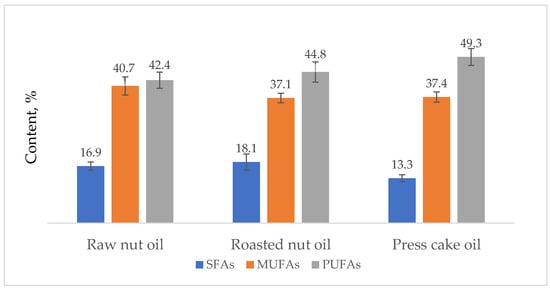
The content of saturated, mono- and polyunsaturated fatty acids of the raw and roasted pine nut oils and press cake oil is presented in Figure 1.
Figure 1.
Content of saturated (SFAs), mono- (MUFAs) and polyunsaturated (PUFAs) fatty acids of the raw and roasted pine nut oils and press cake oil.
The total SFAs content is 16.9% in raw nut oil, 18.1% in roasted nut oil, and 13.3% in press cake oil. MUFAs account for 40.7%, 37.1%, and 37.4% in the respective samples. The highest proportion of PUFAs is observed in press cake oil, reaching 49.3%, compared with 42.4% in raw nut oil and 44.8% in roasted nut oil. Following roasting, the slight increase in SFAs and the decrease in MUFAs result in a small reduction in total unsaturated fatty acids (from 83.1% to 81.9%), despite the relative increase in PUFAs. Since fatty acid composition is expressed as a percentage of total identified fatty acids, these changes reflect differences in their relative distribution and do not necessarily indicate corresponding changes in their absolute amounts. Thus, the increase in the relative proportion of PUFAs cannot be interpreted as evidence of their formation or enhanced preservation during roasting.
Despite these variations, the overall fatty acid profile of the roasted oil remains relatively similar to that of the raw oil. This observation is consistent with the results of An et al. [42], who report that roasting conditions have a significant effect on certain chemical and bioactive parameters, yet the fatty acid composition of the oil remains relatively stable. Teneva et al. [40] likewise show that changes in lipid characteristics occur during pine nut roasting, although the extent of these changes depends on the type and origin of the nuts.
The individual sterol composition was determined in the three analyzed oils, with β-sitosterol, campesterol, and stigmasterol identified as the major components (Table 5).
Table 5.
Individual sterol composition of pine nut oils.
In the analyzed sterol fraction of raw pine nuts, β-sitosterol is the dominant component, accounting for 95.5%. This compound is recognized as the principal structural sterol in the cell membranes of higher plants. The remaining sterols-campesterol, stigmasterol, and cholesterol-are present only in trace amounts (<2%). Given the high level of β-sitosterol found in the analyzed samples and its reported association with potential protective effects against colorectal cancer, this plant material can be considered valuable contributors to a health promoting diet. In contrast, campesterol, typically present only in minor amounts, shows no comparable biological activity [43,44]. Stigmasterol is described as a potential preventive agent against osteoarthritis and as an inhibitor of several pro-inflammatory mediators [45]. In roasted nuts, a substantial reduction in the relative proportion of β-sitosterol is observed, decreasing from 95.5% to 84.0%. Conversely, the levels of other sterols increase upon roasting: campesterol rises from 1.5% to 7.5%, stigmasterol from 1.2% to 4.0%, and Δ7-stigmasterol from 0.2% to 1.4%. The results are consistent with previously reported data for raw and pine nuts by Teneva and Petkova [36], where β-sitosterol and campesterol are likewise identified as the predominant sterols in both oils. In contrast, the sterol profile of the residual oil in the oilcake is markedly different. The proportion of β-sitosterol decreases sharply to 64.2%, while a pronounced enrichment of stigmasterol is observed, reaching 24.7%.
The individual phospholipid composition of the studied oils is determined. The results are given in Table 6. The values are expressed as percentages of the total phospholipid content.
Table 6.
The individual phospholipid composition of pine nut oils.
Phospholipids are structural components of cell membranes, and in pine nuts the predominant representatives of this fraction are phosphatidylcholine, phosphatidylethanolamine, and phosphatidylinositol [39]. These findings are in agreement with our results, where the major identified components are phosphatidylcholine (PC), phosphatidylinositol (PI) and phosphatidylethanolamine (PE). According to Alasalvar et al. [46], the same main phospholipids predominated in the raw hazelnut as follows: PC-56.4%, PI-30.8% and PE-11.7%, respectively. The results in the current study indicate that roasting markedly alters the stability of the phospholipid profile due to thermal degradation and hydrolysis processes. A decrease in the contents of the major phospholipid classes PC, PI, and PE is observed when comparing raw and roasted samples: PC declines from 32.4% to 24.3%, PI from 21.0% to 17.5%, and PE from 14.5% to 10.9%. The appearance of lysophospholipids in the roasted samples may indicate phospholipid hydrolysis during thermal treatment. Lysophosphatidylcholine (10.2%) and lysophosphatidylethanolamine (10.4%) are detected exclusively in roasted nuts, whereas neither compound is present in the raw samples. The sphingomyelin content also shows a pronounced decline upon roasting, decreasing sharply from 10.9% in the raw samples to just 2.7% in the roasted ones. In the solid residue (cake), the trends are clear: a substantial proportion of polar lipids becomes concentrated in this fraction. Phosphatidylcholine reaches as high as 40.5%, while phosphatidylinositol increases to 22.7%. This can be attributed to the fact that, during cold pressing, most triacylglycerols are transferred into the oil phase, whereas the phospholipids remain largely retained and concentrated in the oilcake. Since no heat treatment is applied during the production of the oilcake from raw nuts, lyso-forms are not generated, and therefore no lysophospholipids are detected in this fraction.
4. Conclusions
The present study demonstrates that Chinese P. koraiensis pine nuts are a nutritionally valuable source of glyceride oil, predominantly unsaturated fatty acids, proteins, sterols, tocopherols, and phospholipids. Roasting at 120 °C for 30 min does not substantially affect the total oil, carbohydrate, ash, or moisture contents, although a small but significant increase in protein content was observed. The oilcake exhibited an exceptionally low PV. In particular, roasting increases the peroxide value and decreases the oxidative stability, total tocopherol and phospholipid contents, accompanied by changes in the sterol and phospholipid profiles and the formation of lysophospholipids. The residual press cake obtained after mechanical pressing exhibits a markedly different chemical and lipid composition. The reduction in oil content is accompanied by a pronounced enrichment in protein and carbohydrate, while the residual oil is characterized by a high degree of unsaturation (86.7%), with linoleic and oleic acids representing major components. The oil extracted from the press cake obtained from raw nuts exhibits a low PV (2.8 meq O2/kg oil). The press cake oil also contains appreciable amounts of sterols, tocopherols, and phospholipids and shows substantially higher oxidative stability than the oils obtained from raw and roasted nuts. Overall, the results indicate that roasting modifies selected lipid characteristics of P. koraiensis nuts without substantially altering their overall nutritional composition, whereas mechanical pressing results in a protein-rich press cake containing a residual lipid fraction rich in bioactive lipid components. These findings support the potential valorization of pine press cake as a secondary source of nutrients and bioactive lipid components for further food, feed, or other technological applications.
Supplementary Materials
The following supporting information can be downloaded at: https://www.mdpi.com/article/10.3390/seeds5060077/s1. Supplementary File S1: Chromatograms of fatty acid methyl esters of pine nuts oil.
Author Contributions
Conceptualization, O.T.; methodology, O.T. and Z.P.; validation, O.T. and Z.P.; formal analysis, O.T., Z.P. and I.I.; investigation, O.T. and Z.P.; resources, O.T.; data curation, Z.P.; writing—original draft preparation, O.T.; writing—review and editing Z.P., O.T. and I.I.; visualization, O.T.; supervision, Z.P.; project administration, O.T.; funding acquisition, O.T. All authors have read and agreed to the published version of the manuscript.
Funding
This research was funded by the Fund for Scientific Research of the University of Plovdiv ‘Paisii Hilendarski’, grant number № MУΠД25-XΦ-009.
Institutional Review Board Statement
Not applicable.
Informed Consent Statement
Not applicable.
Data Availability Statement
The original contributions presented in this study are included in the article. Further inquiries can be directed to the corresponding author.
Conflicts of Interest
The authors declare no conflicts of interest.
References
- Afshin, A.; Micha, R.; Khatibzadeh, S.; Mozaffarian, D. Consumption of Nuts and Legumes and Risk of Incident Ischemic Heart Disease, Stroke, and Diabetes: A Systematic Review and Meta-Analysis. Am. J. Clin. Nutr. 2014, 100, 278–288. [Google Scholar] [CrossRef] [Scilit] [PubMed]
- Marzocchi, S.; Pasini, F.; Verardo, V.; Ciemniewska-Żytkiewicz, H.; Caboni, M.F.; Roman, S. Effects of Different Roasting Conditions on Physico-Chemical Properties of Polish Hazelnuts (Corylus avellana L. var. Kataloński). LWT 2017, 77, 440–448. [Google Scholar] [CrossRef] [Scilit]
- Bagheri, H.; Kashaninejad, M.; Ziaiifar, A.M.; Aalami, M. Textural, Color and Sensory Attributes of Peanut Kernels as Affected by Infrared Roasting Method. Inf. Process. Agric. 2019, 6, 255–264. [Google Scholar] [CrossRef] [Scilit]
- Schlörmann, W.; Birringer, M.; Böhm, V.; Löber, K.; Jahreis, G.; Lorkowski, S.; Müller, A.K.; Schöne, F.; Glei, M. Influence of Roasting Conditions on Health-Related Compounds in Different Nuts. Food Chem. 2015, 180, 77–85. [Google Scholar] [CrossRef] [Scilit] [PubMed]
- Rakita, S.; Kokić, B.; Manoni, M.; Mazzoleni, S.; Lin, P.; Luciano, A.; Ottoboni, M.; Cheli, F.; Pinotti, L. Cold-Pressed Oilseed Cakes as Alternative and Sustainable Feed Ingredients: A Review. Foods 2023, 12, 432. [Google Scholar] [CrossRef] [Scilit] [PubMed]
- Parodi, E.; La Nasa, J.; Ribechini, E.; Petri, A.; Piccolo, O. Extraction of Proteins and Residual Oil from Flax (Linum usitatissimum), Camelina (Camelina sativa), and Sunflower (Helianthus annuus) Oilseed Press Cakes. Biomass Convers. Biorefin. 2023, 13, 1915–1926. [Google Scholar] [CrossRef] [Scilit]
- Arntfield, S.D. Proteins from Oil-Producing Plants. In Proteins in Food Processing; Elsevier: Amsterdam, The Netherlands, 2018; pp. 187–221. [Google Scholar] [CrossRef] [Scilit]
- Şahin, S.; Elhussein, E.A.A. Valorization of Biomass: Phytochemicals in Oilseed By-Products. Phytochem. Rev. 2018, 17, 657–668. [Google Scholar] [CrossRef] [Scilit]
- Mullen, A.M.; Álvarez, C.; Pojić, M.; Hadnadev, T.D.; Papageorgiou, M. Classification and Target Compounds in Food Waste Recovery. In Food Waste Recovery: Processing Technologies and Industrial Techniques; Elsevier: Amsterdam, The Netherlands, 2015; pp. 25–57. [Google Scholar] [CrossRef] [Scilit]
- Adelina, N.M.; Wang, H.; Zhang, L.; Zhao, Y. Comparative Analysis of Volatile Profiles in Two Grafted Pine Nuts by Headspace-SPME/GC–MS and Electronic Nose as Responses to Different Roasting Conditions. Food Res. Int. 2021, 140, 110026. [Google Scholar] [CrossRef] [Scilit] [PubMed]
- Nergiz, C.; Dönmez, İ. Chemical Composition and Nutritive Value of Pinus pinea L. Seeds. Food Chem. 2004, 86, 365–368. [Google Scholar] [CrossRef] [Scilit]
- Feng, F.; Han, S.; Wang, H. Genetic Diversity and Genetic Differentiation of Natural Pinus koraiensis Population. J. For. Res. 2006, 17, 21–24. [Google Scholar] [CrossRef] [Scilit]
- Guangsen, F.; Zhilei, F.; Teng, C.; Wu, Q.; Liu, P.; Yang, R.; Minhazul, K.a.H.M.; Li, X. Comprehensive Analysis of Different Grades of Roasted-Sesame-Like Flavored Daqu. Int. J. Food Prop. 2019, 22, 1205–1222. [Google Scholar] [CrossRef] [Scilit]
- Ji, Y.; Liu, Y.; Shi, L.; Wang, N.; Wang, X. Effect of Roasting Treatment on the Chemical Composition of Sesame Oil. LWT 2019, 101, 191–200. [Google Scholar] [CrossRef] [Scilit]
- Napolitano, A.; Cerulli, A.; Pizza, C.; Piacente, S. Multi-Class Polar Lipid Profiling in Fresh and Roasted Hazelnut (Corylus avellana Cultivar “Tonda di Giffoni”) by LC-ESI/LTQOrbitrap/MS/MSn. Food Chem. 2018, 269, 125–135. [Google Scholar] [CrossRef] [Scilit] [PubMed]
- Burdack-Freitag, A.; Schieberle, P. Changes in the Key Odorants of Italian Hazelnuts (Corylus avellana L. var. Tonda Romana) Induced by Roasting. J. Agric. Food Chem. 2010, 58, 6351–6359. [Google Scholar] [CrossRef] [Scilit] [PubMed]
- Özdemir, M.; Devres, O. Analysis of Color Development during Roasting of Hazelnuts Using Response Surface Methodology. J. Food Eng. 2000, 45, 17–24. [Google Scholar] [CrossRef] [Scilit]
- Saklar, S.; Ungan, S.; Katnas, S. Instrumental Crispness and Crunchiness of Roasted Hazelnuts and Correlations with Sensory Assessment. J. Food Sci. 2006, 64, 6. [Google Scholar] [CrossRef] [Scilit]
- ISO 659:2009; Oilseeds—Determination of Oil Content (Reference Method). ISO: Geneva, Switzerland, 2014.
- AOAC—Association of Official Analytical Chemists. Official Methods of Analysis, 20th ed.; Methods 925.40, 950.48, 962.09, and 950.49; AOAC: Arlington, VA, USA, 2016. [Google Scholar]
- Food and Agriculture Organization of the United Nations. Food Energy—Methods of Analysis and Conversion Factors; FAO Food and Nutrition Paper, Report of a Technical Workshop; FAO: Rome, Italy, 2003; Volume 77. [Google Scholar]
- ISO 660:2009; Animal and Vegetable Fats and Oils. Determination of Acid Value and Acidity. ISO: Geneva, Switzerland, 2009; p. 5.
- ISO 3960:2007; Animal and Vegetable Fats and Oils. Determination of Peroxide Value: Iodometric (Visual) Endpoint Determination. ISO: Geneva, Switzerland, 2007; p. 9.
- American Oil Chemists’ Society (AOCS). Calculated Iodine Value. In Official Methods and Recommended Practices of the American Oil Chemists Society, 5th ed.; Firestone, D., Ed.; AOCS Press: Champaign, IL, USA, 1999; p. Cd 1c-8. [Google Scholar]
- ISO 3656:2011; Animal and Vegetable Fats and Oils—Determination of Ultraviolet Absorbance. ISO: Geneva, Switzerland, 2011.
- ISO 6886:2006; Animal and Vegetable Fats and Oils. Determination of Oxidative Stability (Accelerated Oxidation Test). ISO: Geneva, Switzerland, 2006; p. 13.
- ISO 12966-1:2014; Animal and Vegetable Fats and Oils. Gas Chromatography of Fatty Acid Methyl Esters—Part 1: Guidelines on Modern Gas Chromatography of Fatty Acid Methyl Esters. ISO: Geneva, Switzerland, 2014.
- ISO 12966-2:2017; Animal and Vegetable Fat and Oils. Gas Chromatography of Fatty Acid Methyl Esters—Part 2: Preparation of Methyl Esters of Fatty Acids. ISO: Geneva, Switzerland, 2017.
- ISO 18609:2000; Animal and Vegetable Fats and Oils. Determination of Unsaponifiable Matter. Method Using Hexane Extraction. ISO: Geneva, Switzerland, 2000.
- Ivanov, S.; Bitcheva, P.; Konova, B. Méthode de détermination chromatographyque et colorimétrique des phytosterols dans leshuiles végétales et les concentres steroliques. Rev. Fr. Corps Gras. 1972, 19, 177–180. [Google Scholar]
- Animal and Vegetable Fats and Oils. Determination of Individual and Total Sterols Contents. ISO 12228-1:2014; Gas Chromatographic Method. ISO: Geneva, Switzerland, 2014.
- ISO 9936:2016; Animal and Vegetable Fats and Oils. Determination of Tocopherol and Tocotrienol Contents by High-Performance Liquid Chromatography. ISO: Geneva, Switzerland, 2016.
- Schneiter, R.; Daum, G. Analysis of yeast lipids. In Methods in Molecular Biology, 2nd ed.; Xiao, W., Ed.; Humana Press Inc.: Totowa, NJ, USA, 2006; pp. 75–84. [Google Scholar]
- ISO 10540-1:2014; Animal and Vegetable Fats and Oils. Determination of Phosphorus Content., Part 1: Colorimetric Method. ISO: Geneva, Switzerland, 2014.
- Ryan, E.; Galvin, K.; O’Connor, T.P.; Maguire, A.R.; O’Brien, N.M. Fatty Acid Profile, Tocopherol, Squalene and Phytosterol Content of Brazil, Pecan, Pine, Pistachio and Cashew Nuts. Int. J. Food Sci. Nutr. 2006, 57, 219–228. [Google Scholar] [CrossRef] [Scilit] [PubMed]
- Teneva, O.T.; Petkova, Z.Y. Lipid Profile and Chemical Composition of Raw and Roasted Pine Nuts from the Mediterranean Region. Discov. Food 2026, 6, 238. [Google Scholar] [CrossRef] [Scilit]
- Petraru, A.; Amariei, S.; Senila, L. Lipids from Oilcakes—High-Quality Ingredients for Functional Food Products. Molecules 2025, 30, 3640. [Google Scholar] [CrossRef] [Scilit] [PubMed]
- Mirali Akbari, H.; Shahidi, F. Lipid Class Compositions, Tocopherols and Sterols of Tree Nut Oils Extracted with Different Solvents. J. Food Lipids 2008, 15, 81–96. [Google Scholar] [CrossRef] [Scilit]
- Hirata, Y.; Sekiguchi, R.; Saitoh, M.; Kubota, K.; Kayama, M. Components of Pine Seed Lipids. J. Jpn. Oil Chem. Soc. 1994, 43, 579–582. [Google Scholar] [CrossRef] [Scilit]
- Teneva, O.; Petkova, Z.; Toshev, N.; Solakov, N.; Loginovska, K.; Platov, Y. Effect of Roasting on the Chemical and Lipid Composition of Pine Nuts in Two Regions in Russia. Heliyon 2024, 10, e34576. [Google Scholar] [CrossRef] [Scilit] [PubMed]
- Hou, L.; Li, C.; Qiu, J. Comparison of the Physicochemical Characteristics of Pinus koraiensis L. Nut Oils from Different Extraction Technologies. Grain Oil Sci. Technol. 2018, 1, 113–118. [Google Scholar] [CrossRef] [Scilit]
- An, J.; Adelina, N.M.; Zhang, L.; Zhao, Y. Effect of Roasting Pre-Treatment of Two Grafted Pine Nuts (Pinus koraiensis) on Yield, Color, Chemical Compositions, Antioxidant Activity, and Oxidative Stability of the Oil. J. Food Process. Preserv. 2022, 46, e16145. [Google Scholar] [CrossRef] [Scilit]
- Normén, A.L.; Brants, H.A.M.; Voorrips, L.E.; Andersson, H.A.; van den Brandt, P.A.; Goldbohm, R.A. Plant Sterol Intakes and Colorectal Cancer Risk in the Netherlands Cohort Study on Diet and Cancer. Am. J. Clin. Nutr. 2001, 74, 141–148. [Google Scholar] [CrossRef] [Scilit] [PubMed]
- Awad, B.; Fink, C.S. Phytosterols as Anticancer Dietary Components: Evidence and Mechanism of Action. J. Nutr. 2000, 130, 2127–2130. [Google Scholar] [CrossRef] [Scilit] [PubMed]
- Gabay, O.; Sanchez, C.; Salvat, C.; Chevy, F.; Breton, M.; Nourissat, G.; Wolf, C.; Jacques, C.; Berenbaum, F. Stigmasterol: A Phytosterol with Potential Anti-Osteoarthritic Properties. Osteoarthr. Cartil. 2010, 18, 106–116. [Google Scholar] [CrossRef] [Scilit] [PubMed]
- Alasalvar, C.; Shahidi, F.; Ohshima, T.; Wanasundara, U.; Yurttas, H.C.; Liyanapathirana, C.M.; Rodrigues, F.B. Turkish Tombul Hazelnut (Corylus avellana L.). 2. Lipid Characteristics and Oxidative Stability. J. Agric. Food Chem. 2003, 51, 3797–3805. [Google Scholar] [CrossRef] [Scilit] [PubMed]

Disclaimer/Publisher’s Note: The statements, opinions and data contained in all publications are solely those of the individual author(s) and contributor(s) and not of MDPI and/or the editor(s). MDPI and/or the editor(s) disclaim responsibility for any injury to people or property resulting from any ideas, methods, instructions or products referred to in the content. |
© 2026 by the authors. Licensee MDPI, Basel, Switzerland. This article is an open access article distributed under the terms and conditions of the Creative Commons Attribution (CC BY) license.