


Abstract
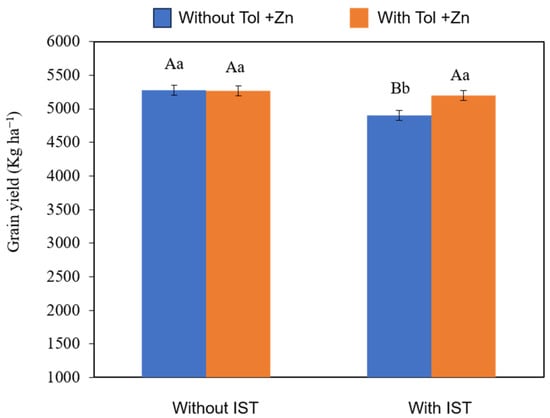
Industrial seed treatment (IST) with fungicides and insecticides is common in wheat, whereas seed-applied biostimulants are still little explored. Tryptophol (indole-3-ethanol, TOL), an indole compound related to auxin metabolism, and zinc (Zn), required for tryptophan synthesis, may favor early seedling development. This study evaluated whether TOL + Zn applied to seeds, with or without a commercial IST (pyraclostrobin + thiophanate-methyl + fipronil), affects establishment, growth and grain yield of bread wheat (Triticum aestivum L. em. Thell.) under rainfed Cerrado conditions. A 2 × 2 factorial field experiment (IST × TOL + Zn) was conducted in randomized blocks with four replicates. TOL + Zn increased emergence at 10 days after sowing from 66.81% to 82.28% without IST and from 73.17% to 85% with IST. Plant height responses were transient and disappeared by 45 days after sowing. TOL + Zn increased source–sink distance only in the absence of IST. Tillering and yield components were not affected. IST alone gave the lowest grain yield (517,221 kg ha−1), whereas IST + TOL + Zn restored yield (5198 kg ha−1) to the level of seeds without IST (5276 and 5267 kg ha−1). Seed-applied TOL + Zn improved wheat establishment and offset the yield reduction associated with IST; confirmation across seasons and sites is needed.
1. Introduction
Global agriculture seeks greater production efficiency through strategies that ensure phytosanitary quality and improve both productivity and crop quality. In line with this trend, seed treatment is regarded as a key practice to ensure crop quality while meeting the challenges of sustainable agriculture [1]. Bread wheat (Triticum aestivum L. em. Thell.) requires technological advances in seed treatment, as it is the second most produced cereal worldwide, after maize (Zea mays L.), with approximately 220 million hectares (ha) cultivated in the 2022/2023 growing season [2].
In Brazil, the Cerrado (a tropical savanna biome) has gained prominence in wheat production [3], mainly driven by new cultivars and technologies such as irrigation [4], and potentially by the use of seed treatments involving fungicides, micronutrients, and biostimulants.
Industrial seed treatment (IST) with chemicals is a fundamental tool for controlling seed and soil-borne pathogens and early-season pests, and contributes to the establishment of an adequate plant stand in the field [1]. Commercial seed treatments for wheat usually combine fungicides and insecticides with protective, systemic and contact action, and formulations containing strobilurins are also known for their physiological effects on plants [5]. However, the yield response of wheat to seed treatment is not always positive. Depending on the products and the growing conditions, grain yield may increase, remain the same or even decrease [6,7,8]. The excessive application of agrochemicals in seed coatings may adversely affect beneficial insects, such as pollinators and natural predators, whereas multilayered coatings may compromise seed germination and subsequent seedling leaf development [1].
Biostimulants are molecules or products that improve plant quality, mitigate stress-related damage, and favor maturation and harvest [9]. However, commercial biostimulants are mostly applied as a foliar spray, and their effects as a seed treatment, particularly during early seedling development, remain poorly understood [10]. There is also growing demand for organic compounds derived from plants, fungi, bacteria, or marine organisms, which have shown promising potential [11].
Among micronutrients, zinc (Zn) deserves special attention, as it is frequently reported as the most deficient micronutrient in Brazilian agricultural systems, affecting both perennial and annual crops, including wheat [12]. Adequate Zn supply is essential for the synthesis of the amino acid tryptophan, a precursor of indole-3-acetic acid (IAA), the main auxin in plants. Auxins regulate cell elongation and division, formation of adventitious and lateral roots, tropic responses, apical dominance, and other physiological functions [13]. Tunes et al. [14] observed that seed treatment with Zn maintained the viability of wheat seeds for up to six months and increased yield components. In wheat, seed treatments containing Zn have also been associated with better early growth [15] and higher yield per plant [6], and Zn seed priming improved stand establishment and grain yield [16,17]. On the other hand, Freiberg et al. [8] reported that a micronutrient product containing Zn, applied to seeds, reduced wheat grain yield in one of two seasons, with no effect in the other. Similarly, seeds with higher Zn content increased wheat yield in India and Pakistan, but not in China or Zambia [18]. Thus, the responses to Zn seed treatment are not consistent and depend on the formulation, the Zn status of the soil and the growing conditions.
Among the molecules that have gained prominence within the biostimulant category is tryptophol (indole-3-ethanol, TOL), a metabolite produced by plants, bacteria, fungi, and marine sponges, whose origin is closely associated with the metabolic pathways of tryptophan and tryptamine [19]. In common bean, tryptophol increased the concentration of photosynthetic pigments and gas exchange and promoted shoot growth [20]. Since tryptophol is related to auxin metabolism [21] and Zn is required for the synthesis of tryptophan, the main precursor of IAA [12], the combined application of both compounds to seeds could favor germination and early seedling growth. Although the biostimulant activity of tryptophol has been reported in other crops, such as common bean [20], it has not yet been evaluated as a seed treatment in wheat. In addition, it is not known whether its effects are compatible with the fungicide and insecticide seed treatments commonly used in this crop.
It was hypothesized that the combination of the organic compound tryptophol (TOL) and the inorganic micronutrient zinc (Zn) would promote beneficial signaling responses in plant tissues, potentially modulating auxin-related pathways. Furthermore, the integration of this biostimulant formulation with industrial seed treatment (IST) was expected to enhance seedling protection during emergence and promote early plant development, ultimately contributing to improved wheat yield.
This study aimed to evaluate the effects of TOL + Zn applied as a seed treatment, with or without IST, on emergence, plant growth, source–sink distance, yield components, and grain yield of bread wheat under rainfed Cerrado conditions.
2. Materials and Methods
2.1. Experimental Site Characterization
The experiment was conducted at an experimental farm of the Cooperativa Agropecuária do Alto Paranaíba (COOPADAP), in Rio Paranaíba, Minas Gerais, Brazil (19°16′00.98″ S; 46°15′00.45″ W), at an altitude of 1057 m. The soil is classified as an Oxisol [22]. The climate of the region is classified as Aw (tropical savanna), characterized by rainy summers and dry winters [23]. During the crop cycle, 74.4 mm of rainfall was recorded (Table 1).
Table 1.
Meteorological conditions in Rio Paranaíba, Minas Gerais, Brazil, from 31 March to 21 July 2023.
2.2. Plant Material
Seeds of the bread wheat cultivar TBIO Aton (Biotrigo Genética, Passo Fundo, Brazil) were obtained from COOPADAP Seeds (São Gotardo, Brazil), either untreated or after COOPADAP’s industrial seed treatment (IST). The wheat was planted on 31 March 2023 and harvested on 21 July 2023, with a crop cycle of 112 days. The seeding rate was 425 seeds per m2.
2.3. Seed Treatments
For the IST, performed by COOPADAP, the commercial product Standak® Top (BASF, São Paulo, Brazil) was applied at a rate of 200 mL per 100 kg of wheat seeds. This formulation consists of two fungicides—pyraclostrobin (25 g active ingredient per liter) and thiophanate-methyl (225 g active ingredient per liter)—and one insecticide, fipronil (225 g active ingredient per liter). In addition, this product is known to exhibit physiological activity due to the presence of the strobilurin molecule [5].
The biostimulant formulation developed in this study (TOL + Zn) consisted of tryptophol (indole-3-ethanol; CAS 526-55-6; Merck, 97% purity) and zinc sulfate heptahydrate (ZnSO4·7H2O; CAS 7446-20-0; Dinâmica Química Contemporânea Ltd.a., Indaiatuba, Brazil; 99% purity). Both compounds were dissolved together in water, as in previous studies [20]. The stock solution contained 2000 mg L−1 of tryptophol and 13,900 mg L−1 of ZnSO4·7H2O and was diluted 400 times. The final solution contained 5.0 mg L−1 of tryptophol and 34.8 mg L−1 of ZnSO4·7H2O (7.9 mg L−1 of Zn) and was applied at 5 mL per kg of seeds.
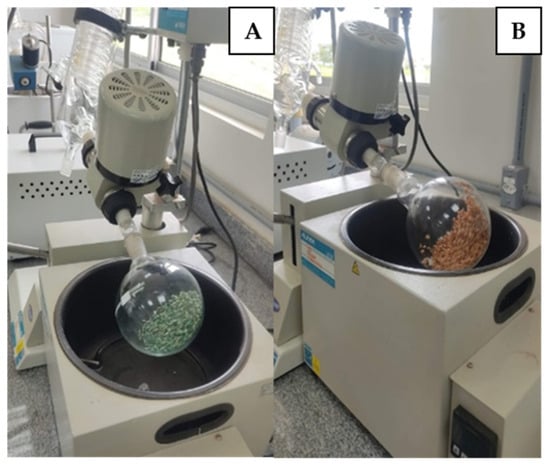
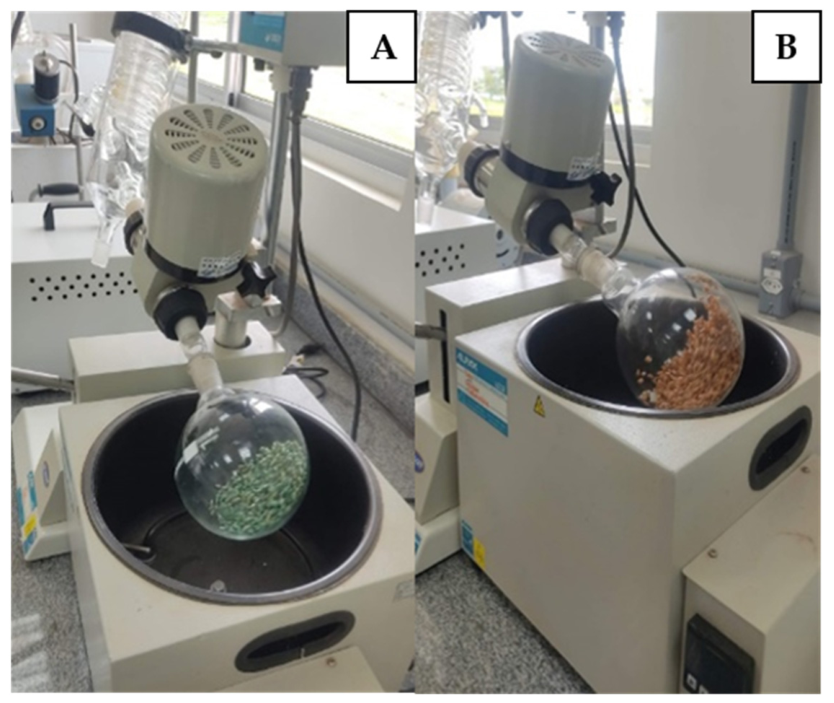
Seed treatment with TOL + Zn was performed at the Laboratory of Plant Production Physiology and Metabolism (LAFIMEPRO), Federal University of Viçosa, Rio Paranaíba Campus. For each replicate, four lots of 100 g of seeds were prepared, two without and two with IST, and TOL + Zn was applied to one lot of each type. Seeds were treated in a rotary evaporator at room temperature (about 25 °C) for 5 min at 160 rpm, to ensure a homogeneous distribution of the solution on the seeds (Figure 1). Seeds without TOL + Zn received no treatment. Wheat seeds were treated on 28 March 2023.
Figure 1.
Wheat seed treatment in a rotary evaporator: (A) green seeds, with industrial seed treatment (IST) and tryptophol + zinc (TOL + Zn); (B) seeds treated with TOL + Zn only.
2.4. Experimental Design and Crop Management
The experiment was conducted in a randomized complete block design in a 2 × 2 factorial arrangement (with or without IST × with or without TOL + Zn), with four replicates. The treatments were:
- T1—Seeds without IST;
- T2—Seeds with IST;
- T3—Seeds without IST, treated with tryptophol + zinc (TOL + Zn);
- T4—Seeds with IST and TOL + Zn.
Sowing was carried out on 31 March 2023, in a no-tillage system, using a seeder designed for experimental plots. Soybean was the previous crop, and its residues formed the straw cover. Wheat was grown under rainfed conditions throughout the cycle. Row spacing was 0.20 m, with a seeding rate of 170 kg ha−1. Given a thousand-seed weight of 40 g, 85 seeds were sown per linear meter. Each experimental plot consisted of five rows, each 5 m long (5 m2).
The soil was fertilized according to regional recommendations for wheat cultivation. At sowing, 200 kg ha−1 of N-P-K (10-35-06) fertilizer was applied, followed by 250 kg ha−1 of urea as topdressing. Phytosanitary management followed regional recommendations and consisted of one herbicide application, four fungicide applications, and three insecticide applications.
2.5. Plant Analysis and Crop Yield
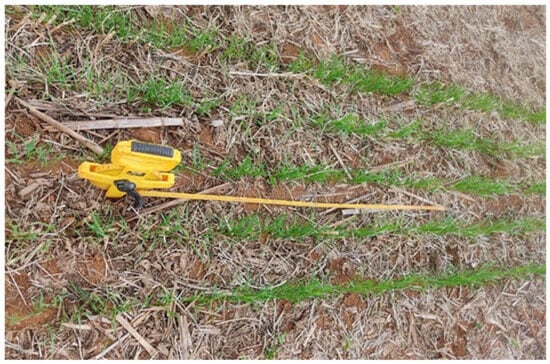
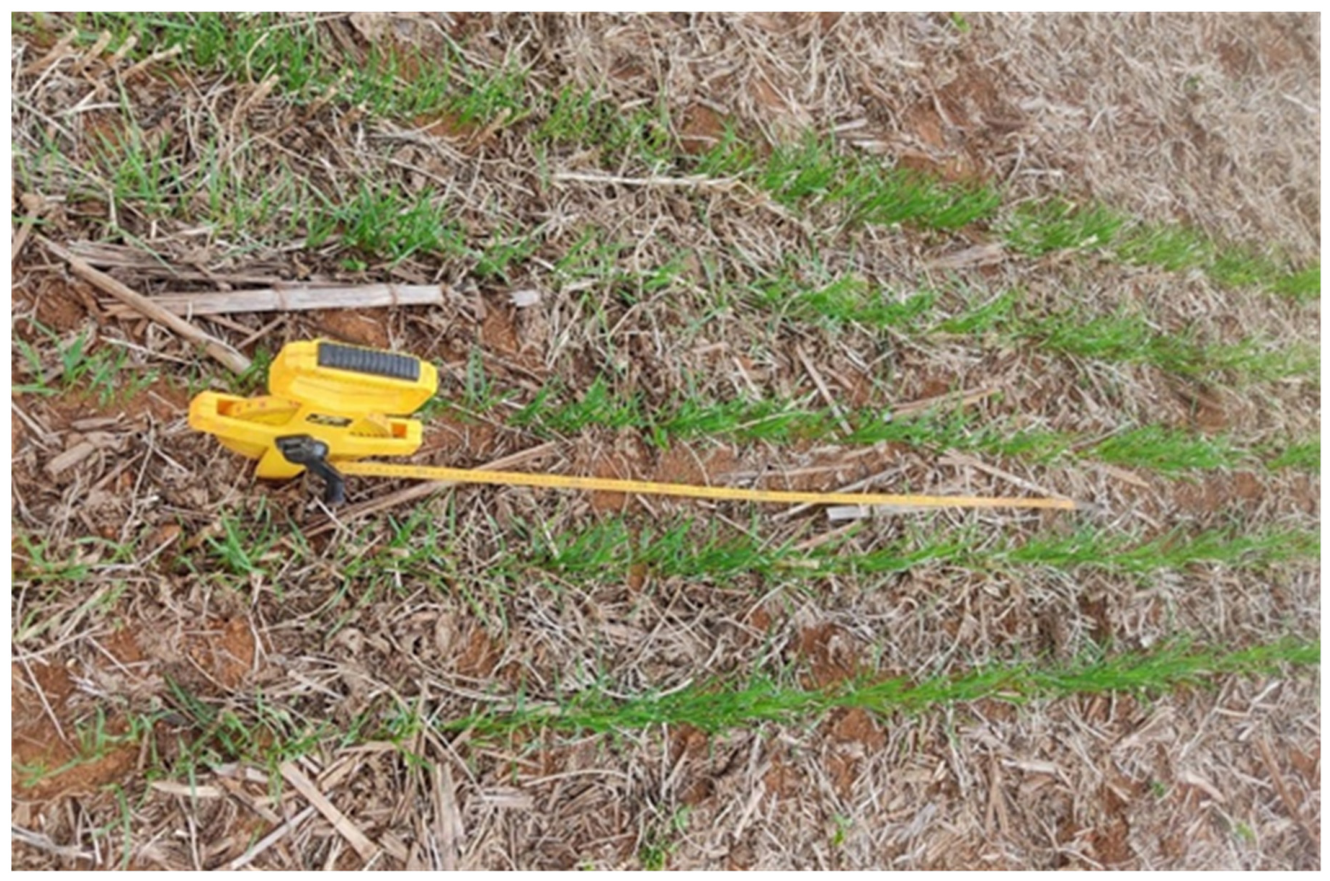
For plant emergence, a 1-m row section was evaluated in each plot (Figure 2), and all emerged plants were counted at 10 days after sowing (DAS). Emergence percentage was calculated as the number of emerged plants divided by the number of seeds sown (85 per meter), multiplied by 100.
Figure 2.
Evaluation of wheat emergence in a 1-m row section, under field conditions during the 2023 crop season, Rio Paranaíba, MG, Brazil.
Plant height was measured weekly in ten randomly selected wheat plants per plot, from the soil surface to the tip of the highest leaf, using a ruler, over six evaluation periods: 10, 17, 24, 31, 38, and 45 DAS. At 38 DAS, the number of tillers per plant was counted in ten plants.
Source–sink distance was determined on the main culm of five plants per plot at the reproductive stage by summing the length of the flag-leaf sheath and the distance between the flag-leaf node and the ear insertion, according to the methodology adapted from Fioreze and Rodrigues [24].
At harvest, on 21 July 2023, the yield components (ear length, number of spikelets per ear, number of grains per ear and grain weight of five ears) were evaluated in five ears per plot, totaling 20 ears per treatment. Grain weight was determined for the five ears together, and the other components were expressed as the mean of the five ears. Grain yield was determined by mechanical harvesting and threshing of all plants in the five rows of each plot (5 m2, with 2125 seeds sown per plot). Grain moisture was measured with a capacitance-based seed and grain moisture meter (Gehaka, São Paulo, Brazil), grain mass was adjusted to 13% moisture, and yield was expressed in kg ha−1.
2.6. Weather Data
Precipitation and mean maximum and minimum temperatures during the crop cycle (Table 1) were recorded by the SISMET agrometeorological monitoring platform of the Regional Cooperative of Coffee Growers in Guaxupé (COOXUPÉ), in Rio Paranaíba, Minas Gerais, Brazil.
2.7. Statistical Analysis
Initially, the assumptions of the analysis of variance were verified. Normality of residuals was tested by the Jarque–Bera test, homogeneity of variances by the Cochran, Bartlett and Hartley tests, additivity of block and treatment effects, and the presence of outliers by the non-reduced ESD test. Then, the data were subjected to analysis of variance for a randomized complete block design in a 2 × 2 factorial arrangement, with blocks, IST, TOL + Zn and the IST × TOL + Zn interaction as sources of variation. When the interaction was significant (p ≤ 0.05), it was decomposed, and the effect of each factor was tested within each level of the other. When it was not significant, the main effects were evaluated. Means were compared by the Student–Newman–Keuls (SNK) test at p ≤ 0.05, using the SPEED Stat software, version 3.3 [25].
3. Results and Discussion
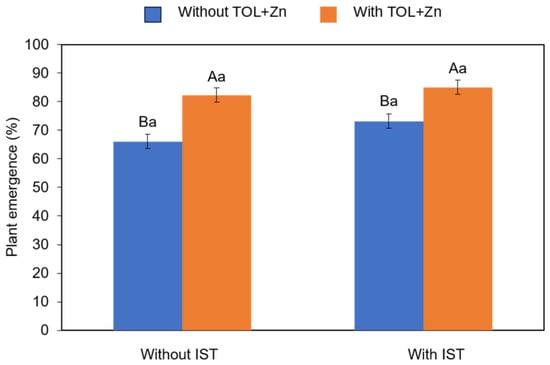
At 10 DAS, TOL + Zn increased wheat emergence both in seeds with and without industrial seed treatment (IST) (Figure 3). On the other hand, IST did not change emergence, with or without TOL + Zn. Since IST protects seeds against pathogens and pests at the beginning of the crop cycle, a positive effect on emergence would be expected. The absence of this effect may indicate that the pressure of pathogens and pests during establishment was low in this experiment. Thus, TOL + Zn acted mainly on the initial establishment of the crop.
Figure 3.
Wheat plant emergence at 10 days after sowing (DAS), as affected by industrial seed treatment (IST) and tryptophol + zinc (TOL + Zn). Uppercase letters denote comparisons between treatments with and without TOL + Zn at each IST level, whereas lowercase letters denote comparisons between treatments with and without IST at each TOL + Zn level. Columns represent means and bars represent the standard error (number of replicates = 4). SNK test (p ≤ 0.05).
The higher emergence with TOL + Zn may be related to auxin metabolism. Tryptophol can be oxidized to indole-3-acetaldehyde, an intermediate in IAA biosynthesis [21], and Zn is required for the synthesis of tryptophan, the main precursor of IAA [12]. Thus, TOL + Zn applied to seeds may have increased auxin availability during germination, favoring the elongation of the radicle and coleoptile. In wheat, seed treatments containing Zn have improved early development, although the magnitude of the response depends on the dose, the formulation and the growing conditions [6,15]. However, further research is needed to elucidate these metabolic pathways for TOL + Zn applied as a seed treatment.
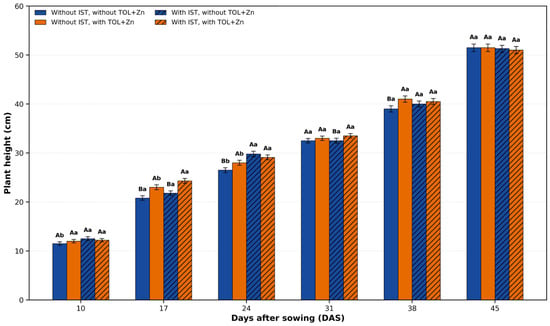
The effects of the treatments on plant height were transient (Figure 4). TOL + Zn did not affect plant height at 10 DAS. At 17 DAS, it increased plant height with and without IST, at 24 and 38 DAS only without IST, and at 31 DAS only with IST. IST, in turn, increased plant height at 10 DAS in seeds without TOL + Zn, at 17 DAS in seeds with TOL + Zn, and at 24 DAS with and without TOL + Zn.
Figure 4.
Height of wheat plants at 10, 17, 24, 31, 38 and 45 days after sowing (DAS), as affected by industrial seed treatment (IST) and tryptophol + zinc (TOL + Zn). Uppercase letters denote comparisons between treatments with and without TOL + Zn at each IST level, whereas lowercase letters denote comparisons between treatments with and without IST at each TOL + Zn level. Columns represent means and bars represent the standard error (number of replicates = 4). SNK test (p ≤ 0.05).
At 45 DAS, there were no differences among treatments. Since the effects of TOL + Zn were small and changed between IST conditions over the evaluation dates, they indicate a transient and inconsistent response, and not a lasting effect on growth. This temporal pattern agrees with studies on seed treatments with Zn and other physiologically active compounds. Rufino et al. [6], for example, reported positive effects of Zn and fungicide seed treatments on early wheat traits, with responses evident up to approximately 30 days after emergence. Georgin et al. [15] also observed that seed treatments involving Zn and phytohormones favored early wheat growth.
The number of tillers did not differ among treatments (Table 2). Thus, the higher emergence and the temporary changes in plant height were not accompanied by changes in tillering. The tillering capacity of wheat depends strongly on the genotype and on crop establishment and management [26]. In addition, elongation promoted by auxins and apical dominance may limit the emergence of tillers [13], which could explain why the early increase in height was not accompanied by more tillers. The responses to seed treatments are not necessarily uniform among traits. Freiberg et al. [7], evaluating different combinations of micronutrients, fungicides, and insecticides in wheat seeds, observed changes in tiller number in some treatments, but no response in other yield components or in grain yield. Therefore, the absence of an effect on tillering does not contradict the effects on emergence and early plant height, but shows that the responses depended on the trait evaluated.
Table 2.
Number of tillers per plant in wheat grown from seeds with or without industrial seed treatment (IST) and with or without tryptophol + zinc (TOL + Zn). Means (± SD, n = 10) followed by the same letter do not differ by the SNK test (p ≤ 0.05).
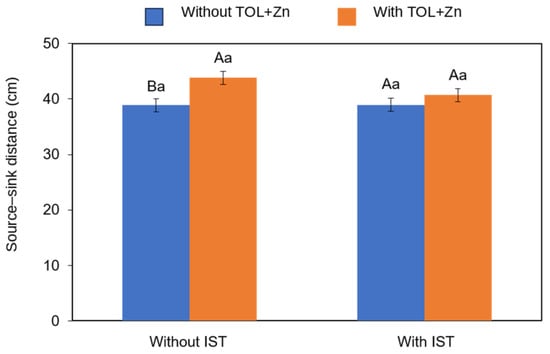
Another parameter evaluated was the source–sink distance, which corresponds to the sum of the flag-leaf sheath length and the distance between the flag-leaf node and the ear insertion. The transport of carbohydrates between source and sink can affect the rate of assimilate translocation and, consequently, grain yield [24].
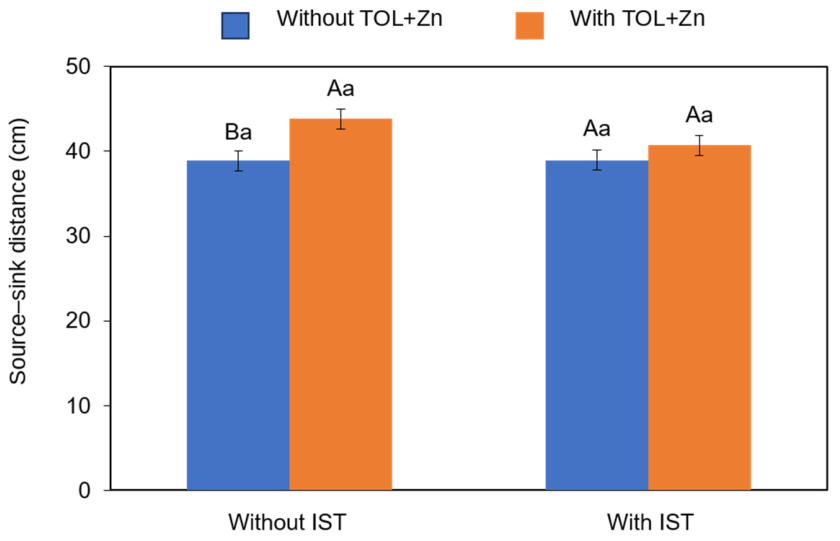
The source–sink distance was affected by the interaction between treatments (Figure 5). Without IST, TOL + Zn increased the source–sink distance, whereas with IST there was no effect. IST did not change this variable, with or without TOL + Zn. The source–sink distance is a morphological trait related to the position of the flag leaf and the ear and to the architecture of the upper part of the culm. Fioreze and Rodrigues [24] demonstrated that this variable can be modified by growth regulators in wheat, but observed that changes in source–sink distance were not necessarily accompanied by changes in grain yield. Therefore, the higher value observed with TOL + Zn should be interpreted mainly as a morphological change in the region between the flag leaf and the ear, and it does not, by itself, indicate a greater efficiency of assimilate translocation.
Figure 5.
Source–sink distance (cm) of wheat plants as affected by industrial seed treatment (IST) and tryptophol + zinc (TOL + Zn). Uppercase letters denote comparisons between treatments with and without TOL + Zn at each IST level, whereas lowercase letters denote comparisons between treatments with and without IST at each TOL + Zn level. Columns represent means and bars represent the standard error (number of replicates = 4). SNK test (p ≤ 0.05).
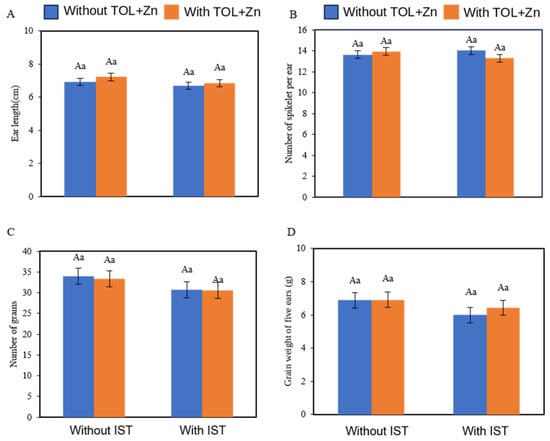
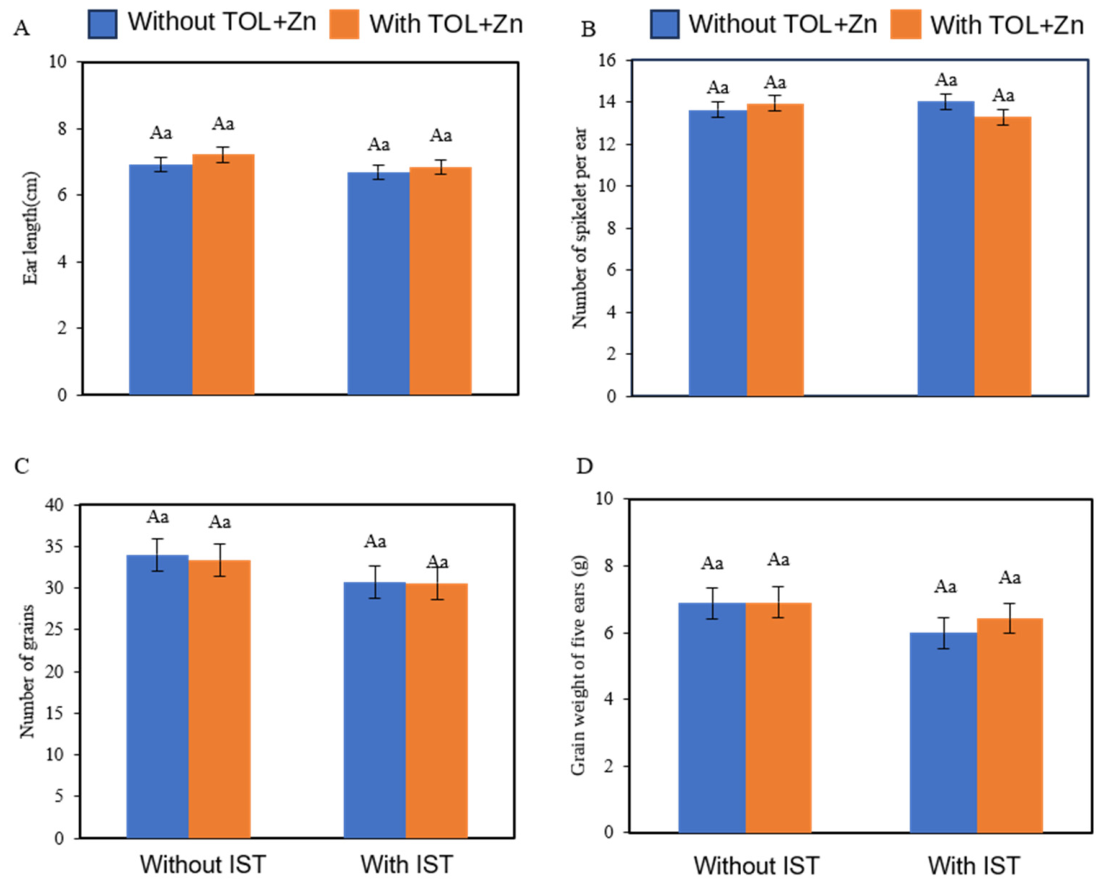
IST and TOL + Zn did not affect ear length, number of spikelets per ear, number of grains per ear or grain weight of five ears (Figure 6). This suggests that the responses to seed treatment are more evident during crop establishment than in the individual yield components. Freiberg et al. [8] found that seed treatments, including micronutrients containing Zn, could increase the seedling stand without increasing wheat grain yield. In another study, Freiberg et al. [7] found no effect of seed treatment on the number or mass of grains per ear, despite responses in other crop traits. These results reinforce that changes in early development do not necessarily result in detectable changes in the individual yield components.
Figure 6.
Yield components of wheat plants: (A) ear length, (B) number of spikelets per ear, (C) number of grains per ear, and (D) grain weight of five ears, as affected by industrial seed treatment (IST) and tryptophol + zinc (TOL + Zn). Uppercase letters denote comparisons between treatments with and without TOL + Zn at each IST level, whereas lowercase letters denote comparisons between treatments with and without IST at each TOL + Zn level. Columns represent means and bars represent the standard error (number of replicates = 4). SNK test (p ≤ 0.05).
The effect of TOL + Zn on grain yield depended on IST (Figure 7). Without IST, TOL + Zn did not alter grain yield. IST alone resulted in the lowest grain yield, about 7% below untreated seeds, whereas IST + TOL + Zn reached a yield similar to that of untreated seeds. Therefore, TOL + Zn did not increase yield above the untreated control, but offset the yield reduction associated with IST. Although TOL + Zn did not increase grain yield in seeds without IST, it did not reduce it either, indicating no phytotoxic effect at the dose used.
Figure 7.
Grain yield of wheat plants as affected by industrial seed treatment (IST) and tryptophol + zinc (TOL + Zn). Uppercase letters denote comparisons between treatments with and without TOL + Zn at each IST level, whereas lowercase letters denote comparisons between treatments with and without IST at each TOL + Zn level. Columns represent means and bars represent the standard error (number of replicates = 4). SNK test (p ≤ 0.05).
The lower yield with IST alone was unexpected, since commercial seed treatments are intended to protect yield potential. Several explanations are possible: phytotoxicity of the pyraclostrobin + thiophanate-methyl + fipronil formulation not detected by the variables evaluated (for example, on root growth), since IST did not reduce emergence or early plant height; an effect specific to this product or dose, or low pathogen and pest pressure at the site, which would limit any protective benefit. Crop water status may also have played a role: only 9 mm of rain fell from May to harvest (Table 1), so grain filling occurred under drought period, which can magnify small differences in establishment and root growth. Because no yield component differed, the reduction probably arose from the number of ears per unit area, which was not measured. These explanations were not tested here, and the result requires confirmation across evaluation of cultivars, seasons and locations.
Interactions between micronutrients and other seed-treatment products have already been reported in wheat. Rufino et al. [6] found that combinations involving Zn, fungicide, and polymer modified early plant performance and that Zn treatment was associated with increased yield per plant.
In the present study, the effect of TOL + Zn on yield was compensatory rather than synergistic, and it was not associated with an isolated change in ear length, number of spikelets, number of grains, or grain weight of five ears. The mechanism of this compensation cannot be identified from our data. IST did not reduce emergence or early plant height; on the contrary, plants from IST seeds were taller between 10 and 24 DAS. The compensation may therefore have occurred later in the cycle, for example through plant survival or the number of ears per area, which were not measured. Without IST, plants may already have been close to the yield potential allowed by the dry season, leaving little room for a response. Grain yield is the integrated result of processes throughout the crop cycle, including stand establishment, growth, plant survival and the number of plants per unit area. In this sense, the higher emergence with TOL + Zn may have contributed to final yield. Naturally, this yield performance may be linked to the plants’ survival performance throughout the growing cycle.
This study developed and evaluated a novel tryptophol (TOL)–Zn biostimulant formulation for wheat seed treatment. Although evaluated at a single location over one growing season under relatively dry grain-filling conditions, the results provide an initial assessment of its potential. Further research should examine its efficacy and consistency across multiple environments, growing seasons, and wheat cultivars. In this sense, Win and Kuk [27] pointed out that the efficacy of biostimulants may depend on the intrinsic stress tolerance of the genotype and on the severity of the stress, and that genotype × environment × biostimulant interactions are still insufficiently investigated.
4. Conclusions
The new biostimulant TOL + Zn, applied to seeds, increased wheat emergence both with and without IST. Its effects on plant height were transient and disappeared by 45 days after sowing, and tillering was not affected. TOL + Zn increased source–sink distance only in the absence of IST.
Neither treatment affected the yield components evaluated. IST alone reduced grain yield, and its combination with TOL + Zn restored yield to the level of untreated seeds, demonstrating its capacity to safeguard the crop during the cycle.
Seed-applied TOL + Zn is therefore a promising tool to improve wheat establishment and to offset possible yield losses associated with IST under unfavorable environment conditions, as observed in tropical savanna biome, although the study needs to be replicated across more seasons and locations.
Author Contributions
Conceptualization, W.R.M. and É.M.S.; methodology, W.R.M., É.M.S., G.H.S. and V.N.; formal analysis, M.C.L. and J.R.E.; investigation, M.C.L. and J.R.E.; resources, W.R.M. and J.R.E.; writing—original draft preparation, M.C.L.; writing—review and editing, W.R.M. and É.M.S.; funding acquisition, W.R.M. All authors have read and agreed to the published version of the manuscript.
Funding
This research was funded by the National Council for Scientific and Technological Development (CNPq) for providing the Productivity in Research Scholarship—PQ (303191/2024-4) to WRM; The Minas Gerais State Research Foundation (Fapemig) through financial support (RED-00144-23).
Data Availability Statement
The original contributions presented in this study are included in the article. Further inquiries can be directed to the corresponding author.
Acknowledgments
The authors would like to express their gratitude to the Cooperativa Agropecuária do Alto Paranaíba (Coopadap) in Brazil for their valuable support and for allowing the cultivation of a wheat crop in its experimental area; and Federal University of Santa Catarina (Rede Biotech UFSC) for institutional support and for fostering collaborative research. The authors used generative artificial intelligence (GenAI) to assist in preparing the graphical abstract (ChatGPT, GPT-6, OpenAI) and Grammarly for Education for English grammar adjustments in the manuscript. The authors reviewed and approved the final content and take full responsibility for the manuscript.
Conflicts of Interest
The authors declare no conflicts of interest.
References
- Sohail, M.; Pirzada, T.; Opperman, C.H.; Khan, S.A. Recent advances in seed coating technologies: Transitioning toward sustainable agriculture. Green Chem. 2022, 24, 6052–6085. [Google Scholar] [CrossRef] [Scilit]
- Dohlman, E.; Hansen, J.; Boussios, D. USDA Agricultural Projections to 2031. 2022. Available online: http://ageconsearch.umn.edu (accessed on 30 November 2025).
- Chagas, J.H.; Fronza, V.; Soares Sobrinho, J.; Sussel, A.A.B.; Albrecht, J.C. Tecnologia de Produção de Trigo Sequeiro No Cerrado Do Brasil Central; Embrapa Trigo: Passo Fundo, Brazil, 2021; p. 101.
- Pereira, J.; da Cunha, G.R.; Moresco, E.R. Improved drought tolerance in wheat is required to unlock the production potential of the Brazilian Cerrado. Crop Breed. Appl. Biotechnol. 2019, 19, 217–225. [Google Scholar] [CrossRef] [Scilit]
- Venancio, W.S.; Rodrigues, M.A.T.; Begliomini, E.; de Souza, N.L. Physiological effects of strobilurin fungicides on plants. Publ. UEPG Ciênc. Exatas Terra Agrár. Eng. 2003, 9, 59–68. [Google Scholar]
- Rufino, C.A.; Tavares, L.C.; Brunes, A.P.; Lemes, E.S.; Villela, F.A. Treatment of wheat seed with zinc, fungicide, and polymer: Seed quality and yield. J. Seed Sci. 2013, 35, 106–112. [Google Scholar] [CrossRef] [Scilit]
- Freiberg, J.A.; Ludwig, M.P.; Girotto, E. Does seed treatment affect wheat yield components? Cad. Ciênc. Agrár. 2021, 13, 1–5. [Google Scholar] [CrossRef] [Scilit]
- Freiberg, J.A.; Ludwig, M.P.; Avelar, S.A.G.; Girotto, E. Seed treatment and its impact on wheat crop yield potential. J. Seed Sci. 2017, 39, 280–287. [Google Scholar] [CrossRef] [Scilit]
- du Jardin, P. Plant biostimulants: Definition, concept, main categories and regulation. Sci. Hortic. 2015, 196, 3–14. [Google Scholar] [CrossRef] [Scilit]
- de Carvalho, T.C.; da Silva, S.S.; da Silva, R.C.; Panobianco, M.; Mógor, Á.F. Influência de bioestimulantes na germinação e desenvolvimento de plântulas de Phaseolus vulgaris sob restrição hídrica. Rev. Ciênc. Agrár. 2013, 36, 199–205. [Google Scholar] [CrossRef]
- Guzmán-López, O.; Trigos, Á.; Fernández, F.J.; Yañez-Morales, M.J.; Saucedo-Castañeda, G. Tyrosol and tryptophol produced by Ceratocystis adiposa. World J. Microbiol. Biotechnol. 2007, 23, 1473–1477. [Google Scholar] [CrossRef] [Scilit]
- Rehman, A.; Farooq, M.; Ozturk, L.; Asif, M.; Siddique, K.H.M. Zinc nutrition in wheat-based cropping systems. Plant Soil 2018, 422, 283–315. [Google Scholar] [CrossRef] [Scilit]
- Taiz, L.; Zeiger, E.; Moller, I.M.; Murphy, A. Fisiologia e Desenvolvimento Vegetal, 6th ed.; Artmed: Porto Alegre, Brazil, 2017; p. 888. [Google Scholar]
- de Tunes, L.M.; Pedroso, D.C.; Tavares, L.C.; Barbieri, A.P.P.; Barros, A.C.S.A.; Muniz, M.F.B. Tratamento de sementes de trigo com zinco: Armazenabilidade, componentes do rendimento e teor do elemento nas sementes. Ciênc. Rural. 2012, 42, 1141–1146. [Google Scholar] [CrossRef] [Scilit]
- Georgin, J.; Lazzari, L.; Lamego, F.P.; Camponogara, A. Initial development of wheat (Triticum aestivum) using phytohormone, zinc and inoculant seed treatment. Rev. Eletrônica Em Gestão Educ. Tecnol. Ambient. 2014, 18, 1318–1325. [Google Scholar]
- Ali, N.; Farooq, M.; Hassan, M.A.; Arshad, M.S.; Saleem, M.K.; Faran, M. Micronutrient seed priming improves stand establishment, grain yield and biofortification of bread wheat. Crop Pasture Sci. 2018, 69, 479–487. [Google Scholar] [CrossRef] [Scilit]
- Hassan, N.; Irshad, S.; Saddiq, M.S.; Bashir, S.; Khan, S.; Wahid, M.A.; Khan, R.R.; Yousra, M. Potential of zinc seed treatment in improving stand establishment, phenology, yield and grain biofortification of wheat. J. Plant Nutr. 2019, 42, 1676–1692. [Google Scholar] [CrossRef] [Scilit]
- Rashid, A.; Ram, H.; Zou, C.Q.; Rerkasem, B.; Duarte, A.P.; Simunji, S.; Yazici, A.; Guo, S.; Rizwan, M.; Bal, R.S.; et al. Effect of zinc-biofortified seeds on grain yield of wheat, rice, and common bean grown in six countries. J. Plant Nutr. Soil Sci. 2019, 182, 791–804. [Google Scholar] [CrossRef] [Scilit] [PubMed]
- Palmieri, A.; Petrini, M. Tryptophol and derivatives: Natural occurrence and applications to the synthesis of bioactive compounds. Nat. Product. Rep. 2019, 36, 490–530. [Google Scholar] [CrossRef] [Scilit] [PubMed]
- Nascimento, A.L.V.; Macedo, W.R.; Silva, G.H.; Almeida Neto, R.G.A.; Mendes, M.G.; Marchiori, P.E.R. Physiological and agronomical responses of common bean subjected to tryptophol. Ann. Appl. Biol. 2016, 168, 195–202. [Google Scholar] [CrossRef] [Scilit]
- Percival, F.W.; Purves, W.K.; Vickery, L.E. Indole-3-ethanol oxidase: Kinetics, inhibition, and regulation by auxins. Plant Physiol. 1973, 51, 739–743. [Google Scholar] [CrossRef] [Scilit] [PubMed]
- Soil Survey Staff. Keys to Soil Taxonomy, 13th ed.; USDA Natural Resources Conservation Service: Washington, DC, USA, 2022.
- Lima, R.F.; de Oliveira Aparecido, L.E.; Torsoni, G.B.; de Souza Rolim, G. Climate Change Assessment in Brazil: Utilizing the Köppen-Geiger (1936) Climate Classification. Rev. Bras. Meteorol. 2023, 38, e38230001. [Google Scholar] [CrossRef] [Scilit]
- Fioreze, S.L.; Rodrigues, J.D. Componentes produtivos do trigo afetados pela densidade de semeadura e aplicação de regulador vegetal. Semin. Ciênc. Agrár. 2014, 35, 39–54. [Google Scholar] [CrossRef] [Scilit]
- Carvalho, A.M.X.; Mendes, F.Q.; Mendes, F.Q.; Tavares, L.F. SPEED Stat: A free, intuitive, and minimalist spreadsheet program for statistical analyses of experiments. Crop Breed. Appl. Biotechnol. 2020, 20, e327420312. [Google Scholar] [CrossRef] [Scilit]
- Valério, I.P.; Carvalho, F.I.F.; Oliveira, A.C.; Benin, G.; Souza, V.Q.; Machado, A.A.; Bertan, I.; Busato, C.C.; Silveira, G.; Fonseca, D.A.R. Seeding density in wheat genotypes as a function of tillering potential. Sci. Agric. 2009, 66, 28–39. [Google Scholar] [CrossRef] [Scilit]
- Win, P.P.; Kuk, Y.I. Biostimulant-mediated enhancement of growth, yield, and abiotic stress tolerance in wheat and barley: Mechanisms, research gaps, and future perspectives. Plants 2026, 15, 3382. [Google Scholar] [CrossRef] [Scilit] [PubMed]

Disclaimer/Publisher’s Note: The statements, opinions and data contained in all publications are solely those of the individual author(s) and contributor(s) and not of MDPI and/or the editor(s). MDPI and/or the editor(s) disclaim responsibility for any injury to people or property resulting from any ideas, methods, instructions or products referred to in the content. |
© 2026 by the authors. Licensee MDPI, Basel, Switzerland. This article is an open access article distributed under the terms and conditions of the Creative Commons Attribution (CC BY) license.