


Abstract
Bacterial isolates obtained from spores of the arbuscular mycorrhizal fungi (AMF) have been reported to possess various plant growth-promoting traits. These bacterial isolates enhance plant growth and development through mechanisms such as phytohormone production and nutrient mobilization. The objective of this study was to investigate the ability of bacterial isolates to promote plant development. Five bacterial isolates, Bacillus methylotrophicus, Fictibacillus barbaricus, Stutzerimonas stutzeri, Bacillus aryabhattai, and Priestia aryabhattai, were isolated from AMF (Funneliformis mosseae) spores. The results indicated that all five bacterial isolates promoted plant growth. The greatest positive effects on the tomato seed germination were obtained with Bacillus methylotrophicus and Stutzerimonas stutzeri, with germination percentages of 90% and 95%, respectively. In addition, Stutzerimonas stutzeri enhanced early tomato seedling growth. Priestia aryabhattai produced the highest amount of indole-3-acetic acid (IAA) at 94.43 µg mL−1, which is the auxin phytohormone for plant growth promotion. Furthermore, Bacillus methylotrophicus, Fictibacillus barbaricus, and Bacillus aryabhattai were able to produce high levels of ammonia, which may contribute to improving plant growth in nutrient-deficient environments. In addition, Bacillus methylotrophicus, Bacillus aryabhattai, and Priestia aryabhattai were able to solubilize both phosphate and potassium. These findings suggest that the investigated bacterial strains could be combined with AMF to improve crop establishment and support sustainable agricultural systems by enhancing nutrient availability and reducing dependence on chemical fertilizers.
1. Introduction
Some of the most abundant and ecologically important soil microorganisms are arbuscular mycorrhizal fungi (AMF), which participate in mutualistic relationships with more than 80% of terrestrial plant species [1]. AMF have been studied regarding several aspects of their functional roles in plants and their beneficial contribution to plant growth and development has been extensively studied [2]. These symbiotic associations are essential for plant nutrition, improving the absorption of relatively immobile nutrients, especially zinc (Zn), copper (Cu), and phosphorus (P), through the extensive extraradical mycelial network developed in the soil [3]. AMF increase nutrient uptake and support plant growth under unfavorable environmental conditions, for instance salt, drought, and heavy-metal stress, and nutrient limitation, and thus contribute to plant productivity in adverse environmental conditions [4]. Furthermore, AMF produce glomalin-related soil proteins that contribute to soil aggregation and ecological stability, which improve soil structure and carbon sequestration [5].
Bacteria associated with AMF are commonly found in the rhizosphere, on fungal spores, and in colonized roots, where they contribute to plant-microbe interactions [6,7]. Some of these bacteria have been reported to stimulate mycorrhizal spore germination, the development of extraradical mycelium, the colonization of roots, and the establishment of mycorrhizal relationships between AMF and host plants [8]. In addition to supporting mycorrhizal formation, bacteria associated with AMF can also promote direct plant development through processes such as the production of plant growth-promoting hormones, mobilization of essential nutrients, fixation of atmospheric nitrogen, and plant pathogen suppression [8]. The interaction between bacteria associated with AMF and AMF often leads to synergistic effects that enhance plant nutrient acquisition, stress tolerance, and growth performance. Consequently, bacteria associated with AMF have gained more attention as a potential bioinoculant for sustainable agricultural systems to reduce dependence on chemical fertilizers while improving crop productivity [9].
Bacteria associated with AMF not only facilitate the establishment and functioning of mycorrhizal symbioses but also directly promote plant growth by several mechanisms that enhance plant development, for example nutrient solubilization, phytohormone production, siderophore secretion, and suppression of soil-borne pathogens [8,9]. Many of these bacteria possess plant growth-promoting traits and are therefore classified as plant growth-promoting bacteria (PGPB) [6,9,10]. Because of their positive effects on plant growth and development, the potential of this bacterial group as microorganisms to promote plant growth has been studied. Many studies demonstrated that PGPB improve germination of seeds, development of roots, uptake of nutrients, and output of plant biomass in several direct and indirect ways. As a result, bacteria associated with AMF are receiving increased attention as promising bioinoculants for environmentally friendly farming practices that increase crop yield while reducing the dependency on chemical fertilizers and other agrochemicals [11].
Tomato (Solanum lycopersicum L.) is a globally cultivated vegetable crop that plays a significant role in agricultural production [12]. It is valued for having a high nutritional value, including vitamins, minerals, antioxidants, and carotenoids such as lycopene, which contribute to human health and nutrition [13,14]. Tomato production is an important aspect of commercial farming and household food security [15]. Therefore, the development of sustainable strategies to increase seed germination and promote early plant growth is an important objective in tomato production systems [16].
The application of plant growth-promoting bacteria (PGPB) during the early stages of seedling development and seed germination might provide considerable advantages in tomato cultivation. The establishment of early seedlings is a critical stage that influences agricultural yield, nutrient uptake efficiency, and subsequent development of plants [17]. PGPB are known to have several properties that are beneficial for plant growth by producing phytohormones, which promote seed germination and stimulate root development [18]. Improved root growth helps seedlings absorb nutrients and water, which in turn helps them grow stronger and become more resistant to stress. In addition, PGPB can improve seedling health and survival by inhibiting some soil-borne diseases and facilitating beneficial microbial interactions in the rhizosphere [19]. These characteristics indicate PGPB are a promising bioinoculants for enhancing tomato seed germination and early growth while supporting sustainable agricultural practices with reduced dependence on chemical inputs. The objective of this research was to examine the possibility of using bacterial isolates obtained from AMF spores to promote plant growth by producing biologically active chemicals and to evaluate their effects on the early seedling development and germination of tomato (Solanum lycopersicum L.).
2. Materials and Methods
2.1. Plant and Bacteria Used
The plant used in this investigation was the tomato (Solanum lycopersicum L.) cv. Sida.
All five bacterial strains, Bacillus methylotrophicus, Fictibacillus barbaricus, Stutzerimonas stutzeri, Bacillus aryabhattai, and Priestia aryabhattai, were previously isolated from surface-sterilized spores of the arbuscular mycorrhizal fungus Funneliformis mosseae. The isolates were purified by repeated streaking on nutrient agar and identified by 16S rRNA gene sequencing. Detailed procedures for bacterial isolation, molecular identification, and evaluation of mycorrhiza helper activity have been described by Mungsachat, Kalee, Daud and Suchitwarasan [20].
2.2. Assessment of Indole-3-Acetic Acid (IAA) Production
The capacity of each bacterial isolate to produce IAA using Salkowski reagent was assessed applying the colorimetric method in duplicate [21]. Each bacterial isolate was inoculated separately in a 50 mL Erlenmeyer flask containing 25 mL of sterile Luria–Bertani (LB) broth supplemented with L-tryptophan (1 mg mL−1). All bacterial cultures were incubated for 72 h at 30 °C on a rotary shaker running at 120 rpm. One mL of each bacterial culture supernatant was centrifuged at 2000 rpm for 10 min and then transferred into a sterile test tube. Subsequently, 4 mL of Salkowski reagent was then added and carefully mixed. The reaction mixtures were kept in the dark for 45 min to develop color. A control treatment consisting of sterile distilled water mixed with Salkowski reagent was included. After incubation, a spectrophotometer (Genesys 30, Thermo Fisher Scientific, Waltham, MA, USA) was used to detect the absorbance at 535 nm [22]. A standard curve created from known IAA concentrations was used to calculate the amount of IAA produced by each bacterial isolate.
2.3. Potassium Solubilization Assay
The ability of all five bacterial isolates to dissolve insoluble potassium was evaluated in duplicate for each bacterial isolate using modified Aleksandrov agar medium [23] comprising 5.0 g glucose, 0.5 g MgSO4.7H2O, 0.006 g FeCl3, 2.0 g Ca3(PO4)2, 0.1 g CaCO3, 3.0 g potassium feldspar powder, and 20.0 g agar (in g L−1). On a Nutrient Agar (NA) plate, each bacterial isolate was first cross-streaked, then incubated at 30 ± 2 °C for 3 days. A single colony from each bacterial isolate was then spotted in the middle of an Aleksandrov agar plate. Plates that had been inoculated were kept at 30 ± 2 °C for 7 days. The plates were then examined for the presence of a clear halo zone around the bacterial colony after incubation. The appearance of a clear halo zone was considered indicative of potassium-solubilizing activity, whereas the absence of a halo zone demonstrated a lack of potassium solubilization [24].
2.4. Phosphate Solubilization Assay
The phosphate-solubilizing capacity of the bacterial isolates was evaluated using modified Pikovskaya’s agar medium [25]. The assay was performed in duplicate for each bacterial isolate. The five bacterial isolates were first cross-streaked onto Nutrient Agar (NA) plates, then all plates were incubated at 30 ± 2 °C for 3 days. A single colony from each bacterial isolate was then spot inoculated in the middle of a modified Pikovskaya’s agar plate comprising 10 g glucose, 0.5 g (NH4)2SO4, 5 g Ca3(PO4)2, 0.5 g yeast extract, 0.1 g MgSO4.7H2O, 0.2 g NaCl, 0.2 g KCl, 0.0001 g MnSO4.H2O, 0.0001 g FeSO4.7H2O, and 20.0 g agar (in g L−1). Then, the plates were kept at 30 ± 2 °C for 7 days. After 7 days of incubation, all plates were checked for the formation of a distinct halo zone around the bacterial colonies, indicating phosphate-solubilizing activity. The bacterial colony diameter and the clear halo zone diameter were measured once in millimeters (mm). The phosphate solubilization index (PSI) was calculated by the following equation [26]:
PSI = (Colony diameter + Halo zone diameter)/Colony diameter
The PSI was used to compare the phosphate-solubilizing capacities of the bacterial isolates.
2.5. Ammonia Production Assay
The ability of each bacterial isolate to generate ammonia was examined in duplicate for each bacterial isolate. Each bacterial isolate was cultured in 5 mL of peptone water. After that, each tube was incubated at 30 °C and 120 rpm for 72 h on a rotary shaker [27]. One mL of Nessler’s reagent was transferred to each tube after incubation. Ammonia production was shown by the formation of a deep yellow to brown color.
2.6. Nitrogen Fixation Assay
The nitrogen-fixing capacity of the bacterial isolates was tested in Jensen’s modified nitrogen-free (N-free) medium [28]. The assay was performed in duplicate for each bacterial isolate. Each bacterial isolate was streaked on plates of Jensen’s modified N-free medium consisting of 20 g sucrose, 0.5 g KH2PO4, 0.5 g MgSO4.7H2O, 0.2 g NaCl, 0.1 g CaCl2, 0.01 g FeSO4.7H2O, 0.005 g Na2MoO4, and 20.0 g agar (in g L−1), then kept at 30 ± 2 °C for 7 days. The bacterial growth was checked on each plate. The ability of bacterial isolate to grow on Jensen’s modified N-free medium was an indication of its potential to fix nitrogen, as the medium does not contain a nitrogen source.
2.7. Tomato Seed Germination and Seedling Growth Assay
The impact of bacterial isolates on tomato seed germination and early seedling growth was studied in aseptic conditions. Seeds of tomato (Solanum lycopersicum L. cv. Sida) were surface sterilized by 6% (w/v) NaOCl and subsequently washed with sterile deionized (DI) water three times to remove residual disinfectant. A bacterial suspension was prepared to an OD600 nm of 0.5 ± 0.02 to a density of bacteria (107–108 CFU mL−1). The bacterial suspensions of the respective bacterial isolates were used to soak the sterilized seeds with 10 seeds in each flask with the bacterial suspension. The flasks were incubated for 2 h at 120 rpm on a rotary shaker for bacteria to attach to the seed surface. The sterile DI water was used to soak the seeds as control. Then, the seeds were aseptically removed and placed onto sterile Petri dishes containing sterile Whatman filter paper. Ten seeds were placed on each Petri dish, and two Petri dishes were prepared for each bacterial isolate, resulting in a total of 20 seeds per treatment. Subsequently, 5 mL of the bacterial suspension was added to each filter paper to ensure adequate contact between the seeds and bacterial cells, and 5 mL of sterile DI water was added in the case of the control. For incubation, the plates were set with a daily temperature of 30 ± 2 °C for 7 days [29]. After completion of the incubation period, germinated seeds were counted. The germination percentage was computed by the following equation [30].
Germination percentage (%) = (number of germinated seeds/total number of seeds) × 100
To evaluate the in vitro seedling growth, Murashige and Skoog (MS) medium was selected to provide a sterile and nutritionally uniform environment for evaluating the effects of bacteria on tomato seed germination and early seedling growth. The use of MS medium minimizes variability associated with soil physicochemical properties and indigenous microbial communities, thereby allowing the direct effects of bacterial inoculation on early plant development to be assessed under controlled in vitro conditions.
MS medium was prepared [31] (full-strength MS medium without sucrose and solidified with 1% (w/v) agar.) and dispensed into culture bottles prior to sterilization by autoclaving. After solidification of the medium, ten germinated seeds from each treatment were aseptically transferred onto the MS medium, with five seedlings cultured per bottle. The culture bottles were set under continuous illumination for an additional seven days. At the end of the growing period, the seedling shoot length and fresh weight were measured. Throughout the 14-day incubation period, no excessive bacterial overgrowth was observed on the agar surface. The control treatment consisted of seeds treated with sterile DI water and no bacterial inoculation.
2.8. Statistical Analyses
The statistical analysis was carried using the R version 4.0.2 software. The IAA Production, germination percentage of seed, seedling shoot length, and fresh weight were examined using ANOVA (one-way analysis of variance), with treatments of each bacterial strain serving as variables. Tukey’s HSD was applied, with a p ≤ 0.05 significant level.
3. Results
3.1. Indole-3-Acetic Acid (IAA) Production
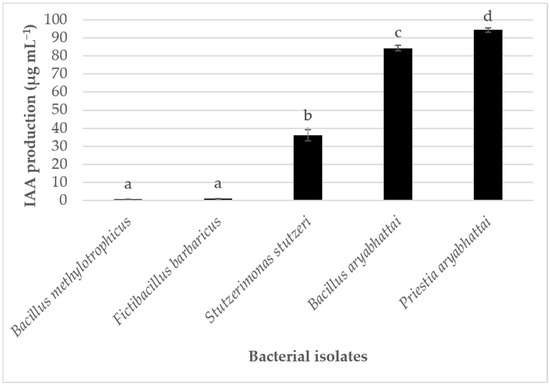
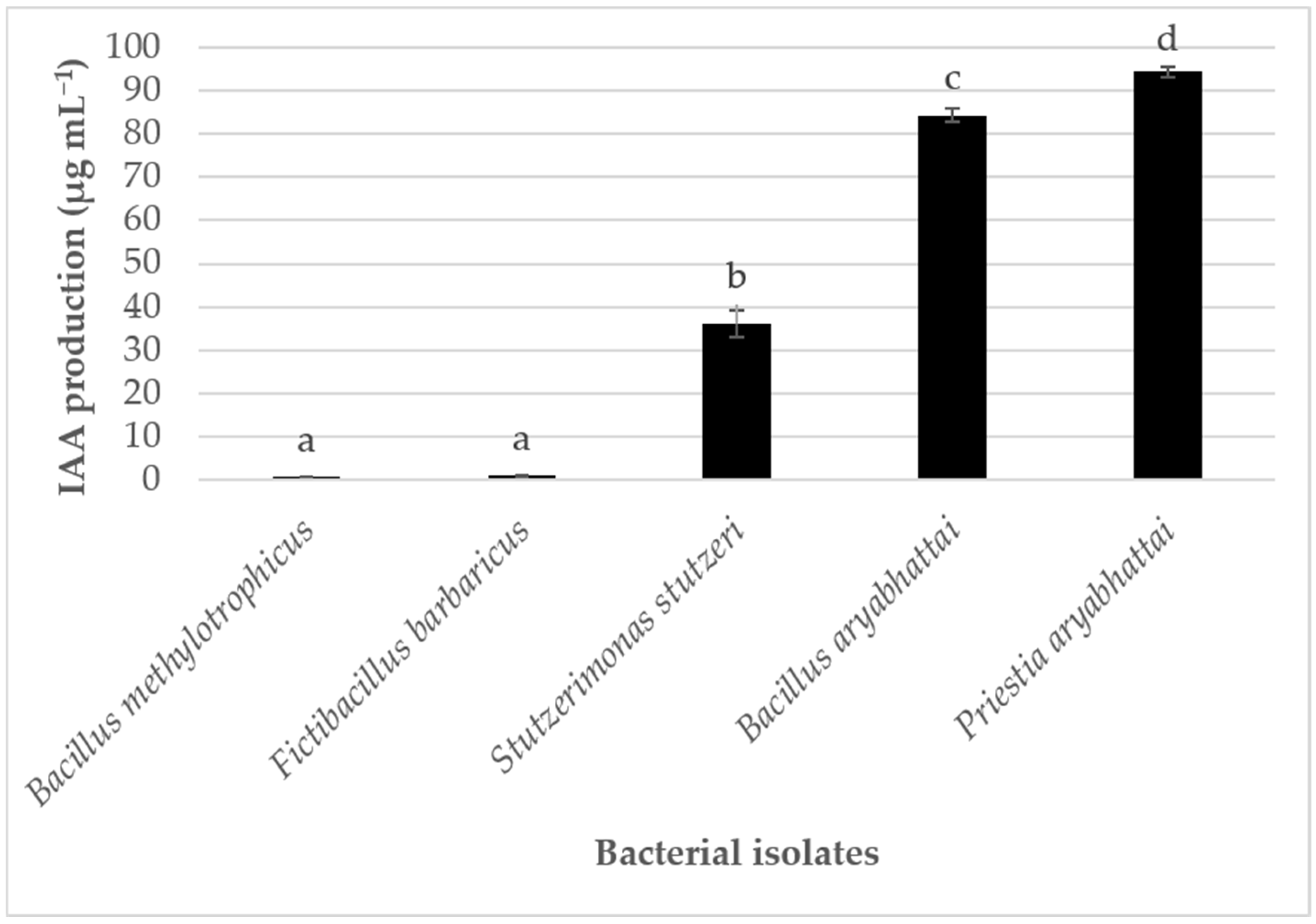
All bacterial isolates were able to produce indole-3-acetic acid (IAA). The maximum IAA production was observed in Priestia aryabhattai, which produced 94.43 µg mL−1 of IAA. Bacillus aryabhattai also exhibited high IAA production (84.43 µg mL−1), while Stutzerimonas stutzeri produced a moderate amount of IAA (36.11 µg mL−1). Lower levels of IAA production were observed in Fictibacillus barbaricus and Bacillus methylotrophicus, which produced 0.99 and 0.60 µg mL−1, respectively (Figure 1).
Figure 1.
Indole-3-acetic acid (IAA) production by all five bacterial isolates. Bars represent the mean IAA concentration produced by each bacterial isolate, with error bars indicating standard deviation (n = 2). Means followed by common letters do not significantly differ among treatments according to Tukey’s HSD test (p ≤ 0.05).
3.2. Potassium Solubilization Activity
Qualitative screening of the bacterial isolates on Aleksandrov medium indicated that Bacillus methylotrophicus, Bacillus aryabhattai, and Priestia aryabhattai exhibited potassium-solubilizing activity as observed by the appearance of a clear halo zone around the bacterial colonies. On the contrary, no potassium solubilizing activity was observed in Fictibacillus barbaricus and Stutzerimonas stutzeri in the conditions tested.
3.3. Phosphate Solubilization Activity
Among all bacterial isolates evaluated, Bacillus methylotrophicus, Bacillus aryabhattai, and Priestia aryabhattai demonstrated phosphate-solubilizing activity on Pikovskaya’s agar medium. The phosphate solubilization index (PSI) of Priestia aryabhattai was observed to be highest throughout the experiment at 1.623, indicating superior phosphate-solubilizing capability. Bacillus aryabhattai showed moderate activity (PSI = 1.350), whereas Bacillus methylotrophicus showed the minimum phosphate-solubilizing activity amongst the positive isolates (PSI = 1.258). No phosphate solubilization was detected in Fictibacillus barbaricus and Stutzerimonas stutzeri.
3.4. Ammonia Production
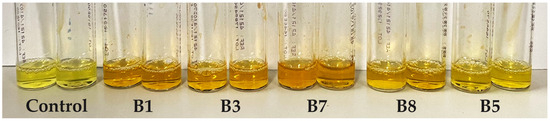
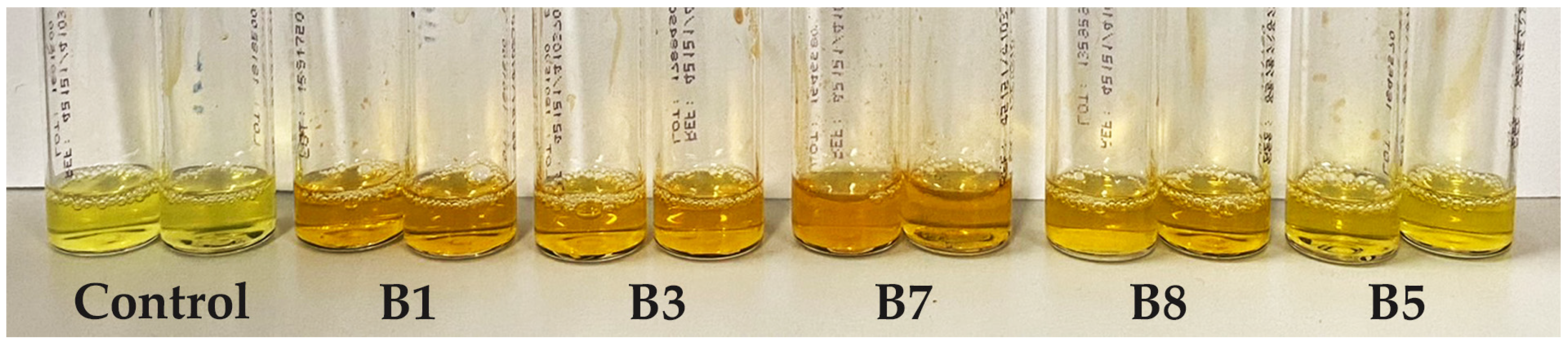
All bacterial isolates had the potential to produce ammonia. Bacillus methylotrophicus, Fictibacillus barbaricus, and Bacillus aryabhattai exhibited the maximum ammonia production. The results were confirmed by the change in the color of the medium in Figure 2, from yellow to orange-brown, indicating positive production of ammonia.
Figure 2.
Ammonia production of all bacteria following reaction with Nessler’s reagent, B1 (Bacillus methylotrophicus), B3 (Fictibacillus barbaricus), B7 (Bacillus aryabhattai), B8 (Priestia aryabhattai), and B5 (Stutzerimonas stutzeri) compared to the control (uninoculated medium).
3.5. Nitrogen Fixation Ability
All bacterial isolates grew on Jensen’s modified nitrogen-free medium, indicating their capacity to fix nitrogen from the atmosphere. All bacteria showed growth after incubation, and no limitation of growth was observed due to the absence of a combined nitrogen source in the medium. The results indicated that all bacterial isolates are able to perform nitrogen fixation and therefore contribute to the availability of nitrogen in the plant rhizosphere.
3.6. Effects of Bacterial Isolates on Germination of Tomato Seeds and Seedling Development
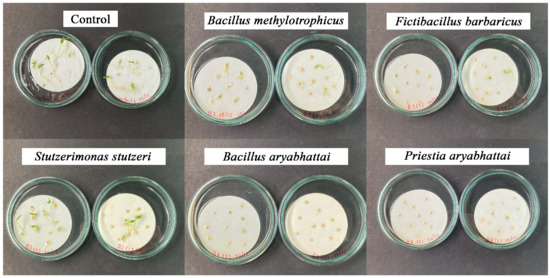
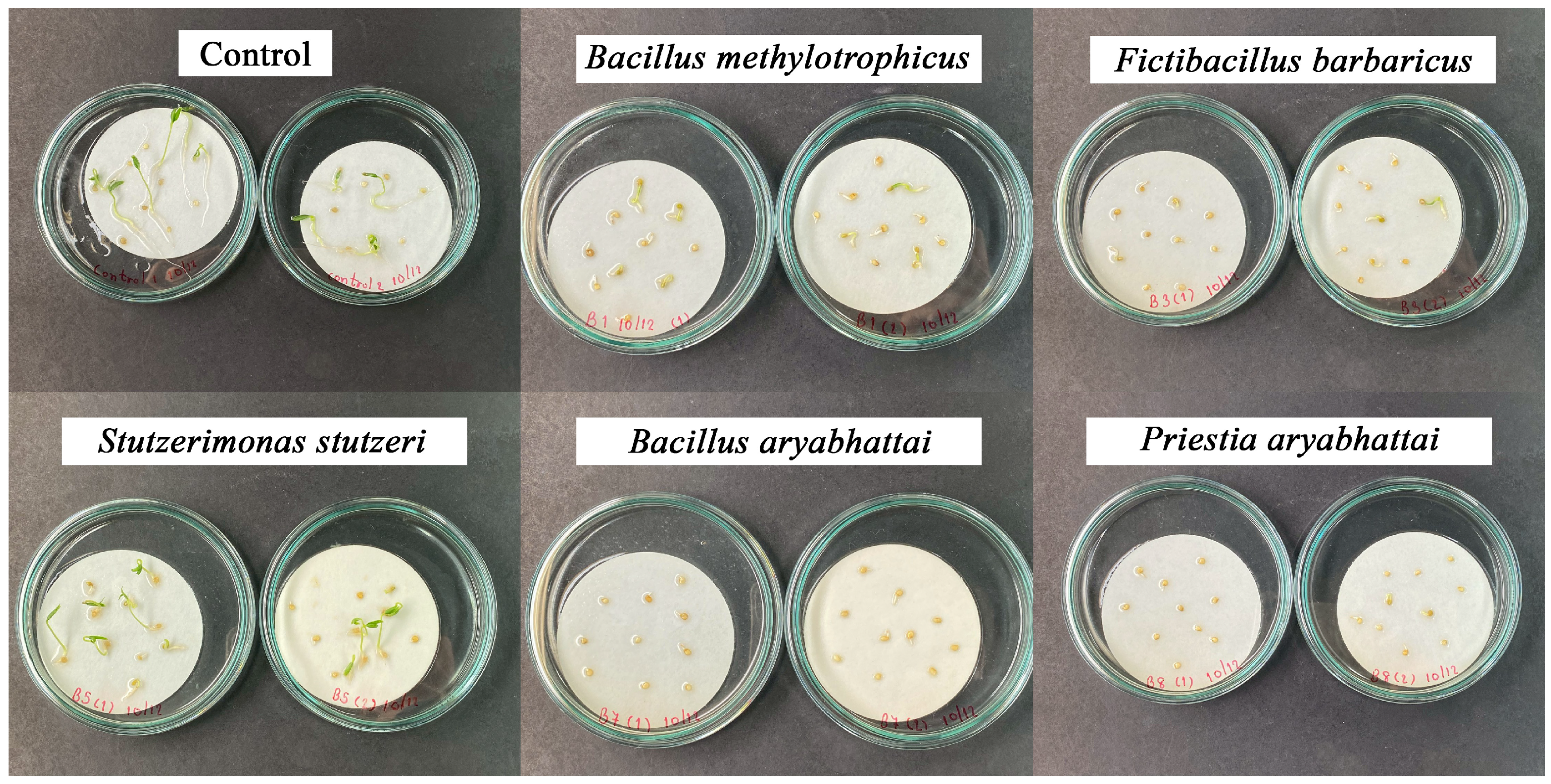
The effects of all five bacteria on tomato seed germination and early seedling development demonstrated that all bacteria influenced seed germination and seedling development at different levels (Table 1 and Figure 3). The highest germination percentage was shown in seeds treated with Stutzerimonas stutzeri (95%), followed by Bacillus methylotrophicus (90%) and Fictibacillus barbaricus (80%), whereas the germination percentage in the control treatment was 55%. On the contrary, Bacillus aryabhattai and Priestia aryabhattai had lower germination percentages of 35% and 40%, respectively.
Table 1.
Interactive effect of all five bacteria on the germination percentage, seedling shoot length, and fresh weight of tomato.
Figure 3.
Tomato seed germination after 7 days of incubation under the six experimental treatments (control and five bacterial isolates).
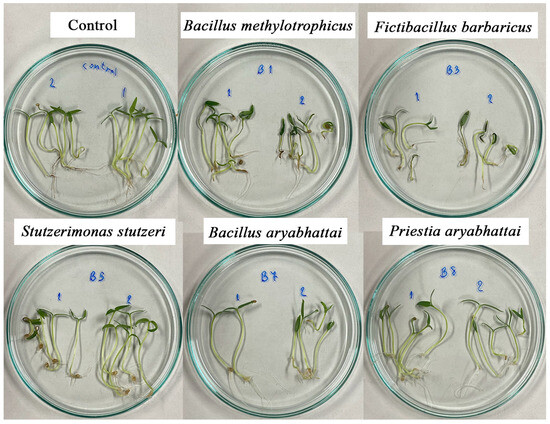
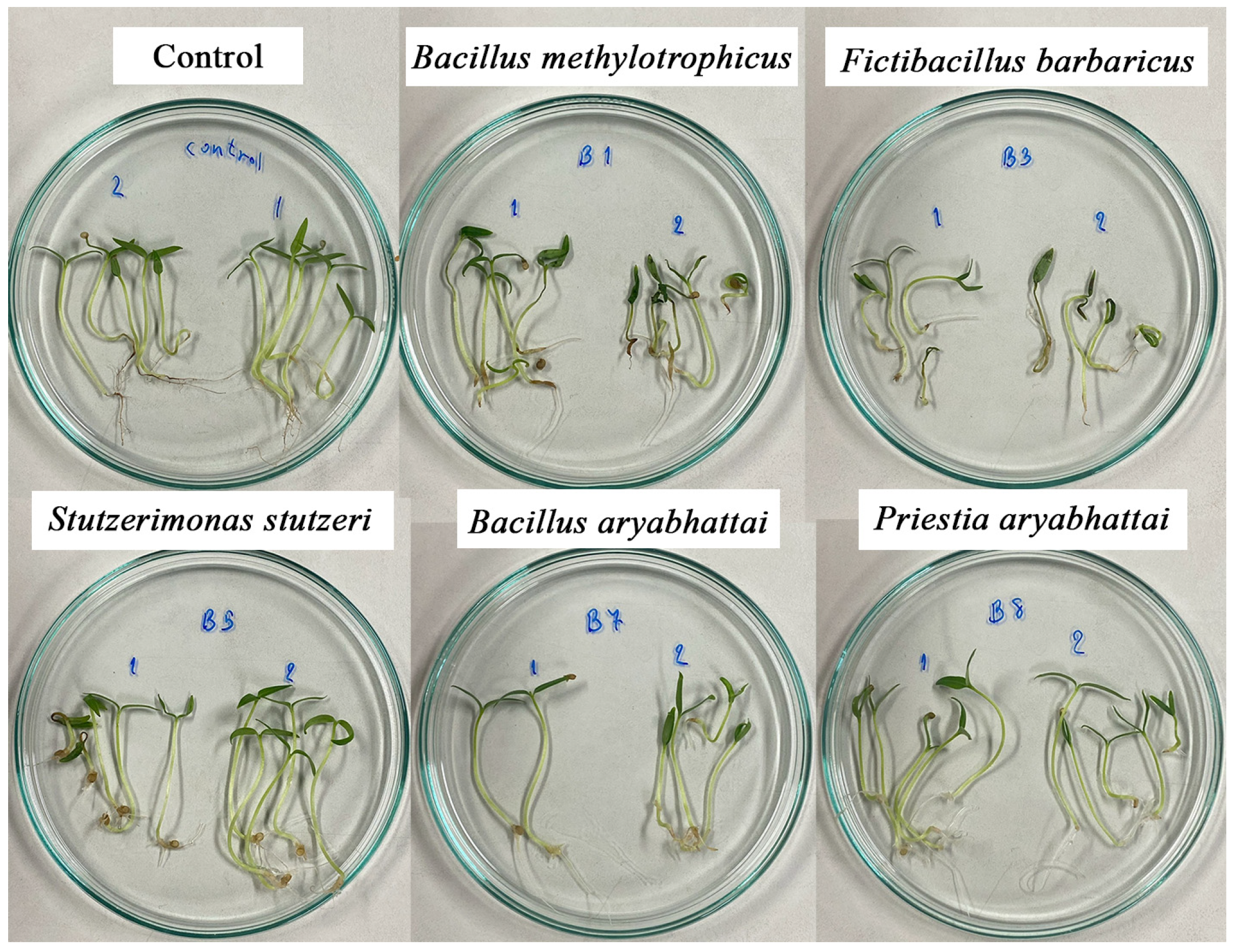
Seedling shoot length was also varied among treatments (Table 1 and Figure 4). The longest shoots were observed in seedlings inoculated with Stutzerimonas stutzeri (3.67 cm), followed by Priestia aryabhattai (3.55 cm) and control treatment (3.53 cm). Bacillus methylotrophicus and Fictibacillus barbaricus significantly increased germination percentage but had lower shoot length than the control. The results suggest that Stutzerimonas stutzeri has the most potential to improve the germination of tomato seeds and the early growth of seedlings.
Figure 4.
Tomato seedlings after 14 days of growth on MS medium without sucrose inoculated with the control and five bacterial isolates.
The result of fresh weight also showed the growth-promoting effect of Stuzerimonas stutzeri (Table 1 and Figure 4). Seedlings treated with Stutzerimonas stutzeri showed the maximum fresh weight (0.185 g) and it was greater than the uninoculated control. This finding indicates that Stutzerimonas stutzeri enhanced overall seedling vigor and biomass production in the early stages of tomato development.
4. Discussion
These findings revealed that bacterial isolates obtained from AMF (Funneliformis mosseae) spores are known to promote plant development through a range of direct and indirect mechanisms, including phytohormone production, nutrient solubilization, ammonia production, nitrogen fixation, and enhancing the availability of nutrients in the rhizosphere [17,32,33]. In the present study, all five bacterial isolates exhibited at least one plant growth-promoting trait, suggesting their capacity to serve as beneficial microorganisms for tomato cultivation.
Among the tested bacterial isolates, Priestia aryabhattai produced the highest amount of indole-3-acetic acid (IAA), followed by Bacillus aryabhattai and Stutzerimonas stutzeri. IAA is one of the most important phytohormones produced by plant growth-promoting bacteria and is essential for root development, root initiation and cell elongation [34]. The ability of these isolates to synthesize IAA indicated that they promote plant growth by influencing the root architecture, thereby increasing the capacity of plants to absorb water and nutrients [34]. Similar findings were reported for rhizosphere-associated bacteria promoting plant growth through auxin production [35]; Priestia aryabhattai was isolated from rhizosphere soil with IAA production at 69 µg mL−1.
However, Priestia aryabhattai had the highest yield of IAA but did not produce the highest percentage of germination, indicating that seed germination is not only affected by IAA production but also by other physiological and biochemical factors [36]. The effects of bacterial inoculation on seed germination and early seedling development are influenced by factors such as bacterial strain, host plant genotype, environmental conditions, and the local concentration and availability of phytohormones [16]. Furthermore, the IAA quantified in the present study was measured in bacterial culture under laboratory conditions and does not provide direct evidence that bacteria synthesized IAA in the seed microenvironment during germination. Therefore, the observed effects on tomato seed germination were likely the result of the combined action of several plant growth-promoting mechanisms, including nutrient mobilization through phosphate and potassium solubilization, ammonia production, nitrogen fixation, and other bacteria–plant interactions, rather than IAA alone [37,38]. Similar findings have been reported in recent studies demonstrating that beneficial bacteria may enhance seedling vigor and early plant development even when improvements in germination percentage are not directly correlated with in vitro IAA production [16,38].
Moreover, the concentration of IAA quantified in bacterial culture should not be interpreted as the concentration to which the seedlings were exposed during the co-cultivation assay. The IAA assay was performed in LB broth supplemented with L-tryptophan under conditions optimized for bacterial IAA production, whereas the seedling growth assay was conducted on sucrose-free MS medium under different nutritional and environmental conditions [39]. Consequently, the actual concentration of bacterially produced IAA in the seed microenvironment was likely much lower than the in vitro value and was further influenced by diffusion, bacterial metabolism, plant uptake, and degradation [40]. These factors may have prevented the accumulation of IAA to inhibitory concentrations, thereby explaining the absence of auxin-induced growth inhibition or morphological abnormalities in tomato seedlings [40].
Phosphorus and potassium are essential macronutrients needed for the growth and development of various plants [41]. Potassium is involved in enzyme activation, osmoregulation, and photosynthesis, while phosphorus is essential for energy transfer, nucleic acid synthesis, and root growth [42]. In this study, Bacillus methylotrophicus, Bacillus aryabhattai, and Priestia aryabhattai demonstrated both potassium and phosphate solubilizing abilities. Among these isolates, Priestia aryabhattai exhibited the highest phosphate solubilization index, which indicates the potential to mobilize insoluble phosphorus into plant available forms. These results are consistent with previous studies, demonstrating that phosphate and potassium solubilizing bacteria can improve nutrient availability and stimulate plant growth in nutrient-limited environments [43,44].
All the bacterial isolates could produce ammonia and grow on nitrogen-free medium, indicating their potential role in nitrogen cycling in the rhizosphere. Ammonia production is considered an important plant growth-promoting trait because it can increase nitrogen availability to plants and improve nutrient acquisition [45,46]. Furthermore, the capacity of all bacterial isolates to grow on Jensen’s modified nitrogen-free medium indicates their potential nitrogen-fixing capability. One useful approach is biological nitrogen fixation, where beneficial bacteria help plant nutrition and reduce dependency on synthetic nitrogen fertilizers [47,48]. The presence of these traits further supports the potential application of the tested bacterial isolates as bioinoculants for sustainable crop production.
The results of the seed germination assay showed that Stutzerimonas stutzeri significantly promoted tomato seed germination and early seedling growth. Seeds treated with Stutzerimonas stutzeri achieved the highest germination percentage (95%), maximum shoot length (3.67 cm), and maximum fresh weight (0.185 g) among all treatments. These results suggest that Stutzerimonas stutzeri has effective plant growth-promoting traits that promote rapid seed germination and vigorous seedling development. Previous studies have shown that production of phytohormones, nutrient mobilization, and improved nutrient acquisition during early plant development by beneficial bacteria is responsible for enhanced seed germination [49]. In the present study, tomato seedlings were grown on Murashige and Skoog (MS) medium, which provides readily available mineral nutrients. Therefore, the enhanced seedling growth observed following inoculation with Stutzerimonas stutzeri is more likely attributable to bacterial phytohormone production and other plant growth-promoting activities than to nutrient mobilization alone. Previously, the growth promotion of tomato seedlings by Stutzerimonas stutzeri was reported in line with the results of the present study. Li, Xue, Yan, Shen, Yang, Fan, Zhang, Shen and Gao [50] have reported that Stutzerimonas stutzeri enhanced seedling growth and improved plant development through its plant growth-promoting activities. Although this in vitro system provided a controlled environment for evaluating the direct effects of bacteria, further studies under greenhouse or field conditions are needed to confirm their effectiveness under natural soil environments.
Although Bacillus aryabhattai resulted in the lowest germination percentage, it promoted relatively greater shoot length and fresh weight in the germinated tomato seedlings. This finding suggests that the effects of plant growth-promoting bacteria on seed germination and subsequent seedling growth may involve different physiological mechanisms [51,52]. Despite the probability that this isolate had no effect on the germination process, it may have enhanced post-germination growth through the production of phytohormones such as indole-3-acetic acid (IAA), improved nutrient availability through phosphate and potassium solubilization, or enhanced nitrogen acquisition [39,53]. Similar observations have been reported in previous studies, where plant growth-promoting bacteria stimulated seedling vigor and biomass accumulation without necessarily increasing germination percentage, indicating that bacterial effects can be growth-stage dependent [39,51].
Interestingly, the isolate exhibiting the highest IAA production was not the isolate that produced the greatest germination percentage or seedling biomass. This observation suggests that the successful seed germination and early seedling establishment are not only attributed to the production of auxin but also to the combined effects of multiple plant growth-promoting mechanisms. The interaction among phytohormone production, nutrient mobilization, nitrogen fixation, and other beneficial activities likely determines the overall effectiveness of bacteria in promoting plant growth. Similar conclusions have been reported for plant growth-promoting bacteria, where strains with multiple growth-promoting traits generally provide more benefits than strains depending on a single mechanism [39].
Overall, the results demonstrate that the bacterial isolates have several beneficial traits related to plant growth promotion. Among the isolates tested, Stutzerimonas stutzeri had the highest potential to improve tomato seed germination and seedling vigor, while Priestia aryabhattai exhibited superior IAA production and nutrient-solubilizing activities. These findings suggest that bacterial isolated from arbuscular mycorrhizal fungi could be potential bioinoculants for improving tomato production and supporting sustainable agricultural practices.
A limitation of the present study is that the experiments were conducted as single independent laboratory trials under controlled in vitro conditions. Although appropriate biological samples and technical replicates were included within each assay, additional independent experiments are required to further confirm the reproducibility of the observed effects. Furthermore, greenhouse and field studies are necessary to evaluate the performance of these bacterial strains under practical cultivation conditions.
5. Conclusions
This study demonstrated that all five bacterial isolated from arbuscular mycorrhizal fungal spores possess several plant growth-promoting traits, such as indole-3-acetic acid (IAA) production, phosphate and potassium solubilization, ammonia production, and nitrogen-fixing potential. All bacteria exhibited at least one positive plant growth-promoting trait. Stutzerimonas stutzeri showed the greatest potential for enhancing tomato (Solanum lycopersicum L.) seed germination and early seedling growth, resulting in the highest germination percentage, shoot length, and fresh weight. However, Priestia aryabhattai exhibited the highest IAA production and phosphate-solubilizing activity, indicating strong plant growth-promoting capabilities.
These findings highlight the importance of several processes such as enhanced nutrient availability and phytohormone production that influence the beneficial effects of bacteria on tomato development. The results demonstrate the potential of bacteria as environmentally friendly bioinoculants for improving tomato seed germination and early seedling development. The application of selected bacterial strains could contribute to sustainable tomato production by enhancing plant growth and reducing the reliance on chemical fertilizers. Further studies under greenhouse and field conditions are recommended to evaluate the long-term effectiveness of these bacteria and their interactions with arbuscular mycorrhizal fungi.
Author Contributions
Conceptualization, S.S. and W.S.; methodology, W.S. and A.M.; software, S.S.; validation, S.S., W.S. and A.M.; formal analysis, S.S.; investigation, S.S.; resources, W.S.; data curation, W.S. and A.M.; writing—original draft preparation, S.S. and W.S.; writing—review and editing, S.S.; visualization, W.S.; supervision, S.S.; project administration, S.S.; funding acquisition, S.S. All authors have read and agreed to the published version of the manuscript.
Funding
This research was funded under Undergraduate Research Matching Fund (URMF) and International SciKU Branding (ISB), Faculty of Science, Kasetsart University.
Institutional Review Board Statement
Not applicable.
Informed Consent Statement
Not applicable.
Data Availability Statement
Data is contained within the article. The original contributions presented in this study are included in the article. Further inquiries can be directed to the corresponding author.
Acknowledgments
The authors would like to thank the technicians of the Department of Microbiology, Faculty of Science, Kasetsart University, for their role in facilitating the conduction of this study.
Conflicts of Interest
The authors declare no conflicts of interest.
References
- Bortolot, M.; Buffoni, B.; Mazzarino, S.; Hoff, G.; Martino, E.; Fiorilli, V.; Salvioli Di Fossalunga, A. The importance of mycorrhizal fungi and their associated bacteria in promoting crops’ performance: An applicative perspective. Horticulturae 2024, 10, 1326. [Google Scholar] [CrossRef] [Scilit]
- Farhaoui, A.; Taoussi, M.; Laasli, S.-E.; Legrifi, I.; El Mazouni, N.; Meddich, A.; Hijri, M.; Lahlali, R. Arbuscular mycorrhizal fungi and their role in plant disease control: A state-of-the-art. Microbe 2025, 8, 100438. [Google Scholar] [CrossRef] [Scilit]
- Smith, S.E.; Jakobsen, I.; Grønlund, M.; Smith, F.A. Roles of arbuscular mycorrhizas in plant phosphorus nutrition: Interactions between pathways of phosphorus uptake in arbuscular mycorrhizal roots have important implications for understanding and manipulating plant phosphorus acquisition. Plant Physiol. 2011, 156, 1050–1057. [Google Scholar] [CrossRef] [Scilit] [PubMed]
- Begum, N.; Qin, C.; Ahanger, M.A.; Raza, S.; Khan, M.I.; Ahmed, N.; Ashraf, M.; Zhang, L. Role of Arbuscular Mycorrhizal Fungi in Plant Growth Regulation: Implications in Abiotic Stress Tolerance. Front. Plant Sci. 2019, 10, 1068. [Google Scholar] [CrossRef] [Scilit] [PubMed]
- Rillig, M.C. Arbuscular mycorrhizae, glomalin, and soil aggregation. Can. J. Soil Sci. 2004, 84, 355–363. [Google Scholar] [CrossRef] [Scilit]
- Agnolucci, M.; Grassi, A.; Giovannetti, M.; Lastovetsky, O.A. Bacteria associated with spores of arbuscular mycorrhizal fungi: A review. Biol. Fertil. Soils 2026, 62, 411–425. [Google Scholar] [CrossRef] [Scilit]
- Iffis, B.; St-Arnaud, M.; Hijri, M. Bacteria associated with arbuscular mycorrhizal fungi within roots of plants growing in a soil highly contaminated with aliphatic and aromatic petroleum hydrocarbons. FEMS Microbiol. Lett. 2014, 358, 44–54. [Google Scholar] [CrossRef] [Scilit] [PubMed]
- Frey-Klett, P.; Garbaye, J.; Tarkka, M. The mycorrhiza helper bacteria revisited. New Phytol. 2007, 176, 22–36. [Google Scholar] [CrossRef] [Scilit] [PubMed]
- Bonfante, P.; Anca, I.-A. Plants, mycorrhizal fungi, and bacteria: A network of interactions. Annu. Rev. Microbiol. 2009, 63, 363–383. [Google Scholar] [CrossRef] [Scilit] [PubMed]
- Artursson, V.; Finlay, R.D.; Jansson, J.K. Interactions between arbuscular mycorrhizal fungi and bacteria and their potential for stimulating plant growth. Environ. Microbiol. 2006, 8, 1–10. [Google Scholar] [PubMed]
- Schütz, L.; Gattinger, A.; Meier, M.; Müller, A.; Boller, T.; Mäder, P.; Mathimaran, N. Improving crop yield and nutrient use efficiency via biofertilization—A global meta-analysis. Front. Plant Sci. 2018, 8, 2204. [Google Scholar] [CrossRef] [Scilit] [PubMed]
- Espinosa-Antón, A.A.; Hernández-Herrera, R.M.; Velasco-Ramírez, S.F.; Ramírez-Anguiano, A.C.; Salcedo-Pérez, E. Productivity and quality characteristics of tomato Fruits (Solanum lycopersicum) are improved by the application of a green seaweed (Ulva ohnoi). Agriculture 2025, 15, 750. [Google Scholar] [CrossRef] [Scilit]
- Bergougnoux, V. The history of tomato: From domestication to biopharming. Biotechnol. Adv. 2014, 32, 170–189. [Google Scholar] [CrossRef] [Scilit] [PubMed]
- Raiola, A.; Rigano, M.M.; Calafiore, R.; Frusciante, L.; Barone, A. Enhancing the health-promoting effects of tomato fruit for biofortified food. Mediat. Inflamm. 2014, 2014, 139873. [Google Scholar] [CrossRef] [Scilit] [PubMed]
- Rahman, M.S.; Acharjee, D.C. Impact of Off-Season Summer Tomato Cultivation on Income and Food Security of the Growers; IntechOpen: London, UK, 2020. [Google Scholar]
- Pappalettere, L.; Bartolini, S.; Toffanin, A. Enhancement of tomato seed germination and growth parameters through seed priming with auxin-producing plant growth promoting bacteria strains. Seeds 2024, 3, 479–492. [Google Scholar] [CrossRef] [Scilit]
- Guan, S.; Shao, X.; Liu, R.; Ge, J.; Song, G.; Yang, Z. Interactions Between Mycorrhizal Fungi and Mycorrhiza Helper Bacteria: Mechanisms, Ecological Functions, and Potential Applications in Sustainable Agriculture and Ecological Restoration. Sustainability 2026, 18, 5643. [Google Scholar] [CrossRef] [Scilit]
- Pérez-Montaño, F.; Aparicio, N.; Arenas, F.; Arjona, J.M.; Camacho, M.; Fernández-García, N.; García-Fraile, P.; Goicoechea, N.; Macías-Naranjo, S.; Matías, J. Emerging crops and plant growth-promoting bacteria (PGPB): A synergistic approach to climate-resilient agriculture. Microbiome 2025, 13, 228. [Google Scholar] [CrossRef] [Scilit] [PubMed]
- Pantigoso, H.A.; Newberger, D.; Vivanco, J.M. The rhizosphere microbiome: Plant–microbial interactions for resource acquisition. J. Appl. Microbiol. 2022, 133, 2864–2876. [Google Scholar] [CrossRef] [Scilit] [PubMed]
- Mungsachat, A.; Kalee, H.H.H.A.; Daud, M.F.; Suchitwarasan, S. Effects of Funneliformis mosseae and Mycorrhiza Helper Bacteria on Growth Enhancement of Rice (Oryza sativa L.) under a Hydroponic Cultivation System. J. Pure Appl. Microbiol. 2026. [Google Scholar] [CrossRef] [Scilit]
- Glickmann, E.; Dessaux, Y. A critical examination of the specificity of the Salkowski reagent for indolic compounds produced by phytopathogenic bacteria. Appl. Environ. Microbiol. 1995, 61, 793–796. [Google Scholar] [CrossRef] [Scilit] [PubMed]
- Pantoja-Guerra, M.; Burkett-Cadena, M.; Cadena, J.; Dunlap, C.A.; Ramírez, C.A. Lysinibacillus spp.: An IAA-producing endospore forming-bacteria that promotes plant growth. Antonie Leeuwenhoek 2023, 116, 615–630. [Google Scholar] [CrossRef] [Scilit] [PubMed]
- Setiawati, T.C.; Mutmainnah, L. Solubilization of potassium containing mineral by microorganisms from sugarcane rhizosphere. Agric. Agric. Sci. Procedia 2016, 9, 108–117. [Google Scholar] [CrossRef] [Scilit]
- Etesami, H.; Emami, S.; Alikhani, H.A. Potassium solubilizing bacteria (KSB): Mechanisms, promotion of plant growth, and future prospects A review. J. Soil Sci. Plant Nutr. 2017, 17, 897–911. [Google Scholar] [CrossRef] [Scilit]
- Leiva-Mora, M.; Mera Guzmán, P.E.; Mera-Andrade, R.I.; Zabala Haro, A.M.; Saa, L.R.; Loján, P.; Silva Agurto, C.L.; Salazar-Garcés, L.F.; González Osorio, B.B.; Cabrera Mederos, D. Isolation and Characterization of Phosphate-Solubilizing Rhizobacteria from Solanum tuberosum with Plant Growth-Promoting Activity. Appl. Microbiol. 2026, 6, 8. [Google Scholar] [CrossRef] [Scilit]
- Kumar, V.; Chourasia, H.K.; Rajani, K.; Kumar, R.R. Exploration and characterization of high-efficiency phosphate-solubilizing bacteria isolates from chickpea rhizospheric soil. Int. J. Bio-Resour. Stress Manag. 2024, 15, 1–9. [Google Scholar] [CrossRef] [Scilit]
- Gohil, R.B.; Raval, V.H.; Panchal, R.R.; Rajput, K.N. Plant growth-promoting activity of Bacillus sp. PG-8 isolated from fermented panchagavya and its effect on the growth of Arachis hypogea. Front. Agron. 2022, 4, 805454. [Google Scholar] [CrossRef] [Scilit]
- Hiranmayee, G.; Marik, D.; Sadhukhan, A.; Reddy, G.S. Isolation of plant growth-promoting rhizobacteria from the agricultural fields of Tattiannaram, Telangana. J. Genet. Eng. Biotechnol. 2023, 21, 159. [Google Scholar] [CrossRef] [Scilit] [PubMed]
- Khaliluev, M.R.; Bogoutdinova, L.R.; Raldugina, G.N.; Baranova, E.N. A simple and effective bioassay method suitable to comparative in vitro study of tomato salt tolerance at early development stages. Methods Protoc. 2022, 5, 11. [Google Scholar] [CrossRef] [Scilit] [PubMed]
- Domingues Neto, F.J.; Carneiro, D.C.d.S.; Putti, F.F.; Rodrigues, J.D.; Tecchio, M.A.; Leonel, S.; Silva, M.d.S. Physiological indexes in seed germination and seedling growth of Rangpur lime (Citrus limonia L. Osbeck) under plant growth regulators. Agronomy 2024, 14, 2066. [Google Scholar] [CrossRef] [Scilit]
- Murashige, T.; Skoog, F. A Revised Medium for Rapid Growth and Bio Assays with Tobacco Tissue Cultures. Physiol. Plant. 1962, 15, 473–497. [Google Scholar] [CrossRef] [Scilit]
- Sangwan, S. Regulatory role of arbuscular mycorrhiza fungi and helper bacteria associations in P and N dynamics in agriculture. Adv. Microbiol. Res. 2023, 6, 026. [Google Scholar] [CrossRef] [Scilit] [PubMed]
- Nasslahsen, B.; Prin, Y.; Ferhout, H.; Smouni, A.; Duponnois, R. Mycorrhizae helper bacteria for managing the mycorrhizal soil infectivity. Front. Soil Sci. 2022, 2, 979246. [Google Scholar] [CrossRef] [Scilit]
- Etesami, H.; Glick, B.R. Bacterial indole-3-acetic acid: A key regulator for plant growth, plant-microbe interactions, and agricultural adaptive resilience. Microbiol. Res. 2024, 281, 127602. [Google Scholar] [CrossRef] [Scilit] [PubMed]
- Phringpaen, W.; Aiedhet, W.; Thitithanakul, S.; Kanjanasopa, D. Ability of phosphate-solubilizing bacteria to enhance the growth of rice in phosphorus-deficient soils. Trends Sci. 2023, 20, 7032. [Google Scholar] [CrossRef] [Scilit]
- Hnini, M.; Rabeh, K. The power of plant growth-promoting rhizobacteria: A systematic review on sustainable pathogen management in tomato crops. Physiol. Mol. Plant Pathol. 2025, 139, 102828. [Google Scholar] [CrossRef] [Scilit]
- Sangwan, S.; Prasanna, R. Mycorrhizae helper bacteria: Unlocking their potential as bioenhancers of plant–arbuscular mycorrhizal fungal associations. Microb. Ecol. 2022, 84, 1–10. [Google Scholar] [CrossRef] [Scilit] [PubMed]
- El Hjouji, H.; Qessaoui, R.; Chafiki, S.; Mayad, E.H.; Houmairi, H.; Dari, K.; Bencharki, B.; Aassila, H. Enhancement of Tomato Growth Through Rhizobacteria and Biocontrol of Associated Diseases. Life 2025, 15, 997. [Google Scholar] [CrossRef] [Scilit] [PubMed]
- Backer, R.; Rokem, J.S.; Ilangumaran, G.; Lamont, J.; Praslickova, D.; Ricci, E.; Subramanian, S.; Smith, D.L. Plant growth-promoting rhizobacteria: Context, mechanisms of action, and roadmap to commercialization of biostimulants for sustainable agriculture. Front. Plant Sci. 2018, 9, 402666. [Google Scholar] [CrossRef] [Scilit] [PubMed]
- Olanrewaju, O.S.; Glick, B.R.; Babalola, O.O. Mechanisms of action of plant growth promoting bacteria. World J. Microbiol. Biotechnol. 2017, 33, 197. [Google Scholar] [CrossRef] [Scilit] [PubMed]
- Islam, M.M.; Li, L.; He, J.; Naznin, A.; Huda, S.; Ahemd, T.; Tissue, D.; Chen, Z.H. Decoding plant metabolomic response to potassium and nutrient stresses in controlled environments. Physiol. Plant. 2025, 177, e70547. [Google Scholar] [CrossRef] [Scilit] [PubMed]
- Hasanuzzaman, M.; Bhuyan, M.B.; Nahar, K.; Hossain, M.S.; Mahmud, J.A.; Hossen, M.S.; Masud, A.A.C.; Moumita; Fujita, M. Potassium: A vital regulator of plant responses and tolerance to abiotic stresses. Agronomy 2018, 8, 31. [Google Scholar] [CrossRef] [Scilit]
- Bakhshandeh, E.; Pirdashti, H.; Lendeh, K.S. Phosphate and potassium-solubilizing bacteria effect on the growth of rice. Ecol. Eng. 2017, 103, 164–169. [Google Scholar] [CrossRef] [Scilit]
- Nawaz, A.; Qamar, Z.U.; Marghoob, M.U.; Imtiaz, M.; Imran, A.; Mubeen, F. Contribution of potassium solubilizing bacteria in improved potassium assimilation and cytosolic K+/Na+ ratio in rice (Oryza sativa L.) under saline-sodic conditions. Front. Microbiol. 2023, 14, 1196024. [Google Scholar] [CrossRef] [Scilit] [PubMed]
- Yang, Z.; Yan, H.; Liu, H.; Yang, L.; Mi, G.; Wang, P. Enhancing crop nitrogen efficiency: The role of mixed nitrate and ammonium supply in plant growth and development. Biology 2025, 14, 546. [Google Scholar] [CrossRef] [Scilit] [PubMed]
- AlAli, H.A.; Khalifa, A.; Almalki, M. Plant growth-promoting rhizobacteria from Ocimum basilicum improve growth of Phaseolus vulgaris and Abelmoschus esculentus. S. Afr. J. Bot. 2021, 139, 200–209. [Google Scholar] [CrossRef] [Scilit]
- Guo, K.; Yang, J.; Yu, N.; Luo, L.; Wang, E. Biological nitrogen fixation in cereal crops: Progress, strategies, and perspectives. Plant Commun. 2023, 4, 100499. [Google Scholar] [CrossRef] [Scilit] [PubMed]
- Reis, V.M.; Teixeira, K.R.d.S. Nitrogen fixing bacteria in the family Acetobacteraceae and their role in agriculture. J. Basic Microbiol. 2015, 55, 931–949. [Google Scholar] [CrossRef] [Scilit] [PubMed]
- Yang, P.; Lu, L.; Condrich, A.; Muni, G.A.; Scranton, S.; Xu, S.; Xia, Y.; Huang, S. Innovative approaches for engineering the seed microbiome to enhance crop performance. Seeds 2025, 4, 24. [Google Scholar] [CrossRef] [Scilit]
- Li, L.; Xue, B.; Yan, S.; Shen, H.; Yang, Y.; Fan, Y.; Zhang, R.; Shen, W.; Gao, N. Stutzerimonas stutzeri culture enhances microbial community structure and tomato seedling growth in saline soil. J. Appl. Microbiol. 2025, 136, lxaf026. [Google Scholar] [CrossRef] [Scilit] [PubMed]
- Glick, B.R. Plant growth-promoting bacteria: Mechanisms and applications. Scientifica 2012, 2012, 963401. [Google Scholar] [CrossRef] [Scilit] [PubMed]
- Fiodor, A.; Ajijah, N.; Dziewit, L.; Pranaw, K. Biopriming of seed with plant growth-promoting bacteria for improved germination and seedling growth. Front. Microbiol. 2023, 14, 1142966. [Google Scholar] [CrossRef] [Scilit] [PubMed]
- Vessey, J.K. Plant growth promoting rhizobacteria as biofertilizers. Plant Soil 2003, 255, 571–586. [Google Scholar] [CrossRef] [Scilit]

Disclaimer/Publisher’s Note: The statements, opinions and data contained in all publications are solely those of the individual author(s) and contributor(s) and not of MDPI and/or the editor(s). MDPI and/or the editor(s) disclaim responsibility for any injury to people or property resulting from any ideas, methods, instructions or products referred to in the content. |
© 2026 by the authors. Licensee MDPI, Basel, Switzerland. This article is an open access article distributed under the terms and conditions of the Creative Commons Attribution (CC BY) license.