


Abstract
This study presents a comprehensive bibliometric analysis of research on 2xxx series aluminum–copper (Al–Cu) alloys published between 2020 and 2025. A complete analysis of 4380 documents from 747 sources indexed in Scopus reveals sustained research growth, with publications rising from 603 in 2020 to 948 in 2025 at a compound annual growth rate of 9.5%. China dominates global output, contributing 35.7% of publications with Central South University as the leading institution (548 articles). However, China’s international collaboration rate (12.2%) remains notably lower than Western counterparts such as the United Kingdom (62.5%) and Canada (53.2%). Core journals including the Journal of Alloys and Compounds, Materials Science and Engineering: A, and Journal of Materials Research and Technology collectively account for 11.4% of total publications, conforming to Bradford’s Law concentration patterns. Keyword co-occurrence analysis revealed five distinct thematic clusters centered on microstructure–property relationships, friction stir welding and joining technologies, corrosion mechanisms, Al–Cu–Li aerospace alloys, and additive manufacturing. While life cycle modeling (K = 5993; tm = 2022.84) indicates the field is approaching maturity, by identifying emerging frontiers such as machine learning-assisted alloy design, sustainable processing routes, and multi-material joining for electric vehicles, this study offers researchers a quantitative roadmap of the Al–Cu alloy knowledge landscape and highlights strategic opportunities for future investigation.
1. Introduction
The 2xxx series Al–Cu alloys are a family of age-hardenable aluminum alloys of technological relevance. They are known for their strength-to-weight ratios, fatigue resistance, and machinability. These alloys, which include copper as the main element (usually 2–6 wt%), show good mechanical properties because of precipitation hardening mechanisms involving θ’ (Al2Cu) and related metastable phases [1,2]. Since their initial development as “duralumin” in the early 20th century, Al–Cu alloys have remained indispensable in aerospace structures, automotive components, and high-performance engineering applications. However, modern alloy design strategies now seek to expand the property portfolio of these materials to meet contemporary lightweighting demands [3].
The strategic importance of 2xxx alloys continues to expand in the context of contemporary industrial challenges. The aerospace sector’s drive toward fuel efficiency demands lightweight structural materials with enhanced damage tolerance, requiring advanced anodizing treatments [4] and fundamental understanding of dealloying-driven corrosion mechanisms at intermetallic constituent particles [5]. The automotive industry’s electrification transition needs alloys that meet crash performance standards while reducing vehicle mass. Furthermore, emerging fabrication processes, particularly additive manufacturing (AM) and friction stir welding (FSW), have stimulated renewed research interest in understanding and optimizing Al–Cu alloy behavior under non-equilibrium processing conditions [6,7,8].
Recent advances in wire arc additive manufacturing (WAAM) and selective laser melting (SLM) have enabled the fabrication of complex Al–Cu alloy parts with enhanced mechanical properties [9,10]. Notably, laser-TIG hybrid additive manufacturing has achieved mechanical properties exceeding those of conventional SLM and arc-based methods [10]. However, challenges related to hot cracking susceptibility and microstructural control continue to drive intensive research efforts [7]. Concurrently, friction stir welding has emerged as a transformative joining technology for aluminum alloys, with cryogenic variants demonstrating enhanced joint properties in dissimilar material combinations [8]. The corrosion behavior of Al–Cu alloys, particularly intergranular corrosion associated with intermetallic constituent particles, remains an active research frontier with significant implications for aerospace applications, as evidenced by studies on precipitation-driven corrosion mechanisms in FSW joints [5,11].
A significant body of recent literature has focused on overcoming the traditional processability and durability limitations of Al–Cu alloys through advanced manufacturing and surface engineering. In the domain of AM, reviews by Shams et al. [12] and Farias et al. [13] highlight the critical role of process parameter optimization and hybrid techniques, such as directed energy deposition (DED) combined with interlayer mechanical deformation, in refining grain structures and mitigating cracking in high-strength aluminum alloys. Rodríguez-González et al. [14] further emphasize the specific challenges of WAAM for Al–Li alloys, noting the necessity of specialized wire compositions to control anisotropy and defects. Specific to solidification cracking, Wu et al. [15] provided a comprehensive review of scandium microalloying in Al–Cu alloys, demonstrating its effectiveness in forming coherent dispersoids that refine grains and enhance thermal stability.
For Al–Cu–Li alloys specifically, significant advances have been made in understanding precipitation behavior and property optimization. Wang et al. [16] conducted quantitative analysis of pre-treatment influences on microstructure evolution and mechanical properties during artificial aging of Al–Cu–Li–Mg–Ag alloys. Chen et al. [17] systematically studied heat treatment effects on microstructure and mechanical properties of extruded 2196 Al–Cu–Li alloy, while subsequent work revealed the texture and mechanical property anisotropy development [18]. The effect of Ag addition on age hardening and precipitation behavior in Al–Cu–Li–Mg–Zn–Mn–Zr alloys has been elucidated [19], and innovative two-step homogenization approaches for Al3Zr precipitation have improved recrystallization resistance [20]. Ma et al. [21] discovered a novel GP–Li precursor and correlated precipitation behaviors in Al–Cu–Li alloys with different Cu/Li ratios.
Parallel to manufacturing advances, novel characterization and joining techniques have emerged. Chawla et al. [22] reviewed the capabilities of 4D X-ray microcomputed tomography, a technique enabling time-resolved observation of dynamic material processes including corrosion fatigue and deformation mechanisms in Al alloys, with specific applications demonstrated for nanoscale deformation in Al–Cu systems. In the field of joining, Liu et al. [23] studied the FSW of fully annealed Al–Cu–Li alloys, reporting that solid solution strengthening and dynamic recrystallization in the nugget zone considerably influence tensile properties and joint hardness. Furthermore, Kou et al. [24] utilized in-situ micro-digital image correlation to elucidate damage evolution in 2195 Al–Li alloys, revealing that particle size and shape govern strain localization and fracture mechanisms.
Enhancing the environmental durability of these alloys remains a priority. Comprehensive reviews by Chen et al. [25] and Cui et al. [26] discuss strategies for improving intergranular corrosion resistance and high-temperature mechanical performance, respectively, pointing to grain boundary engineering and microalloying as key pathways. Ma et al. [27] fabricated enhanced active corrosion protection coatings incorporating mesoporous SiO2 nanoparticles with benzotriazole and 2-mercaptobenzothiazole inhibitors for AA2024-T3. Li et al. [28] developed self-healing epoxy coatings based on tung oil-containing microcapsules for corrosion protection applications. Regarding surface treatments, Gamba et al. [29] reviewed plasma electrolytic oxidation (PEO) for AA2024, noting its potential to replace environmentally hazardous processes while providing superior wear and corrosion resistance. Additionally, Caseri and Niederberger [30] proposed next-generation organic coatings based on poly(phenylene methylene) (PPM), which offer recyclable, self-healing, and fluorescent properties for easier inspection of aerospace components. Dagdag et al. [31] demonstrated epoxy coating formulations as effective anti-corrosive polymeric materials for multiple aluminum alloy substrates including 2024-T3, 5086, and 7075-T6.
The integration of machine learning and artificial intelligence into Al–Cu alloy research represents an emerging frontier. Adithiyaa et al. [32] demonstrated optimal prediction of process parameters using GWO-KNN algorithms for stirring-squeeze casting of AA2219 reinforced metal matrix composites. Mortazavi and Ince [33] developed artificial neural network modeling approaches for short and long fatigue crack propagation prediction. Jiang et al. [34] created a precise Deep Potential model for the Al–Cu–Mg alloy system in full concentration space, combining first-principles accuracy with empirical potential efficiency. These data-driven approaches are increasingly complementing traditional experimental methods.
Despite the extensive body of research on Al–Cu alloys, evidenced by recent broad technical reviews on performance enhancement of composites [35,36] and additive manufacturing processes for 2xxx series Al–Cu alloys [37,38], no comprehensive bibliometric mapping of this knowledge domain has been conducted for the recent period (2020–2025). Qualitative surveys work well for summarizing sub-topics like FSW or precipitation hardening, but they do not have the necessary statistics to show overall collaboration networks and publication rates. The bibliometric analysis gives a way to systematically and quantitatively assess the research output. It pinpoints key studies, charts collaboration, and spots new trends. This kind of analysis helps locate research voids, see how productive different places and institutions are, and plan research strategies. The current analysis explores the publication trends and growth in 2xxx series Al–Cu alloy research over time, which countries, institutions, and authors are most productive and influential, the main journals publishing in this area, the main topics and new research areas right now, and how international collaborations shape the global research effort. The principal contribution of this study is a comprehensive, quantitative synthesis of the latest (2020–2025) stage of Al–Cu alloy research, providing the first systematic, temporally resolved mapping of the 2xxx series during the current transition toward additive manufacturing and sustainable processing. While bibliometric and quantitative mapping approaches have been applied to additive manufacturing (AM) of superalloys [39] and to process-level optimization in AM [40,41], existing Al-alloy reviews focus qualitatively on laser powder bed fusion [42], high-temperature alloy development [43], or sustainability in aluminum AM more broadly [44], without a dedicated, time-resolved bibliometric analysis of 2xxx (Al–Cu) alloys. No prior study has combined life cycle modeling, thematic clustering, and international collaboration network analysis to map the evolving research landscape of this specific alloy type.
This work aims to give a full quantitative view of Al–Cu alloy research. It will locate the most important publications and topics, map how research subjects have changed over time, and suggest future research paths. Using bibliometric methods like Bradford’s Law, Lotka’s Law, co-word analysis, and network visualization, this study gives a structured look that can help researchers entering the field and funding groups deciding where to put money in materials science.
2. Materials and Methods
2.1. Data Source and Search Strategy
The Scopus database (Elsevier) was selected as the bibliographic source for this study due to its comprehensive coverage of materials science literature, high-quality indexing, and standardized metadata structure. This selection aligns with current standards in scientometric analysis; Moral-Munoz et al. [45] identify Scopus and Web of Science as the primary benchmarks for rigorous analysis, specifically noting Scopus’s broad subject coverage and superior data export options. Furthermore, Martín-Martín et al. [46] demonstrate that Scopus possesses strong coverage of highly cited documents across disciplines, performing robustly when compared to Web of Science and Google Scholar.
In the specific context of materials science, Alviz-Meza et al. [47] treat Scopus as a core source for bibliometric data, as evidenced by their analysis of materials science within Industry 4.0. While methodologies for merging databases exist, Caputo and Kargina [48] emphasize that many bibliometric studies rely effectively on a single database, and that workflows are often optimized for Scopus metadata formats. Consequently, Scopus is widely recognized as a comprehensive standalone source for large-scale, topic-focused bibliometric studies, a methodology supported by Omotehinwa [49] in their extensive 30-year analysis of scheduling algorithms.
The data retrieval was conducted on 9 December 2025, covering the publication period from 2020 to 2025 (inclusive). To ensure the retrieval of documents specifically relevant to 2xxx series aluminum alloys while minimizing false positives, a complex search string was developed. The query targeted the title, abstract, and keywords fields, employing a combination of specific alloy designations (e.g., AA2024, AA2219) and general family descriptors.
The exact search query employed was as follows:
- Primary Inclusion: TITLE-ABS-KEY ((“2xxx” OR “2XXX” OR “Al–Cu alloy*” OR “Al–Cu–Mg alloy*” OR “Al–Cu–Li alloy*” OR “aluminum–copper alloy*” OR “aluminium–copper alloy*” OR “duralumin”) OR (“AA2010” OR “AA2011” OR “AA2014” OR “AA2017” OR “AA2018” OR “AA2024” OR “AA2025” OR “AA2036” OR “AA2090” OR “AA2117” OR “AA2124” OR “AA2218” OR “AA2219” OR “AA2224” OR “AA2618”) OR (“alloy 2010” OR “alloy 2011” OR “alloy 2014” OR “alloy 2017” OR “alloy 2018” OR “alloy 2024” OR “alloy 2025” OR “alloy 2036” OR “alloy 2090” OR “alloy 2117” OR “alloy 2124” OR “alloy 2218” OR “alloy 2219” OR “alloy 2224” OR “alloy 2618”))
- Temporal Constraint: AND PUBYEAR > 2019 AND PUBYEAR < 2026
- Exclusion Criteria: AND NOT TITLE-ABS-KEY (“high entropy” OR “high-entropy” OR “HEA” OR “MPEA” OR “superalloy*” OR “Co–Ni” OR “shape memory” OR “bulk metallic glass” OR “BMG” OR “amorphous alloy*” OR “Ti2AlC” OR “Ti3AlC2” OR “MAX phase” OR “copper tube*” OR “quasicrystal*” OR “Al–Si alloy*” OR “AlSi10Mg” OR “A356” OR “A380” OR “phase change material*” OR “thermal energy storage” OR “memristor” OR “meteorite” OR “Zn–Al–Cu” OR “Cu-Al–Ni” OR “CuAl” OR “Mg–Al–Zn”).
Strict exclusion terms were applied to eliminate cross-contamination from unrelated material systems. These exclusions specifically targeted high-entropy alloys (HEAs), aluminum-silicon casting alloys (e.g., AlSi10Mg, A356), bulk metallic glasses, MAX phases, and functional materials such as phase change materials and memristors, which often appear in broad searches for aluminum or copper compounds.
2.2. Data Processing and Analysis
The retrieved bibliographic records were exported in Comma-Separated Values (CSV) and Excel formats, comprising comprehensive metadata fields including author details (names, IDs, affiliations), bibliographic data (source title, volume, issue, DOI), content descriptors (abstract, author and index keywords), and citation metrics.
Data analysis was performed using Bibliometrix (version 5.0), an open-source R-tool specifically designed for comprehensive science mapping analysis [50]. The Biblioshiny web interface was employed for interactive visualization and data exploration [51,52]. Additionally, custom data visualizations for Figure 1, Figure 2, Figure 3, Figure 4, Figure 5, Figure 6, Figure 7 and Figure 8b were generated using Python 3.9 with the matplotlib and NumPy 2.0.2 libraries, using the processed bibliometric data exported from Biblioshiny. The word cloud visualization (Figure 8a) was produced directly within the Biblioshiny interface. Prior to analysis, data cleaning procedures were executed to harmonize the dataset, which included:
- Standardization of author names to resolve homonyms (different authors sharing the same name) and synonyms (the same author listed under different name variants). This was accomplished by cross-referencing Scopus Author IDs and manually verifying ambiguous cases to ensure that each unique researcher was represented by a single standardized entry.
- Unification of institutional affiliations, whereby abbreviated and full forms of the same institution were merged into a single record (e.g., merging “Univ.” and “University”). This step prevented artificial fragmentation of publication counts across nominally identical institutions.
- Consolidation of keyword variants, in which semantically equivalent terms were grouped under a single representative keyword (e.g., “additive manufacturing” and “3D printing”). This harmonization ensured accurate frequency counts and meaningful cluster detection in the subsequent co-occurrence analysis.
The analytical framework was structured into three distinct layers:
- Performance Analysis: This included the calculation of total publication counts, citation metrics (TC), and annual growth rates to assess the field’s trajectory.
- Productivity and Source Analysis: Lotka’s Law was applied to evaluate author productivity distributions, while Bradford’s Law was utilized to identify the core journals disseminating knowledge in this domain [53].
- Science Mapping: This phase involved:
- ○
- Geographic and Institutional Mapping: To visualize the distribution of research output [54].
- ○
- Keyword Co-occurrence Analysis: Utilized with Louvain clustering algorithms to detect major research themes [55].
- ○
- Thematic Mapping: Employed strategic diagrams (centrality vs. density) to classify themes as basic, motor, niche, or declining.
- ○
- Collaboration Network Analysis: To visualize international research partnerships.
Finally, life cycle modeling was performed using a logistic growth function to quantitatively assess the maturity stage of Al–Cu alloy research within the studied period.
Figure 1.
Annual scientific production (2020–2025) showing article counts (bars) and cumulative publications (line).
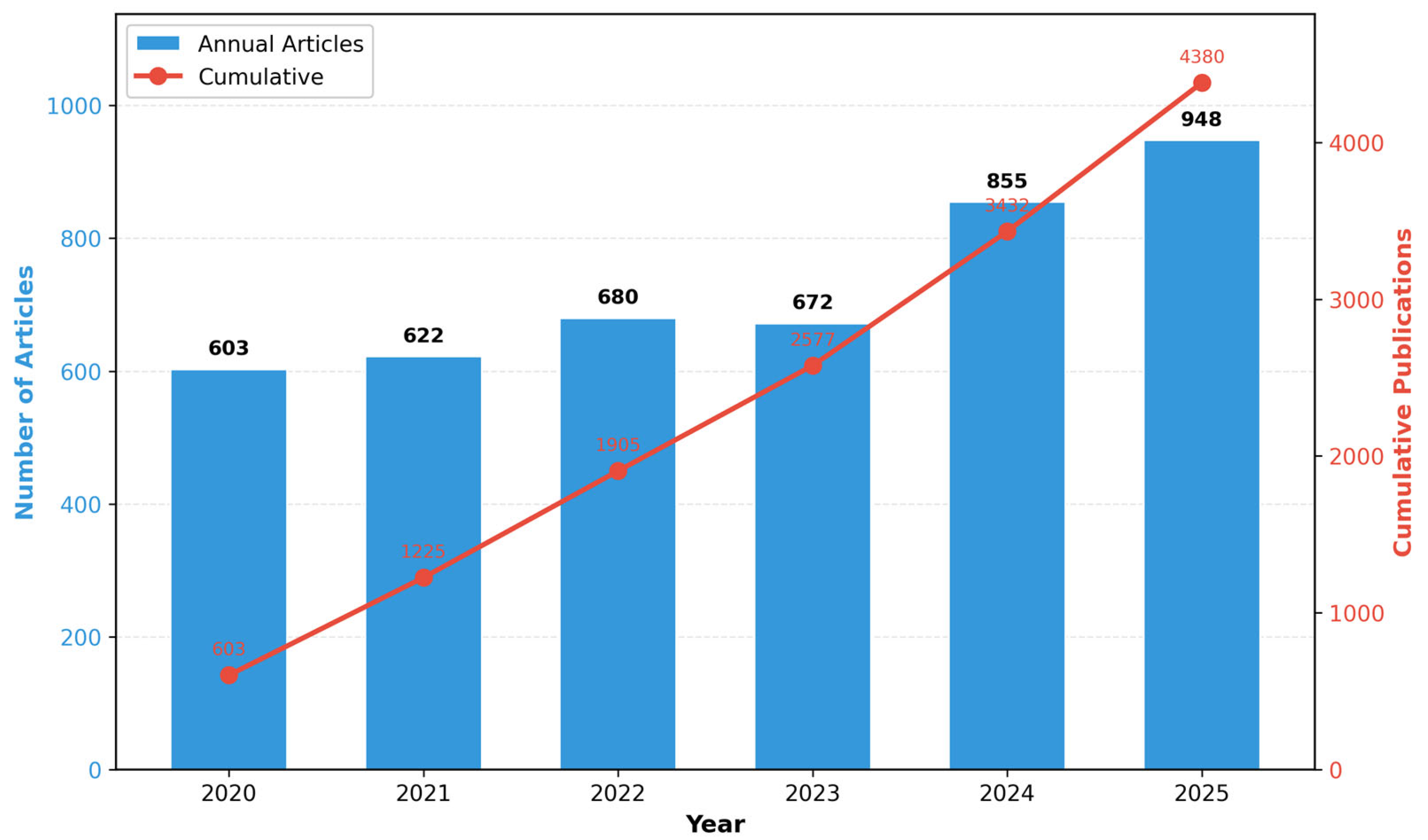
Figure 2.
Top 15 most productive sources with Bradford’s Law zone classification.
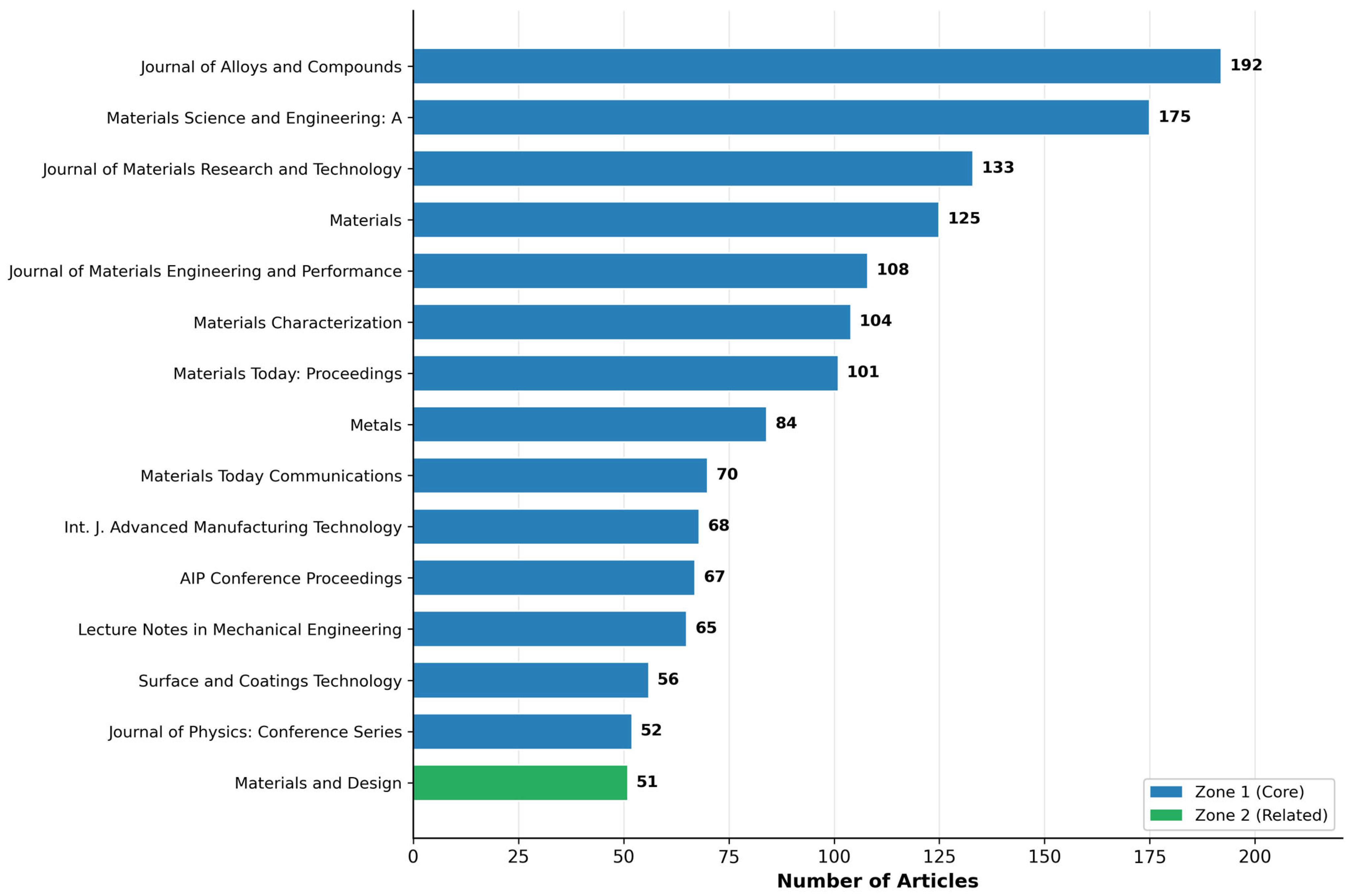
Figure 3.
Geographic distribution of publications showing single-country (SCP) and multi-country (MCP) collaboration patterns.
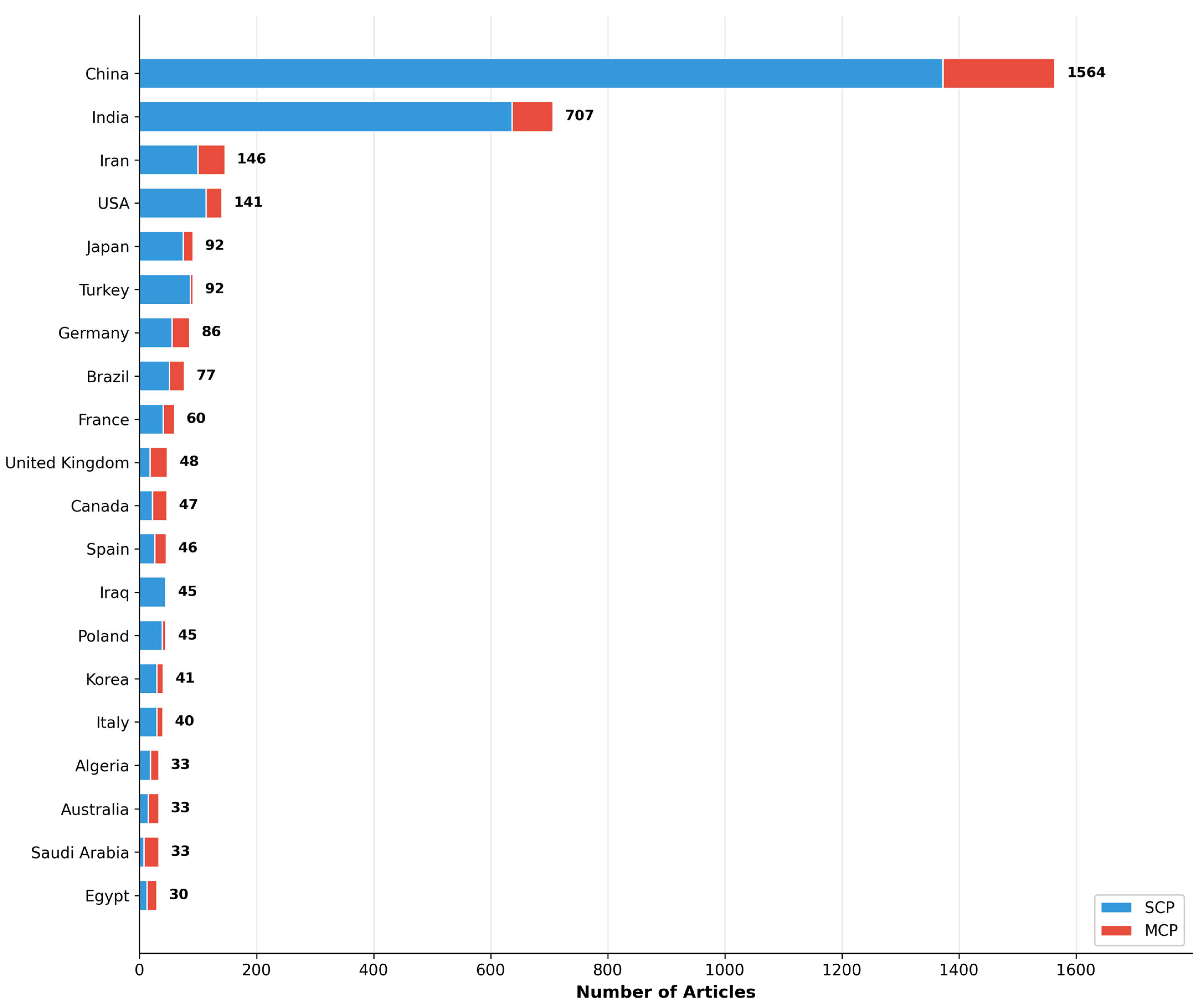
Figure 4.
International collaboration rates (MCP %) by country, ranked by collaboration intensity.
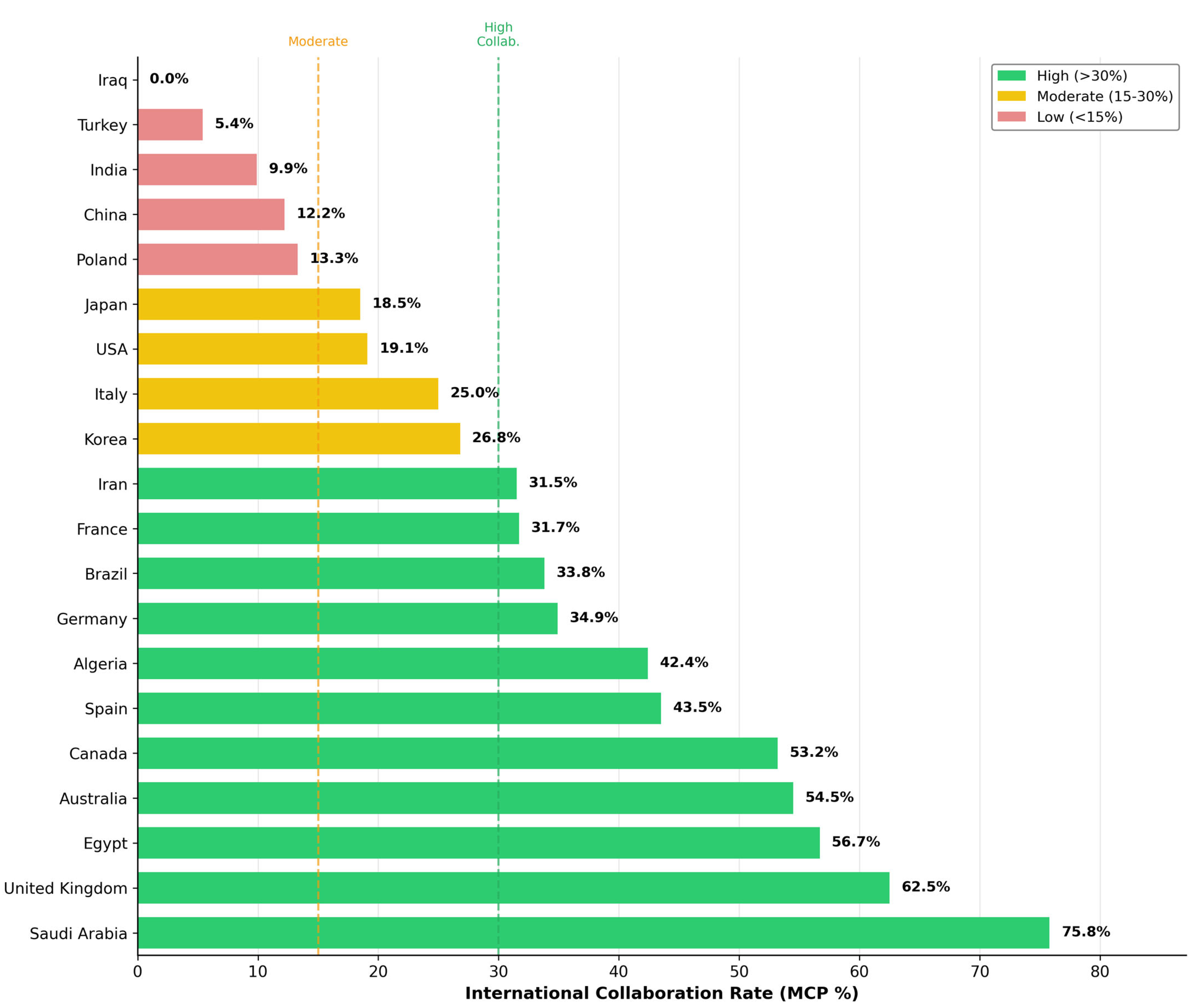
Figure 5.
Top 10 most productive research institutions.
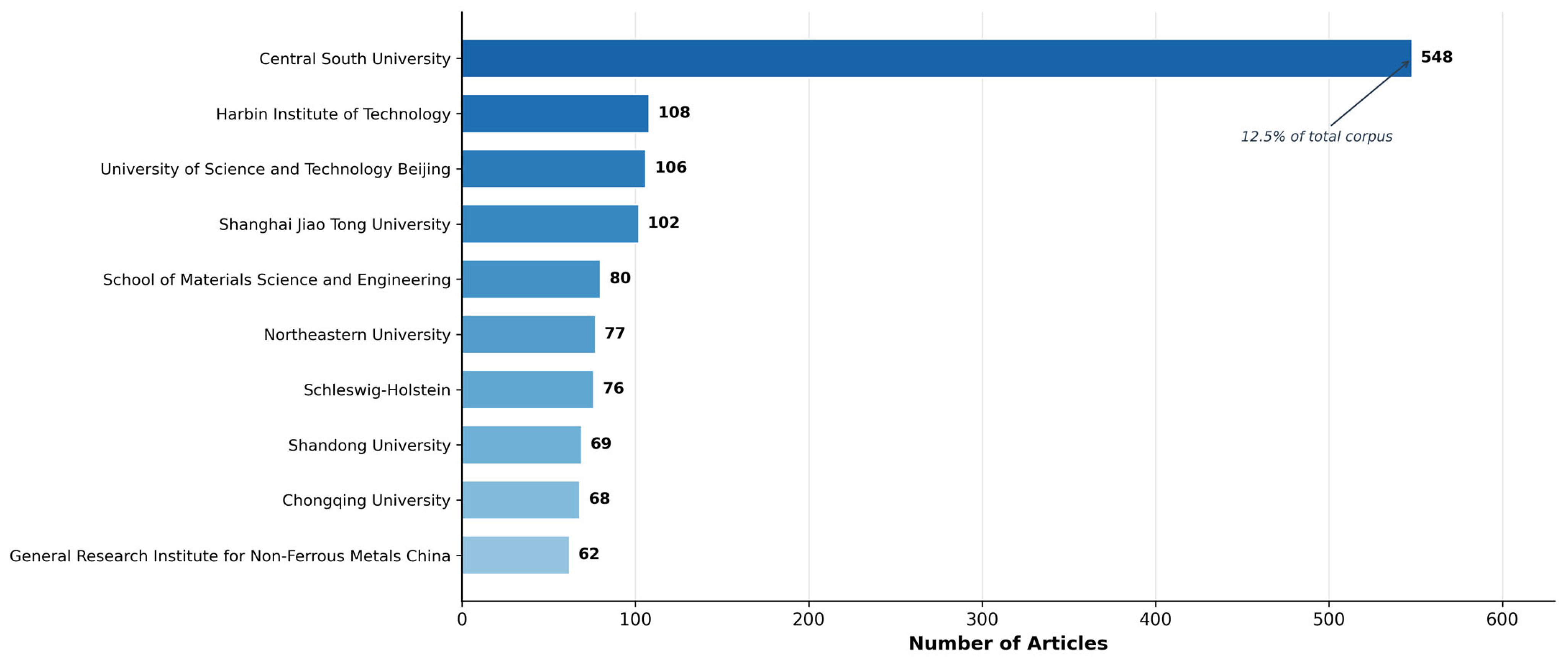
Figure 6.
Comparison of observed author productivity distribution with theoretical Lotka’s Law predictions.
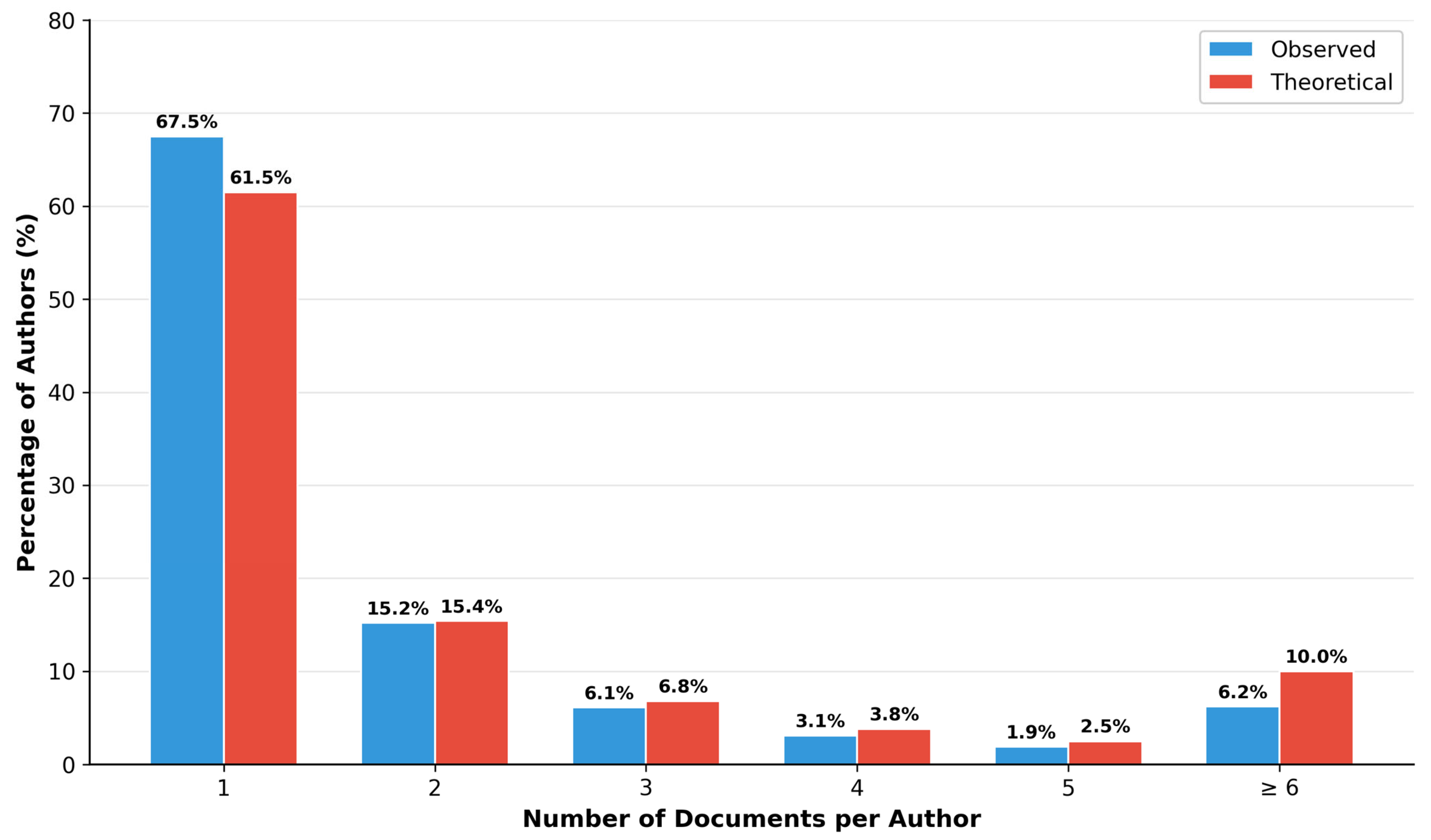
Figure 7.
Top 10 most globally cited documents with citation velocity (TC/Year) indicated by color gradient [1,4,6,7,9,32,56,57,58,59].
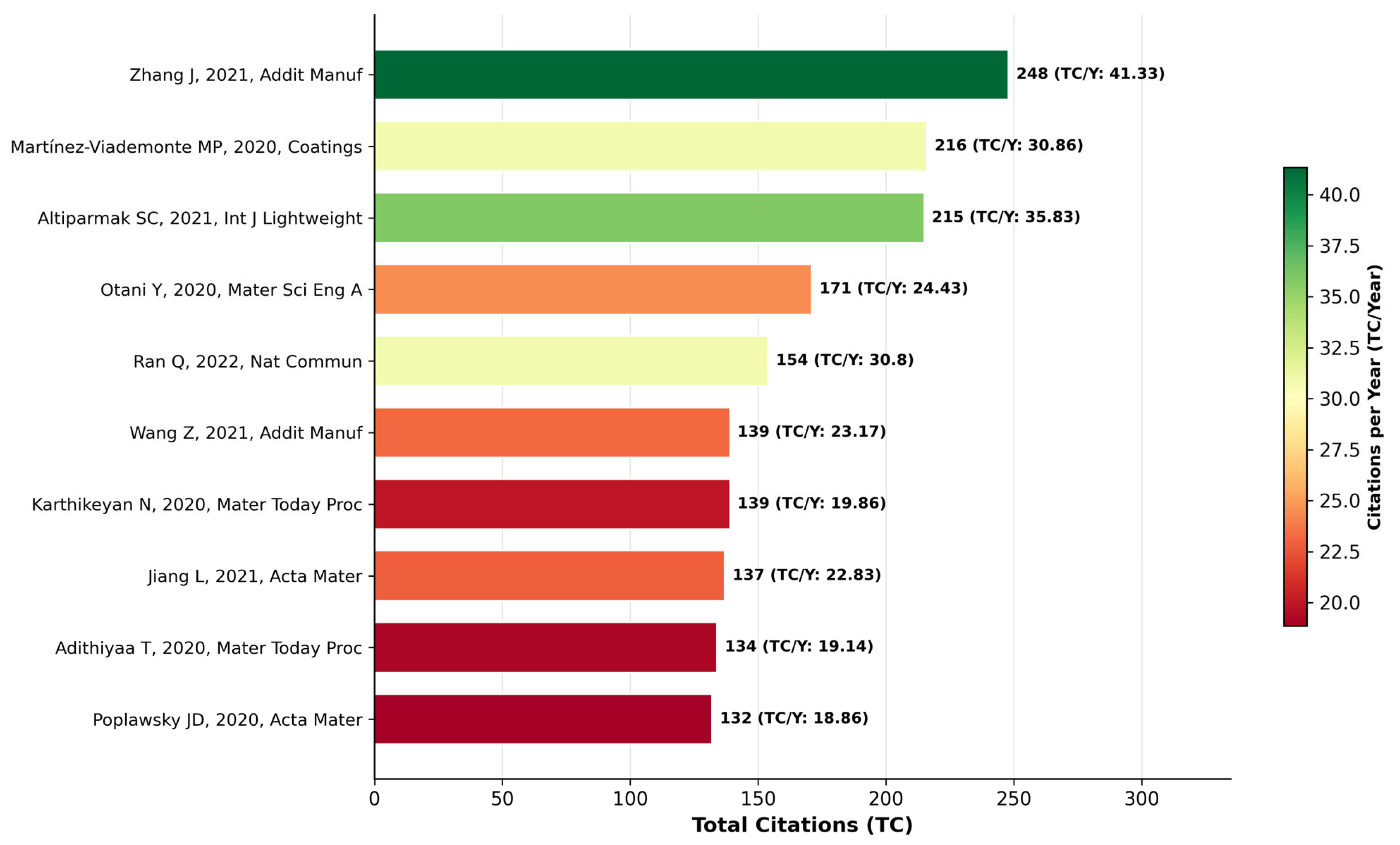
Figure 8.
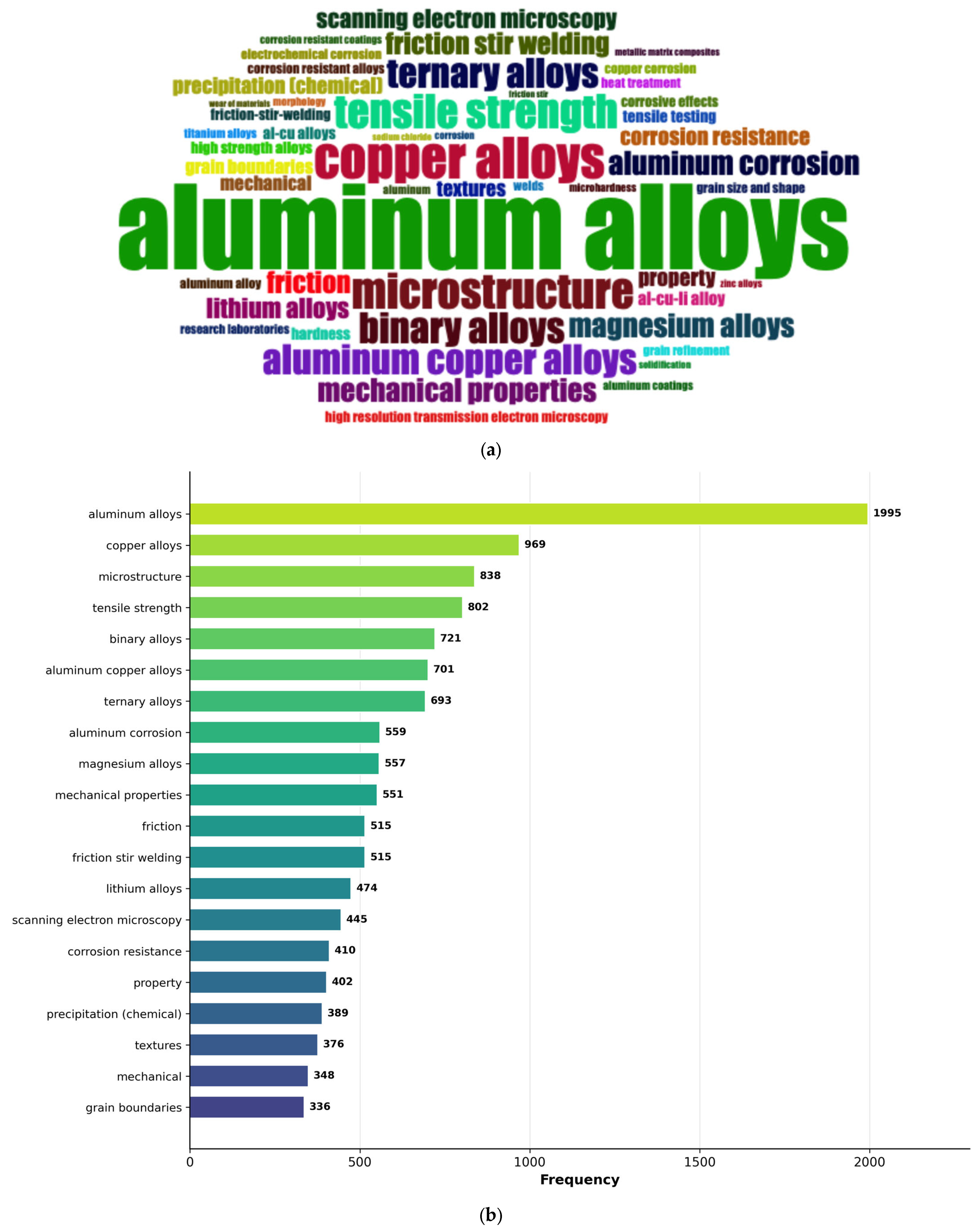
Top 20 most frequent author keywords: (a) word cloud; (b) with frequency distribution.
3. Results
3.1. Dataset Overview and Main Information
The search strategy retrieved 4380 documents published across 747 sources between 2020 and 2025. Table 1 summarizes the main characteristics of the dataset. The corpus includes 3755 articles (85.7%), 482 conference papers (11.0%), 66 book chapters, 49 reviews, and other document types. The average document age is 3.22 years, reflecting the contemporary focus of the analysis period.
Table 1.
Main information about the bibliometric dataset.
A total of 9896 unique authors contributed to the literature, with an average of 5.03 co-authors per document. Single-authored documents (81 total, 1.8%) are relatively rare, indicating the predominantly collaborative nature of materials science research. The international co-authorship rate of 19.45% suggests moderate but not extensive cross-border collaboration. The dataset contains 8620 author keywords and 16,482 Keywords Plus entries, providing a rich vocabulary for thematic analysis. With an average of 10.66 citations per document, the corpus demonstrates substantial scholarly impact within the materials science community.
3.2. Annual Scientific Production and Life Cycle Analysis
The temporal distribution of publications reveals a consistent upward trend throughout the analysis period (Figure 1). Annual output increased steadily from 603 documents in 2020 to 948 in 2025, representing growth of 57.2% over the five-year period. The year 2024 marked a notable acceleration with 855 publications, followed by continued expansion to 948 publications in 2025. This sustained growth trajectory indicates robust and expanding research interest in Al–Cu alloys.
Table 2 presents annual publication counts alongside citation performance metrics. Mean total citations per article decrease progressively from 20.37 (2020) to 1.62 (2025), which reflects the expected citation accumulation pattern whereby older publications have had more time to accrue citations. The normalized mean citations per year remain relatively stable across the period, ranging from 2.88 (2024) to 3.77 (2021), suggesting consistent research quality and impact regardless of publication year.
Table 2.
Annual scientific production and citation performance.
Life cycle analysis using a logistic growth model yielded parameter estimates of K = 5992.75 (carrying capacity), tm = 2022.84 (inflection point, corresponding to late 2022), and δt = 8.10 years (characteristic time). These parameters indicate that the field reached its maximum growth rate in late 2022 and is currently transitioning from exponential growth toward saturation. The model predicts asymptotic stabilization at approximately 5993 cumulative publications, suggesting the field is approaching a mature state within its current paradigmatic boundaries.
3.3. Source Analysis and Bradford’s Law
The distribution of publications across sources reveals significant concentration in a small number of high-impact outlets. Table 3 presents the top 15 most productive sources, which collectively published 1451 articles (33.1% of the total corpus). The Journal of Alloys and Compounds leads with 192 articles (4.38%), followed by Materials Science and Engineering: A (175 articles) and Journal of Materials Research and Technology (133 articles, 3.04%). These three journals alone collectively account for 11.4% of total publications.
Table 3.
Top 15 most productive sources.
The source distribution spans both traditional materials science journals and interdisciplinary outlets. Notably, conference proceedings (AIP Conference Proceedings with 67 articles; Journal of Physics: Conference Series with 52 articles; Lecture Notes in Mechanical Engineering with 65 articles) account for a substantial fraction of the top sources, reflecting the importance of conference venues in disseminating Al–Cu alloy research. Open-access journals such as Materials (125 articles) and Metals (84 articles) also feature prominently, indicating growing adoption of open science practices in the field.
Bradford’s Law analysis partitions the 747 sources into three productivity zones of approximately equal publication volume (Figure 2). Zone 1 (core) comprises 14 journals accounting for approximately 34% of publications, Zone 2 (related) includes 78 journals with 33%, and Zone 3 (peripheral) encompasses 655 sources with the remaining 33%. This distribution conforms to Bradford’s bibliometric principle, wherein a small nucleus of journals produces the bulk of substantive literature in a given field. Researchers seeking maximum visibility for Al–Cu alloy research are advised to target Zone 1 journals, while those exploring niche applications may find receptive outlets in Zone 2 and Zone 3 sources.
3.4. Geographic Distribution and International Collaboration
The geographic distribution of Al–Cu alloy research reveals pronounced concentration in Asia, with China and India collectively accounting for over half of global output. Table 4 presents the top 20 countries by corresponding author publications, distinguishing between single-country publications (SCP) and multi-country publications (MCP). China dominates global output with 1564 corresponding author articles (35.7%), followed by India (707 articles, 16.1%) and Iran (146 articles, 3.3%). The United States (141 articles, 3.2%) and Japan (92 articles, 2.1%) each contribute approximately 2–3% of total output, while European nations including Germany (86 articles), France (60 articles), and the United Kingdom (48 articles) collectively represent a significant but distributed research presence. The stacked bar visualization in Figure 3 illustrates the absolute contribution of each country, with clear dominance by China and India. The data reveal that the top two countries (China and India) together account for 52% of all corresponding authorships, while the remaining 13 countries in the top 15 collectively contribute only 22.1%.
Table 4.
Top 20 countries by corresponding author publications.
Notable disparities exist in international collaboration rates, as illustrated in Figure 4. While the United Kingdom (62.5% MCP) and Canada (53.2% MCP) demonstrate highly internationalized research profiles, the two most productive countries—China (12.2% MCP) and India (9.9% MCP)—show predominantly domestic research production. This pattern suggests that high-volume producers may rely primarily on domestic funding and collaboration networks, whereas smaller research communities leverage international partnerships to enhance capacity and visibility. Germany (34.9% MCP), Brazil (33.8% MCP), France (31.7% MCP), and Iran (31.5% MCP) exhibit intermediate collaboration rates, balancing domestic and international research activities. Turkey exhibits one of the lowest collaboration rates (5.4% MCP), while Iraq’s zero MCP indicates entirely domestic research activity within the dataset.
3.5. Institutional Productivity
Analysis of institutional affiliations reveals exceptional concentration of research activity at a small number of Chinese universities. Figure 5 visualizes the top 10 most productive affiliations. Central South University (Changsha, China) leads substantially with 548 articles (12.5% of the total corpus), demonstrating a remarkable concentration of research activity.
The remaining top institutions are predominantly Chinese, including Harbin Institute of Technology (108 articles), University of Science and Technology Beijing (106 articles), and Shanghai Jiao Tong University (102 articles). The School of Materials Science and Engineering (80 articles) likely represents an aggregated departmental affiliation across multiple institutions. Northeastern University (77 articles), Schleswig-Holstein (76 articles), Shandong University (69 articles), Chongqing University (68 articles) and GRINM—the General Research Institute for Non-Ferrous Metals (62 articles)—round out the top 10. The presence of Schleswig-Holstein (76 articles) is notable as the only non-Chinese entry in the top 10, representing a regional research cluster in northern Germany.
3.6. Author Productivity and Lotka’s Law
Analysis of author productivity provides insights into the distribution of scholarly contributions across the research community. A total of 9896 unique authors contributed to the 4380 documents in the corpus. As shown in Table 5, 6679 authors (67.5%) contributed only one document, while 1508 authors (15.2%) contributed two documents. The number of authors decreases progressively with increasing productivity: 601 authors (6.10%) contributed three documents, 310 authors (3.10%) contributed four documents, and 185 authors (1.90%) contributed five documents. A total of 613 authors (6.20%) contributed six or more documents, representing the most prolific researchers in the field. This distribution broadly conforms to Lotka’s inverse square law, which predicts that the number of authors making n contributions is proportional to 1/n2. Comparison of observed and theoretical distributions (Figure 6) reveals reasonable agreement with minor deviations. The observed proportion of single-document authors (67.50%) exceeds the theoretical prediction (61.50%), while the proportion of highly prolific authors (≥6 documents: 6.20% observed vs. 10.00% theoretical) falls below expectations. These deviations suggest that Al–Cu alloy research may have a higher proportion of occasional contributors, possibly from adjacent fields or industry and a somewhat lower concentration of dedicated specialists than predicted by classical bibliometric models.
Table 5.
Author productivity distribution (Lotka’s Law).
3.7. Most Cited Documents
Citation analysis identifies the most influential publications shaping the Al–Cu alloy knowledge landscape. Figure 7 presents the ten most globally cited documents, ranked by total citations (TC). The most cited work is Zhang et al. [6] published in Additive Manufacturing with 248 total citations (TC/Year = 49.6), addressing defect formation mechanisms in laser powder bed fusion of Al-Cu-Mg alloys. This high citation velocity reflects the intense interest in additive manufacturing of aluminum alloys.
The second-ranked publication is Martínez-Viademonte et al. [4] on anodizing processes for aerospace aluminum alloys (216 citations, TC/Year = 36.0), published in Coatings. Altiparmak et al. [7], reviewing challenges in additive manufacturing of high-strength aluminum alloys in the International Journal of Lightweight Materials and Manufacture, ranks third with 215 citations (TC/Year = 43.0).
3.8. Keyword Analysis and Thematic Structure
Figure 8 visualizes the 20 most frequent author keywords extracted from the corpus. Figure 8a illustrates the relative frequency via a word cloud, and Figure 8b details the precise values in a bar chart. The prominence of “aluminum alloys” (1995 occurrences), “copper alloys” (969), “microstructure” (838), and “tensile strength” (802) reflects the field’s emphasis on processing–structure–property relationships. “Binary alloys” (721) and “ternary alloys” (693) indicate substantial attention to alloy system complexity, while “friction stir welding” (515) and “friction” (515) together indicate substantial research activity in advanced joining technologies. Corrosion-related terms including “aluminum corrosion” (559) and “corrosion resistance” (410) highlight the ongoing importance of environmental durability research. The appearance of “lithium alloys” (474) signals significant attention to third-generation aerospace alloys. The terms “magnesium alloys” (557) and “mechanical properties” (551) further underscore the multi-element alloying and characterization focus. Characterization methods are represented by “scanning electron microscopy” (445), while fundamental metallurgical concepts appear through “precipitation” (389), “textures” (376), and “grain boundaries” (336).
Keyword co-occurrence network analysis using Louvain clustering identified five distinct thematic clusters: (1) a core cluster centered on aluminum alloys, microstructure, and mechanical properties, representing fundamental materials characterization; (2) a processing cluster dominated by friction stir welding and related joining technologies; (3) a corrosion and surface engineering cluster addressing environmental durability; (4) an Al–Cu–Li aerospace alloy cluster focusing on lithium-containing variants for weight-critical applications; and (5) an additive manufacturing cluster featuring wire arc additive manufacturing and laser powder bed fusion terminology.
Trend topic analysis reveals temporal evolution of research foci. Early period keywords (2020–2021) emphasize “friction stir welding” and “microstructure evolution,” reflecting established research themes. Later periods (2024–2025) show the emergence of “aluminum copper alloys” and “property” as consolidated umbrella terms, suggesting increasing maturity and synthesis of research themes as the field transitions toward paradigmatic stability.
4. Discussion
4.1. Research Growth and Field Maturity
The bibliometric data reveal a field characterized by sustained growth transitioning toward maturity. The life cycle model parameters (K ≈ 5993; tm ≈ 2022.84; δt ≈ 8.1 years) position Al–Cu alloy research in the post-inflection phase of its growth trajectory. This interpretation aligns with the observation that most fundamental metallurgical principles governing Al–Cu precipitation hardening are well-established, with contemporary research increasingly focused on optimization for specific applications rather than discovery of new phenomena. From a practical standpoint, the post-inflection maturity phase implies that future research gains are more likely to arise from cross-disciplinary innovation, such as the integration of machine learning with experimental design, or the application of additive manufacturing to alloy compositions previously considered unprocessable, rather than from incremental refinements of well-established metallurgical relationships.
The approximately 57% increase in annual publications from 2020 to 2025 reflects sustained industrial relevance, driven by several technological and economic factors. The aerospace industry’s recovery from pandemic-related disruptions and expansion of next-generation aircraft programs (including single-aisle replacement platforms) has maintained demand for Al–Cu–Li and high-damage-tolerance 2xxx variants. Simultaneously, the automotive sector’s electrification transition has created new requirements for aluminum alloys combining high strength with formability and corrosion resistance, domains where 2xxx alloys compete with 5xxx and 6xxx alternatives. In comparative terms, 2xxx series research occupies a distinct niche within the broader Al alloy landscape. The 6xxx series, which dominates automotive extrusion and sheet applications, attracts a substantially larger research volume centered on formability and age-hardening optimization during paint–bake cycles [60,61]. The 7xxx series, which shares aerospace applications with 2xxx alloys, generates comparable research intensity but with a stronger emphasis on stress corrosion cracking and weldability limitations, especially in plate and welded structures [62,63]. By contrast, 2xxx alloy research is distinguished by its concentrated focus on damage tolerance and fatigue crack growth in friction stir welded joints [64,65], and more recently, on the additive manufacturing processability of high-strength Al–Cu alloys within broader efforts to enable AM of 2xxx/7xxx series while mitigating solidification cracking and defect formation [7,12].
4.2. Geographic Concentration and Knowledge Diffusion
The pronounced concentration of research output in China (35.7% of corresponding authorships) represents a significant structural feature of the contemporary Al–Cu alloy knowledge landscape. Central South University’s dominance (548 articles, 12.5% of total corpus) is remarkable even by Chinese standards and reflects strategic institutional investment in light alloys research. This concentration raises questions regarding knowledge diffusion pathways and potential implications for global technological competitiveness.
The disparity in international collaboration rates merits attention. China’s 12.2% MCP rate contrasts sharply with the United Kingdom (62.5%) and Canada (53.2%), suggesting different research models: a predominantly domestic, nationally-funded Chinese research enterprise versus highly internationalized Western programs. This pattern may reflect language barriers, funding structures favoring domestic collaboration, or strategic considerations regarding sensitive aerospace materials. From a knowledge diffusion perspective, lower international collaboration may limit cross-pollination of ideas and slow convergence toward global best practices.
India’s position as the second-largest contributor (16.1%) with similarly low collaboration rates (9.9% MCP) indicates another significant domestic research community. The emergence of Iran as the third-largest contributor (3.3%) is notable given geopolitical constraints on technology transfer, suggesting independent capability development in aluminum metallurgy. These collaboration disparities highlight opportunities for international funding mechanisms, such as the EU Horizon Europe program, NSF international research supplements, and bilateral science agreements, to incentivize cross-border research partnerships on Al–Cu alloy development, potentially accelerating knowledge transfer between regions with complementary expertise in alloy design, processing, and characterization.
4.3. Thematic Evolution and Research Frontiers
The following discussion highlights representative studies within each thematic cluster to illustrate prevailing research directions; it is not intended as an exhaustive review of the literature within any individual cluster. Keyword analysis and thematic mapping reveal several distinct research trajectories. The persistent prominence of “friction stir welding” (515 occurrences) reflects this technology’s transformative impact on aluminum joining. FSW enables solid-state joining that avoids fusion welding defects in precipitation-hardened alloys, and ongoing research addresses process optimization, tool design, and dissimilar material joining.
Zhang et al. [66] systematically investigated the influence of tool rotational speed on local microstructure, mechanical and corrosion behavior of dissimilar AA2024/7075 joints, while Jabraeili et al. [67] elucidated the effect of FSW process parameters on dissimilar AA2024 Al alloy and 304 stainless steel joints. The development of friction stir tailor-welded blanks of base matrix AA2024 using AA7075 interlayer compensation has demonstrated improved strength and ductility combinations [68]. Advanced optimization using response surface methodology has enabled systematic investigation of FSW process parameters for dissimilar AA2014/AA6063 joints [69]. Post-weld heat treatment protocols have been developed to optimize mechanical properties and fatigue crack growth rates in welded AA-2024 [70].
The emergence of additive manufacturing as a high-impact research front is evidenced by the prominence of AM-related keywords and the high citation impact of publications addressing laser powder bed fusion (LPBF) processing of Al–Cu alloys. The leading cited work (Zhang et al., 2021 [66], 248 citations) specifically addresses defect formation in LPBF-processed Al–Cu–Mg, highlighting the challenges of adapting these alloys to non-equilibrium solidification conditions. Hot cracking susceptibility, porosity control, and post-processing heat treatment optimization represent active research problems. Li et al. [71] developed a systematic alloy design strategy exploiting the rapid solidification potential of LPBF for high-strength, crack-free Al–Cu–Mg–Mn–Zr alloys. Bahl et al. [72] characterized the aging behavior and strengthening mechanisms of coarsening-resistant metastable θ’ precipitates, demonstrating thermal stability after prolonged exposure at elevated temperatures—a critical requirement for aerospace applications.
The Al–Cu–Li system maintains a distinct thematic cluster, reflecting continued aerospace investment in third-generation lithium-containing alloys offering density reductions of approximately 3% per weight percent lithium while maintaining or improving specific strength and modulus. Research in this cluster addresses aging responses, texture evolution during thermomechanical processing, and stress corrosion cracking resistance. Xu et al. [73] developed new aging treatment methods combining pre-deformation with double aging processes to achieve excellent yield strength (609 MPa) while maintaining 11.5% elongation. Wang et al. [74] investigated particle-stimulated nucleation and recrystallization texture initiated by coarsened Al2CuLi phase (T1). Yang et al. [75] developed superhydrophobic and corrosion-resistant layered double hydroxides coatings on AA2099-T83 Al–Cu–Li alloy as alternatives to conventional anodizing. Heat treatment effects on mechanical property anisotropy of extruded 2196 Al–Cu–Li alloy have been systematically characterized [18].
Corrosion research represents a fourth major theme, with particular emphasis on intergranular corrosion mechanisms related to grain boundary precipitation of θ-phase, pitting initiation at constituent particles, and galvanic corrosion in multi-material assemblies. Critical reviews on heat treatment of aluminum alloys have synthesized knowledge on age hardening behavior across 2xxx, 6xxx, and 7xxx series [76]. Wu et al. [77] reported a counterintuitive strategy to stabilize supersaturated solid solution in nanograined Al–Cu alloys via high-density vacancies, addressing the long-standing challenge of low-temperature decomposition into unfavorable intergranular precipitates. This theme gains relevance as Al–Cu alloys are increasingly integrated into hybrid structures combining aluminum with steel, carbon fiber composites, or dissimilar aluminum alloys.
Machine learning and data-driven approaches represent an emerging fifth theme with rapidly growing prominence. Rakhmonov et al. [78] demonstrated enhanced mechanical properties of high-temperature-resistant Al–Cu cast alloy through Mg microalloying, with systematic characterization enabling development of predictive relationships. Jin et al. [79] investigated the contribution of double-sized TiC particle addition to ductility-strength synergy in wire arc additively manufactured Al–Cu alloys. The integration of computational approaches with experimental validation is increasingly evident across all research themes.
4.4. Publication Patterns and Knowledge Dissemination
The concentration of publications in a small number of high-impact journals conforms to Bradford’s Law and provides guidance for researchers seeking visibility and impact. The Journal of Alloys and Compounds and Materials Science and Engineering: A collectively publish over 8% of the field’s literature and represent natural target venues for Al-Cu alloy research. The presence of open-access journals (Materials, Metals) among the top sources indicates growing adoption of open science practices in materials research.
Conference proceedings (AIP Conference Proceedings, Journal of Physics: Conference Series, Lecture Notes in Mechanical Engineering) account for a notable fraction of output (approximately 11%), facilitating rapid dissemination of preliminary findings and enabling research community interaction. However, the generally lower citation impact of conference papers compared to journal articles suggests that subsequent archival publication remains important for long-term visibility.
4.5. Limitations
Several limitations should be acknowledged. First, reliance on Scopus as the sole database may underrepresent literature from non-English-language journals, patents, and industry reports. Second, keyword standardization remains imperfect, with variant spellings and synonymous terms potentially affecting frequency counts. Third, citation metrics for recent publications (2024–2025) have not reached equilibrium, limiting comparative citation analysis. Finally, the exclusion criteria, while necessary to avoid false positives, may have excluded some legitimately relevant studies with unconventional terminology. Additionally, the absence of cross-validation through Web of Science may lead to underrepresentation of some European and American literature that is indexed exclusively in WoS. Furthermore, the potential influence of institutional and national self-citation patterns, particularly among the most prolific contributing countries and institutions, has not been quantitatively assessed; such self-citation bias could inflate apparent productivity and citation metrics for certain countries and institutions.
5. Conclusions
This bibliometric analysis of 4380 documents published between 2020 and 2025 provides a comprehensive mapping of the 2xxx series aluminum–copper alloy research landscape. The principal findings and conclusions are as follows:
The field demonstrates sustained growth, with annual publications increasing from 603 (2020) to 948 (2025). Life cycle modeling indicates the field is transitioning from exponential growth toward maturity, with an estimated carrying capacity of approximately 6000 cumulative publications.
China dominates global research output (35.7% of corresponding authorships), with Central South University as the leading institution (548 articles). However, China’s international collaboration rate (12.2%) is notably lower than Western counterparts such as the United Kingdom (62.5%) and Canada (53.2%).
Core journals including Journal of Alloys and Compounds (192 articles), Materials Science and Engineering: A (175 articles), and Journal of Materials Research and Technology (133 articles) collectively account for 11.4% of total publications. Bradford’s Law analysis confirms the expected concentration of literature in a small nucleus of specialized journals.
Thematic analysis identifies five major research clusters: (1) microstructure-property relationships, (2) friction stir welding and joining, (3) corrosion mechanisms, (4) Al–Cu–Li aerospace alloys, and (5) additive manufacturing. Additive manufacturing represents a particularly dynamic research front with high citation impact.
Several specific future research directions are likely to gain prominence. First, machine learning-assisted alloy design remains underexplored for Al–Cu systems relative to other alloy families; in particular, data-driven approaches for optimizing composition and processing parameters (e.g., predicting age-hardening response or selecting micro-alloying additions in multicomponent Al–Cu alloys) represent a significant gap that warrants systematic investigation. Second, sustainable processing routes incorporating recycled aluminum are insufficiently studied in the context of 2xxx series alloys, where impurity tolerance (especially Fe and Si from secondary aluminum) and its effect on precipitation sequences and mechanical performance require dedicated research. Third, multi-material joining technologies for electric vehicle applications, specifically the development of robust Al–Cu to steel and Al–Cu to carbon fiber-reinforced polymer dissimilar joints, need further attention as lightweight multi-material body structures become standard in the automotive industry. Finally, while qualitative reviews have addressed individual sub-topics such as FSW or precipitation hardening, the lack of quantitative, network-level assessments of collaboration patterns and cross-disciplinary integration suggests that periodic bibliometric updates will remain valuable for identifying emerging research voids and guiding resource allocation.
Funding
This research was funded by the Bulgarian National Science Fund, Project KП-06-H77/5 “Self-lubricating hybrid aluminum metal matrix composites: synthesis, experimental and computer modeling of mechanical and tribological properties”.
Data Availability Statement
No new data were created or analyzed in this study. Data sharing is not applicable to this article.
Acknowledgments
The work in this publication was performed using equipment funded by project BG16RFPR002-1.014-0006 “National Center of Excellence Mechatronics and Clean Technologies”.
Conflicts of Interest
The author declare no conflicts of interest.
References
- Jiang, L.; Rouxel, B.; Langan, T.; Dorin, T. Coupled Segregation Mechanisms of Sc, Zr and Mn at θ′ Interfaces Enhances the Strength and Thermal Stability of Al-Cu Alloys. Acta Mater. 2021, 206, 116634. [Google Scholar] [CrossRef] [Scilit]
- Santos-Güemes, R.; Bellón, B.; Esteban-Manzanares, G.; Segurado, J.; Capolungo, L.; LLorca, J. Multiscale Modelling of Precipitation Hardening in Al–Cu Alloys: Dislocation Dynamics Simulations and Experimental Validation. Acta Mater. 2020, 188, 475–485. [Google Scholar] [CrossRef] [Scilit]
- Stemper, L.; Tunes, M.A.; Tosone, R.; Uggowitzer, P.J.; Pogatscher, S. On the Potential of Aluminum Crossover Alloys. Prog. Mater. Sci. 2022, 124, 100873. [Google Scholar] [CrossRef] [Scilit]
- Paz Martínez-Viademonte, M.; Abrahami, S.T.; Hack, T.; Burchardt, M.; Terryn, H. A Review on Anodizing of Aerospace Aluminum Alloys for Corrosion Protection. Coatings 2020, 10, 1106. [Google Scholar] [CrossRef] [Scilit]
- Kosari, A.; Tichelaar, F.; Visser, P.; Zandbergen, H.; Terryn, H.; Mol, J.M.C. Dealloying-Driven Local Corrosion by Intermetallic Constituent Particles and Dispersoids in Aerospace Aluminium Alloys. Corros. Sci. 2020, 177, 108947. [Google Scholar] [CrossRef] [Scilit]
- Zhang, J.; Gao, J.; Song, B.; Zhang, L.; Han, C.; Cai, C.; Zhou, K.; Shi, Y. A Novel Crack-Free Ti-Modified Al-Cu-Mg Alloy Designed for Selective Laser Melting. Addit. Manuf. 2021, 38, 101829. [Google Scholar] [CrossRef] [Scilit]
- Altıparmak, S.C.; Yardley, V.A.; Shi, Z.; Lin, J. Challenges in Additive Manufacturing of High-Strength Aluminium Alloys and Current Developments in Hybrid Additive Manufacturing. Int. J. Lightweight Mater. Manuf. 2021, 4, 246–261. [Google Scholar] [CrossRef] [Scilit]
- Boopathi, S. Experimental Investigation and Multi-Objective Optimization of Cryogenic Friction-Stir-Welding of AA2014 and AZ31B Alloys Using MOORA Technique. Mater. Today Commun. 2022, 33, 104937. [Google Scholar] [CrossRef] [Scilit]
- Wang, Z.; Lin, X.; Wang, L.; Cao, Y.; Zhou, Y.; Huang, W. Microstructure Evolution and Mechanical Properties of the Wire + Arc Additive Manufacturing Al-Cu Alloy. Addit. Manuf. 2021, 47, 102298. [Google Scholar] [CrossRef] [Scilit]
- Wu, D.; Liu, D.; Niu, F.; Miao, Q.; Zhao, K.; Tang, B.; Bi, G.; Ma, G. Al–Cu Alloy Fabricated by Novel Laser-Tungsten Inert Gas Hybrid Additive Manufacturing. Addit. Manuf. 2020, 32, 100954. [Google Scholar] [CrossRef] [Scilit]
- Xie, Y.; Meng, X.; Wang, F.; Jiang, Y.; Ma, X.; Wan, L.; Huang, Y. Insight on Corrosion Behavior of Friction Stir Welded AA2219/AA2195 Joints in Astronautical Engineering. Corros. Sci. 2021, 192, 109800. [Google Scholar] [CrossRef] [Scilit]
- Shams, E.; Abdelwahed, M.; Ramadan, N.; Awad, M.I.; El Mahallawy, N.; Taha, M.A. A Review on Mechanical Properties of Walls Fabricated by Wire Arc Additive Manufacturing for Aluminum Alloys. Materwiss. Werksttech. 2025, 56, 925–946. [Google Scholar] [CrossRef] [Scilit]
- Farias, F.W.C.; dos Santos, T.J.G.; Oliveira, J.P. Directed Energy Deposition + Mechanical Interlayer Deformation Additive Manufacturing: A State-of-the-Art Literature Review. Int. J. Adv. Manuf. Technol. 2024, 131, 999–1038. [Google Scholar] [CrossRef] [Scilit]
- Rodríguez-González, P.; Ruiz-Navas, E.M.; Gordo, E. Wire Arc Additive Manufacturing (WAAM) for Aluminum-Lithium Alloys: A Review. Materials 2023, 16, 1375. [Google Scholar] [CrossRef] [Scilit] [PubMed]
- Wu, S.; Yang, C.; Zhang, P.; Xue, H.; Gao, Y.; Wang, Y.; Wang, R.; Zhang, J.; Liu, G.; Sun, J. Review of Sc Microalloying Effects in Al–Cu Alloys. Int. J. Miner. Metall. Mater. 2024, 31, 1098–1114. [Google Scholar] [CrossRef] [Scilit]
- Wang, X.-M.; Shao, W.-Z.; Jiang, J.-T.; Li, G.-A.; Wang, X.-Y.; Zhen, L. Quantitative Analysis of the Influences of Pre-Treatments on the Microstructure Evolution and Mechanical Properties during Artificial Ageing of an Al–Cu–Li–Mg–Ag Alloy. Mater. Sci. Eng. A Struct. Mater. 2020, 782, 139253. [Google Scholar] [CrossRef] [Scilit]
- Chen, X.; Ma, X.; Xi, H.; Zhao, G.; Wang, Y.; Xu, X. Effects of Heat Treatment on the Microstructure and Mechanical Properties of Extruded 2196 Al-Cu-Li Alloy. Mater. Des. 2020, 192, 108746. [Google Scholar] [CrossRef] [Scilit]
- Chen, X.; Zhao, G.; Xu, X.; Wang, Y. Effects of Heat Treatment on the Microstructure, Texture and Mechanical Property Anisotropy of Extruded 2196 Al-Cu-Li Alloy. J. Alloys Compd. 2021, 862, 158102. [Google Scholar] [CrossRef] [Scilit]
- Jiang, B.; Wang, H.; Yi, D.; Tian, Y.; Shen, F.; Wang, B.; Liu, H.; Hu, Z. Effect of Ag Addition on the Age Hardening and Precipitation Behavior in an Al-Cu-Li-Mg-Zn-Mn-Zr Alloy. Mater. Charact. 2020, 162, 110184. [Google Scholar] [CrossRef] [Scilit]
- Liu, Q.; Fan, G.; Tan, Z.; Li, Z.; Zhang, D.; Wang, J.; Zhang, H. Precipitation of Al3Zr by Two-Step Homogenization and Its Effect on the Recrystallization and Mechanical Property in 2195 Al–Cu–Li Alloys. Mater. Sci. Eng. A Struct. Mater. 2021, 821, 141637. [Google Scholar] [CrossRef] [Scilit]
- Ma, J.; Liu, X.; Yan, D.; Rong, L. A Novel GP-Li Precursor and the Correlated Precipitation Behaviors in Al-Cu-Li Alloys with Different Cu/Li Ratio. Acta Mater. 2023, 243, 118442. [Google Scholar] [CrossRef] [Scilit]
- Chawla, N.; Ganju, E. Four-Dimensional Materials Science: Time-Resolved x-Ray Microcomputed Tomography. MRS Bull. 2025, 50, 398–415. [Google Scholar] [CrossRef] [Scilit]
- Liu, G.; Tian, M.; Chen, P.; Wang, J.; Chen, W.; Zhang, Z. Microstructure and Mechanical Properties of Friction Stir Welded Full Annealing Condition Al-Cu-Li Alloys. Mater. Today Commun. 2025, 48, 113399. [Google Scholar] [CrossRef] [Scilit]
- Kou, L.; Zhao, Y.; Wang, G.; Cheng, X.; Ouyang, Y.; Yu, Z. In Situ Study of Micro-Damage Evolution in 2195 Aluminum Alloy. Int. J. Mech. Sci. 2025, 306, 110848. [Google Scholar] [CrossRef] [Scilit]
- Chen, S.; Feng, X.; Hong, L.; Wang, W. Research Progress on Intergranular Corrosion Protection of Aluminum-Copper Alloys. Corros. Prot. 2025, 46, 62–67. [Google Scholar] [CrossRef]
- Cui, L.; Liu, K.; Chen, X.-G. Recent Advances in Cost-Effective Aluminum Alloys with Enhanced Mechanical Performance for High-Temperature Applications: A Review. Mater. Des. 2025, 253, 113869. [Google Scholar] [CrossRef] [Scilit]
- Ma, L.; Wang, J.; Wang, Y.; Guo, X.; Wu, S.; Fu, D.; Zhang, D. Enhanced Active Corrosion Protection Coatings for Aluminum Alloys with Two Corrosion Inhibitors Co-Incorporated in Nanocontainers. Corros. Sci. 2022, 208, 110663. [Google Scholar] [CrossRef] [Scilit]
- Li, J.; Shi, H.; Liu, F.; Han, E.-H. Self-Healing Epoxy Coating Based on Tung Oil-Containing Microcapsules for Corrosion Protection. Prog. Org. Coat. 2021, 156, 106236. [Google Scholar] [CrossRef] [Scilit]
- Gamba, M.; Cristoforetti, A.; Fedel, M.; Ceriani, F.; Ormellese, M.; Brenna, A. Plasma Electrolytic Oxidation (PEO) Coatings on Aluminum Alloy 2024: A Review of Mechanisms, Processes, and Corrosion Resistance Enhancement. Appl. Surf. Sci. Adv. 2025, 26, 100707. [Google Scholar] [CrossRef] [Scilit]
- Caseri, W.R.; Niederberger, M. Toward a New Generation of Organic Coatings for Corrosion Protection Based on Poly(Phenylene Methylene). Langmuir 2025, 41, 27623–27630. [Google Scholar] [CrossRef] [Scilit]
- Dagdag, O.; Berisha, A.; Mehmeti, V.; Haldhar, R.; Berdimurodov, E.; Hamed, O.; Jodeh, S.; Lgaz, H.; Sherif, E.-S.M.; Ebenso, E.E. Epoxy Coating as Effective Anti-Corrosive Polymeric Material for Aluminum Alloys: Formulation, Electrochemical and Computational Approaches. J. Mol. Liq. 2022, 346, 117886. [Google Scholar] [CrossRef] [Scilit]
- Adithiyaa, T.; Chandramohan, D.; Sathish, T. Optimal Prediction of Process Parameters by GWO-KNN in Stirring-Squeeze Casting of AA2219 Reinforced Metal Matrix Composites. Mater. Today 2020, 21, 1000–1007. [Google Scholar] [CrossRef] [Scilit]
- Mortazavi, S.N.S.; Ince, A. An Artificial Neural Network Modeling Approach for Short and Long Fatigue Crack Propagation. Comput. Mater. Sci. 2020, 185, 109962. [Google Scholar] [CrossRef] [Scilit]
- Jiang, W.; Zhang, Y.; Zhang, L.; Wang, H. Accurate Deep Potential Model for the Al–Cu–Mg Alloy in the Full Concentration Space. Chin. Phys. B 2021, 30, 050706. [Google Scholar] [CrossRef] [Scilit]
- Prasad, A.S.; Balamurugan, P. Aluminium 2 Series Rutile Composite Materials: Fabrication, Characterization and Performance Enhancement—A Review. In Proceedings of The International Conference on Material Science; Springer Proceedings in Physics; Springer: Singapore, 2025; pp. 79–86. ISBN 9789819665402. [Google Scholar]
- Chandla, N.K.; Kant, S.; Goud, M.M. A Review on Mechanical Properties of Stir Cast Al-2024 Metal Matrix Composites. Adv. Mater. Process. Technol. 2022, 9, 948–969. [Google Scholar] [CrossRef] [Scilit]
- Fan, S.; Guo, X.; Li, Z.; Ma, J.; Li, F.; Jiang, Q. A Review of High-Strength Aluminum-Copper Alloys Fabricated by Wire Arc Additive Manufacturing: Microstructure, Properties, Defects, and Post-Processing. J. Mater. Eng. Perform. 2023, 32, 8517–8540. [Google Scholar] [CrossRef] [Scilit]
- Kenevisi, M.S.; Yu, Y.; Lin, F. A Review on Additive Manufacturing of Al–Cu (2xxx) Aluminium Alloys, Processes and Defects. Mater. Sci. Technol. 2021, 37, 805–829. [Google Scholar] [CrossRef] [Scilit]
- del Bosque, A.; Fernández-Arias, P.; Vergara, D. Advances in the Additive Manufacturing of Superalloys. J. Manuf. Mater. Process. 2025, 9, 215. [Google Scholar] [CrossRef] [Scilit]
- Obi, M.U.; Pradel, P.; Sinclair, M.; Bibb, R. A Bibliometric Analysis of Research in Design for Additive Manufacturing. Rapid Prototyp. J. 2022, 28, 967–987. [Google Scholar] [CrossRef] [Scilit]
- Qin, J.; Hu, F.; Liu, Y.; Witherell, P.; Wang, C.C.L.; Rosen, D.W.; Simpson, T.W.; Lu, Y.; Tang, Q. Research and Application of Machine Learning for Additive Manufacturing. Addit. Manuf. 2022, 52, 102691. [Google Scholar] [CrossRef] [Scilit]
- Kotadia, H.R.; Gibbons, G.; Das, A.; Howes, P.D. A Review of Laser Powder Bed Fusion Additive Manufacturing of Aluminium Alloys: Microstructure and Properties. Addit. Manuf. 2021, 46, 102155. [Google Scholar] [CrossRef] [Scilit]
- Mukherjee, D.; Tiwari, Y.K.; Mukherjee, M.; Roy, H. A Critical Review on the Development of Heat-Resistant Aluminum Alloys for Aerospace Applications. In Advances in Solid-State Welding and Processing of Metallic Materials; CRC Press: Boca Raton, FL, USA, 2025; pp. 351–365. ISBN 9781003513926. [Google Scholar]
- Yadegari, M.J.; Martucci, A.; Biamino, S.; Ugues, D.; Montanaro, L.; Fino, P.; Lombardi, M. Aluminum Laser Additive Manufacturing: A Review on Challenges and Opportunities through the Lens of Sustainability. Appl. Sci. 2025, 15, 2221. [Google Scholar] [CrossRef] [Scilit]
- Moral-Muñoz, J.A.; Herrera-Viedma, E.; Santisteban-Espejo, A.; Cobo, M.J. Software Tools for Conducting Bibliometric Analysis in Science: An up-to-Date Review. Prof. Inf. 2020, 29, e290103. [Google Scholar] [CrossRef] [Scilit]
- Martín-Martín, A.; Orduna-Malea, E.; Delgado López-Cózar, E. Coverage of Highly-Cited Documents in Google Scholar, Web of Science, and Scopus: A Multidisciplinary Comparison. Scientometrics 2018, 116, 2175–2188. [Google Scholar] [CrossRef] [Scilit]
- Alviz-Meza, A.; Orozco-Agamez, J.; Quinayá, D.C.P.; Alviz-Amador, A. Bibliometric Analysis of Fourth Industrial Revolution Applied to Material Sciences Based on Web of Science and Scopus Databases from 2017 to 2021. ChemEngineering 2023, 7, 2. [Google Scholar] [CrossRef] [Scilit]
- Caputo, A.; Kargina, M. A User-Friendly Method to Merge Scopus and Web of Science Data during Bibliometric Analysis. J. Mark. Anal. 2022, 10, 82–88. [Google Scholar] [CrossRef] [Scilit]
- Omotehinwa, T.O. Examining the Developments in Scheduling Algorithms Research: A Bibliometric Approach. Heliyon 2022, 8, e09510. [Google Scholar] [CrossRef] [Scilit]
- Aria, M.; Cuccurullo, C. Bibliometrix: An R-Tool for Comprehensive Science Mapping Analysis. J. Informetr. 2017, 11, 959–975. [Google Scholar] [CrossRef] [Scilit]
- Suman Jose, A.; Kemanabally, A.; Nambiar, K.; George, J.; Jose, J. From Word-of-Mouth to Social Buzz: A Triangulated Bibliometric Analysis of Viral Marketing Using Biblioshiny, VOSviewer, and CiteSpace. Management 2026, 4, 322. [Google Scholar] [CrossRef] [Scilit]
- Lanh, T.T.T.; Yen, D.T.H. Sustainable Development of Rural Tourism: A Bibliometrics Analysis Using r Biblioshiny. Tạp Chí Khoa Học Đại Học Công Thương 2025, 25, 32–44. [Google Scholar] [CrossRef] [Scilit]
- de Souza, C.L.; Kuniyoshi, M.S.; Freitas, A.B.d.G. Mapping the Growth of ESG Research: A Bibliometric Analysis Using Bradford’s, Lotka’s, and Zipf’s Laws. Rev. Gest. Soc. Ambient. 2024, 18, e09479. [Google Scholar] [CrossRef] [Scilit]
- Goyanes, M.; de-Marcos, L.; Durotoye, T.; Kurniasari, T.; Gil de Zúñiga, H. Editors-in-Chief in Social Sciences: Mapping the Institutional, Geographical, and Gender Representation between Academic Fields. PLoS ONE 2025, 20, e0317931. [Google Scholar] [CrossRef] [Scilit]
- Narong, D.K. Research Trends on Micro-Credentials: A Keyword Co-Occurrence Analysis and Science Mapping. J. Furth. High. Educ. 2025, 49, 919–937. [Google Scholar] [CrossRef] [Scilit]
- Otani, Y.; Sasaki, S. Effects of the Addition of Silicon to 7075 Aluminum Alloy on Microstructure, Mechanical Properties, and Selective Laser Melting Processability. Mater. Sci. Eng. A Struct. Mater. 2020, 777, 139079. [Google Scholar] [CrossRef] [Scilit]
- Ran, Q.; Shi, H.; Meng, H.; Zeng, S.-P.; Wan, W.-B.; Zhang, W.; Wen, Z.; Lang, X.-Y.; Jiang, Q. Aluminum-Copper Alloy Anode Materials for High-Energy Aqueous Aluminum Batteries. Nat. Commun. 2022, 13, 576. [Google Scholar] [CrossRef] [Scilit]
- Karthikeyan, N.; Krishnan, B.R.; VembathuRajesh, A.; Vijayan, V. Experimental Analysis of Al-Cu-Si Metal Matrix Composite by Powder-Metallurgy Process. Mater. Today 2021, 37, 2770–2774. [Google Scholar] [CrossRef] [Scilit]
- Poplawsky, J.D.; Milligan, B.K.; Allard, L.F.; Shin, D.; Shower, P.; Chisholm, M.F.; Shyam, A. The Synergistic Role of Mn and Zr/Ti in Producing θ’/L12 Co-Precipitates in Al-Cu Alloys. Acta Mater. 2020, 194, 577–586. [Google Scholar] [CrossRef] [Scilit]
- Lu, Q.; Li, K.; Chen, H.; Yang, M.; Lan, X.; Yang, T.; Liu, S.; Song, M.; Cao, L.; Du, Y. Simultaneously Enhanced Strength and Ductility of 6xxx Al Alloys via Manipulating Meso-Scale and Nano-Scale Structures Guided with Phase Equilibrium. J. Mater. Sci. Technol. 2020, 41, 139–148. [Google Scholar] [CrossRef] [Scilit]
- Alizadeh, A.; Souissi, M.; Zhou, M.; Assadi, H. Gradient-Based Calibration of a Precipitation Hardening Model for 6xxx Series Aluminium Alloys. Metals 2025, 15, 1035. [Google Scholar] [CrossRef] [Scilit]
- Xing, Q.; Chen, C.; Yu, H.; Zang, J.; Li, Y. Quenching Transfer Time-Dependent Microstructural Evolution in a Novel 7xxx Aluminum Alloys: Balancing Strength, Ductility, and Stress Corrosion Cracking Resistance. J. Alloys Compd. 2025, 1039, 183319. [Google Scholar] [CrossRef] [Scilit]
- López Freixes, M.; Peguet, L.; Warner, T.; Gault, B. Nanoscale Perspective on the Stress-Corrosion Cracking Behavior of a Peak-Aged 7XXX-Al Alloy. Corros. Sci. 2024, 229, 111904. [Google Scholar] [CrossRef] [Scilit]
- Muhammad, W.; Hussain, W.; Zaigham, H.; Zubair, N. Evolution of Fatigue Crack Growth Phenomena in Friction Stir Welded AA2xxx Alloys. Key Eng. Mater. 2021, 875, 227–237. [Google Scholar] [CrossRef] [Scilit]
- Yogesh, P.; Shinde, S.K.; Suresh Kumar, R.; Rinawa, M.L.; Puthilibai, G.; Sudhakar, M.; Negash, K.; S, R. Mechanical Strengthening of Lightweight Aluminium Alloys through Friction Stir Process. Adv. Mater. Sci. Eng. 2022, 2022, 1–10. [Google Scholar] [CrossRef] [Scilit]
- Zhang, C.; Cao, Y.; Huang, G.; Zeng, Q.; Zhu, Y.; Huang, X.; Li, N.; Liu, Q. Influence of Tool Rotational Speed on Local Microstructure, Mechanical and Corrosion Behavior of Dissimilar AA2024/7075 Joints Fabricated by Friction Stir Welding. J. Manuf. Process. 2020, 49, 214–226. [Google Scholar] [CrossRef] [Scilit]
- Jabraeili, R.; Jafarian, H.R.; Khajeh, R.; Park, N.; Kim, Y.; Heidarzadeh, A.; Eivani, A.R. Effect of FSW Process Parameters on Microstructure and Mechanical Properties of the Dissimilar AA2024 Al Alloy and 304 Stainless Steel Joints. Mater. Sci. Eng. A Struct. Mater. 2021, 814, 140981. [Google Scholar] [CrossRef] [Scilit]
- Sadoun, A.M.; Meselhy, A.F.; Deabs, A.W. Improved Strength and Ductility of Friction Stir Tailor-Welded Blanks of Base Metal AA2024 Reinforced with Interlayer Strip of AA7075. Results Phys. 2020, 16, 102911. [Google Scholar] [CrossRef] [Scilit]
- Ramamurthy, M.; Balasubramanian, P.; Senthilkumar, N.; Anbuchezhiyan, G. Influence of Process Parameters on the Microstructure and Mechanical Properties of Friction Stir Welds of AA2014 and AA6063 Aluminium Alloys Using Response Surface Methodology. Mater. Res. Express 2022, 9, 026528. [Google Scholar] [CrossRef] [Scilit]
- Yadav, V.K.; Gaur, V.; Singh, I.V. Effect of Post-Weld Heat Treatment on Mechanical Properties and Fatigue Crack Growth Rate in Welded AA-2024. Mater. Sci. Eng. A Struct. Mater. 2020, 779, 139116. [Google Scholar] [CrossRef] [Scilit]
- Li, G.; Brodu, E.; Soete, J.; Wei, H.; Liu, T.; Yang, T.; Liao, W.; Vanmeensel, K. Exploiting the Rapid Solidification Potential of Laser Powder Bed Fusion in High Strength and Crack-Free Al-Cu-Mg-Mn-Zr Alloys. Addit. Manuf. 2021, 47, 102210. [Google Scholar] [CrossRef] [Scilit]
- Bahl, S.; Xiong, L.; Allard, L.F.; Michi, R.A.; Poplawsky, J.D.; Chuang, A.C.; Singh, D.; Watkins, T.R.; Shin, D.; Haynes, J.A.; et al. Aging Behavior and Strengthening Mechanisms of Coarsening Resistant Metastable θ’ Precipitates in an Al–Cu Alloy. Mater. Des. 2021, 198, 109378. [Google Scholar] [CrossRef] [Scilit]
- Xu, J.; Deng, Y.; Chen, J.; Xie, Y.; Guo, X. Effect of Ageing Treatments on the Precipitation Behavior and Mechanical Properties of Al–Cu–Li Alloys. Mater. Sci. Eng. A Struct. Mater. 2020, 773, 138885. [Google Scholar] [CrossRef] [Scilit]
- Wang, X.-Y.; Jiang, J.-T.; Li, G.-A.; Wang, X.-M.; Shao, W.-Z.; Zhen, L. Particle-Stimulated Nucleation and Recrystallization Texture Initiated by Coarsened Al2CuLi Phase in Al–Cu–Li Alloy. J. Mater. Res. Technol. 2021, 10, 643–650. [Google Scholar] [CrossRef] [Scilit]
- Yang, B.; Ma, Y.; Liang, Z.; Liao, Y.; Wang, Z.; Zhu, P. A Superhydrophobic and Corrosion Resistant Layered Double Hydroxides Coating on AA2099-T83 Al-Cu-Li Alloy. Surf. Coat. Technol. 2021, 405, 126629. [Google Scholar] [CrossRef] [Scilit]
- Siddesh Kumar, N.M.; Dhruthi; Pramod, G.K.; Samrat, P.; Sadashiva, M. A Critical Review on Heat Treatment of Aluminium Alloys. Mater. Today 2022, 58, 71–79. [Google Scholar] [CrossRef] [Scilit]
- Wu, S.; Soreide, H.S.; Chen, B.; Bian, J.; Yang, C.; Li, C.; Zhang, P.; Cheng, P.; Zhang, J.; Peng, Y.; et al. Freezing Solute Atoms in Nanograined Aluminum Alloys via High-Density Vacancies. Nat. Commun. 2022, 13, 3495. [Google Scholar] [CrossRef] [Scilit]
- Rakhmonov, J.; Liu, K.; Pan, L.; Breton, F.; Chen, X.-G. Enhanced Mechanical Properties of High-Temperature-Resistant Al–Cu Cast Alloy by Microalloying with Mg. J. Alloys Compd. 2020, 827, 154305. [Google Scholar] [CrossRef] [Scilit]
- Jin, P.; Zhou, J.; Zhou, J.; Liu, Y.; Sun, Q. Contribution Made by Double-Sized TiC Particles Addition to the Ductility–Strength Synergy in Wire and Arc Additively Manufactured Al–Cu Alloys. Compos. B Eng. 2024, 268, 111078. [Google Scholar] [CrossRef] [Scilit]

Disclaimer/Publisher’s Note: The statements, opinions and data contained in all publications are solely those of the individual author(s) and contributor(s) and not of MDPI and/or the editor(s). MDPI and/or the editor(s) disclaim responsibility for any injury to people or property resulting from any ideas, methods, instructions or products referred to in the content. |
© 2026 by the author. Licensee MDPI, Basel, Switzerland. This article is an open access article distributed under the terms and conditions of the Creative Commons Attribution (CC BY) license.