


Abstract
The effect of spark plasma sintering (SPS) temperature on the structural and phase state and the physicomechanical properties of an ODS steel based on the Fe-Cr-Y2O3 system was investigated. It was established that increasing the SPS temperature is accompanied by a gradual increase in the degree of consolidation and a reduction in residual porosity. At 1400 °C, the densest and most homogeneous microstructure is formed, and the relative density reaches 96.3%. Further increasing the temperature to 1500 °C has little effect on the degree of consolidation, while the main phase composition, α-Fe(Cr), is retained. According to X-ray diffraction analysis, the crystallite size increases with increasing temperature, whereas the lattice microstrain decreases up to 1400 °C and increases at 1500 °C. The microhardness ranges from 489.4 to 588.7 HV1, reaching a maximum value of 588.7 HV1 at 1500 °C. Based on the combined consolidation and microstructural characteristics, 1400 °C was identified as the optimal SPS temperature, providing the highest degree of densification and the most homogeneous structural state of the material. The results demonstrate that, after a high degree of consolidation has been achieved, further increasing the temperature primarily promotes structural evolution without a significant increase in material density.
1. Introduction
The progressive development of nuclear power engineering, particularly within the framework of Generation IV reactor systems and controlled thermonuclear fusion technologies, imposes stringent requirements on structural materials operating under high temperatures, intense neutron irradiation, and aggressive environments. Under such conditions, conventional ferritic–martensitic steels are susceptible to degradation phenomena, including radiation swelling, creep, corrosion damage, and hydrogen embrittlement [1,2,3,4]. These factors significantly limit the service lifetime of structural components and reduce the operational safety of advanced energy systems.
Therefore, considerable attention has been focused on the development of novel materials with enhanced radiation and thermal resistance. Among the most promising candidates are oxide dispersion strengthened (ODS) steels, characterized by a unique microstructure containing uniformly distributed nanoscale oxide particles, predominantly based on yttrium oxide Y2O3. The presence of such particles effectively suppresses dislocation motion, stabilizes grain boundaries, and improves resistance to radiation-induced defects, making ODS steels attractive materials for nuclear and fusion reactor applications [5,6,7,8].
Ferritic and ferritic-martensitic Fe-Cr steels serve as the basis for the development of ODS materials due to their high corrosion resistance and thermal stability at elevated temperatures. Additional alloying with elements such as Ti, Nb, V, and Ni allows further tailoring of mechanical properties, providing an optimal combination of strength and ductility. The addition of yttrium oxide promotes the formation of thermodynamically stable nanoparticles and suppresses creep during long-term service [9,10,11,12,13,14].
One of the most effective approaches for fabricating ODS steels is powder metallurgy, particularly mechanical alloying followed by consolidation. During mechanical alloying, intensive powder refinement, defect structure formation, and homogeneous distribution of oxide particles within the metallic matrix occur. Subsequent consolidation enables the formation of dense bulk material while preserving the refined microstructure [12,13,15].
In recent years, spark plasma sintering (SPS) has emerged as a promising consolidation technique due to its rapid heating rates, short holding times, and ability to produce highly dense materials. A key advantage of SPS is the suppression of grain growth and preservation of the dispersed oxide phase under non-equilibrium sintering conditions [13]. However, the non-equilibrium nature of SPS significantly complicates the prediction of phase evolution and microstructural development in ODS steels.
Despite the considerable number of studies devoted to ODS steels, the relationship between SPS parameters, phase evolution, and mechanical properties of complex-composition ODS systems remains insufficiently understood. In particular, the influence of sintering temperature on the stability of the Y2O3 oxide phase and the level of crystal lattice microstrain requires further investigation.
In recent years, research on ODS steels has shifted from general confirmation of their potential toward a more detailed analysis of the relationship between processing routes and material properties. Recent reviews indicate that mechanical alloying followed by solid-state consolidation, including SPS, remains one of the most effective approaches for fabricating ODS materials, while the final properties are strongly governed by the combination of temperature, pressure, and chemical composition. At the same time, it has been shown that the evolution of the oxide phase in ODS steels is controlled not only by the initial Y2O3 content, but also by oxygen redistribution, the formation of complex yttrium-containing nanoclusters, and the influence of alloying elements such as Ti, V, and Zr. Recent studies on MA- and SPS-processed ODS steels demonstrate that optimization of consolidation parameters should be evaluated not only in terms of density and hardness, but also with respect to phase evolution and the stability of the nanoscale oxide subsystem [16,17,18].
According to current understanding, increasing the consolidation temperature enhances diffusion processes and material densification; however, it is also accompanied by grain coarsening and a reduction in oxide particle dispersion. Therefore, an optimal temperature range exists in which the strengthening effect is maximized due to the combination of high density, fine-grained microstructure, and stable oxide dispersion [15,19].
Thus, establishing the relationship between SPS temperature, structural-phase state, and mechanical properties of Fe-Cr-Y2O3-based ODS steels remains an important scientific and technological challenge. Despite extensive investigations, the mechanisms of the combined influence of phase composition and defect structure on the mechanical behavior of ODS steels under non-equilibrium SPS conditions are still not fully understood. The National Nuclear Center of the Republic of Kazakhstan (NNC RK) has expertise in research and development for nuclear and fusion energy [20,21,22,23]. This expertise includes the development and investigation of advanced materials [24,25,26,27], as well as the application of modern technologies for their fabrication and structural and phase characterization [28,29].
The aim of the present work is to investigate the effect of SPS temperature on the microstructure, phase composition, and microhardness of a complex-alloyed ODS steel fabricated by mechanical alloying, as well as to identify the mechanisms governing the formation of the strengthening oxide phase and its influence on the mechanical properties of the material.
The scientific novelty of this work lies in establishing the relationship between the SPS temperature, phase composition, structural state, and microhardness of mechanically alloyed oxide dispersion-strengthened (ODS) steel based on the complex Fe–Cr–Ni–Ti–Nb–V–Si–C–Y2O3 system. Unlike previously investigated model alloys, the studied composition is closer to structural materials intended for nuclear energy applications, enabling a more reliable assessment of the influence of processing parameters on the formation of the microstructure and properties.
The study demonstrates a nonlinear dependence of microhardness on the SPS temperature, resulting from the competition between strengthening mechanisms (associated with microstrain and residual stresses) and structural relaxation processes, including recrystallization and degradation of the oxide phase. The phase composition and defect state of the crystal lattice were found to play a decisive role in determining the mechanical properties of ODS steel consolidated under nonequilibrium conditions.
2. Materials and Methods
The initial material consisted of an iron-based powder composition with the following composition (wt.%): Fe, (Cr-13, Ni, Ti, Si, V, Nb, C and Y2O3-0.4%). The alloy composition was designed to form a ferritic-martensitic matrix strengthened by dispersed oxide particles and improved mechanical properties. The composition was selected to form a ferritic–martensitic matrix with oxide dispersion strengthening and enhanced mechanical properties.
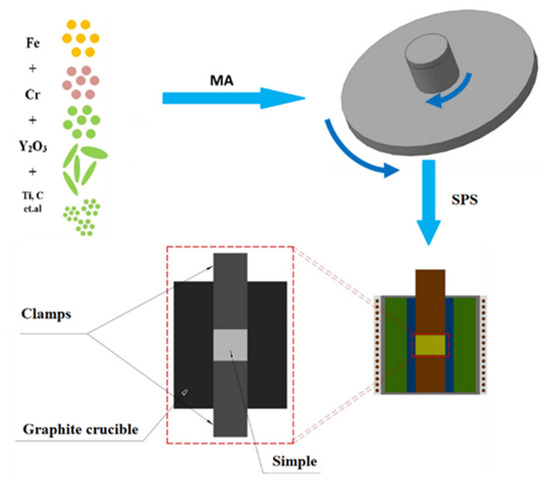
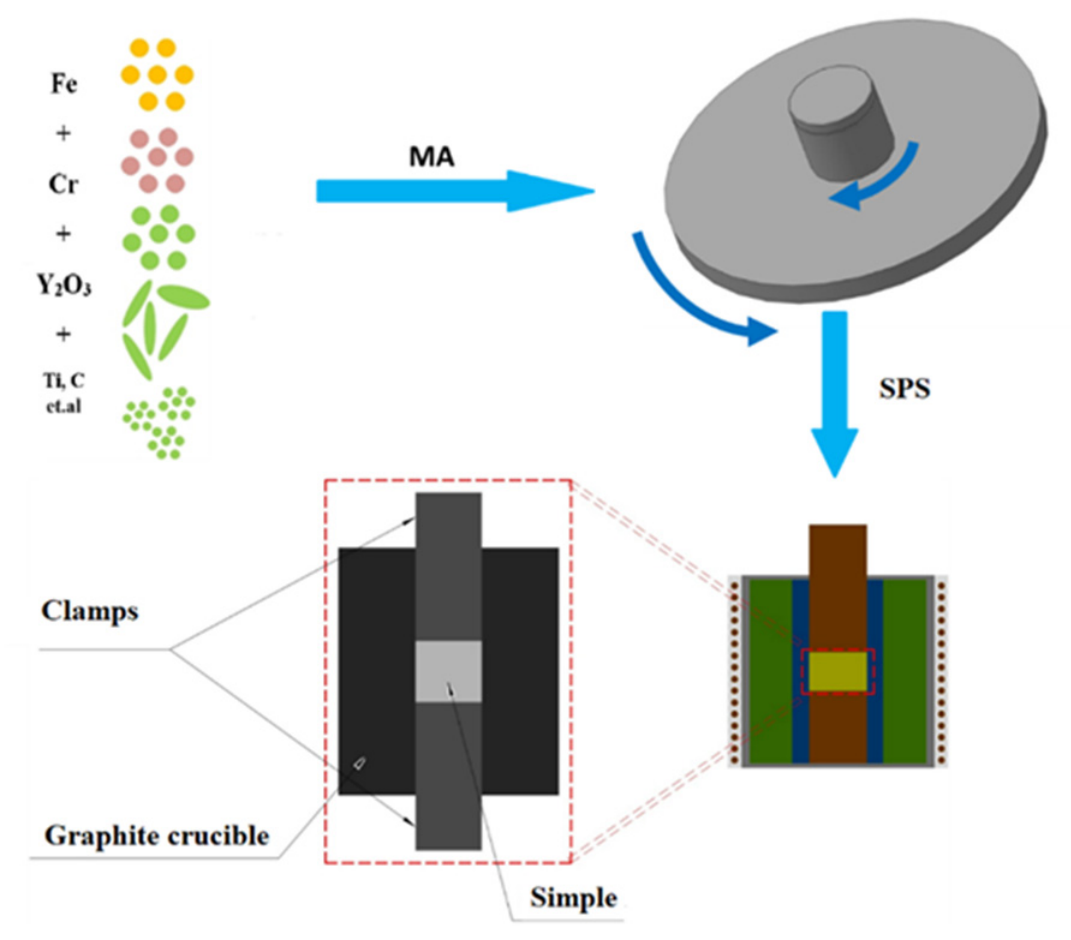
Mechanical alloying of the powder mixture was carried out in a planetary ball mill for 8 h with a ball-to-powder weight ratio of 20:1. Stearic acid was used as a process control agent to prevent excessive cold welding of powder particles during milling. The process was performed with periodic interruptions in order to avoid overheating of the system.
Consolidation of the mechanically alloyed powders was performed by SPS under vacuum conditions (Figure 1). Sintering was carried out at temperatures ranging from 1000 to 1500 °C under a pressure of 40.5 ± 0.2 MPa with a holding time of 5 min. After sintering, disk-shaped samples with a diameter of ~20 mm and a thickness of approximately 2 mm were obtained [29].
Figure 1.
Method for fabrication of ODS steel samples and experimental prototype.
The microstructure of the samples was examined using scanning electron microscopy (SEM) combined with energy-dispersive X-ray spectroscopy (EDS) [30]. Phase composition was analyzed by X-ray diffraction (XRD) using Cu-Kα radiation in the 2θ range of 20–100°. Diffraction patterns were processed using DIFRACC.EVA (version 7) and TOPAS software(version 6) including phase identification and quantitative analysis based on the Rietveld refinement method [31].
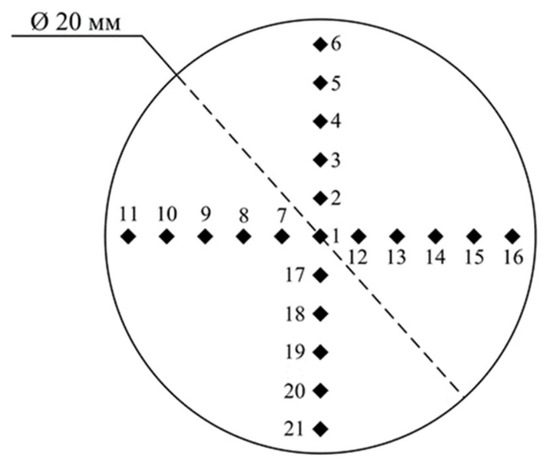
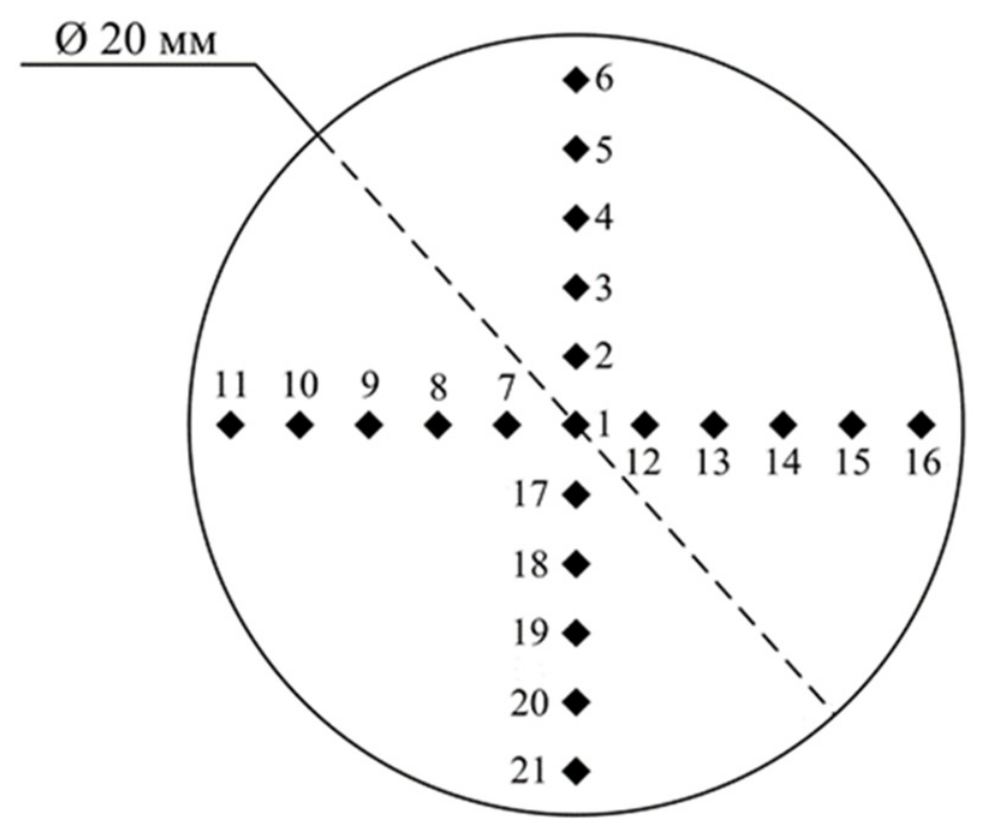
Microhardness measurements were performed using an automated Vickers microhardness tester (QATM, Golling an der Salzach, Austria) under a load of 9.807 N (HV1) with a dwell time of 10 s [32]. For each sample, at least 21 measurements were carried out, followed by statistical analysis of the obtained data (Figure 2).
Figure 2.
Schematic representation of the material microhardness measurement procedure.
The microhardness values were recorded automatically using the instrument software, after which the average value was calculated based on the obtained dataset. The relative density was calculated as the ratio of the experimentally determined density to the theoretical density of the material:
The theoretical density of Fe-Cr-Y2O3, equal to 7.53 g/cm3, was calculated using the rule of mixtures based on the nominal chemical composition of the initial powder mixture and reference density values for the corresponding constituents.
3. Results
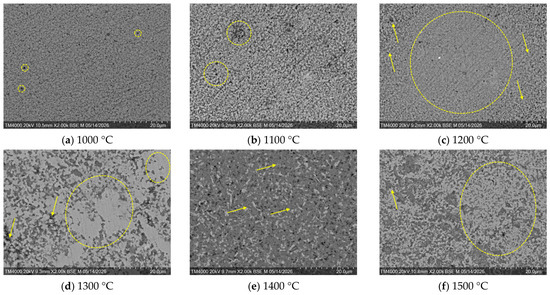
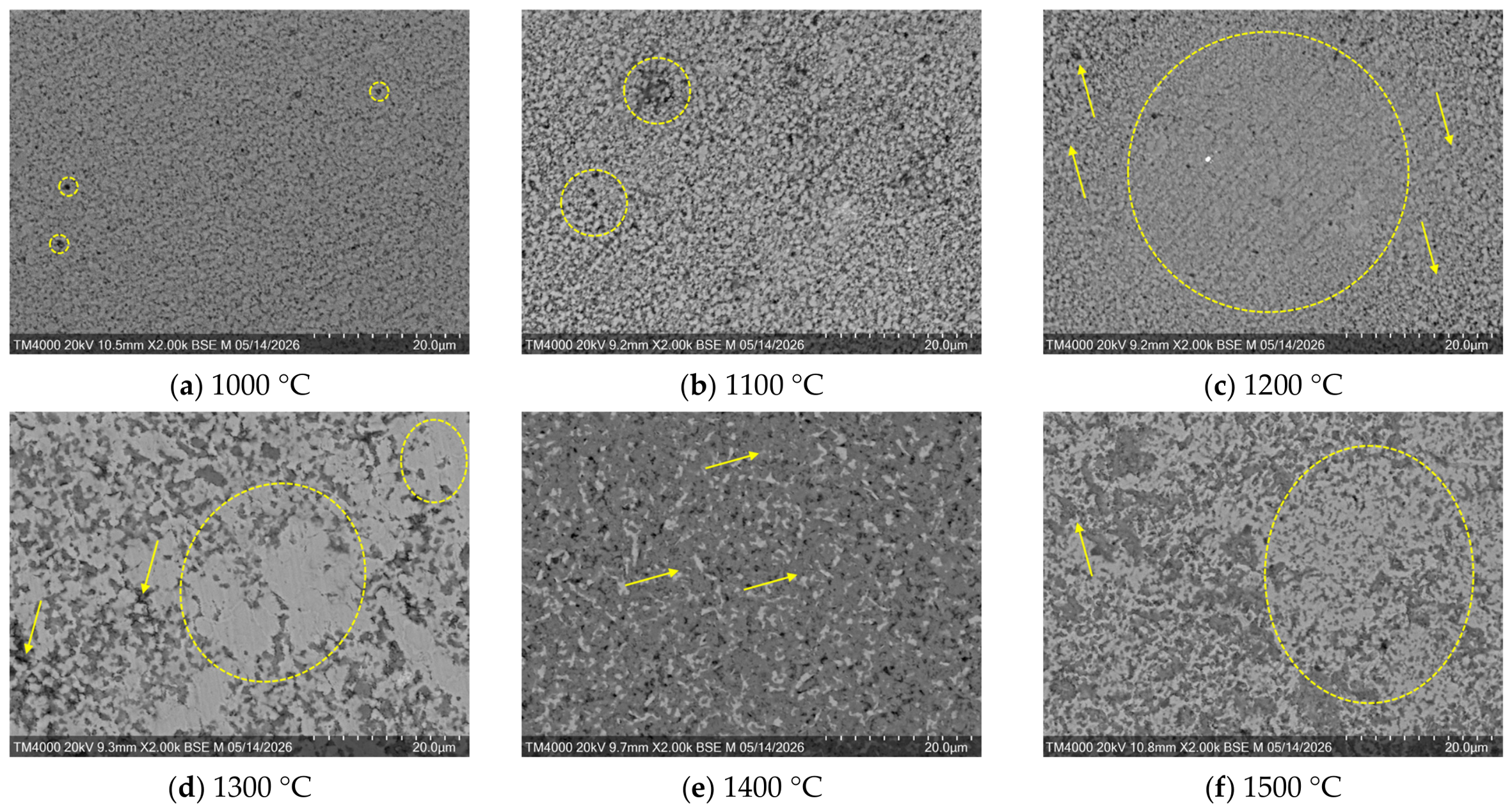
The microstructure of the SPS-sintered ODS steel samples was examined by scanning electron microscopy (SEM). The corresponding results are presented in Figure 3.
Figure 3.
BSE-SEM images (×2000 magnification) of the surface of ODS steel samples sintered by SPS: (a–f) cover the temperature range of 1000–1500 °C at 100 °C intervals.
The SEM micrographs clearly demonstrate the pronounced effect of SPS temperature on the microstructure evolution of the ODS steel. At a sintering temperature of 1000 °C, the sample is characterized by high residual porosity and distinct interparticle boundaries, indicating an insufficient degree of powder consolidation [33]. Increasing the sintering temperature to 1100 °C promotes the development of interparticle bonding and reduces the number of pores; however, isolated porous regions and microstructural heterogeneities are still observed [13].
A further increase in temperature to 1200–1300 °C results in significant densification of the material, the formation of a more continuous metallic structure, and a reduction in residual porosity [34]. The sample sintered at 1400 °C exhibits the densest and most homogeneous microstructure with a minimal number of defects, indicating a high degree of material consolidation [5,35]. A subsequent increase in the sintering temperature to 1500 °C leads to the appearance of locally coarsened structural regions and increased microstructural heterogeneity, which may be attributed to enhanced diffusion processes and localized growth of structural constituents [36].
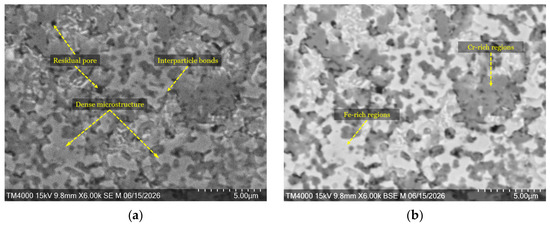
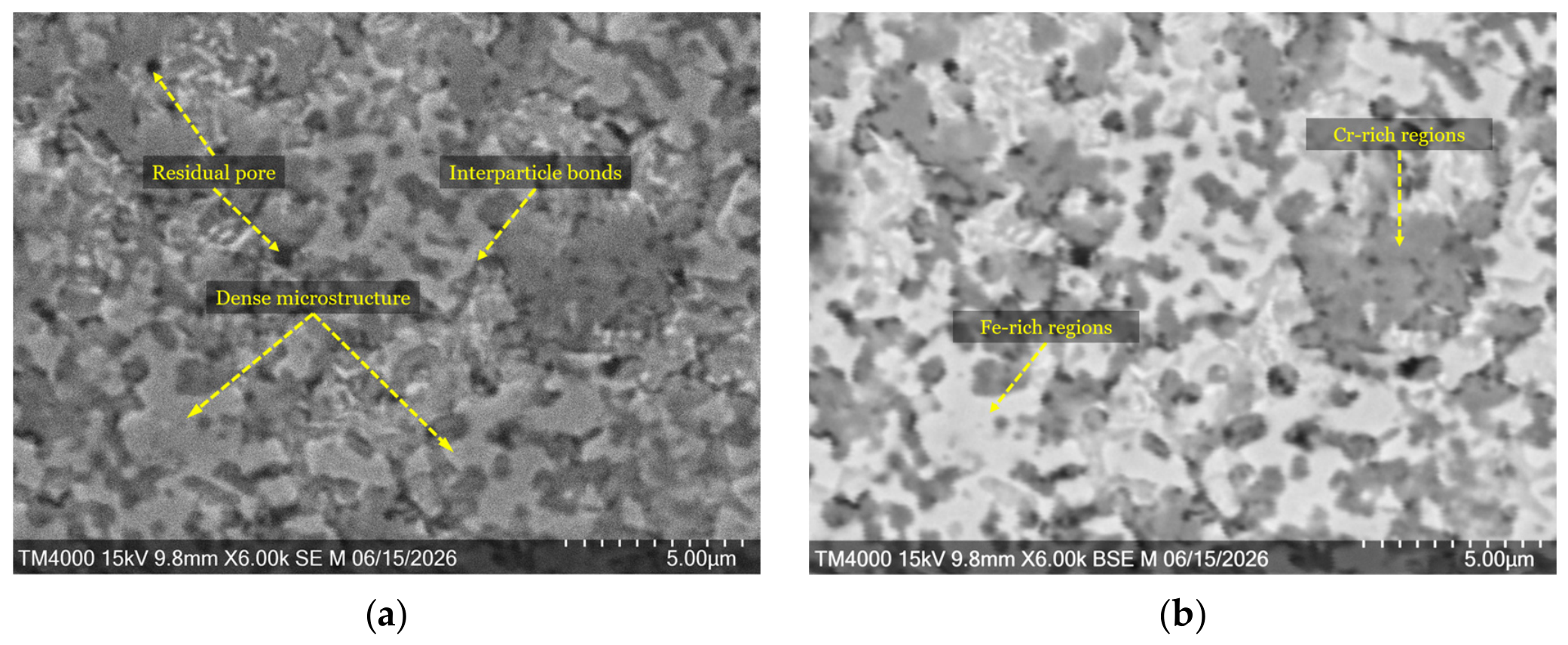
For a more detailed microstructural analysis, the sample sintered at 1400 °C was examined at a magnification of ×6000 using scanning electron microscopy in the secondary electron (SE) and backscattered electron (BSE) imaging modes (Figure 4).
Figure 4.
SEM images acquired in the SE (a) and BSE (b) modes (×6000 magnification) of the surface of the ODS steel sample sintered at 1400 °C.
The SE image reveals a dense microstructure with well-developed interparticle bonding and a small amount of residual porosity, indicating a high degree of material consolidation achieved during SPS.
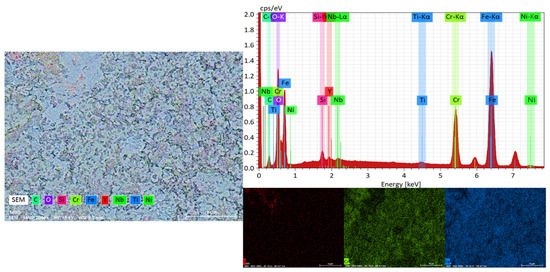
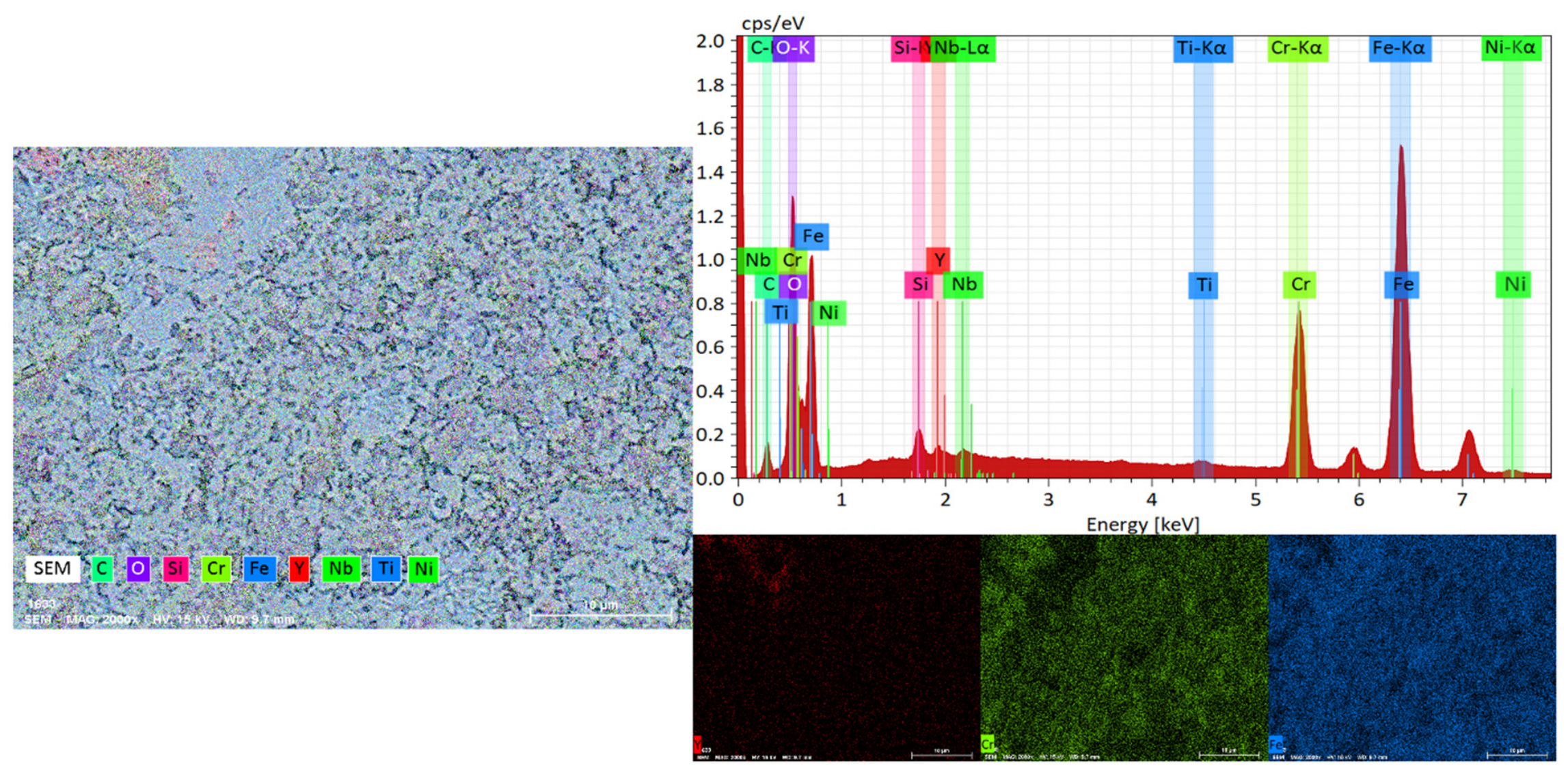
In contrast, the BSE image exhibits heterogeneous contrast arising from variations in the average atomic number of the structural constituents. The bright and dark regions correspond to Fe-rich and Cr-rich areas of the microstructure, respectively, indicating the formation of regions with different elemental compositions. This interpretation is confirmed by the results of energy-dispersive X-ray spectroscopy (EDS) presented in Figure 5.
Figure 5.
EDS analysis of the surface of the ODS steel sample sintered at 1400 °C.
The EDS spectrum confirms the presence of the major alloying elements in the investigated ODS steel and is consistent with the nominal chemical composition of the material. Elemental mapping reveals a predominantly uniform distribution of Fe and Cr throughout the analyzed region, while local variations in signal intensity are consistent with the contrast observed in the BSE image (Figure 4b).
Despite the low Y content in the steel, its presence was reliably detected by EDS analysis, while the elemental distribution maps indicated localized Y enrichment in specific microregions, suggesting the retention of the yttrium-containing oxide component after consolidation of the initial powder mixture [35].
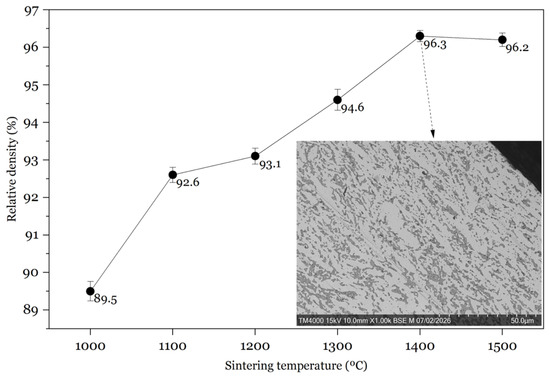
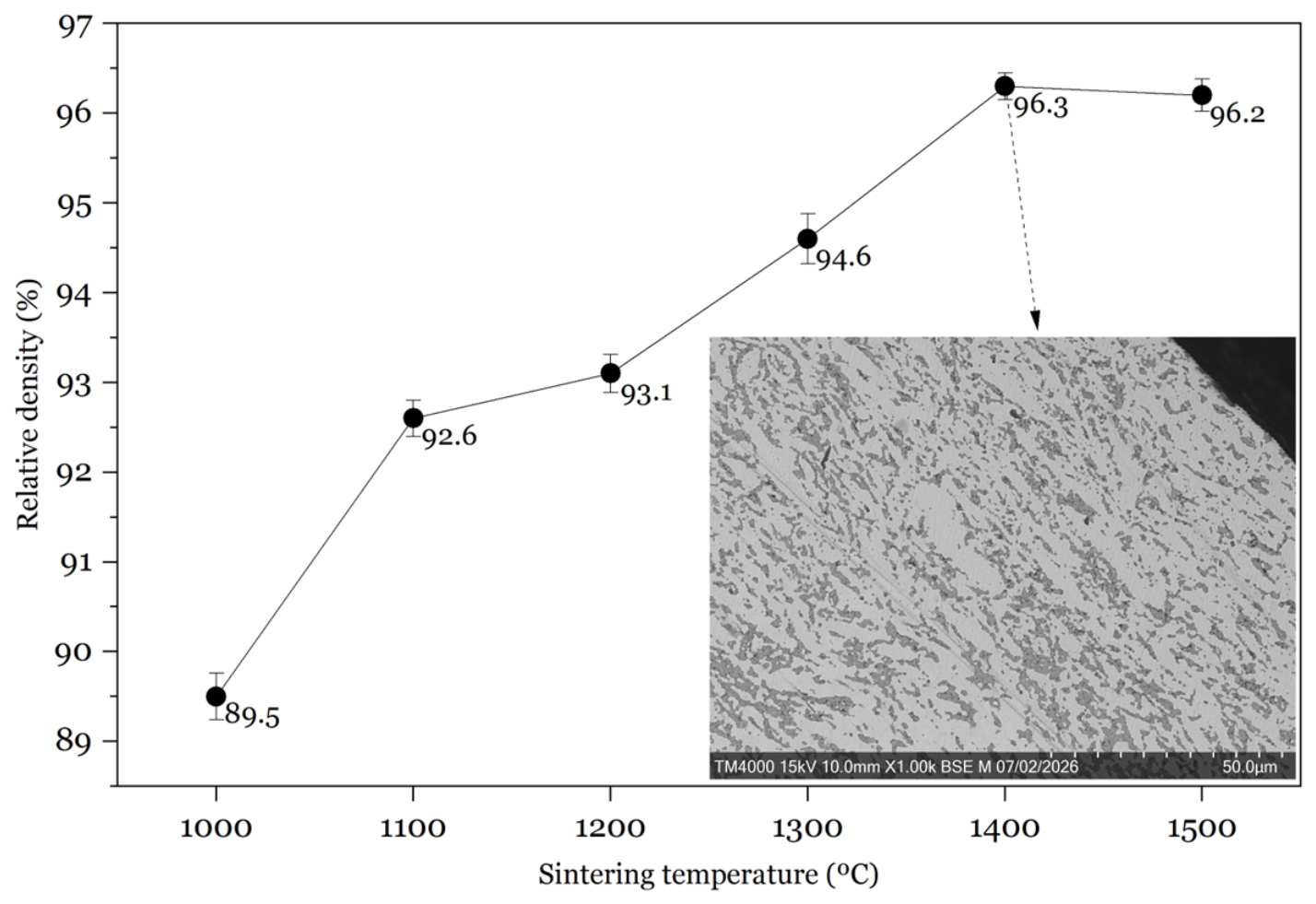
To comprehensively evaluate the degree of consolidation of the sintered samples, their relative density was determined. The dependence of the relative density on the SPS temperature is presented in Figure 6.
Figure 6.
Relative density of ODS steel samples as a function of SPS temperature and SEM image of the cross-section of the sample sintered at 1400 °C.
The obtained results demonstrate a steady increase in relative density with increasing sintering temperature in the range of 1000–1400 °C. The increase in density is attributed to enhanced diffusion processes, the development of interparticle bonding, and the gradual reduction in residual porosity. These findings are in good agreement with the SEM observations (Figure 3) and the cross-sectional image of the sample sintered at 1400 °C shown in Figure 6.
With increasing the sintering temperature to 1500 °C, the relative density remains practically unchanged at 96.2%. Thus, a further increase in temperature does not result in additional densification of the material; however, as demonstrated above, it is accompanied by localized coarsening of the microstructure. These results indicate that a sintering temperature of 1400 °C is the most effective for achieving a high degree of consolidation of the investigated ODS steel [34].
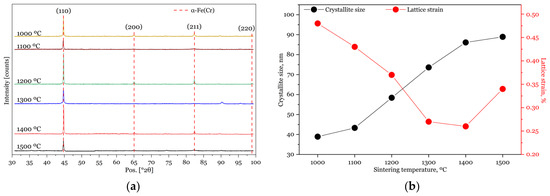
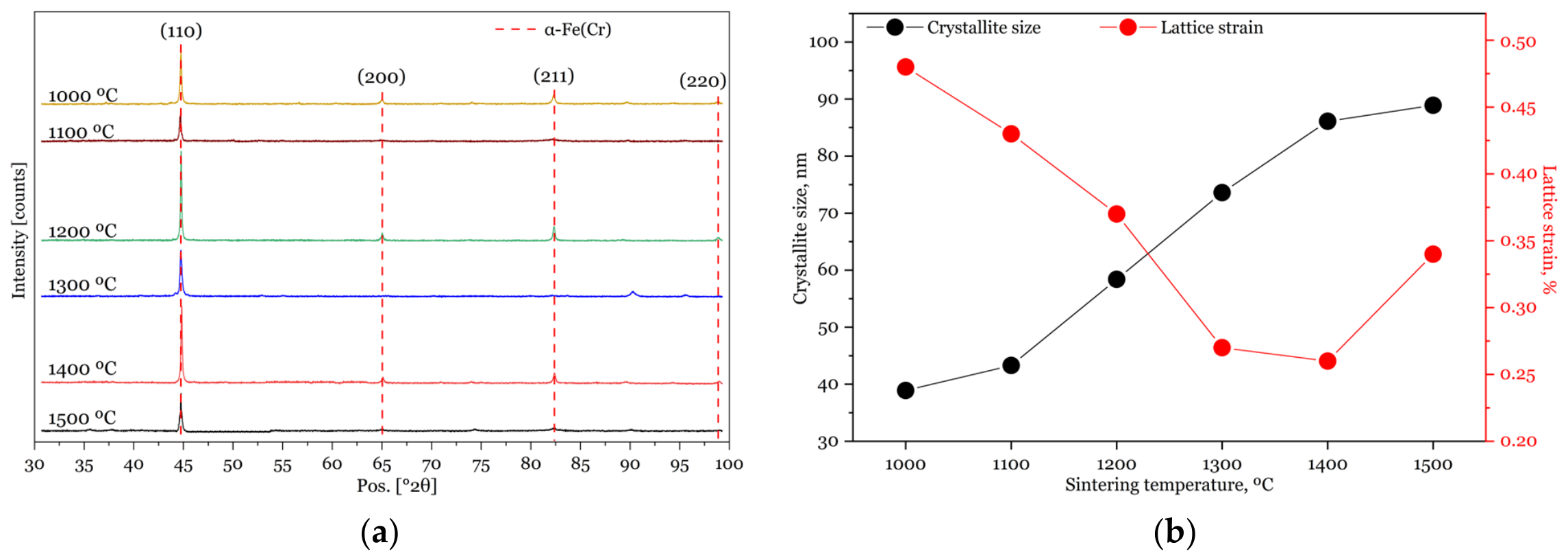
To evaluate the effect of SPS temperature on the phase and structural state of the ODS steel samples, X-ray diffraction (XRD) analysis was performed, followed by refinement of the structural parameters using the Rietveld method. The corresponding results are presented in Figure 7 and Table 1.
Figure 7.
XRD results: (a) superimposed XRD patterns of ODS steel samples sintered at 1000–1500 °C; (b) crystallite size and lattice microstrain determined by Rietveld refinement.
Table 1.
Lattice parameters of the BCC α-Fe(Cr) phase in the ODS steel samples.
The superimposed XRD patterns of the ODS steel samples (Figure 7a) show that, throughout the investigated temperature range, the predominant phase is α-Fe(Cr) with a body-centered cubic (BCC) crystal structure. The diffraction patterns of all samples exhibit well-defined (110), (200), (211), and (220) reflections characteristic of this phase. No significant changes in phase composition were observed over the investigated sintering temperature range.
To refine the structural parameters, whole-pattern Rietveld refinement was performed. In all cases, excellent agreement between the experimental and calculated diffraction patterns was achieved. The Rietveld refinement agreement criteria for the investigated samples are presented in Table 2. The (R_{wp}) and (\chi^2) values for the individual samples characterize the agreement between the experimental and calculated diffraction patterns.
Table 2.
Rietveld refinement agreement criteria for the investigated samples.
Based on the refinement results, the lattice parameters of the α-Fe(Cr) phase were determined, and the corresponding values are summarized in Table 1. For all investigated samples, the lattice parameter remained close to the reference value (a = 2.8692 Å), varying within the range of 2.8524–2.8613 Å. The highest lattice parameter (2.8613 Å) was obtained for the sample sintered at 1400 °C, whereas a decrease to 2.8524 Å was observed for the sample sintered at 1500 °C [11,37].
The evolution of crystallite size and lattice microstrain as a function of SPS temperature is presented in Figure 7b. With increasing sintering temperature, the crystallite size increased progressively from 39 to 89 nm, while the lattice microstrain decreased from 0.48% to 0.26% as the temperature increased to 1400 °C. For the sample sintered at 1500 °C, the microstrain increased to 0.34%, whereas the crystallite size continued to increase [38].
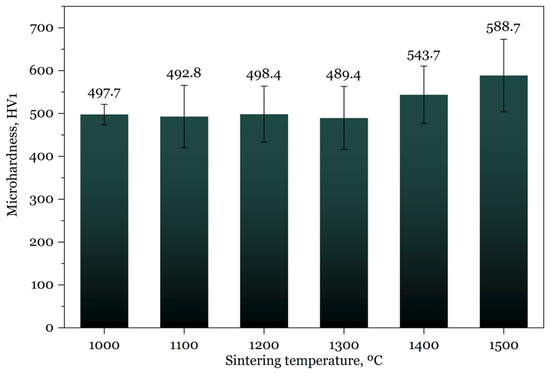
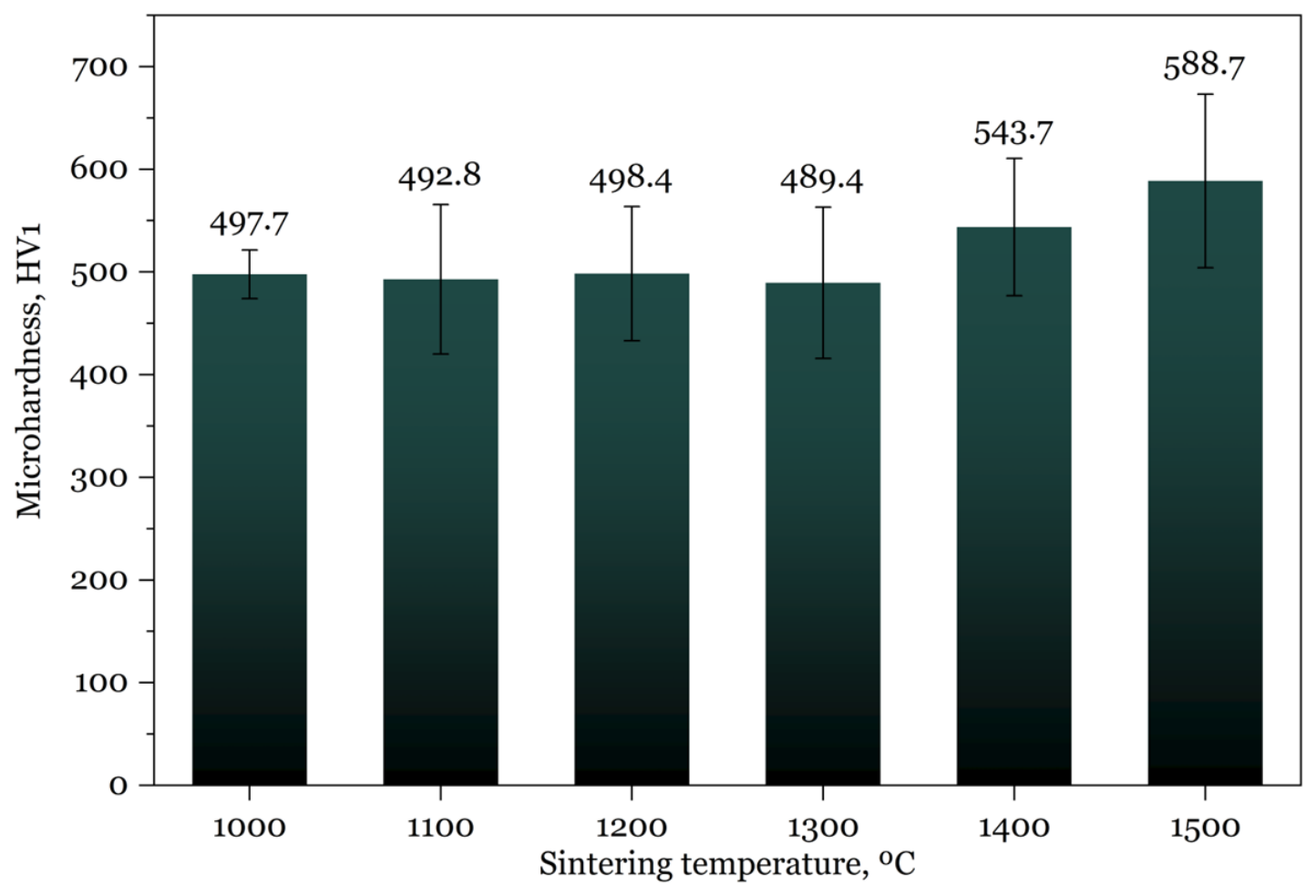
To evaluate the mechanical properties of the sintered ODS steel samples, Vickers microhardness measurements were subsequently performed. The obtained results are presented in Figure 8.
Figure 8.
Vickers microhardness of ODS steel samples as a function of SPS temperature.
The microhardness measurements demonstrated that the SPS temperature significantly influences the mechanical properties of the investigated samples. Within the temperature range of 1000–1300 °C, the microhardness values varied only slightly, remaining within 489.4–498.4 HV1. A further increase in the sintering temperature to 1400 °C resulted in an increase in microhardness to 543.7 HV1, while the sample sintered at 1500 °C exhibited the highest microhardness value of 588.7 HV1.
4. Discussion
The formation of the phase and microstructural state of ODS-steels during SPS is governed by a combination of interrelated physical processes, including plastic deformation of powder particles, formation of interparticle contacts, diffusion-controlled mass transport, grain boundary migration, and the interaction of grain boundaries with dispersed oxide particles. Unlike conventional consolidation techniques, the combination of pulsed electric current, applied pressure, and a high heating rate provides localized activation of diffusion processes and accelerated material consolidation with a significantly shorter high-temperature exposure time [39,40,41].
Temperature is the key parameter of the SPS process, as it governs the diffusion rate and the sequential transition between the dominant consolidation mechanisms. At the initial stage of SPS (1000 °C), the temperature field within the powder compact is non-uniform due to the local concentration of electric current at the interparticle contact regions. According to [42], Joule heating is most intense within the sintering necks, where the electrical resistance differs from that of the particle bulk, resulting in localized activation of surface diffusion even before the onset of intensive bulk mass transport.
As the temperature increases (1100–1400 °C), the temperature gradient between the contact regions and the interior of the powder particles gradually decreases. The enhanced atomic diffusivity promotes the transition from localized neck formation to bulk and grain boundary diffusion. Consequently, the consolidation process becomes more homogeneous throughout the material volume, leading to intensive elimination of residual porosity and the formation of a continuous metallic matrix [39,43].
Once a high degree of consolidation has been achieved, a further increase in temperature to 1500 °C no longer results in significant densification but instead promotes structural rearrangement through grain boundary migration, defect recovery, and crystallite growth [44,45].
It is well established that increasing the SPS temperature leads to a sequential transition between the dominant consolidation mechanisms. During the initial stages, pore elimination and interparticle bonding prevail, whereas after a high density has been attained, grain boundary migration, structural relaxation, and grain growth become the controlling processes. Consequently, a further increase in temperature does not produce a proportional increase in material density but primarily affects its phase and microstructural state [46]. The results obtained in the present study are in good agreement with this mechanism: the highest degree of consolidation was achieved at 1400 °C, whereas further increasing the temperature to 1500 °C resulted in continued structural evolution without a noticeable increase in relative density.
Applied pressure (40.5 ± 0.2 MPa) also plays a crucial role in the SPS process by promoting plastic deformation of the powder particles, localized disruption of surface oxide films, and an increase in the interparticle contact area, thereby creating favorable conditions for diffusion-controlled mass transport. In addition, the applied pressure reduces the diffusion distance between contacting particles, further accelerating the consolidation process. Combined with the short holding time (5 min), the applied pressure enables efficient densification without the prolonged high-temperature exposure characteristic of conventional sintering methods [47,48].
The XRD results reflect the development of recovery and structural relaxation processes: up to 1400 °C, the crystallite size increases, while the lattice microstrain decreases. At 1500 °C, the microstrain increases to 0.34%, whereas the crystallite size continues to increase. At the same time, no significant changes in the phase composition were detected over the entire investigated temperature range, and the lattice parameter varies only slightly. Therefore, the observed temperature dependence of microhardness is associated primarily not with phase transformations, but with changes in the degree of consolidation and the structural-defect state of the material [45,49,50].
Vickers microhardness characterizes the resistance to local plastic deformation in the indentation zone. Therefore, its increase in the range of 1000–1400 °C is primarily consistent with an increase in the degree of consolidation and a reduction in residual porosity. At 1400 °C, the densest and most homogeneous microstructure is formed, and the relative density reaches 96.3%, accompanied by an increase in microhardness to 543.7 HV1.
Local lattice distortions associated with structural defects can impede dislocation motion under applied load and thereby increase resistance to plastic deformation. With increasing SPS temperature to 1400 °C, the crystallite size increases from 39 to 89 nm, while the lattice microstrain decreases from 0.48 to 0.26%. This change in the structural parameters indicates the occurrence of recovery and structural relaxation processes in the crystal lattice. At the same time, microhardness increases from 497.7 to 543.7 HV1, indicating that the change in microhardness is not governed by a single crystal-structural parameter but rather by the combined evolution of the structural state and degree of material consolidation.
An additional structural factor for the investigated ODS steel is the Y2O3 oxide component [51,52,53]. Its presence after SPS is supported by EDS results, in which yttrium was detected in localized microregions of the sample surface, indicating the retention of the yttrium-containing oxide component after consolidation [54,55,56]. However, the obtained data confirm the presence of a Y-containing phase in the sintered material, while its localization in individual regions does not allow conclusions to be drawn regarding its distribution throughout the sample volume.
Of particular interest is the increase in microhardness from 543.7 to 588.7 HV1 upon increasing the temperature from 1400 to 1500 °C. In this temperature range, the relative density remains practically unchanged (96.3 and 96.2%, respectively), while the crystallite size continues to increase and the microstrain increases from 0.26 to 0.34%. The increase in microstrain indicates a change in the state of the crystal lattice with further temperature increase and may contribute to increased resistance to local plastic deformation. Thus, the increase in microhardness at 1500 °C is accompanied by a change in the structural-defect state of the material, whereas further densification is no longer the determining factor [57,58].
Thus, the temperature dependence of microhardness is governed by the sequential evolution of the structural state of the ODS steel during SPS. In the range of 1000–1400 °C, the increase in microhardness is accompanied by an increase in the degree of consolidation and a reduction in residual porosity, alongside structural relaxation of the crystal lattice, whereas at 1500 °C, after a high degree of consolidation has been achieved, the further change in microhardness is accompanied by changes in the structural-defect state of the material. The main phase composition, α-Fe(Cr), remains unchanged throughout the investigated temperature range, indicating that the observed change in mechanical properties is predominantly structural in nature.
5. Conclusions
This study examines the effect of SPS temperature in the 1000–1500 °C range on consolidation processes, microstructural evolution, crystallographic state, and microhardness of mechanically alloyed ODS steel. It was found that the SPS temperature determines the nature of the evolution of the consolidated state of the material. An increase in temperature from 1000 to 1400 °C is accompanied by a consistent decrease in residual porosity, the development of interparticle interactions, and an increase in the degree of consolidation. The maximum relative density of 96.3% is achieved at 1400 °C. A further increase in temperature to 1500 °C leaves the density virtually unchanged at 96.2%, indicating that the maximum degree of consolidation has been reached under the studied pressure and holding conditions. The phase composition of the resulting SPS steel remains highly stable throughout the studied temperature range. According to X-ray diffraction analysis, the main phase remains the α-Fe(Cr) solid solution with a bcc structure, with no significant temperature-induced phase transformations detected. The observed changes in mechanical properties are determined primarily by the evolution of the microstructure and the defect state of the crystal lattice, rather than by changes in phase composition.
An increase in SPS temperature is accompanied by a restructuring of the crystal structure. In the range of 1000–1400 °C, the crystallite size increases from 39 to 89 nm, while the magnitude of lattice microdistortions decreases from 0.48 to 0.26%. This relationship indicates the occurrence of processes of recovery and structural relaxation of the material’s deformed state during consolidation. At 1500 °C, further crystallite growth is accompanied by an increase in microdistortions to 0.34%, indicating a change in the nature of structural evolution after reaching a high degree of consolidation. Microhardness results showed that in the range of 1000–1400 °C, its increase to 543.7 HV1 correlates with an increase in density and a decrease in residual porosity, accompanied by lattice relaxation. At 1500 °C, microhardness increases to a maximum value of 588.7 HV1, despite the absence of additional compaction. Therefore, the increase in microhardness at this temperature cannot be primarily attributed to further consolidation and is likely due to a change in the state of structural defects, as evidenced by an increase in lattice microstrains.
After SPS, the yttrium-containing oxide component is preserved, as confirmed by the detection of yttrium in localized microregions according to EDS. However, the obtained data do not allow for a reliable determination of the volume distribution and nanoscale morphology of the oxide dispersion. Therefore, the contribution of the Y2O3-containing component to material strengthening should be considered in conjunction with changes in density, crystallite structure, and lattice defect state, rather than as an isolated strengthening mechanism.
It was determined that the SPS regime at a pressure of 40.5 ± 0.2 MPa, a temperature of 1400 °C, and a holding time of 5 min provides the highest relative density, the most homogeneous microstructural state, and a favorable combination of structural characteristics. Increasing the temperature to 1500 °C leads to a further increase in microhardness, but is not accompanied by an increase in the degree of consolidation and simultaneously causes further crystallite growth and increased lattice microdistortions.
Author Contributions
Conceptualization, A.S. and N.M.; methodology, O.O. and D.K.; validation, O.O. and A.S.; investigation, A.S. and D.K.; resources, L.Y. and N.M.; writing—original draft preparation, A.S. and N.M.; writing—review and editing, L.Y., A.M. and I.S.; visualization, N.M. and I.S.; supervision, A.M.; project administration, L.Y. All authors have read and agreed to the published version of the manuscript.
Funding
This work was financially supported by the Atomic Energy Agency of the Republic of Kazakhstan under Project No. BR24792713 «Development of Nuclear Energy in the Republic of Kazakhstan».
Data Availability Statement
The raw data supporting the conclusions of this article will be made available by the authors on request.
Conflicts of Interest
The authors declare no conflict of interest.
References
- Hoffelner, W. Damage Assessment in Structural Metallic Materials for Advanced Nuclear Plants. J. Mater. Sci. 2010, 45, 2247–2257. [Google Scholar] [CrossRef] [Scilit]
- Murty, K.L.; Charit, I. Structural Materials for Gen-IV Nuclear Reactors: Challenges and Opportunities. J. Nucl. Mater. 2008, 383, 189–195. [Google Scholar] [CrossRef] [Scilit]
- Kurtz, R.J.; Odette, G.R. Overview of Reactor Systems and Operational Environments for Structural Materials in Fusion Reactors. In Structural Alloys for Nuclear Energy Applications; Elsevier: Amsterdam, The Netherlands, 2019; pp. 51–102. [Google Scholar] [CrossRef] [Scilit]
- Sokolov, I.A.; Skakov, M.K.; Zuev, V.A.; Ganovichev, D.A.; Tulenbergenov, T.R.; Miniyazov, A.Z. Study of the Interaction of Plasma with Beryllium That Is a Candidate Material for the First Wall of a Fusion Reactor. Tech. Phys. 2018, 63, 506–510. [Google Scholar] [CrossRef] [Scilit]
- Odette, G.R.; Alinger, M.J.; Wirth, B.D. Recent Developments in Irradiation-Resistant Steels. Annu. Rev. Mater. Res. 2008, 38, 471–503. [Google Scholar] [CrossRef] [Scilit]
- Ukai, S.; Fujiwara, M. Perspective of ODS Alloys Application in Nuclear Environments. J. Nucl. Mater. 2002, 307–311, 749–757. [Google Scholar] [CrossRef] [Scilit]
- Sokolov, I.A.; Skakov, M.K.; Miniyazov, A.Z.; Aubakirov, B.T.; Tulenbergenov, T.R.; Gradoboev, A.V. Analysis of the Beryllium Stability under Standard and Critical Operation in a Fusion Reactor. Eurasian J. Phys. Funct. Mater. 2021, 5, 304–313. [Google Scholar] [CrossRef] [Scilit]
- Batyrbekov, E.G.; Tazhibayeva, I.L.; Baklanov, V.V.; Chektybaev, B.J.; Zarva, D.B.; Koyanbayev, Y.T.; Gordienko, Y.N.; Kulsartov, T.V.; Miniyazov, A.J.; Ponkratov, Y.V. Research in the Field of Controlled Thermonuclear Fusion in the Republic of Kazakhstan. Phys. At. Nucl. 2024, 87, S10–S16. [Google Scholar] [CrossRef] [Scilit]
- Alinger, M.J.; Odette, G.R.; Hoelzer, D.T. On the Role of Alloy Composition and Processing Parameters in Nanocluster Formation and Dispersion Strengthening in Nanostructured Ferritic Alloys. Acta Mater. 2009, 57, 392–406. [Google Scholar] [CrossRef] [Scilit]
- Zhang, G.; Zhou, Z.; Mo, K.; Miao, Y.; Li, S.; Liu, X.; Wang, M.; Park, J.-S.; Almer, J.; Stubbins, J.F. The Comparison of Microstructures and Mechanical Properties between 14Cr-Al and 14Cr-Ti Ferritic ODS Alloys. Materials 2016, 98, 61–67. [Google Scholar] [CrossRef] [Scilit]
- Dong, H.; Yu, L.; Liu, Y.; Liu, C.; Li, H.; Wu, J. Effect of Hafnium Addition on the Microstructure and Tensile Properties of Aluminum Added High-Cr ODS Steels. J. Alloys Compd. 2017, 702, 538–545. [Google Scholar] [CrossRef] [Scilit]
- Laurent-Brocq, M.; Legendre, F.; Mathon, M.H.; Mascaro, A.; Poissonnet, S.; Radiguet, B.; Pareige, P.; Loyer, M.; Leseigneur, O. Influence of Ball-Milling and Annealing Conditions on Nanocluster Characteristics in Oxide Dispersion Strengthened Steels. Acta Mater. 2012, 60, 7150–7159. [Google Scholar] [CrossRef] [Scilit]
- Zhang, Z.-H.; Liu, Z.-F.; Lu, J.-F.; Shen, X.-B.; Wang, F.-C.; Wang, Y.-D. The Sintering Mechanism in Spark Plasma Sintering—Proof of the Occurrence of Spark Discharge. Scr. Mater. 2014, 81, 56–59. [Google Scholar] [CrossRef] [Scilit]
- Mukhamedova, N.; Miniyazov, A.; Sabyrtayeva, A.; Tulenbergenov, T.; Oken, O. Dispersion of Sintered Mg–Ni–Ce Materials for Efficient Hydrogen Storage. Crystals 2025, 15, 743. [Google Scholar] [CrossRef] [Scilit]
- Li, Z.; Lu, Z.; Xie, R.; Lu, C.; Liu, C. Effect of Spark Plasma Sintering Temperature on Microstructure and Mechanical Properties of 14Cr-ODS Ferritic Steels. Mater. Sci. Eng. A 2016, 660, 52–60. [Google Scholar] [CrossRef] [Scilit]
- Spartacus, G.; Malaplate, J.; De Geuser, F.; Mouton, I.; Sornin, D.; Perez, M.; Guillou, R.; Arnal, B.; Rouesne, E.; Deschamps, A. Chemical and Structural Evolution of Nano-Oxides from Mechanical Alloying to Consolidated Ferritic Oxide Dispersion Strengthened Steel. Acta Mater. 2022, 233, 117992. [Google Scholar] [CrossRef] [Scilit]
- DeJong, M.; Horn, T.; Kaoumi, D. Review of Solid-State Consolidation Processing Techniques of ODS Steels (Hot Extrusion, Hot Isostatic Pressing, Spark Plasma Sintering, and Stir Friction Consolidation): Resulting Microstructures and Mechanical Properties. JOM 2024, 76, 6252–6276. [Google Scholar] [CrossRef] [Scilit]
- Yan, X.; Li, Z.; Yang, H.; Wang, S. Microstructure Evolution and Mechanical Properties of ODS FeCrAl Alloys Fabricated by Spark Plasma Sintering. Ann. Nucl. Energy 2024, 204, 110530. [Google Scholar] [CrossRef] [Scilit]
- Macía, E.; García-Junceda, A.; Serrano, M.; Hernández-Mayoral, M.; Diaz, L.A.; Campos, M. Effect of the Heating Rate on the Microstructure of a Ferritic ODS Steel with Four Oxide Formers (Y–Ti–Al–Zr) Consolidated by Spark Plasma Sintering. J. Nucl. Mater. 2019, 518, 190–201. [Google Scholar] [CrossRef] [Scilit]
- Samarkhanov, K.; Arita, Y.; Batyrbekov, E.; Vityuk, V.; Baklanov, V.; Baklanova, Y.; Sapatayev, Y.; Niino, K.; Tanaka, S.; Yoshikawa, T. An Experimental Study Using CeO2, ZrO2, and SUS316L Powders as Simulated Nuclear Fuel Materials to Examine the Process of Fuel Debris Formation. J. Nucl. Mater. 2026, 607, 156286. [Google Scholar] [CrossRef] [Scilit]
- Mukhamedov, N.Y.; Kozhakhmetov, Y.A.; Tskhe, V.K. Microstructure and Mechanical Properties of the Solidified Melt Obtained by the In-Pile Test. Ann. Nucl. Energy 2022, 179, 109404. [Google Scholar] [CrossRef] [Scilit]
- Mukhamedov, N.; Baklanov, V.; Moldagulov, M.; Toleubekov, K.; Surayev, A.; Yagudin, A.; Kanatnikov, S. The BN-350 Reactor Decommissioning: Quantitative Analysis and Prospects for Solid Radioactive Waste Management. Energies 2025, 18, 4651. [Google Scholar] [CrossRef] [Scilit]
- Mukhamedov, N.; Kukushkin, I.; Vityuk, V.; Vityuk, G.; Dolzhikov, S.; Sapatayev, Y. Properties and Characteristics of Corium Prototype of a Fast Power Reactor. Ann. Nucl. Energy 2025, 206, 111200. [Google Scholar] [CrossRef] [Scilit]
- Kurbanbekov, S.; Aidarova, M.; Kizatov, A.; Bayatanova, L.; Rutkowska-Gorczyca, M.; Amangeldiyeva, Y. Influence of Milling Time and Binder Composition on Phase Evolution in WC-Based Composite Powders Fabricated via High-Energy Ball Milling. Front. Mater. 2025, 12, 1684414. [Google Scholar] [CrossRef] [Scilit]
- Vurim, A.; Mukhamedova, N.; Baklanova, Y.; Syssaletin, A.; Akayev, A. Information and Analytical System for Processing of Research Results to Justify the Safety of Atomic Energy. Appl. Sci. 2022, 12, 9705. [Google Scholar] [CrossRef] [Scilit]
- Mukhamedova, N.; Miniyazov, A.; Zhanbolatova, G.; Ospanova, Z.; Sabyrtayeva, A.; Shaikieva, K. Evolution of Phase Transformations in the Mg–Ni–Ce System After Mechanical Synthesis and Spark Plasma Sintering. Materials 2025, 18, 2131. [Google Scholar] [CrossRef] [Scilit] [PubMed]
- Miniyazov, A.; Mukhamedova, N.; Sokolov, I.; Tulenbergenov, T.; Ospanova, Z.; Uazyrkhanova, G.; Bekmagambetova, B.; Oken, O.; Zhakiya, R. Structural and Phase Evolution in the Mg–Al System Leading to Lower Hydrogen Desorption Temperature. Hydrogen 2025, 6, 108. [Google Scholar] [CrossRef] [Scilit]
- Mukhamedova, N.; Yerbolat, D.; Zakerov, S.; Dauletkhanov, Y.; Urkunbay, A.; Yerbolatova, G. Effect of Mechanical Alloying Time on the Structural and Phase State of BN–C–Ti–Al Composites as Structural Prerequisites for Hydrogen Storage. Crystals 2026, 16, 155. [Google Scholar] [CrossRef] [Scilit]
- Baklanov, V.; Miniyazov, A.; Mukhamedova, N.; Yerygin, L. Method for Producing Oxide-Dispersed Steel. Kazakhstan Utility Model Patent No. 2026/0466.2, 26 February 2026. Available online: https://gosreestr.kazpatent.kz/Utilitymodel/Details?docNumber=451315 (accessed on 15 July 2026).
- Goldstein, J.I.; Newbury, D.E.; Joy, D.C.; Lyman, C.E.; Echlin, P.; Lifshin, E.; Sawyer, L.; Michael, J.R. Scanning Electron Microscopy and X-Ray Microanalysis, 3rd ed.; Springer: New York, NY, USA, 2003. [Google Scholar] [CrossRef] [Scilit]
- International Centre for Diffraction Data (ICDD). PDF-4 Axiom; Release 2025; ICDD: Newtown Square, PA, USA, 2025; Available online: https://www.icdd.com/pdf-4-axiom/ (accessed on 15 July 2026).
- ASTM E384-22; Standard Test Method for Microindentation Hardness of Materials. ASTM International: West Conshohocken, PA, USA, 2022. [CrossRef] [Scilit]
- German, R.M. Sintering Theory and Practice; John Wiley & Sons: New York, NY, USA, 1996. [Google Scholar]
- Grasso, S.; Sakka, Y.; Maizza, G. Electric Current Activated/Assisted Sintering (ECAS): A Review of Patents 1906–2008. Sci. Technol. Adv. Mater. 2009, 10, 053001. [Google Scholar] [CrossRef] [Scilit] [PubMed]
- Cao, S.; Zhou, Z. Microstructure and Mechanical Properties of an ODS Ferritic Steel with Very Low Cr Content. J. Nucl. Mater. 2021, 551, 152971. [Google Scholar] [CrossRef] [Scilit]
- Humphreys, F.J.; Hatherly, M. Recrystallization and Related Annealing Phenomena, 2nd ed.; Elsevier: Oxford, UK, 2004. [Google Scholar]
- Orowan, E. Fracture and Strength of Solids. Rep. Prog. Phys. 1949, 12, 185–232. [Google Scholar] [CrossRef] [Scilit]
- Holzer, J.; Gamanov, Š.; Luptáková, N.; Dlouhý, A.; Svoboda, J. Coarsening Kinetics of Y2O3 Dispersoid in New Grade of Fe–Al–Cr-Based ODS Alloy. Metals 2022, 12, 210. [Google Scholar] [CrossRef] [Scilit]
- Zhou, X.; Liu, Y.; Yu, L.; Ma, Z.; Guo, Q.; Huang, Y.; Li, H. Microstructure Characteristic and Mechanical Property of Transformable 9Cr-ODS Steel Fabricated by Spark Plasma Sintering. Mater. Des. 2017, 132, 158–169. [Google Scholar] [CrossRef] [Scilit]
- Zhao, R.; Jia, H.; Cao, S.; Tong, Z.; Yang, H.; Li, J.; Wang, Y. Effect of the Addition of Y and Y2O3 on Microstructure and Mechanical Properties of 15Cr–15Ni ODS Steel. Nucl. Mater. Energy 2022, 31, 101196. [Google Scholar] [CrossRef] [Scilit]
- Meza, A.; Macía, E.; Serrano, M.; Merten, C.; Gaitzsch, U.; Weißgärber, T.; Campos, M. Enhancement of FeCrAl-ODS Steels through Optimised SPS Parameters and Addition of Novel Nano-Oxide Formers. Nucl. Eng. Technol. 2024, 56, 2584–2594. [Google Scholar] [CrossRef] [Scilit]
- Ji, G.; Grosdidier, T.; Bozzolo, N.; Launois, S. The Mechanisms of Microstructure Formation in a Nanostructured Oxide Dispersion Strengthened FeAl Alloy Obtained by Spark Plasma Sintering. Intermetallics 2007, 15, 108–118. [Google Scholar] [CrossRef] [Scilit]
- Fu, J.; Brouwer, J.C.; Richardson, I.M.; Hermans, M.J.M. Effect of Mechanical Alloying and Spark Plasma Sintering on the Microstructure and Mechanical Properties of ODS Eurofer. Mater. Des. 2019, 171, 107849. [Google Scholar] [CrossRef] [Scilit]
- Bogachev, I.; Grigoryev, E.; Khasanov, O.L.; Olevsky, E. Fabrication of 13Cr-2Mo Ferritic/Martensitic Oxide-Dispersion-Strengthened Steel Components by Mechanical Alloying and Spark Plasma Sintering. JOM 2014, 66, 1020–1026. [Google Scholar] [CrossRef] [Scilit]
- Paul, M.J.; Muthaiah, V.M.S.; Mula, S. Yttria-Reinforced Fe-Cr Ferritic Alloy-Based Nanocomposites for Fusion Reactor Structural Applications. Metall. Mater. Trans. A 2021, 52, 627–643. [Google Scholar] [CrossRef] [Scilit]
- Xie, R.; Lu, Z.; Lu, C.; Li, Z.; Ding, X.; Liu, C. Microstructures and Mechanical Properties of 9Cr Oxide Dispersion Strengthened Steel Produced by Spark Plasma Sintering. Fusion Eng. Des. 2017, 115, 67–73. [Google Scholar] [CrossRef] [Scilit]
- Ukai, S.; Ohtsuka, S.; Kaito, T.; de Carlan, Y.; Ribis, J.; Malaplate, J. Oxide Dispersion-Strengthened/Ferrite-Martensite Steels as Core Materials for Generation IV Nuclear Reactors. In Structural Materials for Generation IV Nuclear Reactors; Yvon, P., Ed.; Woodhead Publishing: Cambridge, UK, 2017; pp. 357–414. [Google Scholar] [CrossRef] [Scilit]
- Chinnappan, R. Thermodynamic Stability of Oxide Phases of Fe-Cr Based ODS Steels via Quantum Mechanical Calculations. Procedia Eng. 2014, 86, 788–798. [Google Scholar] [CrossRef] [Scilit][Green Version]
- Ponraj, B.V.; Kumaran, S. Attributes of Spark Plasma Sintering on Developing Oxide Dispersion Strengthened Ferritic Steels and Understanding Structure–Property Relation. J. Inst. Eng. India Ser. D 2025, 106, 49–55. [Google Scholar] [CrossRef] [Scilit]
- Wang, Y.; Han, L.; Jia, H.; Zhang, H.; Guan, H.; Wang, C.; Su, X.; Zhu, Y.; Mao, X.; Zhou, Z. Improvement of Creep Resistance and Its Mechanism of a F/M Steel through the ODS Strategy. Mater. Charact. 2025, 223, 114939. [Google Scholar] [CrossRef] [Scilit]
- Zhang, Y.; Yan, Y.; Zhai, Y.; Qin, W.; Che, H.; Wang, T.; Cao, R. Effect of Oxygen Content on Microstructure and Tensile Properties of a 22Cr–5Al ODS Steel. Materials 2021, 14, 2241. [Google Scholar] [CrossRef] [Scilit] [PubMed]
- Williams, C.A.; Unifantowicz, P.; Baluc, N.; Smith, G.D.W.; Marquis, E.A. The Formation and Evolution of Oxide Particles in Oxide-Dispersion-Strengthened Ferritic Steels during Processing. Acta Mater. 2013, 61, 2219–2235. [Google Scholar] [CrossRef] [Scilit]
- Hsiung, L.L.; Fluss, M.J.; Kimura, A. Structure of Oxide Nanoparticles in Fe–16Cr MA/ODS Ferritic Steel. Mater. Lett. 2010, 64, 1782–1785. [Google Scholar] [CrossRef] [Scilit]
- Zhao, Q.; Qiao, Z.; Liu, Y.; Yu, L.; Huang, Y.; Guo, Q.; Li, H. Characterization of 14Cr ODS Steel Fabricated by Spark Plasma Sintering. Metals 2019, 9, 200. [Google Scholar] [CrossRef] [Scilit]
- Strakosova, A.; Průša, F.; Michalcová, A.; Vojtěch, D. Structure and Mechanical Properties of the 18Ni300 Maraging Steel Produced by Spark Plasma Sintering. Metals 2021, 11, 748. [Google Scholar] [CrossRef] [Scilit]
- Hirata, A.; Fujita, T.; Wen, Y.; Schneibel, J.H.; Liu, C.T.; Chen, M.W. Atomic Structure of Nanoclusters in Oxide-Dispersion-Strengthened Steels. Nat. Mater. 2011, 10, 922–926. [Google Scholar] [CrossRef] [Scilit] [PubMed]
- Duntu, S.H.; Boakye-Yiadom, S. Microstructural Evolution and Adiabatic Shear Band Formation in Tempered AISI 4340 Steel under High Strain Rate and Elevated Temperature Impact. Mater. Today Commun. 2025, 49, 114059. [Google Scholar] [CrossRef] [Scilit]
- Murphy, C.; Buksa, S.; Day, J.; Felix-Lopez, A.; Antony Jose, S.; Menezes, P.L. Disruptive Manufacturing of Oxide Dispersion-Strengthened Steels for Nuclear Applications: Advances, Challenges, and Future Prospects. Processes 2025, 13, 1572. [Google Scholar] [CrossRef] [Scilit]

Disclaimer/Publisher’s Note: The statements, opinions and data contained in all publications are solely those of the individual author(s) and contributor(s) and not of MDPI and/or the editor(s). MDPI and/or the editor(s) disclaim responsibility for any injury to people or property resulting from any ideas, methods, instructions or products referred to in the content. |
© 2026 by the authors. Licensee MDPI, Basel, Switzerland. This article is an open access article distributed under the terms and conditions of the Creative Commons Attribution (CC BY) license.