


Abstract
This study examines the effect of spark plasma sintering (SPS) temperature on the phase composition, microstructure, densification, and microhardness of cobalt-free WC–Fe and WC–Fe–Ni hard alloys. Increasing the sintering temperature from 1250 °C to 1300 °C improved densification in both alloy systems. Residual porosity decreased from 13.2% to 12.7% in the WC–Fe–Ni alloy and from 13.8% to 12.0% in the WC–Fe alloy, while the density increased from 12.39 g/cm3 to 12.46 g/cm3 and from 12.15 g/cm3 to 12.40 g/cm3, respectively. The WC–Fe -Ni alloy exhibited a more homogeneous microstructure and higher microhardness, increasing from 708 10 HV0.2 to 823 ± 15 HV0.2, whereas the WC–Fe alloy showed an increase from 630 ± 15 HV0.2 to 770 ± 5 HV0.2. X-ray diffraction analyses identified Fe3W3C, FeNi3, and (Fe, Ni) solid-solution phases formed during SPS. The results indicate that both the sintering temperature and binder composition influence densification, phase evolution, and mechanical performance. Among the investigated materials, the WC–Fe–Ni alloy showed better microstructural stability and hardness than the WC–Fe alloy. These findings suggest that Fe–Ni binders are promising candidates for cobalt-free cemented carbides, although additional studies on fracture toughness and wear resistance are required before practical cutting-tool applications can be fully assessed.
1. Introduction
Improving the performance characteristics of materials and products and increasing their service life are among the most pressing problems in modern materials science. In this regard, active research is being conducted on alloys and protective coatings capable of providing high wear resistance, strength and thermal stability under intensive operating conditions. Among such materials, a special place is occupied by cemented alloys based on tungsten carbide, which are widely used in various industries to protect working tools and structural elements of equipment [1,2,3]. Their effectiveness is confirmed by high hardness and wear resistance, which is especially important in the manufacture of cutting tools and parts operating under conditions of increased mechanical loads [4]. One of the common methods for improving the properties of tungsten carbide is alloying with transition metals and their carbides, such as [5] TiC [6,7], NbC [8] and TaC [9], as well as the addition of metallic binders, including Fe and Ni. Such modifications make it possible to increase heat resistance, slow down oxidation processes and improve the performance characteristics of the material. Due to this, such alloys find application in various fields, including metallurgy, medicine, transportation and aerospace industries, as well as in the manufacture of excavator teeth and other elements of earthmoving equipment [10,11,12]. In cemented carbides, tungsten carbide acts as the main hard phase, providing high hardness and wear resistance in the alloy. At the same time, the material has significant crack resistance, reaching approximately 15–20 MPa m1/2 [13,14,15]. Due to the combination of these properties, such materials can be used to protect components that operate in extreme conditions, including elements of nuclear power plants, where high temperatures and significant thermal loads are possible. Traditionally, cobalt is used as a metallic binder in cemented carbides, and plays an important role in wetting tungsten carbide particles and forming a strong metallic matrix. This contributes to an increase in the bending strength of the material, reaching 3–4 GPa. However, cobalt has a number of significant drawbacks, including relatively low resistance to corrosion and oxidation, as well as toxicity, which limits the service life and scope of application of such materials. In this regard, alternative binder systems based on elements such as Ni, Fe [16,17], Cr and Ti have been actively studied in recent years. The use of nickel binders allows for the production of alloys with high hardness (up to ~1400 HV) and increased fracture toughness (about 7.5 MPa m1/2) [18,19,20]. In addition, the presence of nickel helps to reduce the required carbon content in the system, which prevents the formation of the undesirable η-phase. To improve the resistance of materials to radiation damage and thermal effects, the introduction of transition metals, including iron, chromium, vanadium and manganese, as well as the use of high-entropy alloys, are also being considered. The improvement in properties in such systems is explained by the synergistic interaction of the components. An additional advantage of using iron is the formation of relatively safe activation products during potential environmental releases [21,22,23]. Iron and nickel form a ductile metallic matrix that acts as a binder phase, holding tungsten carbide grains and providing mechanical support. This contributes to the increased strength and stability of WC-based refractory hard alloys. Furthermore, iron is capable of forming stable carbide phases that are thermodynamically stable and promote grain refinement of tungsten carbide, which positively impacts the mechanical properties of the material. Ni–Fe alloys are widely used in industry due to their good corrosion resistance and relatively low cost [24,25,26]. With optimal selection of chemical composition and processing conditions, such materials can exhibit properties comparable to or even superior to those of traditional cobalt-based binder systems.
Various technological methods are used to produce such alloys, including laser remelting, vacuum melting, traditional sintering, and other powder metallurgy methods. However, the best combination of strength and hardness is usually achieved using modern sintering methods, among which SPS is particularly noteworthy. SPS is based on the application of pulsed electric current, which activates the compaction and reaction sintering processes of powder materials. Compared to traditional methods such as hot pressing, hot isostatic pressing, induction heating, or liquid-phase sintering, this technology enables high material density to be achieved at lower temperatures and in significantly shorter process times [27]. Furthermore, SPS suppresses grain growth, which is particularly important for maintaining the fine-grain structure of carbide materials [28]. During the SPS process, the conductive metallic phase accelerates diffusion processes between powder particles. Local electrical discharges and microplasma effects occurring between the particles further activate compaction processes and contribute to the effective elimination of residual porosity [29]. Due to these advantages, SPS technology is considered a promising method for producing new metal–ceramic materials with improved performance characteristics, which in some cases are virtually impossible to manufacture using traditional powder metallurgy methods.
The aim of the present study was to investigate the structural–phase evolution and morphology of cobalt-free WC–Fe and WC–Fe–Ni hard alloys produced by SPS, as well as to evaluate the influence of sintering temperature on their phase composition, microstructure, density, porosity, and microhardness. The scientific contribution of this work lies in the comparative investigation of SPS-consolidated WC–Fe and WC–Fe–Ni cemented carbides processed under identical sintering conditions. This approach enables a direct evaluation of the influence of binder composition on phase evolution, densification, microstructure, porosity, and microhardness under the same processing parameters, providing a systematic comparison of two cobalt-free binder systems.
2. Materials and Methods
In this study, WC powder (purity 99.5%, particle size 30–50 μm, density 15.63 g/cm3), Ni powder (purity 99.5%, particle size 30–50 μm, density 8.90 g/cm3), and Fe powder (purity 99.5%, particle size 30–50 μm, density 7.87 g/cm3), supplied by Hebei Suoyi New Material Technology (Handan, China), were used as the starting materials. Four samples with different component weight fractions and sintering temperatures of 1250 °C and 1300 °C were investigated; their compositions are presented in Table 1. Two compositions with different binder chemistries were compared: WC–12 wt.% Fe and WC–6 wt.% Fe + 6 wt.% Ni. Each mixture contained 88 wt.% tungsten carbide and a metallic binder phase. These specific compositions were selected to maintain a total binder content of 12 wt.% (typical for cemented carbides), while varying the chemical composition of the binder. Such binder content provides sufficient mechanical strength without significant reduction in hardness [30,31].
Table 1.
SPS parameters for the investigated samples.
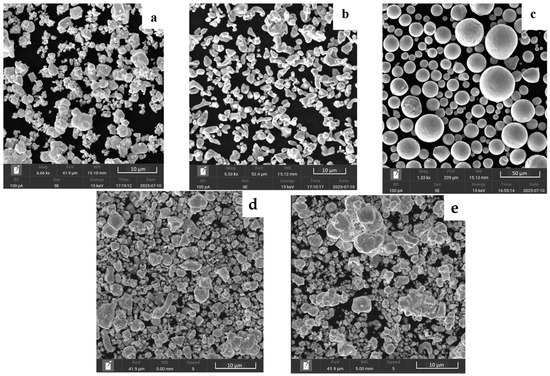
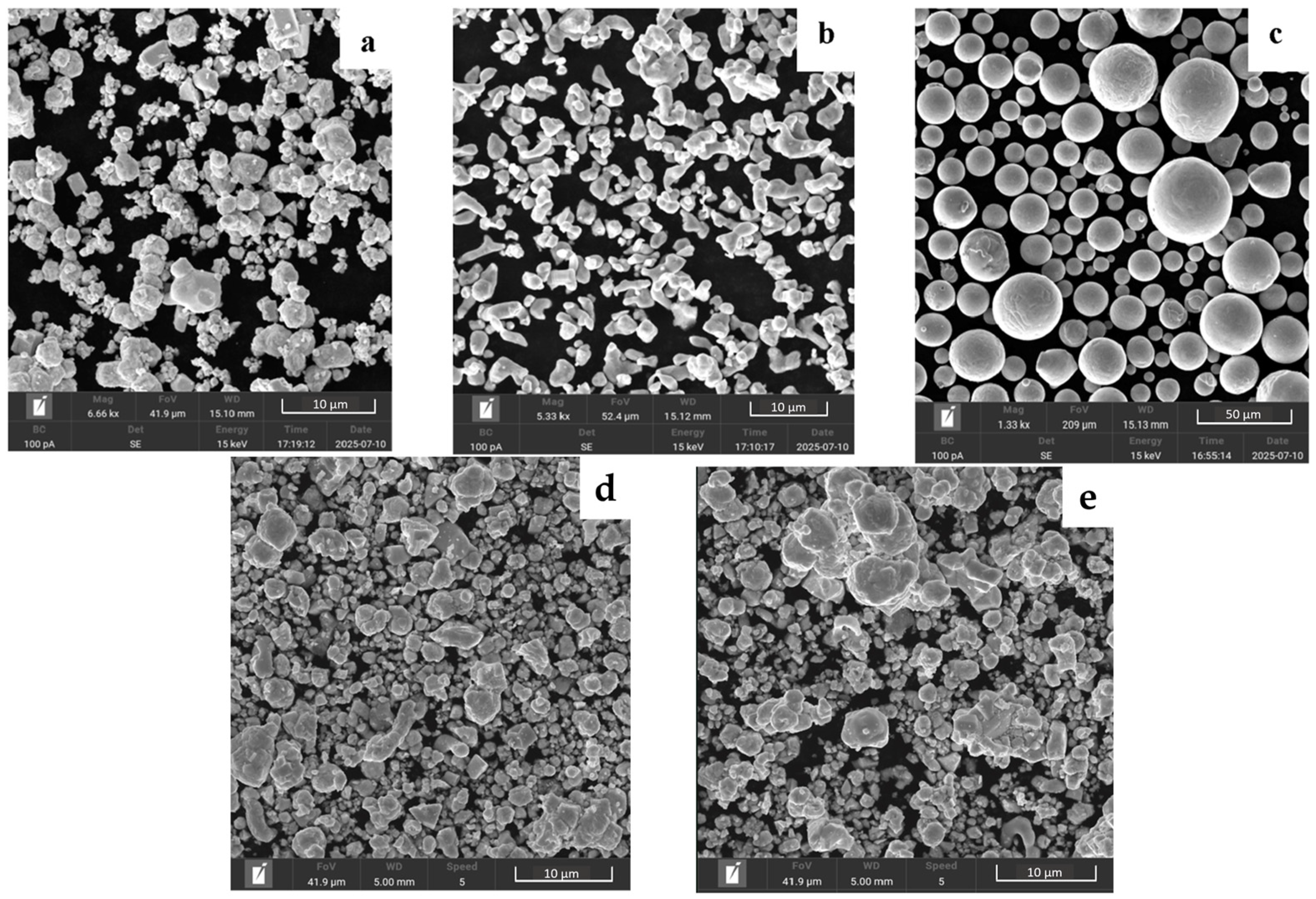
Figure 1 presents SEM images of the initial W, Ni, and Fe powders, as well as their mixture after blending. The comparison of Fe-only and Ni-only binders makes it possible to distinguish their individual effects, since Fe tends to promote η-carbide formation, whereas Ni generally suppresses carbide formation. The combined addition of 6 wt.% Fe and 6 wt.% Ni was selected to evaluate a potential synergistic effect, in which Ni may reduce the brittleness associated with Fe while Fe may enhance the strength associated with Ni.
Figure 1.
SEM images showing (a–c) the as-received powders (WC, Fe, Ni) and (d,e) the blended powder mixtures, including (d) WC–Fe–Ni (88 wt.% WC, 6 wt.% Fe, 6 wt.% Ni) and (e) WC–Fe (88 wt.% WC, 12 wt.% Fe) compositions after mixing [32].
Each powder mixture was labeled and prepared under identical conditions. The preparation procedure included a mechanical activation stage. The mechanochemical activation process and the detailed experimental procedure have been described previously in our earlier work [32]. After mechanical activation, the obtained powder mixtures were consolidated by spark plasma sintering (SPS) using a Dr. Sinter SPS-625 system (Fuji Electronic Industrial Co., Ltd., Tsurugashima, Saitama, Japan). The powder mixture was loaded into a 20 mm internal diameter graphite press and pre-compacted at 2000 kg load. The sintering was carried out at a heating rate of 100 °C/min, with a pressure of 62 MPa and an impulse pattern (“on/off” filling ratio) of 12:2. The process was carried out at temperatures of 1250 °C and 1300 °C with a dwell time of 5 min, after which the samples were cooled to room temperature for 50 min. The selected sintering temperatures of 1250 °C and 1300 °C were determined based on a preliminary analysis of the literature data, as well as the experimentally established critical sintering temperature of the investigated system. The SPS temperatures of 1250 °C and 1300 °C were selected based on previous studies on WC–Fe and WC–Fe–Ni cemented carbides, where this temperature range was shown to provide sufficient densification and diffusion while limiting excessive grain growth [16,33]. According to previous studies, increasing the sintering temperature in W–Ni–Fe and WC–Fe–Ni systems intensifies the diffusion processes, reduces porosity, and increases material density. For the W–Ni–Fe alloy system (W65–Ni17.5–Fe17.5), it has been reported that increasing the sintering temperature from 1100 °C to 1250–1270 °C results in an increase in relative density by 82–86% and enhanced hardness due to a more uniform distribution of the Ni–Fe binder phase between tungsten particles and the formation of a more homogeneous microstructure [34,35,36].
For the WC–Fe–Ni system, increasing the sintering temperature up to 1300 °C provides further structural densification, improved intergranular contact, and enhanced hardness due to more efficient redistribution of the binder phase and activation of mass transport processes. According to the literature, a temperature range of 1250–1300 °C enables the achievement of high relative density and the formation of a fine-grained microstructure with a uniform distribution of the carbide phase, which positively affects the service properties of the material [37].
The elemental composition was quantitatively determined using energy-dispersive X-ray spectroscopy (EDS) coupled with a NANOS Desktop Scanning Electron Microscope (SEM) (Semplor, Nuenen, The Netherlands) equipped with a thermionic tungsten cathode. Surface morphology, phase composition, and structural characteristics of the powders were analyzed using an X’Pert PRO X-ray diffractometer (Malvern Panalytical Ltd., Almelo, The Netherlands) with a Cu anode, operating in the 2θ range of 20–90°, at a tube voltage of 40 kV and a current of 30 mA, with a step size of 0.02° and a counting time of 2 s per step. The obtained diffraction data were processed using HighScore Plus V4.9 software. Phase identification was carried out using the ICDD PDF-5+ 2026 crystallographic database. Quantitative phase analysis was performed by full-pattern Rietveld refinement.
Sample preparation included preliminary grinding using abrasive materials (silicon carbide papers) with progressively decreasing grit sizes (P400, P1200, and P2500) on a Trojan GP-2A double-disk grinding and polishing machine (Trojan (Suzhou) Material Technology Co., Ltd., Suzhou, China). To reveal the microstructural features, chemical etching was performed using Murakami’s reagent, prepared by dissolving potassium ferricyanide (K3Fe(CN)6) and potassium hydroxide (KOH) in distilled water at a volumetric ratio of 1:1:10, respectively. This composition provides effective selective etching of tungsten carbide (WC) without damaging the binder phase [38,39].
The density of the sintered samples was measured by hydrostatic weighting using LC-JA3003 balances (Lichen, Shanghai, China). The theoretical density ρth of compact specimens (WC–Fe and WC–Fe -Ni) was calculated according to the rule of mixtures. The experimental density ρexp after SPS was determined by hydrostatic weighting. The relative density of RD specimen samples (in %) was calculated with the formula
The porosity of the WC–Fe–Ni and WC–Fe composites was determined from the relative density values using the following equation:
where (P) is the porosity, ρexp is the experimentally measured density of the sintered sample, and ρtheor is the theoretical density calculated according to the nominal composition of the material.
P = (1 − ρexp/ρtheor) × 100%
The mechanical properties were evaluated by microhardness measurements using an HLV-1DT Vickers hardness tester (Shanghai Hualong Test Instruments Corporation, Shanghai, China) under a load of 0.2 kgf (HV0.2) with a dwell time of 10 s, providing insight into local hardness variations throughout the composite. This approach made it possible to assess the mechanical properties of different regions of the composite while considering variations in particle distribution and matrix–particle interactions.
The combination of structural and mechanical analyses enabled the correlation of microstructural features with performance characteristics and provided a comprehensive understanding of the properties of the composite material. Data processing and analysis of the mechanical characteristics were performed using OriginPro 2024 software (OriginLab Corporation, Northampton, MA, USA).
All structural, phase, microstructural, compositional, density, and microhardness characterizations were performed on the SPS-consolidated specimens.
3. Results and Discussion
3.1. XRD Patterns of WC-Based Alloys After Various Sintering Temperature Processes
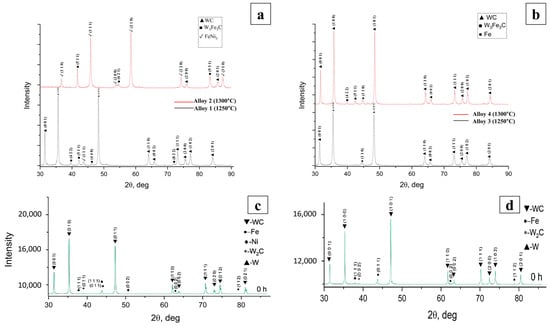
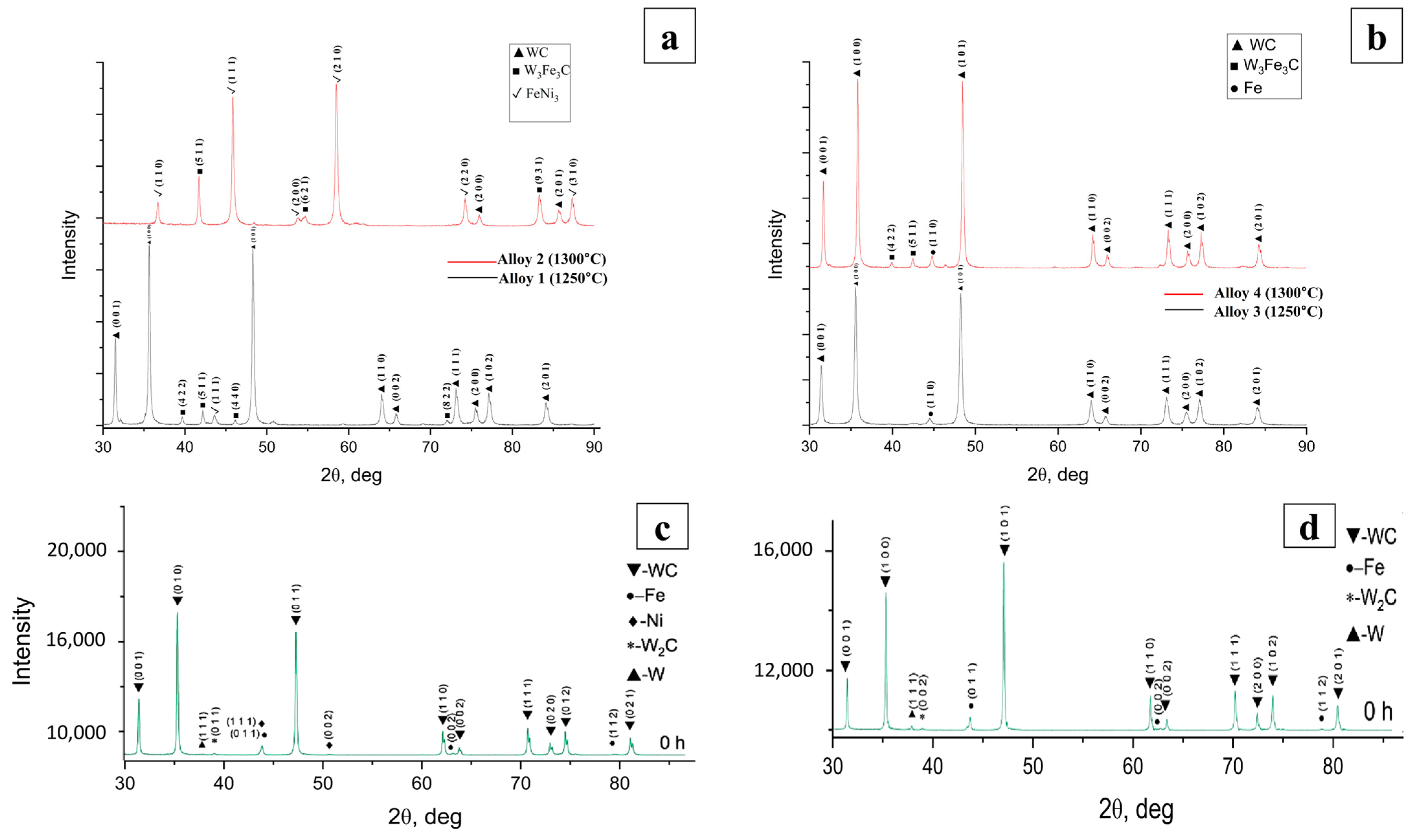
X-ray phase analysis of the fine- and coarse-grained composites with different Fe–Ni binder phase contents (Figure 2) showed that the WC–Fe–Ni and WC–Fe samples predominantly consisted of Fe, WC, and Fe3W3C phases, which is consistent with the results reported in [40]. Quantitative phase analysis by means of clarification of the crystalline structure on Rietveld allowed the phase content to be determined in the samples under investigation (Table 2). The quality of the Rietveld refinement was evaluated using the profile residual (Rp), weighted profile residual (Rwp), and goodness-of-fit (2) parameters.
Figure 2.
XRD patterns of WC–Fe–Ni cemented carbides with different compositions: (a) Alloys 1 and 2 (1250 and 1300 °C); (b) Alloys 3 and 4 (1250 and 1300 °C); (c) initial powder mixture (before sintering) for WC–Fe–Ni; (d) initial powder mixture (before sintering) for WC–Fe.
Table 2.
Results of quantitative phase analysis (Rietveld refinement) of Alloys 1–4.
Although no significant changes in phase composition occured above 1200 °C, the number and intensity of tungsten carbide diffraction peaks increased, particularly for the crystallographic planes (001), (100), (101), and (110). This result indicates that elevated temperature accelerates the diffusion of tungsten and carbon and promotes their interaction, leading to enhanced WC formation.
The comparatively higher Rwp values obtained for Alloys 2 and 4 are attributed to the multiphase nature of the investigated alloys and the overlap of diffraction peaks between WC and Fe-containing phases. Nevertheless, the refinement converged satisfactorily and provided phase compositions consistent with the experimental diffraction patterns.
At a sintering temperature of 1250 °C, tungsten carbide (WC) remained the dominant and most stable carbide phase. However, when the temperature was increased to 1300 °C in the WC–Fe–Ni system, a decrease in the intensity of the WC peaks was observed, which is associated with the partial dissolution of tungsten carbide.
The formation of a small amount of the brittle η-phase Fe3W3C is attributed to the reaction α-Fe + WC → γ-Fe + Fe3W3C, caused by interdiffusion in the Fe–W–C system. According to the literature [41,42], carbon depletion during the initial stage of sintering promotes the formation of this phase. At 1300 °C, XRD analysis confirmed the presence of a limited amount of the η-phase (Fe3W3C), suggesting that although densification was enhanced, η-phase formation was not completely eliminated under the applied SPS conditions [43].
It was also observed that the Fe3W3C region is followed by a broad zone of the WC–Fe cemented carbide layer. The low intensity of its diffraction peaks is attributed to its small volume fraction. Nevertheless, the presence of this phase may weaken the intergranular boundaries between WC particles and the iron matrix, potentially reducing the wear resistance of the material [44]. The evolution of the Fe3W3C phase differed between the investigated alloy systems. In the WC–Fe -Ni composites, its content slightly decreased from 7.4 wt.% to 6.5 wt.% with increasing SPS temperature, whereas in the WC–Fe system it increased from 0.4 wt.% to 2.5 wt.%. This behavior suggests that the formation of the η-phase is governed by both the binder composition and the local carbon balance during SPS rather than by temperature alone. Despite these variations in Fe3W3C content, the microhardness increased in both alloy systems at 1300 °C, indicating that improved densification and reduced residual porosity had a more significant influence on hardness than the observed changes in η-phase content. The introduction of Ni into the WC–Fe–Ni system leads to grain refinement and lattice distortion due to the formation of solid solutions such as FeNi3, which is accompanied by the development of internal microscopic stresses. Regarding phase stability, Ni promotes a ductile fcc structure in the binder, whereas increasing the Fe content induces a transformation to brittle bcc –(Fe, Ni). Moreover, Ni exhibits significantly higher W solubility than Fe—up to 30 wt.% W can dissolve in a Ni binder, compared to only ~1.6–6.3 wt.% in Fe-rich binders [20]. Precipitation of the γ’ phase (Ni, Co, Fe)3Al with L12 structure is characteristic of Ni-containing systems and is not typically observed in Fe-only binders, where the absence of a stable fcc matrix at room temperature prevents such precipitation [44,45]. Ni considerably broadens the carbon window (~0.6 wt.% C for WC-20Ni), whereas Fe-only systems have a much narrower carbon window, making them susceptible to η-phase formation [37]. In fact, FeMn-based binders require at least 25 wt.% Ni to avoid η-carbides [46]. The Fe–Ni binder phases significantly affect the morphology of tungsten carbide grains. Several Fe–Ni intermetallic phases with similar diffraction features were identified during the refinement. Because their individual diffraction peaks were weak and strongly overlapped, they were represented by the dominant FeNi3 phase in the quantitative phase analysis. According to the literature [47], this is attributed to the fact that Fe suppresses the abnormal growth of tungsten carbide grains, while Fe and Ni reduce the interfacial energy between WC and the binder phase, thereby preventing grain flattening and promoting a more rounded grain morphology. The rounded morphology of tungsten carbide grains also has a significant influence on the properties of cemented carbides. In addition, the formation of the FeNi3 intermetallic phase contributes to the suppression of brittle η-phase formation, while the addition of Fe and Ni lowers the melting temperature of the cemented carbide system. The use of an Fe–Ni-based binder phase also improves the corrosion and oxidation resistance of the composite [48].
3.2. Morphology and EDS Mapping of Samples Based on Tungsten Carbide
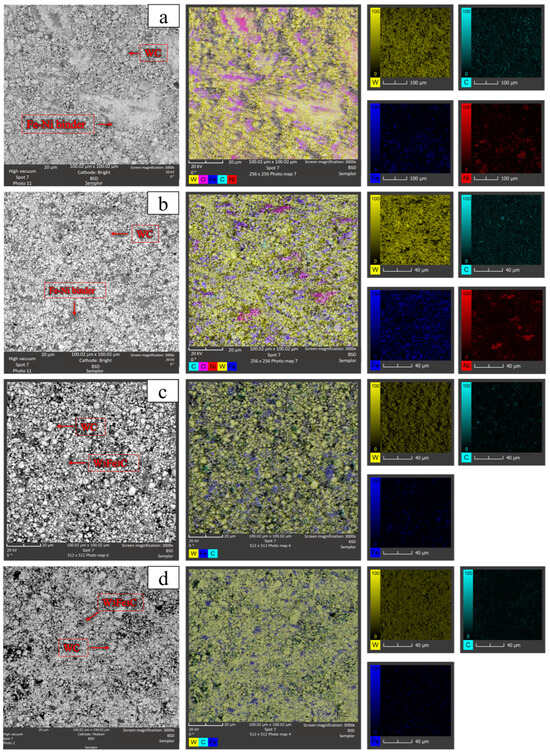
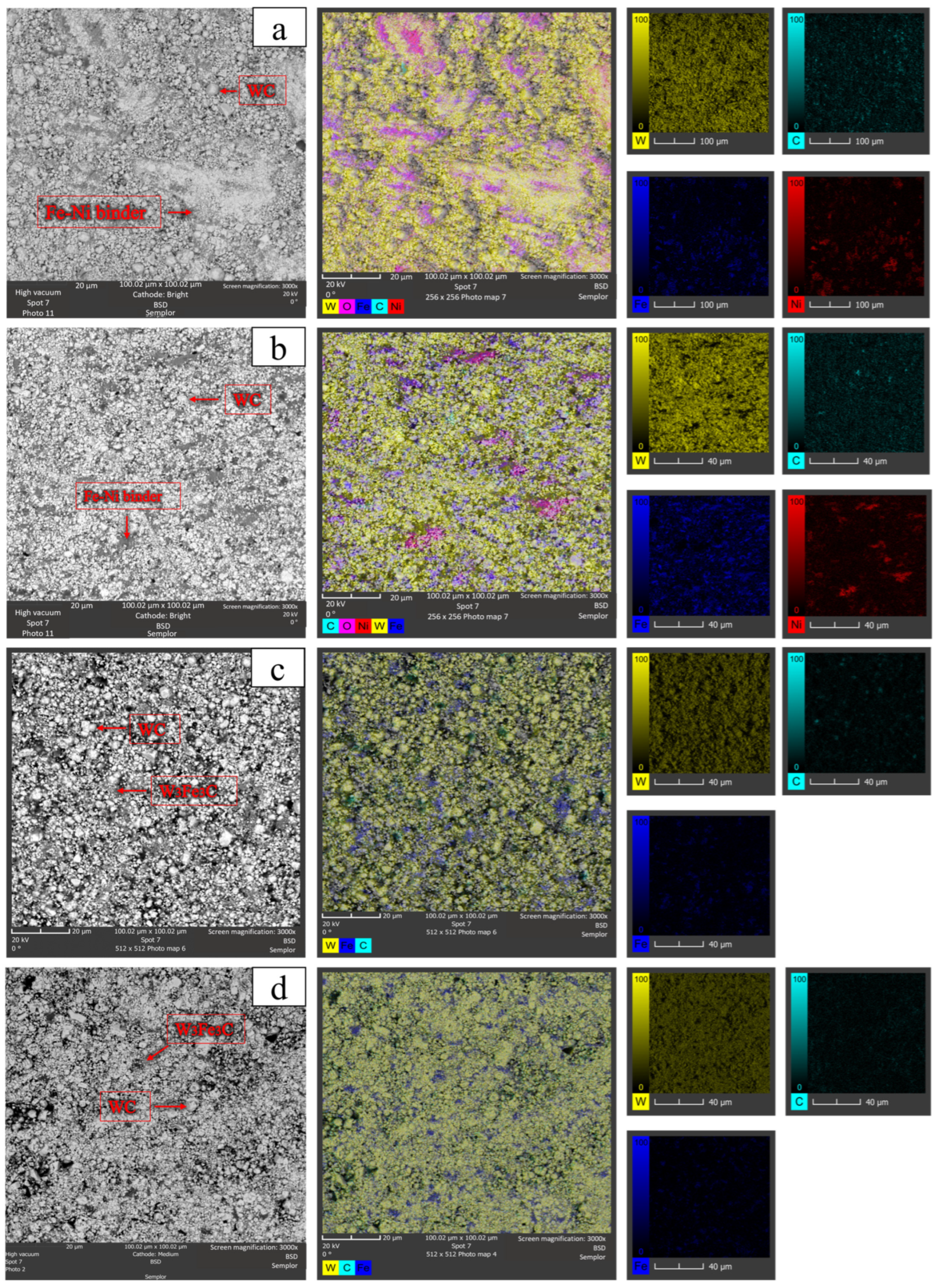
The average WC grain size, estimated from representative SEM micrographs, was approximately 3 ± 1.5 μm, and the height of the consolidated SPS specimens was approximately 2.46 mm. The morphology of the samples obtained after SPS is presented in Figure 3. As shown in Figure 3a (1250 °C), the structure is relatively loose, with non-uniformly distributed tungsten carbide grains and the presence of agglomerated regions. Discontinuous diffusion is observed at the phase boundaries. The presence of dark pore-like regions indicates an insufficient degree of densification and incomplete consolidation at this temperature. In Figure 3c (1250 °C), the structure becomes more homogeneous compared to Figure 3a; however, regions with insufficient wetting of carbide particles by the metallic binder are still observed, indicating limited diffusion and incomplete formation of interfacial contacts. When the temperature is increased to 1300 °C (Figure 3b), pronounced structural densification, reduced porosity, and improved intergranular cohesion are observed. More effective interaction and wetting of tungsten carbide by the Fe–Ni-based binder contribute to the formation of a dense composite structure. Figure 3d (1300 °C) demonstrates WC grain growth caused by thermally activated diffusion processes at elevated temperature, which is consistent with the literature data [37]. At the same time, the porosity is significantly reduced compared to the sample sintered at 1250 °C (Figure 3c), indicating a higher degree of sintering. The inter-granular space is effectively filled with the binder phase, ensuring good adhesion between WC grains and the formation of a uniform composite structure. The average porosity in the WC–Fe–Ni composite region was 13.2% at a sintering temperature of 1250 °C. When the sintering temperature increased to 1300 °C, the porosity in the WC region decreased to 12.7%. With increasing sintering temperature, the porosity continuously decreased, and a pronounced reduction from 13.8% (1250 °C) to 12.0% was observed for the WC–Fe system at 1300 °C. Therefore, the porosity of the WC region can be reduced by increasing the sintering temperature of the composite. The residual porosity cannot be attributed to the as-received WC-powder size (30–50 μm), since the powders were mechanically activated prior to SPS. As reported in our previous study, the average particle size of the mechanically activated WC–Fe -Ni composite powder was approximately 7.4 μm (D50), while the WC–Fe powder exhibited an average particle size of approximately 10.3 μm after milling. Therefore, the residual porosity observed after SPS is mainly assosiated with incomplete densification of the mechanically activated powders under the selected sintering conditions rather than the size of the as-received powders. Residual pores reduce the effective load-bearing area and act as stress concentrators, thereby decreasing the density and hardness of the composites. Increasing the sintering temperature from 1250 °C to 1300 °C enhanced diffusion between WC particles and the metallic binder, resulting in improved interparticle bonding, partial pore elimination, higher relative density, and increased microhardness. Nevertheless, the remaining porosity indicates that further optimization of the SPS parameters is required to achieve more complete densification. At a sintering temperature of 1250 °C, a large number of non-uniformly distributed pore defects are present in the WC–Fe–Ni region, which is associated with the slow diffusion rate of the powders at lower sintering temperatures, leading to insufficiently dense contact between particles. As the sintering temperature increases, most pores in the WC region disappear, leaving only a few small pore defects. In addition, the Ni and Fe binders form a liquid phase that penetrates between WC grains, filling the porous regions and reducing the porosity of the final WC region [26]. Ni promotes diffusion through the liquid phase during sintering, accelerating densification. However, Ni also reduces W solubility and increases the energy barrier for W migration, inhibiting WC grain growth [37]. An increase in the sintering temperature from 1250 °C to 1300 °C monotonically enhances hardness and density while reducing porosity, which is attributed to the grain rearrangement observed in SEM images. Tungsten carbide particles predominantly exhibit a rounded morphology and are surrounded by an iron- and nickel-based metallic binder. At elevated temperatures, this binder forms a transient liquid phase, enabling uniform diffusion and penetration between WC particles, thereby playing a crucial role in densification of the WC framework. This indicates the formation of a binder phase that is uniformly distributed within the intergranular space, leading to a relatively homogeneous composite structure, consistent with the results reported in [30]. The density increased from 12.39 g/cm3 (1250 °C) to 12.46 g/cm3 (1300 °C), which is associated with structural densification. This behavior is likely related to the initial stage of sintering, during which particle rearrangement and neck formation occur due to surface diffusion in alloys 1 and 2. A similar trend was observed for Alloys 3 and 4, where the density increased from 12.15 g/cm3 to 12.40 g/cm3, most likely due to liquid-phase sintering mechanisms. The presence of carbon may also be related to the use of graphite tooling during SPS, which can lead to its diffusion into the surface layers of the samples. It should be noted that EDS provides only semi-quantitative information for light elements, particularly carbon. Therefore, the reported carbon contents should be interpreted qualitatively and used primarily to indicate compositional trends rather than absolute concentrations. The differences in oxygen content between the investigated alloys are attributed to local surface oxidation of the analyzed regions. Because EDS mapping is a local and semi-quantitative technique, especially for light elements such as oxygen, the measured oxygen content may vary between different specimens and analyzed areas. Although the relative density increased with increasing temperature, full densification was not achieved. This behavior may be associated with the particle size of the mechanically activated composite powders together with the limited holding time during SPS, both of which reduce the driving force for complete densification and pore elimination. As reported in our previous study, the average particle size of the mechanically activated powders was substantially lower than that of the as-received WC powder. Nevertheless, further refinement of the powder size and optimization of the SPS parameters would be required to achieve near-theoretical density. Similar densification behavior has been reported for SPS-fabricated WC-based hard materials [44,49]. Therefore, further improvement in densification is expected through the use of finer WC powders, longer holding times, and optimization of the SPS pressure, which would enhance particle rearrangement, diffusion, and pore elimination, allowing the relative density to approach that of commercial cemented carbides. The elemental composition was quantitatively determined using energy-dispersive X-ray spectroscopy (EDS). The average atomic and weight percentages for the selected regions are presented in Table 3.
Figure 3.
SEM microstructures and EDS elemental mapping of cemented carbide alloys sintered at different temperatures: (a) Alloy 1 (1250 °C); (b) Alloy 2 (1300 °C); (c) Alloy 3 (1250 °C); (d) Alloy 4 (1300 °C).
Table 3.
Average atomic and weight percentages derived from EDS maps.
3.3. Microhardness of Samples Based on Tungsten Carbide
Table 4 presents the average microhardness values of the alloys after SPS in the WC–Fe–Ni and WC–Fe systems. The obtained results indicate that the hardness increases from approximately 708 ± 10 HV0.2, associated with incomplete densification and a high amount of porosity, up to 823 ± 15 HV0.2 with increasing sintering temperature in samples 1 and 2, which is consistent with the literature data [50]. It is evident that the addition of WC particles effectively increases the microhardness of alloys with an Fe–Ni binder phase, which is consistent with the XRD results. The presence of insoluble WC particles leads to microstructural refinement of the deposited layer and also hinders dislocation motion and grain boundary migration, thereby producing a dispersion-strengthening effect. The reported hardness values correspond to Vickers microhardness measurements performed under an indentation load of HV0.2. This load is commonly used for evaluating the local mechanical response of heterogeneous WC-based composites. Therefore, a direct quantitative comparison with literature data obtained under different indentation loads (e.g., HV10 or HV30) should be interpreted with caution because the measured hardness depends on the applied indentation load. To improve the comparison with previous studies, representative literature data obtained under comparable test conditions have been included in Table 4.
Table 4.
Microhardness and density characteristics of the investigated WC-based hard alloys.
Compared with the alloy based on 12 wt.% Fe, the microhardness of Fe-based alloys No. 3 and No. 4 increased from 630 15 HV0.2 to 770 ± 5 HV0.2, whereas the microhardness of WC–Fe–Ni alloys with a composition of 88 wt.% WC + 6 wt.% Fe + 6 wt.% Ni increased significantly by 16.2%, which is in good agreement with the data reported in [17]. Although Alloy 8 has a binder composition comparable to that of the WC–Fe -Ni alloys investigated in the present study, it exhibits substantially higher hardness due to its nearly full densification (99.8% relative density). Therefore, the large difference in hardness is primarily attributed to the higher degree of densification and lower residual porosity rather than to differences in binder chemistry alone. These observations indicate that further optimization of SPS processing parameters is necessary to improve densification and mechanical performance. Compared with conventional WC-Co cemented carbides, the investigated WC–Fe and WC–Fe -Ni systems represent promising cobalt-free alternatives by employing more abundant binder elements. However, the present materials exhibited lower relative density than fully optimized commercial WC-Co hard alloys, indicating that further optimization of SPS parameters is required to improve densification and overall mechanical performance. In particular, achieving a relative density above approximately 95% together with a microhardness exceeding about 1200 HV would represent important targets for approaching the performance of commercial WC-Co cemented carbides. Therefore, although Fe- and Fe–Ni-based binders show considerable potential as substitutes for cobalt, further investigations on densification, fracture toughness, and wear resistance are required to fully assess their engineering applicability.
4. Conclusions
This study investigates the structural-phase evolution, morphology, and mechanical properties of cobalt-free WC hard alloys in the WC–Fe -Ni and WC–Fe systems produced by SPS. Based on the obtained results, the following conclusions can be drawn.
Increasing the SPS temperature from 1250 °C to 1300 °C enhanced diffusion and interparticle bonding, resulting in improved densification and reduced residual porosity in both WC–Fe -Ni and WC–Fe systems. In particular, porosity decreases from 13.2% to 12.7% for WC–Fe -Ni and from 13.8% to 12.0% for WC–Fe, which is consistent with an increase in relative density (up to 87–89%) and improved interfacial contact.
Phase analyses confirmed the formation of Fe3W3C, FeNi3, and Fe–Ni solid solutions, indicating that the interaction between WC and the metallic binder during SPS governs the phase evolution and contributes to strengthening of the composite microstructure.
The increase in microhardness with increasing SPS temperature is attributed to enhanced densification, stronger interfacial bonding between WC particles and the metallic binder, and reduced residual porosity, from 708 ± 10 HV0.2 to 823 ± 15 HV0.2 for WC–Fe -Ni and from 630 ± 15 HV0.2 to 770 ± 5 HV0.2 for WC–Fe. This improvement is associated with structural densification, reduced porosity, and redistribution of phase constituents.
Thus, the results confirm the decisive role of SPS processing parameters in controlling phase evolution, densification, microstructural development, and the resulting mechanical properties of cobalt-free WC hard alloys. The WC–Fe -Ni system exhibits a more stable microstructure and higher microhardness than the WC–Fe system, demonstrating its potential as a cobalt-free binder system. Although the present study primarily focuses on the phase composition, morphology, and microhardness of the investigated alloys, further studies including fracture toughness, flexural strength, and wear resistance are required for a comprehensive evaluation of their mechanical performance and potential engineering applications.
Author Contributions
Conceptualization, S.K. (Sherzod Kurbanbekov) and L.B.; methodology, S.K. (Sherzod Kurbanbekov); formal analysis, Y.T. and B.K.; Investigation, L.B. and Y.T.; data curation, M.A. and S.K. (Sardor Kambarbekov); resources, A.A.; project administration, B.K.; writing—review and editing, L.B., D.P. and S.K. (Sardor Kambarbekov); visualization, M.A.; supervision, D.P.; writing—original draft, A.A. All authors have read and agreed to the published version of the manuscript.
Funding
The author(s) declare that financial support was received for the research and/or publication of this article. This research was funded by the Committee of Science of the Ministry of Science and Higher Education of the Republic of Kazakhstan (grant no. BR24992925).
Data Availability Statement
The data supporting the findings of this technical study are available from the corresponding author upon reasonable request.
Acknowledgments
We express our gratitude to the Science Committee of the Ministry of Science and Higher Education of the Republic of Kazakhstan for support of the project “Development of technologies and materials for innovative development of the manufacturing industry of the Republic of Kazakhstan”.
Conflicts of Interest
The authors declare no conflicts of interest.
References
- Huang, N.; Guo, S.; Ren, H.; Guo, J.; Li, B.; Zhang, J.; Hu, M. Preparation of V-element-containing Co-based composite powders by spray conversion and its effect on the microstructure properties of cemented carbides. J. Alloys Compd. 2025, 1010, 178273. [Google Scholar] [CrossRef] [Scilit]
- Zhong, L.; Zhang, X.; Chen, S.; Xu, Y.; Wu, H.; Wang, J. Fe–W–C thermodynamics and in situ preparation of tungsten carbide-reinforced iron-based surface composites by solid-phase diffusion. Int. J. Refract. Met. Hard Mater. 2016, 57, 42–49. [Google Scholar] [CrossRef] [Scilit]
- Aghaali, V.; Ebadzadeh, T.; Zahraee, S.M.; Mirkazemi, S.M. Microstructure and mechanical properties of WC–TiC–Co cemented carbides produced by spark plasma sintering method. SN Appl. Sci. 2023, 5, 285. [Google Scholar] [CrossRef] [Scilit]
- Aubakirova, D.; Sagymbekova, E.; Kozhakhmetov, Y.; Dauletkhanov, Y.; Urkunbay, A.; Yerbolat, D.; Tabiyeva, Y. Evolution of the structural and phase composition of Ni–Ti–Cu alloy produced via spark plasma sintering after aging. Crystals 2025, 15, 939. [Google Scholar] [CrossRef] [Scilit]
- de Medeiros Tavares, M.; Huang, S.; Huang, J.; Vleugels, J.; Mashhadikarimi, M.; Gomes, U.U. Microstructure and properties of WC-11.5% Fe-4% NbH-0.5% C cemented carbides produced by spark plasma sintering. Mater. Charact. 2022, 187, 111838. [Google Scholar] [CrossRef] [Scilit]
- Wang, B.; Zhang, D.; Yin, C.; Jia, B.; Guo, F.; Ding, W. Effects of multi-component cubic carbides TiC/TaC/NbC on the microstructural evolution and properties of ultrafine WC-Co cemented carbides via spark plasma sintering. Ceram. Int. 2025, 51, 61671–61682. [Google Scholar] [CrossRef] [Scilit]
- Wang, C.; Xiao, Y.; Zhang, W.; Zhao, T.; Du, H.; Li, Y. Achieving the synergistic strength and wear resistance in TiC/Fe matrix composites by spark plasma sintering and hot isostatic pressing. J. Mater. Res. Technol. 2025, 36, 7228–7243. [Google Scholar] [CrossRef] [Scilit]
- Xia, X.Q.; Li, M.S.; Gong, M.F. Research on microstructure and mechanical performance of NbC and TiC on WC-12Co. Strength Mater. 2023, 55, 1047–1054. [Google Scholar] [CrossRef] [Scilit]
- Zhang, R.; Xue, Y.; Guo, Q.; Wu, F.; Li, Y.; Ye, Y.; Zhang, S. Microstructure evolution and multi-scale performances of tungsten carbide-based composites with NbC, TaC, and (Ta,Nb)C additives. Colloids Surf. A Physicochem. Eng. Asp. 2025, 729, 138945. [Google Scholar] [CrossRef] [Scilit]
- Buravlev, I.Y.; Shichalin, O.O.; Papynov, E.K.; Golub, A.V.; Gridasova, E.A.; Buravleva, A.A.; Sergienko, V.I. WC-5TiC-10Co hard metal alloy fabrication via mechanochemical and SPS techniques. Int. J. Refract. Met. Hard Mater. 2021, 94, 105385. [Google Scholar] [CrossRef] [Scilit]
- Maizza, G.; Montanari, R.; Richetta, M.; Varone, A.; Kaciulis, S.; Mezzi, A.; Soltani, P. Surface phenomena during the early stage of liquid phase SPS of a mixture of coarse WC and Ni-alloy particles. Surf. Interface Anal. 2018, 50, 1072–1076. [Google Scholar] [CrossRef] [Scilit]
- Ma, B.; Wang, X.; Chen, C.; Zhou, D.; Xu, P.; Zhao, X. Dissimilar welding and joining of cemented carbides. Metals 2019, 9, 1161. [Google Scholar] [CrossRef] [Scilit]
- Kang, K.; Yu, B.; Wang, P.; Yang, S.; Xiao, L.; Ma, Z.; Li, K.; Zhang, Q.; Luo, G. Effects and correlation analysis of the sintering process on the properties of ultrafine-grained WC-Co reinforced by high-entropy alloys. J. Alloys Compd. 2025, 1023, 180162. [Google Scholar] [CrossRef] [Scilit]
- Cai, X.; Zhong, L.; Xu, Y.; Li, X.; Liu, M. Microstructure and fracture toughness of a WC–Fe cemented carbide layer produced by a diffusion-controlled reaction. Surf. Coat. Technol. 2019, 357, 784–793. [Google Scholar] [CrossRef] [Scilit]
- Heydari, D.; Skandani, A.A.; Al Haik, M. Effect of carbon content on carbide morphology and mechanical properties of AR white cast iron with 10–12% tungsten. Mater. Sci. Eng. A 2012, 542, 113–126. [Google Scholar] [CrossRef] [Scilit]
- Nakonechnyi, S.O.; Yurkova, A.I.; Loboda, P.I. WC-based cemented carbide with NiFeCrWMo high-entropy alloy binder as an alternative to cobalt. Vacuum 2024, 222, 113052. [Google Scholar] [CrossRef] [Scilit]
- Xiao, Q.; Sun, W.L.; Yang, K.X.; Xing, X.F.; Chen, Z.H.; Zhou, H.N.; Lu, J. Wear mechanisms and micro-evaluation of WC particles in WC–Fe composite coatings fabricated by laser cladding. Surf. Coat. Technol. 2021, 420, 127341. [Google Scholar] [CrossRef] [Scilit]
- Cao, P.P.; Peng, X.Y.; Hou, S.; Lu, G.Y.; Wang, M.M.; Qiu, L.S.; Liu, Q. Particle size-dependent tribological responses in WC–FeNiCrCu0.5 coatings sprayed by supersonic atmospheric plasma spraying. J. Therm. Spray Technol. 2025, 35, 424–435. [Google Scholar] [CrossRef] [Scilit]
- Xia, J.; Feng, Y.; Ling, Z.; Wang, K. Influence of WC particle content of Fe-based powder-cored wire on microstructure and properties of plasma cladding reinforced layers. J. Alloys Compd. 2022, 922, 166148. [Google Scholar] [CrossRef] [Scilit]
- Steinlechner, R.; de Oro Calderon, R.; Koch, T.; Linhardt, P.; Schubert, W.D. A study on WC–Ni cemented carbides: Constitution, alloy compositions and properties, including corrosion behaviour. Int. J. Refract. Met. Hard Mater. 2022, 103, 105750. [Google Scholar] [CrossRef] [Scilit]
- Torkashvand, K.; Joshi, S.; Gupta, M. Advances in thermally sprayed WC-based wear-resistant coatings: Co-free binders, processing routes and tribological behavior. J. Therm. Spray Technol. 2022, 31, 342–377. [Google Scholar] [CrossRef] [Scilit]
- Shanenkov, I.; Nikitin, D.; Ivashutenko, A.; Rahmatullin, I.; Shanenkova, Y.; Nassyrbayev, A.; Sivkov, A. Hardening the surface of metals with WC1−x coatings deposited by high-speed plasma spraying. Surf. Coat. Technol. 2020, 389, 125639. [Google Scholar] [CrossRef] [Scilit]
- Cai, X.; Xu, Y.; Liu, M.; Zhong, L. Evaluation of microstructure and growth kinetics of tungsten carbide ceramics at the interface of iron and tungsten. J. Alloys Compd. 2018, 741, 666–676. [Google Scholar] [CrossRef] [Scilit]
- Jin, H.; Ji, R.; Dong, T.; Liu, S.; Zhang, F.; Zhao, L.; Liu, Y. Efficient fabrication and characterization of Ni–Fe–WC composite coatings with high corrosion resistance. J. Mater. Res. Technol. 2022, 16, 152–167. [Google Scholar] [CrossRef] [Scilit]
- Soria-Biurrun, T.; Lozada-Cabezas, L.; Navarrete-Cuadrado, J.; Ibarreta-Lopez, F.; Martinez-Pampliega, R.; Sanchez-Moreno, J.M. Densification of WC–Fe–Ni–Co–Cr cemented carbides processed by HIP after sintering: Effect of WC powder particle size. Int. J. Refract. Met. Hard Mater. 2023, 110, 105994. [Google Scholar] [CrossRef] [Scilit]
- Gao, Y.; Luo, B.H.; He, K.J.; Zhang, W.W.; Bai, Z.H. Effect of Fe/Ni ratio on the microstructure and properties of WC–Fe–Ni–Co cemented carbides. Ceram. Int. 2018, 44, 2030–2041. [Google Scholar] [CrossRef] [Scilit]
- Chang, S.H.; Chang, M.H.; Huang, K.T. Study on the sintered characteristics and properties of nanostructured WC–15 wt.% (Fe–Ni–Co) and WC–15 wt.% Co hard metal alloys. J. Alloys Compd. 2015, 649, 89–95. [Google Scholar] [CrossRef] [Scilit]
- Cai, X.; Xu, Y.; Zhong, L.; Liu, M. Fracture toughness of WC–Fe cermet in W–WC–Fe composite by nanoindentation. J. Alloys Compd. 2017, 728, 788–796. [Google Scholar] [CrossRef] [Scilit]
- Shichalin, O.O.; Buravlev, I.Y.; Papynov, E.K.; Golub, A.V.; Belov, A.A.; Buravleva, A.A.; Yudakov, A.A. Comparative study of WC-based hard alloys fabrication via spark plasma sintering using Co, Fe, Ni, Cr, and Ti binders. Int. J. Refract. Met. Hard Mater. 2022, 102, 105725. [Google Scholar] [CrossRef] [Scilit]
- Cramer, C.L.; Preston, A.D.; Ma, K.; Nandwana, P. In-situ metal binder-phase formation to make WC–FeNi cermets with spark plasma sintering from WC, Fe, Ni, and carbon powders. Int. J. Refract. Met. Hard Mater. 2020, 88, 105204. [Google Scholar] [CrossRef] [Scilit]
- Uazyrkhanova, G.; Kozhakhmetov, Y.; Aidarova, M.; Rutkowska-Gorczyca, M.; Tabiyeva, Y. Combined Approach to the Synthesis of WC-(Fe, Ni) Hard Alloys: Mechanical Activation and Spark Plasma Sintering. Crystals 2025, 15, 724. [Google Scholar] [CrossRef] [Scilit]
- Aidarova, M.; Kurbanbekov, S.; Kizatov, A.; Urkunbay, A.; Bayatanova, L.; Rutkowska-Gorczyca, M.; Amangeldiyeva, Y. Influence of milling time and binder composition on phase evolution in WC-based composite powders fabricated via high-energy ball milling. Front. Mater. 2025, 12, 1684414. [Google Scholar] [CrossRef] [Scilit]
- Long, J.; Li, K.; Chen, F.; Yi, M.; Du, Y.; Lu, B.; Zhang, Z.; Wang, Y.; Cheng, K.; Zhang, K. Microstructure evolution of WC grains in WC–Co–Ni–Al alloys: Effect of binder phase composition. J. Alloys Compd. 2017, 710, 338–348. [Google Scholar] [CrossRef] [Scilit]
- Wu, Y.J.; Li, Y.K.; Yu, D.H. Fine-grained W–Ni–Fe heavy alloys prepared by spark plasma sintering. Mater. Sci. Forum 2016, 849, 745–752. [Google Scholar] [CrossRef] [Scilit]
- Silva, A.D.; Schubert, W.D.; Lux, B. The role of the binder phase in WC–Co sintering. Mater. Res. 2001, 4, 59–62. [Google Scholar] [CrossRef] [Scilit]
- Santos, A.D.C.D.; Skury, A.L.D.; Silva, A.G.P.D. Spark plasma sintering of a hard metal powder obtained from hard metal scrap. Mater. Res. 2017, 20, 10–13. [Google Scholar] [CrossRef] [Scilit][Green Version]
- da Silva, E.N.; dos Santos, A.A.A.; do Nascimento, R.M.; Alves, S.M.; da Silva Guimarães, R.; Filgueira, M. Investigation of characteristics and properties of spark plasma sintered ultrafine WC-6.4Fe3.6Ni alloy as a potential alternative to WC–Co hard metals. Int. J. Refract. Met. Hard Mater. 2021, 101, 105669. [Google Scholar] [CrossRef] [Scilit]
- Zhang, Y.; Wang, Y.; Su, Y.; Fan, S.; Dai, M.; Lin, S.; Shi, Q. Optimization and evaluation of a three-step pre-treatment process for PCB microdrills. Int. J. Refract. Met. Hard Mater. 2023, 113, 106190. [Google Scholar] [CrossRef] [Scilit]
- Su, Y.; Wang, Y.; Shi, Q.; Zhang, C.; Lin, S.; Dai, M.; Peng, T. Effect of treatment process on CVD diamond coatings deposited on WC–Co substrate with different Co contents. Diam. Relat. Mater. 2025, 158, 112634. [Google Scholar] [CrossRef] [Scilit]
- Lee, J.H.; Hong, S.K.; Park, H.K. Effects of deep cryogenic treatment for tungsten carbide iron cemented carbide. Int. J. Refract. Met. Hard Mater. 2021, 100, 105649. [Google Scholar] [CrossRef] [Scilit]
- Wei, C.B.; Song, X.Y.; Fu, J.; Liu, X.M.; Gao, Y.; Wang, H.B.; Zhao, S.X. Microstructure and properties of ultrafine cemented carbides—Differences in spark plasma sintering and sinter-HIP. Mater. Sci. Eng. A 2012, 552, 427–433. [Google Scholar] [CrossRef] [Scilit]
- Rosa, J.M.B.; Lugon, R.D.; de Souza Silva, K.; das Chagas, V.M.; da Silva Guimarães, R.; de Carvalho, C.S.; Filgueira, M. Study of characteristics and properties of spark plasma sintered WC with the use of alternative Fe–Ni–Nb binder as Co replacement. Int. J. Refract. Met. Hard Mater. 2020, 92, 105316. [Google Scholar] [CrossRef] [Scilit]
- Smetanina, K.E.; Andreev, P.V.; Lantsev, E.A.; Nokhrin, A.V.; Murashov, A.A.; Isaeva, N.V.; Chuvil’deev, V.N. Nonuniform distribution of crystalline phases and grain sizes in the surface layers of WC ceramics produced by spark plasma sintering. Coatings 2023, 13, 1051. [Google Scholar] [CrossRef] [Scilit]
- Pan, Y.; Liu, A.; Huang, L.; Du, Y.; Jin, Y.; Yang, X.; Zhang, J. Effects of metal binder content and carbide grain size on the microstructure and properties of SPS manufactured WC–Fe composites. J. Alloys Compd. 2019, 784, 519–526. [Google Scholar] [CrossRef] [Scilit]
- Deng, A.L.; Niu, Y.B.; Lin, N.; Wu, Z.G.; Yin, J.; Ma, C. Investigation of microstructure, mechanical and oxidation properties of WC-Co-Ni-Fe-Al multicomponent hardmetals. Int. J. Refract. Met. Hard Mater. 2024, 125, 106894. [Google Scholar] [CrossRef] [Scilit]
- de Oro Calderon, R.; Lunzer, M.; Wodak, I.; Steinlechner, R. Fundamental aspects of phase formation in WC-based cemented carbides containing FeMn-based binders. Int. J. Refract. Met. Hard Mater. 2023, 117, 106411. [Google Scholar] [CrossRef] [Scilit]
- Diao, Y.; Ma, M.; Li, G.; Huang, Q.; Wang, K.; Pei, J.; Wang, Q. L12 strengthening of WC–CoNiFe cemented carbides by spark plasma sintering. Ceram. Int. 2024, 50, 56135–56143. [Google Scholar] [CrossRef] [Scilit]
- Kurbanbekov, S.; Kozhakhmetov, Y.; Skakov, M.; Seitov, B.; Aidarova, M.; Tabiyeva, Y. Properties, advantages, and prospects of using cobalt-free composites based on tungsten carbide in industry. Materials 2024, 18, 129. [Google Scholar] [CrossRef] [Scilit] [PubMed]
- Abdelhaleem, M.M.; El-Daly, A.A.; Elkady, O.A.; Hassan, M.; Atta, M. Impact of processing parameters on the interfacial bonding and properties of recycled LCS/WC–Co bilayers developed through powder metallurgy. Sci. Rep. 2026, 16, 9223. [Google Scholar] [CrossRef] [Scilit] [PubMed]
- Buravleva, A.A.; Fedorets, A.N.; Vornovskikh, A.A.; Ognev, A.V.; Nepomnyushchaya, V.A.; Sakhnevich, V.N.; Buravlev, I.Y. Spark plasma sintering of WC-based 10 wt.% Co hard alloy: A study of sintering kinetics and solid-phase processes. Materials 2022, 15, 1091. [Google Scholar] [CrossRef] [Scilit] [PubMed]

Disclaimer/Publisher’s Note: The statements, opinions and data contained in all publications are solely those of the individual author(s) and contributor(s) and not of MDPI and/or the editor(s). MDPI and/or the editor(s) disclaim responsibility for any injury to people or property resulting from any ideas, methods, instructions or products referred to in the content. |
© 2026 by the authors. Licensee MDPI, Basel, Switzerland. This article is an open access article distributed under the terms and conditions of the Creative Commons Attribution (CC BY) license.