


Abstract
Background: Immunomodulatory therapies, including biologic and targeted synthetic disease-modifying antirheumatic drugs (DMARDs) have reshaped the treatment of autoimmune diseases. They alter host defenses, but the current landscape of associated infectious risk is not fully defined. Objective: A scoping review of recent literature was conducted to characterize infectious complications associated with modern immunomodulatory biologic agents, summarize current pathogen patterns, and highlight recommendations for prevention and early recognition in clinical practice. Methods: Following PRISMA-ScR guidelines, a systematic search was performed on Scopus, Science Direct, and PubMed for studies published since 2023. Inclusion criteria focused on adult human subjects, exposure to immunomodulatory therapy, and reported infectious outcomes. Studies focusing exclusively on antineoplastic agents without established use in autoimmune diseases were excluded. After screening 1046 unique records, 16 studies were included in the final review. Findings: High-dose glucocorticoids remain a primary driver of serious infections across autoimmune diseases. Newer agents present mechanism-specific risk profiles. JAK inhibitors are associated with herpes zoster, while TNF-α inhibitors are linked to opportunistic bacterial infections and reactivation of granulomatous infections. B-cell depletion with rituximab correlates with hypogammaglobulinemia and its associated infections, whereas belimumab may offer a lower infection risk in non-renal SLE. Recent post hoc analyses (2023–2025) quantify the elevated risk of herpes zoster with JAK inhibitors compared to TNF inhibitors, particularly in older populations. Conclusions: The infectious risk associated with biologic and targeted DMARDs varies by mechanism. While glucocorticoids remain a primary driver of serious infections, newer data highlights specific vulnerabilities with JAK inhibitors (herpes zoster) and B-cell depletion (hypogammaglobulinemia) that require targeted risk stratification. This review shows the urgent need for individualized risk stratification, targeted prophylaxis (e.g., for Pneumocystis or zoster), and pre-therapy screening to balance therapeutic efficacy with patient safety.
Keywords:
infection; immunomodulation; immune deficiency; steroids; scoping review; DMARDs; biologics; JAK inhibitors 1. Introduction
Immunomodulatory therapies have reshaped the treatment of autoimmune diseases and immune-mediated inflammatory disorders. These agents include biologics, monoclonal antibodies, JAK inhibitors, B and T-cell directed therapies, and conventional immunosuppressants [1]. They exert therapeutic benefits by altering cytokine signaling, lymphocyte activation, or cellular proliferation. However, by modulating innate and adaptive immunity, they also influence host defense mechanisms and modify susceptibility to infection [1].
The risk and severity of infection during immunomodulatory therapy are not consistent. They vary according to the selectivity and intensity of immune suppression, concomitant corticosteroid exposure, underlying disease activity, comorbid conditions, and latent infection status [2]. Reported infectious complications range from common bacterial infections to viral reactivation (e.g., varicella zoster virus, cytomegalovirus, hepatitis B), invasive fungal disease, Pneumocystis jirovecii pneumonia, mycobacterial infections, and parasitic hyperinfection syndromes. Clinical presentations span from mild mucocutaneous disease to severe sepsis and opportunistic, disseminated, or fatal infections [2].
Recently, the infection landscape has begun to shift as clinical practice increasingly incorporates high-efficacy biologics and targets small-molecule immunosuppressants [3]. Emerging pharmacovigilance reports and real-world data suggest evolving patterns of infectious risk that are not yet fully defined. Understanding these trends is critical for optimizing screening strategies, vaccination planning, prophylaxis, and individualized risk counseling.
To address this gap, a scoping review of contemporary literature since 2023 was conducted to characterize infectious complications associated with modern immunomodulatory therapies.
Rationale: Modern immunomodulatory therapies have improved outcomes in autoimmune and malignant diseases, yet infections remain a major cause of morbidity and mortality. Because each agent alters immune function through distinct mechanisms, infectious risk varies across drug classes. Existing literature often precedes newer agents or lacks practical, mechanism-based clinical guidance. Although immunomodulatory agents are used across oncology and autoimmune disease, this review focuses exclusively on autoimmune and immune-mediated inflammatory diseases. While infectious risks of corticosteroids and TNF inhibitors are well-established, recent data (2023–2025) have provided clearer comparative safety profiles for newer agents (e.g., JAK inhibitors vs. TNF inhibitors) and quantified risks in real-world autoimmune cohorts. This review synthesizes this contemporary evidence.
Objective: To summarize current pathogen patterns, identify clinical and treatment-related risk factors and highlight implications for prevention and early recognition in routine clinical practice.
2. Methods
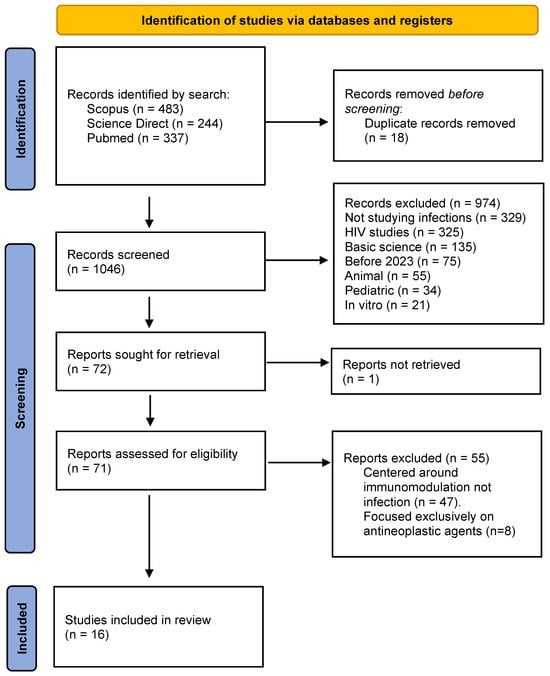
This scoping review followed the PRISMA-ScR (Preferred Reporting Items for Systematic Reviews and Meta-Analyses Extension for Scoping Reviews) guidelines (Figure 1—PRISMA flow diagram) [4]. The PRISMA checklist is provided as Supplementary Material with this manuscript.
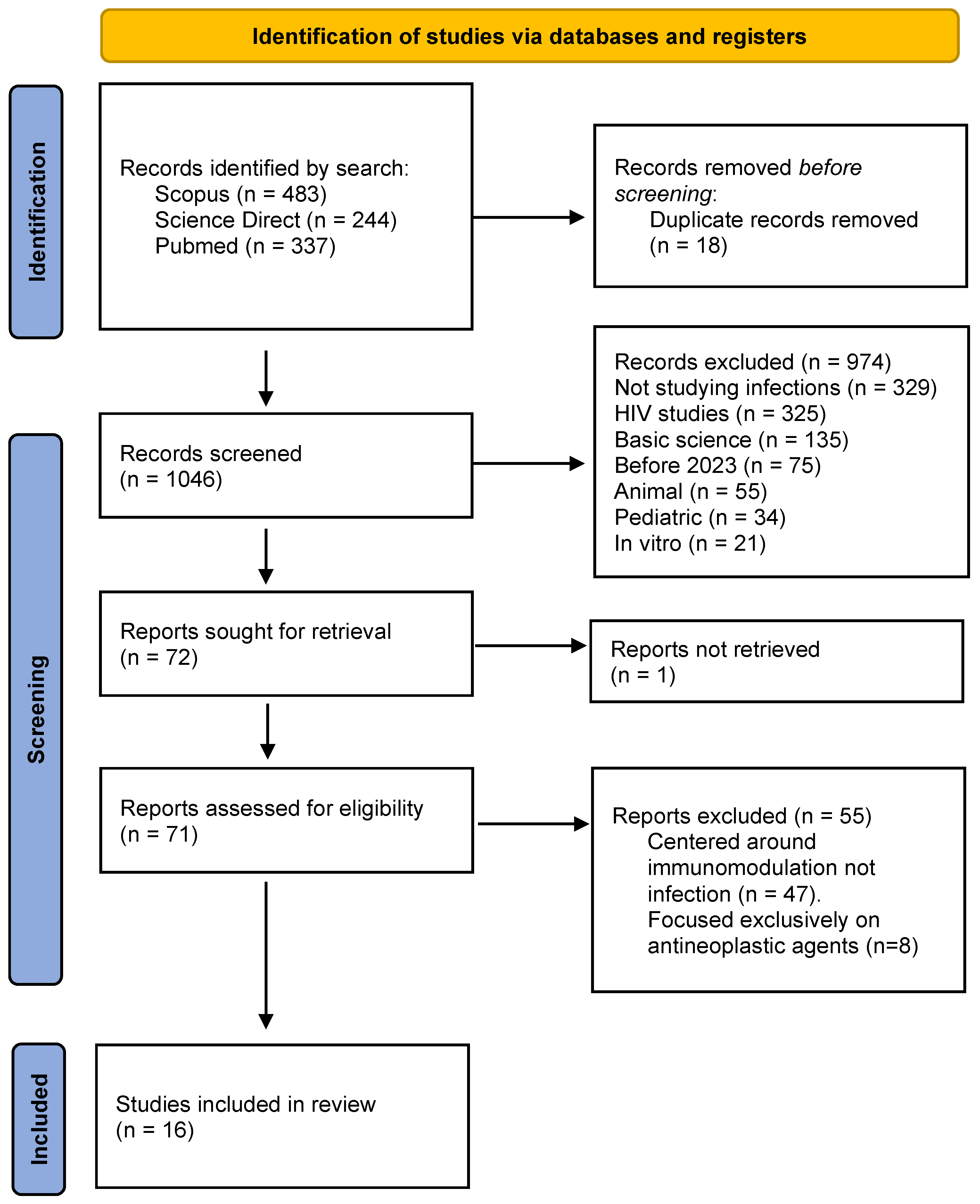
Figure 1.
PRISMA 2020 flow diagram for this scoping review.
To ensure clinical relevance to current therapeutic practice, inclusion was restricted to studies published from 2023 onward, capturing infection risk patterns reflective of modern immunomodulatory agents, updated dosing strategies, and contemporary patient populations. The search was performed on Scopus, Science Direct, and PubMed using predefined Boolean strategies.
Records were imported into Rayyan for deduplication and screening. Inclusion criteria were as follows: (1) adult human subjects; (2) exposure to immunomodulatory therapy; (3) reported infectious outcomes; and (4) publication year ≥ 2023. Studies involving HIV-associated immunosuppression, pediatric populations, animal models, cadaveric or in vitro data, or publications prior to 2023 were excluded. To ensure relevance to the rheumatology readership, studies focusing exclusively on antineoplastic agents without established or investigational use in autoimmune or immune-mediated inflammatory diseases were excluded at full-text screening. Immune checkpoint inhibitors were included in the search to ensure comprehensive capture of immunomodulatory literature, to be assessed for relevance later.
For this review, a search was conducted on Scopus, Science Direct, and Pubmed. The search criteria were as follows:
Scopus:
TITLE-ABS-KEY (“immunosuppressive agent” OR “immune checkpoint inhibitor”) AND TITLE-ABS-KEY (“serious infection”) AND NOT TITLE-ABS-KEY (HIV OR “human immunodeficiency virus”) AND PUBYEAR > 2022 AND PUBYEAR < 2026 AND (LIMIT-TO (SUBJAREA, “MEDI”))
Science Direct:
(“immunosuppressive agent” OR “immune checkpoint inhibitor”) AND “serious infection” AND NOT HIV
Pubmed:
(“Immunosuppressive Agents” [Mesh] OR “Immune Checkpoint Inhibitors” [Mesh] OR “Antibodies, Monoclonal” [Mesh] OR biologic [tiab] OR immunomodulat*[tiab]) AND (infection [Mesh] OR infection [tiab] OR infections[tiab] OR reactivation[tiab]) AND Humans [Mesh] AND NOT (“HIV Infections” [Mesh] OR HIV [tiab]).
The 1064 articles were exported and then uploaded to Rayyan.ai [5] for detection of duplicates and applying selection criteria. Data Charting: Extraction was conducted using a structured charting table. Extracted variables included study design, disease indication, immunomodulatory agent(s), steroid co-administration, infection type and severity, and any prophylaxis strategies reported. Charting highlighted identification of infection patterns and risk modifiers rather than pooled incidence estimates, consistent with scoping review methodology.
Registration: This review protocol is registered in Open Science Framework under the title “A Clinician’s Guide to Opportunistic Infections in the Era of Biologic and Targeted Synthetic DMARDs” with registration DOI: 10.17605/OSF.IO/2WGJ9.
3. Results
The initial database search yielded 1064 articles (483 from Scopus, 244 from Science Direct, and 337 from PubMed). After records were imported to Rayyan.ai [5], 18 duplicate records were removed, leaving 1046 unique manuscripts for title and abstract screening.
After title and abstract screening, 974 records were excluded. The primary reasons for exclusion are detailed in Figure 1 and included studies not focused on infections (n = 329), HIV-related studies (n = 325), and basic science (n = 135).
This left 72 reports sought for retrieval. Of these, one report could not be retrieved, leaving 71 reports assessed for eligibility. After full-text review, 47 reports were excluded, because they were centered on the immunomodulatory agents rather than infectious outcomes. An additional eight reports were excluded as they focused exclusively on antineoplastic agents.
A final set of 16 studies were included in this review. The final dataset therefore represents the current infection risk profile within the modern immunomodulatory treatment landscape, rather than a historical overview of infection incidence across the entire field.
Supplementary Table S1 shows a detailed evaluation of included studies (Supplementary Materials).
Findings
The goal of immunomodulatory therapy is to suppress autoimmune inflammation. This compromises host defense, leading to an increased susceptibility to infection. However, this risk is not uniform; it is a complex interplay between the patient’s disease, their degree of immune suppression, and the mechanism of action of the drug used [6]. In fact, infections are a leading cause of hospitalization and death in autoimmune diseases, including systemic lupus erythematosus (SLE), ANCA-associated vasculitis (AAV), and rheumatoid arthritis (RA) [7,8,9]. Data confirms that patients with autoimmune conditions like SLE and RA have higher baseline rates of serious infections compared to the general population, and this risk is increased by immunosuppression [10]. To note, most reported outcomes are serious infections rather than opportunistic ones.
- Glucocorticoids: The Primary Driver of Infectious Risk
In the world of immunomodulatory therapies, glucocorticoids (GCs) are considered a main cause of serious infectious risk. A “serious infection” (SI) is defined in the literature as an infection requiring hospitalization, intravenous (IV) antimicrobials, or resulting in death.
In patients with SLE, daily prednisone doses exceeding 15 mg/day are a main driver for hospitalization due to serious infection [9]. With higher doses, the risk increases. A paper aimed at creating a risk-prediction model for patients with autoimmune rheumatic diseases (AIRDs) defined “high-dose” as more than or equal to 30 mg/day of prednisolone equivalent for at least 4 consecutive weeks [11]. This high-risk group showed an incidence rate of 40.1 serious infections per 100 person-years [11].
The use of methylprednisolone pulse therapy for rapid remission in severe autoimmune flareups was also separately identified as a predictor for SIs in SLE [9]. The mechanism for this risk is multifactorial, affecting almost all immune cells. Steroids suppress pro-inflammatory mediators, impair neutrophil, macrophage and dendritic cell function, causes lymphopenia and poor wound healing, and masks infective symptoms [9]. In patients with ANCA-associated vasculitis (AAV), the use of methylprednisolone pulses during induction therapy was found to have an independent negative impact on gamma globulin levels. This increases the risk of severe infections [12].
- B-Cell-Targeting Therapies: Rituximab and Belimumab
Therapies targeting B-cells have unique infection risk profiles, primarily related to B-cell depletion and effects on immunoglobulin levels.
- Rituximab (Anti-CD20)
Rituximab’s powerful B-cell depletion is a known risk factor for hypogammaglobulinemia, which directly correlates with infection risk. In AAV patients, a significant decline in gammaglobulin levels following rituximab induction was associated with a 2.3-fold increased risk of severe infections [12]. A systematic review and meta-analysis quantified the cumulative incidence of serious infections during rituximab maintenance therapy for AAV at 14.61% [13].
However, when compared directly to conventional immunosuppressants for maintenance, the risk may be comparable. The RITAZAREM trial, a randomized study in relapsing AAV, found that while rituximab was superior to azathioprine for relapse prevention, there were no differences in the rates of infection or hypogammaglobulinemia between the two groups [14]. The infections associated with rituximab were bronchitis, tuberculosis, pneumonia, Pneumocystis jirovecii pneumonia, bacterial endocarditis, atypical mycobacterial infection, prostatitis, herpes zoster infection, cholecystitis, septicemia, esophageal candidiasis, hepatitis B reactivation, and infectious diarrhea [14]. In SLE, a prospective longitudinal study (BILAG-BR) directly compared the early infection risk of rituximab and belimumab, providing head-to-head real-world safety data with similar safety and infection risk [15].
- Belimumab (Anti-BLyS)
Belimumab, which inhibits B-lymphocyte stimulator (BLyS), is also associated with infection risk. A 2023 study found that it was associated with a lower risk of serious infection compared to oral immunosuppressants like azathioprine and mycophenolate in patients with non-renal SLE [16]. This finding was debated, specifically in clinical decision-making, where it is thought that belimumab may have a favorable safety profile regarding serious infections when compared to some oral immunosuppressants for non-renal SLE [17]. A separate 2025 systematic review and meta-analysis synthesized data on infectious complications, aiming to clarify the overall safety profile of belimumab in SLE, where doses ≤ 10 mg/kg did not increase infection risk when coupled with standard of care [18].
This risk profile is consistent with data from other autoimmune conditions, specifically in multiple sclerosis where infection risk is a significant factor in therapy selection. DMAs were associated with a significantly higher risk of serious infections (Adjusted Hazard Ratio aHR 1.24) and, specifically, urinary tract infections (UTIs) (aHR 1.21) [19]. This aligns with other 2023 studies confirming that both the disease and its treatments predispose MS patients to infections and that predictive factors, such as the lymphocyte-to-monocyte ratio, are needed to stratify this risk [20,21].
- TNF-α Inhibitors
Inhibitors of Tumor Necrosis Factor-alpha (TNF-α) are established therapies, like Adalimumab, Etanercept, Infliximab, Golimumab, and Certolizumab, but their association with serious and opportunistic infections is a concern. A 2024 review showed that serious infections are among the most significant risks of this class, necessitating robust risk minimization plans [22]. Infections associated with these drugs include TB, Histoplasma, Listeria, Legionella, Salmonella, Candida, Aspergillus infections, and hepatitis B virus (HBV) or varicella zoster virus (VZV) reactivations [22].
Opportunistic infections with intracellular pathogens are of concern, as demonstrated by a case report of brucellosis in patients consuming unpasteurized dairy [23]. Anti-TNF therapy (specifically adalimumab) served as a standard in a 5-year study on psoriatic arthritis, where rates of serious infection and herpes zoster were higher in the upadacitinib (JAK inhibitor) group than in the adalimumab group [24].
- JAK Inhibitors (JAKinibs)
This class of oral small molecules is very potent, but long-term data has clarified a specific infection risk profile, particularly for herpes zoster.
- Upadacitinib
The 5-year follow-up of the SELECT-PsA 1 trial provided long-term safety data for upadacitinib in psoriatic arthritis. Compared to adalimumab, upadacitinib was associated with higher rates of serious infection and, most distinctly, herpes zoster [24].
Baricitinib: The SLE-BRAVE-II phase 3 trial evaluated baricitinib in active SLE. While the study failed to meet its primary efficacy endpoints, it provided safety data. Serious adverse events, including TB, herpes zoster, and serious or opportunistic infections, were reported in 11–13% of patients in the baricitinib arms, compared to 9% in the placebo group [25].
Table 1 shows the infectious risk associated with each immunomodulatory agent.
Table 1.
Agent-specific Infectious Risks.
4. Discussion
The synthesized evidence reveals several patterns.
- Glucocorticoids: Still the Primary Driver of Infection Risk
Glucocorticoids are used across almost every autoimmune condition. They are used for induction therapy and flare management, but they are also the reason patients end up hospitalized with serious infections.
Clinical practice should prioritize the use of steroid-sparing agents to mitigate this risk. Starting them early allows a faster steroid taper. Tapering to the lowest effective dose and keeping them on steroids for the shortest time would decrease this infection risk [26].
For Pneumocystis prophylaxis, the standard is that any patient on 20 mg or more of prednisone for longer than 4 weeks needs coverage, usually with trimethoprim-sulfamethoxazole [27]. Screening for latent TB, hepatitis B and C, and Strongyloides (if in endemic areas) is important [28].
Beyond absolute lymphopenia, novel risk stratification tools, such as the lymphocyte-to-monocyte ratio, may help predict severe infection risk in patients on depleting therapies, though validation in rheumatic populations is needed [29].
- B-Cell Therapies: Two Different Stories
How B-cells get targeted makes a difference in infection risk. Rituximab works by depleting CD20-positive B-cells. It is used in ANCA-associated vasculitis, rheumatoid arthritis, and off-label in SLE. A significant challenge is the profound B-cell depletion which leads to hypogammaglobulinemia in many patients [30].
With Rituximab, it is important to regularly check baseline IgG levels. In addition, vaccination before starting rituximab, especially against pneumococcus, influenza, hepatitis B, and COVID-19 2 to 4 weeks before the infusion [31]. Also, live vaccines are to be avoided.
Belimumab targets B-lymphocyte stimulator (BLyS), which modulates B-cell activity more gently with less infection risk. For clinical practice, this makes belimumab an attractive steroid-sparing option for non-renal SLE patients who already have high baseline infection risk or experience recurrent mild-to-moderate infections [32]. Except with concurrent high-dose steroid use, routine antimicrobial prophylaxis is not warranted [33].
- TNF Inhibitors: The Granuloma Problem
TNF-alpha inhibitors are used widely, in rheumatoid arthritis, psoriatic arthritis, Crohn’s disease, and ulcerative colitis. These drugs have a specific infection signature that comes from their role in maintaining granulomas and cell-mediated immunity [34].
Of real concern is reactivation of latent tuberculosis [35]. In addition, opportunistic infections with intracellular pathogens, like Histoplasma, Listeria, Legionella, and Salmonella, plus viral reactivations including hepatitis B and varicella zoster are not uncommon [36].
Before initiating TNF inhibitors, the patient should be screened for TB and checked for hepatitis B and C before starting therapy [36]. Patient education is important, as it is recommended to talk to patients about food safety and environmental exposures. They should also stay away from activities that disturb soil in areas where Histoplasma is common and avoid cleaning bird coops [36]. Basic food safety with poultry matters because of Salmonella risk. Ensure administration of the recombinant zoster vaccine (Shingrix) since VZV reactivation is a real concern [36].
- JAK Inhibitors: The Zoster Problem
JAK inhibitors are used in rheumatoid and psoriatic arthritis. The SELECT-PsA 1 trial showed that the risk of zoster reactivation is high [37]. There is also an increase in serious infections and TB risk. This happens because the JAK-STAT pathway is crucial for interferon signaling and T-cell antiviral responses [37]. The recombinant zoster vaccine is thus essential before starting therapy, in addition to screening for latent TB and viral hepatitis [38].
- Disease Activity as an Independent Risk Factor
While agent-specific risks such as herpes zoster are well-defined, recent data underscores that the patient’s inflammatory burden is a quantifiable driver of infection. Contextualizing the findings, a 2023 post hoc analysis of the ORAL Surveillance trial involving 4362 patients quantified this relationship. The study found that uncontrolled inflammation, measured by C-reactive protein (CRP) and the Clinical Disease Activity Index (CDAI), was a significant predictor of adverse events. Specifically, for every 5 mg/L increase in serum CRP, the hazard ratio for serious infection rose by 9% (HR 1.09) [39]. Furthermore, patients with high clinical disease activity had a 44% higher risk of non-serious infections compared to those in remission (HR 1.44). This suggests that tight control strategies to achieve remission also function as a primary infection prevention strategy [39].
The necessity of this dynamic monitoring is supported by the limitations of static risk assessment. A 2024 machine learning analysis of 8404 patients treated with tofacitinib attempted to predict serious infections using only baseline characteristics such as age, history of infection, and steroid use [40]. Despite using advanced modeling, the predictive accuracy was moderate (AUROC < 0.74), failing to meet the threshold for reliable clinical prediction. This confirms that infection risk is not a fixed baseline trait but a fluctuating probability driven by ongoing disease activity and treatment response, necessitating continuous rather than one-time risk stratification [40].
Table 2 shows the agent-specific recommendations to reduce infection risk.
Table 2.
Agent-specific recommendations.
5. Limitations
This scoping review summarizes contemporary evidence but does not quantify comparative infection risks. Study heterogeneity, variation in definitions of serious infection, and differing background disease activity limit direct comparison across agents. Data for some newer therapies rely on real-world observational studies or case reports, which may under- or over-estimate infection risk. The focus on literature from 2023 to 2025 ensures contemporary relevance and updates but may exclude earlier foundational studies of established therapies. In addition, while quantitative risk estimates were extracted where available, heterogeneity in outcome definitions remains a limitation. Individual patient factors, including comorbidities and cumulative immunosuppression, could not be stratified. Therefore, the findings should guide clinical reasoning rather than be interpreted as absolute risk estimates. Finally, this review focused on rheumatologic autoimmune diseases, hence findings may not generalize to other immune-mediated conditions.
6. Conclusions
The evidence from 2023 to 2025 shows that while newer immunomodulatory agents offer targeted efficacy, they are universally associated with significant infectious risk, presenting as a plethora of specific vulnerabilities. Glucocorticoids, especially at high and pulse doses, remain a primary driver of serious infections across all autoimmune diseases [9,11,12].
Targeted biologics and small molecules present unique risk profiles: JAK inhibitors show a clear signal for herpes zoster [24], TNF-α inhibitors for opportunistic pathogens [23], while B-cell depletion requires vigilance for hypogammaglobulinemia [12].
Across RA-ILD, AAV, and SLE, infections remain a leading cause of death and hospitalization [8,10,19,42]. This underscores the urgent, ongoing need for risk stratification models [11] and individualized prophylactic strategies to balance therapeutic efficacy with patient safety, consisting of screening and vaccination in the right context.
Beyond reaffirming established drug-specific risks, this review highlights emerging evidence linking disease activity to infection risk [40]. These insights support a dual strategy: agent-specific prophylaxis based on mechanistic vulnerabilities, coupled with tight disease control to mitigate inflammation-driven infection risk.
Therefore, infection risk mitigation must be individualized, based on cumulative immunosuppression, steroid exposure, comorbidities, disease control, and specific agent-associated pathogen profiles.
Supplementary Materials
The following supporting information can be downloaded at: https://www.mdpi.com/article/10.3390/rheumato6010004/s1, Table S1: Evaluation of Sources of Evidence. Table S2: Preferred Reporting Items for Systematic reviews and Meta-Analyses extension for Scoping Reviews (PRISMA-ScR) Checklist.
Funding
This research received no external funding.
Institutional Review Board Statement
Not applicable.
Informed Consent Statement
Not applicable.
Data Availability Statement
No new data were created or analyzed in this study. Data sharing is not applicable to this article.
Conflicts of Interest
The author declares no conflicts of interest.
References
- Immunomodulators. Cancer Research Institute. Available online: https://www.cancerresearch.org/immunotherapy-by-treatment-types/immunomodulators (accessed on 10 November 2025).
- Dropulic, L.K.; Lederman, H.M. Overview of Infections in the Immunocompromised Host. Microbiol. Spectr. 2016, 4, 10. [Google Scholar] [CrossRef] [Scilit]
- Sharma, Y.; Arora, M.; Bala, K. The potential of immunomodulators in shaping the future of healthcare. Discov. Med. 2024, 1, 37. [Google Scholar] [CrossRef] [Scilit]
- PRISMA Statement. Available online: https://www.prisma-statement.org (accessed on 10 November 2025).
- Rayyan: AI-Powered Systematic Review Management Platform. Available online: https://www.rayyan.ai/ (accessed on 10 November 2025).
- Bril, V.; Gilhus, N.E. Aging and infectious diseases in myasthenia gravis. J. Neurol. Sci. 2025, 468, 123314. [Google Scholar] [CrossRef] [Scilit] [PubMed]
- Nguyen, Y.; CostéDoat-Chalumeau, N. Serious infections in patients with systemic lupus erythematosus: How can we prevent them? Lancet Rheumatol. 2023, 5, e245–e246. [Google Scholar] [CrossRef] [Scilit] [PubMed]
- Mena-Vázquez, N.; Redondo-Rodriguez, R.; Rojas-Gimenez, M.; Romero-Barco, C.M.; Fuego-Varela, C.; Perez-Gómez, N.; Añón-Oñate, I.; Pérez, P.C.; García-Studer, A.; Hidalgo-Conde, A.; et al. Rate of severe and fatal infections in a cohort of patients with interstitial lung disease associated with rheumatoid arthritis: A multicenter prospective study. Front. Immunol. 2024, 15, 1341321. [Google Scholar] [CrossRef] [Scilit]
- Ko, T.; Koelmeyer, R.; Li, N.; Yap, K.; Yeo, A.L.; Kent, J.; Pellicano, R.; Golder, V.; Kitching, A.R.; Morand, E.; et al. Predictors of infection requiring hospitalization in patients with systemic lupus erythematosus: A time-to-event analysis. Semin. Arthritis Rheum. 2022, 57, 152099. [Google Scholar] [CrossRef] [Scilit]
- Huang, W.-N.; Chuo, C.-Y.; Lin, C.-H.; Chen, Y.-M.; Lin, W.-S.; Tuckwell, K.; Jones, N.S.; Galanter, J.; Lindsay, L. Serious Infection Rates Among Patients with Select Autoimmune Conditions: A Claims-Based Retrospective Cohort Study from Taiwan and the USA. Rheumatol. Ther. 2023, 10, 387–404. [Google Scholar] [CrossRef] [Scilit]
- Choi, S.R.; Ha, Y.J.; Kang, E.H.; Lee, E.Y.; Lee, Y.J.; Lee, E.B.; Park, J.W. POS0912 A novel scoring system to predict serious infections in patients with rheumatic diseases receiving prolonged, high-dose glucocorticoid treatment. Ann. Rheum. Dis. 2024, 83, 1151. [Google Scholar] [CrossRef] [Scilit]
- Liberatore, J.; Nguyen, Y.; Hadjadj, J.; Cohen, P.; Mouthon, L.; Puéchal, X.; Guillevin, L.; Terrier, B. Risk factors for hypogammaglobulinemia and association with relapse and severe infections in ANCA-associated vasculitis: A cohort study. J. Autoimmun. 2024, 142, 103130. [Google Scholar] [CrossRef] [Scilit]
- Vassilopoulos, A.; Vassilopoulos, S.; Kalligeros, M.; Shehadeh, F.; Mylonakis, E. Incidence of serious infections in patients with ANCA-associated vasculitis receiving immunosuppressive therapy: A systematic review and meta-analysis. Front. Med. 2023, 10, 1110548. [Google Scholar] [CrossRef] [Scilit]
- Smith, R.M.; Jones, R.B.; Specks, U.; Bond, S.; Nodale, M.; Al-Jayyousi, R.; Andrews, J.; Bruchfeld, A.; Camilleri, B.; Carette, S.; et al. Rituximab versus azathioprine for maintenance of remission for patients with ANCA-associated vasculitis and relapsing disease: An international randomised controlled trial. Ann. Rheum. Dis. 2023, 82, 937–944. [Google Scholar] [CrossRef] [Scilit]
- Rodziewicz, M.; Dyball, S.; Lunt, M.; McDonald, S.; Sutton, E.; Parker, B.; Bruce, I.N.; Abernethy, R.; Ahmad, Y.; Akil, M.; et al. Early infection risk in patients with systemic lupus erythematosus treated with rituximab or belimumab from the British Isles Lupus Assessment Group Biologics Register (BILAG-BR): A prospective longitudinal study. Lancet Rheumatol. 2023, 5, e284–e292. [Google Scholar] [CrossRef] [Scilit] [PubMed]
- Materne, E.; Choi, H.; Zhou, B.; Costenbader, K.H.; Zhang, Y.; Jorge, A. Comparative Risks of Infection With Belimumab Versus Oral Immunosuppressants in Patients With Nonrenal Systemic Lupus Erythematosus. Arthritis Rheumatol. 2023, 75, 1994–2002. [Google Scholar] [CrossRef] [Scilit] [PubMed]
- Lee, Y.T.; Chen, C.C.; Chen, S.C. Risk of serious infection between belimumab and oral immunosuppressants for non-renal systemic lupus erythematosus: Comment on the article by Materne et al. Arthritis Rheumatol. 2023, 75, 2266–2267. [Google Scholar] [CrossRef] [Scilit] [PubMed]
- Zhao, Y.; Chi, G.; Xia, S.; Wang, X.; Fan, Y.; Ma, C.; Wei, J.C.-C.; Wang, W. Infectious complications of Belimumab with standard care in systemic lupus erythematosus: A systematic review and meta-analysis. Semin. Arthritis Rheum. 2025, 73, 152754. [Google Scholar] [CrossRef] [Scilit]
- Li, J.; Hutton, G.J.; Varisco, T.J.; Lin, Y.; Essien, E.J.; Aparasu, R.R. Infection Risk Associated with High-Efficacy Disease-Modifying Agents in Multiple Sclerosis: A Retrospective Cohort Study. Clin. Pharmacol. Ther. 2025, 117, 561–569. [Google Scholar] [CrossRef] [Scilit]
- Langer-Gould, A.M.; Smith, J.B.; Gonzales, E.G.; Piehl, F.; Li, B.H. Multiple Sclerosis, Disease-Modifying Therapies, and Infections. Neurol. Neuroimmunol. Neuroinflamm. 2023, 10, e200164. [Google Scholar] [CrossRef] [Scilit]
- Takahashi, J.; Okamoto, T.; Lin, Y.; Saika, R.; Katsumoto, A.; Sato, W.; Yamamura, T.; Takahashi, Y. Ratio of lymphocyte to monocyte area under the curve as a novel predictive factor for severe infection in multiple sclerosis. Front. Immunol. 2023, 14, 1133444. [Google Scholar] [CrossRef] [Scilit]
- Lakhmiri, R.; Cherrah, Y.; Serragui, S. Tumor Necrosis Alpha (TNF-α) Antagonists Used in Chronic Inflammatory Rheumatic Diseases: Risks and their Minimization Measures. Curr. Drug Saf. 2024, 19, 431–443. [Google Scholar] [CrossRef] [Scilit]
- Altuwaijri, M.; Alkhraiji, N.; Almasry, M.; Alkhowaiter, S.; Al Amaar, N.; Alotaibi, A. Brucellosis in a patient with Crohn’s disease treated with infliximab: A case report. Arab J. Gastroenterol. 2025, 26, 38–40. [Google Scholar] [CrossRef] [Scilit]
- McInnes, I.; Kato, K.; Magrey, M.; Merola, J.; Kishimoto, M.; Haaland, D.; Coates, L.; Lagunes, I.; Liu, Y.; Mancl, E.; et al. POS0835 long-term safety and efficacy of upadacitinib in patients with psoriatic arthritis: 5-year results from the phase 3 select-psa 1 study. Ann. Rheum. Dis. 2025, 84, 980–981. [Google Scholar] [CrossRef] [Scilit]
- Petri, M.; Bruce, I.N.; Dörner, T.; Tanaka, Y.; Morand, E.F.; Kalunian, K.C.; Cardiel, M.H.; Silk, M.E.; Dickson, C.L.; Meszaros, G.; et al. Baricitinib for systemic lupus erythematosus: A double-blind, randomised, placebo-controlled, phase 3 trial (SLE-BRAVE-II). Lancet 2023, 401, 1011–1019. [Google Scholar] [CrossRef] [Scilit] [PubMed]
- Fenne, I.J.; Askildsen Oftebro, G.; Vestergaard, C.; Frølunde, A.S.; Bech, R. Effect of early initiation of steroid-sparing drugs in patients with bullous pemphigoid. Front. Immunol. 2023, 14, 1176284. [Google Scholar] [CrossRef] [Scilit]
- Caplan, A.S.; Mecoli, C.A.; Micheletti, R.G. Prophylaxis Against Pneumocystis Pneumonia. JAMA 2023, 330, 1908–1909. [Google Scholar] [CrossRef] [Scilit] [PubMed]
- Malpica, L.; Moll, S. Practical approach to monitoring and prevention of infectious complications associated with systemic corticosteroids, antimetabolites, cyclosporine, and cyclophosphamide in nonmalignant hematologic diseases. Hematol. Am. Soc. Hematol. Educ. Program 2020, 2020, 319–327. [Google Scholar] [CrossRef] [Scilit] [PubMed]
- Schweitzer, F.; Laurent, S.; Fink, G.R.; Barnett, M.H.; Hartung, H.P.; Warnke, C. Effects of disease-modifying therapy on peripheral leukocytes in patients with multiple sclerosis. J. Neurol. 2021, 268, 2379–2389. [Google Scholar] [CrossRef] [Scilit]
- Varley, C.D.; Winthrop, K.L. Long-Term Safety of Rituximab (Risks of Viral and Opportunistic Infections). Curr. Rheumatol. Rep. 2021, 23, 74. [Google Scholar] [CrossRef] [Scilit]
- Engel, E.R.; Walter, J.E. Rituximab and eculizumab when treating nonmalignant hematologic disorders: Infection risk, immunization recommendations, and antimicrobial prophylaxis needs. Hematol. Am. Soc. Hematol. Educ. Program 2020, 2020, 312–318. [Google Scholar] [CrossRef] [Scilit]
- Ginzler, E.M.; Wallace, D.J.; Merrill, J.T.; Furie, R.A.; Stohl, W.; Chatham, W.W.; Weinstein, A.; McKay, J.D.; McCune, W.J.; Zhong, Z.J.; et al. Disease Control and Safety of Belimumab Plus Standard Therapy Over 7 Years in Patients with Systemic Lupus Erythematosus. J. Rheumatol. 2014, 41, 300–309. [Google Scholar] [CrossRef] [Scilit]
- Schweitzer, L.; Miko, B.A.; Pereira, M.R. Infectious Disease Prophylaxis During and After Immunosuppressive Therapy. Kidney Int. Rep. 2024, 9, 2337–2352. [Google Scholar] [CrossRef] [Scilit]
- Gerriets, V.; Goyal, A.; Khaddour, K. Tumor Necrosis Factor Inhibitors. In StatPearls; StatPearls Publishing: Tampa Bay Area, FL, USA, 2025. Available online: http://www.ncbi.nlm.nih.gov/books/NBK482425/ (accessed on 10 November 2025).
- Robert, M.; Miossec, P. Reactivation of latent tuberculosis with TNF inhibitors: Critical role of the beta 2 chain of the IL-12 receptor. Cell. Mol. Immunol. 2021, 18, 1644–1651. [Google Scholar] [CrossRef] [Scilit] [PubMed]
- Ali, T.; Kaitha, S.; Mahmood, S.; Ftesi, A.; Stone, J.; Bronze, M.S. Clinical use of anti-TNF therapy and increased risk of infections. Drug Healthc. Patient Saf. 2013, 5, 79–99. [Google Scholar] [CrossRef] [Scilit] [PubMed]
- McInnes, I.B.; Kato, K.; Magrey, M.; Merola, J.F.; Kishimoto, M.; Haaland, D.; Chen, L.; Duan, Y.; Liu, J.; Lippe, R.; et al. Efficacy and Safety of Upadacitinib in Patients with Psoriatic Arthritis: 2-Year Results from the Phase 3 SELECT-PsA 1 Study. Rheumatol. Ther. 2023, 10, 275–292. [Google Scholar] [CrossRef] [Scilit] [PubMed]
- Narbutt, J.; Żuber, Z.; Lesiak, A.; Bień, N.; Szepietowski, J.C. Vaccinations in Selected Immune-Related Diseases Treated with Biological Drugs and JAK Inhibitors—Literature Review and Statement of Experts from Polish Dermatological Society. Vaccines 2024, 12, 82. [Google Scholar] [CrossRef] [Scilit]
- Karpouzas, G.A.; Szekanecz, Z.; Baecklund, E.; Mikuls, T.R.; Bhatt, D.L.; Wang, C.; Sawyerr, G.A.; Chen, Y.; Menon, S.; Connell, C.A.; et al. Rheumatoid arthritis disease activity and adverse events in patients receiving tofacitinib or tumor necrosis factor inhibitors: A post hoc analysis of ORAL Surveillance. Ther. Adv. Musculoskelet. 2023, 15, 1759720X231201047. [Google Scholar] [CrossRef] [Scilit]
- Hetland, M.L.; Strangfeld, A.; Bonfanti, G.; Soudis, D.; Deuring, J.J.; Edwards, R.A. Machine learning prediction and explanatory models of serious infections in patients with rheumatoid arthritis treated with tofacitinib. Arthritis Res. Ther. 2024, 26, 153. [Google Scholar] [CrossRef] [Scilit]
- San, C.; Lê, M.; Matheron, S.; Mourvillier, B.; Caseris, M.; Timsit, J.-F.; Wolff, M.; Yazdanpanah, Y.; Descamps, D.; Peytavin, G. Management of oral antiretroviral administration in patients with swallowing disorders or with an enteral feeding tube. Med. Mal. Infect. 2020, 50, 537–544. [Google Scholar] [CrossRef] [Scilit]
- Yurteri, E.U.; Sezer, S.; Torgutalp, M.; Yayla, M.E.; Eroglu, D.S.; Okatan, I.E.; Dincer, A.B.K.; Gulokuz, E.G.A.; Yuksel, M.L.; Turgay, T.M.; et al. The factors predicting development of serious infections in ANCA-associated vasculitis. Sarcoidosis Vasc. Diffus. Lung Dis. 2023, 40, e2023015. [Google Scholar] [CrossRef] [Scilit]

Disclaimer/Publisher’s Note: The statements, opinions and data contained in all publications are solely those of the individual author(s) and contributor(s) and not of MDPI and/or the editor(s). MDPI and/or the editor(s) disclaim responsibility for any injury to people or property resulting from any ideas, methods, instructions or products referred to in the content. |
© 2026 by the author. Licensee MDPI, Basel, Switzerland. This article is an open access article distributed under the terms and conditions of the Creative Commons Attribution (CC BY) license.